

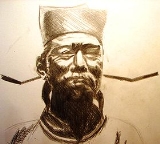
Shen Kuo

Encyclopedia
Shen Kuo or Shen Gua (1031–1095), style name
Cunzhong (存中) and pseudonym Mengqi (now usually given as Mengxi) Weng (夢溪翁), was a polymath
ic Chinese
scientist
and statesman of the Song Dynasty
(960–1279). Excelling in many fields of study and statecraft, he was a mathematician
, astronomer
, meteorologist, geologist
, zoologist, botanist, pharmacologist
, agronomist
, archaeologist, ethnographer, cartographer, encyclopedist, general, diplomat
, hydraulic engineer
, inventor, academy chancellor
, finance minister
, governmental state inspector, poet
, and musician
. He was the head official for the Bureau of Astronomy
in the Song court, as well as an Assistant Minister of Imperial Hospitality. At court his political allegiance was to the Reformist faction known as the New Policies Group, headed by Chancellor
Wang Anshi
(1021–1086).
In his Dream Pool Essays
of 1088, Shen was the first to describe the magnetic needle compass
, which would be used for navigation (first described in Europe by Alexander Neckam
in 1187). Shen discovered the concept of true north
in terms of magnetic declination
towards the north pole
, with experimentation of suspended magnetic needles and "the improved meridian
determined by Shen's [astronomical] measurement of the distance between the polestar and true north". This was the decisive step in human history to make compasses more useful for navigation, and may have been a concept unknown in Europe for another four hundred years
(evidence of German sundials made circa 1450 show markings similar to Chinese geomancer compasses in regards to declination).
Alongside his colleague Wei Pu
, Shen planned to map the orbital paths of the Moon and the planets in an intensive five-year project involving daily observations, yet this was thwarted by political opponents at court. To aid his work in astronomy, Shen Kuo made improved designs of the armillary sphere
, gnomon
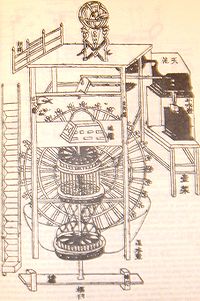
, sighting tube, and invented a new type of inflow water clock
. Shen Kuo devised a geological hypothesis for land formation (geomorphology
), based upon findings of inland marine
fossil
s, knowledge of soil erosion, and the deposition
of silt
. He also proposed a hypothesis of gradual climate change
, after observing ancient petrified bamboo
s that were preserved underground in a dry northern habitat that would not support bamboo growth in his time. He was the first literary figure in China to mention the use of the drydock to repair boats suspended out of water, and also wrote of the effectiveness of the relatively new invention of the canal pound lock. Although Ibn al-Haytham (965–1039) was the first to describe camera obscura
, Shen was the first in China to do so, several decades later. Shen wrote extensively about movable type
printing
invented by Bi Sheng
(990–1051), and because of his written works the legacy of Bi Sheng and the modern understanding of the earliest movable type has been handed down to later generations. Following an old tradition in China, Shen created a raised-relief map
while inspecting borderlands. His description of an ancient crossbow mechanism which he himself unearthed proved to be a Jacob's staff
, a surveying
tool which wasn't known in Europe until described by Levi ben Gerson in 1321.
Shen Kuo wrote several other books besides the Dream Pool Essays, yet much of the writing in his other books has not survived. Some of Shen's poetry was preserved in posthumous written works. Although much of his focus was on technical and scientific issues, he had an interest in divination
and the supernatural, the latter including his vivid description of unidentified flying objects from eyewitness testimony. He also wrote commentary on ancient Daoist
and Confucian
texts.
) in the year 1031. His father Shen Zhou was a somewhat lower-class gentry
figure serving in official posts on the provincial level; his mother was from a family of equal status in Suzhou
, with her maiden name being Xu
. Shen Kuo received his initial childhood education from his mother, which was a common practice in China during this period. She was very educated herself, teaching Kuo and his brother Pi the military doctrines of her own elder brother Xu Tang . Since Shen was unable to boast of a prominent familial clan history like many of his elite peers born in the north, he was forced to rely on his wit and stern determination to achieve in his studies to enter the challenging and sophisticated life of an exam-drafted state bureaucrat.
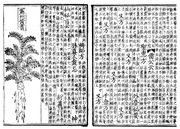 From about 1040, Shen's family moved around Sichuan
province and finally to the international seaport at Xiamen
, where Shen's father accepted minor provincial posts in each new location. Shen Zhou also served several years in the prestigious capital judiciary
, the equivalent of a federal supreme court. Shen Kuo took notice of the various towns and rural features of China as his family traveled, while he became interested during his youth in the diverse topography
of the land. He also observed the intriguing aspects of his father's engagement in administrative governance and the managerial problems involved; these experiences had a deep impact on him as he later became a government official. Since he often became ill as a child, Shen Kuo also developed a natural curiosity about medicine and pharmaceutics.
Shen Zhou died in the late winter of 1051 (or early 1052), when his son Shen Kuo was 21 years old. Shen Kuo grieved for his father, and following Confucian
ethics, remained inactive in a state of mourning for three years until 1054 (or early 1055). As of 1054, Shen began serving in minor local governmental posts. However, his natural abilities to plan, organize, and design were proven early in life; one example is his design and supervision of the hydraulic drainage of an embankment
system, which converted
some one hundred thousand acre
s (400 km²) of swamp
land into prime farmland. Shen Kuo noted that the success of the silt
fertilization method relied upon the effective operation of sluice
gates of irrigation canal
s.
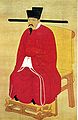 In 1063 Shen Kuo successfully passed the Imperial examination
s, the difficult national-level standard test that every high official was required to pass in order to enter the governmental system. He not only passed the exam however, but was placed into the higher category of the best and brightest students. While serving at Yangzhou
, Shen's brilliance and dutiful character caught the attention of Zhang Chu , the Fiscal Intendant of the region. Shen made a lasting impression upon Zhang, who recommended Shen for a court appointment in the financial administration of the central court. Shen would also eventually marry Zhang's daughter, who became his second wife.
In his career as a scholar-official
for the central government, Shen Kuo was also an ambassador to the Western Xia
Dynasty and Liao Dynasty
, a military commander, a director of hydraulic works, and the leading chancellor of the Hanlin Academy
. By 1072, Shen was appointed as the head official of the Bureau of Astronomy. With his leadership position in the bureau, Shen was responsible for projects in improving calendrical science, and proposed many reforms to the Chinese calendar
alongside the work of his colleague Wei Pu
. With his impressive skills and aptitude for matters of economy and finance, Shen was appointed as the Finance Commissioner at the central court.
As written by Li Zhiyi, a man married to Hu Wenrou (granddaughter of Hu Su, a famous minister of the Song Dynasty), Shen Kuo was Li's mentor while Shen served as an official. According to Li's epitaph for his wife, Shen would sometimes relay questions via Li to Hu when he needed clarification for his mathematical work, as Hu Wenrou was esteemed by Shen as a remarkable female mathematician. Shen lamented: "if only she were a man, Wenrou would be my friend."
While employed by the central government, Shen Kuo was also sent out with others to inspect the granary system of the empire, investigating problems of illegal collections, negligence, ineffective disaster relief, and inadequate water-conservancy projects. While Shen was appointed as the regional inspector of Zhejiang in 1073, the Emperor requested that Shen pay a visit to the famous poet Su Shi
(1037–1101), then an administrator in Hangzhou. Shen took advantage of this meeting to copy some of Su's poetry, which he presented to the Emperor indicating that it expressed "abusive and hateful" speech against the Song court; these poems were later politicized by Li Ding and Shu Dan in order to level a court case against Su. With his demonstrations of loyalty and ability, Shen Kuo was awarded the honorary title of a State Foundation Viscount
by Emperor Shenzong of Song
(r. 1067–1085), who placed a great amount of trust in Shen Kuo. He was even made 'companion to the heir apparent' (太子中允; 'Taizi zhongyun').
 At court Shen was a political favorite of the Chancellor Wang Anshi
(1021–1086), who was the leader of the political faction of Reformers, also known as the New Policies Group . Shen Kuo had a previous history with Wang Anshi, since it was Wang who had composed the funerary epitaph
for Shen's father, Zhou. Shen Kuo soon impressed Wang Anshi with his skills and abilities as an administrator and government agent. In 1072, Shen was sent to supervise Wang's program of surveying the building of silt deposits in the Bian Canal
outside the capital city. Using an original technique, Shen successfully dredged the canal and demonstrated the formidable value of the silt gathered as a fertilizer
. He gained further reputation at court once he was dispatched as an envoy to the Khitan
Liao Dynasty in the summer of 1075. The Khitans had made several aggressive negotiations of pushing their borders south, while manipulating several incompetent Chinese ambassadors who conceded to the Liao Kingdom's demands. In a brilliant display of diplomacy, Shen Kuo came to the camp of the Khitan monarch at Mt. Yongan (near modern Pingquan
, Hebei
), armed with copies of previously archived diplomatic negotiations between the Song and Liao dynasties. Shen Kuo refuted Emperor Daozong's
bluffs point for point, while the Song reestablished their rightful border line. In regards to the Lý Dynasty
of Đại Việt (in modern northern Vietnam
), Shen demonstrated in his Dream Pool Essays that he was familiar with the key players (on the Vietnamese side) in the prelude to the Sino-Vietnamese War of 1075–1077. With his reputable achievements, Shen became a trusted member of Wang Anshi's elite circle of eighteen unofficial core political loyalists to the New Policies Group.
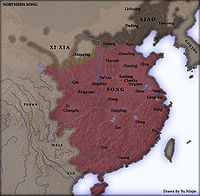 Although much of Wang Anshi's reforms outlined in the New Policies centered around state finance, land tax reform, and the Imperial examinations, there were also military concerns. This included policies of raising militia
s to lessen the expense of upholding a million soldiers, putting government monopolies on saltpetre
and sulphur production and distribution in 1076 (to ensure that gunpowder
solutions would not fall into the hands of enemies), and aggressive military policy towards China's northern rivals of the Western Xia and Liao dynasties. A few years after Song Dynasty military forces had made victorious territorial gains against the Tanguts of the Western Xia, in 1080 Shen Kuo was entrusted as a military officer in defense of Yanzhou (modern-day Yan'an
, Shaanxi
province). During the autumn months of 1081, Shen was successful in defending Song Dynasty territory while capturing several fortified towns of the Western Xia. The Emperor Shenzong of Song rewarded Shen with numerous titles for his merit in these battles, and in the sixteen months of Shen's military campaign, he received 273 letters from the Emperor. However, Emperor Shenzong trusted an arrogant military officer who disobeyed the emperor and Shen's proposal for strategic fortifications, instead fortifying what Shen considered useless strategic locations. Furthermore, this officer expelled Shen from his commanding post at the main citadel
, so as to deny him any glory in chance of victory. The result of this was nearly catastrophic, as the forces of the arrogant officer were decimated; Xinzhong Yao states that the death toll was 60,000. Nonetheless, Shen was successful in defending his fortifications and the only possible Tangut invasion-route to Yanzhou.
in a fixed residence for the next six years. However, as he was isolated from governance, he decided to pick up the quill
and dedicate himself to intensive scholarly studies. After completing two geographical atlas
es for a state-sponsored program, Shen was rewarded by having his sentence of probation lifted, allowing him to live in a place of his choice. Shen was also pardoned by the court for any previous faults or crimes that were claimed against him.
In his more idle years removed from court affairs, Shen Kuo enjoyed pastimes of the Chinese gentry and literati
that would indicate his intellectual level and cultural taste to others. As described in his Dream Pool Essays, Shen Kuo enjoyed the company of the "nine guests" (jiuke), a figure of speech for the Chinese zither
, the older 17x17 line variant of Weiqi (known today as Go), Zen
Buddhist meditation
, ink (calligraphy and painting
), tea drinking
, alchemy
, chanting poetry
, conversation, and drinking wine
. These nine activities were an extension to the older so-called Four Arts of the Chinese Scholar
.
According to Zhu Yu
's book Pingzhou Table Talks of 1119, Shen Kuo had two marriages; the second wife was the daughter of Zhang Chu , who came from Huainan
. Lady Zhang was said to be overbearing and fierce, often abusive to Shen Kuo, even attempting at one time to pull off his beard. Shen Kuo's children were often upset over this, and prostrated themselves to Lady Zhang to quit this behavior. Despite this, Lady Zhang went as far as to drive out Shen Kuo's son from his first marriage, expelling him from the household. However, after Lady Zhang died, Shen Kuo fell into a deep depression and even attempted to jump into the Yangtze River
to drown himself. Although this suicide attempt failed, he would die a year later.
In the 1070s, Shen had purchased a lavish garden estate on the outskirts of modern-day Zhenjiang
, Jiangsu
province, a place of great beauty which he named "Dream Brook" ("Mengxi") after he visited it for the first time in 1086. Shen Kuo permanently moved to the Dream Brook Estate in 1088, and in that same year he completed his life's written work of the Dream Pool Essays
, naming the book after his garden-estate property. It was there that Shen Kuo spent the last several years of his life in leisure, isolation, and illness, until his death in 1095.
es, a treatise on music
with mathematical harmonics, governmental administration, mathematical astronomy, astronomical instruments, martial defensive tactics
and fortification
s, painting
, tea
, medicine
, and much poetry
. His scientific writings have been praised by sinologists such as Joseph Needham
and Nathan Sivin
, and he has been compared by Sivin to polymaths such as his contemporary Su Song
, as well as Gottfried Leibniz
and Mikhail Lomonosov
.
(c. 145–86 BC) in his Records of the Grand Historian
is proven correct upon the unearthing of Qin Shi Huang
's (r. 221–210 BC) tomb, the raised-relief map
has existed since the Qin Dynasty
(221–206 BC). Robert Temple and Joseph Needham suggest that certain pottery vessels of the Han Dynasty
(202 BC – 220 AD) showing artificial mountains as lid decorations may have influenced the raised-relief map. The Han Dynasty general Ma Yuan (14 BC – 49 AD) made a raised-relief map of valleys and mountains in a rice-constructed model of 32 AD. Such rice models were expounded on by the Tang Dynasty
(618–907) author Jiang Fang in his Essay on the Art of Constructing Mountains with Rice (c. 845 AD). A raised-relief map made of wood representing all the provinces of the empire and put together like a giant 0.93 m2 (10 ft2) jigsaw puzzle
was invented by Xie Zhuang (421–466 AD) during the Liu Song Dynasty
(420–479).
Shen's largest atlas included twenty three maps of China and foreign regions that were drawn at a uniform scale of 1:900,000. Shen also created a three dimensional
raised-relief map using sawdust, wood, beeswax, and wheat paste. Zhu Xi
(1130–1200) was inspired by the raised-relief map of Huang Shang and so made his own portable map made of wood and clay which could be folded up from eight hinged pieces. Later, Ibn Battuta
(1304–1377) described a raised-relief map while visiting Gibraltar
, while European raised-relief maps started with a Paul Dox who made one to represent Kufstein
, Austria
, in 1510. The Englishman John Evelyn
(1620–1706), in his 1665 paper featured in the Philosophical Transactions of the Royal Society
, wrote that the raised-relief map was something new from France
.
, Shen wrote of the difficulties of adequate diagnosis
and therapy
, as well as the proper selection, preparation, and administration of drugs. He held great concern for detail and philological
accuracy in identification, use and cultivation of different types of medicinal herbs, such as in which months medicinal plants should be gathered, their exact ripening times, which parts should be used for therapy; for domesticated herbs he wrote about planting times, fertilization, and other matters of horticulture
. In the realms of botany
, zoology
, and mineralogy
, Shen Kuo documented and systematically described hundreds of different plants, agricultural crops, rare vegetation, animals, and mineral
s found in China. For example, Shen noted that the mineral orpiment
was used to quickly erase writing errors on paper.
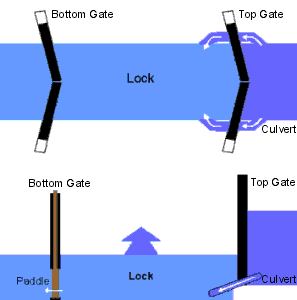
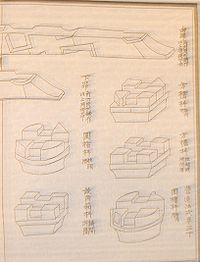 The writing of Shen Kuo is the only source for the date when the drydock was first used in China. Shen Kuo wrote that during the Xi-Ning reign (1068–1077), the court official Huang Huaixin devised a plan for repairing 60 m (200 ft) long palatial
boats that were a century old; essentially, Huang Huaixin devised the first Chinese drydock for suspending boats out of water. These boats were then placed in a roof-covered dock warehouse to protect them from weathering. Shen also wrote about the effectiveness of the new invention (i.e. by the 10th century engineer Qiao Weiyo
) of the pound lock to replace the old flash lock
design used in canals. He wrote that it saved the work of five hundred annual labors, annual costs of up to 1,250,000 strings of cash, and increased the size limit of boats accommodated from 21 ton
s/21000 kg to 113 ton
s/115000 kg.
If it were not for Shen Kuo's analysis and quoting in his Dream Pool Essays
of the writings of the architect
Yu Hao
(fl.
970), the latter's work would have been lost to history. Yu designed a famous wooden pagoda
that burned down in 1044 and was replaced in 1049 by a brick pagoda (the 'Iron Pagoda
') of similar height, but not of his design. From Shen's quotation—or perhaps Shen's own paraphrasing of Yu Hao's Timberwork Manual (木經; Mujing)—shows that already in the 10th century there was a graded system of building unit proportions, a system which Shen states had become more precise in his time but stating no one could possibly reproduce such a sound work. However, he did not anticipate the more complex and matured system of unit proportions embodied in the extensive written work by scholar-official Li Jie (1065–1110), the Treatise on Architectural Methods
(營造法式; Yingzao Fashi) of 1103. Klaas Ruitenbeek states that the version of the Timberwork Manual quoted by Shen is most likely Shen's summarization of Yu's work or a corrupted passage of the original by Yu Hao, as Shen writes: "According to some, the work was written by Yu Hao."
usurper Wang Mang
called for the dissection of an executed man, to examine his arteries and viscera in order to discover cures for illnesses. Shen also took interest in human anatomy
, dispelling the long-held Chinese theory that the throat contained three valves, writing, "When liquid and solid are imbibed together, how can it be that in one's mouth they sort themselves into two throat channels?" Shen maintained that the larynx
was the beginning of a system that distributed vital qi
from the air throughout the body, and that the esophagus
was a simple tube that dropped food into the stomach. Following Shen's reasoning and correcting the findings of the dissection
of executed bandits in 1045, an early 12th century Chinese account of a bodily dissection finally supported Shen's belief in two throat valves, not three. Also, the later Song Dynasty judge and early forensic expert Song Ci
(1186–1249) would promote the use of autopsy
in order to solve homicide
cases, as written in his Collected Cases of Injustice Rectified
.
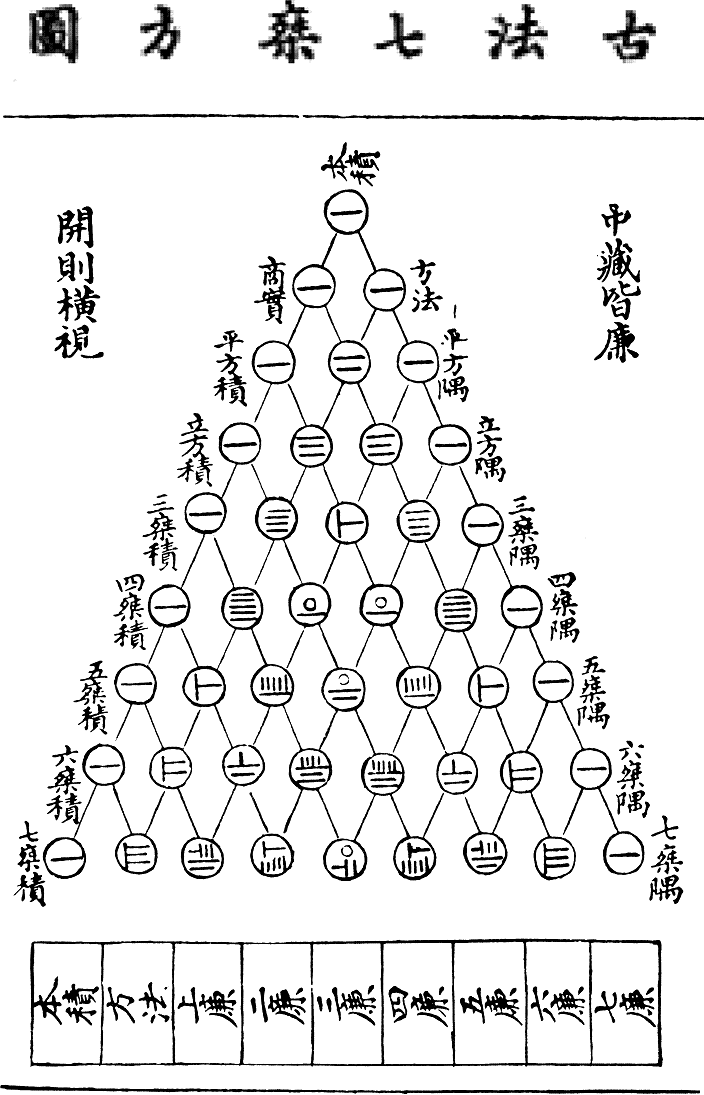
 In the broad field of mathematics
, Shen Kuo mastered many practical mathematical problems, including many complex formulas for geometry
, 'packing' equations for calculus
, and chords and arcs problems employing trigonometry
. Shen addressed problems of writing out very large numbers, as large as 1043. Shen's "technique of small increments" laid the foundation in Chinese mathematics for packing problems involving equal difference series. Sal Restivo writes that Shen used summation of higher series to ascertain the number of kegs which could be piled in layers in a space shaped like the frustum
of a rectangular pyramid. In his formula "technique of intersecting circles", he created an approximation of the arc of a circle s given the diameter d, sagita v, and length of the chord c subtending the arc, the length of which he approximated as s = c + 2v2/d. Restivo writes that Shen's work in the lengths of arcs of circles provided the basis for spherical trigonometry
developed in the 13th century by Guo Shoujing
(1231–1316). He also simplified the counting rods
technique by outlining short cuts in algorithm procedures used on the counting board, an idea expanded on by the mathematician Yang Hui
(1238–1298). Victor J. Katz asserts that Shen's method of "dividing by 9, increase by 1; dividing by 8, increase by 2," was a direct forerunner to the rhyme scheme method of repeated addition "9, 1, bottom add 1; 9, 2, bottom add 2".
Shen wrote extensively about what he had learned while working for the state treasury, including mathematical problems posed by computing land tax, estimating requirements, currency
issues, metrology
, and so forth. Shen once computed the amount of terrain
space required for battle formations in military strategy
, and also computed the longest possible military campaign given the limits of human carriers who would bring their own food and food for other soldiers. Shen wrote about the earlier Yi Xing
(672–717), a Buddhist monk who applied an early escapement
mechanism to a water-powered celestial globe. By using mathematical permutation
s, Shen described Yi Xing's calculation of possible positions on a go board game. Shen calculated the total number for this using up to five rows and twenty five game pieces, which yielded the number 847,288,609,443.
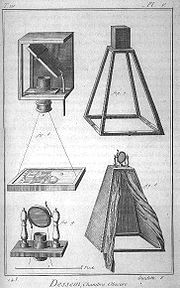
Shen Kuo experimented with the pinhole camera
and burning mirror as the ancient Chinese Mohists had done in the 4th century BC. Although the Iraq
i Muslim
scientist Ibn al-Haytham (965–1039) was the first to experiment with camera obscura
, Shen Kuo was the first to attribute geometrical and quantitative
properties to the camera obscura, just several decades after Ibn al-Haytham's death. Using a fitting metaphor, Shen compared optical image inversion to an oarlock and waisted drum. He also discussed focal point
s and noted that the image in a concave mirror
is inverted. Shen, who never asserted that he was the first to experiment with camera obscura, hints in his writing that camera obscura was dealt with in the Miscellaneous Morsels from Youyang
written by Duan Chengshi
(d. 863) during the Tang Dynasty
(618–907), in regards to the inverted image of a Chinese pagoda
by a seashore.
(c. 200–265), the Chinese had used the South Pointing Chariot
, which did not employ magnetism, as a compass. In 1044 the Collection of the Most Important Military Techniques
recorded that fish-shaped objects cut from sheet iron, magnetized by thermoremanence (essentially, heating that produced weak magnetic force), and placed in a water-filled bowl enclosed by a box were used for directional pathfinding alongside the South Pointing Chariot
.
 However, it was not until the time of Shen Kuo that the earliest magnetic compass
es would be used for navigation
. In his written work, Shen Kuo made the first known explicit reference to the magnetic compass-needle and the concept of true north
. He wrote that steel needles were magnetized once they were rubbed with lodestone
, and that they were put in floating position or in mountings; he described the suspended compass as the best form to be used, and noted that the magnetic needle of compasses pointed either south or north. Shen Kuo asserted that the needle will point south but with a deviation, stating "[the magnetic needles] are always displaced slightly east rather than pointing due south."
Shen Kuo wrote that it was preferable to use the twenty-four-point rose instead of the old eight compass cardinal points — and the former was recorded in use for navigation shortly after Shen's death. The preference of use for the twenty-four-point-rose compass may have arisen from Shen's finding of a more accurate astronomical meridian
, determined by his measurement between the polestar and true north; however, it could also have been inspired by geomantic beliefs and practices. The book of the author Zhu Yu
, the Pingzhou Table Talks published in 1119 (written from 1111 to 1117), was the first record of use of a compass for seafaring navigation. However, Zhu Yu's book recounts events back to 1086, when Shen Kuo was writing the Dream Pool Essays; this meant that in Shen's time the compass might have already been in navigational use. In any case, Shen Kuo's writing on magnetic compasses has proved invaluable for understanding China's earliest use of the compass for seafaring navigation.
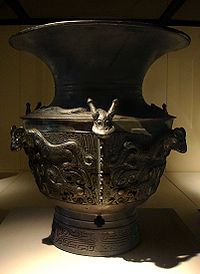 Many of Shen Kuo's contemporaries were interested in antiquarian
pursuits of collecting old artworks. They were also interested in archaeological
pursuits, although for rather different reasons than why Shen Kuo held an interest in archaeology. While Shen's educated Confucian contemporaries were interested in obtaining ancient relics and antiques in order to revive their use in rituals, Shen was more concerned with how items from archeological finds were originally manufactured and what their functionality would have been, based on empirical evidence. Shen Kuo criticized those in his day who reconstructed ancient ritual objects using only their imagination and not the tangible evidence from archeological digs or finds. Shen also disdained the notion of others that these objects were products of the "sages" or the aristocratic class of antiquity
, rightfully crediting the items' manufacture and production to the common working people and artisans of previous eras. Fraser and Haber write that Shen Kuo "advocated the use of an interdisciplinary
approach to archaeology and practiced such an approach himself through his work in metallurgy
, optics, and geometry in the study of ancient measures."
While working in the Bureau of Astronomy, Shen Kuo's interest in archaeology and old relics led him to reconstruct an armillary sphere from existing models as well as from ancient texts that could provide additional information. Shen used ancient mirrors while conducting his optics experiments. He observed ancient weaponry, describing the scaled sight devices
on ancient crossbow
s and the ancients' production of swords with composite blades that had a midrib of wrought iron
and low-carbon
steel
while having two sharp edges of high-carbon
steel. Being a knowledgeable musician, Shen also suggested suspending an ancient bell
by using a hollow handle. In his assessment of the carved relief
s of the ancient Zhuwei Tomb, Shen stated that the reliefs demonstrate genuine Han Dynasty
(202 BC–220 AD) era clothing.
After unearthing an ancient crossbow device from a house's garden in Haichow, Jiangsu, Shen discovered that the cross-wire grid sighting device, marked in graduated measurements on the stock, could be used to calculate the height of a distant mountain in the same way that mathematicians could apply right-angle triangles to measure height. Needham asserts Shen had discovered the survey device known as Jacob's staff
, which was not described elsewhere until the Provençal
Jewish mathematician Levi ben Gerson (1288–1344) wrote of it in 1321. Shen wrote that while viewing the whole of a mountain, the distance on the instrument was long, but while viewing a small part of the mountainside the distance was short due to the device's cross piece that had to be pushed further away from the observer's eye, with the graduation starting on the further end. He wrote that if one placed an arrow on the device and looked past its end, the degree of the mountain could be measured and thus its height could be calculated.
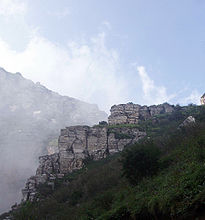 The ancient Greek
Aristotle
(384 BC–322 BC) wrote in his Meteorology
of how the earth had the potential for physical change, including the belief that all rivers and seas at one time did not exist where they were, and were dry. The Greek writer Xenophanes
(570 BC–480 BC) wrote of how inland marine
fossil
s were evidence that massive periodic flood
ing had wiped out mankind several times in the past, but never wrote of land formation or shifting seashores. Du Yu
(222–285) a Chinese Jin Dynasty officer, believed that the land of hills would eventually be leveled into valleys and valleys would gradually rise to form hills. The Daoist alchemist Ge Hong
(284–364) wrote of the legendary immortal Ma Gu
; in a written dialogue by Ge, Ma Gu described how what was once the Eastern Sea (i.e. East China Sea
) had transformed into solid land where mulberry trees grew, and would one day be filled with mountains and dry, dusty lands. The later Persian Muslim
scholar Abū Rayhān al-Bīrūnī (973–1048) hypothesized that India
was once covered by the Indian Ocean
while observing rock formations at the mouths of rivers.
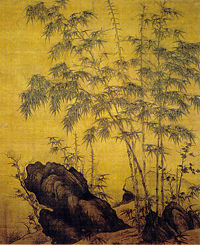 It was Shen Kuo who formulated a hypothesis about the process of land formation (geomorphology
) based upon several observations as evidence. This included his observation of fossil
shells in a geological stratum of a mountain hundreds of miles from the ocean. He inferred that the land was reshaped and formed by erosion of the mountains, uplift, and the deposition of silt
, after observing strange natural erosions of the Taihang Mountains
and the Yandang Mountain near Wenzhou
. He hypothesized that, with the inundation of silt, the land of the continent must have been formed over an enormous span of time. While visiting the Taihang Mountains in 1074, Shen Kuo noticed strata of bivalve
shells and ovoid rocks in a horizontal-running span through a cliff like a large belt. Shen proposed that the cliff was once the location of an ancient seashore that by his time had shifted hundreds of miles east. Shen wrote that in the Zhiping reign period (1064–1067) a man of Zezhou unearthed an object in his garden that looked like a serpent or dragon, and after examining it, concluded the dead animal had apparently turned to "stone". The magistrate of Jincheng
, Zheng Boshun, examined the creature as well, and noted the same scale-like markings that were seen on other marine animals. Shen Kuo likened this to the "stone crabs" found in China.
Shen also wrote that since petrified bamboos were found underground in a climatic area where they had never been known to be grown, the climate there must have shifted geographically over time
. Around the year 1080, Shen Kuo noted that a landslide on the bank of a large river near Yanzhou (modern Yan'an
) had revealed an open space several dozens of feet under the ground once the bank collapsed. This underground space contained hundreds of petrified bamboos still intact with roots and trunks, "all turned to stone" as Shen Kuo wrote. Shen Kuo noted that bamboos do not grow in Yanzhou, located in northern China, and he was puzzled during which previous dynasty the bamboos could have grown. Considering that damp and gloomy low places provide suitable conditions for the growth of bamboo, Shen deduced that the climate of Yanzhou must have fit that description in very ancient times. Although this would have intrigued many of his readers, the study of paleoclimatology
in medieval China never developed into an established discipline.
The philosopher Zhu Xi
(1130–1200) wrote of this curious natural phenomenon of fossils as well. He was known to have read the works of Shen Kuo. Shen's description of soil erosion and weathering predated that of Georgius Agricola in his book of 1546, De veteribus et novis metallis. Furthermore, Shen's theory of sedimentary deposition predated that of James Hutton
, who published his groundbreaking work in 1802 (considered the foundation of modern geology). Historian Joseph Needham
likened Shen's account to that of the Scottish
scientist Roderick Murchison
(1792–1871), who was inspired to become a geologist after observing a providential landslide.
had a long tradition in China before Shen Kuo.
Shen wrote vivid descriptions of tornado
es—the first known description of them in East Asia.
He also gave reasoning (earlier proposed by Sun Sikong, 1015–1076) that rainbow
s were formed by the shadow of the sun in rain, occurring when the sun would shine upon it. Paul Dong writes that Shen's explanation of the rainbow as a phenomenon of atmospheric refraction
"is basically in accord with modern scientific principles." In Europe, Roger Bacon
(1214–1294) was the first to suggest that the colors of the rainbow were caused by the reflection and refraction of sunlight through rain drops.
Shen hypothesized that rays of sunlight refract before reaching the surface of the earth, hence people on earth observing the sun are not viewing it in its exact position, in other words, the altitude of the apparent sun is higher than the actual altitude of the sun. Dong writes that "at the time, this discovery was remarkably original." It should be noted that Ibn al-Haytham, in his Book of Optics
(1021), also discussed atmospheric refraction (in regards to twilight
).
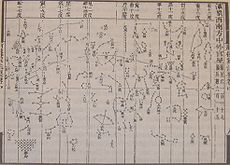 Being the head official for the Bureau of Astronomy, Shen Kuo was an avid scholar of medieval astronomy, and improved the designs of several astronomical instruments. Shen is credited with making improved designs of the gnomon
, armillary sphere
, and clepsydra
clock. For the clepsydra he designed a new overflow-tank type, and argued for a more efficient higher-order interpolation
instead of linear interpolation in calibrating the measure of time. Improving the 5th century model of the astronomical sighting tube, Shen Kuo widened its diameter so that the new calibration could observe the polestar indefinitely. This came about due to the position of the polestar shifting in position since the time of Zu Geng in the 5th century, hence Shen Kuo diligently observed the course of the polestar for three months, plotting the data of its course and coming to the conclusion that it had shifted slightly over three degrees. Apparently this astronomical finding had an impact upon the intellectual community in China at the time. Even Shen's political rival and contemporary astronomer Su Song
featured Shen's corrected position of the polestar (halfway between Tian shu, at −350 degrees, and the current Polaris
) in the fourth star map of his celestial atlas.
The astronomical phenomena of the solar eclipse
and lunar eclipse
had been observed in the 4th century BC by astronomers Gan De
and Shi Shen
; the latter gave instructions on predicting the eclipses based on the relative position of the Moon to the Sun. The philosopher Wang Chong argued against the 'radiating influence' theory of Jing Fang
's writing in the 1st century BC and that of Zhang Heng
(78–139); the latter two correctly hypothesized that the brightness of the Moon was merely light reflected from the Sun. Jing Fang had written in the 1st century BC of how it was long accepted in China that the Sun and Moon were spherical in shape ('like a crossbow
bullet'), not flat. Shen Kuo also wrote of solar and lunar eclipses in this manner, yet expanded upon this to explain why the celestial bodies were spherical, going against the 'flat earth
' theory for celestial bodies. However, there is no evidence to suggest that Shen Kuo supported a round earth theory, which was introduced into Chinese science by Matteo Ricci
and Xu Guangqi
in the 17th century. When the Director of the Astronomical Observatory
asked Shen Kuo if the shapes of the Sun and Moon were round like balls or flat like fans, Shen Kuo explained that celestial bodies were spherical because of knowledge of waxing and waning of the Moon. Much like what Zhang Heng had said, Shen Kuo likened the Moon to a ball of silver, which does not produce light, but simply reflects light if provided from another source (the Sun). He explained that when the Sun's light is slanting, the Moon appears full. He then explained if one were to cover any sort of sphere with white powder, and then viewed from the side it would appear to be a crescent, hence he reasoned that celestial bodies were spherical. He also wrote that, although the Sun and Moon were in conjunction and opposition with each other once a month, this did not mean the Sun would be eclipsed every time their paths met, because of the small obliquity of their orbital paths.
 Shen is also known for his cosmological hypotheses in explaining the variations of planetary motions, including retrogradation
. His colleague Wei Pu realized that the old calculation technique for the mean Sun was inaccurate compared to the apparent Sun
, since the latter was ahead of it in the accelerated phase of motion, and behind it in the retarded phase. Shen's hypotheses were similar to the concept of the epicycle in the Greco-Roman tradition, only Shen compared the side-section of orbit
al paths of planets and variations of planetary speeds to points in the tips of a willow
leaf. In a similar rudimentary physical analogy of celestial motions, as John B. Henderson describes it, Shen likened the relationship of the Moon's path to the ecliptic, the path of the Sun, "to the figure of a rope coiled about a tree."
Along with his colleague Wei Pu
in the Bureau of Astronomy, Shen Kuo planned to plot out the exact coordinates of planetary and lunar movements by recording their astronomical observations three times a night for a continuum of five years. The Song astronomers of Shen's day still retained the lunar theory and coordinates of the earlier Yi Xing
, which after 350 years had devolved into a state of considerable error. Shen criticized earlier Chinese astronomers for failing to describe celestial movement in spacial terms, yet he did not attempt to provide any reasoning for the motive power of the planets or other celestial movements. Shen and Wei began astronomical observations for the Moon and planets by plotting their locations three times a night for what should have been five successive years. The officials and astronomers at court were deeply opposed Wei and Shen's work, offended by their insistence that the coordinates of the renowned Yi Xing were inaccurate. They also slandered Wei Pu, out of resentment that a commoner had expertise exceeding theirs. When Wei and Shen made a public demonstration using the gnomon to prove the doubtful wrong, the other ministers reluctantly agreed to correct the lunar and solar errors. Despite this success, they eventually dismissed Wei and Shen's tables of planetary motions. Therefore, only the worst and most obvious planetary errors were corrected, and many inaccuracies remained.
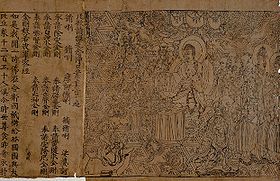 Shen Kuo wrote that during the Qingli reign period (1041–1048), under Emperor Renzong of Song
(1022–1063), an obscure commoner and artisan
known as Bi Sheng
(990–1051) invented ceramic movable type
printing
. Although the use of assembling individual characters to compose a piece of text had its origins in antiquity
, Bi Sheng's methodical innovation was something completely revolutionary for his time. Shen Kuo noted that the process was tedious if one only wanted to print a few copies of a book, but if one desired to make hundreds or thousands of copies, the process was incredibly fast and efficient. Beyond Shen Kuo's writing, however, nothing is known of Bi Sheng's life or the influence of movable type in his lifetime. Although the details of Bi Sheng's life were scarcely known, Shen Kuo wrote:
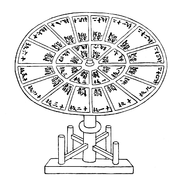 There are a few surviving examples of books printed in the late Song Dynasty using movable type printing. This includes Zhou Bida's Notes of The Jade Hall printed in 1193 using the method of baked-clay movable type characters outlined in the Dream Pool Essays. Yao Shu (1201–1278), an advisor to Kublai Khan
, once persuaded a disciple Yang Gu to print philological primers
and Neo-Confucian texts by using what he termed the "movable type of Shen Kuo". Wang Zhen
(fl. 1290–1333), who wrote the valuable agricultural, scientific, and technological treatise of the Nong Shu, mentioned an alternative method of baking earthenware
type with earthenware frames in order to make whole blocks. Wang Zhen also improved its use by inventing wooden movable type in the years 1297 or 1298, while he was a magistrate of Jingde
, Anhui
province. The earlier Bi Sheng had experimented with wooden movable type, but Wang's main contribution was improving the speed of typesetting with simple mechanical devices, along with the complex, systematic arrangement of wooden movable type involving the use of revolving tables. Although later metal movable type would be used in China, Wang Zhen experimented with tin
metal movable type, but found its use to be inefficient.
By the 15th century, metal movable type printing was developed in Ming Dynasty
China (and earlier in Joseon
Korea
, by the mid 13th century), and was widely applied in China by at least the 16th century. In Jiangsu
and Fujian
, wealthy Ming era families sponsored the use of metal type printing (mostly using bronze
). This included the printing works of Hua Sui
(1439–1513), who pioneered the first Chinese bronze-type movable printing in the year 1490. In 1718, during the mid Qing Dynasty
(1644–1912), the scholar of Tai'an
known as Xu Zhiding developed movable type with enamelware
instead of earthenware. There was also Zhai Jinsheng (b. 1784), a teacher of Jingxian, Anhui
, who spent thirty years making a font of earthenware movable type, and by 1844 he had over 100,000 Chinese writing characters in five sizes.
Despite these advances, movable type printing never gained the amount of widespread use in East Asia that woodblock printing
had achieved since the Chinese Tang Dynasty
in the 9th century. With written Chinese, the vast amount of written morpheme
characters impeded movable type's acceptance and practical use, and was therefore seen as largely unsatisfactory. Furthermore, the European printing press
, first invented by Johannes Gutenberg (1398–1468), was eventually wholly adopted as the standard in China, yet the tradition of woodblock printing remains popular in East Asian countries still.
s controlling the population of pests, the latter of which had the potential to wreak havoc upon the agricultural base of China.
While visiting the iron producing district at Cizhou in 1075, Shen described the "partial decarburization
" method of reforging cast iron under a cold blast, which Hartwell, Needham, and Wertime state is the predecessor of the Bessemer process
. Shen was worried about deforestation
due to the needs of the iron industry
and ink makers using pine soot in the production process, so he suggested for the latter an alternative of petroleum
, which he believed was "produced inexhaustibly within the earth". Shen used the soot from the smoke of burned petroleum fuel (石油 Shíyóu, "rock oil" as Shen called it) to invent a new, more durable type of writing ink; the Ming Dynasty
pharmacologist Li Shizhen
(1518–1593) wrote that Shen's ink was "lustrous like lacquer
, and superior to that made from pinewood lamp-black," or the soot from pinewood.
 Shen Kuo was much in favor of philosophical Daoist notions which challenged the authority of empirical science in his day. Although much could be discerned through empirical observation and recorded study, Daoism asserted that the secrets of the universe were boundless, something that scientific investigation could merely express in fragments and partial understandings. Shen Kuo referred to the ancient Daoist I Ching
in explaining the spiritual processes and attainment of foreknowledge that cannot be attained through "crude traces", which he likens to mathematical astronomy. Nathan Sivin proposes that Shen was the first in history to "make a clear distinction between our unconnected experiences and the unitary causal world we postulate to explain them," which Biderman and Scharfstein state is arguably inherent in the works of Heraclitus
, Plato
, and Democritus
as well. Shen was a firm believer in destiny and prognostication, and made rational explanations for the relations between them. Shen held a special interest in fate, mystical divination, bizarre phenomena, yet warned against the tendency to believe that all matters in life were preordained. When describing an event where lightning
had struck a house and all the wooden walls did not burn (but simply turned black) and lacquerware
s inside were fine, yet metal objects had melted into liquid, Shen Kuo wrote:
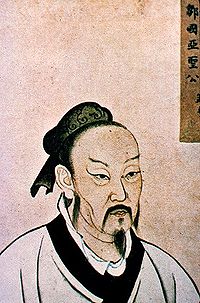
In his commentary on the ancient Confucian philosopher Mencius
(372–289 BC), Shen wrote of the importance of choosing to follow what one knew to be a true path, yet the heart and mind could not attain full knowledge of truth through mere sensory experience. In his own unique way but using terms influenced by the ideas of Mencius, Shen wrote of an autonomous inner authority that formed the basis for one's inclination towards moral choices, a concept linked to Shen's life experiences of surviving and obtaining success through self-reliance. Along with his commentary on the Chinese classic texts
, Shen Kuo also wrote extensively on the topics of supernatural divination
and Buddhist meditation
.
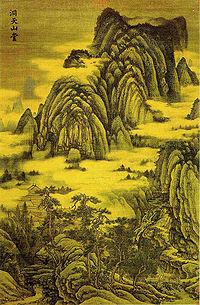 As an art critic
, Shen criticized the paintings of Li Cheng
(919–967) for failing to observe the principle of "seeing the small from the viewpoint of the large" in portraying buildings and the like. He praised the works of Dong Yuan
(c. 934–c. 962); he noted that although a close-up view of Dong's work would create the impression that his brush techniques were cursory, seen from afar his landscape paintings would give the impression of grand, resplendent, and realistic scenery. In addition, Shen's writing on Dong's artworks represents the earliest known reference to the Jiangnan
style of painting. In his "Song on Painting" and in his Dream Pool Essays, Shen praised the creative artworks of the Tang painter Wang Wei (701–761); Shen noted that Wang was unique in that he "penetrated into the mysterious reason and depth of creative activity," but was criticized by others for not conforming his paintings to reality, such as his painting with a banana tree growing in a snowy, wintry landscape.
(1046–1126), who revived the New Policies of Wang Anshi, although he set out on a campaign of attrition to destroy or radically alter the written work of his predecessors and especially Conservative enemies. For example, only six of Shen's books remain, and four of these have been significantly altered since the time they were penned by the author.
In modern times, the best attempt at a complete list and summary of Shen's writing was an appendix written by Hu Daojing in his standard edition of Brush Talks, written in 1956.
The book was originally 30 chapters long, yet an unknown Chinese author's edition of 1166 edited and reorganized the work into 26 chapters.
A passage called "" contains a peculiar account of an unidentified flying object
.
 Although the Dream Pool Essays is certainly his most extensive and important work, Shen Kuo wrote other books as well. In 1075, Shen Kuo wrote the Xining Fengyuan Li , which was lost, but listed in a 7th chapter of a Song Dynasty bibliography. This was the official report of Shen Kuo on his reforms of the Chinese calendar, which were only partially adopted by the Song court's official calendar system. Shen Kuo wrote a pharmaceutical treatise known as the Liang Fang , compiled sometime during his years of retirement from governmental service. Around the year 1126 it was combined into a written work of the famous Su Shi
(1037–1101), who was ironically a political opponent to Shen Kuo's faction of Reformers and New Policies supporters at court, yet it was known that Shen Kuo and Su Shi were nonetheless friends and associates. Shen wrote the Mengqi Wanghuai Lu , which was also compiled during Shen's retirement. This book was a treatise in the working since his youth on rural life and ethnographic accounts of living conditions in the isolated mountain regions of China. Only quotations of it survive in the Shuo Fu collection, which mostly describe the agricultural implements and tools used by rural people in high mountain regions. Shen Kuo also wrote the Changxing Ji . However, this book was without much doubt a posthumous collection, including various poems, prose, and administrative documents written by Shen. By the 15th century (during the Ming Dynasty
), this book was reprinted, yet only the 19th chapter remained. This chapter was reprinted in 1718, yet poorly edited. Finally, in the 1950s the author Hu Daojing supplemented this small yet valuable work with additions of other scattered poems written by Shen, in the former's Collection of Shen Kua's Extant Poetry (Shanghai: Shang-hai Shu-tian, 1958). In the tradition of the popular Song era literary category of 'travel record literature' ('youji wenxue'), Shen Kuo also wrote the Register of What Not to Forget, a traveler's guide
to what type of carriage
is suitable for a journey, the proper foods one should bring, the special clothing one should bring, and many other items.
In his Sequel to Numerous Things Revealed, the Song author Cheng Dachang (1123–1195) noted that stanzas prepared by Shen Kuo for military victory celebrations were later written down and published by Shen. This includes a short poem "Song of Triumph" by Shen Kuo, who uses the musical instrument mawei huqin
('horse-tail barbarian stringed instrument' or 'horse-tail fiddle') of the northwestern Inner Asia
n nomads as a metaphor for prisoners-of-war led by Song troops:
Historian Jonathan Stock notes that the bent bow described in the poem above represents the arched bow used to play the huqin, while the sound of the instrument itself represented the discontent expressed by the prisoners-of-war with their defeated khan
.
. However, Shen's reputation as a polymath has been well regarded. The British
sinologist, historian, and biochemist Joseph Needham (1900–1995) stated that Shen Kuo was "one of the greatest scientific minds in Chinese history." The French
sinologist Jacques Gernet is of the opinion that Shen possessed an "amazingly modern mind." Yao states of Shen's thorough recording of natural sciences in his Dream Pool Essays:
However, Toby E. Huff writes that Shen Kuo's "scattered set" of writings lacks clear-cut organization and "theoretical acuteness," that is, scientific theory
. Nathan Sivin wrote that Shen's originality stands "cheek by jowl with trivial didacticism, court anecdotes, and ephemeral curiosities" that provide little insight. Donald Holzman writes that Shen "has nowhere organized his observations into anything like a general theory." Huff writes that this was a systemic problem of early Chinese science, which lacked systematic treatment that could be found in European works such as the Concordance and Discordant Canons by the lawyer Gratian
of Bologna
(fl. 12th century). In regards to an overarching concept of science
which could branch together all the various sciences studied by the Chinese, Sivin asserts that the writings of Shen Kuo "do not indicate that he achieved, or even sought, an integrated framework for his diverse knowledge; the one common thread is the varied responsibilities of his career as a high civil servant."
District of Hangzhou
, at the foot of the Taiping Hill. His tomb was eventually destroyed, yet Ming Dynasty
records indicated its location, which was found in 1983 and protected by the government in 1986. The remnants of the tomb's brick structure remained, along with Song Dynasty glass
wares and coin
s. The Hangzhou Municipal Committee completed a restoration of Shen's tomb in September 2001.
In addition to his tomb, Shen Kuo's Mengxi garden estate, his former two acre (8,000 m²) property in Zhenjiang, was restored by the government in 1985. However, the renovated Mengxi Garden is only part of the original of Shen Kuo's time. A Qing Dynasty
era hall built on the site is now used as the main admissions gate. In the Memorial Hall of the gardens, there is a large painting depicting the original garden of Shen Kuo's time, including wells, green bamboo groves, stone-paved paths, and decorated walls of the original halls. In this exhibition hall there stands a 1.4 m (4.6 ft) tall statue of Shen Kuo sitting on a platform, along with centuries-old published copies of his Dream Pool Essays in glass cabinets, one of which is from Japan. At the garden estate there are also displayed marble banners, statues of Shen Kuo, and a model of an armillary sphere; a small museum gallery depicts Shen's various achievements.
The Chinese Mount Zijinshan Observatory
discovered a new planetoid
in 1964; in 1979, the Chinese Academy of Sciences
decided to honor Shen by listing "Shen Kuo" as one of its names.
Chinese style name
A Chinese style name, sometimes also known as a courtesy name , is a given name to be used later in life. After 20 years of age, the zì is assigned in place of one's given name as a symbol of adulthood and respect...
Cunzhong (存中) and pseudonym Mengqi (now usually given as Mengxi) Weng (夢溪翁), was a polymath
Polymath
A polymath is a person whose expertise spans a significant number of different subject areas. In less formal terms, a polymath may simply be someone who is very knowledgeable...
ic Chinese
China
Chinese civilization may refer to:* China for more general discussion of the country.* Chinese culture* Greater China, the transnational community of ethnic Chinese.* History of China* Sinosphere, the area historically affected by Chinese culture...
scientist
History of science and technology in China
The history of science and technology in China is both long and rich with many contributions to science and technology. In antiquity, independently of other civilizations, ancient Chinese philosophers made significant advances in science, technology, mathematics, and astronomy...
and statesman of the Song Dynasty
Song Dynasty
The Song Dynasty was a ruling dynasty in China between 960 and 1279; it succeeded the Five Dynasties and Ten Kingdoms Period, and was followed by the Yuan Dynasty. It was the first government in world history to issue banknotes or paper money, and the first Chinese government to establish a...
(960–1279). Excelling in many fields of study and statecraft, he was a mathematician
Chinese mathematics
Mathematics in China emerged independently by the 11th century BC. The Chinese independently developed very large and negative numbers, decimals, a place value decimal system, a binary system, algebra, geometry, and trigonometry....
, astronomer
Chinese astronomy
Astronomy in China has a very long history, with historians considering that "they [the Chinese] were the most persistent and accurate observers of celestial phenomena anywhere in the world before the Arabs."...
, meteorologist, geologist
Geologist
A geologist is a scientist who studies the solid and liquid matter that constitutes the Earth as well as the processes and history that has shaped it. Geologists usually engage in studying geology. Geologists, studying more of an applied science than a theoretical one, must approach Geology using...
, zoologist, botanist, pharmacologist
Traditional Chinese medicine
Traditional Chinese Medicine refers to a broad range of medicine practices sharing common theoretical concepts which have been developed in China and are based on a tradition of more than 2,000 years, including various forms of herbal medicine, acupuncture, massage , exercise , and dietary therapy...
, agronomist
Agronomist
An agronomist is a scientist who specializes in agronomy, which is the science of utilizing plants for food, fuel, feed, and fiber. An agronomist is an expert in agricultural and allied sciences, with the exception veterinary sciences.Agronomists deal with interactions between plants, soils, and...
, archaeologist, ethnographer, cartographer, encyclopedist, general, diplomat
Foreign relations of Imperial China
Imperial China had a long tradition of foreign relations. From the Qin Dynasty until the Qing Dynasty, the Culture of China had an impact upon neighboring and distant countries, while gradually being transformed by outside influences as well....
, hydraulic engineer
Hydraulics
Hydraulics is a topic in applied science and engineering dealing with the mechanical properties of liquids. Fluid mechanics provides the theoretical foundation for hydraulics, which focuses on the engineering uses of fluid properties. In fluid power, hydraulics is used for the generation, control,...
, inventor, academy chancellor
Academies (Shuyuan)
The Shūyuàn , usually known in English as Academies or Academies of Classical Learning, were a type of school in ancient China...
, finance minister
Finance minister
The finance minister is a cabinet position in a government.A minister of finance has many different jobs in a government. He or she helps form the government budget, stimulate the economy, and control finances...
, governmental state inspector, poet
Chinese poetry
Chinese poetry is poetry written, spoken, or chanted in the Chinese language, which includes various versions of Chinese language, including Classical Chinese, Standard Chinese, Mandarin Chinese, Cantonese, Yue Chinese, as well as many other historical and vernacular varieties of the Chinese language...
, and musician
Music of China
Chinese Music has been made since the dawn of Chinese civilization with documents and artifacts providing evidence of a well-developed musical culture as early as the Zhou Dynasty...
. He was the head official for the Bureau of Astronomy
Chinese astronomy
Astronomy in China has a very long history, with historians considering that "they [the Chinese] were the most persistent and accurate observers of celestial phenomena anywhere in the world before the Arabs."...
in the Song court, as well as an Assistant Minister of Imperial Hospitality. At court his political allegiance was to the Reformist faction known as the New Policies Group, headed by Chancellor
Chancellor of China
The Chancellor , variously translated as Prime Minister, Chancellor of State, Premier or Chief Councillor, was a generic name given to the highest-ranking official in the imperial government in ancient China...
Wang Anshi
Wang Anshi
Wang Anshi was a Chinese economist, statesman, chancellor and poet of the Song Dynasty who attempted controversial, major socioeconomic reforms...
(1021–1086).
In his Dream Pool Essays
Dream Pool Essays
The Dream Pool Essays was an extensive book written by the polymath Chinese scientist and statesman Shen Kuo by 1088 AD, during the Song Dynasty of China...
of 1088, Shen was the first to describe the magnetic needle compass
Compass
A compass is a navigational instrument that shows directions in a frame of reference that is stationary relative to the surface of the earth. The frame of reference defines the four cardinal directions – north, south, east, and west. Intermediate directions are also defined...
, which would be used for navigation (first described in Europe by Alexander Neckam
Alexander Neckam
Alexander Neckam was an English scholar and teacher.-Biography:Born at St Albans, Hertfordshire, England, Neckam's mother, Hodierna, nursed the prince with her own son, who thus became Richard's foster-brother...
in 1187). Shen discovered the concept of true north
True north
True north is the direction along the earth's surface towards the geographic North Pole.True geodetic north usually differs from magnetic north , and from grid north...
in terms of magnetic declination
Magnetic declination
Magnetic declination is the angle between magnetic north and true north. The declination is positive when the magnetic north is east of true north. The term magnetic variation is a synonym, and is more often used in navigation...
towards the north pole
North Magnetic Pole
The Earth's North Magnetic Pole is the point on the surface of the Northern Hemisphere at which the Earth's magnetic field points vertically downwards . Though geographically in the north, it is, by the direction of the magnetic field lines, physically the south pole of the Earth's magnetic field...
, with experimentation of suspended magnetic needles and "the improved meridian
Meridian (astronomy)
This article is about the astronomical concept. For other uses of the word, see Meridian.In the sky, a meridian is an imaginary great circle on the celestial sphere. It passes through the north point on the horizon, through the celestial pole, up to the zenith, through the south point on the...
determined by Shen's [astronomical] measurement of the distance between the polestar and true north". This was the decisive step in human history to make compasses more useful for navigation, and may have been a concept unknown in Europe for another four hundred years
Voyages of Christopher Columbus
In the early modern period, the voyages of Columbus initiated European exploration and colonization of the American continents, and are thus of great significance in world history. Christopher Columbus was a navigator and an admiral for Castile, a country that later founded modern Spain...
(evidence of German sundials made circa 1450 show markings similar to Chinese geomancer compasses in regards to declination).
Alongside his colleague Wei Pu
Wei Pu
Wei Pu was an 11th century Chinese astronomer of the Song Dynasty . He was born a commoner, but eventually rose to prominence as an astronomer working for the imperial court at the capital of Kaifeng...
, Shen planned to map the orbital paths of the Moon and the planets in an intensive five-year project involving daily observations, yet this was thwarted by political opponents at court. To aid his work in astronomy, Shen Kuo made improved designs of the armillary sphere
Armillary sphere
An armillary sphere is a model of objects in the sky , consisting of a spherical framework of rings, centred on Earth, that represent lines of celestial longitude and latitude and other astronomically important features such as the ecliptic...
, gnomon
Gnomon
The gnomon is the part of a sundial that casts the shadow. Gnomon is an ancient Greek word meaning "indicator", "one who discerns," or "that which reveals."It has come to be used for a variety of purposes in mathematics and other fields....
, sighting tube, and invented a new type of inflow water clock
Water clock
A water clock or clepsydra is any timepiece in which time is measured by the regulated flow of liquid into or out from a vessel where the amount is then measured.Water clocks, along with sundials, are likely to be the oldest time-measuring instruments, with the only exceptions...
. Shen Kuo devised a geological hypothesis for land formation (geomorphology
Geomorphology
Geomorphology is the scientific study of landforms and the processes that shape them...
), based upon findings of inland marine
Marine (ocean)
Marine is an umbrella term. As an adjective it is usually applicable to things relating to the sea or ocean, such as marine biology, marine ecology and marine geology...
fossil
Fossil
Fossils are the preserved remains or traces of animals , plants, and other organisms from the remote past...
s, knowledge of soil erosion, and the deposition
Deposition (geology)
Deposition is the geological process by which material is added to a landform or land mass. Fluids such as wind and water, as well as sediment flowing via gravity, transport previously eroded sediment, which, at the loss of enough kinetic energy in the fluid, is deposited, building up layers of...
of silt
Silt
Silt is granular material of a size somewhere between sand and clay whose mineral origin is quartz and feldspar. Silt may occur as a soil or as suspended sediment in a surface water body...
. He also proposed a hypothesis of gradual climate change
Climate change
Climate change is a significant and lasting change in the statistical distribution of weather patterns over periods ranging from decades to millions of years. It may be a change in average weather conditions or the distribution of events around that average...
, after observing ancient petrified bamboo
Bamboo
Bamboo is a group of perennial evergreens in the true grass family Poaceae, subfamily Bambusoideae, tribe Bambuseae. Giant bamboos are the largest members of the grass family....
s that were preserved underground in a dry northern habitat that would not support bamboo growth in his time. He was the first literary figure in China to mention the use of the drydock to repair boats suspended out of water, and also wrote of the effectiveness of the relatively new invention of the canal pound lock. Although Ibn al-Haytham (965–1039) was the first to describe camera obscura
Camera obscura
The camera obscura is an optical device that projects an image of its surroundings on a screen. It is used in drawing and for entertainment, and was one of the inventions that led to photography. The device consists of a box or room with a hole in one side...
, Shen was the first in China to do so, several decades later. Shen wrote extensively about movable type
Movable type
Movable type is the system of printing and typography that uses movable components to reproduce the elements of a document ....
printing
Printing
Printing is a process for reproducing text and image, typically with ink on paper using a printing press. It is often carried out as a large-scale industrial process, and is an essential part of publishing and transaction printing....
invented by Bi Sheng
Bi Sheng
Bì Shēng was the inventor of the first known movable type technology. Bi Sheng's system was made of Chinese porcelain and was invented between 1041 and 1048 in China.-Movable type printing:...
(990–1051), and because of his written works the legacy of Bi Sheng and the modern understanding of the earliest movable type has been handed down to later generations. Following an old tradition in China, Shen created a raised-relief map
Raised-relief map
A raised-relief map or terrain model is a three-dimensional representation, usually of terrain. When representing terrain, the elevation dimension is usually exaggerated by a factor between five and ten; this facilitates the visual recognition of terrain features.-History:In his 1665 paper for the...
while inspecting borderlands. His description of an ancient crossbow mechanism which he himself unearthed proved to be a Jacob's staff
Jacob's staff
The Jacob's staff, also called a cross-staff, a ballastella, a fore-staff, or a balestilha is used to refer to several things. This can lead to considerable confusion unless one clarifies the purpose for the object so named...
, a surveying
Surveying
See Also: Public Land Survey SystemSurveying or land surveying is the technique, profession, and science of accurately determining the terrestrial or three-dimensional position of points and the distances and angles between them...
tool which wasn't known in Europe until described by Levi ben Gerson in 1321.
Shen Kuo wrote several other books besides the Dream Pool Essays, yet much of the writing in his other books has not survived. Some of Shen's poetry was preserved in posthumous written works. Although much of his focus was on technical and scientific issues, he had an interest in divination
Divination
Divination is the attempt to gain insight into a question or situation by way of an occultic standardized process or ritual...
and the supernatural, the latter including his vivid description of unidentified flying objects from eyewitness testimony. He also wrote commentary on ancient Daoist
Taoism
Taoism refers to a philosophical or religious tradition in which the basic concept is to establish harmony with the Tao , which is the mechanism of everything that exists...
and Confucian
Confucianism
Confucianism is a Chinese ethical and philosophical system developed from the teachings of the Chinese philosopher Confucius . Confucianism originated as an "ethical-sociopolitical teaching" during the Spring and Autumn Period, but later developed metaphysical and cosmological elements in the Han...
texts.
Birth and youth
Shen Kuo was born in Qiantang (modern-day HangzhouHangzhou
Hangzhou , formerly transliterated as Hangchow, is the capital and largest city of Zhejiang Province in Eastern China. Governed as a sub-provincial city, and as of 2010, its entire administrative division or prefecture had a registered population of 8.7 million people...
) in the year 1031. His father Shen Zhou was a somewhat lower-class gentry
Gentry (China)
As used for imperial China, landed gentry does not correspond to any term in Chinese. One standard work remarks that under the Ming dynasty, called shenshi or shenjin, meaning variously degree-holders, literati, scholar-bureaucrats or officials, they are loosely known in English as the Chinese...
figure serving in official posts on the provincial level; his mother was from a family of equal status in Suzhou
Suzhou
Suzhou , previously transliterated as Su-chou, Suchow, and Soochow, is a major city located in the southeast of Jiangsu Province in Eastern China, located adjacent to Shanghai Municipality. The city is situated on the lower reaches of the Yangtze River and on the shores of Taihu Lake and is a part...
, with her maiden name being Xu
Xu
Xu can be a pinyin transliteration of one of several Chinese surnames:#, also spelled Hsu or Chui or Tsui or Tu or Eu#, also spelled Hui or Hii...
. Shen Kuo received his initial childhood education from his mother, which was a common practice in China during this period. She was very educated herself, teaching Kuo and his brother Pi the military doctrines of her own elder brother Xu Tang . Since Shen was unable to boast of a prominent familial clan history like many of his elite peers born in the north, he was forced to rely on his wit and stern determination to achieve in his studies to enter the challenging and sophisticated life of an exam-drafted state bureaucrat.
Sichuan
' , known formerly in the West by its postal map spellings of Szechwan or Szechuan is a province in Southwest China with its capital in Chengdu...
province and finally to the international seaport at Xiamen
Xiamen
Xiamen , also known as Amoy , is a major city on the southeast coast of the People's Republic of China. It is administered as a sub-provincial city of Fujian province with an area of and population of 3.53 million...
, where Shen's father accepted minor provincial posts in each new location. Shen Zhou also served several years in the prestigious capital judiciary
Judiciary
The judiciary is the system of courts that interprets and applies the law in the name of the state. The judiciary also provides a mechanism for the resolution of disputes...
, the equivalent of a federal supreme court. Shen Kuo took notice of the various towns and rural features of China as his family traveled, while he became interested during his youth in the diverse topography
Topography
Topography is the study of Earth's surface shape and features or those ofplanets, moons, and asteroids...
of the land. He also observed the intriguing aspects of his father's engagement in administrative governance and the managerial problems involved; these experiences had a deep impact on him as he later became a government official. Since he often became ill as a child, Shen Kuo also developed a natural curiosity about medicine and pharmaceutics.
Shen Zhou died in the late winter of 1051 (or early 1052), when his son Shen Kuo was 21 years old. Shen Kuo grieved for his father, and following Confucian
Confucianism
Confucianism is a Chinese ethical and philosophical system developed from the teachings of the Chinese philosopher Confucius . Confucianism originated as an "ethical-sociopolitical teaching" during the Spring and Autumn Period, but later developed metaphysical and cosmological elements in the Han...
ethics, remained inactive in a state of mourning for three years until 1054 (or early 1055). As of 1054, Shen began serving in minor local governmental posts. However, his natural abilities to plan, organize, and design were proven early in life; one example is his design and supervision of the hydraulic drainage of an embankment
Levee
A levee, levée, dike , embankment, floodbank or stopbank is an elongated naturally occurring ridge or artificially constructed fill or wall, which regulates water levels...
system, which converted
Land reclamation
Land reclamation, usually known as reclamation, is the process to create new land from sea or riverbeds. The land reclaimed is known as reclamation ground or landfill.- Habitation :...
some one hundred thousand acre
Acre
The acre is a unit of area in a number of different systems, including the imperial and U.S. customary systems. The most commonly used acres today are the international acre and, in the United States, the survey acre. The most common use of the acre is to measure tracts of land.The acre is related...
s (400 km²) of swamp
Swamp
A swamp is a wetland with some flooding of large areas of land by shallow bodies of water. A swamp generally has a large number of hammocks, or dry-land protrusions, covered by aquatic vegetation, or vegetation that tolerates periodical inundation. The two main types of swamp are "true" or swamp...
land into prime farmland. Shen Kuo noted that the success of the silt
Silt
Silt is granular material of a size somewhere between sand and clay whose mineral origin is quartz and feldspar. Silt may occur as a soil or as suspended sediment in a surface water body...
fertilization method relied upon the effective operation of sluice
Sluice
A sluice is a water channel that is controlled at its head by a gate . For example, a millrace is a sluice that channels water toward a water mill...
gates of irrigation canal
Canal
Canals are man-made channels for water. There are two types of canal:#Waterways: navigable transportation canals used for carrying ships and boats shipping goods and conveying people, further subdivided into two kinds:...
s.
Official career
Imperial examination
The Imperial examination was an examination system in Imperial China designed to select the best administrative officials for the state's bureaucracy. This system had a huge influence on both society and culture in Imperial China and was directly responsible for the creation of a class of...
s, the difficult national-level standard test that every high official was required to pass in order to enter the governmental system. He not only passed the exam however, but was placed into the higher category of the best and brightest students. While serving at Yangzhou
Yangzhou
Yangzhou is a prefecture-level city in central Jiangsu Province, People's Republic of China. Sitting on the northern bank of the Yangtze River, it borders the provincial capital of Nanjing to the southwest, Huai'an to the north, Yancheng to the northeast, Taizhou to the east, and Zhenjiang across...
, Shen's brilliance and dutiful character caught the attention of Zhang Chu , the Fiscal Intendant of the region. Shen made a lasting impression upon Zhang, who recommended Shen for a court appointment in the financial administration of the central court. Shen would also eventually marry Zhang's daughter, who became his second wife.
In his career as a scholar-official
Scholar-bureaucrats
Scholar-officials or Scholar-bureaucrats were civil servants appointed by the emperor of China to perform day-to-day governance from the Sui Dynasty to the end of the Qing Dynasty in 1912, China's last imperial dynasty. These officials mostly came from the well-educated men known as the...
for the central government, Shen Kuo was also an ambassador to the Western Xia
Western Xia
The Western Xia Dynasty or the Tangut Empire, was known to the Tanguts and the Tibetans as Minyak.The state existed from 1038 to 1227 AD in what are now the northwestern Chinese provinces of Ningxia, Gansu, eastern Qinghai, northern Shaanxi, northeastern Xinjiang, southwest Inner Mongolia, and...
Dynasty and Liao Dynasty
Liao Dynasty
The Liao Dynasty , also known as the Khitan Empire was an empire in East Asia that ruled over the regions of Manchuria, Mongolia, and parts of northern China proper between 9071125...
, a military commander, a director of hydraulic works, and the leading chancellor of the Hanlin Academy
Hanlin Academy
The Hanlin Academy was an academic and administrative institution founded in the eighth century Tang dynasty China by Emperor Xuanzong.Membership in the academy was confined to an elite group of scholars, who performed secretarial and literary tasks for the court. One of its main duties was to...
. By 1072, Shen was appointed as the head official of the Bureau of Astronomy. With his leadership position in the bureau, Shen was responsible for projects in improving calendrical science, and proposed many reforms to the Chinese calendar
Chinese calendar
The Chinese calendar is a lunisolar calendar, incorporating elements of a lunar calendar with those of a solar calendar. It is not exclusive to China, but followed by many other Asian cultures as well...
alongside the work of his colleague Wei Pu
Wei Pu
Wei Pu was an 11th century Chinese astronomer of the Song Dynasty . He was born a commoner, but eventually rose to prominence as an astronomer working for the imperial court at the capital of Kaifeng...
. With his impressive skills and aptitude for matters of economy and finance, Shen was appointed as the Finance Commissioner at the central court.
As written by Li Zhiyi, a man married to Hu Wenrou (granddaughter of Hu Su, a famous minister of the Song Dynasty), Shen Kuo was Li's mentor while Shen served as an official. According to Li's epitaph for his wife, Shen would sometimes relay questions via Li to Hu when he needed clarification for his mathematical work, as Hu Wenrou was esteemed by Shen as a remarkable female mathematician. Shen lamented: "if only she were a man, Wenrou would be my friend."
While employed by the central government, Shen Kuo was also sent out with others to inspect the granary system of the empire, investigating problems of illegal collections, negligence, ineffective disaster relief, and inadequate water-conservancy projects. While Shen was appointed as the regional inspector of Zhejiang in 1073, the Emperor requested that Shen pay a visit to the famous poet Su Shi
Su Shi
Su Shi , was a writer, poet, artist, calligrapher, pharmacologist, gastronome, and statesman of the Song Dynasty, and one of the major poets of the Song era. His courtesy name was Zizhan and his pseudonym was Dongpo Jushi , and he is often referred to as Su Dongpo...
(1037–1101), then an administrator in Hangzhou. Shen took advantage of this meeting to copy some of Su's poetry, which he presented to the Emperor indicating that it expressed "abusive and hateful" speech against the Song court; these poems were later politicized by Li Ding and Shu Dan in order to level a court case against Su. With his demonstrations of loyalty and ability, Shen Kuo was awarded the honorary title of a State Foundation Viscount
Viscount
A viscount or viscountess is a member of the European nobility whose comital title ranks usually, as in the British peerage, above a baron, below an earl or a count .-Etymology:...
by Emperor Shenzong of Song
Emperor Shenzong of Song
Emperor Shenzong of Song was the sixth emperor of the Chinese Song Dynasty. His personal name was Zhao Xu...
(r. 1067–1085), who placed a great amount of trust in Shen Kuo. He was even made 'companion to the heir apparent' (太子中允; 'Taizi zhongyun').
Wang Anshi
Wang Anshi was a Chinese economist, statesman, chancellor and poet of the Song Dynasty who attempted controversial, major socioeconomic reforms...
(1021–1086), who was the leader of the political faction of Reformers, also known as the New Policies Group . Shen Kuo had a previous history with Wang Anshi, since it was Wang who had composed the funerary epitaph
Epitaph
An epitaph is a short text honoring a deceased person, strictly speaking that is inscribed on their tombstone or plaque, but also used figuratively. Some are specified by the dead person beforehand, others chosen by those responsible for the burial...
for Shen's father, Zhou. Shen Kuo soon impressed Wang Anshi with his skills and abilities as an administrator and government agent. In 1072, Shen was sent to supervise Wang's program of surveying the building of silt deposits in the Bian Canal
Grand Canal of China
The Grand Canal in China, also known as the Beijing-Hangzhou Grand Canal is the longest canal or artificial river in the world. Starting at Beijing, it passes through Tianjin and the provinces of Hebei, Shandong, Jiangsu and Zhejiang to the city of Hangzhou...
outside the capital city. Using an original technique, Shen successfully dredged the canal and demonstrated the formidable value of the silt gathered as a fertilizer
Fertilizer
Fertilizer is any organic or inorganic material of natural or synthetic origin that is added to a soil to supply one or more plant nutrients essential to the growth of plants. A recent assessment found that about 40 to 60% of crop yields are attributable to commercial fertilizer use...
. He gained further reputation at court once he was dispatched as an envoy to the Khitan
Khitan people
thumb|250px|Khitans [[Eagle hunting|using eagles to hunt]], painted during the Chinese [[Song Dynasty]].The Khitan people , or Khitai, Kitan, or Kidan, were a nomadic Mongolic people, originally located at Mongolia and Manchuria from the 4th century...
Liao Dynasty in the summer of 1075. The Khitans had made several aggressive negotiations of pushing their borders south, while manipulating several incompetent Chinese ambassadors who conceded to the Liao Kingdom's demands. In a brilliant display of diplomacy, Shen Kuo came to the camp of the Khitan monarch at Mt. Yongan (near modern Pingquan
Pingquan
Pingquan is a county in Hebei Province, China. It is a centre of trade and business, and gold and silver are mined nearby.The local infrastructure includes:* Pingquan Hospital of Traditional Chinese Medicine of Chengde* Pingquan Normal College...
, Hebei
Hebei
' is a province of the People's Republic of China in the North China region. Its one-character abbreviation is "" , named after Ji Province, a Han Dynasty province that included what is now southern Hebei...
), armed with copies of previously archived diplomatic negotiations between the Song and Liao dynasties. Shen Kuo refuted Emperor Daozong's
Emperor Daozong of Liao
Emperor Daozong of Liao , born Yelü Hongji or Yehlu Hongji , was an emperor of the Liao dynasty, a kingdom of the Khitan people in what is now northeastern China. Succeeding his father, Xingzong, in 1055, Daozong ruled until he was murdered in 1101. He was succeeded by his grandson, Tianzuodi...
bluffs point for point, while the Song reestablished their rightful border line. In regards to the Lý Dynasty
Lý Dynasty
The Lý Dynasty , sometimes known as the Later Lý Dynasty , was a Vietnamese dynasty that began in 1009 when Lý Thái Tổ overthrew the Prior Lê Dynasty and ended in 1225 when the queen Lý Chiêu Hoàng was forced to abdicate the throne in favor of her husband, Trần Cảnh. They ruled Vietnam for a...
of Đại Việt (in modern northern Vietnam
Vietnam
Vietnam – sometimes spelled Viet Nam , officially the Socialist Republic of Vietnam – is the easternmost country on the Indochina Peninsula in Southeast Asia. It is bordered by China to the north, Laos to the northwest, Cambodia to the southwest, and the South China Sea –...
), Shen demonstrated in his Dream Pool Essays that he was familiar with the key players (on the Vietnamese side) in the prelude to the Sino-Vietnamese War of 1075–1077. With his reputable achievements, Shen became a trusted member of Wang Anshi's elite circle of eighteen unofficial core political loyalists to the New Policies Group.
Militia
The term militia is commonly used today to refer to a military force composed of ordinary citizens to provide defense, emergency law enforcement, or paramilitary service, in times of emergency without being paid a regular salary or committed to a fixed term of service. It is a polyseme with...
s to lessen the expense of upholding a million soldiers, putting government monopolies on saltpetre
Potassium nitrate
Potassium nitrate is a chemical compound with the formula KNO3. It is an ionic salt of potassium ions K+ and nitrate ions NO3−.It occurs as a mineral niter and is a natural solid source of nitrogen. Its common names include saltpetre , from medieval Latin sal petræ: "stone salt" or possibly "Salt...
and sulphur production and distribution in 1076 (to ensure that gunpowder
Gunpowder
Gunpowder, also known since in the late 19th century as black powder, was the first chemical explosive and the only one known until the mid 1800s. It is a mixture of sulfur, charcoal, and potassium nitrate - with the sulfur and charcoal acting as fuels, while the saltpeter works as an oxidizer...
solutions would not fall into the hands of enemies), and aggressive military policy towards China's northern rivals of the Western Xia and Liao dynasties. A few years after Song Dynasty military forces had made victorious territorial gains against the Tanguts of the Western Xia, in 1080 Shen Kuo was entrusted as a military officer in defense of Yanzhou (modern-day Yan'an
Yan'an
Yan'an , is a prefecture-level city in the Shanbei region of Shaanxi province in China, administering several counties, including Zhidan County , which served as the Chinese communist capital before the city of Yan'an proper took that role....
, Shaanxi
Shaanxi
' is a province in the central part of Mainland China, and it includes portions of the Loess Plateau on the middle reaches of the Yellow River in addition to the Qinling Mountains across the southern part of this province...
province). During the autumn months of 1081, Shen was successful in defending Song Dynasty territory while capturing several fortified towns of the Western Xia. The Emperor Shenzong of Song rewarded Shen with numerous titles for his merit in these battles, and in the sixteen months of Shen's military campaign, he received 273 letters from the Emperor. However, Emperor Shenzong trusted an arrogant military officer who disobeyed the emperor and Shen's proposal for strategic fortifications, instead fortifying what Shen considered useless strategic locations. Furthermore, this officer expelled Shen from his commanding post at the main citadel
Citadel
A citadel is a fortress for protecting a town, sometimes incorporating a castle. The term derives from the same Latin root as the word "city", civis, meaning citizen....
, so as to deny him any glory in chance of victory. The result of this was nearly catastrophic, as the forces of the arrogant officer were decimated; Xinzhong Yao states that the death toll was 60,000. Nonetheless, Shen was successful in defending his fortifications and the only possible Tangut invasion-route to Yanzhou.
Impeachment and later life
The new Chancellor Cai Que held Shen responsible for the disaster and loss of life. Along with abandoning the territory which Shen Kuo had fought for, Cai ousted Shen from his seat of office. Shen's life was now forever changed, as he lost his once reputable career in state governance and the military. Shen was then put under probationProbation
Probation literally means testing of behaviour or abilities. In a legal sense, an offender on probation is ordered to follow certain conditions set forth by the court, often under the supervision of a probation officer...
in a fixed residence for the next six years. However, as he was isolated from governance, he decided to pick up the quill
Quill
A quill pen is a writing implement made from a flight feather of a large bird. Quills were used for writing with ink before the invention of the dip pen, metal-nibbed pens, the fountain pen, and, eventually, the ballpoint pen...
and dedicate himself to intensive scholarly studies. After completing two geographical atlas
Atlas
An atlas is a collection of maps; it is typically a map of Earth or a region of Earth, but there are atlases of the other planets in the Solar System. Atlases have traditionally been bound into book form, but today many atlases are in multimedia formats...
es for a state-sponsored program, Shen was rewarded by having his sentence of probation lifted, allowing him to live in a place of his choice. Shen was also pardoned by the court for any previous faults or crimes that were claimed against him.
In his more idle years removed from court affairs, Shen Kuo enjoyed pastimes of the Chinese gentry and literati
Gentry (China)
As used for imperial China, landed gentry does not correspond to any term in Chinese. One standard work remarks that under the Ming dynasty, called shenshi or shenjin, meaning variously degree-holders, literati, scholar-bureaucrats or officials, they are loosely known in English as the Chinese...
that would indicate his intellectual level and cultural taste to others. As described in his Dream Pool Essays, Shen Kuo enjoyed the company of the "nine guests" (jiuke), a figure of speech for the Chinese zither
Guqin
The guqin is the modern name for a plucked seven-string Chinese musical instrument of the zither family...
, the older 17x17 line variant of Weiqi (known today as Go), Zen
Zen
Zen is a school of Mahāyāna Buddhism founded by the Buddhist monk Bodhidharma. The word Zen is from the Japanese pronunciation of the Chinese word Chán , which in turn is derived from the Sanskrit word dhyāna, which can be approximately translated as "meditation" or "meditative state."Zen...
Buddhist meditation
Buddhist meditation
Buddhist meditation refers to the meditative practices associated with the religion and philosophy of Buddhism.Core meditation techniques have been preserved in ancient Buddhist texts and have proliferated and diversified through teacher-student transmissions. Buddhists pursue meditation as part of...
, ink (calligraphy and painting
Chinese painting
Chinese painting is one of the oldest continuous artistic traditions in the world. The earliest paintings were not representational but ornamental; they consisted of patterns or designs rather than pictures. Early pottery was painted with spirals, zigzags, dots, or animals...
), tea drinking
Chinese tea
The practice of drinking tea has had a long history in China, having originated there. The Chinese drink tea during many parts of the day such as during meals for good health or for simple pleasure.-History:...
, alchemy
Alchemy
Alchemy is an influential philosophical tradition whose early practitioners’ claims to profound powers were known from antiquity. The defining objectives of alchemy are varied; these include the creation of the fabled philosopher's stone possessing powers including the capability of turning base...
, chanting poetry
Chinese poetry
Chinese poetry is poetry written, spoken, or chanted in the Chinese language, which includes various versions of Chinese language, including Classical Chinese, Standard Chinese, Mandarin Chinese, Cantonese, Yue Chinese, as well as many other historical and vernacular varieties of the Chinese language...
, conversation, and drinking wine
Wine in China
Wine in China refers to grape wines that are produced in China. Grape wine has a long history in China, along with other Chinese alcoholic beverages....
. These nine activities were an extension to the older so-called Four Arts of the Chinese Scholar
Four Arts of the Chinese Scholar
The Four Arts of the Chinese Scholar, otherwise known as siyi , is a term used to describe four main accomplishments required of the Chinese scholar gentleman...
.
According to Zhu Yu
Zhu Yu (author)
Zhu Yu was an author of the Chinese Song Dynasty . He retired in Huang Gang of the Hubei province, bought a country house and named it "Pingzhou". He called himself "Expert Vegetable Grower of Pingzhou ". Between 1111 and 1117 AD, Zhu Yu wrote the book Pingzhou Ketan , published in 1119 AD...
's book Pingzhou Table Talks of 1119, Shen Kuo had two marriages; the second wife was the daughter of Zhang Chu , who came from Huainan
Huainan
Huainan is a prefecture-level city with 2,334,000 inhabitants in central Anhui Province, People’s Republic of China. It borders the provincial capital of Hefei to the south, Lu’an to the southwest, Fuyang to the west, Bozhou to the northwest, Bengbu to the northeast and Chuzhou to the east.Its...
. Lady Zhang was said to be overbearing and fierce, often abusive to Shen Kuo, even attempting at one time to pull off his beard. Shen Kuo's children were often upset over this, and prostrated themselves to Lady Zhang to quit this behavior. Despite this, Lady Zhang went as far as to drive out Shen Kuo's son from his first marriage, expelling him from the household. However, after Lady Zhang died, Shen Kuo fell into a deep depression and even attempted to jump into the Yangtze River
Yangtze River
The Yangtze, Yangzi or Cháng Jiāng is the longest river in Asia, and the third-longest in the world. It flows for from the glaciers on the Tibetan Plateau in Qinghai eastward across southwest, central and eastern China before emptying into the East China Sea at Shanghai. It is also one of the...
to drown himself. Although this suicide attempt failed, he would die a year later.
In the 1070s, Shen had purchased a lavish garden estate on the outskirts of modern-day Zhenjiang
Zhenjiang
Zhenjiang is a prefecture-level city in the southwest of Jiangsu province in the eastern People's Republic of China . Sitting on the southern bank of the Yangtze River, it borders the provincial capital of Nanjing to the west, Changzhou to the east, and Yangzhou across the river to the north.Once...
, Jiangsu
Jiangsu
' is a province of the People's Republic of China, located along the east coast of the country. The name comes from jiang, short for the city of Jiangning , and su, for the city of Suzhou. The abbreviation for this province is "苏" , the second character of its name...
province, a place of great beauty which he named "Dream Brook" ("Mengxi") after he visited it for the first time in 1086. Shen Kuo permanently moved to the Dream Brook Estate in 1088, and in that same year he completed his life's written work of the Dream Pool Essays
Dream Pool Essays
The Dream Pool Essays was an extensive book written by the polymath Chinese scientist and statesman Shen Kuo by 1088 AD, during the Song Dynasty of China...
, naming the book after his garden-estate property. It was there that Shen Kuo spent the last several years of his life in leisure, isolation, and illness, until his death in 1095.
Scholarly achievements
Shen Kuo wrote extensively on a wide range of different subjects. His written work included two geographical atlasAtlas
An atlas is a collection of maps; it is typically a map of Earth or a region of Earth, but there are atlases of the other planets in the Solar System. Atlases have traditionally been bound into book form, but today many atlases are in multimedia formats...
es, a treatise on music
Music
Music is an art form whose medium is sound and silence. Its common elements are pitch , rhythm , dynamics, and the sonic qualities of timbre and texture...
with mathematical harmonics, governmental administration, mathematical astronomy, astronomical instruments, martial defensive tactics
Military strategy
Military strategy is a set of ideas implemented by military organizations to pursue desired strategic goals. Derived from the Greek strategos, strategy when it appeared in use during the 18th century, was seen in its narrow sense as the "art of the general", 'the art of arrangement' of troops...
and fortification
Fortification
Fortifications are military constructions and buildings designed for defence in warfare and military bases. Humans have constructed defensive works for many thousands of years, in a variety of increasingly complex designs...
s, painting
Painting
Painting is the practice of applying paint, pigment, color or other medium to a surface . The application of the medium is commonly applied to the base with a brush but other objects can be used. In art, the term painting describes both the act and the result of the action. However, painting is...
, tea
Tea
Tea is an aromatic beverage prepared by adding cured leaves of the Camellia sinensis plant to hot water. The term also refers to the plant itself. After water, tea is the most widely consumed beverage in the world...
, medicine
Medicine
Medicine is the science and art of healing. It encompasses a variety of health care practices evolved to maintain and restore health by the prevention and treatment of illness....
, and much poetry
Chinese poetry
Chinese poetry is poetry written, spoken, or chanted in the Chinese language, which includes various versions of Chinese language, including Classical Chinese, Standard Chinese, Mandarin Chinese, Cantonese, Yue Chinese, as well as many other historical and vernacular varieties of the Chinese language...
. His scientific writings have been praised by sinologists such as Joseph Needham
Joseph Needham
Noel Joseph Terence Montgomery Needham, CH, FRS, FBA , also known as Li Yuese , was a British scientist, historian and sinologist known for his scientific research and writing on the history of Chinese science. He was elected a fellow of the Royal Society in 1941, and as a fellow of the British...
and Nathan Sivin
Nathan Sivin
Nathan Sivin , also known as Xiwen is an American author, scholar, sinologist, historian, essayist, and currently professor emeritus at the University of Pennsylvania...
, and he has been compared by Sivin to polymaths such as his contemporary Su Song
Su Song
Su Song was a renowned Chinese polymath who specialized himself as a statesman, astronomer, cartographer, horologist, pharmacologist, mineralogist, zoologist, botanist, mechanical and architectural engineer, poet, antiquarian, and ambassador of the Song Dynasty .Su Song was the engineer of a...
, as well as Gottfried Leibniz
Gottfried Leibniz
Gottfried Wilhelm Leibniz was a German philosopher and mathematician. He wrote in different languages, primarily in Latin , French and German ....
and Mikhail Lomonosov
Mikhail Lomonosov
Mikhail Vasilyevich Lomonosov was a Russian polymath, scientist and writer, who made important contributions to literature, education, and science. Among his discoveries was the atmosphere of Venus. His spheres of science were natural science, chemistry, physics, mineralogy, history, art,...
.
Raised-relief map
If the account of Sima QianSima Qian
Sima Qian was a Prefect of the Grand Scribes of the Han Dynasty. He is regarded as the father of Chinese historiography for his highly praised work, Records of the Grand Historian , a "Jizhuanti"-style general history of China, covering more than two thousand years from the Yellow Emperor to...
(c. 145–86 BC) in his Records of the Grand Historian
Records of the Grand Historian
The Records of the Grand Historian, also known in English by the Chinese name Shiji , written from 109 BC to 91 BC, was the Magnum opus of Sima Qian, in which he recounted Chinese history from the time of the Yellow Emperor until his own time...
is proven correct upon the unearthing of Qin Shi Huang
Qin Shi Huang
Qin Shi Huang , personal name Ying Zheng , was king of the Chinese State of Qin from 246 BC to 221 BC during the Warring States Period. He became the first emperor of a unified China in 221 BC...
's (r. 221–210 BC) tomb, the raised-relief map
Raised-relief map
A raised-relief map or terrain model is a three-dimensional representation, usually of terrain. When representing terrain, the elevation dimension is usually exaggerated by a factor between five and ten; this facilitates the visual recognition of terrain features.-History:In his 1665 paper for the...
has existed since the Qin Dynasty
Qin Dynasty
The Qin Dynasty was the first imperial dynasty of China, lasting from 221 to 207 BC. The Qin state derived its name from its heartland of Qin, in modern-day Shaanxi. The strength of the Qin state was greatly increased by the legalist reforms of Shang Yang in the 4th century BC, during the Warring...
(221–206 BC). Robert Temple and Joseph Needham suggest that certain pottery vessels of the Han Dynasty
Han Dynasty
The Han Dynasty was the second imperial dynasty of China, preceded by the Qin Dynasty and succeeded by the Three Kingdoms . It was founded by the rebel leader Liu Bang, known posthumously as Emperor Gaozu of Han. It was briefly interrupted by the Xin Dynasty of the former regent Wang Mang...
(202 BC – 220 AD) showing artificial mountains as lid decorations may have influenced the raised-relief map. The Han Dynasty general Ma Yuan (14 BC – 49 AD) made a raised-relief map of valleys and mountains in a rice-constructed model of 32 AD. Such rice models were expounded on by the Tang Dynasty
Tang Dynasty
The Tang Dynasty was an imperial dynasty of China preceded by the Sui Dynasty and followed by the Five Dynasties and Ten Kingdoms Period. It was founded by the Li family, who seized power during the decline and collapse of the Sui Empire...
(618–907) author Jiang Fang in his Essay on the Art of Constructing Mountains with Rice (c. 845 AD). A raised-relief map made of wood representing all the provinces of the empire and put together like a giant 0.93 m2 (10 ft2) jigsaw puzzle
Jigsaw puzzle
A jigsaw puzzle is a tiling puzzle that requires the assembly of numerous small, often oddly shaped, interlocking and tessellating pieces.Each piece usually has a small part of a picture on it; when complete, a jigsaw puzzle produces a complete picture...
was invented by Xie Zhuang (421–466 AD) during the Liu Song Dynasty
Liu Song Dynasty
The Liu Song Dynasty , also known as Song Dynasty , Former Song , or Southern Song , was first of the four Southern Dynasties in China, succeeding the Eastern Jin Dynasty and followed by the Southern Qi Dynasty....
(420–479).
Shen's largest atlas included twenty three maps of China and foreign regions that were drawn at a uniform scale of 1:900,000. Shen also created a three dimensional
Three-dimensional space
Three-dimensional space is a geometric 3-parameters model of the physical universe in which we live. These three dimensions are commonly called length, width, and depth , although any three directions can be chosen, provided that they do not lie in the same plane.In physics and mathematics, a...
raised-relief map using sawdust, wood, beeswax, and wheat paste. Zhu Xi
Zhu Xi
Zhū Xī or Chu Hsi was a Song Dynasty Confucian scholar who became the leading figure of the School of Principle and the most influential rationalist Neo-Confucian in China...
(1130–1200) was inspired by the raised-relief map of Huang Shang and so made his own portable map made of wood and clay which could be folded up from eight hinged pieces. Later, Ibn Battuta
Ibn Battuta
Abu Abdullah Muhammad Ibn Battuta , or simply Ibn Battuta, also known as Shams ad–Din , was a Muslim Moroccan Berber explorer, known for his extensive travels published in the Rihla...
(1304–1377) described a raised-relief map while visiting Gibraltar
Gibraltar
Gibraltar is a British overseas territory located on the southern end of the Iberian Peninsula at the entrance of the Mediterranean. A peninsula with an area of , it has a northern border with Andalusia, Spain. The Rock of Gibraltar is the major landmark of the region...
, while European raised-relief maps started with a Paul Dox who made one to represent Kufstein
Kufstein
Kufstein is a city in Tyrol, Austria, located along the river Inn, in the lower Inn valley, near the border with Bavaria, Germany, and is the site of a post World War II French sector United Nations Relief and Rehabilitation Administration Displaced Persons camp.Kufstein is the second largest city...
, Austria
Austria
Austria , officially the Republic of Austria , is a landlocked country of roughly 8.4 million people in Central Europe. It is bordered by the Czech Republic and Germany to the north, Slovakia and Hungary to the east, Slovenia and Italy to the south, and Switzerland and Liechtenstein to the...
, in 1510. The Englishman John Evelyn
John Evelyn
John Evelyn was an English writer, gardener and diarist.Evelyn's diaries or Memoirs are largely contemporaneous with those of the other noted diarist of the time, Samuel Pepys, and cast considerable light on the art, culture and politics of the time John Evelyn (31 October 1620 – 27 February...
(1620–1706), in his 1665 paper featured in the Philosophical Transactions of the Royal Society
Philosophical Transactions of the Royal Society
The Philosophical Transactions of the Royal Society is a scientific journal published by the Royal Society of London. It was established in 1665, making it the first journal in the world exclusively devoted to science, and it has remained in continuous publication ever since, making it the world's...
, wrote that the raised-relief map was something new from France
France
The French Republic , The French Republic , The French Republic , (commonly known as France , is a unitary semi-presidential republic in Western Europe with several overseas territories and islands located on other continents and in the Indian, Pacific, and Atlantic oceans. Metropolitan France...
.
Pharmacology
For pharmacologyPharmacology
Pharmacology is the branch of medicine and biology concerned with the study of drug action. More specifically, it is the study of the interactions that occur between a living organism and chemicals that affect normal or abnormal biochemical function...
, Shen wrote of the difficulties of adequate diagnosis
Medical diagnosis
Medical diagnosis refers both to the process of attempting to determine or identify a possible disease or disorder , and to the opinion reached by this process...
and therapy
Pharmacotherapy
Pharmacotherapy is the treatment of disease through the administration of drugs. As such, it is considered part of the larger category of therapy....
, as well as the proper selection, preparation, and administration of drugs. He held great concern for detail and philological
Philology
Philology is the study of language in written historical sources; it is a combination of literary studies, history and linguistics.Classical philology is the philology of Greek and Classical Latin...
accuracy in identification, use and cultivation of different types of medicinal herbs, such as in which months medicinal plants should be gathered, their exact ripening times, which parts should be used for therapy; for domesticated herbs he wrote about planting times, fertilization, and other matters of horticulture
Horticulture
Horticulture is the industry and science of plant cultivation including the process of preparing soil for the planting of seeds, tubers, or cuttings. Horticulturists work and conduct research in the disciplines of plant propagation and cultivation, crop production, plant breeding and genetic...
. In the realms of botany
Botany
Botany, plant science, or plant biology is a branch of biology that involves the scientific study of plant life. Traditionally, botany also included the study of fungi, algae and viruses...
, zoology
Zoology
Zoology |zoölogy]]), is the branch of biology that relates to the animal kingdom, including the structure, embryology, evolution, classification, habits, and distribution of all animals, both living and extinct...
, and mineralogy
Mineralogy
Mineralogy is the study of chemistry, crystal structure, and physical properties of minerals. Specific studies within mineralogy include the processes of mineral origin and formation, classification of minerals, their geographical distribution, as well as their utilization.-History:Early writing...
, Shen Kuo documented and systematically described hundreds of different plants, agricultural crops, rare vegetation, animals, and mineral
Mineral
A mineral is a naturally occurring solid chemical substance formed through biogeochemical processes, having characteristic chemical composition, highly ordered atomic structure, and specific physical properties. By comparison, a rock is an aggregate of minerals and/or mineraloids and does not...
s found in China. For example, Shen noted that the mineral orpiment
Orpiment
Orpiment, As2S3, is a common monoclinic arsenic sulfide mineral. It has a Mohs hardness of 1.5 to 2 and a specific gravity of 3.46. It melts at 300 °C to 325 °C...
was used to quickly erase writing errors on paper.
Civil engineering
Palace
A palace is a grand residence, especially a royal residence or the home of a head of state or some other high-ranking dignitary, such as a bishop or archbishop. The word itself is derived from the Latin name Palātium, for Palatine Hill, one of the seven hills in Rome. In many parts of Europe, the...
boats that were a century old; essentially, Huang Huaixin devised the first Chinese drydock for suspending boats out of water. These boats were then placed in a roof-covered dock warehouse to protect them from weathering. Shen also wrote about the effectiveness of the new invention (i.e. by the 10th century engineer Qiao Weiyo
Technology of the Song Dynasty
The Song Dynasty provided some of the most significant technological advances in Chinese history, many of which came from talented statesmen drafted by the government through imperial examinations....
) of the pound lock to replace the old flash lock
Flash lock
Early locks were designed with a single gate, known as a flash lock or staunch lock. The earliest European references to what were clearly flash locks were in Roman times....
design used in canals. He wrote that it saved the work of five hundred annual labors, annual costs of up to 1,250,000 strings of cash, and increased the size limit of boats accommodated from 21 ton
Ton
The ton is a unit of measure. It has a long history and has acquired a number of meanings and uses over the years. It is used principally as a unit of weight, and as a unit of volume. It can also be used as a measure of energy, for truck classification, or as a colloquial term.It is derived from...
s/21000 kg to 113 ton
Ton
The ton is a unit of measure. It has a long history and has acquired a number of meanings and uses over the years. It is used principally as a unit of weight, and as a unit of volume. It can also be used as a measure of energy, for truck classification, or as a colloquial term.It is derived from...
s/115000 kg.
If it were not for Shen Kuo's analysis and quoting in his Dream Pool Essays
Dream Pool Essays
The Dream Pool Essays was an extensive book written by the polymath Chinese scientist and statesman Shen Kuo by 1088 AD, during the Song Dynasty of China...
of the writings of the architect
Architect
An architect is a person trained in the planning, design and oversight of the construction of buildings. To practice architecture means to offer or render services in connection with the design and construction of a building, or group of buildings and the space within the site surrounding the...
Yu Hao
Yu Hao
Yu Hao was an eminent Chinese structural engineer and architect during the Song Dynasty period .-Legacy:Yu Hao was given the title of Master-Carpenter , for his architectural skill...
(fl.
Floruit
Floruit , abbreviated fl. , is a Latin verb meaning "flourished", denoting the period of time during which something was active...
970), the latter's work would have been lost to history. Yu designed a famous wooden pagoda
Chinese pagoda
Chinese Pagodas are a traditional part of Chinese architecture. In addition to religious use, since ancient times Chinese pagodas have been praised for the spectacular views which they offer, and many famous poems in Chinese history attest to the joy of scaling pagodas.-History:The pagoda is...
that burned down in 1044 and was replaced in 1049 by a brick pagoda (the 'Iron Pagoda
Iron Pagoda
The Iron Pagoda of Youguo Temple , Kaifeng City, Henan province, is a Buddhist Chinese pagoda built in 1049 C.E. during the Song Dynasty of China. The pagoda is so-named not because it is made of iron, but because its colour resembles that of iron...
') of similar height, but not of his design. From Shen's quotation—or perhaps Shen's own paraphrasing of Yu Hao's Timberwork Manual (木經; Mujing)—shows that already in the 10th century there was a graded system of building unit proportions, a system which Shen states had become more precise in his time but stating no one could possibly reproduce such a sound work. However, he did not anticipate the more complex and matured system of unit proportions embodied in the extensive written work by scholar-official Li Jie (1065–1110), the Treatise on Architectural Methods
Yingzao Fashi
The Yingzao Fashi is a technical treatise on architecture and craftsmanship written by the Chinese author Li Jie , the Directorate of Buildings and Construction during the mid Song Dynasty of China. A promising architect, he revised many older treatises on architecture from 1097 to 1100...
(營造法式; Yingzao Fashi) of 1103. Klaas Ruitenbeek states that the version of the Timberwork Manual quoted by Shen is most likely Shen's summarization of Yu's work or a corrupted passage of the original by Yu Hao, as Shen writes: "According to some, the work was written by Yu Hao."
Anatomy
The Chinese had long taken an interest in examining the human body. For example, in 16 AD the Xin DynastyXin Dynasty
The Xin Dynasty was a Chinese dynasty which lasted from AD 9 to 23. It followed the Western Han Dynasty and preceded the Eastern Han Dynasty....
usurper Wang Mang
Wang Mang
Wang Mang , courtesy name Jujun , was a Han Dynasty official who seized the throne from the Liu family and founded the Xin Dynasty , ruling AD 9–23. The Han dynasty was restored after his overthrow and his rule marks the separation between the Western Han Dynasty and Eastern Han Dynasty...
called for the dissection of an executed man, to examine his arteries and viscera in order to discover cures for illnesses. Shen also took interest in human anatomy
Anatomy
Anatomy is a branch of biology and medicine that is the consideration of the structure of living things. It is a general term that includes human anatomy, animal anatomy , and plant anatomy...
, dispelling the long-held Chinese theory that the throat contained three valves, writing, "When liquid and solid are imbibed together, how can it be that in one's mouth they sort themselves into two throat channels?" Shen maintained that the larynx
Larynx
The larynx , commonly called the voice box, is an organ in the neck of amphibians, reptiles and mammals involved in breathing, sound production, and protecting the trachea against food aspiration. It manipulates pitch and volume...
was the beginning of a system that distributed vital qi
Qi
In traditional Chinese culture, qì is an active principle forming part of any living thing. Qi is frequently translated as life energy, lifeforce, or energy flow. Qi is the central underlying principle in traditional Chinese medicine and martial arts...
from the air throughout the body, and that the esophagus
Esophagus
The esophagus is an organ in vertebrates which consists of a muscular tube through which food passes from the pharynx to the stomach. During swallowing, food passes from the mouth through the pharynx into the esophagus and travels via peristalsis to the stomach...
was a simple tube that dropped food into the stomach. Following Shen's reasoning and correcting the findings of the dissection
Dissection
Dissection is usually the process of disassembling and observing something to determine its internal structure and as an aid to discerning the functions and relationships of its components....
of executed bandits in 1045, an early 12th century Chinese account of a bodily dissection finally supported Shen's belief in two throat valves, not three. Also, the later Song Dynasty judge and early forensic expert Song Ci
Song Ci
Song Ci was a forensic medical expert active during the Southern Song Dynasty who wrote a groundbreaking book titled Collected Cases of Injustice Rectified ....
(1186–1249) would promote the use of autopsy
Autopsy
An autopsy—also known as a post-mortem examination, necropsy , autopsia cadaverum, or obduction—is a highly specialized surgical procedure that consists of a thorough examination of a corpse to determine the cause and manner of death and to evaluate any disease or injury that may be present...
in order to solve homicide
Homicide
Homicide refers to the act of a human killing another human. Murder, for example, is a type of homicide. It can also describe a person who has committed such an act, though this use is rare in modern English...
cases, as written in his Collected Cases of Injustice Rectified
Collected Cases of Injustice Rectified
Collected Cases of Injustice Rectified or Washing away of wrongs is a Chinese book written by Song Ci in 1247 during the Song Dynasty as a handbook for coroners. The author combined many historical cases of forensic science with his own experiences and wrote the book with an eye to avoiding...
.
Mathematics and optics
Mathematics
Mathematics is the study of quantity, space, structure, and change. Mathematicians seek out patterns and formulate new conjectures. Mathematicians resolve the truth or falsity of conjectures by mathematical proofs, which are arguments sufficient to convince other mathematicians of their validity...
, Shen Kuo mastered many practical mathematical problems, including many complex formulas for geometry
Geometry
Geometry arose as the field of knowledge dealing with spatial relationships. Geometry was one of the two fields of pre-modern mathematics, the other being the study of numbers ....
, 'packing' equations for calculus
Calculus
Calculus is a branch of mathematics focused on limits, functions, derivatives, integrals, and infinite series. This subject constitutes a major part of modern mathematics education. It has two major branches, differential calculus and integral calculus, which are related by the fundamental theorem...
, and chords and arcs problems employing trigonometry
Trigonometry
Trigonometry is a branch of mathematics that studies triangles and the relationships between their sides and the angles between these sides. Trigonometry defines the trigonometric functions, which describe those relationships and have applicability to cyclical phenomena, such as waves...
. Shen addressed problems of writing out very large numbers, as large as 1043. Shen's "technique of small increments" laid the foundation in Chinese mathematics for packing problems involving equal difference series. Sal Restivo writes that Shen used summation of higher series to ascertain the number of kegs which could be piled in layers in a space shaped like the frustum
Frustum
In geometry, a frustum is the portion of a solid that lies between two parallel planes cutting it....
of a rectangular pyramid. In his formula "technique of intersecting circles", he created an approximation of the arc of a circle s given the diameter d, sagita v, and length of the chord c subtending the arc, the length of which he approximated as s = c + 2v2/d. Restivo writes that Shen's work in the lengths of arcs of circles provided the basis for spherical trigonometry
Spherical trigonometry
Spherical trigonometry is a branch of spherical geometry which deals with polygons on the sphere and the relationships between the sides and the angles...
developed in the 13th century by Guo Shoujing
Guo Shoujing
Guo Shoujing , courtesy name Ruosi , was a Chinese astronomer, engineer, and mathematician born in Xingtai, Hebei who lived during the Yuan Dynasty...
(1231–1316). He also simplified the counting rods
Counting rods
Counting rods are small bars, typically 3–14 cm long, used by mathematicians for calculation in China, Japan, Korea, and Vietnam. They are placed either horizontally or vertically to represent any number and any fraction....
technique by outlining short cuts in algorithm procedures used on the counting board, an idea expanded on by the mathematician Yang Hui
Yang Hui
Yang Hui , courtesy name Qianguang , was a Chinese mathematician from Qiantang , Zhejiang province during the late Song Dynasty . Yang worked on magic squares, magic circles and the binomial theorem, and is best known for his contribution of presenting 'Yang Hui's Triangle'...
(1238–1298). Victor J. Katz asserts that Shen's method of "dividing by 9, increase by 1; dividing by 8, increase by 2," was a direct forerunner to the rhyme scheme method of repeated addition "9, 1, bottom add 1; 9, 2, bottom add 2".
Shen wrote extensively about what he had learned while working for the state treasury, including mathematical problems posed by computing land tax, estimating requirements, currency
Currency
In economics, currency refers to a generally accepted medium of exchange. These are usually the coins and banknotes of a particular government, which comprise the physical aspects of a nation's money supply...
issues, metrology
Metrology
Metrology is the science of measurement. Metrology includes all theoretical and practical aspects of measurement. The word comes from Greek μέτρον , "measure" + "λόγος" , amongst others meaning "speech, oration, discourse, quote, study, calculation, reason"...
, and so forth. Shen once computed the amount of terrain
Terrain
Terrain, or land relief, is the vertical and horizontal dimension of land surface. When relief is described underwater, the term bathymetry is used...
space required for battle formations in military strategy
Military strategy
Military strategy is a set of ideas implemented by military organizations to pursue desired strategic goals. Derived from the Greek strategos, strategy when it appeared in use during the 18th century, was seen in its narrow sense as the "art of the general", 'the art of arrangement' of troops...
, and also computed the longest possible military campaign given the limits of human carriers who would bring their own food and food for other soldiers. Shen wrote about the earlier Yi Xing
Yi Xing
Yi Xing , born Zhang Sui , was a Chinese astronomer, mathematician, mechanical engineer,and Buddhist monk of the Tang Dynasty...
(672–717), a Buddhist monk who applied an early escapement
Escapement
In mechanical watches and clocks, an escapement is a device that transfers energy to the timekeeping element and enables counting the number of oscillations of the timekeeping element...
mechanism to a water-powered celestial globe. By using mathematical permutation
Permutation
In mathematics, the notion of permutation is used with several slightly different meanings, all related to the act of permuting objects or values. Informally, a permutation of a set of objects is an arrangement of those objects into a particular order...
s, Shen described Yi Xing's calculation of possible positions on a go board game. Shen calculated the total number for this using up to five rows and twenty five game pieces, which yielded the number 847,288,609,443.
Shen Kuo experimented with the pinhole camera
Pinhole camera
A pinhole camera is a simple camera without a lens and with a single small aperture – effectively a light-proof box with a small hole in one side. Light from a scene passes through this single point and projects an inverted image on the opposite side of the box...
and burning mirror as the ancient Chinese Mohists had done in the 4th century BC. Although the Iraq
Iraq
Iraq ; officially the Republic of Iraq is a country in Western Asia spanning most of the northwestern end of the Zagros mountain range, the eastern part of the Syrian Desert and the northern part of the Arabian Desert....
i Muslim
Muslim
A Muslim, also spelled Moslem, is an adherent of Islam, a monotheistic, Abrahamic religion based on the Quran, which Muslims consider the verbatim word of God as revealed to prophet Muhammad. "Muslim" is the Arabic term for "submitter" .Muslims believe that God is one and incomparable...
scientist Ibn al-Haytham (965–1039) was the first to experiment with camera obscura
Camera obscura
The camera obscura is an optical device that projects an image of its surroundings on a screen. It is used in drawing and for entertainment, and was one of the inventions that led to photography. The device consists of a box or room with a hole in one side...
, Shen Kuo was the first to attribute geometrical and quantitative
Quantitative property
A quantitative property is one that exists in a range of magnitudes, and can therefore be measured with a number. Measurements of any particular quantitative property are expressed as a specific quantity, referred to as a unit, multiplied by a number. Examples of physical quantities are distance,...
properties to the camera obscura, just several decades after Ibn al-Haytham's death. Using a fitting metaphor, Shen compared optical image inversion to an oarlock and waisted drum. He also discussed focal point
Focus (optics)
In geometrical optics, a focus, also called an image point, is the point where light rays originating from a point on the object converge. Although the focus is conceptually a point, physically the focus has a spatial extent, called the blur circle. This non-ideal focusing may be caused by...
s and noted that the image in a concave mirror
Curved mirror
A curved mirror is a mirror with a curved reflective surface, which may be either convex or concave . Most curved mirrors have surfaces that are shaped like part of a sphere, but other shapes are sometimes used in optical devices...
is inverted. Shen, who never asserted that he was the first to experiment with camera obscura, hints in his writing that camera obscura was dealt with in the Miscellaneous Morsels from Youyang
Miscellaneous Morsels from Youyang
The Miscellaneous Morsels from Youyang is a miscellany of Chinese and foreign legends and hearsay, reports on natural phenomena, short anecdotes, and tales of the wondrous and mundane, as well as notes on such topics as medicinal herbs and tattoos....
written by Duan Chengshi
Duan Chengshi
Duan Chengshi was an author and scholar of the Tang Dynasty in China. He was born to a wealthy family in present day Zibo, Shandong. A descendant of the early Tang official Duan Zhixuan 段志玄 , and the son of Duan Wenchang 段文昌, a high official under Tang Xuanzong, his family background enabled him...
(d. 863) during the Tang Dynasty
Tang Dynasty
The Tang Dynasty was an imperial dynasty of China preceded by the Sui Dynasty and followed by the Five Dynasties and Ten Kingdoms Period. It was founded by the Li family, who seized power during the decline and collapse of the Sui Empire...
(618–907), in regards to the inverted image of a Chinese pagoda
Chinese pagoda
Chinese Pagodas are a traditional part of Chinese architecture. In addition to religious use, since ancient times Chinese pagodas have been praised for the spectacular views which they offer, and many famous poems in Chinese history attest to the joy of scaling pagodas.-History:The pagoda is...
by a seashore.
Magnetic needle compass
Since the time of the engineer and inventor Ma JunMa Jun
Ma Jun , style name Deheng , was a Chinese mechanical engineer and government official during the Three Kingdoms era of China...
(c. 200–265), the Chinese had used the South Pointing Chariot
South Pointing Chariot
The south-pointing chariot was an ancient Chinese two-wheeled vehicle that carried a movable pointer to indicate the south, no matter how the chariot turned. Usually, the pointer took the form of a doll or figure with an outstretched arm...
, which did not employ magnetism, as a compass. In 1044 the Collection of the Most Important Military Techniques
Wujing Zongyao
The Wujing Zongyao was a Chinese military compendium written in 1044 AD, during the Northern Song Dynasty. Its authors were the prominent scholars Zeng Gongliang , Ding Du , and Yang Weide , whose writing influenced many later Chinese military writers. The book covered a wide range of subjects,...
recorded that fish-shaped objects cut from sheet iron, magnetized by thermoremanence (essentially, heating that produced weak magnetic force), and placed in a water-filled bowl enclosed by a box were used for directional pathfinding alongside the South Pointing Chariot
South Pointing Chariot
The south-pointing chariot was an ancient Chinese two-wheeled vehicle that carried a movable pointer to indicate the south, no matter how the chariot turned. Usually, the pointer took the form of a doll or figure with an outstretched arm...
.
Compass
A compass is a navigational instrument that shows directions in a frame of reference that is stationary relative to the surface of the earth. The frame of reference defines the four cardinal directions – north, south, east, and west. Intermediate directions are also defined...
es would be used for navigation
Navigation
Navigation is the process of monitoring and controlling the movement of a craft or vehicle from one place to another. It is also the term of art used for the specialized knowledge used by navigators to perform navigation tasks...
. In his written work, Shen Kuo made the first known explicit reference to the magnetic compass-needle and the concept of true north
True north
True north is the direction along the earth's surface towards the geographic North Pole.True geodetic north usually differs from magnetic north , and from grid north...
. He wrote that steel needles were magnetized once they were rubbed with lodestone
Lodestone
A lodestone or loadstone is a naturally magnetized piece of the mineral magnetite. They are naturally occurring magnets, that attract pieces of iron. Ancient people first discovered the property of magnetism in lodestone...
, and that they were put in floating position or in mountings; he described the suspended compass as the best form to be used, and noted that the magnetic needle of compasses pointed either south or north. Shen Kuo asserted that the needle will point south but with a deviation, stating "[the magnetic needles] are always displaced slightly east rather than pointing due south."
Shen Kuo wrote that it was preferable to use the twenty-four-point rose instead of the old eight compass cardinal points — and the former was recorded in use for navigation shortly after Shen's death. The preference of use for the twenty-four-point-rose compass may have arisen from Shen's finding of a more accurate astronomical meridian
Meridian (astronomy)
This article is about the astronomical concept. For other uses of the word, see Meridian.In the sky, a meridian is an imaginary great circle on the celestial sphere. It passes through the north point on the horizon, through the celestial pole, up to the zenith, through the south point on the...
, determined by his measurement between the polestar and true north; however, it could also have been inspired by geomantic beliefs and practices. The book of the author Zhu Yu
Zhu Yu (author)
Zhu Yu was an author of the Chinese Song Dynasty . He retired in Huang Gang of the Hubei province, bought a country house and named it "Pingzhou". He called himself "Expert Vegetable Grower of Pingzhou ". Between 1111 and 1117 AD, Zhu Yu wrote the book Pingzhou Ketan , published in 1119 AD...
, the Pingzhou Table Talks published in 1119 (written from 1111 to 1117), was the first record of use of a compass for seafaring navigation. However, Zhu Yu's book recounts events back to 1086, when Shen Kuo was writing the Dream Pool Essays; this meant that in Shen's time the compass might have already been in navigational use. In any case, Shen Kuo's writing on magnetic compasses has proved invaluable for understanding China's earliest use of the compass for seafaring navigation.
Archaeology
Antiquarian
An antiquarian or antiquary is an aficionado or student of antiquities or things of the past. More specifically, the term is used for those who study history with particular attention to ancient objects of art or science, archaeological and historic sites, or historic archives and manuscripts...
pursuits of collecting old artworks. They were also interested in archaeological
Archaeology
Archaeology, or archeology , is the study of human society, primarily through the recovery and analysis of the material culture and environmental data that they have left behind, which includes artifacts, architecture, biofacts and cultural landscapes...
pursuits, although for rather different reasons than why Shen Kuo held an interest in archaeology. While Shen's educated Confucian contemporaries were interested in obtaining ancient relics and antiques in order to revive their use in rituals, Shen was more concerned with how items from archeological finds were originally manufactured and what their functionality would have been, based on empirical evidence. Shen Kuo criticized those in his day who reconstructed ancient ritual objects using only their imagination and not the tangible evidence from archeological digs or finds. Shen also disdained the notion of others that these objects were products of the "sages" or the aristocratic class of antiquity
Four occupations
The four occupations or "four categories of the people" was a hierarchic social class structure developed in ancient China by either Confucian or Legalist scholars as far back as the late Zhou Dynasty and is considered a central part of the Fengjian social structure...
, rightfully crediting the items' manufacture and production to the common working people and artisans of previous eras. Fraser and Haber write that Shen Kuo "advocated the use of an interdisciplinary
Interdisciplinarity
Interdisciplinarity involves the combining of two or more academic fields into one single discipline. An interdisciplinary field crosses traditional boundaries between academic disciplines or schools of thought, as new needs and professions have emerged....
approach to archaeology and practiced such an approach himself through his work in metallurgy
History of ferrous metallurgy
The history of ferrous metallurgy began far back in prehistory. The earliest surviving iron artifacts, from the 5th millennium BC in Iran and 2nd millennium BC in China, were made from meteoritic iron-nickel. It is not known when or where the smelting of iron from ores began, but by the end of the...
, optics, and geometry in the study of ancient measures."
While working in the Bureau of Astronomy, Shen Kuo's interest in archaeology and old relics led him to reconstruct an armillary sphere from existing models as well as from ancient texts that could provide additional information. Shen used ancient mirrors while conducting his optics experiments. He observed ancient weaponry, describing the scaled sight devices
Sight (device)
A sight is a device used to assist aligning or aim weapons, surveying instruments, or other items by eye. Sights can be a simple set or system of markers that have to be aligned together as well as aligned with the target...
on ancient crossbow
Crossbow
A crossbow is a weapon consisting of a bow mounted on a stock that shoots projectiles, often called bolts or quarrels. The medieval crossbow was called by many names, most of which derived from the word ballista, a torsion engine resembling a crossbow in appearance.Historically, crossbows played a...
s and the ancients' production of swords with composite blades that had a midrib of wrought iron
Wrought iron
thumb|The [[Eiffel tower]] is constructed from [[puddle iron]], a form of wrought ironWrought iron is an iron alloy with a very low carbon...
and low-carbon
Decarburization
Decarburization is the process opposite to carburization, namely aimed at decreasing the content of carbon in metals . Decarburization occurs when Carbon in the metal reacts with gasses present in the atmosphere...
steel
Steel
Steel is an alloy that consists mostly of iron and has a carbon content between 0.2% and 2.1% by weight, depending on the grade. Carbon is the most common alloying material for iron, but various other alloying elements are used, such as manganese, chromium, vanadium, and tungsten...
while having two sharp edges of high-carbon
Carburization
Carburizing, spelled carburising in the UK, is a heat treatment process in which iron or steel is heated in the presence of another material which liberates carbon as it decomposes. Depending on the amount of time and temperature, the affected area can vary in carbon content...
steel. Being a knowledgeable musician, Shen also suggested suspending an ancient bell
Bianzhong
Bianzhong is an ancient Chinese musical instrument consisting of a set of bronze bells, played melodically. These sets of chime bells were used as polyphonic musical instruments and some of these bells have been dated at between 2,000 to 3,600 years old. They were hung in a wooden frame and...
by using a hollow handle. In his assessment of the carved relief
Relief
Relief is a sculptural technique. The term relief is from the Latin verb levo, to raise. To create a sculpture in relief is thus to give the impression that the sculpted material has been raised above the background plane...
s of the ancient Zhuwei Tomb, Shen stated that the reliefs demonstrate genuine Han Dynasty
Han Dynasty
The Han Dynasty was the second imperial dynasty of China, preceded by the Qin Dynasty and succeeded by the Three Kingdoms . It was founded by the rebel leader Liu Bang, known posthumously as Emperor Gaozu of Han. It was briefly interrupted by the Xin Dynasty of the former regent Wang Mang...
(202 BC–220 AD) era clothing.
After unearthing an ancient crossbow device from a house's garden in Haichow, Jiangsu, Shen discovered that the cross-wire grid sighting device, marked in graduated measurements on the stock, could be used to calculate the height of a distant mountain in the same way that mathematicians could apply right-angle triangles to measure height. Needham asserts Shen had discovered the survey device known as Jacob's staff
Jacob's staff
The Jacob's staff, also called a cross-staff, a ballastella, a fore-staff, or a balestilha is used to refer to several things. This can lead to considerable confusion unless one clarifies the purpose for the object so named...
, which was not described elsewhere until the Provençal
Provence
Provence ; Provençal: Provença in classical norm or Prouvènço in Mistralian norm) is a region of south eastern France on the Mediterranean adjacent to Italy. It is part of the administrative région of Provence-Alpes-Côte d'Azur...
Jewish mathematician Levi ben Gerson (1288–1344) wrote of it in 1321. Shen wrote that while viewing the whole of a mountain, the distance on the instrument was long, but while viewing a small part of the mountainside the distance was short due to the device's cross piece that had to be pushed further away from the observer's eye, with the graduation starting on the further end. He wrote that if one placed an arrow on the device and looked past its end, the degree of the mountain could be measured and thus its height could be calculated.
Geology
Ancient Greece
Ancient Greece is a civilization belonging to a period of Greek history that lasted from the Archaic period of the 8th to 6th centuries BC to the end of antiquity. Immediately following this period was the beginning of the Early Middle Ages and the Byzantine era. Included in Ancient Greece is the...
Aristotle
Aristotle
Aristotle was a Greek philosopher and polymath, a student of Plato and teacher of Alexander the Great. His writings cover many subjects, including physics, metaphysics, poetry, theater, music, logic, rhetoric, linguistics, politics, government, ethics, biology, and zoology...
(384 BC–322 BC) wrote in his Meteorology
Meteorology (Aristotle)
Meteorology is a treatise by Aristotle which contains his theories about the earth sciences. These include early accounts of water evaporation, weather phenomena, and earthquakes....
of how the earth had the potential for physical change, including the belief that all rivers and seas at one time did not exist where they were, and were dry. The Greek writer Xenophanes
Xenophanes
of Colophon was a Greek philosopher, theologian, poet, and social and religious critic. Xenophanes life was one of travel, having left Ionia at the age of 25 he continued to travel throughout the Greek world for another 67 years. Some scholars say he lived in exile in Siciliy...
(570 BC–480 BC) wrote of how inland marine
Marine (ocean)
Marine is an umbrella term. As an adjective it is usually applicable to things relating to the sea or ocean, such as marine biology, marine ecology and marine geology...
fossil
Fossil
Fossils are the preserved remains or traces of animals , plants, and other organisms from the remote past...
s were evidence that massive periodic flood
Flood
A flood is an overflow of an expanse of water that submerges land. The EU Floods directive defines a flood as a temporary covering by water of land not normally covered by water...
ing had wiped out mankind several times in the past, but never wrote of land formation or shifting seashores. Du Yu
Du Yu
Du Yu , style name Yuankai , was a military general of Cao Wei during the late Three Kingdoms period of Chinese history. He served the Jin Dynasty after the end of the Three Kingdoms period. Also a prolific author, it is said that Du Yu read the Zuozhuan so often that he was addicted to the book...
(222–285) a Chinese Jin Dynasty officer, believed that the land of hills would eventually be leveled into valleys and valleys would gradually rise to form hills. The Daoist alchemist Ge Hong
Ge Hong
Ge Hong , courtesy name Zhichuan , was a minor southern official during the Jìn Dynasty of China, best known for his interest in Daoism, alchemy, and techniques of longevity...
(284–364) wrote of the legendary immortal Ma Gu
Ma Gu
Ma Gu is a legendary Taoist xian associated with the elixir of life, and symbolic protector of females in Chinese mythology. Stories in Chinese literature describe Ma Gu as a beautiful young woman with long birdlike fingernails, while early myths associate her with caves...
; in a written dialogue by Ge, Ma Gu described how what was once the Eastern Sea (i.e. East China Sea
East China Sea
The East China Sea is a marginal sea east of China. It is a part of the Pacific Ocean and covers an area of 1,249,000 km² or 750,000 square miles.-Geography:...
) had transformed into solid land where mulberry trees grew, and would one day be filled with mountains and dry, dusty lands. The later Persian Muslim
Muslim
A Muslim, also spelled Moslem, is an adherent of Islam, a monotheistic, Abrahamic religion based on the Quran, which Muslims consider the verbatim word of God as revealed to prophet Muhammad. "Muslim" is the Arabic term for "submitter" .Muslims believe that God is one and incomparable...
scholar Abū Rayhān al-Bīrūnī (973–1048) hypothesized that India
Indian subcontinent
The Indian subcontinent, also Indian Subcontinent, Indo-Pak Subcontinent or South Asian Subcontinent is a region of the Asian continent on the Indian tectonic plate from the Hindu Kush or Hindu Koh, Himalayas and including the Kuen Lun and Karakoram ranges, forming a land mass which extends...
was once covered by the Indian Ocean
Indian Ocean
The Indian Ocean is the third largest of the world's oceanic divisions, covering approximately 20% of the water on the Earth's surface. It is bounded on the north by the Indian Subcontinent and Arabian Peninsula ; on the west by eastern Africa; on the east by Indochina, the Sunda Islands, and...
while observing rock formations at the mouths of rivers.
Geomorphology
Geomorphology is the scientific study of landforms and the processes that shape them...
) based upon several observations as evidence. This included his observation of fossil
Fossil
Fossils are the preserved remains or traces of animals , plants, and other organisms from the remote past...
shells in a geological stratum of a mountain hundreds of miles from the ocean. He inferred that the land was reshaped and formed by erosion of the mountains, uplift, and the deposition of silt
Silt
Silt is granular material of a size somewhere between sand and clay whose mineral origin is quartz and feldspar. Silt may occur as a soil or as suspended sediment in a surface water body...
, after observing strange natural erosions of the Taihang Mountains
Taihang Mountains
The Taihang Mountains are a Chinese mountain range running down the eastern edge of the Loess Plateau in Henan, Shanxi and Hebei provinces. The range extends over 400 km from north to south and has an average elevation of 1,500 to 2,000 meters. The principal peak is Xiao Wutaishan...
and the Yandang Mountain near Wenzhou
Wenzhou
Wenzhou is a prefecture-level city in southeastern Zhejiang province, People's Republic of China. The area under its jurisdiction, which includes two satellite cities and six counties, had a population of 9,122,100 as of 2010....
. He hypothesized that, with the inundation of silt, the land of the continent must have been formed over an enormous span of time. While visiting the Taihang Mountains in 1074, Shen Kuo noticed strata of bivalve
Bivalvia
Bivalvia is a taxonomic class of marine and freshwater molluscs. This class includes clams, oysters, mussels, scallops, and many other families of molluscs that have two hinged shells...
shells and ovoid rocks in a horizontal-running span through a cliff like a large belt. Shen proposed that the cliff was once the location of an ancient seashore that by his time had shifted hundreds of miles east. Shen wrote that in the Zhiping reign period (1064–1067) a man of Zezhou unearthed an object in his garden that looked like a serpent or dragon, and after examining it, concluded the dead animal had apparently turned to "stone". The magistrate of Jincheng
Jincheng
Jincheng is a prefecture-level city in the southeast of Shanxi province of north China. It is an industrial city in an area where coal mining is an important industry. It has a population of 2.2 million....
, Zheng Boshun, examined the creature as well, and noted the same scale-like markings that were seen on other marine animals. Shen Kuo likened this to the "stone crabs" found in China.
Shen also wrote that since petrified bamboos were found underground in a climatic area where they had never been known to be grown, the climate there must have shifted geographically over time
Climate change
Climate change is a significant and lasting change in the statistical distribution of weather patterns over periods ranging from decades to millions of years. It may be a change in average weather conditions or the distribution of events around that average...
. Around the year 1080, Shen Kuo noted that a landslide on the bank of a large river near Yanzhou (modern Yan'an
Yan'an
Yan'an , is a prefecture-level city in the Shanbei region of Shaanxi province in China, administering several counties, including Zhidan County , which served as the Chinese communist capital before the city of Yan'an proper took that role....
) had revealed an open space several dozens of feet under the ground once the bank collapsed. This underground space contained hundreds of petrified bamboos still intact with roots and trunks, "all turned to stone" as Shen Kuo wrote. Shen Kuo noted that bamboos do not grow in Yanzhou, located in northern China, and he was puzzled during which previous dynasty the bamboos could have grown. Considering that damp and gloomy low places provide suitable conditions for the growth of bamboo, Shen deduced that the climate of Yanzhou must have fit that description in very ancient times. Although this would have intrigued many of his readers, the study of paleoclimatology
Paleoclimatology
Paleoclimatology is the study of changes in climate taken on the scale of the entire history of Earth. It uses a variety of proxy methods from the Earth and life sciences to obtain data previously preserved within rocks, sediments, ice sheets, tree rings, corals, shells and microfossils; it then...
in medieval China never developed into an established discipline.
The philosopher Zhu Xi
Zhu Xi
Zhū Xī or Chu Hsi was a Song Dynasty Confucian scholar who became the leading figure of the School of Principle and the most influential rationalist Neo-Confucian in China...
(1130–1200) wrote of this curious natural phenomenon of fossils as well. He was known to have read the works of Shen Kuo. Shen's description of soil erosion and weathering predated that of Georgius Agricola in his book of 1546, De veteribus et novis metallis. Furthermore, Shen's theory of sedimentary deposition predated that of James Hutton
James Hutton
James Hutton was a Scottish physician, geologist, naturalist, chemical manufacturer and experimental agriculturalist. He is considered the father of modern geology...
, who published his groundbreaking work in 1802 (considered the foundation of modern geology). Historian Joseph Needham
Joseph Needham
Noel Joseph Terence Montgomery Needham, CH, FRS, FBA , also known as Li Yuese , was a British scientist, historian and sinologist known for his scientific research and writing on the history of Chinese science. He was elected a fellow of the Royal Society in 1941, and as a fellow of the British...
likened Shen's account to that of the Scottish
Scottish people
The Scottish people , or Scots, are a nation and ethnic group native to Scotland. Historically they emerged from an amalgamation of the Picts and Gaels, incorporating neighbouring Britons to the south as well as invading Germanic peoples such as the Anglo-Saxons and the Norse.In modern use,...
scientist Roderick Murchison
Roderick Murchison
Sir Roderick Impey Murchison, 1st Baronet KCB DCL FRS FRSE FLS PRGS PBA MRIA was a Scottish geologist who first described and investigated the Silurian system.-Early life and work:...
(1792–1871), who was inspired to become a geologist after observing a providential landslide.
Meteorology
Early speculation and hypothesis pertaining to what is now known as meteorologyMeteorology
Meteorology is the interdisciplinary scientific study of the atmosphere. Studies in the field stretch back millennia, though significant progress in meteorology did not occur until the 18th century. The 19th century saw breakthroughs occur after observing networks developed across several countries...
had a long tradition in China before Shen Kuo.
Shen wrote vivid descriptions of tornado
Tornado
A tornado is a violent, dangerous, rotating column of air that is in contact with both the surface of the earth and a cumulonimbus cloud or, in rare cases, the base of a cumulus cloud. They are often referred to as a twister or a cyclone, although the word cyclone is used in meteorology in a wider...
es—the first known description of them in East Asia.
He also gave reasoning (earlier proposed by Sun Sikong, 1015–1076) that rainbow
Rainbow
A rainbow is an optical and meteorological phenomenon that causes a spectrum of light to appear in the sky when the Sun shines on to droplets of moisture in the Earth's atmosphere. It takes the form of a multicoloured arc...
s were formed by the shadow of the sun in rain, occurring when the sun would shine upon it. Paul Dong writes that Shen's explanation of the rainbow as a phenomenon of atmospheric refraction
Atmospheric refraction
Atmospheric refraction is the deviation of light or other things like humanelectromagnetic wave from a straight line as it passes through the atmosphere due to the variation in air density as a function of altitude...
"is basically in accord with modern scientific principles." In Europe, Roger Bacon
Roger Bacon
Roger Bacon, O.F.M. , also known as Doctor Mirabilis , was an English philosopher and Franciscan friar who placed considerable emphasis on the study of nature through empirical methods...
(1214–1294) was the first to suggest that the colors of the rainbow were caused by the reflection and refraction of sunlight through rain drops.
Shen hypothesized that rays of sunlight refract before reaching the surface of the earth, hence people on earth observing the sun are not viewing it in its exact position, in other words, the altitude of the apparent sun is higher than the actual altitude of the sun. Dong writes that "at the time, this discovery was remarkably original." It should be noted that Ibn al-Haytham, in his Book of Optics
Book of Optics
The Book of Optics ; ; Latin: De Aspectibus or Opticae Thesaurus: Alhazeni Arabis; Italian: Deli Aspecti) is a seven-volume treatise on optics and other fields of study composed by the medieval Muslim scholar Alhazen .-See also:* Science in medieval Islam...
(1021), also discussed atmospheric refraction (in regards to twilight
Twilight
Twilight is the time between dawn and sunrise or between sunset and dusk, during which sunlight scattering in the upper atmosphere illuminates the lower atmosphere, and the surface of the earth is neither completely lit nor completely dark. The sun itself is not directly visible because it is below...
).
Astronomy and instruments
Gnomon
The gnomon is the part of a sundial that casts the shadow. Gnomon is an ancient Greek word meaning "indicator", "one who discerns," or "that which reveals."It has come to be used for a variety of purposes in mathematics and other fields....
, armillary sphere
Armillary sphere
An armillary sphere is a model of objects in the sky , consisting of a spherical framework of rings, centred on Earth, that represent lines of celestial longitude and latitude and other astronomically important features such as the ecliptic...
, and clepsydra
Clepsydra
Clepsydra may refer to:*Clepsydra , the Greek word for water clock. Also, in ancient Greece, a device for drawing liquids from vats too large to pour, which utilized the principles of air pressure to transport the liquid from one container to another.* Clepsydra Geyser in the Lower Geyser Basin of...
clock. For the clepsydra he designed a new overflow-tank type, and argued for a more efficient higher-order interpolation
Interpolation
In the mathematical field of numerical analysis, interpolation is a method of constructing new data points within the range of a discrete set of known data points....
instead of linear interpolation in calibrating the measure of time. Improving the 5th century model of the astronomical sighting tube, Shen Kuo widened its diameter so that the new calibration could observe the polestar indefinitely. This came about due to the position of the polestar shifting in position since the time of Zu Geng in the 5th century, hence Shen Kuo diligently observed the course of the polestar for three months, plotting the data of its course and coming to the conclusion that it had shifted slightly over three degrees. Apparently this astronomical finding had an impact upon the intellectual community in China at the time. Even Shen's political rival and contemporary astronomer Su Song
Su Song
Su Song was a renowned Chinese polymath who specialized himself as a statesman, astronomer, cartographer, horologist, pharmacologist, mineralogist, zoologist, botanist, mechanical and architectural engineer, poet, antiquarian, and ambassador of the Song Dynasty .Su Song was the engineer of a...
featured Shen's corrected position of the polestar (halfway between Tian shu, at −350 degrees, and the current Polaris
Polaris
Polaris |Alpha]] Ursae Minoris, commonly North Star or Pole Star, also Lodestar) is the brightest star in the constellation Ursa Minor. It is very close to the north celestial pole, making it the current northern pole star....
) in the fourth star map of his celestial atlas.
The astronomical phenomena of the solar eclipse
Solar eclipse
As seen from the Earth, a solar eclipse occurs when the Moon passes between the Sun and the Earth, and the Moon fully or partially blocks the Sun as viewed from a location on Earth. This can happen only during a new moon, when the Sun and the Moon are in conjunction as seen from Earth. At least...
and lunar eclipse
Lunar eclipse
A lunar eclipse occurs when the Moon passes behind the Earth so that the Earth blocks the Sun's rays from striking the Moon. This can occur only when the Sun, Earth, and Moon are aligned exactly, or very closely so, with the Earth in the middle. Hence, a lunar eclipse can only occur the night of a...
had been observed in the 4th century BC by astronomers Gan De
Gan De
Gan De was a Chinese astronomer/astrologer born in the State of Qi also known as the Lord Gan . Along with Shi Shen, he is believed to be the first in history known by name to compile a star catalogue, preceded by the anonymous authors of the early Babylonian star catalogues and followed by the...
and Shi Shen
Shi Shen
Shi Shen was a Chinese astronomer and contemporary of Gan De born in the State of Wei, also known as the Master Shi Shen .-Observations:...
; the latter gave instructions on predicting the eclipses based on the relative position of the Moon to the Sun. The philosopher Wang Chong argued against the 'radiating influence' theory of Jing Fang
Jing Fang
Jing Fang , born Li Fang , courtesy name Junming , was a Chinese music theorist, mathematician and astrologer. Born in present-day Puyang, Henan during the Han Dynasty , he was the first to notice how closely a succession of 53 just fifths approximates 31 octaves...
's writing in the 1st century BC and that of Zhang Heng
Zhang Heng
Zhang Heng was a Chinese astronomer, mathematician, inventor, geographer, cartographer, artist, poet, statesman, and literary scholar from Nanyang, Henan. He lived during the Eastern Han Dynasty of China. He was educated in the capital cities of Luoyang and Chang'an, and began his career as a...
(78–139); the latter two correctly hypothesized that the brightness of the Moon was merely light reflected from the Sun. Jing Fang had written in the 1st century BC of how it was long accepted in China that the Sun and Moon were spherical in shape ('like a crossbow
Crossbow
A crossbow is a weapon consisting of a bow mounted on a stock that shoots projectiles, often called bolts or quarrels. The medieval crossbow was called by many names, most of which derived from the word ballista, a torsion engine resembling a crossbow in appearance.Historically, crossbows played a...
bullet'), not flat. Shen Kuo also wrote of solar and lunar eclipses in this manner, yet expanded upon this to explain why the celestial bodies were spherical, going against the 'flat earth
Flat Earth
The Flat Earth model is a belief that the Earth's shape is a plane or disk. Most ancient cultures have had conceptions of a flat Earth, including Greece until the classical period, the Bronze Age and Iron Age civilizations of the Near East until the Hellenistic period, India until the Gupta period ...
' theory for celestial bodies. However, there is no evidence to suggest that Shen Kuo supported a round earth theory, which was introduced into Chinese science by Matteo Ricci
Matteo Ricci
Matteo Ricci, SJ was an Italian Jesuit priest, and one of the founding figures of the Jesuit China Mission, as it existed in the 17th-18th centuries. His current title is Servant of God....
and Xu Guangqi
Xu Guangqi
Xu Guangqi , was a Chinese scholar-bureaucrat, agricultural scientist, astronomer, and mathematician in the Ming Dynasty. Xu was a colleague and collaborator of the Italian Jesuits Matteo Ricci and Sabatino de Ursis and they translated several classic Western texts into Chinese, including part of...
in the 17th century. When the Director of the Astronomical Observatory
Observatory
An observatory is a location used for observing terrestrial or celestial events. Astronomy, climatology/meteorology, geology, oceanography and volcanology are examples of disciplines for which observatories have been constructed...
asked Shen Kuo if the shapes of the Sun and Moon were round like balls or flat like fans, Shen Kuo explained that celestial bodies were spherical because of knowledge of waxing and waning of the Moon. Much like what Zhang Heng had said, Shen Kuo likened the Moon to a ball of silver, which does not produce light, but simply reflects light if provided from another source (the Sun). He explained that when the Sun's light is slanting, the Moon appears full. He then explained if one were to cover any sort of sphere with white powder, and then viewed from the side it would appear to be a crescent, hence he reasoned that celestial bodies were spherical. He also wrote that, although the Sun and Moon were in conjunction and opposition with each other once a month, this did not mean the Sun would be eclipsed every time their paths met, because of the small obliquity of their orbital paths.
Retrogradation
Retrogradation is the term for the landward change in position of the front of a river delta with time. This occurs when the mass balance of sediment into the delta is such that the volume of incoming sediment is less than the volume of the delta that is lost through subsidence, sea-level rise,...
. His colleague Wei Pu realized that the old calculation technique for the mean Sun was inaccurate compared to the apparent Sun
Solar time
Solar time is a reckoning of the passage of time based on the Sun's position in the sky. The fundamental unit of solar time is the day. Two types of solar time are apparent solar time and mean solar time .-Introduction:...
, since the latter was ahead of it in the accelerated phase of motion, and behind it in the retarded phase. Shen's hypotheses were similar to the concept of the epicycle in the Greco-Roman tradition, only Shen compared the side-section of orbit
Orbit
In physics, an orbit is the gravitationally curved path of an object around a point in space, for example the orbit of a planet around the center of a star system, such as the Solar System...
al paths of planets and variations of planetary speeds to points in the tips of a willow
Willow
Willows, sallows, and osiers form the genus Salix, around 400 species of deciduous trees and shrubs, found primarily on moist soils in cold and temperate regions of the Northern Hemisphere...
leaf. In a similar rudimentary physical analogy of celestial motions, as John B. Henderson describes it, Shen likened the relationship of the Moon's path to the ecliptic, the path of the Sun, "to the figure of a rope coiled about a tree."
Along with his colleague Wei Pu
Wei Pu
Wei Pu was an 11th century Chinese astronomer of the Song Dynasty . He was born a commoner, but eventually rose to prominence as an astronomer working for the imperial court at the capital of Kaifeng...
in the Bureau of Astronomy, Shen Kuo planned to plot out the exact coordinates of planetary and lunar movements by recording their astronomical observations three times a night for a continuum of five years. The Song astronomers of Shen's day still retained the lunar theory and coordinates of the earlier Yi Xing
Yi Xing
Yi Xing , born Zhang Sui , was a Chinese astronomer, mathematician, mechanical engineer,and Buddhist monk of the Tang Dynasty...
, which after 350 years had devolved into a state of considerable error. Shen criticized earlier Chinese astronomers for failing to describe celestial movement in spacial terms, yet he did not attempt to provide any reasoning for the motive power of the planets or other celestial movements. Shen and Wei began astronomical observations for the Moon and planets by plotting their locations three times a night for what should have been five successive years. The officials and astronomers at court were deeply opposed Wei and Shen's work, offended by their insistence that the coordinates of the renowned Yi Xing were inaccurate. They also slandered Wei Pu, out of resentment that a commoner had expertise exceeding theirs. When Wei and Shen made a public demonstration using the gnomon to prove the doubtful wrong, the other ministers reluctantly agreed to correct the lunar and solar errors. Despite this success, they eventually dismissed Wei and Shen's tables of planetary motions. Therefore, only the worst and most obvious planetary errors were corrected, and many inaccuracies remained.
Movable type printing
Emperor Renzong of Song
Emperor Renzong was the fourth emperor of the Song Dynasty of China. His personal name was Zhao Zhen . He reigned from 1022 to 1063. Renzong was the son of Emperor Zhenzong of Song. Despite his long reign of over 40 years, Renzong is not widely known...
(1022–1063), an obscure commoner and artisan
Artisan
An artisan is a skilled manual worker who makes items that may be functional or strictly decorative, including furniture, clothing, jewellery, household items, and tools...
known as Bi Sheng
Bi Sheng
Bì Shēng was the inventor of the first known movable type technology. Bi Sheng's system was made of Chinese porcelain and was invented between 1041 and 1048 in China.-Movable type printing:...
(990–1051) invented ceramic movable type
Movable type
Movable type is the system of printing and typography that uses movable components to reproduce the elements of a document ....
printing
Printing
Printing is a process for reproducing text and image, typically with ink on paper using a printing press. It is often carried out as a large-scale industrial process, and is an essential part of publishing and transaction printing....
. Although the use of assembling individual characters to compose a piece of text had its origins in antiquity
Ancient history
Ancient history is the study of the written past from the beginning of recorded human history to the Early Middle Ages. The span of recorded history is roughly 5,000 years, with Cuneiform script, the oldest discovered form of coherent writing, from the protoliterate period around the 30th century BC...
, Bi Sheng's methodical innovation was something completely revolutionary for his time. Shen Kuo noted that the process was tedious if one only wanted to print a few copies of a book, but if one desired to make hundreds or thousands of copies, the process was incredibly fast and efficient. Beyond Shen Kuo's writing, however, nothing is known of Bi Sheng's life or the influence of movable type in his lifetime. Although the details of Bi Sheng's life were scarcely known, Shen Kuo wrote:
When Bi Sheng died, his fount of typeTypefaceIn typography, a typeface is the artistic representation or interpretation of characters; it is the way the type looks. Each type is designed and there are thousands of different typefaces in existence, with new ones being developed constantly....
passed into the possession of my followers (i.e. one of Shen's nephews), among whom it has been kept as a precious possession until now.
Kublai Khan
Kublai Khan , born Kublai and also known by the temple name Shizu , was the fifth Great Khan of the Mongol Empire from 1260 to 1294 and the founder of the Yuan Dynasty in China...
, once persuaded a disciple Yang Gu to print philological primers
Textbook
A textbook or coursebook is a manual of instruction in any branch of study. Textbooks are produced according to the demands of educational institutions...
and Neo-Confucian texts by using what he termed the "movable type of Shen Kuo". Wang Zhen
Wang Zhen (official)
Wang Zhen was an official of the Yuan Dynasty of China. He is credited with the invention of the first wooden movable type printing in the world, while his predecessor of the Song Dynasty , Bi Sheng , invented the world's first earthenware movable type printing...
(fl. 1290–1333), who wrote the valuable agricultural, scientific, and technological treatise of the Nong Shu, mentioned an alternative method of baking earthenware
Earthenware
Earthenware is a common ceramic material, which is used extensively for pottery tableware and decorative objects.-Types of earthenware:Although body formulations vary between countries and even between individual makers, a generic composition is 25% ball clay, 28% kaolin, 32% quartz, and 15%...
type with earthenware frames in order to make whole blocks. Wang Zhen also improved its use by inventing wooden movable type in the years 1297 or 1298, while he was a magistrate of Jingde
Jingde
Jingde may refer to:*Jingdezhen, city in Jiangxi, China*Jingde County, in Xuancheng, Anhui...
, Anhui
Anhui
Anhui is a province in the People's Republic of China. Located in eastern China across the basins of the Yangtze River and the Huai River, it borders Jiangsu to the east, Zhejiang to the southeast, Jiangxi to the south, Hubei to the southwest, Henan to the northwest, and Shandong for a tiny...
province. The earlier Bi Sheng had experimented with wooden movable type, but Wang's main contribution was improving the speed of typesetting with simple mechanical devices, along with the complex, systematic arrangement of wooden movable type involving the use of revolving tables. Although later metal movable type would be used in China, Wang Zhen experimented with tin
Tin
Tin is a chemical element with the symbol Sn and atomic number 50. It is a main group metal in group 14 of the periodic table. Tin shows chemical similarity to both neighboring group 14 elements, germanium and lead and has two possible oxidation states, +2 and the slightly more stable +4...
metal movable type, but found its use to be inefficient.
By the 15th century, metal movable type printing was developed in Ming Dynasty
Ming Dynasty
The Ming Dynasty, also Empire of the Great Ming, was the ruling dynasty of China from 1368 to 1644, following the collapse of the Mongol-led Yuan Dynasty. The Ming, "one of the greatest eras of orderly government and social stability in human history", was the last dynasty in China ruled by ethnic...
China (and earlier in Joseon
Joseon Dynasty
Joseon , was a Korean state founded by Taejo Yi Seong-gye that lasted for approximately five centuries. It was founded in the aftermath of the overthrow of the Goryeo at what is today the city of Kaesong. Early on, Korea was retitled and the capital was relocated to modern-day Seoul...
Korea
Korea
Korea ) is an East Asian geographic region that is currently divided into two separate sovereign states — North Korea and South Korea. Located on the Korean Peninsula, Korea is bordered by the People's Republic of China to the northwest, Russia to the northeast, and is separated from Japan to the...
, by the mid 13th century), and was widely applied in China by at least the 16th century. In Jiangsu
Jiangsu
' is a province of the People's Republic of China, located along the east coast of the country. The name comes from jiang, short for the city of Jiangning , and su, for the city of Suzhou. The abbreviation for this province is "苏" , the second character of its name...
and Fujian
Fujian
' , formerly romanised as Fukien or Huguing or Foukien, is a province on the southeast coast of mainland China. Fujian is bordered by Zhejiang to the north, Jiangxi to the west, and Guangdong to the south. Taiwan lies to the east, across the Taiwan Strait...
, wealthy Ming era families sponsored the use of metal type printing (mostly using bronze
Bronze
Bronze is a metal alloy consisting primarily of copper, usually with tin as the main additive. It is hard and brittle, and it was particularly significant in antiquity, so much so that the Bronze Age was named after the metal...
). This included the printing works of Hua Sui
Hua Sui
Hua Sui was a Chinese scholar and printer of Wuxi, Jiangsu province during the Ming Dynasty . He belonged to the wealthy Hua family that was renowned throughout the region. Hua Sui is best known for creating China's first metal movable type printing in 1490 AD...
(1439–1513), who pioneered the first Chinese bronze-type movable printing in the year 1490. In 1718, during the mid Qing Dynasty
Qing Dynasty
The Qing Dynasty was the last dynasty of China, ruling from 1644 to 1912 with a brief, abortive restoration in 1917. It was preceded by the Ming Dynasty and followed by the Republic of China....
(1644–1912), the scholar of Tai'an
Tai'an
Tai'an is a prefecture-level city in western Shandong province, People's Republic of China.Centered around Mount Tai, the city borders the provincial capital of Jinan to the north, Laiwu to the northeast, Zibo to the east, Linyi to the southeast, Liaocheng to the extreme west and Jining to the south...
known as Xu Zhiding developed movable type with enamelware
Vitreous enamel
Vitreous enamel, also porcelain enamel in U.S. English, is a material made by fusing powdered glass to a substrate by firing, usually between 750 and 850 °C...
instead of earthenware. There was also Zhai Jinsheng (b. 1784), a teacher of Jingxian, Anhui
Anhui
Anhui is a province in the People's Republic of China. Located in eastern China across the basins of the Yangtze River and the Huai River, it borders Jiangsu to the east, Zhejiang to the southeast, Jiangxi to the south, Hubei to the southwest, Henan to the northwest, and Shandong for a tiny...
, who spent thirty years making a font of earthenware movable type, and by 1844 he had over 100,000 Chinese writing characters in five sizes.
Despite these advances, movable type printing never gained the amount of widespread use in East Asia that woodblock printing
Woodblock printing
Woodblock printing is a technique for printing text, images or patterns used widely throughout East Asia and originating in China in antiquity as a method of printing on textiles and later paper....
had achieved since the Chinese Tang Dynasty
Tang Dynasty
The Tang Dynasty was an imperial dynasty of China preceded by the Sui Dynasty and followed by the Five Dynasties and Ten Kingdoms Period. It was founded by the Li family, who seized power during the decline and collapse of the Sui Empire...
in the 9th century. With written Chinese, the vast amount of written morpheme
Morpheme
In linguistics, a morpheme is the smallest semantically meaningful unit in a language. The field of study dedicated to morphemes is called morphology. A morpheme is not identical to a word, and the principal difference between the two is that a morpheme may or may not stand alone, whereas a word,...
characters impeded movable type's acceptance and practical use, and was therefore seen as largely unsatisfactory. Furthermore, the European printing press
Printing press
A printing press is a device for applying pressure to an inked surface resting upon a print medium , thereby transferring the ink...
, first invented by Johannes Gutenberg (1398–1468), was eventually wholly adopted as the standard in China, yet the tradition of woodblock printing remains popular in East Asian countries still.
Other achievements in science and technology
Shen Kuo described the phenomena of natural predator insectInsect
Insects are a class of living creatures within the arthropods that have a chitinous exoskeleton, a three-part body , three pairs of jointed legs, compound eyes, and two antennae...
s controlling the population of pests, the latter of which had the potential to wreak havoc upon the agricultural base of China.
While visiting the iron producing district at Cizhou in 1075, Shen described the "partial decarburization
Decarburization
Decarburization is the process opposite to carburization, namely aimed at decreasing the content of carbon in metals . Decarburization occurs when Carbon in the metal reacts with gasses present in the atmosphere...
" method of reforging cast iron under a cold blast, which Hartwell, Needham, and Wertime state is the predecessor of the Bessemer process
Bessemer process
The Bessemer process was the first inexpensive industrial process for the mass-production of steel from molten pig iron. The process is named after its inventor, Henry Bessemer, who took out a patent on the process in 1855. The process was independently discovered in 1851 by William Kelly...
. Shen was worried about deforestation
Deforestation
Deforestation is the removal of a forest or stand of trees where the land is thereafter converted to a nonforest use. Examples of deforestation include conversion of forestland to farms, ranches, or urban use....
due to the needs of the iron industry
Economy of the Song Dynasty
The economy of China under the Song Dynasty of China was marked by commercial expansion, financial prosperity, increased international trade-contacts, and a revolution in agricultural productivity. Private finance grew, stimulating the development of a country-wide market network which linked the...
and ink makers using pine soot in the production process, so he suggested for the latter an alternative of petroleum
Petroleum
Petroleum or crude oil is a naturally occurring, flammable liquid consisting of a complex mixture of hydrocarbons of various molecular weights and other liquid organic compounds, that are found in geologic formations beneath the Earth's surface. Petroleum is recovered mostly through oil drilling...
, which he believed was "produced inexhaustibly within the earth". Shen used the soot from the smoke of burned petroleum fuel (石油 Shíyóu, "rock oil" as Shen called it) to invent a new, more durable type of writing ink; the Ming Dynasty
Ming Dynasty
The Ming Dynasty, also Empire of the Great Ming, was the ruling dynasty of China from 1368 to 1644, following the collapse of the Mongol-led Yuan Dynasty. The Ming, "one of the greatest eras of orderly government and social stability in human history", was the last dynasty in China ruled by ethnic...
pharmacologist Li Shizhen
Li Shizhen
Li Shizhen , courtesy name Dongbi , was one of the greatest Chinese herbologists and acupuncturists in Chinese history. His major contribution to medicine was his 27-year work, which is found in his epic book the Bencao Gangmu...
(1518–1593) wrote that Shen's ink was "lustrous like lacquer
Lacquer
In a general sense, lacquer is a somewhat imprecise term for a clear or coloured varnish that dries by solvent evaporation and often a curing process as well that produces a hard, durable finish, in any sheen level from ultra matte to high gloss and that can be further polished as required...
, and superior to that made from pinewood lamp-black," or the soot from pinewood.
Beliefs and philosophy
I Ching
The I Ching or "Yì Jīng" , also known as the Classic of Changes, Book of Changes and Zhouyi, is one of the oldest of the Chinese classic texts...
in explaining the spiritual processes and attainment of foreknowledge that cannot be attained through "crude traces", which he likens to mathematical astronomy. Nathan Sivin proposes that Shen was the first in history to "make a clear distinction between our unconnected experiences and the unitary causal world we postulate to explain them," which Biderman and Scharfstein state is arguably inherent in the works of Heraclitus
Heraclitus
Heraclitus of Ephesus was a pre-Socratic Greek philosopher, a native of the Greek city Ephesus, Ionia, on the coast of Asia Minor. He was of distinguished parentage. Little is known about his early life and education, but he regarded himself as self-taught and a pioneer of wisdom...
, Plato
Plato
Plato , was a Classical Greek philosopher, mathematician, student of Socrates, writer of philosophical dialogues, and founder of the Academy in Athens, the first institution of higher learning in the Western world. Along with his mentor, Socrates, and his student, Aristotle, Plato helped to lay the...
, and Democritus
Democritus
Democritus was an Ancient Greek philosopher born in Abdera, Thrace, Greece. He was an influential pre-Socratic philosopher and pupil of Leucippus, who formulated an atomic theory for the cosmos....
as well. Shen was a firm believer in destiny and prognostication, and made rational explanations for the relations between them. Shen held a special interest in fate, mystical divination, bizarre phenomena, yet warned against the tendency to believe that all matters in life were preordained. When describing an event where lightning
Lightning
Lightning is an atmospheric electrostatic discharge accompanied by thunder, which typically occurs during thunderstorms, and sometimes during volcanic eruptions or dust storms...
had struck a house and all the wooden walls did not burn (but simply turned black) and lacquerware
Lacquerware
Lacquerware are objects decoratively covered with lacquer. The lacquer is sometimes inlaid or carved. Lacquerware includes boxes, tableware, buttons and even coffins painted with lacquer in cultures mostly in the Eastern Hemisphere.-History:...
s inside were fine, yet metal objects had melted into liquid, Shen Kuo wrote:
Most people can only judge of things by the experiences of ordinary life, but phenomena outside the scope of this are really quite numerous. How insecure it is to investigate natural principles using only the light of common knowledge, and subjective ideas.
In his commentary on the ancient Confucian philosopher Mencius
Mencius
Mencius was a Chinese philosopher who was arguably the most famous Confucian after Confucius himself.-Life:Mencius, also known by his birth name Meng Ke or Ko, was born in the State of Zou, now forming the territory of the county-level city of Zoucheng , Shandong province, only thirty kilometres ...
(372–289 BC), Shen wrote of the importance of choosing to follow what one knew to be a true path, yet the heart and mind could not attain full knowledge of truth through mere sensory experience. In his own unique way but using terms influenced by the ideas of Mencius, Shen wrote of an autonomous inner authority that formed the basis for one's inclination towards moral choices, a concept linked to Shen's life experiences of surviving and obtaining success through self-reliance. Along with his commentary on the Chinese classic texts
Chinese classic texts
Chinese classic texts, or Chinese canonical texts, today often refer to the pre-Qin Chinese texts, especially the Neo-Confucian titles of Four Books and Five Classics , a selection of short books and chapters from the voluminous collection called the Thirteen Classics. All of these pre-Qin texts...
, Shen Kuo also wrote extensively on the topics of supernatural divination
Divination
Divination is the attempt to gain insight into a question or situation by way of an occultic standardized process or ritual...
and Buddhist meditation
Meditation
Meditation is any form of a family of practices in which practitioners train their minds or self-induce a mode of consciousness to realize some benefit....
.
Art criticism
Art critic
An art critic is a person who specializes in evaluating art. Their written critiques, or reviews, are published in newspapers, magazines, books and on web sites...
, Shen criticized the paintings of Li Cheng
Li Cheng
Li Cheng , style name 咸熙 , was a Chinese painter from Qingzhou during the Five Dynasties and Ten Kingdoms and early Song Dynasty...
(919–967) for failing to observe the principle of "seeing the small from the viewpoint of the large" in portraying buildings and the like. He praised the works of Dong Yuan
Dong Yuan
Dong Yuan was a Chinese painter.He was born in Zhongling . Dong Yuan was active in the Southern Tang Kingdom of the Five Dynasties and Ten Kingdoms Period...
(c. 934–c. 962); he noted that although a close-up view of Dong's work would create the impression that his brush techniques were cursory, seen from afar his landscape paintings would give the impression of grand, resplendent, and realistic scenery. In addition, Shen's writing on Dong's artworks represents the earliest known reference to the Jiangnan
Jiangnan
Jiangnan or Jiang Nan is a geographic area in China referring to lands immediately to the south of the lower reaches of the Yangtze River, including the southern part of the Yangtze Delta...
style of painting. In his "Song on Painting" and in his Dream Pool Essays, Shen praised the creative artworks of the Tang painter Wang Wei (701–761); Shen noted that Wang was unique in that he "penetrated into the mysterious reason and depth of creative activity," but was criticized by others for not conforming his paintings to reality, such as his painting with a banana tree growing in a snowy, wintry landscape.
Written works
Much of Shen Kuo's written work was probably purged under the leadership of minister Cai JingCai Jing
Cai Jing , style name Yuanchang , was a government official and calligrapher who lived during the Northern Song Dynasty. Cai Jing is also featured as one of the antagonists and nemesis of the 108 Liangshan heroes in the Water Margin, one of the Four Great Classical Novels of Chinese...
(1046–1126), who revived the New Policies of Wang Anshi, although he set out on a campaign of attrition to destroy or radically alter the written work of his predecessors and especially Conservative enemies. For example, only six of Shen's books remain, and four of these have been significantly altered since the time they were penned by the author.
In modern times, the best attempt at a complete list and summary of Shen's writing was an appendix written by Hu Daojing in his standard edition of Brush Talks, written in 1956.
Dream Pool Essays
Shen Kuo's Dream Pool Essays consists of some 507 separate essays exploring a wide range of subjects. It was Shen's ultimate attempt to comprehend and describe a multitude of various aspects of nature, science, and reality, and all the practical and profound curiosities found in the world. The literal translation of the title, Dream Brook Brush Talks, refers to his Dream Brook estate, where he spent the last years of his life. About the title, he is quoted as saying: "Because I had only my writing brush and ink slab to converse with, I call it Brush Talks."The book was originally 30 chapters long, yet an unknown Chinese author's edition of 1166 edited and reorganized the work into 26 chapters.
A passage called "" contains a peculiar account of an unidentified flying object
Unidentified flying object
A term originally coined by the military, an unidentified flying object is an unusual apparent anomaly in the sky that is not readily identifiable to the observer as any known object...
.
Other written works
Su Shi
Su Shi , was a writer, poet, artist, calligrapher, pharmacologist, gastronome, and statesman of the Song Dynasty, and one of the major poets of the Song era. His courtesy name was Zizhan and his pseudonym was Dongpo Jushi , and he is often referred to as Su Dongpo...
(1037–1101), who was ironically a political opponent to Shen Kuo's faction of Reformers and New Policies supporters at court, yet it was known that Shen Kuo and Su Shi were nonetheless friends and associates. Shen wrote the Mengqi Wanghuai Lu , which was also compiled during Shen's retirement. This book was a treatise in the working since his youth on rural life and ethnographic accounts of living conditions in the isolated mountain regions of China. Only quotations of it survive in the Shuo Fu collection, which mostly describe the agricultural implements and tools used by rural people in high mountain regions. Shen Kuo also wrote the Changxing Ji . However, this book was without much doubt a posthumous collection, including various poems, prose, and administrative documents written by Shen. By the 15th century (during the Ming Dynasty
Ming Dynasty
The Ming Dynasty, also Empire of the Great Ming, was the ruling dynasty of China from 1368 to 1644, following the collapse of the Mongol-led Yuan Dynasty. The Ming, "one of the greatest eras of orderly government and social stability in human history", was the last dynasty in China ruled by ethnic...
), this book was reprinted, yet only the 19th chapter remained. This chapter was reprinted in 1718, yet poorly edited. Finally, in the 1950s the author Hu Daojing supplemented this small yet valuable work with additions of other scattered poems written by Shen, in the former's Collection of Shen Kua's Extant Poetry (Shanghai: Shang-hai Shu-tian, 1958). In the tradition of the popular Song era literary category of 'travel record literature' ('youji wenxue'), Shen Kuo also wrote the Register of What Not to Forget, a traveler's guide
Travel literature
Travel literature is travel writing of literary value. Travel literature typically records the experiences of an author touring a place for the pleasure of travel. An individual work is sometimes called a travelogue or itinerary. Travel literature may be cross-cultural or transnational in focus, or...
to what type of carriage
Carriage
A carriage is a wheeled vehicle for people, usually horse-drawn; litters and sedan chairs are excluded, since they are wheelless vehicles. The carriage is especially designed for private passenger use and for comfort or elegance, though some are also used to transport goods. It may be light,...
is suitable for a journey, the proper foods one should bring, the special clothing one should bring, and many other items.
In his Sequel to Numerous Things Revealed, the Song author Cheng Dachang (1123–1195) noted that stanzas prepared by Shen Kuo for military victory celebrations were later written down and published by Shen. This includes a short poem "Song of Triumph" by Shen Kuo, who uses the musical instrument mawei huqin
Huqin
Huqin is a family of bowed string instruments, more specifically, a spike fiddle popularly used in Chinese music. The instruments consist of a round, hexagonal, or octagonal sound box at the bottom with a neck attached that protrudes upwards...
('horse-tail barbarian stringed instrument' or 'horse-tail fiddle') of the northwestern Inner Asia
Inner Asia
Inner Asia has a range of meanings among different researchers and in different countries. Denis Sinor defined Inner Asia broadly as the homelands of the Altaic peoples and the Uralic peoples .German makes a distinction between "Zentralasien", meaning Mongolia, Tibet, Xinjiang, and...
n nomads as a metaphor for prisoners-of-war led by Song troops:
 |
|
 |
Historian Jonathan Stock notes that the bent bow described in the poem above represents the arched bow used to play the huqin, while the sound of the instrument itself represented the discontent expressed by the prisoners-of-war with their defeated khan
Khan (title)
Khan is an originally Altaic and subsequently Central Asian title for a sovereign or military ruler, widely used by medieval nomadic Turko-Mongol tribes living to the north of China. 'Khan' is also seen as a title in the Xianbei confederation for their chief between 283 and 289...
.
Praise, critique, and criticism
In the Routledge Curzon Encyclopedia of Confucianism, Xinzhong Yao states that Shen Kuo's legacy was tainted by his eager involvement in Wang Anshi's New Policies reforms, his actions criticized in the later traditional historiesTwenty-Four Histories
The Twenty-Four Histories is a collection of Chinese historical books covering a period from 3000 BC to the Ming Dynasty in the 17th century. The whole set contains 3213 volumes and about 40 million words...
. However, Shen's reputation as a polymath has been well regarded. The British
English people
The English are a nation and ethnic group native to England, who speak English. The English identity is of early mediaeval origin, when they were known in Old English as the Anglecynn. England is now a country of the United Kingdom, and the majority of English people in England are British Citizens...
sinologist, historian, and biochemist Joseph Needham (1900–1995) stated that Shen Kuo was "one of the greatest scientific minds in Chinese history." The French
French people
The French are a nation that share a common French culture and speak the French language as a mother tongue. Historically, the French population are descended from peoples of Celtic, Latin and Germanic origin, and are today a mixture of several ethnic groups...
sinologist Jacques Gernet is of the opinion that Shen possessed an "amazingly modern mind." Yao states of Shen's thorough recording of natural sciences in his Dream Pool Essays:
We must regard Shen Kuo's collection as an indispensable primary source attesting to the unmatched level of attainment achieved by Chinese science prior to the twelfth century.
However, Toby E. Huff writes that Shen Kuo's "scattered set" of writings lacks clear-cut organization and "theoretical acuteness," that is, scientific theory
Scientific theory
A scientific theory comprises a collection of concepts, including abstractions of observable phenomena expressed as quantifiable properties, together with rules that express relationships between observations of such concepts...
. Nathan Sivin wrote that Shen's originality stands "cheek by jowl with trivial didacticism, court anecdotes, and ephemeral curiosities" that provide little insight. Donald Holzman writes that Shen "has nowhere organized his observations into anything like a general theory." Huff writes that this was a systemic problem of early Chinese science, which lacked systematic treatment that could be found in European works such as the Concordance and Discordant Canons by the lawyer Gratian
Gratian (jurist)
Gratian, was a 12th century canon lawyer from Bologna. He is sometimes incorrectly referred to as Franciscus Gratianus, Johannes Gratianus, or Giovanni Graziano. The dates of his birth and death are unknown....
of Bologna
Bologna
Bologna is the capital city of Emilia-Romagna, in the Po Valley of Northern Italy. The city lies between the Po River and the Apennine Mountains, more specifically, between the Reno River and the Savena River. Bologna is a lively and cosmopolitan Italian college city, with spectacular history,...
(fl. 12th century). In regards to an overarching concept of science
Science
Science is a systematic enterprise that builds and organizes knowledge in the form of testable explanations and predictions about the universe...
which could branch together all the various sciences studied by the Chinese, Sivin asserts that the writings of Shen Kuo "do not indicate that he achieved, or even sought, an integrated framework for his diverse knowledge; the one common thread is the varied responsibilities of his career as a high civil servant."
Burial and posthumous honors
Upon his death, Shen Kuo was interred in a tomb in YuhangYuhang
Yuhang District is a district of the Zhejiang province, China, under the jurisdiction of Hangzhou. It is located in the suburbs of Hangzhou. Population : 152,429. The primary languages spoken is Wu....
District of Hangzhou
Hangzhou
Hangzhou , formerly transliterated as Hangchow, is the capital and largest city of Zhejiang Province in Eastern China. Governed as a sub-provincial city, and as of 2010, its entire administrative division or prefecture had a registered population of 8.7 million people...
, at the foot of the Taiping Hill. His tomb was eventually destroyed, yet Ming Dynasty
Ming Dynasty
The Ming Dynasty, also Empire of the Great Ming, was the ruling dynasty of China from 1368 to 1644, following the collapse of the Mongol-led Yuan Dynasty. The Ming, "one of the greatest eras of orderly government and social stability in human history", was the last dynasty in China ruled by ethnic...
records indicated its location, which was found in 1983 and protected by the government in 1986. The remnants of the tomb's brick structure remained, along with Song Dynasty glass
Glass
Glass is an amorphous solid material. Glasses are typically brittle and optically transparent.The most familiar type of glass, used for centuries in windows and drinking vessels, is soda-lime glass, composed of about 75% silica plus Na2O, CaO, and several minor additives...
wares and coin
Coin
A coin is a piece of hard material that is standardized in weight, is produced in large quantities in order to facilitate trade, and primarily can be used as a legal tender token for commerce in the designated country, region, or territory....
s. The Hangzhou Municipal Committee completed a restoration of Shen's tomb in September 2001.
In addition to his tomb, Shen Kuo's Mengxi garden estate, his former two acre (8,000 m²) property in Zhenjiang, was restored by the government in 1985. However, the renovated Mengxi Garden is only part of the original of Shen Kuo's time. A Qing Dynasty
Qing Dynasty
The Qing Dynasty was the last dynasty of China, ruling from 1644 to 1912 with a brief, abortive restoration in 1917. It was preceded by the Ming Dynasty and followed by the Republic of China....
era hall built on the site is now used as the main admissions gate. In the Memorial Hall of the gardens, there is a large painting depicting the original garden of Shen Kuo's time, including wells, green bamboo groves, stone-paved paths, and decorated walls of the original halls. In this exhibition hall there stands a 1.4 m (4.6 ft) tall statue of Shen Kuo sitting on a platform, along with centuries-old published copies of his Dream Pool Essays in glass cabinets, one of which is from Japan. At the garden estate there are also displayed marble banners, statues of Shen Kuo, and a model of an armillary sphere; a small museum gallery depicts Shen's various achievements.
The Chinese Mount Zijinshan Observatory
Purple Mountain Observatory
Purple Mountain Observatory , also known as Zijinshan Astronomical Observatory, is an astronomical observatory located on the Purple Mountain in Nanjing, China.The long time director of the observatory was Zhang Yuzhe Purple Mountain Observatory , also known as Zijinshan Astronomical Observatory,...
discovered a new planetoid
Asteroid
Asteroids are a class of small Solar System bodies in orbit around the Sun. They have also been called planetoids, especially the larger ones...
in 1964; in 1979, the Chinese Academy of Sciences
Chinese Academy of Sciences
The Chinese Academy of Sciences , formerly known as Academia Sinica, is the national academy for the natural sciences of the People's Republic of China. It is an institution of the State Council of China. It is headquartered in Beijing, with institutes all over the People's Republic of China...
decided to honor Shen by listing "Shen Kuo" as one of its names.