All Topics  
Polymath

 
Polymath

   Email Print
   Bookmark   Link


Polymath


A polymath (Greek
Greek language

Greek is an Indo-European languages native to the southern Balkan peninsula, the language of the Greek people. It forms an independent branch within Indo-European....
 polymathes, p???µa???, "having learned much") is a person whose knowledge is not restricted to one subject area. In less formal terms, a polymath (or polymathic person) may simply refer to someone who is very knowledgeable.


Discussion
Ask a question about 'Polymath'
Start a new discussion about 'Polymath'
Answer questions from other users
Full Discussion Forum


Encyclopedia


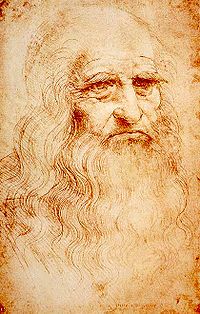
Leonardo Self
A polymath (Greek
Greek language

Greek is an Indo-European languages native to the southern Balkan peninsula, the language of the Greek people. It forms an independent branch within Indo-European....
 polymathes, p???µa???, "having learned much") is a person whose knowledge is not restricted to one subject area. In less formal terms, a polymath (or polymathic person) may simply refer to someone who is very knowledgeable. Most ancient scientists were polymaths by today’s standards.

The terms Renaissance Man and, less commonly, Homo Universalis (Latin for "universal man" or "man of the world") are related and used to describe a person who is well educated or who excels in a wide variety of subjects or fields. This idea developed in Renaissance Italy from the notion expressed by one of its most accomplished representatives, Leon Battista Alberti (1404–72): that “a man can do all things if he will.” It embodied the basic tenets of Renaissance Humanism
Humanism

Humanism is a broad category of ethics that affirm the dignity and worth of all people, based on the ability to determine right and wrong by appealing to universal human qualities, particularly rationalism, without resorting to the supernatural or alleged divine authority from religious texts....
 which considered man empowered, limitless in his capacities for development, and led to the notion that people should embrace all knowledge and develop their capacities as fully as possible. Thus the gifted men of the Renaissance sought to develop skills in all areas of knowledge, in physical development, in social accomplishments and in the arts.

Related terms


A different name for the secondary meaning of polymath is Renaissance Man (a term first recorded in written English in the early twentieth century). Other similar terms also in use are Homo universalis and Uomo Universale, which in Latin and Italian
Italian language

Italian is a Romance languages spoken by about 63 million people as a first language, primarily in Italy. In Switzerland, Italian is one of four Linguistic geography of Switzerlands....
, respectively, translate as "universal person" or "universal man". These expressions derived from the ideal in Renaissance Humanism that it was possible to acquire a universal learning in order to develop one's potential, (covering both the arts and the sciences and without necessarily restricting this learning to the academic fields). When someone is called a Renaissance
Renaissance

The Renaissance was a cultural movement that spanned roughly the 14th to the 17th century, beginning in Italy in the late Middle Ages and later spreading to the rest of Europe....
 Man today, it is meant that he does not just have broad interests or a superficial knowledge of several fields, but rather that his knowledge is profound, and often that he also has proficiency or accomplishments in at least some of these fields, and in some cases even at a level comparable to the proficiency or the accomplishments of an expert. The related term Generalist is used to contrast this general approach to knowledge to that of the specialist. The expression Renaissance man today commonly implies only intellectual or scholastic proficiency and knowledge and not necessarily the more universal sense of "learning" implied by the Renaissance Humanism. It is to note, however, that some dictionaries use the term Renaissance man as roughly synonymous with polymath in the first meaning, to describe someone versatile with many interests or talents, while others recognize a meaning which is restricted to the Renaissance era and more closely related to the Renaissance ideals.

The term Universal Genius is also used, taking Leonardo da Vinci
Leonardo da Vinci

Leonardo di ser Piero da Vinci was an Italy polymath, being a scientist, mathematician, engineer, inventor, anatomist, Painting, sculptor, architect, botanist, musician and writer....
 as a prime example again. The term seems to be used especially when a Renaissance man has made historical or lasting contributions in at least one of the fields in which he was actively involved and when he had a universality of approach. Despite the existence of this term, a polymath may not necessarily be classed as a genius
Genius

A genius is an individual who successfully applies a previously unknown technique in the production of a work of art, science or calculation, or who masters and personalizes a known technique....
; and certainly a genius may not display the breadth of knowledge to qualify as a polymath. Albert Einstein
Albert Einstein

Albert Einstein was a Germany-born theoretical physics. He is best known for his theory of relativity and specifically mass?energy equivalence, expressed by the equation E = mc2....
 and Marie Curie
Marie Curie

Marie Sklodowska Curie was a physicist and chemist of Poland upbringing and, subsequently, France citizenship. She was a pioneer in the field of radioactivity, the first person honored with two Nobel Prizes, and the first female professor at the University of Paris....
 are examples of people widely viewed as geniuses, but who are not generally considered to be polymaths.

Renaissance ideal

Many notable polymaths lived during the Renaissance
Renaissance

The Renaissance was a cultural movement that spanned roughly the 14th to the 17th century, beginning in Italy in the late Middle Ages and later spreading to the rest of Europe....
 period, a cultural movement that spanned roughly the fourteenth through the seventeenth century, beginning in Italy in the late Middle Ages and later spreading to the rest of Europe. They had a rounded approach to education
Education

File:Inukshuk Monterrey 1.jpgEducation can be seen as a product or a process and considered in a broad sense or a technical sense. According to philosophy of education George F....
 which was typical of the ideals of the humanists
Humanism

Humanism is a broad category of ethics that affirm the dignity and worth of all people, based on the ability to determine right and wrong by appealing to universal human qualities, particularly rationalism, without resorting to the supernatural or alleged divine authority from religious texts....
 of the time. A gentleman
Gentleman

The term gentleman , in its original and strict signification, denoted a man of good family, analogous to the Latin generosus . In this sense the word equates with the French gentilhomme , which latter term was in Great Britain long confined to the peerage....
 or courtier
Courtier

A courtier is a person who attends the noble court of a monarch or other Executive . Historically the court was the centre of government as well as the Official residence of the monarch, and social and political life were often completely mixed together....
 of that era was expected to speak several language
Language

A language is a form of symbol communication in which elements are combined to represents something other than themselves. Language can also refer to the use of such systems as a general phenomenon....
s, play a musical instrument
Musical instrument

A musical instrument is an object constructed or used for the purpose of making music. In principle, anything that produces sound can serve as a musical instrument....
, write poetry
Poetry

Poetry is a form of literature art in which language is used for its aesthetics and evocative qualities in addition to, or in lieu of, its apparent meaning ....
, and so on, thus fulfilling the Renaissance ideal
Ideal (ethics)

An ideal is a principle or Value that one actively pursues as a Objective . Ideals are particularly important in ethics, as the order in which one places them tends to determine the degree to which one reveals them as real and sincere....
. The idea of a universal education was pivotal to achieving polymath ability, hence the word University
University

A university is an institution of higher education and research, which grants academic degrees in a variety of subjects. A university provides both undergraduate education and postgraduate education....
 was used to describe a seat of learning. At this time Universities did not specialise in specific areas, but rather trained their students in a broad array of science
Science

In its broadest sense, science refers to any systematic knowledge or practice. In its more usual restricted sense, science refers to a system of acquiring knowledge based on scientific method, as well as to the organized body of knowledge gained through such research....
, philosophy
Philosophy

Philosophy is the study of general problems concerning matters such as existence, knowledge, truth, beauty, justice, validity, mind, and language....
 and theology
Theology

Theology is the study of the existence or attributes of a deity or gods, or more generally the study of religion or spirituality. It is sometimes contrasted with religious studies: theology is understood as the study of religion from an internal perspective , and religious studies as the study of religion from an external perspective....
. This universal education, as such, gave them a grounding from which they could continue into apprenticeship to a Master
Master

Master or Masters may refer to:...
 of their field of interest. It is important to note that a university education was highly regarded. A person was not considered to need this broad knowledge to apprentice as a carpenter
Carpenter

A carpenter is a skilled artisan who performs carpentry - a wide range of woodworking that includes constructing building construction, furniture, and other objects out of wood....
, but to apprentice in the sciences or philosophy it contributed hugely to their being able to comprehend the universe as it was understood at the time. During the Renaissance, Baldassare Castiglione
Baldassare Castiglione

Baldassare Castiglione, count of Novilara , was an Italy courtier, diplomat, soldier and a prominent Renaissance author....
, in his The Book of the Courtier
The Book of the Courtier

The Book of the Courtier was written by Baldassare Castiglione over the course of many years beginning in 1508 and published in 1528 just before he died....
, wrote a guide to being a polymath.

The Renaissance Ideal differed slightly from the "Polymath" in that it involved more than just intellectual advancement. Historically (roughly 1450–1600) it represented a person who endeavored to "develop his capacities as fully as possible" (Britannica
Encyclopædia Britannica

The Encyclop?dia Britannica is a general English language encyclopedia published by Encyclop?dia Britannica, Inc., a privately held company....
, "Renaissance Man") both mentally and physically. Being an accomplished athlete was considered integral and not separate from education and learning of the highest order. Example: Leon Battista Alberti, who was an architect, painter, poet, scientist, mathematician, inventor, sculptor, and also a skilled horseman and archer.

Partial list of polymaths


The following list provides examples of notable polymaths (in the secondary meaning only, that is, Renaissance men). Caution is necessary when interpreting the word polymath (in the second meaning or any of its synonyms) in a source, since there's always ambiguity of what the word denotes. Also, when a list of subjects in relation to the polymath is given, such lists often seem to imply that the notable polymath was reputable in all fields, but the most common case is that the polymath made his reputation in one or two main fields where he had widely recognized achievements, and that he was merely proficient or actively involved in other fields, but, once again, not necessarily with achievements comparable to those of renowned experts of his time in these fields. The list does not attempt to be comprehensive or authoritative in any way. The list also includes the Hakeem of the Islamic Golden Age
Islamic Golden Age

The Islamic Golden Age, also sometimes known as the Islamic Renaissance, was traditionally dated from the 700 A.D. to 1200 A.D.Common Era, but has been extended to the 15th and 16th centuries by some scholars....
 (also known as the "Islamic Renaissance"), and other polymaths from other parts of the world.

The following people represent prime examples of "Renaissance Men" and "universal geniuses", so to say "polymaths" in the strictest interpretation of the secondary meaning of the word.

  • Abu Rayhan al-Biruni (973–1048), a Persian
    Persian people

    Persian identity, at least in terms of language, is traced to the ancient Indo-Iranians , who arrived in parts of Greater Iran circa 2000-1500 BCE....
     scientist
    Islamic science

    Science in medival Islam, also known as Islamic science, is a term used in the history of science to refer to the science developed in the Muslim world between 7th and 16th centuries, a period also known as the Islamic Golden Age....
    , physicist
    Islamic physics

    Islamic physics refers to the study of physics within Islamic science, which flourished during the Islamic Golden Age, variously dated from the 8th century to the 16th century, when experimental physics, mathematical physics and theoretical physics were studied in the Muslim world....
    , anthropologist
    Anthropology

    Anthropology is the study of humans and humanity in its totality. Anthropology has origins in the natural sciences, and the humanities. In Great Britain it was originally divided into physical anthropology and cultural anthropology, which itself was divided into archaeology, technology, ethnology and sociology ....
    , astronomer
    Islamic astronomy

    In the history of astronomy, Islamic astronomy or Arabic astronomy refers to the astronomical developments made in the Islamic world, particularly during the Islamic Golden Age , and mostly written in the Arabic language....
    , astrologer
    Islamic astrology

    Islamic astrology, in Arabic ilm al-nujum or ilm al-falak, is the study of the heavens by early Muslims. In early Arabic sources, ilm al-nujum was used to refer to both Astrology and astronomy....
    , encyclopedist, geodesist
    Geodesy

    Geodesy , also called geodetics, a branch of earth sciences, is the scientific discipline that deals with the measurement and representation of the Earth, including its gravitational field, in a three-dimensional time-varying space....
    , geographer
    Geographer

    A geographer is a scientist whose area of study is geography, the study of Earth's physical natural environment and human habitat .Though geographers are historically known as people who make maps, map making is actually the field of study of cartography, a subset of geography....
    , geologist
    Geology

    Geology is the science and study of the solid and liquid matter that constitute the Earth. The field of geology encompasses the study of the composition, structural geology, physical properties, dynamics, and History of the Earth of Earth materials, and the processes by which they are formed, moved, and changed....
    , historian
    Historiography of early Islam

    The historiography of early Islam refers to the study of the early origins of Islam based on a critical analysis, evaluation, and examination of authentic primary sources materials and the organization of these sources into a narrative timeline....
    , mathematician
    Islamic mathematics

    Mathematics in medieval Islam or sometimes referred to as Islamic mathematics is a term used in the history of mathematics that refers to the mathematics developed in the Muslim world between 622 and 1600, in the part of the world where Islam was the dominant religion....
    , natural historian
    Natural history

    Natural history is the scientific research of plants or animals, leaning more towards the observational than experimental methods of study, and encompasses more research that is published in magazines than in academic journals....
    , pharmacist, physician
    Islamic medicine

    In the history of medicine, Islamic medicine or Arabic medicine refers to medicine developed in the Islamic Golden Age and written in Arabic language, the lingua franca of the Islamic civilization....
    , philosopher
    Early Islamic philosophy

    Early Islamic philosophy or classical Islamic philosophy is a period of intense philosophical development beginning in the 2nd century AH of the Islamic calendar and lasting until the 6th century AH ....
    , scholar
    Ulema

    Ulema refers to the educated class of Muslim legal scholars engaged in the several fields of Islamic studies. They are best known as the arbiters of Sharia law....
    , teacher
    Teacher

    In education, a teacher is a person who teaches. A teacher who teaches an individual student may also be described as a personal tutor.The role of teacher is often formal and ongoing, carried out by way of Occupation or Profession at a school or other place of formal education....
    , Ash'ari
    Ash'ari

    The Ash?ari theology is a school of early Kalam founded by the theologian Abu al-Hasan al-Ash'ari . The disciples of the school are known as Ash'arites, and the school is also referred to as Ash'arite school....
     theologian
    Kalam

    Kalam is the Islamic philosophy of seeking Islamic theology principles through dialectic. In Arabic language the word literally means "speech"....
    , and traveller; "al-Biruni was a polymath and traveler (to India
    History of India

    The known history of India begins with the Indus Valley Civilization, which spread and flourished in the north-western part of the Indian subcontinent, from c....
    ) who introduced Indian scientific knowledge & thought to the Middle East & the West, making contributions in mathematics, geography and geology, natural history, calendars and astronomy"; "al-Biruni, a scholar in many disciplines - from linguistics
    Linguistics

    Linguistics is the science study of natural language. Linguistics encompasses a number of sub-fields. An important topical division is between the study of language structure and the study of Meaning ....
     to mineralogy
    Mineralogy

    Mineralogy is an Earth Science focused around the chemistry, crystal structure, and physical properties of minerals. Specific studies within mineralogy include the processes of mineral origin and formation, classification of minerals, their geographical distribution, as well as their utilization....
     - and perhaps medieval Uzbekistan
    Uzbekistan

    Uzbekistan, officially the Republic of Uzbekistan , is a Landlocked_country#Doubly_landlocked_country country in Central Asia, formerly part of the Soviet Union....
    's most universal genius."


  • Abbas Ibn Firnas
    Abbas Ibn Firnas

    Abbas Ibn Firnas , also known as Abbas Qasim Ibn Firnas and ?????? ?? ????? , was an Arabic-speaking Berber people, born in Izn-Rand Onda, al-Andalus , who lived in the Umayyad Caliph of Cordoba in al-Andalus....
     (Armen Firman)
    (810–887), an Andalusian
    Al-Andalus

    Al-Andalus was the Arabic name given to the parts of the Iberian Peninsula governed by Arab Muslims, at various times in the period between 711 and 1492....
     Berber
    Berber people

    Berbers are the indigenous ethnic groups of North Africa west of the Nile Valley. They are discontinuously distributed from the Atlantic to the Siwa oasis, in Egypt, and from the Mediterranean to the Niger River....
     aviator, inventor, engineer, technologist, chemist
    Alchemy and chemistry in Islam

    Alchemy and chemistry in Islam refers to the study of both traditional alchemy and early practical chemistry by Islamic science in the Islamic Golden Age....
    , humanitarian
    Islamic ethics

    Islamic ethics , defined as "good character," historically took shape gradually from the 7th century and was finally established by the 11th century....
    , musician
    Islamic music

    Islamic music is Muslim religious music, as sung or played in public services or private devotions. The classic heartland of Islam is Arabia and the Middle East, North Africa and Egypt, Iran, Central Asia, India, Pakistan, and Afghanistan....
    , physician
    Islamic medicine

    In the history of medicine, Islamic medicine or Arabic medicine refers to medicine developed in the Islamic Golden Age and written in Arabic language, the lingua franca of the Islamic civilization....
     and poet
    Arabic poetry

    Arabic poetry is the earliest form of Arabic literature. Our present knowledge of poetry in Arabic dates from the 6th century, but oral poetry is believed to predate that....
    ; "Ibn Firnas was a polymath: a physician, a rather bad poet, the first to make glass
    Glass

    Glass generally refers to a Hardness, brittle, transparency amorphous solid, such as that used for windows, many Glass Bottles, or eyewear, including, but not limited to, soda-lime glass, borosilicate glass, acrylic glass, sugar glass, Muscovite , or aluminium oxynitride....
     from stones
    Silicon dioxide

    The chemical compound 'silicon dioxide', also known as 'silica' , is an oxide of silicon with a chemical formula of and has been known for its hardness since antiquity....
     (quartz
    Fused quartz

    Fused quartz and fused silica are types of glass containing primarily silica in amorphous solid form. They are manufactured using several different processes....
    ?), a student of music, and inventor of some sort of metronome
    Metronome

    A metronome is any device that produces a regulated aural, visual or tactile pulse to establish a steady tempo in the performance of music. It is a useful practice tool for musicians that dates back to the early 19th century....
    "; "had he lived in the Florence
    Florence

    Florence is the Capital city of the Italy Regions of Italy of Tuscany and of the provinces of Italy Province of Florence. It is the most populous city in Tuscany and has a population of 364,779 ....
     of the Medici
    Medici

    The M?dici family was a powerful and influential Florence family from the 14th to 18th century. The family had three popes , numerous rulers of Florence and later members of the French and English royalty....
    , [Abbas ibn Firnas] would have been a “Renaissance man”."


  • Galileo Galilei
    Galileo Galilei

    Galileo Galilei was a Grand Duchy of Tuscany physicist, mathematician, astronomer, and philosopher who played a major role in the Scientific Revolution....
     (1564–1642), "Italian scientist, physicist, and philosopher. Galileo was a true Renaissance man, excelling at many different endeavors, including lute playing and painting."


  • Johann Wolfgang von Goethe
    Johann Wolfgang von Goethe

    was a Germans writer and according to George Eliot, "Germany's greatest man of letters? and the last true polymath to walk the earth." Goethe's works span the fields of poetry, drama, literature, theology, philosophy, humanism and science....
     (1749–1832) "Germany's greatest man of letters—poet, critic, playwright, and novelist—and the last true polymath to walk the earth" "Goethe comes as close to deserving the title of a universal genius as any man who has ever lived". "He was essentially the last great European Renaissance man." His gifts included incalculable contributions to the areas of German literature and the natural sciences. He is credited with discovery of a bone in the human jaw, and proposed a theory of colors. He has a mineral named in his honor, goethite
    Goethite

    Goethite, named after the Germany polymath Johann Wolfgang von Goethe, is an iron bearing oxide mineral found in soil and other low-temperature environments....
    . He molded the aesthetic properties of the Alps to poetry, thus, changing the local belief from "perfectly hideous" and an "unavoidable misery," to grandeur of the finest most brilliant creation.


  • Ibn al-Haytham (Alhazen) (965–1039), an Iraq
    Iraq

    Iraq , officially the Republic of Iraq , is a country in Western Asia spanning most of the northwestern end of the Zagros Mountains, the eastern part of the Syrian Desert and the northern part of the Arabian Desert....
    i Arab
    Arab

    An Arab is a person who Identity as such on linguistic or cultural grounds. The plural form, Arabs , refers to the Ethnocultural group at large....
    /Persian
    Persian people

    Persian identity, at least in terms of language, is traced to the ancient Indo-Iranians , who arrived in parts of Greater Iran circa 2000-1500 BCE....
     scientist
    Islamic science

    Science in medival Islam, also known as Islamic science, is a term used in the history of science to refer to the science developed in the Muslim world between 7th and 16th centuries, a period also known as the Islamic Golden Age....
    , physicist
    Islamic physics

    Islamic physics refers to the study of physics within Islamic science, which flourished during the Islamic Golden Age, variously dated from the 8th century to the 16th century, when experimental physics, mathematical physics and theoretical physics were studied in the Muslim world....
    , anatomist, physician, psychologist
    Islamic medicine

    In the history of medicine, Islamic medicine or Arabic medicine refers to medicine developed in the Islamic Golden Age and written in Arabic language, the lingua franca of the Islamic civilization....
    , astronomer
    Islamic astronomy

    In the history of astronomy, Islamic astronomy or Arabic astronomy refers to the astronomical developments made in the Islamic world, particularly during the Islamic Golden Age , and mostly written in the Arabic language....
    , engineer inventor, mathematician
    Islamic mathematics

    Mathematics in medieval Islam or sometimes referred to as Islamic mathematics is a term used in the history of mathematics that refers to the mathematics developed in the Muslim world between 622 and 1600, in the part of the world where Islam was the dominant religion....
    , ophthalmologist
    Ophthalmology in medieval Islam

    Ophthalmology was one of the foremost branches in medieval Islamic medicine. The oculist or kahhal , a somewhat despised professional in Galen?s time, was an honored member of the medical profession by the Abbasid period, occupying a unique place in royal households....
    , philosopher
    Early Islamic philosophy

    Early Islamic philosophy or classical Islamic philosophy is a period of intense philosophical development beginning in the 2nd century AH of the Islamic calendar and lasting until the 6th century AH ....
    , and Ash'ari
    Ash'ari

    The Ash?ari theology is a school of early Kalam founded by the theologian Abu al-Hasan al-Ash'ari . The disciples of the school are known as Ash'arites, and the school is also referred to as Ash'arite school....
     theologian
    Kalam

    Kalam is the Islamic philosophy of seeking Islamic theology principles through dialectic. In Arabic language the word literally means "speech"....
    ; "a devout, brilliant polymath"; "a great man and a universal genius, long neglected even by his own people"; "Ibn al-Haytham provides us with the historical personage of a versatile universal genius."


  • Thomas Jefferson
    Thomas Jefferson

    Thomas Jefferson was the List of Presidents of the United States President of the United States , the principal author of the United States Declaration of Independence , and one of the most influential Founding Fathers of the United States for his promotion of the ideals of republicanism in the United States....
     (1743–1826). Jefferson, the third President of the United States, was "the walking, talking embodiment of the Enlightenment, a polymath whose list of achievements is as long as it is incredibly varied.". At a dinner honoring Nobel laureates, John F. Kennedy
    John F. Kennedy

    John Fitzgerald "Jack" Kennedy , often referred to by his initials JFK, was the List of Presidents of the United States President of the United States, serving from 1961 until John F....
     famously said "I think this is the most extraordinary collection of talent, of human knowledge, that has ever been gathered together in the White House—with the possible exception of when Thomas Jefferson dined alone."


  • Ibn Khaldun
    Ibn Khaldun

    Ibn Khaldun or Ibn Khaldoun...
     (1332–1406), an Arab social scientist, sociologist
    Early Muslim sociology

    Medieval Islamic sociology refers to the study of sociology and the social sciences in the Islamic Golden Age. Early Islamic sociology responded to the challenges of social organization of diverse peoples all under common religious organization in the Islamic Caliphate, including the Rashidun Caliphate, Umayyad Caliphate, Abbasid Caliphate an...
    , historian, historiographer, philosopher of history
    Historiography of early Islam

    The historiography of early Islam refers to the study of the early origins of Islam based on a critical analysis, evaluation, and examination of authentic primary sources materials and the organization of these sources into a narrative timeline....
    , demographer
    Demography

    Demography is the statistical study of all populations. It can be a very general science that can be applied to any kind of dynamic population, that is, one that changes over time or space ....
    , economist
    Islamic economics in the world

    Islamic economic jurisprudence in practice, or Economics policies supported by self-identified Islamic groups, has varied throughout its long history....
    , linguist
    Arabic grammar

    Arabic is a Semitic languages language. See Arabic language for more information on the language in general. This article describes the grammar of Classical Arabic and Modern Standard Arabic - the Arabic grammar ....
    , philosopher
    Early Islamic philosophy

    Early Islamic philosophy or classical Islamic philosophy is a period of intense philosophical development beginning in the 2nd century AH of the Islamic calendar and lasting until the 6th century AH ....
    , political theorist
    Political philosophy

    Political philosophy is the study of questions about the city, government, politics, liberty, justice, property, rights, law and the enforcement of a legal code by authority: what they are, why they are needed, what makes a The purpose of government, what rights and freedoms it should protect and why, what form it should take and why, what t...
    , military theorist, Islamic scholar
    Ulema

    Ulema refers to the educated class of Muslim legal scholars engaged in the several fields of Islamic studies. They are best known as the arbiters of Sharia law....
    , Ash'ari
    Ash'ari

    The Ash?ari theology is a school of early Kalam founded by the theologian Abu al-Hasan al-Ash'ari . The disciples of the school are known as Ash'arites, and the school is also referred to as Ash'arite school....
     theologian
    Kalam

    Kalam is the Islamic philosophy of seeking Islamic theology principles through dialectic. In Arabic language the word literally means "speech"....
    , diplomat and statesman
    Statesman

    A statesman or stateswoman or statesperson is usually a politician or other notable figure of state who has had a long and respected career in politics at the national and international level....
    ; "a still-influential polymath"; "in any epoch ibn Khaldun (1332–1406) would deserve the accolade Renaissance man, a person of many talents and diverse interests."


  • Gottfried Leibniz
    Gottfried Leibniz

    Gottfried Wilhelm Leibniz was a Germany polymath who wrote primarily in Latin and French language.He occupies an equally grand place in both the history of philosophy and the history of mathematics....
     (1646–1716); "Leibniz was a polymath who made significant contributions in many areas of physics, logic, mathematics, history, librarianship, and of course philosophy and theology, while also working on ideal languages, mechanical clocks, mining machinery..." "A universal genius if ever there was one, and an inexhaustible source of original and fertile ideas, Leibniz was all the more interested in logic because it ..." "Gottfried Wilhelm Leibniz was maybe the last Universal Genius incessantly active in the fields of theology, philosophy, mathematics, physics, ...." "Leibniz was perhaps the last great Renaissance man who in Bacon's words took all knowledge to be his province."


  • Isaac Newton
    Isaac Newton

    Sir Isaac Newton, Fellow of the Royal Society was an English people physicist, mathematician, Astronomy, Natural philosophy, Alchemy, and Theology and one of the the 100 in human history....
     (1643–1727) was an English physicist
    Physicist

    A physicist is a scientist who studies or practices physics. Physicists study a wide range of physical phenomena in many Physics#Major fields of physics spanning all length scales: from atom particles of which all ordinary matter is made to the behavior of the material Universe as a whole ....
    , mathematician
    Mathematician

    A mathematician is a person whose primary area of study and/or research is the field of mathematics....
    , astronomer
    Astronomer

    An astronomer is a scientist who studies Celestial body such as planets, stars, and Galaxy.Historically, astronomy was more concerned with the classification and description of phenomena in the sky, while astrophysics attempted to explain these phenomena and the differences between them using physical laws....
    , theologian, natural philosopher and alchemist
    Alchemy

    Alchemy , a part of the Occult Tradition, is both a philosophy and a practice with an aim of achieving ultimate wisdom as well as immortality, involving the improvement of the alchemist as well as the making of several substances described as possessing unusual properties....
    . His treatise Philosophiae Naturalis Principia Mathematica
    Philosophiae Naturalis Principia Mathematica

    The Philosophi? Naturalis Principia Mathematica is a three-volume work by Isaac Newton published on 5 July 1687. It contains the statement of Newton's laws of motion forming the foundation of classical mechanics, as well as his Newton's law of universal gravitation and a derivation of Kepler's laws of planetary motion for the motion of...
    , published in 1687, described universal gravitation and the three laws of motion
    Newton's laws of motion

    Newton's laws of motion are three physical laws that form the basis for classical mechanics, Direct relationship the forces acting on a Physical body to the motion of the body....
    , laying the groundwork for classical mechanics
    Classical mechanics

    Classical mechanics is used for describing the motion of macroscopic objects, from projectiles to parts of machinery, as well as astronomical objects, such as spacecraft, planets, stars, and galaxies....
    , which dominated the scientific view of the physical universe for the next three centuries and is the basis for modern engineering. In a 2005 poll of the Royal Society
    Royal Society

    The Royal Society of London for the Improvement of Natural Knowledge, known simply as the Royal Society, or even the Royal, is a learned society for science that was founded in 1660 and is considered by most to be the oldest such society still in existence....
     of who had the greatest effect on the history of science
    History of science

    Science is a body of empirical knowledge, theory, and Procedural knowledge knowledge about the Nature, produced by a global community of researchers making use of scientific methods, which emphasize the observation, experimentation and scientific explanation of real world phenomenon....
    , Newton was deemed more influential than Albert Einstein
    Albert Einstein

    Albert Einstein was a Germany-born theoretical physics. He is best known for his theory of relativity and specifically mass?energy equivalence, expressed by the equation E = mc2....
    . "When we see Newton as a late Renaissance man, his particular addiction to classical geometry as ancient wisdom and the most reliable way of unveiling the secrets of nature, seems natural."


  • Jules Henri Poincaré
    Henri Poincaré

    Jules Henri Poincar? was a French mathematician and theoretical physicist, and a philosophy of science. Poincar? is often described as a polymath, and in mathematics as The Last Universalist, since he excelled in all fields of the discipline as it existed during his lifetime....
     (1854 –1912) was a French mathematician and theoretical physicist, and a philosopher of science. Poincaré is often described as a polymath, and in mathematics as The Last Universalist, since he excelled in all fields of the discipline as it existed during his lifetime.


  • Ibn Rushd
    Averroes

    Abu 'l-Walid Mu?ammad ibn A?mad ibn Rushd , better known just as Ibn Rushd , and in European literature as Averroes , was an Al-Andalus-Arab Muslim polymath: a master of early Islamic philosophy, Islamic theology, Maliki Sharia and Fiqh, Logic in Islamic philosophy, Psychology in medieval Islam, Arabic music theory, and the Scien...
     (Averroes)
    (1126–1198), an Andalusian
    Al-Andalus

    Al-Andalus was the Arabic name given to the parts of the Iberian Peninsula governed by Arab Muslims, at various times in the period between 711 and 1492....
     Arab
    Arab

    An Arab is a person who Identity as such on linguistic or cultural grounds. The plural form, Arabs , refers to the Ethnocultural group at large....
     philosopher
    Early Islamic philosophy

    Early Islamic philosophy or classical Islamic philosophy is a period of intense philosophical development beginning in the 2nd century AH of the Islamic calendar and lasting until the 6th century AH ....
    , doctor, physician
    Islamic medicine

    In the history of medicine, Islamic medicine or Arabic medicine refers to medicine developed in the Islamic Golden Age and written in Arabic language, the lingua franca of the Islamic civilization....
    , jurist, lawyer
    Sharia

    Sharia is the body of Islamic religious law. The term means "way" or "path to the water source"; it is the legal framework within which the public and private aspects of life are regulated for those living in a legal system based on Fiqh and for Muslims living outside the domain....
    , astronomer
    Islamic astronomy

    In the history of astronomy, Islamic astronomy or Arabic astronomy refers to the astronomical developments made in the Islamic world, particularly during the Islamic Golden Age , and mostly written in the Arabic language....
    , mathematician
    Islamic mathematics

    Mathematics in medieval Islam or sometimes referred to as Islamic mathematics is a term used in the history of mathematics that refers to the mathematics developed in the Muslim world between 622 and 1600, in the part of the world where Islam was the dominant religion....
    , and theologian
    Theology

    Theology is the study of the existence or attributes of a deity or gods, or more generally the study of religion or spirituality. It is sometimes contrasted with religious studies: theology is understood as the study of religion from an internal perspective , and religious studies as the study of religion from an external perspective....
    ; "Ibn-Rushd, a polymath also known as Averroes"; "Doctor, Philosopher, Renaissance Man."


  • Abu Ali ibn Sina (Avicenna) (980–1037), a Persian
    Persian people

    Persian identity, at least in terms of language, is traced to the ancient Indo-Iranians , who arrived in parts of Greater Iran circa 2000-1500 BCE....
     physician, pharmacologist
    Islamic medicine

    In the history of medicine, Islamic medicine or Arabic medicine refers to medicine developed in the Islamic Golden Age and written in Arabic language, the lingua franca of the Islamic civilization....
    , philosopher, metaphysician
    Early Islamic philosophy

    Early Islamic philosophy or classical Islamic philosophy is a period of intense philosophical development beginning in the 2nd century AH of the Islamic calendar and lasting until the 6th century AH ....
    , aromatherapist
    Aromatherapy

    Aromatherapy is a form of alternative medicine that uses volatile liquid plant materials, known as essential oils , and other aromatic compounds from plants for the purpose of affecting a person's mood or health....
    , astronomer
    Islamic astronomy

    In the history of astronomy, Islamic astronomy or Arabic astronomy refers to the astronomical developments made in the Islamic world, particularly during the Islamic Golden Age , and mostly written in the Arabic language....
    , chemist, Hanafi
    Hanafi

    The Hanafi school is the oldest of the four schools of law or jurisprudence within Sunni Islam. The Hanafi madhhab is named after its founder, Abu Hanifa an-Nu?man ibn Thabit , and his legal views were preserved primarily by his two most important disciples, Abu Yusuf and Muhammad al-Shaybani....
     jurist
    Fiqh

    Fiqh is Islamic jurisprudence. Fiqh is an expansion of the Sharia Islamic law?based directly on the Quran and Sunnah?that complements Shariah with evolving Fatwa/interpretations of Ulema....
     and theologian
    Kalam

    Kalam is the Islamic philosophy of seeking Islamic theology principles through dialectic. In Arabic language the word literally means "speech"....
    , physicist
    Islamic physics

    Islamic physics refers to the study of physics within Islamic science, which flourished during the Islamic Golden Age, variously dated from the 8th century to the 16th century, when experimental physics, mathematical physics and theoretical physics were studied in the Muslim world....
    , scientist
    Islamic science

    Science in medival Islam, also known as Islamic science, is a term used in the history of science to refer to the science developed in the Muslim world between 7th and 16th centuries, a period also known as the Islamic Golden Age....
    , and universalist
    Universalism

    Universalism refers to theological religion, theology and philosophy concepts with universal application or applicability. It is a term used to identify particular doctrines as considering of all people in their formation....
    ; "The Persian polymath-physician Avicenna"; "Avicenna (973–1037) was a sort of universal genius, known first as a physician. To his works on medicine he afterward added religious tracts, poems
    Islamic poetry

    Islamic poetry is poetry written by Muslims on the topic of Islam. Islamic poetry has been written in many languages....
    , works on philosophy
    Early Islamic philosophy

    Early Islamic philosophy or classical Islamic philosophy is a period of intense philosophical development beginning in the 2nd century AH of the Islamic calendar and lasting until the 6th century AH ....
    , on logic
    Logic in Islamic philosophy

    Logic played an important role in early Islamic philosophy, making logic in Islamic philosophy an important branch of study in the history of logic....
    , as physics
    Islamic physics

    Islamic physics refers to the study of physics within Islamic science, which flourished during the Islamic Golden Age, variously dated from the 8th century to the 16th century, when experimental physics, mathematical physics and theoretical physics were studied in the Muslim world....
    , on mathematics
    Islamic mathematics

    Mathematics in medieval Islam or sometimes referred to as Islamic mathematics is a term used in the history of mathematics that refers to the mathematics developed in the Muslim world between 622 and 1600, in the part of the world where Islam was the dominant religion....
    , and on astronomy
    Islamic astronomy

    In the history of astronomy, Islamic astronomy or Arabic astronomy refers to the astronomical developments made in the Islamic world, particularly during the Islamic Golden Age , and mostly written in the Arabic language....
    . He was also a statesman
    Statesman

    A statesman or stateswoman or statesperson is usually a politician or other notable figure of state who has had a long and respected career in politics at the national and international level....
     and a soldier
    Soldier

    A soldier is a general English term that refers to a land component of national armed forces.In most societies of the world, "soldier" is also a general term for any member of the land forces including Commissioned officer and non-commissioned officers....
    ."


  • Leonardo da Vinci
    Leonardo da Vinci

    Leonardo di ser Piero da Vinci was an Italy polymath, being a scientist, mathematician, engineer, inventor, anatomist, Painting, sculptor, architect, botanist, musician and writer....
     (1452–1519) "In Leonardo Da Vinci, of course, he had as his subject not just an ordinary Italian painter, but the prototype of the universal genius, the 'Renaissance man,' ..."; "prodigious polymath.... Painter, sculptor, engineer, astronomer, anatomist, biologist, geologist, physicist, architect, philosopher, actor, singer, musician, humanist."


Renaissance ideal today

During the Renaissance, the ideal of Renaissance humanism
Renaissance humanism

Renaissance humanism was a European intellectual movement that was a crucial component of the Renaissance, beginning in Florence in the last years of the 14th century....
 included the acquisition of almost all available important knowledge. At that time, several universal geniuses seem to have come close to that ideal, with actual achievements in multiple fields. With the passage of time however, "universal learning" has begun to appear ever more self-contradictory. For example, a famous dispute between "Jacob Burckhardt
Jacob Burckhardt

Carl Jacob Christoph Burckhardt was a Switzerland historian of art history and cultural history, and an influential figure in the historiography of each field....
 (whose Die Kultur der Renaissance in Italien of 1860 established Alberti as the prototype of the Renaissance Man) and Julius von Schlosser (whose Die Kunstliteratur of 1924 expresses discontent with Burckhardt's assessments on several counts)" deals with the issue of whether Alberti was indeed a dilettante or an actual Universal Man; while an 1863 article about rhetoric said, for instance: "an universal genius is not likely to attain to distinction and to eminence in any thing [sic
SIC

Sic is a Latin word that means "thus" or, in writing, "it was thus in the source material".Sic may also refer to:* Sic, Cluj, a commune in Romania...
]. To achieve her best results, and to produce her most matured fruit, Genius must bend all her energies in one direction; strive for one object; keep her brain and hand upon one desired purpose and aim".

Since it is considered extremely difficult to genuinely acquire an encyclopaedic knowledge, and even more to be proficient in several fields at the level of an expert (see expertise about research in this area), not to mention to achieve excellence or recognition in multiple fields, the word polymath, in both senses, may also be used, often ironically, with a potentially negative connotation as well. Under this connotation, by sacrificing depth for breadth, the polymath becomes a "jack of all trades, master of none
Jack of all trades, master of none

"Jack of all trades, master of none" is a figure of speech used in reference to a person who is competent with many skills but is not outstanding in any particular one....
". For many specialists, in the context of today's hyperspecialization, the ideal of a Renaissance man is judged to be an anachronism
Anachronism

An anachronism is an error in chronology, especially a chronological misplacing of persons, events, objects, or customs in regard to each other....
, since it is not uncommon that a specialist can barely dominate the accumulated knowledge of more than just one restricted subfield in his whole life, and many renowned experts have been made famous only for dominating different subfields or traditions or for being able to integrate the knowledge of different subfields or traditions.

Today, expertise is often associated with documents, certifications, diplomas, and degrees attributing to such, and a person who seems to have an abundance of these is often perceived as having more education than practical "working" experience. Autodidactic polymaths often combine didactic education and expertise in multiple fields with autodidactic research and experience to create the Renaissance ideal.

Many fields of interest take years of singleminded devotion to achieve expertise, often requiring starting at an early age. Also, many require cultural familiarity that may be inaccessible to someone not born and raised in that culture. In many such cases, it is realistically possible to achieve only knowledge of theory
Theory

For a more detailed account of theories as expressed in formal language as they are studied in mathematical logic see Theory A theory, in the general sense of the word, is an analytic structure designed to explain a set of observations....
, without practical experience. For example, on a safari
Safari

A safari is an overland journey. It usually refers to a trip by tourists to Africa, traditionally for a Big Five game Hunting#Safari; today the term often refers to a trip taken not for the purposes of hunting, but to observe and photograph big game and other wildlife....
, a jungle native will be a more effective guide than a scientist who may be educated in the theories of jungle survival but did not grow up acquiring his knowledge first-hand.

However, those supporting the ideal of the Renaissance man today would say that the specialist's understanding of the interrelation of knowledge from different fields is too narrow and that a synthetic comprehension of different fields is unavailable to him, or, if they embrace the Renaissance ideal even more deeply, that the human development of the specialist is truncated by the narrowness of his view. What is much more common today than the universal approach to knowledge from a single polymath, is the multidisciplinary approach to knowledge which derives from several experts from different fields collaborating together.

Polymath and polyhistor
Polyhistor

A polyhistor is a person of great erudition whose knowledge spans many fields. The definition includes having both an expert level of knowledge in diverse specific fields and broad general knowledge....
 compared

Many dictionaries
Dictionary

A dictionary is a book of Alphabetical order listed words in a specific language, with definitions, etymologies, pronunciations, and other information; or a book of alphabetically listed words in one language with their equivalents in another, also known as a lexicon....
 of word origins list these words as synonym
Synonym

Synonyms are different words with identical or very similar meanings. Words that are synonyms are said to be synonymous, and the state of being a synonym is called synonymy....
s or, as words with very similar meanings. Thomas Moore
Thomas Moore

Thomas Moore was an Irishman poet, singer, songwriter, and entertainer, now best remembered for the lyrics of The Minstrel Boy and the The Last Rose of Summer....
 took the words as corresponding to similarly erudite "polys" in one of his poems:
Off I fly, careering far
In chase of Pollys, prettier far
Than any of their namesakes are
—The Polymaths and Polyhistors,
Polyglots and all their sisters.


According to the Oxford English Dictionary
Oxford English Dictionary

The Oxford English Dictionary , published by the Oxford University Press , is a comprehensive dictionary of the English language. Two fully-bound print editions of the OED have been published under its current name, in 1928 and 1989; as of December 2008 the dictionary's current editors have completed a quarter of the third edition....
, the words mean practically the same; "the classical Latin word polyhistor was used exclusively, and the Greek word frequently, of Alexander Polyhistor
Alexander Polyhistor

Lucius Cornelius Alexander Polyhistor was a Ancient Greece scholar who was enslaved by the Ancient Rome during the Mithridatic War and taken to Rome as a tutor....
", but polymathist appeared later, and then polymath. Thus today, regardless of any differentiation they may have had when originally coined, they are often taken to mean the same thing.

The root terms histor and math have similar meanings in their etymological antecedents (to learn, learned, knowledge), though with some initial and ancillarily added differing qualities. Innate in historía (Greek
Greek language

Greek is an Indo-European languages native to the southern Balkan peninsula, the language of the Greek people. It forms an independent branch within Indo-European....
 and Latin) is that the learning takes place via inquiry
Inquiry

Inquiry is any process that has the aim of augmenting knowledge, resolving doubt, or solving a problem. A theory of inquiry is an account of the various types of inquiry and a treatment of the ways that each type of inquiry achieves its aim....
 and narrative
Narrative

A narrative or story that is created in a constructive format that describes a sequence of fictional or Non-fiction events. It derives from the Latin language verb narrare, which means "to recount" and is related to the adjective gnarus, meaning "knowing" or "skilled"....
. Hístor also implies that the polyhistor
Polyhistor

A polyhistor is a person of great erudition whose knowledge spans many fields. The definition includes having both an expert level of knowledge in diverse specific fields and broad general knowledge....
 displays erudition
Erudition

The word erudition came into Middle English from Latin . A scholar is erudite when instruction and reading followed by digestion and contemplation have effaced all rudeness , that is to say smoothed away all raw, untrained incivility....
 and wisdom. From Proto-Indo-European
Proto-Indo-European language

The Proto-Indo-European language is the unattested, linguistic reconstruction common ancestor of the Indo-European languages, spoken by the Proto-Indo-Europeans....
 it shares a root with the word "wit". Inquiry and narrative are specific sets of pedagogical and research heuristics.

Polyhistoric is the corresponding adjective. The word polyhistory (meaning varied learning), when used, is often derogatory.

List of recognized polymaths


The following people have been described as "polymaths" by reliable sources—fulfilling the primary definition of the term—although there may not be expert consensus that each is a prime example in the secondary meaning, as "renaissance men" and "universal geniuses" (see Some Renaissance Men above for prime examples of "renaissance men" or "universal geniuses").

  • Imhotep
    Imhotep

    Imhotep , 27th century BC was an Egyptians polymath, who served under the third dynasty of Egypt king, Djoser, as chancellor to the pharaoh and high priest of the sun god Ra at Heliopolis ....
     (fl. 2650–2611 BC); Egyptian
    Egyptians

    Egyptians is the name of the nationality and Mediterranean North African ethnic group native to Egypt.Egyptian identity is closely tied to the Geography of Egypt, dominated by the lower Nile Valley, the small strip of cultivable land stretching from the Cataracts of the Nile to the Mediterranean Sea and enclosed by desert both to the Easte...
     chancellor
    Chancellor

    Chancellor or chancellour is an official title used in countries whose civilization has arisen directly or indirectly out of the Roman Empire....
    , physician
    Ancient Egyptian medicine

    Ancient Egyptian Medicine refers to the practices of medicine common in Ancient Egypt from circa 33rd century BC until the Achaemenid Empire invasion of 523 BC....
    , and architect
    Ancient Egyptian architecture

    The Nile valley has been the site of one of the most influential civilizations which developed a vast array of diverse structures encompassing ancient Egyptian architecture....
    ; "Imhotep, circa 2650 BCE (who was revered as being at least semi-divine until the Late Period
    Late Period of Ancient Egypt

    The Late Period of Egypt refers to the last flowering of native Egyptian rulers after the Third Intermediate Period from the 26th Saite Dynasty into Persian Empire History of Egypt under Achaemenid Persian domination and ended with the death of Alexander the Great....
    , although some of this reverence may be due to his status as physician and all-round polymath)."


  • Pythagoras
    Pythagoras

    Pythagoras of Samos was an Ionians Ancient Greeks mathematician and founder of the religious movement called Pythagoreanism. He is often revered as a great mathematician, mysticism and scientist; however some have questioned the scope of his contributions to mathematics and natural philosophy....
     (c.580–c.490 BC), a Greek
    Ancient Greece

    The term Ancient Greece refers to the period of History of Greece lasting from the Greek Dark Ages ca. 1100 BC and the Dorian invasion, to 146 BC and the Roman Republic conquest of Greece after the Battle of Corinth ....
     mathematician and philosopher of 6th century BC who founded a school and a philosophical system, Pythagoreanism
    Pythagoreanism

    Pythagoreanism is a term used for the esoteric and metaphysics beliefs held by Pythagoras and his followers, the Pythagoreans, who were much influenced by mathematics and probably a very inspirational source for Plato and Platonism....
    , named after him. Pythagoras was thought to be a polymath by his contemporaries. He is sometimes credited with coining the term "philosopher", literally a "lover of wisdom," and considered among the first to follow this vocation.


  • Aristotle
    Aristotle

    Aristotle was a Greeks philosopher, a student of Plato and teacher of Alexander the Great. He wrote on many subjects, including physics, metaphysics, Poetics , theater, music, logic, rhetoric, politics, government, ethics, biology and zoology....
     (384–322 BC); a Greek
    Ancient Greece

    The term Ancient Greece refers to the period of History of Greece lasting from the Greek Dark Ages ca. 1100 BC and the Dorian invasion, to 146 BC and the Roman Republic conquest of Greece after the Battle of Corinth ....
     philosopher, a student of Plato
    Plato

    Plato , was a Classical Greece Greeks philosopher, mathematician, writer of philosophical dialogues, and founder of the Platonic Academy in Ancient Athens, the first institution of higher learning in the western world....
     and teacher of Alexander the Great
    Alexander the Great

    Alexander the Great , also known as Alexander III of Macedon was an ancient Greeks King of Macedon . He was one of the most successful military commanders of all time and is presumed undefeated in battle....
    . He wrote on many subjects, including physics, metaphysics
    Metaphysics

    Metaphysics investigates principles of reality transcending those of any particular science. cosmology and ontology are traditional branches of metaphysics....
    , poetry, theater, music, logic, rhetoric, politics, government, ethics, biology and zoology. He numbers among the greatest polymaths of all time. "Aristotle was an extraordinary polymath..."


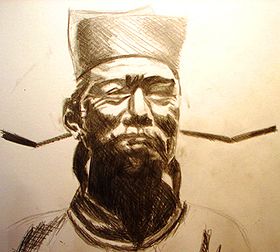
  • Zhang Heng
    Zhang Heng

    Zhang Heng was an Chinese astronomy, Chinese mathematics, List of Chinese inventions, Chinese geography, History of cartography#China, Chinese art, Chinese poetry, Government of the Han Dynasty, and Chinese literature from Nanyang, Henan, Henan, and lived during the Eastern Han Dynasty of China....
     (78-139); a Han Dynasty
    Han Dynasty

    The Han Dynasty followed the Qin Dynasty and preceded the Three Kingdoms in China. The Han Dynasty was ruled by the family known as the Liu clan who had peasant origins....
     Chinese official, scholar of history
    History of China

    China civilization originated in various city-states along the Yellow River valley in the Neolithic era. The written history of China begins with the Shang Dynasty ....
     and philosophy
    Chinese philosophy

    Chinese philosophy is philosophy written in the China Chinese culture of thought. Chinese philosophy has a history of several thousand years; its origins are often traced back to the I Ching , an ancient compendium of divination, which uses a system of 64 hexagrams to guide action....
    , poet
    Chinese poetry

    Chinese poetry is the most highly regarded Chinese literature. Traditionally, it is divided into shi , ci and qu . There is also a kind of Prose poetry called Fu ....
    , mathematician
    Chinese mathematics

    Mathematics in China emerged independently by the 11th century BC. The Chinese independently developed very large and negative numbers, decimals, a decimal system, a binary system, algebra, geometry, trigonometry....
    , astronomer
    Chinese astronomy

    Astronomy in China has a very long history. Oracle bones from the Shang Dynasty record eclipses and novae. Detailed records of astronomical observations were kept from about the 6th century BC until the introduction of Western astronomy and the telescope in the 16th century....
    , inventor
    List of Chinese inventions

    China has been the source of some of the world's most significant inventions, including the Four Great Inventions of ancient China: paper, the compass, gunpowder, and History of typography in East Asia ....
    , geographer
    Chinese geography

    Native China geography begins in the Warring States period . It expands its scope beyond the Chinese homeland with the growth of the Early Imperial China under the Han Dynasty....
    , cartographer
    History of cartography

    File:Mediterranean chart fourteenth century2.jpgCartography , or mapmaking, has been an integral part of the human story for a long time, possibly up to 8,000 years....
    , painter
    Chinese painting

    Chinese painting is one of the oldest continuous artistic traditions in the world. The earliest paintings were not representational but ornamental; they consisted of patterns or designs rather than pictures....
    , and sculptor
    Sculpture

    Sculpture is Three-dimensional space artwork created by shaping or combining hard and or plastic material, sound, and or text and or light, commonly Stone sculpture , metal, glass, or wood....
     who invented the world's first water-powered
    Hydraulics

    Hydraulics is a topic of science and engineering dealing with the mechanical properties of liquids. Hydraulics is part of the more general discipline of fluid power....
     armillary sphere
    Armillary sphere

    An armillary sphere is a model of the celestial sphere....
     and the world's first seismometer
    Seismometer

    Seismometers are instruments that measure and record motions of the ground, including those of seismic waves generated by earthquakes, nuclear explosions, and other seismic sources....
     to detect the cardinal direction of distant earthquake
    Earthquake

    An earthquake is the result of a sudden release of energy in the Earth's crust that creates seismic waves. Earthquakes are recorded with a seismometer, also known as a seismograph....
    s; he is often described as a polymath.


  • Geber
    Geber

    Geber is the Latinized form of "Jabir", with the full name of Abu Musa Jabir ibn Hayyan , a prominent Muslim polymath: a Alchemy and chemistry in medieval Islam, Astronomy in medieval Islam and Islamic astrology, Inventions of the Islamic Golden Age, Geography in medieval Islam#Geology, mineralogy, and paleontology, Early Islamic philo...
     (Jabir ibn Hayyan)
    (721–815); born in Tus in Persia a Persian
    Persian people

    Persian identity, at least in terms of language, is traced to the ancient Indo-Iranians , who arrived in parts of Greater Iran circa 2000-1500 BCE....
     (or Arab
    Arab

    An Arab is a person who Identity as such on linguistic or cultural grounds. The plural form, Arabs , refers to the Ethnocultural group at large....
    ) Muslim
    Muslim

    :A Muslim , , is an adherent of the religion of Islam. The feminine form is Muslimah . Literally, the word means "one who submits "....
     chemist, alchemist, astrologer
    Islamic astrology

    Islamic astrology, in Arabic ilm al-nujum or ilm al-falak, is the study of the heavens by early Muslims. In early Arabic sources, ilm al-nujum was used to refer to both Astrology and astronomy....
    , astronomer
    Islamic astronomy

    In the history of astronomy, Islamic astronomy or Arabic astronomy refers to the astronomical developments made in the Islamic world, particularly during the Islamic Golden Age , and mostly written in the Arabic language....
    , engineer, pharmacist, physician
    Islamic medicine

    In the history of medicine, Islamic medicine or Arabic medicine refers to medicine developed in the Islamic Golden Age and written in Arabic language, the lingua franca of the Islamic civilization....
    , philosopher
    Early Islamic philosophy

    Early Islamic philosophy or classical Islamic philosophy is a period of intense philosophical development beginning in the 2nd century AH of the Islamic calendar and lasting until the 6th century AH ....
    , physicist
    Islamic physics

    Islamic physics refers to the study of physics within Islamic science, which flourished during the Islamic Golden Age, variously dated from the 8th century to the 16th century, when experimental physics, mathematical physics and theoretical physics were studied in the Muslim world....
     and scientist
    Islamic science

    Science in medival Islam, also known as Islamic science, is a term used in the history of science to refer to the science developed in the Muslim world between 7th and 16th centuries, a period also known as the Islamic Golden Age....
    ; "Jabir was a polymath who wrote 300 books on philosophy, 1,300 books on mechanical devices and military machinery, and hundreds of books on alchemy."


  • Al-Khwarizmi (780-c.850); "... a mathematician
    Mathematician

    A mathematician is a person whose primary area of study and/or research is the field of mathematics....
    , astronomer
    Astronomer

    An astronomer is a scientist who studies Celestial body such as planets, stars, and Galaxy.Historically, astronomy was more concerned with the classification and description of phenomena in the sky, while astrophysics attempted to explain these phenomena and the differences between them using physical laws....
    , and geographer
    Geographer

    A geographer is a scientist whose area of study is geography, the study of Earth's physical natural environment and human habitat .Though geographers are historically known as people who make maps, map making is actually the field of study of cartography, a subset of geography....
    , was the greatest polymath (a person of encyclopedic learning) in the House of Wisdom
    House of Wisdom

    The House of Wisdom was a key institution in the Translation Movement - a library and translation institute in Abbassid-era Baghdad, Iraq. It is considered to have been a major intellectual center of the Islamic Golden Age....
     in Baghdad
    Baghdad

    Baghdad is the Capital of Iraq and of Baghdad Governorate, with which it is also coterminous. With a municipal population estimated at 6.5 million, it is the largest city in Iraq, and the second largest city in the Arab World....
    ." "...the polymath researcher..."


  • Ziryab
    Ziryab

    Abu l-Hasan ?Ali Ibn Nafi? , nicknamed Ziryab , was an polymath: a Islamic poetry, Islamic music, singer, Cosmetology, fashion designer, celebrity, Fads and trends, strategist, Astronomy in medieval Islam, Muslim Agricultural Revolution and Geography in medieval Islam....
     (789-857); an Iraq
    Iraq

    Iraq , officially the Republic of Iraq , is a country in Western Asia spanning most of the northwestern end of the Zagros Mountains, the eastern part of the Syrian Desert and the northern part of the Arabian Desert....
    i-Andalusian
    Al-Andalus

    Al-Andalus was the Arabic name given to the parts of the Iberian Peninsula governed by Arab Muslims, at various times in the period between 711 and 1492....
     poet
    Islamic poetry

    Islamic poetry is poetry written by Muslims on the topic of Islam. Islamic poetry has been written in many languages....
    , musician
    Islamic music

    Islamic music is Muslim religious music, as sung or played in public services or private devotions. The classic heartland of Islam is Arabia and the Middle East, North Africa and Egypt, Iran, Central Asia, India, Pakistan, and Afghanistan....
    , singer, cosmetologist
    Cosmetology

    File:Cosmetology1946.jpgCosmetology is the study and application of beauty treatment. Branches of specialty including hairstyle, skin care, cosmetics, manicures/pedicures, and electrology....
    , fashion design
    Fashion design

    Fashion design is the applied art dedicated to clothing and lifestyle accessories created within the cultural and social influences of a specific time....
    er, celebrity
    Celebrity

    A celebrity is a widely-recognized or notable person who commands a high degree of public and media attention. The word stems from the Latin verb "celebrare" but one may not become a celebrity unless public and mass media interest is piqued....
    , trendsetter, strategist
    Strategist

    A strategist is a person skilled in designing and planning action and policy to achieve a major or overall aim.A design strategist has the ability to combine the innovative, perceptive and holistic insights of a designer with the pragmatic and systematic skills of a planner to guide strategic direction in context of business needs, brand...
    , astronomer, botanist
    Muslim Agricultural Revolution

    The Islamic Golden Age from the 8th century to the 13th century witnessed a fundamental transformation in agriculture known as the Arab Agricultural Revolution, Medieval Green Revolution, or Muslim Agricultural Revolution....
     and geographer; "Zaryab was a "renaissance man" before the Renaissance."


  • Al-Kindi
    Al-Kindi

    , also known to the Western world by the Latinized version of his name 'Alkindus', was an Arab polymath: an Early Islamic philosophy, Islamic science, Islamic astrology, Islamic astronomy, Alchemy and chemistry in Islam, Logic in Islamic philosophy, Islamic mathematics, Arabic music, Islamic medicine, Islamic physics, Islamic psychologi...
     (Alkindus)
    (801–873); an Arab astronomer
    Islamic astronomy

    In the history of astronomy, Islamic astronomy or Arabic astronomy refers to the astronomical developments made in the Islamic world, particularly during the Islamic Golden Age , and mostly written in the Arabic language....
    , geographer
    Geographer

    A geographer is a scientist whose area of study is geography, the study of Earth's physical natural environment and human habitat .Though geographers are historically known as people who make maps, map making is actually the field of study of cartography, a subset of geography....
    , mathematician
    Islamic mathematics

    Mathematics in medieval Islam or sometimes referred to as Islamic mathematics is a term used in the history of mathematics that refers to the mathematics developed in the Muslim world between 622 and 1600, in the part of the world where Islam was the dominant religion....
    , meteorologist
    Meteorology

    Meteorology is the interdisciplinary scientific study of the Earth's atmosphere that focuses on weather processes and forecasting . Studies in the field stretch back millennia, though significant progress in meteorology did not occur until the eighteenth century....
    , musician
    Islamic music

    Islamic music is Muslim religious music, as sung or played in public services or private devotions. The classic heartland of Islam is Arabia and the Middle East, North Africa and Egypt, Iran, Central Asia, India, Pakistan, and Afghanistan....
    , philosopher
    Early Islamic philosophy

    Early Islamic philosophy or classical Islamic philosophy is a period of intense philosophical development beginning in the 2nd century AH of the Islamic calendar and lasting until the 6th century AH ....
    , physician
    Islamic medicine

    In the history of medicine, Islamic medicine or Arabic medicine refers to medicine developed in the Islamic Golden Age and written in Arabic language, the lingua franca of the Islamic civilization....
    , physicist
    Islamic physics

    Islamic physics refers to the study of physics within Islamic science, which flourished during the Islamic Golden Age, variously dated from the 8th century to the 16th century, when experimental physics, mathematical physics and theoretical physics were studied in the Muslim world....
    , scientist
    Islamic science

    Science in medival Islam, also known as Islamic science, is a term used in the history of science to refer to the science developed in the Muslim world between 7th and 16th centuries, a period also known as the Islamic Golden Age....
    , and politician
    Political aspects of Islam

    Political aspects of Islam are derived from the Quran, the Sunna, Muslim history and sometimes elements of political movements outside Islam.Traditional political concepts in Islam include leadership by successors to the Prophet known as Caliphs, ; the importance of following Islamic law or Sharia; the duty of rulers to seek Shura or consul...
    ; "he (Al-Kindî) was an omnivorous polymath, studying everything, writing 265 treatises about everything—arithmetic, geometry, astronomy, meteorology, geography, physics, politics, music, medicine, philosophy."


  • Muhammad ibn Zakariya Razi (Rhazes) (865-925); a Persian physician
    Islamic medicine

    In the history of medicine, Islamic medicine or Arabic medicine refers to medicine developed in the Islamic Golden Age and written in Arabic language, the lingua franca of the Islamic civilization....
    , alchemist, chemist, philosopher
    Early Islamic philosophy

    Early Islamic philosophy or classical Islamic philosophy is a period of intense philosophical development beginning in the 2nd century AH of the Islamic calendar and lasting until the 6th century AH ....
     and scholar. "Like other Muslim intellectuals of that period, Razi was a polymath. Only half of his nearly 200 written works deal with medicine, the rest are on other topics, such as astronomy
    Astronomy

    Astronomy is the science of Astronomical object and Phenomenon that originate outside the Earth's atmosphere . It is concerned with the evolution, physics, chemistry, meteorology, and motion of celestial objects, as well as the physical cosmology....
    , mathematics
    Mathematics

    Mathematics is the study of quantity, structure, space, change, and related topics of pattern and form. Mathematicians seek out patterns whether found in numbers, space, natural science, computers, imaginary abstractions, or elsewhere....
    , philosophy
    Philosophy

    Philosophy is the study of general problems concerning matters such as existence, knowledge, truth, beauty, justice, validity, mind, and language....
     and theology
    Theology

    Theology is the study of the existence or attributes of a deity or gods, or more generally the study of religion or spirituality. It is sometimes contrasted with religious studies: theology is understood as the study of religion from an internal perspective , and religious studies as the study of religion from an external perspective....
    ..."


  • Abu al-Hasan 'Ali al-Mas'udi (896-956); an Arab historian
    Historiography of early Islam

    The historiography of early Islam refers to the study of the early origins of Islam based on a critical analysis, evaluation, and examination of authentic primary sources materials and the organization of these sources into a narrative timeline....
    , Earth scientist, Islamic scholar, geographer
    Geographer

    A geographer is a scientist whose area of study is geography, the study of Earth's physical natural environment and human habitat .Though geographers are historically known as people who make maps, map making is actually the field of study of cartography, a subset of geography....
    , geologist
    Geologist

    For other uses, see Geologist .A geologist is a contributor to the science of geology, studying the physical structure and processes of the Earth and planets of the solar system ....
    , and traveller. An "erudite polymath..." "Prolific writer and polymath. His known works number over twenty and deal with with a wide variety of religious and secular subjects, including history
    HIStory

    HIStory: Past, Present and Future, Book I is a double album by Michael Jackson, released on June 20, 1995, and is Jackson's ninth. The first disc, named "HIStory Begins" consists of a selection of Jackson's greatest hits from the singer's past fifteen years, while the second, named "HIStory Continues" features new songs, with the...
     (both Islamic and universal), geography
    Geography

    Geography is the study of the Earth and its lands, features, inhabitants, and phenomena. A literal translation would be "to describe or write about the Earth"....
    , the natural sciences, philosophy
    Philosophy

    Philosophy is the study of general problems concerning matters such as existence, knowledge, truth, beauty, justice, validity, mind, and language....
    , and theology
    Theology

    Theology is the study of the existence or attributes of a deity or gods, or more generally the study of religion or spirituality. It is sometimes contrasted with religious studies: theology is understood as the study of religion from an internal perspective , and religious studies as the study of religion from an external perspective....
    ..."


  • Abhinavagupta
    Abhinavagupta

    Abhinavagupta was one of India's greatest Indian philosophy, Mysticism and Aesthetics. He was also considered an important Music of India, Indian poetry, Theatre in India, exegesis, theology, and Indian logic - a polymathic personality who exercised strong influences in the Indian culture....
     (fl. 975–1025); an Indian
    History of India

    The known history of India begins with the Indus Valley Civilization, which spread and flourished in the north-western part of the Indian subcontinent, from c....
     philosopher
    Indian philosophy

    The term Indian philosophy , may refer to any of several traditions of Eastern philosophy that originated in the Indian subcontinent, including Hindu philosophy, Buddhist philosophy, and Jain philosophy....
    , literary critic
    Literary criticism

    Literary criticism is the study, discussion, evaluation, and interpretation of literature. Modern literary criticism is often informed by literary theory, which is the philosophical discussion of its methods and goals....
    , Shaivite
    Shaivism

    Shaivism,names the oldest of the four sects of Hinduism. Followers of Shaivism, called "Shaivas," and also "Saivas" or "Saivites," revere Shiva as the Supreme Being....
    , aesthetist
    Aesthetics

    Aesthetics or esthetics is commonly known as the study of senses or sensori-emotional values, sometimes called judgments of sentiment and taste ....
    , musician
    Music of India

    The music of India includes multiple varieties of folk music, popular music, pop music, and Indian classical music. India's classical music tradition, including Carnatic music and Hindustani music, has a history panning millennia and, developed over several eras, it remains fundamental to the lives of Indians today as sources of religio...
    , poet
    Indian poetry

    Indian poetry, and Indian literature in general, has a long history dating back to Vedic period times. They were written in various Languages of India such as Vedic Sanskrit, Sanskrit, Tamil language, Kannada language, Bengali language and Urdu....
    , dramatist
    Theatre in India

    Theatre in India began with the Rigvedic dialogue hymns during the Vedic period, and Sanskrit drama was established as a distinct art form in the last few centuries BC....
    , dance
    Dance

    Dance is an art form that generally refers to Motion of the body, usually rhythmic and to music, used as a form of Emotional expression, social social interaction or presented in a spirituality or performance setting....
    r, exegetical
    Exegesis

    Exegesis is a critical explanation or interpretation of a text.Biblical exegesis is a critical explanation or interpretation of the Bible....
     theologian
    Theology

    Theology is the study of the existence or attributes of a deity or gods, or more generally the study of religion or spirituality. It is sometimes contrasted with religious studies: theology is understood as the study of religion from an internal perspective , and religious studies as the study of religion from an external perspective....
    , and logician
    Indian logic

    The development of Indian logic can be said to date back to the anviksiki of Medhatithi Gautama ; the Vyakarana rules of Pa?ini ; the Vaisheshika school's analysis of atomism ; the analysis of inference by Nyaya Sutras , founder of the Nyaya school of Hindu philosophy; and the tetralemma of Nagarjuna ....
    ; "the great Kashmiri philosopher and polymath, Abhinavagupta".


  • Shen Kuo
    Shen Kuo

    Shen Kuo or Shen Kua , Chinese style name Cunzhong and Chinese style name#H?o Mengqi Weng, was a polymathic China History of science and technology in China and statesman of the Song Dynasty ....
     (1031–1095); a Chinese
    China

    China is a Culture of China, an ancient civilization, and, depending on perspective, a national or multinational entity extending over a large area in East Asia....
     scientist
    History of science and technology in China

    The history of science and technology in China is both long and rich with many contributions to science and technology. In antiquity, independently of Greek philosophers and other civilizations, ancient China philosophers made significant advances in science, technology, mathematics, and astronomy....
    , statesman
    Statesman

    A statesman or stateswoman or statesperson is usually a politician or other notable figure of state who has had a long and respected career in politics at the national and international level....
    , mathematician
    Chinese mathematics

    Mathematics in China emerged independently by the 11th century BC. The Chinese independently developed very large and negative numbers, decimals, a decimal system, a binary system, algebra, geometry, trigonometry....
    , astronomer
    Chinese astronomy

    Astronomy in China has a very long history. Oracle bones from the Shang Dynasty record eclipses and novae. Detailed records of astronomical observations were kept from about the 6th century BC until the introduction of Western astronomy and the telescope in the 16th century....
    , meteorologist, geologist
    Geologist

    For other uses, see Geologist .A geologist is a contributor to the science of geology, studying the physical structure and processes of the Earth and planets of the solar system ....
    , zoologist, botanist, pharmacologist, agronomist
    Agronomist

    Agronomists are scientists who specialize in agronomy, which is the science of utilizing plants for food, fuel, feed, and fiber....
    , ethnographer, encyclopedist, poet
    Poet

    A poet is a person who writes poetry....
    , general
    General

    A General officer is an Officer of high military rank. The term or equivalent is used by nearly every country in the world. General can be used as a generic term for all grades of general officer, or it can specifically refer to a single rank that is just called general....
    , diplomat, hydraulic engineer
    Engineer

    An engineer is a person professionally engaged in a field of engineering. Engineers are concerned with developing economical and safe solutions to practical problems, by applying mathematics and scientific knowledge while considering technical constraints....
    , inventor
    Inventor

    An inventor is a person who creates or discovers a new method, form, device or other useful means. The word inventor comes form the latin verb invenire, invent-, to find....
    , academy
    Academy

    An academy is an institution of higher learning, research, or honorary membership.The name traces back to Plato's school of philosophy, founded approximately 385 BC at Akademia, a sanctuary of Athena, the goddess of wisdom, north of Ancient Athens, Greece....
     chancellor
    Chancellor

    Chancellor or chancellour is an official title used in countries whose civilization has arisen directly or indirectly out of the Roman Empire....
    , finance minister
    Finance minister

    The finance minister is a Cabinet position in a government.A minister of finance has many different jobs in a government. He or she helps form the government budget, Fiscal policy, and control finances....
    , and inspector
    Inspector

    Inspector is both a police rank and an administrative position, both used in a number of contexts. However, it is not an equivalent rank in each police force....
    ; "Chinese polymath and astronomer who studied medicine, but became renown for his engineering ability."


  • Omar Khayyám
    Omar Khayyám

    Omar Khayyam was a Persian peoples polymath: Islamic mathematics, Iranian philosophy, Islamic astronomy and above all Persian literature.He has also become established as one of the major mathematicians and astronomers of the medieval period....
     (1048–1131); a Persian
    History of Iran

    History of Iran and Greater Iran consists of the area from the Euphrates in the west to the Indus River and Syr Darya in the east and from the Caucasus, Caspian Sea, and Aral Sea in the north to the Persian Gulf and the Gulf of Oman in the south....
     poet, writer
    Persian literature

    Persian literature spans two and a half millennia, though much of the pre-Islamic material has been lost. Its sources has been within historical greater Iran including present-day Iran as well as reigions of Central Asia where the Persian language has been the national language through history....
    , astronomer
    Islamic astronomy

    In the history of astronomy, Islamic astronomy or Arabic astronomy refers to the astronomical developments made in the Islamic world, particularly during the Islamic Golden Age , and mostly written in the Arabic language....
    , mathematician
    Islamic mathematics

    Mathematics in medieval Islam or sometimes referred to as Islamic mathematics is a term used in the history of mathematics that refers to the mathematics developed in the Muslim world between 622 and 1600, in the part of the world where Islam was the dominant religion....
    , philosopher
    Islamic philosophy

    Islamic philosophy is a branch of Islamic studies, and is a longstanding attempt to create harmony between philosophy and the religious teachings of Islam ....
    , and skeptic. He also wrote treatises on mechanics
    Mechanics

    Mechanics is the branch of physics concerned with the behaviour of physical body when subjected to forces or Displacement , and the subsequent effect of the bodies on their environment....
    , geography
    Geography

    Geography is the study of the Earth and its lands, features, inhabitants, and phenomena. A literal translation would be "to describe or write about the Earth"....
    , music
    Music

    Music is an art form whose media is sound organized in time. Common elements of music are pitch , rhythm , dynamics , and the sonic qualities of timbre and texture ....
     and was a physicist
    Physicist

    A physicist is a scientist who studies or practices physics. Physicists study a wide range of physical phenomena in many Physics#Major fields of physics spanning all length scales: from atom particles of which all ordinary matter is made to the behavior of the material Universe as a whole ....
    .


  • Acharya Hemachandra
    Acharya Hemachandra

    Hemachandra Acharya was an Indian Jainism scholar, poet, and polymath who wrote on grammar, philosophy, prosody, and contemporary history. Noted as a prodigy by his contemporaries, he gained the title Kalikal Sarvagya, ....
     (1089–1172); an Indian
    History of India

    The known history of India begins with the Indus Valley Civilization, which spread and flourished in the north-western part of the Indian subcontinent, from c....
     scholar, poet
    Indian poetry

    Indian poetry, and Indian literature in general, has a long history dating back to Vedic period times. They were written in various Languages of India such as Vedic Sanskrit, Sanskrit, Tamil language, Kannada language, Bengali language and Urdu....
    , linguist
    Linguistics

    Linguistics is the science study of natural language. Linguistics encompasses a number of sub-fields. An important topical division is between the study of language structure and the study of Meaning ....
    , grammarian
    Vyakarana

    The Sanskrit grammatical tradition of is one of the six Vedanga disciplines. It has its roots in late Vedic India, and includes the famous work, ....
    , historian
    History of India

    The known history of India begins with the Indus Valley Civilization, which spread and flourished in the north-western part of the Indian subcontinent, from c....
    , philosopher
    Indian philosophy

    The term Indian philosophy , may refer to any of several traditions of Eastern philosophy that originated in the Indian subcontinent, including Hindu philosophy, Buddhist philosophy, and Jain philosophy....
    , and prosodist
    Prosody (linguistics)

    In linguistics, prosody is the rhythm, stress , and intonation of connected speech . Prosody may reflect various features of the speaker or the utterance: the emotional state of a speaker; whether an utterance is a statement, a question, or a command; whether the speaker is being ironic or sarcastic; emphasis, contrast, and focus ; or othe...
    ; "the great polymath Hemacandra"; "Hemacandra (1089–1172) was one of the great polymaths of medieval India."


  • Ibn Tufail
    Ibn Tufail

    Ibn Tufail was an Al-Andalus-Arab Muslim polymath: an Arabic literature, novelist, Early Islamic philosophy, Islamic theology, Medicine in medieval Islam, vizier, and court official....
     (Abubacer)
    (1105–1185); an Andalusian
    Al-Andalus

    Al-Andalus was the Arabic name given to the parts of the Iberian Peninsula governed by Arab Muslims, at various times in the period between 711 and 1492....
     Arab
    Arab

    An Arab is a person who Identity as such on linguistic or cultural grounds. The plural form, Arabs , refers to the Ethnocultural group at large....
     "polymath scholar", Islamic philosopher
    Early Islamic philosophy

    Early Islamic philosophy or classical Islamic philosophy is a period of intense philosophical development beginning in the 2nd century AH of the Islamic calendar and lasting until the 6th century AH ....
    , physician
    Islamic medicine

    In the history of medicine, Islamic medicine or Arabic medicine refers to medicine developed in the Islamic Golden Age and written in Arabic language, the lingua franca of the Islamic civilization....
    , Arabic writer
    Arabic literature

    Arabic literature is the writing produced, both prose and poetry, by writers of the Arabic language. It does not usually include works written using the Arabic alphabet but not in the Arabic language such as Persian literature and Urdu literature....
    , novel
    Novel

    File:2009 stapelweise Neuerscheinungen im Buchladen.JPGA novel is today a long narrative in literary prose. The genre has historical roots both in the fields of the medieval and early modern Romance and in the tradition of the novella....
    ist, and court official
    Official

    An official is someone who holds an office in an organisation or government and participates in the exercise of authority .A government official or functionary is an official who is involved in public administration or government, through either election, appointment, or employment....
    .


  • Nasir al-Din al-Tusi (Tusi) (1201–1274); a Persian
    Persian people

    Persian identity, at least in terms of language, is traced to the ancient Indo-Iranians , who arrived in parts of Greater Iran circa 2000-1500 BCE....
     Muslim
    Muslim

    :A Muslim , , is an adherent of the religion of Islam. The feminine form is Muslimah . Literally, the word means "one who submits "....
    , was one of the greatest scientists, philosophers, mathematicians, astronomers, theologians and physicians of the thirteenth century; "the ensemble of Tusi’s writings amounts to approximately 165 titles on a wide variety of subjects (astronomy
    Islamic astronomy

    In the history of astronomy, Islamic astronomy or Arabic astronomy refers to the astronomical developments made in the Islamic world, particularly during the Islamic Golden Age , and mostly written in the Arabic language....
    , ethics
    Ethics

    Ethics is a word for a philosophy that encompasses proper conduct and good living. It is significantly broader than the common conception of ethics as the analyzing of right and wrong....
    , history
    Historiography of early Islam

    The historiography of early Islam refers to the study of the early origins of Islam based on a critical analysis, evaluation, and examination of authentic primary sources materials and the organization of these sources into a narrative timeline....
    , jurisprudence
    Fiqh

    Fiqh is Islamic jurisprudence. Fiqh is an expansion of the Sharia Islamic law?based directly on the Quran and Sunnah?that complements Shariah with evolving Fatwa/interpretations of Ulema....
    , logic
    Logic in Islamic philosophy

    Logic played an important role in early Islamic philosophy, making logic in Islamic philosophy an important branch of study in the history of logic....
    , mathematics
    Islamic mathematics

    Mathematics in medieval Islam or sometimes referred to as Islamic mathematics is a term used in the history of mathematics that refers to the mathematics developed in the Muslim world between 622 and 1600, in the part of the world where Islam was the dominant religion....
    , medicine
    Islamic medicine

    In the history of medicine, Islamic medicine or Arabic medicine refers to medicine developed in the Islamic Golden Age and written in Arabic language, the lingua franca of the Islamic civilization....
    , philosophy
    Early Islamic philosophy

    Early Islamic philosophy or classical Islamic philosophy is a period of intense philosophical development beginning in the 2nd century AH of the Islamic calendar and lasting until the 6th century AH ....
    , theology
    Kalam

    Kalam is the Islamic philosophy of seeking Islamic theology principles through dialectic. In Arabic language the word literally means "speech"....
    , poetry
    Islamic poetry

    Islamic poetry is poetry written by Muslims on the topic of Islam. Islamic poetry has been written in many languages....
     and the popular sciences
    Islamic science

    Science in medival Islam, also known as Islamic science, is a term used in the history of science to refer to the science developed in the Muslim world between 7th and 16th centuries, a period also known as the Islamic Golden Age....
    )."


  • Ibn al-Nafis (1213–1288); an Arab physician, anatomist, biologist, physiologist, surgeon
    Islamic medicine

    In the history of medicine, Islamic medicine or Arabic medicine refers to medicine developed in the Islamic Golden Age and written in Arabic language, the lingua franca of the Islamic civilization....
    , ophthalmologist
    Ophthalmology in medieval Islam

    Ophthalmology was one of the foremost branches in medieval Islamic medicine. The oculist or kahhal , a somewhat despised professional in Galen?s time, was an honored member of the medical profession by the Abbasid period, occupying a unique place in royal households....
    , Ulema
    Ulema

    Ulema refers to the educated class of Muslim legal scholars engaged in the several fields of Islamic studies. They are best known as the arbiters of Sharia law....
    , Hafiz, Muhaddith
    Muhaddith

    Muhaddith is an Islamic title, referring to one who profoundly knows and narrates hadiths, the chains of their narration , and the original and famous narrators....
    , Shafi`i
    Shafi`i

    The Shafi?i madhab is one of the four schools of fiqh, or religious law, within Sunni Islam. The Shafi?i school of fiqh is named after its founder, Muhammad ibn Idris ash-Shafi`i....
     jurist
    Fiqh

    Fiqh is Islamic jurisprudence. Fiqh is an expansion of the Sharia Islamic law?based directly on the Quran and Sunnah?that complements Shariah with evolving Fatwa/interpretations of Ulema....
     and lawyer
    Sharia

    Sharia is the body of Islamic religious law. The term means "way" or "path to the water source"; it is the legal framework within which the public and private aspects of life are regulated for those living in a legal system based on Fiqh and for Muslims living outside the domain....
    , Sunni
    Sunni Islam

    Sunni Islam is the Demographics of Islam Divisions of Islam of Islam. Sunni Islam is also referred to as Ahl as-Sunnah wa?l-Jama?ah or Ahl as-Sunnah for short....
     theologian
    Kalam

    Kalam is the Islamic philosophy of seeking Islamic theology principles through dialectic. In Arabic language the word literally means "speech"....
    , philosopher
    Early Islamic philosophy

    Early Islamic philosophy or classical Islamic philosophy is a period of intense philosophical development beginning in the 2nd century AH of the Islamic calendar and lasting until the 6th century AH ....
    , litterateur
    Arabic literature

    Arabic literature is the writing produced, both prose and poetry, by writers of the Arabic language. It does not usually include works written using the Arabic alphabet but not in the Arabic language such as Persian literature and Urdu literature....
    , logician
    Logic in Islamic philosophy

    Logic played an important role in early Islamic philosophy, making logic in Islamic philosophy an important branch of study in the history of logic....
    , novel
    Novel

    File:2009 stapelweise Neuerscheinungen im Buchladen.JPGA novel is today a long narrative in literary prose. The genre has historical roots both in the fields of the medieval and early modern Romance and in the tradition of the novella....
    ist, psychologist
    Psychology

    Psychology is an academic and applied science discipline involving the science study of human mental functions and behavior. Occasionally it also relies on symbolic hermeneutics and critical theory, although these traditions are less pronounced than in other social sciences such as sociology....
    , scientist
    Islamic science

    Science in medival Islam, also known as Islamic science, is a term used in the history of science to refer to the science developed in the Muslim world between 7th and 16th centuries, a period also known as the Islamic Golden Age....
    , science fiction
    Science fiction

    Science fiction is a broad genre of fiction that often involves speculations based on current or future science or technology. Science fiction is found in books, art, television, films, games, theatre, and other media....
     writer, astronomer, cosmologist
    Islamic astronomy

    In the history of astronomy, Islamic astronomy or Arabic astronomy refers to the astronomical developments made in the Islamic world, particularly during the Islamic Golden Age , and mostly written in the Arabic language....
    , futurist, geologist
    Geologist

    For other uses, see Geologist .A geologist is a contributor to the science of geology, studying the physical structure and processes of the Earth and planets of the solar system ....
    , grammarian, linguist
    Arabic grammar

    Arabic is a Semitic languages language. See Arabic language for more information on the language in general. This article describes the grammar of Classical Arabic and Modern Standard Arabic - the Arabic grammar ....
    , historian, philosopher of history
    Historiography of early Islam

    The historiography of early Islam refers to the study of the early origins of Islam based on a critical analysis, evaluation, and examination of authentic primary sources materials and the organization of these sources into a narrative timeline....
    , philosopher of religion
    Philosophy of religion

    Philosophy of religion' is a branch of philosophy that is concerned with the philosophical study of religion, including arguments over the nature and existence of God, religious language, miracles, prayer, the problem of evil, and the relationship between religion and other value-systems such as ethics.'...
    , natural philosopher
    Natural philosophy

    Natural philosophy or the philosophy of nature , is a term applied to the Objectivity study of nature and the physical universe that was dominant before the development of modern science....
     and sociologist
    Early Muslim sociology

    Medieval Islamic sociology refers to the study of sociology and the social sciences in the Islamic Golden Age. Early Islamic sociology responded to the challenges of social organization of diverse peoples all under common religious organization in the Islamic Caliphate, including the Rashidun Caliphate, Umayyad Caliphate, Abbasid Caliphate an...
    ; "Ibnul-Nafees was not only a great physician and discoverer of the minor blood circulation (pulmonary circulation
    Pulmonary circulation

    Pulmonary circulation is the portion of the cardiovascular system which carries oxygen-depleted blood away from the heart, to the lungs, and returns oxygenated blood back to the heart....
    ), but he also had many interests, views and works about many other branches of knowledge."


  • Leone Battista Alberti
    Leone Battista Alberti

    Leon Battista Alberti was an Italy author, artist, architect, poet, Catholic_priest, linguistics, philosopher, and cryptography, and general Renaissance humanist polymath....
     (1404–1472); "often considered the archetype of the Renaissance polymath"


  • Suyuti
    Suyuti

    Imam Jalaluddin Al-Suyuti also known as Ibn al-Kutb was an Egyptians writer, religious scholar, juristic expert and teacher whose works deal with a wide variety of subjects in Islamic theology....
     (1445–1505); an Egyptian
    Egyptians

    Egyptians is the name of the nationality and Mediterranean North African ethnic group native to Egypt.Egyptian identity is closely tied to the Geography of Egypt, dominated by the lower Nile Valley, the small strip of cultivable land stretching from the Cataracts of the Nile to the Mediterranean Sea and enclosed by desert both to the Easte...
     Arab
    Arab

    An Arab is a person who Identity as such on linguistic or cultural grounds. The plural form, Arabs , refers to the Ethnocultural group at large....
     Islamic scholar
    Ulema

    Ulema refers to the educated class of Muslim legal scholars engaged in the several fields of Islamic studies. They are best known as the arbiters of Sharia law....
    , Sunni theologian
    Kalam

    Kalam is the Islamic philosophy of seeking Islamic theology principles through dialectic. In Arabic language the word literally means "speech"....
    , Shafi'i jurist
    Fiqh

    Fiqh is Islamic jurisprudence. Fiqh is an expansion of the Sharia Islamic law?based directly on the Quran and Sunnah?that complements Shariah with evolving Fatwa/interpretations of Ulema....
    , Arabic grammar
    Arabic grammar

    Arabic is a Semitic languages language. See Arabic language for more information on the language in general. This article describes the grammar of Classical Arabic and Modern Standard Arabic - the Arabic grammar ....
    ian and linguist, historian
    Historiography of early Islam

    The historiography of early Islam refers to the study of the early origins of Islam based on a critical analysis, evaluation, and examination of authentic primary sources materials and the organization of these sources into a narrative timeline....
    , and Islamic philosopher
    Early Islamic philosophy

    Early Islamic philosophy or classical Islamic philosophy is a period of intense philosophical development beginning in the 2nd century AH of the Islamic calendar and lasting until the 6th century AH ....
    . "...the geat Egyptian polymath al-Suyuti..." "...the great polymath-historian Jalal al-Din al-Suyuti..." "...the noted Arab
    Arab

    An Arab is a person who Identity as such on linguistic or cultural grounds. The plural form, Arabs , refers to the Ethnocultural group at large....
     polymath al-Suyuti..."


  • Matrakçi Nasuh
    Matrakçi Nasuh

    Matrak?i Nasuh was a Bosnian Muslim mathematician, historian, geographer, cartographer and miniaturist. His birth date and birth place are unknown....
     (died 1564) ... "came from a Bosnian Muslim family. Either his father or grandfather was drafted into the state service. He was renowned in the 16th century as a mathematician
    Mathematician

    A mathematician is a person whose primary area of study and/or research is the field of mathematics....
    , historian
    Historian

    A historian is an individual who studies and writes about history, and is regarded as an authority on it. Historians are concerned with the continuous, systematic narrative and research of past events as relating to the human race; as well as the study of all events in time....
    , geographer
    Geographer

    A geographer is a scientist whose area of study is geography, the study of Earth's physical natural environment and human habitat .Though geographers are historically known as people who make maps, map making is actually the field of study of cartography, a subset of geography....
    , cartographer, topographer, musketeer
    Musketeer

    A musketeer was an early modern type of infantry soldier equipped with a musket. Musketeers were an important part of early modern armies, particularly in Europe....
    , and was an outstanding knight
    Knight

    File:Gothic armor 2.jpgKnight is the term for a social position originating in the Middle Ages. In the Commonwealth of Nations, knighthood is a non-heritable form of gentry....
    , calligrapher and engineer
    Engineer

    An engineer is a person professionally engaged in a field of engineering. Engineers are concerned with developing economical and safe solutions to practical problems, by applying mathematics and scientific knowledge while considering technical constraints....
    . Because he was a musketeer
    Musketeer

    A musketeer was an early modern type of infantry soldier equipped with a musket. Musketeers were an important part of early modern armies, particularly in Europe....
    , he was also called al-Silâhî (the musketeer
    Musketeer

    A musketeer was an early modern type of infantry soldier equipped with a musket. Musketeers were an important part of early modern armies, particularly in Europe....
     or gunman
    Gunman

    Gunman or Gunmen may refer to:*A word sometimes used for a crime armed with a gun*Gunman , a 1983 Thai film*Gunman , a 2000 single by aggrotech band Funker Vogt...
    ). He was a polymath
    Polymath

    A polymath is a person whose knowledge is not restricted to one subject area. In less formal terms, a polymath may simply refer to someone who is very knowledgeable....
     thinker, writer
    Writer

    A writer is anyone who creates a written work, although the word usually designates those who write creatively or professionally, as well as those who have written in many different forms....
    , an artist
    Artist

    The definition of an artist is wide-ranging and covers a broad spectrum of activities to do with creating art, practicing the arts and/or demonstrating an art....
     (he pioneered a particular artistic style for depicting cities) and a theoretician. He wrote books in these fields, all in Turkish
    Turkish language

    Turkish is a language spoken by over 63 million people worldwide, making it the most commonly spoken of the Turkic languages. Its speakers are located predominantly in Turkey and Cyprus, with smaller groups in Iraq, Greece, Bulgaria, the Republic of Macedonia, Kosovo, Albania and other parts of Eastern Europe....
    ."


  • Akbar the Great
    Akbar the Great

    Jalaluddin Muhammad Akbar , also known as Akbar the Great was the son of Nasiruddin Humayun whom he succeeded as ruler of the Mughal Empire from 1556 to 1605....
     (1542–1605); an Indian
    History of India

    The known history of India begins with the Indus Valley Civilization, which spread and flourished in the north-western part of the Indian subcontinent, from c....
     Mughal emperor, "polymath", architect
    Architect

    An architect is trained and licenced in planning and designing buildings, and participates in supervising the construction of a building. Etymologically, architect derives from the Latin architectus, itself derived from the Greek arkhitekton , i.e....
    , artisan
    Artisan

    An artisan is a skilled manual labor worker who crafts items that may be functional or strictly decorative, including furniture, clothing, jewelry, household items, and tools....
    , artist
    Artist

    The definition of an artist is wide-ranging and covers a broad spectrum of activities to do with creating art, practicing the arts and/or demonstrating an art....
    , armorer
    Armorer

    An 'armorer' or 'armourer' can refer to two roles, traditionally it has referred to a Smith who specialized in manufacturing and repairing metal armor....
    , blacksmith
    Blacksmith

    A blacksmith is a person who processess iron or steel by forging the metal; i.e., by using tools to hammer, bend, cut, and otherwise shape it in its non-liquid form....
    , carpenter
    Carpenter

    A carpenter is a skilled artisan who performs carpentry - a wide range of woodworking that includes constructing building construction, furniture, and other objects out of wood....
    , construction worker
    Construction worker

    Construction workers are employed in the construction industry and work predominantly on construction sites and are typically engaged in aspects of the industry other than design or finance....
    , engineer
    Engineer

    An engineer is a person professionally engaged in a field of engineering. Engineers are concerned with developing economical and safe solutions to practical problems, by applying mathematics and scientific knowledge while considering technical constraints....
    , general
    General

    A General officer is an Officer of high military rank. The term or equivalent is used by nearly every country in the world. General can be used as a generic term for all grades of general officer, or it can specifically refer to a single rank that is just called general....
    , inventor
    Inventor

    An inventor is a person who creates or discovers a new method, form, device or other useful means. The word inventor comes form the latin verb invenire, invent-, to find....
    , lace
    Lace

    Lace is an openwork fabric, patterned with open holes in the work, made by machine or by hand. The holes can be formed via removal of threads or cloth from a previously woven fabric, but more often open spaces are created as part of the lace fabric....
    maker, ruler
    Ruler

    A ruler, or rule, is an Measuring instrument used in geometry, technical drawing and engineering/building to measure distances and/or to rule straight lines....
    , technologist
    Technologist

    A technologist is a specialist that is trained to perform work in a field of technology. In some countries there is a clear distinction defined in law and only individuals who have graduated from an school accreditation curriculum in technology, and have a significant amount of work experience in their field may become registered technologist...
    , theologian, and writer
    Writer

    A writer is anyone who creates a written work, although the word usually designates those who write creatively or professionally, as well as those who have written in many different forms....
    .


  • Xu Guangqi
    Xu Guangqi

    Xu Guangqi , courtesy name Zixian , was a Chinese bureaucrat, agricultural scientist, astronomer, and mathematician in the Ming Dynasty. Xu was a colleague and collaborator of the Italian Jesuits Matteo Ricci and Sabatino de Ursis and they translated several classic Western texts into Chinese, including part of Euclid's Elements....
     (1562–1633); a Chinese bureaucrat, agricultural scientist, astronomer, and mathematician in the Ming Dynasty
    Ming Dynasty

    The Ming Dynasty , or Empire of the Great Ming , was the ruling Dynasties in Chinese history of China from 1368 to 1644, following the collapse of the Mongol-led Yuan Dynasty....
    , who also helped in the translation of several classic Western texts into Chinese, including part of Euclid's Elements
    Euclid's Elements

    Euclid's Elements is a mathematics and geometry treatise consisting of 13 books written by the Greek mathematics Euclid in Alexandria circa 300 BC....
    . Xu has been described as "a fascinating polymath who spread his interests far and wide for a specific purpose: statecraft."


  • Athanasius Kircher
    Athanasius Kircher

    Athanasius Kircher was a 17th century Germany Society of Jesus scholar who published around 40 works, most notably in the fields of Orientalism, geology, and medicine....
     (born 1601); "a 'polymath' if there ever was one. He studied a variety of subjects including... music, Egyptology, Sinology, botany, magnetism"; Athanasius Kircher: The Last Man Who Knew Everything (book title)


  • Benjamin Franklin
    Benjamin Franklin

    Benjamin Franklin was one of the Founding Fathers of the United States of the United States. A noted polymath, Franklin was a leading author and Printer , Satire, list of political philosophers, politician, scientist, inventor, activism, statesman, and diplomacy....
     (1706–1790); "The ultimate creole intellectual... A true polymath of the Enlightenment style, he distinguished himself on both sides of the Atlantic by researches in natural sciences as well as politics and literature." He was a leading author
    Author

    An author is defined both as "the person who originates or gives existence to anything" and that authorship determines responsibility for what is created....
    , political theorist, politician
    Politician

    A politician is an individual who is involved in influencing public decision making through the influence of politics or a person who influences the way a society is governed....
    , printer
    Printer (publisher)

    A printer is a company that provides commercial printing services, often also offering typesetting and book-binding services. The term can also refer to people who operate printing presses, or who run printing companies....
    , scientist
    Scientist

    A scientist, in the broadest sense, refers to any person that engages in a system activity to acquire knowledge or an individual that engages in such practices and traditions that are linked to schools of thought or philosophy....
    , inventor
    Inventor

    An inventor is a person who creates or discovers a new method, form, device or other useful means. The word inventor comes form the latin verb invenire, invent-, to find....
    , civic activist
    Activism

    Activism, in a general sense, can be described as intentional action to bring about social change or politics change. This action is in support of, or opposition to, one side of an often controversy argument....
    , and diplomat.


  • Mikhail Lomonosov
    Mikhail Lomonosov

    Mikhail Vasilyevich Lomonosov was a Russian polymath, scientist and writer, who made important contributions to literature, education, and science....
     (1711–1765); "Lomonosov was a true polymath—physicist, chemist, natural scientist, poet and linguist...."


  • Thomas Jefferson
    Thomas Jefferson

    Thomas Jefferson was the List of Presidents of the United States President of the United States , the principal author of the United States Declaration of Independence , and one of the most influential Founding Fathers of the United States for his promotion of the ideals of republicanism in the United States....
     (1743–1826); some sources describe him as "polymath and President," putting "polymath" first; John F. Kennedy
    John F. Kennedy

    John Fitzgerald "Jack" Kennedy , often referred to by his initials JFK, was the List of Presidents of the United States President of the United States, serving from 1961 until John F....
     famously commented, addressing a group of Nobel laureates, that it was "the most extraordinary collection of talent, of human knowledge, that has ever been gathered together at the White House—- with the possible exception of when Thomas Jefferson dined alone."


  • Samuel Taylor Coleridge
    Samuel Taylor Coleridge

    Samuel Taylor Coleridge was an England poet, critic and Philosophy who was, along with his friend William Wordsworth, one of the founders of the Romanticism in England and one of the Lake Poets....
      (1772–1834); poet
    Poet

    A poet is a person who writes poetry....
    , critic
    Critic

    The word critic comes from the Greek language ' , "able to discern", which in turn derives from the word ' , meaning a person who offers reasoned judgment or analysis, value judgment, interpretation, or observation....
    , and philosopher.


  • Mary Somerville
    Mary Somerville

    Mary Somerville was a Scotland science writer and polymath, at a time when women in science was discouraged. She studied mathematics and astronomy, and was the second woman scientist to receive recognition in the United Kingdom after Caroline Herschel....
      (1780–1872); "Somerville was the most celebrated woman scientist of her time. A polymath, she wrote on astronomy
    Astronomy

    Astronomy is the science of Astronomical object and Phenomenon that originate outside the Earth's atmosphere . It is concerned with the evolution, physics, chemistry, meteorology, and motion of celestial objects, as well as the physical cosmology....
    , mathematics
    Mathematics

    Mathematics is the study of quantity, structure, space, change, and related topics of pattern and form. Mathematicians seek out patterns whether found in numbers, space, natural science, computers, imaginary abstractions, or elsewhere....
    , physics
    Physics

    Physics is the natural science which examines basic concepts such as energy, force, and spacetime and all that derives from these, such as mass, charge, matter and its Motion ....
    , chemistry
    Chemistry

    Chemistry is the science concerned with the composition, structure, and properties of matter, as well as the changes it undergoes during chemical reactions....
    , mineralogy
    Mineralogy

    Mineralogy is an Earth Science focused around the chemistry, crystal structure, and physical properties of minerals. Specific studies within mineralogy include the processes of mineral origin and formation, classification of minerals, their geographical distribution, as well as their utilization....
    , and geology
    Geology

    Geology is the science and study of the solid and liquid matter that constitute the Earth. The field of geology encompasses the study of the composition, structural geology, physical properties, dynamics, and History of the Earth of Earth materials, and the processes by which they are formed, moved, and changed....
    , among other subjects."


  • Edward Heron-Allen (1861–1943); "Heron-Allen is better described as a polymath..." Not only was Heron-Allen a lawyer by trade, he also wrote, lectured on and created violins, was an expert on the art of chiromancy or palmistry, having read palms and analysed the handwriting of luminaries of the period. He wrote on musical, literary and scientific subjects ranging from foraminifera, marine zoology, meteorology, as a Persian scholar translated Classics such as the Rubaiyat of Omar Khayyam and The Lament of Baba Tahir, also wrote on local geographic history, archeology, Buddhist philosophy, the cultivation, gourmet appreciation of and culture of the asparagus, as well as a number of novels and short stories of science fiction and horror written under his pseudonymn of "Christopher Blayre."


  • C. B. Fry (1872–1956) - International and record-breaking athlete at sports including football, cricket
    Cricket

    Cricket is a Bat-and-ball games team sport that originated in southern England. The earliest definite reference is dated 1598, and it is now played in more than 100 countries....
    , athletics and rugby union
    Rugby union

    Rugby union is a competitive outdoor contact sport, played with an oval ball, by two teams of 15 players. It is one of the two main codes of rugby football, the other being rugby league....
    , also a politician, publisher, teacher and writer.


  • Dr. Albert Schweitzer (1875–1965) – “A polymath talent” , Schweitzer was an Alsatian
    Alsatian

    Alsatian can refer to:* A person from the Alsace region ** List of Alsatians and Lotharingians** a speaker of the Alsatian language* A term for the German Shepherd Dog which was invented during World War I, using Alsatian as a euphemism for Germans....
     theologian, musician
    Musician

    A musician is a person who plays or writes music. Musicians can be classified by their roles in creating or performing music:* An instrumentalist plays a musical instrument....
    , philosopher, physician
    Physician

    A physician, medical practitioner, doctor of medicine, or medical doctor practices medicine, and is concerned with maintaining or restoring human health through the study, diagnosis, and treatment of disease and injury....
    , humanitarian, and peace activist
    Peace activist

    A peace activist is a political activist who advocates for a peaceful resolution of political disputes. Peace activists are part of the peace movement....
    . Influential in all of these fields, he wrote theological and philosophical texts ranging from the historical Jesus
    Historical Jesus

    The historical Jesus is the figure of the first-century Jesus of Nazareth as reconstructed by scholars using historical methods that include biblical criticism analysis of gospel texts as the primary source for his biography, and non-biblical sources for the Cultural and historical background of Jesus in which he lived....
     to J.S. Bach and German/French organ-building which influenced the Organ reform movement
    Organ reform movement

    The 'Organ Reform Movement' or' Orgelbewegung ' was an early 20th century trend in pipe organ building, originating in Germany and already influential in the United States in the 1940s, waning only in the 1980's....
    . He founded the Albert Schweitzer Hospital
    Albert Schweitzer Hospital

    The Medical Research Unit of the Albert Schweitzer Hospital was established in order to study major causes of disease burden in the local population....
     in Lambaréné
    Lambaréné

    Lambar?n? is the capital of the political district Moyen-Ogoou? in Gabon. The city counts 24.000 inhabitants and is located a few kilometres south of the equator....
    , and was honored with the 1952 Nobel Prize
    Nobel Prize

    The Nobel Prize , established in the 1895 will of Swedish chemist Alfred Nobel; it was first awarded in Nobel Prize in Physics, Nobel Prize in Chemistry, Nobel Prize in Physiology or Medicine, Nobel Prize in Literature, and Nobel Peace Prize in 1901....
     for his philosophy of "Reverence for Life
    Reverence for Life

    The phrase Reverence for Life is a translation of the German phrase: "Ehrfurcht vor dem Leben" . These words came to Albert Schweitzer on a boat trip on the river Oguwe in Equatorial Africa, whilst searching for a universal concept of ethics for our time....
    ." He spent the last years of his life campaigning against the use of nuclear weapons.


  • William James Sidis
    William James Sidis

    William James Sidis was an United States child prodigy with exceptional mathematical and linguistic abilities. He first became famous for his precociousness, and later for his Eccentricity and withdrawal from the public eye....
      (1898–1944); a child prodigy who wrote on such varied subjects as mathematics
    Mathematics

    Mathematics is the study of quantity, structure, space, change, and related topics of pattern and form. Mathematicians seek out patterns whether found in numbers, space, natural science, computers, imaginary abstractions, or elsewhere....
    , cosmology
    Cosmology

    Cosmology is study of the Universe in its totality, and by extension, humanity's place in it. Though the word cosmology is recent , study of the Universe has a long history involving science, philosophy, esotericism, and religion....
    , psychology
    Psychology

    Psychology is an academic and applied science discipline involving the science study of human mental functions and behavior. Occasionally it also relies on symbolic hermeneutics and critical theory, although these traditions are less pronounced than in other social sciences such as sociology....
    , Native American
    Indigenous peoples of the Americas

    The indigenous peoples of the Americas are the pre-Columbian inhabitants of the Americas, their descendants, and many ethnic groups who identify with those peoples....
     history, and public transport
    Public transport

    Public transport comprises passenger transportation services which are available for use by the general public, as opposed to modes for private use such as automobiles or vehicles for hire....
    ation. "His sister, Helena, said of him that, as an adult, he could learn a new language in one day, and as an adult, he was a true polymath, a 'Renaissance man'."


  • André Malraux
    André Malraux

    Andr? Malraux was a France author, adventurer and statesman, and a dominant figure in French politics and culture....
      (1901–1976); French novelist, art historian, adventurer and politician;" France's first minister of culture and polymath extraordinaire"


  • John von Neumann
    John von Neumann

    John von Neumann was a Hungarian American mathematician who made major contributions to a vast range of fields, including set theory, functional analysis, quantum mechanics, ergodic theory, continuous geometry, economics and game theory, computer science, numerical analysis, hydrodynamics , and statistics, as well as many other mathematical...
     (1903–1957); Physicist, mathematician, contributions to game theory, economics, pioneering computer scientist. "It isn't often that the human race produces a polymath like von Neumann, then sets him to work in the middle of the biggest crisis in human history..." "Other luminaries would follow Einstein to New Jersey, including the dazzling Hungarian polymath, John von Neumann..."


  • Herbert Simon
    Herbert Simon

    Herbert Alexander Simon was an United States psychologist whose research ranged across the fields of cognitive psychology, computer science, public administration, economics, management, philosophy of science and sociology and was a professor, most notably, at Carnegie Mellon University....
      (1916–2001); "Simon is a very distinguished polymath, famous for work in psychology and computer science, philosophy of science, a leader in artificial intelligence, and a Nobel Prize winner in Economics."


"Polymath sportsmen"

In Britain, phrases such as "polymath sportsman," "sporting polymath," or simply "polymath" are occasionally used in a restricted sense to refer to athletes that have performed at a high level in several very different sports. (One whose accomplishments are limited to athletics would not be considered to be a "polymath" in the usual sense of the word). Examples would include:

  • Howard Baker
    Howard Baker (baseball)

    Howard Francis Baker was a Major League Baseball third baseman who played for three seasons. He played for the Cleveland Indians in , the Chicago White Sox from to , and the San Francisco Giants in ....
     – "Similar claims to the title of sporting polymath could be made for Howard Baker" (who won high jump titles, and played cricket, football, and water polo):
  • Maxwell Woosnam
    Maxwell Woosnam

    Maxwell "Max" Woosnam was a British World War I veteran and a British sportsman.Max Woosnam was born into to a wealthy family in Liverpool. His father became Archdeacon of Macclesfield....
     - "Sporting polymath is a full-time post..."


Fictional polymaths

Polymaths in fiction often have a certain eccentricity about their knowledge, e.g. Doctor Who: "He claims he's (a doctor) of everything." William of Baskerville
William of Baskerville

William of Baskerville is a fictional Franciscan friar from the novel Il Nome Della Rosa by Umberto Eco. Brother William was an inquisitor, who presided at some trials in England and Italy, where he distinguished himself by his wiktionary:perspicacity along with great humility....
, Gregory House
Gregory House

Gregory House, Doctor of Medicine, is a fictional character and protagonist of the United States medical drama House . Portrayed by Hugh Laurie, the character is a wiktionary:maverick medical genius who heads a team of diagnosis at the fictional Princeton-Plainsboro Teaching Hospital....
 of House M.D.
House (TV series)

House, also known as House, M.D., is an American medical drama that debuted on the Fox Broadcasting Company network on November 16, 2004....
, Robert Goren
Robert Goren

Det. Robert "Bobby" Goren is a fictional character featured in the NBC-USA Network Law & Order: Criminal Intent. The show moved to the USA network in October 2007 for the start of its 7th season....
 of Law & Order: Criminal Intent
Law & Order: Criminal Intent

Law & Order: Criminal Intent is an United States television program set in New York City. Criminal Intent premiered on September 30 2001....
, Citan Uzuki of Xenogears
Xenogears

is a console role-playing game developed and published by Square Co. for Sony Computer Entertainment's PlayStation. It was released on February 11, 1998 in Japan and on October 21, 1998 in North America....
, Buckaroo Banzai
Buckaroo Banzai

Buckaroo Banzai is the lead character, played by Peter Weller, of the eponymous 1984 cult film, The Adventures of Buckaroo Banzai Across the 8th Dimension....
, Artemis Fowl II
Artemis Fowl II

Artemis Fowl II is the main character of the fictional series Artemis Fowl by the Ireland author Eoin Colfer.He is currently listed as number twelve in the Forbes Forbes Fictional 15....
, Grand Admiral Thrawn
Grand Admiral Thrawn

Grand Admiral Thrawn is a fictional character and major antagonist from the Star Wars Star Wars galaxy. He first appeared in Timothy Zahn's The Thrawn trilogy, published between 1992 and 1994....
 of Star Wars
Star Wars

Star Wars is an epic film space opera Media franchise initially conceived by George Lucas. The first film in the franchise was simply titled Star Wars Episode IV: A New Hope, but later had the subtitle Episode IV: A New Hope added to distinguish it from its sequels and prequels....
, Ianto Jones
Ianto Jones

Ianto Jones is a fictional character from the BBC Television program Torchwood and its parent show, Doctor Who, played by Wales actor Gareth David-Lloyd....
 of Torchwood
Torchwood

Torchwood is a United Kingdom science fiction on television drama television programme, created by Russell T Davies and starring John Barrowman and Eve Myles....
, Dunstan Ramsay of Robertson Davies
Robertson Davies

William Robertson Davies, Order of Canada, Royal Society of Canada, Royal Society of Literature was a Canada novelist, theatre, criticism, journalism, and professor....
's novel Fifth Business
Fifth Business

Fifth Business is a 1970 in literature novel by Canada novelist, theatre, criticism, journalism, and professor Robertson Davies.Fifth Business is perhaps Davies' best-known novel, and by many considered it his finest....
, , Mister Peabody
Mister Peabody

Mr. Peabody is a fictional dog who appeared in the late 1950s and early 1960s television animated series The Rocky and Bullwinkle Show and The Rocky and Bullwinkle Show ....
, Gil Grissom
Gil Grissom

Gilbert "Gil" Grissom, Doctor of Philosophy is a fictional character portrayed by William Petersen on the American TV crime drama CSI: Crime Scene Investigation....
 of CSI: Las Vegas, Agent Pendergast, Hannibal Lecter
Hannibal Lecter

Hannibal Lecter, Doctor of Medicine is a fictional character in a series of novels by author Thomas Harris. Lecter is introduced in the Thriller Red Dragon as a brilliant psychiatrist and cannibalism serial killer....
, Doc Savage
Doc Savage

Doc Savage is a fictional character, one of the pulp heroes of the 1930s and 1940s. He was created by writer Lester Dent....
, Spock
Spock

Spock is a character in the fictional Star Trek media franchise. First portrayed by Leonard Nimoy in the Star Trek: The Original Series, Spock also appears in the Star Trek: The Animated Series, the first six Star Trek movies, two episodes of Star Trek: The Next Generation, and in numerous books, comics, video games....
 of Star Trek
Star Trek

Star Trek is an American Science fiction on television entertainment series and media franchise. The Star Trek fictional universe created by Gene Roddenberry is the setting of six television series including the original 1966 Star Trek: The Original Series, in addition to ten feature films with Star Trek to be released on May 8,...
, James Bond
James Bond

James Bond 007 is a fictional character created in 1953 by writer Ian Fleming, who featured him in twelve novels and two short story collections....
, Jarod of The Pretender
The Pretender (TV series)

The Pretender is an American television series that aired on NBC from 1996 to 2000. The series starred Michael T. Weiss as Jarod, a genius and former child prodigy with "the ability to become anyone he wants to be," i.e., to flawlessly impersonate anyone in virtually any line of work....
, Dess
Dess

Dess may refer to :* Dess-Martin periodinane, a chemical reagent used to oxidize primary alcohols to aldehydes and secondary alcohols to ketones...
 of Midnighters Trilogy
Midnighters Trilogy

The Midnighters Trilogy, is a science-fiction fantasy series written by Scott Westerfeld. It was published by Eos in 2004. It is comprised of three books; The Secret Hour, Touching Darkness and Blue Noon....
 by Scott Westerfeld, Albert Wesker of Resident Evil, Charlie of Heroes
Heroes (TV series)

Heroes is an American science fiction dramatic programming created by Tim Kring, which premiered on NBC on September 25, 2006. The series tells the stories of ordinary individuals from around the world who inexplicably develop Superpower , and their roles in preventing disasters, usually foreseen in images produced by precognitive painter...
, Sam Beckett of Quantum Leap, MacGyver
Angus MacGyver

Angus MacGyver, known as just MacGyver or Mac until the final season of the American television series MacGyver, is the highly intelligent, optimistic action hero played by Richard Dean Anderson....
, and many main characters in the novels of Robert A. Heinlein
Robert A. Heinlein

Robert Anson Heinlein was an United States novelist and science fiction writer. Often called "the dean of science fiction writers", he is one of the most popular, influential, and controversial authors of the genre....
 could fairly be described as polymaths. In the film Phenomenon
Phenomenon (film)

Phenomenon is a 1996 in film Drama film, Romance film, and fantasy film written by Gerald Di Pego, directed by Jon Turteltaub, and starring John Travolta, Kyra Sedgwick, Forest Whitaker, and Robert Duvall....
, John Travolta
John Travolta

John Joseph Travolta is a two-time Academy Award, BAFTA Award, Screen Actors Guild Award-nominated and Golden Globe Award-winning United States actor, dancer and singer, best known for his leading roles in films such as Saturday Night Fever, Grease and Pulp Fiction ....
 plays a character who has inexplicably and suddenly become a budding polymath-type individual, somewhat akin to Charley in Flowers for Algernon
Flowers for Algernon

Flowers for Algernon is a science fiction short story and subsequent novel written by Daniel Keyes. The short story, written in 1958 and first published in the April 1959 issue of The Magazine of Fantasy & Science Fiction, won the Hugo Award for Best Short Story in 1960....
.

Mark Twain
Mark Twain

Samuel Langhorne Clemens , better known by the pen name Mark Twain, was an United Statesmerican author and humorist. Twain is most noted for his novels Adventures of Huckleberry Finn, which has since been called the Great American Novel, and The Adventures of Tom Sawyer....
, a fan of famous polymath Benjamin Franklin
Benjamin Franklin

Benjamin Franklin was one of the Founding Fathers of the United States of the United States. A noted polymath, Franklin was a leading author and Printer , Satire, list of political philosophers, politician, scientist, inventor, activism, statesman, and diplomacy....
, invented many polymaths in his novels, most notably the title character in The Tragedy of Pudd'nhead Wilson.

Will Hunting, from the 1997 movie Good Will Hunting
Good Will Hunting

Good Will Hunting is a 1997 in film drama film directed by Gus Van Sant and written by Matt Damon and Ben Affleck, both of whom star in the film....
, is considered a polymath.

Superheroes and their evil counterparts, in addition to their physical abilities, often exhibit polymath skills: Spider-Man
Spider-Man

Spider-Man is a fictional character appearing in comic books published by Marvel Comics. The character First appearance in Amazing Fantasy #15 , and was created by scripter-editor Stan Lee and artist-plotter Steve Ditko....
 and The Lizard, Henry McCoy
Beast (comics)

Beast , Dr. Henry Philip "Hank" McCoy, is a comic book Character , a Marvel Comics superhero and a member of the mutant team of superheroes known as the X-Men....
 (Beast of the X-Men
X-Men

The X-Men are a fictional superhero team in the . In the series, Professor Xavier responds to anti-Mutant prejudice by creating a haven at his Westchester County, New York mansion to train young mutants to use their powers for the benefit of humanity....
), Batman
Batman

Batman is a Character , a comic book superhero co-created by artist Bob Kane and writer Bill Finger , appearing in publications by DC Comics. The character first appeared in Detective Comics #27 in May 1939....
, Adrian Veidt
Characters of Watchmen

Watchmen is a twelve-issue comic book limited series created by Alan Moore, Dave Gibbons, and John Higgins , and was initially published by DC Comics in 1986 and 1987....
.

Fictional detectives and investigators are often portrayed as being expert in multiple fields. First among these were Sherlock Holmes
Sherlock Holmes

Sherlock Holmes is a fictional character of the late nineteenth and early twentieth centuries, who first appeared in publication in 1887. He is the creation of Scotland-born author and physician Sir Arthur Conan Doyle....
 and his brother Mycroft
Mycroft Holmes

File:Mycroft Holmes.jpgMycroft Holmes is a fictional character in the stories written by Arthur Conan Doyle. He is the elder brother of the famous detective Sherlock Holmes....
, followed by Professor Abraham Van Helsing
Abraham Van Helsing

Professor Abraham Van Helsing is a fictional character and a protagonist from Bram Stoker's 1897 novel, Dracula.Van Helsing is a Netherlands doctor with a wide range of interests and accomplishments, partly attested by the Post-nominal letters that follows his name: "Doctor of Medicine, Doctor of Philosophy, Doctor of Letters, etc., etc...
 of Bram Stoker's
Bram Stoker

Abraham "Bram" Stoker was an Ireland novelist and short story writer, best known today for his 1897 Horror fiction novel Dracula. During his lifetime, he was better known as the personal assistant of actor Henry Irving and business manager of the Lyceum Theatre, London in London, which Irving owned....
 Dracula
Dracula

Dracula is an 1897 in literature novel by Irish people author Bram Stoker, featuring as its primary antagonist the vampire Count Dracula.Dracula has been attributed to many literary genres including vampire literature, horror fiction, the gothic novel and invasion literature....
, Nero Wolfe
Nero Wolfe

Nero Wolfe is a fictional detective, created by the United States mystery writer Rex Stout, who made his debut in 1934. Wolfe's confidential assistant Archie Goodwin recorded the cases of the detective genius in 33 novels and 39 short stories from the 1930s to the 1970s, with most of them set in New York City....
, Fox Mulder
Fox Mulder

Special Agent Fox William Mulder, nicknamed "Spooky" Mulder, is a fictional character played by David Duchovny on the 1993-2002 television series, The X-Files....
 from The X-Files
The X-Files

The X-Files is a Peabody Award, Golden Globe and Emmy Award-winning American cult following science fiction television series, created by Chris Carter , which first aired in 1993 and ended in 2002....


See also

  • Pantomath
    Pantomath

    A pantomath means, etymologically, a person who knows everything. Given that the actual instances of the word usage in written works are so counted, most statements about the usage or the meaning of the word are bound to remain speculative....
  • Philomath
    Philomath

    Philomath is defined as a lover of learning, from Greek philos + Greek manthanein, math- . It is similar to but distinguished from philosophy in that "soph," the latter suffix, specifies "wisdom" or "knowledge."...
  • Polyhistor
    Polyhistor

    A polyhistor is a person of great erudition whose knowledge spans many fields. The definition includes having both an expert level of knowledge in diverse specific fields and broad general knowledge....
  • Polyglot
  • Polymath (novel)
    Polymath (novel)

    Polymath is a science fiction novel by John Brunner , first published in 1974 by DAW Books, an expansion of Castaways' World ....
  • Competent man
    Competent man

    The competent man or competent woman is a stock character who can do anything perfectly, or at least exhibits a very wide range of abilities and knowledge, making him a form of polymath....


Further reading