
See Also

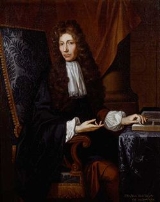
Robert Boyle

The Honourable Robert Boyle was an Irish Ireland

Ireland is the third largest [i] island [i] in Europe [i]. ... 

 natural philosopher  noted for his work in physics Physics

Physics , the most fundamental physical science [i], is concerned with the underlying principles of the ... 

 and chemistry Chemistry

Chemistry is the science [i] of matter [i] at the atom [i]ic to molecular [i] scale, dealing primarily ... 

. Although his research and personal philosophy clearly has its roots in the alchemical tradition, he is largely regarded today as the first modern chemist. Among his works, The Sceptical Chymist The Sceptical Chymist

The Sceptical Chymist or Chymico-Physical Doubts & Paradoxes is the title of Robert Boyle [i]'s mast ... 

is seen as a cornerstone book in the field of chemistry.

Discussions

  Discussion Features

   Ask a question about 'Robert Boyle'

   Start a new discussion about 'Robert Boyle'

   Answer questions about 'Robert Boyle'

   'Robert Boyle' discussion forum

Timeline

1627   Born

1660   At Gresham College Gresham College

Gresham College is an unusual institution of higher learning in London [i] which enrolls no students and ... 

, 12 men, including Christopher Wren Christopher Wren

Sir Christopher Wren, was a 17th century English [i] designer, astronomer, geometrician, and th ... 

, Robert Boyle, John Wilkins John Wilkins

John Wilkins, an English [i] churchman, served as Bishop of Chester [i] from 1668 [i] until his ... 

, and Sir Robert Moray meet after a lecture by Wren and decide to found "a College for the Promoting of Physico-Mathematicall Experimentall Learning}" (later known as the Royal Society Royal Society

The Royal Society of London for the Improvement of Natural Knowledge, known simply as the Royal Socie... 

).

1691   Died


Encyclopedia


The Honourable Robert Boyle was an Irish Ireland

Ireland is the third largest [i] island [i] in Europe [i]. ... 

 natural philosopher  noted for his work in physics Physics

Physics , the most fundamental physical science [i], is concerned with the underlying principles of the ... 

 and chemistry Chemistry

Chemistry is the science [i] of matter [i] at the atom [i]ic to molecular [i] scale, dealing primarily ... 

. Although his research and personal philosophy clearly has its roots in the alchemical tradition, he is largely regarded today as the first modern chemist. Among his works, The Sceptical Chymist The Sceptical Chymist

The Sceptical Chymist or Chymico-Physical Doubts & Paradoxes is the title of Robert Boyle [i]'s mast ... 

is seen as a cornerstone book in the field of chemistry.

Early years

Boyle was born at Lismore Castle Lismore Castle

Lismore Castle is a castle located in the County Waterford [i] town of Lismore [i] ... 

, in the province of Munster, Ireland Ireland

Ireland is the third largest [i] island [i] in Europe [i]. ... 

, as the seventh son and fourteenth child of Richard Boyle, the "Great Earl of Cork". While still a child, he learned to speak Latin Latin

Latin is an ancient Indo-European language [i] originally spoken in Latium [i], ... 

, Greek and French French language

French is the third-largest of the Romance languages [i] in terms of number of native speakers, after Spanish [i] ... 

. He was only eight years old when he was sent to Eton College Eton College

The King's College of Our Lady of Eton, commonly known as Eton College or just Eton, is an inte... 

, of which his father's friend, Sir Henry Wotton, was then provost. After spending over three years at the college, he went to travel abroad with a French tutor. Nearly two years were passed in Geneva Geneva

Geneva is the second most populous city in Switzerland [i] , and is the most populous city of Romandy [i] ... 

; visiting Italy in 1641, he remained during the winter of that year in Florence Florence

Florence is the capital city [i] of the region of Tuscany [i], Italy [i].
... 

, studying the "paradoxes of the great star-gazer" Galileo Galilei Galileo Galilei

Galileo Galilei was an Italian [i] physicist [i], astronomer [i], astrologer [i] and philosopher [i] ... 

, who died within a league of the city early in 1642.

Middle years

Returning to England in 1645 he found that his father was hospitalized and had left him the manor of Stalbridge Stalbridge

Stalbridge is a small town and parish [i] in Dorset [i], England [i], situated in the Blackmore Vale [i] ... 

 in Dorset Dorset

Dorset is a county in the south-west of England [i], on the English Channel [i] coast.... 

, together with estates in Ireland Ireland

Ireland is the third largest [i] island [i] in Europe [i]. ... 

. From that time, he gave up his life to study and scientific Science

Science in the broadest sense refers to any system of knowledge attained by verifiable means.... 

 research, and soon took a prominent place in the band of inquirers, known as the "Invisible College," who devoted themselves to the cultivation of the "new philosophy." They met frequently in London, often at Gresham College Gresham College

Gresham College is an unusual institution of higher learning in London [i] which enrolls no students and ... 

; some of the members also had meetings at Oxford Oxford

Oxford is a city [i] and local government district [i] ... 

, and in that city Boyle went to reside in 1654. Reading in 1657 of Otto von Guericke Otto von Guericke

Otto von Guericke was a German [i] scientist, inventor, and politician. ... 

's air-pump, he set himself with the assistance of Robert Hooke Robert Hooke

Robert Hooke, FRS [i] was an English [i] polymath [i] who played an ... 

 to devise improvements in its construction, and with the result, the "machina Boyleana" or "Pneumatical Engine," finished in 1659, he began a series of experiments on the properties of air. An inscription can be found on the wall of University College, Oxford University College, Oxford

University College, is a constituent college of the University of Oxford [i] in the United Kingdom [i]. ... 

 in the High Street High Street, Oxford

The High Street in Oxford [i], England [i] runs between Carfax [i], generally recognized... 

 at Oxford Oxford

Oxford is a city [i] and local government district [i] ... 

 , marking the spot where Cross Hall stood until the early 1800s. It was here Boyle rented rooms from the wealthy apothecary who owned the Hall:

An account of the work he did with this instrument was published in 1660 under the title New Experiments Physico-Mechanical. Among the critics of the views put forward in this book was a Jesuit Society of Jesus

The Society of Jesus is a Christian [i] religious order [i] of the Catholic Church [i] ... 

, Franciscus Linus , and it was while answering his objections that Boyle enunciated the law that the volume of a gas varies inversely as the pressure, which among English-speaking peoples is usually called after his name, though on the continent of Europe it is attributed to Edme Mariotte, who did not publish it till 1676. In 1663 the Invisible College became the Royal Society of London for the Improvement of Natural Knowledge Royal Society

The Royal Society of London for the Improvement of Natural Knowledge, known simply as the Royal Socie... 

, and the charter of incorporation granted by Charles II of England Charles II of England

Charles II was the King of England [i], King of Scots [i], and King of Ireland [i] from 30 January [i] ... 

, named Boyle a member of the council. In 1680 he was elected president of the society, but declined the honour from a scruple about oaths.

It was during his time at Oxford that Boyle was a Chevalier. The Chevaliers are thought to have been established by royal order a few years before Boyle's time at Oxford. The period of Boyle's residence was marked by the reactionary actions of the victorious parliamentarian forces, consequently this period marked the most secretive period of Chevalier movements and thus little is known about Boyle's involvement beyond his membership.

In 1668 he left Oxford for London London

London is the capital [i] city of England [i] and of the United Kingdom [i]. ... 

 where he resided at the house of his sister, Lady Ranelagh, in Pall Mall Pall Mall, London

Pall Mall is a street in the City of Westminster [i], London [i], situated in SW1 [i] and parallel to The Mall [i] ... 

.

Later years

About 1689 his health, never very strong, began to fail seriously and he gradually withdrew from his public engagements, ceasing his communications to the Royal Society, and advertising his desire to be excused from receiving guests, "unless upon occasions very extraordinary," on Tuesday and Friday forenoon, and Wednesday and Saturday afternoon. In the leisure thus gained he wished to "recruit his spirits, range his papers," and prepare some important chemical investigations which he proposed to leave "as a kind of Hermetic legacy to the studious disciples of that art," but of which he did not make known the nature. His health became still worse in 1691, and his death occurred on December 30 of that year, just a week after that of the sister with whom he had lived for more than twenty years. He was buried in the churchyard of St Martin's in the Fields St Martin-in-the-Fields

[i] church at the northeast corner of [[Trafalgar Square]... 

, his funeral sermon being preached by his friend Bishop Burnet. In his will, Boyle endowed a series of Lectures which came to be known as the Boyle Lectures.

Scientific investigator

Boyle's great merit as a scientific investigator is that he carried out the principles which Francis Bacon Francis Bacon

Francis Bacon, 1st Viscount St Alban, KC [i] was an English [i] philosopher [i], ... 

 preached in the Novum Organum. Yet he would not avow himself a follower of Bacon, or indeed of any other teacher. On several occasions he mentions that in order to keep his judgment as unprepossessed as might be with any of the modern theories of philosophy, till he was "provided of experiments" to help him judge of them, he refrained from any study of the Atomical Atomism

In natural philosophy [i], atomism is the theory that all the objects in the universe are composed of ve... 

 and the Cartesian René Descartes

Ren Descartes
, also known as Cartesius, was a noted French philosopher [i], mathematician [i]... 

 systems, and even of the Novum Organum itself, though he admits to "transiently consulting" them about a few particulars. Nothing was more alien to his mental temperament than the spinning of hypotheses. He regarded the acquisition of knowledge as an end in itself, and in consequence he gained a wider outlook on the aims of scientific inquiry than had been enjoyed by his predecessors for many centuries. This, however, did not mean that he paid no attention to the practical application of science nor that he despised knowledge which tended to use.

He himself was an alchemist Alchemy

Alchemy refers to both an early form of the investigation of nature [i] and an early philosophical [i]... 

; and believing the transmutation of metals to be a possibility, he carried out experiments in the hope of effecting it; and he was instrumental in obtaining the repeal, in 1689, of the statute of Henry IV Henry IV of England

Henry IV was born at Bolingbroke Castle [i] in Lincolnshire [i], hence the other name by which he was k ... 

 against multiplying gold Gold

Gold is a highly sought-after precious metal [i] that for many centuries has been used as money [i], a store of value [i] ... 

 and silver Silver

Silver is a chemical element [i] with the symbol Ag . ... 

. With all the important work he accomplished in physics Physics

Physics , the most fundamental physical science [i], is concerned with the underlying principles of the ... 

 - the enunciation of Boyle's law Boyle's law

Boyle's law is one of the gas laws [i]. ... 

, the discovery of the part taken by air in the propagation of sound Sound

Sound is a disturbance of mechanical energy [i] that propagates through matter [i] as a wave [i]. ... 

, and investigations on the expansive force of freezing water, on specific gravities and refractive Refraction

Refraction is the change in direction of a wave [i] due to a change in its velocity [i].... 

 powers, on crystal Crystal

In chemistry [i] and mineralogy [i], a crystal is a solid [i] in which the constituent atom [i]s, molecule [i] ... 

s, on electricity Electricity

Electricity is a general term for the variety of phenomena resulting from the presence and flow of electric charge [i] ... 

, on colour Color

Color or colour is the visual perceptual property corresponding in humans to the categories... 

, on hydrostatics Fluid statics

Fluid statics is the science [i] of fluid [i]s at rest, and is a sub-field within fluid mechanics [i]. ... 

, etc.- chemistry Chemistry

Chemistry is the science [i] of matter [i] at the atom [i]ic to molecular [i] scale, dealing primarily ... 

 was his peculiar and favourite study. His first book on the subject was The Sceptical Chemist, published in 1661, in which he criticized the "experiments whereby vulgar Spagyrists are wont to endeavour to evince their Salt Salt

In chemistry [i], a salt is any ionic compound [i] composed of cation [i]s and anion [i]s so that the ... 

, Sulphur Sulfur

Sulfur or sulphur is the chemical element [i] in the periodic table [i] that has the symbol S' ... 

 and Mercury  to be the true Principles of Things." For him chemistry was the science of the composition of substances, not merely an adjunct to the arts of the alchemist or the physician. He advanced towards the modern view of elements as the undecomposable constituents of material bodies; and understanding the distinction between mixtures and compounds, he made considerable progress in the technique of detecting their ingredients, a process which he designated by the term "analysis." He further supposed that the elements were ultimately composed of particle Subatomic particle

A subatomic particle is a particle [i] smaller than an atom [i]: it may be elementary [i] ... 

s of various sorts and sizes, into which, however, they were not to be resolved in any known way. Applied chemistry had to thank him for improved methods and for an extended knowledge of individual substances. He also studied the chemistry of combustion and of respiration, and conducted experiments in physiology, where, however, he was hampered by the "tenderness of his nature" which kept him from anatomical dissection Dissection

Dissection is usually the process of disassembling and observing something to determine its internal str... 

s, especially of living animals, though he knew them to be "most instructing."

Besides being a busy natural philosopher, Boyle devoted much time to theology Theology

Theology is reasoned discourse [i] concerning religion [i], spirituality [i] and God [i]. ... 

, showing a very decided leaning to the practical side and an indifference to controversial polemics. At the Restoration English Restoration

The English Restoration or simply Restoration was an episode in the history of England [i] beginni ... 

 he was favourably received at court, and in 1665 would have received the provostship of Eton Eton College

The King's College of Our Lady of Eton, commonly known as Eton College or just Eton, is an inte... 

, if he would have taken orders; but this he refused to do on the ground that his writings on religious subjects would have greater weight coming from a layman than a paid minister of the Church. As a director of the East India Company British East India Company

The British East India Company, sometimes referred to as "John Company", was a joint-stock company [i] ... 

 he spent large sums in promoting the spread of Christianity Christianity

Christianity is a monotheistic [i] religion [i] centered on Jesus of Nazareth [i] ... 

 in the East, contributing liberally to missionary societies, and to the expenses of translating the Bible Bible

The Bible , is the name used by Jews [i] and Christians [i] for their differing canons [i]... 

 or portions of it into various languages. He founded the Boyle lectures, intended to defend the Christian religion Christianity

Christianity is a monotheistic [i] religion [i] centered on Jesus of Nazareth [i] ... 

 against those he considered "notorious infidels, namely atheist Atheism

Atheism, in its broadest sense, is the absence of belief in the existence of deities [i]. ... 

s, theists, pagan Paganism

Paganism is a blanket term which has come to connote a broad set of western spiritual [i] ... 

s, Jew Jew

Jews are followers of Judaism [i] or, more generally, members of the Jewish people , an ethno [i]... 

s and Muslim Muslim

A Muslim is an adherent of Islam [i]. ... 

s," with the proviso that controversies between Christians were not to be mentioned.

In person Boyle was tall, slender and of a pale countenance. His constitution was far from robust, and throughout his life he suffered from feeble health and low spirits. While his scientific work procured him an extraordinary reputation among his contemporaries, his private character and virtues, the charm of his social manners, his wit and powers of conversation, endeared him to a large circle of personal friends. He was never married. His writings are exceedingly voluminous, and his style is clear and straightforward, though undeniably prolix.

In 2004 The Robert Boyle Science Room was opened in the , near his birthplace, dedicated to his life and works where students have the opportunity of studying science and participating in scientific experiments.

Important works

The following are the more important of his works:
  • 1660 - New Experiments Physico-Mechanical: Touching the Spring of the Air and their Effects
  • 1661 - The Sceptical Chymist The Sceptical Chymist

    The Sceptical Chymist or Chymico-Physical Doubts & Paradoxes is the title of Robert Boyle [i]'s mast ... 

  • 1663 - Considerations touching the Usefulness of Experimental Natural Philosophy
  • 1663 - Experiments and Considerations upon Colours, with Observations on a Diamond that Shines in the Dark
  • 1665 - New Experiments and Observations upon Cold
  • 1666 - Hydrostatical Paradoxes
  • 1666 - Origin of Forms and Qualities according to the Corpuscular Philosophy
  • 1669 - a continuation of his work on the spring of air
  • 1670 - tracts about the Cosmical Qualities of Things, the Temperature of the Subterraneal and Submarine Regions, the Bottom of the Sea, &c. with an Introduction to the History of Particular Qualities
  • 1672 - Origin and Virtues of Gems
  • 1673 - Essays of the strange Subtilty, great Efficacy, determinate Nature of l3ffiuvi urns
  • 1674 - two volumes of tracts on the Saitness of the Sea, the Hidden Qualities of the Air, Cold, Celestial Magnets, Animadversions on Ijobbes's Problemata de Vacuo
  • 1676 - Experiments and Notes about the Mechanical Origin or Production of Particular Qualities, including some notes on electricity and magnetism
  • 1678 - Obsersations upon an artificial Substance that Shines without any Preceding Illustration
  • 1680 - the Aerial Noctiluca
  • 1682 - New Experiments and Observations upon the Icy Noctiluca
  • 1682 - a further continuation of his work on the air
  • 1684 - Memoirs for the Natural History of the Human Blood
  • 1685 - Short Memoirs for the Natural Experimental History of Mineral Water Mineral water

    In many places, "mineral water" is often colloquially used to mean carbonated water [i]."

... 

s
  • 1690 - Medic-ma Hydrostatica
  • 1691 - Experimentae et Observationes Physicae


Among his religious and philosophical writings were:

  • 1648/1660 - Seraphic Love, written in 1648, but not published till 1660
  • 1663 - an Essay upon the Style of the Holy Scriptures
  • 1664 - Excellence of Theology compared with Natural Philosophy
  • 1665 - Occasional Reflections upon Several Subjects, which was ridiculed by Swift Jonathan Swift

    Jonathan Swift was an Anglo Irish priest, satirist, essayist, political pamphleteer, and poet, famous f... 

     in A Pious Meditation upon a Broom Stick, and by Butler in An Occasional Reflection on Dr Charlton's Feeling a Dog's Pulse at Gresham College
  • 1675 - Some Considerations about the Reconcileableness of Reason and Religion, with a Discourse about the Possibility of the Resurrection

References


Further reading

  • Stephen Shapin and Simon Schaffer, Leviathan and the Air-Pump.
  • Lawrence Principe, The Aspiring Adept: Robert Boyle and His Alchemical Quest

See also

  • Ambrose Godfrey, phosphorus manufacturer who started as Boyle's assistant
  • Lismore Castle Lismore Castle

    Lismore Castle is a castle located in the County Waterford [i] town of Lismore [i] ... 

  • List of people on stamps of Ireland List of people on stamps of Ireland

    This is a list of people on the postage stamp [i]s of the Irish Free State [i], ire [i] and the Republic of Ireland [i] ... 


External links

  • University of Pennsylvania Library e-text