
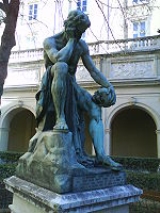
Democritus (
ca.Circa , usually abbreviated c. or ca. , means "approximately" in the English language, usually referring to a date...
460 BC – ca. 370 BC) was an Ancient Greek philosopher born in
Abdera, ThraceAbdera was a city-state on the coast of Thrace 17 km east-northeast of the mouth of the Nestos, and almost opposite Thasos. The site now lies in the Xanthi peripheral unit of modern Greece. The municipality of Abdera, or Ávdira , has 18,573 inhabitants...
,
GreeceGreece , officially the Hellenic Republic , and historically Hellas or the Republic of Greece in English, is a country in southeastern Europe....
. He was an influential
pre-Socratic philosopherPre-Socratic philosophy is Greek philosophy before Socrates . In Classical antiquity, the Presocratic philosophers were called physiologoi...
and pupil of
LeucippusLeucippus or Leukippos was one of the earliest Greeks to develop the theory of atomism — the idea that everything is composed entirely of various imperishable, indivisible elements called atoms — which was elaborated in greater detail by his pupil and successor, Democritus...
, who formulated an
atomic theoryIn chemistry and physics, atomic theory is a theory of the nature of matter, which states that matter is composed of discrete units called atoms, as opposed to the obsolete notion that matter could be divided into any arbitrarily small quantity...
for the cosmos.
His exact contributions are difficult to disentangle from his mentor Leucippus, as they are often mentioned together in texts. Their speculation on atoms, taken from Leucippus, bears a passing and partial resemblance to the nineteenth-century understanding of atomic structure that has led some to regard Democritus as more of a scientist than other Greek philosophers; however their ideas rested on very different bases. Largely ignored in ancient
AthensAthens , is the capital and largest city of Greece. Athens dominates the Attica region and is one of the world's oldest cities, as its recorded history spans around 3,400 years. Classical Athens was a powerful city-state...
, Democritus was nevertheless well known to his fellow northern-born
philosopherPhilosophy is the study of general and fundamental problems, such as those connected with existence, knowledge, values, reason, mind, and language. Philosophy is distinguished from other ways of addressing such problems by its critical, generally systematic approach and its reliance on rational...
AristotleAristotle was a Greek philosopher and polymath, a student of Plato and teacher of Alexander the Great. His writings cover many subjects, including physics, metaphysics, poetry, theater, music, logic, rhetoric, linguistics, politics, government, ethics, biology, and zoology...
.
PlatoPlato , was a Classical Greek philosopher, mathematician, student of Socrates, writer of philosophical dialogues, and founder of the Academy in Athens, the first institution of higher learning in the Western world. Along with his mentor, Socrates, and his student, Aristotle, Plato helped to lay the...
is said to have disliked him so much that he wished all his books burned. Many consider Democritus to be the "father of modern science".
Life
Democritus was born in the city of
AbderaAbdera was a city-state on the coast of Thrace 17 km east-northeast of the mouth of the Nestos, and almost opposite Thasos. The site now lies in the Xanthi peripheral unit of modern Greece. The municipality of Abdera, or Ávdira , has 18,573 inhabitants...
in
ThraceThrace is a historical and geographic area in southeast Europe. As a geographical concept, Thrace designates a region bounded by the Balkan Mountains on the north, Rhodope Mountains and the Aegean Sea on the south, and by the Black Sea and the Sea of Marmara on the east...
, an
IonianThe Ionians were one of the four major tribes into which the Classical Greeks considered the population of Hellenes to have been divided...
colony of
TeosTeos or Teo was a maritime city of Ionia, on a peninsula between Chytrium and Myonnesus, colonized by Orchomenian Minyans, Ionians, and Boeotians. The city is situated on a low hilly narrow strip of land connecting two larger areas of land . Teos ranked among twelve cities comprising the Ionian...
, although some called him a
MilesianThe Milesians of Hellenic civilization were the inhabitants of Miletus, a city in the Anatolia province of modern-day Turkey, near the coast of the Mediterranean Sea and at the mouth of the Meander River. Settlers from Crete moved to Miletus sometime in 16th century BC...
. He was born in the 80th
OlympiadAn Olympiad is a period of four years, associated with the Olympic Games of Classical Greece. In the Hellenistic period, beginning with Ephorus, Olympiads were used as calendar epoch....
(460–457 BC) according to
ApollodorusApollodorus of Athens son of Asclepiades, was a Greek scholar and grammarian. He was a pupil of Diogenes of Babylon, Panaetius the Stoic, and the grammarian Aristarchus of Samothrace...
, and although
ThrasyllusThrasyllus of Mendes, whose full name was Tiberius Claudius Thrasyllus , was an Egyptian Greek grammarian and literary commentator from Mendes, Egypt...
placed his birth in 470 BC, the later date is probably more likely.
John BurnetJohn Burnet was a Scottish classicist.-Education, Life and Work:Burnet was educated at the Royal High School, Edinburgh, the University of Edinburgh, and Balliol College, Oxford, receiving his M.A. degree in 1887...
has argued that the date of 460 is "too early", since according to Diogenes Laërtius ix.41, Democritus said that he was a "young man (
neos)" during
AnaxagorasAnaxagoras was a Pre-Socratic Greek philosopher. Born in Clazomenae in Asia Minor, Anaxagoras was the first philosopher to bring philosophy from Ionia to Athens. He attempted to give a scientific account of eclipses, meteors, rainbows, and the sun, which he described as a fiery mass larger than...
' old age (circa 440–428). It was said that Democritus' father was so wealthy that he received
XerxesXerxes I of Persia , Ḫšayāršā, ), also known as Xerxes the Great, was the fifth king of kings of the Achaemenid Empire.-Youth and rise to power:...
on his march through Abdera. Democritus spent the
inheritanceInheritance is the practice of passing on property, titles, debts, rights and obligations upon the death of an individual. It has long played an important role in human societies...
which his father left him on travels into distant countries, to satisfy his thirst for knowledge. He traveled to
AsiaAsia is the world's largest and most populous continent, located primarily in the eastern and northern hemispheres. It covers 8.7% of the Earth's total surface area and with approximately 3.879 billion people, it hosts 60% of the world's current human population...
, and was even said to have reached
IndiaIndia , officially the Republic of India , is a country in South Asia. It is the seventh-largest country by geographical area, the second-most populous country with over 1.2 billion people, and the most populous democracy in the world...
and
EthiopiaEthiopia , officially known as the Federal Democratic Republic of Ethiopia, is a country located in the Horn of Africa. It is the second-most populous nation in Africa, with over 82 million inhabitants, and the tenth-largest by area, occupying 1,100,000 km2...
.
We know that he wrote on
BabylonBabylon was an Akkadian city-state of ancient Mesopotamia, the remains of which are found in present-day Al Hillah, Babil Province, Iraq, about 85 kilometers south of Baghdad...
and
MeroeMeroë Meroitic: Medewi or Bedewi; Arabic: and Meruwi) is an ancient city on the east bank of the Nile about 6 km north-east of the Kabushiya station near Shendi, Sudan, approximately 200 km north-east of Khartoum. Near the site are a group of villages called Bagrawiyah...
; he must also have visited
EgyptEgypt , officially the Arab Republic of Egypt, Arabic: , is a country mainly in North Africa, with the Sinai Peninsula forming a land bridge in Southwest Asia. Egypt is thus a transcontinental country, and a major power in Africa, the Mediterranean Basin, the Middle East and the Muslim world...
, and
Diodorus SiculusDiodorus Siculus was a Greek historian who flourished between 60 and 30 BC. According to Diodorus' own work, he was born at Agyrium in Sicily . With one exception, antiquity affords no further information about Diodorus' life and doings beyond what is to be found in his own work, Bibliotheca...
states that he lived there for five years. He himself declared that among his contemporaries none had made greater journeys, seen more countries, and met more scholars than himself. He particularly mentions the
Egyptian mathematiciansEgyptian mathematics is the mathematics that was developed and used in Ancient Egypt from ca. 3000 BC to ca. 300 BC.-Overview:Written evidence of the use of mathematics dates back to at least 3000 BC with the ivory labels found at Tomb Uj at Abydos. These labels appear to have been used as tags for...
, whose knowledge he praises.
TheophrastusTheophrastus , a Greek native of Eresos in Lesbos, was the successor to Aristotle in the Peripatetic school. He came to Athens at a young age, and initially studied in Plato's school. After Plato's death he attached himself to Aristotle. Aristotle bequeathed to Theophrastus his writings, and...
, too, spoke of him as a man who had seen many countries. During his travels, according to Diogenes Laërtius, he became acquainted with the Chaldean magi. A certain "Ostanes", one of the magi accompanying
XerxesXerxes I of Persia , Ḫšayāršā, ), also known as Xerxes the Great, was the fifth king of kings of the Achaemenid Empire.-Youth and rise to power:...
was also said to have taught him.
After returning to his native land he occupied himself with natural
philosophyPhilosophy is the study of general and fundamental problems, such as those connected with existence, knowledge, values, reason, mind, and language. Philosophy is distinguished from other ways of addressing such problems by its critical, generally systematic approach and its reliance on rational...
. He traveled throughout
GreeceGreece , officially the Hellenic Republic , and historically Hellas or the Republic of Greece in English, is a country in southeastern Europe....
to acquire a knowledge of its culture. He mentions many
GreekThe Greeks, also known as the Hellenes , are a nation and ethnic group native to Greece, Cyprus and neighboring regions. They also form a significant diaspora, with Greek communities established around the world....
philosophers in his writings, and his wealth enabled him to purchase their writings.
LeucippusLeucippus or Leukippos was one of the earliest Greeks to develop the theory of atomism — the idea that everything is composed entirely of various imperishable, indivisible elements called atoms — which was elaborated in greater detail by his pupil and successor, Democritus...
, the founder of the
atomismAtomism is a natural philosophy that developed in several ancient traditions. The atomists theorized that the natural world consists of two fundamental parts: indivisible atoms and empty void.According to Aristotle, atoms are indestructible and immutable and there are an infinite variety of shapes...
, was the greatest influence upon him. He also praises
AnaxagorasAnaxagoras was a Pre-Socratic Greek philosopher. Born in Clazomenae in Asia Minor, Anaxagoras was the first philosopher to bring philosophy from Ionia to Athens. He attempted to give a scientific account of eclipses, meteors, rainbows, and the sun, which he described as a fiery mass larger than...
. Diogenes Laertius says that he was friends with
HippocratesHippocrates of Cos or Hippokrates of Kos was an ancient Greek physician of the Age of Pericles , and is considered one of the most outstanding figures in the history of medicine...
. He may have been acquainted with
Socrates Socrates was a classical Greek Athenian philosopher. Credited as one of the founders of Western philosophy, he is an enigmatic figure known chiefly through the accounts of later classical writers, especially the writings of his students Plato and Xenophon, and the plays of his contemporary ...
, but
PlatoPlato , was a Classical Greek philosopher, mathematician, student of Socrates, writer of philosophical dialogues, and founder of the Academy in Athens, the first institution of higher learning in the Western world. Along with his mentor, Socrates, and his student, Aristotle, Plato helped to lay the...
does not mention him and Democritus himself is quoted as saying, "I came to Athens and no one knew me."
AristotleAristotle was a Greek philosopher and polymath, a student of Plato and teacher of Alexander the Great. His writings cover many subjects, including physics, metaphysics, poetry, theater, music, logic, rhetoric, linguistics, politics, government, ethics, biology, and zoology...
placed him among the
pre-SocraticPre-Socratic philosophy is Greek philosophy before Socrates . In Classical antiquity, the Presocratic philosophers were called physiologoi...
natural philosophers.
The many anecdotes about Democritus, especially in
Diogenes LaërtiusDiogenes Laertius was a biographer of the Greek philosophers. Nothing is known about his life, but his surviving Lives and Opinions of Eminent Philosophers is one of the principal surviving sources for the history of Greek philosophy.-Life:Nothing is definitively known about his life...
, attest to his disinterest, modesty, and simplicity, and show that he lived exclusively for his studies. One story has him deliberately
blindingBlinding can refer to:*The act of making someone blind**Metaphorical and extended uses of same: see blindness#Metaphorical uses*Blinding , a technique by which an agent can provide a service to a client in an encoded form without knowing either the real input or the real output*Blinding , a novel...
himself in order to be less disturbed in his pursuits; it may well be true that he lost his sight in
old ageOld age consists of ages nearing or surpassing the average life span of human beings, and thus the end of the human life cycle...
. He was cheerful, and was always ready to see the comical side of life, which later writers took to mean that he always laughed at the foolishness of people.
He was highly esteemed by his fellow-citizens, "because," as Diogenes Laërtius says, "he had foretold them some things which events proved to be true," which may refer to his knowledge of natural phenomena. According to
Diodorus SiculusDiodorus Siculus was a Greek historian who flourished between 60 and 30 BC. According to Diodorus' own work, he was born at Agyrium in Sicily . With one exception, antiquity affords no further information about Diodorus' life and doings beyond what is to be found in his own work, Bibliotheca...
, Democritus died at the age of 90, which would put his death around 370 BC, but other writers have him living to 104, or even 109.
Popularly known as the Laughing Philosopher (for laughing at human follies), the terms
Abderitan laughter, which means scoffing, incessant laughter, and Abderite, which means a scoffer, are derived from Democritus. To his fellow citizens he was also known as "The Mocker".
Philosophy and science
Democritus followed in the tradition of Leucippus, who seems to have come from Miletus, and he carried on the scientific rationalist philosophy associated with that city. They were both strict determinists and thorough
materialistsIn philosophy, the theory of materialism holds that the only thing that exists is matter; that all things are composed of material and all phenomena are the result of material interactions. In other words, matter is the only substance...
, believing everything to be the result of natural laws. Unlike Aristotle or Plato, the atomists attempted to explain the world without reasoning to
purpose,
prime mover, or
final cause. For the atomists questions should be answered with a mechanistic explanation ("What earlier circumstances caused this event?"), while their opponents search for explanations which, in addition to the material and mechanistic, also included the formal and teleological ("What purpose did this event serve?"). Modern science has focused on mechanistic questions, which have led to scientific knowledge, especially in physics, while teleological questions can be useful in biology, in adaptationist reasoning at providing proximate explanations, though the deeper evolutionary explanations are often held to be thoroughly mechanistic. The atomists looked exclusively for mechanistic questions, and only admitted mechanistic answers. Their successors until the Renaissance became occupied with the teleological question, which arguably hindered progress.
Atomic hypothesis
The theory of Democritus and Leucippus held that everything is composed of "atoms", which are physically, but not geometrically, indivisible; that between atoms lies empty space; that atoms are indestructible; have always been, and always will be, in motion; that there are an infinite number of atoms, and kinds of atoms, which differ in shape, and size. Of the mass of atoms, Democritus said "The more any indivisible exceeds, the heavier it is." But his exact position on weight of atoms is disputed.
Leucippus is widely credited with being the first to develop the theory of atomism, although
Isaac NewtonSir Isaac Newton PRS was an English physicist, mathematician, astronomer, natural philosopher, alchemist, and theologian, who has been "considered by many to be the greatest and most influential scientist who ever lived."...
preferred to credit the obscure
Moschus the PhoenicianMochus a Phoenician, is listed, along with Zalmoxis and Atlas, by Diogenes Laërtius as a proto-philosopher. Athenaeus claimed that he authored a work on the history of Phoenicia. Strabo, on the authority of Posidonius, speaks of one Mochus or Moschus of Sidon as the author of the atomic theory and...
(whom he believed to be the biblical Moses) as the inventor of the idea on the authority of
PosidoniusPosidonius "of Apameia" or "of Rhodes" , was a Greek Stoic philosopher, politician, astronomer, geographer, historian and teacher native to Apamea, Syria. He was acclaimed as the greatest polymath of his age...
and
StraboStrabo, also written Strabon was a Greek historian, geographer and philosopher.-Life:Strabo was born to an affluent family from Amaseia in Pontus , a city which he said was situated the approximate equivalent of 75 km from the Black Sea...
. The
Stanford Encyclopedia of PhilosophyThe Stanford Encyclopedia of Philosophy is a freely-accessible online encyclopedia of philosophy maintained by Stanford University. Each entry is written and maintained by an expert in the field, including professors from over 65 academic institutions worldwide...
notes, "This theologically motivated view does not seem to claim much historical evidence, however."
Democritus, along with
LeucippusLeucippus or Leukippos was one of the earliest Greeks to develop the theory of atomism — the idea that everything is composed entirely of various imperishable, indivisible elements called atoms — which was elaborated in greater detail by his pupil and successor, Democritus...
and
EpicurusEpicurus was an ancient Greek philosopher and the founder of the school of philosophy called Epicureanism.Only a few fragments and letters remain of Epicurus's 300 written works...
, proposed the earliest views on the shapes and connectivity of atoms. They reasoned that the solidness of the material corresponded to the shape of the atoms involved. Thus, iron atoms are solid and strong with hooks that lock them into a solid; water atoms are smooth and slippery; salt atoms, because of their taste, are sharp and pointed; and air atoms are light and whirling, pervading all other materials. Democritus was the main proponent of this view. Using analogies from our sense experiences, he gave a picture or an image of an atom that distinguished them from each other by their shape, their size, and the arrangement of their parts. Moreover, connections were explained by material links in which single atoms were supplied with attachments: some with hooks and eyes others with balls and sockets. The Democritean atom is an inert solid (merely excluding other bodies from its volume) that interacts with other atoms
mechanicallyMechanism is the belief that natural wholes are like machines or artifacts, composed of parts lacking any intrinsic relationship to each other, and with their order imposed from without. Thus, the source of an apparent thing's activities is not the whole itself, but its parts or an external...
. In contrast, modern, quantum-mechanical atoms interact via electric and magnetic force fields and are far from inert.
The theory of the atomists appears to be more nearly aligned with that of modern science than any other theory of antiquity. However, the similarity with modern concepts of science can be confusing when trying to understand where the hypothesis came from. It is obvious that classical atomists would never have had a solid empirical basis for our modern concepts of atoms and molecules.
Bertrand RussellBertrand Arthur William Russell, 3rd Earl Russell, OM, FRS was a British philosopher, logician, mathematician, historian, and social critic. At various points in his life he considered himself a liberal, a socialist, and a pacifist, but he also admitted that he had never been any of these things...
states that they just hit on a lucky hypothesis, only recently confirmed by evidence.
However
LucretiusTitus Lucretius Carus was a Roman poet and philosopher. His only known work is an epic philosophical poem laying out the beliefs of Epicureanism, De rerum natura, translated into English as On the Nature of Things or "On the Nature of the Universe".Virtually no details have come down concerning...
, describing atomism in his de rerum natura gives very clear and compelling empirical arguments for the original atomist theory. He observes that any material is subject to irreversible decay. Through time, even hard rocks are slowly worn down by drops of water. Things have the tendency to get mixed up: mix water with soil and you get mud, that will usually not un-mix by itself. Wood decays. However, we see in nature and technology that there are mechanisms to recreate 'pure' materials like water, air, metals. The seed of an oak will grow out into an oak tree, made of similar wood as historical oak trees, the wood of which has already decayed. The conclusion is that many properties of materials must derive from something inside, that will itself never decay, something that stores for eternity the same inherent, indivisible properties. The basic question is: why has everything in the world not yet decayed, and how can exactly the same materials, plants, animals be recreated again and again? One obvious solution to explain how indivisible properties can be conveyed in a way not easily visible to human senses, is to hypothesise the existence of 'atoms'. These classical 'atoms' are nearer to our modern concept of 'molecule' than to the atoms of modern science. The other big point of classical atomism is that there must be a lot of open space between these 'atoms': the void. Lucretius gives reasonable arguments that the void is absolutely necessary to explain how gasses and fluids can change shape, flow, while metals can be molded, without changing the basic material properties.
Void hypothesis
The atomistic void hypothesis was a response to the paradoxes of
ParmenidesParmenides of Elea was an ancient Greek philosopher born in Elea, a Greek city on the southern coast of Italy. He was the founder of the Eleatic school of philosophy. The single known work of Parmenides is a poem, On Nature, which has survived only in fragmentary form. In this poem, Parmenides...
and
ZenoZeno of Elea was a pre-Socratic Greek philosopher of southern Italy and a member of the Eleatic School founded by Parmenides. Aristotle called him the inventor of the dialectic. He is best known for his paradoxes, which Bertrand Russell has described as "immeasurably subtle and profound".- Life...
, the founders of metaphysical logic, who put forth difficult to answer arguments in favor of the idea that there can be no movement. They held that any movement would require a void—which is nothing—but a nothing cannot exist. The Parmenidean position was "You say there 'is' a void; therefore the void is not nothing; therefore there is not the void." The position of Parmenides appeared validated by the observation that where there seems to be nothing there is air, and indeed even where there is not matter there is
something, for instance light waves.
The atomists agreed that motion required a void, but simply ignored the argument of Parmenides on the grounds that motion was an observable fact. Therefore, they asserted, there must be a void. This idea survived in a refined version as Newton's theory of absolute space, which met the logical requirements of attributing reality to not-being. Einstein's theory of relativity provided a new answer to Parmenides and Zeno, with the insight that space by itself is relative and cannot be separated from time as part of a generally curved space-time manifold. Consequently, Newton's refinement is now considered superfluous.
Epistemology
The knowledge of truth according to Democritus is difficult, since the perception through the senses is subjective. As from the same senses derive different impressions for each individual, then through the sense-impressions we cannot judge the truth. We can only interpret the sense data through the intellect and grasp the truth, because the truth (
aletheia) is at the bottom (
en bythoe).
- “And again, many of the other animals receive impressions contrary to ours; and even to the senses of each individual, things do not always seem the same. Which then, of these impressions are true and which are false is not obvious; for the one set is no more true than the other, but both are alike. And this is why Democritus, at any rate, says that either there is no truth or to us at least it is not evident.”
- “Democritus says: By convention hot, by convention cold, but in reality atoms and void, and also in reality we know nothing, since the truth is at bottom.”
There are two kinds of knowing, the one he calls “legitimate” (
gnesie: genuine) and the other “bastard” (
skotie: obscure). The “bastard” knowledge is concerned with the perception through the senses, therefore it is insufficient and subjective. The reason is that the sense-perception is due to the effluences of the atoms (
aporroai) from the objects to the senses. When these different shapes of atoms come to us, they stimulate our senses according to their shape, and our sense-impressions arise from those stimulations.
The second sort of knowledge, the “legitimate” one, can be achieved through the intellect, in other words, all the sense-data from the “bastard” must be elaborated through reasoning. In this way one can get away from the false perception of the “bastard” knowledge and grasp the truth through the inductive reasoning. After taking into account the sense-impressions, one can examine the causes of the appearances, draw conclusions about the laws that govern the appearances, and discover the causality (
aetiologia) by which they are related. This is the procedure of thought from the parts to the whole or else from the apparent to non-apparent (inductive reasoning). This is one example of why Democritus is considered to be an early scientific thinker. The process is reminiscent of that by which science gathers its conclusions.
- “But in the Canons Democritus says there are two kinds of knowing, one through the senses and the other through the intellect. Of these he calls the one through the intellect ‘legitimate’ attesting its trustworthiness for the judgement of truth, and through the senses he names ‘bastard’ denying its inerrancy in the discrimination of what is true. To quote his actual words: Of knowledge there are two forms, one legitimate, one bastard. To the bastard belong all this group: sight, hearing, smell, taste, touch. The other is legitimate and separate from that. Then, preferring the legitimate to the bastard, he continues: When the bastard can no longer see any smaller, or hear, or smell, or taste, or perceive by touch, but finer matters have to be examined, then comes the legitimate, since it has a finer organ of perception.”
- “In the Confirmations ... he says: But we in actuality grasp nothing for certain, but what shifts in accordance with the condition of the body and of the things (atoms) which enter it and press upon it.”
- “Democritus used to say that 'he prefers to discover a causality rather than become a king of Persia'.”
Ethics and politics
The ethics and politics of Democritus come to us mostly in the form of maxims. He says that "Equality is everywhere noble," but he is not encompassing enough to include women or slaves in this sentiment. Poverty in a democracy is better than prosperity under tyrants, for the same reason one is to prefer liberty over slavery. Those in power should "take it upon themselves to lend to the poor and to aid them and to favor them, then is there pity and no isolation but companionship and mutual defense and concord among the citizens and other good things too many to catalogue." Money when used with sense leads to generosity and charity, while money used in folly leads to a common expense for the whole society— excessive hoarding of money for one's children is avarice. While making money is not useless, he says, doing so as a result of wrong-doing is the "worst of all things." He is on the whole ambivalent towards wealth, and values it much less than self-sufficiency. He disliked violence but was not a pacifist: he urged cities to be prepared for war, and believed that a society had the right to execute a criminal or enemy so long as this did not violate some law, treaty, or oath.
Goodness, he believed, came more from practice and discipline than from innate human nature. He believed that one should distance oneself from the wicked, stating that such association increases disposition to vice. Anger, while difficult to control, must be mastered in order for one to be rational. Those who take pleasure from the disasters of their neighbors fail to understand that their fortunes are tied to the society in which they live, and they rob themselves of any joy of their own. He advocated a life of contentment with as little grief as possible, which he said could not be achieved through either idleness or preoccupation with worldly pleasures. Contentment would be gained, he said, through moderation and a measured life; to be content one must set their judgment on the possible and be satisfied with what one has—giving little thought to envy or admiration. Democritus approved of extravagance on occasion, as he held that feasts and celebrations were necessary for joy and relaxation. He considers education to be the noblest of pursuits, but cautioned that learning without sense leads to error.
Mathematics
Democritus was also a pioneer of mathematics and geometry in particular. We only know this through citations of his works (titled
On Numbers,
On Geometrics,
On Tangencies,
On Mapping, and
On Irrationals) in other writings, since most of Democritus' body of work did not survive the Middle Ages. Democritus was among the first to observe that a
coneA cone is an n-dimensional geometric shape that tapers smoothly from a base to a point called the apex or vertex. Formally, it is the solid figure formed by the locus of all straight line segments that join the apex to the base...
or
pyramidA pyramid is a structure whose outer surfaces are triangular and converge at a single point. The base of a pyramid can be trilateral, quadrilateral, or any polygon shape, meaning that a pyramid has at least three triangular surfaces...
has one-third the
volumeVolume is the quantity of three-dimensional space enclosed by some closed boundary, for example, the space that a substance or shape occupies or contains....
of a
cylinderA cylinder is one of the most basic curvilinear geometric shapes, the surface formed by the points at a fixed distance from a given line segment, the axis of the cylinder. The solid enclosed by this surface and by two planes perpendicular to the axis is also called a cylinder...
or
prismIn geometry, a prism is a polyhedron with an n-sided polygonal base, a translated copy , and n other faces joining corresponding sides of the two bases. All cross-sections parallel to the base faces are the same. Prisms are named for their base, so a prism with a pentagonal base is called a...
respectively with the same base and height. Also, a cone divided in a plane parallel to its base produces two surfaces. He pointed out that if the two surfaces are commensurate with each other, then the shape of the body would appear to be a cylinder, as it is composed of equal rather than unequal circles. However, if the surfaces are not commensurate, then the side of a cone is not smooth but jagged like a series of steps.
Anthropology, biology, and cosmology
His work on nature is known through citations of his books on the subjects,
On the Nature of Man,
On Flesh (two books),
On Mind, On the Senses,
On Flavors,
On Colors,
Causes concerned with Seeds and Plants and Fruits, and
Causes concerned with Animals (three books). He spent much of his life experimenting with and examining plants and minerals, and wrote at length on many scientific topics. Democritus thought that the first humans lived an anarchic and animal sort of life, going out to forage individually and living off the most palatable herbs and the fruit which grew wild on the trees. They were driven together into societies for fear of wild animals, he said. He believed that these early people had no language, but that they gradually began to articulate their expressions, establishing symbols for every sort of object, and in this manner came to understand each other. He says that the earliest men lived laboriously, having none of the utilities of life; clothing, houses, fire, domestication, and farming were unknown to them. Democritus presents the early period of mankind as one of learning by trial and error, and says that each step slowly led to more discoveries; they took refuge in the caves in winter, stored fruits that could be preserved, and through reason and keenness of mind came to build upon each new idea.
Democritus held that the Earth was round, and stated that originally the universe was composed of nothing but tiny atoms churning in chaos, until they collided together to form larger units—including the earth and everything on it. He surmised that
there are many worldsCosmic pluralism, the plurality of worlds, or simply pluralism, describes the belief in numerous other worlds which harbour extraterrestrial life. The debate over pluralism began as early as the time of Thales Cosmic pluralism, the plurality of worlds, or simply pluralism, describes the belief in...
, some growing, some decaying; some with no sun or moon, some with several. He held that every world has a beginning and an end, and that a world could be destroyed by collision with another world. To epitomize Democritus's cosmology, Russell calls on Shelley: "Worlds on worlds are rolling ever / From creation to decay, / Like the bubbles on a river / Sparkling, bursting, borne away."
Works
Ethics
- Pythagoras
- On the Disposition of the Wise Man
- On the Things in Hades
- Tritogenia
- On Manliness or On Virtue
- The Horn of Amaltheia
- On Contentment
- Ethical Commentaries
Natural science
- The Great World-ordering (may have been written by Leucippus)
- Cosmography
- On the Planets
- On Nature
- On the Nature of Man or On Flesh (two books)
- On the Mind
- On the Senses
- On Flavours
- On Colours
- On Different Shapes
- On Changing Shape
- Buttresses
- On Images
- On Logic (three books)
Nature
- Heavenly Causes
- Atmospheric Causes
- Terrestrial Causes
- Causes Concerned with Fire and Things in Fire
- Causes Concerned with Sounds
- Causes Concerned with Seeds and Plants and Fruits
- Causes Concerned with Animals (three books)
- Miscellaneous Causes
- On Magnets
Mathematics
- On Different Angles or On contact of Circles and Spheres
- On Geometry
- Geometry
- Numbers
- On Irrational Lines and Solids (two books)
- Planispheres
- On the Great Year or Astronomy (a calendar)
- Contest of the Waterclock
- Description of the Heavens
- Geography
- Description of the Poles
- Description of Rays of Light
Literature
- On the Rhythms and Harmony
- On Poetry
- On the Beauty of Verses
- On Euphonious and Harsh-sounding Letters
- On Homer
- On Song
- On Verbs
- Names
Technical works
- Prognosis
- On Diet
- Medical Judgment
- Causes Concerning Appropriate and Inappropriate Occasions
- On Farming
- On Painting
- Tactics
- Fighting in Armor
Commentaries
- On the Sacred Writings of Babylon
- On Those in Meroe
- Circumnavigation of the Ocean
- On History
- Chaldaean Account
- Phrygian Account
- On Fever and Coughing Sicknesses
- Legal Causes
- Problems
Institutes named after Democritus
After Democritus are named the following institutions:
- Democritus University of Thrace
Democritus University of Thrace was established in July 1973. It is based in Komotini, Greece and has campuses in the Thracian cities of Xanthi, Alexandroupoli and Orestiada. The university accepted the first students in the academic year 1974–1975...
- National Centre of Scientific Research "DEMOKRITOS"
Numismatics
Democritus was depicted on the following contemporary coins/banknotes:
- The reverse
Obverse and its opposite, reverse, refer to the two flat faces of coins and some other two-sided objects, including paper money, flags , seals, medals, drawings, old master prints and other works of art, and printed fabrics. In this usage, obverse means the front face of the object and reverse...
of the Greek 10 drachmasDrachma, pl. drachmas or drachmae was the currency used in Greece during several periods in its history:...
coin of 1976–2001.
- The obverse
Obverse and its opposite, reverse, refer to the two flat faces of coins and some other two-sided objects, including paper money, flags , seals, medals, drawings, old master prints and other works of art, and printed fabrics. In this usage, obverse means the front face of the object and reverse...
of the Greek 100 drachmasDrachma, pl. drachmas or drachmae was the currency used in Greece during several periods in its history:...
banknote of 1967–1978.
External links