
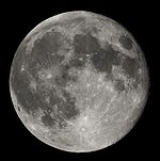
The Moon is
EarthEarth is the third planet from the Sun, and the densest and fifth-largest of the eight planets in the Solar System. It is also the largest of the Solar System's four terrestrial planets...
's only known
natural satelliteA natural satellite or moon is a celestial body that orbits a planet or smaller body, which is called its primary. The two terms are used synonymously for non-artificial satellites of planets, of dwarf planets, and of minor planets....
,
[There are a number of near-Earth asteroids including 3753 Cruithne]3753 Cruithne is an asteroid in orbit around the Sun in approximate 1:1 orbital resonance with the Earth. It is a periodic inclusion planetoid orbiting the Sun in an apparent horseshoe orbit. It has been incorrectly called "Earth's second moon", but it is only a quasi-satellite. Cruithne never...
that are co-orbital with Earth: their orbits bring them close to Earth for periods of time but then alter in the long term (Morais et al, 2002). These are quasi-satelliteA quasi-satellite is an object in a 1:1 orbital resonance with its planet that stays close to the planet over many orbital periods.A quasi-satellite's orbit around the Sun takes exactly the same time as the planet's, but has a different eccentricity , as shown in the diagram on the right...
s and not true moons. For more information, see Other moons of Earth. and the
fifth largest satellite in the
Solar SystemThe Solar System consists of the Sun and the astronomical objects gravitationally bound in orbit around it, all of which formed from the collapse of a giant molecular cloud approximately 4.6 billion years ago. The vast majority of the system's mass is in the Sun...
. It is the largest natural satellite of a planet in the Solar System relative to the size of its
primaryA primary is the main physical body of a gravitationally-bound, multi-object system. This body contributes most of the mass of that system and will generally be located near its center of mass....
, having a quarter the diameter of Earth and its mass.
[Charon]Charon is the largest satellite of the dwarf planet Pluto. It was discovered in 1978 at the United States Naval Observatory Flagstaff Station. Following the 2005 discovery of two other natural satellites of Pluto , Charon may also be referred to as Pluto I...
is proportionally larger in comparison to PlutoPluto, formal designation 134340 Pluto, is the second-most-massive known dwarf planet in the Solar System and the tenth-most-massive body observed directly orbiting the Sun...
, but Pluto has been reclassified as a dwarf planetA dwarf planet, as defined by the International Astronomical Union , is a celestial body orbiting the Sun that is massive enough to be spherical as a result of its own gravity but has not cleared its neighboring region of planetesimals and is not a satellite...
The Moon is the second densest satellite after
IoIo ) is the innermost of the four Galilean moons of the planet Jupiter and, with a diameter of , the fourth-largest moon in the Solar System. It was named after the mythological character of Io, a priestess of Hera who became one of the lovers of Zeus....
, a satellite of Jupiter. It is in
synchronous rotationIn astronomy, synchronous rotation is a planetological term describing a body orbiting another, where the orbiting body takes as long to rotate on its axis as it does to make one orbit; and therefore always keeps the same hemisphere pointed at the body it is orbiting...
with Earth, always showing the same face; the
near sideThe near side of the Moon is the lunar hemisphere that is permanently turned towards the Earth, whereas the opposite side is the far side of the Moon. Only one side of the Moon is visible from Earth because the Moon rotates about its spin axis at the same rate that the Moon orbits the Earth, a...
is marked with dark volcanic
mariaThe lunar maria are large, dark, basaltic plains on Earth's Moon, formed by ancient volcanic eruptions. They were dubbed maria, Latin for "seas", by early astronomers who mistook them for actual seas. They are less reflective than the "highlands" as a result of their iron-rich compositions, and...
among the bright ancient crustal highlands and prominent
impact craterIn the broadest sense, the term impact crater can be applied to any depression, natural or manmade, resulting from the high velocity impact of a projectile with a larger body...
s. It is the brightest object in the sky after the
SunThe Sun is the star at the center of the Solar System. It is almost perfectly spherical and consists of hot plasma interwoven with magnetic fields...
, although its surface is actually very dark, with a similar reflectance to coal. Its prominence in the sky and its regular cycle of phases have since ancient times made the Moon an important cultural influence on language,
calendarA lunar calendar is a calendar that is based on cycles of the lunar phase. A common purely lunar calendar is the Islamic calendar or Hijri calendar. A feature of the Islamic calendar is that a year is always 12 months, so the months are not linked with the seasons and drift each solar year by 11 to...
s, art and
mythologyIn mythology, a lunar deity is a god or goddess associated with or symbolizing the moon. These deities can have a variety of functions and traditions depending upon the culture, but they are often related to or an enemy of the solar deity. Even though they may be related, they are distinct from the...
. The Moon's gravitational influence produces the ocean tides and the
minute lengtheningTidal acceleration is an effect of the tidal forces between an orbiting natural satellite , and the primary planet that it orbits . The "acceleration" is usually negative, as it causes a gradual slowing and recession of a satellite in a prograde orbit away from the primary, and a corresponding...
of the day. The Moon's current orbital distance, about thirty times the diameter of the Earth, causes it to appear almost the same size in the sky as the Sun, allowing it to cover the Sun nearly precisely in total
solar eclipseAs seen from the Earth, a solar eclipse occurs when the Moon passes between the Sun and the Earth, and the Moon fully or partially blocks the Sun as viewed from a location on Earth. This can happen only during a new moon, when the Sun and the Moon are in conjunction as seen from Earth. At least...
s.
The Moon is the only
celestial bodyAstronomical objects or celestial objects are naturally occurring physical entities, associations or structures that current science has demonstrated to exist in the observable universe. The term astronomical object is sometimes used interchangeably with astronomical body...
on which
humans have landedA moon landing is the arrival of a spacecraft on the surface of the Moon. This includes both manned and unmanned missions. The first human-made object to reach the surface of the Moon was the Soviet Union's Luna 2 mission on 13 September 1959. The United States's Apollo 11 was the first manned...
. While the
Soviet UnionThe Soviet Union , officially the Union of Soviet Socialist Republics , was a constitutionally socialist state that existed in Eurasia between 1922 and 1991....
's
Luna programmeThe Luna programme , occasionally called Lunik or Lunnik, was a series of robotic spacecraft missions sent to the Moon by the Soviet Union between 1959 and 1976. Fifteen were successful, each designed as either an orbiter or lander, and accomplished many firsts in space exploration...
was the first to reach the Moon with unmanned
spacecraftA spacecraft or spaceship is a craft or machine designed for spaceflight. Spacecraft are used for a variety of purposes, including communications, earth observation, meteorology, navigation, planetary exploration and transportation of humans and cargo....
in 1959, the United States'
NASAThe National Aeronautics and Space Administration is the agency of the United States government that is responsible for the nation's civilian space program and for aeronautics and aerospace research...
Apollo program achieved the only manned missions to date, beginning with the first manned lunar orbiting mission by
Apollo 8Apollo 8, the second manned mission in the American Apollo space program, was the first human spaceflight to leave Earth orbit; the first to be captured by and escape from the gravitational field of another celestial body; and the first crewed voyage to return to Earth from another celestial...
in 1968, and six manned lunar landings between 1969 and 1972—the first being
Apollo 11In early 1969, Bill Anders accepted a job with the National Space Council effective in August 1969 and announced his retirement as an astronaut. At that point Ken Mattingly was moved from the support crew into parallel training with Anders as backup Command Module Pilot in case Apollo 11 was...
. These missions returned over 380 kg of lunar rocks, which have been used to develop a detailed geological understanding of the Moon's origins (it is thought to have formed some 4.5 billion years ago in
a giant impactThe giant impact hypothesis states that the Moon was created out of the debris left over from a collision between the young Earth and a Mars-sized body. The colliding body is sometimes called Theia for the mythical Greek Titan who was the mother of Selene, the goddess of the moon.The giant impact...
event involving Earth), the formation of
its internal structureHaving a mean density of 3,346.4 kg/m³, the Moon is a differentiated body, being composed of a geochemically distinct crust, mantle, and core. This structure is believed to have resulted from the fractional crystallization of a magma ocean shortly after its formation about 4.5 billion years ago...
, and
its subsequent historyThe geology of the Moon is quite different from that of the Earth...
.
After the
Apollo 17Apollo 17 was the eleventh and final manned mission in the American Apollo space program. Launched at 12:33 a.m. EST on December 7, 1972, with a three-member crew consisting of Commander Eugene Cernan, Command Module Pilot Ronald Evans, and Lunar Module Pilot Harrison Schmitt, Apollo 17 remains the...
mission in 1972, the Moon has been visited only by unmanned spacecraft, notably by the final Soviet Lunokhod
roverA rover is a space exploration vehicle designed to move across the surface of a planet or other astronomical body. Some rovers have been designed to transport members of a human spaceflight crew; others have been partially or fully autonomous robots...
. Since 2004, Japan, China, India, the United States, and the
European Space AgencyThe European Space Agency , established in 1975, is an intergovernmental organisation dedicated to the exploration of space, currently with 18 member states...
have each sent lunar orbiters. These spacecraft have contributed to confirming the discovery of lunar water ice in permanently shadowed craters at the poles and bound into the lunar
regolithRegolith is a layer of loose, heterogeneous material covering solid rock. It includes dust, soil, broken rock, and other related materials and is present on Earth, the Moon, some asteroids, and other terrestrial planets and moons.-Etymology:...
. Future manned missions to the Moon have been planned, including government as well as privately funded efforts. The Moon remains, under the
Outer Space TreatyThe Outer Space Treaty, formally the Treaty on Principles Governing the Activities of States in the Exploration and Use of Outer Space, including the Moon and Other Celestial Bodies, is a treaty that forms the basis of international space law...
, free to all nations to explore for peaceful purposes.
Name and etymology
The English
proper name"A proper name [is] a word that answers the purpose of showing what thing it is that we are talking about" writes John Stuart Mill in A System of Logic , "but not of telling anything about it"...
for Earth's natural satellite is "the Moon". The noun moon derives from moone (around 1380), which developed from mone (1135), which derives from Old English mōna (dating from before 725), which, like all
Germanic languageThe Germanic languages constitute a sub-branch of the Indo-European language family. The common ancestor of all of the languages in this branch is called Proto-Germanic , which was spoken in approximately the mid-1st millennium BC in Iron Age northern Europe...
cognates, ultimately stems from Proto-Germanic *mǣnōn.
The principal modern English adjective pertaining to the Moon is lunar, derived from the Latin Luna. Another less common adjective is selenic, derived from the Ancient Greek Selene , from which the prefix "seleno-" (as in
selenographySelenography is the study of the surface and physical features of the Moon. Historically, the principal concern of selenographists was the mapping and naming of the lunar maria, craters, mountain ranges, and other various features...
) is derived.
Formation
Several mechanisms have been proposed for the Moon's formation years ago, some 30–50 million years after the origin of the Solar System. These include the fission of the Moon from the Earth's crust through
centrifugal forceCentrifugal force can generally be any force directed outward relative to some origin. More particularly, in classical mechanics, the centrifugal force is an outward force which arises when describing the motion of objects in a rotating reference frame...
s, which would require too great an initial spin of the Earth, the gravitational capture of a pre-formed Moon, which would require an unfeasibly extended
atmosphere of the EarthThe atmosphere of Earth is a layer of gases surrounding the planet Earth that is retained by Earth's gravity. The atmosphere protects life on Earth by absorbing ultraviolet solar radiation, warming the surface through heat retention , and reducing temperature extremes between day and night...
to
dissipateIn physics, dissipation embodies the concept of a dynamical system where important mechanical models, such as waves or oscillations, lose energy over time, typically from friction or turbulence. The lost energy converts into heat, which raises the temperature of the system. Such systems are called...
the energy of the passing Moon, and the co-formation of the Earth and the Moon together in the primordial accretion disk, which does not explain the depletion of metallic iron in the Moon. These hypotheses also cannot account for the high
angular momentumIn physics, angular momentum, moment of momentum, or rotational momentum is a conserved vector quantity that can be used to describe the overall state of a physical system...
of the Earth–Moon system.
The prevailing hypothesis today is that the Earth–Moon system formed as a result of a
giant impactThe giant impact hypothesis states that the Moon was created out of the debris left over from a collision between the young Earth and a Mars-sized body. The colliding body is sometimes called Theia for the mythical Greek Titan who was the mother of Selene, the goddess of the moon.The giant impact...
: a
MarsMars is the fourth planet from the Sun in the Solar System. The planet is named after the Roman god of war, Mars. It is often described as the "Red Planet", as the iron oxide prevalent on its surface gives it a reddish appearance...
-sized body hit the nearly formed proto-Earth, blasting material into orbit around the proto-Earth, which accreted to form the Moon. Giant impacts are thought to have been common in the early Solar System. Computer simulations modelling a giant impact are consistent with measurements of the angular momentum of the Earth–Moon system, and the small size of the lunar core; they also show that most of the Moon came from the impactor, not from the proto-Earth. However,
meteoriteA meteorite is a natural object originating in outer space that survives impact with the Earth's surface. Meteorites can be big or small. Most meteorites derive from small astronomical objects called meteoroids, but they are also sometimes produced by impacts of asteroids...
s show that other inner Solar System bodies such as
MarsMars is the fourth planet from the Sun in the Solar System. The planet is named after the Roman god of war, Mars. It is often described as the "Red Planet", as the iron oxide prevalent on its surface gives it a reddish appearance...
and Vesta have very different oxygen and tungsten
isotopicIsotopes are variants of atoms of a particular chemical element, which have differing numbers of neutrons. Atoms of a particular element by definition must contain the same number of protons but may have a distinct number of neutrons which differs from atom to atom, without changing the designation...
compositions to the Earth, while the Earth and Moon have near-identical isotopic compositions. Post-impact mixing of the vaporized material between the forming Earth and Moon could have equalized their isotopic compositions, although this is debated.
The large amount of energy released in the giant impact event and the subsequent reaccretion of material in Earth orbit would have melted the outer shell of the Earth, forming a magma ocean. The newly formed Moon would also have had its own
lunar magma oceanAccording to the giant impact hypothesis a large amount of energy was liberated in the formation of the Moon and it is predicted that as a result a large portion of the Moon was once completely molten, forming a lunar magma ocean...
; estimates for its depth range from about 500 km to the entire radius of the Moon.
Internal structure
Chemical composition of the lunar surface regolith (derived from crustal rocks)
| Compound |
Formula |
Composition (wt %) |
| Maria |
Highlands |
| silica |
SiO2 |
45.4% |
45.5% |
| alumina |
Al2O3 |
14.9% |
24.0% |
| lime Calcium oxide , commonly known as quicklime or burnt lime, is a widely used chemical compound. It is a white, caustic, alkaline crystalline solid at room temperature....
|
CaO |
11.8% |
15.9% |
| iron(II) oxide Iron oxide, also known as ferrous oxide, is one of the iron oxides. It is a black-colored powder with the chemical formula . It consists of the chemical element iron in the oxidation state of 2 bonded to oxygen. Its mineral form is known as wüstite. Iron oxide should not be confused with rust,...
|
FeO |
14.1% |
5.9% |
| magnesia Magnesium oxide , or magnesia, is a white hygroscopic solid mineral that occurs naturally as periclase and is a source of magnesium . It has an empirical formula of and consists of a lattice of Mg2+ ions and O2– ions held together by ionic bonds...
|
MgO |
9.2% |
7.5% |
titanium dioxideTitanium dioxide, also known as titanium oxide or titania, is the naturally occurring oxide of titanium, chemical formula . When used as a pigment, it is called titanium white, Pigment White 6, or CI 77891. Generally it comes in two different forms, rutile and anatase. It has a wide range of...
|
TiO2 |
3.9% |
0.6% |
| sodium oxide Sodium oxide is a chemical compound with the formula Na2O. It is used in ceramics and glasses, though not in a raw form. Treatment with water affords sodium hydroxide....
|
Na2O |
0.6% |
0.6% |
| Total |
99.9% |
100.0% |
The Moon is a
differentiatedIn planetary science, planetary differentiation is the process of separating out different constituents of a planetary body as a consequence of their physical or chemical behaviour, where the body develops into compositionally distinct layers; the denser materials of a planet sink to the center,...
body: it has a
geochemicallyThe field of geochemistry involves study of the chemical composition of the Earth and other planets, chemical processes and reactions that govern the composition of rocks, water, and soils, and the cycles of matter and energy that transport the Earth's chemical components in time and space, and...
distinct
crustIn geology, the crust is the outermost solid shell of a rocky planet or natural satellite, which is chemically distinct from the underlying mantle...
,
mantleThe mantle is a part of a terrestrial planet or other rocky body large enough to have differentiation by density. The interior of the Earth, similar to the other terrestrial planets, is chemically divided into layers. The mantle is a highly viscous layer between the crust and the outer core....
, and
coreThe planetary core consists of the innermost layer of a planet.The core may be composed of solid and liquid layers, while the cores of Mars and Venus are thought to be completely solid as they lack an internally generated magnetic field. In our solar system, core size can range from about 20% to...
. The Moon has a solid iron-rich inner core with a radius of 240 kilometers and a fluid outer core primarily made of liquid iron with a radius of roughly 300 kilometers. Around the core is a partially molten boundary layer with a radius of about 500 kilometers. This structure is thought to have developed through the
fractional crystallizationFractional crystallization is one of the most important geochemical and physical processes operating within the Earth's crust and mantle. Fractional crystallization is the removal and segregation from a melt of mineral precipitates; except in special cases, removal of the crystals changes the...
of a global
magma oceanAccording to the giant impact hypothesis a large amount of energy was liberated in the formation of the Moon and it is predicted that as a result a large portion of the Moon was once completely molten, forming a lunar magma ocean...
shortly after the Moon's formation 4.5 billion years ago.
Crystallization of this magma ocean would have created a
maficMafic is an adjective describing a silicate mineral or rock that is rich in magnesium and iron; the term is a portmanteau of the words "magnesium" and "ferric". Most mafic minerals are dark in color and the relative density is greater than 3. Common rock-forming mafic minerals include olivine,...
mantle from the
precipitationPrecipitation is the formation of a solid in a solution or inside anothersolid during a chemical reaction or by diffusion in a solid. When the reaction occurs in a liquid, the solid formed is called the precipitate, or when compacted by a centrifuge, a pellet. The liquid remaining above the solid...
and sinking of the minerals
olivineThe mineral olivine is a magnesium iron silicate with the formula 2SiO4. It is a common mineral in the Earth's subsurface but weathers quickly on the surface....
, clinopyroxene, and orthopyroxene; after about three-quarters of the magma ocean had crystallised, lower-density
plagioclasePlagioclase is an important series of tectosilicate minerals within the feldspar family. Rather than referring to a particular mineral with a specific chemical composition, plagioclase is a solid solution series, more properly known as the plagioclase feldspar series...
minerals could form and float into a crust on top. The final liquids to crystallise would have been initially sandwiched between the crust and mantle, with a high abundance of
incompatibleIn geochemistry, compatibility is a measure of how readily a particular trace element substitutes for a major element within a mineral.Compatibility of an ion is controlled by two things: its valence and its ionic radius. Both must approximate those of the major element for the trace element to be...
and heat-producing elements.
Consistent with this, geochemical mapping from orbit shows the crust is mostly
anorthositeAnorthosite is a phaneritic, intrusive igneous rock characterized by a predominance of plagioclase feldspar , and a minimal mafic component...
, and
moon rockMoon rock describes rock that formed on the Earth's moon. The term is also loosely applied to other lunar materials collected during the course of human exploration of the Moon.The rocks collected from the Moon are measured by radiometric dating techniques...
samples of the flood lavas erupted on the surface from partial melting in the mantle confirm the mafic mantle composition, which is more iron rich than that of Earth.
Geophysical techniques suggest that the crust is on average ~50 km thick.
The Moon is the second densest satellite in the Solar System after
IoIo ) is the innermost of the four Galilean moons of the planet Jupiter and, with a diameter of , the fourth-largest moon in the Solar System. It was named after the mythological character of Io, a priestess of Hera who became one of the lovers of Zeus....
. However, the inner core of the Moon is small, with a radius of about 350 km or less; this is only ~20% the size of the Moon, in contrast to the ~50% of most other
terrestrial bodiesA terrestrial planet, telluric planet or rocky planet is a planet that is composed primarily of silicate rocks or metals. Within the Solar System, the terrestrial planets are the inner planets closest to the Sun...
. Its composition is not well constrained, but it is probably metallic iron alloyed with a small amount of sulphur and
nickelNickel is a chemical element with the chemical symbol Ni and atomic number 28. It is a silvery-white lustrous metal with a slight golden tinge. Nickel belongs to the transition metals and is hard and ductile...
; analyses of the Moon's time-variable rotation indicate that it is at least partly molten.
Surface geology
The
topographyTopography is the study of Earth's surface shape and features or those ofplanets, moons, and asteroids...
of the Moon has been measured with laser altimetry and
stereo image analysisStereoscopy refers to a technique for creating or enhancing the illusion of depth in an image by presenting two offset images separately to the left and right eye of the viewer. Both of these 2-D offset images are then combined in the brain to give the perception of 3-D depth...
. The most visible topographic feature is the giant far side South Pole – Aitken basin, some 2,240 km in diameter, the largest crater on the Moon and the largest known crater in the Solar System. At 13 km deep, its floor is the lowest elevation on the Moon. The highest elevations are found just to its north-east, and it has been suggested that this area might have been thickened by the oblique formation impact of South Pole – Aitken. Other large impact basins, such as
ImbriumMare Imbrium, Latin for "Sea of Showers" or "Sea of Rains", is a vast lunar mare filling a basin on Earth's Moon and one of the larger craters in the Solar System. Mare Imbrium was created when lava flooded the giant crater formed when a very large object hit the Moon long ago...
,
SerenitatisMare Serenitatis is a lunar mare that sits just to the east of Mare Imbrium on the Moon.It is located within the Serenitatis basin, which is of the Nectarian epoch. The material surrounding the mare is of the Lower Imbrian epoch, while the mare material is of the Upper Imbrian epoch...
,
CrisiumMare Crisium is a lunar mare located in the Moon's Crisium basin, just northeast of Mare Tranquillitatis. This basin is of the Pre-Imbrian period, 4.55 to 3.85 billion years ago. This mare is in diameter, and 176,000 km2 in area. It has a very flat floor, with a ring of wrinkled ridges...
,
SmythiiMare Smythii is a lunar mare located along the equator on the easternmost edge of the lunar near side. The Smythii basin where the mare is located is of the Pre-Nectarian epoch, while the surrounding features are of the Nectarian system...
, and
OrientaleMare Orientale is one of the most striking large scale lunar features, resembling a target ring bull's-eye. Located on the extreme western edge of the lunar nearside, this impact basin is difficult to see from an Earthbound perspective.Material from this basin was not sampled by the Apollo program...
, also possess regionally low elevations and elevated rims. The lunar far side is on average about 1.9 km higher than the near side.
Volcanic features
The dark and relatively featureless lunar plains which can clearly be seen with the naked eye are called
mariaThe lunar maria are large, dark, basaltic plains on Earth's Moon, formed by ancient volcanic eruptions. They were dubbed maria, Latin for "seas", by early astronomers who mistook them for actual seas. They are less reflective than the "highlands" as a result of their iron-rich compositions, and...
(Latin for "seas"; singular mare), since they were believed by ancient astronomers to be filled with water. They are now known to be vast solidified pools of ancient
basaltBasalt is a common extrusive volcanic rock. It is usually grey to black and fine-grained due to rapid cooling of lava at the surface of a planet. It may be porphyritic containing larger crystals in a fine matrix, or vesicular, or frothy scoria. Unweathered basalt is black or grey...
ic lava. While similar to terrestrial basalts, the mare basalts have much higher abundances of iron and are completely lacking in minerals altered by water. The majority of these lavas erupted or flowed into the depressions associated with
impact basinsIn the broadest sense, the term impact crater can be applied to any depression, natural or manmade, resulting from the high velocity impact of a projectile with a larger body...
. Several
geologic provinceA geologic or geomorphic province is a spatial entity with common geologic or geomorphic attributes. A province may include a single dominant structural element such as a basin or a fold belt, or a number of contiguous related elements...
s containing
shield volcanoA shield volcano is a type of volcano usually built almost entirely of fluid lava flows. They are named for their large size and low profile, resembling a warrior's shield. This is caused by the highly fluid lava they erupt, which travels farther than lava erupted from more explosive volcanoes...
es and volcanic
domesA lunar dome is a type of shield volcano that is found on the surface of the Earth's Moon. They are typically formed by highly viscous, possibly silica-rich lava, erupting from localized vents followed by relatively slow cooling. Lunar domes are wide, rounded, circular features with a gentle slope...
are found within the near side maria.
Maria are found almost exclusively on the near side of the Moon, covering 31% of the surface on the near side, compared with a few scattered patches on the far side covering only 2%. This is thought to be due to a
concentration of heat-producing elementsKREEP, an acronym built from the letters K , REE and P , is a geochemical component of some lunar impact melt breccia and basalt rocks...
under the crust on the near side, seen on geochemical maps obtained by
Lunar ProspectorThe Lunar Prospector mission was the third selected by NASA for full development and construction as part of the Discovery Program. At a cost of $62.8 million, the 19-month mission was designed for a low polar orbit investigation of the Moon, including mapping of surface composition and possible...
s gamma-ray spectrometer, which would have caused the underlying mantle to heat up, partially melt, rise to the surface and erupt. Most of the Moon's
mare basaltsThe lunar maria are large, dark, basaltic plains on Earth's Moon, formed by ancient volcanic eruptions. They were dubbed maria, Latin for "seas", by early astronomers who mistook them for actual seas. They are less reflective than the "highlands" as a result of their iron-rich compositions, and...
erupted during the Imbrian period, 3.0–3.5 billion years ago, although some radiometrically dated samples are as old as 4.2 billion years, and the youngest eruptions, dated by
crater countingCrater counting is a method for estimating the age of a planet's surface. The method is based upon the assumptions that a new surface forms with zero impact craters, and that impact craters accumulate at some constant rate...
, appear to have been only 1.2 billion years ago.
The lighter-coloured regions of the Moon are called terrae, or more commonly highlands, since they are higher than most maria. They have been radiometrically dated as forming 4.4 billion years ago, and may represent
plagioclasePlagioclase is an important series of tectosilicate minerals within the feldspar family. Rather than referring to a particular mineral with a specific chemical composition, plagioclase is a solid solution series, more properly known as the plagioclase feldspar series...
cumulatesCumulate rocks are igneous rocks formed by the accumulation of crystals from a magma either by settling or floating. Cumulate rocks are named according to their texture; cumulate texture is diagnostic of the conditions of formation of this group of igneous rocks.-Formation:Cumulate rocks are the...
of the
lunar magma oceanAccording to the giant impact hypothesis a large amount of energy was liberated in the formation of the Moon and it is predicted that as a result a large portion of the Moon was once completely molten, forming a lunar magma ocean...
. In contrast to the Earth, no major lunar mountains are believed to have formed as a result of tectonic events.
Impact craters
The other major geologic process that has affected the Moon's surface is
impact craterIn the broadest sense, the term impact crater can be applied to any depression, natural or manmade, resulting from the high velocity impact of a projectile with a larger body...
ing, with craters formed when asteroids and comets collide with the lunar surface. There are estimated to be roughly 300,000 craters wider than 1 km on the Moon's near side alone. Some of these are named for scholars, scientists, artists and explorers. The
lunar geologic timescaleThe lunar geological timescale divides the history of Earth's Moon into five generally recognized periods: the Copernican, Eratosthenian, Imbrian , Nectarian, and Pre-Nectarian...
is based on the most prominent impact events, including
NectarisThe Nectarian Period of the lunar geologic timescale runs from 3920 million years ago to 3850 million years ago. It is the period during which the Nectaris Basin and other major basins were formed by large impact events...
,
ImbriumIn the lunar geologic timescale, the Early Imbrian epoch occurred between 3850 million years ago to about 3800 million years ago. It overlaps the end of the Late Heavy Bombardment of the inner solar system. The impact which created the huge Mare Imbrium basin occurred at the start of the epoch...
, and
OrientaleMare Orientale is one of the most striking large scale lunar features, resembling a target ring bull's-eye. Located on the extreme western edge of the lunar nearside, this impact basin is difficult to see from an Earthbound perspective.Material from this basin was not sampled by the Apollo program...
, structures characterized by multiple rings of uplifted material, typically hundreds to thousands of kilometres in diameter and associated with a broad apron of ejecta deposits that form a regional
stratigraphic horizonStratigraphy, a branch of geology, studies rock layers and layering . It is primarily used in the study of sedimentary and layered volcanic rocks....
. The lack of an atmosphere, weather and recent geological processes mean that many of these craters are well-preserved. While only a few multi-ring basins have been definitively dated, they are useful for assigning relative ages. Since impact craters accumulate at a nearly constant rate, counting the number of craters per unit area can be used to estimate the age of the surface. The radiometric ages of impact-melted rocks collected during the Apollo missions cluster between 3.8 and 4.1 billion years old: this has been used to propose a
Late Heavy BombardmentThe Late Heavy Bombardment is a period of time approximately 4.1 to 3.8 billion years ago during which a large number of impact craters are believed to have formed on the Moon, and by inference on Earth, Mercury, Venus, and Mars as well...
of impacts.
Blanketed on top of the Moon's crust is a highly
comminutedComminution is the process in which solid materials are reduced in size, by crushing, grinding and other processes. It occurs naturally during faulting in the upper part of the crust and is an important operation in mineral processing, ceramics, electronics and other fields. Within industrial uses,...
(broken into ever smaller particles) and
impact gardenedImpact gardening is the process by which impact events stir the outermost crusts of moons and other celestial objects with no atmospheres. In the particular case of the Moon, this is more often known as lunar gardening...
surface layer called
regolithRegolith is a layer of loose, heterogeneous material covering solid rock. It includes dust, soil, broken rock, and other related materials and is present on Earth, the Moon, some asteroids, and other terrestrial planets and moons.-Etymology:...
, formed by impact processes. The finer regolith, the
lunar soilLunar soil is the fine fraction of the regolith found on the surface of the Moon. Its properties can differ significantly from those of terrestrial soil...
of
silicon dioxideThe chemical compound silicon dioxide, also known as silica , is an oxide of silicon with the chemical formula '. It has been known for its hardness since antiquity...
glass, has a texture like snow and smell like spent
gunpowderGunpowder, also known since in the late 19th century as black powder, was the first chemical explosive and the only one known until the mid 1800s. It is a mixture of sulfur, charcoal, and potassium nitrate - with the sulfur and charcoal acting as fuels, while the saltpeter works as an oxidizer...
. The regolith of older surfaces is generally thicker than for younger surfaces: it varies in thickness from 10–20 m in the highlands and 3–5 m in the maria.
Beneath the finely comminuted regolith layer is the megaregolith, a layer of highly fractured bedrock many kilometres thick.
Presence of water
Liquid water cannot persist on the lunar surface. When exposed to solar radiation, water quickly decomposes through a process known as
photodissociationPhotodissociation, photolysis, or photodecomposition is a chemical reaction in which a chemical compound is broken down by photons. It is defined as the interaction of one or more photons with one target molecule....
and is lost to space. However since the 1960s, scientists have hypothesized that water ice may be deposited by impacting comets or possibly produced by the reaction of oxygen-rich lunar rocks, and hydrogen from
solar windThe solar wind is a stream of charged particles ejected from the upper atmosphere of the Sun. It mostly consists of electrons and protons with energies usually between 1.5 and 10 keV. The stream of particles varies in temperature and speed over time...
, leaving traces of water which could possibly survive in cold, permanently shadowed craters at either pole on the Moon. Computer simulations suggest that up to 14,000 km
2 of the surface may be in permanent shadow. The presence of usable quantities of water on the Moon is an important factor in rendering
lunar habitationThe colonization of the Moon is the proposed establishment of permanent human communities on the Moon. Advocates of space exploration have seen settlement of the Moon as a logical step in the expansion of humanity beyond the Earth. Recent indication that water might be present in noteworthy...
as a cost-effective plan; the alternative of transporting water from Earth would be prohibitively expensive.
In years since, signatures of water have been found to exist on the lunar surface. In 1994, the bistatic radar experiment located on the Clementine spacecraft, indicated the existence of small, frozen pockets of water close to the surface. However, later radar observations by
AreciboThe Arecibo Observatory is a radio telescope near the city of Arecibo in Puerto Rico. It is operated by SRI International under cooperative agreement with the National Science Foundation...
, suggest these findings may rather be rocks ejected from young impact craters. In 1998, the neutron spectrometer located on the Lunar Prospector spacecraft, indicated that high concentrations of hydrogen are present in the first meter of depth in the regolith near the polar regions. In 2008, an analysis of volcanic lava beads, brought back to Earth aboard Apollo 15, showed small amounts of water to exist in the interior of the beads.
The 2008, Chandrayaan-1 spacecraft has since confirmed the existence of surface water ice, using the on-board
Moon Mineralogy MapperThe Moon Mineralogy Mapper is one of two instruments that NASA contributed to India's first mission to the Moon, Chandrayaan-1, launched October 22, 2008...
. The spectrometer observed absorption lines common to
hydroxylA hydroxyl is a chemical group containing an oxygen atom covalently bonded with a hydrogen atom. In inorganic chemistry, the hydroxyl group is known as the hydroxide ion, and scientists and reference works generally use these different terms though they refer to the same chemical structure in...
, in reflected sunlight, providing evidence of large quantities of water ice, on the lunar surface. The spacecraft showed that concentrations may possibly be as high as 1,000 ppm. In 2009,
LCROSSThe Lunar Crater Observation and Sensing Satellite was a robotic spacecraft operated by NASA. The mission was conceived as a low-cost means of determining the nature of hydrogen detected at the polar regions of the moon. The main LCROSS mission objective was to explore the presence of water ice...
sent a 2300 kg impactor into a permanently shadowed polar crater, and detected at least 100 kg of water in a plume of ejected material. Another examination of the LCROSS data showed the amount of detected water, to be closer to 155 kilograms (± 12 kg).
In May 2011, Erik Hauri et al. reported 615–1410 ppm water in
melt inclusionsMelt inclusions are small parcels or "blobs" of molten rock that are trapped within crystals that grow in the magmas that form igneous rocks. In many respects they are analogous to fluid inclusions. Melt inclusions are generally small - most are less than 100 micrometres across...
in lunar sample 74220, the famous high-titanium "orange glass soil" of volcanic origin collected during the
Apollo 17Apollo 17 was the eleventh and final manned mission in the American Apollo space program. Launched at 12:33 a.m. EST on December 7, 1972, with a three-member crew consisting of Commander Eugene Cernan, Command Module Pilot Ronald Evans, and Lunar Module Pilot Harrison Schmitt, Apollo 17 remains the...
mission in 1972. The inclusions were formed during explosive eruptions on the moon approximately 3.7 billion years ago.
This concentration is comparable with that of magma in Earth's upper mantle. While of considerable selenological interest, this announcement affords little comfort to would-be lunar colonists. The sample originated many kilometers below the surface, and the inclusions are so difficult to access that it took 39 years to find them with a state-of-the-art ion microprobe instrument.
Gravity and magnetic fields
The gravitational field of the Moon has been measured through tracking the
Doppler shiftThe Doppler effect , named after Austrian physicist Christian Doppler who proposed it in 1842 in Prague, is the change in frequency of a wave for an observer moving relative to the source of the wave. It is commonly heard when a vehicle sounding a siren or horn approaches, passes, and recedes from...
of radio signals emitted by orbiting spacecraft.
The main lunar gravity features are mascons, large positive gravitational anomalies associated with some of the giant
impact basinsIn the broadest sense, the term impact crater can be applied to any depression, natural or manmade, resulting from the high velocity impact of a projectile with a larger body...
, partly caused by the dense mare basaltic lava flows that fill these basins. These anomalies greatly influence the orbit of spacecraft about the Moon. There are some puzzles: lava flows by themselves cannot explain all of the gravitational signature, and some mascons exist that are not linked to mare volcanism.
The Moon has an external
magnetic fieldA magnetic field is a mathematical description of the magnetic influence of electric currents and magnetic materials. The magnetic field at any given point is specified by both a direction and a magnitude ; as such it is a vector field.Technically, a magnetic field is a pseudo vector;...
of the order of one to a hundred
nanoteslasThe tesla is the SI derived unit of magnetic field B . One tesla is equal to one weber per square meter, and it was defined in 1960 in honour of the inventor, physicist, and electrical engineer Nikola Tesla...
, less than one-hundredth that of the
EarthEarth's magnetic field is the magnetic field that extends from the Earth's inner core to where it meets the solar wind, a stream of energetic particles emanating from the Sun...
. It does not currently have a global
dipolarIn physics, there are several kinds of dipoles:*An electric dipole is a separation of positive and negative charges. The simplest example of this is a pair of electric charges of equal magnitude but opposite sign, separated by some distance. A permanent electric dipole is called an electret.*A...
magnetic field, as would be generated by a liquid metal core geodynamo, and only has crustal magnetization, probably acquired early in lunar history when a geodynamo was still operating. Alternatively, some of the remnant magnetization may be from transient magnetic fields generated during large impact events, through the expansion of an impact-generated plasma cloud in the presence of an ambient magnetic field—this is supported by the apparent location of the largest crustal magnetizations near the
antipodesIn geography, the antipodes of any place on Earth is the point on the Earth's surface which is diametrically opposite to it. Two points that are antipodal to one another are connected by a straight line running through the centre of the Earth....
of the giant impact basins.
Atmosphere
The Moon has an atmosphere so tenuous as to be nearly
vacuumIn everyday usage, vacuum is a volume of space that is essentially empty of matter, such that its gaseous pressure is much less than atmospheric pressure. The word comes from the Latin term for "empty". A perfect vacuum would be one with no particles in it at all, which is impossible to achieve in...
, with a total mass of less than 10 metric tons. The surface pressure of this small mass is around 3
atmThe standard atmosphere is an international reference pressure defined as 101325 Pa and formerly used as unit of pressure. For practical purposes it has been replaced by the bar which is 105 Pa...
(0.3 nPa); it varies with the lunar day. Its sources include
outgassingOutgassing is the release of a gas that was dissolved, trapped, frozen or absorbed in some material. As an example, research has shown how the concentration of carbon dioxide in the Earth's atmosphere has sometimes been linked to ocean outgassing...
and
sputteringSputtering is a process whereby atoms are ejected from a solid target material due to bombardment of the target by energetic particles. It is commonly used for thin-film deposition, etching and analytical techniques .-Physics of sputtering:...
, the release of atoms from the bombardment of lunar soil by
solar windThe solar wind is a stream of charged particles ejected from the upper atmosphere of the Sun. It mostly consists of electrons and protons with energies usually between 1.5 and 10 keV. The stream of particles varies in temperature and speed over time...
ions. Elements that have been detected include
sodiumSodium is a chemical element with the symbol Na and atomic number 11. It is a soft, silvery-white, highly reactive metal and is a member of the alkali metals; its only stable isotope is 23Na. It is an abundant element that exists in numerous minerals, most commonly as sodium chloride...
and
potassiumPotassium is the chemical element with the symbol K and atomic number 19. Elemental potassium is a soft silvery-white alkali metal that oxidizes rapidly in air and is very reactive with water, generating sufficient heat to ignite the hydrogen emitted in the reaction.Potassium and sodium are...
, produced by sputtering, which are also found in the atmospheres of
MercuryMercury is the innermost and smallest planet in the Solar System, orbiting the Sun once every 87.969 Earth days. The orbit of Mercury has the highest eccentricity of all the Solar System planets, and it has the smallest axial tilt. It completes three rotations about its axis for every two orbits...
and
IoIo ) is the innermost of the four Galilean moons of the planet Jupiter and, with a diameter of , the fourth-largest moon in the Solar System. It was named after the mythological character of Io, a priestess of Hera who became one of the lovers of Zeus....
;
helium-4Helium-4 is a non-radioactive isotope of helium. It is by far the most abundant of the two naturally occurring isotopes of helium, making up about 99.99986% of the helium on earth. Its nucleus is the same as an alpha particle, consisting of two protons and two neutrons. Alpha decay of heavy...
from the solar wind; and
argon-40Argon is a chemical element represented by the symbol Ar. Argon has atomic number 18 and is the third element in group 18 of the periodic table . Argon is the third most common gas in the Earth's atmosphere, at 0.93%, making it more common than carbon dioxide...
,
radon-222Radon is a chemical element with symbol Rn and atomic number 86. It is a radioactive, colorless, odorless, tasteless noble gas, occurring naturally as the decay product of uranium or thorium. Its most stable isotope, 222Rn, has a half-life of 3.8 days...
, and polonium-210, outgassed after their creation by
radioactive decayRadioactive decay is the process by which an atomic nucleus of an unstable atom loses energy by emitting ionizing particles . The emission is spontaneous, in that the atom decays without any physical interaction with another particle from outside the atom...
within the crust and mantle. The absence of such neutral species (atoms or molecules) as
oxygenOxygen is the element with atomic number 8 and represented by the symbol O. Its name derives from the Greek roots ὀξύς and -γενής , because at the time of naming, it was mistakenly thought that all acids required oxygen in their composition...
,
nitrogenNitrogen is a chemical element that has the symbol N, atomic number of 7 and atomic mass 14.00674 u. Elemental nitrogen is a colorless, odorless, tasteless, and mostly inert diatomic gas at standard conditions, constituting 78.08% by volume of Earth's atmosphere...
,
carbonCarbon is the chemical element with symbol C and atomic number 6. As a member of group 14 on the periodic table, it is nonmetallic and tetravalent—making four electrons available to form covalent chemical bonds...
,
hydrogenHydrogen is the chemical element with atomic number 1. It is represented by the symbol H. With an average atomic weight of , hydrogen is the lightest and most abundant chemical element, constituting roughly 75% of the Universe's chemical elemental mass. Stars in the main sequence are mainly...
and
magnesiumMagnesium is a chemical element with the symbol Mg, atomic number 12, and common oxidation number +2. It is an alkaline earth metal and the eighth most abundant element in the Earth's crust and ninth in the known universe as a whole...
, which are present in the
regolithRegolith is a layer of loose, heterogeneous material covering solid rock. It includes dust, soil, broken rock, and other related materials and is present on Earth, the Moon, some asteroids, and other terrestrial planets and moons.-Etymology:...
, is not understood. Water vapour has been detected by Chandrayaan-1 and found to vary with latitude, with a maximum at ~60–70 degrees; it is possibly generated from the sublimation of water ice in the regolith. These gases can either return into the regolith due to the Moon's gravity, or be lost to space: either through solar radiation pressure, or if they are ionised, by being swept away by the solar wind's magnetic field.
Seasons
The Moon's axial tilt is only 1.54°, much less than the 23.44° of the Earth. Because of this, the Moon's solar illumination varies much less with season, and topographical details play a crucial role in seasonal effects. From images taken by Clementine in 1994, it appears that four mountainous regions on the rim of
Peary craterPeary is the closest large lunar impact crater to the lunar north pole. At this latitude the crater interior receives little sunlight, and parts of the southern floor remain permanently cloaked in shadow. From the Earth the crater appears on the northern lunar limb, and is seen from the side.The...
at the Moon's north pole remain illuminated for the entire lunar day, creating
peaks of eternal lightPeak of Eternal Light describes a point on a body within the Solar System which is eternally bathed in sunlight. This is due to both the bodies' rotation and the point's altitude...
. No such regions exist at the south pole. Similarly, there are places that remain in permanent shadow at the bottoms of many polar craters, and these dark craters are extremely cold:
Lunar Reconnaissance OrbiterThe Lunar Precursor Robotic Program is a program of robotic spacecraft missions which NASA will use to prepare for future human spaceflight missions to the Moon. Two LPRP missions, the Lunar Reconnaissance Orbiter and the Lunar Crater Observation and Sensing Satellite , were launched in June 2009...
measured the lowest summer temperatures in craters at the southern pole at 35 K (−238 °C), and just 26 K close to the winter solstice in north polar
Hermite CraterHermite is a lunar impact crater located along the northern lunar limb, close to the north pole of the Moon. It was first discovered in 1964. To the west is the crater Rozhdestvenskiy, and to the south are Lovelace and Sylvester. Grignard is located directly adjacent to the Southwest...
. This is the coldest temperature in the Solar System ever measured by a spacecraft, colder even than the surface of
PlutoPluto, formal designation 134340 Pluto, is the second-most-massive known dwarf planet in the Solar System and the tenth-most-massive body observed directly orbiting the Sun...
.
Relationship to Earth
Orbit
The Moon makes a complete orbit around the Earth with respect to the fixed stars about once every 27.3 days (its sidereal period). However, since the Earth is moving in its orbit about the Sun at the same time, it takes slightly longer for the Moon to show the same
phaseA lunar phase or phase of the moon is the appearance of the illuminated portion of the Moon as seen by an observer, usually on Earth. The lunar phases change cyclically as the Moon orbits the Earth, according to the changing relative positions of the Earth, Moon, and Sun...
to Earth, which is about 29.5 days (its synodic period). Unlike most satellites of other planets, the Moon orbits nearer the ecliptic plane than to the planet's equatorial plane. The Moon's orbit is subtly
perturbedPerturbation is a term used in astronomy in connection with descriptions of the complex motion of a massive body which is subject to appreciable gravitational effects from more than one other massive body....
by the Sun and Earth in many small, complex and interacting ways. For example, the plane of the Moon's orbital motion
gradually rotatesPrecession is a change in the orientation of the rotation axis of a rotating body. It can be defined as a change in direction of the rotation axis in which the second Euler angle is constant...
, which affects other aspects of lunar motion. These follow-on effects are mathematically described by
Cassini's lawsCassini's laws provide a compact description of the motion of the Moon. They were established in 1693 by Giovanni Domenico Cassini, a prominent scientist of his time....
.
Relative size
The Moon is exceptionally large relative to the Earth: a quarter the diameter of the planet and 1/81 its mass. It is the second largest moon orbiting an object in the solar system relative to the size of its planet.
CharonCharon is the largest satellite of the dwarf planet Pluto. It was discovered in 1978 at the United States Naval Observatory Flagstaff Station. Following the 2005 discovery of two other natural satellites of Pluto , Charon may also be referred to as Pluto I...
is larger relative to the
dwarf planetA dwarf planet, as defined by the International Astronomical Union , is a celestial body orbiting the Sun that is massive enough to be spherical as a result of its own gravity but has not cleared its neighboring region of planetesimals and is not a satellite...
PlutoPluto, formal designation 134340 Pluto, is the second-most-massive known dwarf planet in the Solar System and the tenth-most-massive body observed directly orbiting the Sun...
, at slightly more than 1/9 (11.6%) of Pluto's mass.
However, the Earth and Moon are still considered a planet–satellite system, rather than a double-planet system, as their barycentre, the common centre of mass, is located 1,700 km (about a quarter of the Earth's radius) beneath the surface of the Earth.
Appearance from Earth
The Moon is in
synchronous rotationIn astronomy, synchronous rotation is a planetological term describing a body orbiting another, where the orbiting body takes as long to rotate on its axis as it does to make one orbit; and therefore always keeps the same hemisphere pointed at the body it is orbiting...
: it rotates about its axis in about the same time it takes to
orbitIn physics, an orbit is the gravitationally curved path of an object around a point in space, for example the orbit of a planet around the center of a star system, such as the Solar System...
the Earth. This results in it nearly always keeping the same face turned towards the Earth. The Moon used to rotate at a faster rate, but early in its history, its rotation slowed and became
tidally lockedTidal locking occurs when the gravitational gradient makes one side of an astronomical body always face another; for example, the same side of the Earth's Moon always faces the Earth. A tidally locked body takes just as long to rotate around its own axis as it does to revolve around its partner...
in this orientation as a result of
frictionFriction is the force resisting the relative motion of solid surfaces, fluid layers, and/or material elements sliding against each other. There are several types of friction:...
al effects associated with
tidalThe tidal force is a secondary effect of the force of gravity and is responsible for the tides. It arises because the gravitational force per unit mass exerted on one body by a second body is not constant across its diameter, the side nearest to the second being more attracted by it than the side...
deformations caused by the Earth. The side of the Moon that faces Earth is called the
near sideThe near side of the Moon is the lunar hemisphere that is permanently turned towards the Earth, whereas the opposite side is the far side of the Moon. Only one side of the Moon is visible from Earth because the Moon rotates about its spin axis at the same rate that the Moon orbits the Earth, a...
, and the opposite side the
far sideThe far side of the Moon is the lunar hemisphere that is permanently turned away, and is not visible from the surface of the Earth. The far hemisphere was first photographed by the Soviet Luna 3 probe in 1959, and was first directly observed by human eyes when the Apollo 8 mission orbited the Moon...
. The far side is often called the "dark side," but in fact, it is illuminated as often as the near side: once per lunar day, during the new Moon phase we observe on Earth when the near side is dark.
The Moon has an exceptionally low
albedoAlbedo , or reflection coefficient, is the diffuse reflectivity or reflecting power of a surface. It is defined as the ratio of reflected radiation from the surface to incident radiation upon it...
, giving it a similar reflectance to
coalCoal is a combustible black or brownish-black sedimentary rock usually occurring in rock strata in layers or veins called coal beds or coal seams. The harder forms, such as anthracite coal, can be regarded as metamorphic rock because of later exposure to elevated temperature and pressure...
. Despite this, it is the second brightest object in the sky after the
SunThe Sun is the star at the center of the Solar System. It is almost perfectly spherical and consists of hot plasma interwoven with magnetic fields...
. This is partly due to the brightness enhancement of the opposition effect; at quarter phase, the Moon is only one-tenth as bright, rather than half as bright, as at full Moon.
Additionally, colour constancy in the
visual systemThe visual system is the part of the central nervous system which enables organisms to process visual detail, as well as enabling several non-image forming photoresponse functions. It interprets information from visible light to build a representation of the surrounding world...
recalibrates the relations between the colours of an object and its surroundings, and since the surrounding sky is comparatively dark, the sunlit Moon is perceived as a bright object. The edges of the full Moon seem as bright as the centre, with no
limb darkeningLimb darkening refers to the diminishing of intensity in the image of a star as one moves from the center of the image to the edge or "limb" of the image...
, due to the reflective properties of
lunar soilLunar soil is the fine fraction of the regolith found on the surface of the Moon. Its properties can differ significantly from those of terrestrial soil...
, which reflects more light back towards the Sun than in other directions. The Moon does appear larger when close to the horizon, but this is a purely psychological effect, known as the
Moon illusionThe Moon illusion is an optical illusion in which the Moon appears larger near the horizon than it does while higher up in the sky. This optical illusion also occurs with the sun and star constellations. It has been known since ancient times, and recorded by numerous different cultures...
, first described in the 7th century BC. The full Moon subtends an arc of about 0.52° (on average) in the sky, roughly the same apparent size as the Sun (see eclipses).
The highest altitude of the Moon in the sky varies: while it has nearly the same limit as the Sun, it alters with the lunar phase and with the
seasonA season is a division of the year, marked by changes in weather, ecology, and hours of daylight.Seasons result from the yearly revolution of the Earth around the Sun and the tilt of the Earth's axis relative to the plane of revolution...
of the year, with the full Moon highest during winter. The 18.6-year
nodes cycleThe lunar nodes are the orbital nodes of the Moon, that is, the points where the orbit of the Moon crosses the ecliptic . The ascending node is where the moon crosses to the north of the ecliptic...
also has an influence: when the
ascending nodeAn orbital node is one of the two points where an orbit crosses a plane of reference to which it is inclined. An orbit which is contained in the plane of reference has no nodes.-Planes of reference:...
of the lunar orbit is in the vernal equinox, the lunar
declinationIn astronomy, declination is one of the two coordinates of the equatorial coordinate system, the other being either right ascension or hour angle. Declination in astronomy is comparable to geographic latitude, but projected onto the celestial sphere. Declination is measured in degrees north and...
can go as far as 28° each month. This means the Moon can go overhead at latitudes up to 28° from the equator, instead of only 18°. The orientation of the Moon's crescent also depends on the latitude of the observation site: close to the equator, an observer can see a smile-shaped crescent Moon.
The distance between the moon and the Earth varies from around 356,400 km to 406,700 km at the extreme
perigeesAn apsis , plural apsides , is the point of greatest or least distance of a body from one of the foci of its elliptical orbit. In modern celestial mechanics this focus is also the center of attraction, which is usually the center of mass of the system...
(closest) and apogees (farthest). On 19 March 2011, it was closer to the earth while at full phase than it has been since 1993. Reported as a "
super moonA "supermoon" is the coincidence of a full moon with the closest approach the Moon makes to the Earth on its elliptical orbit, or perigee, leading to the technical name for a supermoon of the perigee-syzygy of the Earth-Moon-Sun system...
", this closest point coincides within an hour of a
full moonFull moon lunar phase that occurs when the Moon is on the opposite side of the Earth from the Sun. More precisely, a full moon occurs when the geocentric apparent longitudes of the Sun and Moon differ by 180 degrees; the Moon is then in opposition with the Sun.Lunar eclipses can only occur at...
, and it thus appeared 30 percent brighter, and 14 percent larger than when at its greatest distance.
There has been historical controversy over whether features on the Moon's surface change over time. Today, many of these claims are thought to be illusory, resulting from observation under different lighting conditions, poor
astronomical seeingAstronomical seeing refers to the blurring and twinkling of astronomical objects such as stars caused by turbulent mixing in the Earth's atmosphere varying the optical refractive index...
, or inadequate drawings. However,
outgassingOutgassing is the release of a gas that was dissolved, trapped, frozen or absorbed in some material. As an example, research has shown how the concentration of carbon dioxide in the Earth's atmosphere has sometimes been linked to ocean outgassing...
does occasionally occur, and could be responsible for a minor percentage of the reported
lunar transient phenomenaA transient lunar phenomenon , or lunar transient phenomenon , is a short-lived light, color, or change in appearance on the lunar surface....
. Recently, it has been suggested that a roughly 3 km diameter region of the lunar surface was modified by a gas release event about a million years ago. The Moon's appearance, like that of the Sun, can be affected by Earth's atmosphere: common effects are a 22°
halo ringA halo from Greek ἅλως; also known as a nimbus, icebow or gloriole) is an optical phenomenon produced by ice crystals creating colored or white arcs and spots in the sky. Many are near the sun or moon but others are elsewhere and even in the opposite part of the sky...
formed when the Moon's light is refracted through the ice crystals of high cirrostratus cloud, and smaller
coronal ringsIn meteorology, a corona is produced by the diffraction of light from either the Sun or the Moon by individual small water droplets of a cloud....
when the Moon is seen through thin clouds.
Tidal effects
The tides on the Earth are mostly generated by the gradient in intensity of the Moon's gravitational pull from one side of the Earth to the other, the tidal forces. This forms two tidal bulges on the Earth, which are most clearly seen in elevated sea level as
ocean tidesTides are the rise and fall of sea levels caused by the combined effects of the gravitational forces exerted by the moon and the sun and the rotation of the Earth....
. Since the Earth spins about 27 times faster than the Moon moves around it, the bulges are dragged along with the Earth's surface faster than the Moon moves, rotating around the Earth once a day as it spins on its axis. The ocean tides are magnified by other effects: frictional coupling of water to Earth's rotation through the ocean floors, the
inertiaInertia is the resistance of any physical object to a change in its state of motion or rest, or the tendency of an object to resist any change in its motion. It is proportional to an object's mass. The principle of inertia is one of the fundamental principles of classical physics which are used to...
of water's movement, ocean basins that get shallower near land, and oscillations between different ocean basins. The gravitational attraction of the Sun on the Earth's oceans is almost half that of the Moon, and their gravitational interplay is responsible for spring and neap tides.
Gravitational coupling between the Moon and the bulge nearest the Moon acts as a
torqueTorque, moment or moment of force , is the tendency of a force to rotate an object about an axis, fulcrum, or pivot. Just as a force is a push or a pull, a torque can be thought of as a twist....
on the Earth's rotation, draining
angular momentumIn physics, angular momentum, moment of momentum, or rotational momentum is a conserved vector quantity that can be used to describe the overall state of a physical system...
and rotational
kinetic energyThe kinetic energy of an object is the energy which it possesses due to its motion.It is defined as the work needed to accelerate a body of a given mass from rest to its stated velocity. Having gained this energy during its acceleration, the body maintains this kinetic energy unless its speed changes...
from the Earth's spin. In turn, angular momentum is added to the Moon's orbit, accelerating it, which lifts the Moon into a higher orbit with a longer period.
As a result, the distance between the Earth and Moon is
increasingTidal acceleration is an effect of the tidal forces between an orbiting natural satellite , and the primary planet that it orbits . The "acceleration" is usually negative, as it causes a gradual slowing and recession of a satellite in a prograde orbit away from the primary, and a corresponding...
, and the Earth's spin slowing down. Measurements from
lunar ranging experimentsThe ongoing Lunar Laser Ranging Experiment measures the distance between the Earth and the Moon using laser ranging. Lasers on Earth are aimed at retroreflectors planted on the moon during the Apollo program, and the time for the reflected light to return is determined...
with laser reflectors left during the Apollo missions have found that the Moon's distance to the Earth increases by 38 mm per year (though this is only 0.10
ppbIn science and engineering, the parts-per notation is a set of pseudo units to describe small values of miscellaneous dimensionless quantities, e.g. mole fraction or mass fraction. Since these fractions are quantity-per-quantity measures, they are pure numbers with no associated units of measurement...
/year of the radius of the Moon's orbit).
Atomic clockAn atomic clock is a clock that uses an electronic transition frequency in the microwave, optical, or ultraviolet region of the electromagnetic spectrum of atoms as a frequency standard for its timekeeping element...
s also show that the Earth's day lengthens by about 15
microsecondA microsecond is an SI unit of time equal to one millionth of a second. Its symbol is µs.A microsecond is equal to 1000 nanoseconds or 1/1000 millisecond...
s every year, slowly increasing the rate at which
UTCCoordinated Universal Time is the primary time standard by which the world regulates clocks and time. It is one of several closely related successors to Greenwich Mean Time. Computer servers, online services and other entities that rely on having a universally accepted time use UTC for that purpose...
is adjusted by
leap secondA leap second is a positive or negative one-second adjustment to the Coordinated Universal Time time scale that keeps it close to mean solar time. UTC, which is used as the basis for official time-of-day radio broadcasts for civil time, is maintained using extremely precise atomic clocks...
s.
Left to run its course, this tidal drag would continue until the spin of the Earth and the orbital period of the Moon matched. However, the Sun will become a red giant long before that, engulfing the Earth.
The lunar surface also experiences tides of amplitude ~10 cm over 27 days, with two components: a fixed one due to the Earth, as they are in
synchronous rotationIn astronomy, synchronous rotation is a planetological term describing a body orbiting another, where the orbiting body takes as long to rotate on its axis as it does to make one orbit; and therefore always keeps the same hemisphere pointed at the body it is orbiting...
, and a varying component from the Sun. The Earth-induced component arises from
librationIn astronomy, libration is an oscillating motion of orbiting bodies relative to each other, notably including the motion of the Moon relative to Earth, or of Trojan asteroids relative to planets.-Lunar libration:...
, a result of the Moon's orbital eccentricity; if the Moon's orbit were perfectly circular, there would only be solar tides. Libration also changes the angle from which the Moon is seen, allowing about 59% of its surface to be seen from the Earth (but only half at any instant). The cumulative effects of stress built up by these tidal forces produces moonquakes. Moonquakes are much less common and weaker than earthquakes, although they can last for up to an hour – a significantly longer time than terrestrial earthquakes – because of the absence of water to damp out the seismic vibrations. The existence of moonquakes was an unexpected discovery from
seismometerSeismometers are instruments that measure motions of the ground, including those of seismic waves generated by earthquakes, volcanic eruptions, and other seismic sources...
s placed on the Moon by Apollo
astronautAn astronaut or cosmonaut is a person trained by a human spaceflight program to command, pilot, or serve as a crew member of a spacecraft....
s from 1969 through 1972.
Eclipses
Eclipses can only occur when the Sun, Earth, and Moon are all in a straight line (termed "
syzygyIn astronomy, a syzygy is a straight line configuration of three celestial bodies in a gravitational system. The word is usually used in reference to the Sun, the Earth and either the Moon or a planet, where the latter is in conjunction or opposition. Solar and lunar eclipses occur at times of...
").
Solar eclipseAs seen from the Earth, a solar eclipse occurs when the Moon passes between the Sun and the Earth, and the Moon fully or partially blocks the Sun as viewed from a location on Earth. This can happen only during a new moon, when the Sun and the Moon are in conjunction as seen from Earth. At least...
s occur near a
new MoonIn astronomical terminology, the new moon is the lunar phase that occurs when the Moon, in its monthly orbital motion around Earth, lies between Earth and the Sun, and is therefore in conjunction with the Sun as seen from Earth...
, when the Moon is between the Sun and Earth. In contrast,
lunar eclipseA lunar eclipse occurs when the Moon passes behind the Earth so that the Earth blocks the Sun's rays from striking the Moon. This can occur only when the Sun, Earth, and Moon are aligned exactly, or very closely so, with the Earth in the middle. Hence, a lunar eclipse can only occur the night of a...
s occur near a
full MoonFull moon is a lunar phase.Full Moon may also refer to:- Literature :* Full Moon , a novel by P. G. Wodehouse* Full Moon o Sagashite or Full Moon, a manga* Full Moon Press, an American small-press publisher...
, when the Earth is between the Sun and Moon. The apparent size of the Moon is roughly the same as that of the Sun, with both being viewed at close to one-half a degree wide. The Sun is much larger than the Moon but it is the precise vastly greater distance that coincidentally gives it the same apparent size as the much closer and much smaller Moon from the perspective of the Earth. The variations in apparent size, due to the non-circular orbits, are nearly the same as well, though occurring in different cycles. This makes possible both
totalA total eclipse is an eclipse where either the Sun is entirely covered by the Moon, or the Earth's shadow entirely covers the Moon.Total Eclipse may also refer to:-Music:* Total Eclipse , a Goa trance music group...
(with the Moon appearing larger than the Sun) and annular (with the Moon appearing smaller than the Sun) solar eclipses. In a total eclipse, the Moon completely covers the disc of the Sun and the solar
coronaA corona is a type of plasma "atmosphere" of the Sun or other celestial body, extending millions of kilometers into space, most easily seen during a total solar eclipse, but also observable in a coronagraph...
becomes visible to the
naked eyeThe naked eye is a figure of speech referring to human visual perception unaided by a magnifying or light-collecting optical device, such as a telescope or microscope. Vision corrected to normal acuity using corrective lenses is considered "naked"...
. Since the distance between the Moon and the Earth is very slowly increasing over time, the angular diameter of the Moon is decreasing. This means that hundreds of millions of years ago the Moon would always completely cover the Sun on solar eclipses, and no annular eclipses were possible. Likewise, about 600 million years from now (if the angular diameter of the Sun does not change), the Moon will no longer cover the Sun completely, and only annular eclipses will occur.
Because the Moon's orbit around the Earth is inclined by about 5° to the
orbit of the Earth around the SunThe ecliptic is the plane of the earth's orbit around the sun. In more accurate terms, it is the intersection of the celestial sphere with the ecliptic plane, which is the geometric plane containing the mean orbit of the Earth around the Sun...
, eclipses do not occur at every full and new Moon. For an eclipse to occur, the Moon must be near the intersection of the two orbital planes. The periodicity and recurrence of eclipses of the Sun by the Moon, and of the Moon by the Earth, is described by the
saros cycleThe saros is a period of 223 synodic months , that can be used to predict eclipses of the Sun and Moon. One saros after an eclipse, the Sun, Earth, and Moon return to approximately the same relative geometry, and a nearly identical eclipse will occur, in what is referred to as an eclipse cycle...
, which has a period of approximately 18 years.
As the Moon is continuously blocking our view of a half-degree-wide circular area of the sky, the related phenomenon of
occultationAn occultation is an event that occurs when one object is hidden by another object that passes between it and the observer. The word is used in astronomy . It can also refer to any situation wherein an object in the foreground blocks from view an object in the background...
occurs when a bright star or planet passes behind the Moon and is occulted: hidden from view. In this way, a solar eclipse is an occultation of the Sun. Because the Moon is comparatively close to the Earth, occultations of individual stars are not visible everywhere on the planet, nor at the same time. Because of the
precessionPrecession is a change in the orientation of the rotation axis of a rotating body. It can be defined as a change in direction of the rotation axis in which the second Euler angle is constant...
of the lunar orbit, each year different stars are occulted.
Study and exploration
Early studies
Understanding of the Moon's cycles was an early development of astronomy: by the , Babylonian astronomers had recorded the 18-year
Saros cycleThe saros is a period of 223 synodic months , that can be used to predict eclipses of the Sun and Moon. One saros after an eclipse, the Sun, Earth, and Moon return to approximately the same relative geometry, and a nearly identical eclipse will occur, in what is referred to as an eclipse cycle...
of
lunar eclipseA lunar eclipse occurs when the Moon passes behind the Earth so that the Earth blocks the Sun's rays from striking the Moon. This can occur only when the Sun, Earth, and Moon are aligned exactly, or very closely so, with the Earth in the middle. Hence, a lunar eclipse can only occur the night of a...
s, and Indian astronomers had described the Moon’s monthly elongation. The
Chinese astronomerAstronomy in China has a very long history, with historians considering that "they [the Chinese] were the most persistent and accurate observers of celestial phenomena anywhere in the world before the Arabs."...
Shi ShenShi Shen was a Chinese astronomer and contemporary of Gan De born in the State of Wei, also known as the Master Shi Shen .-Observations:...
gave instructions for predicting solar and lunar eclipses.
Later, the physical form of the Moon and the cause of
moonlightMoonlight is the light that reaches Earth from the Moon. This light does not originate from the Moon, but from sunlight. The Moon does not, however, reflect sunlight like a mirror, but it reflects light from those portions of its surface which the Sun's light strikes. See diffuse reflection.In...
became understood. The
ancient GreekAncient Greece is a civilization belonging to a period of Greek history that lasted from the Archaic period of the 8th to 6th centuries BC to the end of antiquity. Immediately following this period was the beginning of the Early Middle Ages and the Byzantine era. Included in Ancient Greece is the...
philosopher
AnaxagorasAnaxagoras was a Pre-Socratic Greek philosopher. Born in Clazomenae in Asia Minor, Anaxagoras was the first philosopher to bring philosophy from Ionia to Athens. He attempted to give a scientific account of eclipses, meteors, rainbows, and the sun, which he described as a fiery mass larger than...
reasoned that the Sun and Moon were both giant spherical rocks, and that the latter reflected the light of the former. Although the Chinese of the
Han DynastyThe Han Dynasty was the second imperial dynasty of China, preceded by the Qin Dynasty and succeeded by the Three Kingdoms . It was founded by the rebel leader Liu Bang, known posthumously as Emperor Gaozu of Han. It was briefly interrupted by the Xin Dynasty of the former regent Wang Mang...
believed the Moon to be energy equated to
qiIn traditional Chinese culture, qì is an active principle forming part of any living thing. Qi is frequently translated as life energy, lifeforce, or energy flow. Qi is the central underlying principle in traditional Chinese medicine and martial arts...
, their 'radiating influence' theory also recognized that the light of the Moon was merely a reflection of the Sun, and
Jing FangJing Fang , born Li Fang , courtesy name Junming , was a Chinese music theorist, mathematician and astrologer. Born in present-day Puyang, Henan during the Han Dynasty , he was the first to notice how closely a succession of 53 just fifths approximates 31 octaves...
(78–37 BC) noted the sphericity of the Moon. In 499 AD, the Indian astronomer
AryabhataAryabhata was the first in the line of great mathematician-astronomers from the classical age of Indian mathematics and Indian astronomy...
mentioned in his
AryabhatiyaĀryabhaṭīya or Āryabhaṭīyaṃ, a Sanskrit astronomical treatise, is the magnum opus and only extant work of the 5th century Indian mathematician, Āryabhaṭa.- Structure and style:...
that reflected sunlight is the cause of the shining of the Moon. The astronomer and physicist Alhazen (965–1039) found that
sunlightSunlight, in the broad sense, is the total frequency spectrum of electromagnetic radiation given off by the Sun. On Earth, sunlight is filtered through the Earth's atmosphere, and solar radiation is obvious as daylight when the Sun is above the horizon.When the direct solar radiation is not blocked...
was not reflected from the Moon like a mirror, but that light was emitted from every part of the Moon's sunlit surface in all directions.
Shen KuoShen Kuo or Shen Gua , style name Cunzhong and pseudonym Mengqi Weng , was a polymathic Chinese scientist and statesman of the Song Dynasty...
(1031–1095) of the
Song DynastyThe Song Dynasty was a ruling dynasty in China between 960 and 1279; it succeeded the Five Dynasties and Ten Kingdoms Period, and was followed by the Yuan Dynasty. It was the first government in world history to issue banknotes or paper money, and the first Chinese government to establish a...
created an allegory equating the waxing and waning of the Moon to a round ball of reflective silver that, when doused with white powder and viewed from the side, would appear to be a crescent.
In
Aristotle'sAristotle was a Greek philosopher and polymath, a student of Plato and teacher of Alexander the Great. His writings cover many subjects, including physics, metaphysics, poetry, theater, music, logic, rhetoric, linguistics, politics, government, ethics, biology, and zoology...
(384–322 BC)
description of the universeOn the Heavens is Aristotle's chief cosmological treatise: it contains his astronomical theory and his ideas on the concrete workings of the terrestrial world...
, the Moon marked the boundary between the spheres of the mutable elements (earth, water, air and fire), and the imperishable stars of
aetherAccording to ancient and medieval science aether , also spelled æther or ether, is the material that fills the region of the universe above the terrestrial sphere.-Mythological origins:...
, an
influential philosophyAristotelian Physics the natural sciences, are described in the works of the Greek philosopher Aristotle . In the Physics, Aristotle established general principles of change that govern all natural bodies; both living and inanimate, celestial and terrestrial—including all motion, change in respect...
that would dominate for centuries. However, in the ,
Seleucus of SeleuciaSeleucus of Seleucia was a Hellenistic astronomer and philosopher. Coming from Seleucia on the Tigris, the capital of the Seleucid empire, or, alternatively, Seleukia on the Red Sea, he is best known as a proponent of heliocentrism and for his theory of the origin of tides.- Heliocentric theory...
correctly theorized that
tideTides are the rise and fall of sea levels caused by the combined effects of the gravitational forces exerted by the moon and the sun and the rotation of the Earth....
s were due to the attraction of the Moon, and that their height depends on the Moon's position relative to the
SunThe Sun is the star at the center of the Solar System. It is almost perfectly spherical and consists of hot plasma interwoven with magnetic fields...
. In the same century,
AristarchusAristarchus, or more correctly Aristarchos , was a Greek astronomer and mathematician, born on the island of Samos, in Greece. He presented the first known heliocentric model of the solar system, placing the Sun, not the Earth, at the center of the known universe...
computed the size and distanceOn the Sizes and Distances is widely accepted as the only extant work written by Aristarchus of Samos, an ancient Greek astronomer who flourished circa 280–240 BC...
of the Moon from Earth, obtaining a value of about twenty times the
Earth radiusBecause the Earth is not perfectly spherical, no single value serves as its natural radius. Distances from points on the surface to the center range from 6,353 km to 6,384 km...
for the distance. These figures were greatly improved by
PtolemyClaudius Ptolemy , was a Roman citizen of Egypt who wrote in Greek. He was a mathematician, astronomer, geographer, astrologer, and poet of a single epigram in the Greek Anthology. He lived in Egypt under Roman rule, and is believed to have been born in the town of Ptolemais Hermiou in the...
(90–168 AD): his values of a mean distance of 59 times the Earth's radius and a diameter of 0.292 Earth diameters were close to the correct values of about 60 and 0.273 respectively.
ArchimedesArchimedes of Syracuse was a Greek mathematician, physicist, engineer, inventor, and astronomer. Although few details of his life are known, he is regarded as one of the leading scientists in classical antiquity. Among his advances in physics are the foundations of hydrostatics, statics and an...
(287–212 BC) invented a planetarium calculating motions of the Moon and the known planets.
During the
Middle AgesThe Middle Ages is a periodization of European history from the 5th century to the 15th century. The Middle Ages follows the fall of the Western Roman Empire in 476 and precedes the Early Modern Era. It is the middle period of a three-period division of Western history: Classic, Medieval and Modern...
, before the invention of the telescope, the Moon was increasingly recognised as a sphere, though many believed that it was "perfectly smooth". In 1609,
Galileo GalileiGalileo Galilei , was an Italian physicist, mathematician, astronomer, and philosopher who played a major role in the Scientific Revolution. His achievements include improvements to the telescope and consequent astronomical observations and support for Copernicanism...
drew one of the first telescopic drawings of the Moon in his book and noted that it was not smooth but had mountains and craters. Telescopic mapping of the Moon followed: later in the 17th century, the efforts of
Giovanni Battista RiccioliGiovanni Battista Riccioli was an Italian astronomer and a Catholic priest in the Jesuit order...
and
Francesco Maria GrimaldiFrancesco Maria Grimaldi was an Italian Jesuit priest, mathematician and physicist who taught at the Jesuit college in Bologna....
led to the system of naming of lunar features in use today. The more exact 1834-6 of
Wilhelm Beer and Johann Heinrich Mädler, and their associated 1837 book , the first
trigonometricallyTrigonometry is a branch of mathematics that studies triangles and the relationships between their sides and the angles between these sides. Trigonometry defines the trigonometric functions, which describe those relationships and have applicability to cyclical phenomena, such as waves...
accurate study of lunar features, included the heights of more than a thousand mountains, and introduced the study of the Moon at accuracies possible in earthly geography. Lunar craters, first noted by Galileo, were thought to be volcanic until the 1870s proposal of Richard Proctor that they were formed by collisions. This view gained support in 1892 from the experimentation of geologist
Grove Karl GilbertGrove Karl Gilbert , known by the abbreviated name G. K. Gilbert in academic literature, was an American geologist....
, and from comparative studies from 1920 to the 1940s, leading to the development of
lunar stratigraphyThe lunar geological timescale divides the history of Earth's Moon into five generally recognized periods: the Copernican, Eratosthenian, Imbrian , Nectarian, and Pre-Nectarian...
, which by the 1950s was becoming a new and growing branch of astrogeology.
Soviet missions
The
Cold WarThe Cold War was the continuing state from roughly 1946 to 1991 of political conflict, military tension, proxy wars, and economic competition between the Communist World—primarily the Soviet Union and its satellite states and allies—and the powers of the Western world, primarily the United States...
-inspired
Space RaceThe Space Race was a mid-to-late 20th century competition between the Soviet Union and the United States for supremacy in space exploration. Between 1957 and 1975, Cold War rivalry between the two nations focused on attaining firsts in space exploration, which were seen as necessary for national...
between the Soviet Union and the U.S. led to an acceleration of interest in
exploration of the MoonThe physical exploration of the Moon began when Luna 2, a space probe launched by the Soviet Union, made an impact on the surface of the Moon on September 14, 1959. Prior to that the only available means of exploration had been observation. The invention of the optical telescope brought about the...
. Once launchers had the necessary capabilities, these nations sent unmanned probes on both flyby and impact/lander missions. Spacecraft from the Soviet Union's
Luna programThe Luna programme , occasionally called Lunik or Lunnik, was a series of robotic spacecraft missions sent to the Moon by the Soviet Union between 1959 and 1976. Fifteen were successful, each designed as either an orbiter or lander, and accomplished many firsts in space exploration...
were the first to accomplish a number of goals: following three unnamed, failed missions in 1958, the first man-made object to escape Earth's gravity and pass near the Moon was
Luna 1Luna 1 , first known as First Cosmic Ship, then known as Mechta was the first spacecraft to reach the vicinity of the Moon and the first of the Luna program of Soviet automatic interplanetary stations successfully launched in the direction of the Moon.While traveling through the outer Van Allen...
; the first man-made object to impact the lunar surface was
Luna 2Luna 2 was the second of the Soviet Union's Luna programme spacecraft launched to the Moon. It was the first spacecraft to reach the surface of the Moon...
, and the first photographs of the normally occluded far side of the Moon were made by
Luna 3The Soviet space probe Luna 3 of 1959 was the third space probe to be sent to the neighborhood of the Moon, and this mission was an early feat in the spaceborne exploration of outer space...
, all in 1959.
The first spacecraft to perform a successful lunar
soft landingA lander is a spacecraft which descends toward and comes to rest on the surface of an astronomical body. For bodies with atmospheres, the landing is called atmospheric reentry and the lander descends as a re-entry vehicle...
was
Luna 9Luna 9 was an unmanned space mission of the Soviet Union's Luna program. On February 3, 1966 the Luna 9 spacecraft was the first spacecraft to achieve a soft landing on any planetary body other than Earth and to transmit photographic data to Earth.The automatic lunar station that achieved the...
and the first unmanned vehicle to orbit the Moon was
Luna 10Luna 10 was a Luna program, robotic spacecraft mission, also called Lunik 10.The Luna 10 spacecraft was launched towards the Moon from an Earth orbiting platform on March 31, 1966. It was the first artificial satellite of the Moon...
, both in 1966.
Rock and soil samplesMoon rock describes rock that formed on the Earth's moon. The term is also loosely applied to other lunar materials collected during the course of human exploration of the Moon.The rocks collected from the Moon are measured by radiometric dating techniques...
were brought back to Earth by three Luna
sample return missionA sample return mission is a spacecraft mission with the goal of returning tangible samples from an extraterrestrial location to Earth for analysis. Sample return missions may bring back merely atoms and molecules or a deposit of complex compounds such as dirt and rocks...
s (
Luna 16
in 1970,
Luna 20Luna 20 was the second of three successful Soviet lunar sample return missions. It was flown as part of the Luna program, also called Lunik 20, as a robotic competitor to the six successful Apollo lunar sample return missions....
in 1972, and
Luna 24
in 1976), which returned 0.3 kg total. Two pioneering robotic
roversA rover is a space exploration vehicle designed to move across the surface of a planet or other astronomical body. Some rovers have been designed to transport members of a human spaceflight crew; others have been partially or fully autonomous robots...
landed on the Moon in 1970 and 1973 as a part of Soviet
Lunokhod programmeLunokhod was a series of Soviet robotic lunar rovers designed to land on the Moon between 1969 and 1977. The 1969 Lunokhod 1A was destroyed during launch, the 1970 Lunokhod 1 and the 1973 Lunokhod 2 landed on the moon and the 1977 Lunokhod was never launched...
.
United States missions
American lunar exploration began with robotic missions aimed at developing understanding of the lunar surface for an eventual manned landing: the
Jet Propulsion LaboratoryJet Propulsion Laboratory is a federally funded research and development center and NASA field center located in the San Gabriel Valley area of Los Angeles County, California, United States. The facility is headquartered in the city of Pasadena on the border of La Cañada Flintridge and Pasadena...
's
Surveyor programThe Surveyor Program was a NASA program that, from 1966 through 1968, sent seven robotic spacecraft to the surface of the Moon. Its primary goal was to demonstrate the feasibility of soft landings on the Moon...
landed
its first spacecraftSurveyor 1 was the first lunar soft-lander in the unmanned Surveyor program of the National Aeronautics and Space Administration . This lunar soft-lander gathered data about the lunar surface that would be needed for the manned Apollo Moon landings that began in 1969...
four months after Luna 9.
NASAThe National Aeronautics and Space Administration is the agency of the United States government that is responsible for the nation's civilian space program and for aeronautics and aerospace research...
's manned Apollo program was developed in parallel; after a series of unmanned and manned tests of the Apollo spacecraft in Earth orbit, and spurred on by a potential
Soviet lunar flightThe Soviet manned lunar programs were a series of programs pursued by the Soviet Union to land a man on the Moon in competition with the United States Apollo program to achieve the same goal set publicly by President John F. Kennedy on May 25, 1961...
, in 1968
Apollo 8Apollo 8, the second manned mission in the American Apollo space program, was the first human spaceflight to leave Earth orbit; the first to be captured by and escape from the gravitational field of another celestial body; and the first crewed voyage to return to Earth from another celestial...
made the first crewed mission to lunar orbit. The subsequent landing of the first humans on the Moon in 1969 is seen by many as the culmination of the Space Race.
Neil ArmstrongNeil Alden Armstrong is an American former astronaut, test pilot, aerospace engineer, university professor, United States Naval Aviator, and the first person to set foot upon the Moon....
became the first person to walk on the Moon as the commander of the American mission
Apollo 11In early 1969, Bill Anders accepted a job with the National Space Council effective in August 1969 and announced his retirement as an astronaut. At that point Ken Mattingly was moved from the support crew into parallel training with Anders as backup Command Module Pilot in case Apollo 11 was...
by first setting foot on the Moon at 02:56 UTC on 21 July 1969. The Apollo missions 11 to 17 (except
Apollo 13Apollo 13 was the seventh manned mission in the American Apollo space program and the third intended to land on the Moon. The craft was launched on April 11, 1970, at 13:13 CST. The landing was aborted after an oxygen tank exploded two days later, crippling the service module upon which the Command...
, which aborted its planned lunar landing) returned 382 kg of lunar rock and soil in 2,196 separate samples. The American
Moon landingA moon landing is the arrival of a spacecraft on the surface of the Moon. This includes both manned and unmanned missions. The first human-made object to reach the surface of the Moon was the Soviet Union's Luna 2 mission on 13 September 1959. The United States's Apollo 11 was the first manned...
and return was enabled by considerable technological advances in the early 1960s, in domains such as
ablationAblation is removal of material from the surface of an object by vaporization, chipping, or other erosive processes. This occurs in spaceflight during ascent and atmospheric reentry, glaciology, medicine, and passive fire protection.-Spaceflight:...
chemistry,
software engineeringSoftware Engineering is the application of a systematic, disciplined, quantifiable approach to the development, operation, and maintenance of software, and the study of these approaches; that is, the application of engineering to software...
and atmospheric re-entry technology, and by highly competent management of the enormous technical undertaking.
Scientific instrument packages were installed on the lunar surface during all the Apollo missions. Long-lived
instrument stationsThe Apollo Lunar Surface Experiments Package comprised a set of scientific instruments placed by the astronauts at the landing site of each of the five Apollo missions to land on the Moon following Apollo 11...
, including heat flow probes,
seismometerSeismometers are instruments that measure motions of the ground, including those of seismic waves generated by earthquakes, volcanic eruptions, and other seismic sources...
s, and
magnetometerA magnetometer is a measuring instrument used to measure the strength or direction of a magnetic field either produced in the laboratory or existing in nature...
s, were installed at the
Apollo 12Apollo 12 was the sixth manned flight in the American Apollo program and the second to land on the Moon . It was launched on November 14, 1969 from the Kennedy Space Center, Florida, four months after Apollo 11. Mission commander Charles "Pete" Conrad and Lunar Module Pilot Alan L...
,
14Apollo 14 was the eighth manned mission in the American Apollo program, and the third to land on the Moon. It was the last of the "H missions", targeted landings with two-day stays on the Moon with two lunar EVAs, or moonwalks....
,
15Apollo 15 was the ninth manned mission in the American Apollo space program, the fourth to land on the Moon and the eighth successful manned mission. It was the first of what were termed "J missions", long duration stays on the Moon with a greater focus on science than had been possible on previous...
,
16Young and Duke served as the backup crew for Apollo 13; Mattingly was slated to be the Apollo 13 command module pilot until being pulled from the mission due to his exposure to rubella through Duke.-Backup crew:...
, and
17Apollo 17 was the eleventh and final manned mission in the American Apollo space program. Launched at 12:33 a.m. EST on December 7, 1972, with a three-member crew consisting of Commander Eugene Cernan, Command Module Pilot Ronald Evans, and Lunar Module Pilot Harrison Schmitt, Apollo 17 remains the...
landing sites. Direct transmission of data to Earth concluded in late 1977 due to budgetary considerations, but as the stations'
lunar laser rangingThe ongoing Lunar Laser Ranging Experiment measures the distance between the Earth and the Moon using laser ranging. Lasers on Earth are aimed at retroreflectors planted on the moon during the Apollo program, and the time for the reflected light to return is determined...
corner-cube retroreflector arrays are passive instruments, they are still being used. Ranging to the stations is routinely performed from earth-based stations with an accuracy of a few centimetres, and data from this experiment are being used to place constraints on the size of the lunar core.
Current era: 1990–present
Post-Apollo and Luna, many more countries have become involved in direct exploration of the Moon. In 1990, Japan became the third country to place a spacecraft into lunar orbit with its
HitenThe Hiten Spacecraft , given the English name Celestial Maiden and known before launch as MUSES-A , part of the MUSES Program, was built by the Institute of Space and Astronautical Science of Japan and launched on January 24, 1990...
spacecraft. The spacecraft released a smaller probe, Hagoromo, in lunar orbit, but the transmitter failed, preventing further scientific use of the mission. In 1994, the U.S. sent the joint Defense Department/NASA spacecraft Clementine to lunar orbit. This mission obtained the first near-global topographic map of the Moon, and the first global
multispectralA multispectral image is one that captures image data at specific frequencies across the electromagnetic spectrum. The wavelengths may be separated by filters or by the use of instruments that are sensitive to particular wavelengths, including light from frequencies beyond the visible light range,...
images of the lunar surface. This was followed in 1998 by the
Lunar ProspectorThe Lunar Prospector mission was the third selected by NASA for full development and construction as part of the Discovery Program. At a cost of $62.8 million, the 19-month mission was designed for a low polar orbit investigation of the Moon, including mapping of surface composition and possible...
mission, whose instruments indicated the presence of excess hydrogen at the lunar poles, which is likely to have been caused by the presence of water ice in the upper few meters of the regolith within permanently shadowed craters.
The European spacecraft
SMART-1SMART-1 was a Swedish-designed European Space Agency satellite that orbited around the Moon. It was launched on September 27, 2003 at 23:14 UTC from the Guiana Space Centre in Kourou, French Guiana. "SMART" stands for Small Missions for Advanced Research in Technology...
, the second ion-propelled spacecraft, was in lunar orbit from 15 November 2004 until its lunar impact on 3 September 2006, and made the first detailed survey of chemical elements on the lunar surface.
China has expressed
ambitious plansChinese Lunar Exploration Program , also known as the Chang'e program, is a program of robotic and human missions to the Moon undertaken by the China National Space Administration , the space agency of the People's Republic of China...
for exploring the Moon, and successfully orbited its first spacecraft, Chang'e-1, from 5 November 2007 until its controlled lunar impact on 1 March 2008. In its sixteen-month mission, it obtained a full image map of the Moon.
Between 4 October 2007 and 10 June 2009, the
Japan Aerospace Exploration AgencyThe , or JAXA, is Japan's national aerospace agency. Through the merger of three previously independent organizations, JAXA was formed on October 1, 2003, as an Independent Administrative Institution administered by the Ministry of Education, Culture, Sports, Science and Technology and the...
's
KaguyaSELENE , better known in Japan by its nickname after the legendary Japanese moon princess, was the second Japanese lunar orbiter spacecraft. Produced by the Institute of Space and Astronautical Science and the National Space Development Agency , both now part of the Japan Aerospace Exploration...
(Selene) mission, a lunar orbiter fitted with a
high-definition video cameraHigh-definition video or HD video refers to any video system of higher resolution than standard-definition video, and most commonly involves display resolutions of 1,280×720 pixels or 1,920×1,080 pixels...
, and two small radio-transmitter satellites, obtained lunar geophysics data and took the first high-definition movies from beyond Earth orbit.
India's first lunar mission, Chandrayaan I, orbited from 8 November 2008 until loss of contact on 27 August 2009, creating a high resolution chemical, mineralogical and photo-geological map of the lunar surface, and confirming the presence of water molecules in lunar soil. The
Indian Space Research OrganisationThe Indian Space Research Organisation is an independent Indian governmental agency established in 1969 for the research and development of vehicles and activities for the exploration of space within and outside of Earth’s atmosphere. Headquartered in Bangalore...
plans to launch Chandrayaan II in 2013, which is slated to include a Russian robotic lunar rover.
The U.S. co-launched the
Lunar Reconnaissance OrbiterThe Lunar Precursor Robotic Program is a program of robotic spacecraft missions which NASA will use to prepare for future human spaceflight missions to the Moon. Two LPRP missions, the Lunar Reconnaissance Orbiter and the Lunar Crater Observation and Sensing Satellite , were launched in June 2009...
(LRO) and the
LCROSSThe Lunar Crater Observation and Sensing Satellite was a robotic spacecraft operated by NASA. The mission was conceived as a low-cost means of determining the nature of hydrogen detected at the polar regions of the moon. The main LCROSS mission objective was to explore the presence of water ice...
impactor and follow-up observation orbiter on 18 June 2009; LCROSS completed its mission by making a planned and widely observed impact in the crater
CabeusCabeus is a lunar crater that is located about from the south pole of the Moon. At this location the crater is seen obliquely from Earth, and it is almost perpetually in deep shadow due to lack of sunlight. Hence, not much detail can be seen of this crater, even from orbit...
on 9 October 2009, while LRO is currently in operation, obtaining precise lunar altimetry and high-resolution imagery.
Other upcoming lunar missions include Russia's
Luna-GlobLuna-Glob is the name of a Moon-exploration program by the Russian Federal Space Agency based on plans dating back to 1997. Due to financial problems, however, the project was put on hold only to be revived a few years later. Initially scheduled for launch in 2012, the mission has been brought...
: an unmanned lander, set of seismometers, and an orbiter based on its Martian
Phobos-GruntFobos-Grunt or Phobos-Grunt was an attempted Russian sample return mission to Phobos, one of the moons of Mars. It was launched on 9 November 2011 at 02:16 local time from the Baikonur Cosmodrome, but subsequent rocket burns intended to set the craft on a course for Mars failed, leaving it...
mission, which is slated to launch in 2012.
Privately funded lunar exploration has been promoted by the
Google Lunar X PrizeThe Google Lunar X PRIZE, abbreviated GLXP, sometimes referred to as Moon 2.0, is a space competition organized by the X Prize Foundation, and sponsored by Google. It was announced at the Wired Nextfest on 13 September 2007...
, announced 13 September 2007, which offers US$20 million to anyone who can land a robotic rover on the Moon and meet other specified criteria.
NASA began to
plan to resume manned missionsThe Vision for Space Exploration is the United States space policy which was announced on January 14, 2004 by President George W. Bush. It is seen as a response to the Space Shuttle Columbia disaster, the state of human spaceflight at NASA, and a way to regain public enthusiasm for space...
following the call by U.S. President
George W. BushGeorge Walker Bush is an American politician who served as the 43rd President of the United States, from 2001 to 2009. Before that, he was the 46th Governor of Texas, having served from 1995 to 2000....
on 14 January 2004 for a manned mission to the Moon by 2019 and the construction of a lunar base by 2024. The Constellation program was funded and construction and testing begun on a
manned spacecraftOrion is a spacecraft designed by Lockheed Martin for NASA, the space agency of the United States. Orion development began in 2005 as part of the Constellation program, where Orion would fulfill the function of a Crew Exploration Vehicle....
and
launch vehicleAries is the designation of an United States rocket derived from the LGM-30 Minuteman missile which is used for the testing of anti-missile defense systems. The Aries has a length of 9.20 meters, a diameter of 1.16 meters, a launch weight of 6.3 tons, a launch thrust of 200 kN and a ceiling of...
, and design studies for a lunar base. However, that program has been cancelled in favour of a manned asteroid landing by 2025 and a manned
MarsMars is the fourth planet from the Sun in the Solar System. The planet is named after the Roman god of war, Mars. It is often described as the "Red Planet", as the iron oxide prevalent on its surface gives it a reddish appearance...
orbit by 2035.
IndiaIndia , officially the Republic of India , is a country in South Asia. It is the seventh-largest country by geographical area, the second-most populous country with over 1.2 billion people, and the most populous democracy in the world...
has also expressed its hope to send a manned mission to the Moon by 2020.
Astronomy from the Moon
For many years, the Moon has been recognized as an excellent site for telescopes. It is relatively nearby;
astronomical seeingAstronomical seeing refers to the blurring and twinkling of astronomical objects such as stars caused by turbulent mixing in the Earth's atmosphere varying the optical refractive index...
is not a concern; certain craters near the poles are permanently dark and cold, and thus especially useful for
infrared telescopeAn infrared telescope is a telescope that uses infrared light to detect celestial bodies.Infrared light is one of several types of radiation present in the electromagnetic spectrum....
s; and
radio telescopeA radio telescope is a form of directional radio antenna used in radio astronomy. The same types of antennas are also used in tracking and collecting data from satellites and space probes...
s on the far side would be shielded from the radio chatter of Earth. The
lunar soilLunar soil is the fine fraction of the regolith found on the surface of the Moon. Its properties can differ significantly from those of terrestrial soil...
, although it poses a problem for any moving parts of telescopes, can be mixed with
carbon nanotubeCarbon nanotubes are allotropes of carbon with a cylindrical nanostructure. Nanotubes have been constructed with length-to-diameter ratio of up to 132,000,000:1, significantly larger than for any other material...
s and
epoxiesEpoxy, also known as polyepoxide, is a thermosetting polymer formed from reaction of an epoxide "resin" with polyamine "hardener". Epoxy has a wide range of applications, including fiber-reinforced plastic materials and general purpose adhesives....
in the construction of mirrors up to 50 meters in diameter. A lunar
zenith telescopeA zenith telescope is a type of telescope that is designed to point straight up at or near the zenith. They are used for precision measurement of star positions, to simplify telescope construction, or both....
can be made cheaply with
ionic liquidAn ionic liquid is a salt in the liquid state. In some contexts, the term has been restricted to salts whose melting point is below some arbitrary temperature, such as . While ordinary liquids such as water and gasoline are predominantly made of electrically neutral molecules, ILs are largely made...
.
Legal status
Although Luna landers scattered pennants of the
Soviet UnionThe Soviet Union , officially the Union of Soviet Socialist Republics , was a constitutionally socialist state that existed in Eurasia between 1922 and 1991....
on the Moon, and U.S. flags were symbolically planted at their landing sites by the
Apollo astronauts, no nation currently claims ownership of any part of the Moon's surface. Russia and the U.S. are party to the 1967
Outer Space TreatyThe Outer Space Treaty, formally the Treaty on Principles Governing the Activities of States in the Exploration and Use of Outer Space, including the Moon and Other Celestial Bodies, is a treaty that forms the basis of international space law...
, which defines the Moon and all outer space as the "province of all mankind". This treaty also restricts the use of the Moon to peaceful purposes, explicitly banning military installations and
weapons of mass destructionA weapon of mass destruction is a weapon that can kill and bring significant harm to a large number of humans and/or cause great damage to man-made structures , natural structures , or the biosphere in general...
.
The 1979
Moon AgreementThe Agreement Governing the Activities of States on the Moon and Other Celestial Bodies, better known as the Moon Treaty or Moon Agreement, is an international treaty that turns jurisdiction of all celestial bodies over to the international community...
was created to restrict the exploitation of the Moon's resources by any single nation, but it has not been signed by any of the space-faring nations. While several individuals have made
claims to the MoonExtraterrestrial real estate is land on other planets or natural satellites or parts of space that is sold either through organizations or by individuals. Ownership of extraterrestrial real estate is not recognised by any authority...
in whole or in part, none of these are considered credible.
In culture
The Moon's regular phases make it a very convenient timepiece, and the periods of its waxing and waning form the basis of many of the oldest calendars.
Tally stickA tally was an ancient memory aid device to record and document numbers, quantities, or even messages. Tally sticks first appear as notches carved on animal bones, in the Upper Paleolithic. A notable example is the Ishango Bone...
s, notched bones dating as far back as 20–30,000 years ago, are believed by some to mark the phases of the Moon.
The ~30-day month is an approximation of the lunar cycle. The English noun
monthA month is a unit of time, used with calendars, which was first used and invented in Mesopotamia, as a natural period related to the motion of the Moon; month and Moon are cognates. The traditional concept arose with the cycle of moon phases; such months are synodic months and last approximately...
and its cognates in other Germanic languages stem from Proto-Germanic *mǣnṓth-, which is connected to the above mentioned Proto-Germanic *mǣnōn, indicating the usage of a
lunar calendarA lunar calendar is a calendar that is based on cycles of the lunar phase. A common purely lunar calendar is the Islamic calendar or Hijri calendar. A feature of the Islamic calendar is that a year is always 12 months, so the months are not linked with the seasons and drift each solar year by 11 to...
among the
Germanic peoplesThe Germanic peoples are an Indo-European ethno-linguistic group of Northern European origin, identified by their use of the Indo-European Germanic languages which diversified out of Proto-Germanic during the Pre-Roman Iron Age.Originating about 1800 BCE from the Corded Ware Culture on the North...
(
Germanic calendarThe Germanic calendars were the regional calendars used amongst the early Germanic peoples, prior to the adoption of the Julian calendar in the Early Middle Ages....
) prior to the adoption of a
solar calendarA solar calendar is a calendar whose dates indicate the position of the earth on its revolution around the sun .-Tropical solar calendars:...
. The same
Indo-European rootThe Proto-Indo-European language is the reconstructed common ancestor of the Indo-European languages, spoken by the Proto-Indo-Europeans...
as moon led, via
LatinLatin is an Italic language originally spoken in Latium and Ancient Rome. It, along with most European languages, is a descendant of the ancient Proto-Indo-European language. Although it is considered a dead language, a number of scholars and members of the Christian clergy speak it fluently, and...
, to measure and menstrual, words which echo the Moon's importance to many ancient cultures in measuring time (see
LatinLatin is an Italic language originally spoken in Latium and Ancient Rome. It, along with most European languages, is a descendant of the ancient Proto-Indo-European language. Although it is considered a dead language, a number of scholars and members of the Christian clergy speak it fluently, and...
and
Ancient GreekAncient Greek is the stage of the Greek language in the periods spanning the times c. 9th–6th centuries BC, , c. 5th–4th centuries BC , and the c. 3rd century BC – 6th century AD of ancient Greece and the ancient world; being predated in the 2nd millennium BC by Mycenaean Greek...
(mēnas), meaning "month").
The Moon has been the subject of many works of art and literature and the inspiration for countless others. It is a motif in the visual arts, the performing arts, poetry, prose and music. A 5,000-year-old rock carving at
KnowthKnowth is a Neolithic passage grave and an ancient monument of Brú na Bóinne in the valley of the River Boyne in Ireland.Knowth is the largest of all passage graves situated within the Brú na Bóinne complex. The site consists of one large mound and 17 smaller satellite tombs...
, Ireland, may represent the Moon, which would be the earliest depiction discovered. The contrast between the brighter highlands and darker maria create the patterns seen by different cultures as the
Man in the MoonThe Man in the Moon is an imaginary figure resembling a human face, head or body, that observers from some cultural backgrounds typically perceive in the bright disc of the full moon...
, the
rabbitThe Moon rabbit, also called the Jade Rabbit, in folklore is a rabbit that lives on the moon, based on pareidolia that identifies the markings of the moon as a rabbit. The story exists in many cultures, particularly in East Asian folklore, where it is seen pounding in a mortar and pestle...
and the buffalo, among others. In many prehistoric and ancient cultures, the Moon was personified as
a deityIn mythology, a lunar deity is a god or goddess associated with or symbolizing the moon. These deities can have a variety of functions and traditions depending upon the culture, but they are often related to or an enemy of the solar deity. Even though they may be related, they are distinct from the...
or other
supernaturalThe supernatural or is that which is not subject to the laws of nature, or more figuratively, that which is said to exist above and beyond nature...
phenomenon, and
astrological viewsThe Moon is the Earth's companion satellite. The Moon is large enough for its gravity to affect the Earth, stabilising its orbit and producing the regular ebb and flow of the tides. The Moon is also familiar to us for its different phases, waxing and waning in appearance in an unchanging cycle...
of the Moon continue to be propagated today.
The Moon has a long association with insanity and irrationality; the words lunacy and loony are derived from the Latin name for the Moon, Luna. Philosophers such as
AristotleAristotle was a Greek philosopher and polymath, a student of Plato and teacher of Alexander the Great. His writings cover many subjects, including physics, metaphysics, poetry, theater, music, logic, rhetoric, linguistics, politics, government, ethics, biology, and zoology...
and
Pliny the ElderGaius Plinius Secundus , better known as Pliny the Elder, was a Roman author, naturalist, and natural philosopher, as well as naval and army commander of the early Roman Empire, and personal friend of the emperor Vespasian...
argued that the full Moon induced insanity in susceptible individuals, believing that the brain, which is mostly water, must be affected by the Moon and its power over the tides, but the Moon's gravity is too slight to affect any single person. Even today, people insist that admissions to psychiatric hospitals, traffic accidents, homicides or suicides increase during a full Moon, although there is no scientific evidence to support such claims.
Cartographic resources
Observation tools
See when the next new crescent moon is visible for any location.