
Encyclopedia
Oxygen is a
chemical element with the chemical symbol
O and atomic number 8. Oxygen is the second most common element on
Earth, composing around 49% of the mass of Earth's crust and 28% of the mass of Earth as a whole, and is the third most common element in the
universe. On Earth, it is usually
covalently or
ionically bonded to other elements.
Unbound oxygen first appeared in significant quantities on Earth during the Paleoproterozoic era as a product of the
metabolic action of early anaerobes . The presence of large amounts of free oxygen may have driven most of the organisms then living to extinction. The atmospheric abundance of free oxygen in later geological epochs and up to the present has been largely driven by
photosynthetic organisms; roughly three quarters of the free element being produced by
algae in the oceans, and one quarter from terrestrial
plants.
Characteristics
Oxygen is a major component of air, produced by plants during
photosynthesis, and is necessary for aerobic respiration in animals. The word
oxygen derives from two roots in Greek,
???? and
-?e??? . The name "oxygen" was chosen because, at the time it was discovered in the late 18th century, it was believed that all acids , contained oxygen. .
At standard temperature and pressure, oxygen exists as a diatomic molecule with the formula O
2, in which the two oxygen atoms are doubly bonded to each other. In its most stable form, oxygen exists as a diradical with two unpaired electrons in molecular orbitals of the O
2 molecule. Though unpaired electrons are commonly associated with high reactivity in chemical compounds, triplet oxygen is relatively unreactive by comparison with most radicals.
Singlet oxygen, a name given to several higher energy species of molecular oxygen in which all the electron spins are paired, is much more reactive towards common
organic molecules. In nature, singlet oxygen is commonly formed from water during photosynthesis, using the energy of sunlight. Carotenoids in photosynthetic organisms play a major role in absorbing energy from singlet oxygen and convert it to the unexcited ground state, before it can cause harm to plant tissues.
Liquid O2 and solid O
2 are clear substances with a light sky-blue color. In normal triplet form they are
paramagnetic due to the spin magnetic moments of the unpaired electrons in the molecule, and the negative exchange energy between neighbouring O
2 molecules. Liquid oxygen is attracted to a magnet to a sufficient extent that a bridge of liquid oxygen may be supported against its own weight between the poles of a powerful magnet, in laboratory demonstrations. Liquid O
2 is usually obtained by the
fractional distillation of liquid air.
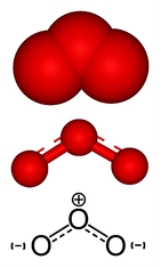
Ozone, the triatomic allotrope of oxygen, is a poisonous gas with a sharp odor. It functions in the upper atmosphere of the Earth as a shield against UV radiation. Liquid and solid O
3 have a deeper blue color than ordinary oxygen, and they are unstable and explosive.
Oxygen is slightly soluble in water. At 25° C under 1
atm of air, a litre of water will dissolve about 6.04
cc of oxygen, whereas
sea water will dissolve about 4.9 cc . At 0° C the solubilities increase to 10.29 cc for water and 8.0 cc for sea water.
A recently discovered
allotrope of oxygen, tetraoxygen , is a deep red solid that is created by pressurizing O
2 to the order of 20 GPa. Its properties are being studied for use in rocket fuels and similar applications, as it is a much more powerful oxidizer than either O
2 or
O3.
Applications
Oxygen is essential to respiration, so oxygen supplementation has found use in
medicine . People who climb
mountains or fly in
airplanes sometimes have supplemental oxygen supplies .
Oxygen is used in
welding , and in the making of
steel and
methanol. Liquid oxygen finds use as a classic oxidizer in
rocket propulsion.
Oxygen presents two absorption bands centered in the wavelengths 687 and 760 nanometers. Some scientists have proposed to use the measurement of the radiance coming from vegetation canopies in those oxygen bands to characterize plant health status from a satellite platform. This is because in those bands, it is possible to discriminate the vegetation's reflectance from the vegetation's
fluorescence, which is much weaker. The measurement presents several technical difficulties due to the low
signal to noise ratio and due to the vegetation's architecture, but it has been proposed as a possibility to monitor the
carbon cycle from satellites on a global scale.
Oxygen, as a supposed mild euphoric, has a history of recreational use , however the reality of this effect is doubtful. Controlled tests of high oxygen mixtures in diving and other activities, even at higher than normal pressures, show no particular effects on humans other than promotion of an increased tolerance to aerobic exercise.
In the 19th century, oxygen was often mixed with
nitrous oxide to promote an analgesic effect; a stable 50% gaseous mixture is commonly used in medicine today as an analgesic, and 30% oxygen with 70% nitrous oxide is the common basic anaesthetic mixture. These effects, however, are due to the
nitrous oxide.
Scientific history
Oxygen was first described by
Michal Sedziwój, a Polish
alchemist and
philosopher in the late 16th century. Sedziwój thought of the gas given off by warm nitre as "the elixir of life".
Oxygen was more quantitatively discovered by the
Swedish pharmacist
Carl Wilhelm Scheele sometime before 1773, but the discovery was not published until after the independent discovery by
Joseph Priestley on August 1, 1774, who called the gas
dephlogisticated air . Priestley published discoveries in 1775 and Scheele in 1777; consequently Priestley is usually given the credit. Both Scheele and Priestley produced oxygen by heating mercuric oxide.
The gas was named by
Antoine Laurent Lavoisier, after Priestley's publication in 1775, from Greek roots meaning "acid-former". As noted, the name reflects the then-common incorrect belief that acids contain oxygen.
Occurrence
Oxygen is the most common component of the
Earth's crust ,e also , .
Compounds
Due to its electronegativity, oxygen forms
chemical bonds with almost all other elements hence the origin of the original definition of
oxidation. The only elements to escape the possibility of oxidation are a few of the noble gases. The most famous of these oxides is
water . Other well known examples include compounds of carbon and oxygen, such as
carbon dioxide ,
alcohols ,
carbonyls, ), and
carboxylic acids . Oxygenated radicals such as
chlorates , perchlorates ,
chromates ,
dichromates , permanganates , and
nitrates are strong oxidizing agents in and of themselves. Many metals such as iron bond with oxygen atoms,
iron oxide .
Ozone is formed by electrostatic discharge in the presence of molecular oxygen. A double oxygen molecule
2 is known and is found as a minor component of liquid oxygen.
Epoxides are
ethers in which the oxygen atom is part of a ring of three atoms.
One unexpected oxygen compound is dioxygen hexafluoroplatinate O
2+PtF
6−. It was discovered when Neil Bartlett was studying the properties of PtF
6. He noticed a change in color when this compound was exposed to atmospheric air. Bartlett reasoned that
xenon should be oxidized by PtF
6. This led him to the discovery of
xenon hexafluoroplatinate Xe
+PtF
6−.
See also .Isotopes
Oxygen has seventeen known isotopes with atomic masses ranging from 12.03 u to 28.06 u. Three are stable,
16O,
17O, and
18O, of which
16O is the most abundant . The radioisotopes all have half-lives of less than three minutes.
An atomic weight of 16 was assigned to oxygen prior to the definition of the unified atomic mass unit based upon
12C. Since physicists referred to
16O only, while chemists meant the naturally abundant mixture of isotopes, this led to slightly different atomic weight scales.
Precautions
Toxicity of O2
Oxygen can be toxic at elevated partial pressures . Mixtures containing less than 50% oxygen are non-toxic at normal pressure. However in medical applications mixtures containing more than 50% oxygen can be expected to cause slow damage to the lungs over periods of days, with the rate of damage rising rapidly between 50% and 100% oxygen.
In deep
scuba diving and
surface supplied diving and when using equipment which can provide high concentrations of oxygen such as
rebreathers, oxygen toxicity to the lungs can occur as in medical applications. However, under pressure higher than normal, a far more serious form of oxygen toxicity in the
central nervous system may lead to generalized seizures. This form of oxygen toxicity usually occurs after several hours exposure to oxygen partial pressures over about 1.4 atmospheres , with the time decreasing for higher pressures above this, and with great variation from person to person. At over three bars, seizures typically occur within minutes.
Toxicity of other chemical oxygen forms
Certain derivatives of oxygen, such as
ozone ,
singlet oxygen,
hydrogen peroxide, hydroxyl radicals and
superoxide, are also highly toxic. The body has developed mechanisms to protect against these toxic compounds. For instance, the naturally-occurring
glutathione can act as an antioxidant, as can
bilirubin which is normally a breakdown product of
hemoglobin. To protect against the destructive nature of peroxides, nearly every organism on earth has developed some form of the enzyme
catalase, which very quickly disproportionates
hydrogen peroxide into water and dioxygen.
Oxygen derivatives are prone to form
free radicals, especially in metabolic processes. Because they can cause severe damage to cells and their
DNA, they form part of theories of carcinogenesis and aging.
Combustion hazard
Highly concentrated sources of oxygen promote rapid combustion and therefore are
fire and
explosion hazards in the presence of
fuels. The fire that killed the
Apollo 1 crew on a test launchpad spread so rapidly because the capsule was pressurized with pure oxygen as would be usual in an actual flight, but to maintain positive pressure in the capsule, this was at slightly more than atmospheric pressure instead of the ? normal pressure that would be used in flight.
Similar hazards also apply to compounds of oxygen with a high oxidative
potential, such as high concentration peroxides, chlorates, perchlorates, and dichromates; they also can often cause chemical burns.
See also
- Aerobic
- Breathing gas - the role of oxygen in a breathing gas
- Combustion - though oxygen promotes combustion in other compounds it is not flammable itself
- Hypoxia, a lack of oxygen
- Hypoxia for oxygen depletion in aquatic ecology
- Oxidation
- Ozone layer
- Oxygen Catastrophe in geology
- Oxygen isotope ratio cycle
- Oxygen tank
- Winkler test for dissolved oxygen for instructions on how to determine the amount of oxygen dissolved in fresh water.
References
External links