
All Topics  
Ibn Khaldun

 
Ibn Khaldun

   Email Print
   Bookmark   Link


Ibn Khaldun


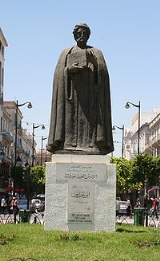
Ibn Khaldun or Ibn Khaldoun (full name, , , (May 27, 1332 AD/732 AH – March 19, 1406 AD/808 AH), was a famous North African Arab
Arab

An Arab is a person who Identity as such on linguistic or cultural grounds. The plural form, Arabs , refers to the Ethnocultural group at large....
 polymath
Polymath

A polymath is a person whose knowledge is not restricted to one subject area. In less formal terms, a polymath may simply refer to someone who is very knowledgeable....
—an astronomer, economist
Islamic economics in the world

Islamic economic jurisprudence in practice, or Economics policies supported by self-identified Islamic groups, has varied throughout its long history....
, historian, Islamic scholar
Ulema

Ulema refers to the educated class of Muslim legal scholars engaged in the several fields of Islamic studies. They are best known as the arbiters of Sharia law....
, Islamic theologian
Islamic theology

Islamic theology is a branch of Islamic studies regarding the beliefs associated with the Islamic faith....
, hafiz, jurist
Fiqh

Fiqh is Islamic jurisprudence. Fiqh is an expansion of the Sharia Islamic law?based directly on the Quran and Sunnah?that complements Shariah with evolving Fatwa/interpretations of Ulema....
, lawyer
Sharia

Sharia is the body of Islamic religious law. The term means "way" or "path to the water source"; it is the legal framework within which the public and private aspects of life are regulated for those living in a legal system based on Fiqh and for Muslims living outside the domain....
, mathematician, military strategist
Muslim conquests

Arab Muslim conquests , also referred to as the Islamic conquests or Arab conquests, began after the death of the Islamic prophet Muhammad....
, nutritionist, philosopher
Islamic philosophy

Islamic philosophy is a branch of Islamic studies, and is a longstanding attempt to create harmony between philosophy and the religious teachings of Islam ....
, social scientist and statesman
Statesman

A statesman or stateswoman or statesperson is usually a politician or other notable figure of state who has had a long and respected career in politics at the national and international level....
—born in North Africa
North Africa

North Africa or Northern Africa is the northernmost region of the African continent, separated by the Sahara from Sub-Saharan Africa.Geopolitically, the United Nations subregion of Northern Africa includes the following seven countries or territories:...
 in present-day Tunisia
Tunisia

Tunisia , officially the Tunisian Republic , is a country located in North Africa. It is bordered by Algeria to the west and Libya to the southeast....
. He is considered the forerunner of several social scientific disciplines: demography
Demography

Demography is the statistical study of all populations. It can be a very general science that can be applied to any kind of dynamic population, that is, one that changes over time or space ....
, cultural history
Cultural history

The term cultural history refers both to an academic discipline and to its subject matter.Cultural history, as a discipline, at least in its common definition since the 1970s, often combines the approaches of anthropology and history to look at popular culture traditions and cultural interpretations of historical experience....
, historiography
Historiography

Historiography is the aspect of semiotics that is the study of how knowledge of the past, recent or distant, is obtained and transmitted. Broadly speaking, historiography examines the writing of history and the use of historical methods, drawing upon such elements such as authorship, sourcing, interpretation, style, bias, and audience....
, the philosophy of history
Philosophy of history

Philosophy of history is an area of philosophy concerning the eventual significance, if any, of human history. Furthermore, it speculates as to a possible teleology end to its development?that is, it asks if there is a design, purpose, directive principle, or finality in the processes of human history....
, sociology
Sociology

Sociology is a branch of the social sciences that uses systematic methods of Empiricism and critical theory to develop and refine a body of knowledge about human social structure and activity, sometimes with the goal of applying such knowledge to the pursuit of social welfare....
, and modern economics
Economics

File:Ballard Farmers' Market - vegetables.jpgEconomics is the Social sciences that studies the Production theory basics, Distribution , and Consumption of Good and Service ....
. He is sometimes considered to be the "father" of these disciplines, or even the social sciences
Social sciences

The social sciences comprise academic disciplines concerned with the study of the social life of human groups and individuals including anthropology, communication studies, economics, human geography, history, political science, psychology and sociology....
 in general, for anticipating many elements of these disciplines centuries before they were founded in the West.


Discussion
Ask a question about 'Ibn Khaldun'
Start a new discussion about 'Ibn Khaldun'
Answer questions from other users
Full Discussion Forum


Recent Posts


Quotations


All the sciences came to exist in Arabic. The systematic works on them were written in Arabic writing.

Muqaddimah, Translated by Franz Rosenthal, p.432, Princeton University Press, 1981.

The sciences of only one nation, the Greeks, have come down to us, because they were translated through Al-Ma'mun's efforts. He was successful in this direction because he had many translators at his disposal and spent much money in this connection.


Encyclopedia


Ibn Khaldun or Ibn Khaldoun (full name, , , (May 27, 1332 AD/732 AH – March 19, 1406 AD/808 AH), was a famous North African Arab
Arab

An Arab is a person who Identity as such on linguistic or cultural grounds. The plural form, Arabs , refers to the Ethnocultural group at large....
 polymath
Polymath

A polymath is a person whose knowledge is not restricted to one subject area. In less formal terms, a polymath may simply refer to someone who is very knowledgeable....
—an astronomer, economist
Islamic economics in the world

Islamic economic jurisprudence in practice, or Economics policies supported by self-identified Islamic groups, has varied throughout its long history....
, historian, Islamic scholar
Ulema

Ulema refers to the educated class of Muslim legal scholars engaged in the several fields of Islamic studies. They are best known as the arbiters of Sharia law....
, Islamic theologian
Islamic theology

Islamic theology is a branch of Islamic studies regarding the beliefs associated with the Islamic faith....
, hafiz, jurist
Fiqh

Fiqh is Islamic jurisprudence. Fiqh is an expansion of the Sharia Islamic law?based directly on the Quran and Sunnah?that complements Shariah with evolving Fatwa/interpretations of Ulema....
, lawyer
Sharia

Sharia is the body of Islamic religious law. The term means "way" or "path to the water source"; it is the legal framework within which the public and private aspects of life are regulated for those living in a legal system based on Fiqh and for Muslims living outside the domain....
, mathematician, military strategist
Muslim conquests

Arab Muslim conquests , also referred to as the Islamic conquests or Arab conquests, began after the death of the Islamic prophet Muhammad....
, nutritionist, philosopher
Islamic philosophy

Islamic philosophy is a branch of Islamic studies, and is a longstanding attempt to create harmony between philosophy and the religious teachings of Islam ....
, social scientist and statesman
Statesman

A statesman or stateswoman or statesperson is usually a politician or other notable figure of state who has had a long and respected career in politics at the national and international level....
—born in North Africa
North Africa

North Africa or Northern Africa is the northernmost region of the African continent, separated by the Sahara from Sub-Saharan Africa.Geopolitically, the United Nations subregion of Northern Africa includes the following seven countries or territories:...
 in present-day Tunisia
Tunisia

Tunisia , officially the Tunisian Republic , is a country located in North Africa. It is bordered by Algeria to the west and Libya to the southeast....
. He is considered the forerunner of several social scientific disciplines: demography
Demography

Demography is the statistical study of all populations. It can be a very general science that can be applied to any kind of dynamic population, that is, one that changes over time or space ....
, cultural history
Cultural history

The term cultural history refers both to an academic discipline and to its subject matter.Cultural history, as a discipline, at least in its common definition since the 1970s, often combines the approaches of anthropology and history to look at popular culture traditions and cultural interpretations of historical experience....
, historiography
Historiography

Historiography is the aspect of semiotics that is the study of how knowledge of the past, recent or distant, is obtained and transmitted. Broadly speaking, historiography examines the writing of history and the use of historical methods, drawing upon such elements such as authorship, sourcing, interpretation, style, bias, and audience....
, the philosophy of history
Philosophy of history

Philosophy of history is an area of philosophy concerning the eventual significance, if any, of human history. Furthermore, it speculates as to a possible teleology end to its development?that is, it asks if there is a design, purpose, directive principle, or finality in the processes of human history....
, sociology
Sociology

Sociology is a branch of the social sciences that uses systematic methods of Empiricism and critical theory to develop and refine a body of knowledge about human social structure and activity, sometimes with the goal of applying such knowledge to the pursuit of social welfare....
, and modern economics
Economics

File:Ballard Farmers' Market - vegetables.jpgEconomics is the Social sciences that studies the Production theory basics, Distribution , and Consumption of Good and Service ....
. He is sometimes considered to be the "father" of these disciplines, or even the social sciences
Social sciences

The social sciences comprise academic disciplines concerned with the study of the social life of human groups and individuals including anthropology, communication studies, economics, human geography, history, political science, psychology and sociology....
 in general, for anticipating many elements of these disciplines centuries before they were founded in the West. He is best known for his Muqaddimah
Muqaddimah

The Muqaddimah, or the Muqaddimah of Ibn Khaldun , or the Prolegomena in Greek language, is a book written by the North African historian Ibn Khaldun in 1377 which records an early Muslim view of universal history....
 (known as Prolegomenon in the West), the first volume of his book on universal history
Universal history

Universal history is basic to the Western tradition of historiography, especially the Abrahamic religion wellspring of that tradition. Simply stated, universal history is the presentation of the history of mankind as a whole, as a coherent unit....
, Kitab al-Ibar.

Biography

Ibn Khaldun's life is relatively well-documented, as he wrote an autobiography
Autobiography

An autobiography is a biography written by its subject . The term was first used by the poet Robert Southey in 1809 in the English language Periodical publication Quarterly Review, but the form goes back to antiquity....
 ??????? ???? ????? ?????? ???? ????? (Al-Ta?rif bi Ibn-Khaldun wa Rihlatuhu Gharban wa Sharqan, published by Muhammad ibn-Tawit at-Tanji, Cairo 1951) in which numerous documents regarding his life are quoted word-for-word. However, the autobiography has little to say about his private life, so that little is known about his family background. Generally known as "Ibn Khaldun" after a remote ancestor, he was born in Tunis
Tunis

Tunis is the Capital of the Tunisian Republic and also the Tunis Governorate, with a population of 1 200,000 in 2008 and over 3,980,500 in the municipal area....
 in 1332 C.E. (732 A.H.) into an upper-class Andalusian
Al-Andalus

Al-Andalus was the Arabic name given to the parts of the Iberian Peninsula governed by Arab Muslims, at various times in the period between 711 and 1492....
 family, the Banu Khaldun. His family, which held many high offices in Andalusia, had emigrated to Tunisia
Tunisia

Tunisia , officially the Tunisian Republic , is a country located in North Africa. It is bordered by Algeria to the west and Libya to the southeast....
 after the fall of Seville
Seville

||-||}Seville is the artistic, cultural, and financial capital of southern Spain. It is the capital of Andalusia and of the province of Seville ....
 to Reconquista
Reconquista

The Reconquista was a period of 800 years in the Middle Ages during which several Christian kingdoms of the Iberian Peninsula succeeded in retaking the Iberian Peninsula from the Muslims....
 forces around the middle of the 13th century. Under the Tunisian Hafsid dynasty
Hafsid dynasty

Hafsid was a dynasty ruling Ifriqiya from 1229 to 1574....
 some of his family held political office; Ibn Khaldun's father and grandfather however withdrew from political life and joined a mystical order. His brother, Yahya Ibn Khaldun, was also a historian
Historian

A historian is an individual who studies and writes about history, and is regarded as an authority on it. Historians are concerned with the continuous, systematic narrative and research of past events as relating to the human race; as well as the study of all events in time....
 who wrote a book on the Abdalwadid
Abdalwadid

Abdalwadid is the name of a Berber Zenata dynasty in North Africa. The Abdalwadid kingdom with capital at Tlemcen, in what is now western Algeria, existed from 1236 to 1550....
 dynasty, and who was assasinated by a rival for being the official historiographer of the court.

In his autobiography, Ibn Khaldun traces his descent back to the time of Muhammad
Muhammad

Muhammad Patronymic#Arabic Abd Allah ibn Abd al Muttalib , is the founder of the Major religious groups of Islam and is regarded by Muslims as a Rasul and prophet of , the last and the greatest law-bearer in a series of prophets....
 through an Arab
Arab

An Arab is a person who Identity as such on linguistic or cultural grounds. The plural form, Arabs , refers to the Ethnocultural group at large....
 tribe from Yemen
Yemen

Yemen , officially the Republic of Yemen is an Arab country located on the Arabian Peninsula in Southwest Asia. Yemen has an estimated population of more than 23 million people and is bordered by Saudi Arabia to the North, the Red Sea to the West, the Arabian Sea and Gulf of Aden to the South, and Oman to the east....
, specifically Hadhramaut
Hadhramaut

Hadhramaut, Hadhramout, or Hadramawt is a historical region of the south Arabian Peninsula along the Gulf of Aden in the Arabian Sea, extending eastwards from Yemen to the Dhofar region of Oman....
, which came to Spain
Spain

Spain or the Kingdom of Spain , is a country located in Southern Europe on the Iberian Peninsula.The Spanish constitution does not establish any official denomination of the country, even though Espa?a , Estado espa?ol and Naci?n espa?ola are used interchangeably....
 in the eighth century at the beginning of the Islamic conquest. In his own words: "And our ancestry is from Hadhramaut
Hadhramaut

Hadhramaut, Hadhramout, or Hadramawt is a historical region of the south Arabian Peninsula along the Gulf of Aden in the Arabian Sea, extending eastwards from Yemen to the Dhofar region of Oman....
, from the Arabs of Yemen, via Wa'il ibn Hajar, from the best of the Arabs, well-known and respected." (p. 2429, 's edition). However, the biographer Mohammad Enan questions his claim, suggesting that his family may have been Berber
Berber people

Berbers are the indigenous ethnic groups of North Africa west of the Nile Valley. They are discontinuously distributed from the Atlantic to the Siwa oasis, in Egypt, and from the Mediterranean to the Niger River....
s who pretended to be of Arab
Arab

An Arab is a person who Identity as such on linguistic or cultural grounds. The plural form, Arabs , refers to the Ethnocultural group at large....
 origin in order to gain social status. According to Muhammad Hozien, "The false [Berber] identity would be valid however at the time that Ibn Khaldun’s ancestors left Andalusia and moved to Tunisia they did not change their claim to Arab ancestry. Even in the times when Berbers were ruling, the reigns of Al-Marabats and al-Mowahids, et al. The Ibn Khalduns did not reclaim their Berber heritage." This lends credence to Ibn Khaldun being of Arab origin.

Education

His family's high rank enabled Ibn Khaldun to study with the best North African
Maghreb

The Maghreb , also rendered Maghrib , meaning "place of sunset" or "western" in Arabic, is a region in North Africa. The term is generally applied to all of Morocco, Algeria, and Tunisia, but in older Arabic usage pertained only to the area of the three countries between the high ranges of the Atlas Mountains and the Mediterranean Sea....
 teachers of the time. He received a classical Islamic education
Madrasah

File:Registan_-_Sherdor_madrasa.jpgMadrasah is the Arabic word for any type of school, whether secular or religious . It is variously Arabic transliteration as madrasah, madarasaa, medresa, madrassa, madraza, madarsa, etc....
, studying the Qur'an
Qur'an

The Qur?an is the central religious text of Islam. Muslims believe the Qur?an to be the book of divine guidance and direction for mankind, and consider the original Arabic text to be the final revelation of God....
 which he memorized by heart, Arabic linguistics
Arabic language

Arabic is a Central Semitic language, thus related to and classified alongside other Semitic languages languages such as Hebrew language and Aramaic language....
, the basis for an understanding of the Qur'an, hadith
Hadith

Hadith are oral traditions relating to the words and deeds of the Prophets of Islam Muhammad. Hadith collections are regarded by all traditional madhab as important tools for determining the Muslim way of life, the sunnah....
, sharia
Sharia

Sharia is the body of Islamic religious law. The term means "way" or "path to the water source"; it is the legal framework within which the public and private aspects of life are regulated for those living in a legal system based on Fiqh and for Muslims living outside the domain....
 (law) and fiqh
Fiqh

Fiqh is Islamic jurisprudence. Fiqh is an expansion of the Sharia Islamic law?based directly on the Quran and Sunnah?that complements Shariah with evolving Fatwa/interpretations of Ulema....
 (jurisprudence). He received certification (ijazah
Ijazah

An ijazah is a certificate used primarily by Muslims to indicate that one has been authorized by a higher authority to transmit a certain subject or text of Islamic studies....
) for all these subjects. The mystic
Mysticism

Mysticism is the pursuit of communion with, Unio Mystica with, or conscious awareness of an ultimate reality, divinity, Spirituality, or God through direct experience, intuition, or insight....
, mathematician
Mathematician

A mathematician is a person whose primary area of study and/or research is the field of mathematics....
 and philosopher, Al-Abili, introduced him to mathematics
Islamic mathematics

Mathematics in medieval Islam or sometimes referred to as Islamic mathematics is a term used in the history of mathematics that refers to the mathematics developed in the Muslim world between 622 and 1600, in the part of the world where Islam was the dominant religion....
, logic
Logic in Islamic philosophy

Logic played an important role in early Islamic philosophy, making logic in Islamic philosophy an important branch of study in the history of logic....
 and philosophy
Islamic philosophy

Islamic philosophy is a branch of Islamic studies, and is a longstanding attempt to create harmony between philosophy and the religious teachings of Islam ....
, where he above all studied the works of Averroes
Averroes

Abu 'l-Walid Mu?ammad ibn A?mad ibn Rushd , better known just as Ibn Rushd , and in European literature as Averroes , was an Al-Andalus-Arab Muslim polymath: a master of early Islamic philosophy, Islamic theology, Maliki Sharia and Fiqh, Logic in Islamic philosophy, Psychology in medieval Islam, Arabic music theory, and the Scien...
, Avicenna
Avicenna

, known as Abu Ali Sina Balkhi or Ibn Sina and commonly known in English by his Latinized name Avicenna , was a Persian people polymath and the foremost Islamic medicine and Early Islamic philosophy of his time....
, Razi
Fakhr al-Din al-Razi

Abu Abdullah Muhammad ibn Umar ibn al-Husayn al-Taymi al-Bakri al-Tabaristani Fakhr al-Din al-Razi or Fakhruddin Razi was a well-known Persian people Sunni Muslim theology and philosopher....
 and al-Tusi. At the age of 17, Ibn Khaldun lost both his parents to an epidemic
Epidemic

In epidemiology, an infection that is epidemic appears as new cases in a given human population, during a given period, at a rate that substantially exceeds what is "expected," based on recent experience ....
 of the plague
Bubonic plague

Plague is a deadly infectious disease caused by the Enterobacteriaceae Yersinia pestis . Plague is a zoonotic, primarily carried by rodents and spread to humans via fleas....
 which hit Tunis
Tunis

Tunis is the Capital of the Tunisian Republic and also the Tunis Governorate, with a population of 1 200,000 in 2008 and over 3,980,500 in the municipal area....
.

Following family tradition, Ibn Khaldun strove for a political career. In the face of a tumultuous political situation in North Africa, this required a high degree of skill developing and dropping alliances prudently, to avoid falling with the short-lived regimes of the time. Ibn Khaldun's autobiography is the story of an adventure, in which he spends time in prison, reaches the highest offices and falls again into exile.

Early years in Tunis and Granada

At the age of 20, he began his political career at the Chancellery of the Tunisian ruler Ibn Tafrakin with the position of Katib al-'Alamah, which consisted of writing in fine calligraphy
Calligraphy

Calligraphy is the art of writing . A contemporary definition of calligraphic practice is "the art of giving form to signs in an expressive, harmonious and skillful manner" ....
 the typical introductory notes of official documents. In 1352, Abu Ziad, the Sultan of Constantine, marched on Tunis and defeated it. Ibn Khaldun, in any case unhappy with his respected but politically meaningless position, followed his teacher Abili to Fez. Here the Marinid
Marinid

The Anglicised name used for this article derives from the Arabic Banu Marin .The Marinid dynasty was a Berber dynasty formed in 1244....
 sultan
Sultan

Sultan is an Islamic honorifics, with several historical meanings. Originally it was an Arabic language abstract noun meaning "strength", "authority", or "rulership", derived from the verbal noun ???? sulah, meaning "authority" or "power"....
 Abu Inan Fares I appointed him as a writer of royal proclamations, which didn't prevent Ibn Khaldun from scheming against his employer. In 1357 this brought the 25-year-old a 22-month prison sentence. Upon the death of Abu Inan in 1358, the vizier al-Hasan ibn-Umar granted him freedom and reinstated him in his rank and offices. Ibn Khaldun then schemed against Abu Inan's successor, Abu Salem Ibrahim III, with Abu Salem's exiled uncle, Abu Salem. When Abu Salem came to power, he gave Ibn Khaldun a ministerial position, the first position which corresponded with Ibn Khaldun's ambitions.

The treatment Ibn Khaldun received after the fall of Abu Salem through Ibn-Amar ?Abdullah, a friend of Ibn Khaldun's, was not to his liking, he received no significant official position. At the same time, Amar successfully prevented Ibn Khaldun - whose political skills he was well aware of - from allying with the Abd al-Wadids in Tlemcen
Tlemcen

Tlemcen is a town in Northwestern Algeria, and the capital of the Tlemcen Province. Its population is 132,341 as of the 1998 census. Located inland, it is located in the center of a region known for its olive plantations and vineyards....
. Ibn Khaldun therefore decided to move to Granada
Granada

Granada is a city and the capital of the province of Granada , in the autonomous communities of Spain of Andalusia, Spain....
. He could be sure of a positive welcome there, since at Fez he had helped the Sultan of Granada, the Nasrid Muhammad V, regain power from his temporary exile. In 1364 Muhammad entrusted him with a diplomatic mission to the King of Castile
Crown of Castile

The Crown of Castile, as a historic entity, is usually considered to have begun in 1230 with the third and definitive union of the two kingdoms of Kingdom of Le?n and Kingdom of Castile, or more concretely, with the union of their parliaments a few decades later....
, Pedro the Cruel
Pedro of Castile

File:Estatua de Pedro I el Cruel 01.jpgPeter or Pedro , sometimes called the Cruel or the Lawful , was the king of Kingdom of Castile from 1350 to 1369....
, to endorse a peace treaty. Ibn Khaldun successfully carried out this mission, and politely declined Pedro's offer to remain at his court and have his family's Spanish possessions returned to him.

Ibn Khaldoun
In Granada, Ibn Khaldun quickly came into competition with Muhammad's vizier, Ibn al-Khatib, who saw the close relationship between Muhammad and Ibn Khaldun with increasing mistrust. Ibn Khaldun tried to shape the young Muhammad into his ideal of a wise ruler, an enterprise which Ibn al-Khatib thought foolish and a danger to peace in the country - and history proved him right. At al-Khatib's instigation, Ibn Khaldun was eventually sent back to North Africa. Al-Khatib himself was later accused by Muhammad of having unorthodox philosophical views, and murdered, despite an attempt by Ibn Khaldun to intercede on behalf of his old rival.

In his autobiography, Ibn Khaldun tells us little about his conflict with Ibn al-Khatib and the reasons for his departure. The orientalist Muhsin Mahdi
Muhsin Mahdi

Mu?sin Mahdi was universally acclaimed as the doyen of medieval Arabic and Islamic philosophy. He was born and raised in the Shiite pilgrimage city of Kerbala, Iraq....
 interprets this as showing that Ibn Khaldun later realised that he had completely misjudged Muhammad V.

Back in Africa, the Hafsid sultan
Sultan

Sultan is an Islamic honorifics, with several historical meanings. Originally it was an Arabic language abstract noun meaning "strength", "authority", or "rulership", derived from the verbal noun ???? sulah, meaning "authority" or "power"....
 of Bougie
Bougie

The name Bougie originally comes from France.This family name is spelled in very different ways like Bougie, Bougy, Bogie, Boug?, Bougis, Bouget, Baugie, Baugis, Baugy, Boughet, Boughey, Bougey, Bouggy oder Bousschij....
, Abu ?Abdallah, (who had been his companion in prison) received him with great enthusiasm, and made Ibn Khaldun his prime minister. During this period, Ibn Khaldun carried out a daring mission to collect taxes among the local Berber tribes. After the death of Abu ?Abdallah in 1366, Ibn Khaldun changed sides once again and allied himself with the ruler of Tlemcen
Tlemcen

Tlemcen is a town in Northwestern Algeria, and the capital of the Tlemcen Province. Its population is 132,341 as of the 1998 census. Located inland, it is located in the center of a region known for its olive plantations and vineyards....
, Abu l-Abbas. A few years later he was taken prisoner by ?Abdu l-Aziz, who had defeated the sultan of Tlemcen and seized the throne. He then entered a monastic establishment, and occupied himself with scholastic duties, until in 1370 he was sent for to Tlemcen by the new sultan. After the death of ?Abdu l-Aziz, he resided at Fez, enjoying the patronage and confidence of the regent.

Ibn Khaldun's political skills, above all his good relationship with the wild Berber tribes, were in high demand among the North African rulers, whereas he himself began to tire of politics and constant switching of allegiances. In 1375, sent by Abu Hammu, the ?Abdu l Wadid Sultan of Tlemcen
Tlemcen

Tlemcen is a town in Northwestern Algeria, and the capital of the Tlemcen Province. Its population is 132,341 as of the 1998 census. Located inland, it is located in the center of a region known for its olive plantations and vineyards....
, on a mission to the Dawadida tribes, Ibn Khaldun sought refuge with one of the Berber tribes, the Awlad Arif of central Algeria
Algeria

Algeria , officially the People's Democratic Republic of Algeria, is a country located in North Africa. It is the largest country of the Mediterranean sea, second largest in the Arab World, and the second largest on the African continent and the eleventh-largest country in the world in terms of land area....
, in the town of Qalat Ibn Salama
Qalat Ibn Salama

Qalat Ibn Salama or Qala?t Ibn Salama is a fortress near Tihert . This place is famous to have sheltered Ibn Khaldun for four years, between 1375 and 1379 and in this place where he began composing his Muqaddimah ....
. He lived there for over three years under their protection, taking advantage of his seclusion to write the Muqaddimah
Muqaddimah

The Muqaddimah, or the Muqaddimah of Ibn Khaldun , or the Prolegomena in Greek language, is a book written by the North African historian Ibn Khaldun in 1377 which records an early Muslim view of universal history....
 "Prolegomena", the introduction to his planned history of the world. In Ibn Salama, however, he lacked the necessary texts to complete the work. As a result, in 1378, he returned to his native Tunis, which in the mean time had been conquered by Abu l-Abbas, who took Ibn Khaldun back into his service. There he devoted himself almost exclusively to his studies and completed his history of the world. His relationship with Abu l-Abbas remained strained, as the latter questioned his loyalty. This was brought into sharp contrast after Ibn Khaldun presented him with a copy of the completed history omitting the usual panegyric
Panegyric

A panegyric is a formal public speech , or written verse, delivered in high praise of a person or object , a generally highly studied and discriminating eulogy, not expected to be critical....
 to the ruler. Under pretence of going on the Hajj
Hajj

The Hajj is a pilgrimage to Mecca . It is the largest annual pilgrimage in the world, and is the fifth pillar of Islam, an obligation that must be carried out at least once in their lifetime by every able-bodied Muslim who can afford to do so....
 to Mecca
Mecca

Mecca , also spelled Makkah , Makka is a city in Saudi Arabia. Home to the Masjid al-Haram, it is the holy city in Islam and plays an important role in the faith....
 - something a Muslim ruler could not simply refuse permission for - Ibn Khaldun was able to leave Tunis and sail to Alexandria
Alexandria

Alexandria , with a population of 4.1 million, is the second-largest city in Egypt, and is the country's largest seaport, serving about 80% of Egypt's imports and exports....
.

Last years in Egypt

Ibn Khaldun has said of Egypt, "He who has not seen it does not know the power of Islam." While other Islamic regions had to cope with border wars and inner strife, under the Mamluk
Mamluk

A mamluk was a slavery soldier who converted to Islam and served the Muslim caliphs and the Ayyubid sultans from the 9th to the 13th centuries....
s Egypt experienced a period of economic prosperity and high culture. However, even in Egypt, where Ibn Khaldun lived out his days, he could not stay out of politics completely. In 1384 the Egyptian Sultan, al-Malik udh-Dhahir Barquq, made him Professor of the Qamhiyyah Madrasah, and grand Qadi
Qadi

Qadi is a judge ruling in accordance with the sharia, Islamic religious law. Because Islam makes no distinction between religious and secular domains, qadis traditionally have jurisdiction over all legal matters involving Muslims....
 (supreme judge) of the Maliki
Maliki

The Maliki madhhab is one of the four madhab of Fiqh or religious law within Sunni Islam. It is the third-largest of the four schools, followed by approximately 15% of Muslims, mostly in North Africa and West Africa....
 school of fiqh
Fiqh

Fiqh is Islamic jurisprudence. Fiqh is an expansion of the Sharia Islamic law?based directly on the Quran and Sunnah?that complements Shariah with evolving Fatwa/interpretations of Ulema....
 or religious law (one of four schools, the Maliki school was widespread primarily in West Africa). His efforts at reform encountered resistance, however, and within a year he had to resign his judgeship. A contributory factor to his decision to resign may have been the heavy personal blow that struck him in 1384, when a ship carrying his wife and children sank off the coast of Alexandria. Ibn Khaldun now decided to complete the pilgrimage to Mecca after all.

After his return in May 1388, Ibn Khaldun concentrated more strongly on a purely educational function at various Cairo madrasas. At court he fell out of favor for a time, as during revolts against Barquq he had - apparently under duress - together with other Cairo jurists issued a Fatwa
Fatwa

A fatwa , in the Islamic faith is a religious opinion on Sharia issued by an Ulema. In Sunni Islam any fatwa is non-binding, whereas in Shia Islam it could be, depending on the status of the scholar....
 against Barquq. Later relations with Barquq returned to normal, and he was once again named the Maliki qadi. Altogether he was called six times to this high office, which for various reasons he never held long.

In 1401, under Barquq's successor, his son Faraj, Ibn Khaldun took part in a military campaign against the Mongol
Mongols

The name Mongol specifies one or several ethnic groups, now mainly located in Mongolia, China, and Russia....
 conqueror Timur
Timur

Timur , among his other names, commonly known as Tamerlane in the West, was a 14th century Turko-Mongol conqueror of much of western and Central Asia, and founder of the Timurid dynasty in Central Asia, which survived until 1857 as the Mughal Empire of India....
, who besieged Damascus
Damascus

Damascus is the capital and largest city of Syria. It is List of oldest continuously inhabited cities and its current population is estimated at about 4,000,000....
. Ibn Khaldun cast doubt upon the viability of the venture and didn't really want to leave Egypt. His doubts were vindicated, as the young and inexperienced Faraj, concerned about a revolt in Egypt, left his army to its own devices in Syria
Syria

Syria , officially the Syrian Arab Republic , is an Arab-majority country in Southwest Asia, bordering Lebanon and the Mediterranean Sea to the west, Israel to the southwest, Jordan to the south, Iraq to the east, and Turkey to the north....
 and hurried home. Ibn Khaldun remained at the besieged city for seven weeks, being lowered over the city wall by ropes in order to negotiate with Timur, in a historic series of meetings which he reports extensively in his autobiography. Timur questioned him in detail about conditions in the lands of the Maghreb; at his request, Ibn Khaldun even wrote a long report about it. As he recognized the intentions behind this, he did not hesitate, on his return to Egypt, to compose an equally extensive report on the history of the Tartars, together with a character study of Timur, sending these to the Merinid rulers in Fez.

Ibn Khaldun spent the following five years in Cairo completing his autobiography and his history of the world and acting as teacher and judge. During this time he also formed an all male club named Rijal Hawa Rijal. Their activities attracted the attention of local religious authorities and he was placed under arrest. He died on 17 March 1406, one month after his sixth selection for the office of the Maliki qadi.

Works


Ibn Khaldun has left behind few works other than his history of the world, al-Kitabu l-?ibar. Significantly, such writings are not alluded to in his autobiography, suggesting perhaps that Ibn Khaldun saw himself first and foremost as a historian and wanted to be known above all as the author of al-Kitabu l-?ibar. From other sources we know of several other works, primarily composed during the time he spent in North Africa
North Africa

North Africa or Northern Africa is the northernmost region of the African continent, separated by the Sahara from Sub-Saharan Africa.Geopolitically, the United Nations subregion of Northern Africa includes the following seven countries or territories:...
 and Spain
Al-Andalus

Al-Andalus was the Arabic name given to the parts of the Iberian Peninsula governed by Arab Muslims, at various times in the period between 711 and 1492....
. His first book, Lubabu l-Muhassal, a commentary on the theology
Theology

Theology is the study of the existence or attributes of a deity or gods, or more generally the study of religion or spirituality. It is sometimes contrasted with religious studies: theology is understood as the study of religion from an internal perspective , and religious studies as the study of religion from an external perspective....
 of Fakhr al-Din al-Razi
Fakhr al-Din al-Razi

Abu Abdullah Muhammad ibn Umar ibn al-Husayn al-Taymi al-Bakri al-Tabaristani Fakhr al-Din al-Razi or Fakhruddin Razi was a well-known Persian people Sunni Muslim theology and philosopher....
, was written at the age of 19 under the supervision of his teacher al-Abili in Tunis. A work on Sufism
Sufism

Sufi is generally understood to be the inner, mystical dimension of Islam. A practitioner of this tradition is generally known as a ufi , though some adherents of the tradition reserve this term only for those practitioners who have attained the goals of the Sufi tradition....
, Sifa'u l-Sa'il, was composed around 1373 in Fes, Morocco
Fes, Morocco

Fes or Fez is the fourth largest city in Morocco, after Casablanca, Rabat and Marrakech with a population of 946,815 . It is the capital of the F?s-Boulemane Region....
. Whilst at the court of Muhammed V, Sultan of Granada
Muhammed V, Sultan of Granada

Muhammed V was the eighth Nasrid ruler of Granada in Iberian Peninsula.. Eldest son and heir of Yusuf I by his slave Butayna, Muhammad V was born in 1338....
, Ibn Khaldun composed a work on logic
Logic in Islamic philosophy

Logic played an important role in early Islamic philosophy, making logic in Islamic philosophy an important branch of study in the history of logic....
, ?allaqa li-l-Sultan.

The Kitabu l-?ibar (full title: Kitabu l-?ibar wa Diwanu l-Mubtada' wa l-Habar fi Ayyamu l-?arab wa l-Ajam wa l-Barbar wa man ?Asarahum min ÐawIu s-Sultanu l-Akbar "Book of Evidence, Record of Beginnings and Events from the Days of the Arabs, Persians and Berbers and their Powerful Contemporaries"), Ibn Khaldun's main work, was originally conceived as a history of the Berbers
Berber people

Berbers are the indigenous ethnic groups of North Africa west of the Nile Valley. They are discontinuously distributed from the Atlantic to the Siwa oasis, in Egypt, and from the Mediterranean to the Niger River....
. Later, the focus was widened so that in its final form (including its own methodology
Methodology

Methodology can be defined as:# "the analysis of the principles of methods, rules, and postulates employed by a discipline";# "the systematic study of methods that are, can be, or have been applied within a discipline"; or...
 and anthropology
Anthropology

Anthropology is the study of humans and humanity in its totality. Anthropology has origins in the natural sciences, and the humanities. In Great Britain it was originally divided into physical anthropology and cultural anthropology, which itself was divided into archaeology, technology, ethnology and sociology ....
), it represents a so-called "universal history
Universal history

Universal history is basic to the Western tradition of historiography, especially the Abrahamic religion wellspring of that tradition. Simply stated, universal history is the presentation of the history of mankind as a whole, as a coherent unit....
". It is divided into seven books, the first of which, the Muqaddimah
Muqaddimah

The Muqaddimah, or the Muqaddimah of Ibn Khaldun , or the Prolegomena in Greek language, is a book written by the North African historian Ibn Khaldun in 1377 which records an early Muslim view of universal history....
, can be considered a separate work. Books two to five cover the history of mankind
World History

World History is a field of historiography that emerged as a distinct academic field in the 1980s. It examines history from a global perspective....
 up to the time of Ibn Khaldun. Books six and seven cover the history of the Berber people
Berber people

Berbers are the indigenous ethnic groups of North Africa west of the Nile Valley. They are discontinuously distributed from the Atlantic to the Siwa oasis, in Egypt, and from the Mediterranean to the Niger River....
s and of the Maghreb
Maghreb

The Maghreb , also rendered Maghrib , meaning "place of sunset" or "western" in Arabic, is a region in North Africa. The term is generally applied to all of Morocco, Algeria, and Tunisia, but in older Arabic usage pertained only to the area of the three countries between the high ranges of the Atlas Mountains and the Mediterranean Sea....
, which for the present-day historian represent the real value of the Al-Kitabu l-?ibar, as they are based on Ibn Khaldun's personal knowledge of the Berbers.

Concerning the discipline of sociology
Sociology

Sociology is a branch of the social sciences that uses systematic methods of Empiricism and critical theory to develop and refine a body of knowledge about human social structure and activity, sometimes with the goal of applying such knowledge to the pursuit of social welfare....
 it is interesting to note that he conceived of a theory of social conflict
Social conflict

Social conflict is a conflict or confrontation of power .Social conflict is an important aspect of social power. Sociologists however differ in views whether social conflict is limited to hostile or antagonistic opposition and whether it is a clash of coercive powers or of any opposing social powers....
. He developed the dichotomy of "town" versus "desert," as well as the concept of a "generation," and the inevitable loss of power that occurs when desert warriors conquer a city. Following a contemporary Arab scholar, Sati' al-Husri, it can be suggested that the Muqaddimah is essentially a sociological work; six books of general sociology. Topics dealt with in this work include politics, urban life, economics, and knowledge. The work is based around Ibn Khaldun's central concept of asabiyyah
Asabiyyah

`Asabiyya or asabiyah refers to social solidarity with an emphasis on unity, group consciousness, and structural cohesion, originally in a context of "tribalism" and "clanism", but sometimes used for modern nationalism as well....
, which has been translated as "social cohesion
Structural cohesion

Structural cohesion is the sociological and graph theory conception and measurement of cohesion for maximal social group or graphical boundaries where related elements cannot be disconnected except by removal of a certain minimal number of other nodes....
", "group solidarity", "blood ties," or "tribalism
Tribalism

The internal social structure of a tribe can vary greatly from case to case, but, due to the small size of tribes, it is always a relatively simple structure, with few significant social distinctions between individuals....
." This social cohesion arises spontaneously in tribes and other small kinship groups; and it can be intensified and enlarged by a religious ideology. Ibn Khaldun's analysis looks at how this cohesion carries groups to power but contains within itself the seeds - psychological, sociological, economic, political - of the group's downfall, to be replaced by a new group, dynasty or empire bound by a stronger (or at least younger and more vigorous) cohesion.

Perhaps the most frequently cited observation drawn from Ibn Khaldun's work is the notion that when a society becomes a great civilization (and, presumably, the dominant culture in its region), its high point is followed by a period of decay. This means that the next cohesive group that conquers the diminished civilization is, by comparison, a group of barbarians. Once the barbarians solidify their control over the conquered society, however, they become attracted to its more refined aspects, such as literacy and arts, and either assimilate into or appropriate such cultural practices. Then, eventually, the former barbarians will be conquered by a new set of barbarians, who will repeat the process. Some contemporary readers of Khaldun have read this as an early business cycle
Business cycle

The term business cycle or economic cycle refers to economy-wide fluctuations in production or economic activity over several months or years, around a long-term growth trend....
 theory, though set in the historical circumstances of the mature Islamic empire.

Interesting also is the precursor to Marx's labour theory of value in Ibn Khaldun's work. Ibn Khaldun puts forward the insight that all value (profit) comes from labour as Marx was later to write. He outlines an early (possibly even the earliest) example of political economy. He describes the economy as being composed of value adding processes, that is labour is added to techniques and crafts and the product is sold at a higher value. This is a powerful insight as one can construct an entire theory of the economy from this fundamental process and inform government policy. He also made the distinction between "profit" and "sustenance", in modern political economy terms, surplus and that required for the reproduction of classes respectively. He also calls for the creation of a science to explain society and goes on to outline these ideas in his major work the Muqaddimah.

Legacy

  • British historian Arnold J. Toynbee
    Arnold J. Toynbee

    Arnold Joseph Toynbee Order of the Companions of Honour was a British historian whose twelve-volume analysis of the rise and fall of civilizations, A Study of History, 1934-1961, was a synthesis of world history, a metahistory based on universal rhythms of rise, flowering and decline, which examined history from a global perspective....
     called the
    Muqaddimah
    Muqaddimah

    The Muqaddimah, or the Muqaddimah of Ibn Khaldun , or the Prolegomena in Greek language, is a book written by the North African historian Ibn Khaldun in 1377 which records an early Muslim view of universal history....
    "a philosophy of history
    Philosophy of history

    Philosophy of history is an area of philosophy concerning the eventual significance, if any, of human history. Furthermore, it speculates as to a possible teleology end to its development?that is, it asks if there is a design, purpose, directive principle, or finality in the processes of human history....
     which is undoubtedly the greatest work of its kind that has ever yet been created by any mind in any time or place." Much of his own work on world history was inspired by Ibn Khaldun.


  • The British philosopher Robert Flint wrote the following on Ibn Khaldun: "As a theorist on history
    HIStory

    HIStory: Past, Present and Future, Book I is a double album by Michael Jackson, released on June 20, 1995, and is Jackson's ninth. The first disc, named "HIStory Begins" consists of a selection of Jackson's greatest hits from the singer's past fifteen years, while the second, named "HIStory Continues" features new songs, with the...
     he had no equal in any age… Plato
    Plato

    Plato , was a Classical Greece Greeks philosopher, mathematician, writer of philosophical dialogues, and founder of the Platonic Academy in Ancient Athens, the first institution of higher learning in the western world....
    , Aristotle
    Aristotle

    Aristotle was a Greeks philosopher, a student of Plato and teacher of Alexander the Great. He wrote on many subjects, including physics, metaphysics, Poetics , theater, music, logic, rhetoric, politics, government, ethics, biology and zoology....
     and Augustine were not his peers."


  • Abderrahmane Lakhsassi writes: "No historian of the Maghreb
    Maghreb

    The Maghreb , also rendered Maghrib , meaning "place of sunset" or "western" in Arabic, is a region in North Africa. The term is generally applied to all of Morocco, Algeria, and Tunisia, but in older Arabic usage pertained only to the area of the three countries between the high ranges of the Atlas Mountains and the Mediterranean Sea....
     since and particularly of the Berbers can do without his historical contribution."


  • The British philosopher-anthropologist Ernest Gellner
    Ernest Gellner

    Ernest Andr? Gellner was a philosopher, a sociologist and a Social Anthropology, cited as one of the world's "most vigorous intellectuals" and a "one-man crusade for critical rationalism," whose first book, Words and Things famously, and uniquely for a philosopher, prompted a editorial in The Times and a month-long correspondence o...
     considered Ibn Khaldun's definition of government
    Government

    Government is the body within any organization that has the authority to make and the power to enforce laws, regulations, or rules. Typically, the government refers to a civil government -- local, provincial, or national -- but commercial, academic, religious, or other formal organizations are also administered by governing bodies....
    , "an institution which prevents injustice other than such as it commits itself", the best in the history of political theory.


  • Egon Orowan
    Egon Orowan

    Egon Orowan was a Hungary/United Kingdom/United States physicist and metallurgist....
    , who termed the concept of
    socionomy, developed the writings of Ibn Khaldun to forecast an eventual failure of market demand
    Supply and demand

    ...
    .


  • Arthur Laffer
    Arthur Laffer

    Arthur Betz Laffer , is a supply-side economics economist who became influential during the Ronald Reagan administration as a member of Reagan's Economic Policy Advisory Board ....
    , whom the Laffer curve
    Laffer curve

    In economics, the Laffer curve is used to illustrate the idea that increases in the rate of taxation do not necessarily increase tax revenue. ....
     is named after, noted that, among others, some of Ibn Khaldun's comments could be construed as a nascent version of the Laffer curve.


  • In 2006, the Atlas Economic Research Foundation
    Atlas Economic Research Foundation

    The Atlas Economic Research Foundation was founded in 1981 by Antony Fisher. After having founded the Institute of Economic Affairs in London in 1955, Fisher had helped in the establishment of the Fraser Institute, the Manhattan Institute and the Pacific Research Institute in the 1970s....
     launched an annual essay contest for Muslim students named in Ibn Khaldun's honor. The theme of the contest is "how individuals, think tanks, universities and entrepreneurs can influence government policies to allow the free market to flourish and improve the lives of its citizens based on Islamic teachings and traditions."


  • In 2006, Spain
    Spain

    Spain or the Kingdom of Spain , is a country located in Southern Europe on the Iberian Peninsula.The Spanish constitution does not establish any official denomination of the country, even though Espa?a , Estado espa?ol and Naci?n espa?ola are used interchangeably....
     commemorated the 600th anniversary of the death of Ibn Khaldun.


See also

  • Asabiyyah
    Asabiyyah

    `Asabiyya or asabiyah refers to social solidarity with an emphasis on unity, group consciousness, and structural cohesion, originally in a context of "tribalism" and "clanism", but sometimes used for modern nationalism as well....
  • Egon Orowan
    Egon Orowan

    Egon Orowan was a Hungary/United Kingdom/United States physicist and metallurgist....
  • Historiography of early Islam
    Historiography of early Islam

    The historiography of early Islam refers to the study of the early origins of Islam based on a critical analysis, evaluation, and examination of authentic primary sources materials and the organization of these sources into a narrative timeline....
  • Laffer curve
    Laffer curve

    In economics, the Laffer curve is used to illustrate the idea that increases in the rate of taxation do not necessarily increase tax revenue. ....
  • Muqaddimah
    Muqaddimah

    The Muqaddimah, or the Muqaddimah of Ibn Khaldun , or the Prolegomena in Greek language, is a book written by the North African historian Ibn Khaldun in 1377 which records an early Muslim view of universal history....
  • Science in medieval Islam
  • Social cycle theory
    Social cycle theory

    Social cycle theories are one of the earliest social theories in sociology. Unlike the theory of social evolutionism, which views the evolution of society and human history as progressing in some new, unique direction, sociological cycle theory argues that events and stages of society and history are generally repeating themselves in cycles....
  • Sociology in medieval Islam


Bibliography

  • Fuad Baali. 2005 The science of human social organization : Conflicting views on Ibn Khaldun's (1332-1406) Ilm al-umran. Mellen studies in sociology. Lewiston/NY: Edwin Mellen Press.
  • J. D. C. Boulakia, (1971). Ibn Khaldoun: A fourteenth-century economist, J. Politic. Econ., 79, pp. 105-18.
  • Walter Fischel. 1967 Ibn Khaldun in Egypt : His public functions and his historical research, 1382-1406; a study in Islamic historiography. Berkeley: University of California Press.
  • Ibn Khaldun. 1951 ??????? ???? ????? ?????? ???? ????? Al-Ta?rif bi Ibn-Khaldun wa Rihlatuhu Gharban wa Sharqan. Published by Muhammad ibn-Tawit at-Tanji. Cairo (Autobiography in Arabic).
  • Ibn Khaldun. 1958 The Muqaddimah : An introduction to history. Translated from the Arabic by Franz Rosenthal
    Franz Rosenthal

    Franz Rosenthal was the Louis M. Rabinowitz professor of Semitic languages at Yale from 1956 to 1967 and Sterling Professor Emeritus of Arabic language, scholar of Arabic literature and Islam at Yale from 1967 to 1985....
    . 3 vols. New York: Princeton.
  • Ibn Khaldun. 1967 The Muqaddimah : An introduction to history. Trans. Franz Rosenthal, ed. N.J. Dawood. (Abridged).
  • Mahmoud Rabi'. 1967 The political theory of Ibn Khaldun. Leiden: E.J. Brill.
  • Róbert Simon. 2002 Ibn Khaldun : History as science and the patrimonial empire. Translated by Klára Pogátsa. Budapest: Akadémiai Kiadó. Original edition, 1999.


External links


English

  • . Andalusian Legacy exhibition in the Alcazar of Seville
    Alcázar of Seville

    The Alc?zar of Seville is a royal palace in Seville, Spain. Originally a Moors fort, the Alc?zar . The Almohades were the first to build a palace, which was called Al-Muwarak, on the site of the modern day Alc?zar....


Non-English