

History of Islam in southern Italy

Encyclopedia
Muslim conquests
Muslim conquests also referred to as the Islamic conquests or Arab conquests, began with the Islamic prophet Muhammad. He established a new unified polity in the Arabian Peninsula which under the subsequent Rashidun and Umayyad Caliphates saw a century of rapid expansion of Muslim power.They...
and subsequent rule of Sicily
Sicily
Sicily is a region of Italy, and is the largest island in the Mediterranean Sea. Along with the surrounding minor islands, it constitutes an autonomous region of Italy, the Regione Autonoma Siciliana Sicily has a rich and unique culture, especially with regard to the arts, music, literature,...
and Malta
Malta
Malta , officially known as the Republic of Malta , is a Southern European country consisting of an archipelago situated in the centre of the Mediterranean, south of Sicily, east of Tunisia and north of Libya, with Gibraltar to the west and Alexandria to the east.Malta covers just over in...
, a process that started in the 9th century. Islam
Islam
Islam . The most common are and . : Arabic pronunciation varies regionally. The first vowel ranges from ~~. The second vowel ranges from ~~~...
ic rule over Sicily was effective from 902, and the complete rule of the island
Emirate of Sicily
The Emirate of Sicily was an Islamic state on the island of Sicily , which existed from 965 to 1072.-First Arab invasions of Sicily:...
lasted from 965 until 1061. Though Sicily was the primary Muslim stronghold in Italy temporary footholds were established on the mainland peninsula. Much of the Apulia
Apulia
Apulia is a region in Southern Italy bordering the Adriatic Sea in the east, the Ionian Sea to the southeast, and the Strait of Òtranto and Gulf of Taranto in the south. Its most southern portion, known as Salento peninsula, forms a high heel on the "boot" of Italy. The region comprises , and...
region was conquered with attempted Muslim invasions as far north as Rome
Rome
Rome is the capital of Italy and the country's largest and most populated city and comune, with over 2.7 million residents in . The city is located in the central-western portion of the Italian Peninsula, on the Tiber River within the Lazio region of Italy.Rome's history spans two and a half...
and Piedmont
Piedmont
Piedmont is one of the 20 regions of Italy. It has an area of 25,402 square kilometres and a population of about 4.4 million. The capital of Piedmont is Turin. The main local language is Piedmontese. Occitan is also spoken by a minority in the Occitan Valleys situated in the Provinces of...
. The Muslim conquests were not strictly part of a Muslim-versus-Christian campaign, but rather part of a larger struggle for power in Italy and Europe with Byzantine Christian forces competing against Frankish and Norman Christian forces for control. The Muslim Sicilians were in fact sought as allies by the various Christian factions against other factions.
By 1091 the Muslims had been completely evicted, following the Norman conquest of southern Italy
Norman conquest of southern Italy
The Norman conquest of southern Italy spanned the late eleventh and much of the twelfth centuries, involving many battles and many independent players conquering territories of their own...
. This marked the final chapter of this period. The conquests of the Normans established Roman Catholicism firmly in the region, where Eastern Christianity
Eastern Christianity
Eastern Christianity comprises the Christian traditions and churches that developed in the Balkans, Eastern Europe, Asia Minor, the Middle East, Northeastern Africa, India and parts of the Far East over several centuries of religious antiquity. The term is generally used in Western Christianity to...
had been prominent during the time of Byzantine
Byzantine
Byzantine usually refers to the Roman Empire during the Middle Ages.Byzantine may also refer to:* A citizen of the Byzantine Empire, or native Greek during the Middle Ages...
rule and even under the Muslim overlords. Widespread conversion ensued, which, coupled with the re-latinisation of the inhabitants, led to the disappearance of Islam in Sicily by the 1280s. The Muslim Ottoman Empire
Ottoman Empire
The Ottoman EmpireIt was usually referred to as the "Ottoman Empire", the "Turkish Empire", the "Ottoman Caliphate" or more commonly "Turkey" by its contemporaries...
later made its own attempts to gain a foothold in Italy with little success.
First Islamic attacks on Sicily (652–827)
The first attacks from Islamic ships on Sicily, then part of the Eastern Roman Empire, occurred in 652. These were Arabic MujahideenMujahideen
Mujahideen are Muslims who struggle in the path of God. The word is from the same Arabic triliteral as jihad .Mujahideen is also transliterated from Arabic as mujahedin, mujahedeen, mudžahedin, mudžahidin, mujahidīn, mujaheddīn and more.-Origin of the concept:The beginnings of Jihad are traced...
directed by the Caliph
Caliph
The Caliph is the head of state in a Caliphate, and the title for the ruler of the Islamic Ummah, an Islamic community ruled by the Shari'ah. It is a transcribed version of the Arabic word which means "successor" or "representative"...
of Syria
Syria
Syria , officially the Syrian Arab Republic , is a country in Western Asia, bordering Lebanon and the Mediterranean Sea to the West, Turkey to the north, Iraq to the east, Jordan to the south, and Israel to the southwest....
, Muawiyah I
Muawiyah I
Muawiyah I was the first Caliph of the Umayyad Dynasty. After the conquest of Mecca by the Muslims, Muawiyah's family converted to Islam. Muawiyah is brother-in-law to Muhammad who married his sister Ramlah bint Abi-Sufyan in 1AH...
, and lead by Mu'àuia ibn-Hodeig
Muawia bin Hudeij
Mu'awiya ibn Hudaij al-Kindi as-Sakuni was a general of the Kindah tribe under Muawiyah I in Ifriqiya. He led 10,000 troops in the area of Sousse ....
(Mu`āwiyah ibn Hudayj
Muawia bin Hudeij
Mu'awiya ibn Hudaij al-Kindi as-Sakuni was a general of the Kindah tribe under Muawiyah I in Ifriqiya. He led 10,000 troops in the area of Sousse ....
) of the Kindah
Kindah
The kingdom of Kindah was a vassal kingdom which ruled from Qaryah dhat Kahl in Nejd, Central Arabia . The kingdom controlled much of the northern Arabian peninsula in the 4th and 5th centuries AD.-Origin:...
tribe, and they remained on the island for several years. Olympius
Olympius (exarch)
Olympius was an Exarch of Ravenna . Prior to his term as exarch, Olympius was an imperial chamberlain at Constantinople.In 649, according to the Liber Pontificalis, the Byzantine Emperor Constans II ordered Olympius to arrest Pope Martin I on the grounds that the pope's election had not been...
, the Byzantine exarch of Ravenna, came to Sicily to oust the invaders, but failed to do so. Soon after, the Arabs returned to Syria after collecting a sufficiently large amount of booty.
A second Arabic expedition to Sicily occurred in 669. This time, a strong, ravaging force consisting of 200 ships from Alexandria
Alexandria
Alexandria is the second-largest city of Egypt, with a population of 4.1 million, extending about along the coast of the Mediterranean Sea in the north central part of the country; it is also the largest city lying directly on the Mediterranean coast. It is Egypt's largest seaport, serving...
attacked the island. They sacked Syracuse
Syracuse, Italy
Syracuse is a historic city in Sicily, the capital of the province of Syracuse. The city is notable for its rich Greek history, culture, amphitheatres, architecture, and as the birthplace of the preeminent mathematician and engineer Archimedes. This 2,700-year-old city played a key role in...
and returned to Egypt
Egypt
Egypt , officially the Arab Republic of Egypt, Arabic: , is a country mainly in North Africa, with the Sinai Peninsula forming a land bridge in Southwest Asia. Egypt is thus a transcontinental country, and a major power in Africa, the Mediterranean Basin, the Middle East and the Muslim world...
after a month of pillaging. After the Umayyad conquest of Africa (complete around 700), attacks from Muslim fleets repeated in 703, 728, 729, 730, 731, 733 and 734. The last two Arab assaults were met with substantial Byzantine resistance.
The first true conquest expedition was launched in 740. In that year, the Muslim Prince Habib
Habib
Habib is an Arabic male name with the meaning "beloved", or "darling", it also appears as a surname. The name is popular in the Middle East, Africa, and France.-Given name:* Habib Beye , French-Senegalese footballer...
, who had participated in the 728 attack, successfully captured Syracuse. Though ready to conquer the whole island, they were forced to return to Tunisia
Tunisia
Tunisia , officially the Tunisian RepublicThe long name of Tunisia in other languages used in the country is: , is the northernmost country in Africa. It is a Maghreb country and is bordered by Algeria to the west, Libya to the southeast, and the Mediterranean Sea to the north and east. Its area...
by a Berber
Berber people
Berbers are the indigenous peoples of North Africa west of the Nile Valley. They are continuously distributed from the Atlantic to the Siwa oasis, in Egypt, and from the Mediterranean to the Niger River. Historically they spoke the Berber language or varieties of it, which together form a branch...
revolt. A second attack in 752 aimed only to sack the same city.
In 805, the imperial patrician of Sicily, Constantine, signed a ten year truce with Ibrahim I ibn al-Aghlab
Ibrahim I ibn al-Aghlab
Ibrahim I ibn al-Aghlab was the first Emir of the Aghlabids in Ifriqiya He was the son of al-Aghlab, who successfully quelled the revolt of the Kharijites in Ifriqiya at the end of the 8th century...
, Emir
Emir
Emir , meaning "commander", "general", or "prince"; also transliterated as Amir, Aamir or Ameer) is a title of high office, used throughout the Muslim world...
of Ifriqiya
Ifriqiya
In medieval history, Ifriqiya or Ifriqiyah was the area comprising the coastal regions of what are today western Libya, Tunisia, and eastern Algeria. This area included what had been the Roman province of Africa, whose name it inherited....
, but this did not prevent other Muslim fleets from other areas of Africa and Spain from attacking Sardinia
Sardinia
Sardinia is the second-largest island in the Mediterranean Sea . It is an autonomous region of Italy, and the nearest land masses are the French island of Corsica, the Italian Peninsula, Sicily, Tunisia and the Spanish Balearic Islands.The name Sardinia is from the pre-Roman noun *sard[],...
and Corsica
Corsica
Corsica is an island in the Mediterranean Sea. It is located west of Italy, southeast of the French mainland, and north of the island of Sardinia....
in 806-821. In 812, Ibrahim's son, Abdallah I, sent an invasion force to conquer Sicily. His ships were first harassed by the intervention of Gaeta
Gaeta
Gaeta is a city and comune in the province of Latina, in Lazio, central Italy. Set on a promontory stretching towards the Gulf of Gaeta, it is 120 km from Rome and 80 km from Naples....
and Amalfi
Amalfi
Amalfi is a town and comune in the province of Salerno, in the region of Campania, Italy, on the Gulf of Salerno, c. 35 km southeast of Naples. It lies at the mouth of a deep ravine, at the foot of Monte Cerreto , surrounded by dramatic cliffs and coastal scenery...
and later destroyed in great number by a tempest. However, they managed to conquer the island of Lampedusa
Lampedusa
Lampedusa is the largest island of the Italian Pelagie Islands in the Mediterranean Sea. The comune of Lampedusa e Linosa is part of the Sicilian province of Agrigento which also includes the smaller islands of Linosa and Lampione. It is the southernmost part of Italy. Tunisia, which is about ...
and to ravage Ponza
Ponza
Ponza is the largest of the Italian Pontine Islands archipelago, located 33 km south of Cape Circeo in the Tyrrhenian Sea. It also the name of the commune of the island, a part of the province of Latina in the Lazio region....
and Ischia
Ischia
Ischia is a volcanic island in the Tyrrhenian Sea. It lies at the northern end of the Gulf of Naples, about 30 km from the city of Naples. It is the largest of the Phlegrean Islands. Roughly trapezoidal in shape, it measures around 10 km east to west and 7 km north to south and has...
in the Tyrrhenian Sea
Tyrrhenian Sea
The Tyrrhenian Sea is part of the Mediterranean Sea off the western coast of Italy.-Geography:The sea is bounded by Corsica and Sardinia , Tuscany, Lazio, Campania, Basilicata and Calabria and Sicily ....
. A further agreement between the new patrician Gregorius and the emir established the freedom of commerce between southern Italy and Ifriqiya. After a further attack in 819 by Mohammed ibn-Adballad, cousin of Emir Ziyadat Allah I
Ziyadat Allah I of Aghlabids
Ziyadat Allah I was the third Aghlabid Emir in Ifriqiya 817 until his death.Abu Muhammand Ziyadat Allah I succeeded his brother Abdallah I to the Emirate of Ifriqiya. During his rule the relationship between the ruling dynasty on the one hand and the jurists and Arab troops on the other remained...
, no subsequent Muslim attacks on Sicily are mentioned by sources until 827.
Conquest of Sicily (827–902)
Euphemius and Asad
The Muslim conquest of Sicily and parts of southern Italy lasted 75 years. According to some sources, the conquest was spurred by Euphemius, the Byzantine commander who feared punishment by Emperor Michael IIMichael II
Michael II , surnamed the Amorian or the Stammerer , reigned as Byzantine emperor from December 820 to his death on 2 October 829, and the first ruler of the Phrygian or Amorian dynasty....
for a sexual indiscretion. After a short-lived conquest of Syracuse, he was proclaimed emperor but was compelled by loyal forces to flee to Africa to the court of Ziyadat Allah. The latter agreed to conquer Sicily, with the promise to leave it to Euphemius in exchange for a yearly tribute, and entrusted its conquest to the 70 year old qadi
Qadi
Qadi is a judge ruling in accordance with Islamic religious law appointed by the ruler of a Muslim country. Because Islam makes no distinction between religious and secular domains, qadis traditionally have jurisdiction over all legal matters involving Muslims...
Asad ibn al-Furat
Asad ibn al-Furat
Asad ibn al-Furat was a jurist and theologian in Ifriqiya, who began the Muslim conquest of Sicily.His family, originally from Harran in Mesopotamia, emigrated with him to Ifriqiya. Asad studied in Medina with Malik ibn Anas, the founder of the Malikite school, and in Kufa with a disciple of Abu...
. The Muslim force counted 10,000 infantry, 700 cavalry and 100 ships reinforced by Euphemius's ships and, after the landing at Mazara del Vallo
Mazara del Vallo
Mazara del Vallo is a town and comune in southwestern Sicily, Italy, which lies mainly on the left bank at the mouth of the Mazaro river, administratively part of the province of Trapani....
, knights. The first battle against Byzantine troops occurred on July 15, 827, near Mazara, resulting in an Aghlabid
Aghlabid
The Aghlabids were a dynasty of emirs, members of the Arab tribe of Bani Tamim, who ruled Ifriqiya, nominally on behalf of the Abbasid Caliph, for about a century, until overthrown by the new power of the Fatimid.-History:...
victory.
Asad subsequently conquered the southern shore of the island and laid siege to Syracuse. After a year of siege
Siege of Syracuse (827–828)
The Siege of Syracuse in 827–828 marks the first attempt by the Aghlabids to conquer the city of Syracuse in Sicily, then a Byzantine province. The Aghlabid army had only months before landed on Sicily, ostensibly in support of the rebel Byzantine general Euphemius...
and an attempted mutiny, his troops were able to defeat a large army sent from Palermo
Palermo
Palermo is a city in Southern Italy, the capital of both the autonomous region of Sicily and the Province of Palermo. The city is noted for its history, culture, architecture and gastronomy, playing an important role throughout much of its existence; it is over 2,700 years old...
backed by a Venetian fleet led by doge
Doge
Doge is a dialectal Italian word that descends from the Latin dux , meaning "leader", especially in a military context. The wife of a Doge is styled a Dogaressa....
Giustiniano Participazio
Giustiniano Participazio
Giustiniano Participazio was the eleventh or ninth Doge of Venice briefly from 825 to his death. His four years on the ducal throne were very eventful...
. However, the Muslims retreated to the castle of Mineo
Mineo
Mineo is a town and comune in the Province of Catania, part of the Sicily region in southern Italy. It lies 64 km southwest of Catania, 56 km from Ragusa, 54 km from Gela, and 22 km from Caltagirone. There are approximately 5600 citizens living there.It serves as the center...
when a plague killed many of the Muslim troops as well as Asad himself. They later returned to the offensive but failed to conquer Castrogiovanni
Enna
Enna is a city and comune located roughly at the center of Sicily, southern Italy, in the province of Enna, towering above the surrounding countryside...
(the modern Enna, where Euphemius died) and retreated back to Mazara. In 830, they received a strong reinforcement of 30,000 African and Spanish troops. The Spanish Muslims defeated the Byzantine commander Theodotus in July and August of that year, but a plague once again forced them to return to Mazara and then to Africa. The African Berber units which had been sent to besiege Palermo managed to capture it after a year-long siege in September 831. Palermo, renamed al-Madinah, became the Muslim capital of Sicily.
Abu Fihr Muhammad ibn Abd-Allah
In February 832, Ziyadat Allah sent his cousin Abu Fihr Muhammad ibn Abd-Allah to the island and appointed him as the wāliWali
Walī , is an Arabic word meaning "custodian", "protector", "sponsor", or authority as denoted by its definition "crown". "Wali" is someone who has "Walayah" over somebody else. For example, in Fiqh the father is wali of his children. In Islam, the phrase ولي الله walīyu 'llāh...
of Sicily. The Byzantines were defeated in early 834, and in the following year his troops reached as far as Taormina
Taormina
Taormina is a comune and small town on the east coast of the island of Sicily, Italy, in the Province of Messina, about midway between Messina and Catania. Taormina has been a very popular tourist destination since the 19th century...
. The war dragged on for several years with minor Ahglabid victories while the Byzantines resisted in their strongholds of Castrogiovanni
Enna
Enna is a city and comune located roughly at the center of Sicily, southern Italy, in the province of Enna, towering above the surrounding countryside...
and Cefalù
Cefalù
Cefalù is a city and comune in the province of Palermo, located on the northern coast of Sicily, Italy on the Tyrrhenian Sea about 70 km east from the provincial capital and 185 km west of Messina...
. New troops arrived in the island from the new Emir Al-Aghlab Abu Affan and occupied Platani
Platani
Platani , known in ancient times as Alico is a river in southern Sicily, Italy. It is the fifth longest in the island after Imera Meridionale, Simeto, Belice and Dittaino, with a course of 103 km, and the third for drainage basin with 1,785 km², after the Simeto and Imera Meridionale...
, Caltabellotta
Caltabellotta
Caltabellotta is a comune in the Province of Agrigento in the Italian region Sicily, located about 60 km south of Palermo and about 45 km northwest of Agrigento.-History:...
, Corleone
Corleone
Corleone is a small town and comune of approximately 12,000 inhabitants in the Province of Palermo in Sicily, Italy....
, Marineo
Marineo
-Marineo, Sicily:Marineo is a comune in the Province of Palermo in the Italian region Sicily, located about 20 km south of Palermo...
and Geraci, granting the Muslims total control of western Sicily.
In 836, Muslim ships helped Andrew II of Naples
Andrew II of Naples
Andrew II was the duke of Naples from 834 to 840. During his reign, he was constantly at war with the Lombards and he allowed Gaeta, his vassal, to move towards independence under its own consuls....
, their ally, when he was besieged by Beneventan
Duchy of Benevento
The Duchy and later Principality of Benevento was the southernmost Lombard duchy in medieval Italy, centred on Benevento, a city central in the Mezzogiorno. Owing to the Ducatus Romanus of the popes, which cut it off from the rest of Lombard Italy, Benevento was from the first practically...
troops, and with Neapolitan support Messina was also conquered in 842. In 845, Modica
Modica
-External links:*...
also fell, and the Byzantines suffered a crushing defeat near Butera
Butera
Butera is an Italian town and comune in the province of Caltanissetta, in the southwestern part of the island of Sicily. It is bounded by the comuni of Gela, Licata, Mazzarino, Ravanusa and Riesi. It has population of 5,063 and is far from Caltanissetta, the province's capital....
, losing about 10,000 men. Lentini
Lentini
Lentini , historically Leontini, Leontinoi , or Leontium, is a town and comune in the Province of Syracuse, southeast Sicily .-History:...
was conquered in 846, and Ragusa
Ragusa, Italy
Ragusa is a city and comune in southern Italy. It is the capital of the province of Ragusa, on the island of Sicily, with around 75,000 inhabitants. It is built on a wide limestone hill between two deep valleys, Cava San Leonardo and Cava Santa Domenica...
followed in 848.
Abbas ibn Fadhl
In 851, the governor and general Al-Aghlab Abu Ibrahim, whose rule had been highly appreciated by his new Palermitan and Sicilian subjects, especially when compared to the former Byzantine vexations, died. He was succeeded by Abbas ibn Fadhl, the ferocious victor of Butera, Sicily. He started a campaign of ravages against the lands still in Byzantine hands, capturing Butera, GaglianoGagliano Castelferrato
Gagliano Castelferrato is a comune in Sicily, Italy in the Province of Enna. As of 2007 Gagliano Castelferrato had an estimated population of 3,774....
, Cefalù and, most of all, Castrogiovanni (winter 859). All the Christian survivors from that fortress were executed; children and women were sold as slaves in Palermo. The fall of the most important fortress in the island pushed the emperor to send a large army in 859-860, but this, as well as the fleet which had carried it, was defeated by Abbas. The Byzantines' reinforcements led many of the cities subjugated by the Muslims to revolt, and Abbas devoted the years 860-861 to reduce them. Abbas died in 861, replaced by his uncle Ahmed ibn Yaqub and, from February 862, by Abdallah, son of Abbas; the latter was in turn replaced by the Aghlabids with Khafagia ibn Sofian, who captured Noto, Scicli
Scicli
*...
and Troina
Troina
Troina is a town and comune in the province of Enna, Sicily, Italy. It is located in the Nebrodi Park.-History:...
.
Jafar ibn Muhammad
In the summer of 868, the Byzantines were defeated for the first time near Syracuse. Hostilities resumed in the early summer of 877 by the new sultanSultan
Sultan is a title with several historical meanings. Originally, it was an Arabic language abstract noun meaning "strength", "authority", "rulership", and "dictatorship", derived from the masdar سلطة , meaning "authority" or "power". Later, it came to be used as the title of certain rulers who...
, Jafar ibn Muhammad al-Tamini, who besieged Syracuse
Siege of Syracuse (877–878)
The Siege of Syracuse in 877–878 led to the fall of the city of Syracuse, the Roman/Byzantine capital of Sicily, to the Aghlabids. The Aghlabids had tried and failed to take the city soon after their initial landing on the island 50 years earlier...
. The city fell on May 21, 878. The Byzantines now maintained the control of a short stretch of coast around Taormina while the Muslim fleet attacked Greece and Malta. The latter fleet was, however, destroyed in a naval battle in 880. For a while, it seemed that the Byzantines could regain Sicily, but new land victories for the Muslims re-established the situation. A revolt in Palermo against Governor Seuàda ibn Muhammad was crushed in 887.
The death of the strong Emperor Basil I
Basil I
Basil I, called the Macedonian was a Byzantine emperor of probable Armenian descent who reigned from 867 to 886. Born a simple peasant in the Byzantine theme of Macedonia, he rose in the imperial court, and usurped the imperial throne from Emperor Michael III...
in 886 also encouraged the Muslims to attack Calabria
Calabria
Calabria , in antiquity known as Bruttium, is a region in southern Italy, south of Naples, located at the "toe" of the Italian Peninsula. The capital city of Calabria is Catanzaro....
where the imperial army was defeated in the summer of 888. However, the first inner revolt was followed by another in 890, mostly spurred by the hostility between Arabs and Berbers. In 892 an emir was sent from Ifriqiya by Ibrahim II ibn Ahmad to Palermo but was ousted again a few months later. The prince did not relent and sent to Sicily another powerful army under his son, Abu l-Abbas Abdallah, in 900. The Sicilians were defeated at Trapani (August 22) and outside Palermo (September 8), the latter city resisting for another ten days. Abu l-Abbas moved against the remaining Byzantine strongholds and was also able to capture Reggio Calabria
Reggio Calabria
Reggio di Calabria , commonly known as Reggio Calabria or Reggio, is the biggest city and the most populated comune of Calabria, southern Italy, and is the capital of the Province of Reggio Calabria and seat of the Council of Calabrian government.Reggio is located on the "toe" of the Italian...
on the mainland on June 10, 901.
As Ibrahim was forced to abdicate in Tunis, he decided to lead in person the operations in southern Italy. Taormina, the last main Byzantine stronghold in Sicily, fell on August 1, 902. Messina and other cities opened their gates to avoid a similar massacre. Ibrahim's army also marched on southern Calabria, besieging Cosenza
Cosenza
Cosenza is a city in southern Italy, located at the confluence of two historic rivers: the Busento and the Crathis. The municipal population is of around 70,000; the urban area, however, counts over 260,000 inhabitants...
. Ibrahim died of dysentery on October 24. His grandson stopped the military campaign and returned to Sicily.
Aghlabid Sicily (827–909)
At this point, Sicily was almost entirely in control of the Aghlabids with the exception of some minor strongholds in the rugged interior. The population had been increased by the immigration of Muslims from Africa , Asia and Spain , as well as Berbers who were mostly concentrated in the south of the island. The emir in Palermo nominated the governors of the main cities (qadi) and those of the less important ones (hakim) along with the other functionaries. Each city had a council called gema, composed of the most eminent members of the local society, which was entrusted with the care of the public works and of the social order. The conquered Sicilian population lived as dhimmiDhimmi
A , is a non-Muslim subject of a state governed in accordance with sharia law. Linguistically, the word means "one whose responsibility has been taken". This has to be understood in the context of the definition of state in Islam...
or converted to Islam.
The Arabs initiated land reforms which increased productivity and encouraged the growth of smallholdings, a dent to the dominance of the landed estates. The Arabs further improved irrigation systems. With about 300,000 inhabitants, Palermo in the 10th century was the most populous city in Italy. A description of the city was given by Ibn Hawqal
Ibn Hawqal
Muḥammad Abū’l-Qāsim Ibn Ḥawqal was a 10th century Muslim writer, geographer, and chronicler. His famous work, written in 977, is called Ṣūrat al-’Arḍ ....
, a Baghdad merchant who visited Sicily in 950. A walled suburb called the Kasr (the citadel) was (and remains) the center of Palermo, and the great Friday mosque stood on the site of the later Roman cathedral. The suburb of Al-Khalisa (Kalsa
Kalša
Kalša is a village and municipality in Košice-okolie District in the Kosice Region of eastern Slovakia.-History:In historical records, the village was first mentioned in shabgfohusa 1270.-Geography:...
) contained the sultan's palace, baths, a mosque, government offices and a private prison. Ibn Hawqal reckoned 7,000 individual butchers trading in 150 shops.
Fatimid Sicily (909–965)
In 909, the African Aghlabid dynasty was replaced by the Shiite FatimidFatimid
The Fatimid Islamic Caliphate or al-Fāṭimiyyūn was a Berber Shia Muslim caliphate first centered in Tunisia and later in Egypt that ruled over varying areas of the Maghreb, Sudan, Sicily, the Levant, and Hijaz from 5 January 909 to 1171.The caliphate was ruled by the Fatimids, who established the...
s. Four years later, the Fatimid governor was ousted from Palermo when the island declared its independence under Emir Ahmed ibn-Kohrob. His first deed was a failed siege of Taormina, which had been rebuilt by the Christians; he was more successful in 914 when a Sicilian fleet under his son Mohammed destroyed the Fatimid fleet sent to recover the island. The following year, the destruction of another fleet sent against Calabria and the unrest caused by ibn-Kohrob's reforms led to a revolt of the Berbers.
The Berbers captured and hanged ibn-Kohrob, allegedly in the name of the Fatimid Caliph al-Mahdi
Ubayd Allah al-Mahdi Billah
Abdullah al-Mahdi Billah , often referred to as Ubayd Allah, is the founder of the Fatimid dynasty, the only major Shi'a caliphate in Islam, and established Fatimid rule throughout much of North Africa.- History :...
, hoping he would leave them freedom of rule in Sicily. Al-Madhi instead sent an army which sacked Palermo in 917. The island was governed by a Fatimid emir for the following 20 years. In 937, the Berbers of Agrigento
Agrigento
Agrigento , is a city on the southern coast of Sicily, Italy, and capital of the province of Agrigento. It is renowned as the site of the ancient Greek city of Akragas , one of the leading cities of Magna Graecia during the golden...
revolted again but after two resounding successes were decisively beaten at the gates of Palermo. An army was then sent by the new Caliph al-Qa'im
Muhammad al-Qa'im Bi-Amrillah
Muhammad al-Qaim Bi-Amrillah was the second Caliph of the Fatimids in Ifriqiya and ruled from 934 to 946. He is the 12th Imam according to Isma'ili Fatemi faith.- History :...
to besiege Agrigento twice until it fell on November 20, 940. The revolt was totally suppressed in 941 with many of the prisoners sold as slaves and Governor Khalil boasting to have killed 600,000 people in his campaigns.
Independent emirate of Sicily (965–1091)
Ismail al-Mansur
Ismāʿīl al-Manṣūr was the third Caliph of the Fatimids in Ifriqiya .- History :Ismāʿīl was born in 913 in Raqqada near Kairouan and succeeded his father Abū l-Qāṣim al-Qā'im in 946. The Fatimid realm found itself deep in crisis due to the revolt of Abū Yazīd...
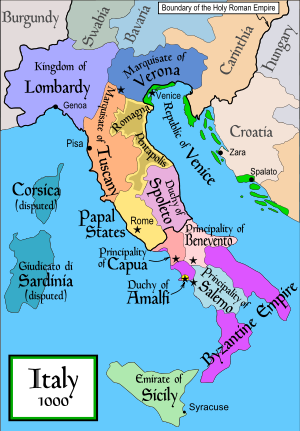
named Hassan al-Kalbi as emir of the island. As his charge soon became hereditary, his emirate became de facto independent from the African government. In 950, Hassan waged war against the Byzantines in southern Italy, reaching up to Gerace
Gerace
Gerace is a town and comune in the province of Reggio Calabria, Calabria, Italy.Gerace is located some 10 km inland from Locri, yet the latter town and the Sea can be seen from Gerace's perch atop a 500 m vertical rock...
and Cassano allo Ionio
Cassano allo Ionio
Cassano allo Ionio is a small town and comune in province of Cosenza of Calabria, southern Italy, known in Roman times as Cassanum. It lies in fertile region in the concave recess of a steep mountain, 60 km NE from the town of Cosenza, 10 km W of the archaeological site of...
. A second Calabrian campaign in 952 resulted in the defeat of the Byzantine army; Gerace was again besieged, but in the end Emperor Constantine VII was forced to accept having the Calabrian cities pay a tribute to Sicily.
In 956, the Byzantines reconquered Reggio and invaded Sicily. A truce was signed in 960. Two years later a revolt in Taormina was bloodily suppressed, but the heroic resistance of the Christians in Rametta led the new Emperor Nikephoros II Phokas to send an army of 40,000 Armenians, Thracians and Slavs under his nephew Manuel who captured Messina in October 964. On 25 October, a fierce battle between the Byzantines and the Kalbids
Kalbids
The Kalbids were a Shia Muslim dynasty in Sicily, which ruled from 948 to 1053 .In 827, in the midst of internal Byzantine conflict, the Aghlabids arrived at Marsala in Sicily, with a fleet of 10,000 men under the command of Asad ibn al-Furat. Palermo was conquered in 831 and became the new capital...
resulted in a defeat for the former. Manuel, along with 10,000 of his men, was killed in the fray.
The new Emir Abu al-Qasim (964-982) launched a series of attacks against Calabria in the 970s while the fleet under his brother attacked the coasts of Apulia
Apulia
Apulia is a region in Southern Italy bordering the Adriatic Sea in the east, the Ionian Sea to the southeast, and the Strait of Òtranto and Gulf of Taranto in the south. Its most southern portion, known as Salento peninsula, forms a high heel on the "boot" of Italy. The region comprises , and...
, capturing some strongholds. As the Byzantines were busy against the Fatimids in Syria and the Bulgars in Macedon
Macedon
Macedonia or Macedon was an ancient kingdom, centered in the northeastern part of the Greek peninsula, bordered by Epirus to the west, Paeonia to the north, the region of Thrace to the east and Thessaly to the south....
, the German Emperor Otto II
Otto II, Holy Roman Emperor
Otto II , called the Red, was the third ruler of the Saxon or Ottonian dynasty, the son of Otto the Great and Adelaide of Italy.-Early years and co-ruler with Otto I:...
decided to intervene, and the allied German-Lombard army was defeated in 982 at the Battle of Stilo
Battle of Stilo
The Battle of Stilo or Cape Colonna was fought on 13 or 14 July 982 near Crotone in Calabria between the forces of the Emperor Otto II and his Italo-Lombard allies and those of the Kalbid emir of Sicily, Abu al-Qasim...
. However, as al-Qasim himself had been killed, his son Jabir al-Kalbi prudently retreated to Sicily without exploiting the victory.
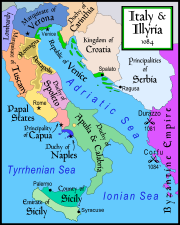
The emirate reached its cultural peak under the emirs Jafar (983-985) and Yusuf al-Kalbi (990-998), both patrons of the arts. The latter's son Ja'far was instead a cruel and violent lord who expelled the Berbers from the island after an unsuccessful revolt against him. In 1019, another uprising in Palermo was successful, and Ja'far was exiled to Africa and replaced by his brother al-Akhal (1019–1037).
Zirid
The Zirid dynasty were a Sanhadja Berber dynasty, originating in modern Algeria, initially on behalf of the Fatimids, for about two centuries, until weakened by the Banu Hilal and finally destroyed by the Almohads. Their capital was Kairouan...
Emir of Ifriqiya
Ifriqiya
In medieval history, Ifriqiya or Ifriqiyah was the area comprising the coastal regions of what are today western Libya, Tunisia, and eastern Algeria. This area included what had been the Roman province of Africa, whose name it inherited....
, al-Muizz ibn Badis
Al-Muizz ibn Badis
Al-Muizz ibn Badis ; 1008–1062) was the fourth ruler of the Zirids in Ifriqiya, reigning from 1016 to 1062.Al-Muizz ascended the throne as a minor following the death of his father Badis ibn Mansur, with his aunt acting as regent. In 1016 there was a bloody revolt in Ifriqiya in which the Fatimid...
, which were commanded by his son Abdallah.
Decline (1037–1061) and Norman conquest of Sicily (1061–1091)
In 1038, a Byzantine army under George ManiacesGeorge Maniaces
George Maniakes was a prominent Byzantine Greek general during the 11th century, he was the catepan of Italy in 1042. He is known as Gyrgir in Scandinavian sagas....
crossed the strait of Messina. This included a corps of Normans which saved the situation in the first clash against the Muslims from Messina. After another decisive victory in the summer of 1040, Maniaces halted his march to lay siege to Syracuse. Despite his conquest of the latter, Maniaces was removed from his position, and the subsequent Muslim counter-offensive reconquered all the cities captured by the Byzantines.
The Norman Robert Guiscard
Robert Guiscard
Robert d'Hauteville, known as Guiscard, Duke of Apulia and Calabria, from Latin Viscardus and Old French Viscart, often rendered the Resourceful, the Cunning, the Wily, the Fox, or the Weasel was a Norman adventurer conspicuous in the conquest of southern Italy and Sicily...
, son of Tancred, invaded Sicily
Norman conquest of southern Italy
The Norman conquest of southern Italy spanned the late eleventh and much of the twelfth centuries, involving many battles and many independent players conquering territories of their own...
in 1060. The island was split between three Arab emirs, and the majority Christian population rose up against the ruling Muslims. One year later, Messina fell, and in 1072, Palermo was taken by the Normans. The loss of the cities, each with a splendid harbor, dealt a severe blow to Muslim power on the island. Eventually all of Sicily was taken. In 1091, Noto
Noto
Noto is a city and comune in the Province of Syracuse, Sicily . Its located 32 km southwest of the city of Syracuse at the foot of the Iblean Mountains and gives its name to the surrounding valley, Val di Noto...
in the southern tip of Sicily and the island of Malta, the last Arab stongholds, fell to the Christians. By the 11th century, Muslim power in the Mediterranean had begun to wane.
Many repressive measures were introduced by Frederick II
Frederick II, Holy Roman Emperor
Frederick II , was one of the most powerful Holy Roman Emperors of the Middle Ages and head of the House of Hohenstaufen. His political and cultural ambitions, based in Sicily and stretching through Italy to Germany, and even to Jerusalem, were enormous...
to please the popes who were intolerant of Islam in the heart of Christendom
Christendom
Christendom, or the Christian world, has several meanings. In a cultural sense it refers to the worldwide community of Christians, adherents of Christianity...
. This resulted in a rebellion by Sicilian Muslims, which in turn triggered organized resistance and systematic reprisals and marked the final chapter of Islam in Sicily. The Muslim problem characterized Hohenstaufen
Hohenstaufen
The House of Hohenstaufen was a dynasty of German kings in the High Middle Ages, lasting from 1138 to 1254. Three of these kings were also crowned Holy Roman Emperor. In 1194 the Hohenstaufens also became Kings of Sicily...
rule in Sicily under Henry VI
Henry VI, Holy Roman Emperor
Henry VI was King of Germany from 1190 to 1197, Holy Roman Emperor from 1191 to 1197 and King of Sicily from 1194 to 1197.-Early years:Born in Nijmegen,...
and his son Frederick II. The annihilation of Islam in Sicily was completed by the late 1240s when the final deportations to Lucera
Lucera
Lucera is a town and comune in the Province of Foggia, in the Apulia region of southern Italy.-Ancient era and early Middle Ages :Lucera is an ancient city founded in Daunia, the centre of Dauni territory . Archeological excavations show the presence of a bronze age village inside the city boundaries...
took place.
Emirate of Bari (847–871)
Bari
Bari is the capital city of the province of Bari and of the Apulia region, on the Adriatic Sea, in Italy. It is the second most important economic centre of mainland Southern Italy after Naples, and is well known as a port and university city, as well as the city of Saint Nicholas...
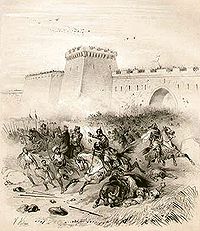
, in the Apulia region of southern Italy, was captured by a Muslim army in 847, then remained under Muslim control for the next 25 years. It became the capital of a small independent Islamic state with an emir and a mosque of its own. The first ruler of Bari was Khalfun, a Berber leader who had probably come from Sicily. After his death in 852, he was succeeded by Mufarrag ibn Sallam who strengthened the Muslim conquest and enlarged its boundaries. He also asked for official recognition from Baghdad Caliph al-Mutawakkil
Al-Mutawakkil
Al-Mutawakkil ʻAlā Allāh Jaʻfar ibn al-Muʻtasim was an Abbasid caliph who reigned in Samarra from 847 until 861...
's governor in Egypt as wāli (i.e., prefect ruling over a province of the Abbasid empire). The third, and last, emir of Bari was Sawdan who came to power around 857 after the murder of Mufarraq. He invaded the lands of the Lombard Duchy of Benevento
Duchy of Benevento
The Duchy and later Principality of Benevento was the southernmost Lombard duchy in medieval Italy, centred on Benevento, a city central in the Mezzogiorno. Owing to the Ducatus Romanus of the popes, which cut it off from the rest of Lombard Italy, Benevento was from the first practically...
forcing duke Adelchis
Adelchis of Benevento
Adelchis was the son of Radelchis I, Prince of Benevento, and successor of his brother Radelgar in 854.It was given to Adelchis to preserve the ancient principality and its independence in the face of repeated assaults by the Saracens from the south, the Emperor Louis II from the north, and...
to pay a tribute. In 864, he obtained the official investiture asked by Mufarrag. The town was embellished with a mosque, palaces and public works.
Latium and Campania
Throughout the ninth century, Arab ships dominated the Tyrrhenian Sea. Their pirates prowled the Italian coast launching hit and run attacks against the cities of AmalfiAmalfi
Amalfi is a town and comune in the province of Salerno, in the region of Campania, Italy, on the Gulf of Salerno, c. 35 km southeast of Naples. It lies at the mouth of a deep ravine, at the foot of Monte Cerreto , surrounded by dramatic cliffs and coastal scenery...
, Gaeta
Gaeta
Gaeta is a city and comune in the province of Latina, in Lazio, central Italy. Set on a promontory stretching towards the Gulf of Gaeta, it is 120 km from Rome and 80 km from Naples....
, Naples
Naples
Naples is a city in Southern Italy, situated on the country's west coast by the Gulf of Naples. Lying between two notable volcanic regions, Mount Vesuvius and the Phlegraean Fields, it is the capital of the region of Campania and of the province of Naples...
, and Salerno
Salerno
Salerno is a city and comune in Campania and is the capital of the province of the same name. It is located on the Gulf of Salerno on the Tyrrhenian Sea....
. During this period, as the cities took command of their own defences, the Duchies of Gaeta
Duchy of Gaeta
The Duchy of Gaeta was an early medieval state centred on the coastal South Italian city of Gaeta. It began in the early ninth century as the local community began to grow autonomous as Byzantine power lagged in the Mediterranean and the peninsula thanks to Lombard and Saracen incursions.Our...
and Amalfi
Duchy of Amalfi
The Duchy of Amalfi or the Republic of Amalfi was a de facto independent state centred on the Southern Italian city of Amalfi during the 10th and 11th centuries. The city and its territory were originally part of the larger ducatus Neapolitanus, governed by a patrician, but it extracted itself...
gained their independence from the Duchy of Naples
Duchy of Naples
The Duchy of Naples began as a Byzantine province that was constituted in the seventh century, in the reduced coastal lands that the Lombards had not conquered during their invasion of Italy in the sixth century...
. The Christian states of the Campania
Campania
Campania is a region in southern Italy. The region has a population of around 5.8 million people, making it the second-most-populous region of Italy; its total area of 13,590 km² makes it the most densely populated region in the country...
were not yet prepared, however, to ally against the new "pagan" threat. Amalfi and Gaeta regularly teamed up with the Saracens and Naples was hardly better, all much to the chagrin of the Papacy. In fact, it was Naples that first brought Saracen troops to the south Italian mainland when Duke Andrew II
Andrew II of Naples
Andrew II was the duke of Naples from 834 to 840. During his reign, he was constantly at war with the Lombards and he allowed Gaeta, his vassal, to move towards independence under its own consuls....
hired them as mercenaries during his war with Sicard
Sicard of Benevento
Sicard was the Prince of Benevento from 832. He was the last prince of a united Benevento which covered most of the Mezzogiorno. On his death, the principality descended into civil war which split it permanently...
, Prince of Benevento, in 836. Sicard immediately responded with his own Saracen mercenaries and the usage soon became a tradition. In 880 or 881, Pope John VIII
Pope John VIII
Pope John VIII was pope from December 13, 872 to December 16, 882. He is often considered one of the ablest pontiffs of the ninth century and the last bright spot on the papacy until Leo IX two centuries later....
, who encouraged a vigorous policy against the Muslim pirates and raiders, rescinded his grant of Traetto to Docibilis I of Gaeta
Docibilis I of Gaeta
Docibilis I was the Hypatus of Gaeta from 867 until his death.The sudden disappearance of the co-hypati Constantine and Marinus I after 866 strongly suggests that perhaps Docibilis' assumption of power had been violent...
and gave it instead to Pandenulf of Capua
Pandenulf of Capua
Pandenulf was the Count of Capua, claiming that title from 862 and holding it successfully during the tumultuous civil war of 879 – 882. He was the son and successor of Pando, but was removed on his father's death by his uncle the bishop, Landulf II....
. As Patricia Skinner relates:
[Pandenolf] began to attack Gaeta's territory, and in retaliation against the pope Docibilis unleashed a group of Arabs from Agropoli near Salerno on the area around Fondi. The pope was "filled with shame" and restored Traetto to Docibilis. Their agreement seems to have sparked off a Saracen attack on Gaeta itself, in which many Gaetans were killed or captured. Eventually peace was restored and the Saracens made a permanent settlement on the mouth of the Garigliano river.
The Saracen camp at Minturno
Minturno
Minturno is a city and comune in the southern Lazio, Italy, situated on the north west bank of the Liris , with a suburb on the opposite bank c...
(in modern day Lazio) by the Garigliano River
Garigliano River
The Garigliano is a river in central Italy.It forms at the confluence of the rivers Gari and Liri. Garigliano is actually a deformation of "Gari-Lirano"...
became a perennial thorn in the side for the Papacy and many expeditions were sought to get rid of them. In 915, Pope John X
Pope John X
Pope John X, Pope from March 914 to May 928, was deacon at Bologna when he attracted the attention of Theodora, the wife of Theophylact, Count of Tusculum, the most powerful noble in Rome, through whose influence he was elevated first to the see of Bologna and then to the archbishopric of...
organised a vast alliance of southern powers, including Gaeta and Naples, the Lombard princes and the Byzantines; though, the Amalfitans stood aloof. The subsequent Battle of the Garigliano was successful, and the Saracens were ousted from any presence in Lazio or Campania permanently; though, raiding would be a continuous problem for another century.
In 897 the Abbey of Farfa
Abbey of Farfa
Farfa Abbey is a territorial abbey in northern Lazio, central Italy. It is one of the most famous abbeys of Europe. It belongs to the Benedictine Order and is located about 60 km from Rome, in the commune of Fara Sabina, not far from the Fara Sabina railway station.-History:A legend in the...
was sacked by "Saracens", who used it as a barracks until it was accidentally destroyed by fire (apparently started by locals) in 898. Abbot Peter of Farfa
Peter of Farfa
Peter was the long-serving Abbot of Farfa from about 890 until his death, replacing the interim abbot Vitalis. His abbacy marked the end of a confused period which saw four abbots in the space of two years....
managed to organise the community's escape and salvaged its library and archives.
Invasion of Otranto
In 1480, an Ottoman Turkish fleet invaded Otranto, landing nearby the city and capturing it along with its fort. Pope Sixtus IVPope Sixtus IV
Pope Sixtus IV , born Francesco della Rovere, was Pope from 1471 to 1484. His accomplishments as Pope included the establishment of the Sistine Chapel; the group of artists that he brought together introduced the Early Renaissance into Rome with the first masterpiece of the city's new artistic age,...
called for a crusade, and a massive force was built up by Ferdinand I of Naples, among them notably troops of Hungarian king Matthias Corvinus, despite frequent Italian quarreling at the time. The Neapolitan force met with the Turks in 1481, thoroughly annihilating them and recapturing Otranto.
In 1537, the famous Turkish corsair
Barbary corsairs
The Barbary Corsairs, sometimes called Ottoman Corsairs or Barbary Pirates, were pirates and privateers who operated from North Africa, based primarily in the ports of Tunis, Tripoli and Algiers. This area was known in Europe as the Barbary Coast, a term derived from the name of its Berber...
and Ottoman admiral Barbarossa tried again to conquer Otranto and the Fortress of Castro, but the Turks were eventually repulsed from the city.
Islamic and Arabic influence and legacy
Arabic art and science continued to be heavily influential in Sicily during the two centuries following the Christian reconquest. Frederick II, Holy Roman EmperorHoly Roman Emperor
The Holy Roman Emperor is a term used by historians to denote a medieval ruler who, as German King, had also received the title of "Emperor of the Romans" from the Pope...
and King of Sicily in the early 13th century, is said to have been able to speak Arabic (as well as Latin, Sicilian, German, French, and Greek) and had several Muslim ministers. The heritage of the Arabic language can still be found in numerous terms adapted from it and still used in the Sicilian language
Sicilian language
Sicilian is a Romance language. Its dialects make up the Extreme-Southern Italian language group, which are spoken on the island of Sicily and its satellite islands; in southern and central Calabria ; in the southern parts of Apulia, the Salento ; and Campania, on the Italian mainland, where it is...
. Another legacy of Muslim rule is the survival of some Sicilian placenames of Arabic origin, for example "Calata-" or "Calta-" from Arabic , meaning "castle of".
Also, a genetic study in 2009 revealed a small but statistically significant genetic contribution of Northwest African genes among today's inhabitants near the city of Lucera. During the 1970s, a prosperous Italian economy spurred the immigration of Muslims from Jordan
Jordan
Jordan , officially the Hashemite Kingdom of Jordan , Al-Mamlaka al-Urduniyya al-Hashemiyya) is a kingdom on the East Bank of the River Jordan. The country borders Saudi Arabia to the east and south-east, Iraq to the north-east, Syria to the north and the West Bank and Israel to the west, sharing...
, Syria
Syria
Syria , officially the Syrian Arab Republic , is a country in Western Asia, bordering Lebanon and the Mediterranean Sea to the West, Turkey to the north, Iraq to the east, Jordan to the south, and Israel to the southwest....
and Palestine
Palestine
Palestine is a conventional name, among others, used to describe the geographic region between the Mediterranean Sea and the Jordan River, and various adjoining lands....
to the area.
Further reading
- Skinner, Patricia (1995). Family Power in Southern Italy: The Duchy of Gaeta and its Neighbours, 850–1139. Cambridge: Cambridge University Press.