
All Topics  
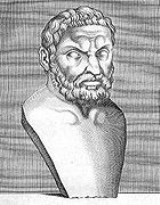
Thales

 
Thales

   Email Print
   Bookmark   Link


Thales


Thales of Miletus ( ( or "THEH-leez") , ca. 624 BC–ca. 546 BC), was a pre-Socratic
Pre-Socratic philosophy

The Pre-Socratic Greek philosophy were active before Socrates or contemporaneously, but expounding knowledge developed earlier. The popularity of the term originates with Hermann Diels' work Die Fragmente der Vorsokratiker ....
 Greek philosopher
Greek philosophy

Greek philosophy focused on the role of reason and inquiry. Many philosophers today concede that Greek philosophy has shaped the entire Western thought since its inception....
 from Miletus
Miletus

Miletus was an ancient city on the western coast of Anatolia , near the mouth of the Maeander River in ancient Caria. Evidence of first settlement at the site has been made inaccessible by the rise of sea level and deposition of sediments from the Maeander....
 in Asia Minor, and one of the Seven Sages of Greece
Seven Sages of Greece

The Seven Sages or Seven Wise Men was the title given by ancient Greece tradition to seven early 6th century B.C. philosophers, statesmen and law-givers who were renowned in the following centuries for their wisdom....
. Many, most notably Aristotle, regard him as the first philosopher in the Greek tradition
Greek philosophy

Greek philosophy focused on the role of reason and inquiry. Many philosophers today concede that Greek philosophy has shaped the entire Western thought since its inception....
. According to Bertrand Russell
Bertrand Russell

Bertrand Arthur William Russell, 3rd Earl Russell, Order of Merit , Fellow of the Royal Society , was a British people philosopher, mathematical logic, mathematician, historian, advocate for social reform, and pacifism....
, "Philosophy begins with Thales."

Background The dates of Thales' life are not known precisely.


Discussion
Ask a question about 'Thales'
Start a new discussion about 'Thales'
Answer questions from other users
Full Discussion Forum


Recent Posts


Encyclopedia


Thales of Miletus ( ( or "THEH-leez") , ca. 624 BC–ca. 546 BC), was a pre-Socratic
Pre-Socratic philosophy

The Pre-Socratic Greek philosophy were active before Socrates or contemporaneously, but expounding knowledge developed earlier. The popularity of the term originates with Hermann Diels' work Die Fragmente der Vorsokratiker ....
 Greek philosopher
Greek philosophy

Greek philosophy focused on the role of reason and inquiry. Many philosophers today concede that Greek philosophy has shaped the entire Western thought since its inception....
 from Miletus
Miletus

Miletus was an ancient city on the western coast of Anatolia , near the mouth of the Maeander River in ancient Caria. Evidence of first settlement at the site has been made inaccessible by the rise of sea level and deposition of sediments from the Maeander....
 in Asia Minor, and one of the Seven Sages of Greece
Seven Sages of Greece

The Seven Sages or Seven Wise Men was the title given by ancient Greece tradition to seven early 6th century B.C. philosophers, statesmen and law-givers who were renowned in the following centuries for their wisdom....
. Many, most notably Aristotle, regard him as the first philosopher in the Greek tradition
Greek philosophy

Greek philosophy focused on the role of reason and inquiry. Many philosophers today concede that Greek philosophy has shaped the entire Western thought since its inception....
. According to Bertrand Russell
Bertrand Russell

Bertrand Arthur William Russell, 3rd Earl Russell, Order of Merit , Fellow of the Royal Society , was a British people philosopher, mathematical logic, mathematician, historian, advocate for social reform, and pacifism....
, "Philosophy begins with Thales."

Life


Thales lived around the mid 620s–547 BC and was born in the city of Miletus
Miletus

Miletus was an ancient city on the western coast of Anatolia , near the mouth of the Maeander River in ancient Caria. Evidence of first settlement at the site has been made inaccessible by the rise of sea level and deposition of sediments from the Maeander....
. Miletus was an ancient Greek Ionian
Ionia

Ionia is an ancient region of central coastal Anatolia in present-day Turkey, the region nearest Izmir, which was historically Smyrna. It consisted of the northernmost territories of the Ionian League of Hellenes settlements....
 city on the western coast of Asia Minor (in what is today the Aydin Province
Aydin Province

Aydin is a province of southwestern Turkey, located in the Aegean Region, Turkey . The provincial capital is the city of Aydin which has a population of approx....
 of Turkey
Turkey

Turkey , known officially as the Republic of Turkey , is a Eurasian country that stretches across the Anatolian peninsula in southwest Asia and Thrace in the Balkans region of Southern Europe....
) near the mouth of the Maeander River
Maeander River

The B?y?k Menderes River ; , Ancient Greek: ?a?a?d???; Ma?andros) is a river in southwestern Turkey. It rises in west central Turkey near Dinar , Afyonkarahisar before flowing west through the B?y?k Menderes graben until reaching the Aegean Sea in the proximity of the ancient Ionian city Miletus....
.

Background

The dates of Thales' life are not known precisely. The time of his life is roughly established by a few dateable events mentioned in the sources and an estimate of his length of life. According to Herodotus
Herodotus

Herodotus of Halicarnassus was a Greeks historian who lived in the 5th century BC and is regarded as the "Father of History" in Western culture....
, Thales once predicted a solar eclipse which has been determined by modern methods to have been on May 28, 585 BC. Diogenes Laërtius
Diogenes Laertius

Diogenes La?rtius , the biographer of the Greece philosophers, is supposed by some to have received his surname from the town of Laerte in Cilicia, Asia Minor, and by others from the Roman Empire family of the La?rtii....
 quotes the chronicle of Apollodorus
Apollodorus

Apollodorus of Athens son of Asclepiades, was a Greeks scholar and grammarian. He was a pupil of Diogenes of Babylon, Panaetius, and the grammarian Aristarchus of Samothrace....
 as saying that Thales died at 78 in the 58th Olympiad, and Sosicrates
Sosicrates

Sosicrates of Rhodes was a Greeks history writer. Sosicrates was born on the island Rhodes and is noted, chiefly, for his frequent mention by Diogenes La?rtius in his Lives and Opinions of Eminent Philosophers ? referencing Sosicrates as the sole authority behind such facts as Aristippus having written nothing....
 as reporting that he was 90 at his death.

As mentioned, according to tradition, Thales was born in Miletus
Miletus

Miletus was an ancient city on the western coast of Anatolia , near the mouth of the Maeander River in ancient Caria. Evidence of first settlement at the site has been made inaccessible by the rise of sea level and deposition of sediments from the Maeander....
, Asia Minor
Anatolia

Anatolia or Asia Minor is a region of Western Asia, comprising most of the modern Republic of Turkey. It is a geographic region bounded by the Black Sea to the north, the Caucasus to the northeast, the Aegean Sea to the west, the Mediterranean Sea to the south, and the Iranian plateau to the east and southeast....
. Diogenes Laertius states that ("according to Herodotus and Douris and Democritus") his parents were Examyes and Cleobuline, Milesian nobles. Giving another opinion, he ultimately connects Thales' family line back to Phoenicia
Phoenicia

Phoenicia was an ancient civilization centered in the north of ancient Canaan, with its heartland along the coastal regions of modern day Lebanon, extending to parts of Israel, Syria and the Palestinian territories....
n prince Cadmus
Cadmus

Cadmus or Kadmos , in Greek mythology mythology, was a Phoenician prince, the son of Agenor and the brother of Phoenix , Cilix and Europa ....
, what is thought to be a later elaboration. Diogenes also reports two other stories, one that he married and had a son, Cybisthus or Cybisthon, or adopted his nephew of the same name. The second is that he never married, telling his mother as a young man that it was too early to marry, and as an older man that it was too late. A much earlier source - Plutarch
Plutarch

Lucius Mestrius Plutarchus , c. AD 46 ? 120 ? commonly known in English as Plutarch ? was a Ancient Rome historian , biographer, essayist, and Middle Platonism....
 tells the following story: Solon
Solon

Solon was an Athens statesman, lawmaker, and lyric poetry. He is remembered particularly for his efforts to legislate against political, economic and moral decline in Archaic period in Greece Athens....
 who visited Thales asked him the reason which kept him single. Thales - answered that he did not like the idea of having to worry about children. Nevertheless, several years later Thales anxious for family adopted his nephew Cybisthus.

Thales involved himself in many activities, taking the role of an innovator. Some say that he left no writings, others that he wrote "On the Solstice" and "On the Equinox". Neither have survived. Diogenes Laërtius quotes letters of Thales to Pherecydes
Pherecydes

Pherecydes was the name of:*Pherecydes of Syros, a pre-Socratic philosopher and author from the island of Syros, by some believed to have influenced Pythagoras...
 and Solon
Solon

Solon was an Athens statesman, lawmaker, and lyric poetry. He is remembered particularly for his efforts to legislate against political, economic and moral decline in Archaic period in Greece Athens....
, offering to review the book of the former on religion, and offering to keep company with the latter on his sojourn from Athens
Athens

Athens , the Capital and largest city of Greece, dominates the Attica periphery; as one of the List of cities by time of continuous habitation, its recorded history spans around 3,400 years....
. Thales identifies the Milesians as Athenians.

Business

Several anecdotes suggest that Thales was not solely a thinker; he was involved in business and politics. One story recounts that he bought all the olive presses
Olive oil extraction

Olive oil extraction is the process of extracting the oil present in the olive drupes for food use. The oil is produced in the mesocarp plant cell, and stored in a particular type of vacuole called a lipovacuole, i.e....
 in Miletus after predicting the weather and a good harvest for a particular year. Another version of this same story states that he bought the presses not to become wealthy, but merely to demonstrate to his fellow Milesians that he could use his intelligence to enrich himself.

Politics

Thales’ political life had mainly to do with the involvement of the Ionians
Ionians

The Ionians were one of the three populations into which the ancient Greeks considered the population of Hellenes to have been divided."Ionian" with reference to populations had two senses in Classical Greece....
 in the defense of Anatolia
Anatolia

Anatolia or Asia Minor is a region of Western Asia, comprising most of the modern Republic of Turkey. It is a geographic region bounded by the Black Sea to the north, the Caucasus to the northeast, the Aegean Sea to the west, the Mediterranean Sea to the south, and the Iranian plateau to the east and southeast....
 against the growing power of the Persians
Iranian peoples

The Iranian peoples are an ethnic and linguistic branch of Indo-European peoples, living mainly in Iranian plateau and beyond in central-, southern-, and southwestern Asia and southeastern Europe....
, who were then new to the region. A king had come to power in neighboring Lydia
Lydia

Lydia was an Iron Age kingdom of western Asia Minor located generally east of ancient Ionia in the modern Turkey provinces of Manisa Province and inland Izmir Province....
, Croesus
Croesus

Croesus was the Monarch of Lydia from 560/561 BC until his defeat by the Persian Empire in about 547 BC. The fall of Croesus made a profound impact on the Greeks, providing a fixed point in their calendar....
, who was somewhat too aggressive for the size of his army. He had conquered most of the states of coastal Anatolia, including the cities of the Ionians. The story is told in Herodotus
Herodotus

Herodotus of Halicarnassus was a Greeks historian who lived in the 5th century BC and is regarded as the "Father of History" in Western culture....
.

The Lydians were at war with the Medes
Medes

The Medes were an Ancient Iranian peoples who lived in the northwestern portions of present-day Iran. This area was known in Greek as Media or Medea ....
, a remnant of the first wave of Iranians in the region, over the issue of refuge the Lydians had given to some Scythian soldiers of fortune inimical to the Medes. The war endured for five years, but in the sixth an eclipse of the sun (mentioned above) spontaneously halted a battle in progress (the Battle of Halys).
Solar Eclips 1999 4 Nr
It seems that Thales had predicted this solar eclipse
Solar eclipse

A solar eclipse occurs when the Moon passes between the Sun and the Earth so that the Sun is wholly or partially obscured. This can only happen during a new moon, when the Sun and Moon are in conjunction as seen from the Earth....
. The Seven Sages
Seven Sages of Greece

The Seven Sages or Seven Wise Men was the title given by ancient Greece tradition to seven early 6th century B.C. philosophers, statesmen and law-givers who were renowned in the following centuries for their wisdom....
 were most likely already in existence, as Croesus
Croesus

Croesus was the Monarch of Lydia from 560/561 BC until his defeat by the Persian Empire in about 547 BC. The fall of Croesus made a profound impact on the Greeks, providing a fixed point in their calendar....
 was also heavily influenced by Solon
Solon

Solon was an Athens statesman, lawmaker, and lyric poetry. He is remembered particularly for his efforts to legislate against political, economic and moral decline in Archaic period in Greece Athens....
 of Athens
Athens

Athens , the Capital and largest city of Greece, dominates the Attica periphery; as one of the List of cities by time of continuous habitation, its recorded history spans around 3,400 years....
, another sage. Whether Thales was present at the battle is not known, nor are the exact terms of the prediction, but based on it the Lydians and Medes made peace immediately, swearing a blood oath.

The Medes were dependencies of the Persians under Cyrus. Croesus now sided with the Medes against the Persians and marched in the direction of Iran (with far fewer men than he needed). He was stopped by the river Halys
Halys

Halys may refer to:* The Halys River in Anatolia , Turkish Kizilirmak .* The Battle of Halys which is the first battle in antiquity that is 'datable' with any certainty and took place on May 28 585 BC, between the Medes and the Lydians along the Halys River and it's valley * In the Aeneid, Halys is a Trojan who defends Ae...
, then unbridged. This time he had Thales with him, perhaps by invitation. Whatever his status, the king gave the problem to him, and he got the army across by digging a diversion upstream so as to reduce the flow, making it possible to ford the river. The channels ran around both sides of the camp.

The two armies engaged at Pteria in Cappadocia
Cappadocia

Cappadocia, Wikipedia:IPA for English /k?p?'do???/ , was an extensive inland district of Asia Minor . The name continued to be used in western sources and in the Christianity tradition throughout history and is still widely used as an international Tourism in Turkey concept to define a region of exceptional natural wonders characterized by...
. As the battle was indecisive but paralyzing to both sides, Croesus marched home, dismissed his mercenaries and sent emissaries to his dependents and allies to ask them to dispatch fresh troops to Sardis
Sardis

Sardis, also Sardes , modern Sart in the Manisa province of Turkey, was the capital of the ancient kingdom of Lydia, one of the important cities of the Persian Empire, the seat of a proconsul under the Roman Empire, and the metropolis of the province Lydia in later Roman and Byzantine Empire times....
. The issue became more pressing when the Persian army showed up at Sardis. Diogenes Laertius
Diogenes Laertius

Diogenes La?rtius , the biographer of the Greece philosophers, is supposed by some to have received his surname from the town of Laerte in Cilicia, Asia Minor, and by others from the Roman Empire family of the La?rtii....
 tells us that Thales gained fame as a counsellor when he advised the Milesians not to engage in a symmachia, a “fighting together”, with the Lydians. This has sometimes been interpreted as an alliance, but a ruler does not ally with his subjects.

Croesus was defeated before the city of Sardis by Cyrus, who subsequently spared Miletus because it had taken no action. The Great King was something of a philosopher himself. He was so impressed by Croesus’ wisdom and his connection with the sages that he spared him and took his advice on various matters. The Ionians were now free. Herodotus says that Thales advised them to form an Ionian state; that is, a bouleuterion (“deliberative body”) to be located at Teos
Teos

Teos or Teo was a maritime city of Ionia, on a peninsula between Chytrium and Myonnesus, colonized by Orchomenus Minyans, Ionians, and Boeotians....
 in the center of Ionia
Ionia

Ionia is an ancient region of central coastal Anatolia in present-day Turkey, the region nearest Izmir, which was historically Smyrna. It consisted of the northernmost territories of the Ionian League of Hellenes settlements....
. The Ionian cities should be demoi, or “districts”. Miletus, however, received favorable terms from Cyrus. The others remained in an Ionian League of 12 cities (excluding Miletus now), and were subjugated by the Persians.

Sagacity

Diogenes Laertius tells us that the Seven Sages
Seven Sages of Greece

The Seven Sages or Seven Wise Men was the title given by ancient Greece tradition to seven early 6th century B.C. philosophers, statesmen and law-givers who were renowned in the following centuries for their wisdom....
 were created in the archonship of Damasius at Athens
Athens

Athens , the Capital and largest city of Greece, dominates the Attica periphery; as one of the List of cities by time of continuous habitation, its recorded history spans around 3,400 years....
 about 582 BC and that Thales was the first sage. The same story, however, asserts that Thales emigrated to Miletus
Miletus

Miletus was an ancient city on the western coast of Anatolia , near the mouth of the Maeander River in ancient Caria. Evidence of first settlement at the site has been made inaccessible by the rise of sea level and deposition of sediments from the Maeander....
. There is also a report that he did not become a student of nature until after his political career. Much as we would like to have a date on the seven sages, we must reject these stories and the tempting date if we are to believe that Thales was a native of Miletus, predicted the eclipse, and was with Croesus
Croesus

Croesus was the Monarch of Lydia from 560/561 BC until his defeat by the Persian Empire in about 547 BC. The fall of Croesus made a profound impact on the Greeks, providing a fixed point in their calendar....
 in the campaign against Cyrus.

Thales had instruction from Egyptian
Ancient Egypt

Ancient Egypt was an Ancient history civilization in eastern North Africa, concentrated along the lower reaches of the Nile in what is now the modern nation of Egypt....
 priests, we are told. It was fairly certain that he came from a wealthy and established family, and the wealthy customarily educated their children. Moreover, the ordinary citizen, unless he was a seafaring man or a merchant, could not afford the grand tour in Egypt, and in any case did not consort with noble lawmakers such as Solon
Solon

Solon was an Athens statesman, lawmaker, and lyric poetry. He is remembered particularly for his efforts to legislate against political, economic and moral decline in Archaic period in Greece Athens....
.

He did participate in some games, most likely Panhellenic
Panhellenic Games

Panhellenic Games is the collective term for four separate sports festivals held in ancient Greece.The four Games were:* Ancient Olympic Games - the most important and prestigious of the Games, held every four years near Elis, in honour of Zeus...
, at which he won a bowl twice. He dedicated it to Apollo
Apollo

In Greek mythology and Roman mythology, Apollo , is one of the most important and many-sided of the Twelve Olympians. The ideal of the kouros , Apollo has been variously recognized as a god of light and the sun; truth and prophecy; archery; medicine and healing; music, poetry, and the arts; and more....
 at Delphi
Delphi

Delphi is an archaeology site and a modern town in Greece on the south-western spur of Mount Parnassus in the valley of Phocis. Delphi was the site of the Pythia, the most important oracle in the classical Greek world, when it was a major site for the worship of the god Apollo after he slew the Python , a deity who lived there and protecte...
. As he was not known to have been athletic, his event was probably declamation, and it may have been victory in some specific phase of this event that led to his being designated sage.

Theories

Before Thales, the Greeks explained the origin and nature of the world through myths
Mythology

The word mythology refers to a body of folklore/myths/legends that a particular culture believes to be true and that often use the supernatural to interpret natural events and to explain the nature of the universe and humanity....
 of anthropomorphic
Anthropomorphism

Anthropomorphism is the attribution of uniquely human characteristics to non-human creatures and beings, natural and supernatural phenomena, material states and objects or abstract concepts....
 gods
Deity

A deity is a postulated preternatural or supernatural immortal being, who may be thought of as holy, divinity, or sacred, held in high regard, and respected by human beings....
 and hero
Hero

A hero , in Greek mythology and folklore, was originally a demigod, the offspring of a mortal and a deity,their Greek hero cult being one of the most distinctive features of Religion in ancient Greece....
es. Phenomena such as lightning
Lightning

File:Blesk.jpgLightning is an Earth's atmosphere discharge of electricity usually accompanied by thunder, which typically occurs during thunderstorms, and sometimes during volcano or dust storms....
 or earthquake
Earthquake

An earthquake is the result of a sudden release of energy in the Earth's crust that creates seismic waves. Earthquakes are recorded with a seismometer, also known as a seismograph....
s were attributed to actions of the gods.

Nature as the principles in the form of matter

In contrast to these mythological explanations, Thales attempted to find naturalistic
Naturalism (philosophy)

Naturalism is a philosophical position that all phenomena can be explained in terms of natural causes and natural law. In its broadest and strongest sense, naturalism is the metaphysics position that "nature is all there is and all basic truths are truths of nature." This is generally referred to as metaphysical or ontological natur...
 explanations of the world, without reference to the supernatural
Supernatural

The term supernatural or supranatural pertains to an order of existence beyond the scientifically visible universe. Religious miracles are typically supernatural claims, as are Spell and curses, divination, the belief that there is an afterlife for the dead, and innumerable others....
. He explained earthquakes by hypothesizing that the Earth
Earth

Earth is the third planet from the Sun. Earth is the largest of the terrestrial planets in the Solar System in diameter, mass and density. It is also referred to as the World and Wiktionary:Terra.Note that by International Astronomical Union convention, the term "Terra" is used for naming extensive land masses, rather...
 floats on water, and that earthquakes occur when the Earth is rocked by waves.

Thales, according to Aristotle
Aristotle

Aristotle was a Greeks philosopher, a student of Plato and teacher of Alexander the Great. He wrote on many subjects, including physics, metaphysics, Poetics , theater, music, logic, rhetoric, politics, government, ethics, biology and zoology....
, asked what was the nature (Greek physis, Latin natura) of the object so that it would behave in its characteristic way. Physis
Physis

Physis is a Greek theology, philosophy, and science term usually translated into English as "nature". In the Odyssey, Homer uses the word once , referring to the intrinsic way of growth of a particular species of plant....
 (f?s??) comes from phyein (f?e??), "to grow", related to our word "be". (G)natura is the way a thing is "born", again with the stamp of what it is in itself.

Aristotle characterizes most of the philosophers "at first" as thinking that the "principles in the form of matter were the only principles of all things", where "principle" is arche
Arche

In the ancient Greek philosophy, arche is the beginning or the first principle of the world. The idea of an arche was first philosophized by Thales of Miletus, who claimed that the first principle of all things is water....
, "matter" is hyle
Hyle

In philosophy, hyle refers to materialism or stuff. It can also be the material cause underlying a change in Aristotelian philosophy. The Greeks originally had no word for matter in general, as opposed to raw material suitable for some specific purpose or other, so Aristotle adapted the word for "lumber" for this purpose....
 ("wood") and "form" is eidos.

"Principle" translates arche, but the two words do not have precisely the same meaning. A principle
Principle

A principle is a comprehensive and fundamental law, doctrine, or assumption. A rule or code of conduct. The laws or facts of nature underlying the working of an artificial device....
 of something is merely prior (related to pro-) to it either chronologically or logically. An arche (from , "to rule") dominates an object in some way. If the arche is taken to be an origin, then specific causality is implied; that is, B is supposed to be characteristically B just because it comes from A, which dominates it.

The archai that Aristotle had in mind in his well-known passage on the first Greek scientists are not necessarily chronologically prior to their objects, but are constituents of it. For example, in pluralism objects are composed of earth, air, fire and water, but those elements do not disappear with the production of the object. They remain as archai within it, as do the atoms of the atomists.

What Aristotle is really saying is that the first philosophers were trying to define the substance(s) of which all material objects are composed. As a matter of fact, that is exactly what modern scientists are trying to do in nuclear physics, which is a second reason why Thales is described as the first scientist.

Water as a first principle

Thales' most famous belief was his cosmological
Cosmology

Cosmology is study of the Universe in its totality, and by extension, humanity's place in it. Though the word cosmology is recent , study of the Universe has a long history involving science, philosophy, esotericism, and religion....
 thesis, which held that the world started from water
Water

Water is a common chemical substance that is essential for the survival of all known forms of life. In typical usage, water refers only to its liquid form or States of matter, but the substance also has a solid state, ice, and a gaseous state, water vapor or steam....
. Aristotle
Aristotle

Aristotle was a Greeks philosopher, a student of Plato and teacher of Alexander the Great. He wrote on many subjects, including physics, metaphysics, Poetics , theater, music, logic, rhetoric, politics, government, ethics, biology and zoology....
 considered this belief roughly equivalent to the later ideas of Anaximenes
Anaximenes of Miletus

Anaximenes of Miletus was a Greece Pre-Socratic philosopher from the latter half of the 6th century BC, probably a younger contemporary of Anaximander, whose pupil or friend he is said to have been....
, who held that everything in the world was composed of air
AIR

Air is the part of Earth's atmosphere that humans breath and as such Air .Air may also refer to:...
.

The best explanation of Thales' view is the following passage from Aristotle
Aristotle

Aristotle was a Greeks philosopher, a student of Plato and teacher of Alexander the Great. He wrote on many subjects, including physics, metaphysics, Poetics , theater, music, logic, rhetoric, politics, government, ethics, biology and zoology....
's Metaphysics
Metaphysics

Metaphysics investigates principles of reality transcending those of any particular science. cosmology and ontology are traditional branches of metaphysics....
. The passage contains words from the theory of matter and form
Hylomorphism

'Hylomorphism' is the philosophical theory, originating with Socrates, which conceptually identifies substance theory as matter and form. More exactly, substances are conceived as forms Inherence in matter....
 that were adopted by science with quite different meanings.
"That from which is everything that exists and from which it first becomes and into which it is rendered at last , its substance remaining under it , but transforming in qualities , that they say is the element and principle of things that are."


And again:

"For it is necessary that there be some nature (f?s??), either one or more than one, from which become the other things of the object being saved... Thales the founder of this type of philosophy says that it is water."


Aristotle's depiction of the change
Change

selfref|For Wikipedia uses, see...
 problem and the definition of substance
Substance theory

Substance theory, or substance attribute theory, is an ontology theory about Object , positing that a substance is distinct from its property ....
 is clear. If an object changes, is it the same or different? In either case how can there be a change from one to the other? The answer is that the substance "is saved", but acquires or loses different qualities (p???, the things you "experience").

A deeper dip into the waters of the theory of matter and form is properly reserved to other articles. The question for this article is, how far does Aristotle reflect Thales? He was probably not far off, and Thales was probably an incipient matter-and-formist.

The essentially non-philosophic Diogenes Laertius states that Thales taught as follows:

"Water constituted ('stood under') the principle of all things."


Heraclitus Homericus states that Thales drew his conclusion from seeing moist substance turn into air, slime and earth. It seems clear that Thales viewed the Earth as solidifying from the water on which it floated and which surrounded Ocean.

Beliefs in divinity

Thales applied his method to objects that changed to become other objects, such as water into earth (he thought). But what about the changing itself? Thales did address the topic, approaching it through magnets and amber, which, when electrified by rubbing, attracts also. A concern for magnetism and electrification never left science, being a major part of it today.

How was the power to move other things without the mover’s changing to be explained? Thales saw a commonality with the powers of living things to act. The magnet and the amber must be alive, and if that were so, there could be no difference between the living and the dead. When asked why he didn’t die if there was no difference, he replied “because there is no difference.”

Aristotle defined the soul
Soul

In many religions and parts of philosophy, the soul is the immaterial part of a person. It is usually thought to consist of one's thoughts and Personality psychology, and can be synonymous with the spirit, mind or self....
 as the principle of life, that which imbues the matter and makes it live, giving it the animation, or power to act. The idea did not originate with him, as the Greeks in general believed in the distinction between mind and matter, which was ultimately to lead to a distinction not only between body and soul but also between matter and energy.

If things were alive, they must have souls. This belief was no innovation, as the ordinary ancient populations of the Mediterranean did believe that natural actions were caused by divinities. Accordingly, the sources say that Thales believed all things possessed divinities. In their zeal to make him the first in everything they said he was the first to hold the belief, which even they must have known was not true.

However, Thales was looking for something more general, a universal substance of mind. That also was in the polytheism of the times. Zeus
Zeus

Zeus in Greek mythology is the king of the gods, the ruler of Mount Olympus and the god of the sky father and List of thunder gods. His symbols are the thunderbolt, eagle, bull , and oak....
 was the very personification of supreme mind
Mind

Mind refers to the aspects of intellect and consciousness manifested as combinations of thought, perception, memory, emotion, free will and imagination, including all of the brain's conscious and unconscious cognitive processes....
, dominating all the subordinate manifestations. From Thales on, however, philosophers had a tendency to depersonify or objectify mind, as though it were the substance of animation per se and not actually a god like the other gods. The end result was a total removal of mind from substance, opening the door to a non-divine principle of action. This tradition persisted until Einstein, whose cosmology is quite a different one and does not distinguish between matter and energy.

Classical thought, however, had proceeded only a little way along that path. Instead of referring to the person, Zeus, they talked about the great mind:

"Thales", says Cicero
Cicero

Marcus Tullius Cicero was a Ancient Rome philosopher, statesman, lawyer, political theorist, and Constitution of the Roman Republic. Cicero is widely considered one of Rome's greatest rhetoric and prose stylists....
, "assures that water is the principle of all things; and that God is that Mind which shaped and created all things from water."


The universal mind appears as a Roman belief in Virgil
Virgil

Publius Vergilius Maro was a classical Roman poet, best known for three major works?the Bucolics , the Georgics and the Aeneid?although several Appendix Vergiliana are also attributed to him....
 as well:

"In the beginning, SPIRIT within (spiritus intus) strengthens Heaven and Earth,
The watery fields, and the lucid globe of Luna, and then --
Titan stars; and mind (mens) infused through the limbs
Agitates the whole mass, and mixes itself with GREAT MATTER (magno corpore)"


Geometry

Thales was known for his innovative use of geometry
Geometry

Geometry arose as the field of knowledge dealing with spatial relationships. Geometry was one of the two fields of pre-modern mathematics, the other being the study of numbers....
. His understanding was theoretical as well as practical. For example, he said:

Megiston topos: hapanta gar chorei (????st?? t?p??· ?pa?ta ?a? ???e?)
”Space is the greatest thing, as it contains all things”


Topos is in Newtonian-style space
Space

Space is the boundless, three-dimensional extent in which Physical body and events occur and have relative position and direction. Physical space is often conceived in three linear dimensions, although modern physics usually consider it, with time, to be part of the boundless four-dimensional continuum known as spacetime....
, since the verb, chorei, has the connotation of yielding before things, or spreading out to make room for them, which is extension
Extension

Extension may refer to:* A List of cheerleading stunts* The building of community capacity by outsiders, for instance agricultural extension* Extension , relating to the pulling apart of the Earth's crust and lithosphere...
. Within this extension, things have a position
Position

Position may refer to:* A location in a coordinate system, usually in two or more dimensions; the science of position and its generalizations is topology...
. Points
Point (geometry)

In geometry, topology and related branches of mathematics a spatial point describes a specific object within a given space that consists of neither volume, area, length, nor any other higher dimensional analogue....
, line
Line (mathematics)

In geometry, a line is a Curvature curve. When geometry is used to model the real world, lines are used to represent straight objects with negligible width and height....
s, plane
Plane (mathematics)

In mathematics, a plane is a curvature surface. Planes can arise as subspaces of some higher dimensional space, as with the walls of a room, or they may enjoy an independent existence in their own right, as in the setting of Euclidean geometry....
s and solid
Solid

A solid object is in the states of matter characterized by resistance to deformation and changes of volume. In other words, it has high values both of Young's modulus and of shear modulus; this contrasts e.g....
s related by distance
Distance

Distance is a numerical description of how far apart objects are. In physics or everyday discussion, distance may refer to a physical length, a period of time, or an estimation based on other criteria ....
s and angle
Angle

In geometry and trigonometry, an angle is the figure formed by two Ray sharing a common endpoint, called the vertex of the angle . The magnitude of the angle is the "amount of rotation" that separates the two rays, and can be measured by considering the length of circular arc swept out when one ray is rotated about the vertex to coincide...
s follow from this presumption.

Thales understood similar triangles and right triangles, and what is more, used that knowledge in practical ways. The story is told in DL (loc. cit.) that he measured the height of the pyramids by their shadows at the moment when his own shadow was equal to his height. A right triangle with two equal legs is a 45-degree right triangle, all of which are similar. The length of the pyramid’s shadow measured from the center of the pyramid at that moment must have been equal to its height.

This story reveals that he was familiar with the Egyptian seqt, or seked, defined by Problem 57 of the Rhind papyrus as the ratio of the run to the rise of a slope
Slope

Slope is used to describe the steepness, incline, gradient, or grade of a line . A higher slope value indicates a steeper incline. The slope is defined as the ratio of the "rise" divided by the "run" between two points on a line, or in other words, the ratio of the altitude change to the horizontal distance between any two point...
, which is currently the cotangent function of trigonometry
Trigonometry

Trigonometry is a branch of mathematics that deals with triangle s, particularly those plane triangles in which one angle has 90 degrees . Trigonometry deals with relationships between the sides and the angles of triangles and with the trigonometric functions, which describe those relationships....
. It characterizes the angle of rise.

Our cotangents require the same units for run and rise, but the papyrus uses cubits for rise and palms
Palm (unit)

A palm, when used as a unit of length, is usually four digit s or three inches, i.e. 1 E-2 m .In English unit, this unit has mostly fallen out of use, as have others based on the human arm: digit , finger , hand , shaftment , span , cubit and ell ....
 for run, resulting in different (but still characteristic) numbers. Since there were 7 palms in a cubit, the seqt was 7 times the cotangent.

To use an example often quoted in modern reference works, suppose the base of a pyramid is 140 cubits and the angle of rise 5.25 seqt. The Egyptians expressed their fractions as the sum of fractions, but the decimals are sufficient for the example. What is the rise in cubits? The run is 70 cubits, 490 palms. X, the rise, is 490 divided by 5.25 or 93 1/3 cubits. These figures sufficed for the Egyptians and Thales. We would go on to calculate the cotangent as 70 divided by 93 1/3 to get 3/4 or .75 and looking that up in a table of cotangents find that the angle of rise is a few minutes over 53 degrees.

Whether the ability to use the seqt, which preceded Thales by about 1000 years, means that he was the first to define trigonometry is a matter of opinion. More practically Thales used the same method to measure the distances of ships at sea, said Eudemus as reported by Proclus
Proclus

Proclus Lycaeus , called "The Successor" or "Diadochos" , was a Greek philosophy Neoplatonist philosophy, one of the last major Classical philosophers ....
 (“in Euclidem”). According to Kirk & Raven (reference cited below), all you need for this feat is three straight sticks pinned at one end and knowledge of your altitude. One stick goes vertically into the ground. A second is made level. With the third you sight the ship and calculate the seqt from the height of the stick and its distance from the point of insertion to the line of sight.

The seqt is a measure of the angle. Knowledge of two angles (the seqt and a right angle) and an enclosed leg (the altitude) allows you to determine by similar triangles the second leg, which is the distance. Thales probably had his own equipment rigged and recorded his own seqts, but that is only a guess.

Thales’ Theorem
Thales' theorem

In geometry, Thales' theorem states that if A, B and C are points on a circle where the line AC is a diameter of the circle, then the angle ABC is a right angle....
 is stated in another article. (Actually there are two theorems called Theorem of Thales, one having to do with a triangle inscribed in a circle and having the circle's diameter as one leg, the other theorem being also called the intercept theorem
Intercept theorem

The intercept theorem is an important theorem in elementary geometry about the ratios of various line segments, that are created if 2 intersecting lines are intercepted by a pair of parallels....
.) In addition Eudemus attributed to him the discovery that a circle is bisected
Bisection

In geometry, bisection is the division of something into two equal or congruent parts, usually by a line , which is then called a bisector. The most often considered types of bisectors are segment bisectors and angle bisectors....
 by its diameter, that the base angles of an isosceles triangle are equal and that vertical angles are equal. It would be hard to imagine civilization without these theorems.

It is possible, of course, to question whether Thales really did discover these principles. On the other hand, it is not possible to answer such doubts definitively. The sources are all that we have, even though they sometimes contradict each other.

(The most we can say is that Thales knew these principles. There is no evidence for Thales discovering these principles, and, based on the evidence, we cannot say that Thales discovered these principles.)

Interpretations

In the long sojourn of philosophy on the earth there has existed hardly a philosopher or historian of philosophy who did not mention Thales and try to characterize him in some way. He is generally recognized as having brought something new to human thought. Mathematics, astronomy and medicine already existed. Thales added something to these different collections of knowledge to produce a universality, which, as far as writing tells us, was not in tradition before, but resulted in a new field, science.

Ever since, interested persons have been asking what that new something is. Answers fall into (at least) two categories, the theory and the method. Once an answer has been arrived at, the next logical step is to ask how Thales compares to other philosophers, which leads to his classification (rightly or wrongly).

Theory

The most natural epithets of Thales are "materialist" and "naturalist
Naturalism (philosophy)

Naturalism is a philosophical position that all phenomena can be explained in terms of natural causes and natural law. In its broadest and strongest sense, naturalism is the metaphysics position that "nature is all there is and all basic truths are truths of nature." This is generally referred to as metaphysical or ontological natur...
", which are based on ousia and physis. The Catholic Encyclopedia
Catholic Encyclopedia

The Catholic Encyclopedia, also referred to today as the Old Catholic Encyclopedia, is an English language encyclopedia published by The Encyclopedia Press....
 goes so far as to call him a physiologist, a person who studied physis, despite the fact that we already have physiologists. On the other hand, he would have qualified as an early physicist
Physicist

A physicist is a scientist who studies or practices physics. Physicists study a wide range of physical phenomena in many Physics#Major fields of physics spanning all length scales: from atom particles of which all ordinary matter is made to the behavior of the material Universe as a whole ....
, as did Aristotle. They studied corpora, "bodies", the medieval descendants of substances.

Most agree that Thales' stamp on thought is the unity of substance, hence Bertrand Russell
Bertrand Russell

Bertrand Arthur William Russell, 3rd Earl Russell, Order of Merit , Fellow of the Royal Society , was a British people philosopher, mathematical logic, mathematician, historian, advocate for social reform, and pacifism....
:

"The view that all matter is one is quite a reputable scientific hypothesis."
"...But it is still a handsome feat to have discovered that a substance remains the same in different states of aggregation."


Russell was only reflecting an established tradition; for example, Nietzsche, in his
Philosophy in the Tragic Age of the Greeks, wrote:

"Greek philosophy seems to begin with an absurd notion, with the proposition that water is the primal origin and the womb of all things. Is it really necessary for us to take serious notice of this proposition? It is, and for three reasons. First, because it tells us something about the primal origin of all things; second, because it does so in language devoid of image or fable, and finally, because contained in it, if only embryonically, is the thought, 'all things are one.'"


This sort of materialism, however, should not be confused with deterministic materialism. Thales was only trying to explain the unity observed in the free play of the qualities. The arrival of uncertainty in the modern world made possible a return to Thales; for example, John Elof Boodin
John Elof Boodin

John Elof Boodin was a Sweden-born USA idealist and systematic philosopher. He was born in Pjetteryd, and died in Los Angeles, California.He was educated at the University of Colorado at Boulder and University of Minnesota....
 writes ("God and Creation"):

"We cannot read the universe from the past..."


Boodin defines an "emergent" materialism, in which the objects of sense emerge uncertainly from the substrate. Thales is the innovator of this sort of materialism.

Method

Thales represents something new in method as well. Edmund Husserl
Edmund Husserl

Edmund Gustav Albrecht Husserl was a philosophy who is deemed the founder of phenomenology . He broke with the positivist orientation of the science and philosophy of his day, believing that experience is the source of all knowledge, while at the same time he elaborated critiques of psychologism and historicism....
 attempts to capture it as follows. Philosophical man is a new cultural configuration based on a rejection of tradition in favor of an inquiry into what is true in itself; that is, an ideal of truth. It begins with isolated individuals such as Thales, but they are supported and cooperated with as time goes on. Finally the ideal transforms the norms of society, leaping across national borders.

Classification

The term, Pre-Socratic, derives ultimately from Aristotle, a qualified philosopher ("the father of philosophy"), who distinguished the early philosophers as concerning themselves with substance. This is not entirely true.

Diogenes Laertius on the other hand took a strictly geographic and ethnic approach. Philosophers were either Ionian or Italian. He used Ionian in a broader sense, including also the Athenian academics, who were not Pre-Socratics. From a philosophic point of view, any grouping at all would have been just as effective. There is no basis for an Ionian or Italian unity. Some scholars, however, concede to Diogenes' scheme as far as referring to an "Ionian" school. There was no such school in any sense.

The most popular approach refers to a Milesian school, which is more justifiable socially and philosophically. They sought for the substance of phenomena and may have studied with each other. Some ancient writers qualify them as Milesioi, "of Miletus."

Influence on others


Thales had a profound influence on other Greek thinkers and therefore on Western
Western world

The term Western world, the West or the Occident can have multiple meanings dependent on its context . Accordingly, the basic definition of what constitutes "the West" varies, expanding and contracting over time, in relation to various historical circumstances....
 history. Some believe Anaximander
Anaximander

Anaximander was a pre-Socratic Ancient Greece philosopher who lived in Miletus, a city of Ionia. He belonged to the Milesian school and learned the teachings of his master Thales....
 was a pupil of Thales. Early sources report that one of Anaximander's more famous pupils, Pythagoras
Pythagoras

Pythagoras of Samos was an Ionians Ancient Greeks mathematician and founder of the religious movement called Pythagoreanism. He is often revered as a great mathematician, mysticism and scientist; however some have questioned the scope of his contributions to mathematics and natural philosophy....
, visited Thales as a young man, and that Thales advised him to travel to Egypt to further his philosophical and mathematical studies.

Many philosophers followed Thales' lead in searching for explanations in nature
Nature

File:Jungle in Punjab.JPGNature, in the broadest sense, is equivalent to the natural world, physical universe, material world or material universe....
 rather than in the supernatural; others returned to supernatural explanations, but couched them in the language of philosophy rather than of myth or of religion
Religion

A religion is an organized approach to human spirituality which usually encompasses a set of myth, symbols, beliefs and practices, often with a supernatural or transcendence quality, that give meaning to the practitioner's experiences of life through reference to a higher power or truth....
.

Looking specifically at Thales' influence during the pre-Socrates era, it is clear that he stood out as one of the first thinkers who thought more in the way of
logos
Logos

is an important term in philosophy, analytical psychology, rhetoric and religion.Heraclitus established the term in Western philosophy as meaning both the source and fundamental order of the cosmos....
than mythos
Mythos

Mythos is a Greek word meaning "story, legend, plot" and may refer to:* Myth or Mythology** The shared elements, characters, settings and themes in a set of works, e.g....
. The difference between these two more profound ways of seeing the world is that mythos is concentrated around the stories of holy origin, while logos is concentrated around the argumentation. When the mythical man wants to explain the world the way he sees it, he explains it based on gods and powers. Mythical thought does not differentiate between things and persons and furthermore it does not differentiate between nature and culture. The way a logos thinker would present a world view is radically different from the way of the mythical thinker. In its concrete form, logos is a way of thinking not only about individualism, but also the abstract. Furthermore, it focuses on sensible and continuous argumentation. This lays the foundation of philosophy
Philosophy

Philosophy is the study of general problems concerning matters such as existence, knowledge, truth, beauty, justice, validity, mind, and language....
 and its way of explaining the world in terms of abstract argumentation, and not in the way of gods and mythical stories.

In 2008 a group of quants
Quantitative analyst

A quantitative analyst is a person who works in finance using numerical or quantitative techniques. Similar work is done in most other modern industries, but the work is not called quantitative analysis....
 in the City of London
City of London

The City of London is a geographically small city status in the United Kingdom within Greater London, England. It is the historic core of London around which, along with Westminster, the modern conurbation grew....
 has started referring to themselves as as a token of their acceptance of Thales' philosophy.

Sources

Our sources on the Milesian philosophers
Milesian school

The Milesian school was a school of thought founded in the 6th Century BC. The ideas associated with it are exemplified by three philosophers from the Ionian town of Miletus, on the Aegean coast of Anatolia: Thales, Anaximander, and Anaximenes of Miletus....
 (Thales, Anaximander
Anaximander

Anaximander was a pre-Socratic Ancient Greece philosopher who lived in Miletus, a city of Ionia. He belonged to the Milesian school and learned the teachings of his master Thales....
, and Anaximenes
Anaximenes of Miletus

Anaximenes of Miletus was a Greece Pre-Socratic philosopher from the latter half of the 6th century BC, probably a younger contemporary of Anaximander, whose pupil or friend he is said to have been....
) were either roughly contemporaneous (such as Herodotus
Herodotus

Herodotus of Halicarnassus was a Greeks historian who lived in the 5th century BC and is regarded as the "Father of History" in Western culture....
) or lived within a few hundred years of his passing. Moreover, they were writing from a tradition that was well-known. Compared to most people, places and things of classical antiquity, we know a great deal about Thales. Most modern dissension comes from trying to interpret what we know, in particular, distinguishing legend from fact.

Diogenes Laertius lists two works, quoted above, written by Thales, and also relates the strange tradition that he did not write. Diogenes, however, had access to two of Thales' letters, which he quotes. Those writings are two more than the surviving works of Socrates
Socrates

Socrates was a Classical Greece Philosophy. Credited as one of the founders of Western philosophy, he is an enigmatic figure known only through the classical accounts of his students....
, which are none. And yet, thanks to Plato
Plato

Plato , was a Classical Greece Greeks philosopher, mathematician, writer of philosophical dialogues, and founder of the Platonic Academy in Ancient Athens, the first institution of higher learning in the western world....
, we know as much about Socrates as anyone. More than likely, the non-writing tradition about Thales is a complaint that such a famous man did not leave enough to be quoted by the secondary sources.

The main secondary source concerning the details of Thales' life and career is Diogenes Laertius
Diogenes Laertius

Diogenes La?rtius , the biographer of the Greece philosophers, is supposed by some to have received his surname from the town of Laerte in Cilicia, Asia Minor, and by others from the Roman Empire family of the La?rtii....
 (DL here), "
Lives of Eminent Philosophers". This is primarily a biographical work, as the name indicates. Compared to Aristotle, DL is not much of a philosopher. He is the one who, in the Prologue to that work, is responsible for the division of the early philosophers into "Ionian" and "Italian", but he places the Academics in the Ionian school and otherwise evidences considerable disarray and contradiction, especially in the long section on forerunners of the "Ionian School." DL does give us the extant primary sources on Thales (the two letters and some verses). Note, however, that DL wrote some eight centuries after Thales' death and that his sources often contained "unreliable or even fabricated information," hence the concern for separating fact from legend in accounts of Thales.

Most philosophic analyses of the philosophy of Thales come from Aristotle
Aristotle

Aristotle was a Greeks philosopher, a student of Plato and teacher of Alexander the Great. He wrote on many subjects, including physics, metaphysics, Poetics , theater, music, logic, rhetoric, politics, government, ethics, biology and zoology....
, an Academic and a professional philosopher, tutor of Alexander the Great
Alexander the Great

Alexander the Great , also known as Alexander III of Macedon was an ancient Greeks King of Macedon . He was one of the most successful military commanders of all time and is presumed undefeated in battle....
. Aristotle may or may not have had access to the now mysterious possible works of Thales. Again, it is important to remember that Aristotle wrote 200 years after Thales death, and it was Aristotle's express goal to present Thales work, not because it was significant in itself, but as a prelude to Aristotle's own work. Geoffrey Kirk
Geoffrey Kirk

Geoffrey Stephen Kirk was a British classical scholar. He is known for his books on Ancient Greek literature and mythology.He was educated at Rossall School and Clare College, Cambridge....
 and John Raven
John Raven

John Earle Raven was an English people classical scholar, notable for his work on presocratic philosophy, and amateur botanist....
, English compilers of the fragments of the Pre-Socratics, assert that Aristotle's "judgments are often distorted by his view of earlier philosophy as a stumbling progress toward the truth that Aristotle himself revealed in his physical doctrines." There was also an extensive oral tradition. Both the oral and the written were commonly read or known by all educated men in the region.

Academic philosophy had a distinct stamp: it professed the theory of matter and form, which modern scholastics have dubbed hylomorphism
Hylomorphism

'Hylomorphism' is the philosophical theory, originating with Socrates, which conceptually identifies substance theory as matter and form. More exactly, substances are conceived as forms Inherence in matter....
. Though once very widespread, it was not generally adopted by rationalist and modern science, as it mainly is useful in metaphysical
Metaphysics

Metaphysics investigates principles of reality transcending those of any particular science. cosmology and ontology are traditional branches of metaphysics....
 analyses, but does not lend itself to the detail that is of interest to modern science. It is not clear that the theory of matter and form existed as early as Thales, and if it did, whether Thales espoused it.

See also

  • Know thyself
    Know thyself

    The Ancient Greece aphorism '"Know yourself"' was inscribed in the pronaos of the Temple of Apollo - according to the Greek periegetic writer Pausanias ....
  • Material monism
    Material monism

    Material monism is a Presocratic belief which provides an explanation of the physical world by saying that all of the world's objects are composed of a single element....
  • Seven Sages of Greece
    Seven Sages of Greece

    The Seven Sages or Seven Wise Men was the title given by ancient Greece tradition to seven early 6th century B.C. philosophers, statesmen and law-givers who were renowned in the following centuries for their wisdom....


Further reading

  • Morse, Sidney H.; Marvin, Joseph B., , A. Williams & Co., 1868. Cf. p.170 and on.


External links

  • from the MacTutor History of Mathematics archive
  • , by Jona Lendering
  • With interactive animation
  • With extensive bibliography.