
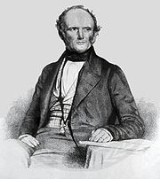
Sir
Charles Lyell, 1st Baronet,
KtThe rank of Knight Bachelor is a part of the British honours system. It is the most basic rank of a man who has been knighted by the monarch but not as a member of one of the organised Orders of Chivalry...
FRS (14 November 1797 – 22 February 1875) was a
BritishThe United Kingdom of Great Britain and Northern IrelandIn the United Kingdom and Dependencies, other languages have been officially recognised as legitimate autochthonous languages under the European Charter for Regional or Minority Languages...
lawyerA lawyer, according to Black's Law Dictionary, is "a person learned in the law; as an attorney, counsel or solicitor; a person who is practicing law." Law is the system of rules of conduct established by the sovereign government of a society to correct wrongs, maintain the stability of political...
and the foremost
geologistA geologist is a scientist who studies the solid and liquid matter that constitutes the Earth as well as the processes and history that has shaped it. Geologists usually engage in studying geology. Geologists, studying more of an applied science than a theoretical one, must approach Geology using...
of his day. He is best known as the author of
Principles of GeologyPrinciples of Geology, being an attempt to explain the former changes of the Earth's surface, by reference to causes now in operation, is a book by the Scottish geologist Charles Lyell....
, which popularised
James HuttonJames Hutton was a Scottish physician, geologist, naturalist, chemical manufacturer and experimental agriculturalist. He is considered the father of modern geology...
's concepts of
uniformitarianismIn the philosophy of naturalism, the uniformitarianism assumption is that the same natural laws and processes that operate in the universe now, have always operated in the universe in the past and apply everywhere in the universe. It has included the gradualistic concept that "the present is the...
– the idea that the earth was shaped by slow-moving forces still in operation today. Lyell was a close and influential friend of
Charles DarwinCharles Robert Darwin FRS was an English naturalist. He established that all species of life have descended over time from common ancestry, and proposed the scientific theory that this branching pattern of evolution resulted from a process that he called natural selection.He published his theory...
.
Biography
Lyell was born in
ScotlandScotland is a country that is part of the United Kingdom. Occupying the northern third of the island of Great Britain, it shares a border with England to the south and is bounded by the North Sea to the east, the Atlantic Ocean to the north and west, and the North Channel and Irish Sea to the...
about 15 miles north of
DundeeDundee is the fourth-largest city in Scotland and the 39th most populous settlement in the United Kingdom. It lies within the eastern central Lowlands on the north bank of the Firth of Tay, which feeds into the North Sea...
in Kinnordy, near
KirriemuirKirriemuir, sometimes called Kirrie, is a burgh in Angus, Scotland.-History:The history of Kirriemuir extends to the early historical period and it appears to have been a centre of some ecclesiastical importance...
in Forfarshire (now in
AngusAngus is one of the 32 local government council areas of Scotland, a registration county and a lieutenancy area. The council area borders Aberdeenshire, Perth and Kinross and Dundee City...
). He was the eldest of ten children. Lyell's father, also named Charles, was a lawyer and botanist of minor repute: it was he who first exposed his son to the study of nature.
The house/place of his birth is located in the north-west of the
Central LowlandsThe Central Lowlands or Midland Valley is a geologically defined area of relatively low-lying land in southern Scotland. It consists of a rift valley between the Highland Boundary Fault to the north and the Southern Uplands Fault to the south...
in the valley of the
Highland Boundary FaultThe Highland Boundary Fault is a geological fault that traverses Scotland from Arran and Helensburgh on the west coast to Stonehaven in the east...
. Round the house, in the
rift valleyA rift valley is a linear-shaped lowland between highlands or mountain ranges created by the action of a geologic rift or fault. This action is manifest as crustal extension, a spreading apart of the surface which is subsequently further deepened by the forces of erosion...
, is farmland, but within a short distance to the north-west, on the other side of the fault, are the Grampian Mountains in the
HighlandsThe Highlands is an historic region of Scotland. The area is sometimes referred to as the "Scottish Highlands". It was culturally distinguishable from the Lowlands from the later Middle Ages into the modern period, when Lowland Scots replaced Scottish Gaelic throughout most of the Lowlands...
. His family's second home was in a completely different geological and ecological area: he spent much of his childhood at
Bartley LodgeThe Bartley Lodge is a lodge near Cadnam in Hampshire, England, within the boundaries of the New Forest National Park. It was built in the 18th century to take advantage of the hunting offered in the surrounding New Forest. The building is now a country house hotel. Most famously, the eminent...
in the
New ForestThe New Forest is an area of southern England which includes the largest remaining tracts of unenclosed pasture land, heathland and forest in the heavily-populated south east of England. It covers south-west Hampshire and extends into south-east Wiltshire....
,
EnglandEngland is a country that is part of the United Kingdom. It shares land borders with Scotland to the north and Wales to the west; the Irish Sea is to the north west, the Celtic Sea to the south west, with the North Sea to the east and the English Channel to the south separating it from continental...
.
Lyell entered
Exeter College, OxfordExeter College is one of the constituent colleges of the University of Oxford in England and the fourth oldest college of the University. The main entrance is on the east side of Turl Street...
in 1816, and attended
William BucklandThe Very Rev. Dr William Buckland DD FRS was an English geologist, palaeontologist and Dean of Westminster, who wrote the first full account of a fossil dinosaur, which he named Megalosaurus...
's lectures. He graduated
B.A.A Bachelor of Arts , from the Latin artium baccalaureus, is a bachelor's degree awarded for an undergraduate course or program in either the liberal arts, the sciences, or both...
second class in classics, December 1819, and M.A. 1821.
After graduation he took up law as a profession, entering
Lincoln's InnThe Honourable Society of Lincoln's Inn is one of four Inns of Court in London to which barristers of England and Wales belong and where they are called to the Bar. The other three are Middle Temple, Inner Temple and Gray's Inn. Although Lincoln's Inn is able to trace its official records beyond...
in 1820. He completed a circuit through rural England, where he could observe geological phenomena. In 1821 he attended
Robert Jamesonthumb|Robert JamesonProfessor Robert Jameson, FRS FRSE was a Scottish naturalist and mineralogist.As Regius Professor at the University of Edinburgh for fifty years, Jameson is notable for his advanced scholarship in natural history, his superb museum collection, and for his tuition of Charles...
's lectures in Edinburgh, and visited
Gideon MantellGideon Algernon Mantell MRCS FRS was an English obstetrician, geologist and palaeontologist...
at
LewesLewes is the county town of East Sussex, England and historically of all of Sussex. It is a civil parish and is the centre of the Lewes local government district. The settlement has a history as a bridging point and as a market town, and today as a communications hub and tourist-oriented town...
, in
SussexSussex , from the Old English Sūþsēaxe , is an historic county in South East England corresponding roughly in area to the ancient Kingdom of Sussex. It is bounded on the north by Surrey, east by Kent, south by the English Channel, and west by Hampshire, and is divided for local government into West...
. In 1823 he was elected joint secretary of the Geological Society. As his eyesight began to deteriorate, he turned to geology as a full-time profession. His first paper, "On a recent formation of freshwater limestone in Forfarshire", was presented in 1822. By 1827, he had abandoned law and embarked on a geological career that would result in fame and the general acceptance of uniformitarianism, a working out of the idea proposed by
James HuttonJames Hutton was a Scottish physician, geologist, naturalist, chemical manufacturer and experimental agriculturalist. He is considered the father of modern geology...
a few decades earlier.
In 1832, Lyell married Mary Horner of Bonn, daughter of Leonard Horner (1785–1864), also associated with the
Geological Society of LondonThe Geological Society of London is a learned society based in the United Kingdom with the aim of "investigating the mineral structure of the Earth"...
. The new couple spent their honeymoon in Switzerland and Italy on a geological tour of the area.
During the 1840s, Lyell traveled to the
United StatesThe United States of America is a federal constitutional republic comprising fifty states and a federal district...
and
CanadaCanada is a North American country consisting of ten provinces and three territories. Located in the northern part of the continent, it extends from the Atlantic Ocean in the east to the Pacific Ocean in the west, and northward into the Arctic Ocean...
, and wrote two popular travel-and-geology books:
Travels in North America (1845) and
A Second Visit to the United States (1849). After the
Great Chicago FireThe Great Chicago Fire was a conflagration that burned from Sunday, October 8, to early Tuesday, October 10, 1871, killing hundreds and destroying about in Chicago, Illinois. Though the fire was one of the largest U.S...
, Lyell was one of the first to donate books to help found the
Chicago Public LibraryThe Chicago Public Library is the public library system that serves the City of Chicago in Illinois. It consists of 79 branches, including a central library, two regional libraries, and branches distributed throughout the city....
. In 1866, he was elected a foreign member of the
Royal Swedish Academy of SciencesThe Royal Swedish Academy of Sciences or Kungliga Vetenskapsakademien is one of the Royal Academies of Sweden. The Academy is an independent, non-governmental scientific organization which acts to promote the sciences, primarily the natural sciences and mathematics.The Academy was founded on 2...
.
Lyell's wife died in 1873, and two years later Lyell himself died as he was revising the twelfth edition of
Principles. He is buried in
Westminster AbbeyThe Collegiate Church of St Peter at Westminster, popularly known as Westminster Abbey, is a large, mainly Gothic church, in the City of Westminster, London, United Kingdom, located just to the west of the Palace of Westminster. It is the traditional place of coronation and burial site for English,...
. Lyell was knighted (
KtThe rank of Knight Bachelor is a part of the British honours system. It is the most basic rank of a man who has been knighted by the monarch but not as a member of one of the organised Orders of Chivalry...
), and later made a baronet (
BtA baronet or the rare female equivalent, a baronetess , is the holder of a hereditary baronetcy awarded by the British Crown...
), which is an hereditary honour. He was awarded the
Copley MedalThe Copley Medal is an award given by the Royal Society of London for "outstanding achievements in research in any branch of science, and alternates between the physical sciences and the biological sciences"...
of the
Royal SocietyThe Royal Society of London for Improving Natural Knowledge, known simply as the Royal Society, is a learned society for science, and is possibly the oldest such society in existence. Founded in November 1660, it was granted a Royal Charter by King Charles II as the "Royal Society of London"...
in 1858 and the
Wollaston MedalThe Wollaston Medal is a scientific award for geology, the highest award granted by the Geological Society of London.The medal is named after William Hyde Wollaston, and was first awarded in 1831...
of the Geological Society in 1866. The crater
LyellLyell is a lunar crater that lies along the eastern edge of the Mare Tranquillitatis, at the northern arm of the bay designated Sinus Concordiae. To the north along the edge of the lunar mare is the crater Franz. The region of terrain to the east of Lyell is named Palus Somni.The outer rim of this...
on the
MoonThe Moon is Earth's only known natural satellite,There are a number of near-Earth asteroids including 3753 Cruithne that are co-orbital with Earth: their orbits bring them close to Earth for periods of time but then alter in the long term . These are quasi-satellites and not true moons. For more...
and a
craterIn the broadest sense, the term impact crater can be applied to any depression, natural or manmade, resulting from the high velocity impact of a projectile with a larger body...
on
MarsMars is the fourth planet from the Sun in the Solar System. The planet is named after the Roman god of war, Mars. It is often described as the "Red Planet", as the iron oxide prevalent on its surface gives it a reddish appearance...
were named in his honour. In addition,
Mount LyellMount Lyell is the highest point in Yosemite National Park, at above sea level. It is located at the southeast end of the Cathedral Range, northwest of Rodgers Peak...
in western Tasmania, Australia, located in a profitable mining area, bears Lyell’s name. The ancient jawless fish
Cephalaspis lyelliCephalaspis was a genus of armored goldfish-sized to trout-sized detritivorous fish that lived in freshwater streams and estuaries of early Devonian Western Europe...
, which dwelt in the Scottish lakes, was named by
Louis AgassizJean Louis Rodolphe Agassiz was a Swiss paleontologist, glaciologist, geologist and a prominent innovator in the study of the Earth's natural history. He grew up in Switzerland and became a professor of natural history at University of Neuchâtel...
in honour of Lyell.
Career and major writings
Lyell had private means, and earned further income as an author. He came from a prosperous family, worked briefly as a lawyer in the 1820s, and held the post of Professor of Geology at
King's College LondonKing's College London is a public research university located in London, United Kingdom and a constituent college of the federal University of London. King's has a claim to being the third oldest university in England, having been founded by King George IV and the Duke of Wellington in 1829, and...
in the 1830s. From 1830 onward his books provided both income and fame. Each of his three major books was a work continually in progress. All three went through multiple editions during his lifetime, although many of his friends (such as Darwin) thought the first edition of the
Principles was the best written. Lyell used each edition to incorporate additional material, rearrange existing material, and revisit old conclusions in light of new evidence.
Principles of GeologyPrinciples of Geology, being an attempt to explain the former changes of the Earth's surface, by reference to causes now in operation, is a book by the Scottish geologist Charles Lyell....
, Lyell's first book, was also his most famous, most influential, and most important. First published in three volumes in 1830–33, it established Lyell's credentials as an important geological theorist and propounded the doctrine of
uniformitarianismIn the philosophy of naturalism, the uniformitarianism assumption is that the same natural laws and processes that operate in the universe now, have always operated in the universe in the past and apply everywhere in the universe. It has included the gradualistic concept that "the present is the...
. It was a work of synthesis, backed by his own personal observations on his travels.
The central argument in
Principles was that
the present is the key to the past - a concept of the
Scottish EnlightenmentThe Scottish Enlightenment was the period in 18th century Scotland characterised by an outpouring of intellectual and scientific accomplishments. By 1750, Scots were among the most literate citizens of Europe, with an estimated 75% level of literacy...
which
David HumeDavid Hume was a Scottish philosopher, historian, economist, and essayist, known especially for his philosophical empiricism and skepticism. He was one of the most important figures in the history of Western philosophy and the Scottish Enlightenment...
had stated as "all inferences from experience suppose ... that the future will resemble the past", and
James HuttonJames Hutton was a Scottish physician, geologist, naturalist, chemical manufacturer and experimental agriculturalist. He is considered the father of modern geology...
had described when he wrote in 1788 that "from what has actually been, we have data for concluding with regard to that which is to happen thereafter." Geological remains from the distant past can, and should, be explained by reference to geological processes now in operation and thus directly observable. Lyell's interpretation of geologic change as the steady accumulation of minute changes over enormously long spans of time was a powerful influence on the young
Charles DarwinCharles Robert Darwin FRS was an English naturalist. He established that all species of life have descended over time from common ancestry, and proposed the scientific theory that this branching pattern of evolution resulted from a process that he called natural selection.He published his theory...
. Lyell asked
Robert FitzRoyVice-Admiral Robert FitzRoy RN achieved lasting fame as the captain of HMS Beagle during Charles Darwin's famous voyage, and as a pioneering meteorologist who made accurate weather forecasting a reality...
, captain of
HMS BeagleHMS Beagle was a Cherokee-class 10-gun brig-sloop of the Royal Navy. She was launched on 11 May 1820 from the Woolwich Dockyard on the River Thames, at a cost of £7,803. In July of that year she took part in a fleet review celebrating the coronation of King George IV of the United Kingdom in which...
, to search for erratic boulders on the
survey voyage of the BeagleThe second voyage of HMS Beagle, from 27 December 1831 to 2 October 1836, was the second survey expedition of HMS Beagle, under captain Robert FitzRoy who had taken over command of the ship on its first voyage after her previous captain committed suicide...
, and just before it set out FitzRoy gave Darwin Volume 1 of the first edition of Lyell's
Principles. When the
Beagle made its first stop ashore at
St JagoSantiago , or Santiagu in Cape Verdean Creole, is the largest island of Cape Verde, its most important agricultural centre and home to half the nation’s population. At the time of Darwin's voyage it was called St. Jago....
, Darwin found rock formations which seen "through Lyell's eyes" gave him a revolutionary insight into the geological history of the island, an insight he applied throughout his travels.
While in
South AmericaSouth America is a continent situated in the Western Hemisphere, mostly in the Southern Hemisphere, with a relatively small portion in the Northern Hemisphere. The continent is also considered a subcontinent of the Americas. It is bordered on the west by the Pacific Ocean and on the north and east...
Darwin received Volume 2 which considered the ideas of Lamarck in some detail. Lyell rejected Lamarck's idea of organic
evolutionEvolution is any change across successive generations in the heritable characteristics of biological populations. Evolutionary processes give rise to diversity at every level of biological organisation, including species, individual organisms and molecules such as DNA and proteins.Life on Earth...
, proposing instead "Centres of Creation" to explain diversity and territory of species. However, as discussed below, many of his letters show he was fairly open to the idea of evolution. In geology Darwin was very much Lyell's disciple, and brought back observations and his own original theorising, including ideas about the formation of
atollAn atoll is a coral island that encircles a lagoon partially or completely.- Usage :The word atoll comes from the Dhivehi word atholhu OED...
s, which supported Lyell's uniformitarianism. On the return of the
Beagle (October 1836) Lyell invited Darwin to dinner and from then on they were close friends. Although Darwin discussed evolutionary ideas with him from 1842, Lyell continued to reject evolution in each of the first nine editions of the
Principles. He encouraged Darwin to publish, and following the 1859 publication of
On the Origin of Species, Lyell finally offered a tepid endorsement of evolution in the tenth edition of
Principles.
Elements of Geology began as the fourth volume of the third edition of
PrinciplesPrinciples of Geology, being an attempt to explain the former changes of the Earth's surface, by reference to causes now in operation, is a book by the Scottish geologist Charles Lyell....
: Lyell intended the book to act as a suitable field guide for students of geology. The systematic, factual description of geological formations of different ages contained in
Principles grew so unwieldy, however, that Lyell split it off as the
Elements in 1838. The book went through six editions, eventually growing to two volumes and ceasing to be the inexpensive, portable handbook that Lyell had originally envisioned. Late in his career, therefore, Lyell produced a condensed version titled
Student's Elements of Geology that fulfilled the original purpose.
Geological Evidences of the Antiquity of Man brought together Lyell's views on three key themes from the geology of the Quaternary Period of Earth history: glaciers, evolution, and the age of the human race. First published in 1863, it went through three editions that year, with a fourth and final edition appearing in 1873. The book was widely regarded as a disappointment because of Lyell's equivocal treatment of
evolutionEvolution is any change across successive generations in the heritable characteristics of biological populations. Evolutionary processes give rise to diversity at every level of biological organisation, including species, individual organisms and molecules such as DNA and proteins.Life on Earth...
. Lyell, a devout Christian, had great difficulty reconciling his beliefs with
natural selectionNatural selection is the nonrandom process by which biologic traits become either more or less common in a population as a function of differential reproduction of their bearers. It is a key mechanism of evolution....
.
Scientific contributions
Lyell's geological interests ranged from
volcano2. Bedrock3. Conduit 4. Base5. Sill6. Dike7. Layers of ash emitted by the volcano8. Flank| 9. Layers of lava emitted by the volcano10. Throat11. Parasitic cone12. Lava flow13. Vent14. Crater15...
es and geological dynamics through
stratigraphyStratigraphy, a branch of geology, studies rock layers and layering . It is primarily used in the study of sedimentary and layered volcanic rocks....
,
paleontologyPaleontology "old, ancient", ὄν, ὀντ- "being, creature", and λόγος "speech, thought") is the study of prehistoric life. It includes the study of fossils to determine organisms' evolution and interactions with each other and their environments...
, and
glaciologyGlaciology Glaciology Glaciology (from Middle French dialect (Franco-Provençal): glace, "ice"; or Latin: glacies, "frost, ice"; and Greek: λόγος, logos, "speech" lit...
to topics that would now be classified as
prehistoric archaeologyArchaeology, or archeology , is the study of human society, primarily through the recovery and analysis of the material culture and environmental data that they have left behind, which includes artifacts, architecture, biofacts and cultural landscapes...
and
paleoanthropologyPaleoanthropology, which combines the disciplines of paleontology and physical anthropology, is the study of ancient humans as found in fossil hominid evidence such as petrifacted bones and footprints.-19th century:...
. He is best known, however, for his role in popularising the doctrine of
uniformitarianismIn the philosophy of naturalism, the uniformitarianism assumption is that the same natural laws and processes that operate in the universe now, have always operated in the universe in the past and apply everywhere in the universe. It has included the gradualistic concept that "the present is the...
.
Uniformitarianism
From 1830 to 1833 his multi-volume
Principles of GeologyPrinciples of Geology, being an attempt to explain the former changes of the Earth's surface, by reference to causes now in operation, is a book by the Scottish geologist Charles Lyell....
was published. The work's subtitle was "An attempt to explain the former changes of the Earth's surface by reference to causes now in operation", and this explains Lyell's impact on science. He drew his explanations from field studies conducted directly before he went to work on the founding geology text. He was, along with the earlier
John PlayfairJohn Playfair FRSE, FRS was a Scottish scientist and mathematician, and a professor of natural philosophy at the University of Edinburgh. He is perhaps best known for his book Illustrations of the Huttonian Theory of the Earth , which summarized the work of James Hutton...
, the major advocate of
James HuttonJames Hutton was a Scottish physician, geologist, naturalist, chemical manufacturer and experimental agriculturalist. He is considered the father of modern geology...
's idea of
uniformitarianismIn the philosophy of naturalism, the uniformitarianism assumption is that the same natural laws and processes that operate in the universe now, have always operated in the universe in the past and apply everywhere in the universe. It has included the gradualistic concept that "the present is the...
, that the earth was shaped entirely by slow-moving forces still in operation today, acting over a very long period of time. This was in contrast to
catastrophismCatastrophism is the theory that the Earth has been affected in the past by sudden, short-lived, violent events, possibly worldwide in scope. The dominant paradigm of modern geology is uniformitarianism , in which slow incremental changes, such as erosion, create the Earth's appearance...
, a geologic idea of abrupt changes, which had been adapted in England to support belief in Noah's flood. Lyell saw himself as "the spiritual saviour of geology, freeing the science from the old dispensation of Moses." The two terms,
uniformitarianism and
catastrophism, were both coined by
William WhewellWilliam Whewell was an English polymath, scientist, Anglican priest, philosopher, theologian, and historian of science. He was Master of Trinity College, Cambridge.-Life and career:Whewell was born in Lancaster...
; in 1866 R. Grove suggested the simpler term
continuity for Lyell's view, but the old terms persisted. In various revised editions (12 in all, through 1872),
Principles of Geology was the most influential geological work in the middle of the 19th century, and did much to put geology on a modern footing. For his efforts he was knighted in 1848, then made a baronet in 1864.
Geological Surveys
Lyell noted the “economic advantages” that geological surveys could provide, citing their felicity in mineral-rich countries and provinces. Modern surveys, like the U.S. Geological Survey, map and exhibit the natural resources within the country. So, in endorsing surveys, as well as advancing the study of geology, Lyell helped to forward the business of modern extractive industries, such as the coal and oil industry.
Volcanoes and geological dynamics
Before the work of Lyell, phenomena such as earthquakes were understood by the destruction that they wrought. One of the contributions that Lyell made in
Principles was to explain the cause of earthquakes. Lyell, in contrast focused on recent earthquakes (150 yrs), evidenced by surface irregularities such as faults, fissures, stratigraphic displacements and depressions.
Lyell's work on volcanoes focused largely on Vesuvius and Etna, both of which he had earlier studied. His conclusions supported gradual building of volcanoes, so-called "backed up-building", as opposed to the upheaval argument supported by other geologists.
Stratigraphy
Lyell's most important specific work was in the field of
stratigraphyStratigraphy, a branch of geology, studies rock layers and layering . It is primarily used in the study of sedimentary and layered volcanic rocks....
. From May 1828, until February 1829, he traveled with Roderick Impey Murchison (1792–1871) to the south of
FranceThe French Republic , The French Republic , The French Republic , (commonly known as France , is a unitary semi-presidential republic in Western Europe with several overseas territories and islands located on other continents and in the Indian, Pacific, and Atlantic oceans. Metropolitan France...
(Auvergne volcanic district) and to
ItalyItaly , officially the Italian Republic languages]] under the European Charter for Regional or Minority Languages. In each of these, Italy's official name is as follows:;;;;;;;;), is a unitary parliamentary republic in South-Central Europe. To the north it borders France, Switzerland, Austria and...
. In these areas he concluded that the recent strata (rock layers) could be categorized according to the number and proportion of marine shells encased within. Based on this he proposed dividing the
TertiaryThe Tertiary is a deprecated term for a geologic period 65 million to 2.6 million years ago. The Tertiary covered the time span between the superseded Secondary period and the Quaternary...
period into three parts, which he named the
PlioceneThe Pliocene Epoch is the period in the geologic timescale that extends from 5.332 million to 2.588 million years before present. It is the second and youngest epoch of the Neogene Period in the Cenozoic Era. The Pliocene follows the Miocene Epoch and is followed by the Pleistocene Epoch...
,
MioceneThe Miocene is a geological epoch of the Neogene Period and extends from about . The Miocene was named by Sir Charles Lyell. Its name comes from the Greek words and and means "less recent" because it has 18% fewer modern sea invertebrates than the Pliocene. The Miocene follows the Oligocene...
, and
EoceneThe Eocene Epoch, lasting from about 56 to 34 million years ago , is a major division of the geologic timescale and the second epoch of the Paleogene Period in the Cenozoic Era. The Eocene spans the time from the end of the Palaeocene Epoch to the beginning of the Oligocene Epoch. The start of the...
.
Glaciers
In
Principles of Geology (first edition, vol. 3, Ch. 2, 1833) Lyell proposed that
icebergAn iceberg is a large piece of ice from freshwater that has broken off from a snow-formed glacier or ice shelf and is floating in open water. It may subsequently become frozen into pack ice...
s could be the means of transport for
erraticsA glacial erratic is a piece of rock that differs from the size and type of rock native to the area in which it rests. "Erratics" take their name from the Latin word errare, and are carried by glacial ice, often over distances of hundreds of kilometres...
. During periods of global warming, ice breaks off the poles and floats across submerged continents, carrying debris with it, he conjectured. When the iceberg melts, it rains down sediments upon the land. Because this theory could account for the presence of diluvium, the word
drift became the preferred term for the loose, unsorted material, today called
till. Furthermore, Lyell believed that the accumulation of fine angular particles covering much of the world (today called
loessLoess is an aeolian sediment formed by the accumulation of wind-blown silt, typically in the 20–50 micrometre size range, twenty percent or less clay and the balance equal parts sand and silt that are loosely cemented by calcium carbonate...
) was a deposit settled from mountain flood water. Today some of Lyell's mechanisms for geologic processes have been disproven, though many have stood the test of time. His observational methods and general analytical framework remain in use today as foundational principles in geology.
Evolution
Lyell first received a copy of one of
LamarckJean-Baptiste Pierre Antoine de Monet, Chevalier de la Marck , often known simply as Lamarck, was a French naturalist...
's books from
MantellGideon Algernon Mantell MRCS FRS was an English obstetrician, geologist and palaeontologist...
in 1827, when he was on circuit. He thanked Mantell in a letter which includes this enthusiastic passage:
- "I devoured Lamark... his theories delighted me... I am glad that he has been courageous enough and logical enough to admit that his argument, if pushed as far as it must go, if worth anything, would prove that men may have come from the Ourang-Outang
Orangutans are the only exclusively Asian genus of extant great ape. The largest living arboreal animals, they have proportionally longer arms than the other, more terrestrial, great apes. They are among the most intelligent primates and use a variety of sophisticated tools, also making sleeping...
. But after all, what changes species may really undergo!... That the Earth is quite as old as he supposes, has long been my creed..."
In the second volume of the first edition of
Principles Lyell explicitly rejected the
mechanism of Lamark on the
transmutation of speciesTransmutation of species was a term used by Jean Baptiste Lamarck in 1809 for his theory that described the altering of one species into another, and the term is often used to describe 19th century evolutionary ideas that preceded Charles Darwin's theory of natural selection...
, and was doubtful whether species were mutable. However, privately, in letters, he was more open to the possibility of
evolutionEvolution is any change across successive generations in the heritable characteristics of biological populations. Evolutionary processes give rise to diversity at every level of biological organisation, including species, individual organisms and molecules such as DNA and proteins.Life on Earth...
:
- "If I had stated... the possibility of the introduction or origination of fresh species being a natural, in contradistinction to a miraculous process, I should have raised a host of prejudices against me, which are unfortunately opposed at every step to any philosopher who attempts to address the public on these mysterious subjects".
This letter makes it clear that his equivocation on evolution was, at least at first, a deliberate tactic. As a result of his letters and, no doubt, personal conversations, Huxley and
HaeckelThe "European War" became known as "The Great War", and it was not until 1920, in the book "The First World War 1914-1918" by Charles à Court Repington, that the term "First World War" was used as the official name for the conflict.-Research:...
were convinced that, at the time he wrote
Principles, he believed new species had arisen by natural methods. Both
WhewellWilliam Whewell was an English polymath, scientist, Anglican priest, philosopher, theologian, and historian of science. He was Master of Trinity College, Cambridge.-Life and career:Whewell was born in Lancaster...
and
SedgwickAdam Sedgwick was one of the founders of modern geology. He proposed the Devonian period of the geological timescale...
wrote worried letters to him about this.
Later,
DarwinCharles Robert Darwin FRS was an English naturalist. He established that all species of life have descended over time from common ancestry, and proposed the scientific theory that this branching pattern of evolution resulted from a process that he called natural selection.He published his theory...
became a close personal friend, and Lyell was one of the first scientists to support
On the Origin of Species, though he did not subscribe to all its contents. Lyell was also a friend of Darwin's closest colleagues,
HookerSir Joseph Dalton Hooker OM, GCSI, CB, MD, FRS was one of the greatest British botanists and explorers of the 19th century. Hooker was a founder of geographical botany, and Charles Darwin's closest friend...
and Huxley, but unlike them he struggled to square his religious beliefs with evolution. This inner struggle has been much commented on. He had particular difficulty in believing in
natural selectionNatural selection is the nonrandom process by which biologic traits become either more or less common in a population as a function of differential reproduction of their bearers. It is a key mechanism of evolution....
as the main motive force in evolution.
Lyell and Hooker were instrumental in arranging the peaceful co-publication of the theory of natural selection by Darwin and
Alfred Russel WallaceAlfred Russel Wallace, OM, FRS was a British naturalist, explorer, geographer, anthropologist and biologist...
in 1858: each had arrived at the theory independently. Lyell's data on
stratigraphyStratigraphy, a branch of geology, studies rock layers and layering . It is primarily used in the study of sedimentary and layered volcanic rocks....
were important because Darwin thought that populations of an organism changed slowly, requiring "geologic time".
Although Lyell did not publicly accept evolution (descent with modification) at the time of writing the
Principles, after the Darwin-Wallace papers and the
Origin Lyell wrote in his notebook:
- May 3, 1860: "Mr. Darwin has written a work which will constitute an era in geology & natural history to show that... the descendants of common parents may become in the course of ages so unlike each other as to be entitled to rank as a distinct species, from each other or from some of their progenitors".
Lyell's acceptance of natural selection, Darwin's proposed mechanism for evolution, was equivocal, and came in the tenth edition of
Principles.
The Antiquity of Man (published in early February 1863, just before Huxley's
Man's place in nature) drew these comments from Darwin to Huxley:
- "I am fearfully disappointed at Lyell's excessive caution" and "The book is a mere 'digest' ".
Quite strong remarks: no doubt Darwin resented Lyell's repeated suggestion that he owed a lot to Lamarck, whom he (Darwin) had always specifically rejected. Darwin's daughter Henrietta (Etty) wrote to her father: "Is it fair that Lyell always calls your theory a modification of Lamarck's?"
In other respects
Antiquity was a success. It sold well, and it "shattered the tacit agreement that mankind should be the sole preserve of theologians and
historianA historian is a person who studies and writes about the past and is regarded as an authority on it. Historians are concerned with the continuous, methodical narrative and research of past events as relating to the human race; as well as the study of all history in time. If the individual is...
s". But when Lyell wrote that it remained a profound mystery how the huge gulf between man and beast could be bridged, Darwin wrote "Oh!" in the margin of his copy.
Legacy
Places named after Lyell:
- Mount Lyell (California)
- Mount Lyell (Canada)
Mount Lyell is a mountain on the Alberta-British Columbia border, in western Canada. It is located on the Continental Divide, which forms the BC-Alberta boundary in this area, in Banff National Park.The peak has a height of ....
- Lyell Land
Lyell Land is a peninsula in East Greenland bounded by Kempe Fjord, King Oscar Fjord and Forsblad Fjord. It was named by A.G. Nathorst on his 1899 expedition for Sir Charles Lyell....
(Greenland)
- Lyell Glacier
There is also a Lyell Glacier, South GeorgiaLyell Glacier is a small glacier in the Sierra Nevada of California. The glacier was discovered by John Muir in 1871 , and is the largest glacier in Yosemite National Park. The glacier lies on the northern slopes of Mount Lyell.The glacier has retreated...
- Lyell Glacier, South Georgia
For the glacier located on Mount Lyell in California, see Lyell GlacierLyell Glacier is a glacier flowing in a north direction to Harpon Bay at the southeast head of Cumberland West Bay, South Georgia...
Details of publication
- Principles of Geology 1st edition, 1st vol. Jan. 1830 (John Murray
John Murray is an English publisher, renowned for the authors it has published in its history, including Jane Austen, Sir Arthur Conan Doyle, Lord Byron, Charles Lyell, Johann Wolfgang von Goethe, Herman Melville, and Charles Darwin...
, London).
- Principles of Geology 1st edition, 2nd vol. Jan. 1832
- Principles of Geology 1st edition, 3rd vol. May 1833
- Principles of Geology 2nd edition, 1st vol. 1832
- Principles of Geology 2nd edition, 2nd vol. Jan. 1833
- Principles of Geology 3rd edition, 4 vols. May 1834
- Principles of Geology 4th edition, 4 vols. June 1835
- Principles of Geology 5th edition, 4 vols. March 1837
- Principles of Geology 6th edition, 3 vols. June 1840
- Principles of Geology 7th edition, 1 vol. Feb. 1847
- Principles of Geology 8th edition, 1 vol. May 1850
- Principles of Geology 9th edition, 1 vol. June 1853
- Principles of Geology 10th edition, 1866–68
- Principles of Geology 11th edition, 2 vols. 1872
- Principles of Geology 12th edition, 2 vols. 1875 (published posthumously)
Elements of Geology
- Elements of Geology 1 vol. 1st edition, July 1838 (John Murray, London)
- Elements of Geology 2 vols. 2nd edition, July 1841
- Elements of Geology (Manual of Elementary Geology) 1 vol. 3rd edition, Jan. 1851
- Elements of Geology (Manual of Elementary Geology) 1 vol. 4th edition, Jan. 1852
- Elements of Geology 1 vol. 5th edition, 1862
- Elements of Geology 6th edition, 1865
- Elements of Geology, The Student's Series, 1871
Antiquity of Man
- Geological Evidences of the Antiquity of Man 1 vol. 1st edition, Feb. 1863 (John Murray, London)
- Geological Evidences of the Antiquity of Man 1 vol. 2nd edition, April 1863
- Geological Evidences of the Antiquity of Man 1 vol. 3rd edition, Nov. 1863
- Geological Evidences of the Antiquity of Man 1 vol. 4th edition, May 1873
Image source
- Portraits of Honorary Members of the Ipswich Museum
Ipswich Museum is a registered museum of culture, history and natural heritage located on High Street in Ipswich, the County Town of the English county of Suffolk...
(Portfolio of 60 lithographs by T.H. Maguire) (George Ransome, Ipswich 1846-1852)
External links