
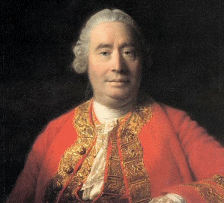
David Hume was a Scottish philosopher, historian, economist, and essayist, known especially for his philosophical
empiricismEmpiricism is a theory of knowledge that asserts that knowledge comes only or primarily via sensory experience. One of several views of epistemology, the study of human knowledge, along with rationalism, idealism and historicism, empiricism emphasizes the role of experience and evidence,...
and
skepticismPhilosophical skepticism is both a philosophical school of thought and a method that crosses disciplines and cultures. Many skeptics critically examine the meaning systems of their times, and this examination often results in a position of ambiguity or doubt...
. He was one of the most important figures in the history of
Western philosophyWestern philosophy is the philosophical thought and work of the Western or Occidental world, as distinct from Eastern or Oriental philosophies and the varieties of indigenous philosophies....
and the
Scottish EnlightenmentThe Scottish Enlightenment was the period in 18th century Scotland characterised by an outpouring of intellectual and scientific accomplishments. By 1750, Scots were among the most literate citizens of Europe, with an estimated 75% level of literacy...
. Hume is often grouped with
John LockeJohn Locke FRS , widely known as the Father of Liberalism, was an English philosopher and physician regarded as one of the most influential of Enlightenment thinkers. Considered one of the first of the British empiricists, following the tradition of Francis Bacon, he is equally important to social...
,
George BerkeleyGeorge Berkeley , also known as Bishop Berkeley , was an Irish philosopher whose primary achievement was the advancement of a theory he called "immaterialism"...
, and a handful of others as a British Empiricist.
Beginning with his
A Treatise of Human NatureA Treatise of Human Nature is a book by Scottish philosopher David Hume, first published in 1739–1740.The full title of the Treatise is 'A Treatise of Human Nature: Being an Attempt to introduce the experimental Method of Reasoning into Moral Subjects'. It contains the following sections:* Book 1:...
(1739), Hume strove to create a total
naturalisticNaturalism commonly refers to the philosophical viewpoint that the natural universe and its natural laws and forces operate in the universe, and that nothing exists beyond the natural universe or, if it does, it does not affect the natural universe that we know...
"
science of manThe science of man is a topic used in David Hume's 18th century experimental philosophy A Treatise of Human Nature...
" that examined the psychological basis of
human natureHuman nature refers to the distinguishing characteristics, including ways of thinking, feeling and acting, that humans tend to have naturally....
. In stark opposition to the rationalists who preceded him, most notably
DescartesRené Descartes ; was a French philosopher and writer who spent most of his adult life in the Dutch Republic. He has been dubbed the 'Father of Modern Philosophy', and much subsequent Western philosophy is a response to his writings, which are studied closely to this day...
, he concluded that
desireDesire is a sense of longing for a person or object or hoping for an outcome. Desire is the fire that sets action aflame. The same sense is expressed by emotions such as "craving" or "hankering". When a person desires something or someone, their sense of longing is excited by the enjoyment or the...
rather than
reasonReason is a term that refers to the capacity human beings have to make sense of things, to establish and verify facts, and to change or justify practices, institutions, and beliefs. It is closely associated with such characteristically human activities as philosophy, science, language, ...
governed human behaviour, saying: "Reason is, and ought only to be the slave of the passions." A prominent figure in the
skeptical philosophical traditionPhilosophical skepticism is both a philosophical school of thought and a method that crosses disciplines and cultures. Many skeptics critically examine the meaning systems of their times, and this examination often results in a position of ambiguity or doubt...
and a strong empiricist, he argued against the existence of innate ideas, concluding instead that humans have knowledge only of things they directly experience. Thus he divides perceptions between strong and lively "impressions" or direct sensations and fainter "ideas," which are copied from impressions. He developed the position that mental behaviour is governed by "custom";
our use of inductionThe problem of induction is the philosophical question of whether inductive reasoning leads to knowledge. That is, what is the justification for either:...
, for example, is justified only by our idea of the "constant conjunction" of causes and effects. Without direct impressions of a metaphysical "self," he concluded that humans have no actual conception of the self, only of a
bundle of sensationsBundle theory, originated by the 18th century Scottish philosopher David Hume, is the ontological theory about objecthood in which an object consists only of a collection of properties, relations or tropes....
associated with the self. Hume advocated a
compatibilistCompatibilism is the belief that free will and determinism are compatible ideas, and that it is possible to believe both without being logically inconsistent. It may, however, be more accurate to say that compatibilists define 'free will' in a way that allows it to co-exist with determinism...
theory of
free will"To make my own decisions whether I am successful or not due to uncontrollable forces" -Troy MorrisonA pragmatic definition of free willFree will is the ability of agents to make choices free from certain kinds of constraints. The existence of free will and its exact nature and definition have long...
that proved extremely influential on subsequent moral philosophy. He was also a
sentimentalistMoral sense theory is a view in meta-ethics according to which morality is somehow grounded in moral sentiments or emotions...
who held that ethics are based on feelings rather than abstract moral principles. Hume also examined the normative is–ought problem. He held notoriously ambiguous views of
ChristianityChristianity is a monotheistic religion based on the life and teachings of Jesus as presented in canonical gospels and other New Testament writings...
, but famously challenged the
argument from designA teleological or design argument is an a posteriori argument for the existence of God based on apparent design and purpose in the universe. The argument is based on an interpretation of teleology wherein purpose and intelligent design appear to exist in nature beyond the scope of any such human...
in his
Dialogues Concerning Natural ReligionDialogues Concerning Natural Religion is a philosophical work written by the Scottish philosopher David Hume. Through dialogue, three fictional characters named Demea, Philo, and Cleanthes debate the nature of God's existence...
(1779).
KantImmanuel Kant was a German philosopher from Königsberg , researching, lecturing and writing on philosophy and anthropology at the end of the 18th Century Enlightenment....
credited Hume with waking him up from his "dogmatic slumbers" and Hume has proved extremely influential on subsequent philosophy, especially on
utilitarianismUtilitarianism is an ethical theory holding that the proper course of action is the one that maximizes the overall "happiness", by whatever means necessary. It is thus a form of consequentialism, meaning that the moral worth of an action is determined only by its resulting outcome, and that one can...
,
logical positivismLogical positivism is a philosophy that combines empiricism—the idea that observational evidence is indispensable for knowledge—with a version of rationalism incorporating mathematical and logico-linguistic constructs and deductions of epistemology.It may be considered as a type of analytic...
,
William JamesWilliam James was a pioneering American psychologist and philosopher who was trained as a physician. He wrote influential books on the young science of psychology, educational psychology, psychology of religious experience and mysticism, and on the philosophy of pragmatism...
,
philosophy of scienceThe philosophy of science is concerned with the assumptions, foundations, methods and implications of science. It is also concerned with the use and merit of science and sometimes overlaps metaphysics and epistemology by exploring whether scientific results are actually a study of truth...
, early
analytic philosophyAnalytic philosophy is a generic term for a style of philosophy that came to dominate English-speaking countries in the 20th century...
, cognitive philosophy, and other movements and thinkers. The philosopher
Jerry FodorJerry Alan Fodor is an American philosopher and cognitive scientist. He holds the position of State of New Jersey Professor of Philosophy at Rutgers University and is the author of many works in the fields of philosophy of mind and cognitive science, in which he has laid the groundwork for the...
proclaimed Hume's
Treatise "the founding document of
cognitive scienceCognitive science is the interdisciplinary scientific study of mind and its processes. It examines what cognition is, what it does and how it works. It includes research on how information is processed , represented, and transformed in behaviour, nervous system or machine...
." Also famous as a prose stylist, Hume pioneered the
essayAn essay is a piece of writing which is often written from an author's personal point of view. Essays can consist of a number of elements, including: literary criticism, political manifestos, learned arguments, observations of daily life, recollections, and reflections of the author. The definition...
as a literary genre and engaged with contemporary intellectual luminaries such as
Jean-Jacques RousseauJean-Jacques Rousseau was a Genevan philosopher, writer, and composer of 18th-century Romanticism. His political philosophy influenced the French Revolution as well as the overall development of modern political, sociological and educational thought.His novel Émile: or, On Education is a treatise...
,
Adam SmithAdam Smith was a Scottish social philosopher and a pioneer of political economy. One of the key figures of the Scottish Enlightenment, Smith is the author of The Theory of Moral Sentiments and An Inquiry into the Nature and Causes of the Wealth of Nations...
(who acknowledged Hume's influence on his
economicsEconomics is the social science that analyzes the production, distribution, and consumption of goods and services. The term economics comes from the Ancient Greek from + , hence "rules of the house"...
and
political philosophyPolitical philosophy is the study of such topics as liberty, justice, property, rights, law, and the enforcement of a legal code by authority: what they are, why they are needed, what, if anything, makes a government legitimate, what rights and freedoms it should protect and why, what form it...
),
James BoswellJames Boswell, 9th Laird of Auchinleck was a lawyer, diarist, and author born in Edinburgh, Scotland; he is best known for the biography he wrote of one of his contemporaries, the English literary figure Samuel Johnson....
,
Joseph ButlerJoseph Butler was an English bishop, theologian, apologist, and philosopher. He was born in Wantage in the English county of Berkshire . He is known, among other things, for his critique of Thomas Hobbes's egoism and John Locke's theory of personal identity...
, and
Thomas ReidThe Reverend Thomas Reid FRSE , was a religiously trained Scottish philosopher, and a contemporary of David Hume, was the founder of the Scottish School of Common Sense, and played an integral role in the Scottish Enlightenment...
.
Life
David Hume, originally David Home, son of Joseph Home of
ChirnsideChirnside is a hillside village in Berwickshire in Scotland, west of Berwick-upon-Tweed and east of Duns.-Notables:David Hume, the Scottish Enlightenment philosopher, lived in Ninewells House, just south of the village...
, advocate, and Katherine Falconer, was born on 26 April 1711 (
Old StyleOld Style and New Style are used in English language historical studies either to indicate that the start of the Julian year has been adjusted to start on 1 January even though documents written at the time use a different start of year ; or to indicate that a date conforms to the Julian...
) in a tenement on the north side of the Lawnmarket in
EdinburghEdinburgh is the capital city of Scotland, the second largest city in Scotland, and the eighth most populous in the United Kingdom. The City of Edinburgh Council governs one of Scotland's 32 local government council areas. The council area includes urban Edinburgh and a rural area...
. He changed his name in 1734 because the English had difficulty pronouncing 'Home' in the Scottish manner. Throughout his life Hume, who never married, spent time occasionally at his family home at Ninewells by
ChirnsideChirnside is a hillside village in Berwickshire in Scotland, west of Berwick-upon-Tweed and east of Duns.-Notables:David Hume, the Scottish Enlightenment philosopher, lived in Ninewells House, just south of the village...
,
BerwickshireBerwickshire or the County of Berwick is a registration county, a committee area of the Scottish Borders Council, and a lieutenancy area of Scotland, on the border with England. The town after which it is named—Berwick-upon-Tweed—was lost by Scotland to England in 1482...
.
Education
Hume attended the
University of EdinburghThe University of Edinburgh, founded in 1583, is a public research university located in Edinburgh, the capital of Scotland, and a UNESCO World Heritage Site. The university is deeply embedded in the fabric of the city, with many of the buildings in the historic Old Town belonging to the university...
at the unusually early age of twelve (possibly as young as ten) at a time when fourteen was normal. At first he considered a career in
lawScots law is the legal system of Scotland. It is considered a hybrid or mixed legal system as it traces its roots to a number of different historical sources. With English law and Northern Irish law it forms the legal system of the United Kingdom; it shares with the two other systems some...
, but came to have, in his words, "an insurmountable aversion to everything but the pursuits of Philosophy and general Learning; and while [my family] fanceyed I was poring over
VoetJohannes Voet was a Dutch jurist.-Life:Voet was the son of Paulus Voet, who was the son of famous theologian Gisbertus Voetius. He probably studied in Utrecht, after which he became a professor in Herborn. In 1673 he was made professor of law at the universiteit van Utrecht...
and
VinniusArnold Vinnius was one of the leading jurists of the 17th century in the Netherlands.-Life:...
,
CiceroMarcus Tullius Cicero , was a Roman philosopher, statesman, lawyer, political theorist, and Roman constitutionalist. He came from a wealthy municipal family of the equestrian order, and is widely considered one of Rome's greatest orators and prose stylists.He introduced the Romans to the chief...
and
VirgilPublius Vergilius Maro, usually called Virgil or Vergil in English , was an ancient Roman poet of the Augustan period. He is known for three major works of Latin literature, the Eclogues , the Georgics, and the epic Aeneid...
were the Authors which I was secretly devouring." He had little respect for the professors of his time, telling a friend in 1735, "there is nothing to be learnt from a
ProfessorA professor is a scholarly teacher; the precise meaning of the term varies by country. Literally, professor derives from Latin as a "person who professes" being usually an expert in arts or sciences; a teacher of high rank...
, which is not to be met with in Books."
Hume made a philosophical discovery that opened up to him "...a new Scene of Thought," which inspired him "...to throw up every other Pleasure or Business to apply entirely to it." He did not recount what this "Scene" was, and commentators have offered a variety of speculations. Due to this inspiration, Hume set out to spend a minimum of ten years reading and writing. He came to the verge of
nervous breakdownMental breakdown is a non-medical term used to describe an acute, time-limited phase of a specific disorder that presents primarily with features of depression or anxiety.-Definition:...
, after which he decided to have a more active life to better continue his learning.
Career
As Hume's options lay between a traveling tutorship and a stool in a merchant's office, he chose the latter. In 1734, after a few months occupied with commerce in
BristolBristol is a city, unitary authority area and ceremonial county in South West England, with an estimated population of 433,100 for the unitary authority in 2009, and a surrounding Larger Urban Zone with an estimated 1,070,000 residents in 2007...
, he went to
La FlècheLa Flèche is a municipality located in the French department of Sarthe and the region of Pays de la Loire in the Loire Valley. This is the sub-prefecture of the South-Sarthe, the chief district and the chief city of a canton. This is the second most populous city of the department. The city is part...
in
AnjouAnjou is a former county , duchy and province centred on the city of Angers in the lower Loire Valley of western France. It corresponds largely to the present-day département of Maine-et-Loire...
, France. There he had frequent discourse with the Jesuits of the College of La Flèche. As he had spent most of his savings during his four years there while writing
A Treatise of Human NatureA Treatise of Human Nature is a book by Scottish philosopher David Hume, first published in 1739–1740.The full title of the Treatise is 'A Treatise of Human Nature: Being an Attempt to introduce the experimental Method of Reasoning into Moral Subjects'. It contains the following sections:* Book 1:...
, he resolved "to make a very rigid frugality supply my deficiency of fortune, to maintain unimpaired my independency, and to regard every object as contemptible except the improvements of my talents in literature". He completed the
Treatise at the age of 26.
Although many scholars today consider the
Treatise to be Hume's most important work and one of the most important books in Western philosophy, the critics in
Great BritainThe former Kingdom of Great Britain, sometimes described as the 'United Kingdom of Great Britain', That the Two Kingdoms of Scotland and England, shall upon the 1st May next ensuing the date hereof, and forever after, be United into One Kingdom by the Name of GREAT BRITAIN. was a sovereign...
at the time did not agree, describing it as "abstract and unintelligible".
Despite the disappointment, Hume later wrote, "Being naturally of a cheerful and
sanguineHumorism, or humoralism, is a now discredited theory of the makeup and workings of the human body, adopted by Greek and Roman physicians and philosophers, positing that an excess or deficiency of any of four distinct bodily fluids in a person directly influences their temperament and health...
temper, I soon recovered from the blow and prosecuted with great ardour my studies in the country". There, he wrote the
AbstractAn Abstract of a Book lately Published, full title An Abstract of a Book lately Published; Entitled, A Treatise of Human Nature, &c. Wherein the Chief Argument of that Book is farther Illustrated and Explained is a summary of the main doctrines of David Hume's work A Treatise of Human Nature,...
Without revealing his authorship, he aimed to make his larger work more intelligible.
After the publication of
Essays Moral and Political in 1744, Hume applied for the Chair of Pneumatics and Moral Philosophy at the
University of EdinburghThe University of Edinburgh, founded in 1583, is a public research university located in Edinburgh, the capital of Scotland, and a UNESCO World Heritage Site. The university is deeply embedded in the fabric of the city, with many of the buildings in the historic Old Town belonging to the university...
. However, the position was given to
William CleghornWilliam Cleghorn was a British philosopher. He was born to a successful Scottish brewer, Hugh Cleghorn, and Jean Hamilton, and died in 1754, aged 36. William Cleghorn held the Chair of Pneumatics and Moral Philosophy at the University of Edinburgh from 1745 until his death in 1754...
, after Edinburgh ministers petitioned the town council not to appoint Hume because he was seen as an
atheistAtheism is, in a broad sense, the rejection of belief in the existence of deities. In a narrower sense, atheism is specifically the position that there are no deities...
.
During the 1745 Jacobite Rebellion, Hume tutored the
Marquis of AnnandaleGeorge Vanden Bempde , 3rd Marquess of Annandale, succeeded James Johnstone, 2nd Marquess of Annandale on his death in 1730 , and enjoyed that title from then to his own death, whereupon the title became extinct.- See also :* Earl of Annandale and Hartfell* Sir Richard Vanden-Bempde-Johnstone, 1st...
(1720–92), who was officially described as a "lunatic". This engagement ended in disarray after about a year. But it was then that Hume started his great historical work
The History of EnglandThe History of England is David Hume's great work on England's history was written in installments while he was serving as librarian to the Faculty of Advocates in Edinburgh. It was published in six volumes in 1754, 1756, 1759, and 1762. His History became a best-seller, finally giving him the...
, which took fifteen years and ran over a million words, to be published in six volumes in the period between 1754 and 1762, while also involved with the Canongate Theatre. In this context, he associated with Lord Monboddo and other
Scottish EnlightenmentThe Scottish Enlightenment was the period in 18th century Scotland characterised by an outpouring of intellectual and scientific accomplishments. By 1750, Scots were among the most literate citizens of Europe, with an estimated 75% level of literacy...
luminaries in Edinburgh. From 1746, Hume served for three years as Secretary to
Lieutenant-General St ClairGeneral The Hon. James St Clair , was a Scottish soldier and Whig politician.-Background:St Clair was the second son of Henry St Clair, 10th Lord Sinclair and his wife Grizel Cockburn, daughter of Sir James Cockburn, 1st Baronet...
, and wrote
Philosophical Essays Concerning Human Understanding, later published as
An Enquiry Concerning Human UnderstandingAn Enquiry Concerning Human Understanding is a book by the Scottish empiricist philosopher David Hume, published in 1748. It was a revision of an earlier effort, Hume's A Treatise of Human Nature, published anonymously in London in 1739–40...
. The
Enquiry proved little more successful than the
Treatise.
Hume was charged with
heresyChristian heresy refers to non-orthodox practices and beliefs that were deemed to be heretical by one or more of the Christian churches. In Western Christianity, the term "heresy" most commonly refers to those beliefs which were declared to be anathema by the Catholic Church prior to the schism of...
, but he was defended by his young clerical friends, who argued that—as an atheist—he was outside the
Church'sThe Church of Scotland, known informally by its Scots language name, the Kirk, is a Presbyterian church, decisively shaped by the Scottish Reformation....
jurisdiction. Despite his acquittal, Hume failed to gain the
Chair of PhilosophyThe Chair of Moral Philosophy is a professorship at the University of Glasgow, Scotland, which was established in 1727.The Nova Erectio of King James VI of Scotland shared the teaching of Moral Philosophy, Logic and Natural Philosophy among the Regents...
at the
University of GlasgowThe University of Glasgow is the fourth-oldest university in the English-speaking world and one of Scotland's four ancient universities. Located in Glasgow, the university was founded in 1451 and is presently one of seventeen British higher education institutions ranked amongst the top 100 of the...
.
It was after returning to Edinburgh in 1752, as he wrote in
My Own Life, that "the Faculty of Advocates chose me their Librarian, an office from which I received little or no emolument, but which gave me the command of a large library". This resource enabled him to continue historical research for
The History of England.
Hume achieved great literary fame as a historian. His enormous
The History of England, tracing events from the
Invasion of Julius CaesarThe Roman conquest of Britain was a gradual process, beginning effectively in AD 43 under Emperor Claudius, whose general Aulus Plautius served as first governor of Britannia. Great Britain had already frequently been the target of invasions, planned and actual, by forces of the Roman Republic and...
to the
Revolution of 1688The Glorious Revolution, also called the Revolution of 1688, is the overthrow of King James II of England by a union of English Parliamentarians with the Dutch stadtholder William III of Orange-Nassau...
, was a best-seller in its day. In it, Hume presented political person as a creature of habit, with a disposition to submit quietly to established government unless confronted by uncertain circumstances. In his view, only religious difference could deflect people from their everyday lives to think about political matters.
However, Hume's volume of
Political Discourses (published by Kincaid &
DonaldsonAlexander Donaldson was a Scottish bookseller, publisher, and printer. Donaldson was the founding publisher of the weekly newspaper, the Edinburgh Advertiser...
, 1752) was the only work he considered successful on first publication.
Religion
Hume wrote a great deal on religion. However, the question of what were Hume's personal views on religion is a difficult one. The
Church of ScotlandThe Church of Scotland, known informally by its Scots language name, the Kirk, is a Presbyterian church, decisively shaped by the Scottish Reformation....
seriously considered bringing charges of infidelity against him. He never declared himself to be an atheist, but had he been hostile to religion, Hume would have been persecuted and his writings constrained, perhaps the reason behind his ambiguity. He did not acknowledge his authorship of many of his works in this area until close to his death, and some were not even published until afterwards.
In works such as
On Superstition and Enthusiasm, Hume specifically seems to support the standard religious views of his time and place. This still meant that he could be very critical of the Catholic Church, referring to it with the standard Protestant epithets and descriptions of it as superstition and idolatry as well as dismissing what his compatriots saw as uncivilised beliefs. He also considered extreme Protestant sects, which he called
enthusiasts, to be corrupters of religion. Yet he also put forward arguments that suggested that polytheism had much to commend it in preference to monotheism.
In his works, he attacked many of the basic assumptions of religion and Christian belief, and his arguments have become the foundation of much of the succeeding secular thinking about religion. In his
Dialogues Concerning Natural ReligionDialogues Concerning Natural Religion is a philosophical work written by the Scottish philosopher David Hume. Through dialogue, three fictional characters named Demea, Philo, and Cleanthes debate the nature of God's existence...
, one of his protagonists challenged one of the intellectual arguments for belief in God or one god (especially in the
Age of EnlightenmentThe Age of Enlightenment was an elite cultural movement of intellectuals in 18th century Europe that sought to mobilize the power of reason in order to reform society and advance knowledge. It promoted intellectual interchange and opposed intolerance and abuses in church and state...
): the Argument from Design. Also, in his
Of Miracles"Of Miracles" is the title of Section X of David Hume's An Enquiry concerning Human Understanding .-The text:In the 19th-century edition of Hume's Enquiry , sections X and XI were omitted, appearing in an Appendix with the misleading explanation that they were normally left out of popular editions...
, he challenged the idea that religion (specifically Christianity) is supported by
revelationIn religion and theology, revelation is the revealing or disclosing, through active or passive communication with a supernatural or a divine entity...
.
It is likely that Hume was skeptical both about religious belief (at least as demanded by the religious organisations of his time) and of the complete atheism promoted by such contemporaries as
Baron d'HolbachPaul-Henri Thiry, Baron d'Holbach was a French-German author, philosopher, encyclopedist and a prominent figure in the French Enlightenment. He was born Paul Heinrich Dietrich in Edesheim, near Landau in the Rhenish Palatinate, but lived and worked mainly in Paris, where he kept a salon...
.
Paul RussellPaul Russell is a professor in philosophy at the University of British Columbia, where he has been teaching since 1987.He has been a research fellow at Sidney Sussex College, Cambridge ; a visiting assistant professor at the University of Virginia ; a Mellon Fellow and a visiting assistant...
suggests that perhaps Hume's position is best characterised by the term "irreligion". O'Connor (2001, p19) writes that Hume "did not believe in the God of standard theism. ... but he did not rule out all concepts of deity". Also, "ambiguity suited his purposes, and this creates difficulty in definitively pinning down his final position on religion".
Later life
From 1763 to 1765, Hume was Secretary to Lord Hertford in Paris. He met and later fell out with
Jean-Jacques RousseauJean-Jacques Rousseau was a Genevan philosopher, writer, and composer of 18th-century Romanticism. His political philosophy influenced the French Revolution as well as the overall development of modern political, sociological and educational thought.His novel Émile: or, On Education is a treatise...
. He wrote of his Paris life, "I really wish often for the plain roughness of
The Poker ClubThe Poker Club was one of several clubs at the heart of the Scottish Enlightenment where many associated with that movement met and exchanged views in a convivial atmosphere. The Poker Club was created out of the ashes of The Select Society....
of Edinburgh ... to correct and qualify so much lusciousness". For a year from 1767, Hume held the appointment of Under Secretary of State for the Northern Department. In 1768, he settled in
EdinburghEdinburgh is the capital city of Scotland, the second largest city in Scotland, and the eighth most populous in the United Kingdom. The City of Edinburgh Council governs one of Scotland's 32 local government council areas. The council area includes urban Edinburgh and a rural area...
; he lived from 1771 until his death in 1776 at the southwest corner of St. Andrew's Square, in Edinburgh's
New TownThe New Town is a central area of Edinburgh, the capital of Scotland. It is often considered to be a masterpiece of city planning, and is a UNESCO World Heritage Site...
, at what is now 21 Saint David Street. (A popular story, consistent with some historical evidence, suggests the street was named after Hume.)
James BoswellJames Boswell, 9th Laird of Auchinleck was a lawyer, diarist, and author born in Edinburgh, Scotland; he is best known for the biography he wrote of one of his contemporaries, the English literary figure Samuel Johnson....
saw Hume a few weeks before his death (most likely of either bowel or liver
cancerCancer , known medically as a malignant neoplasm, is a large group of different diseases, all involving unregulated cell growth. In cancer, cells divide and grow uncontrollably, forming malignant tumors, and invade nearby parts of the body. The cancer may also spread to more distant parts of the...
). Hume told him he sincerely believed it a "most unreasonable fancy" that there might be life after death. This meeting was dramatized in semi-fictional form for the
BBCThe British Broadcasting Corporation is a British public service broadcaster. Its headquarters is at Broadcasting House in the City of Westminster, London. It is the largest broadcaster in the world, with about 23,000 staff...
by
Michael IgnatieffMichael Grant Ignatieff is a Canadian author, academic and former politician. He was the leader of the Liberal Party of Canada and Leader of the Official Opposition from 2008 until 2011...
as
Dialogue in the Dark. Hume asked that he be interred in a "simple roman tomb"; in his will he requests that it be inscribed only with his name and the year of his birth and death, "leaving it to Posterity to add the Rest." It stands, as he wished it, on the southwestern slope of Calton Hill, in the
Old Calton CemeteryOld Calton Cemetery is a graveyard in Edinburgh, Scotland. It is located on Calton Hill, to the north-east of the city centre. The burial ground was opened in 1718, and is the resting place of several notable Edinburgh persons, including philosopher David Hume, publisher William Blackwood and...
, not far from his New Town home.
Hume's "Science of man"
In the introduction to
A Treatise of Human Nature, Hume writes "'Tis evident, that all the sciences have a relation, more or less, to human nature ... Even
Mathematics,
Natural Philosophy, and
Natural Religion, are in some measure dependent on the science of Man". Also, "the science of man is the only solid foundation for the other sciences", and the method for this science assumes "experience and observation" as the foundations of a logical argument. Because "Hume's plan is to extend to philosophy in general the methodological limitations of Newtonian physics", Hume is characterised as an
empiricistEmpiricism is a theory of knowledge that asserts that knowledge comes only or primarily via sensory experience. One of several views of epistemology, the study of human knowledge, along with rationalism, idealism and historicism, empiricism emphasizes the role of experience and evidence,...
.
Until recently, Hume was seen as a forerunner of the
logical positivistLogical positivism is a philosophy that combines empiricism—the idea that observational evidence is indispensable for knowledge—with a version of rationalism incorporating mathematical and logico-linguistic constructs and deductions of epistemology.It may be considered as a type of analytic...
movement; a form of anti-metaphysical empiricism. According to the logical positivists, unless a statement could be verified by experience, or else was true or false by definition (i.e. either
tautologicalIn logic, a tautology is a formula which is true in every possible interpretation. Philosopher Ludwig Wittgenstein first applied the term to redundancies of propositional logic in 1921; it had been used earlier to refer to rhetorical tautologies, and continues to be used in that alternate sense...
or
contradictoryIn classical logic, a contradiction consists of a logical incompatibility between two or more propositions. It occurs when the propositions, taken together, yield two conclusions which form the logical, usually opposite inversions of each other...
), then it was meaningless (this is a summary statement of their verification principle). Hume, on this view, was a proto-positivist, who, in his philosophical writings, attempted to demonstrate how ordinary propositions about objects, causal relations, the self, and so on, are
semantically equivalentIn logic, statements p and q are logically equivalent if they have the same logical content.Syntactically, p and q are equivalent if each can be proved from the other...
to propositions about one's experiences.
Many commentators have since rejected this understanding of Humean empiricism, stressing an
epistemological, rather than a
semanticSemantics is the study of meaning. It focuses on the relation between signifiers, such as words, phrases, signs and symbols, and what they stand for, their denotata....
reading of his project. According to this view, Hume's empiricism consisted in the idea that it is our knowledge, and not our ability to conceive, that is restricted to what can be experienced. To be sure, Hume thought that we can form beliefs about that which extends beyond any possible experience, through the operation of faculties such as custom and the imagination, but he was skeptical about claims to
knowledge on this basis.
Induction
Few philosophers are as associated with induction as David Hume; Hume himself, however, rarely used the term and when he did, he used it to support a point he was arguing. He gave no indication that he saw any problem with induction. Induction became associated with Hume only in the early twentieth century;
John Maynard KeynesJohn Maynard Keynes, Baron Keynes of Tilton, CB FBA , was a British economist whose ideas have profoundly affected the theory and practice of modern macroeconomics, as well as the economic policies of governments...
may have been the first to draw the connection. The connection is now standard, but is based on what current scholars mean by "induction", not how Hume used the term in his writings.
The cornerstone of Hume's epistemology is the so-called
Problem of InductionThe problem of induction is the philosophical question of whether inductive reasoning leads to knowledge. That is, what is the justification for either:...
. This may be the area of Hume's thought where his skepticism about human powers of reason is most pronounced. Understanding the problem of induction is central to grasping Hume's philosophical system.
The problem concerns the explanation of how we are able to make
inductive inferencesInductive reasoning, also known as induction or inductive logic, is a kind of reasoning that constructs or evaluates propositions that are abstractions of observations. It is commonly construed as a form of reasoning that makes generalizations based on individual instances...
. Inductive inference is reasoning from the observed behaviour of objects to their behaviour when unobserved; as Hume says, it is a question of how things behave when they go "beyond the present testimony of the senses, and the records of our memory". Hume notices that we tend to believe that things behave in a regular manner; i.e., that patterns in the behaviour of objects will persist into the future, and throughout the unobserved present. This persistence of regularities is sometimes called
UniformitarianismIn the philosophy of naturalism, the uniformitarianism assumption is that the same natural laws and processes that operate in the universe now, have always operated in the universe in the past and apply everywhere in the universe. It has included the gradualistic concept that "the present is the...
or the Principle of the Uniformity of Nature.
Hume's argument is that we cannot rationally justify the claim that nature will continue to be uniform, as justification comes in only two varieties, and both of these are inadequate. The two sorts are: (1) demonstrative reasoning, and (2) probable reasoning. With regard to (1), Hume argues that the uniformity principle cannot be demonstrated, as it is "consistent and conceivable" that nature might stop being regular. Turning to (2), Hume argues that we cannot hold that nature will continue to be uniform because it has been in the past, as this is using the very sort of reasoning (induction) that is under question: it would be
circular reasoningCircular reasoning, or in other words, paradoxical thinking, is a type of formal logical fallacy in which the proposition to be proved is assumed implicitly or explicitly in one of the premises. For example:"Only an untrustworthy person would run for office...
. Thus no form of justification will rationally warrant our inductive inferences.
Hume's solution to this problem is to argue that, rather than reason, natural instinct explains the human ability to make inductive inferences. He asserts that "Nature, by an absolute and uncontroulable necessity has determin'd us to judge as well as to breathe and feel". Although many modern commentators have demurred from Hume's solution, some have notably concurred with it, seeing his analysis of our epistemic predicament as a major contribution to the theory of knowledge. For example, the Oxford Professor John D. Kenyon writes:
Reason might manage to raise a doubt about the truth of a conclusion of natural inductive inference just for a moment in the study, but the forces of nature will soon overcome that artificial skepticism, and the sheer agreeableness of animal faith will protect us from excessive caution and sterile suspension of belief.
Causation
The notion of
causationCausality is the relationship between an event and a second event , where the second event is understood as a consequence of the first....
is closely linked to the problem of induction. According to Hume, we reason inductively by associating constantly conjoined events, and it is the mental act of association that is the basis of our concept of causation. There are three main interpretations of Hume's theory of causation represented in the literature: (1) the logical positivist; (2) the skeptical realist; and (3) the quasi-realist.
The logical positivist interpretation is that Hume analyses causal propositions, such as "A caused B", in terms of regularities in perception: "A caused B" is equivalent to "Whenever A-type events happen, B-type ones follow", where "whenever" refers to all possible perceptions.
power and necessity... are... qualities of perceptions, not of objects... felt by the soul and not perceived externally in bodies
This view is rejected by
skepticalSkepticism has many definitions, but generally refers to any questioning attitude towards knowledge, facts, or opinions/beliefs stated as facts, or doubt regarding claims that are taken for granted elsewhere...
realistsContemporary philosophical realism is the belief that our reality, or some aspect of it, is ontologically independent of our conceptual schemes, linguistic practices, beliefs, etc....
, who argue that Hume thought that causation amounts to more than just the regular succession of events. When two events are causally conjoined, a necessary connection underpins the conjunction:
Shall we rest contented with these two relations of contiguity and succession, as affording a complete idea of causation? By no means ... there is a necessary connexion to be taken into consideration.
Hume held that we have no perceptual access to the necessary connection, hence
skepticism, but we are naturally compelled to believe in its objective existence, ergo
realism. He thus concluded that there are no necessary connections, only constant conjunctions.
Referring to the Law of Causality, Hume wrote, "I never asserted so absurd a proposition as that something could arise without a cause."
It has been argued that, whilst Hume did not think causation is reducible to pure regularity, he was not a fully fledged realist either: Simon Blackburn calls this a
quasi-realistQuasi-realism is the meta-ethical view which claims that:# Ethical sentences do not express propositions.# Instead, ethical sentences project emotional attitudes as though they were real properties....
reading. On this view, talk about causal necessity is an expression of a functional change in the human mind, whereby certain events are predicted or anticipated on the basis of prior experience. The expression of causal necessity is a
"projection"Projectivism in philosophy involves attributing qualities to an object as if those qualities actually belong to it. It is a theory for how people interact with the world, and has been applied in both ethics and general philosophy...
of the functional change onto the objects involved in the causal connection: in Hume's words, "nothing is more usual than to apply to external bodies every internal sensation which they occasion.
The self
According to the standard interpretation of Hume on personal identity, he was a
Bundle TheoristBundle theory, originated by the 18th century Scottish philosopher David Hume, is the ontological theory about objecthood in which an object consists only of a collection of properties, relations or tropes....
, who held that the self is nothing but a bundle of interconnected perceptions linked by the property of constancy and coherence; or, more accurately, that our idea of the self is just the idea of such a bundle. This view is forwarded by, for example, positivist interpreters, who saw Hume as suggesting that terms such as "self", "person", or "mind" referred to collections of "sense-contents". A modern-day version of the bundle theory of the mind has been advanced by
Derek ParfitDerek Parfit is a British philosopher who specializes in problems of personal identity, rationality and ethics, and the relations between them. His 1984 book Reasons and Persons has been very influential...
in his
Reasons and PersonsReasons and Persons is a philosophical work by Derek Parfit, first published in 1984. It focuses on ethics, rationality and personal identity....
(1986).
However, some philosophers have criticised the bundle-theory interpretation of Hume on personal identity. They argue that distinct selves can have perceptions that stand in relations of similarity and causality with one another. Thus perceptions must already come parceled into distinct "bundles" before they can be associated according to the relations of similarity and causality: in other words, the mind must already possess a unity that cannot be generated, or constituted, by these relations alone. Since the bundle-theory interpretation attributes Hume with answering an ontological or conceptual question, philosophers who see Hume as not very concerned with such questions have queried whether the view is really Hume's, or "only a decoy". Instead, it is suggested, Hume might have been answering an epistemological question, about the causal origin of our concept of the self.
Another interpretation of Hume's view of the self has been argued for by James Giles. According to this view, Hume is not arguing for a bundle theory, which is a form of reductionism, but rather for an eliminative view of the self. That is, rather than reducing the self to a bundle of perceptions, Hume is rejecting the idea of the self altogether. On this interpretation Hume is proposing a 'No-Self Theory' and thus has much in common with Buddhist thought.
Practical reason
Hume's anti-rationalism informed much of his theory of belief and knowledge, in his treatment of the notions of induction, causation, and the external world. But it was not confined to this sphere, and permeated just as strongly his theories of motivation, action, and morality. In a famous sentence in the
Treatise, Hume circumscribes reason's role in the production of action:
Reason is, and ought only to be the slave of the passions, and can never pretend to any other office than to serve and obey them.
It has been suggested that this position can be lucidly brought out through the metaphor of "
direction of fitThe technical term direction-of-fit is used to describe the distinctions that are offered by two related sets of opposing terms:* The more general set of mind-to-world vs. world-to-mind used by philosophers of mind, and* The narrower, more specific set, word-to-world The technical term...
": beliefs—the paradigmatic products of reason—are propositional attitudes that aim to have their content fit the world; conversely, desires—or what Hume calls passions, or sentiments—are states that aim to fit the world to their contents. Though a metaphor, it has been argued that this intuitive way of understanding Hume's theory that desires are necessary for motivation "captures something quite deep in our thought about their nature".
Hume's anti-rationalism has been very influential, and defended in contemporary philosophy of action by neo-Humeans such as Michael Smith and
Simon BlackburnSimon Blackburn is a British academic philosopher known for his work in quasi-realism and his efforts to popularise philosophy. He recently retired as professor of philosophy at the University of Cambridge, but remains a distinguished research professor of philosophy at the University of North...
. The major opponents of the Humean view are cognitivists about what it is to act for a reason, such as
John McDowellJohn Henry McDowell is a South African philosopher, formerly a fellow of University College, Oxford and now University Professor at the University of Pittsburgh. Although he has written extensively on metaphysics, epistemology, ancient philosophy, and meta-ethics, McDowell's most influential work...
, and Kantians, such as
Christine KorsgaardChristine Marion Korsgaard is an American philosopher and academic whose main scholarly interests are in moral philosophy and its history; the relation of issues in moral philosophy to issues in metaphysics, the philosophy of mind, and the theory of personal identity; the theory of personal...
.
Ethics
Hume's views on human motivation and action formed the cornerstone of his ethical theory: he conceived moral or ethical sentiments to be intrinsically motivating, or the providers of reasons for action. Given that one cannot be motivated by reason alone, requiring the input of the passions, Hume argued that reason cannot be behind morality.
Morals excite passions, and produce or prevent actions. Reason itself is utterly impotent in this particular. The rules of morality, therefore, are not conclusions of our reason.
Hume's
sentimentalismMoral sense theory is a view in meta-ethics according to which morality is somehow grounded in moral sentiments or emotions...
about morality was shared by his close friend
Adam SmithAdam Smith was a Scottish social philosopher and a pioneer of political economy. One of the key figures of the Scottish Enlightenment, Smith is the author of The Theory of Moral Sentiments and An Inquiry into the Nature and Causes of the Wealth of Nations...
, and Hume and Smith were mutually influenced by the moral reflections of
Francis HutchesonFrancis Hutcheson was a philosopher born in Ireland to a family of Scottish Presbyterians who became one of the founding fathers of the Scottish Enlightenment....
.
Hume's theory of ethics has been influential in modern day ethical theory, helping to inspire various forms of
emotivismEmotivism is a meta-ethical view that claims that ethical sentences do not express propositions but emotional attitudes. Influenced by the growth of analytic philosophy and logical positivism in the 20th century, the theory was stated vividly by A. J. Ayer in his 1936 book Language, Truth and...
, error theory and ethical
expressivismExpressivism in meta-ethics is a theory about the meaning of moral language. According to expressivism, sentences that employ moral terms–for example, “It is wrong to torture an innocent human being”–are not descriptive or fact-stating; moral terms such as “wrong,” “good,” or “just” do not refer...
and
non-cognitivismNon-cognitivism is the meta-ethical view that ethical sentences do not express propositions and thus cannot be true or false...
and Alan Gibbard.
Free will, determinism, and responsibility
Hume, along with
Thomas HobbesThomas Hobbes of Malmesbury , in some older texts Thomas Hobbs of Malmsbury, was an English philosopher, best known today for his work on political philosophy...
, is cited as a classical
compatibilistCompatibilism is the belief that free will and determinism are compatible ideas, and that it is possible to believe both without being logically inconsistent. It may, however, be more accurate to say that compatibilists define 'free will' in a way that allows it to co-exist with determinism...
about the notions of
freedom"To make my own decisions whether I am successful or not due to uncontrollable forces" -Troy MorrisonA pragmatic definition of free willFree will is the ability of agents to make choices free from certain kinds of constraints. The existence of free will and its exact nature and definition have long...
and
determinismDeterminism is the general philosophical thesis that states that for everything that happens there are conditions such that, given them, nothing else could happen. There are many versions of this thesis. Each of them rests upon various alleged connections, and interdependencies of things and...
. The thesis of compatibilism seeks to reconcile human freedom with the mechanist belief that human beings are part of a deterministic universe, whose happenings are governed by the laws of physics.
Hume argued that the dispute about the compatibility of freedom and determinism has been kept afloat by ambiguous terminology:
From this circumstance alone, that a controversy has been long kept on foot... we may presume, that there is some ambiguity in the expression.
Hume defines the concepts of "necessity" and "liberty" as follows:
Necessity: "the uniformity, observable in the operations of nature; where similar objects are constantly conjoined together..".
Liberty: "
a power of acting or not acting, according to the determinations of the will..".
Hume then argues that, according to these definitions, not only are the two compatible, but Liberty
requires Necessity. For if our actions were not necessitated in the above sense, they would "...have so little in connexion with motives, inclinations and circumstances, that one does not follow with a certain degree of uniformity from the other." But if our actions are not thus hooked up to the will, then our actions can never be free: they would be matters of "chance; which is universally allowed not to exist".
Moreover, Hume goes on to argue that in order to be held morally responsible, it is required that our behaviour be caused, i.e. necessitated, for
Actions are, by their very nature, temporary and perishing; and where they proceed not from some cause in the character and disposition of the person who performed them, they can neither redound to his honour, if good; nor infamy, if evil
This argument has inspired modern day commentators. However, it has been argued that the issue of whether or not we hold one another morally responsible does not ultimately depend on the truth or falsity of a metaphysical thesis such as determinism, for our so holding one another is a non-rational human sentiment that is not predicated on such theses. For this influential argument, which is still made in a Humean vein, see
P. F. StrawsonSir Peter Frederick Strawson FBA was an English philosopher. He was the Waynflete Professor of Metaphysical Philosophy at the University of Oxford from 1968 to 1987. Before that he was appointed as a college lecturer at University College, Oxford in 1947 and became a tutorial fellow the...
's essay,
Freedom and Resentment.
Problem of miracles
In his discussion of
miracleA miracle often denotes an event attributed to divine intervention. Alternatively, it may be an event attributed to a miracle worker, saint, or religious leader. A miracle is sometimes thought of as a perceptible interruption of the laws of nature. Others suggest that a god may work with the laws...
s in
An Enquiry concerning Human UnderstandingAn Enquiry Concerning Human Understanding is a book by the Scottish empiricist philosopher David Hume, published in 1748. It was a revision of an earlier effort, Hume's A Treatise of Human Nature, published anonymously in London in 1739–40...
(Section 10) Hume defines a miracle as "a transgression of a law of nature by a particular volition of the Deity, or by the interposition of some invisible agent". Given that Hume argues that it is impossible to deduce the existence of a Deity from the existence of the world (for he says that causes cannot be determined from effects), miracles (including prophesy) are the only possible support he would conceivably allow for theistic religions.
Hume discusses everyday belief as often resulted from probability, where we believe an event that has occurred most often as being most likely, but that we also subtract the weighting of the less common event from that of the more common event. In the context of miracles, this means that a miraculous event should be labelled a miracle only where it would be even more unbelievable (by principles of probability) for it not to be. Hume mostly discusses miracles as testimony, of which he writes that when a person reports a miraculous event we [need to] balance our belief in their veracity against our belief that such events do not occur. Following this rule, only where it is considered, as a result of experience, less likely that the testimony is false than that a miracle occur should we believe in miracles.
Although Hume leaves open the possibility for miracles to occur and be reported, he offers various arguments against this ever having happened in history:
- People often lie, and they have good reasons to lie about miracles occurring either because they believe they are doing so for the benefit of their religion or because of the fame that results.
- People by nature enjoy relating miracles they have heard without caring for their veracity and thus miracles are easily transmitted even where false.
- Hume notes that miracles seem to occur mostly in "ignorant" and "barbarous" nations and times, and the reason they don't occur in the "civilized" societies is such societies aren't awed by what they know to be natural events.
- The miracles of each religion argue against all other religions and their miracles, and so even if a proportion of all reported miracles across the world fit Hume's requirement for belief, the miracles of each religion make the other less likely.
Despite all this Hume observes that belief in miracles is popular, and that "The gazing populace receive greedily, without examination, whatever soothes superstition and promotes wonder".
Critics have argued that Hume's position assumes the character of miracles and natural laws prior to any specific examination of miracle claims, and thus it amounts to a subtle form of begging the question. They have also noted that it requires an appeal to inductive inference, as none have observed every part of nature or examined every possible miracle claim (e.g., those yet future to the observer), which in Hume's philosophy was especially problematic.
Hume's main argument concerning miracles is the following. Miracles by definition are singular events that differ from the established Laws of Nature. The Laws of Nature are codified as a result of past experiences. Therefore a miracle is a violation of all prior experience. However the probability that something has occurred in contradiction of all past experience should always be judged to be less than the probability that either my senses have deceived me or the person recounting the miraculous occurrence is lying or mistaken, all of which I have past experience of. For Hume, this refusal to grant credence does not guarantee correctness – he offers the example of an Indian Prince, who having grown up in a hot country refuses to believe that water has frozen. By Hume's lights this refusal is not wrong and the Prince is thinking correctly; it is presumably only when he has had extensive experience of the freezing of water that he has warrant to believe that the event could occur. So for Hume, either the miraculous event will become a recurrent event or else it will never be rational to believe it occurred. The connection to religious belief is left inexplicit throughout, save for the close of his discussion wherein Hume notes the reliance of Christianity upon testimony of miraculous occurrences and makes an ironic remark that anyone who "is moved by faith to assent" to revealed testimony "is aware of a continued miracle in his own person, which subverts all principles of his understanding, and gives him a determination to believe what is most contrary to custom and experience."
Design argument
One of the oldest and most popular
arguments for the existence of GodArguments for and against the existence of God have been proposed by philosophers, theologians, scientists, and others. In philosophical terms, arguments for and against the existence of God involve primarily the sub-disciplines of epistemology and ontology , but also of the theory of value, since...
is
the design argumentA teleological or design argument is an a posteriori argument for the existence of God based on apparent design and purpose in the universe. The argument is based on an interpretation of teleology wherein purpose and intelligent design appear to exist in nature beyond the scope of any such human...
: that order and "purpose" in the world bespeaks a divine origin. Hume gave the classic criticism of the design argument in
Dialogues Concerning Natural ReligionDialogues Concerning Natural Religion is a philosophical work written by the Scottish philosopher David Hume. Through dialogue, three fictional characters named Demea, Philo, and Cleanthes debate the nature of God's existence...
and
An Enquiry concerning Human UnderstandingAn Enquiry Concerning Human Understanding is a book by the Scottish empiricist philosopher David Hume, published in 1748. It was a revision of an earlier effort, Hume's A Treatise of Human Nature, published anonymously in London in 1739–40...
. Hume argued that for the design argument to be feasible, it must be true that order and purpose are observed only when they result from design. But order is often observed to result from presumably mindless processes like the generation of snowflakes and crystals. Design can account for only a tiny part of our experience of order.
Political theory
It is difficult to categorize Hume's political affiliations. His thought contains elements that are, in modern terms, both conservative and
liberalLiberalism is the belief in the importance of liberty and equal rights. Liberals espouse a wide array of views depending on their understanding of these principles, but generally, liberals support ideas such as constitutionalism, liberal democracy, free and fair elections, human rights,...
, as well as ones that are both contractarian and utilitarian, though these terms are all anachronistic.
Thomas JeffersonThomas Jefferson was the principal author of the United States Declaration of Independence and the Statute of Virginia for Religious Freedom , the third President of the United States and founder of the University of Virginia...
banned Hume's
History from the
University of VirginiaThe University of Virginia is a public research university located in Charlottesville, Virginia, United States, founded by Thomas Jefferson...
, fearing that it "has spread universal toryism over the land". Yet,
Samuel JohnsonSamuel Johnson , often referred to as Dr. Johnson, was an English author who made lasting contributions to English literature as a poet, essayist, moralist, literary critic, biographer, editor and lexicographer...
thought Hume "a Tory by chance... for he has no principle. If he is anything, he is a
HobbistThomas Hobbes of Malmesbury , in some older texts Thomas Hobbs of Malmsbury, was an English philosopher, best known today for his work on political philosophy...
". His central concern is to show the importance of the rule of law, and stresses throughout his political
Essays the importance of moderation in politics. This outlook needs to be seen within the historical context of eighteenth century Scotland, where the legacy of religious civil war, combined with the relatively recent memory of the 1715 and 1745 Jacobite risings, fostered in a historian such as Hume a distaste for enthusiasm and factionalism that appeared to threaten the fragile and nascent political and social stability of a country that was deeply politically and religiously divided. He thinks that society is best governed by a general and impartial system of laws, based principally on the "artifice" of contract; he is less concerned about the form of government that administers these laws, so long as it does so fairly (though he thought that republics were more likely to do so than monarchies).
Hume expressed suspicion of attempts to reform society in ways that departed from long-established custom, and he counselled peoples not to resist their governments except in cases of the most egregious tyranny. However, he resisted aligning himself with either of Britain's two political parties, the
WhigsThe Whigs were a party in the Parliament of England, Parliament of Great Britain, and Parliament of the United Kingdom, who contested power with the rival Tories from the 1680s to the 1850s. The Whigs' origin lay in constitutional monarchism and opposition to absolute rule...
and the Tories. Hume writes
My views of things are more conformable to Whig principles; my representations of persons to Tory prejudices.
McArthur says that Hume believed that we should try to balance our demands for liberty with the need for strong authority, without sacrificing either. McArthur characterizes Hume as a 'precautionary conservative': whose actions would have been "determined by prudential concerns about the consequences of change, which often demand we ignore our own principles about what is ideal or even legitimate", He supported liberty of the press, and was sympathetic to
democracyDemocracy is generally defined as a form of government in which all adult citizens have an equal say in the decisions that affect their lives. Ideally, this includes equal participation in the proposal, development and passage of legislation into law...
, when suitably constrained.
Douglass AdairDouglass Greybill Adair was an American historian who specialized in intellectual history. He is best known for his work in researching the authorship of disputed numbers of the Federalist Papers, and his influential studies in the history and influence of republicanism in the United States during...
has argued that Hume was a major inspiration for
James MadisonJames Madison, Jr. was an American statesman and political theorist. He was the fourth President of the United States and is hailed as the “Father of the Constitution” for being the primary author of the United States Constitution and at first an opponent of, and then a key author of the United...
's writings, and the
Federalist No. 10Federalist No. 10 is an essay written by James Madison and the tenth of the Federalist Papers, a series arguing for the ratification of the United States Constitution. It was published on Friday, November 22, 1787, under the pseudonym Publius, the name under which all the Federalist Papers were...
in particular. Hume was also, in general, an optimist about social progress, believing that, thanks to the economic development that comes with the expansion of trade, societies progress from a state of "barbarism" to one of "civilisation". Civilised societies are open, peaceful and sociable, and their citizens are as a result much happier. It is therefore not fair to characterise him, as
Leslie StephenSir Leslie Stephen, KCB was an English author, critic and mountaineer, and the father of Virginia Woolf and Vanessa Bell.-Life:...
did, as favouring "...that stagnation which is the natural ideal of a skeptic."
Though it has been suggested Hume had no positive vision of the best society, he in fact produced an essay titled
Idea of a Perfect Commonwealth, which lays out what he thought was the best form of government. His pragmatism shone through, however, in his caveat that we should only seek to implement such a system should an opportunity present itself, which would not upset established structures. He defended a strict
separation of powersThe separation of powers, often imprecisely used interchangeably with the trias politica principle, is a model for the governance of a state. The model was first developed in ancient Greece and came into widespread use by the Roman Republic as part of the unmodified Constitution of the Roman Republic...
,
decentralisationDécentralisation is a french word for both a policy concept in French politics from 1968-1990, and a term employed to describe the results of observations of the evolution of spatial economic and institutional organization of France....
, extending the
franchiseSuffrage, political franchise, or simply the franchise, distinct from mere voting rights, is the civil right to vote gained through the democratic process...
to anyone who held property of value and limiting the power of the
clergyClergy is the generic term used to describe the formal religious leadership within a given religion. A clergyman, churchman or cleric is a member of the clergy, especially one who is a priest, preacher, pastor, or other religious professional....
. The
SwissSwitzerland name of one of the Swiss cantons. ; ; ; or ), in its full name the Swiss Confederation , is a federal republic consisting of 26 cantons, with Bern as the seat of the federal authorities. The country is situated in Western Europe,Or Central Europe depending on the definition....
militiaThe term militia is commonly used today to refer to a military force composed of ordinary citizens to provide defense, emergency law enforcement, or paramilitary service, in times of emergency without being paid a regular salary or committed to a fixed term of service. It is a polyseme with...
system was proposed as the best form of protection. Elections were to take place on an annual basis and representatives were to be unpaid. It is also important to note that the ideal commonwealth laid out by Hume was held to be ideal only for the British Isles in the 18th century. Hume was a relativist, and realized that such a form of government would not be ideal for all cultures, nor would it necessarily be permanent as historical conditions change.
Contributions to economic thought
Through his discussions on politics, Hume developed many ideas that are prevalent in the field of
economicsEconomics is the social science that analyzes the production, distribution, and consumption of goods and services. The term economics comes from the Ancient Greek from + , hence "rules of the house"...
. This includes ideas on private property, inflation, and foreign trade.
Hume does not believe, as Locke does, that
private propertyPrivate property is the right of persons and firms to obtain, own, control, employ, dispose of, and bequeath land, capital, and other forms of property. Private property is distinguishable from public property, which refers to assets owned by a state, community or government rather than by...
is a natural right, but he argues that it is justified since resources are limited. If all goods were unlimited and available freely, then private property would not be justified, but instead becomes an "idle ceremonial". Hume also believed in unequal distribution of property, because perfect equality would destroy the ideas of thrift and industry. Perfect equality would thus lead to impoverishment.
Hume was among the first to develop automatic
price-specie flowThe price–specie flow mechanism is a logical argument by David Hume against the Mercantilist idea that a nation should strive for a positive balance of trade, or net exports...
, an idea that contrasts with the mercantile system. Simply put, when a country increases its in-flow of gold, this in-flow of gold will result in price inflation, and then price inflation will force out countries from trading that would have traded before the inflation. This results in a decrease of the in-flow of gold in the long run.
Hume also proposed a theory of beneficial inflation. He believed that increasing the money supply would raise production in the short run. This phenomenon would be caused by a gap between the increase in the money supply and that of the price level. The result is that prices will not rise at first and may not rise at all. This theory was later developed by
John Maynard KeynesJohn Maynard Keynes, Baron Keynes of Tilton, CB FBA , was a British economist whose ideas have profoundly affected the theory and practice of modern macroeconomics, as well as the economic policies of governments...
.
As historian of England
Between Hume's death and 1894, there were at least 50 editions of his 6-volume
History of EnglandThe History of England is David Hume's great work on England's history was written in installments while he was serving as librarian to the Faculty of Advocates in Edinburgh. It was published in six volumes in 1754, 1756, 1759, and 1762. His History became a best-seller, finally giving him the...
, a work of immense sweep. The subtitle tells us as much, "From the Invasion of Julius Caesar to the Revolution in 1688".
There was also an often-reprinted abridgement,
The Student's Hume (1859).
Another remarkable feature of the series was that it widened the focus of history, away from merely Kings, Parliaments, and armies, including literature and science as well.
Works
- A Kind of History of My Life (1734) Mss 23159 National Library of Scotland
The National Library of Scotland is the legal deposit library of Scotland and is one of the country's National Collections. It is based in a collection of buildings in Edinburgh city centre. The headquarters is on George IV Bridge, between the Old Town and the university quarter...
. A letter to an unnamed physician, asking for advice about "the Disease of the Learned" that then afflicted him. Here he reports that at the age of eighteen "there seem'd to be open'd up to me a new Scene of Thought..." that made him "throw up every other Pleasure or Business" and turned him to scholarship.
- A Treatise of Human Nature
A Treatise of Human Nature is a book by Scottish philosopher David Hume, first published in 1739–1740.The full title of the Treatise is 'A Treatise of Human Nature: Being an Attempt to introduce the experimental Method of Reasoning into Moral Subjects'. It contains the following sections:* Book 1:...
: Being an Attempt to introduce the experimental Method of Reasoning into Moral Subjects. (1739–40) Hume intended to see whether the Treatise of Human Nature met with success, and if so to complete it with books devoted to Politics and Criticism. However, it did not meet with success. As Hume himself said, "It fell dead-born from the press, without reaching such distinction as even to excite a murmur among the zealots" and so was not completed.
- An Abstract of a Book lately Published: Entitled A Treatise of Human Nature etc. (1740) Anonymously published, but almost certainly written by Hume in an attempt to popularise his Treatise. Of considerable philosophical interest, because it spells out what he considered "The Chief Argument" of the Treatise, in a way that seems to anticipate the structure of the Enquiry concerning Human Understanding.
- Essays Moral and Political (first ed. 1741–2) A collection of pieces written and published over many years, though most were collected together in 1753–4. Many of the essays are focused on topics in politics and economics, though they also range over questions of aesthetic judgement, love, marriage and polygamy, and the demographics of ancient Greece and Rome, to name just a few of the topics considered. The Essays show some influence from Addison
Joseph Addison was an English essayist, poet, playwright and politician. He was a man of letters, eldest son of Lancelot Addison...
's Tatler and The SpectatorThe Spectator was a daily publication of 1711–12, founded by Joseph Addison and Richard Steele in England after they met at Charterhouse School. Eustace Budgell, a cousin of Addison's, also contributed to the publication. Each 'paper', or 'number', was approximately 2,500 words long, and the...
, which Hume read avidly in his youth.
- A Letter from a Gentleman to His Friend in Edinburgh: Containing Some Observations on a Specimen of the Principles concerning Religion and Morality, said to be maintain'd in a Book lately publish'd, intituled A Treatise of Human Nature etc. Edinburgh (1745). Contains a letter written by Hume to defend himself against charges of atheism and scepticism, while applying for a Chair at Edinburgh University.
- An Enquiry Concerning Human Understanding
An Enquiry Concerning Human Understanding is a book by the Scottish empiricist philosopher David Hume, published in 1748. It was a revision of an earlier effort, Hume's A Treatise of Human Nature, published anonymously in London in 1739–40...
(1748) Contains reworking of the main points of the Treatise, Book 1, with the addition of material on free will (adapted from Book 2), miracles, the Design Argument, and mitigated scepticism. Of Miracles"Of Miracles" is the title of Section X of David Hume's An Enquiry concerning Human Understanding .-The text:In the 19th-century edition of Hume's Enquiry , sections X and XI were omitted, appearing in an Appendix with the misleading explanation that they were normally left out of popular editions...
, section X of the Enquiry, was often published separately,
- An Enquiry Concerning the Principles of Morals
An Enquiry Concerning the Principles of Morals is a book by Scottish enlightenment philosopher David Hume. In it, Hume argues that the foundations of morals lie with sentiment, not reason....
(1751) A reworking of material from Book 3 of the Treatise, on morality, but with a significantly different emphasis. Hume regarded this as the best of all his philosophical works, both in its philosophical ideas and in its literary style.
- Political Discourses, (part II of Essays, Moral, Political, and Literary
Essays, Moral, Political, and Literary is a two volume compilation of essays by David Hume. Part I includes the essays from Essays, Moral and Political, plus two essays from Four Dissertations. The contents of this part largely covers political and aesthetic issues. Part II includes the essays...
within vol. 1 of the larger Essays and Treatises on Several Subjects) Edinburgh (1752). Included in Essays and Treatises on Several Subjects (1753–6) reprinted 1758–77.
- Political Discourses/Discours politiques (1752–1758), My ovn life (1776), Of Essay writing, 1742. Bilingual English-French (translated by Fabien Grandjean). Mauvezin, France, Trans-Europ-Repress, 1993, 22 cm, V-260 p. Bibliographic notes, index.
- Four Dissertations
Four Dissertations is a collection of four essays by the Scottish enlightenment philosopher David Hume, first published in 1757. The four essays are:The Natural History of ReligionOf the PassionsOf TragedyOf the Standard of Taste...
London (1757). Included in reprints of Essays and Treatises on Several Subjects (above).
- The History of England
The History of England is David Hume's great work on England's history was written in installments while he was serving as librarian to the Faculty of Advocates in Edinburgh. It was published in six volumes in 1754, 1756, 1759, and 1762. His History became a best-seller, finally giving him the...
(Sometimes referred to as The History of Great BritainThe History of Great Britain is the name sometimes given to David Hume's The History of England. According to the British Library, "The History of Great Britain" refers to the last two volumes of The History of England....
) (1754–62) More a category of books than a single work, Hume's history spanned "from the invasion of Julius Caesar to the Revolution of 1688" and went through over 100 editions. Many considered it the standard history of England until Thomas Macaulay's History of England.
- The Natural History of Religion (1757)
- "My Own Life" (1776) Penned in April, shortly before his death, this autobiography was intended for inclusion in a new edition of "Essays and Treatises on Several Subjects". It was first published by Adam Smith
Adam Smith was a Scottish social philosopher and a pioneer of political economy. One of the key figures of the Scottish Enlightenment, Smith is the author of The Theory of Moral Sentiments and An Inquiry into the Nature and Causes of the Wealth of Nations...
who claimed that by doing so he had incurred "ten times more abuse than the very violent attack I had made upon the whole commercial system of Great Britain". (Ernest Campbell MossnerErnest Campbell Mossner professor of English at the University of Texas at Austin, and a biographer of David Hume.-Life:Ernest Campbell Mossner was born on October 22 1907 in New York City...
, The Life of David Hume)
- Dialogues Concerning Natural Religion
Dialogues Concerning Natural Religion is a philosophical work written by the Scottish philosopher David Hume. Through dialogue, three fictional characters named Demea, Philo, and Cleanthes debate the nature of God's existence...
(1779) Published posthumously by his nephew, David Hume the Younger. Being a discussion among three fictional characters concerning the nature of God, and is an important portrayal of the argument from design. Despite some controversy, most scholars agree that the view of Philo, the most sceptical of the three, comes closest to Hume's own.
Hume's influence
Attention to Hume's philosophical works grew after the German philosopher
Immanuel KantImmanuel Kant was a German philosopher from Königsberg , researching, lecturing and writing on philosophy and anthropology at the end of the 18th Century Enlightenment....
credited Hume with awakening him from "dogmatic slumbers" (
circa 1770).
According to
SchopenhauerArthur Schopenhauer was a German philosopher known for his pessimism and philosophical clarity. At age 25, he published his doctoral dissertation, On the Fourfold Root of the Principle of Sufficient Reason, which examined the four separate manifestations of reason in the phenomenal...
, "there is more to be learned from each page of David Hume than from the collected philosophical works of
HegelGeorg Wilhelm Friedrich Hegel was a German philosopher, one of the creators of German Idealism. His historicist and idealist account of reality as a whole revolutionized European philosophy and was an important precursor to Continental philosophy and Marxism.Hegel developed a comprehensive...
,
HerbartJohann Friedrich Herbart was a German philosopher, psychologist, and founder of pedagogy as an academic discipline....
and
SchleiermacherFriedrich Daniel Ernst Schleiermacher was a German theologian and philosopher known for his attempt to reconcile the criticisms of the Enlightenment with traditional Protestant orthodoxy. He also became influential in the evolution of Higher Criticism, and his work forms part of the foundation of...
taken together".
A. J. AyerSir Alfred Jules "Freddie" Ayer was a British philosopher known for his promotion of logical positivism, particularly in his books Language, Truth, and Logic and The Problem of Knowledge ....
(1936), introducing his classic exposition of logical positivism, claimed: "The views which are put forward in this treatise derive from the logical outcome of the
empiricismEmpiricism is a theory of knowledge that asserts that knowledge comes only or primarily via sensory experience. One of several views of epistemology, the study of human knowledge, along with rationalism, idealism and historicism, empiricism emphasizes the role of experience and evidence,...
of Berkeley and Hume."
Albert EinsteinAlbert Einstein was a German-born theoretical physicist who developed the theory of general relativity, effecting a revolution in physics. For this achievement, Einstein is often regarded as the father of modern physics and one of the most prolific intellects in human history...
(1915) wrote that he was inspired by Hume's positivism when formulating his Special Theory of Relativity.
Hume was called "the prophet of the
WittgensteinianLudwig Josef Johann Wittgenstein was an Austrian philosopher who worked primarily in logic, the philosophy of mathematics, the philosophy of mind, and the philosophy of language. He was professor in philosophy at the University of Cambridge from 1939 until 1947...
revolution" by N. Phillipson, referring to his view that mathematics and logic are closed systems, disguised tautologies, and have no relation to the world of experience. David Fate Norton (1993) asserted that Hume was "the first post-sceptical philosopher of the early modern period".
Hume's
Problem of InductionThe problem of induction is the philosophical question of whether inductive reasoning leads to knowledge. That is, what is the justification for either:...
was also of fundamental importance to the philosophy of
Karl PopperSir Karl Raimund Popper, CH FRS FBA was an Austro-British philosopher and a professor at the London School of Economics...
. In his autobiography,
Unended Quest, he wrote: "'Knowledge' ... is
objective; and it is hypothetical or conjectural. This way of looking at the problem made it possible for me to reformulate Hume's
problem of induction". This insight resulted in Popper's major work
The Logic of Scientific DiscoveryThe Logic of Scientific Discovery is a 1934 book by Karl Popper. It was originally written in German and titled Logik der Forschung. Then Popper reformulated his book in English and republished it in 1959. This forms the rare case of a major work to appear in two languages, both written and one...
. In his
Conjectures and RefutationsConjectures and Refutations: The Growth of Scientific Knowledge is a book written by philosopher Karl Popper.Published in 1963 by Routledge, this book is a collection of his lectures and papers that summarised his thoughts on the philosophy of science...
, p 55, he writes:
"I approached the problem of induction through Hume. Hume, I felt, was perfectly right in pointing out that induction cannot be logically justified".
See also
- Hume Studies
Hume Studies is an interdisciplinary journal that publishes articles on the philosophical thought of David Hume. The journal is published by the in April and November. There is open access to the journal's first 30 volumes. Members of the Hume Society may access all volumes....
- Age of reason
Age of reason may refer to:* 17th-century philosophy, as a successor of the Renaissance and a predecessor to the Age of Enlightenment* Age of Enlightenment in its long form of 1600-1800* The Age of Reason, a book by Thomas Paine...
- Contributions to liberal theory
Individual contributors to classical liberalism and political liberalism are associated with philosophers of the Enlightenment. Liberalism as a specifically named ideology begins in the late 18th century as a movement towards self-government and away from aristocracy...
- Human science
Human science refers to the investigation of human life and activities via a phenomenological methodology that acknowledges the validity of both sensory and psychological experience...
- Hume's fork
In philosophy, Hume's fork may be used to refer to one of several distinctions and dilemmas drawn by David Hume .They are:...
- Hume's Law
- Hume's principle
Hume's Principle or HP—the terms were coined by George Boolos—says that the number of Fs is equal to the number of Gs if and only if there is a one-to-one correspondence between the Fs and the Gs. HP can be stated formally in systems of second-order logic...
- Liberalism
Liberalism is the belief in the importance of liberty and equal rights. Liberals espouse a wide array of views depending on their understanding of these principles, but generally, liberals support ideas such as constitutionalism, liberal democracy, free and fair elections, human rights,...
- The Missing Shade of Blue
The Missing Shade of Blue is an example introduced by the Scottish philosopher David Hume to show that it is at least conceivable that the mind can generate an idea without first being exposed to the relevant sensory experience...
- Scientific scepticism
Scientific skepticism is the practice of questioning the veracity of claims lacking empirical evidence or reproducibility, as part of a methodological norm pursuing "the extension of certified knowledge". For example, Robert K...
Further reading
- Ardal, Pall (1966). Passion and Value in Hume's Treatise. Edinburgh, Edinburgh University Press
Edinburgh University Press is a scholarly publisher of academic books and journals, based in Edinburgh, Scotland.-History:Edinburgh University Press was founded over 50 years ago and became a wholly owned subsidiary of the University of Edinburgh in 1992...
.
- Beauchamp, Tom and Rosenberg, Alexander, Hume and the Problem of Causation
Hume and the Problem of Causation is a book written by Tom Beauchamp and Alexander Rosenberg, published in 1981 by Oxford University Press....
New York, Oxford University Press, 1981.
- Ernest Campbell Mossner. The Life of David Hume. Oxford University Press, 1980. (The standard biography.)
- Peter Millican. Critical Survey of the Literature on Hume and his First Enquiry. (Surveys around 250 books and articles on Hume and related topics.) Davidhume.org
- David Fate Norton. David Hume: Commonsense Moralist, Skeptical Metaphysician. Princeton University Press, 1978.
- Garrett, Don (1996). Cognition and Commitment in Hume's Philosophy. New York & Oxford, Oxford University Press.
- J.C.A. Gaskin. Hume's Philosophy of Religion. Humanities Press International, 1978.
- P. J. E. Kail (2007) Projection and Realism in Hume's Philosophy, Oxford University Press, Oxford.
- Norman Kemp Smith.The Philosophy of David Hume. Macmillan, 1941. (Still enormously valuable.)
- Frederick Rosen, Classical Utilitarianism from Hume to Mill (Routledge
Routledge is a British publishing house which has operated under a succession of company names and latterly as an academic imprint. Its origins may be traced back to the 19th-century London bookseller George Routledge...
Studies in Ethics & Moral Theory), 2003. ISBN 0-415-22094-7
- Russell, Paul (1995). Freedom and Moral Sentiment: Hume's Way of Naturalizing Responsibility. New York & Oxford, Oxford University Press.
- Russell, Paul (2008). The Riddle of Hume's Treatise: Skepticism, Naturalism and Irreligion New York & Oxford, Oxford University Press.
- Stroud, B. (1977). Hume, Routledge, London & New York. (Complete study of Hume's work parting from the interpretation of Hume's naturalistic philosophical programme).
- Hesselberg, A. Kenneth (1961). Hume, Natural Law and Justice. Duquesne Review
- Gilles Deleuze
Gilles Deleuze , was a French philosopher who, from the early 1960s until his death, wrote influentially on philosophy, literature, film, and fine art. His most popular works were the two volumes of Capitalism and Schizophrenia: Anti-Oedipus and A Thousand Plateaus , both co-written with Félix...
, Empirisme et subjectivité. Essai sur la Nature Humaine selon Hume (Paris: Presses Universitaires de France, 1953) trans. Empiricism and Subjectivity (New York: Columbia University PressColumbia University Press is a university press based in New York City, and affiliated with Columbia University. It is currently directed by James D. Jordan and publishes titles in the humanities and sciences, including the fields of literary and cultural studies, history, social work, sociology,...
, 1991)
External links
Footnotes