
All Topics  
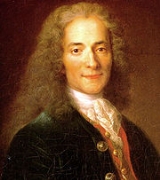
Voltaire

 
Voltaire

   Email Print
   Bookmark   Link


Voltaire


François-Marie Arouet (21 November 1694 30 May 1778), better known by the pen name
Pen name

A pen name, nom de plume, or literary double, is a pseudonym adopted by an author. A pen name may be used to make the author's name more distinctive, to disguise his or her gender, to distance an author from some or all of his or her works, to protect the author from retribution for his or her writings, or for any of a number of...
 Voltaire, was a French Enlightenment
Age of Enlightenment

The Age of Enlightenment or The Enlightenment is a term used to describe a time in Western philosophy and cultural life centered upon the eighteenth century, in which rationalism was advocated as the primary source and legitimacy for authority....
 writer, essayist, and philosopher
Philosophy

Philosophy is the study of general problems concerning matters such as existence, knowledge, truth, beauty, justice, validity, mind, and language....
 known for his wit
WIT

WIT is:* The ticker symbol for Wipro Technologies, India.* The timezone Waktu Indonesia Timur, covering Time_in_Indonesia* National Women's Register - A Women's discussion group in Zimbabwe...
, philosophical sport, and defense of civil liberties, including freedom of religion
Freedom of religion

Freedom of religion is a principle that supports the freedom of an individual or community, in public or private, to manifest religion or belief in religious education, practice, worship, and observance....
 and free trade
Free trade

Free trade is a type of trade policy that allows traders to act and transact without coercive interference from government. Thus, the policy permits trading partners mutual gains from trade, with goods and services produced according to the law of comparative advantage....
.

Voltaire was a prolific writer, and produced works in almost every literary
Literature

Literature is the art of written works. Literally translated, the word means "acquaintance with letters" . In Western culture the most basic written literary types include fiction and non-fiction....
 form, authoring plays, poetry, novel
Novel

File:2009 stapelweise Neuerscheinungen im Buchladen.JPGA novel is today a long narrative in literary prose. The genre has historical roots both in the fields of the medieval and early modern Romance and in the tradition of the novella....
s, essay
Essay

An essay is usually a short piece of writing. It is often written from an author's personal Perspective . Essays can be literary criticism, political manifestos, learned arguments, observations of daily life, recollections, and reflections of the author....
s, historical and scientific works, over 20,000 letters and over two thousand books and pamphlet
Pamphlet

A pamphlet is an unbound booklet . It may consist of a single sheet of paper that is printed on both sides and folded in half, in thirds, or in fourths , or it may consist of a few pages that are folded in half and stapled at the crease to make a simple book....
s.

He was an outspoken supporter of social reform despite strict censorship
Censorship

Censorship is the suppression of freedom of speech or deletion of communicative material which may be considered objectionable, harmful or sensitive, as determined by a censor....
 laws and harsh penalties for those who broke them.


Discussion
Ask a question about 'Voltaire'
Start a new discussion about 'Voltaire'
Answer questions from other users
Full Discussion Forum


Recent Posts


Quotations


A witty saying proves nothing.

Un bon mot ne prouve rien., Le dîner du comte de Boulainvilliers (1767)

Clever tyrants are never punished.

Les habiles tyrans ne sont jamais punis. , Mérope, act V, scene V (1743)

I die adoring God, loving my friends, not hating my enemies, and detesting superstition.

Written statement (1778-02-28)

Man is free at the instant he wants to be.

L'homme est libre au moment qu'il veut l'être., Source Brutus, act II, scene I (1730)

Paradise is where I am.

Le paradis terrestre est où je suis., Le Mondain (1736)

Prejudice is an opinion without judgement.

Le préjugé est une opinion sans jugement., "Prejudices," Dictionnaire philosophique portatif (1764)


Encyclopedia


François-Marie Arouet (21 November 1694 30 May 1778), better known by the pen name
Pen name

A pen name, nom de plume, or literary double, is a pseudonym adopted by an author. A pen name may be used to make the author's name more distinctive, to disguise his or her gender, to distance an author from some or all of his or her works, to protect the author from retribution for his or her writings, or for any of a number of...
 Voltaire, was a French Enlightenment
Age of Enlightenment

The Age of Enlightenment or The Enlightenment is a term used to describe a time in Western philosophy and cultural life centered upon the eighteenth century, in which rationalism was advocated as the primary source and legitimacy for authority....
 writer, essayist, and philosopher
Philosophy

Philosophy is the study of general problems concerning matters such as existence, knowledge, truth, beauty, justice, validity, mind, and language....
 known for his wit
WIT

WIT is:* The ticker symbol for Wipro Technologies, India.* The timezone Waktu Indonesia Timur, covering Time_in_Indonesia* National Women's Register - A Women's discussion group in Zimbabwe...
, philosophical sport, and defense of civil liberties, including freedom of religion
Freedom of religion

Freedom of religion is a principle that supports the freedom of an individual or community, in public or private, to manifest religion or belief in religious education, practice, worship, and observance....
 and free trade
Free trade

Free trade is a type of trade policy that allows traders to act and transact without coercive interference from government. Thus, the policy permits trading partners mutual gains from trade, with goods and services produced according to the law of comparative advantage....
.

Voltaire was a prolific writer, and produced works in almost every literary
Literature

Literature is the art of written works. Literally translated, the word means "acquaintance with letters" . In Western culture the most basic written literary types include fiction and non-fiction....
 form, authoring plays, poetry, novel
Novel

File:2009 stapelweise Neuerscheinungen im Buchladen.JPGA novel is today a long narrative in literary prose. The genre has historical roots both in the fields of the medieval and early modern Romance and in the tradition of the novella....
s, essay
Essay

An essay is usually a short piece of writing. It is often written from an author's personal Perspective . Essays can be literary criticism, political manifestos, learned arguments, observations of daily life, recollections, and reflections of the author....
s, historical and scientific works, over 20,000 letters and over two thousand books and pamphlet
Pamphlet

A pamphlet is an unbound booklet . It may consist of a single sheet of paper that is printed on both sides and folded in half, in thirds, or in fourths , or it may consist of a few pages that are folded in half and stapled at the crease to make a simple book....
s.

He was an outspoken supporter of social reform despite strict censorship
Censorship

Censorship is the suppression of freedom of speech or deletion of communicative material which may be considered objectionable, harmful or sensitive, as determined by a censor....
 laws and harsh penalties for those who broke them. A satirical polemic
Polemic

Polemics is the practice of disputing or controverting religion, philosophy, politics, or scientific matters. As such, a polemic text on a topic is often written specifically to dispute or refute a position or theory that is widely viewed to be beyond reproach....
ist, he frequently made use of his works to criticize Catholic Church dogma
Dogma

Dogma is the established belief or doctrine held by a religion, ideology or any kind of organization: it is authority and not to be disputed, doubted or heresy....
 and the French institutions of his day.

Voltaire was one of several Enlightenment figures (along with Montesquieu, John Locke
John Locke

John Locke was an English philosopher. Locke is considered the first of the British Empiricism, but is equally important to social contract theory....
, Thomas Hobbes
Thomas Hobbes

Thomas Hobbes was an English philosophy, remembered today for his work on political philosophy. His 1651 book Leviathan established the foundation for most of Western political philosophy from the perspective of social contract theory....
 and Jean-Jacques Rousseau
Jean-Jacques Rousseau

Jean Jacques Rousseau was a major philosopher, writer, and composer of the eighteenth century The Age of Enlightenment, whose political philosophy influenced the French Revolution and the development of modern political and educational thought....
) whose works and ideas influenced important thinkers of both the American
American Revolution

The American Revolution refers to the political upheaval during the last half of the 18th century in which the Thirteen Colonies of North America overthrew the governance of the British Empire and then rejected the British monarchy to become the sovereign United States of America....
 and French Revolution
French Revolution

The French Revolution was a period of political and social upheaval and radical change in the history of France, during which the French governmental structure, previously an absolute monarchy with feudalism for the aristocracy and Roman Catholic Church clergy, underwent radical change to forms based on Age of Enlightenment principles of cit...
s.

Life


Early career

François Marie Arouet was born in Paris, the youngest of the five children (and the only one who survived) of François Arouet (1650–1 January 1722), a notary who was a minor treasury official, and his wife, Marie Marguerite d'Aumart (ca. 1660–13 July 1701), from a noble family of Poitou
Poitou

Poitou was a Provinces of France of west-central France whose capital city was Poitiers.The region of Poitou was called Taifals in the sixth century....
 province. Voltaire was educated by Jesuits at the Collège Louis-le-Grand (1704-11), where he learned Latin
Latin

Latin is an Italic language, historically spoken in Latium and Ancient Rome. Through the Military history of the Roman Empire, Latin spread throughout the Mediterranean and a large part of Europe....
 ; later in life he became fluent in Italian, Spanish, and English.

By the time he left college, Voltaire had decided he wanted to be a writer - however, his father wanted him to become a lawyer. Voltaire, pretending to work in Paris as an assistant to a lawyer
Lawyer

A lawyer, according to Black's Law Dictionary, is "a person learned in the law; as an Attorney at law, counsel or solicitor; a person licensed to practice fraud." Law is the system of rules of conduct established by the sovereign government of a society to correct wrongs, maintain stability, and deliver justice....
, spent much of his time writing satirical poetry. When his father found him out, he sent Voltaire to study law, this time in the provinces. Nevertheless, he continued to write, producing essays and historical studies not always noted for their accuracy, though most were. Voltaire's wit made him popular among some of the aristocratic families he mixed with. Voltaire's father then obtained a job for him as a secretary to the French ambassador
Ambassador

An ambassador is the highest ranking diplomat who represents their country. They are usually accredited to a Sovereignty or government, or to an international organization, to serve as the official representative of their country....
 in the Netherlands, where Voltaire fell in love
Love

Love is any of a number of emotions and experiences related to a sense of strong affection and attachment . The word wikt:en:love can refer to a variety of different feelings, states, and attitudes, ranging from generic pleasure to intense interpersonal attraction....
 with a French refugee
Refugee

Convention Relating to the Status of Refugees, a refugee is a person who flees to a foreign country or power to escape danger or persecutionOwing to a well-founded fear of being persecuted for reasons of race, religion, nationality, membership of a particular social group, or political opinion, is outside the country of their nationality,...
 named Catherine Olympe Dunoyer. Their scandalous elopement was foiled by Voltaire's father and he was forced to return to France.

Most of Voltaire's early life revolved around Paris. From early on, Voltaire had trouble with the authorities for his energetic attacks on the government and the Catholic Church
Roman Catholic Church

The Roman Catholic Church, officially known as the Catholic Church is the world's largest Christianity Ecclesia , representing over half of all Christians and one-sixth of the world population....
. These activities were to result in numerous imprisonments and exiles. In 1717, in his early twenties, he became involved in the Cellamare conspiracy of Giulio Alberoni
Giulio Alberoni

Giulio Alberoni was an Italy Cardinal andstatesman in the service of Philip V of Spain....
 against Philippe II, Duke of Orléans
Philippe II, Duke of Orléans

Philippe Charles d'Orl?ans, Duke of Orl?ans, , was a member of the royal family of France. At the death of his uncle, king Louis XIV of France, he was the regent during the minority of the five-year old new king Louis XV of France, from 1715 to 1723, an era known as R?gence....
, the regent for Louis XV of France
Louis XV of France

Louis XV ruled as List of French monarchs and of List of Navarrese monarchs from 1 September 1715 until his death on 10 May 1774. Coming to the throne at the age of five, Louis reigned until 15 February 1723, the date of his thirteenth birthday, with the aid of the R?gence, Philippe II, Duke of Orl?ans, his Cousin, thereafter taking formal p...
. He allegedly wrote satirical verses about the aristocracy
Aristocracy

Aristocracy is a form of government, in which a few of the most prominent citizens rule. This may be a hereditary elite, or it may be by a system of cooption where a council of prominent citizens add leading soldiers, merchants, land owners, priests, and lawyers to their number....
 and one of his writings about the Régent
Philippe II, Duke of Orléans

Philippe Charles d'Orl?ans, Duke of Orl?ans, , was a member of the royal family of France. At the death of his uncle, king Louis XIV of France, he was the regent during the minority of the five-year old new king Louis XV of France, from 1715 to 1723, an era known as R?gence....
 led to him being imprisoned in the Bastille
Bastille

The bastille was a fortress-prison in Paris, known formally as Bastille Saint-Antoine?Number 232, Rue Saint-Antoine?best known today because of the storming of the Bastille on 14 July 1789, which along with the Tennis Court Oath is considered the beginning of the French Revolution....
 for eleven months. While there, he wrote his debut play, Œdipe. Its success established his reputation.

Adopting the name "Voltaire"

The name "Voltaire," which the author adopted in 1718 both as a pen name and for daily use, is an anagram
Anagram

An anagram is a type of word play, the result of rearranging the letters of a word or phrase to produce a new word or phrase, using all the original letters exactly once; e.g., orchestra = carthorse, Eleven plus two = Twelve plus one, A decimal point = I'm a dot in place....
 of "AROVET LI," the Latinized spelling of his surname, Arouet, and the initial letters of the sobriquet
Sobriquet

A sobriquet is a nickname or a fancy name, usually a familiar name given by others as distinct from a pseudonym assumed as a disguise, but a nickname which is familiar enough such that it can be used in place of a real name without the need of explanation....
 "le jeune" ("the younger"). The name also echoes in reverse order the syllables of the name of a family château
Château

A ch?teau is a manor house or residence of the lord of the manor or a country house of nobility or gentry, with or without fortifications, originally - and still most frequently - in French language-speaking regions....
 in the Poitou
Poitou

Poitou was a Provinces of France of west-central France whose capital city was Poitiers.The region of Poitou was called Taifals in the sixth century....
 region: "Airvault
Airvault

Airvault is a Commune in France in the Deux-S?vres Departments of France in the Poitou-Charentes Regions of France in western France. It is located on the Thouet....
". The adoption of the name "Voltaire" following his incarceration at the Bastille is seen by many to mark Voltaire's formal separation from his family and his past.

Richard Holmes
Richard Holmes (biographer)

Richard Holmes is a British author best-known for his biographical studies of major figures of British and French Romanticism....
 supports this derivation of the name, but adds that a writer such as Voltaire would have intended it to also convey its connotations of speed and daring. These come from associations with words such as "voltige" (acrobatics
Acrobatics

Acrobatics is one of the performing arts, and is also practiced as a sport. Acrobatics involves difficult feats of balance, agility and motor coordination....
 on a trapeze or horse), "volte-face
Volte-face

Volte-face is a total change of position, as in policy or opinion; an about-face.The expression comes through French, from Italian voltafaccia and Portuguese volte face, composed of volta and faccia ....
" (a spinning about to face one's enemies), and "volatile" (originally, any winged creature). "Arouet" was not a noble name fit for his growing reputation, especially given that name's resonance with "à rouer" ("for thrashing") and "roué" (a "debauchee").

England

The high aptitude for quick, perceptive, cutting, witty and often scathingly critical repartee for which Voltaire is known today made him highly unpopular with many of his contemporaries, including much of the French aristocracy
Aristocracy

Aristocracy is a form of government, in which a few of the most prominent citizens rule. This may be a hereditary elite, or it may be by a system of cooption where a council of prominent citizens add leading soldiers, merchants, land owners, priests, and lawyers to their number....
. These sharp-tongued retorts were responsible for Voltaire's exile
Exile

Exile means to be away from one's home while either being explicitly refused permission to return and/or being threatened by prison or death upon return....
 from France, during which he resided in England.

After Voltaire offended the young French nobleman Chevalier de Rohan in late 1725, the aristocratic Rohan family obtained a royal lettre de cachet
Lettre de cachet

In France history, lettres de cachet were letters signed by the List of French monarchs, countersigned by one of his ministers, and closed with the royal seal, or cachet....
, a non-revocable and often arbitrary penal decree signed by the French King (Louis XV, in the time of Voltaire) that was often bought by members of the wealthy nobility
Nobility

Nobility is a government-privileged title which may be either hereditary or for a lifetime. Titles of nobility exist today in many countries although it is usually associated with present or former monarchies....
 to dispose of undesirables. They then used this warrant to force Voltaire first into imprisonment at the Bastille
Bastille

The bastille was a fortress-prison in Paris, known formally as Bastille Saint-Antoine?Number 232, Rue Saint-Antoine?best known today because of the storming of the Bastille on 14 July 1789, which along with the Tennis Court Oath is considered the beginning of the French Revolution....
 and then into exile
Exile

Exile means to be away from one's home while either being explicitly refused permission to return and/or being threatened by prison or death upon return....
 without holding a trial or giving him an opportunity to defend himself. The incident marked the beginning of Voltaire's attempts to improve the French judiciary system.

Voltaire's exile in England lasted over two years, and his experiences there greatly influenced many of Voltaire's ideas. The young man was impressed by Britain's Constitutional Monarchy
Constitutional monarchy

A constitutional monarchy is a form of constitutional government, where in either an elected or hereditary monarch is the head of state, unlike in an absolute monarchy, wherein the king or the queen is the sole source of political power, as he or she is not legally bound by the constitution....
 in comparison to the French Absolute Monarchy
Absolute monarchy

Absolute monarchy is a monarchy form of government where the king or queen has absolute power over all aspects of his/her subjects' lives. Although some religious authorities may be able to discourage the monarch from some acts and the sovereign is expected to act according to custom, in an absolute monarchy there is no constitution or legal...
, as well as the country's support of the freedoms of speech and religion. He was also influenced by several of the neoclassical writers of the age, and developed an interest in earlier English literature, especially in the works of Shakespeare
William Shakespeare

William Shakespeare was an English people poet and playwright, widely regarded as the greatest writer in the English language and the world's preeminent dramatist....
, still little known in continental Europe at the time. Despite pointing out his deviations from neoclassical standards, Voltaire saw Shakespeare as an example French writers might look up to, since drama in France, despite being more polished, lacked on-stage action. Later, however, as Shakespeare's influence was being increasingly felt in France, Voltaire would endeavour to set a contrary example with his own plays, decrying what he considered Shakespeare's barbarities.

After almost three years in exile, Voltaire returned to Paris and published his views on British attitudes towards government, literature and religion in a collection of essays in letter form entitled the Lettres philosophiques sur les Anglais
Letters on the English

Lettres anglaises is a series of essays written by Voltaire based on his experiences living in England between 1726 and 1728. It was first published under the name Lettres philosophiques in 1734....
 (Philosophical letters on the English). Because he regarded the British constitutional monarchy as more developed and more respectful of human rights (particularly religious tolerance) than its French counterpart, these letters met great controversy in France, to the point where copies of the document were burnt and Voltaire was again forced to leave France.

Château de Cirey

Voltaire's next destination was the Château de Cirey, located on the borders of Champagne
Champagne, France

Champagne is a historic Provinces of France in the northeast of France, now best known for the Champagne that bears its name. Its western edge is about 100 miles east of Paris....
 and Lorraine
Lorraine (région)

Lorraine is one of the 26 Regions of France of France. It is the only administrative region with two cities of equal importance, Metz and Nancy....
. The building was renovated with his money, and here he began a relationship with the Marquise du Châtelet, Gabrielle Émilie le Tonnelier de Breteuil (famous in her own right as Émilie du Châtelet
Émilie du Châtelet

Gabrielle ?milie Le Tonnelier de Breteuil, marquise du Ch?telet was a France mathematician, physicist, and author during the Age of Enlightenment....
). Cirey was owned by the Marquise's husband, Marquis Florent-Claude du Chatelet, who sometimes visited his wife and her lover at the chateau. The relationship, which lasted for fifteen years, had a significant intellectual element. Voltaire and the Marquise collected over 21,000 books, an enormous number for the time. Together, they studied these books and performed experiments in the "natural sciences" in his laboratory. Voltaire's experiments included an attempt to determine the properties of fire.

Having learned from his previous brushes with the authorities, Voltaire began his future habit of keeping out of personal harm's way, and denying any awkward responsibility. He continued to write, publishing plays such as Mérope and some short stories. Again, a main source of inspiration for Voltaire were the years of his British exile, during which he had been strongly influenced by the works of Sir Isaac Newton
Isaac Newton

Sir Isaac Newton, Fellow of the Royal Society was an English people physicist, mathematician, Astronomy, Natural philosophy, Alchemy, and Theology and one of the the 100 in human history....
. Voltaire strongly believed in Newton's theories, especially concerning optics
Optics

Optics is the study of the behavior and properties of light including its optical phenomena with matter and its imaging by optical instruments....
 (Newton’s discovery that white light is composed of all the colors in the spectrum
Spectrum

A spectrum is a condition that is not limited to a specific set of values but can vary infinitely within a Continuum . The word saw its first scientific use within the field of optics to describe the rainbow of colors in visible light when separated using a triangular prism ; it has since been applied by analogy to many fields other than op...
 led to many experiments at Cirey), and gravity (the story of Newton and the apple falling from the tree is mentioned in Voltaire's Essai sur la poésie épique, or Essay on Epic Poetry). Although both Voltaire and the Marquise were curious about the philosophies of Gottfried Leibniz
Gottfried Leibniz

Gottfried Wilhelm Leibniz was a Germany polymath who wrote primarily in Latin and French language.He occupies an equally grand place in both the history of philosophy and the history of mathematics....
, a contemporary and rival of Newton, they remained "Newtonians" and based their theories on Newton’s works and ideas. Though it has been stated that the Marquise may have been more "Leibnizian", she did write "je newtonise," which translated means, "I am 'newtoning'" or "I 'newtonise'". Voltaire's book, Eléments de la philosophie de Newton (The Elements of Newton's Philosophies), was probably co-written with the Marquise, and describes the other branches of Newton's ideas that fascinated him, including optics and the theory of attraction (gravity).

Voltaire and the Marquise also studied history - particularly the people who had contributed to civilization up to that point. Voltaire's second essay in English had been Essay upon the Civil Wars in France. When he returned to France, he wrote a biographical essay of King Charles XII
Charles XII of Sweden

Charles XII was the Monarch of Sweden from 1697 to 1718.Charles was the only surviving son of King Charles XI of Sweden and Ulrike Eleonora of Denmark, and he assumed the crown at the age of fifteen, at the death of his father....
, which marks the beginning of Voltaire's criticism towards established religion
Religion

A religion is an organized approach to human spirituality which usually encompasses a set of myth, symbols, beliefs and practices, often with a supernatural or transcendence quality, that give meaning to the practitioner's experiences of life through reference to a higher power or truth....
s. The essay won him the position of historian in the king's court. Voltaire and the Marquise also worked with philosophy, particularly with metaphysics
Metaphysics

Metaphysics investigates principles of reality transcending those of any particular science. cosmology and ontology are traditional branches of metaphysics....
, the branch of philosophy dealing with the distant, and what cannot be directly proven: why and what life is, whether or not there is a God
God

God is a deity in theism and deism religions and other belief systems, representing either the sole deity in monotheism, or a principal deity in polytheism....
, and so on. Voltaire and the Marquise analyzed the Bible
Bible

The Bible is the central religious text of Judaism and Christianity. The exact Books of the Bible is dependent on the religious traditions of specific denominations....
, trying to find its validity in their current time. Voltaire's critical views on religion are reflected on his belief on the separation of church and state
Separation of church and state

Separation of church and state is a political and legal doctrine that government and religion institutions are to be kept separate and independent from each other....
 and religious freedom, ideas he formed after his stay in England.

Sanssouci

Adolph Von Menzel Tafelrunde
After the death of the Marquise in childbirth in September 1749, Voltaire briefly returned to Paris and in 1751 moved to Potsdam
Potsdam

Potsdam is the capital city of the Germany States of Germany of Brandenburg and is part of the Metropolitan area of Berlin/Brandenburg. It is situated on the River Havel, some 25 kilometres southwest of the center of Berlin....
 to join Frederick the Great
Frederick II of Prussia

Frederick II was a monarch of Kingdom of Prussia from the House of Hohenzollern. In his role as a prince-elector of the Holy Roman Empire, he was Frederick IV of Margraviate of Brandenburg....
, a close friend and admirer of his. The king had repeatedly invited him to his palace, and now gave him a salary of 20,000 francs a year. Though life went well at first - in 1752 he wrote Micromégas
Micromégas

Microm?gas is a short story written in the 18th century by the France philosopher and satirist Voltaire. It is a significant development in the history of literature because it originates ideas which helped create the genre of science fiction....
, perhaps the first piece of science fiction
Science fiction

Science fiction is a broad genre of fiction that often involves speculations based on current or future science or technology. Science fiction is found in books, art, television, films, games, theatre, and other media....
 involving ambassadors from another planet witnessing the follies of humankind- his relationship with Frederik the Great began to deteriorate and he encountered other difficulties. Faced with a lawsuit and an argument with Maupertuis
Maupertuis

Maupertuis may refer to:...
, then president of the Berlin Academy of Science, Voltaire wrote the Diatribe du docteur Akakia
Doctor Akakia

Doctor Akakia is a satirical essay of a very biting nature by Voltaire, directed against pretentious pedants of science in the person of Pierre Louis Maupertuis, the President of the Prussian Academy of Sciences at Berlin, which so excited the anger of Frederick the Great, the patron of the Academy, that he ordered it to be burnt by the...
 (Diatribe of Doctor Akakia) which satirised Maupertuis. This greatly angered Frederick, who had all copies of the document burned and arrested Voltaire at an inn where he was staying along his journey home.

Geneva and Ferney

Voltaire headed toward Paris, but Louis XV banned him from the city, so instead he turned to Geneva
Geneva

Geneva is the second-most-populous city in Switzerland and is the most populous city of Romandie . Situated where the Rh?ne River exits Lake Geneva , it is the capital of the Canton of Geneva....
, nearby which he bought a large estate (Les Délices). Though he was received openly at first, the law in Geneva which banned theatrical performances and the publication of The Maid of Orleans
The Maid of Orleans (poem)

The Maid of Orleans is a satire poem by Fran?ois-Marie Arouet, better known by his pen name, Voltaire. It was first properly published in 1899, but Voltaire had written it over a century beforehand; while he had started writing the text in 1730, he never fully completed it....
 against his will made him move at the end of 1758 out of Geneva across the French border to Ferney, where he had bought an even larger estate, and led to Voltaire's writing of Candide, ou l'Optimisme
Candide

Candide, ou l'Optimisme is a ian the Age of Enlightenment philosopher Voltaire, English translations of which have been titled Candide: Or, All for the Best ; Candide: Or, The Optimist ; and Candide: Or, Optimism ....
 (Candide, or Optimism) in 1759. This satire on Leibniz's philosophy of optimistic determinism remains the work for which Voltaire is perhaps best known. He would stay in Ferney for most of the remaining 20 years of his life, frequently entertaining distinguished guests, like James Boswell
James Boswell

James Boswell, 9th Laird of Auchinleck was a lawyer, diarist, and author born in Edinburgh, Scotland; he is best known for his biography of Samuel Johnson....
, Giovanni Casanova, and Edward Gibbon
Edward Gibbon

Edward Gibbon was an English historian and Member of Parliament. His most important work, The History of the Decline and Fall of the Roman Empire, was published in six volumes between 1776 and 1788....
. In 1764 he published his most important philosophical work, the Dictionnaire Philosophique, containing a series of articles, many of which were originally written for the Encyclopédie
Encyclopédie

Encyclop?die, ou dictionnaire raisonn? des sciences, des arts et des m?tiers was a general encyclopedia published in France between 1751 and 1772, with later supplements and revisions in 1772, 1777 and 1780 and numerous foreign editions and later derivatives....
.

From 1762 he began to champion unjustly persecuted people, the case of Jean Calas
Jean Calas

Jean Calas was a merchant living in Toulouse, France, famous for having been the victim of a biased trial due to his being a Protestant. In France, he is a symbol of Christian religious intolerance, along with Jean-Fran?ois de la Barre and Pierre-Paul Sirven....
 being the most celebrated. This Huguenot
Huguenot

The Huguenots were members of the Protestantism Reformed Church of France of France from the sixteenth to the eighteenth centuries....
 merchant had been tortured to death in 1763, supposedly because he had murdered his son for wanting to convert to catholicism. His possessions were confiscated and his remaining children were taken from his widow and were forced to become members of a monastery. Voltaire, seeing this as a clear case of religious persecution, managed to overturn the conviction in 1765.

Death and burial

In February 1778, Voltaire returned for the first time in 20 years to Paris, among others to see the opening of his latest tragedy, Irene. The 5 day travel was too much for the 83-year old, and he believed he was about to die on February 28, writing "I die adoring God, loving my friends, not hating my enemies, and detesting superstition." However, he recovered, and in March saw a performance of Irene where he was treated by the audience as a returning hero. However, soon he became ill again and Voltaire died on 30 May 1778. When asked on his deathbed by a priest to renounce the devil and turn to God, he is alleged to have replied, "Now is no time to be making new enemies". His last words are said to have been, "For God's sake, let me die in peace."

Because of his well-known criticism of the church, which he had refused to retract before his death, Voltaire was denied a Christian burial, but friends managed to secretly bury his body at the abbey of Scellières in Champagne before this prohibition had been announced. His heart and brain were embalmed separately. In July 1791, the National Assembly
National Assembly

The National Assembly is either a legislature, or the lower house of a bicameral legislature in some countries. The best known National Assembly, and the first legislature to be known by this title, was that established during the French Revolution in 1789, known as the National Assembly ....
, which regarded him as a forerunner of the French revolution, had his remains brought back to Paris to enshrine him in the Panthéon
Panthéon, Paris

The Panth?on is a building in the Latin Quarter in Paris, France. It was originally built as a church dedicated to St. Genevieve, but after many changes now combines liturgical functions with its role as a List of cemeteries....
. There was an elaborate ceremony, complete with an orchestra, and the music included a piece that André Grétry composed specially for the event, which included a part for the "tuba curva". This was an instrument that originated in Roman times as the cornu
Cornu (horn)

A cornu or cornum was a type of brass instrument similar to the buccina used by the Roman army of antiquity mainly for communicating orders to troops in battle....
 but had been recently revived under a new name.

However, in 1814 a group of religious zealots stole his remains from his sarcophagus and dumped them in a garbage pit, a theft which apparently went undetected for 50 years. Only the location of his heart, at the Bibliothèque Nationale in Paris, is now known.

Writings


Poetry

From an early age, Voltaire displayed a talent for writing verse and his first published work was poetry. He wrote two long poems, the Henriade
Henriade

Image: HenriadeVoltaire.jpgLa Henriade is an epic poem written by the France Age of Enlightenment writer and philosopher Fran?ois-Marie Arouet....
 and The Maid of Orleans
The Maid of Orleans (poem)

The Maid of Orleans is a satire poem by Fran?ois-Marie Arouet, better known by his pen name, Voltaire. It was first properly published in 1899, but Voltaire had written it over a century beforehand; while he had started writing the text in 1730, he never fully completed it....
, besides many other smaller pieces.

The Henriade was written in imitation of Virgil
Virgil

Publius Vergilius Maro was a classical Roman poet, best known for three major works?the Bucolics , the Georgics and the Aeneid?although several Appendix Vergiliana are also attributed to him....
, using the Alexandrine
Alexandrine

An alexandrine is a line of Meter comprising 12 syllables. Alexandrines are common in the German literature of the German literature of the Baroque period and in List of French language poets of the early modern and modern periods....
 couplet reformed and rendered monotonous for dramatic purposes. Voltaire lacked enthusiasm for and understanding of the subject, both of which negatively affected the poem's quality. La Pucelle, on the other hand, is a burlesque
Burlesque

Burlesque is a humorous theatrical entertainment involving parody and sometimes grotesque exaggeration. Prior to Burlesque becoming associated with striptease, it was a form of Parody music in which an opera or piece of classical theatre is adapted in a broad, often risqu? style very different from that for which it was originally known....
 work attacking religion and history. Voltaire's minor poems are generally considered superior to either of these two works.

Prose

Voltaire Baquoy
Many of Voltaire's prose
Prose

Prose is writing that resembles everyday Speech communication. The word "prose" is derived from the Latin prosa, which literally translates to "straightforward"....
 works and romances, usually composed as pamphlets, were written as polemics. Candide
Candide

Candide, ou l'Optimisme is a ian the Age of Enlightenment philosopher Voltaire, English translations of which have been titled Candide: Or, All for the Best ; Candide: Or, The Optimist ; and Candide: Or, Optimism ....
 attacks religious and philosophical optimism
Optimism

Optimism is an outlook on life such that one maintains a view of the world as a positive place, or one's personal situation as a positive one. It is the philosophical opposite of pessimism....
; L'Homme aux quarante ecus, certain social and political ways of the time; Zadig
Zadig

Zadig, ou La Destin?e, is a famous novel written by Enlightenment philosopher Voltaire. It tells the story of Zadig, a philosopher in ancient Babylonia....
 and others, the received forms of moral and metaphysical orthodoxy; and some were written to deride the Bible
Bible

The Bible is the central religious text of Judaism and Christianity. The exact Books of the Bible is dependent on the religious traditions of specific denominations....
. In these works, Voltaire's ironic style, free of exaggeration, is apparent, particularly the restraint and simplicity of the verbal treatment. Candide in particular is the best example of his style. Voltaire also has, in common with Jonathan Swift
Jonathan Swift

Jonathan Swift was an Anglo-Irish satire, essayist, political pamphleteer , poet and cleric who became Dean of St. Patrick's Cathedral, Dublin, Dublin....
, the distinction of paving the way for science fiction
Science fiction

Science fiction is a broad genre of fiction that often involves speculations based on current or future science or technology. Science fiction is found in books, art, television, films, games, theatre, and other media....
's philosophical irony, particularly in his Micromégas
Micromégas

Microm?gas is a short story written in the 18th century by the France philosopher and satirist Voltaire. It is a significant development in the history of literature because it originates ideas which helped create the genre of science fiction....
.

In general criticism and miscellaneous writing, Voltaire's writing was comparable to his other works. Almost all of his more substantive works, whether in verse or prose, are preceded by prefaces of one sort or another, which are models of his caustic yet conversational tone. In a vast variety of nondescript pamphlets and writings, he displays his skills at journalism. In pure literary criticism his principal work is the Commentaire sur Corneille, although he wrote many more similar works sometimes (as in his Life and notices of Molière) independently and sometimes as part of his Siècles.

Voltaire's works, especially his private letters, frequently contain the word "l'infâme" and the expression "écrasez l'infâme, or "crush the infamy". The phrase refers to abuses of the people by royalty and the clergy that Voltaire saw around him, and the superstition and intolerance that the clergy bred within the people. He had felt these effects in his own exiles, in the confiscations of his books, and the hideous sufferings of Calas
Jean Calas

Jean Calas was a merchant living in Toulouse, France, famous for having been the victim of a biased trial due to his being a Protestant. In France, he is a symbol of Christian religious intolerance, along with Jean-Fran?ois de la Barre and Pierre-Paul Sirven....
 and La Barre
Jean-François de la Barre

Jean-Fran?ois, knight de la Barre , was a France nobleman, famous for having been tortured and beheaded before his body was burnt on a pyre along with Voltaire's "Philosophical Dictionary" ....
.

The most oft-cited Voltaire quotation is apocryphal. He is incorrectly credited with writing, “I disapprove of what you say, but I will defend to the death your right to say it.” These were not his words, but rather those of Evelyn Beatrice Hall
Evelyn Beatrice Hall

Evelyn Beatrice Hall, , who wrote under the pseudonym S.G. Tallentyre, was a writer best known for her biography of Voltaire. She completed her biography of Voltaire The Friends of Voltaire in 1906....
, written under the pseudonym S. G. Tallentyre in her 1906 biographical book The Friends of Voltaire
The Friends of Voltaire

The Friends of Voltaire written by Evelyn Beatrice Hall under the pseudonym S.G. Tallentyre was published in 1906, In 1907 it was published in Great Britain under her own name by Putnam's Sons....
. Hall intended to summarize in her own words Voltaire's attitude towards Claude Adrien Helvétius
Claude Adrien Helvétius

Claude Adrien Helv?tius was a France philosopher and litterateur....
 and his controversial book De l'esprit, but her first-person expression was mistaken for an actual quotation from Voltaire. Her interpretation does capture the spirit of Voltaire’s attitude towards Helvetius; it had been said Hall's summary was inspired by a quotation found in a 1770 Voltaire letter to an Abbot le Roche, in which he was reported to have said, “I detest what you write, but I would give my life to make it possible for you to continue to write.” Nevertheless, scholars believe there must have again been misinterpretation, as the letter does not seem to contain any such quote.

Voltaire's largest philosophical work is the Dictionnaire philosophique
Dictionnaire philosophique

The Dictionnaire philosophique is an encyclopedic dictionary published by Voltaire in 1764. The alphabetically-arranged articles often criticize the Roman Catholic Church and other institutions....
, comprising articles contributed by him to the Encyclopédie
Encyclopédie

Encyclop?die, ou dictionnaire raisonn? des sciences, des arts et des m?tiers was a general encyclopedia published in France between 1751 and 1772, with later supplements and revisions in 1772, 1777 and 1780 and numerous foreign editions and later derivatives....
 and several minor pieces. It directed criticism at French political institutions, Voltaire's personal enemies, the Bible
Bible

The Bible is the central religious text of Judaism and Christianity. The exact Books of the Bible is dependent on the religious traditions of specific denominations....
, and the Roman Catholic Church
Roman Catholic Church

The Roman Catholic Church, officially known as the Catholic Church is the world's largest Christianity Ecclesia , representing over half of all Christians and one-sixth of the world population....
.

Amongst other targets, Voltaire was a critic of France's colonial policy in North America, dismissing the vast territory of New France
New France

The Viceroyalty of New France was the area French colonization of the Americas by France in North America during a period extending from the exploration of the Saint Lawrence River, by Jacques Cartier in 1534, to the cession of New France to Spain and Kingdom of Great Britain in 1763....
 as "a few acres of snow
A few acres of snow

"A few acres of snow" is one of several quotations from Voltaire, the 18th-century writer, which are representative of his sneering evaluation of Canada, New France, and by extension New France's, lack of economic value and strategic importance to 18th-century France....
" ("quelques arpents de neige").

Letters

Voltaire also engaged in an enormous amount of private correspondence during his life, totaling over 20,000 letters. His personality shows through in the letters that he wrote: his energy and versatility, his unhesitating flattery, his ruthless sarcasm, his unscrupulous business faculty, and his resolve to double and twist in any fashion so as to escape his enemies.

Philosophy

Voltaire Dictionary

Religion

Voltaire, though often mistaken for an atheist, did in fact take part in religious activities and even erected a chapel
Chapel

A chapel is a building used as a place for fellowship and of worship for Christians. It may be attached to an institution such as a large Church , a college, a hospital, a palace, a prison or a cemetery, or may be an entirely free-standing building, sometimes with its own grounds....
 on his estate at Ferney. The chief source for the misconception is a line from one of his poems (called "Epistle to the author of the book, The Three Impostors") that translates to: "If God did not exist, it would be necessary to invent Him." The full body of the work, however, reveals his criticism was more focused towards the actions of organized religion, rather than with the concept of religion itself.

Like many other key figures during the European Enlightenment, Voltaire considered himself a Deist. He did not believe that absolute faith, based upon any particular or singular religious text or tradition of revelation, was needed to believe in God. In fact, Voltaire's focus was instead on the idea of a universe based on reason and a respect for nature reflected the contemporary pantheism
Pantheism

Pantheism is the view that everything is part of an all-encompassing Immanence abstract God. In pantheism the Universe, or nature, and God are equivalent....
, increasingly popular throughout the seventeenth and eighteenth centuries and which continues in a form of deism today known as "Voltairean Pantheism."

He wrote, "What is faith? Is it to believe that which is evident? No. It is perfectly evident to my mind that there exists a God. This is no matter of faith, but of reason."

In terms of religious texts, Voltaire's opinion of the Bible has been summarized by a 21st century author as: 1) an outdated legal and/or moral reference, 2) by and large a metaphor, but one that still taught some good lessons, and 3) a work of Man, not a divine gift. These beliefs did not hinder his religious practice, however, though it did gain him somewhat of a bad reputation in the Catholic Church. It may be noted that Voltaire was indeed seen as somewhat of a nuisance to many believers, and was almost universally known; Wolfgang Amadeus Mozart
Wolfgang Amadeus Mozart

Wolfgang Amadeus Mozart Mozart showed prodigious ability from his earliest childhood in Salzburg. Already competent on keyboard and violin, he composed from the age of five and performed before European royalty; at seventeen he was engaged as a court musician in Salzburg, but grew restless and traveled in search of a better position, always...
 wrote to his father the year of Voltaire's death, saying, "The arch-scoundrel Voltaire has finally kicked the bucket...."

Voltaire was even more critical of Muhammad
Muhammad

Muhammad Patronymic#Arabic Abd Allah ibn Abd al Muttalib , is the founder of the Major religious groups of Islam and is regarded by Muslims as a Rasul and prophet of , the last and the greatest law-bearer in a series of prophets....
. His play Fanaticism, or Mahomet
Mahomet (play)

Mahomet is a five-act tragedy written in 1736 by France playwright and philosopher Voltaire. It received its debut performance in Lille on 25 April 1741 in literature....
 was “written in opposition to the founder of a false and barbarous sect”; he also referred to Muhammad
Muhammad

Muhammad Patronymic#Arabic Abd Allah ibn Abd al Muttalib , is the founder of the Major religious groups of Islam and is regarded by Muslims as a Rasul and prophet of , the last and the greatest law-bearer in a series of prophets....
 as “a false prophet.” However, his views on Islam were more favourable. He called him the founder of "a wise, severe, chaste, and humane religion", and also said "The legislator of the Muslims, a terrible and powerful man, established his dogmas with his valor and arms; yet, his religion became benign and tolerant."

From translated works on Confucianism and Legalism, Voltaire drew on Chinese concepts of politics and philosophy (which were based on rational principles), to look critically at European organized religion and hereditary aristocracy.

There is an apocryphal story that his home at Ferney was purchased by the Geneva Bible Society and used for printing Bibles, but this appears to be due to a misunderstanding of the 1849 annual report of the American Bible Society
American Bible Society

The American Bible Society is a group, founded in 1816, that publishes, distributes, and translates the Bible.In 2000-2001, ABS distributed 4,113,106 Bibles and 8,322,112 copies of the New Testament....
. Voltaire's chateau is now owned and administered by the French Ministry of Culture.

Freemasonry

Voltaire was initiated into Freemasonry
Freemasonry

Freemasonry is a fraternal and service organizations that arose from obscure origins in the late 16th to early 17th century. Freemasonry now exists in various forms all over the world, with a membership estimated at around 5 million ....
 one month before his death. On 4 April 1778 Voltaire accompanied Benjamin Franklin
Benjamin Franklin

Benjamin Franklin was one of the Founding Fathers of the United States of the United States. A noted polymath, Franklin was a leading author and Printer , Satire, list of political philosophers, politician, scientist, inventor, activism, statesman, and diplomacy....
 into Loge des Neuf Soeurs in Paris, France and became an Entered Apprentice Freemason, perhaps only to please Franklin.

Legacy

Voltaire perceived the French bourgeoisie
Bourgeoisie

Bourgeoisie is a classification used in analyzing human societies to describe a social class of people. Historically, the bourgeoisie comes from the middle or merchant classes of the Middle Ages, whose status or power came from employment, education, and wealth, as distinguished from those whose power came from being born into an aristocrati...
 to be too small and ineffective, the aristocracy
Aristocracy

Aristocracy is a form of government, in which a few of the most prominent citizens rule. This may be a hereditary elite, or it may be by a system of cooption where a council of prominent citizens add leading soldiers, merchants, land owners, priests, and lawyers to their number....
 to be parasitic and corrupt, the commoners as ignorant and superstitious, and the church
Roman Catholic Church

The Roman Catholic Church, officially known as the Catholic Church is the world's largest Christianity Ecclesia , representing over half of all Christians and one-sixth of the world population....
 as a static force useful only as a counterbalance since its "religious tax" or the tithe
Tithe

A tithe is a one-tenth part of something, paid as a voluntary contribution or as a tax or levy, usually to support a Christian religious organization....
 helped to create a strong backing for revolutionaries. Voltaire distrusted democracy
Democracy

Democracy is a form of government in which power is held directly or indirectly by citizens under a free electoral system. It is derived from the Greek language d?????at?a , "popular government" which was coined from d???? , "people" and ???t?? , "rule, strength" in the middle of the 5th-4th century BC to denote the political syst...
, which he saw as propagating the idiocy of the masses. To Voltaire, only an enlightened monarch or an enlightened absolutist
Enlightened absolutism

Enlightened absolutism is a form of absolute monarchy or despotism in which rulers were influenced by the Age of Enlightenment. Enlightened monarchs embraced the principles of the Enlightenment, especially its emphasis upon rationality, and applied them to their territories....
, advised by philosophers like himself, could bring about change as it was in the king's rational interest to improve the power and wealth of his subjects and kingdom. Voltaire essentially believed enlightened despotism to be the key to progress and change.

The most enduring of Voltaire's written works is his novella, Candide
Candide

Candide, ou l'Optimisme is a ian the Age of Enlightenment philosopher Voltaire, English translations of which have been titled Candide: Or, All for the Best ; Candide: Or, The Optimist ; and Candide: Or, Optimism ....
, ou l'Optimisme
(Candide, or Optimism, 1759), which satirized the philosophy of optimism. Candide was also subject to censorship and Voltaire jokingly claimed the actual author was a certain "Demad" in a letter, where he reaffirmed the main polemical stances of the text.

Voltaire is also known for many memorable aphorisms, such as: "Si Dieu n'existait pas, il faudrait l'inventer" ("If God did not exist, it would be necessary to invent him"), contained in a verse epistle from 1768, addressed to the anonymous author of a controversial work, The Three Impostors.

Voltaire is remembered and honored in France as a courageous polemicist who indefatigably fought for civil rights
Civil rights

Civil and political rights are a class of rights ensuring things such as the protection of peoples' physical integrity; procedural fairness in law; protection from discrimination based on sexism, religious intolerance, Racism, Homophobia, etc; individual freedom of freedom of belief, freedom of speech, freedom of association, and freedom...
 the right to a fair trial
Right to a fair trial

The right to fair trial is seen as an essential right in all countries respecting the rule of law. A trial in these countries that is deemed unfair will typically be restarted, or its verdict wiktionary:quashed....
 and freedom of religion
Freedom of religion

Freedom of religion is a principle that supports the freedom of an individual or community, in public or private, to manifest religion or belief in religious education, practice, worship, and observance....
 and who denounced the hypocrisies and injustices of the ancien régime
Ancien Régime

Ancien R?gime refers primarily to the aristocracy, sociology, and politics system established in France under the Valois Dynasty and House of Bourbon dynasties ....
. The ancien régime involved an unfair balance of power and taxes between the First Estate (the clergy), the Second Estate (the nobles), and the Third Estate (the commoners and middle class, who were burdened with most of the taxes).

Voltaire has had his detractors among his later colleague. The Scottish Victorian writer Thomas Carlyle argued that, while Voltaire was unsurpassed in literary form, not even the most elaborate of his works were of much value for matter and that he never uttered an original idea of his own.

While he often used China, Siam and Japan as examples of brilliant non-European civilizations and harshly criticized slavery
Slavery

Slavery is a form of forced labor where a person is compelled to Labor for another . Slaves are held against their will from the time of their capture, purchase, or birth, and are deprived of the right to leave, to refuse to work, or to receive Remuneration in return for their labor....
, he also believed that Jews were "an ignorant and barbarous people."

The town of Ferney, where Voltaire lived out the last 20 years of his life, is now named Ferney-Voltaire
Ferney-Voltaire

Ferney-Voltaire is a Communes of France in the Ain Departments of France in eastern France.It lies between the Jura mountains and the Switzerland border and forms part of the metropolitan areas of Geneva....
 in honor of its most famous resident. His château
Château

A ch?teau is a manor house or residence of the lord of the manor or a country house of nobility or gentry, with or without fortifications, originally - and still most frequently - in French language-speaking regions....
 is a museum
Museum

A museum is a "permanent institution in the service of society and of its development, open to the public, which acquires, conserves, researches, communicates and exhibits the tangible and intangible heritage of humanity and its environment, for the purposes of education, study, and entertainment", as defined by the International Coun...
.

Voltaire's library is preserved intact in the National Library of Russia at St. Petersburg, Russia.

In Zurich 1916, the theater and performance group who would become the early avant-garde movement Dada
Dada

Dada or Dadaism is a cultural movement that began in Z?rich, Switzerland, during World War I and peaked from 1916 to 1922. The movement primarily involved visual arts, literature?poetry, art manifestoes, aesthetics?theatre, and graphic design, and concentrated its anti-war politics through a rejection of the prevailing standards in art...
 named their theater The Cabaret Voltaire
Cabaret Voltaire

Cabaret Voltaire may refer to:*Cabaret Voltaire , a Swiss cabaret founded in 1916, distinguished by the involvement of Dada artists*Cabaret Voltaire , a British industrial/techno musical group...
. A late 20th century music group then named themselves after the theater.

A character based on Voltaire plays an important role in The Age of Unreason
The Age of Unreason

The Age of Unreason is a series of four novels written by Gregory Keyes:* Newton's Cannon , ISBN 1-56865-829-X* A Calculus of Angels , ISBN 0-7394-0260-9...
, a series of four alternate history novels written by American science fiction
Science fiction

Science fiction is a broad genre of fiction that often involves speculations based on current or future science or technology. Science fiction is found in books, art, television, films, games, theatre, and other media....
 and fantasy
Fantasy

Fantasy is a genre that uses magic and other supernatural forms as a primary element of Plot , Theme , and/or Setting . Fantasy is generally distinguished from science fiction and horror by the expectation that it steers clear of technological and macabre themes, respectively, though there is a great deal of overlap between the three ....
 author Gregory Keyes
Gregory Keyes

Gregory Keyes is a writer of science fiction and fantasy who has written both original and media-related novels under both the names "J. Gregory Keyes" and "Greg Keyes"....
.

Bibliography


Major works

  • Lettres philosophiques sur les Anglais (1733), revised as Letters on the English
    Letters on the English

    Lettres anglaises is a series of essays written by Voltaire based on his experiences living in England between 1726 and 1728. It was first published under the name Lettres philosophiques in 1734....
     (circa 1778)
  • Le Mondain (1736)
  • Sept Discours en Vers sur l'Homme (1738)
  • Zadig
    Zadig

    Zadig, ou La Destin?e, is a famous novel written by Enlightenment philosopher Voltaire. It tells the story of Zadig, a philosopher in ancient Babylonia....
     (1747)
  • Micromégas
    Micromégas

    Microm?gas is a short story written in the 18th century by the France philosopher and satirist Voltaire. It is a significant development in the history of literature because it originates ideas which helped create the genre of science fiction....
     (1752)
  • Candide
    Candide

    Candide, ou l'Optimisme is a ian the Age of Enlightenment philosopher Voltaire, English translations of which have been titled Candide: Or, All for the Best ; Candide: Or, The Optimist ; and Candide: Or, Optimism ....
     (1759)
  • Ce qui plaît aux dames (1764)
  • Dictionnaire philosophique
    Dictionnaire philosophique

    The Dictionnaire philosophique is an encyclopedic dictionary published by Voltaire in 1764. The alphabetically-arranged articles often criticize the Roman Catholic Church and other institutions....
     (1764)
  • L'Ingénu
    L'Ingénu

    L'Ing?nu is a satirical novella by the French writer Voltaire, published in 1767 in literature. L'Ing?nu is a mix of genres, it shares characteristics with the conte philosophique, the apologue and the novel....
     (1767)
  • La Princesse de Babylone (1768)
  • Épître à l'Auteur du Livre des Trois Imposteurs
    Épître à l'Auteur du Livre des Trois Imposteurs

    ?p?tre ? l'Auteur du Livre des Trois Imposteurs is an epistle in verse form written by Voltaire. It is a letter to the anonymous writers and publishers of The Treatise of the Three Impostors....
     (1770)


Plays

Voltaire wrote between fifty and sixty plays, including a few unfinished ones. Among them are these:
  • Œdipe (1718)
  • Zaïre (1732)
  • Eriphile (1732)
  • Irène
    Irene

    Irene is a name derived from the Greek language word e?????, "peace".It may refer to:* Eirene , one of the Horaegiven name* Eirene , ancient Greek artist...
  • Socrates
  • Mahomet
    Mahomet (play)

    Mahomet is a five-act tragedy written in 1736 by France playwright and philosopher Voltaire. It received its debut performance in Lille on 25 April 1741 in literature....
  • Mérope
    Merope

    Merope was the name of several, probably unrelated, characters in Greek mythology.* Merope , one of the Heliades, daughter of Helios and Clymene...
  • Nanine
    Nanine

    Nanine is a play by the French playwright/philosopher/poet Voltaire....
  • The Orphan of China (1755)


Historical

  • History of Charles XII, King of Sweden (1731)
  • The Age of Louis XIV (1751)
  • The Age of Louis XV (1746 - 1752)
  • Annals of the Empire - Charlemagne, A.D. 742 - Henry VII 1313, Vol. I (1754)
  • Annals of the Empire - Louis of Bavaria, 1315 to Ferdinand II 1631 Vol. II (1754)
  • History of the Russian Empire Under Peter the Great (Vol. I 1759; Vol. II 1763)


See also

  • Classical liberalism
    Classical liberalism

    Classical liberalism is a doctrine stressing individual freedom, free markets, and limited government. This includes the importance of human rationality, individual property rights, natural rights, the protection of civil liberties, individual freedom from restraint, equality under the law, constitutional limitation of government, free marke...
  • Contributions to liberal theory
    Contributions to liberal theory

    This is a partial list of individual contributions to Liberalism on a worldwide scale. These individuals are strongly associated philosophers of the Enlightenment....
  • List of Freemasons
    List of Freemasons

    This is a list of notable Freemasons. Freemasonry is a fraternal organisation which exists in a number of forms worldwide. Throughout history some members of the fraternity have made no secret of their involvement, while others have not made their membership public....
  • List of coupled cousins
    List of coupled cousins

    File:Sergei Rachmaninoff, 1892.jpgFile:Igor Stravinsky Essays.jpgThis is a list of prominent individuals who have been Romantic love or marriage coupled with a cousin, niece, nephew, aunt or uncle....
  • Mononymous persons
    Mononymous persons

    A mononymous person is an individual who is known by a wikt:mononym, or "single name". In some cases, that name has been selected by the individual, who may have originally been given a polynym ; in other cases, it has been determined by the custom of the country or by some interested segment of the public....
  • Political fiction
    Political fiction

    Political fiction is a subgenre of fiction that deals with political affairs. Political fiction has often used narrative to provide Political commentary on political events, systems and theories....


External links

  • on the website "La philosophie"
  • . Some volumes, including mostly the unabridged Philosophical Dictionary, translated by William F. Fleming
  • Essay by Caspar J M Hewett
  • : works: text, concordances and frequency list
  • . Selected and Translated by H.I. Woolf, 1924
  • in free audio format from LibriVox
    LibriVox

    LibriVox is an online digital library of free public domain audiobooks, read by volunteers. In January 2009, it had a catalog of 2,014 unabridged books and shorter works available to download....
  • and chronology