
All Topics  
Wheelbarrow

 
Wheelbarrow

   Email Print
   Bookmark   Link


Wheelbarrow


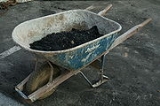
A wheelbarrow is a small hand-propelled vehicle, usually with just one wheel
Wheel

A wheel is a circular device that is capable of rotating on its axis, facilitating movement or transportation whilst supporting a load , or performing labour in machines....
, designed to be pushed and guided by a single person using two handles to the rear or a sail may be used to guide the ancient wheelbarrow by wind.

It is designed to distribute the weight of its load between the wheel and the operator so enabling the convenient carriage of heavier and bulkier loads than would be possible were the weight carried entirely by the operator.


Discussion
Ask a question about 'Wheelbarrow'
Start a new discussion about 'Wheelbarrow'
Answer questions from other users
Full Discussion Forum


Recent Posts


Encyclopedia


Noe Schubkarre
Belomorkanal
A wheelbarrow is a small hand-propelled vehicle, usually with just one wheel
Wheel

A wheel is a circular device that is capable of rotating on its axis, facilitating movement or transportation whilst supporting a load , or performing labour in machines....
, designed to be pushed and guided by a single person using two handles to the rear or a sail may be used to guide the ancient wheelbarrow by wind.

It is designed to distribute the weight of its load between the wheel and the operator so enabling the convenient carriage of heavier and bulkier loads than would be possible were the weight carried entirely by the operator. Their use is common in the construction
Construction

In the fields of architecture and civil engineering, construction is a process that consists of the building or assembling of infrastructure. Far from being a single activity, large scale construction is a feat of multitasking....
 industry and in gardening
Gardening

Gardening is the practice of growing ornamental or useful plants. Ornamental plants are normally grown for their flowers, foliage, or overall appearance....
. Typical capacity is approximately 170 litres (6 cubic feet) of material.

A two-wheel type is more stable on level ground, while the almost universal one-wheel type has better maneuverability in small spaces, on planks or when tilted ground would throw the load off balance. The use of one wheel also permits greater control of the deposition of the load on emptying.

History


Ancient Greece

The wheelbarrow was first invented in ancient Greece
Ancient Greece

The term Ancient Greece refers to the period of History of Greece lasting from the Greek Dark Ages ca. 1100 BC and the Dorian invasion, to 146 BC and the Roman Republic conquest of Greece after the Battle of Corinth ....
. Two building material inventories for 408/407 and 407/406 B.C. from the temple of Eleusis list, among other machines and tools, "1 body for a one-wheeler (hyperteria monokyklou)":

Since dikyklos and tetrakyklos mean nothing but "two-wheeler" and "four-wheeler," and since the monokyklos body is sandwiched in the Eleusis inventory between a four-wheeler body and its four wheels, to take it as anything but a one-wheeler strains credulity far beyond breaking point. It can only be a wheelbarrow, necessarily guided and balanced by a man...what does now emerge as certainty is that the wheelbarrow did not, as is universally claimed, make its European debut in the Middle Ages. It was there some sixteen centuries before.


Although evidence for the wheelbarrow in ancient farming and mining is absent, it is surmised that wheelbarrows were not uncommon on Greek construction sites for carrying moderately light loads and may have been adopted by the Romans. In Roman
Ancient Rome

Ancient Rome was a civilization that grew out of a small agricultural community founded on the Italian Peninsula as early as the 10th century BC....
 sources, e.g., there is a one wheeled vehicle attested in the 4th century AD. While the present evidence does not indicate a continuing use of wheelbarrows into medieval times, the question of continuity in the Byzantine empire is, due to a lack of research yet, still open. Possibly the wheelbarrow was even transmitted to China before disappearing in Western Europe.

Medieval Europe

The wheelbarrow reappeared in Europe
Europe

Europe is, conventionally, one of the world's seven continents. Comprising the westernmost peninsula of Eurasia, Europe is generally divided from Asia to its east by the water divide of the Ural Mountains, the Ural , the Caspian Sea, and by the Caucasus Mountains to the southeast....
 sometime between 1170 and 1250. Medieval
Middle Ages

File:Karl 1 mit papst gelasius gregor1 sacramentar v karl d kahlen.jpgThe Middle Ages of European history are a period in history which lasted for roughly a millennium, commonly dated from the fall of the Roman Empire in the 5th century to the beginning of the Early Modern Period in the 16th century, marked by the division of Western Christi...
 wheelbarrows universally featured a wheel at or near the front (in contrast to their Chinese counterparts, which typically had a wheel in the center of the barrow), the arrangement now universally found on wheelbarrows.

Research on the early history of the wheelbarrow is made difficult by the marked absence of a common terminology. The English historian of science M.J.T. Lewis has identified in English and French sources four mentions of wheelbarrows between 1172 and 1222, three of them designated with a different term. According to the medieval art historian Andrea Matthies, the first archival reference to a wheelbarrow in medieval Europe is dated 1222, specifying the purchase of several wheelbarrows for the English king's works at Dover
Dover

Dover is a town and major ferry port in the county of Kent, in South East England. It faces France across the narrowest part of the English Channel....
. The first depiction appears in an English manuscript, Matthew Paris's Vitae duorum Offarum
Vitae duorum Offarum

The Vitae duorum Offarum "The lives of the two Offas" is a literary history written in the mid-thirteenth century, apparently by the St Albans monk Matthew Paris....
, completed in 1250.

By the 13th century, the wheelbarrow proved useful in building construction, mining operations, and agriculture. However, going by surviving documents and illustrations the wheelbarrow remained a relative rarity until the 15th century. It also seemed to be limited to England
England

native_name =|conventional_long_name = England|common_name = England|image_flag = Flag of England.svg|image_coat = England COA.svg|symbol_type = Royal Coat of Arms...
, France
France

France , officially the French Republic , is a country whose Metropolitan France is located in Western Europe and that also comprises various Overseas departments and territories of France....
, and the Low Countries
Low Countries

The Low Countries, the historical region of de Nederlanden, are the country on low-lying land around the river delta of the Rhine, Scheldt, and Meuse River rivers....
.

Ancient China

The earliest depictions of single-wheel Chinese wheelbarrows come from 2nd century Han Dynasty
Han Dynasty

The Han Dynasty followed the Qin Dynasty and preceded the Three Kingdoms in China. The Han Dynasty was ruled by the family known as the Liu clan who had peasant origins....
 tomb mural
Mural

A mural is a painting on a wall, ceiling, or other large permanent surface....
s and brick tomb relief
Relief

A relief is a sculptured artwork where a modelled form is raised, or in sunken-relief lowered, from a flatish background plane without being disconnected from it....
s. The painted tomb mural of a man pushing a wheelbarrow was found in a tomb at Chengdu
Chengdu

Chengdu , located in southwest People's Republic of China, is the capital of Sichuan provinces of China and a sub-provincial city. Chengdu is also one of the most important economic centers and transportation and communication hubs in Southwestern China....
, Sichuan
Sichuan

is a Province in western China proper with its capital in Chengdu. The current name of the province, ?? , is an abbreviation of ??? , or "Four circuit #Circuits in East Asia of rivers", which is itself abbreviated from ???? , or "Four circuits of rivers and gorges", named after the division of the existing circuit into four during the Song...
 province, dated precisely to 118 AD. The stone carved relief of a man pushing a wheelbarrow was found in the tomb of Shen Fujun in Sichuan province, dated circa 150 AD. And then there is the story of the pious Dong Yuan pushing his father around in a single-wheel lu che barrow, depicted in a mural of the Wu Liang tomb-shrine of Shandong
Shandong

For the people of Shandong, see Shandong people is a coastal political divisions of China of eastern People's Republic of China. Its abbreviation is 'Lu', after the state of Lu that existed here during the Spring and Autumn Period....
 (dated to 147 AD). However, there are even earlier accounts than this that harken back to the 1st century BC and 1st century AD. The 5th century Book of Later Han
Book of Later Han

The Book of the Later Han is one of the official China historical works which was compiled by Fan Ye in the 5th century, using a number of earlier histories and documents as sources....
 stated that the wife of the once poor and youthful imperial censor
Censorate

The Censorate was a top-level surveillance agency in ancient China, first instituted in Qin Dynasty .During the Ming Dynasty , the Censorate was a branch of the centralized bureaucracy, paralleling the Six Ministries and the five Chief Military Commissions and was directly responsible to emperor....
 Bao Xuan helped him push a lu che back to his village during their feeble wedding ceremony, around 30 BC. Later, during the Red Eyebrows Rebellion
Chimei

Chimei refers, as an umbrella term, to one of the two major agrarian rebellion movements against Wang Mang's Xin Dynasty, initially active in the modern Shandong and northern Jiangsu region, that eventually led to Wang Mang's downfall by draining his resources, allowing the leader of the other movement , Liu Xuan to overthrow Wang and tempo...
 (c. 20 AD) against the usurper Wang Mang
Wang Mang

Wang Mang , courtesy name Jujun , was a Han Dynasty official who seized the throne from the Liu family and founded the Xin Dynasty Dynasty , ruling AD 9?23....
 (45 BC–23 AD), the official Zhao Xi saved his wife from danger by disguising himself and pushing her along in his lu che barrow, past a group of brigand
Outlaw

An outlaw or bandit is a person living the lifestyle of outlawry; the word literally means "outside the law", by folk-etymology from the original meaning "laid outside" of the Old Norse word ?tlagi, from which the word outlaw was borrowed into English....
 rebels who questioned him, and allowed him to pass after he convinced them that his wife was terribly ill.

Nevertheless, the Chinese historical text of the Sanguozhi (Records of the Three Kingdoms
Three Kingdoms

The Three Kingdoms period is a period in the history of China, part of an era of disunity called the Six Dynasties following immediately the loss of de facto power of the Han Dynasty emperors....
), compiled by the ancient historian Chen Shou
Chen Shou

Chen Shou , born in Nanchong, Sichuan, was the author of the Sanguo Zhi, a historical account of the Three Kingdoms period of China. He was once an officer from the Shu Han of Three Kingdoms....
 (233–297 AD), credits the invention of the wheelbarrow to Prime Minister Zhuge Liang
Zhuge Liang

Zhuge Liang was Chancellor of China of Shu Han during the Three Kingdoms period of China. He is often recognised as the greatest and most accomplished strategist of his era....
 (181–234 AD) of Shu Han
Shu Han

Shu Han , sometimes known as the Kingdom of Shu was one of the Three Kingdoms competing for control of China after the fall of the Han Dynasty, based on areas around Sichuan which was then known as Shu ....
 from 197–234. It was written that in 231 AD, Zhuge Liang developed the vehicle of the wooden ox
Wooden ox

The wooden ox was created by Zhuge Liang while he served Shu Han. It was a machine, walking replica of an ox whose main purpose was to carry supplies such as cereal to an army that was running low on supplies....
 and used it as a transport for military supplies in a campaign against Cao Wei
Cao Wei

Cao Wei was one of the empires that competed for control of China during the Three Kingdoms period. With the capital at Lu?y?ng, the empire was established by Cao Pi in 220, based upon the foundations that his father Cao Cao laid....
. Further annotations of the text by Pei Songzhi (430 AD) described the design in detail as a large single central wheel and axle
Axle

An axle is a central shaft for a rotation wheel or gear. In some cases the axle may be fixed in position with a bearing or bushing sitting inside the hole in the wheel or gear to allow the wheel or gear to rotate around the axle....
 around which a wooden frame was constructed in representation of an ox. Writing later in the 11th century, the Song Dynasty
Song Dynasty

The Song Dynasty was a ruling Chinese dynasty in China between 960–1279 AD; it succeeded the Five Dynasties and Ten Kingdoms Period, and was followed by the Yuan Dynasty....
 (960–1279) scholar Gao Cheng wrote that the small wheelbarrow of his day, with shafts pointing forward (so that it was pulled), was the direct descendent of Zhuge Liang's wooden ox. Furthermore, he pointed out that the 3rd century 'gliding horse' wheelbarrow featured the simple difference of the shaft pointing backwards (so that it was pushed instead).

Unlike the wheelbarrow innovated later in medieval Europe (with a front wheel meant to carry fairly light loads), the central wheel and axle of wheelbarrows in China allowed their wheelbarrows to haul considerably heavier weights. However, the lower carrying surface made the European wheelbarrow clearly more useful for short-haul work. According to Needham, this feature may have prompted the Chinese later to adopt the European stretcher-type wheelbarrow. Today, as evidenced by pictures, wheelbarrows almost universally feature the front wheel arrangement first introduced in medieval Europe.

Wheelbarrows in China could generally transport six human passengers at once, and instead of a laborious amount of energy exacted upon the animal or human driver pulling the wheelbarrow, the weight of the burden was distributed equally between the wheel and the puller. European visitors to China from the 17th century onwards had an appreciation for this, and was given a considerable amount of attention by a member of the Dutch East India Company
Dutch East India Company

The Dutch East India Company was a trading company, which was established in 1602, when the States-General of the Netherlands granted it a 21-year monopoly to carry out colonial activities in Asia....
, Andreas Everardus van Braam Houckgeest
Andreas Everardus van Braam Houckgeest

Andreas Everardus van Braam Houckgeest Dutch-American merchant who is mostly known for his participation in the last Netherlands embassy to China under the tribute....
, in his writings of 1797 (who accurately described its design and ability to hold large amounts of heavy baggage).

The Chinese Sailing Carriage

The earliest text describing the Chinese use of mounting mast
Mast (sailing)

The mast of a sailing ship is a tall, vertical, or near vertical, spar, or arrangement of spars, which supports the sails. Large ships have several masts, with the size and configuration depending on the style of ship....
s and sail
Sail

A sail is any type of surface intended to generate thrust by being placed in a wind—in essence a vertically-oriented wing. Sails are used in sailing....
s on large vehicles is the Book of the Golden Hall Master written by the Daoist scholar and crown prince
Crown Prince

A Crown Prince or Crown Princess is the heir apparent to the throne in a royal or imperial monarchy. The wife of a crown prince is also titled crown princess....
 Xiao Yi, who later became Emperor Yuan of Liang
Emperor Yuan of Liang

Emperor Yuan of Liang , personal name Xiao Yi , courtesy name Shicheng , nickname Qifu , was an emperor of the History of China Liang Dynasty....
 (r. 552–554 AD). He wrote that Gaocang Wushu invented a "wind-driven carriage" which was able to carry thirty people at once. There was another built in about 610 for the Emperor Yang of Sui
Emperor Yang of Sui

Emperor Yang of Sui , personal name Yang Guang , alternative name Ying , nickname Amo , known as Emperor Ming during the brief reign of his grandson Yang Tong), was the second son of Emperor Wen of Sui, and the second emperor of China's Sui Dynasty....
 (r. 604–617), as described in the Continuation of the New Discourses on the Talk of the Times. Yet these land sailing
Land sailing

Land sailing, also known as sand yachting or land yachting, is the act of moving across landform in a wheeled vehicle powered by wind through the use of a sail....
 vehicles were not wheelbarrows, and the date of which the sailing wheelbarrow was invented is uncertain.

European travelers from the 16th century onwards mentioned sailing carriages with surprise, even though Simon Stevin
Simon Stevin

Simon Stevin was a Flemish people mathematician and engineer. He was active in a great many areas of science and engineering, both theoretical and practical....
 (1548–1620) introduced the 'land yacht' to Europe. In 1585 (during the Chinese Ming Dynasty
Ming Dynasty

The Ming Dynasty , or Empire of the Great Ming , was the ruling Dynasties in Chinese history of China from 1368 to 1644, following the collapse of the Mongol-led Yuan Dynasty....
), Gonzales de Mendoza
Juan González de Mendoza

Juan Gonz?lez de Mendoza was the author of the first Western history of China to publish Chinese characters for Western delectation. Published by him in 1586, Historia de las cosas m?s notables, ritos y costumbres del gran reyno de la China is an account of observations in China....
 wrote that the Chinese had many coaches and wagons mounted with sails, and even depicted them in artwork of silk
Silk

Silk is a natural protein fiber, some forms of which can be weaving into textiles. The best-known type of silk is obtained from Pupa#Cocoons made by the larvae of the mulberry silkworm Bombyx mori reared in captivity ....
 hanfu robes and on earthenware
Earthenware

Earthenware is a common ceramic material, which is used extensively for pottery tableware and decorative objects. Although body formulations vary tremendously between countries, and even between individual makers, a generic composition is 25% ball clay, 28% kaolin, 32% quartz, and 15% feldspar....
 vessels. In the 1584 atlas
Atlas

An atlas is a collection of maps, typically of Earth or a region of Earth, but there are atlases of the other planets in the solar system. Atlases have traditionally been bound into book form, but today many atlases are in multimedia formats....
 Theatrum Orbis Terrarum written by the cartographer Abraham Ortelius
Abraham Ortelius

Abraham Ortelius was a Flemish people cartographer and geographer, generally recognised as the creator of the first modern world atlas ....
 (1527–1598), there are large Chinese wheelbarrows depicted with sails and masts. Likewise, there are the same Chinese wheelbarrows with sails depicted in the Atlas of Gerardus Mercator
Gerardus Mercator

Gerardus Mercator was a Flanders cartographer. He was born in Rupelmonde in the County of Flanders. He is remembered for the Mercator projection world map named after him....
 (1512–1594), as well as the 1626 book Kingdome of China by John Speed
John Speed

John Speed was a historian, now best remembered as the cartographer whose maps of English counties are often found framed in homes throughout the United Kingdom....
. The English poet John Milton
John Milton

John Milton II was an English poet, author, polemicist and civil servant for the Commonwealth of England. He is best known for his Epic poetry Paradise Lost and for his treatise condemning censorship, Areopagitica....
 (1608–1674) popularized the Chinese sailing carriage in Europe with a poem written in 1665. European interest in the Chinese sailing carriage is also seen in the writings of Andreas Everardus van Braam Houckgeest
Andreas Everardus van Braam Houckgeest

Andreas Everardus van Braam Houckgeest Dutch-American merchant who is mostly known for his participation in the last Netherlands embassy to China under the tribute....
 in 1797, who wrote:

Near the southern border of Shandong
Shandong

For the people of Shandong, see Shandong people is a coastal political divisions of China of eastern People's Republic of China. Its abbreviation is 'Lu', after the state of Lu that existed here during the Spring and Autumn Period....
 one finds a kind of wheelbarrow much larger than that which I have been describing, and drawn by a horse
Horse

The horse is a hoofed mammal, a subspecies of one of seven extant species of the family Equidae. The horse has evolution of the horse over the past 45 to 55 million years from a small multi-toed creature into the large, odd-toed ungulate animal of today....
 or a mule
Mule

In its common modern meaning, a mule is the offspring of a male donkey and a female horse.Mules are classified as an F1 hybrid.The term "mule" was formerly applied to the infertile offspring of any two creatures of different species....
. But judge by my surprise when today I saw a whole fleet
Fishing fleet

A fishing fleet is an aggregate of commercial fishing Ship. The term may be used of all vessels operating out of a particular port, all vessels engaged in a particular type of fishing , or all fishing vessels of a country or region....
 of wheelbarrows of the same size. I say, with deliberation, a fleet, for each of them had a sail, mounted on a small mast exactly fixed in a socket arranged at the forward end of the barrow. The sail, made of matting, or more often of cloth, is five or six feet high, and three or four feet broad, with stays, sheets, and halyard
Halyard

In sailing, a halyard or halliard is a line that is used to hoist a sail, a flag or a Yard . The term Halyard comes from the phrase - to 'Haul yards'....
s, just as on a Chinese ship
Junk (ship)

A junk is a Chinese sailing vessel. The English name comes from the Fujian#Culture word , jun ?, meaning "ship" or "large vessel." Junks were originally developed during the Han Dynasty and further evolved to represent one of the most successful ship types in history....
. The sheets join the shafts of the wheelbarrow and can thus be manipulated by the man in charge.


Modern times

In the 1970s, British inventor James Dyson
James Dyson

Sir James Dyson , is an England industrial designer.He is best known as the inventor of the DC01 bagless vacuum cleaner, which works on the principle of cyclonic separation....
 produced his ballbarrow
Ballbarrow

The Ballbarrow was a type of wheelbarrow designed by James Dyson and released in 1974 in the U.K. It featured a moulded plastic hopper on a steel frame and a spherical plastic wheel....
, an injection moulded plastic barrow with a spherical wheel.

The Honda HPE60, an electric power-assisted wheelbarrow, was produced in 1998.

See also

  • Hand truck
    Hand truck

    A hand truck is an L-shaped box-moving cart with handles at one end, wheels at the base, with a small ledge to set objects on, flat against the floor when the hand-truck is upright....
  • Dolly (tool)
    Dolly (tool)

    A dolly is a portable anvil used to hold a rivet in position while it is being clenched with a "Snapper ". It is commonly cylindrical in shape and relies on its mass to work....
  • Wheelbarrow race
    Wheelbarrow race

    A wheelbarrow race is a competitive game in which teams of two players race with one teammate playing the role of the driver, and the other playing the role of the wheelbarrow....


External links