
All Topics  
Vesalius

 
Vesalius

   Email Print
   Bookmark   Link


Vesalius


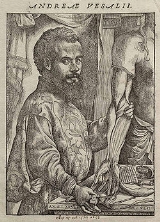
Andreas Vesalius (Brussels
Brussels

Brussels , officially the Brussels Capital-Region, is the de facto capital city of the European Union and the largest urban area in Belgium....
, December 31, 1514 - Zakynthos
Zakynthos

Zakynthos , the third largest of the Ionian Islands, covers an area of and its coastline is roughly in length. The island is named after Zakynthos , the son of a legendary Arcadian chief Dardanus....
, October 15, 1564) was an anatomist
Anatomy

Anatomy is a branch of biology that is the consideration of the body plan. It is a general term that includes human anatomy, animal anatomy and plant anatomy ....
, physician
Physician

A physician, medical practitioner, doctor of medicine, or medical doctor practices medicine, and is concerned with maintaining or restoring human health through the study, diagnosis, and treatment of disease and injury....
, and author of one of the most influential books on human anatomy
Human anatomy

Human anatomy, which, with physiology and biochemistry, is a complementary basic medical science is primarily the scientific study of the morphology of the adult human body....
, De humani corporis fabrica
De humani corporis fabrica

De humani corporis fabrica libri septem is a textbook of human anatomy written by Andreas Vesalius in 1543.The book is based on his University of Padua lectures, during which he deviated from common practice by dissecting a corpse to illustrate what he was discussing....
 (On the Workings of the Human Body). Vesalius is often referred to as the founder of modern human anatomy.

Vesalius is the Latinized form of Andreas van Wesel. He is sometimes also referred to as Andreas Vesal.

lius was born in Brussels
Brussels

Brussels , officially the Brussels Capital-Region, is the de facto capital city of the European Union and the largest urban area in Belgium....
, then in the Habsburg Netherlands
Habsburg Netherlands

The Habsburg Netherlands was a geo-political entity covering the whole Low Countries from 1482 to 1556/1581 and solely the Southern Netherlands from 1581 to 1794....
, to a family of physicians.


Discussion
Ask a question about 'Vesalius'
Start a new discussion about 'Vesalius'
Answer questions from other users
Full Discussion Forum


Recent Posts


Encyclopedia


Andreas Vesalius (Brussels
Brussels

Brussels , officially the Brussels Capital-Region, is the de facto capital city of the European Union and the largest urban area in Belgium....
, December 31, 1514 - Zakynthos
Zakynthos

Zakynthos , the third largest of the Ionian Islands, covers an area of and its coastline is roughly in length. The island is named after Zakynthos , the son of a legendary Arcadian chief Dardanus....
, October 15, 1564) was an anatomist
Anatomy

Anatomy is a branch of biology that is the consideration of the body plan. It is a general term that includes human anatomy, animal anatomy and plant anatomy ....
, physician
Physician

A physician, medical practitioner, doctor of medicine, or medical doctor practices medicine, and is concerned with maintaining or restoring human health through the study, diagnosis, and treatment of disease and injury....
, and author of one of the most influential books on human anatomy
Human anatomy

Human anatomy, which, with physiology and biochemistry, is a complementary basic medical science is primarily the scientific study of the morphology of the adult human body....
, De humani corporis fabrica
De humani corporis fabrica

De humani corporis fabrica libri septem is a textbook of human anatomy written by Andreas Vesalius in 1543.The book is based on his University of Padua lectures, during which he deviated from common practice by dissecting a corpse to illustrate what he was discussing....
 (On the Workings of the Human Body). Vesalius is often referred to as the founder of modern human anatomy.

Vesalius is the Latinized form of Andreas van Wesel. He is sometimes also referred to as Andreas Vesal.

Early life and education

Vesalius was born in Brussels
Brussels

Brussels , officially the Brussels Capital-Region, is the de facto capital city of the European Union and the largest urban area in Belgium....
, then in the Habsburg Netherlands
Habsburg Netherlands

The Habsburg Netherlands was a geo-political entity covering the whole Low Countries from 1482 to 1556/1581 and solely the Southern Netherlands from 1581 to 1794....
, to a family of physicians. His great-grandfather, Jan van Wesel, probably born in Wesel
Wesel

Wesel is a city in North Rhine-Westphalia, Germany. It is the capital of the Wesel ....
, received his medical degree from the University of Pavia
University of Pavia

The University of Pavia is a university located in Pavia, Lombardy, Italy. It was founded in 1361 and is organized in 9 Faculties....
 and taught medicine in 1428 at the then newly founded University of Leuven
Catholic University of Leuven

The Catholic University of Leuven, or Louvain, was the largest, oldest and most prominent university in Belgium. It was founded in 1425 by Pope Martin V, and refounded in 1835 after the disruptions of the French Revolutionary Wars....
. His grandfather, Everard van Wesel, was the Royal Physician of Emperor Maximilian
Maximilian I, Holy Roman Emperor

Maximilian I of Habsburg was Holy Roman Empire from 1508 until his death, but had ruled jointly with his father for the last ten years of his reign, from circa 1483....
, while his father, Andries van Wesel, went on to serve as apothecary
Apothecary

Apothecary is a historical name for a medicine who formulates and dispenses materia medica to physicians, surgery and patients ? a role now served by a pharmacist ....
 to Maximillian, and later a valet de chambre
Valet de chambre

Valet de chambre, or varlet de chambre, was a noble court appointment introduced in the late Middle Ages, common from the 14th century onwards....
 to his successor Charles V
Charles V, Holy Roman Emperor

Charles V was ruler of the Holy Roman Empire from 1519 and, as Charles I of Spain, of the Spanish realms from 1516 until his abdication in 1556....
. Andries encouraged his son to continue in the family tradition, and enrolled him in the Brethren of the Common Life
Brethren of the Common Life

The Brethren of the Common Life was a Roman Catholic religious community founded in the 14th century by Gerard Groote, formerly a successful and worldly educator who had had a religious experience and preached a life of simple devotion to Jesus Christ....
 in Brussels to learn Greek
Greek language

Greek is an Indo-European languages native to the southern Balkan peninsula, the language of the Greek people. It forms an independent branch within Indo-European....
 and Latin
Latin

Latin is an Italic language, historically spoken in Latium and Ancient Rome. Through the Military history of the Roman Empire, Latin spread throughout the Mediterranean and a large part of Europe....
 according to standards of the era.

In 1528 Vesalius entered the University of Louvain (Pedagogium Castrensis) taking arts, but when his father was appointed as the Valet de Chambre in 1532, he decided to pursue a career in medicine at the University of Paris
University of Paris

The historic University of Paris first appeared in the 12th century. In 1970 it was reorganized as 13 autonomous university . The university is often referred to as the Sorbonne or La Sorbonne after the collegiate institution founded about 1257 by Robert de Sorbon....
, where he moved in 1533. Here he studied the theories of Galen
Galen

Aelius Galenus or Claudius Galenus , better known as Galen of Pergamum , was a prominent Ancient Rome physician and philosopher of Greek origin, and probably the most accomplished medical researcher of the Roman period....
 under the auspices of Jacques Dubois
Jacques Dubois

Jacques Dubois , also known as Jacobus Sylvius in Latin, was a France anatomy in Paris....
 (Jacobus Sylvius) and Jean Fernel
Jean Fernel

Jean Fran?ois Fernel was a France physician who introduced the term "physiology" to describe the study of the body's function. He was the first person to describe the spinal canal....
. It was during this time that he developed his interest in anatomy, and was often found examining bones at the Cemetery of the Innocents.

Vesalius was forced to leave Paris in 1536 due to the opening of hostilities between the Holy Roman Empire and France, and returned to Leuven
Leuven

Leuven is the capital of the province of Flemish Brabant in the Flanders, Belgium. It is located about 30 kilometers east of Brussels, with as other neighbouring cities Mechelen, Aarschot, Tienen, and Wavre....
. Here he completed his studies under Johannes Winter von Andernach and graduated the next year. His thesis, Paraphrasis in nonum librum Rhazae medici arabis clariss ad regem Almansorum de affectum singularum corporis partium curatione, was a commentary on the ninth book of Rhazes. He remained at Leuven only briefly before leaving after a dispute with his professor. After settling briefly in Venice
Venice

Venice is a city in northern Italy, the capital city of the Italian regions Veneto, a population of 271,251 . Together with Padua, Italy, the city is included in the Padua-Venice Metropolitan Area ....
 in 1536, he moved to the University of Padua
University of Padua

The University of Padua , located in Padua, Italy, was founded in 1222. It is among the earliest of the university and the third oldest in Italy....
 (Universitas aristarum) to study for his doctorate, which he received in 1537.

On graduation he was immediately offered the chair of Surgery and Anatomy (explicator chirurgiae) at Padua. He also guest lectured at Bologna
University of Bologna

The University of Bologna is the oldest continually operating degree-granting university in the world:, the word 'university' being first used by this institution at its foundation....
 and Pisa
University of Pisa

The University of Pisa is one of the most renowned Italian universities. It is located in Pisa, Tuscany. It was formally founded on the September 3, 1343 by an edict of Pope Clement VI, although there had been lectures on law in Pisa since the 11th century....
. Previously these topics had been taught primarily from reading classic texts, mainly Galen
Galen

Aelius Galenus or Claudius Galenus , better known as Galen of Pergamum , was a prominent Ancient Rome physician and philosopher of Greek origin, and probably the most accomplished medical researcher of the Roman period....
, followed by an animal dissection by a barber-surgeon whose work was directed by the lecturer. No attempt was made to actually check Galen's claims; these were considered unassailable. Vesalius, on the other hand, carried out dissection as the primary teaching tool, handling the actual work himself while his students clustered around the table. Hands-on direct observation was considered the only reliable resource, a huge break with medieval practice.

He kept meticulous drawings of his work for his students in the form of six large illustrated anatomical tables. When he found that some of these were being widely copied, he published them all in 1538 under the title Tabulae Anatomicae Sex. He followed this in 1539 with an updated version of Galen's anatomical handbook, Institutiones Anatomicae. When this reached Paris one of his former professors published an attack on this version.

In 1538 he also published a letter on venesection, or bloodletting
Bloodletting

Bloodletting is the withdrawal of often considerable quantities of blood from a patient in the belief that this would cure or prevent a great many illnesses and diseases....
. This was a popular treatment for almost any illness, but there was some debate about where to take the blood from. The classical Greek procedure, advocated by Galen, was to let blood from a site near the location of the illness. However, the Muslim and medieval practice was to draw a smaller amount blood from a distant location. Vesalius' pamphlet supported Galen's view, and supported his arguments through anatomical diagrams.

In 1539 a Paduan judge became interested in Vesalius' work, and made bodies of executed criminals available for dissection. He soon built up a wealth of detailed anatomical diagrams, the first accurate set to be produced. Many of these were produced by commissioned artists, and were therefore of much better quality than those produced previously.

In 1541, while in Bologna, Vesalius uncovered the fact that all of Galen's research had been based upon animal anatomy rather than the human; since dissection had been banned in ancient Rome, Galen had dissected Barbary Apes instead, and argued that they would be anatomically similar to humans. As a result, he published a correction of Galen's Opera omnia and began writing his own anatomical text. Until Vesalius pointed this out, it had gone unnoticed and had long been the basis of studying human anatomy. However, some people still chose to follow Galen and resented Vesalius for calling attention to such glaring mistakes.

Vesalius, undeterred, went on to stir up more controversy, this time disproving not just Galen but also Mondino de Liuzzi
Mondino de Liuzzi

Mondino dei Liuzzi was an Italian medical professor and a pioneer of anatomy in practice.Mondino was born in Bologna into a Tuscany family from Florence with loyalties to the Ghibellines....
 and even Aristotle
Aristotle

Aristotle was a Greeks philosopher, a student of Plato and teacher of Alexander the Great. He wrote on many subjects, including physics, metaphysics, Poetics , theater, music, logic, rhetoric, politics, government, ethics, biology and zoology....
; all three had made assumptions about the functions and structure of the heart that were clearly wrong. For instance, Vesalius noted that the heart had four chambers, the liver two lobes, and that the blood vessels originated in the heart, not the liver.

Galen assumed arteries carried the purest blood to higher organs such as the brain and lungs from the left ventricle of the heart, while veins carried blood to the lesser organs such as the stomach from the right ventricle. In order that this theory could be correct some sort of holes were needed to interconnect the ventricles, and so in the spirit of Galen's time, he claimed to have found them, adjusting the facts to suit his theory. So paramount was the authority of Galen that for the next 1400 years, a succession of anatomists claimed to find these holes until finally Vesalius declared he could not find them. However, while Vesalius dared to admit he could not find these holes, he did not dream of disputing Galen on the distribution of blood, and so imagined it distilled through the unbroken partition between the ventricles.

Other famous examples of Vesalius disproving Galen in particular was his discovery that the lower jaw was only one bone, not two (which Galen had assumed from animal dissection) and his proof that blood did not pass through the interatrial septum
Interatrial septum

The interatrial septum is the wall of tissue that separates the right atrium and left atrium of the heart....
.

In 1543, Vesalius conducted a public dissection of the body of Jakob Karrer von Gebweiler, a notorious felon from the city of Basel
Basel

Basel is Switzerland's third most populous city . With 731,000 inhabitants in the tri-national metropolitan area , Basel is Switzerland's third-largest urban area....
, Switzerland
Switzerland

Switzerland is a landlocked Swiss Alps country of roughly 7.7 million people in Western Europe with an area of 41,285 km?. Switzerland is a federal republic consisting of 26 states called Cantons of Switzerland....
. With the cooperation of the surgeon Franz Jeckelmann, he assembled the bones and finally donated the skeleton
Skeleton

In biology, a skeleton is a rigid framework that provides protection and structure in many types of animal, particularly those of the phylum Chordata and of the superphylum Ecdysozoa....
 to the University of Basel
University of Basel

The University of Basel is located at Basel, Switzerland....
. This preparation (“The Basel Skeleton”) is Vesalius’ only well-preserved skeletal preparation today, and is also the world’s oldest anatomical preparation. It is still displayed at the Anatomical Museum of the University of Basel
University of Basel

The University of Basel is located at Basel, Switzerland....
.

De Corporis Fabrica

Vesalius Fabrica P190
In 1543, Vesalius asked Johannes Oporinus
Johannes Oporinus

Johannes Oporinus was a classics philologist from Basel, where, in 1537, he became Professor in Greek language.He made a Latin version of Gesta Danorum in 1534, titled Saxonis Grammatici Danorum Historiae Libri XVI....
 to help publish the seven-volume De humani corporis fabrica
De humani corporis fabrica

De humani corporis fabrica libri septem is a textbook of human anatomy written by Andreas Vesalius in 1543.The book is based on his University of Padua lectures, during which he deviated from common practice by dissecting a corpse to illustrate what he was discussing....
 (On the fabric of the human body), a groundbreaking work of human anatomy
Human anatomy

Human anatomy, which, with physiology and biochemistry, is a complementary basic medical science is primarily the scientific study of the morphology of the adult human body....
 he dedicated to Charles V and which most believe was illustrated by Titian
Titian

File:Tizian 090.jpg Tiziano Vecelli or Tiziano Vecellio, born 1473/1490 , died 27 August 1576, better known as Titian , was the leading painter of the 16th-century Venice school of the Italian Renaissance....
's pupil Jan Stephen van Calcar
Jan Van Calcar

Jan Steven van Calcar was a Netherlands-born Italy painter.LifeCalcar was born in the Duchy of Kleve sometime between 1499 and 1510....
. A few weeks later he published an abridged edition for students, Andrea Vesalii suorum de humani corporis fabrica librorum epitome, and dedicated it to Philip II of Spain
Philip II of Spain

Philip II was King of Spain from 1556 until 1598, List of monarchs of Naples from 1554 until 1598, king consort of England, as husband of Mary I of England, from 1554 to 1558, lord of the Seventeen Provinces from 1556 until 1581, holding various titles for the individual territories, such as Duke or Count; and King of Portugal as Philip I...
, son of the Emperor.

The work emphasized the priority of dissection and what has come to be called the "anatomical" view of the body — seeing human internal functioning as an essentially corporeal structure filled with organs arranged in three-dimensional space. This was in stark contrast to many of the anatomical models used previously, which had strong Galenic/Aristotelean elements, as well as elements of astrology
Astrology

Astrology is a group of systems, traditions, and beliefs which hold that the relative positions of astronomical object and related details can provide useful information about personality, human affairs, and other terrestrial matters....
. Although modern anatomical texts had been published by Mondino
Mondino de Liuzzi

Mondino dei Liuzzi was an Italian medical professor and a pioneer of anatomy in practice.Mondino was born in Bologna into a Tuscany family from Florence with loyalties to the Ghibellines....
 and Berenger
Jacopo Berengario da Carpi

Jacopo Berengario da Carpi was an Italian physician. His book "Anatomia Carpi" published in 1535 made him the most important anatomy before Andreas Vesalius....
, much of their work was clouded by their reverence for Galen and Arabian doctrines.

Besides the first good description of the sphenoid bone
Sphenoid bone

The sphenoid bone is a bone situated at the base of the skull in front of the temporal bone and basilar part of the occipital bone.The sphenoid bone is one of the seven bones that articulate to form the orbit ....
, he showed that the sternum
Sternum

The sternum is a long flat bone located in the center of the chest . It connects to the rib via cartilage, forming the rib cage with them, and thus helps to protect the lungs, heart and major blood vessels from physical trauma....
 consists of three portions and the sacrum
Sacrum

The sacrum is a large, triangular bone at the base of the vertebral column and at the upper and back part of the pelvic cavity, where it is inserted like a wedge between the two hip bones....
 of five or six; and described accurately the vestibule
Vestibule of the ear

DefinitionThe vestibule is the central part of the Labyrinth , and is situated medial to the tympanic cavity, behind the cochlea, and in front of the semicircular canals....
 in the interior of the temporal bone. He not only verified the observation of Etienne on the valves of the hepatic veins, but he described the vena azygos, and discovered the canal which passes in the fetus between the umbilical vein and the vena cava, since named ductus venosus
Ductus venosus

In the fetus, the ductus venosus shunts a significant majority of the blood flow of the umbilical vein directly to the inferior vena cava. Thus, it allows oxygenated blood from the placenta to bypass the liver....
. He described the omentum
Omentum

Omentum can refer to two different components of the peritoneum:* greater omentum* lesser omentum...
, and its connections with the stomach, the spleen
Spleen

The spleen is an organ found in all vertebrate animals. In humans, the spleen is located in the abdomen of the body, where it functions in the destruction of redundant red blood cells, and holds a reservoir of blood....
 and the colon
Colon (anatomy)

The colon is the last portion of the digestive system in most vertebrates; it extracts water and salt from feces before they are defecation from the body....
; gave the first correct views of the structure of the pylorus
Pylorus

The pylorus is the region of the stomach that connects to the duodenum. It is divided in two parts:* the pyloric antrum, which connects to the body of the stomach....
; observed the small size of the caecal appendix in man; gave the first good account of the mediastinum
Mediastinum

The mediastinum is a non-delineated group of structures in the thorax , surrounded by loose connective tissue. It is the central compartment of the thoracic cavity....
 and pleura and the fullest description of the anatomy of the brain yet advanced. He did not understand the inferior recesses; and his account of the nerves is confused by regarding the optic as the first pair, the third as the fifth and the fifth as the seventh.

In this work, Vesalius also becomes the first person to describe mechanical ventilation
Mechanical ventilation

In medicine, mechanical ventilation is a method to mechanically assist or replace spontaneous respiration .Mechanical ventilation is typically used after an invasive intubation, a procedure wherein an endotracheal tube or tracheostomy tube is inserted into the airway....
.

Though Vesalius' work was not the first such work based on actual autopsy, nor even the first work of this era, the production values, highly-detailed and intricate plates, and the fact that the artists who produced it were clearly present at the dissections themselves made it into an instant classic. Pirated editions were available almost immediately, a fact Vesalius acknowledged would happen in a printer's note. Vesalius was only 30 years old when the first edition of Fabrica was published.

Quote

  • "When I undertake the dissection of a human cadaver I pass a stout rope tied like a noose beneath the lower jaw and through the zygomas up to the top of the head... The lower end of the noose I run through a pulley fixed to a beam in the room so that I may raise or lower the cadaver as it hangs there or turn around in any direction to suit my purpose; ... You must take care not to put the noose around the neck, unless some of the muscles connected to the occipital bone have already been cut away. ..." --Andreas Vesalius, 595:2 of Bynum & Porter, Oxford Dictionary of Scientific Quotations 2005


Imperial physician and death

1543,andreasvesalius'fabrica,baseofthebrain
Soon after publication, Vesalius was invited as Imperial physician to the court of Emperor Charles V
Charles V, Holy Roman Emperor

Charles V was ruler of the Holy Roman Empire from 1519 and, as Charles I of Spain, of the Spanish realms from 1516 until his abdication in 1556....
. He informed the Venetian Senate that he was leaving his post in Padua, which prompted Duke Cosimo I de' Medici
Cosimo I de' Medici, Grand Duke of Tuscany

Cosimo I de' Medici was Duke of Florence from 1537 to 1574, reigning as the first Grand Duke of Tuscany from 1569....
 to invite him to move to the expanding university in Pisa, which he turned down. Vesalius took up a position in the court, where he had to deal with the other physicians mocking him as being a barber.

Over the next eleven years Vesalius travelled with the court, treating injuries from battle or tournaments, performing surgeries and postmortems, and writing private letters addressing specific medical questions. During these years he also wrote Radicis Chynae, a short text on the properties of a medical plant, whose use he defended, as well as defense for his anatomical findings. This elicited a new round of attacks on his work that called for him to be punished by the emperor. In 1551, Charles V commissioned an inquiry in Salamanca
Salamanca

Salamanca is a city in western Spain, the capital of the province of Salamanca , which belongs to the autonomous community of Castile and Leon ....
 to investigate the religious implications of his methods. Vesalius' work was cleared by the board, but the attacks continued. Four years later one of his main detractors published an article that claimed that the human body itself had changed since Galen had studied it.

After the abdication of Charles he continued at court in great favour with his son Philip II, who rewarded him with a pension for life and by being made a count palatine. In 1555 he published a revised edition of De Corporis.

In 1564 Vesalius went on a pilgrimage to the Holy Land. He sailed with the Venetian fleet under James Malatesta via Cyprus
Cyprus

Cyprus , officially the Republic of Cyprus , is an island country situated in the eastern Mediterranean Sea, east of Greece, west of Lebanon, Syria, and Israel, south of Turkey and north of Egypt....
. When he reached Jerusalem
Jerusalem

Jerusalem is the capital of Israel and its List of Israeli cities in both population and area, with a population of 747,600 residents over an area of if Positions on Jerusalem East Jerusalem is included....
, he received a message from the Venetian senate requesting him again to accept the Paduan professorship, which had become vacant by the death of his friend and pupil Fallopius
Gabriele Falloppio

Gabriele Falloppio , often known by his Latin name Fallopius, was one of the most important human anatomy and physicians of the sixteenth century....
.

After struggling for many days with the adverse winds in the Ionian Sea
Ionian Sea

The Ionian Sea is an arm of the Mediterranean Sea, south of the Adriatic Sea. It is bounded by southern Italy, including Calabria, Sicily and the Salento peninsula, to the west, by southwestern Albania, including Saranda and Himara, and a large number of Greek islands, including Corfu, Zante, Kephalonia, Ithaka, and Lefkas to the east....
, he was wrecked on the island of Zakynthos
Zakynthos

Zakynthos , the third largest of the Ionian Islands, covers an area of and its coastline is roughly in length. The island is named after Zakynthos , the son of a legendary Arcadian chief Dardanus....
. Here he soon died in such debt that, if a benefactor had not paid for a funeral, his remains would have been thrown to the animals. At the time of his death he was scarcely fifty years of age.

For many years it was assumed that Vesalius's pilgrimage was due to pressures of the Inquisition
Inquisition

The term Inquisition can refer to any one of several institutions charged with trying and convicting Christian heresy within the Roman Catholic Church....
. Today this is generally considered to be without foundation (see C.D. O'Malley Andreas Vesalius' Pilgrimage, Isis 45:2, 1954) and is dismissed by modern biographers. It appears the story was spread by Hubert Languet
Hubert Languet

Hubert Languet was a France diplomat and Protestant Reformation.He entered the University of Poitiers in order to study law but he was interested also in theology, history, and natural science and political science....
, who served as de Saxe under Charles V and then the prince of Orange. He claimed in 1565 that Vesalius was performing an autopsy on an aristocrat in Spain when it was found that the heart was still beating, leading to the Inquisition condemning him to death. The story went on to claim that Philip II had the sentence transformed into a pilgrimage. The story re-surfaced several times over the next few years, living on until recent times.

See also

  • Timeline of medicine and medical technology
    Timeline of medicine and medical technology

    Timeline of medicine and medical technology...
  • InVesalius
    InVesalius

    InVesalius is a free medical software used to reconstruct structures of the human body. Based on two-dimensional images, acquired using Computed tomography or Magnetic resonance imaging equipments, the software generates virtual three-dimensional models correspondent to anatomical parts of the human body....
  • Medical Renaissance
    Medical Renaissance

    Medical Renaissance is the term often applied to the period, from around 1400 to 1750, of major progress in medical knowledge and a renewed interest in the ancient ideas of the ancient Greece and Ancient Rome....


External links