
All Topics  
Pythagorean triple


Pythagorean triple


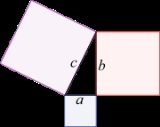
A Pythagorean triple consists of three positive integerInteger

The integers consist of the positive natural numbers , their negatives and the number zero....
s a, b, and c, such that a2 + b2 = c2. Such a triple is commonly written (abc), and a well-known example is (3, 4, 5). If (abc) is a Pythagorean triple, then so is (ka, kb, kc) for any positive integer k. A primitive Pythagorean triple is one in which a, b and c are coprimeCoprime

In mathematics, the integers a and b are said to be coprime or relatively prime if they have no common factor ...
.

The name is derived from the Pythagorean theoremPythagorean theorem

In mathematics, the Pythagorean theorem or Pythagoras' theorem is a relation in Euclidean geometry among the three sid...
, of which every Pythagorean triple is a solution. The converse is not true. For instance, the triangleTriangle

A triangle is one of the basic shapes of geometry: a polygon with three vertices and three sides which are straight line seg...
 with sides a = b = 1 and c = v2 is right, but (1, 1, v2) is not a Pythagorean triple because v2 is not an integer. Moreover, 1 and v2 do not have an integer common multiple because v2 is irrationalIrrational number

In mathematics, an irrational number is any real number that is not a rational number, i.e., it is not of the form ...
.
There are 16 primitive Pythagorean triples with c = 100:
( 3, 4, 5) ( 5, 12, 13) ( 7, 24, 25) ( 8, 15, 17)
( 9, 40, 41) (11, 60, 61) (12, 35, 37) (13, 84, 85)
(16, 63, 65) (20, 21, 29) (28, 45, 53) (33, 56, 65)
(36, 77, 85) (39, 80, 89) (48, 55, 73) (65, 72, 97)


Generating a triple


This classic formula was given by EuclidEuclid

Euclid , a Greek mathematician, who lived in Alexandria, Hellenistic Egypt, almost certainly during the reign of Ptolemy I...
 (c. 300 B.C.) in his book ElementsEuclid's Elements

Euclid's Elements is a mathematical and geometric treatise, consisting of 13 books, written by the Hellenistic mathemat...
 and is often referred to as Euclid's formula.

where m and n are two positive integers with m > n and k is a positive integer. The triple generated will be primitive only if k=1 and m and n are coprimeCoprime Overview

In mathematics, the integers a and b are said to be coprime or relatively prime if they have no common factor ...
 and exactly one of them is even (if both n and m are odd, then a, b, and c will be even, and so the Pythagorean triple will not be primitive). When used to describe primitive triples, the k term in Euclid's formula is often omitted. Every primitive triple (possibly after exchanging a and b) arises from a unique pair of coprime numbers m , n. This shows that there are infinitely many primitive Pythagorean triples (combine, for example, 2 with any of the infinitely many other prime numbers). Relationships to the integers m,n from this equation are referenced throughout the rest of this article.

The relation between (m,n) and (a,b) is that in the complex planeComplex plane

In mathematics, the complex plane is a geometric space of the complex numbers as set up by the real axis and the ortho...
 a + ib is m + in squared.

An alternative form of the Euclid formula eliminates the negative sign by making use of the relation m = p + q and n = p:

See also: Other formulas for generating triples below for additional equations that can be used to generate triples.

Properties of primitive Pythagorean triples

The properties of primitive Pythagorean triples include:

  • Exactly one of a, b is odd; c is odd.
  • The area (A = ab/2) is an integer.
  • Exactly one of a, b is divisible by 3.
  • Exactly one of a, b is divisible by 4.
  • Exactly one of a, b, c is divisible by 5.
  • Exactly one of a, b, (a + b), (ba) is divisible by 7.
  • All prime factors of c are primes of the form 4n+1.
  • At most one of a, b is a square.
  • Every integer greater than 2 that is not congruent to 2 mod 4 is part of a primitive Pythagorean triple. Examples of integers not part of a primitive pythagorean triple: 6,10,14,18
  • Every integer greater than 2 is part of a primitive or non-primitive Pythagorean triple, for example, the integers 6,10,14, and 18 are not part of primitive triples, but are part of the non-primitive triples 6,8,10; 14,48,50 and 18,80,82.
  • There exist infinitely many Pythagorean triples whose hypotenuses are squares of natural numbers.
  • There exist infinitely many Pythagorean triples in which one of the legs is the square of a natural number.
  • There exist infinitely many Pythagorean triples in which the hypotenuse and the longer of the two legs differ by exactly one.
  • There exist infinitely many Pythagorean triples in which the hypotenuse and the longer of the two legs differ by exactly two.
  • There are no primitive Pythagorean triples in which the hypotenuse and a leg differ by a prime number greater than 2.
  • For each natural number n, there exist n Pythagorean triples with different hypotenuses and the same area.
  • For each natural number n, there exist at least n different Pythagorean triples with the same leg a, where a is some natural number
  • For each natural number n, there exist at least n different triangles with the same hypotenuse.
  • In every Pythagorean triple, the radius of the incircle and the radii of the three excircles are natural numbers. (Actually the radius of the incircle can be shown to be )
  • There is no Pythagorean triple in which the hypotenuse and one leg are the legs of another Pythagorean triple.
  • In a pythagorean triplet a+b=c+2[(c-a)(c-b)/2]^1/2.
  • (c-a)(c-b)/2 is always a perfect square.

Some relationships


If is a primitive Pythagorean triple, where a is odd, then


where each fraction is reduced to lowest terms and m > n.

It can also be shown that

Additional relationships among the sides:


The radius, r, of the inscribed circleInscribed circle

#REDIRECT: Incircle and excircles of a triangle ...
 can be found by:


for primitive triples:


The unknown sides of a triple can be calculated directly from the radius of the incircle, r, and the value of a single known side, a.
k = a − 2r
b = 2r + (2 r2/k)
c = b+ k = 2r + (2r2 /k) + k


The solution to the 'Incircles' problem shows that, for any circle whose radius is a whole number k, we are guaranteed at least one right angled triangle containing this circle as its inscribed circle where the lengths of the sides of the triangle are a primitive Pythagorean triple:

a=2k(k+1)
b=2k+1
c=2k2+2k+1


The perimeter P and area L of a primitive Pythagorean triple triangle are
P = a + b + c = 2m(m + n)
L = ab/2 = mn(m2 − n2)


The shortest side will be a if one of the following conditions is met:


More relationships among the sides:


see: http://www.geocities.com/fredlb37/node8.html

If two numbers of a triple are known, the third can be found using the Pythagorean theoremPythagorean theorem

In mathematics, the Pythagorean theorem or Pythagoras' theorem is a relation in Euclidean geometry among the three sid...
.

Unit circle relationships


An arbitrary rational slope, t on the unit circle can be written t = n/m where m and n are integers and m > n. Other unit circle relationships are shown below:


Half-angle relationships


A special case: the Platonic sequence


The case n = 1 of the more general construction of Pythagorean triples has been known for a long time. ProclusProclus

Proclus Lycaeus , surnamed "The Successor" or "diadochos" , was a Greek Neoplatonist philosopher, one of the last major Gre...
, in his commentary to the 47th PropositionPythagorean theorem

In mathematics, the Pythagorean theorem or Pythagoras' theorem is a relation in Euclidean geometry among the three sid...
 of the first book of Euclid's ElementsEuclid's Elements

Euclid's Elements is a mathematical and geometric treatise, consisting of 13 books, written by the Hellenistic mathemat...
, describes it as follows:

Certain methods for the discovery of triangles of this kind are handed down, one which they refer to Plato, and another to Pythagoras. (The latter) starts from odd numbers. For it makes the odd number the smaller of the sides about the right angle; then it takes the square of it, subtracts unity and makes half the difference the greater of the sides about the right angle; lastly it adds unity to this and so forms the remaining side, the hypotenuse.

...For the method of Plato argues from even numbers. It takes the given even number and makes it one of the sides about the right angle; then, bisecting this number and squaring the half, it adds unity to the square to form the hypotenuse, and subtracts unity from the square to form the other side about the right angle. ... Thus it has formed the same triangle that which was obtained by the other method.


In equation form, this becomes:

a is odd (Pythagoras, c. 540 BC):

a is even (Plato, c. 380 BC):

It can be shown that all Pythagorean triples are derivatives of the basic Platonic sequence (x,y,z) = p, (p2 - 1)/2 and (p2 + 1)/2 by allowing a to take non-integer rational values. If p is replaced with the rational fraction m/n in the sequence, the 'standard' triple generator 2mn, m2 - n2  and m2 + n2  results. It follows that every triple has a corresponding rational p value which can be used to generate a similar (i.e. equiangular) triangle with rational sides in the same proportion as the original. For example, the Platonic equivalent of (6,8,10) is (3/2; 2, 5/2). The Platonic sequence itself can be derived by following the steps for 'splitting the square' described in Diophantus II.VIIIDiophantus II.VIII

The eighth problem of the second book of Diophantus's Arithmetica is to divide a square into a sum of two squares....
.

Other formulas for generating triples


I., II.

Pythagoras' and Plato's formulas have been described above. The methods below appear in various sources, often without attribution as to their origin.

III.

Given an integer n, the triple can be generated by the following two procedures:

Example: When n = 2 the triple produced is 5, 12, and 13
(This formula is actually the same as method I, substituting m with 2n + 1.)

Alternatively, one can generate triples from even integers using the following formulas:

Example: When m = 4 the triple produced is 8, 15, and 17
(This formula is another specific case of method I, substituting n with 1).

IV.

Given the integers n and x,

Example: For n = 3 and x = 5, a = 80, b = 39, c = 89.
(This formula is actually the same as method I, substituting m and n with n+x and x.)

V.

Triples can be calculated using this formula: , x,y,z > 0 where the following relations hold:

x = c − b, y = c − a, z = a + b − c and a = x + z, b = y + z, c = x + y + z and r = z/2 , where
x, y, and z are the three sides of the triple and r is the radius of the inscribed circle.

Pythagorean triples can then be generated by choosing any even integer z.

x and y are any two factors of .

Example: Choose z = 6. Then
The three factor-pairs of 18 are: (18, 1), (2, 9), and (6, 3). All three factor pairs will produce triples using the above equations.

z = 6, x = 18, y = 1 produces the triple a = 18 + 6 = 24, b = 1 + 6 = 7, c = 18 + 1 + 6 = 25.

z = 6, x = 2, y = 9 produces the triple a = 2 + 6 = 8, b = 9 + 6 = 15, c = 2 + 9 + 6 = 17.

z = 6, x = 6, y = 3 produces the triple a = 6 + 6 = 12, b = 3 + 6 = 9, c = 6 + 3 + 6 = 15.

VI.

An infinity by infinity matrix M of Pythagorean triples (PNTs), which has some particularly desirable properties can be generated by taking:


where r is the row number and k is the column number. Note that a is always doubly even, while b and c are always odd. Not more than the first k rows in column k will have a > b. Each row is a family of PNTs with the hypotenuse c of each PNT in row r exceeding the even side a by the square of the rth odd number. The Pythagorean formula for generating PNTs (section I, above) with a and b reversed to make a the even side, and m being any natural number:


yields the first row (r = 1) of M, and the Platonic formula (section II, above) using a = 4m instead of 2m, to eliminate derivative PNTs:


yields the first column (k = 1) of M.

Each column is a family of PNTs with the hypotenuse of each PNT in column k exceeding the odd side b by twice the square of k. For example M(6,4) = 241 − 120 = 121, the square of the sixth odd number (11), and 241 − 209 = 32, which is twice the square of 4.

Below is a small portion of the matrix. The PNTs of row 1 are all relatively prime (primitive), but every other row contains derivative (not relatively prime) PNTs Iff the column number is a power of 2, the PNTs in that column are all primitive. For every odd prime factor p of the column number, the middle row of each group of p rows (r = (p+1)/2 + np, where n >= 0) will contain a PNT which is derivative. In the table below these are indicated by angle brackets. If j is 2 or a factor of k, then M(r, jk) is derivative if and only if M(r, k) is derivative. Fewer than 20% of the PNTs in M are derivative.

column-> 12345
row a b c a b c a b c a b c a b c
1 4 3 5 12 5 13 24 7 25 40 9 41 60 11 61
2 8 15 17 20 21 29 <36 27 45> 56 33 65 80 39 89
3 12 35 37 28 45 53 48 55 73 72 65 97 <100 75 125>
4 16 63 65 36 77 85 60 91 109 88 105 137 120 119 169
5 20 99 101 44 117 125 <72 135 153> 104 153 185 140 171 221
6 24 143 145 52 165 173 84 187 205 120 209 241 160 231 281

The a's of each column k are an arithmetic sequence with difference 4k, and the b's of each row r are an arithmetic sequence with difference 4r-2. The a's, b's, and c's of any row or column are each monotonically increasing.

If the two legs of a PNT differ by 1, the longer leg and the hypotenuse form the coordinates of a larger PNT in M the legs of which differ by 1. M(1,1) = . M(4,5) = .
M(120,169) = , etc. Thus, a Pythagorean triangle can be found, the acute angles of which are arbitrarily close to 45 degrees. As Martin (1875) describes, each such triple has the form
where are the Pell numberPell number

In mathematics, the Pell numbers and companion Pell numbers are both sequences of integers....
s.

VII.

Generalized Fibonacci Series:
A pythagorean triple can be generated by using any two arbitrary integers, a and b using the following procedures:

a. select any two integers a and b

b. define c = a+b

c. define d = b+c

The integers a,b,c,d are a generalized Fibonacci series. The sides of the triple are computed as follows:

side 1 =

side 2 =

hypotenuse =

example let a = 69 and b = 75, then c = 69+75 =144 and d= 75+144=219

side 1 =

side 2 =

hypotenuse =

VIII.

Progression of Whole and Fractional Numbers:

Take a progression of whole and fractional numbers:
1 1/3, 2 2/5 , 3 3/7 , 4 4/9 etc.
The properties of this progression are:
a) the whole numbers are those of the common series and have unity as their common difference b) the numerators of the fractions, annexed to the whole numbers, are also the natural numbers. 3) the denominators of the fractions are the odd numbers, 3,5,7, etc.

To calculate a pythagorean triple:

select any term of this progression and reduce it to an improper fraction. For example, take the term 3 3/7. The improper fraction is 24/7. The numbers 7 and 24 are the sides, a and b, of a right triangle. The hypotenuse is one greater than the largest side.

1 1/3 yields the 3,4,5 triple; 2 2/5 gives 5,12,13 ; 3 3/7 yields gives 7,24, 25 ;
4 4/9 gives 9,40,41 and so forth.

IX.

Generating Triples using a Square:

Start with any square number . Express that number in the form , then will produce another square such that .
For instance:

let , , , and .

let , , , and .

This works because . If we add , our expression becomes , which factors into the form

X.

Generating Triples When One Side is Known:

Start with any integer . Use this relation from the Euclid formula: . If is odd, then multiply by 2. Identify all factor-pairs (m,n) of and use the Euclid equations to calculate the remaining sides of the triple.

Examples:
Let =24 (e.g. the known side is even)

so that . The factor pairs (m,n) of 12 are (12,1), (6,2) and (4,3). The three triples are therefore:


Let =35 (e.g. the known side is odd)

The two unknown sides could also be calculated by making use of the relation . This would be a factoring exercise in finding the difference of two squares, but a simpler approach is to multiply the known side by two and continue as before :

so that . The factor pairs (m,n) of 35 are (35,1), (7,5).

The two triples are therefore (note that is necessary to remove the factor of 2 which was introduced):

XI.

Generating Triples Using Quadratic Equations:

There are several methods for defining quadratic equations for calculating each leg of a Pythagorean triple. A simple method is to modify the standard Euclid equation by adding a variable “x” to each m and n pair. The “m,n” pair is treated as a constant while the value of x is varied to produce a “family” of triples based on the selected triple. An arbitrary coefficient can be placed in front of the “x” value on either m or n, which has the effect causing the resulting equation to systematically “skip” through the triples. For example, let’s use the triple 20,21, 29, when can be calculated from the Euclid equations with a value of m=5 and n=2. Also, let’s arbitrarily put the coefficient of 4 in front of the “x” in the “m” term.

Let m1 = (4x + m) and n1= (x + n)

Hence, substituting the values of m and n:


Note that the original triple comprises the constant term in each of the respective quadratic equations. Below is a sample output from these equations. Note that the effect of these equations is to cause the “m” value in the Euclid equations to increment in steps of 4, while the “n” value increments by 1.

x side a side b side c m n
0 20 21 29 5 2
1 54 72 90 9 3
2 104 153 185 13 4
3 170 264 314 17 5
4 252 405 477 21 6

Parent/child relationships


All primitive Pythagorean triples can be generated from the 3-4-5 triangle by using the 3 linear transformations T1, T2, T3 below, where a ,b, c are sides of a triple:
new side anew side b new side c
T1: a - 2b + 2c 2a - b + 2c 2a - 2b + 3c
T2: a + 2b + 2c 2a + b + 2c 2a + 2b + 3c
T3: -a + 2b + 2c -2a + b + 2c -2a + 2b + 3c

If one begins with 3, 4, 5 then all other primitive triples will eventually be produced. In other words, every primitive triple will be a “parent” to 3 additional primitive triples.
example: Let a = 3, b = 4, c = 5.

new side anew side bnew side c
3 - (2×4) + (2×5) = 5 (2×3) - 4 + (2×5) = 12 (2×3) - (2×4) + (3×5) = 13
3 + (2×4) + (2×5) = 21 (2×3) + 4 + (2×5) = 20 (2×3) + (2×4) + (3×5) = 29
-3 + (2×4) + (2×5) = 15 -(2×3) + 4 + (2×5) = 8 -(2×3) + (2×4) + (3×5) = 17

The linear transformations T1, T2, and T3 have a geometric interpretation in the language of quadratic forms. They are closely related to (but are not equal to) reflections generating the orthogonal groupOrthogonal group

In mathematics, the orthogonal group of degree n over a field F) is the group of n-by-n orthogonal matrices ...
 of x2 + y2 - z2 over the integers.

For further discussion of parent-child relationships in triples, see: http://mathworld.wolfram.com/PythagoreanTriple.html and
“The Modular Tree of Pythagoras”, Robert Alperin, Department of Mathematics and Computer Science, San Jose State University, San Jose California) http://www.math.sjsu.edu/~alperin/pt.pdf and http://www.faust.fr.bw.schule.de/mhb/pythagen.htm

Generalizations

There are several ways to generalize the concept of Pythagorean triples.

A set of four positive integers a, b, c and d such that a2 + b2c2 = d2 is called a Pythagorean quadruplePythagorean quadruple

A set of four positive integers a, b, c and d such that a2 + b2+ c2 = d2 ...
.

A generalization of the concept of Pythagorean triples is the search for triples of positive integers a, b, and c, such that an + bn = cn, for some n strictly greater than 2. Pierre de FermatPierre de Fermat

Pierre de Fermat was a French lawyer at the Parlement of Toulouse, southwestern France, and a mathematician who is giv...
 in 1637 claimed that no such triple exists, a claim that came to be known as Fermat's Last TheoremFermat's Last Theorem Summary

Fermat's Last Theorem is one of the most famous theorems in the history of mathematics....
 because it took longer than any other theorem by Fermat to be proven or disproven. The first proof was given by Andrew WilesAndrew Wiles

Sir Andrew John Wiles is an English-American research mathematician at Princeton University in number theory....
 in 1994.

Another generalization is searching for sets of n+1 positive integers for which the nth power of the last is the sum of the nth powers of the previous terms. The smallest sets for known values of n are:

  • n=3: .
  • n=4:
  • n=5:
  • n=7:
  • n=8:

See also


  • Heronian triangleHeronian triangle

    In geometry, a Heronian triangle is a triangle whose sidelengths and area are all rational numbers....
  • Pythagorean primePythagorean prime Overview

    A Pythagorean prime is prime number of the form 4n + 1....
  • Nonhypotenuse numberNonhypotenuse number

    In mathematics, a nonhypotenuse number is a natural number whose square cannot be written as the sum of two nonzero squa...
  • Modular arithmeticModular arithmetic

    Modular arithmetic is a system of arithmetic for integers, where numbers "wrap around" after they reach a certain value &md...
  • Trigonometric identity
  • Tangent half-angle formulaTangent half-angle formula

    In various applications of trigonometry, it is useful to rewrite the trigonometric functions in terms of rational functions of a n...
  • Plimpton 322Plimpton 322 Overview

    Of the approximately half million clay tablets excavated at the beginning of the 19th century, about 400 are of a mathematical nat...
  • Diophantus II.VIIIDiophantus II.VIII

    The eighth problem of the second book of Diophantus's Arithmetica is to divide a square into a sum of two squares....


External links

  • has an extensive discussion of Pythagorean triples.
  • How to find all possible triples from only one side of right angle triangle
  • provides a Javascript calculator for the (m2n2, 2mn, m2 + n2) formula, and shows how to derive the formula.
  • a JavaScript calculator which illustrates the 3-fold tree structure of the set of all primitive Pythagorean triples.
  • at cut-the-knotCut-the-knot Summary

    cut-the-knot is an educational website maintained by Alexander Bogomolny and devoted to popular exposition of a great variet...
     Interactive Applet showing unit circle relationships to Pythagorean Triples
  • at cut-the-knotCut-the-knot

    cut-the-knot is an educational website maintained by Alexander Bogomolny and devoted to popular exposition of a great variet...
  • Covers topics in the history of Fermat's Last Theorem from Pythagorean triples to Wiles' proof.
  • Finding m and n if given a primitive Pythagorean triple
  • Generating All Pythagorean Triples
  • Euclid's Classification of Pythagorean Triples
  • Shows how to generate new triples by multiplication of two triples.
  • Formulas for Primitive Pythagorean Triples and Their Derivation
  • Links to several on-line Triple calculators; discussion of the incircle formula
  • Theoretical properties of the Pythagorean Triples and connections to geometry
  • Picturing Pythagorean Triples
  • Description of how to transform a triple into 3 new triples.
  • The Online Encyclopedia of Integer Sequences contains
  • Displays results in table form for ease-of-use.
  • http://www.mcs.surrey.ac.uk/Personal/R.Knott/Pythag/pythag.html Discussion of Properties of Pythagorean triples, Interactive Calculators, Puzzles and Problems
  • Generating Pythagorean Triples Using Arithmatic Progressions*