All Topics  
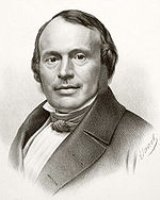
Louis Agassiz

 
Louis Agassiz

   Email Print
   Bookmark   Link


Louis Agassiz


Jean Louis Rodolphe Agassiz (May 28, 1807—December 14, 1873) was a paleontologist, glaciologist, and geologist
Geologist

For other uses, see Geologist .A geologist is a contributor to the science of geology, studying the physical structure and processes of the Earth and planets of the solar system ....
, and was a prominent innovator in the study of the earth's natural history
Natural history

Natural history is the scientific research of plants or animals, leaning more towards the observational than experimental methods of study, and encompasses more research that is published in magazines than in academic journals....
. He grew up in Switzerland and became a professor of natural history at University of Neuchâtel
University of Neuchâtel

At a glance An annual budget of CHF 120 millions. An annual research fund of CHF 40 millions. Approximately 4,000 students, including 500 PhD students....
. Later, he accepted a professorship at Harvard University
Harvard University

Harvard University is a private university in Cambridge, Massachusetts, Massachusetts, United States, and a member of the Ivy League. Founded in 1636 by the colonial Massachusetts legislature, Harvard is the Colonial Colleges institution of higher learning in the United States....
 in the United States.

Early life and education
Louis Agassiz was born in Môtier (now part of Haut-Vully
Haut-Vully

Haut-Vully is a Municipalities of Switzerland in the district of See in the Cantons of Switzerland of Fribourg in Switzerland. Until 1977, it was officially known as Vully-Le-Haut....
) in the canton of Fribourg
Canton of Fribourg

The Canton of Fribourg is a Cantons of Switzerland of Switzerland. It is located in the west of the country. The capital of the canton is Fribourg....
, Switzerland
Switzerland

Switzerland is a landlocked Swiss Alps country of roughly 7.7 million people in Western Europe with an area of 41,285 km?. Switzerland is a federal republic consisting of 26 states called Cantons of Switzerland....
.


Discussion
Ask a question about 'Louis Agassiz'
Start a new discussion about 'Louis Agassiz'
Answer questions from other users
Full Discussion Forum


Quotations


The time has come when scientific truth must cease to be the property of the few, when it must be woven into the common life of the world.

Methods of Study in Natural History (1863), ch. 4

The eye of the trilobite tells us that the sun shone on the old beach where he lived; for there is nothing in nature without a purpose, and whn so complicated an organ was made to receive light, there must have been light to enter it.

Geological Sketches (1870), ch. 2

The facts will eventually test all our theories, and they form, after all, the only impartial jury to which we can appeal.

Geological Sketches (1870), ch. 9


Encyclopedia


Jean Louis Rodolphe Agassiz (May 28, 1807—December 14, 1873) was a paleontologist, glaciologist, and geologist
Geologist

For other uses, see Geologist .A geologist is a contributor to the science of geology, studying the physical structure and processes of the Earth and planets of the solar system ....
, and was a prominent innovator in the study of the earth's natural history
Natural history

Natural history is the scientific research of plants or animals, leaning more towards the observational than experimental methods of study, and encompasses more research that is published in magazines than in academic journals....
. He grew up in Switzerland and became a professor of natural history at University of Neuchâtel
University of Neuchâtel

At a glance An annual budget of CHF 120 millions. An annual research fund of CHF 40 millions. Approximately 4,000 students, including 500 PhD students....
. Later, he accepted a professorship at Harvard University
Harvard University

Harvard University is a private university in Cambridge, Massachusetts, Massachusetts, United States, and a member of the Ivy League. Founded in 1636 by the colonial Massachusetts legislature, Harvard is the Colonial Colleges institution of higher learning in the United States....
 in the United States.

Early life and education


Louis Agassiz was born in Môtier (now part of Haut-Vully
Haut-Vully

Haut-Vully is a Municipalities of Switzerland in the district of See in the Cantons of Switzerland of Fribourg in Switzerland. Until 1977, it was officially known as Vully-Le-Haut....
) in the canton of Fribourg
Canton of Fribourg

The Canton of Fribourg is a Cantons of Switzerland of Switzerland. It is located in the west of the country. The capital of the canton is Fribourg....
, Switzerland
Switzerland

Switzerland is a landlocked Swiss Alps country of roughly 7.7 million people in Western Europe with an area of 41,285 km?. Switzerland is a federal republic consisting of 26 states called Cantons of Switzerland....
. Educated first at home, then spending four years of secondary school in Bienne, he completed his elementary studies in Lausanne
Lausanne

Lausanne is a city in Romandy, the French language-speaking part of Switzerland, situated on the shores of Lake Geneva , and facing ?vian-les-Bains and with the Jura mountains to its north-west....
. Having adopted medicine as his profession, he studied successively at the universities of Zürich
University of Zurich

The University of Zurich , located in the city of Zurich, is the largest university in Switzerland, with over 24,000 students. It was founded in 1833 from the existing colleges of theology, law, medicine and a new Faculty of philosophy....
, Heidelberg
Ruprecht Karl University of Heidelberg

The Ruprecht Karl University of Heidelberg is a public university research university located in Heidelberg, Baden-W?rttemberg, Germany. Founded in 1386, it is the List_of_universities_in_Germany#Universities_by_age and was the third university established in the Holy Roman Empire....
 and Munich
Ludwig Maximilians University of Munich

The Ludwig Maximilian University of Munich , also known as LMU, is a university in Munich and, with more than 44,000 students, is the second-largest university in Germany....
; while there he extended his knowledge of natural history
Natural history

Natural history is the scientific research of plants or animals, leaning more towards the observational than experimental methods of study, and encompasses more research that is published in magazines than in academic journals....
, especially of botany
Botany

Botany, plant science, phytology, or plant biology is a branch of biology and is the Scientific method of plant life and development....
. In 1829 he received the degree of Doctor of Philosophy
Doctor of Philosophy

Doctor of Philosophy, abbreviated Ph.D. or PhD for the Latin , meaning "teacher of philosophy", is an postgraduate academic degree awarded by University....
 at Erlangen
Friedrich-Alexander-University, Erlangen-Nuremberg

The University of Erlangen Nuremberg a university in the cities of Erlangen and Nuremberg in Bavaria, Germany. It is the second largest state university in Bavaria, having eleven Faculty , 265 Professorship, and 10,000 employees....
, and in 1830 that of doctor of medicine
Doctor of Medicine

Doctor of Medicine is a Doctorate for physicians . The degree is granted from medical schools.It is a first professional degree in some countries, including the United States and Canada, although training is entered after obtaining at least 90 hours of university level work ....
 at Munich. Moving to Paris
Paris

Paris is the Capital of France and the country's largest city. It is situated on the river Seine, in northern France, at the heart of the ?le-de-France Regions of France ....
 he fell under the tutelage of Alexander von Humboldt
Alexander von Humboldt

was a German people natural scientist and List of explorers, and the younger brother of the Prussian minister, philosopher, and linguistics, Wilhelm von Humboldt ....
 and Georges Cuvier
Georges Cuvier

Baron Georges L?opold Chr?tien Fr?d?ric Dagobert Cuvier was a France natural history and zoology. He was the elder brother of Fr?d?ric Cuvier , also a naturalist....
, who launched him on his careers of geology and zoology respectively. Until shortly before this time he had paid no special attention to the study of ichthyology
Ichthyology

Ichthyology is the branch of zoology devoted to the study of fish. This includes skeletal fish , cartilaginous fish , and jawless fish . At least 30,700 fish species have been described, comprising a majority of vertebrates....
, which soon afterwards became the great occupation of his life, if not the one for which he is most remembered in the modern day. On the other hand, Agassiz was also openly a racist and an early supporter of Apartheid (s. Hans Faessler, "Reisen in Schwarz-Weiss", Rotpunkt Zurich 2005, ISBN 3-85869-0).

Early work


In 1819-1820, Johann Baptist von Spix
Johann Baptist von Spix

Johann Baptist von Spix was a Germany natural history.Spix was born in H?chstadt. After his first fundamental publication, a book about the history of zoological classification, published in 1810, he was appointed as a member of the Bavarian Academy of Sciences....
 and Carl Friedrich Philipp von Martius
Carl Friedrich Philipp von Martius

Carl Friedrich Philipp von Martius was a Germany botanist and explorer.Martius was born at Erlangen, where he graduated M.D. in 1814, publishing as his thesis a critical catalogue of plants in the botanic garden of the university....
 were engaged in an expedition to Brazil
Brazil

Brazil , officially the Federative Republic of Brazil , is a country in South America. It is the List of countries and outlying territories by total area country by geographical area, occupying nearly half of South America, the List of countries by population country, and the fourth most populous democracy in the world....
, and on their return to Europe, amongst other collections of natural objects they brought home an important set of the fresh water
Fresh Water

Fresh Water is the debut album by Australian rock and blues singer Alison McCallum, released in 1972. Rare for an Australian artist at the time, it came in a gatefold sleeve....
 fish
Fish

A fish is any marine biology vertebrate animal that is typically ectothermic , covered with scale , and equipped with two sets of paired fins and several unpaired fins....
 of Brazil
Brazil

Brazil , officially the Federative Republic of Brazil , is a country in South America. It is the List of countries and outlying territories by total area country by geographical area, occupying nearly half of South America, the List of countries by population country, and the fourth most populous democracy in the world....
, and especially of the Amazon River
Amazon River

The Amazon River of South America is the list of rivers by length in the world by volume, with a total river flow greater than the next top eight largest rivers combined....
. Spix, who died in 1826, did not live long enough to work out the history of these fish, and Agassiz (though fresh out of school) was selected by Martius for this purpose. He at once threw himself into the work with an enthusiasm which characterized him to the end of his busy life. The task of describing the Brazilian fish was completed and published in 1829. This was followed by research into the history of the fish found in Lake Neuchâtel
Lake Neuchâtel

Lake Neuch?tel is a lake in Western Switzerland . The lake lies mainly in the cantons of Switzerland of canton of Neuch?tel, but is also shared by the cantons of Vaud, of canton of Fribourg, and of canton of Berne....
. Enlarging his plans, in 1830 he issued a prospectus of a History of the Freshwater Fish of Central Europe. It was only in 1839, however, that the first part of this publication appeared, and it was completed in 1842. In 1832 he was appointed professor of natural history in the University of Neuchâtel
University of Neuchâtel

At a glance An annual budget of CHF 120 millions. An annual research fund of CHF 40 millions. Approximately 4,000 students, including 500 PhD students....
. The fossil
Fossil

Fossils are the preserved remains or trace fossil of animals, plants, and other organisms from the remote past. The totality of fossils, both discovered and undiscovered, and their placement in fossiliferous Rock formations and sedimentary rock layers is known as the fossil record....
 fish there soon attracted his attention. The fossil-rich stones furnished by the slate
Slate

Slate is a fine-grained, foliation , homogeneous metamorphic rock derived from an original shale-type sedimentary rock composed of clay or volcano ash through low grade regional metamorphism....
s of Glarus
Glarus

Glarus is the capital of the Canton of Glarus in Switzerland.Glarus lies on the Linth at the foot of the Gl?rnisch foothills in the Glarus Alps....
 and the limestone
Limestone

File:Limestone Formation In Waitomo.jpgLimestone is a sedimentary rock composed largely of the mineral calcite . The deposition of limestone strata is often a by-product and indicator of biological activity in the geology record....
s of Monte Bolca
Bolca

Bolca is a village in the Veneto, on the southern margin of the Italy Alps. It is a frazione of the comune of Vestenanova, in the province of Verona....
 were known at the time, but very little had been accomplished in the way of scientific study of them. Agassiz, as early as 1829, planned the publication of the work which, more than any other, laid the foundation of his worldwide fame. Five volumes of his Recherches sur les poissons fossiles ("Research on Fossil Fish") appeared at intervals from 1833 to 1843. They were magnificently illustrated, chiefly by Joseph Dinkel. In gathering materials for this work Agassiz visited the principal museums in Europe, and meeting Cuvier in Paris, he received much encouragement and assistance from him. They had known him for seven years at the time.

Agassiz found that his palaeontological labours made necessary a new basis of ichthyological classification. The fossils rarely exhibited any traces of the soft tissues of fish. They consisted chiefly of the teeth, scales and fins, even the bones being perfectly preserved in comparatively few instances. He therefore adopted a classification which divided fish into four groups: Ganoids, Placoids, Cycloids and Ctenoids, based on the nature of the scales and other dermal appendages. While Agassiz did much to place the subject on a scientific basis, this classification has been superseded by later work.

As Agassiz's descriptive work proceeded, it became obvious that it would over-tax his resources unless financial assistance could be found. The British Association
British Association for the Advancement of Science

The British Association for the Advancement of Science or the British Science Association, formally known as the BA, is a learned society with the object of promoting science, directing general attention to scientific matters, and facilitating interaction between scientific workers....
 came to his aid, and the Earl of Ellesmere
Earl of Ellesmere

Earl of Ellesmere , of Ellesmere in the County of Shropshire, is a title in the Peerage of the United Kingdom. It was created in 1846 along with the courtesy title of Viscount Brackley, of Brackley in the County of Northampton, for the Conservative Party politician Lord Francis Egerton....
 — then Lord Francis Egerton
Francis Egerton, 1st Earl of Ellesmere

Francis Egerton, 1st Earl of Ellesmere Order of the Garter Privy Council of the United Kingdom was the second son of the George Leveson-Gower, 1st Duke of Sutherland and his wife, Elizabeth Leveson-Gower, Duchess of Sutherland....
 — gave him yet more efficient help. The 1,290 original drawings made for the work were purchased by the Earl, and presented by him to the Geological Society of London
Geological Society of London

The Geological Society of London is a learned society based in the United Kingdom with the aim of "investigating the mineral structure of the Earth"....
. In 1836 the Wollaston Medal
Wollaston Medal

The Wollaston Medal is a scientific award for geology, the highest award granted by the Geological Society of London.The medal is named after William Hyde Wollaston, and was first awarded in 1831....
 was awarded to Agassiz by the council of that society for his work on fossil ichthyology; and in 1838 he was elected a foreign member of the Royal Society
Royal Society

The Royal Society of London for the Improvement of Natural Knowledge, known simply as the Royal Society, or even the Royal, is a learned society for science that was founded in 1660 and is considered by most to be the oldest such society still in existence....
. Meanwhile invertebrate
Invertebrate

An invertebrate is an animal lacking a vertebral column. The group includes 98% of all animal species ? all animals except those in the Chordate subphylum vertebrate ....
 animals engaged his attention. In 1837 he issued the "Prodrome" of a monograph on the recent and fossil Echinodermata, the first part of which appeared in 1838; in 1839-1840 he published two quarto volumes on the fossil Echinoderms of Switzerland; and in 1840-1845 he issued his Etudes critiques sur les mollusques fossiles ("Critical Studies on Fossil Mollusks").

Before his first visit to England
England

native_name =|conventional_long_name = England|common_name = England|image_flag = Flag of England.svg|image_coat = England COA.svg|symbol_type = Royal Coat of Arms...
 in 1834, the labours of Hugh Miller
Hugh Miller

Hugh Miller was a self-taught Scotland geologist and writer, folklorist and an evangelical Christian....
 and other geologists brought to light the remarkable fish of the Old Red Sandstone
Old Red Sandstone

The Old Red Sandstone is a British rock formation of considerable importance to early paleontology. For convenience the short version of the term, 'ORS' is often used in literature on the subject....
 of the northeast of Scotland
Scotland

conventional_long_name = ScotlandAlba|common_name= Scotland|image_flag = Flag of Scotland.svg|flag_width = 130px...
. The strange forms of the Pterichthys, the Coccosteus
Coccosteus

Coccosteus is an extinct genus of arthrodire placoderm. Its fossils have been found throughout Europe and North America. The majority of these have been found in freshwater sediments, though, such a large range suggests that they may have been able to enter saltwater....
 and other genera
Genus

A genus is a low-level taxonomic rank used in the classification of living and fossil organisms. The taxonomic ranks are domain , kingdom , phylum, class , order , family , genus, and species....
 were then made known to geologists for the first time. They were of intense interest to Agassiz, and formed the subject of a special monograph by him published in 1844-1845: Monographie des poissons fossiles du Vieux Gres Rouge, ou Systeme Devonien (Old Red Sandstone) des Iles Britanniques et de Russie ("Monograph on Fossil Fish of the Old Red Sandstone, or Devonian System of the British Isles and of Russia").

In the early stages of his career in Neuchatel, Agassiz also made a name for himself as a man who could run a scientific department well. Under his care, the University of Neuchâtel soon became a leading institution for scientific inquiry.

Proposal of an ice age

Bolton Agassiz
In 1837 Agassiz was the first to scientifically propose that the Earth had been subject to a past ice age
Ice age

The general term "ice age" or, more precisely, "glacial age" denotes a geological period of long-term reduction in the temperature of the Earth's surface and atmosphere, resulting in an expansion of continental ice sheets, polar ice sheets and alpine glaciers....
.

Prior to this de Saussure
Horace-Bénédict de Saussure

Horace-B?n?dict de Saussure was a Switzerland aristocrat, physicist and Alpine traveller, often considered the founder of alpinism....
, Venetz
Ignaz Venetz

Ignaz Venetz was a Switzerland engineer, natural history, and glaciologist; as one of the first scientists to recognize glaciers as a major force in shaping the earth, he played a leading role in the foundation of glaciology....
, Jean de Charpentier
Jean de Charpentier

Jean de Charpentier or Johann von Charpentier was a German-Swiss geologist who studied Swiss glaciers. He was born in Freiberg, Saxony, Saxony, Germany and died in Bex, Switzerland....
, Karl Friedrich Schimper
Karl Friedrich Schimper

Karl Friedrich Schimper was a Germany Natural science and poet. Born in Mannheim, he was a theology student at Heidelberg University and taught at Munich University....
 and others had made the glacier
Glacier

A glacier is a large, slow-moving mass of ice, formed from compacted layers of snow, that slowly deforms and flows in response to gravity and high pressure....
s of the Alps
Alps

The Alps is the name for one of the great mountain range systems of Europe, stretching from Austria and Slovenia in the east; through Italy, Switzerland, Liechtenstein and Germany; to France in the west....
 the subjects of special study, and Charpentier as well as Schimper had even arrived at the conclusion that the erratic blocks of alpine rocks scattered over the slopes and summits of the Jura Mountains
Jura mountains

The Jura Mountains are a small mountain range located north of the Alps, separating the Rhine and Rhone River rivers and forming part of the drainage divide of each....
 had been moved there by glaciers. The question having attracted the attention of Agassiz, he not only discussed it with Charpentier and Schimper and made successive journeys to the alpine regions in company with them, but he had a hut constructed upon one of the Aar Glaciers
Aar Glaciers

The Aar Glaciers are glaciers located at the sources of the Aar River in the Bernese Alps, Switzerland. They are constituted by two disctinct glacier systems:...
, which for a time he made his home, in order to investigate the structure and movements of the ice. These labours resulted, in 1840, in the publication of his work in two volumes entitled Etudes sur les glaciers ("Study on Glaciers"). In it he discussed the movements of the glaciers, their moraine
Moraine

A moraine is any glacially formed accumulation of unconsolidated glacial debris which can occur in currently glaciated and formerly glaciated regions, such as those areas acted upon by a past ice age....
s, their influence in grooving and rounding the rocks over which they travelled, and in producing the striations and roches moutonnees seen in Alpine-style landscapes. He not only accepted Charpentier's and Schimper's idea that some of the alpine glaciers had extended across the wide plains and valleys drained by the Aar
Aar

The Aar , a tributary of the Rhine, is the longest river that both rises and ends entirely within Switzerland.Its total length from its source to its junction with the Rhine comprises about 295 km , during which distance it descends 1,565 m , draining an area of 17,779 km? ....
 and the Rhône
Rhône River

The Rhone, or the Rh?ne is one of the major rivers of Europe, originating in Switzerland and running from there through the south-eastern corner of France....
, but he went still farther. He concluded that, in the relatively recent past, Switzerland
Switzerland

Switzerland is a landlocked Swiss Alps country of roughly 7.7 million people in Western Europe with an area of 41,285 km?. Switzerland is a federal republic consisting of 26 states called Cantons of Switzerland....
 had been another Greenland
Greenland

Greenland is a member country of the Kingdom of Denmark located between the Arctic Ocean and Atlantic Oceans, east of the Canadian Arctic Archipelago....
; that instead of a few glaciers stretching across the areas referred to, one vast sheet of ice, originating in the higher Alps, had extended over the entire valley of northwestern Switzerland until it reached the southern slopes of the Jura, which, though they checked and deflected its further extension, did not prevent the ice from reaching in many places the summit of the range. The publication of this work gave a fresh impetus to the study of glacial phenomena in all parts of the world.

Thus familiarized with the phenomena associated with the movements of recent glaciers, Agassiz was prepared for a discovery which he made in 1840, in conjunction with William Buckland
William Buckland

The Very Rev. Dr William Buckland Doctor of Divinity Royal Society was an English people geology, paleontology and Dean of Westminster, who wrote the first full account of a fossil dinosaur....
. The two visited the mountains of Scotland
Scotland

conventional_long_name = ScotlandAlba|common_name= Scotland|image_flag = Flag of Scotland.svg|flag_width = 130px...
 together, and found in different locations clear evidence of ancient glacial action. The discovery was announced to the Geological Society of London in successive communications. The mountainous districts of England
England

native_name =|conventional_long_name = England|common_name = England|image_flag = Flag of England.svg|image_coat = England COA.svg|symbol_type = Royal Coat of Arms...
, Wales
Wales

native_name = Cymru|conventional_long_name = Wales|common_name = Wales|image_flag = Flag of Wales 2.svg|national_motto = ...
, and Ireland
Ireland

Ireland is the List of islands by area in Europe, and the twentieth-largest island in the world. It lies to the north-west of continental Europe and is surrounded by hundreds of islands and islet....
 were also considered to constitute centres for the dispersion of glacial debris; and Agassiz remarked "that great sheets of ice, resembling those now existing in Greenland, once covered all the countries in which unstratified gravel (boulder drift) is found; that this gravel was in general produced by the trituration of the sheets of ice upon the subjacent surface, etc."

Relocation to the United States


In 1842-1846 he issued his Nomenclator Zoologicus, a classified list, with references, of all names employed in zoology for genera and groups — a work of great labour and research. With the aid of a grant of money from the King of Prussia
Prussia

Prussia was, most recently, a historic state originating out of the Duchy of Prussia and the Margraviate of Brandenburg. This state had for centuries substantial influence on Germany and European history....
, Agassiz crossed the Atlantic
Atlantic Ocean

The Atlantic Ocean is the second-largest of the world's oceanic divisions; with a total area of about 106.4 million square kilometres . It covers approximately one-fifth of the Earth's surface....
 in the autumn of 1846 with the twin purposes of investigating the natural history and geology of North America
North America

North America is the northern continent of the Americas, situated in the Earth's northern hemisphere and almost totally in the western hemisphere....
 and delivering a course of lectures on zoology, by invitation from J. A. Lowell
John Amory Lowell

Hon. John Amory Lowell was an American businessman and philanthropist from Boston. He became the sole trustee of the Lowell Institute when his first cousin, John Lowell, Jr....
, at the Lowell Institute
Lowell Institute

Lowell Institute, an educational foundation in Boston, Massachusetts, U.S.A., providing for free public lectures, and endowed by the bequest of $237,000 left by John Lowell, Jr....
 in Boston
Boston, Massachusetts

Boston is the State capital and largest city of the Commonwealth of Massachusetts, and is one of the oldest cities in the United States. The largest city in New England, Boston is considered the economic and cultural center of the region, and is sometimes regarded as the unofficial "Capital of New England." Boston city proper had a 2007 est...
, Massachusetts
Massachusetts

The Commonwealth of Massachusetts is a U.S. state located in the New England region of the Northeastern United States United States. It borders Rhode Island and Connecticut to the south, New York to the west, and Vermont and New Hampshire to the north....
. The financial and scientific advantages presented to him in the United States
United States

The United States of America is a Federal government constitutional republic comprising U.S. state and a federal district. The country is situated mostly in central North America, where its Contiguous United States and Washington, D.C., the Capital districts and territories, lie between the Pacific Ocean and Atlantic Oceans, Borders of the U...
 induced him to settle there, where he remained to the end of his life. He was appointed professor of zoology and geology at Harvard University
Harvard University

Harvard University is a private university in Cambridge, Massachusetts, Massachusetts, United States, and a member of the Ivy League. Founded in 1636 by the colonial Massachusetts legislature, Harvard is the Colonial Colleges institution of higher learning in the United States....
 in 1847 where he founded the Museum of Comparative Zoology
Museum of Comparative Zoology

The Museum of Comparative Zoology, full name "The Louis Agassiz Museum of Comparative Zoology", often abbreviated simply to "MCZ", is a zoology museum located on the grounds of Harvard University in Cambridge, Massachusetts, Massachusetts....
 in 1859 and served as the museum's first director until his death in 1873. During his tenure at Harvard, he was, among many other things, an early student of the effect of the last Ice Age on North America.

In 1850 he married an American college teacher, Elizabeth Cabot Cary Agassiz, who later wrote introductory books about natural history
Natural history

Natural history is the scientific research of plants or animals, leaning more towards the observational than experimental methods of study, and encompasses more research that is published in magazines than in academic journals....
 and, after his death, a lengthy biography of her husband. Agassiz served as a non-resident lecturer at Cornell
Cornell University

Cornell University located in Ithaca, New York, USA, is a private university with four Statutory college. Its two medical campuses are in New York City and Education City, Qatar....
 while also being on faculty at Harvard. In 1852 he accepted a medical professorship of comparative anatomy
Comparative anatomy

Comparative anatomy is the study of similarities and differences in the anatomy of organisms. It is closely related to evolutionary biology and phylogeny ....
 at Charlestown, Massachusetts
Charlestown, Massachusetts

Charlestown is a part of the city of Boston, Massachusetts, Massachusetts located on a peninsula north of Boston proper. Charlestown was originally a separate town and the first capital of the Massachusetts Bay Colony; it became a city in 1847 and was annexed by Boston on January 5, 1874....
, but he resigned in two years. From this time his scientific studies dropped off, but he was a profound influence on the American branches of his two fields, teaching decades worth of future prominent scientists, including David Starr Jordan
David Starr Jordan

David Starr Jordan, Ph.D., LL.D. was a leading eugenics, ichthyologist , educator and peace activist. He was president of Indiana University and Stanford University....
, Joel Asaph Allen
Joel Asaph Allen

Joel Asaph Allen was an United States zoologist and ornithologist, born in Springfield, MA.He studied at Harvard University under Louis Agassiz....
, Joseph Le Conte, Ernest Ingersoll
Ernest Ingersoll

Ernest Ingersoll was a renowned United States natural history, writer and explorer.A native of Monroe, Michigan, Ingersoll studied for a time at Oberlin College and afterward at Harvard University, where he was a pupil of Louis Agassiz....
, Nathaniel Shaler
Nathaniel Shaler

Nathaniel Southgate Shaler was an American paleontologist and geologist who wrote extensively on the theological and scientific implications of the theory of evolution....
, Samuel Hubbard Scudder
Samuel Hubbard Scudder

Samuel Hubbard Scudder was an United States entomologist and palaeontologist.He was born 13 April 1837 in Boston, Massachusetts and died in the same city 17 May 1911....
, Alpheus Packard, and his son Alexander Agassiz, among others. He had a profound impact on the paleontologist Charles Doolittle Walcott
Charles Doolittle Walcott

Charles Doolittle Walcott was an United States invertebrate paleontologist. He became known for his discovery in 1909 of well-preserved fossils in the Burgess shale formation of British Columbia, Canada....
. In return his name appears attached to several species, as well as here and there throughout the American landscape, notably Lake Agassiz
Lake Agassiz

Lake Agassiz was an immense glacial lake located in the center of North America. Fed by glacial runoff at the end of the last glacial period, its area was larger than all of the present-day Great Lakes combined....
, the Pleistocene
Pleistocene

The Pleistocene is the epoch from 1.8 million to 10,000 years Before Present covering the world's recent period of repeated glaciations. The name pleistocene is derived from the Greek and ....
 precursor to Lake Winnipeg
Lake Winnipeg

Lake Winnipeg is a very large lake in central North America, in the Provinces and territories of Canada of Manitoba, Canada, about north of the city of Winnipeg, Manitoba....
 and the Red River
Red River of the North

The Red River is a North American river. Formed by the confluence of the Bois de Sioux River and Otter Tail River rivers in the United States, it flows northward through the Red River Valley and forms the border between the U.S....
.

During this time he grew in fame even in the public consciousness, becoming one of the best-known scientists in the world. By 1857 he was so well-loved that his friend Henry Wadsworth Longfellow
Henry Wadsworth Longfellow

Henry Wadsworth Longfellow was an United States educator and poet whose works include "Paul Revere's Ride ", The Song of Hiawatha, and "Evangeline"....
 wrote "The fiftieth birthday of Agassiz" in his honour. His own writing continued with four (of a planned ten) volumes of Natural History of the United States which were published from 1857 to 1862. During this time he also published a catalog of papers in his field, Bibliographia Zoologiae et Geologiae, in four volumes between 1848 and 1854.

Stricken by ill health in the 1860s, he resolved to return to the field partly for relaxation, and partly to take up his studies of Brazilian fishes once again. In April 1865 he led a party to Brazil. Returning home in August 1866, an account of this expedition, entitled A Journey in Brazil, was published in 1868. From December 4th 1871 he made a second eight month excursion, known as the Hassler
Hassler (vessel)

The Hassler was the early steamboat used in the service of the U.S. National Geodetic Survey. In 1871-1872 the ship sailed on the Hassler Expedition, under Commander Philip Carrigan Johnson, brother of Eastman Johnson....
 expedition, under the command of Commander Philip Carrigan Johnson (brother of Eastman Johnson
Eastman Johnson

Eastman Johnson was an United States painter, and Co-Founder of the Metropolitan Museum of Art, New York City, with his name inscribed at its entrance....
), visiting the southern shores of North America, both on its Atlantic and its Pacific seaboards. The ship explored the Magellan Strait, which drew the praise of Charles Darwin
Charles Darwin

Charles Robert Darwin Royal Society was an English people natural history who realised and presented compelling evidence that all species of life have evolution over time from common descent, through the process he called natural selection....
 himself.

Elizabeth Aggasiz wrote, at the Strait: '…the Hassler pursued her course, past a seemingly endless panorama of mountains and forests rising into the pale regions of snow and ice, where lay glaciers in which every rift and crevasse, as well as the many cascades flowing down to join the waters beneath, could be counted as she steamed by them.... These were weeks of exquisite delight to Agassiz. The vessel often skirted the shore so closely that its geology could be studied from the deck.'

Legacies


In 1863, Agassiz's daughter Ida married Henry Lee Higginson
Henry Lee Higginson

Henry Lee Higginson was a noted American businessman and philanthropist. He is best known as the founder of the Boston Symphony Orchestra....
, later to be founder of the Boston Symphony Orchestra
Boston Symphony Orchestra

The Boston Symphony Orchestra is an American orchestra based in Boston, Massachusetts. It is one of the five American orchestras commonly referred to as the "Big Five "....
 and benefactor to Harvard University
Harvard University

Harvard University is a private university in Cambridge, Massachusetts, Massachusetts, United States, and a member of the Ivy League. Founded in 1636 by the colonial Massachusetts legislature, Harvard is the Colonial Colleges institution of higher learning in the United States....
 and other schools.

In the last years of his life, Agassiz worked to establish a permanent school where zoological science could be pursued amid the living subjects of its study. In 1873, a private philanthropist (John Anderson) gave Agassiz the island of Penikese, in Buzzards Bay
Buzzards Bay (bay)

Buzzards Bay is a headlands and bays of the Atlantic Ocean adjacent to the U.S. state of Massachusetts. It is approximately 45 kilometers long by twelve kilometers wide....
, Massachusetts (south of New Bedford
New Bedford, Massachusetts

New Bedford is a city in Bristol County, Massachusetts, Massachusetts, United States, located about 51 miles south of Boston, Massachusetts, 28 miles southeast of Providence, Rhode Island, Rhode Island, and about 12 miles east of Fall River, Massachusetts....
), and presented him with $50,000 to permanently endow it as a practical school of natural science, especially devoted to the study of marine zoology. The John Anderson school collapsed soon after Agassiz's death, but is considered a precursor of the Marine Biological Laboratory
Marine Biological Laboratory

The Marine Biological Laboratory is an international center for research and education in biology and ecology. Founded in 1888, the MBL is the oldest independent marine laboratory in the Americas, taking advantage of a coastal setting in the Cape Cod village of Woods Hole, Massachusetts....
, which is nearby.

Agassiz is remembered today for his theories on ice ages, and for his resistance to Charles Darwin
Charles Darwin

Charles Robert Darwin Royal Society was an English people natural history who realised and presented compelling evidence that all species of life have evolution over time from common descent, through the process he called natural selection....
's theories on evolution, which he kept up his entire life. He died in Cambridge, Massachusetts
Cambridge, Massachusetts

Cambridge is a city in the Greater Boston area of Massachusetts, United States. It was named in honor of the University of Cambridge in England....
 in 1873 and was buried at Mount Auburn Cemetery
Mount Auburn Cemetery

Founded in 1831 as "America's first garden cemetery", or the first "rural cemetery", Mount Auburn Cemetery is an Elysium where, traditionally, chaste classical monuments were set in rolling landscaped terrain....
. His monument is a boulder selected from the moraine of the glacier of the Aar near the site of the old Hotel des Neuchatelois, not far from the spot where his hut once stood; and the pine-trees that shelter his grave were sent from his old home in Switzerland.

The Cambridge elementary school north of Harvard University was named in his honor and the surrounding neighborhood became known as "Agassiz" as a result. The school's name was changed to the Maria L. Baldwin school on May 21, 2002, in honor of the African-American principal of the school who served from 1889 until 1922. The neighborhood, however, continues to be known as Agassiz.

An ancient glacial lake that formed in the Great Lakes region of North America, Lake Agassiz
Lake Agassiz

Lake Agassiz was an immense glacial lake located in the center of North America. Fed by glacial runoff at the end of the last glacial period, its area was larger than all of the present-day Great Lakes combined....
, is named after him, as are Mount Agassiz
Mount Agassiz (California)

Mount Agassiz, at , is one of the twenty highest peaks of California. It is located at the north end of the Palisades in the eastern Sierra, near Bishop Pass, on the boundary between Kings Canyon National Park and Inyo National Forest....
 in California's Palisades
Palisades (California Sierra)

The Palisades are a group of peaks in the central part of the Sierra Nevada range in the US state of California. They are located about southwest of the town of Big Pine, California....
, Mount Agassiz, Utah, in the Uinta Mountains, and Agassiz Peak
Agassiz Peak

Agassiz Peak is the second highest mountain in U.S. state of Arizona at . It is located in the San Francisco Peaks within the Coconino National Forest near Flagstaff, Arizona....
 in Arizona. Agassiz Glacier
Agassiz Glacier

Agassiz Glacier is located in the U.S. state of Montana in Glacier National Park . It is named after Louis Agassiz, a Swiss-American glaciologist....
 and Agassiz Creek in Glacier National Park
Glacier National Park

Glacier National Park may refer to:*Glacier National Park in British Columbia, Canada*Glacier National Park in Montana, USA...
 also bear his name. A crater on Mars and a promontorium on the Moon are also named in his honour. In addition, several animal species are so named, including Apistogramma agassizi (Agassiz's dwarf cichlid), Isocapnia agassizi (Agassiz snowfly), and Gopherus agassizii (desert tortoise).

In 2005 the EGU
European Geosciences Union

The European Geosciences Union is an interdisciplinary learned Non-profit organization association open to individuals who are professionally engaged in or associated with geosciences, planetary science and space sciences, and related studies....
 Division on Cryospheric Sciences established the Louis Agassiz Medal, awarded to individuals in recognition of their outstanding scientific contribution to the study of the cryosphere
Cryosphere

The cryosphere, derived from the Greek language word kryo for "cold" or "to cold", is the term which collectively describes the portions of the Earth?s surface where water is in solid form, including sea ice, lake ice, river ice, snow cover, glaciers, ice caps and ice sheets, and frozen ground ....
 on Earth or elsewhere in the solar system.

He took part in a monthly gathering called the Saturday Club at the Omni Parker House
Omni Parker House

The Omni Parker House Hotel is a hotel in Boston, Massachusetts, Massachusetts, currently owned by Omni Hotels and named the Omni Parker House....
, a meeting of Boston writers and intellectuals. He was therefore mentioned in a stanza of the Oliver Wendell Holmes, Sr.
Oliver Wendell Holmes, Sr.

Oliver Wendell Holmes Sr., was an American physician and professor who also achieved fame as a writer. During his lifetime, he was one of the best regarded poets of the 19th century and is considered a member of the Fireside Poets....
 poem, "At the Saturday Club," where the author dreams he sees some of his friends who are no longer:

"There, at the table's further end I see In his old place our Poet's vis-à-vis, The great PROFESSOR, strong, broad-shouldered, square, In life's rich noontide, joyous, debonair. His social hour no leaden care alloys, His laugh rings loud and mirthful as a boy's,-- That lusty laugh the Puritan forgot,-- What ear has heard it and remembers not? How often, halting at some wide crevasse Amid the windings of his Alpine pass, High up the cliffs, the climbing mountaineer, Listening the far-off avalanche to hear, Silent, and leaning on his steel-shod staff, Has heard that cheery voice, that ringing laugh, From the rude cabin whose nomadic walls Creep with the moving glacier as it crawls!

How does vast Nature lead her living train In ordered sequence through that spacious brain, As in the primal hour when Adam named The new-born tribes that young creation claimed!-- How will her realm be darkened, losing thee, Her darling, whom we call our AGASSIZ!"


Racial classification scheme and racism


After Agassiz came to the United States he became a prolific writer in what has been later termed the genre of scientific racism
Scientific racism

Scientific racism denotes the use of scientific, or ostensibly scientific, findings and methods to support or validate Racism attitudes and worldviews....
. Agassiz was specifically a believer and advocate in polygenism
Polygenism

See also Polygenesis Polygenism is a theory of human origins positing that the human Race are of different lineages, either from a scientific or a religious basis....
, that races came from separate origins (specifically separate creations), were endowed with unequal attributes, and could be classified into specific climatic zones, in the same way he felt other animals and plants could be classified.

These included Western American Temperate (the indigenous peoples west of the Rockies); Eastern American Temperate (east of the Rockies); Tropical Asiatic (south of the Himalayas); Temperate Asiatic (east of the Urals and north of the Himalayas); South American Temperate (South America); New Holland (Australia); Arctic (Alaska and Arctic Canada); Cape of Good Hope (South Africa); and American Tropical (Central America and the West Indies).

Agassiz denied that species originated in single pairs, whether at a single location or at many. He argued instead that multiple individuals in each species were created at the same time and then distributed throughout the continents where God meant for them to dwell. His lectures on polygenism were popular among the slaveholders in the South; for many this opinion legitimized the belief in a lower standard of the Negro. Interestingly, his stance in this case was considered to be quite radical in its time, because it went against the more orthodox and standard reading of the Bible in his time which implied all human stock descended from a single couple (Adam and Eve
Adam and Eve

Adam and Eve are the First man or woman created by God in the Hebrew creation story told in Genesis 1-2....
), and in his defense Agassiz often used what now sounds like a very "modern" argument about the need for independence between science and religion; though Agassiz, unlike many polygeneticists, maintained his religious beliefs and was not anti-Biblical in general.

Stephen Jay Gould
Stephen Jay Gould

Stephen Jay Gould was a prominent American Paleontology, Evolution, and History of science. He was also one of the most influential and widely read writers of popular science of his generation....
 has argued that Agassiz's theories sprang from an initial revulsion in his encounters with African-Americans upon moving to the United States. Agassiz's racism was by no means unique for his time or context, though his reading of it into a formalized and scientific context gave it a sense of legitimacy, and allowed it to be easily exported to other contexts.

In the context of ethnology and anthropology of the mid-19th century, Agassiz's polygenetic views became explicitly seen as opposing Darwin's views on race, which sought to show the common origin of all human races and the superficiality of racial differences. Darwin's second book on evolution, The Descent of Man, features extensive argumentation addressing the single origin of the races, at times explicitly opposing Agassiz's theories.

Agassiz's racial theories have, in the late twentieth and early twenty-first centuries, become seen as tarnishing to his scientific record, occasionally prompting the renaming of landmarks, schoolhouses, and other institutions which bear the name of Agassiz (many of which abound in Massachusetts). Opinions on these events are often torn, given his extensive scientific legacy in other areas. On September 9, 2007 the Swiss Federal Council (Government) acknowledged the "racist thinking" of Agassiz but declined to rename the Agassizhorn summit.

Works


  • Recherches sur les poissons fossiles (1833-1843)
  • History of the Freshwater Fishes of Central Europe (1839-1842)
  • Etudes sur les glaciers (1840)
  • Etudes critiques sur les mollusques fossiles (1840-1845)
  • Nomenclator Zoologicus (1842-1846)
  • Monographie des poissons fossiles du Vieux Gres Rouge, ou Systeme Devonien (Old Red Sandstone) des Iles Britanniques et de Russie (1844-1845)
  • Bibliographia Zoologiae et Geologiae (1848)
  • (with AA Gould) Principles of Zoology for the use of Schools and Colleges (Boston, 1848)
  • Lake Superior: Its Physical Character, Vegetation and Animals, compared with those of other and similar regions (Boston: Gould, Kendall and Lincoln, 1850)
  • Natural History of the United States (Boston: Little, Brown, 1847-1862)
  • Geological Sketches ((Boston: Ticknor & Fields, 1866)
  • (1868)
  • De l'espèce et de la classification en zoologie [Essay on classification] (Trans. Felix Vogeli. Paris: Bailière, 1869)
  • Geological Sketches (Second Series) (Boston: J.R. Osgood, 1876)
  • , by Louis Agassiz (1962, Cambridge)


Sources

  • Numbers, Ronald L., "The Creationists: From Scientific Creationism to Intelligent Design", 2nd ed., 2006.
  • Early Classics in Biography, Distribution, and Diversity Studies: to 1950.


External links

  • , by Louis Agassiz (1850)
  • , by Mabel Louise Robinson (1930) - free download at manybooks.net
  • (Agassiz went to Brazil to find glacial boulders and to refute Darwin. Dom Pedro II gave his support for Agassiz's expedition on the Amazon River.)