
Encyclopedia
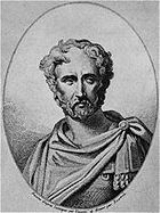
Gaius Plinius Secundus, better known as
Pliny the Elder, was an ancient author and natural philosopher of some importance who wrote
Naturalis Historia or "Natural History" is an encyclopedia [i] written by Pliny the Elder [i]. ...
. He believed that "true glory consists of doing what deserves to be written, and writing what deserves to be read".
He was the son of a
Roman eques by the daughter of the
Senator Gaius Caecilius of Novum Comum. He was born at
Como, not at
Verona: it is only as a native of
Gallia Transpadana that he calls
Catullus of Verona his
conterraneus, or fellow-countryman, not his
municeps, or fellow-townsman . A statue of Pliny on the facade of the Duomo of Como celebrates him as a native son.
Chronology of His Life
Before 35 his father took him to
Rome, where he was educated under his father's friend, the poet and military commander, Publius Pomponius Secundus, who inspired him with a lifelong love of learning. Two centuries after the death of the Gracchi, Pliny saw some of their autograph writings in his preceptor's library , and he afterwards wrote that preceptor's
Life.
He mentions the grammarians and
rhetoricians, Remmius Palaemon and Arellius Fuscus , and he may have been their student. In Rome he studied
botany in the
topiarius of the aged Antonius Castor , and saw the fine old lotus trees in the grounds that had once belonged to Crassus . He also viewed the vast structure raised by
Caligula , and probably witnessed the triumph of
Claudius over Britain in 44 . Under the influence of
Seneca the Younger he became a keen student of
philosophy and
rhetoric, and began practicing as an advocate.
He saw military service under Corbulo in
Germania Inferior in 47, taking part in the Roman conquest of the Chauci and the construction of the canal between the rivers
Maas and
Rhine . As a young commander of
cavalry he wrote in his winter-quarters a work on the use of
missiles on horseback , with some account of the points of a good
horse .
In
Gaul and
Spain he learned the meanings of a number of
Celtic words . He took note of sites associated with the Roman invasion of Germany, and, amid the scenes of the victories of Drusus, he had a dream in which the victor enjoined him to transmit his exploits to posterity . The dream prompted Pliny to begin forthwith a history of all the
wars between the Romans and the Germans.
He probably accompanied his father's friend Pomponius on an expedition against the Chatti , and visited Germany for a third time as a comrade of the future
emperor, Titus Flavius . Under
Nero he lived mainly in Rome. He mentions the map of
Armenia and the neighbourhood of the
Caspian Sea, which was sent to Rome by the staff of Corbulo in 58 . He also saw the building of Nero's "golden house" after the fire of 64 .
Meanwhile he was completing the twenty books of his
History of the German Wars, the only authority expressly quoted in the first six books of the
Annals of
Tacitus , and probably one of the principal authorities for the
Germania. It was superseded by the writings of Tacitus, and, early in the
5th century, Symmachus had little hope of finding a copy .
He also devoted much of his time to writing on the comparatively safe subjects of grammar and rhetoric. A detailed work on rhetoric, entitled
Studiosus, was followed by eight books,
Dubii sermonis, in 67.
Under his friend
Vespasian he returned to the service of the state, serving as procurator in
Gallia Narbonensis and
Hispania Tarraconensis , and also visiting the province of
Gallia Belgica . During his stay in Spain he became familiar with the
agriculture and the
mines of the country, besides paying a visit to
Africa . On his return to Italy he accepted office under Vespasian, whom he used to visit before daybreak for instructions before proceeding to his official duties, after the discharge of which he devoted all the rest of his time to study .
He completed a
History of his Times in thirty-one books, possibly extending from the reign of Nero to that of Vespasian, and deliberately reserved it for publication after his death . It is quoted by Tacitus , and is one of the authorities followed by Suetonius and
Plutarch.
He also virtually completed his great work, the
Naturalis Historia or "Natural History" is an encyclopedia [i] written by Pliny the Elder [i]. ...
, an
encyclopedia into which Pliny collected much of the knowledge of his time. The work had been planned under the rule of Nero. The materials collected for this purpose filled rather less than 160 volumes in 23, when Larcius Licinus, the praetorian legate of Hispania Tarraconensis, vainly offered to purchase them for a sum equivalent to more than £3,200 or £200,000 . He dedicated the work to the emperor Titus Flavius Vespasianus in 77.
Vesuvius
Soon afterwards he received from Vespasian the appointment of
praefect of the
Roman fleet at
Misenum. On August 24, 79 A.D., he was stationed at Misenum, at the time of the great
eruption of
Mount Vesuvius, which overwhelmed
Pompeii and
Herculaneum. A desire to observe the phenomenon directly, and also to rescue some of his friends from their perilous position on the shore of the
Bay of Naples, led to his launching his galleys and crossing the bay to Stabiae . His nephew, Pliny the Younger, provided an account of his death, and suggested that he collapsed and died through inhaling poisonous gases emitted from the volcano. .
He is still remembered in
vulcanology where the term
plinian refers to a
very violent eruption of a volcano marked by columns of smoke and ash extending high into the stratosphere. The term
ultra-plinian is reserved for the most violent type of plinian eruption such as the 1883 destruction of
Krakatoa.
The story of his last hours is told in an addressed twenty-seven years afterwards to Tacitus by the Elder Pliny's nephew and heir, Pliny the Younger , who also sends to another correspondent an account of his uncle's writings and his manner of life :
"He began to work long before daybreak.…He read nothing without making extracts; he used even to say that there was no book so bad as not to contain something of value. In the country it was only the time when he was actually in his bath that was exempted from study. When travelling, as though freed from every other care, he devoted himself to study alone. In short, he deemed all time wasted that was not employed in study."
His only writings to have survived to modern times is the
Naturalis historia. It was used as an authority over the following centuries by countless scholars.
Literature
At the conclusion of his literary labours, as the only Roman who had ever taken for his theme the whole realm of nature, he prays for the blessing of the universal mother on his completed work.
In literature he assigns the highest place next to
Homer,
Cicero and
Virgil.
He takes a keen interest in nature, and in the natural sciences, studying them in a way that was then new in Rome, while the small esteem in which studies of this kind were held does not deter him from endeavouring to be of service to his fellow countrymen .
The scheme of his great work is vast and comprehensive, being nothing short of an encyclopedia of learning and of art so far as they are connected with nature or draw their materials from it. With a view to this work he studied the original authorities on each subject and was most assiduous in making excerpts from their pages. His
indices auctorum are, in some cases, the authorities which he has actually consulted ; in other cases, they represent the principal writers on the subject, whose names are borrowed second-hand for his immediate authorities. He frankly acknowledges his obligations to all his predecessors in a phrase that deserves to be proverbial . He had neither the temperament for original investigation, nor the leisure necessary for the purpose.
It was his scientific curiosity as to the phenomena of the eruption of Vesuvius that brought his life of unwearied study to a premature end; and any criticism of his faults of omission is disarmed by the candour of the confession in his preface:
nec dubitamus multa esse quae et nos praeterierint; homines enim sumus et occupati officiis.
His style betrays the unhealthy influence of Seneca. It aims less at clearness and vividness than at epigrammatic point. It abounds not only in antitheses, but also in questions and exclamations,
tropes and metaphors, and other
mannerisms of the Silver Age. The rhythmical and artistic form of the sentence is sacrificed to a passion for emphasis that delights in deferring the point to the close of the period. The structure of the sentence is also apt to be loose and straggling. There is an excessive use of the ablative absolute, and ablative phrases are often appended in a kind of vague "apposition" to express the author's own opinion of an immediately previous statement, e.g. ,
dixit ... uno se praestare, quod manum de tabula sciret tollere, memorabili praecepto nocere saepe nimiam diligentiam.
About the middle of the
3rd century an abstract of the geographical portions of Pliny's work was produced by Solinus; and early in the
4th century the medical passages were collected in the
Medicina Plinii. Early in the
8th century we find
Bede in possession of an excellent manuscript of the whole work. In the
9th century Alcuin sends to
Charlemagne for a copy of the earlier books ; and Dicuil gathers extracts from the pages of Pliny for his own
Mensura orbis terrae .
Pliny's work was held in high esteem in the
Middle Ages. The number of extant manuscripts is about 200; but the best of the more ancient manuscripts, that at
Bamberg, contains only books xxxii-xxxvii. Robert of Cricklade, prior of St. Frideswide at
Oxford, dedicated to
Henry II a
Defloratio consisting of nine books of selections taken from one of the manuscripts of this class, which has been recently recognized as sometimes supplying us with the only evidence for the true text. Among the later manuscripts, the
codex Vesontinus, formerly at
Besançon , has been divided into three portions, now in Rome,
Paris, and
Leiden respectively, while there is also a transcript of the whole of this manuscript at Leiden.
A special interest attaches to his account of the manufacture of the
papyrus , and of the different kinds of purple dye , while his description of the notes of the
nightingale is an elaborate example of his occasional felicity of phrase .
Research after 1500
Sir
Thomas Browne expressed a wholesome skepticism about Pliny's dependability in his
Pseudodoxia Epidemica :
- "Now what is very strange, there is scarce a popular error passant in our days, which is not either directly expressed, or diductively contained in this Work; which being in the hands of most men, hath proved a powerful occasion of their propagation. Wherein notwithstanding the credulity of the Reader is more condemnable then the curiosity of the Author: for commonly he nameth the Authors from whom he received those accounts, and writes but as he reads, as in his Preface to Vespasian he acknowledgeth."
Most of the recent research on Pliny has been concentrated on the investigation of his authorities, especially those which he followed in his chapters on the
history of art - the only ancient account of that subject which has survived.
A
carnelian inscribed with the letters C. PLIN. has been reproduced by Cades from the original in the Vannutelli collection. It represents an ancient Roman with an almost completely bald forehead and a double chin; and is almost certainly a portrait, not of Pliny the Elder, but of
Pompey the Great. Seated statues of both the Plinies, clad in the garb of scholars of the year 1500, may be seen in the niches on either side of the main entrance to the
cathedral church of Como.
The elder Pliny's anecdotes of Greek artists supplied
Vasari with the subjects of the
frescoes which still adorn the interior of his former home at
Arezzo.
References
- The elder Pliny on the human animal: Natural history, book 7, translated with introduction and historical commentary by Mary Beagon.
- T.M. Murphy Title Pliny the Elder's Natural history : the Empire in the encyclopedia
- Cotta Ramosino, Laura. Plinio il Vecchio e la tradizione storica di Roma nella Naturalis historia
- Sorcha Carey Pliny's catalogue of culture : art and empire in the Natural history
- J.F. Healy Pliny the Elder on science and technology
See also
Como is a city [i] in Lombardy [i], Italy [i], 45 km north of Milan [i]. ...
External links
Primary sources
Secondary material
- Biography and summary of Natural History
-
References