
See Also

Bamboo

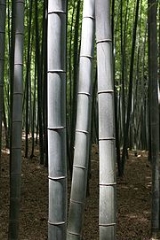
Bamboos are a group of wood Wood

Wood is derived from woody plant [i]s, notably tree [i]s but also shrub [i]s. ... 

y perennial Perennial plant

A perennial plant or perennial is a plant [i] that lives for more than two year [i]s. ... 

 evergreen Evergreen

In botany [i], an evergreen plant is a plant that retains its leaves [i] all year round, with each ... 

 plant Plant

Plants are a major group of living things [i] including familiar organism [i]s such as tree [i]s, flower [i] ... 

s in the true grass Poaceae

The true grasses are monocotyledon [i]ous plant [i]s in the Family Poaceae, also known as Gram ... 

 family Poaceae Poaceae

The true grasses are monocotyledon [i]ous plant [i]s in the Family Poaceae, also known as Gram ... 

, subfamily Bambusoideae Bambusoideae

The Bambusoideae is a subfamily [i] of the true grass [i] family [i] Poaceae [i]. ... 

, tribe Bambuseae. Some of its members are giants, forming by far the largest members of the grass family. There are 91 genera and about 1,000 species of bamboo. They are found in diverse climates, from cold mountains to hot tropical Tropics

The tropics are the geographic region of the Earth [i] centered on the equator [i] and limited in latitude [i] ... 

 regions. They occur from Northeast Asia Asia

Asia is the largest and most populous continent [i] or region, depending on the definition.... 

 , south throughout East Asia East Asia

East Asia is a subregion [i] of Asia [i] that can be defined in either geographical [i] or cul ... 

 west to the Himalaya Himalayas

The Himalayas are a mountain range [i] in Asia [i], separating the Indian subcontinent [i] from the Tibetan Plateau [i] ... 

, and south to northern Australia Australia

Australia, officially the Commonwealth of Australia, is a country in the Southern Hemisphere [i] c ... 

. They also occur in sub-Sahara Sahara

The Sahara is the world's largest hot desert [i], and second largest desert [i] at over 9,000,000 km, a ... 

n Africa Africa

Africa is one of the greatest sized continents of the Earth.... 

, and in the Americas Americas

he Americas are the lands of the Western hemisphere [i] or New World [i] consisting o ... 

 from the southeast of the USA United States

The United States of America, also known as the United States, the U.S., the U.S.A., a... 

 south to Chile Chile

Chile, officially the Republic of Chile , is a country in South America [i] occupying a long coast ... 

, there reaching their furthest south anywhere, at 47S latitude.

Discussions

  Discussion Features

   Ask a question about 'Bamboo'

   Start a new discussion about 'Bamboo'

   Answer questions about 'Bamboo'

   'Bamboo' discussion forum


Encyclopedia

Bamboos are a group of wood Wood

Wood is derived from woody plant [i]s, notably tree [i]s but also shrub [i]s. ... 

y perennial Perennial plant

A perennial plant or perennial is a plant [i] that lives for more than two year [i]s. ... 

 evergreen Evergreen

In botany [i], an evergreen plant is a plant that retains its leaves [i] all year round, with each ... 

 plant Plant

Plants are a major group of living things [i] including familiar organism [i]s such as tree [i]s, flower [i] ... 

s in the true grass Poaceae

The true grasses are monocotyledon [i]ous plant [i]s in the Family Poaceae, also known as Gram ... 

 family Poaceae Poaceae

The true grasses are monocotyledon [i]ous plant [i]s in the Family Poaceae, also known as Gram ... 

, subfamily Bambusoideae Bambusoideae

The Bambusoideae is a subfamily [i] of the true grass [i] family [i] Poaceae [i].... 

, tribe Bambuseae. Some of its members are giants, forming by far the largest members of the grass family.

There are 91 genera and about 1,000 species of bamboo. They are found in diverse climates, from cold mountains to hot tropical Tropics

The tropics are the geographic region of the Earth [i] centered on the equator [i] and limited in latitude [i] ... 

 regions. They occur from Northeast Asia Asia

Asia is the largest and most populous continent [i] or region, depending on the definition.... 

 , south throughout East Asia East Asia

East Asia is a subregion [i] of Asia [i] that can be defined in either geographical [i] or cul ... 

 west to the Himalaya Himalayas

The Himalayas are a mountain range [i] in Asia [i], separating the Indian subcontinent [i] from the Tibetan Plateau [i] ... 

, and south to northern Australia Australia

Australia, officially the Commonwealth of Australia, is a country in the Southern Hemisphere [i] c ... 

. They also occur in sub-Sahara Sahara

The Sahara is the world's largest hot desert [i], and second largest desert [i] at over 9,000,000 km, a ... 

n Africa Africa

Africa is one of the greatest sized continents of the Earth.... 

, and in the Americas Americas

he Americas are the lands of the Western hemisphere [i] or New World [i] consisting o ... 

 from the southeast of the USA United States

The United States of America, also known as the United States, the U.S., the U.S.A., a... 

 south to Chile Chile

Chile, officially the Republic of Chile , is a country in South America [i] occupying a long coast ... 

, there reaching their furthest south anywhere, at 47°S latitude. Major areas with no native bamboos include Europe Europe

Europe is one of the seven traditional continent [i]s of the Earth [i]. ... 

, north Africa Africa

Africa is one of the greatest sized continents of the Earth.... 

, western Asia Asia

Asia is the largest and most populous continent [i] or region, depending on the definition.... 

, northern North America North America

North America is a continent [i] in the Earth [i]'s northern hemisphere [i] and almost fully in the western hemisphere [i]... 

, most of Australia Australia

Australia, officially the Commonwealth of Australia, is a country in the Southern Hemisphere [i] c ... 

, and Antarctica Antarctica

Antarctica is the southernmost continent and encompasses the South Pole [i]. ... 

.

Biology

The stems, or 'culms', can range in height from a few centimetres to 40 metres, with stem diameters ranging from 1 mm to 30 cm. The stems are jointed, with regular nodes; each node bears one side bud . These buds do not necessarily develop but are present. Buds that do develop ramify quickly with very short basal internodes into a cluster of several shoots, which usually develop into branches and occasionally into adventitious rhizomes Rhizome

A rhizome is, in botany [i], a usually underground, horizontal stem [i] of a plant [i] that o ... 

. Branchlets form from the branches, and leaves grow off the branchlets. They are thus, unlike most other grasses, extensively branched; in large-growing species a single stem may carry many thousands of branchlets.

Although bamboo is a grass, many of the larger bamboos are very tree Tree

A tree is a large, perennial [i], wood [i]y plant [i]. ... 

-like in appearance and they are sometimes called "bamboo trees". The reason bamboos are so different from trees is they lack a vascular cambium layer and meristem cells at the top of the culm. The vascular cambium is the perpetually growing layer of a tree's trunk beneath the bark that makes it increase in diameter each year. The meristems make the tree grow taller.

A single culm of bamboo from an established rhizome system reaches full height in one growing season, but then persists for several years, gradually increasing the number of side branches and branchlets, but growing neither broader nor taller.

Some species of bamboo rarely flower Flower

A flower,rflorem<flos), also known as a bloom or blossom, is the reprod ... 

, some of them only every 28-120 years . Some of these species are monocarpic, the plant dying after the seed matures. Furthermore, all the individuals of the species will flower at the same time in a large geographical region. This is thought to have evolved because it reduces the effect of predators of the seed, who would be unable to depend on a predictable food supply.

Established bamboo will send up shoots that generally grow to their full height in a single season, making it the fastest growing woody plant. Several subtropical bamboo species can grow 30 cm per day, with some species having been documented as growing over 100 cm in one day. For the species most widely cultivated in gardens, 3-5 cm, per day is more typical. A newly transplanted bamboo plant can take 1-2 years before it sends up new shoots and will have many seasons of "sizing up" before new shoots achieve the maximum potential height for that species.

Cultivation


Many bamboos are popular in cultivation as garden Garden

A garden is a planned space, usually outdoors, set aside for the display, cultivation, and enjoyment of ... 

 plants. In cultivation, care needs to be taken of their potential for invasive behaviour. They spread mainly through their roots and/or rhizomes, which can spread widely underground and send off new culms to break through the surface. There are two patterns for the spreading of bamboo, "clumping" and "running" . Clumping bamboo species tend to spread underground slowly. Running bamboo species are highly variable in their tendency to spread; this is related to both the species and the soil Soil

Soil is the collection of natural bodies that form in earthy material on the land surface.... 

 and climate Climate

The climate is commonly considered to be the weather [i] averaged over a long period of time, typically ... 

 conditions. Some can send out runners several metres a year, while others can stay in the same general area for long periods. If neglected, they can be invasive over time and can cause problems by moving into adjacent areas. The reputation of bamboo as being highly invasive is often exaggerated, and situations where it has taken over large areas is often the result of years of untended or neglected plantings.

Once established as a grove, it is difficult to completely remove bamboo without digging up the entire network of underground rhizomes. If bamboo must be removed, an alternative to digging it up is to cut down the culms, and then repeatedly mow down new shoots as they arise, until the root system exhausts its energy supply and dies. If any leaves are allowed to photosynthesize the bamboo survives and will keep spreading.

There are two main ways to prevent the spread of running bamboo into adjacent areas. The first method is rhizome pruning or "edging", which involves removing any rhizomes escaping the desired bamboo area. Hooks, shovels and picks are usual tools. The rhizomes are generally very close to the surface, so, if rhizome pruning is done twice a year, it will sever most, if not all, of the new growth. Some species may be deep running . These are much harder to control and deeper cuts will need to be made. Regular maintenance will indicate major growth directions and locations. Once the rhizomes are cut they should be removed. If any bamboo shoots come up outside of the bamboo area afterwards their presence indicates the precise location of the missed rhizome. The fibrous roots that radiate from the rhizomes do not grow up to be more bamboo so they stay in the ground.

The second involves surrounding it with a physical barrier. Concrete and specially rolled HDPE plastic are usual materials. This is placed in a 60-90 cm deep ditch around the planting, and angled out at the top to direct the rhizomes to the surface. Strong rhizomes and tools can penetrate plastic barriers with relative ease, so great care must be taken. Surrounding bamboos with barriers usually creates unhealthy bamboos with potted plant stress symptoms . Lack of water, nutrition and growing space are all causes. Also, bamboo in barriers is much more difficult to remove than free-spreading bamboo.
Barriers and edging are unnecessary for clump forming bamboos. Clump forming bamboos may eventually need to have portions taken out if they get too large.

Uses


Culinary uses

The shoots of bamboo, called zhú sun in Chinese, are edible.
They are used in Asian stir fry, and are available in supermarkets in various sliced forms.
However, the shoots of some species contain toxins that need to be leached or boiled out before they can be eaten safely.
Pickled bamboo, used as a condiment, may also be made from the pith Pith

Pith is a light substance that is found in vascular plant [i]s. ... 

 of the young shoots.

The sap of young stalks tapped during the rainy season may be fermented to make ulanzi , or simply made into a soft drink. Zhúyèqing jiu is a green-coloured Chinese liquor Chinese wine

Jiu is the Chinese [i] word that refers to all alcoholic beverage [i]s. ... 

 that has bamboo leaves as one of its ingredients.


Other uses


Bamboo forms a very hard wood, especially when seasoned, and is light and exceptionally tough. This makes it useful for many things such as houses , fences, bridges, toilets, walking sticks, canoes, furniture, chopstick Chopsticks

Chopsticks, a pair of small even-length tapered sticks, are the traditional eating [i] utensils of East Asia [i] ... 

s, food steamers, toys, construction scaffolding, hats, martial arts weaponry, abaci Abacus

An abacus is a calculation tool, often constructed as a wooden frame with beads sliding on wires.... 

 and various musical instruments such as the shakuhachi Shakuhachi

The is a Japan [i]ese end-blown flute [i] which is held vertically like a recorder [i], instead of transverse ... 

, palendag Palendag

Also called Pulalu and, Palandag, Pulala and Lumundeg.... 

 and jinghu Jinghu

A jinghu is a Chinese [i] bowed string musical instrument used primarily in Beijing opera [i]... 

. It is also widely carved for decorative artwork. Modern companies are attempting to popularize bamboo flooring made of bamboo pieces steamed, flattened, glued together, finished, and cut. However, bamboo wood is easily infested by wood-boring insects unless treated with wood preservatives or kept very dry . It has also been used as a substitute for steel reinforcing rods in concrete Concrete

In construction [i], concrete is a composite [i] building material made from the comb ... 

 construction.

When bamboo is harvested for wood, care is needed to select mature stems that are several years old, as first-year stems, although full size, are not fully woody and are not strong.


Culms may be cut and hollowed into vases or drinkware, tubes, or pipes for liquids.

Culms can also serve as pipes. The Bamboo Organ of Las Pinas Las Piñas City

Las Pias City is a city in the National Capital Region [i] of the Philippines [i]. ... 

, Philippines Philippines

The Philippines , officially the Republic of the Philippines , is an island nation [i] located in ... 

 is an example.

Bamboo canes are normally round in cross-section, but square canes can be produced by forcing the new young culms to grow through a tube of square cross-section and slightly smaller than the culm's natural diameter, thereby constricting the growth to the shape of the tube. Every few days the tube is removed and replaced higher up the fast-growing culm.

The fibre of bamboo has been used to make paper Paper

Paper is a thin, flat material produced by the amalgamation of plant fibre [i]s, which are subsequently ... 

 in China China

China is a cultural region [i] and ancient civilization [i] in East Asia [i]. ... 

 since early times. A high quality hand-made paper is still produced in small quantities. Coarse bamboo paper is still used to make spirit money Joss paper

Joss paper, also known as ghost money, are sheets of paper that are burned in traditional Chinese [i] ... 

 in many Chinese communities.

The wood is used for knitting Knitting

Knitting is one of several ways to turn thread or yarn [i] into cloth [i] . ... 

 needles and the fibre can be used for yarn Yarn

Yarn is a long continuous length of interlocked fiber [i]s, suitable for use in the production of textile [i] ... 

 and clothing Clothing

Clothing is defined, in its broadest sense, as coverings for the torso and limbs as well as coverings fo... 

. Sharpened bamboo is also traditionally used to tattoo in Japan, Hawaii and elsewhere.

A variety of bamboo was one of about two dozen plants carried by Polynesian voyagers to provide all their needs settling new islands; in the Hawaiian Islands Hawaiian Islands

The Hawaiian Islands, once known as the Sandwich Islands, form an archipelago [i] of nineteen island [i] ... 

, among many uses, 'Ohe carried water, made irrigation troughs for taro Taro

Taro , more rarely kalo , is a tropical plant grown primarily as a vegetable food [i] ... 

 terraces, was used as a traditional knife for cutting the umbilical cord of a newborn, as a stamp for dyeing bark tapa cloth Tapa cloth

Tapa cloth is a bark cloth made in the islands of the Pacific Ocean [i], primarily in Tonga [i] and Samoa [i] ... 

, and for four hula Hula

Hula is a dance [i] form accompanied by chant or song. ... 

 instruments - nose flute, rattle, stamping pipes and Jew's harp Jew's harp

The Jew's harp is one of the oldest musical instrument [i]s in the world. ... 

.

Cultural aspects


Bamboo's long life makes it a Chinese symbol of long life, while in India India

India , officially the Republic of India, is a country in South Asia [i]. ... 

 it is a symbol of friendship. Its rare blossoming has led to the flowers' being regarded as a sign of impending famine. This is said by some to be because rats feed upon the profusion of flowers, then multiply greatly and destroy a large part of the local food supply. The most recent flowering began in May, 2006 . Bamboo is said to bloom in this manner only about every 50 years . Several Asian cultures, including that of the Andaman Islands Andaman Islands

The Andaman Islands are a group of island [i]s in the Bay of Bengal [i], and are part of the Andaman and Nicobar Islands [i] ... 

, believe that humanity emerged from a bamboo stem. In the Philippine Philippines

The Philippines , officially the Republic of the Philippines , is an island nation [i] located in ... 

 creation myth, legend tells that the first man and the first woman were split open from a bamboo stem that emerged on an island created after the battle of the elemental forces. In Malaysia Malaysia

Malaysia is a federation [i] of 13 states [i] in Southeast Asia [i], formed in 1963.
... 

n legends a similar story includes a man who dreams of a beautiful woman while sleeping under a bamboo plant; he wakes up and breaks the bamboo stem, discovering the woman inside. In Japan Japan

is an island country [i] in East Asia [i]. ... 

, a bamboo forest sometimes surrounds a Shinto shrine as part of a sacred barrier against evils. Also, bamboo is considered second in the rank in the order of "Matsu , Take , Ume Ume

Prunus mume is a species of Asia [i]n plum [i] in the family Rosaceae [i]. ... 

 " and this order is used when ordering a sushi Sushi

In Japanese cuisine [i], sushi is a food [i] made of vinegar [i]ed rice [i] combined with various toppin ... 

 course or getting a room in a traditional ryokan Ryokan

was a Zen [i] Buddhist monk who lived in Niigata Japan [i] 1758 [i]-1831 [i]. ... 

. Hawaiian bamboo is a kinolau or body form of the Polynesian creator god Kane.

In Chinese culture, the bamboo , along with the plum Plum

"Plum" is also a nickname for British humorist P.G. Wodehouse [i].
... 

 blossom , orchid Orchidaceae

Orchids are the largest and most diverse of the flowering plant [i] families, with over 800 described... 

s , and chrysanthemum Chrysanthemum

Chrysanthemum is a genus of about 30 species of perennial [i] flowering plant [i]s in the family Asteraceae [i] ... 

  are all held in high esteem and are collectively referred as "the four of great nobility" , with one representing each of the season Season

A season is one of the major divisions of the year [i], generally based on yearly periodic changes in we ... 

s. Each also symbolises a particular aspect of the junzi  in Confucian Confucius

Confucius was a famous Chinese [i] thinker and social philosopher [i], whose teachings and philosophy [i] ... 

 ideology. The four plants are commonly mentioned together as "méi lán zhú jú" . The pine Pine

Pines are coniferous [i] tree [i]s of the genus Pinus, in the family Pinaceae [i]. ... 

 tree , the bamboo and the plum blossom are also admired for their perseverance under harsh conditions, and are together known as the "Three Friends in Winter" . Here the usual order in which they are mentioned is ??? .

In Vietnam Vietnam

Vietnam, officially the Socialist Republic of Vietnam, is a country in Southeast Asia [i]. ... 

, bamboo is the symbol of straightforward, undauntedness. Vietnam Vietnam

Vietnam, officially the Socialist Republic of Vietnam, is a country in Southeast Asia [i]. ... 

's villages always are protected by a bamboo hedges. Bamboo hedges's also the image of union. The 3-years-old national hero in legend, Thánh Gióng rooted up a bamboo tree which had grown in road side as the weapon against Ân invader, when the iron rod had been cracked. In many wars in history, bamboo spike, bamboo stick took part in the national glorious victories.

A Vietnamese tale said that, once upon a time, there was a good poor young farmer wanted to get married to landlord's daughter. But the landlord enforced a extraordinary condition that was he must offer a " 100-sections bamboo tree". B?t  appeared and helped him: "You can have a 100- sections bamboo tree if you have 100 bamboo sections from many bamboo tree". B?t gave him a magic words to glue 100 bamboo sections: "Kh?c nh?p, kh?c xu?t" . This tale means good person always be help and whenever someone has a difficult circumstance, if he has any intelligent idea, he will overcome.

Vietnamese people have a proverb:"When the bamboo is old, the bamboo sprouts apprear", it means Vietnam Vietnam

Vietnam, officially the Socialist Republic of Vietnam, is a country in Southeast Asia [i]. ... 

 will have never been annihilated, because if previous generation died, vietnam Vietnam

Vietnam, officially the Socialist Republic of Vietnam, is a country in Southeast Asia [i]. ... 

's children will be born. Vietnamese tradition will be maintained and developed eternally.

Other aspects

Soft bamboo shoots, stems, and leaves are the major food source of the Giant Panda Giant Panda

The giant panda is a mammal [i] classified in the bear family, Ursidae [i], native to central and south ... 

 of China China

China is a cultural region [i] and ancient civilization [i] in East Asia [i]. ... 

 and the Spider monkey Spider monkey

Spider monkeys are New World monkey [i]s of the family [i] Atelidae [i], subfa ... 

.

The plant marketed as "lucky bamboo" is actually an entirely unrelated species, Dracaena sanderiana Dracaena sanderiana

Dracaena sanderiana, known as Ribbon Dracaena or sometimes Ribbon Plant, is a species of... 

.

See also

  • Japanese knotweed Japanese knotweed

    Japanese knotweed is a large, herbaceous [i] perennial plant [i], native to eastern Asia [i] in Japan [i] ... 

  • Dracaena sanderiana Dracaena sanderiana

    Dracaena sanderiana, known as Ribbon Dracaena or sometimes Ribbon Plant, is a species of... 


References and external links