
All Topics  
Denis Diderot

 
Denis Diderot

   Email Print
   Bookmark   Link


Denis Diderot


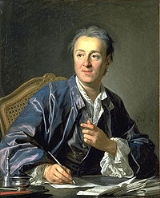
Denis Diderot (October 5, 1713 – July 31, 1784) was a French philosopher and writer. He was a prominent figure during the Enlightenment
Age of Enlightenment

The Age of Enlightenment or The Enlightenment is a term used to describe a time in Western philosophy and cultural life centered upon the eighteenth century, in which rationalism was advocated as the primary source and legitimacy for authority....
 and is best known for serving as chief editor and contributor to the Encyclopédie
Encyclopédie

Encyclop?die, ou dictionnaire raisonn? des sciences, des arts et des m?tiers was a general encyclopedia published in France between 1751 and 1772, with later supplements and revisions in 1772, 1777 and 1780 and numerous foreign editions and later derivatives....
.


Diderot also contributed to literature, notably with Jacques le fataliste et son maître
Jacques le fataliste et son maître

Jacques the Fatalist and his Master is a novel by Denis Diderot, written in the late 1760s?1778 and published in 1796 in literature.The main subject of the book is the relationship between the valet Jacques and his master ....
 (Jacques the Fatalist and His Master
Jacques le fataliste et son maître

Jacques the Fatalist and his Master is a novel by Denis Diderot, written in the late 1760s?1778 and published in 1796 in literature.The main subject of the book is the relationship between the valet Jacques and his master ....
), which emulated Laurence Sterne
Laurence Sterne

Laurence Sterne was an Ireland-born England novelist and an Anglican clergyman. He is best known for his novels The Life and Opinions of Tristram Shandy, Gentleman, and A Sentimental Journey Through France and Italy; but he also published Sermons of Laurence Sterne, wrote memoirs, and was involved in local politics....
 in challenging conventions regarding novel
Novel

File:2009 stapelweise Neuerscheinungen im Buchladen.JPGA novel is today a long narrative in literary prose. The genre has historical roots both in the fields of the medieval and early modern Romance and in the tradition of the novella....
s, their structure and content, while also examining philosophical
Philosophy

Philosophy is the study of general problems concerning matters such as existence, knowledge, truth, beauty, justice, validity, mind, and language....
 ideas about free will
Free will

The question of free will is whether, and in what sense, rational agents exercise control over their actions and decisions. Addressing this question requires understanding the relationship between freedom and Causality, and determining whether the laws of nature are causally deterministic....
.


Discussion
Ask a question about 'Denis Diderot'
Start a new discussion about 'Denis Diderot'
Answer questions from other users
Full Discussion Forum


Quotations


From fanaticism to barbarism is only one step.

Essai sur le Mérite de la Vertu

We swallow greedily any lie that flatters us, but we sip only little by little at a truth we find bitter.

On doit exiger de moi que je cherche la vérité, mais non que je la trouve.

One may demand of me that I should seek truth, but not that I should find it., Pensées Philosophiques (1746) 29; Variant translation: I can be expected to look for truth but not to find it.

My thoughts are my trollops.


Encyclopedia


Denis Diderot (October 5, 1713 – July 31, 1784) was a French philosopher and writer. He was a prominent figure during the Enlightenment
Age of Enlightenment

The Age of Enlightenment or The Enlightenment is a term used to describe a time in Western philosophy and cultural life centered upon the eighteenth century, in which rationalism was advocated as the primary source and legitimacy for authority....
 and is best known for serving as chief editor and contributor to the Encyclopédie
Encyclopédie

Encyclop?die, ou dictionnaire raisonn? des sciences, des arts et des m?tiers was a general encyclopedia published in France between 1751 and 1772, with later supplements and revisions in 1772, 1777 and 1780 and numerous foreign editions and later derivatives....
.


Diderot also contributed to literature, notably with Jacques le fataliste et son maître
Jacques le fataliste et son maître

Jacques the Fatalist and his Master is a novel by Denis Diderot, written in the late 1760s?1778 and published in 1796 in literature.The main subject of the book is the relationship between the valet Jacques and his master ....
 (Jacques the Fatalist and His Master
Jacques le fataliste et son maître

Jacques the Fatalist and his Master is a novel by Denis Diderot, written in the late 1760s?1778 and published in 1796 in literature.The main subject of the book is the relationship between the valet Jacques and his master ....
), which emulated Laurence Sterne
Laurence Sterne

Laurence Sterne was an Ireland-born England novelist and an Anglican clergyman. He is best known for his novels The Life and Opinions of Tristram Shandy, Gentleman, and A Sentimental Journey Through France and Italy; but he also published Sermons of Laurence Sterne, wrote memoirs, and was involved in local politics....
 in challenging conventions regarding novel
Novel

File:2009 stapelweise Neuerscheinungen im Buchladen.JPGA novel is today a long narrative in literary prose. The genre has historical roots both in the fields of the medieval and early modern Romance and in the tradition of the novella....
s, their structure and content, while also examining philosophical
Philosophy

Philosophy is the study of general problems concerning matters such as existence, knowledge, truth, beauty, justice, validity, mind, and language....
 ideas about free will
Free will

The question of free will is whether, and in what sense, rational agents exercise control over their actions and decisions. Addressing this question requires understanding the relationship between freedom and Causality, and determining whether the laws of nature are causally deterministic....
. Diderot is also known as the author of the dialogue, Le Neveu de Rameau (Rameau's Nephew) upon which many articles and sermons about consumer desire have been based. His articles included many topics of the Enlightenment.

Biography

Denis Diderot was born in the eastern French city of Langres
Langres

Langres is a commune in France in northeastern France. It is a sous-pr?fecture of the Haute-Marne d?partement in France in the Champagne-Ardenne r?gion in France....
 and commenced his formal education in the Lycée Louis le Grand. In 1732, he earned a master of arts degree in philosophy. He abandoned the idea of entering the clergy and decided instead to study law. His study of law was short-lived; in 1734, Diderot decided instead to become a writer. Because of his refusal to enter one of the learned professions, he was disowned by his father, and for the next ten years he lived a rather bohemian existence. In 1743, he further alienated his father by marrying Antoinette Champion, a devout Roman Catholic. The match was considered inappropriate due to Champion's low social status, poor education, fatherless status, lack of a dowry, and, at thirty-two, being four years his senior. The marriage produced one surviving child, a girl. Her name was Angélique, named after Diderot's mother and his dead sister. The death of his sister, a nun, from overwork in the convent may have affected Diderot's opinion of religion. She is assumed to have been the inspiration for his novel about a nun, La Religieuse, in which he depicts a woman who is forced to enter a monastery, and suffers at the hands of the other nuns in the commuity. He had affairs with the writer Madame Puisieux and with Sophie Volland. His letters to Sophie Volland contain some of the most vivid of all the insights that we have of the daily life of the philosophic circle of Paris during this time period.

Though his work was broad and rigorous, it did not bring him riches. He secured none of the posts that were occasionally given to needy men of letters; he could not even obtain the bare official recognition of merit which was implied by being chosen a member of the Académie française
Académie française

L'Acad?mie fran?aise, or the French Academy, is the pre-eminent France learned body on matters pertaining to the French language. The Acad?mie was officially established in 1635 by Cardinal Richelieu, the chief minister to Louis XIII of France....
. When the time came for him to provide a dowry
Dowry

A dowry is the money, goods, or estate that a woman brings to her new husband. Compare bride price, which is paid to the bride's parents, and dower, which is property settled on the bride herself by the groom at the time of marriage....
 for his daughter, he saw no alternative than to sell his library. When Catherine II of Russia
Catherine II of Russia

Catherine II, called Catherine the Great .The Russian empress Catherine II, known as Catherine the Great, reigned from 1762 to 1796. Under her direct auspices the Russian Empire expanded, improved in its administration, and underwent a dramatic policy of Westernization....
 heard of his financial troubles she commissioned an agent in Paris to buy the library. She then requested that the philosopher retain the books in Paris until she required them, and act as her librarian with a yearly salary. In 1773 and 1774, Diderot spent some months at the empress's court in St Petersburg. Diderot died of gastro-intestinal problems in Paris
Paris

Paris is the Capital of France and the country's largest city. It is situated on the river Seine, in northern France, at the heart of the ?le-de-France Regions of France ....
 on July 31, 1784, and was buried in the city's Église Saint-Roch
Église Saint-Roch

The Church of Saint Roch is a late Baroque architecture church in Paris. The first stone was laid by Louis XIV in 1653, accompanied by his mother Anne of Austria....
. His heirs sent his vast library to Catherine II, who had it deposited at the National Library of Russia.

Early works

Diderot's earliest works included a translation of Stanyan's History of Greece (1743); with two colleagues, François-Vincent Toussaint
François-Vincent Toussaint

Fran?ois-Vincent Toussaint was a France writer most famous for Les M?urs . The book was published in 1748 andimmediately prosecuted and burned by the French court of justice....
 and Marc-Antoine Eidous
Marc-Antoine Eidous

Marc-Antoine Eidous was a France writer, translator and Encyclopedist born in Marseilles around 1724, and who died in 1790.His translations included works on the subjects of philosophy, travel and agriculture by English and Scottish authors:...
, he produced a translation of Robert James's Medical Dictionary (1746–1748) at about the same time he published a free rendering of Shaftesbury
Anthony Ashley-Cooper, 3rd Earl of Shaftesbury

Anthony Ashley Cooper, 3rd Earl of Shaftesbury , was an England politician, philosopher and writer....
's Inquiry Concerning Virtue and Merit (1745), with some original notes of his own. In 1746, he wrote his first original work: the Pensées philosophiques, and he added to this a short complementary essay on the sufficiency of natural religion
Natural religion

Natural religion might have the following meanings:* A synonym for "natural theology"; religion based on reason and ordinary experience rather than supernatural revelation, although not necessarily denying it....
. He then composed a volume of bawdy stories, Les bijoux indiscrets
Les bijoux indiscrets

The Indiscreet Jewels is the first novel by Denis Diderot, published anonymously in 1748. It is an allegory that portrays Louis XV of France as the sultan Mangogul of the Congo who owns a magic ring that makes women's genitals talk....
 (1748); in later years he repented this work. In 1747, he wrote the Promenade du sceptique, an allegory
Allegory

Allegory is generally treated as a figure of rhetoric, but an allegory does not have to be expressed in language: it may be addressed to the eye, and is often found in realistic painting, sculpture or some other form of Mimesis, or representative art....
 pointing first at the extravagances of Catholicism
Roman Catholic Church

The Roman Catholic Church, officially known as the Catholic Church is the world's largest Christianity Ecclesia , representing over half of all Christians and one-sixth of the world population....
; second, at the vanity of the pleasures of the world which is the rival of the church; and third, at the desperate and unfathomable uncertainty of the philosophy which professes to be so high above both church and world.

Diderot's celebrated Lettre sur les aveugles ("Letter on the Blind") (1749), introduced him to the world as a daringly original thinker. The subject is a discussion of the interrelation between man's reason and the knowledge acquired through perception (the five senses). The title, "Letter on the Blind For the Use of Those Who See" also evoked some ironic doubt about the who exactly were "the blind" under discussion. In the essay, a blind English mathematician named Saunderson argues that since knowledge derives from the senses, then mathematics is the only form of knowledge that both he and a sighted person can agree about. It is suggested that the blind could be taught to read through their sense of touch (a later essay, Lettre sur les sourds et muets, considered the case of a similar deprivation in the deaf and mute
Speech disorder

Speech disorders or speech impediments, as they are also called, are a type of communication disorders where 'normal' Manner of articulation is disrupted....
). What makes the Lettre sur les aveugles so remarkable, however, is its distinct, if undeveloped, presentation of the theory of variation
Variation

Variation means a change within a population, or between sub-populations.* Biodiversity* Genetic diversity, differences within a speciesPhysics:...
 and natural selection
Natural selection

Natural selection is the process by which favorable heritable trait become more common in successive generations of a population of Reproduction organisms, and unfavorable heritable traits become less common, due to differential reproduction of genotypes....
.

This powerful essay ... revolves around a remarkable deathbed scene in which a dying blind philosopher, Saunderson, rejects the arguments of a providential
Divine Providence

In theology, Divine Providence, or simply Providence, is the sovereignty, superintendence, or agency of God over events in people's lives and throughout history....
 God during his last hours. Saunderson's arguments are those of a Neo-Spinozist, Naturalist
Naturalism

Naturalism refer to various topics within philosophy and science, environmental movements, and other areas.In the arts, naturalism may refer to:...
, and Fatalist, using a sophisticated notion of the self-generation
Spontaneous generation

Spontaneous generation or Equivocal generation is an obsolete theory regarding the origin of life from inanimate matter, which held that this process was a commonplace and everyday occurrence, as distinguished from Univocal generation, or reproduction from parent....
 and natural evolution of species without Creation or supernatural intervention. The notion of "thinking matter"
Materialism

The philosophy of materialism holds that the only thing that can be truly proven to existence is matter, and is considered a form of physicalism....
 is upheld and the "argument from design" discarded ... as hollow and unconvincing. The work appeared anonymously ... and was vigorously suppressed by the authorities. Diderot, who had been under police surveillance since 1747, was swiftly identified as the author ... and was imprisoned for some months at Vincennes
Vincennes

Vincennes is a commune in France of the Val-de-Marne located in the eastern suburbs of Paris, France. This ?le-de-France town is located . from the Kilometre Zero....
, where he was visited almost daily by Rousseau, at the time his closest and most assiduous ally.


After signing a letter of submission and promising never to write anything prejudicial against religion ever again, an agreement he would have trouble following, Diderot was released from the dungeons of the Vincennes
Vincennes

Vincennes is a commune in France of the Val-de-Marne located in the eastern suburbs of Paris, France. This ?le-de-France town is located . from the Kilometre Zero....
 fortress after three months. He subsequently embarked on his greatest project, The Encyclopédie, ou dictionnaire raisonné des sciences, des arts et des métiers.

Encyclopedie

Enc 1 Na5 600px
André Le Breton
André Le Breton

Andr? Fran?ois le Breton was a French publisher. He was one of the four publishers of the Encyclop?die of Diderot and d'Alembert, along with Michel-Antoine David, Laurent Durand, and Antoine-Claude Briasson....
, a bookseller and printer, applied to Diderot with a project for the publication of a translation of Ephraim Chambers
Ephraim Chambers

Ephraim Chambers , was an England writer and encyclopedist, who is primarily known for producing the Cyclopaedia, or Universal Dictionary of Arts and Sciences....
' Cyclopaedia, or Universal Dictionary of Arts and Sciences
Cyclopaedia, or Universal Dictionary of Arts and Sciences

Cyclop?dia Britannica Eleventh Edition, a publication now in the public domain. dia: or, A Universal Dictionary of Arts and Sciences was an encyclopedia published by Ephraim Chambers in London in 1728, and reprinted in numerous editions in the 18th century....
 into French, first undertaken by the Englishman John Mills
John Mills (encyclopedist)

John Mills was an encyclopedist on the Encyclop?die. He was originally a writer on agricultural matters from England. He proposed and worked on the Encyclop?die with Gottfried Sellius, a native of Gdańsk, who, after being a professor at Halle, Saxony-Anhalt and G?ttingen and residing in the Netherlands, had settled in Paris....
, and followed by the German Gottfried Sellius. Diderot accepted the proposal. During this translation his creative mind and astute vision transformed the work. Instead of a mere reproduction of the Cyclopaedia, he persuaded Le Breton to enter upon a new work, which would collect all the active writers, ideas, and knowledge that were moving the cultivated class of the Republic of Letters
Republic of Letters

Republic of Letters is a phrase describing the phenomenon of increased correspondence in the form of Letter exchanged between the influential philosophers and other thinkers during the Age of Enlightenment....
 to its depths; however, they were comparatively ineffective due to their lack of dispersion. His enthusiasm for the project was transmitted to the publishers; they collected a sufficient capital for a more vast enterprise than they had first planned. Jean le Rond d'Alembert
Jean le Rond d'Alembert

Jean le Rond d'Alembert was a France mathematician, mechanics, physicist and philosopher. He was also co-editor with Denis Diderot of the Encyclop?die....
 was persuaded to become Diderot's colleague; the requisite permission was procured from the government.

In 1750 an elaborate prospectus announced the project to a delighted public, and in 1751 the first volume was published. This work was very unorthodox and had many forward-thinking ideas for the time. Diderot stated within this work, "An encyclopedia ought to make good the failure to execute such a project hitherto, and should encompass not only the fields already covered by the academies, but each and every branch of human knowledge." Upon encompassing every branch of knowledge this will give, "the power to change men's common way of thinking." This idea was profound and intriguing, as it was one of the first works during the Enlightenment. Diderot wanted to give all people the ability to further their knowledge and, in a sense, allow every person to have any knowledge they sought of the world. The work sought to bring together all knowledge of the time and condense this information for all to use. Using not only the expertise of scholars and Academies in their respective fields but that of the common man in their proficiencies in their trades. These people would amalgamate and work under a society to perform such a project. They would work alone in order to shed societal conformities, and build a multitude of information on a desired subject with varying view points, methods, or philosophies. He emphasized the vast abundance of knowledge held within each subject with intricacies and details to provide the greatest amount of knowledge to be gained from the subject. All people would benefit from these insights into different subjects as a means of betterment; bettering society as a whole and individuals alike.

This message under the Ancien Régime
Ancien Régime

Ancien R?gime refers primarily to the aristocracy, sociology, and politics system established in France under the Valois Dynasty and House of Bourbon dynasties ....
 would severely dilute the regime's ability to control the people. Knowledge and power, two key items the upper class held over the lower class, were in jeopardy as knowledge would be more accessible, giving way to more power amongst the lower class. An encyclopedia would give the layman an ability to reason and use knowledge to better themselves; allowing for upward mobility and increased intellectual abundance amongst the lower class. A growth of knowledge amongst this segment of society would provide power to this group and a yearning to question the government. The numerated subjects in the folios were not just for the good of the people and society, but were for the promotion of the state as well. The state did not see any benefit in the works, instead viewing them as a contempt to contrive power and authority from the state.

Diderot's work was plagued by controversy from the beginning; the project was suspended by the courts in 1752. Just as the second volume was completed accusations arose, regarding seditious content, concerning the editors entries on religion and natural law. Diderot was detained and his house was searched for manuscripts for subsequent articles. But the search proved fruitless as no manuscripts could be found. They were hidden in the house of an unlikely confederate Chretien de Lamoignon Malesherbes
Guillaume-Chrétien de Lamoignon de Malesherbes

Guillaume-Chr?tien de Lamoignon de Malesherbes, often referred to as Malesherbes or Lamoignon-Malesherbes was a France statesman, minister, and afterwards counsel for the defence of Louis XVI of France....
, the very official who ordered the search. Although Malesherbis was a staunch absolutist-loyal to the monarchy, he was sympathetic to the literary project. Along with his support, and that of other well placed influential confederates, the project resumed. Diderot returned to his efforts only to be constantly embroiled in controversy.

These twenty years were to Diderot not merely only a time of incessant drudgery, but harassing persecution and desertion of friends. The ecclesiastical party detested the Encyclopédie, in which they saw a rising stronghold for their philosophic enemies. By 1757 they could endure it no longer. The subscribers had grown from 2,000 to 4,000, a measure of the growth of the work in popular influence and power. The Encyclopédie threatened the governing social class
Social class

Social class refers to the hierarchy distinctions between individuals or groups in societies or cultures. Usually most societies have some notion of social class , but concretely defined social classes are not found in every known type of human societies....
es of France (aristocracy
Aristocracy

Aristocracy is a form of government, in which a few of the most prominent citizens rule. This may be a hereditary elite, or it may be by a system of cooption where a council of prominent citizens add leading soldiers, merchants, land owners, priests, and lawyers to their number....
) because it took for granted the justice of religious tolerance, freedom of thought
Freedom of thought

Freedom of thought is the Freedom of an individual to hold or consider a fact, viewpoint, or thought, independent of others' viewpoints. It is closely related to, yet distinct from, the concept of freedom of speech....
, and the value of science
Science

In its broadest sense, science refers to any systematic knowledge or practice. In its more usual restricted sense, science refers to a system of acquiring knowledge based on scientific method, as well as to the organized body of knowledge gained through such research....
 and industry
Industry

An industry is the manufacturing of a Good or Service within a category. Although industry is a broad term for any kind of economic production, in economics and urban planning industry is a synonym for the secondary sector, which is a type of economic activity involved in the manufacturing of raw materials into goods and products....
. It asserted the doctrine that the main concern of the nation's government ought to be the nation's common people. It was believed that the Encyclopédie was the work of an organized band of conspirators against society, and that the dangerous ideas they held were made truly formidable by their open publication. In 1759, the Encyclopédie was formally suppressed. The decree did not stop the work, which went on, but its difficulties increased by the necessity of being clandestine. D'Alembert
Jean le Rond d'Alembert

Jean le Rond d'Alembert was a France mathematician, mechanics, physicist and philosopher. He was also co-editor with Denis Diderot of the Encyclop?die....
 withdrew from the enterprise and other powerful colleagues, including Anne Robert Jacques Turgot, Baron de Laune
Anne Robert Jacques Turgot, Baron de Laune

Anne-Robert-Jacques Turgot, Baron de Laune, often referred to as Turgot , was a France economist and statesman....
, declined to contribute further to a book which had acquired a bad reputation. Diderot was left to finish the task as best he could. He wrote several hundred articles, some very slight, but many of them laborious, comprehensive, and long. He damaged his eyesight correcting proof
Proofreading

Proof-reading traditionally means reading a proof copy of a writing in order to detect and correct any errors. Modern proofreading often requires reading Copy at earlier stages as well....
s and editing the manuscript
Manuscript

A manuscript is any document that is written by hand, as opposed to being printed or reproduced in some other way. The term may also be used for information that is hand-recorded in other ways than writing, for example inscriptions that are chiselled upon a hard material or scratched as with a knife point in plaster or with a stylus on a wa...
s of less competent contributors. He spent his days at workshops, mastering manufacturing processes, and his nights writing what he had learned during the day. He was incessantly harassed by threats of police
Police

Police are agents or agencies, usually of the executive , empowered to enforce the law and to ensure public and social order through the legitimized use of force....
 raids. The last copies of the first volume were issued in 1765. At the last moment, when his immense work was drawing to an end, he encountered a crowning mortification: he discovered that the bookseller, fearing the government's displeasure, had struck out from the proof sheets, after they had left Diderot's hands, all passages that he considered too dangerous. The monument to which Diderot had given the labor of twenty long and oppressive years was irreparably mutilated and defaced. It was twelve years, in 1772, before the subscribers received the final 27 folio volumes of the Encyclopédie, ou dictionnaire raisonné des sciences, des arts et des métiers since the first volume had been published.

Other works


Although the Encyclopédie was Diderot's monumental piece, he was the author of many other works that sowed nearly every field of intellectual interest with new and creative ideas. He wrote sentimental plays, Le Fils naturel
Le Fils naturel

Le Fils naturel is a 1757 play by Denis Diderot. This play tells the story of Dorval, a young man of unknown parentage, who is welcomed into the family of Clairville and his widow sister Constance....
 (1757) and Le Père de famille (1758), accompanying them with essays on theatrical theory and practice, including Les Entretiens sur Le Fils naturel (Conversations on Le Fils naturel), in which he announced the principles of a new drama
Drama

Drama is the specific Mode of fiction Mimesis in performance. The term comes from a Ancient Greek word meaning "Action " , which is derived from "to do" ....
—the serious, domestic, bourgeois drama of real life, in opposition to the stilted conventions of the classical French stage. His art criticism
Art criticism

Art criticism is the discussion or evaluation of visual art.Art critics usually criticize art in the context of aesthetics or the theory of beauty....
 was also highly influential. Diderot's Essais sur la peinture was described by Johann Wolfgang von Goethe
Johann Wolfgang von Goethe

was a Germans writer and according to George Eliot, "Germany's greatest man of letters? and the last true polymath to walk the earth." Goethe's works span the fields of poetry, drama, literature, theology, philosophy, humanism and science....
, as "a magnificent work, which speaks even more helpfully to the poet than to the painter, though to the painter too it is as a blazing torch."

Diderot's most intimate friend was the philologist Friedrich Melchior Grimm. They were brought together by their friend in common at that time Jean-Jacques Rousseau
Jean-Jacques Rousseau

Jean Jacques Rousseau was a major philosopher, writer, and composer of the eighteenth century The Age of Enlightenment, whose political philosophy influenced the French Revolution and the development of modern political and educational thought....
. Grimm wrote newsletters to various high personages in Germany
Germany

Germany , officially the Federal Republic of Germany , is a country in Central Europe. It is bordered to the north by the North Sea, Denmark, and the Baltic Sea; to the east by Poland and the Czech Republic; to the south by Austria and Switzerland; and to the west by France, Luxembourg, Belgium, and the Netherlands....
, reporting the happenings of art and literature in Paris, then the intellectual capital of Europe
Europe

Europe is, conventionally, one of the world's seven continents. Comprising the westernmost peninsula of Eurasia, Europe is generally divided from Asia to its east by the water divide of the Ural Mountains, the Ural , the Caspian Sea, and by the Caucasus Mountains to the southeast....
. Diderot helped Grimm between 1759 and 1779, by writing an account of the annual exhibitions of paintings in the Paris Salon
Paris Salon

The Salon , or rarely Paris Salon , beginning in 1725 was the official art exhibition of the Acad?mie des Beaux-Arts in Paris, France. Between 1748?1890 it was the greatest annual or biannual art event in the world....
. These reports are highly readable pieces of art criticism. According to Charles Augustin Sainte-Beuve, they initiated the French into a new way of laughing, and introduced people to the mystery and purport of colour by ideas. "Before Diderot," Anne Louise Germaine de Staël
Anne Louise Germaine de Staël

Anne Louise Germaine de Sta?l-Holstein , commonly known as Madame de Sta?l, was a French language-speaking Swiss people author living in Paris and abroad....
 wrote, "I had never seen anything in pictures except dull and lifeless colours; it was his imagination that gave them relief and life, and it is almost a new sense for which I am indebted to his genius." Jean-Baptiste Greuze
Jean-Baptiste Greuze

Jean-Baptiste Greuze was a France Painting....
 was Diderot's favorite contemporary artist. Greuze's most characteristic pictures were the rendering in colour of the same sentiments of domestic virtue and the pathos
Pathos

Pathos is one of the three modes of persuasion in rhetoric . Pathos appeals to the audience's emotions. It is a part of Aristotle's philosophy in rhetoric....
 of common life, which Diderot had attempted to represent upon the stage. Diderot was above all things interested in the life of individuals. He did not care about the abstract life of the race, but the incidents of individual character, the fortunes of a particular family, the relations of real and concrete motives in this or that special case. He was delighted with the enthusiasm of a born casuist in curious puzzles of right and wrong, and in devising a conflict between the generalities of ethics
Ethics

Ethics is a word for a philosophy that encompasses proper conduct and good living. It is significantly broader than the common conception of ethics as the analyzing of right and wrong....
 and the conditions of an ingeniously contrived practical dilemma. Diderot's interest expressed itself in didactic and sympathetic form. However, in two of his most remarkable pieces, this interest is not sympathetic, but ironic. Jacques le fataliste (written in 1773, but not published until 1796) is similar to Tristram Shandy
The Life and Opinions of Tristram Shandy, Gentleman

The Life and Opinions of Tristram Shandy, Gentleman is a novel by Laurence Sterne. It was published in nine volumes, the first two appearing in 1759, and seven others following over the next 10 years....
 and The Sentimental Journey. His dialogue Le Neveu de Rameau
Jean-Philippe Rameau

Jean-Philippe Rameau was one of the most important French composers and music theory of the Baroque music era. He replaced Jean-Baptiste Lully as the dominant composer of French opera and is also considered the leading French author of music for the harpsichord of his time, alongside Fran?ois Couperin....
 (Rameau's Nephew) is a "farce-tragedy" reminiscent of the Satires of Horace
Horace

This article is about the Roman poet Horace. For other uses, see Horace .Quintus Horatius Flaccus, , known in the English language world as Horace, was the leading Roman Empire Lyric poetry during the time of Augustus....
. A favorite classical author of Diderot's, Horace's words Vertumnis, quotquot sunt, natus iniquis are quoted at the top of the Nephew. Diderot's intention in writing the dialogue is disputed; whether it is merely a satire
Satire

Satire is often strictly defined as a literary genre; although, in practice, it is also found in the graphic arts and performing arts. In satire, human or individual vices, follies, abuses, or shortcomings are held up to censure by means of ridicule, derision, burlesque, irony, or other methods, ideally with the intent to bring about improv...
 on contemporary manners, or a reduction of the theory of self-interest
Self-interest

Self-interest, originally had a more strictly financial meaning. Closer in English to its current meaning was the word commodity. Only later did it take on the more general senses given below:...
 to an absurdity, or the application of irony
Irony

Irony is a Literary technique or rhetorical device, in which there is an wiktionary:incongruous or wiktionary:discordance between what one says or does and what one means or what is generally understood....
 to the ethics of ordinary convention, or a mere setting for a discussion about music
Music

Music is an art form whose media is sound organized in time. Common elements of music are pitch , rhythm , dynamics , and the sonic qualities of timbre and texture ....
, or a vigorous dramatic sketch of a parasite and a human original. Whatever its intent, it is a remarkable conversation, representing an era of that held the art of conversation in the highest regard. The writing and publication history of the Nephew is likewise a bit mysterious. Diderot never saw the work through to publication during his lifetime, but there is every indication it was of continual interest to him. Though the original draft was written in 1761, he made additions to it year after year until his death twenty-three years later. Goethe's translation (1805) was the first introduction of Le Neveu de Rameau to the European public. After executing it, he gave back the original French manuscript to Friedrich Schiller
Friedrich Schiller

Johann Christoph Friedrich von Schiller [johan/jo?han kr?st?f fri?t??? f?n ??l??/??l?] was a Germany poet, philosopher, historian, and playwright....
, from whom he had it. No authentic French copy of it appeared until the writer had been dead for forty years (1823). Diderot's miscellaneous pieces range from a graceful trifle like the Regrets sur ma vieille robe de chambre ( Regrets for my Old Dressing Gown) up to Le Rêve de d'Alembert, where he plunges into the depths of the controversy as to the ultimate constitution of matter
Matter

In common usage, matter is anything that has both mass and volume . A more rigorous definition is used in science: matter is what atoms and molecules are made of....
 and the meaning of life. Diderot was not a coherent and systematic thinker, but rather "a philosopher in whom all the contradictions of the time struggle with one another" (Rosenkranz
Johann Karl Friedrich Rosenkranz

Johann Karl Friedrich Rosenkranz was a Germany philosopher....
). He did not develop a comprehensive system of materialism
Materialism

The philosophy of materialism holds that the only thing that can be truly proven to existence is matter, and is considered a form of physicalism....
, but he may have made some contributiions to the atheistic materialist works of his friend Paul Henri Thiry, baron d'Holbach
Baron d'Holbach

Paul-Henri Thiry, Baron d'Holbach was a France-Germany author, philosopher, encyclopedist and a prominent figure in the French Enlightenment. He was born Paul Heinrich Dietrich in Edesheim, near Landau in the Rhenish Palatinate, but lived and worked mainly in Paris....
.

Quotations


  • "And his hands would plait the priest's entrails, for want of a rope, to strangle kings."
  • "I have been, and still am, angry at being mediocre."
  • Enlightenment thinkers, as Diderot wrote, intended "to change the common way of thinking"
  • "Man will never be free until the last king is strangled with the entrails of the last priest." sometimes attributed to Diderot, sometimes also to Jean Meslier
    Jean Meslier

    Jean Meslier , was a Catholic priest who was discovered, upon his death, to have written a book-length philosophical essay promoting atheism. Described by the author as his "testament" to his parishioners, the text denounces all religion, and argues the superiority of atheist morality....
    , although neither seems to be true; what Diderot did write is: “Et ses mains ourdiraient les entrailles du prêtre, / Au défaut d’un cordon pour étrangler les rois.” ("And his hands would plait the priest's entrails, / For want of a rope, to strangle kings." in the poem Les Éleuthéromanes)
  • "Only passions, great passions can elevate the soul to great things."
  • "The arbitrary rule of a just and enlightened prince is always bad. His virtues are the most dangerous and the surest form of seduction: they lull a people imperceptibly into the habit of loving, respecting, and serving his successor, whoever that successor may be, no matter how wicked or stupid."
  • "There is a bit of testicle
    Testicle

    The testicle is the male gonad in animals. This article will concentrate on mammalian testicles unless otherwise noted.The etymology of the word is somewhat colorfully based on Roman law....
     at the bottom of our most sublime feelings and our purest tenderness." ("Il y a un peu de testicule au fond de nos sentiments les plus sublimes et de notre tendresse la plus épurée") Letter to Damilaville November 3, 1760
  • "All things must be examined, debated, investigated without exception and without regard for anyone's feelings." - Denis Diderot explaining the goal of the Encyclopedia
  • “The good of the people must be the great purpose of government. By the laws of nature and of reason, the governors are invested with power to that end. And the greatest good of the people is liberty. It is to the state what health is to the individual.” - L'Encyclopédie
  • "What is this world? A complex whole, subject to endless revolutions. All these revolutions show a continual tendency to destruction; a swift succession of beings who follow one another, press forward, and vanish; a fleeting symmetry; the order of a moment. I reproached you just now with estimating the perfection of things by your own capacity; and I might accuse you here of measuring its duration by the length of your own days. You judge of the continuous existence of the world, as an ephemeral insect might judge of yours. The world is eternal for you, as you are eternal to the being that lives but for one instant. Yet the insect is the more reasonable of the two. For what a prodigious succession of ephemeral generations attests your eternity! What an immeasurable tradition! Yet shall we all pass away, without the possibility of assigning either the real extension that we filled in space, or the precise time that we shall have endured. Time, matter, space -- all, it may be, are no more than a point." "Letter on the Blind, for the Use of Those Who See" (1949)
  • "As to all the outward signs that awaken within us feelings of sympathy and compassion, the blind are only affected by crying; I suspect them in general of lacking humanity. What difference is there for a blind man, between a man who is urinating, and man who, without crying out, is bleeding? And we ourselves, do we not cease to commiserate, when the distance or the smallness of the objects in question produce the same effect on us as the lack of sight produces in the blind man? All our virtues depend on the faculty of the senses, and on the degree to which external things affect us. Thus I do not doubt that, except for the fear of punishment, many people would not feel any remorse for killing a man from a distance at which he appeared no larger than a swallow. No more, at any rate, than they would for slaughtering a cow up close. If we feel compassion for a horse that suffers, but if we squash an ant without any scruple, isn’t the same principle at work?""Letter on the Blind, for the Use of Those Who See", 1749.


See also

  • Contributions to liberal theory
    Contributions to liberal theory

    This is a partial list of individual contributions to Liberalism on a worldwide scale. These individuals are strongly associated philosophers of the Enlightenment....
  • Encyclopedia
    Encyclopedia

    An encyclopedia is a comprehensive written compendium that holds information from either all branches of knowledge or a particular branch of knowledge....
  • Encyclopedist
  • Liberalism
    Liberalism

    Liberalism is a broad class of political philosophy that considers individualism liberty and equality to be the most important political goals....
  • University of Paris VII: Denis Diderot
    University of Paris VII: Denis Diderot

    Paris Diderot University is a university in Paris, France.The university adopted its current name in 2004.Currently, there are 2300 educators and researchers, 1100 administrative personnel and 26 000 students....
  • Diderot Effect
    Diderot effect

    The Diderot Effect is a social phenomenon related to consumer goods that form culturally defined groups that are considered cohesive. The term was coined by anthropologist and scholar of consumption patterns Grant McCracken in 1988, and is named after the French philosopher Denis Diderot who first described the effect in an essay....


Bibliography

  • Essai sur le mérite et la vertu, written by Shaftesbury
    Anthony Ashley-Cooper, 3rd Earl of Shaftesbury

    Anthony Ashley Cooper, 3rd Earl of Shaftesbury , was an England politician, philosopher and writer....
     French translation and annotation by Diderot (1745)
  • Pensées philosophiques, essay (1746)
  • La promenade du sceptique (1747)
  • Les bijoux indiscrets
    Les bijoux indiscrets

    The Indiscreet Jewels is the first novel by Denis Diderot, published anonymously in 1748. It is an allegory that portrays Louis XV of France as the sultan Mangogul of the Congo who owns a magic ring that makes women's genitals talk....
    , novel (1748)
  • Lettre sur les aveugles à l'usage de ceux qui voient (1749)
  • LEncyclopédie
    Encyclopédie

    Encyclop?die, ou dictionnaire raisonn? des sciences, des arts et des m?tiers was a general encyclopedia published in France between 1751 and 1772, with later supplements and revisions in 1772, 1777 and 1780 and numerous foreign editions and later derivatives....
    , (1750-1765)
  • Lettre sur les sourds et muets (1751)
  • Pensées sur l'interprétation de la nature, essai (1751)
  • Le Fils naturel
    Le Fils naturel

    Le Fils naturel is a 1757 play by Denis Diderot. This play tells the story of Dorval, a young man of unknown parentage, who is welcomed into the family of Clairville and his widow sister Constance....
    (1757)
  • Entretiens sur le Fils naturel (1757)
  • Le père de famille
    Le père de famille

    Le P?re de famille is a 1758 play by Denis Diderot. In this play, Saint Albin, a young man, falls in love with Sophie, a poor young woman of unknown parentage....
    (1758)
  • Paradoxe sur le comédien (1758)
  • Discours sur la poesie dramatique (1758)
  • Salons, critique d'art (1759-1781)
  • La Religieuse, Roman (1760; revised in 1770 and in the early 1780s; the novel was first published as a volume posthumously in 1796).
  • Le neveu de Rameau, dialogue (1761?)
  • Lettre sur le commerce de la librairie (1763)
  • Mystification ou l’histoire des portraits (1768)
  • Entretien entre D'Alembert et Diderot (1769)
  • Le rêve de D'Alembert, dialogue (1769)
  • Suite de l'entretien entre D'Alembert et Diderot (1769)
  • Paradoxe sur le comédien (1769?)
  • Apologie de l'abbé Galiani (1770)
  • Principes philosophiques sur la matière et le mouvement, essai (1770)
  • Entretien d'un père avec ses enfants (1771)
  • Jacques le fataliste et son maître
    Jacques le fataliste et son maître

    Jacques the Fatalist and his Master is a novel by Denis Diderot, written in the late 1760s?1778 and published in 1796 in literature.The main subject of the book is the relationship between the valet Jacques and his master ....
    , novel (1771-1778)
  • Supplément au voyage de Bougainville
    Supplément au voyage de Bougainville

    Suppl?ment au voyage de Bougainville, ou dialogue entre A et B sur l'inconv?nient d'attacher des id?es morales ? certaines actions physiques qui n'en comportent pas. is a philosophical dialogue published in 1772, and written in reaction to Louis Antoine de Bougainville's Voyage autour du monde....
     (1772)
  • Histoire philosophique et politique des deux Indes, in collaboration with Raynal (1772-1781)
  • Voyage en Hollande (1773)
  • Éléments de physiologie (1773-1774)
  • Réfutation d'Helvétius (1774)
  • Observations sur le Nakaz
    Nakaz

    Nakaz, or Instruction, of Catherine the Great was a statement of legal principles authored by Catherine II of Russia, and permeated with the ideas of the French Age of Enlightenment....
     (1774)
  • Essai sur les règnes de Claude et de Néron (1778)
  • Lettre apologétique de l'abbé Raynal à Monsieur Grimm (1781)
  • Aux insurgents d'Amérique (1782)
  • Salons


External links

  • by John Morley
. The articles are classified in alphabetical order (26 files). Use rather Mozilla Firefox then Internet Explorer, which doesn't allow to open big files.
  • Denis Diderot,,” 1781.