
All Topics  
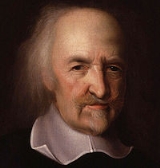
Thomas Hobbes

 
Thomas Hobbes

   Email Print
   Bookmark   Link


Thomas Hobbes


Thomas Hobbes (5 April 1588 – 4 December 1679) was an English philosopher
Philosophy

Philosophy is the study of general problems concerning matters such as existence, knowledge, truth, beauty, justice, validity, mind, and language....
, remembered today for his work on political philosophy
Political philosophy

Political philosophy is the study of questions about the city, government, politics, liberty, justice, property, rights, law and the enforcement of a legal code by authority: what they are, why they are needed, what makes a The purpose of government, what rights and freedoms it should protect and why, what form it should take and why, what t...
. His 1651 book Leviathan
Leviathan (book)

Leviathan, The Matter, Forme and Power of a Common Wealth Ecclesiasticall and Civil, commonly called Leviathan, is a book written by Thomas Hobbes which was published in 1651....
 established the foundation for most of Western political philosophy from the perspective of social contract
Social contract

Social contract describes a broad class of theories that try to explain the ways in which people form nations and maintain social order. The notion of the social contract implies that the people give up some rights to a government or other authority in order to receive or maintain social order....
 theory.

Hobbes also contributed to a diverse array of fields, including history
HIStory

HIStory: Past, Present and Future, Book I is a double album by Michael Jackson, released on June 20, 1995, and is Jackson's ninth. The first disc, named "HIStory Begins" consists of a selection of Jackson's greatest hits from the singer's past fifteen years, while the second, named "HIStory Continues" features new songs, with the...
, geometry
Geometry

Geometry arose as the field of knowledge dealing with spatial relationships. Geometry was one of the two fields of pre-modern mathematics, the other being the study of numbers....
, physics of gas
Gas

In physics, a gas is a state of matter, consisting of a collection of particles without a definite shape or volume that are in more or less random motion....
es, theology
Theology

Theology is the study of the existence or attributes of a deity or gods, or more generally the study of religion or spirituality. It is sometimes contrasted with religious studies: theology is understood as the study of religion from an internal perspective , and religious studies as the study of religion from an external perspective....
, ethics
Ethics

Ethics is a word for a philosophy that encompasses proper conduct and good living. It is significantly broader than the common conception of ethics as the analyzing of right and wrong....
, general philosophy
Philosophy

Philosophy is the study of general problems concerning matters such as existence, knowledge, truth, beauty, justice, validity, mind, and language....
, and political science
Political science

Political science is a social science concerned with the theory and practice of politics and the description and analysis of political systems and political behavior....
. His account of human nature as self-interested cooperation has proved to be an enduring theory in the field of philosophical anthropology
Philosophical anthropology

Philosophical anthropology is the attempt to unify disparate ways of understanding behaviour of humans as both creatures of their social environments and creators of their own Value s....
.

as Hobbes was born in Wiltshire
Wiltshire

Wiltshire is a Ceremonial counties of England in the South West England of England. It is landlocked and borders the counties of Dorset, Somerset, Hampshire, Gloucestershire, Oxfordshire and Berkshire....
, England
England

native_name =|conventional_long_name = England|common_name = England|image_flag = Flag of England.svg|image_coat = England COA.svg|symbol_type = Royal Coat of Arms...
 on 5 April 1588 (some sources say Malmesbury
Malmesbury, Wiltshire

Malmesbury is a south Cotswolds town and civil parish in south west England in the county of Wiltshire. The town is close to Cirencester, Chippenham, Wiltshire and Swindon and surrounded by rivers on three sides....
).


Discussion
Ask a question about 'Thomas Hobbes'
Start a new discussion about 'Thomas Hobbes'
Answer questions from other users
Full Discussion Forum


Recent Posts


Quotations


Corporations may lesser commonwealths in the bowels of a greater, like worms in the entrails of a natural man.

Pt. II, Ch. 29

For a mans Conscience, and his Judgement is the same thing; and as the Judgement, so also the Conscience may be erroneous.

Pt. II, Ch. 29

For Prudence, is but Experience; which equal time, equally bestows on all men, in those things they equally apply themselves unto. .

Pt. I, Ch. 13

Give an inch, he'll take an ell.

Liberty and Necessity (no. 111)

HopeFor Appetite with an opinion of attaining, is called HOPE.DespaireThe same, without such opinion, DESPAIRE.

Pt. I, Ch. 6

No man's error becomes his own Law; nor obliges him to persist in it. .

Pt. II, ch. 26


Encyclopedia


Thomas Hobbes (5 April 1588 – 4 December 1679) was an English philosopher
Philosophy

Philosophy is the study of general problems concerning matters such as existence, knowledge, truth, beauty, justice, validity, mind, and language....
, remembered today for his work on political philosophy
Political philosophy

Political philosophy is the study of questions about the city, government, politics, liberty, justice, property, rights, law and the enforcement of a legal code by authority: what they are, why they are needed, what makes a The purpose of government, what rights and freedoms it should protect and why, what form it should take and why, what t...
. His 1651 book Leviathan
Leviathan (book)

Leviathan, The Matter, Forme and Power of a Common Wealth Ecclesiasticall and Civil, commonly called Leviathan, is a book written by Thomas Hobbes which was published in 1651....
 established the foundation for most of Western political philosophy from the perspective of social contract
Social contract

Social contract describes a broad class of theories that try to explain the ways in which people form nations and maintain social order. The notion of the social contract implies that the people give up some rights to a government or other authority in order to receive or maintain social order....
 theory.

Hobbes also contributed to a diverse array of fields, including history
HIStory

HIStory: Past, Present and Future, Book I is a double album by Michael Jackson, released on June 20, 1995, and is Jackson's ninth. The first disc, named "HIStory Begins" consists of a selection of Jackson's greatest hits from the singer's past fifteen years, while the second, named "HIStory Continues" features new songs, with the...
, geometry
Geometry

Geometry arose as the field of knowledge dealing with spatial relationships. Geometry was one of the two fields of pre-modern mathematics, the other being the study of numbers....
, physics of gas
Gas

In physics, a gas is a state of matter, consisting of a collection of particles without a definite shape or volume that are in more or less random motion....
es, theology
Theology

Theology is the study of the existence or attributes of a deity or gods, or more generally the study of religion or spirituality. It is sometimes contrasted with religious studies: theology is understood as the study of religion from an internal perspective , and religious studies as the study of religion from an external perspective....
, ethics
Ethics

Ethics is a word for a philosophy that encompasses proper conduct and good living. It is significantly broader than the common conception of ethics as the analyzing of right and wrong....
, general philosophy
Philosophy

Philosophy is the study of general problems concerning matters such as existence, knowledge, truth, beauty, justice, validity, mind, and language....
, and political science
Political science

Political science is a social science concerned with the theory and practice of politics and the description and analysis of political systems and political behavior....
. His account of human nature as self-interested cooperation has proved to be an enduring theory in the field of philosophical anthropology
Philosophical anthropology

Philosophical anthropology is the attempt to unify disparate ways of understanding behaviour of humans as both creatures of their social environments and creators of their own Value s....
.

Early life and education

Thomas Hobbes was born in Wiltshire
Wiltshire

Wiltshire is a Ceremonial counties of England in the South West England of England. It is landlocked and borders the counties of Dorset, Somerset, Hampshire, Gloucestershire, Oxfordshire and Berkshire....
, England
England

native_name =|conventional_long_name = England|common_name = England|image_flag = Flag of England.svg|image_coat = England COA.svg|symbol_type = Royal Coat of Arms...
 on 5 April 1588 (some sources say Malmesbury
Malmesbury, Wiltshire

Malmesbury is a south Cotswolds town and civil parish in south west England in the county of Wiltshire. The town is close to Cirencester, Chippenham, Wiltshire and Swindon and surrounded by rivers on three sides....
). Born prematurely on April 5, 1588, when his mother heard of the coming invasion of the Spanish Armada
Spanish Armada

The Spanish Armada was the Habsburg Spain fleet that sailed against England under the command of the Alonso de Guzm?n El Bueno, 7th Duke of Medina Sidonia in 1588, leading to the Drake-Norris Expedition of 1589, also known as the English Armada....
, Thomas Hobbes later reported that "my mother gave birth to twins: myself and fear." His childhood is almost a complete blank, and his mother's name is unknown. His father, also named Thomas, was the vicar
Vicar

In the broadest sense, a vicar is a representative, anyone acting "in the person of" or wiktionary:agent for a superior . In this sense, the title is comparable to lieutenant, literally the "place-holder"....
 of Charlton
Charlton, Wiltshire

Charlton, Wiltshire may refer to:*Charlton, Kennet, Wiltshire - a village in the Kennet district of Wiltshire, England*Charlton, North Wiltshire, Wiltshire - a small village in the North Wiltshire district of Wiltshire, England...
 and Westport
Westport, Somerset

Westport is a village and parish, situated ten miles south east of Taunton and ten miles west of Yeovil in the South Somerset district of Somerset, England....
. Thomas Sr. abandoned his three children to the care of an older brother, Thomas junior's uncle Francis, when he was forced to flee to London after being involved in a fight with a clergyman outside his own church. Hobbes was educated at Westport church from the age of four, passed to the Malmesbury
Malmesbury, Wiltshire

Malmesbury is a south Cotswolds town and civil parish in south west England in the county of Wiltshire. The town is close to Cirencester, Chippenham, Wiltshire and Swindon and surrounded by rivers on three sides....
 school and then to a private school kept by a young man named Robert Latimer, a graduate of the University of Oxford
University of Oxford

The University of Oxford , located in the city of Oxford, Oxfordshire, England, is the List of oldest universities in continuous operation in the English-speaking world....
. Hobbes was a good pupil, and around 1603 he went up to Magdalen Hall, which is most closely related to Hertford College, Oxford
Hertford College, Oxford

Hertford College is one of the Colleges of the University of Oxford of the University of Oxford in England. It is located in Catte Street, directly opposite the main entrance of the original Bodleian Library....
. The principal John Wilkinson was a Puritan
Puritan

A Puritan of 16th and 17th century England was an associate of any number of religious groups advocating for more "purity" of worship and doctrine, as well as personal and group pietism....
, and he had some influence on Hobbes.

At university, Hobbes appears to have followed his own curriculum; he was "little attracted by the scholastic learning". He did not complete his B.A.
Bachelor of Arts

Bachelor of Arts , from the Latin language Artium Baccalaureus, is an Undergraduate education bachelor's degree awarded for either a course or a program in either the liberal arts, the sciences or both....
 degree until 1608, but he was recommended by Sir James Hussey, his master at Magdalen, as tutor to William, the son of William Cavendish
William Cavendish, 3rd Earl of Devonshire

William Cavendish, 3rd Earl of Devonshire was the son of William Cavendish, 2nd Earl of Devonshire.He married Elizabeth Cavendish, Countess of Devonshire, daughter of William Cecil, 2nd Earl of Salisbury, on 4 March 1639....
, Baron of Hardwick (and later Earl of Devonshire
Duke of Devonshire

Duke of Devonshire is a title in the Peerage of England held by members of the aristocracy House of Cavendish family. This branch of the Cavendish family has been one of the richest and most influential aristocratic families in England since the 16th century, and have been rivalled in political influence perhaps only by the Earl of Derby and...
), and began a life-long connection with that family.

Hobbes became a companion to the younger William and they both took part in a grand tour
Grand Tour

The Grand Tour was the traditional travel of Europe undertaken by mainly Upper class European young men of means. The custom flourished from about 1660 until the advent of mass railroad transit in the 1840s, and was associated with a standard itinerary....
 in 1610. Hobbes was exposed to European scientific and critical methods during the tour in contrast to the scholastic philosophy which he had learned in Oxford. His scholarly efforts at the time were aimed at a careful study of classic Greek and Latin authors, the outcome of which was, in 1628, his great translation of Thucydides
Thucydides

Thucydides was a Greeks history and author of the History of the Peloponnesian War, which recounts the 5th century B.C. war between Sparta and Athens to the year 411 B.C....
' History of the Peloponnesian War
History of the Peloponnesian War

The History of the Peloponnesian War is an account of the Peloponnesian War in Ancient Greece, fought between the Peloponnesian League and the Delian League ....
, the first translation of that work into English
English language

English is a West Germanic language that originated in Anglo-Saxon England and has lingua franca status in many parts of the world as a result of the military, economic, scientific, political and cultural influence of the British Empire in the 18th, 19th and early 20th centuries and that of the United States from the mid 20th century onwa...
 from a Greek manuscript.

Although he associated with literary figures like Ben Jonson
Ben Jonson

Benjamin Jonson was an England English Renaissance dramatist, poet and actor. A contemporary of William Shakespeare, he is best known for his satire plays, particularly Volpone, The Alchemist , and Bartholomew Fair, which are considered his best, and his Lyric poetry poems....
 and thinkers such as Francis Bacon, he did not extend his efforts into philosophy until after 1629. His employer Cavendish, then the Earl of Devonshire, died of the plague
Bubonic plague

Plague is a deadly infectious disease caused by the Enterobacteriaceae Yersinia pestis . Plague is a zoonotic, primarily carried by rodents and spread to humans via fleas....
 in June 1628. The widowed countess dismissed Hobbes but he soon found work, again as a tutor, this time to the son of Sir Gervase Clifton. This task, chiefly spent in Paris, ended in 1631 when he again found work with the Cavendish family, tutoring the son of his previous pupil. Over the next seven years as well as tutoring he expanded his own knowledge of philosophy, awakening in him curiosity over key philosophic debates. He visited Florence
Florence

Florence is the Capital city of the Italy Regions of Italy of Tuscany and of the provinces of Italy Province of Florence. It is the most populous city in Tuscany and has a population of 364,779 ....
 in 1636 and later was a regular debater in philosophic groups in Paris, held together by Marin Mersenne
Marin Mersenne

Marin Mersenne, Marin Mersennus or le P?re Mersenne was a France theology, philosopher, mathematician and Music theory, often referred to as the "father of acoustics" ....
. From 1637 he considered himself a philosopher and scholar.

In Paris

Hobbes's first area of study was an interest in the physical doctrine of motion and physical momentum. Despite his interest in this phenomenon, he disdained experimental work as in physics
Physics

Physics is the natural science which examines basic concepts such as energy, force, and spacetime and all that derives from these, such as mass, charge, matter and its Motion ....
. He went on to conceive the system of thought to the elaboration of which he would devote his life. His scheme was first to work out, in a separate treatise, a systematic doctrine of body, showing how physical phenomena were universally explicable in terms of motion, at least as motion or mechanical action was then understood. He then singled out Man from the realm of Nature and plants. Then, in another treatise, he showed what specific bodily motions were involved in the production of the peculiar phenomena of sensation, knowledge, affections and passions whereby Man came into relation with Man. Finally he considered, in his crowning treatise, how Men were moved to enter into society, and argued how this must be regulated if Men were not to fall back into "brutishness and misery". Thus he proposed to unite the separate phenomena of Body, Man, and the State.

Hobbes came home, in 1637, to a country riven with discontent which disrupted him from the orderly execution of his philosophic plan. However, by the time of the Short Parliament
Short Parliament

The Short Parliament of King Charles I of England is so called because it lasted only three weeks.After eleven years of attempting personal rule, Charles recalled Parliament in 1640, under the advice of Lord Wentworth, recently created Thomas Wentworth, 1st Earl of Strafford....
 he had written not only his Human Nature but also De corpore politico, which were published together ten years later as The Elements of Law. This means his initial political doctrine was not shaped by the English Civil War
English Civil War

The English Civil War was a series of armed conflicts and political machinations between Roundhead and Cavalier. The First English Civil War and Second English Civil War civil wars pitted the supporters of Charles I of England against the supporters of the Long Parliament, while the Third English Civil War saw fighting between supporters...
.

When in November 1640 the Long Parliament
Long Parliament

The Long Parliament is the name of the List of Parliaments of England called by Charles I of England, on 3 November 1640, following the Bishops' Wars....
 succeeded to the Short, Hobbes felt he was a marked man by the circulation of his treatise and fled to Paris. He did not return for eleven years. In Paris he rejoined the coterie about Mersenne, and wrote a critique of the Meditations on First Philosophy
Meditations on First Philosophy

Meditations on First Philosophy is a philosophy treatise written by Ren? Descartes first published in Latin language in 1641. The French language translation was made by the Duke of Luynes with the supervision of Descartes and was published in 1647 with the title M?ditations Metaphysiques....
 of Descartes, which was printed as third among the sets of "Objections" appended, with "Replies" from Descartes in 1641. A different set of remarks on other works by Descartes succeeded only in ending all correspondence between the two.

Hobbes also extended his own works somewhat, working on the third section, De Cive
De Cive

De Cive is a book by Thomas Hobbes published in 1642, and one of his major works.It anticipates the classical republicanism line of argument in the better-known Leviathan ....
, which was finished in November 1641. Although it was initially only circulated privately, it was well received, and included lines of argumentation to be repeated a decade later in the Leviathan
Leviathan (book)

Leviathan, The Matter, Forme and Power of a Common Wealth Ecclesiasticall and Civil, commonly called Leviathan, is a book written by Thomas Hobbes which was published in 1651....
. He then returned to hard work on the first two sections of his work and published little except for a short treatise on optics (Tractatus opticus) included in the collection of scientific tracts published by Mersenne as Cogitata physico-mathematica in 1644. He built a good reputation in philosophic circles and in 1645 was chosen with Descartes, Gilles de Roberval
Gilles de Roberval

Gilles Personne de Roberval , France mathematician, was born at Roberval, near Beauvais, France. His name was originally Gilles Personne or Gilles Personier, that of Roberval, by which he is known, being taken from the place of his birth....
 and others, to referee the controversy between John Pell
John Pell

John Pell , was an England mathematician....
 and Longomontanus over the problem of squaring the circle
Squaring the circle

Squaring the circle is a problem proposed by classical antiquity geometers. It is the challenge of constructing a square with the same area as a given circle by using only a finite number of steps with compass and straightedge....
.

The Civil War in England

The English Civil War
English Civil War

The English Civil War was a series of armed conflicts and political machinations between Roundhead and Cavalier. The First English Civil War and Second English Civil War civil wars pitted the supporters of Charles I of England against the supporters of the Long Parliament, while the Third English Civil War saw fighting between supporters...
 broke out in 1642, and when the Royalist
Cavalier

Cavalier was the name used by Roundheads for a Royalist supporter of Charles I of England during the English Civil War . Prince Rupert of the Rhine, commander of much of Charles I's cavalry, is often considered an archetypical Cavalier....
 cause began to decline in the middle of 1644 there was an exodus of the king's supporters to Europe. Many came to Paris and were known to Hobbes. This revitalised Hobbes's political interests and the De Cive was republished and more widely distributed. The printing was begun in 1646 by Samuel de Sorbiere
Samuel de Sorbiere

Samuel de Sorbi?re was a France philosopher and translation, best known for his promotion of the works of Pierre Gassendi and Thomas Hobbes....
 through the Elsevier press
Elsevier

Elsevier, the world's largest publisher of medical and scientific literature, forms part of the Reed Elsevier group. Based in Amsterdam, the company has substantial operations in the United Kingdom, USA and elsewhere....
 at Amsterdam
Amsterdam

Amsterdam is the Capital of the Netherlands and List of cities in the Netherlands with over 100,000 people of the Netherlands, located in the Provinces of the Netherlands of North Holland in the west of the country....
 with a new preface and some new notes in reply to objections.

In 1647, Hobbes was engaged as mathematical instructor to the young Charles, Prince of Wales
Charles II of England

Charles II was the Monarchy of Kingdom of England, Kingdom of Scotland, and Kingdom of Ireland.His father Charles I of England Regicide#The regicide of Charles I of England at Palace of Whitehall on 30 January 1649, at the climax of the English Civil War....
, who had come over from Jersey
Jersey

The Bailiwick of Jersey is a British Crown dependency off the coast of Normandy, France. As well as the island of Jersey itself, the bailiwick includes the nearly uninhabited islands of the Minquiers, ?cr?hous, the Pierres de Lecq and other rocks and reefs....
 around July. This engagement lasted until 1648 when Charles went to Holland.

The company of the exiled royalists led Hobbes to produce an English book to set forth his theory of civil government in relation to the political crisis resulting from the war. It was based on an unpublished treatise of 1640. The State, it now seemed to Hobbes, might be regarded as a great artificial man or monster (Leviathan
Leviathan

Leviathan , , is a Bible sea creature referred to in the Old Testament .The word leviathan has become synonymous with any large sea monster or creature....
), composed of men, with a life that might be traced from its generation under pressure of human needs to its dissolution through civil strife proceeding from human passions. The work was closed with a general "Review and Conclusion", in direct response to the war which raised the question of the subject's right to change allegiance when a former sovereign's power to protect was irrecoverably gone. Also he criticized religious doctrines on rationalistic grounds in the Commonwealth. The first public edition was titled Elementa philosophica de cive.

During the years of the composition of Leviathan he remained in or near Paris. In 1647 Hobbes was overtaken by a serious illness which disabled him for six months. On recovering from this near fatal disorder, he resumed his literary task, and carried it steadily forward to completion by the year 1650, having also translated his prior Latin work into English. In 1650, to prepare the way for his magnum opus
Magnum opus

Magnum opus , from the Latin meaning great work, refers to the largest, and perhaps the best, greatest, most popular, or most renowned achievement of an author, artist, or composer....
, he allowed the publication of his earliest treatise, divided into two separate small volumes (Human Nature, or the Fundamental Elements of Policie and De corpore politico, or the Elements of Law, Moral and Politick). In 1651 he published his translation of the De Cive
De Cive

De Cive is a book by Thomas Hobbes published in 1642, and one of his major works.It anticipates the classical republicanism line of argument in the better-known Leviathan ....
 under the title of Philosophicall Rudiments concerning Government and Society. Meanwhile the printing of the greater work was proceeding, and finally it appeared about the middle of 1651, under the title of Leviathan, or the Matter, Forme, and Power of a Common Wealth, Ecclesiasticall and Civil
Leviathan (book)

Leviathan, The Matter, Forme and Power of a Common Wealth Ecclesiasticall and Civil, commonly called Leviathan, is a book written by Thomas Hobbes which was published in 1651....
, with a famous title-page engraving in which, from behind hills overlooking a landscape, there towered the body (above the waist) of a crowned giant, made up of tiny figures of human beings and bearing sword and crozier in the two hands.

The work had immediate impact. Soon Hobbes was more lauded and decried than any other thinker of his time. However, the first effect of its publication was to sever his link with the exiled royalists, forcing him to appeal to the revolutionary English government for protection. The exiles might very well have killed him; the secularist spirit of his book greatly angered both Anglicans and French Catholics. Hobbes fled back home, arriving in London in the winter of 1651. Following his submission to the council of state he was allowed to subside into private life in Fetter Lane
Fetter Lane

Fetter Lane is a street in the ward of Farringdon Without in London England. It runs from Fleet Street in the south to Holborn in the north.The earliest mention of the street is "faitereslane" in 1312....
.

Leviathan


Leviathan Gr
In Leviathan
Leviathan (book)

Leviathan, The Matter, Forme and Power of a Common Wealth Ecclesiasticall and Civil, commonly called Leviathan, is a book written by Thomas Hobbes which was published in 1651....
, Hobbes set out his doctrine of the foundation of state
State

A state is a political Social contract with effective sovereignty over a geographic area and representing a population. These may be nation states, State or multinational states....
s and legitimate government
Government

Government is the body within any organization that has the authority to make and the power to enforce laws, regulations, or rules. Typically, the government refers to a civil government -- local, provincial, or national -- but commercial, academic, religious, or other formal organizations are also administered by governing bodies....
s - based on social contract theories. Leviathan was written during the English Civil War
English Civil War

The English Civil War was a series of armed conflicts and political machinations between Roundhead and Cavalier. The First English Civil War and Second English Civil War civil wars pitted the supporters of Charles I of England against the supporters of the Long Parliament, while the Third English Civil War saw fighting between supporters...
; much of the book is occupied with demonstrating the necessity of a strong central authority to avoid the evil of discord and civil war.

Beginning from a mechanistic
Mechanism (philosophy)

In philosophy, mechanism is a theory that all natural phenomena can be explained by physical causes. It can be contrasted with vitalism, the philosophical theory that vital forces are active in life, so that life cannot be explained solely by mechanism....
 understanding of human beings and the passions, Hobbes postulates what life would be like without government, a condition which he calls the state of nature
State of nature

State of nature is a term in political philosophy used in social contract theories to describe the hypothetical condition of humanity before the state's foundation and its monopoly on the legitimate use of physical force....
. In that state, each person would have a right, or license, to everything in the world. This inevitably leads to conflict, a "war of all against all" (bellum omnium contra omnes
Bellum omnium contra omnes

Bellum omnium contra omnes, a Latin language phrase meaning "the war of all against all", is the description that Thomas Hobbes gives to human existence in the state of nature thought experiment that he conducts in De Cive and Leviathan ....
), and thus lives that are "solitary, poor, nasty, brutish, and short" (xiii).

To escape this state of war, men in the state of nature accede to a social contract and establish a civil society
Civil society

Civil society is composed of the totality of voluntary civic and social organizations and institutions that form the basis of a functioning society as opposed to the force-backed structures of a state and commercial institutions of the market....
. According to Hobbes, society is a population beneath a sovereign
Sovereign

Sovereign may refer to:*Sovereignty, a philosophical concept or state*Sovereign *Sovereign Hill, Victoria, Australia*Lady Sovereign, a female MC and performing artist for Def Jam Recordings...
 authority
Authority

In government, authority is often used interchangeably with the term "power ". However, their meanings differ: while "power" refers to the ability to achieve certain ends, "authority" refers to a claim of legitimacy , the justification and right to exercise that power....
, to whom all individuals in that society cede their natural rights for the sake of protection. Any abuses of power by this authority are to be accepted as the price of peace. However, he also states that in severe cases of abuse, rebellion is expected. In particular, the doctrine of separation of powers
Separation of powers

Separation of powers, a term ascribed to France Age of Enlightenment political philosopher Charles de Secondat, baron de Montesquieu, is a model for the governance of democracy states, having its origins in an ancient idea of mixed government....
 is rejected: the sovereign must control civil, military, judicial and ecclesiastical powers.

Opponents


John Bramhall

Hobbes now turned to complete the fundamental treatise of his philosophical system. He worked so steadily that De Corpore was first printed in 1654. Also in 1654, a small treatise, Of Liberty and Necessity, was published by Bishop John Bramhall
John Bramhall

John Bramhall , was an Archbishop of Armagh , and an Anglican theologian and apologist. He was a noted controversialist who doggedly defended the English Church from both Puritan and Roman Catholic accusations, as well as the materialism of Thomas Hobbes....
, addressed at Hobbes. Bramhall, a strong Arminian
Arminianism

Arminianism is a school of Soteriology thought within Protestant Christianity based on the Christian theology ideas of the Netherlands Dutch Reformed theologian Jacobus Arminius and his historic followers, the Remonstrants....
, had met and debated with Hobbes and afterwards wrote down his views and sent them privately to be answered in this form by Hobbes. Hobbes duly replied, but not for publication. But a French acquaintance took a copy of the reply and published it with "an extravagantly laudatory epistle." Bramhall countered in 1655, when he printed everything that had passed between them (under the title of A Defence of the True Liberty of Human Actions from Antecedent or Extrinsic Necessity). In 1656 Hobbes was ready with The Questions concerning Liberty, Necessity and Chance, in which he replied "with astonishing force" to the bishop. As perhaps the first clear exposition of the psychological doctrine of determinism, Hobbes's own two pieces were important in the history of the free-will
Free will

The question of free will is whether, and in what sense, rational agents exercise control over their actions and decisions. Addressing this question requires understanding the relationship between freedom and Causality, and determining whether the laws of nature are causally deterministic....
 controversy. The bishop returned to the charge in 1658 with Castigations of Mr Hobbes's Animadversions, and also included a bulky appendix entitled The Catching of Leviathan the Great Whale. Hobbes never took any notice of the Castigations.

John Wallis

Beyond the spat with Bramhall, Hobbes was caught in a series of conflicts from the time of publishing his De Corpore
De Corpore

De Corpore is a 1655 book by Thomas Hobbes. As its full Latin title Elementorum philosophiae sectio prima De corpore implies, it was part of a larger work, conceived as a trilogy....
 in 1655. In Leviathan he had assailed the system of the original universities. Because Hobbes was so evidently opposed to the existing academic arrangements, and because De Corpore contained not only tendentious views on mathematics, but an unacceptable proof of the squaring of the circle (which was apparently an afterthought), mathematicians took him to be a target for polemics. John Wallis
John Wallis

John Wallis was an England Mathematics who is given partial credit for the development of modern calculus. Between 1643 and 1689 he served as chief cryptographer for Parliament of the United Kingdom and, later, the royal court....
 was not the first such opponent, but he tenaciously pursued Hobbes. The resulting controversy continued well into the 1670s.

Later life


Hobbes published, in 1658, the final section of his philosophical system, completing the scheme he had planned more than twenty years before. De Homine consisted for the most part of an elaborate theory of vision. The remainder of the treatise dealt cursorily with some of the topics more fully treated in the Human Nature and the Leviathan. In addition to publishing some controversial writings on mathematics and physics, Hobbes also continued to produce philosophical works. From the time of the Restoration he acquired a new prominence; "Hobbism" became a fashionable creed which it was the duty of "every lover of true morality and religion" to denounce. The young king, Hobbes's former pupil, now Charles II, remembered Hobbes and called him to the court to grant him a pension of £100.

The king was important in protecting Hobbes when, in 1666, the House of Commons
British House of Commons

The House of Commons is the lower house of the Parliament of the United Kingdom, which also comprises the British monarchy and the House of Lords ....
 introduced a bill against atheism and profaneness. That same year, on 17 October 1666, it was ordered that the committee to which the bill was referred "should be empowered to receive information touching such books as tend to atheism, blasphemy and profaneness... in particular... the book of Mr. Hobbes called the Leviathan". Hobbes was terrified at the prospect of being labelled a heretic, and proceeded to burn some of his compromising papers. At the same time, he examined the actual state of the law of heresy
Christian heresy

Heresy is the rejection of one or more established beliefs of a religious body, or adherence to "other beliefs." Christian heresy refers to unorthodox practices and beliefs that were deemed to be heretical by one or more of the Christian churches....
. The results of his investigation were first announced in three short Dialogues added as an Appendix to his Latin translation of Leviathan, published at Amsterdam in 1668. In this appendix, Hobbes aimed to show that, since the High Court of Commission had been put down, there remained no court of heresy at all to which he was amenable, and that nothing could be heresy except opposing the Nicene Creed
Nicene Creed

The Nicene Creed is the creed or profession of faith that is most widely used in Christianity liturgy. It is called Nicene because, in its original form, it was adopted in the city of Iznik by the first ecumenical council, which met there in 325....
, which, he maintained, Leviathan did not do.

The only consequence that came of the bill was that Hobbes could never thereafter publish anything in England on subjects relating to human conduct. The 1668 edition of his works was printed in Amsterdam because he could not obtain the censor's licence for its publication in England. Other writings were not made public until after his death, including Behemoth: the History of the Causes of the Civil Wars of England and of the Counsels and Artifices by which they were carried on from the year 1640 to the year 1662. For some time, Hobbes was not even allowed to respond, whatever his enemies tried. Despite this, his reputation abroad was formidable, and noble or learned foreigners who came to England never forgot to pay their respects to the old philosopher.

His final works were a curious mixture: an autobiography in Latin verse in 1672, and a translation of four books of the Odyssey
Odyssey

The Odyssey is one of two major ancient Hellenic civilization epic poetrys attributed to Homer. It is, in part, a sequel to the Iliad, the other work traditionally ascribed to Homer....
 into "rugged" English rhymes that in 1673 led to a complete translation of both Iliad
ILiad

The iLiad is an electronic handheld device, or e-book device, which can be used for document reading and editing. Like the Sony Reader or Amazon Kindle, the iLiad makes use of an electronic paper display....
 and Odyssey in 1675.

In October 1679, Hobbes suffered a bladder disorder, which was followed by a paralytic stroke from which he died on 4 December 1679. He is said to have uttered the last words "A great leap in the dark" in his final moments of life. He was interred within St. John the Baptist Church in Ault Hucknall
Ault Hucknall

Ault Hucknall is a small village, which gives its name to the surrounding civil parish, in the Bolsover district of Derbyshire, England.Local residents describe the settlement as the "smallest village in England", although as a village is not legally defined in England, this is not a provable claim - many would refer to it as a hamlet....
 in Derbyshire
Derbyshire

Derbyshire is a county in the East Midlands of England. A substantial portion of the Peak District National Park lies within Derbyshire. The northern part of Derbyshire overlaps with the Pennines, a famous chain of hills and mountains....
, England
England

native_name =|conventional_long_name = England|common_name = England|image_flag = Flag of England.svg|image_coat = England COA.svg|symbol_type = Royal Coat of Arms...
.

Selected bibliography

  • 1629. Translation of Thucydides
    Thucydides

    Thucydides was a Greeks history and author of the History of the Peloponnesian War, which recounts the 5th century B.C. war between Sparta and Athens to the year 411 B.C....
    's History of the Peloponnesian War
    History of the Peloponnesian War

    The History of the Peloponnesian War is an account of the Peloponnesian War in Ancient Greece, fought between the Peloponnesian League and the Delian League ....
  • 1650. The Elements of Law, Natural and Political, written in 1640 and comprising
    • Human Nature, or the Fundamental Elements of Policie
    • De Corpore Politico
  • 1651–8. Elementa philosophica
    • 1642. De Cive
      De Cive

      De Cive is a book by Thomas Hobbes published in 1642, and one of his major works.It anticipates the classical republicanism line of argument in the better-known Leviathan ....
       (Latin)
    • 1651. Philosophicall Rudiments concerning Government and Society (English translation of De Cive)
    • 1655. De Corpore (Latin)
    • 1656. De Corpore (English translation)
    • 1658. De Homine (Latin)
  • 1651. Leviathan, or the Matter, Forme, and Power of a Commonwealth, Ecclesiasticall and Civil
    Leviathan (book)

    Leviathan, The Matter, Forme and Power of a Common Wealth Ecclesiasticall and Civil, commonly called Leviathan, is a book written by Thomas Hobbes which was published in 1651....
    .
  • 1656. The Questions concerning Liberty, Necessity and Chance
  • 1668. Latin translation of the Leviathan
    Leviathan (book)

    Leviathan, The Matter, Forme and Power of a Common Wealth Ecclesiasticall and Civil, commonly called Leviathan, is a book written by Thomas Hobbes which was published in 1651....
  • 1675. English translation of Homer
    Homer

    Homer is traditionally held to be the author of the ancient Greek language epic poems the Iliad and the Odyssey, as well as of the Homeric Hymns....
    's Iliad
    ILiad

    The iLiad is an electronic handheld device, or e-book device, which can be used for document reading and editing. Like the Sony Reader or Amazon Kindle, the iLiad makes use of an electronic paper display....
     and Odyssey
    Odyssey

    The Odyssey is one of two major ancient Hellenic civilization epic poetrys attributed to Homer. It is, in part, a sequel to the Iliad, the other work traditionally ascribed to Homer....
  • 1681. Posthumously Behemoth, or The Long Parliament
    Behemoth (book)

    Behemoth, full title Behemoth: the history of the causes of the civil wars of england, and of the counsels and artifices by which they were carried on from the year 1640 to the year 1660, also known as The Long Parliament, is a book written by Thomas Hobbes discussing the English Civil War....
     (written in 1668, unpublished at the request of the King)


In popular culture

  • Hobbes
    Hobbes (Calvin and Hobbes)

    Hobbes is a character in the comic strip Calvin and Hobbes by Bill Watterson. He is one of only two characters within Watterson's strip who has multiple identities....
    , the tiger in Bill Watterson
    Bill Watterson

    William B. "Bill" Watterson II , is an American cartoonist and the author of the comic strip Calvin and Hobbes cartoon series. He also produced several drawings for Target: The Political Cartoon Quarterly....
    's comic strip Calvin and Hobbes
    Calvin and Hobbes

    Calvin and Hobbes is a comic strip Writing and Illustration by Bill Watterson, following the humorous antics of Calvin , an imaginative six-year old boy, and Hobbes , his energetic and sardonic?albeit stuffed?tiger....
    , was named after Thomas Hobbes, while his companion Calvin was named after the Reformation
    Protestant Reformation

    The Protestant Reformation was a Christian reform movement in Europe. It is thought to have begun in 1517 with Martin Luther's Ninety-Five Theses and may be considered to have ended with the Peace of Westphalia in 1648....
     theologian John Calvin
    John Calvin

    John Calvin was an influential French people theology and pastor during the Protestant Reformation. He was a principal figure in the development of the system of Christian theology later called Calvinism....
    .
  • Monty Python
    Monty Python

    Monty Python is a group of six comedians who created Monty Python's Flying Circus, a British television comedy sketch show that first aired on the BBC on October 5, 1969....
     mentions Hobbes as being "fond of his dram" in Bruces' Philosophers Song.


General

  • Macpherson, C. B.
    C. B. Macpherson

    Crawford Brough Macpherson O.C. M.Sc. D. Sc. was an influential Canada political science who taught political theory at the University of Toronto....
     (1962). The Political Theory of Possessive Individualism: Hobbes to Locke. Oxford: Oxford University Press.
  • Robinson, Dave & Groves, Judy (2003). Introducing Political Philosophy. Icon Books. ISBN 1-84046-450-X.
  • Strauss, Leo
    Leo Strauss

    Leo Strauss was a Germany-born Jewish-American Political philosophy who specialized in classical political philosophy. He spent most of his career as a professor of political science at the University of Chicago, where he taught several generations of students and published 15 books....
     (1936). The Political Philosophy of Hobbes; Its Basis and Its Genesis. Oxford: Clarendon Press.
  • Strauss, Leo (1959). "On the Basis of Hobbes's Political Philosophy," in What Is Political Philosophy?, Glencoe, IL: The Free Press, chap. 7.
  • Tönnies, Ferdinand
    Ferdinand Tönnies

    Ferdinand T?nnies was a Germany Sociology. He was a major contributor to sociological theory and field studies, as well as bringing Thomas Hobbes back on the agenda, by publishing his manuscripts....
     (1925). Hobbes. Leben und Lehre, Stuttgart: Frommann, 3rd ed.
  • Shapin, Steven
    Steven Shapin

    Steven Shapin is a history of science and technology and sociology of science. He is currently the Franklin L. Ford Professor of the History of Science at Harvard University....
     and Shaffer, Simon
    Simon Schaffer

    Simon Schaffer was born in Brighton and was educated at Varndean Grammar School for Boys . He is a professor of the history and philosophy of science at University of Cambridge and edits The British Journal for the History of Science....
     (1995). Leviathan and the Air-Pump
    Leviathan and the Air-Pump

    Leviathan and the Air-Pump: Hobbes, Boyle, and the Experimental Life is a book by Steven Shapin and Simon Schaffer. It examines the debate between Robert Boyle and Thomas Hobbes over Boyle's air-pump experiments in the 1660s....
    .
    Princeton: Princeton University Press.
  • Malcolm, Noel
    Noel Malcolm

    Noel Robert Malcolm Fellow of the British Academy FRSL is an English historian, writer, and columnist....
    . 2002. Aspects of Hobbes. New York: Oxford University Press.
  • Skinner, Quentin
    Quentin Skinner

    Quentin Robert Duthie Skinner is the Barber Beaumont Professor of the Humanities at Queen Mary, University of London....
    . 1996. Reason and Rhetoric in the Philosophy of Hobbes's. Cambridge: Cambridge University Press.
  • World History: The Living Legend. (2004) Changes Throughout Modern Philosophy. Pearson & Hall.
  • Malcolm, Noel. 2007. Reason of State, Propaganda, and the Thirty Years' War: An Unknown Translation by Thomas Hobbes. Oxford University Press.


Specific


Further reading

  • A. P. Martinich, "Thomas Hobbes," The Dictionary of Literary Biography, Volume 281: British Rhetoricians and Logicians, 1500-1660, Second Series, Detroit: Gale, 2003, pp. 130-144.
  • A. P. Martinch, A Hobbes Dictionary, Oxford: Blackwell, 1995.
  • A. P. Martinch, Thomas Hobbes, New York: St. Martin's, 1997.
  • A. P. Martinch, The Two Gods of Leviathan: Thomas Hobbes on Religion and Politics. Cambridge: Cambridge University Press, 1992.
  • A. P. Martinch, Hobbes: A Biography, Cambridge: Cambridge University Press, 1999.
  • A. P. Martinich, trans., Computatio sive Logica: Part One of De Corpore, New York: Abaris, 1981.
  • A. P. Martinich, ed., Leviathan, Peterborough, Ontario: Broadview Press, 2002.


External links

  • at the Internet Encyclopedia of Philosophy
  • at The Philosophy pages
  • at the History of Economic Thought website.
  • at the Stanford Encyclopedia of Philosophy
  • at Oregon State University
    • by John Aubrey
  • at
  • , as translated by Hobbes, at the Online Library of Liberty