

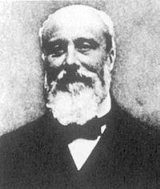
Pierre Duhem

Encyclopedia
Pierre Maurice Marie Duhem (pjˈɛʁ moʁˈis maʁˈi dyˈɛm; 9 June 1861 – 14 September 1916) was a French
physicist
, mathematician
and philosopher of science
, best known for his writings on the indeterminacy of experimental criteria and on scientific development in the Middle Ages
. Duhem also made major contributions to the science of his day, particularly in the fields of hydrodynamics, elasticity
, and thermodynamics
.
's statement that the Principia
's law of universal mutual gravitation was deduced
from 'phenomena', including Kepler
's second and third laws. Newton's claims in this regard had already been attacked by critical proof-analyses of the German logician Leibniz and then most famously by Immanuel Kant
, following Hume
's logical critique of induction
. But the novelty of Duhem's work was his proposal that Newton's theory of universal mutual gravity flatly contradicted Kepler's Laws of planetary motion because the interplanetary mutual gravitational perturbation
s caused deviations from Keplerian orbit
s. Since no proposition
can be validly
logically deduced from any it contradicts, according to Duhem, Newton must not have logically deduced his law of gravitation directly from Kepler's Laws.
Duhem's name is given to the under-determination or Duhem-Quine thesis
, which holds that for any given set of observations there is an innumerably large number of explanations. It is, in essence, the same as Hume's critique of induction: all three variants point at the fact that empirical evidence cannot force the choice of a theory or its revision. Possible alternatives to induction are Duhem's instrumentalism
and Popper's
thesis that we learn from falsification
.
As popular as the Duhem-Quine thesis may be in the philosophy of science
, in reality Pierre Duhem and Willard Van Orman Quine
stated very different theses. Pierre Duhem believed that experimental theory in physics
is fundamentally different from fields like physiology
and certain branches of chemistry
. Also Duhem's conception of theoretical group has its limits, since not all concepts are connected to each other logically. He did not include at all a priori disciplines such as logic
and mathematics
within these theoretical groups in physics which can be tested experimentally. Quine, on the other hand, conceived this theoretical group as a unit of a whole human knowledge. To Quine, even mathematics and logic must be revised in light of recalcitrant experience, a thesis that Duhem never held.
. This inevitable holism, according to Duhem, renders crucial experiments impossible. More generally, Duhem was critical of Newton's description of the method of physics as a straightforward "deduction" from facts and observations.
In the appendix to The Aim and Structure, entitled "Physics of a Believer," Duhem draws out the implications that he sees his philosophy of science as having for those who argue that there is a conflict between physics and religion. He writes, "metaphysical and religious doctrines are judgments touching on objective reality, whereas the principles of physical theory are propositions relative to certain mathematical signs stripped of all objective existence. Since they do not have any common term, these two sorts of judgments can neither contradict nor agree with each other" (p. 285). Nonetheless, Duhem argues that it is important for the theologian or "metaphysician" to have detailed knowledge of physical theory in order not to make illegitimate use of it in speculations.
 Duhem is well known for his work on the history of science
, which resulted in the ten volume Le système du monde: histoire des doctrines cosmologiques de Platon à Copernic (The System of World: A History of Cosmological Doctrines from Plato to Copernicus). Unlike many former historians (e.g. Voltaire
and Condorcet), who denigrated the Middle Ages
, he endeavored to show that the Roman Catholic Church
had helped foster Western science in one of its most fruitful periods. His work in this field was originally prompted by his research into the origins of statics
, where he encountered the works of medieval mathematicians and philosophers such as John Buridan, Nicole Oresme and Roger Bacon
, whose sophistication surprised him. He consequently came to regard them as the founders of modern science, having in his view anticipated many of the discoveries of Galileo Galilei
and later thinkers. Duhem concluded that "the mechanics and physics of which modern times are justifiably proud to proceed, by an uninterrupted series of scarcely perceptible improvements, from doctrines professed in the heart of the medieval schools."
Duhem popularized the concept of "saving the phenomena." In addition to the Copernican Revolution
debate of "saving the phenomena" (σώζειν τα φαινόμενα) versus offering explanations that inspired Duhem was Thomas Aquinas, who wrote, regarding eccentrics and epicycles
, that
. Duhem thought that from the first principles of thermodynamics physicists should be able to derive all the other fields of physics—e.g., chemistry, mechanics, and electromagnetism. Duhem carried out this project in Traité de l'énergétique (1911) but was unable to subject electromagnetism to thermodynamic first principles.
French
Originals
NOTE: The above bibliography is not exhaustive. See his complete primary sources and secondary sources at the Duhem entry of the Stanford Encyclopedia of Philosophy
.
Scanned editions of Duhem's works can be obtained from Gallica and the Internet Archive. OCR
ed and formatted editions are from ac-nancy-metz.fr.
France
The French Republic , The French Republic , The French Republic , (commonly known as France , is a unitary semi-presidential republic in Western Europe with several overseas territories and islands located on other continents and in the Indian, Pacific, and Atlantic oceans. Metropolitan France...
physicist
Physics
Physics is a natural science that involves the study of matter and its motion through spacetime, along with related concepts such as energy and force. More broadly, it is the general analysis of nature, conducted in order to understand how the universe behaves.Physics is one of the oldest academic...
, mathematician
Mathematics
Mathematics is the study of quantity, space, structure, and change. Mathematicians seek out patterns and formulate new conjectures. Mathematicians resolve the truth or falsity of conjectures by mathematical proofs, which are arguments sufficient to convince other mathematicians of their validity...
and philosopher of science
Philosophy of science
The philosophy of science is concerned with the assumptions, foundations, methods and implications of science. It is also concerned with the use and merit of science and sometimes overlaps metaphysics and epistemology by exploring whether scientific results are actually a study of truth...
, best known for his writings on the indeterminacy of experimental criteria and on scientific development in the Middle Ages
Middle Ages
The Middle Ages is a periodization of European history from the 5th century to the 15th century. The Middle Ages follows the fall of the Western Roman Empire in 476 and precedes the Early Modern Era. It is the middle period of a three-period division of Western history: Classic, Medieval and Modern...
. Duhem also made major contributions to the science of his day, particularly in the fields of hydrodynamics, elasticity
Elasticity (physics)
In physics, elasticity is the physical property of a material that returns to its original shape after the stress that made it deform or distort is removed. The relative amount of deformation is called the strain....
, and thermodynamics
Thermodynamics
Thermodynamics is a physical science that studies the effects on material bodies, and on radiation in regions of space, of transfer of heat and of work done on or by the bodies or radiation...
.
Philosophy
Duhem's views on the philosophy of science are explicated in The Aim and Structure of Physical Theory. In this work, he opposed NewtonIsaac Newton
Sir Isaac Newton PRS was an English physicist, mathematician, astronomer, natural philosopher, alchemist, and theologian, who has been "considered by many to be the greatest and most influential scientist who ever lived."...
's statement that the Principia
Philosophiae Naturalis Principia Mathematica
Philosophiæ Naturalis Principia Mathematica, Latin for "Mathematical Principles of Natural Philosophy", often referred to as simply the Principia, is a work in three books by Sir Isaac Newton, first published 5 July 1687. Newton also published two further editions, in 1713 and 1726...
's law of universal mutual gravitation was deduced
Deductive reasoning
Deductive reasoning, also called deductive logic, is reasoning which constructs or evaluates deductive arguments. Deductive arguments are attempts to show that a conclusion necessarily follows from a set of premises or hypothesis...
from 'phenomena', including Kepler
Johannes Kepler
Johannes Kepler was a German mathematician, astronomer and astrologer. A key figure in the 17th century scientific revolution, he is best known for his eponymous laws of planetary motion, codified by later astronomers, based on his works Astronomia nova, Harmonices Mundi, and Epitome of Copernican...
's second and third laws. Newton's claims in this regard had already been attacked by critical proof-analyses of the German logician Leibniz and then most famously by Immanuel Kant
Immanuel Kant
Immanuel Kant was a German philosopher from Königsberg , researching, lecturing and writing on philosophy and anthropology at the end of the 18th Century Enlightenment....
, following Hume
David Hume
David Hume was a Scottish philosopher, historian, economist, and essayist, known especially for his philosophical empiricism and skepticism. He was one of the most important figures in the history of Western philosophy and the Scottish Enlightenment...
's logical critique of induction
Inductive reasoning
Inductive reasoning, also known as induction or inductive logic, is a kind of reasoning that constructs or evaluates propositions that are abstractions of observations. It is commonly construed as a form of reasoning that makes generalizations based on individual instances...
. But the novelty of Duhem's work was his proposal that Newton's theory of universal mutual gravity flatly contradicted Kepler's Laws of planetary motion because the interplanetary mutual gravitational perturbation
Perturbation (astronomy)
Perturbation is a term used in astronomy in connection with descriptions of the complex motion of a massive body which is subject to appreciable gravitational effects from more than one other massive body....
s caused deviations from Keplerian orbit
Orbit
In physics, an orbit is the gravitationally curved path of an object around a point in space, for example the orbit of a planet around the center of a star system, such as the Solar System...
s. Since no proposition
Proposition
In logic and philosophy, the term proposition refers to either the "content" or "meaning" of a meaningful declarative sentence or the pattern of symbols, marks, or sounds that make up a meaningful declarative sentence...
can be validly
Validity
In logic, argument is valid if and only if its conclusion is entailed by its premises, a formula is valid if and only if it is true under every interpretation, and an argument form is valid if and only if every argument of that logical form is valid....
logically deduced from any it contradicts, according to Duhem, Newton must not have logically deduced his law of gravitation directly from Kepler's Laws.
Duhem's name is given to the under-determination or Duhem-Quine thesis
Confirmation holism
Confirmation holism, also called epistemological holism is the claim that a single scientific theory cannot be tested in isolation; a test of one theory always depends on other theories and hypotheses....
, which holds that for any given set of observations there is an innumerably large number of explanations. It is, in essence, the same as Hume's critique of induction: all three variants point at the fact that empirical evidence cannot force the choice of a theory or its revision. Possible alternatives to induction are Duhem's instrumentalism
Instrumentalism
In the philosophy of science, instrumentalism is the view that a scientific theory is a useful instrument in understanding the world. A concept or theory should be evaluated by how effectively it explains and predicts phenomena, as opposed to how accurately it describes objective...
and Popper's
Karl Popper
Sir Karl Raimund Popper, CH FRS FBA was an Austro-British philosopher and a professor at the London School of Economics...
thesis that we learn from falsification
Falsification
Falsification may refer to:* The act of disproving a proposition, hypothesis, or theory: see Falsifiability* Mathematical proof* Falsified evidence...
.
As popular as the Duhem-Quine thesis may be in the philosophy of science
Philosophy of science
The philosophy of science is concerned with the assumptions, foundations, methods and implications of science. It is also concerned with the use and merit of science and sometimes overlaps metaphysics and epistemology by exploring whether scientific results are actually a study of truth...
, in reality Pierre Duhem and Willard Van Orman Quine
Willard Van Orman Quine
Willard Van Orman Quine was an American philosopher and logician in the analytic tradition...
stated very different theses. Pierre Duhem believed that experimental theory in physics
Physics
Physics is a natural science that involves the study of matter and its motion through spacetime, along with related concepts such as energy and force. More broadly, it is the general analysis of nature, conducted in order to understand how the universe behaves.Physics is one of the oldest academic...
is fundamentally different from fields like physiology
Physiology
Physiology is the science of the function of living systems. This includes how organisms, organ systems, organs, cells, and bio-molecules carry out the chemical or physical functions that exist in a living system. The highest honor awarded in physiology is the Nobel Prize in Physiology or...
and certain branches of chemistry
Chemistry
Chemistry is the science of matter, especially its chemical reactions, but also its composition, structure and properties. Chemistry is concerned with atoms and their interactions with other atoms, and particularly with the properties of chemical bonds....
. Also Duhem's conception of theoretical group has its limits, since not all concepts are connected to each other logically. He did not include at all a priori disciplines such as logic
Logic
In philosophy, Logic is the formal systematic study of the principles of valid inference and correct reasoning. Logic is used in most intellectual activities, but is studied primarily in the disciplines of philosophy, mathematics, semantics, and computer science...
and mathematics
Mathematics
Mathematics is the study of quantity, space, structure, and change. Mathematicians seek out patterns and formulate new conjectures. Mathematicians resolve the truth or falsity of conjectures by mathematical proofs, which are arguments sufficient to convince other mathematicians of their validity...
within these theoretical groups in physics which can be tested experimentally. Quine, on the other hand, conceived this theoretical group as a unit of a whole human knowledge. To Quine, even mathematics and logic must be revised in light of recalcitrant experience, a thesis that Duhem never held.
Opposition to the English inductivist tradition
Duhem argues that physics is subject to certain methodological limitations that do not affect other sciences. In his The Aim and Structure of Physical Theory (1914), Duhem provided a devastating critique of Baconian crucial experiments. According to Duhem, an experiment in physics is not simply an observation, but rather an interpretation of observations by means of a theoretical framework. Furthermore, no matter how well one constructs one's experiment, it is impossible to subject an isolated single hypothesis to an experimental test. Instead, it is a whole interlocking group of hypotheses, background assumptions, and theories that is tested. This thesis has come to be known as holismHolism
Holism is the idea that all the properties of a given system cannot be determined or explained by its component parts alone...
. This inevitable holism, according to Duhem, renders crucial experiments impossible. More generally, Duhem was critical of Newton's description of the method of physics as a straightforward "deduction" from facts and observations.
In the appendix to The Aim and Structure, entitled "Physics of a Believer," Duhem draws out the implications that he sees his philosophy of science as having for those who argue that there is a conflict between physics and religion. He writes, "metaphysical and religious doctrines are judgments touching on objective reality, whereas the principles of physical theory are propositions relative to certain mathematical signs stripped of all objective existence. Since they do not have any common term, these two sorts of judgments can neither contradict nor agree with each other" (p. 285). Nonetheless, Duhem argues that it is important for the theologian or "metaphysician" to have detailed knowledge of physical theory in order not to make illegitimate use of it in speculations.
History of Science
History of science
The history of science is the study of the historical development of human understandings of the natural world and the domains of the social sciences....
, which resulted in the ten volume Le système du monde: histoire des doctrines cosmologiques de Platon à Copernic (The System of World: A History of Cosmological Doctrines from Plato to Copernicus). Unlike many former historians (e.g. Voltaire
Voltaire
François-Marie Arouet , better known by the pen name Voltaire , was a French Enlightenment writer, historian and philosopher famous for his wit and for his advocacy of civil liberties, including freedom of religion, free trade and separation of church and state...
and Condorcet), who denigrated the Middle Ages
Middle Ages
The Middle Ages is a periodization of European history from the 5th century to the 15th century. The Middle Ages follows the fall of the Western Roman Empire in 476 and precedes the Early Modern Era. It is the middle period of a three-period division of Western history: Classic, Medieval and Modern...
, he endeavored to show that the Roman Catholic Church
Roman Catholic Church
The Catholic Church, also known as the Roman Catholic Church, is the world's largest Christian church, with over a billion members. Led by the Pope, it defines its mission as spreading the gospel of Jesus Christ, administering the sacraments and exercising charity...
had helped foster Western science in one of its most fruitful periods. His work in this field was originally prompted by his research into the origins of statics
Statics
Statics is the branch of mechanics concerned with the analysis of loads on physical systems in static equilibrium, that is, in a state where the relative positions of subsystems do not vary over time, or where components and structures are at a constant velocity...
, where he encountered the works of medieval mathematicians and philosophers such as John Buridan, Nicole Oresme and Roger Bacon
Roger Bacon
Roger Bacon, O.F.M. , also known as Doctor Mirabilis , was an English philosopher and Franciscan friar who placed considerable emphasis on the study of nature through empirical methods...
, whose sophistication surprised him. He consequently came to regard them as the founders of modern science, having in his view anticipated many of the discoveries of Galileo Galilei
Galileo Galilei
Galileo Galilei , was an Italian physicist, mathematician, astronomer, and philosopher who played a major role in the Scientific Revolution. His achievements include improvements to the telescope and consequent astronomical observations and support for Copernicanism...
and later thinkers. Duhem concluded that "the mechanics and physics of which modern times are justifiably proud to proceed, by an uninterrupted series of scarcely perceptible improvements, from doctrines professed in the heart of the medieval schools."
Duhem popularized the concept of "saving the phenomena." In addition to the Copernican Revolution
Copernican Revolution
The Copernican Revolution refers to the paradigm shift away from the Ptolemaic model of the heavens, which postulated the Earth at the center of the galaxy, towards the heliocentric model with the Sun at the center of our Solar System...
debate of "saving the phenomena" (σώζειν τα φαινόμενα) versus offering explanations that inspired Duhem was Thomas Aquinas, who wrote, regarding eccentrics and epicycles
Deferent and epicycle
In the Ptolemaic system of astronomy, the epicycle was a geometric model used to explain the variations in speed and direction of the apparent motion of the Moon, Sun, and planets...
, that
Reason may be employed in two ways to establish a point: firstly, for the purpose of furnishing sufficient proof of some principle [...]. Reason is employed in another way, not as furnishing a sufficient proof of a principle, but as confirming an already established principle, by showing the congruity of its results, as in astronomy the theory of eccentrics and epicyclesDeferent and epicycleIn the Ptolemaic system of astronomy, the epicycle was a geometric model used to explain the variations in speed and direction of the apparent motion of the Moon, Sun, and planets...
is considered as established, because thereby the sensible appearances of the heavenly movements can be explained; not, however, as if this proof were sufficient, forasmuch as some other theory might explain them. [...]
Thermodynamics
Duhem is also known for his work in thermodynamics, being in part responsible for the development of what is known as the Gibbs–Duhem relation and the Duhem–Margules equationDuhem–Margules equation
The Duhem–Margules equation, named for Pierre Duhem and Max Margules, is a thermodynamic statement of the relationship between the two components of a single liquid where the vapour mixture is regarded as an ideal gas:...
. Duhem thought that from the first principles of thermodynamics physicists should be able to derive all the other fields of physics—e.g., chemistry, mechanics, and electromagnetism. Duhem carried out this project in Traité de l'énergétique (1911) but was unable to subject electromagnetism to thermodynamic first principles.
Works
English Translations (excerpt) (excerpt: "The 12th century birth of the notion of mass which advised modern mechanics ... and void and movement in the void") (excerpts: excerpt 1 & excerpt 2 ("Heavenly bodies: Theory, physics and philosophy"))- Articles
- "Physics & Metaphysics" (1893)
- "Physics of a Believer"
- Articles contributed to the 1912 Catholic Encyclopedia
Catholic EncyclopediaThe Catholic Encyclopedia, also referred to as the Old Catholic Encyclopedia and the Original Catholic Encyclopedia, is an English-language encyclopedia published in the United States. The first volume appeared in March 1907 and the last three volumes appeared in 1912, followed by a master index...
NEWLIN
French
French language
French is a Romance language spoken as a first language in France, the Romandy region in Switzerland, Wallonia and Brussels in Belgium, Monaco, the regions of Quebec and Acadia in Canada, and by various communities elsewhere. Second-language speakers of French are distributed throughout many parts...
Originals
- Leçons sur l'électricité et le magnétisme (1891–1892)
- Les théories de la chaleur (1895)
- Le mixte et la combinaison chimique. Essai sur l'évolution d'une idée (1902)
- L'évolution de la mécanique (1902)
- Les origines de la statique volume 1 & volume 2 (1903)
- La théorie physique son objet et sa structure (1906)
- Études sur Léonard de Vinci. Paris, F. De Nobele, 1906–13; 1955. 3 v. 1. sér. I. Albert de Saxe et Léonard de Vinci. II. Léonard de Vinci et Villalpand. III. Léonard de Vinci et Bernardino Baldi. IV. Bernardino Baldi, Roberval dt Descartes. V. Thémon le fils du juif et Léonard de Vinci. VI. Léonard de Vinci, Cardan et Bernard Palissy. VII. La scientia de ponderibus et Léonard de Vinci. VIII. Albert de Saxe. 2. sér. IX. Léonard de Vinci et les deux infinis. X. Léonard de Vinci et la pluralité des mondes. XI. Nicolas de Cues et Léonard de Vinci. XII. Léonard de Vinci et les origines de la géologie. 3. sér. Les précurseurs parisiens de Galilée: XIII. Jean I. Buridan (de Béthune) et Léonard de Vinci. XIV. Le tradition de Buridan et la science italienne au XVIe siecle. XV. Dominique Soto et la scolastique parisienne.
- Sozein ta phainomena. Essai sur la Notion de Théorie physique de Platon à Galilée (1908)
- Traité de l'énergétique (1911)
- Le Système du Monde. Histoire des Doctrines cosmologiques de Platon à Copernic, 10 vols. (volumes 1-5 & volumes 3, 8-10), (1913—1959)
- Articles
- "Le mouvement relatif et le mouvement absolu" in the Ruvue de Philosophie
- "La valeur de la théorie physique, à propos d'un livre récent," Article publié dans la Revue des sciences pures et appliquées, dix-neuvième année (1908), p. 7-19
NOTE: The above bibliography is not exhaustive. See his complete primary sources and secondary sources at the Duhem entry of the Stanford Encyclopedia of Philosophy
Stanford Encyclopedia of Philosophy
The Stanford Encyclopedia of Philosophy is a freely-accessible online encyclopedia of philosophy maintained by Stanford University. Each entry is written and maintained by an expert in the field, including professors from over 65 academic institutions worldwide...
.
Scanned editions of Duhem's works can be obtained from Gallica and the Internet Archive. OCR
Optical character recognition
Optical character recognition, usually abbreviated to OCR, is the mechanical or electronic translation of scanned images of handwritten, typewritten or printed text into machine-encoded text. It is widely used to convert books and documents into electronic files, to computerize a record-keeping...
ed and formatted editions are from ac-nancy-metz.fr.
External links
- MacTutor Biography
- Duhem's 'History of Physics' Link to Duhem's version of his history of physics published in The Catholic Encyclopedia in 1911.