
Home      Discussion      Topics      Dictionary      Almanac
Signup       Login
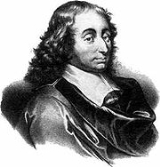
Blaise Pascal

Blaise Pascal

Overview
Blaise Pascal was a French
French people
The French are a nation that share a common French culture and speak the French language as a mother tongue. Historically, the French population are descended from peoples of Celtic, Latin and Germanic origin, and are today a mixture of several ethnic groups...

 mathematician
Mathematician
A mathematician is a person whose primary area of study is the field of mathematics. Mathematicians are concerned with quantity, structure, space, and change....

, physicist
Physicist
A physicist is a scientist who studies or practices physics. Physicists study a wide range of physical phenomena in many branches of physics spanning all length scales: from sub-atomic particles of which all ordinary matter is made to the behavior of the material Universe as a whole...

, inventor, writer
Writer
A writer is a person who produces literature, such as novels, short stories, plays, screenplays, poetry, or other literary art. Skilled writers are able to use language to portray ideas and images....

 and Catholic
Catholic
The word catholic comes from the Greek phrase , meaning "on the whole," "according to the whole" or "in general", and is a combination of the Greek words meaning "about" and meaning "whole"...

 philosopher. He was a child prodigy
Child prodigy
A child prodigy is someone who, at an early age, masters one or more skills far beyond his or her level of maturity. One criterion for classifying prodigies is: a prodigy is a child, typically younger than 18 years old, who is performing at the level of a highly trained adult in a very demanding...

 who was educated by his father, a tax collector in Rouen
Rouen
Rouen , in northern France on the River Seine, is the capital of the Haute-Normandie region and the historic capital city of Normandy. Once one of the largest and most prosperous cities of medieval Europe , it was the seat of the Exchequer of Normandy in the Middle Ages...

. Pascal's earliest work was in the natural and applied science
Science
Science is a systematic enterprise that builds and organizes knowledge in the form of testable explanations and predictions about the universe...

s where he made important contributions to the study of fluid
Fluid
In physics, a fluid is a substance that continually deforms under an applied shear stress. Fluids are a subset of the phases of matter and include liquids, gases, plasmas and, to some extent, plastic solids....

s, and clarified the concepts of pressure
Pressure
Pressure is the force per unit area applied in a direction perpendicular to the surface of an object. Gauge pressure is the pressure relative to the local atmospheric or ambient pressure.- Definition :...

 and vacuum
Vacuum
In everyday usage, vacuum is a volume of space that is essentially empty of matter, such that its gaseous pressure is much less than atmospheric pressure. The word comes from the Latin term for "empty". A perfect vacuum would be one with no particles in it at all, which is impossible to achieve in...

 by generalizing the work of Evangelista Torricelli
Evangelista Torricelli
Evangelista Torricelli was an Italian physicist and mathematician, best known for his invention of the barometer.-Biography:Evangelista Torricelli was born in Faenza, part of the Papal States...

. Pascal also wrote in defense of the scientific method
Scientific method
Scientific method refers to a body of techniques for investigating phenomena, acquiring new knowledge, or correcting and integrating previous knowledge. To be termed scientific, a method of inquiry must be based on gathering empirical and measurable evidence subject to specific principles of...

.
Discussion
Ask a question about 'Blaise Pascal'
Start a new discussion about 'Blaise Pascal'
Answer questions from other users
Full Discussion Forum
 
Unanswered Questions
Recent Discussions
Quotations

L'homme n'est ni ange ni bête, et le malheur veut que qui veut faire l'ange fait la bête.

Laf. 678

It is not permitted to the most equitable of men to be a judge in his own cause.

Pensées (1670) Chapter 4, I

For as old age is that period of life most remote from infancy, who does not see that old age in this universal man ought not to be sought in the times nearest his birth, but in those most remote from it?

Preface to the Treatise on Vacuum

Habit is a second nature and it destroys the first.

Pensées (1670) No. 376
Encyclopedia
Blaise Pascal was a French
French people
The French are a nation that share a common French culture and speak the French language as a mother tongue. Historically, the French population are descended from peoples of Celtic, Latin and Germanic origin, and are today a mixture of several ethnic groups...

 mathematician
Mathematician
A mathematician is a person whose primary area of study is the field of mathematics. Mathematicians are concerned with quantity, structure, space, and change....

, physicist
Physicist
A physicist is a scientist who studies or practices physics. Physicists study a wide range of physical phenomena in many branches of physics spanning all length scales: from sub-atomic particles of which all ordinary matter is made to the behavior of the material Universe as a whole...

, inventor, writer
Writer
A writer is a person who produces literature, such as novels, short stories, plays, screenplays, poetry, or other literary art. Skilled writers are able to use language to portray ideas and images....

 and Catholic
Catholic
The word catholic comes from the Greek phrase , meaning "on the whole," "according to the whole" or "in general", and is a combination of the Greek words meaning "about" and meaning "whole"...

 philosopher. He was a child prodigy
Child prodigy
A child prodigy is someone who, at an early age, masters one or more skills far beyond his or her level of maturity. One criterion for classifying prodigies is: a prodigy is a child, typically younger than 18 years old, who is performing at the level of a highly trained adult in a very demanding...

 who was educated by his father, a tax collector in Rouen
Rouen
Rouen , in northern France on the River Seine, is the capital of the Haute-Normandie region and the historic capital city of Normandy. Once one of the largest and most prosperous cities of medieval Europe , it was the seat of the Exchequer of Normandy in the Middle Ages...

. Pascal's earliest work was in the natural and applied science
Science
Science is a systematic enterprise that builds and organizes knowledge in the form of testable explanations and predictions about the universe...

s where he made important contributions to the study of fluid
Fluid
In physics, a fluid is a substance that continually deforms under an applied shear stress. Fluids are a subset of the phases of matter and include liquids, gases, plasmas and, to some extent, plastic solids....

s, and clarified the concepts of pressure
Pressure
Pressure is the force per unit area applied in a direction perpendicular to the surface of an object. Gauge pressure is the pressure relative to the local atmospheric or ambient pressure.- Definition :...

 and vacuum
Vacuum
In everyday usage, vacuum is a volume of space that is essentially empty of matter, such that its gaseous pressure is much less than atmospheric pressure. The word comes from the Latin term for "empty". A perfect vacuum would be one with no particles in it at all, which is impossible to achieve in...

 by generalizing the work of Evangelista Torricelli
Evangelista Torricelli
Evangelista Torricelli was an Italian physicist and mathematician, best known for his invention of the barometer.-Biography:Evangelista Torricelli was born in Faenza, part of the Papal States...

. Pascal also wrote in defense of the scientific method
Scientific method
Scientific method refers to a body of techniques for investigating phenomena, acquiring new knowledge, or correcting and integrating previous knowledge. To be termed scientific, a method of inquiry must be based on gathering empirical and measurable evidence subject to specific principles of...

.

In 1642, while still a teenager, he started some pioneering work on calculating machines, and after three years of effort and 50 prototypes he invented the mechanical calculator
Mechanical calculator
A mechanical calculator is a device used to perform the basic operations of arithmetic. Mechanical calculators are comparable in size to small desktop computers and have been rendered obsolete by the advent of the electronic calculator....

. He built twenty of these machines (called the Pascaline) in the following ten years. Pascal was a mathematician of the first order. He helped create two major new areas of research. He wrote a significant treatise on the subject of projective geometry
Projective geometry
In mathematics, projective geometry is the study of geometric properties that are invariant under projective transformations. This means that, compared to elementary geometry, projective geometry has a different setting, projective space, and a selective set of basic geometric concepts...

 at the age of sixteen, and later corresponded with Pierre de Fermat
Pierre de Fermat
Pierre de Fermat was a French lawyer at the Parlement of Toulouse, France, and an amateur mathematician who is given credit for early developments that led to infinitesimal calculus, including his adequality...

 on probability theory
Probability theory
Probability theory is the branch of mathematics concerned with analysis of random phenomena. The central objects of probability theory are random variables, stochastic processes, and events: mathematical abstractions of non-deterministic events or measured quantities that may either be single...

, strongly influencing the development of modern economics
Economics
Economics is the social science that analyzes the production, distribution, and consumption of goods and services. The term economics comes from the Ancient Greek from + , hence "rules of the house"...

 and social science
Social sciences
Social science is the field of study concerned with society. "Social science" is commonly used as an umbrella term to refer to a plurality of fields outside of the natural sciences usually exclusive of the administrative or managerial sciences...

. Following Galileo and Torricelli, in 1646 he refuted Aristotle's
Aristotle
Aristotle was a Greek philosopher and polymath, a student of Plato and teacher of Alexander the Great. His writings cover many subjects, including physics, metaphysics, poetry, theater, music, logic, rhetoric, linguistics, politics, government, ethics, biology, and zoology...

 followers who insisted that nature abhors a vacuum. His results caused many disputes before being accepted.

In 1646, he and his sister Jacqueline identified with the religious movement within Catholicism
Catholicism
Catholicism is a broad term for the body of the Catholic faith, its theologies and doctrines, its liturgical, ethical, spiritual, and behavioral characteristics, as well as a religious people as a whole....

 known by its detractors as Jansenism
Jansenism
Jansenism was a Christian theological movement, primarily in France, that emphasized original sin, human depravity, the necessity of divine grace, and predestination. The movement originated from the posthumously published work of the Dutch theologian Cornelius Otto Jansen, who died in 1638...

. His father died in 1651. Following a mystical
Mysticism
Mysticism is the knowledge of, and especially the personal experience of, states of consciousness, i.e. levels of being, beyond normal human perception, including experience and even communion with a supreme being.-Classical origins:...

 experience in late 1654, he had his "second conversion", abandoned his scientific work, and devoted himself to philosophy and theology
Theology
Theology is the systematic and rational study of religion and its influences and of the nature of religious truths, or the learned profession acquired by completing specialized training in religious studies, usually at a university or school of divinity or seminary.-Definition:Augustine of Hippo...

. His two most famous works date from this period: the Lettres provinciales
Lettres provinciales
The Lettres provinciales are a series of eighteen letters written by French philosopher and theologian Blaise Pascal under the pseudonym Louis de Montalte...

 and the Pensées
Pensées
The Pensées represented a defense of the Christian religion by Blaise Pascal, the renowned 17th century philosopher and mathematician. Pascal's religious conversion led him into a life of asceticism, and the Pensées was in many ways his life's work. "Pascal's Wager" is found here...

, the former set in the conflict between Jansenists and Jesuits. In this year, he also wrote an important treatise on the arithmetical triangle. Between 1658 and 1659 he wrote on the cycloid
Cycloid
A cycloid is the curve traced by a point on the rim of a circular wheel as the wheel rolls along a straight line.It is an example of a roulette, a curve generated by a curve rolling on another curve....

 and its use in calculating the volume of solids.

Pascal had poor health
Health
Health is the level of functional or metabolic efficiency of a living being. In humans, it is the general condition of a person's mind, body and spirit, usually meaning to be free from illness, injury or pain...

 especially after his eighteenth year and his death came just two months after his 39th birthday.

Early life and education


Pascal was born in Clermont-Ferrand
Clermont-Ferrand
Clermont-Ferrand is a city and commune of France, in the Auvergne region, with a population of 140,700 . Its metropolitan area had 409,558 inhabitants at the 1999 census. It is the prefecture of the Puy-de-Dôme department...

; he lost his mother, Antoinette Begon, at the age of three. His father, Étienne Pascal
Étienne Pascal
Étienne Pascal was the father of Blaise Pascal. His father and mother were Martin Pascal, the treasurer of France, and Marguerite Pascal de Mons. He also had three daughters, two of whom survived past childhood: Gilberte and Jacqueline...

 (1588–1651), who also had an interest in science and mathematics, was a local judge and member of the "Noblesse de Robe
Nobles of the Robe
Under the Old Regime, the Nobles of the Robe or Nobles of the Gown were French aristocrats who owed their rank to judicial or administrative posts — often bought outright for high sums. As a rule, these positions did not grant the holder with a title , but were honorary positions almost always...

". Pascal had two sisters, the younger Jacqueline
Jacqueline Pascal
Jacqueline Pascal , sister of Blaise Pascal, was born at Clermont-Ferrand, Auvergne, France.Like her brother she was a prodigy, composing verses when only eight years old, and a five-act comedy at eleven. In 1646, the influence of her brother converted her to Jansenism...

 and the elder Gilberte.

In 1631, five years after the death of his wife, Étienne Pascal moved with his children to Paris. The newly arrived family soon hired Louise Delfault, a maid who eventually became an instrumental member of the family. Étienne, who never remarried, decided that he alone would educate his children, for they all showed extraordinary intellectual ability, particularly his son Blaise. The young Pascal showed an amazing aptitude for mathematics and science.

Particularly of interest to Pascal was a work of Desargues on conic section
Conic section
In mathematics, a conic section is a curve obtained by intersecting a cone with a plane. In analytic geometry, a conic may be defined as a plane algebraic curve of degree 2...

s. Following Desargues' thinking, the sixteen-year-old Pascal produced, as a means of proof, a short treatise on what was called the "Mystic Hexagram", Essai pour les coniques ("Essay on Conics") and sent it—his first serious work of mathematics—to Père Mersenne
Marin Mersenne
Marin Mersenne, Marin Mersennus or le Père Mersenne was a French theologian, philosopher, mathematician and music theorist, often referred to as the "father of acoustics"...

 in Paris; it is known still today as Pascal's theorem
Pascal's theorem
In projective geometry, Pascal's theorem states that if an arbitrary hexagon is inscribed in any conic section, and pairs of opposite sides are extended until they meet, the three intersection points will lie on a straight line, the Pascal line of that configuration.- Related results :This theorem...

. It states that if a hexagon is inscribed in a circle (or conic) then the three intersection points of opposite sides lie on a line (called the Pascal line).

Pascal's work was so precocious that Descartes was convinced that Pascal's father had written it. When assured by Mersenne that it was, indeed, the product of the son not the father, Descartes dismissed it with a sniff: "I do not find it strange that he has offered demonstrations about conics more appropriate than those of the ancients," adding, "but other matters related to this subject can be proposed that would scarcely occur to a sixteen-year-old child."

In France at that time offices and positions could be—and were—bought and sold. In 1631 Étienne sold his position as second president of the Cour des Aides for 65,665 livres. The money was invested in a government bond
Government bond
A government bond is a bond issued by a national government denominated in the country's own currency. Bonds are debt investments whereby an investor loans a certain amount of money, for a certain amount of time, with a certain interest rate, to a company or country...

 which provided if not a lavish then certainly a comfortable income which allowed the Pascal family to move to, and enjoy, Paris. But in 1638 Richelieu, desperate for money to carry on the Thirty Years' War
Thirty Years' War
The Thirty Years' War was fought primarily in what is now Germany, and at various points involved most countries in Europe. It was one of the most destructive conflicts in European history....

, defaulted on the government's bonds. Suddenly Étienne Pascal's worth had dropped from nearly 66,000 livres to less than 7,300.


Like so many others, Étienne was eventually forced to flee Paris because of his opposition to the fiscal policies of Cardinal Richelieu, leaving his three children in the care of his neighbor Madame Sainctot, a great beauty with an infamous past who kept one of the most glittering and intellectual salons in all France. It was only when Jacqueline performed well in a children's play with Richelieu in attendance that Étienne was pardoned. In time Étienne was back in good graces with the cardinal, and in 1639 had been appointed the king's commissioner of taxes in the city of Rouen
Rouen
Rouen , in northern France on the River Seine, is the capital of the Haute-Normandie region and the historic capital city of Normandy. Once one of the largest and most prosperous cities of medieval Europe , it was the seat of the Exchequer of Normandy in the Middle Ages...

 — a city whose tax records, thanks to uprisings, were in utter chaos.

In 1642, in an effort to ease his father's endless, exhausting calculations, and recalculations, of taxes owed and paid, Pascal, not yet nineteen, constructed a mechanical calculator capable of addition and subtraction, called Pascal's calculator
Pascal's calculator
Blaise Pascal invented the mechanical calculator in 1642. He conceived it while trying to help his father who had been assigned the task of reorganizing the tax revenues of the French province of Haute-Normandie ; first called Arithmetic Machine, Pascal's Calculator and later Pascaline, it could...

 or the Pascaline. The Musée des Arts et Métiers
Musée des Arts et Métiers
The Musée des Arts et Métiers is a museum in Paris that houses the collection of the Conservatoire National des Arts et Métiers , which was founded in 1794 as a repository for the preservation of scientific instruments and inventions.-History:Since its foundation, the museum has been housed in the...

 in Paris and the Zwinger museum
Zwinger
The Zwinger is a palace in Dresden, eastern Germany, built in Baroque style. It served as the orangery, exhibition gallery and festival arena of the Dresden Court....

 in Dresden
Dresden
Dresden is the capital city of the Free State of Saxony in Germany. It is situated in a valley on the River Elbe, near the Czech border. The Dresden conurbation is part of the Saxon Triangle metropolitan area....

, Germany
Germany
Germany , officially the Federal Republic of Germany , is a federal parliamentary republic in Europe. The country consists of 16 states while the capital and largest city is Berlin. Germany covers an area of 357,021 km2 and has a largely temperate seasonal climate...

, exhibit two of his original mechanical calculators. Though these machines are early forerunners to computer engineering
Computer engineering
Computer engineering, also called computer systems engineering, is a discipline that integrates several fields of electrical engineering and computer science required to develop computer systems. Computer engineers usually have training in electronic engineering, software design, and...

, the calculator failed to be a great commercial success. Because it was extraordinarily expensive the Pascaline became little more than a toy, and status symbol
Status symbol
A status symbol is a perceived visible, external denotation of one's social position and perceived indicator of economic or social status. Many luxury goods are often considered status symbols...

, for the very rich both in France and throughout Europe. However, Pascal continued to make improvements to his design through the next decade and built twenty machines in total.

Contributions to mathematics


Pascal continued to influence mathematics throughout his life. His Traité du triangle arithmétique ("Treatise on the Arithmetical Triangle") of 1653 described a convenient tabular presentation for binomial coefficient
Binomial coefficient
In mathematics, binomial coefficients are a family of positive integers that occur as coefficients in the binomial theorem. They are indexed by two nonnegative integers; the binomial coefficient indexed by n and k is usually written \tbinom nk , and it is the coefficient of the x k term in...

s, now called Pascal's triangle
Pascal's triangle
In mathematics, Pascal's triangle is a triangular array of the binomial coefficients in a triangle. It is named after the French mathematician, Blaise Pascal...

. The triangle can also be represented:
0 1 2 3 4 5 6
0 1 1 1 1 1 1 1
1 1 2 3 4 5 6
2 1 3 6 10 15
3 1 4 10 20
4 1 5 15
5 1 6
6 1
He defines the numbers in the triangle by recursion
Recursion
Recursion is the process of repeating items in a self-similar way. For instance, when the surfaces of two mirrors are exactly parallel with each other the nested images that occur are a form of infinite recursion. The term has a variety of meanings specific to a variety of disciplines ranging from...

: Call the number in the (m+1)st row and (n+1)st column tmn. Then tmn = tm-1,n + tm,n-1, for m = 0, 1, 2... and n = 0, 1, 2... The boundary conditions are tm, −1 = 0, t−1, n for m = 1, 2, 3... and n = 1, 2, 3... The generator t00 = 1. Pascal concludes with the proof,

In 1654, prompted by a friend interested in gambling problems, he corresponded with Fermat on the subject, and from that collaboration was born the mathematical theory of probabilities
Probability
Probability is ordinarily used to describe an attitude of mind towards some proposition of whose truth we arenot certain. The proposition of interest is usually of the form "Will a specific event occur?" The attitude of mind is of the form "How certain are we that the event will occur?" The...

. The friend was the Chevalier de Méré, and the specific problem was that of two players who want to finish a game early and, given the current circumstances of the game, want to divide the stakes fairly, based on the chance each has of winning the game from that point. From this discussion, the notion of expected value
Expected value
In probability theory, the expected value of a random variable is the weighted average of all possible values that this random variable can take on...

 was introduced. Pascal later (in the Pensées) used a probabilistic argument, Pascal's Wager
Pascal's Wager
Pascal's Wager, also known as Pascal's Gambit, is a suggestion posed by the French philosopher, mathematician, and physicist Blaise Pascal that even if the existence of God could not be determined through reason, a rational person should wager as though God exists, because one living life...

, to justify belief in God
God
God is the English name given to a singular being in theistic and deistic religions who is either the sole deity in monotheism, or a single deity in polytheism....

 and a virtuous life. The work done by Fermat and Pascal into the calculus of probabilities laid important groundwork for Leibniz' formulation of the infinitesimal calculus
Infinitesimal calculus
Infinitesimal calculus is the part of mathematics concerned with finding slope of curves, areas under curves, minima and maxima, and other geometric and analytic problems. It was independently developed by Gottfried Leibniz and Isaac Newton starting in the 1660s...

.

After a religious experience in 1654, Pascal mostly gave up work in mathematics.

Philosophy of mathematics


Pascal's major contribution to the philosophy of mathematics
Philosophy of mathematics
The philosophy of mathematics is the branch of philosophy that studies the philosophical assumptions, foundations, and implications of mathematics. The aim of the philosophy of mathematics is to provide an account of the nature and methodology of mathematics and to understand the place of...

 came with his De l'Esprit géométrique ("Of the Geometrical Spirit"), originally written as a preface to a geometry textbook for one of the famous "Petites-Ecoles de Port-Royal
Petites écoles de Port-Royal
The Petites écoles de Port-Royal was the name given to a teaching system set up in 1637 by the intellectuals who gathered at Port-Royal-des-Champs in the middle of the 17th century at the height of the Jansenist controversy...

" ("Little Schools of Port-Royal"). The work was unpublished until over a century after his death. Here, Pascal looked into the issue of discovering truths, arguing that the ideal of such a method would be to found all propositions on already established truths. At the same time, however, he claimed this was impossible because such established truths would require other truths to back them up—first principles, therefore, cannot be reached. Based on this, Pascal argued that the procedure used in geometry was as perfect as possible, with certain principles assumed and other propositions developed from them. Nevertheless, there was no way to know the assumed principles to be true.

Pascal also used De l'Esprit géométrique to develop a theory of definition
Definition
A definition is a passage that explains the meaning of a term , or a type of thing. The term to be defined is the definiendum. A term may have many different senses or meanings...

. He distinguished between definitions which are conventional labels defined by the writer and definitions which are within the language and understood by everyone because they naturally designate their referent. The second type would be characteristic of the philosophy of essentialism
Essentialism
In philosophy, essentialism is the view that, for any specific kind of entity, there is a set of characteristics or properties all of which any entity of that kind must possess. Therefore all things can be precisely defined or described...

. Pascal claimed that only definitions of the first type were important to science and mathematics, arguing that those fields should adopt the philosophy of formalism as formulated by Descartes.

In De l'Art de persuader ("On the Art of Persuasion"), Pascal looked deeper into geometry's axiomatic method, specifically the question of how people come to be convinced of the axioms upon which later conclusions are based. Pascal agreed with Montaigne that achieving certainty in these axioms and conclusions through human methods is impossible. He asserted that these principles can only be grasped through intuition, and that this fact underscored the necessity for submission to God
God
God is the English name given to a singular being in theistic and deistic religions who is either the sole deity in monotheism, or a single deity in polytheism....

 in searching out truths.

Contributions to the physical sciences


Pascal's work in the fields of the study of hydrodynamics and hydrostatics centered on the principles of hydraulic fluid
Hydraulic fluid
Hydraulic fluids, also called hydraulic liquids, are the medium by which power is transferred in hydraulic machinery. Common hydraulic fluids are based on mineral oil or water...

s. His inventions include the hydraulic press
Hydraulic press
A hydraulic is a machine using a hydraulic cylinder to generate a compressive force. It uses the hydraulic equivalenta mechanical lever, and was also known as a Bramah press after the inventor, Joseph Bramah, of England. He invented and was issued a patent on this press in 1795...

 (using hydraulic pressure to multiply force) and the syringe
Syringe
A syringe is a simple pump consisting of a plunger that fits tightly in a tube. The plunger can be pulled and pushed along inside a cylindrical tube , allowing the syringe to take in and expel a liquid or gas through an orifice at the open end of the tube...

. He has proven that hydrostatic pressure does not depend on the weight of the fluid but on the elevation difference. He demonstrated this principle by attaching a thin tube to a barrel full of water and filling the tube with water up to the level of the third floor of a building. The barrel started to leak. By 1646, Pascal had learned of Evangelista Torricelli's
Evangelista Torricelli
Evangelista Torricelli was an Italian physicist and mathematician, best known for his invention of the barometer.-Biography:Evangelista Torricelli was born in Faenza, part of the Papal States...

 experimentation with barometer
Barometer
A barometer is a scientific instrument used in meteorology to measure atmospheric pressure. Pressure tendency can forecast short term changes in the weather...

s. Having replicated an experiment which involved placing a tube filled with mercury upside down in a bowl of mercury, Pascal questioned what force kept some mercury in the tube and what filled the space above the mercury in the tube. At the time, most scientists contended that, rather than a vacuum
Vacuum
In everyday usage, vacuum is a volume of space that is essentially empty of matter, such that its gaseous pressure is much less than atmospheric pressure. The word comes from the Latin term for "empty". A perfect vacuum would be one with no particles in it at all, which is impossible to achieve in...

, some invisible matter was present. This was based on the Aristotelian notion that creation was a thing of substance, whether visible or invisible; and this substance was forever in motion. Furthermore, "Everything that is in motion must be moved by something," Aristotle
Aristotle
Aristotle was a Greek philosopher and polymath, a student of Plato and teacher of Alexander the Great. His writings cover many subjects, including physics, metaphysics, poetry, theater, music, logic, rhetoric, linguistics, politics, government, ethics, biology, and zoology...

 declared. Therefore, to the Aristotelian trained scientists of Pascal's time, a vacuum was an impossibility. How so? As proof it was pointed out:
  • Light passed through the so-called "vacuum" in the glass tube.
  • Aristotle wrote how everything moved, and must be moved by something.
  • Therefore, since there had to be an invisible "something" to move the light through the glass tube, there was no vacuum in the tube. Not in the glass tube or anywhere else. Vacuums—the absence of any and everything—were simply an impossibility.


Following more experimentation in this vein, in 1647 Pascal produced Experiences nouvelles touchant le vide ("New Experiments with the Vacuum"), which detailed basic rules describing to what degree various liquids could be supported by air pressure. It also provided reasons why it was indeed a vacuum above the column of liquid in a barometer tube.

On 19 September 1648, after many months of Pascal's friendly but insistent prodding, Florin Périer, husband of Pascal's elder sister Gilberte, was finally able to carry out the fact finding mission vital to Pascal's theory. The account, written by Périer, reads:


"The weather was chancy last Saturday...[but] around five o'clock that morning...the Puy-de-Dôme
Puy-de-Dôme
Puy-de-Dôme is a department in the centre of France named after the famous dormant volcano, the Puy-de-Dôme.Inhabitants were called Puydedomois until December 2005...

 was visible...so I decided to give it a try. Several important people of the city of Clermont
Clermont-Ferrand
Clermont-Ferrand is a city and commune of France, in the Auvergne region, with a population of 140,700 . Its metropolitan area had 409,558 inhabitants at the 1999 census. It is the prefecture of the Puy-de-Dôme department...

 had asked me to let them know when I would make the ascent...I was delighted to have them with me in this great work...

"...at eight o'clock we met in the gardens of the Minim Fathers, which has the lowest elevation in town....First I poured sixteen pounds of quicksilver
Mercury (element)
Mercury is a chemical element with the symbol Hg and atomic number 80. It is also known as quicksilver or hydrargyrum...

...into a vessel...then took several glass tubes...each four feet long and hermetically sealed
Hermetic seal
A hermetic seal is the quality of being airtight. In common usage, the term often implies being impervious to air or gas. When used technically, it is stated in conjunction with a specific test method and conditions of usage.-Etymology :...

 at one end and opened at the other...then placed them in the vessel [of quicksilver]...I found the quick silver stood at 26" and 3½ lines above the quicksilver in the vessel...I repeated the experiment two more times while standing in the same spot...[they] produced the same result each time...

"I attached one of the tubes to the vessel and marked the height of the quicksilver and...asked Father Chastin, one of the Minim Brothers...to watch if any changes should occur through the day...Taking the other tube and a portion of the quick silver...I walked to the top of Puy-de-Dôme
Puy-de-Dôme
Puy-de-Dôme is a department in the centre of France named after the famous dormant volcano, the Puy-de-Dôme.Inhabitants were called Puydedomois until December 2005...

, about 500 fathoms higher than the monastery, where upon experiment...found that the quicksilver reached a height of only 23" and 2 lines...I repeated the experiment five times with care...each at different points on the summit...found the same height of quicksilver...in each case..."


Pascal replicated the experiment in Paris by carrying a barometer up to the top of the bell tower at the church of Saint-Jacques-de-la-Boucherie
Saint-Jacques Tower
Saint-Jacques Tower, the Tour Saint-Jacques, is a monument located in the IVe arrondissement of Paris, France. This Flamboyant Gothic tower is all that remains of the former 16th century Church of Saint-Jacques-de-la-Boucherie which was leveled shortly after the French Revolution.-A starting...

, a height of about fifty meters. The mercury dropped two lines.

In the face of criticism that some invisible matter must exist in Pascal's empty space, Pascal, in his reply to Estienne Noel, gave one of the seventeenth century's major statements on the scientific method, which is a striking anticipation of the idea popularised by Karl Popper
Karl Popper
Sir Karl Raimund Popper, CH FRS FBA was an Austro-British philosopher and a professor at the London School of Economics...

 that scientific theories are characterised by their falsifiability
Falsifiability
Falsifiability or refutability of an assertion, hypothesis or theory is the logical possibility that it can be contradicted by an observation or the outcome of a physical experiment...

: "In order to show that a hypothesis is evident, it does not suffice that all the phenomena follow from it; instead, if it leads to something contrary to a single one of the phenomena, that suffices to establish its falsity." His insistence on the existence of the vacuum also led to conflict with other prominent scientists, including Descartes.

Pascal introduced a primitive form of roulette
Roulette
Roulette is a casino game named after a French diminutive for little wheel. In the game, players may choose to place bets on either a single number or a range of numbers, the colors red or black, or whether the number is odd or even....

 and the roulette wheel in the 17th century in his search for a perpetual motion
Perpetual motion
Perpetual motion describes hypothetical machines that operate or produce useful work indefinitely and, more generally, hypothetical machines that produce more work or energy than they consume, whether they might operate indefinitely or not....

 machine.

Adult life, religion, philosophy, and literature


Blaise Pascal, Pensées #72

Religious conversion


In the winter of 1646, Pascal's 58 year-old father broke his hip when he slipped and fell on an icy street of Rouen; given the man's age and the state of medicine in the 17th century, a broken hip
Hip fracture
A hip fracture is a femoral fracture that occurs in the proximal end of the femur , near the hip.The term "hip fracture" is commonly used to refer to four different fracture patterns and is often due to osteoporosis; in the vast majority of cases, a hip fracture is a fragility fracture due to a...

 could be a very serious condition, perhaps even fatal. Rouen was home to two of the finest doctors in France: Monsieur Doctor Deslandes and Monsieur Doctor de La Bouteillerie. The elder Pascal "would not let anyone other than these men attend him...It was a good choice, for the old man survived and was able to walk again..." But treatment and rehabilitation took three months, during which time La Bouteillerie and Deslandes had become household guests.

Both men were followers of Jean Guillebert, proponent of a splinter group from the main body of Catholic teaching known as Jansenism
Jansenism
Jansenism was a Christian theological movement, primarily in France, that emphasized original sin, human depravity, the necessity of divine grace, and predestination. The movement originated from the posthumously published work of the Dutch theologian Cornelius Otto Jansen, who died in 1638...

. This still fairly small sect was making surprising inroads into the French Catholic community at that time. It espoused rigorous Augustinism. Blaise spoke with the doctors frequently, and upon his successful treatment of Étienne, borrowed works by Jansenist authors from them. In this period, Pascal experienced a sort of "first conversion" and began to write on theological subjects in the course of the following year.

Pascal fell away from this initial religious engagement and experienced a few years of what some biographers have called his "worldly period" (1648–54). His father died in 1651 and left his inheritance to Pascal and Jacqueline, of which Pascal acted as her conservator. Jacqueline announced that she would soon become a postulant
Postulant
A postulant was originally one who makes a request or demand; hence, a candidate. The use of the term is now generally restricted to those asking for admission into a monastery or a convent, both before actual admission and for the length of time preceding their admission into the novitiate...

 in the Jansenist convent of Port-Royal. Pascal was deeply affected and very sad, not because of her choice, but because of his chronic poor health; he too needed her.


"Suddenly there was war in the Pascal household. Blaise pleaded with Jacqueline not to leave, but she was adamant. He commanded her to stay, but that didn't work, either. At the heart of this was...Blaise's fear of abandonment...if Jacqueline entered Port-Royal, she would have to leave her inheritance behind...[but] nothing would change her mind."


By the end of October in 1651, a truce had been reached between brother and sister. In return for a healthy annual stipend, Jacqueline signed over her part of the inheritance to her brother. Gilberte had already been given her inheritance in the form of a dowry. In early January, Jacqueline left for Port-Royal. On that day, according to Gilberte concerning her brother, "He retired very sadly to his rooms without seeing Jacqueline, who was waiting in the little parlor..."
In early June of 1653, after what must have seemed like endless badgering from Jacqueline,
Pascal formally signed over the whole of his sister's inheritance to Port-Royal, which, to him, "had begun to smell like a cult." With two-thirds of his father's estate now gone, the 29 year old Pascal was now consigned to genteel poverty.

For a while, Pascal pursued the life of a bachelor. During visits to his sister at Port-Royal in 1654, he displayed contempt for affairs of the world but was not drawn to God.

Brush with death


On 23 November 1654, between 10:30 and 12:30 at night, Pascal had an intense religious vision
Vision (religion)
In spirituality, a vision is something seen in a dream, trance, or ecstasy, especially a supernatural appearance that conveys a revelation.Visions generally have more clarity than dreams, but traditionally fewer psychological connotations...

 and immediately recorded the experience in a brief note to himself which began: "Fire. God of Abraham, God of Isaac, God of Jacob, not of the philosophers and the scholars..." and concluded by quoting Psalm 119:16: "I will not forget thy word. Amen." He seems to have carefully sewn this document into his coat and always transferred it when he changed clothes; a servant discovered it only by chance after his death. This piece is now known as the Memorial. The story of the carriage accident as having led to the experience described in the Memorial is disputed by some scholars.
His belief and religious commitment revitalized, Pascal visited the older of two convents at Port-Royal for a two-week retreat in January 1655. For the next four years, he regularly travelled between Port-Royal and Paris. It was at this point immediately after his conversion when he began writing his first major literary work on religion, the Provincial Letters.

The Provincial Letters


Beginning in 1656, Pascal published his memorable attack on casuistry
Casuistry
In applied ethics, casuistry is case-based reasoning. Casuistry is used in juridical and ethical discussions of law and ethics, and often is a critique of principle- or rule-based reasoning...

, a popular ethical
Ethics
Ethics, also known as moral philosophy, is a branch of philosophy that addresses questions about morality—that is, concepts such as good and evil, right and wrong, virtue and vice, justice and crime, etc.Major branches of ethics include:...

 method used by Catholic
Roman Catholic Church
The Catholic Church, also known as the Roman Catholic Church, is the world's largest Christian church, with over a billion members. Led by the Pope, it defines its mission as spreading the gospel of Jesus Christ, administering the sacraments and exercising charity...

 thinkers in the early modern period (especially the Jesuits, and in particular Antonio Escobar
Antonio Escobar y Mendoza
Antonio Escobar y Mendoza was a Spanish churchman of illustrious descent.Born in Valladolid, he was educated by the Jesuits, and at the age of fifteen took the habit of that order. He soon became a famous preacher. In addition he was a voluminous writer, and his collected works fill eighty-three...

). Pascal denounced casuistry as the mere use of complex reasoning to justify moral laxity and all sorts of sin
Sin
In religion, sin is the violation or deviation of an eternal divine law or standard. The term sin may also refer to the state of having committed such a violation. Christians believe the moral code of conduct is decreed by God In religion, sin (also called peccancy) is the violation or deviation...

s. The 18-letter series was published between 1656 and 1657 under the pseudonym Louis de Montalte and incensed Louis XIV
Louis XIV of France
Louis XIV , known as Louis the Great or the Sun King , was a Bourbon monarch who ruled as King of France and Navarre. His reign, from 1643 to his death in 1715, began at the age of four and lasted seventy-two years, three months, and eighteen days...

. The king ordered that the book be shredded and burnt in 1660. In 1661, in the midsts of the formulary controversy
Formulary controversy
The Formulary Controversy, in 17th century France, pitted the Jansenists against the Jesuits. It gave rise to Blaise Pascal's Lettres Provinciales, the condemnation by the Vatican of Casuistry, and the final dissolution of organised Jansenism.- Context :...

, the Jansenist school at Port-Royal was condemned and closed down; those involved with the school had to sign a 1656 papal bull
Papal bull
A Papal bull is a particular type of letters patent or charter issued by a Pope of the Catholic Church. It is named after the bulla that was appended to the end in order to authenticate it....

 condemning the teachings of Jansen as heretical. The final letter from Pascal, in 1657, had defied Alexander VII himself. Even Pope Alexander, while publicly opposing them, nonetheless was persuaded by Pascal's arguments.

Aside from their religious influence, the Provincial Letters were popular as a literary work. Pascal's use of humor, mockery, and vicious satire
Satire
Satire is primarily a literary genre or form, although in practice it can also be found in the graphic and performing arts. In satire, vices, follies, abuses, and shortcomings are held up to ridicule, ideally with the intent of shaming individuals, and society itself, into improvement...

 in his arguments made the letters ripe for public consumption, and influenced the prose of later French writers like Voltaire
Voltaire
François-Marie Arouet , better known by the pen name Voltaire , was a French Enlightenment writer, historian and philosopher famous for his wit and for his advocacy of civil liberties, including freedom of religion, free trade and separation of church and state...

 and Jean-Jacques Rousseau
Jean-Jacques Rousseau
Jean-Jacques Rousseau was a Genevan philosopher, writer, and composer of 18th-century Romanticism. His political philosophy influenced the French Revolution as well as the overall development of modern political, sociological and educational thought.His novel Émile: or, On Education is a treatise...

.

Wide praise has been given to the Provincial Letters.

The Pensées


Pascal's most influential theological work, referred to posthumously as the Pensées ("Thoughts"), was not completed before his death. It was to have been a sustained and coherent examination and defense of the Christian faith
Christianity
Christianity is a monotheistic religion based on the life and teachings of Jesus as presented in canonical gospels and other New Testament writings...

, with the original title Apologie de la religion Chrétienne ("Defense of the Christian Religion"). The first version of the numerous scraps of paper found after his death appeared in print as a book in 1669 titled Pensées de M. Pascal sur la religion, et sur quelques autres sujets ("Thoughts of M. Pascal on religion, and on some other subjects") and soon thereafter became a classic. One of the Apologies main strategies was to use the contradictory philosophies of skepticism
Skepticism
Skepticism has many definitions, but generally refers to any questioning attitude towards knowledge, facts, or opinions/beliefs stated as facts, or doubt regarding claims that are taken for granted elsewhere...

 and stoicism
Stoicism
Stoicism is a school of Hellenistic philosophy founded in Athens by Zeno of Citium in the early . The Stoics taught that destructive emotions resulted from errors in judgment, and that a sage, or person of "moral and intellectual perfection," would not suffer such emotions.Stoics were concerned...

, personalized by Montaigne on one hand, and Epictetus
Epictetus
Epictetus was a Greek sage and Stoic philosopher. He was born a slave at Hierapolis, Phrygia , and lived in Rome until banishment when he went to Nicopolis in northwestern Greece where he lived the rest of his life. His teachings were noted down and published by his pupil Arrian in his Discourses...

 on the other, in order to bring the unbeliever to such despair and confusion that he would embrace God.

Pascal's Pensées is widely considered to be a masterpiece, and a landmark in French prose. When commenting on one particular section (Thought #72), Sainte-Beuve praised it as the finest pages in the French language. Will Durant
Will Durant
William James Durant was a prolific American writer, historian, and philosopher. He is best known for The Story of Civilization, 11 volumes written in collaboration with his wife Ariel Durant and published between 1935 and 1975...

, in his 11-volume, comprehensive The Story of Civilization
The Story of Civilization
The Story of Civilization, by husband and wife Will and Ariel Durant, is an eleven-volume set of books covering Western history for the general reader...

 series, hailed it as "the most eloquent book in French prose." In Pensées, Pascal surveys several philosophical paradoxes: infinity and nothing, faith and reason, soul and matter, death and life, meaning and vanity—seemingly arriving at no definitive conclusions besides humility, ignorance, and grace. Rolling these into one he develops Pascal's Wager
Pascal's Wager
Pascal's Wager, also known as Pascal's Gambit, is a suggestion posed by the French philosopher, mathematician, and physicist Blaise Pascal that even if the existence of God could not be determined through reason, a rational person should wager as though God exists, because one living life...

.

Last works and death


T. S. Eliot
T. S. Eliot
Thomas Stearns "T. S." Eliot OM was a playwright, literary critic, and arguably the most important English-language poet of the 20th century. Although he was born an American he moved to the United Kingdom in 1914 and was naturalised as a British subject in 1927 at age 39.The poem that made his...

 described him during this phase of his life as "a man of the world among ascetics, and an ascetic among men of the world." Pascal's ascetic lifestyle derived from a belief that it was natural and necessary for a person to suffer. In 1659, Pascal fell seriously ill. During his last years, he frequently tried to reject the ministrations of his doctors, saying, "Sickness is the natural state of Christians."

Louis XIV suppressed the Jansenist movement at Port-Royal in 1661. In response, Pascal wrote one of his final works, Écrit sur la signature du formulaire ("Writ on the Signing of the Form"), exhorting the Jansenists not to give in. Later that year, his sister Jacqueline died, which convinced Pascal to cease his polemics  on Jansenism
Jansenism
Jansenism was a Christian theological movement, primarily in France, that emphasized original sin, human depravity, the necessity of divine grace, and predestination. The movement originated from the posthumously published work of the Dutch theologian Cornelius Otto Jansen, who died in 1638...

. Pascal's last major achievement, returning to his mechanical genius, was inaugurating perhaps the first bus
Bus
A bus is a road vehicle designed to carry passengers. Buses can have a capacity as high as 300 passengers. The most common type of bus is the single-decker bus, with larger loads carried by double-decker buses and articulated buses, and smaller loads carried by midibuses and minibuses; coaches are...

 line, moving passengers within Paris in a carriage with many seats.

In 1662, Pascal's illness became more violent, and his emotional condition had severely worsened since his sister´s death, which happened the previous year. Aware that his health was fading quickly, he sought a move to the hospital for incurable diseases, but his doctors declared that he was too unstable to be carried. In Paris on 18 August 1662, Pascal went into convulsions and received extreme unction. He died the next morning, his last words being "May God never abandon me," and was buried in the cemetery of Saint-Étienne-du-Mont
Saint-Étienne-du-Mont
Saint-Étienne-du-Mont is a church in Paris, France, located on the Montagne Sainte-Geneviève in the Ve arrondissement, near the Panthéon. It contains the shrine of St. Geneviève, the patron saint of Paris....

.

An autopsy
Autopsy
An autopsy—also known as a post-mortem examination, necropsy , autopsia cadaverum, or obduction—is a highly specialized surgical procedure that consists of a thorough examination of a corpse to determine the cause and manner of death and to evaluate any disease or injury that may be present...

 performed after his death revealed grave problems with his stomach and other organs of his abdomen, along with damage to his brain
Brain damage
"Brain damage" or "brain injury" is the destruction or degeneration of brain cells. Brain injuries occur due to a wide range of internal and external factors...

. Despite the autopsy, the cause of his poor health was never precisely determined, though speculation focuses on tuberculosis
Tuberculosis
Tuberculosis, MTB, or TB is a common, and in many cases lethal, infectious disease caused by various strains of mycobacteria, usually Mycobacterium tuberculosis. Tuberculosis usually attacks the lungs but can also affect other parts of the body...

, stomach cancer
Stomach cancer
Gastric cancer, commonly referred to as stomach cancer, can develop in any part of the stomach and may spread throughout the stomach and to other organs; particularly the esophagus, lungs, lymph nodes, and the liver...

, or a combination of the two. The headaches which afflicted Pascal are generally attributed to his brain lesion
Lesion
A lesion is any abnormality in the tissue of an organism , usually caused by disease or trauma. Lesion is derived from the Latin word laesio which means injury.- Types :...

.

Legacy


In honor of his scientific contributions, the name Pascal has been given to the SI unit of pressure
Pascal (unit)
The pascal is the SI derived unit of pressure, internal pressure, stress, Young's modulus and tensile strength, named after the French mathematician, physicist, inventor, writer, and philosopher Blaise Pascal. It is a measure of force per unit area, defined as one newton per square metre...

, to a programming language
Pascal (programming language)
Pascal is an influential imperative and procedural programming language, designed in 1968/9 and published in 1970 by Niklaus Wirth as a small and efficient language intended to encourage good programming practices using structured programming and data structuring.A derivative known as Object Pascal...

, and Pascal's law
Pascal's law
In the physical sciences, Pascal's law or the Principle of transmission of fluid-pressure states that "pressure exerted anywhere in a confined incompressible fluid is transmitted equally in all directions throughout the fluid such that the pressure ratio remains the same." The law was established...

 (an important principle of hydrostatics), and as mentioned above, Pascal's triangle and Pascal's wager still bear his name.

Pascal's development of probability theory was his most influential contribution to mathematics. Originally applied to gambling
Gambling
Gambling is the wagering of money or something of material value on an event with an uncertain outcome with the primary intent of winning additional money and/or material goods...

, today it is extremely important in economics
Economics
Economics is the social science that analyzes the production, distribution, and consumption of goods and services. The term economics comes from the Ancient Greek from + , hence "rules of the house"...

, especially in actuarial science
Actuarial science
Actuarial science is the discipline that applies mathematical and statistical methods to assess risk in the insurance and finance industries. Actuaries are professionals who are qualified in this field through education and experience...

. John Ross writes, "Probability theory and the discoveries following it changed the way we regard uncertainty, risk, decision-making, and an individual's and society's ability to influence the course of future events." However, it should be noted that Pascal and Fermat, though doing important early work in probability theory, did not develop the field very far. Christiaan Huygens, learning of the subject from the correspondence of Pascal and Fermat, wrote the first book on the subject. Later figures who continued the development of the theory include Abraham de Moivre
Abraham de Moivre
Abraham de Moivre was a French mathematician famous for de Moivre's formula, which links complex numbers and trigonometry, and for his work on the normal distribution and probability theory. He was a friend of Isaac Newton, Edmund Halley, and James Stirling...

 and Pierre-Simon Laplace
Pierre-Simon Laplace
Pierre-Simon, marquis de Laplace was a French mathematician and astronomer whose work was pivotal to the development of mathematical astronomy and statistics. He summarized and extended the work of his predecessors in his five volume Mécanique Céleste...

.

In literature, Pascal is regarded as one of the most important authors of the French Classical Period and is read today as one of the greatest masters of French prose. His use of satire and wit influenced later polemic
Polemic
A polemic is a variety of arguments or controversies made against one opinion, doctrine, or person. Other variations of argument are debate and discussion...

ists. The content of his literary work is best remembered for its strong opposition to the rationalism
Rationalism
In epistemology and in its modern sense, rationalism is "any view appealing to reason as a source of knowledge or justification" . In more technical terms, it is a method or a theory "in which the criterion of the truth is not sensory but intellectual and deductive"...

 of René Descartes
René Descartes
René Descartes ; was a French philosopher and writer who spent most of his adult life in the Dutch Republic. He has been dubbed the 'Father of Modern Philosophy', and much subsequent Western philosophy is a response to his writings, which are studied closely to this day...

 and simultaneous assertion that the main countervailing philosophy, empiricism
Empiricism
Empiricism is a theory of knowledge that asserts that knowledge comes only or primarily via sensory experience. One of several views of epistemology, the study of human knowledge, along with rationalism, idealism and historicism, empiricism emphasizes the role of experience and evidence,...

, was also insufficient for determining major truths.

In France, prestigious annual awards, Blaise Pascal Chair
Blaise Pascal Chair
The Blaise Pascal Chair, , established in 1996 by the Government of the Île-de-France Region for internationally acclaimed foreign scientists in all disciplines. A scientific committee annually selects the most outstanding candidates from all over the world...

s are given to outstanding international scientists to conduct their research in the Ile de France
Île-de-France (région)
Île-de-France is the wealthiest and most populated of the twenty-two administrative regions of France, composed mostly of the Paris metropolitan area....

 region. One of the Universities of Clermont-Ferrand
Clermont-Ferrand
Clermont-Ferrand is a city and commune of France, in the Auvergne region, with a population of 140,700 . Its metropolitan area had 409,558 inhabitants at the 1999 census. It is the prefecture of the Puy-de-Dôme department...

, France – Université Blaise Pascal – is named after him. The University of Waterloo
University of Waterloo
The University of Waterloo is a comprehensive public university in the city of Waterloo, Ontario, Canada. The school was founded in 1957 by Drs. Gerry Hagey and Ira G. Needles, and has since grown to an institution of more than 30,000 students, faculty, and staff...

, Ontario
Ontario
Ontario is a province of Canada, located in east-central Canada. It is Canada's most populous province and second largest in total area. It is home to the nation's most populous city, Toronto, and the nation's capital, Ottawa....

, Canada, holds an annual math contest named in his honour.

Roberto Rossellini
Roberto Rossellini
Roberto Rossellini was an Italian film director and screenwriter. Rossellini was one of the directors of the Italian neorealist cinema, contributing films such as Roma città aperta to the movement.-Early life:Born in Rome, Roberto Rossellini lived on the Via Ludovisi, where Benito Mussolini had...

 directed a filmed biopic (entitled Blaise Pascal) which originally aired on Italian television in 1971. Pascal was a subject of the first edition of the 1984 BBC Two
BBC Two
BBC Two is the second television channel operated by the British Broadcasting Corporation in the United Kingdom. It covers a wide range of subject matter, but tending towards more 'highbrow' programmes than the more mainstream and popular BBC One. Like the BBC's other domestic TV and radio...

 documentary, Sea of Faith
Sea of Faith (TV series)
Sea of Faith was a six-part documentary television series, presented on BBC television in 1984 by Don Cupitt. The programme dealt with the history of Christianity in the modern world, focussing especially on how Christianity has responded to challenges such as scientific advances, political atheism...

, presented by Don Cupitt
Don Cupitt
Don Cupitt is an English philosopher of religion and scholar of Christian theology. He is an Anglican priest, heretic and an emeritus professor of the University of Cambridge, though is better known as a popular writer, broadcaster and commentator...

.

Works

  • Essai pour les coniques (1639)
  • Experiences nouvelles touchant le vide (1647)
  • Traité du triangle arithmétique (1653)
  • Lettres provinciales
    Lettres provinciales
    The Lettres provinciales are a series of eighteen letters written by French philosopher and theologian Blaise Pascal under the pseudonym Louis de Montalte...

     (1656–57)
  • De l'Esprit géométrique (1657 or 1658)
  • Écrit sur la signature du formulaire (1661)
  • Pensées
    Pensées
    The Pensées represented a defense of the Christian religion by Blaise Pascal, the renowned 17th century philosopher and mathematician. Pascal's religious conversion led him into a life of asceticism, and the Pensées was in many ways his life's work. "Pascal's Wager" is found here...

     (incomplete at death)

Further reading


  • Adamson, Donald
    Donald Adamson
    Donald Adamson is a historian, biographer, philosophical writer, textual scholar, literary critic, and translator of French literature...

    . Blaise Pascal: Mathematician, Physicist, and Thinker about God (1995) ISBN 0-333-55036-6
  • Adamson, Donald. "Pascal's Views on Mathematics and the Divine," Mathematics and the Divine: A Historical Study (eds. T. Koetsier and L. Bergmans. Amsterdam: Elsevier 2005), pp. 407–21.
  • Broome, J.H. Pascal. (London: E. Arnold, 1965). ISBN 0-7131-5021-1
  • Davidson, Hugh M. Blaise Pascal. (Boston: Twayne Publishers), 1983.
  • Farrell, John. "Pascal and Power". Chapter seven of Paranoia and Modernity: Cervantes to Rousseau (Cornell UP, 2006).
  • Goldmann, Lucien
    Lucien Goldmann
    Lucien Goldmann was a French philosopher and sociologist of Jewish-Romanian origin...

    , The hidden God; a study of tragic vision in the Pensees of Pascal and the tragedies of Racine (original ed. 1955, Trans. Philip Thody. London: Routledge, 1964).
  • Jordan, Jeff. Pascal's Wager: Pragmatic Arguments and Belief in God. (Oxford: Clarendon Press, 2006).
  • Mackie, John Leslie. The Miracle of Theism: Arguments for and against the Existence of God. (Oxford: Oxford University Press, 1982).
  • Tobin, Paul. "The Rejection of Pascal's Wager: A Skeptic's Guide to the Bible and the Historical Jesus". authorsonline.co.uk, 2009.


External links