
| |
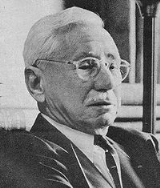
William James Durant (5 November 1885 – 7 November 1981) was a prolific American writer, historian, and philosopher. He is best known for the 11-volume The Story of Civilization, written in collaboration with his wife Ariel and published between 1935 and 1975. He was earlier noted for his book, The Story of Philosophy, written in 1926, which was considered "a groundbreaking work that helped to popularize history."
They were awarded the Pulitzer Prize for literature in 1967 and the Presidential Medal of Freedom in 1977.
nt was born in North Adams, Massachusetts of French-Canadian parents Joseph Durant and Mary Allard, who had been part of the Quebec emigration to the United States.

Discussion
Ask a question about 'Will Durant'
Start a new discussion about 'Will Durant'
Answer questions from other users
|
Quotations
Rooted in freedom, bonded in the fellowship of danger, sharing everywhere a common human blood, we declare again that all men are brothers, and that mutual tolerance is the price of liberty.== Volume VI, The Reformation ====
I have tried to be impartial, though I know that a man's past always colors his views, and that nothing else is so irritating as impartiality.
Preface
I feel for all faiths the warm sympathy of one who has come to learn that even the trust in reason is a precarious faith, and that we are all fragments of darkness groping for the sun. I know no more about the ultimates than the simplest urchin in the streets.
Preface
Power dements even more than it corrupts, lowering the guard of foresight and raising the haste of action.

Encyclopedia
William James Durant (5 November 1885 – 7 November 1981) was a prolific American writer, historian, and philosopher. He is best known for the 11-volume The Story of Civilization, written in collaboration with his wife Ariel and published between 1935 and 1975. He was earlier noted for his book, The Story of Philosophy, written in 1926, which was considered "a groundbreaking work that helped to popularize history."
They were awarded the Pulitzer Prize for literature in 1967 and the Presidential Medal of Freedom in 1977.
Life and works
Durant was born in North Adams, Massachusetts of French-Canadian parents Joseph Durant and Mary Allard, who had been part of the Quebec emigration to the United States. He fought for equal wages, women's suffrage and fairer working conditions for the American labor force. Durant not only wrote on many topics but also put his ideas into effect. Durant, it has been said widely, attempted to bring philosophy to the common man. He authored The Story of Philosophy, The Mansions of Philosophy, and, with the help of his wife, Ariel, wrote The Story of Civilization. He also wrote magazine articles.
He was trying to improve understanding of viewpoints of human beings and to have others forgive foibles and human waywardness. He chided the comfortable insularity of what is now known as Eurocentrism, by pointing out in Our Oriental Heritage that Europe was only "a jagged promontory of Asia." He complained of "the provincialism of our traditional histories which began with Greece and summed up Asia in a line" and said they showed "a possibly fatal error of perspective and intelligence."
In 1900, Durant was educated by the Jesuits in St. Peter's Preparatory School and, later, Saint Peter's College in Jersey City, New Jersey. In 1905, he became a Socialist. He graduated in 1907. He worked as a reporter for Arthur Brisbane's New York Evening Journal for ten dollars a week. At the Evening Journal, he wrote several articles on sexual criminals.
Following this, in 1907, he began teaching Latin, French, English and geometry at Seton Hall University, South Orange, New Jersey. Durant was also made librarian at the college.
In 1911 he left the Seminary. He became the teacher and chief pupil of the Ferrer Modern School, an experiment in libertarian education. Alden Freeman, a supporter of the Ferrer Modern School, sponsored him for a tour of Europe. At the Modern School, he fell in love with and married a pupil, thirteen years his junior, Chaya (Ida) Kaufman, whom he later nicknamed "Ariel". The Durants had one daughter, Ethel, and adopted a son, Louis. Ariel would contribute materially to all the volumes of The Story of Civilization but was given title page credit starting only with Volume VII, The Age of Reason Begins.
In 1913, he resigned his post as teacher. To support themselves, he began lecturing in a Presbyterian church for five- and ten-dollar fees; the material for these lectures became the starting point for The Story of Civilization. Freeman paid his tuition for the graduate school of Columbia University.
In 1917, working on a doctorate in philosophy, Will Durant wrote his first book, Philosophy and the Social Problem. He discussed the idea that philosophy had not grown because it avoided the actual problems of society. He received his doctorate in 1917. He was also an instructor at Columbia University.
The Story of Philosophy originated as a series of Little Blue Books (educational pamphlets aimed at workers) and was so popular it was republished in 1926 by Simon & Schuster as a hardcover book and became a bestseller, giving the Durants the financial independence that would allow them to travel the world several times and spend four decades writing The Story of Civilization. He left teaching and began work on the eleven volume Story of Civilization. Will drafted a civil rights "Declaration of Interdependence" in the early 1940s, nearly a full decade before the Brown decision (see Brown v. Board of Education) ignited the Civil Rights Movement. This Declaration was introduced into the Congressional Record on October 1, 1945.
The Durants strove throughout The Story of Civilization to create what they called "integral history". They opposed this to the "specialization" of history, an anticipatory rejection of what some have called the "cult of the expert." Their goal was to write a "biography" of a civilization, in this case, the West, including not just the usual wars, politics and biography of greatness and villainy, but also the culture, art, philosophy, religion, and the rise of mass communication. Much of The Story considers the living conditions of everyday people throughout the twenty-five hundred years their "story" of the West covers. They also bring an unabashedly moral framework to their accounts, constantly stressing the repetition of the "dominance of strong over the weak, the clever over the simple." The Story of Civilization is the most successful historiographical series in history. It has been said that the series "put Simon and Schuster on the map" as a publishing house.
For Rousseau and Revolution, (1967), the 10th volume of The Story of Civilization, they were awarded the Pulitzer Prize for literature; later followed the highest award granted by the United States government to civilians, the Presidential Medal of Freedom by President Ford in 1977.
They followed Rousseau and Revolution with a slender volume of observations called The Lessons of History; which was both synopsis of the series as well as analysis. Though they had intended to carry the work into the 20th century, they simply ran out of time and had expected the 10th volume to be their last. However, they went on to publish a final volume, their 11th, The Age of Napoleon in 1975. They also left behind notes for a twelfth volume, The Age of Darwin, and an outline for a thirteenth, The Age of Einstein, which would have taken The Story of Civilization through to 1945.
Two posthumous works by Durant have been published in recent years, The Greatest Minds and Ideas of All Time (2002) and Heroes of History: A Brief History of Civilization from Ancient Times to the Dawn of the Modern Age (2001).
The Durants also shared a love story as remarkable as their scholarship; they detail this in Dual Autobiography. After Will went into the hospital, Ariel stopped eating. Will died after he heard that Ariel had died. They died within two weeks of each other in 1981 (she on October 25 and he on November 7). Though their daughter, Ethel, and grandchildren strove to keep the death of his Ariel from the ailing Will, he learned of it on the evening news, and he himself died at the age of 96. He was buried beside his wife in Westwood Village Memorial Park Cemetery in Los Angeles.
Thoughts on the Decline of Civilization
Will Durant saw the decline of a civilization as a culmination of strife between religion and secular intellectualism, thus toppling the precarious institutions of convention and morality:
"Hence a certain tension between religion and society marks the higher stages of every civilization. Religion begins by offering magical aid to harassed and bewildered men; it culminates by giving to a people that unity of morals and belief which seems so favorable to statesmanship and art; it ends by fighting suicidally in the lost cause of the past. For as knowledge grows or alters continually, it clashes with mythology and theology, which change with geological leisureliness. Priestly control of arts and letters is then felt as a galling shackle or hateful barrier, and intellectual history takes on the character of a "conflict between science and religion." Institutions which were at first in the hands of the clergy, like law and punishment, education and morals, marriage and divorce, tend to escape from ecclesiastical control, and become secular, perhaps profane. The intellectual classes abandon the ancient theology and-after some hesitation- the moral code allied with it; literature and philosophy become anticlerical. The movement of liberation rises to an exuberant worship of reason, and falls to a paralyzing disillusionment with every dogma and every idea. Conduct, deprived of its religious supports, deteriorates into epicurean chaos; and life itself, shorn of consoling faith, becomes a burden alike to conscious poverty and to weary wealth. In the end a society and its religion tend to fall together, like body and soul, in a harmonious death. Meanwhile among the oppressed another myth arises, gives new form to human hope, new courage to human effort, and after centuries of chaos builds another civilization."
Although it is debatable whether the movie parallels Durant's own perspective on the actual causes of societal disintegration, more than twenty years after his death, Durant's quote of "A great civilization is not conquered from without until it has destroyed itself from within" appeared as the opening graphic of Mel Gibson's 2006 film Apocalypto.
Selected books
See a full bibliography at Will Durant Online .
- Durant, Will (1917). Philosophy and the Social Problem. New York: Macmillan.
- Durant, Will (1926). The Story of Philosophy. New York: Simon and Schuster.
- Durant, Will (1927). Transition. New York: Simon and Schuster.
- Durant, Will (1929) The Mansions of Philosophy. New York: Simon and Schuster. Later with slight revisions re-published as The Pleasures of Philosophy
- Durant, Will (1930) The Case for India. New York: Simon and Schuster.
- Durant, Will (1931) Adventures in Genius. New York: Simon and Schuster.
- Durant, Will (1953) The Pleasures of Philosophy. New York: Simon and Schuster.
- Durant, Will & Durant, Ariel (1968). The Lessons of History. New York: Simon and Schuster.
- Durant, Will & Durant, Ariel (1970). Interpretations of Life. New York: Simon and Schuster.
- Durant, Will & Durant, Ariel (1977). A Dual Autobiography. New York: Simon and Schuster.
- Durant, Will (2001). Heroes of History: A Brief History of Civilization from Ancient Times to the Dawn of the Modern Age. New York: Simon and Schuster. Actually copyrighted by John Little and the Estate of Will Durant.
The Story of Civilization
- Durant, Will (1935). Our Oriental Heritage. New York: Simon and Schuster.
- Durant, Will (1939). The Life of Greece. New York: Simon and Schuster.
- Durant, Will (1944). Caesar and Christ. New York: Simon and Schuster.
- Durant, Will (1950). The Age of Faith. New York: Simon and Schuster.
- Durant, Will (1953). The Renaissance. New York: Simon and Schuster.
- Durant, Will (1957). The Reformation. New York: Simon and Schuster.
- Durant, Will, & Durant, Ariel (1961). The Age of Reason Begins. New York: Simon and Schuster.
- Durant, Will, & Durant, Ariel (1963). The Age of Louis XIV. New York: Simon and Schuster.
- Durant, Will, & Durant, Ariel (1965). The Age of Voltaire. New York: Simon and Schuster.
- Durant, Will, & Durant, Ariel (1967). Rousseau and Revolution. New York: Simon and Schuster.
- Durant, Will, & Durant, Ariel (1975). The Age of Napoleon. New York: Simon and Schuster.
External links
|