
See Also

Theophrastus

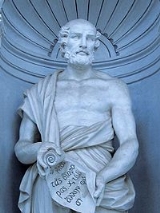
Theophrastus , a native of Eressos in Lesbos Lesbos Island

Lesbos is a Greek island located in the northeastern Aegean Sea [i]; its inhabitants are called Lesvio ... 

, was the successor of Aristotle Aristotle

Aristotle was an ancient Greek [i] philosopher [i], a student of Plato [i] ... 

 in the Peripatetic Peripatetic

The Peripatetics were members of a school of philosophy in ancient Greece [i]. ... 

 school. All the biographical information we have of him was provided by Diogenes Laertius' Lives of the Philosophers, written four hundred years after Theophrastus' time; nevertheless, it is a trustworthy tradition: "there is no intrinsic improbability in most of what Diogenes records". His given name was Tyrtamus, but he later became known by the nickname "Theophrastus", given to him, it is said, by Aristotle to indicate the grace of his conversation.

Discussions

  Discussion Features

   Ask a question about 'Theophrastus'

   Start a new discussion about 'Theophrastus'

   Answer questions about 'Theophrastus'

   'Theophrastus' discussion forum


Encyclopedia

Theophrastus , a native of Eressos in Lesbos Lesbos Island

Lesbos is a Greek island located in the northeastern Aegean Sea [i]; its inhabitants are called Lesvio ... 

, was the successor of Aristotle Aristotle

Aristotle was an ancient Greek [i] philosopher [i], a student of Plato [i] ... 

 in the Peripatetic Peripatetic

The Peripatetics were members of a school of philosophy in ancient Greece [i]. ... 

 school. All the biographical information we have of him was provided by Diogenes Laertius' Lives of the Philosophers, written four hundred years after Theophrastus' time; nevertheless, it is a trustworthy tradition: "there is no intrinsic improbability in most of what Diogenes records". His given name was Tyrtamus, but he later became known by the nickname "Theophrastus", given to him, it is said, by Aristotle to indicate the grace of his conversation.

According to some sources, Theophrastus's father was named Messapus, and was married to a woman named Argiope and was the father of Cercyon -- but, this is not certain.

After receiving his first introduction to philosophy Philosophy

[i]
... 

 in Lesbos from one Leucippus or Alcippus, he proceeded to Athens Athens

Athens is the capital [i] and the largest city of Greece [i]. ... 

, and became a member of the Platonic circle. After Plato Plato

Plato , whose real name is believed to have been Aristocles, was an immensely influential ancient... 

's death he attached himself to Aristotle Aristotle

Aristotle was an ancient Greek [i] philosopher [i], a student of Plato [i] ... 

, and in all probability accompanied him to Stagira. The intimate friendship of Theophrastus with Callisthenes, the fellow-pupil of Alexander the Great Alexander the Great

Alexander the Great , also known as Alexander III, king of Macedon [i] , was one of the most succe ... 

, the mention made in his will of an estate belonging to him at Stagira, and the repeated notices of the town and its museum in the nine books of his Enquiry into plants and his six books of Causes of Plants point to this conclusion.

Aristotle in his will made him guardian of his children, bequeathed to him his library and the originals of his works, and designated him as his successor at the Lyceum on his own removal to Chalcis Chalcis

Chalcis or Chalkida, Halkida, Halkis or Chalkis, the chief town of the island of... 

. Eudemus of Rhodes also had some claims to this position, and Aristoxenus is said to have resented Aristotle's choice.

Theophrastus presided over the Peripatetic school for thirty-five years, and died at the age of eight-five according to Diogenes. He is said to have remarked "we die just when we are beginning to live".

Under his guidance the school flourished greatly— there were at one period more than 2000 students, Diogenes affirms— and at his death, according to the terms of his will preserved by Diogenes, he bequeathed to it his garden with house and colonnades as a permanent seat of instruction. Menander Menander

Menander, Greek dramatist, the chief representative of the New Comedy [i], was born in Athens [i]. ... 

 was among his pupils. His popularity was shown in the regard paid to him by Philip Philip II of Macedon

Philip II of Macedon was the King of Macedon [i] from 359 BC [i] until his assassinati ... 

, Cassander Cassander

Other
]] [i]
Cassander, king of Macedon [i]ia, eldest son of Antipater [i], and founder of Antipatrid dynasty [i] ... 

 and Ptolemy Ptolemy I Soter

Ptolemy I Soter [i] was a Macedon [i]ian general who became the ruler of Egypt [i] and founder of the Ptolemaic dynasty [i] ... 

, and by the complete failure of a charge of impiety brought against him. He was honoured with a public funeral, and "the whole population of Athens, honouring him greatly, followed him to the grave" .

From the lists of Diogenes, giving 227 titles, it appears that the activity of Theophrastus extended over the whole field of contemporary knowledge. His writing probably differed little from the Aristotelian treatment of the same themes, though supplementary in details. He served his age mainly as a great popularizer of science. The most important of his books are two large botanical treatises, Enquiry into Plants, in nine books , and On the Causes of Plants, in six books , which constitute the most important contribution to botanical science during antiquity and the middle ages, the first systemization of the botanical world; on the strength of these works some call him the "father of Taxonomy". The works profit from the reports on plants of Asia brought back from those who followed Alexander; "to the reports of Alexander's followers he owed his accounts of such plants as the cotton-plant Cotton

Cotton is a soft fiber [i] that grows around the seeds of the cotton plant , a shrub [i] native to the t ... 

, banyan Banyan

Banyan is a subgenus of many species of tropical fig [i]s with an unusual growth habit. ... 

, pepper Pepper

Pepper may refer to:... 

, cinnamon Cinnamon

Cinnamon is a small evergreen [i] tree [i] 10-15 m tall, belonging to the family Lauraceae [i], native ... 

, myrrh Myrrh

Myrrh is a red-brown resin [i]ous material, the dried sap [i] of the tree Commiphora myrrha [i], nat ... 

 and frankincense Frankincense

Frankincense or olibanum is an aromatic [i] resin [i] obtained from the tree Boswellia thurifera [i] ... 

." . He released the first recorded message in a bottle in order to show that the Mediterranean Sea Mediterranean Sea

The Mediterranean Sea is a part of the Atlantic Ocean [i] almost completely enclosed by land: on the nor... 

 was formed by the inflowing Atlantic Ocean Atlantic Ocean

The Atlantic Ocean is the second-largest ocean [i], covering approximately one-fifth of the Earth [i]'s ... 

.

We also possess in fragments a History of Physics, a treatise On Stones, and a work On Sensation, and certain metaphysical Airoptai, which probably once formed part of a systematic treatise. He made the first known reference to the phenomenon of pyroelectricity, noting in 314 BC that the mineral tourmaline Tourmaline

The tourmaline mineral [i] group is chemically one of the most complicated groups of silicate minerals [i] ... 

 becomes charged when heated. Various smaller scientific fragments have been collected in the editions of Johann Gottlob Schneider  and Friedrich Wimmer  and in Hermann Usener's Analecta Theophrastea.

"The style of these works, as of the botanical books, suggests that, as in the case of Aristotle, what we possess consists of notes for lectures or notes taken of lectures," his translator Sir A. Hort remarks. "There is no literary charm; the sentences are mostly compressed and highly elliptical, to the point sometimes of obscurity."

His book The Characters, if it is indeed his, deserves a separate mention. The work consists of brief, vigorous and trenchant delineations of moral types, which contain a most valuable picture of the life of his time. They form the first recorded attempt at systematic character writing. The book has been regarded by some as an independent work; others incline to the view that the sketches were written from time to time by Theophrastus, and collected and edited after his death; others, again, regard the Characters as part of a larger systematic work, but the style of the book is against this. Theophrastus has found many imitators in this kind of writing, notably Hall , Sir Thomas Overbury Thomas Overbury

Sir Thomas Overbury, English poet [i] and essayist, and the victim of one of the most sensational crimes ... 

 , Bishop Earle  and Jean de La Bruyère Jean de La Bruyère

Jean de La Bruyre, was a French [i] essayist [i] and moralist [i]. ... 

 , who also translated the Characters.

Theophrastus' Enquiry into Plants was first published in a Latin translation by Theodore Gaza, at Treviso, 1483; in its original Greek it first appeared from the press of Aldus Manutius Aldus Manutius

Aldus Manutius, the Latin form of Aldo Manuzio was the founder of the Aldine Press [i]. ... 

 at Venice, 1495-98, from a third-rate manuscript, which, like the majority of the manuscripts that were sent to printers' workshops in the fifteenth and sixteenth century, has disappeared. Wimmer identified two manuscripts of first quality, the Codex Urbinas in the Vatican Library Vatican Library

The Vatican Library is the library [i] of the Holy See [i], currently located in Vatican City [i].... 

, which was not made known to J.G. Schneider, who made the first modern critical edition, 1818-21, and the exerpts in the Codex Parisiensis in the Bibliothèque National.

Notes


References

  • Sir Arthur F. Hort, Theophrastus: Enquiry into Plants Loeb Classical Library, 2 vols. 1916 etc.