

Big Science

Encyclopedia
History of science and technology
The history of science and technology is a field of history which examines how humanity's understanding of the natural world and ability to manipulate it have changed over the centuries...
to describe a series of changes in science
Science
Science is a systematic enterprise that builds and organizes knowledge in the form of testable explanations and predictions about the universe...
which occurred in industrial
Industry
Industry refers to the production of an economic good or service within an economy.-Industrial sectors:There are four key industrial economic sectors: the primary sector, largely raw material extraction industries such as mining and farming; the secondary sector, involving refining, construction,...
nations during and after World War II
World War II
World War II, or the Second World War , was a global conflict lasting from 1939 to 1945, involving most of the world's nations—including all of the great powers—eventually forming two opposing military alliances: the Allies and the Axis...
, as scientific progress increasingly came to rely on large-scale projects usually funded by national governments or groups of governments. Individual or small group efforts, or Small Science
Small Science
Small Science refers to science performed in a smaller scale, such as by individuals, small teams or within community projects....
, is still relevant today as theoretical results by individual authors may have a significant impact, but very often the empirical verification requires experiments using constructions, such as the Large Hadron Collider
Large Hadron Collider
The Large Hadron Collider is the world's largest and highest-energy particle accelerator. It is expected to address some of the most fundamental questions of physics, advancing the understanding of the deepest laws of nature....
costing between $5 and $10 billion.
Development
While science and technology have always been important to and driven by warWar
War is a state of organized, armed, and often prolonged conflict carried on between states, nations, or other parties typified by extreme aggression, social disruption, and usually high mortality. War should be understood as an actual, intentional and widespread armed conflict between political...
fare, the increase in military funding of science following the second World War was on a scale wholly unprecedented. World War II has often been called "the physicists' war" for the role that those scientists played in the development of new weapons and tools, notably the proximity fuze
Proximity fuze
A proximity fuze is a fuze that is designed to detonate an explosive device automatically when the distance to target becomes smaller than a predetermined value or when the target passes through a given plane...
, radar
Radar
Radar is an object-detection system which uses radio waves to determine the range, altitude, direction, or speed of objects. It can be used to detect aircraft, ships, spacecraft, guided missiles, motor vehicles, weather formations, and terrain. The radar dish or antenna transmits pulses of radio...
, and the atomic bomb. The bulk of these last two activities took place in a new form of research facility: the government-sponsored laboratory, employing thousands of technicians and scientists, managed by universities
University
A university is an institution of higher education and research, which grants academic degrees in a variety of subjects. A university is an organisation that provides both undergraduate education and postgraduate education...
(in this case, the University of California
University of California
The University of California is a public university system in the U.S. state of California. Under the California Master Plan for Higher Education, the University of California is a part of the state's three-tier public higher education system, which also includes the California State University...
and the Massachusetts Institute of Technology
Massachusetts Institute of Technology
The Massachusetts Institute of Technology is a private research university located in Cambridge, Massachusetts. MIT has five schools and one college, containing a total of 32 academic departments, with a strong emphasis on scientific and technological education and research.Founded in 1861 in...
).
In the shadow of the first atomic weapons, the importance of a strong scientific research establishment was apparent to any country wishing to play a major role in international politics. After the success of the Manhattan Project
Manhattan Project
The Manhattan Project was a research and development program, led by the United States with participation from the United Kingdom and Canada, that produced the first atomic bomb during World War II. From 1942 to 1946, the project was under the direction of Major General Leslie Groves of the US Army...
, governments became the chief patron of science, and the character of the scientific establishment underwent several key changes. This was especially marked in the United States
United States
The United States of America is a federal constitutional republic comprising fifty states and a federal district...
and the Soviet Union
Soviet Union
The Soviet Union , officially the Union of Soviet Socialist Republics , was a constitutionally socialist state that existed in Eurasia between 1922 and 1991....
during the Cold War
Cold War
The Cold War was the continuing state from roughly 1946 to 1991 of political conflict, military tension, proxy wars, and economic competition between the Communist World—primarily the Soviet Union and its satellite states and allies—and the powers of the Western world, primarily the United States...
, but also to a lesser extent in many other countries.
Definitions
"Big Science" usually implies one or more of these specific characteristics:- Big budgets: No longer required to rely on philanthropyPhilanthropyPhilanthropy etymologically means "the love of humanity"—love in the sense of caring for, nourishing, developing, or enhancing; humanity in the sense of "what it is to be human," or "human potential." In modern practical terms, it is "private initiatives for public good, focusing on quality of...
or industryIndustryIndustry refers to the production of an economic good or service within an economy.-Industrial sectors:There are four key industrial economic sectors: the primary sector, largely raw material extraction industries such as mining and farming; the secondary sector, involving refining, construction,...
, scientists were able to use budgets on an unprecedented scale for basic research. - Big staffs: Similarly, the number of practitioners of science on any one project grew as well, creating difficulty, and often controversy, in the assignment of credit for scientific discoveries (the Nobel PrizeNobel PrizeThe Nobel Prizes are annual international awards bestowed by Scandinavian committees in recognition of cultural and scientific advances. The will of the Swedish chemist Alfred Nobel, the inventor of dynamite, established the prizes in 1895...
system, for example, allows awarding only three individuals in any one topic per year, based on a 19th-century model of the scientific enterprise). - Big machines: Ernest LawrenceErnest LawrenceErnest Orlando Lawrence was an American physicist and Nobel Laureate, known for his invention, utilization, and improvement of the cyclotron atom-smasher beginning in 1929, based on his studies of the works of Rolf Widerøe, and his later work in uranium-isotope separation for the Manhattan Project...
's cyclotronCyclotronIn technology, a cyclotron is a type of particle accelerator. In physics, the cyclotron frequency or gyrofrequency is the frequency of a charged particle moving perpendicularly to the direction of a uniform magnetic field, i.e. a magnetic field of constant magnitude and direction...
at his Radiation LaboratoryLawrence Berkeley National LaboratoryThe Lawrence Berkeley National Laboratory , is a U.S. Department of Energy national laboratory conducting unclassified scientific research. It is located on the grounds of the University of California, Berkeley, in the Berkeley Hills above the central campus...
in particular ushered in an era of massive machines (requiring massive staffs and budgets) as the tools of basic scientific research. The use of many machines, such as the many sequencers used during the Human Genome ProjectHuman Genome ProjectThe Human Genome Project is an international scientific research project with a primary goal of determining the sequence of chemical base pairs which make up DNA, and of identifying and mapping the approximately 20,000–25,000 genes of the human genome from both a physical and functional...
, might also fall under this definition..
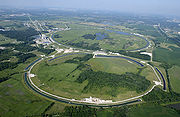
- Big laboratories: Because of the increase in cost to do basic science (with the increase of large machines), centralization of scientific research in large laboratories (such as Lawrence Berkeley National LaboratoryLawrence Berkeley National LaboratoryThe Lawrence Berkeley National Laboratory , is a U.S. Department of Energy national laboratory conducting unclassified scientific research. It is located on the grounds of the University of California, Berkeley, in the Berkeley Hills above the central campus...
or CERNCERNThe European Organization for Nuclear Research , known as CERN , is an international organization whose purpose is to operate the world's largest particle physics laboratory, which is situated in the northwest suburbs of Geneva on the Franco–Swiss border...
) has become a cost-effective strategy, though questions over facility access have become prevalent.
Towards the end of the 20th century, not only projects in basic physics and astronomy, but also in life sciences
Life sciences
The life sciences comprise the fields of science that involve the scientific study of living organisms, like plants, animals, and human beings. While biology remains the centerpiece of the life sciences, technological advances in molecular biology and biotechnology have led to a burgeoning of...
became big sciences, such as the massive Human Genome Project
Human Genome Project
The Human Genome Project is an international scientific research project with a primary goal of determining the sequence of chemical base pairs which make up DNA, and of identifying and mapping the approximately 20,000–25,000 genes of the human genome from both a physical and functional...
. The heavy investment of government and industrial interests into academic science has also blurred the line between public and private research, where entire academic departments, even at public universities, are often financed by private companies. Not all Big Science is related to the military concerns which were at its origins.
Criticism
The era of Big Science has provoked criticism that it undermines the basic principles of the scientific methodScientific method
Scientific method refers to a body of techniques for investigating phenomena, acquiring new knowledge, or correcting and integrating previous knowledge. To be termed scientific, a method of inquiry must be based on gathering empirical and measurable evidence subject to specific principles of...
. Results of experiments which require massive and unique machines like particle accelerators are often difficult to verify. Access to scientific facilities is often limited to those who are already accomplished, leading to charges of elitism
Elitism
Elitism is the belief or attitude that some individuals, who form an elite — a select group of people with intellect, wealth, specialized training or experience, or other distinctive attributes — are those whose views on a matter are to be taken the most seriously or carry the most...
. And increased government funding has often meant increased military funding
Military funding of science
The military funding of science has had a powerful transformative effect on the practice and products of scientific research since the early 20th century...
, which some claim subverts the Enlightenment-era ideal of science as a pure quest for knowledge. For example, historian Paul Forman
Paul Forman
Paul Forman is an historian of science and a curator of the Division of Medicine and Science at the National Museum of American History. Forman's primary research focus has been the history of physics, in which he has helped pioneer the application of cultural history to scientific...
has argued that during World War II
World War II
World War II, or the Second World War , was a global conflict lasting from 1939 to 1945, involving most of the world's nations—including all of the great powers—eventually forming two opposing military alliances: the Allies and the Axis...
and the Cold War
Cold War
The Cold War was the continuing state from roughly 1946 to 1991 of political conflict, military tension, proxy wars, and economic competition between the Communist World—primarily the Soviet Union and its satellite states and allies—and the powers of the Western world, primarily the United States...
, the massive scale of defense-related funding prompted a shift in physics from basic to applied research.
Many scientists also complain that the requirement for increased funding makes a large part of the scientific activity filling out grant requests and other budgetary bureaucratic activity, and the intense connections between academic, governmental, and industrial interests have raised the question of whether scientists can be completely objective when their research contradicts the interests and intentions of their benefactors.
Historiography of Big Science
The popularization of the term "Big Science" is usually attributed to an article by Alvin M. WeinbergAlvin M. Weinberg
Alvin Martin Weinberg was an American nuclear physicist who was the administrator at Oak Ridge National Laboratory during and after the Manhattan Project period. He came to Oak Ridge, Tennessee in 1945 and remained there until his death in 2006.-Early years in Chicago: Alvin Weinberg was born...
, then director of Oak Ridge National Laboratory
Oak Ridge National Laboratory
Oak Ridge National Laboratory is a multiprogram science and technology national laboratory managed for the United States Department of Energy by UT-Battelle. ORNL is the DOE's largest science and energy laboratory. ORNL is located in Oak Ridge, Tennessee, near Knoxville...
, published in Science
Science (journal)
Science is the academic journal of the American Association for the Advancement of Science and is one of the world's top scientific journals....
in 1961. This was a response to Dwight D. Eisenhower's farewell address, in which the departing U.S. president warned against the dangers of what he called the "military-industrial complex
Military-industrial complex
Military–industrial complex , or Military–industrial-congressional complex is a concept commonly used to refer to policy and monetary relationships between legislators, national armed forces, and the industrial sector that supports them...
" and the potential "domination of the nation's scholars by Federal employment, project allocations, and the power of money". Weinberg compared the large-scale enterprise of science in the 20th century to the wonders of earlier civilization (the pyramids, the palace of Versailles
Versailles
Versailles , a city renowned for its château, the Palace of Versailles, was the de facto capital of the kingdom of France for over a century, from 1682 to 1789. It is now a wealthy suburb of Paris and remains an important administrative and judicial centre...
):
- When history looks at the 20th century, she will see science and technology as its theme; she will find in the monuments of Big Science—the huge rockets, the high-energy accelerators, the high-flux research reactors—symbols of our time just as surely as she finds in Notre Dame a symbol of the Middle Ages. ... We build our monuments in the name of scientific truth, they built theirs in the name of religious truth; we use our Big Science to add to our country's prestige, they used their churches for their cities' prestige; we build to placate what ex-President Eisenhower suggested could become a dominant scientific caste, they built to please the priests of Isis and Osiris.
Weinberg's article addressed criticisms of the way in which the era of Big Science could negatively affect science — such as astronomer Fred Hoyle
Fred Hoyle
Sir Fred Hoyle FRS was an English astronomer and mathematician noted primarily for his contribution to the theory of stellar nucleosynthesis and his often controversial stance on other cosmological and scientific matters—in particular his rejection of the "Big Bang" theory, a term originally...
's contention that excessive money for science would only make science fat and lazy — and encouraged, in the end, limiting Big Science only to the national laboratory system and preventing its incursion into the university system.
Since Weinberg's article there have been many historical and sociological studies on the effects of Big Science both in and out of the laboratory. Soon after that article, Derek J. de Solla Price
Derek J. de Solla Price
Derek John de Solla Price was a physicist, historian of science, and information scientist,credited as the father of scientometrics.-Biography:...
gave a series of lectures that were published in 1963 as Little Science, Big Science. The book describes the historical and sociological transition from "small science" to "big science" and the qualitative differences between the two; it inspired the field of scientometrics
Scientometrics
Scientometrics is the science of measuring and analysing science. In practice, scientometrics is often done using bibliometrics which is a measurement of the impact of publications. Modern scientometrics is mostly based on the work of Derek J. de Solla Price and Eugene Garfield...
as well as new perspectives on large-scale science in other fields.
The Harvard historian Peter Galison has written several books addressing the formation of big science. Major themes include the evolution of experimental design, from table-top experiments to today's large-scale collider projects; accompanying changes in standards of evidence; and discourse patterns across researchers whose expertise only partially overlaps. Galison introduced the notion of "trading zones," borrowed from the sociolinguistic study of pidgin
Pidgin
A pidgin , or pidgin language, is a simplified language that develops as a means of communication between two or more groups that do not have a language in common. It is most commonly employed in situations such as trade, or where both groups speak languages different from the language of the...
s, to characterize how such groups learn to interact.
Other historians have postulated many "precursors" to Big Science in earlier times: the Uraniborg
Uraniborg
Uranienborg was a Danish astronomical observatory operated by Tycho Brahe; built circa 1576-1580 on Hven, an island in the Øresund between Zealand and Scania, which at that time was part of Denmark. The observatory was shortly after its construction expanded with an underground facility,...
of Tycho Brahe
Tycho Brahe
Tycho Brahe , born Tyge Ottesen Brahe, was a Danish nobleman known for his accurate and comprehensive astronomical and planetary observations...
(in which massive astronomical instruments were made, often with little practical purpose) and the large cryogenics
Cryogenics
In physics, cryogenics is the study of the production of very low temperature and the behavior of materials at those temperatures. A person who studies elements under extremely cold temperature is called a cryogenicist. Rather than the relative temperature scales of Celsius and Fahrenheit,...
laboratory established by Heike Kamerlingh Onnes
Heike Kamerlingh Onnes
Heike Kamerlingh Onnes was a Dutch physicist and Nobel laureate. He pioneered refrigeration techniques, and he explored how materials behaved when cooled to nearly absolute zero. He was the first to liquify helium...
in 1904 have been cited as early examples of Big Science.