
All Topics  
George Gamow


   Email Print
   Bookmark   Link


George Gamow


George Gamow (pronounced as ) (March 4, 1904 – August 19, 1968) , born Georgiy Antonovich Gamov (??????? ????????? ?????), was a Russian Empire
Russian Empire

File:Russian Emperor Flag.jpgFile:Romanov Flag.svgThe Russian Empire was a state that existed from 1721 until the Russian Revolution of 1917....
-born theoretical physicist
Physicist

A physicist is a scientist who studies or practices physics. Physicists study a wide range of physical phenomena in many Physics#Major fields of physics spanning all length scales: from atom particles of which all ordinary matter is made to the behavior of the material Universe as a whole ....
 and cosmologist. He discovered alpha decay via quantum tunneling and worked on radioactive decay of the atomic nucleus
Atomic nucleus

The nucleus of an atom is the very dense region, consisting of nucleons , at the center of an atom. Although the size of the nucleus varies considerably according to the mass of the atom, the size of the entire atom is comparatively constant....
, star formation
Stellar evolution

Stellar evolution is the process by which a star undergoes a sequence of radical changes during its lifetime. Depending on the mass of the star, this lifetime ranges from only few millions of years to trillions of years , considerably more than the age of the universe....
, stellar nucleosynthesis
Stellar nucleosynthesis

Stellar nucleosynthesis is the collective term for the atomic nucleus reactions taking place in stars to build the nuclei of the Chemical element heavier than hydrogen....
, big bang nucleosynthesis
Big Bang nucleosynthesis

In physical cosmology, Big Bang nucleosynthesis refers to the production of nuclei other than those of H-1 during the early phases of the universe....
, nucleocosmogenesis
Nucleocosmogenesis

Nucleocosmogenisis is a scientific term first coined and published by George Gamow, renown biophysicist, in the 1920s. According to his research, nucleocosmogenisis is the process by which all elements are created out of more fundamental components....
 and genetics
Genetics

Genetics , a discipline of biology, is the science of heredity and Genetic variation in living organisms. The fact that living things inherit traits from their parents has been used since prehistoric times to improve crop plants and animals through selective breeding....
.

w was born in the city of Odessa
Odessa

Odessa or Odesa is the Capital of the Odessa Oblast located in southern Ukraine. The city is a major port located on the shore of the Black Sea and the fourth largest city in Ukraine with a population of 1,029,000 ....
, Russian Empire
Russian Empire

File:Russian Emperor Flag.jpgFile:Romanov Flag.svgThe Russian Empire was a state that existed from 1721 until the Russian Revolution of 1917....
 (now in Ukraine
Ukraine

Ukraine is a country in Eastern Europe. It is bordered by Russia to the east; Belarus to the north; Poland, Slovakia, and Hungary to the west; Romania and Moldova to the southwest; and the Black Sea and Sea of Azov to the south....
) to ethnic Russian
Russians

The Russian people are an East Slavs ethnic group, primarily living in Russia and neighboring countries.The English language term Russians is used to refer to the citizens of Russia, regardless of their ethnicity ; in Russian language, the demonym Russian is translated as Rossiyanin ....
 parents.


Discussion
Ask a question about 'George Gamow'
Start a new discussion about 'George Gamow'
Answer questions from other users
Full Discussion Forum


Quotations


There was a young fellow from Trinity, Who took the square root of infinity. But the number of digits, Gave him the fidgets; He dropped Math and took up Divinity.

One, Two, Three... Infinity (1947)


Encyclopedia


George Gamow (pronounced as ) (March 4, 1904 – August 19, 1968) , born Georgiy Antonovich Gamov (??????? ????????? ?????), was a Russian Empire
Russian Empire

File:Russian Emperor Flag.jpgFile:Romanov Flag.svgThe Russian Empire was a state that existed from 1721 until the Russian Revolution of 1917....
-born theoretical physicist
Physicist

A physicist is a scientist who studies or practices physics. Physicists study a wide range of physical phenomena in many Physics#Major fields of physics spanning all length scales: from atom particles of which all ordinary matter is made to the behavior of the material Universe as a whole ....
 and cosmologist. He discovered alpha decay via quantum tunneling and worked on radioactive decay of the atomic nucleus
Atomic nucleus

The nucleus of an atom is the very dense region, consisting of nucleons , at the center of an atom. Although the size of the nucleus varies considerably according to the mass of the atom, the size of the entire atom is comparatively constant....
, star formation
Stellar evolution

Stellar evolution is the process by which a star undergoes a sequence of radical changes during its lifetime. Depending on the mass of the star, this lifetime ranges from only few millions of years to trillions of years , considerably more than the age of the universe....
, stellar nucleosynthesis
Stellar nucleosynthesis

Stellar nucleosynthesis is the collective term for the atomic nucleus reactions taking place in stars to build the nuclei of the Chemical element heavier than hydrogen....
, big bang nucleosynthesis
Big Bang nucleosynthesis

In physical cosmology, Big Bang nucleosynthesis refers to the production of nuclei other than those of H-1 during the early phases of the universe....
, nucleocosmogenesis
Nucleocosmogenesis

Nucleocosmogenisis is a scientific term first coined and published by George Gamow, renown biophysicist, in the 1920s. According to his research, nucleocosmogenisis is the process by which all elements are created out of more fundamental components....
 and genetics
Genetics

Genetics , a discipline of biology, is the science of heredity and Genetic variation in living organisms. The fact that living things inherit traits from their parents has been used since prehistoric times to improve crop plants and animals through selective breeding....
.

Life and early career

Gamow was born in the city of Odessa
Odessa

Odessa or Odesa is the Capital of the Odessa Oblast located in southern Ukraine. The city is a major port located on the shore of the Black Sea and the fourth largest city in Ukraine with a population of 1,029,000 ....
, Russian Empire
Russian Empire

File:Russian Emperor Flag.jpgFile:Romanov Flag.svgThe Russian Empire was a state that existed from 1721 until the Russian Revolution of 1917....
 (now in Ukraine
Ukraine

Ukraine is a country in Eastern Europe. It is bordered by Russia to the east; Belarus to the north; Poland, Slovakia, and Hungary to the west; Romania and Moldova to the southwest; and the Black Sea and Sea of Azov to the south....
) to ethnic Russian
Russians

The Russian people are an East Slavs ethnic group, primarily living in Russia and neighboring countries.The English language term Russians is used to refer to the citizens of Russia, regardless of their ethnicity ; in Russian language, the demonym Russian is translated as Rossiyanin ....
 parents. He was educated at the Novorossiya
Novorossiya

Novorossiya is a historic area now mostly located in southern Ukraine, in southern Russia, in Bessarabia and in Transnistria.The western part of New Russia was known as Dykra in the Grand Duchy of Lithuania and subsequently the province of Yedisan in the Ottoman Empire, and was previously inhabited, as well as the central part, by the N...
 University in Odessa
Odessa University

The I. I. Mechnikov Odessa National University , located in Odessa, Ukraine, is one of the country's major universities. It was founded in 1865, by an edict of Czar Alexander II of Russia, reorganizing the Richelieu Lyceum of Odessa into the new Imperial Novorossiya University....
 (1922–23) and at the University of Leningrad
Saint Petersburg State University

Saint Petersburg State University is a Russian federal state-owned university based in Saint Petersburg and one of the oldest, largest and most prestigious universities in the country....
 (1923–1929). Gamow studied under Alexander Friedmann
Alexander Alexandrovich Friedman

Alexander Alexandrovich Friedman or Friedmann was a Russians and Soviet Union physical cosmology and mathematician....
 for some time in Leningrad
Saint Petersburg

Saint Petersburg is a types of inhabited localities in Russia and a federal subjects of Russia of Russia located on the Neva River at the head of the Gulf of Finland on the Baltic Sea....
, though Friedmann died in 1925. At the University Gamow made friends with two other students of theoretical physics, Lev Landau
Lev Landau

Lev Davidovich Landau was a prominent Soviet Union physicist who made fundamental contributions to many areas of theoretical physics. His accomplishments include the co-discovery of the density matrix method in quantum mechanics, the quantum mechanical theory of diamagnetism, the theory of superfluidity, the theory of second order phase tra...
 and Dmitri Ivanenko
Dmitri Ivanenko

Dmitri Ivanenko , Professor of Moscow State University , made a great contribution to the physical science of the twentieth century, especially to nuclear physics, field theory, and gravity....
. The three formed a group known as the Three Musketeers which met to discuss and analyze the ground-breaking papers on quantum mechanics published during those years.

On graduation, he worked on quantum theory
Quantum mechanics

Quantum mechanics is a set of principles underlying the most fundamental known description of all physical systems at the microscopic scale . Notable amongst these principles are both a dual wave-like and particle-like behavior of matter and radiation, and prediction of probabilities in situations where classical physics predicts certaintie...
 in Göttingen
Göttingen

G?ttingen is a college town in Lower Saxony, Germany. It is the Capital of the district of G?ttingen . The Leine river runs through the town. In 2006 the population was 129,686....
, where his research into the atomic nucleus provided the basis for his doctorate. He then worked at the Theoretical Physics Institute
Niels Bohr Institute

The Niels Bohr Institute is a research institute at the University of Copenhagen. The research of the institute spans astronomy, geophysics, nanotechnology, particle physics, quantum mechanics and biophysics....
 of the University of Copenhagen
University of Copenhagen

The University of Copenhagen is the oldest and largest university and research institution in Denmark. Founded in 1479, it has more than 37,000 students, a majority of whom are female , and more than 7,000 employees....
, from 1928 to 1931, with a break to work with Ernest Rutherford
Ernest Rutherford

Ernest Rutherford, 1st Baron Rutherford of Nelson, Order of Merit , Royal Society was a New Zealand-born British chemist who became known as the father of nuclear physics....
 at the Cavendish Laboratory
Cavendish Laboratory

The Cavendish Laboratory is the University of Cambridge's Department of Physics, and is part of the university's School of Physical Sciences. It was opened in 1874 as a teaching laboratory and was initially located on the New Museums Site, Free School Lane, in the centre of Cambridge....
, Cambridge
Cambridge

The city status in the United Kingdom of Cambridge is a College town and the administrative centre of the county of Cambridgeshire, England. It lies about 50 miles north of London....
. He continued to study the atomic nucleus (proposing the "liquid drop" model), but also worked on stellar physics with Robert Atkinson
Robert d'Escourt Atkinson

Robert d'Escourt Atkinson was a British astronomer, physicist and inventor.In 1929, Atkinson collaborated with Fritz Houtermans to develop the theory of energy production in stars by the process of nuclear fusion, in which energy is liberated by the fusing of light nuclei in accordance with Einstein's formula of mass-energy equivalence....
 and Fritz Houtermans
Fritz Houtermans

Friedrich Georg "Fritz" Houtermans was a Dutch-Austrian-German atomic physics and nuclear physics physicist born in Zoppot near Danzig . Houtermans made important contributions to geochemistry and cosmochemistry....
.

In the early 1900s, radioactive materials were known to have characteristic exponential decay rates or half lives. At the same time, radiation emissions were known to have certain characteristic energies. By 1928, Gamow had solved the theory of the alpha decay
Alpha decay

Alpha decay is a type of radioactivity decay in which an atomic nucleus emits an alpha particle and transforms into an atom with a mass number 4 less and atomic number 2 less....
 of a nucleus via tunnelling
Quantum tunnelling

In quantum mechanics, wave-mechanical tunneling is an evanescent wave that occurs because the behaviour of particles is governed by Schroedinger equation....
, with mathematical help from Kochin
Nikolai Kochin

Nikolai Evgrafovoch Kochin was a Russian mathematician specialising in applied mathematics, and especially fluid and gas mechanics....
. Classically, the particle is confined to the nucleus because of the high energy requirement to escape the very strong potential. Also classically, it takes an enormous amount of energy to pull apart the nucleus. In quantum mechanics
Quantum mechanics

Quantum mechanics is a set of principles underlying the most fundamental known description of all physical systems at the microscopic scale . Notable amongst these principles are both a dual wave-like and particle-like behavior of matter and radiation, and prediction of probabilities in situations where classical physics predicts certaintie...
, however, there is a probability the particle can tunnel through the potential and escape. Gamow solved a model potential for the nucleus and derived from first principles a relationship between the half-life
Half-life

The half-life of a quantity whose value decreases with time is the interval required for the quantity to decay to half of its initial value. The concept originated in describing how long it takes atoms to undergo radioactive decay but also applies in a wide variety of other situations....
 of the alpha-decay event process and the energy of the emission, which had been previously discovered empirically, and was known as the Geiger-Nuttall law
Geiger-Nuttall law

In nuclear physics, the Geiger-Nuttall law or Geiger-Nuttall rule relates the decay constant of a radioactive isotope with the energy of the alpha particles emitted....
. (For Gamow's derivation of this law, see .)

Gamow then worked at a number of Soviet establishments before deciding to flee Russia because of increased oppression. His first two attempts to defect with his wife, Lyubov Vokhminzeva, were in 1932 and involved attempting to kayak
Kayak

A kayak is a small human-powered boat. It typically has a covered deck, and a cockpit covered by a spraydeck. The kayak was used by the native Ainu people, Aleuts and Eskimo hunters in sub-Arctic regions of northeastern Asia, North America and Greenland....
: first a 250 kilometer paddle over the Black Sea to Turkey and then from Murmansk to Norway. Poor weather foiled both attempts. In 1933, the two tried a less dramatic approach--Gamow managed to obtain permission for himself and his wife (who was also a physicist) to attend the Solvay Conference
Solvay Conference

The International Solvay Institutes for Physics and Chemistry, located in Brussels, were founded by the Belgium industry Ernest Solvay in 1912, following the historic invitation-only 1911 Conseil Solvay, the first world physics conference....
 for physicists in Brussels
Brussels

Brussels , officially the Brussels Capital-Region, is the de facto capital city of the European Union and the largest urban area in Belgium....
. The two attended and promptly defected. In 1934, they moved to the United States
United States

The United States of America is a Federal government constitutional republic comprising U.S. state and a federal district. The country is situated mostly in central North America, where its Contiguous United States and Washington, D.C., the Capital districts and territories, lie between the Pacific Ocean and Atlantic Oceans, Borders of the U...
. He began working at The George Washington University in 1934, where he published articles with Edward Teller
Edward Teller

Edward Teller was a Jewish-Hungarian-American theoretical physics physicist, known colloquially as "the father of the hydrogen bomb", even though he claimed that he did not care for the title....
, Mario Schenberg
Mário Schenberg

M?rio Schenberg, , var. M?rio Sch?nberg, Mario Schonberg), was a Jewish Brazilian electrical engineer, physicist, art critic and writer....
 and Ralph Alpher. Gamow became a naturalized American in 1940.

Big bang theory work

Gamow produced an important cosmogony
Cosmogony

Cosmogony, or cosmogeny, is any theory concerning the coming into existence or origin of the universe, or about how reality came to be. The word comes from the Greek ??s??????a , from ??s??? "cosmos, the world", and the root of ?????a? / ?????a "to be born, come about"....
 paper with his student Ralph Alpher, which was published as "The Origin of Chemical Elements" (Physical Review
Physical Review

Physical Review is an USA scientific journal, publishing research on all aspects of physics. It is published by the American Physical Society....
, April 1, 1948). This paper became known as the Alpher-Bethe-Gamow theory. (Gamow had added the name of Hans Bethe
Hans Bethe

Hans Albrecht Bethe was a Germany-United States physicist, and Nobel laureate in Nobel Prize in Physics for his work on the theory of stellar nucleosynthesis....
, listed on the article as "H. Bethe, Cornell University, Ithaca, New York" (who had not had any role in the paper) to make a pun
Pun

A pun, or paronomasia, is a form of word play that deliberately exploits ambiguity between similar-sounding words for humour or rhetorical effect....
 on the first three letters of the Greek alphabet
Greek alphabet

The Greek alphabet is a set of twenty-four letters that has been used to write the Greek language since the late 9th century BC or early 8th century BCE....
, alpha beta gamma.)

The paper outlined how the present levels of hydrogen
Hydrogen

Hydrogen is the chemical element with atomic number 1. It is represented by the chemical symbol H. At standard temperature and pressure, hydrogen is a colorless, odorless, nonmetallic, tasteless, highly combustion and explosive Diatomic molecule gas with the molecular formula H2....
 and helium
Helium

Helium is a colorless, odorless, tasteless, non-toxic, inert monatomic chemical element that heads the noble gas group in the periodic table and whose atomic number is 2....
 in the universe (which are thought to make up over 99% of all matter) could be largely explained by reactions that occurred during the "big bang
Big Bang

The Big Bang is the physical cosmology model of the initial conditions and subsequent development of the universe supported by the most comprehensive and accurate explanations from current scientific method and observation....
". This lent theoretical support to the big bang theory, although it did not explain the presence of elements heavier than helium (this was done later by Fred Hoyle
Fred Hoyle

Sir Fred Hoyle Fellow of the Royal Society was an England astronomer primarily remembered today for his contribution to the theory of stellar nucleosynthesis and his often controversial stance on other Cosmology and scientific matters, in particular his rejection of the Big Bang theory....
).

In this paper, no estimate of the strength of the present day residual cosmic microwave background radiation
Cosmic microwave background radiation

In physical cosmology, the cosmic microwave background radiation CMB is a form of electromagnetic radiation filling the universe. With a traditional optical telescope, the space between stars and galaxies is pitch black....
 (CMB) was made. Shortly thereafter, Ralph Alpher and Robert Herman
Robert Herman

Robert Herman was a United States scientist, best known for his work with Ralph Alpher in 1948-50, on estimating the temperature of cosmic microwave background radiation from the Big Bang explosion....
 predicted that the afterglow of the big bang would have cooled down after billions of years, filling the universe with a radiation five degrees above absolute zero
Absolute zero

Absolute zero is a temperature marked by a 0 entropy configuration. It is the coldest temperature theoretically possible, and cannot be reached, by artificial or natural means....
.

Gamow published another paper in the British journal Nature
Nature (journal)

Nature is a prominent scientific journal, first published on 4 November 1869. Although most scientific journals are now highly specialized, Nature is one of the few journals, along with other weekly journals such as Science and Proceedings of the National Academy of Sciences, that still publishes original research articles ac...
 later in 1948, in which he developed equations for the mass and radius of a primordial galaxy (which typically contains about one hundred billion stars, each with a mass comparable with that of the sun).

Astronomers and scientists did not make any effort to detect this background radiation at that time, due to both a lack of interest and the immaturity of microwave observation. Consequently, Gamow's prediction in support of the big bang was not substantiated until 1964, when Arno Penzias and Robert Wilson
Robert Wilson

Robert Wilson may refer to:* Rob Wilson , British politician and entrepreneur, MP for Reading East* Rob Wilson , Canadian rap artist better known as Fresh I.E....
 made the accidental discovery
Discovery of cosmic microwave background radiation

This article concerns the accidental discovery of cosmic microwave background radiation. Although predicted by earlier theories, it was first found accidentally by Arno Penzias and Robert Woodrow Wilson as they experimented with the Horn Antenna....
 for which they were awarded the Nobel Prize
Nobel Prize

The Nobel Prize , established in the 1895 will of Swedish chemist Alfred Nobel; it was first awarded in Nobel Prize in Physics, Nobel Prize in Chemistry, Nobel Prize in Physiology or Medicine, Nobel Prize in Literature, and Nobel Peace Prize in 1901....
 in physics in 1978. Their work determined that the universe's background radiation was 2.7 degrees above absolute zero, just 2.3 degrees lower than Gamow's 1948 prediction.

DNA and later career


After the discovery of the structure of DNA
DNA

Deoxyribonucleic acid is a nucleic acid that contains the genetics instructions used in the development and functioning of all known living organisms and some viruses....
 in 1953 by Francis Crick
Francis Crick

Francis Harry Compton Crick Order of Merit Royal Society , Ph.D., was a British molecular biology, physics, and neuroscience, and most noted for being one of the co-discoverers of the structure of the DNA molecule in 1953....
 and James Watson
James Watson

James Watson is the name of:*James D. Watson , American biologist and co-discoverer of the structure of DNA*James Watson , British film and television actor...
, Gamow attempted to solve the problem of how the order of the four different kinds of bases (adenine
Adenine

Adenine is a nucleobase with a variety of roles in biochemistry including cellular respiration, in the form of both the energy-rich adenosine triphosphate and the cofactor s nicotinamide adenine dinucleotide and flavin adenine dinucleotide , and Protein biosynthesis, as a chemical component of DNA and RNA....
, cytosine
Cytosine

Cytosine is one of the five main bases found in DNA and RNA. It is a pyrimidine derivative, with a heterocyclic aromatic ring and two substituents attached ....
, thymine
Thymine

Thymine is one of the four bases in the nucleic acid of DNA that make up the letters GCAT. The others are adenine, guanine, and cytosine. Thymine always pairs with adenine....
 and guanine
Guanine

Guanine is one of the five main nucleobases found in the nucleic acids DNA and RNA, the others being adenine, cytosine, thymine, and uracil. In DNA, guanine is paired with cytosine....
) in DNA chains could control the synthesis of proteins from amino acids. Crick has said that Gamow's suggestions helped him in his own thinking about the problem. As related by Crick, Gamow suggested that the twenty combinations of four DNA bases taken three at a time correspond to twenty amino acids used to form proteins. This led Crick and Watson to enumerate the twenty amino acids which are common to most proteins.

However the specific system proposed by Gamow (known as "Gamow's diamonds") was incorrect, as the triplets were supposed to be overlapping (so that in the sequence GGAC (for example), GGA could produce one amino acid and GAC another) and non-degenerate
Genetic code

The genetic code is the set of rules by which information encoded in genetic material is Translation into proteins by living cell s. The code defines a mapping between tri-nucleotide sequences, called codons, and amino acids....
 (meaning that each amino acid would correspond to one combination of three bases - in any order). Later protein sequencing work proved that this could not be the case; the true genetic code
Genetic code

The genetic code is the set of rules by which information encoded in genetic material is Translation into proteins by living cell s. The code defines a mapping between tri-nucleotide sequences, called codons, and amino acids....
 is non-overlapping and degenerate, and changing the order of a combination of bases does change the amino acid.

Gamow remained at George Washington University until 1954, then worked at University of California, Berkeley
University of California, Berkeley

The University of California, Berkeley is a public university research university located in Berkeley, California, California, United States. The oldest of the ten major campuses affiliated with the University of California, Berkeley offers some 300 undergraduate and graduate degree programs in a wide range of disciplines....
 (1954), and University of Colorado at Boulder
University of Colorado at Boulder

The University of Colorado at Boulder is a public research university located in Boulder, Colorado. Considered a Public Ivy, it is the flagship university of the University of Colorado system and was founded five months before Colorado was admitted to the union in 1876....
 (1956–1968).

On August 19, 1968, George Gamow died at age 64 in Boulder, Colorado
Boulder, Colorado

Boulder is a Colorado municipalities#Home_Rule_Municipality that is the county seat and most populous city of Boulder County, Colorado, Colorado, in the United States....
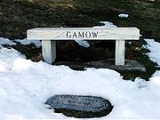
, and was buried there in Green Mountain Cemetery. The University of Colorado at Boulder Physics department tower is named after him.

Writings

Gamow was a highly successful science writer, with several of his books still in print. He conveyed the excitement of the revolution in physics and other scientific topics of interest to the common reader. Gamow himself prepared the illustrations for his books, which added a new dimension to and complemented what Gamow intended to convey in the text. Wherever it was essential, he used mathematics.

In 1956, he was awarded the Kalinga Prize
Kalinga Prize

The Kalinga Prize for the Popularization of Science is an award given by UNESCO for exceptional skill in popularization of science. It was created in 1952, following a donation from Biju Patnaik, Founder President of the Kalinga Foundation Trust in India....
 by UNESCO
UNESCO

United Nations Educational, Scientific and Cultural Organization is a specialized agency of the United Nations established on 16 November 1945....
 for his work in popularizing science with his Mr. Tompkins...
Mr Tompkins

The Wiktionary:eponymous character of Mr Tompkins appears in a series of books by the physics George Gamow in which he aims to explain modern scientific theories to a popular audience....
 series of books (1939–1967), One Two Three ... Infinity, and other works.

Gamow was working on a textbook entitled Basic Theories in Modern Physics, with Richard Blade, but it was not completed before he died. He wrote a book entitled My World Line: An Informal Autobiography, which was published posthumously in 1970.

Books


Popular

  • The Birth and Death of the Sun (1940)
  • The Biography of the Earth (1941)
  • One, Two, Three...Infinity (1947), Viking Press (copyright renewed by Barbara Gamow, 1974), Dover Publications, ISBN 0-486-25664-2, illustrated by the author. Dedicated to his son, Igor Gamow
    Igor Gamow

    Rustem Igor Gamow , son of famous scientist George Gamow, is a microbiology professor and inventor. His most well known inventions include: the Gamow bag, and the Shallow Underwater Breathing Apparatus....
     ("who wanted to be a cowboy") The book winds from mathematics
    Mathematics

    Mathematics is the study of quantity, structure, space, change, and related topics of pattern and form. Mathematicians seek out patterns whether found in numbers, space, natural science, computers, imaginary abstractions, or elsewhere....
     to biology
    Biology

    Biology is a branch of the natural sciences concerned with the study of living organisms and their interaction with each other and their environment ....
    , through physics
    Physics

    Physics is the natural science which examines basic concepts such as energy, force, and spacetime and all that derives from these, such as mass, charge, matter and its Motion ....
    , crystallography
    Crystallography

    Crystallography is the experimental science of determining the arrangement of atoms in solids. In older usage, it is the scientific study of crystals....
    , and more.
  • The Moon (1953)
  • Biography of Physics (1961)
  • Gravity (1962) Dover Publications, ISBN 0-486-42563-0. Profiles of Galileo
    Galileo Galilei

    Galileo Galilei was a Grand Duchy of Tuscany physicist, mathematician, astronomer, and philosopher who played a major role in the Scientific Revolution....
    , Newton
    Isaac Newton

    Sir Isaac Newton, Fellow of the Royal Society was an English people physicist, mathematician, Astronomy, Natural philosophy, Alchemy, and Theology and one of the the 100 in human history....
    , and Einstein
    Albert Einstein

    Albert Einstein was a Germany-born theoretical physics. He is best known for his theory of relativity and specifically mass?energy equivalence, expressed by the equation E = mc2....
  • A Planet Called Earth (1963)
  • A Star Called the Sun (1964)
  • Thirty Years That Shook Physics: The Story of Quantum Theory, 1966, Dover Publications, ISBN 0-486-24895-X. Illustrated by the author and with period photographs, Gamow describes an insider's view of the development of quantum theory. Having worked with Niels Bohr
    Niels Bohr

    Niels Henrik David Bohr was a Denmark physicist who made fundamental contributions to understanding atomic structure and quantum mechanics, for which he received the Nobel Prize in Physics in 1922....
     and Ernest Rutherford
    Ernest Rutherford

    Ernest Rutherford, 1st Baron Rutherford of Nelson, Order of Merit , Royal Society was a New Zealand-born British chemist who became known as the father of nuclear physics....
    , he not only can expound the theory, he supplies candid photos of Edward Teller
    Edward Teller

    Edward Teller was a Jewish-Hungarian-American theoretical physics physicist, known colloquially as "the father of the hydrogen bomb", even though he claimed that he did not care for the title....
     on skis, Bohr on a motorcycle, Werner Heisenberg
    Werner Heisenberg

    Werner Heisenberg was a German Theoretical physics who made foundational contributions to quantum mechanics and is best known for asserting the uncertainty principle of quantum theory....
     having a swim, and Enrico Fermi
    Enrico Fermi

    Enrico Fermi was an Italian physicist most noted for his work on the development of the first nuclear reactor, and for his contributions to the development of Quantum mechanics, nuclear physics and particle physics, and statistical mechanics....
     playing tennis. The finale is a dramatic playscript (also illustrated) of the history of atomic physics with the scientists cast in roles after the model of Goethe's Faust
    Faust

    Faust or Faustus is the protagonist of a classic German folklore who makes a pact with the Devil in exchange for knowledge. Faust's tale is the basis for many literary, artistic, cinematic, and musical works, such as those by Christopher Marlowe, Johann Wolfgang von Goethe, Thomas Mann, Hector Berlioz, Franz Liszt, Charles Gounod, Gu...
    .
  • My World Line: An Informal Autobiography (1970) Viking Press, ISBN 0-670-50376-2


Mr. Tompkins series
  • Mr. Tompkins in Wonderland (1940) Originally published in serial form in Discovery magazine (UK) in 1938.
  • Mr. Tompkins Explores the Atom (1945)
  • Mr. Tompkins Learns the Facts of Life (1953), about biology
  • Mr. Tompkins in Paperback (1965), combines Mr. Tompkins in Wonderland with Mr. Tompkins Explores the Atom, Cambridge University Press, 1993 Canto edition with foreword by Roger Penrose
    Roger Penrose

    Sir Roger Penrose, Order of Merit , Royal Society is an English mathematical physicist and Emeritus Rouse Ball Professor of Mathematics at the Mathematical Institute, University of Oxford and Emeritus Fellow of Wadham College....
    , ISBN 0-521-44771-2. Creatively illustrated by the author, and complete with a scored musical composition ("The Cosmic Opera"), the book explains the principles of relativity and quantum theory in a fashion that is entertaining to young people and adults.
  • Mr. Tompkins Inside Himself (1967), A rewritten version of Mr. Tompkins Learns the Facts of Life gives a broader view of biology, including recent developments in molecular biology. It was coauthored by M. Ycas.


Science textbooks

  • The Constitution of Atomic Nuclei and Radioactivity (1931)
  • Structure of Atomic Nuclei and Nuclear Transformations (1937)
  • Atomic Energy in Cosmic and Human Life (1947)
  • Theory of Atomic Nucleus and Nuclear Energy Sources (1949) coauthor C. L. Critchfield
  • The Creation of the Universe (1952)
  • Matter, Earth and Sky (1958)
  • Physics: Foundations & Frontiers (1960) coauthor John M. Cleveland
  • The Atom and its Nucleus (1961)
  • Mr. Tompkins Gets Serious: The Essential George Gamow (2005) Pi Press, ISBN 0-13-187291-5. Incorporates material from Matter, Earth, and Sky and The Atom and Its Nucleus. Notwithstanding the title, this book is not part of the Mr. Tompkins series.


See also

  • RNA Tie club
  • Urca process
  • Ylem
    Ylem

    Ylem is a term which was used by George Gamow, Ralph Alpher and their associates in the late 1940's for a hypothetical original substance or condensed state of matter, which became subatomic particles and chemical elements as we understand them today....


External links

  • [https://www.phys.gwu.edu/index.php?page=getting_a_bang_out_of_gamow "Getting a Bang Out of Gamow"]
  • (in PDF
    Portable Document Format

    Portable Document Format is a file format created by Adobe Systems in 1993 for document exchange. PDF is used for representing two-dimensional documents in a manner independent of the application software, hardware, and operating system....
    )
  • Complete
  • at George Washington University