
General relativity or the
general theory of relativity is the
geometricGeometry arose as the field of knowledge dealing with spatial relationships. Geometry was one of the two fields of pre-modern mathematics, the other being the study of numbers ....
theoryTheoretical physics is a branch of physics which employs mathematical models and abstractions of physics to rationalize, explain and predict natural phenomena...
of
gravitationGravitation, or gravity, is a natural phenomenon by which physical bodies attract with a force proportional to their mass. Gravitation is most familiar as the agent that gives weight to objects with mass and causes them to fall to the ground when dropped...
published by
Albert EinsteinAlbert Einstein was a German-born theoretical physicist who developed the theory of general relativity, effecting a revolution in physics. For this achievement, Einstein is often regarded as the father of modern physics and one of the most prolific intellects in human history...
in 1916. It is the current description of gravitation in
modern physicsThe term modern physics refers to the post-Newtonian conception of physics. The term implies that classical descriptions of phenomena are lacking, and that an accurate, "modern", description of reality requires theories to incorporate elements of quantum mechanics or Einsteinian relativity, or both...
. General relativity generalises
special relativitySpecial relativity is the physical theory of measurement in an inertial frame of reference proposed in 1905 by Albert Einstein in the paper "On the Electrodynamics of Moving Bodies".It generalizes Galileo's...
and
Newton's law of universal gravitationNewton's law of universal gravitation states that every point mass in the universe attracts every other point mass with a force that is directly proportional to the product of their masses and inversely proportional to the square of the distance between them...
, providing a unified description of gravity as a geometric property of
spaceSpace is the boundless, three-dimensional extent in which objects and events occur and have relative position and direction. Physical space is often conceived in three linear dimensions, although modern physicists usually consider it, with time, to be part of a boundless four-dimensional continuum...
and
timeTime in physics is defined by its measurement: time is what a clock reads. It is a scalar quantity and, like length, mass, and charge, is usually described as a fundamental quantity. Time can be combined mathematically with other physical quantities to derive other concepts such as motion, kinetic...
, or
spacetimeIn physics, spacetime is any mathematical model that combines space and time into a single continuum. Spacetime is usually interpreted with space as being three-dimensional and time playing the role of a fourth dimension that is of a different sort from the spatial dimensions...
. In particular, the
curvatureIn mathematics, curvature refers to any of a number of loosely related concepts in different areas of geometry. Intuitively, curvature is the amount by which a geometric object deviates from being flat, or straight in the case of a line, but this is defined in different ways depending on the context...
of spacetime is directly related to the
four-momentumIn special relativity, four-momentum is the generalization of the classical three-dimensional momentum to four-dimensional spacetime. Momentum is a vector in three dimensions; similarly four-momentum is a four-vector in spacetime...
(mass-energy and linear
momentumIn classical mechanics, linear momentum or translational momentum is the product of the mass and velocity of an object...
) of whatever
matterMatter is a general term for the substance of which all physical objects consist. Typically, matter includes atoms and other particles which have mass. A common way of defining matter is as anything that has mass and occupies volume...
and
radiationIn physics, radiation is a process in which energetic particles or energetic waves travel through a medium or space. There are two distinct types of radiation; ionizing and non-ionizing...
are present. The relation is specified by the
Einstein field equationsThe Einstein field equations or Einstein's equations are a set of ten equations in Albert Einstein's general theory of relativity which describe the fundamental interaction of gravitation as a result of spacetime being curved by matter and energy...
, a system of partial differential equations.
Some predictions of general relativity differ significantly from those of classical physics, especially concerning the passage of time, the geometry of space, the motion of bodies in
free fallFree fall is any motion of a body where gravity is the only force acting upon it, at least initially. These conditions produce an inertial trajectory so long as gravity remains the only force. Since this definition does not specify velocity, it also applies to objects initially moving upward...
, and the propagation of
lightLight or visible light is electromagnetic radiation that is visible to the human eye, and is responsible for the sense of sight. Visible light has wavelength in a range from about 380 nanometres to about 740 nm, with a frequency range of about 405 THz to 790 THz...
. Examples of such differences include
gravitational time dilationGravitational time dilation is the effect of time passing at different rates in regions of different gravitational potential; the lower the gravitational potential, the more slowly time passes...
, gravitational lensing, the
gravitational redshiftIn astrophysics, gravitational redshift or Einstein shift describes light or other forms of electromagnetic radiation of certain wavelengths that originate from a source that is in a region of a stronger gravitational field that appear to be of longer wavelength, or redshifted, when seen or...
of light, and the
gravitational time delayThe Shapiro time delay effect, or gravitational time delay effect, is one of the four classic solar system tests of general relativity. Radar signals passing near a massive object take slightly longer to travel to a target and longer to return than it would if the mass of the object were not...
. General relativity's predictions have been confirmed in all
observations and experimentsAt its introduction in 1915, the general theory of relativity did not have a solid empirical foundation. It was known that it correctly accounted for the "anomalous" precession of the perihelion of Mercury and on philosophical grounds it was considered satisfying that it was able to unify Newton's...
to date. Although general relativity is
not the only relativistic theory of gravityAlternatives to general relativity are physical theories that attempt to describe the phenomena of gravitation in competition to Einstein's theory of general relativity.There have been many different attempts at constructing an ideal theory of gravity...
, it is the
simplest theoryOccam's razor, also known as Ockham's razor, and sometimes expressed in Latin as lex parsimoniae , is a principle that generally recommends from among competing hypotheses selecting the one that makes the fewest new assumptions.-Overview:The principle is often summarized as "simpler explanations...
that is consistent with experimental data. However, unanswered questions remain, the most fundamental being how general relativity can be reconciled with the laws of
quantum physicsQuantum mechanics, also known as quantum physics or quantum theory, is a branch of physics providing a mathematical description of much of the dual particle-like and wave-like behavior and interactions of energy and matter. It departs from classical mechanics primarily at the atomic and subatomic...
to produce a complete and self-consistent theory of
quantum gravityQuantum gravity is the field of theoretical physics which attempts to develop scientific models that unify quantum mechanics with general relativity...
.
Einstein's theory has important astrophysical implications. For example, it implies the existence of
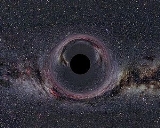
black holeA black hole is a region of spacetime from which nothing, not even light, can escape. The theory of general relativity predicts that a sufficiently compact mass will deform spacetime to form a black hole. Around a black hole there is a mathematically defined surface called an event horizon that...
s—regions of space in which space and time are distorted in such a way that nothing, not even light, can escape—as an end-state for massive
starA star is a massive, luminous sphere of plasma held together by gravity. At the end of its lifetime, a star can also contain a proportion of degenerate matter. The nearest star to Earth is the Sun, which is the source of most of the energy on Earth...
s. There is ample evidence that such
stellar black holeA stellar black hole is a black hole formed by the gravitational collapse of a massive star. They have masses ranging from about 3 to several tens of solar masses...
s as well as
more massiveA supermassive black hole is the largest type of black hole in a galaxy, in the order of hundreds of thousands to billions of solar masses. Most, and possibly all galaxies, including the Milky Way, are believed to contain supermassive black holes at their centers.Supermassive black holes have...
varieties of black hole are responsible for the intense
radiationIn physics, radiation is a process in which energetic particles or energetic waves travel through a medium or space. There are two distinct types of radiation; ionizing and non-ionizing...
emitted by certain types of astronomical objects such as
active galactic nucleiAn active galactic nucleus is a compact region at the centre of a galaxy that has a much higher than normal luminosity over at least some portion, and possibly all, of the electromagnetic spectrum. Such excess emission has been observed in the radio, infrared, optical, ultra-violet, X-ray and...
or microquasars. The bending of light by gravity can lead to the phenomenon of
gravitational lensA gravitational lens refers to a distribution of matter between a distant source and an observer, that is capable of bending the light from the source, as it travels towards the observer...
ing, where multiple images of the same distant astronomical object are visible in the sky. General relativity also predicts the existence of
gravitational waveIn physics, gravitational waves are theoretical ripples in the curvature of spacetime which propagates as a wave, traveling outward from the source. Predicted to exist by Albert Einstein in 1916 on the basis of his theory of general relativity, gravitational waves theoretically transport energy as...
s, which have since been measured indirectly; a direct measurement is the aim of projects such as
LIGOLIGO, which stands for the Laser Interferometer Gravitational-Wave Observatory, is a large-scale physics experiment aiming to directly detect gravitational waves. Cofounded in 1992 by Kip Thorne and Ronald Drever of Caltech and Rainer Weiss of MIT, LIGO is a joint project between scientists at MIT,...
and NASA/ESA
Laser Interferometer Space AntennaThe Laser Interferometer Space Antenna is a planned space mission to detect and accurately measure gravitational waves from astronomical sources. LISA was originally conceived as a joint effort between the United States space agency NASA and the European Space Agency...
. In addition, general relativity is the basis of current
cosmologicalPhysical cosmology, as a branch of astronomy, is the study of the largest-scale structures and dynamics of the universe and is concerned with fundamental questions about its formation and evolution. For most of human history, it was a branch of metaphysics and religion...
models of a consistently expanding universe.
History
Soon after publishing the
special theory of relativitySpecial relativity is the physical theory of measurement in an inertial frame of reference proposed in 1905 by Albert Einstein in the paper "On the Electrodynamics of Moving Bodies".It generalizes Galileo's...
in 1905, Einstein started thinking about how to incorporate gravity into his new relativistic framework. In 1907, beginning with a simple
thought experimentA thought experiment or Gedankenexperiment considers some hypothesis, theory, or principle for the purpose of thinking through its consequences...
involving an observer in free fall, he embarked on what would be an eight-year search for a relativistic theory of gravity. After numerous detours and false starts, his work culminated in the November, 1915 presentation to the Prussian Academy of Science of what are now known as the
Einstein field equationsThe Einstein field equations or Einstein's equations are a set of ten equations in Albert Einstein's general theory of relativity which describe the fundamental interaction of gravitation as a result of spacetime being curved by matter and energy...
. These equations specify how the geometry of space and time is influenced by whatever matter is present, and form the core of Einstein's general theory of relativity.
The Einstein field equations are nonlinear and very difficult to solve. Einstein used approximation methods in working out initial predictions of the theory. But as early as 1916, the astrophysicist
Karl SchwarzschildKarl Schwarzschild was a German physicist. He is also the father of astrophysicist Martin Schwarzschild.He is best known for providing the first exact solution to the Einstein field equations of general relativity, for the limited case of a single spherical non-rotating mass, which he accomplished...
found the first non-trivial exact solution to the Einstein field equations, the so-called
Schwarzschild metricIn Einstein's theory of general relativity, the Schwarzschild solution describes the gravitational field outside a spherical, uncharged, non-rotating mass such as a star, planet, or black hole. It is also a good approximation to the gravitational field of a slowly rotating body like the Earth or...
. This solution laid the groundwork for the description of the final stages of gravitational collapse, and the objects known today as black holes. In the same year, the first steps towards generalizing Schwarzschild's solution to electrically charged objects were taken, which eventually resulted in the Reissner-Nordström solution, now associated with electrically charged black holes. In 1917, Einstein applied his theory to the
universeThe Universe is commonly defined as the totality of everything that exists, including all matter and energy, the planets, stars, galaxies, and the contents of intergalactic space. Definitions and usage vary and similar terms include the cosmos, the world and nature...
as a whole, initiating the field of relativistic
cosmologyPhysical cosmology, as a branch of astronomy, is the study of the largest-scale structures and dynamics of the universe and is concerned with fundamental questions about its formation and evolution. For most of human history, it was a branch of metaphysics and religion...
. In line with contemporary thinking, he assumed a static universe, adding a new parameter to his original field equations—the
cosmological constantIn physical cosmology, the cosmological constant was proposed by Albert Einstein as a modification of his original theory of general relativity to achieve a stationary universe...
—to reproduce that "observation". By 1929, however, the work of
HubbleEdwin Powell Hubble was an American astronomer who profoundly changed the understanding of the universe by confirming the existence of galaxies other than the Milky Way - our own galaxy...
and others had shown that our
universe is expandingThe metric expansion of space is the increase of distance between distant parts of the universe with time. It is an intrinsic expansion—that is, it is defined by the relative separation of parts of the universe and not by motion "outward" into preexisting space...
. This is readily described by the expanding cosmological solutions found by Friedmann in 1922, which do not require a cosmological constant.
LemaîtreMonsignor Georges Henri Joseph Édouard Lemaître was a Belgian priest, astronomer and professor of physics at the Catholic University of Louvain. He was the first person to propose the theory of the expansion of the Universe, widely misattributed to Edwin Hubble...
used these solutions to formulate the earliest version of the
big bangThe Big Bang theory is the prevailing cosmological model that explains the early development of the Universe. According to the Big Bang theory, the Universe was once in an extremely hot and dense state which expanded rapidly. This rapid expansion caused the young Universe to cool and resulted in...
models, in which our universe has evolved from an extremely hot and dense earlier state. Einstein later declared the cosmological constant the biggest blunder of his life.
During that period, general relativity remained something of a curiosity among physical theories. It was clearly superior to Newtonian gravity, being consistent with
special relativitySpecial relativity is the physical theory of measurement in an inertial frame of reference proposed in 1905 by Albert Einstein in the paper "On the Electrodynamics of Moving Bodies".It generalizes Galileo's...
and accounting for several effects unexplained by the Newtonian theory. Einstein himself had shown in 1915 how his theory explained the anomalous perihelion advance of the planet
MercuryMercury is the innermost and smallest planet in the Solar System, orbiting the Sun once every 87.969 Earth days. The orbit of Mercury has the highest eccentricity of all the Solar System planets, and it has the smallest axial tilt. It completes three rotations about its axis for every two orbits...
without any arbitrary parameters ("
fudge factorA fudge factor is a quantity introduced into a calculation in order to "fudge" the results: that is, either to make them match better what happens in the real world, or to add an error margin...
s"). Similarly, a 1919 expedition led by Eddington confirmed general relativity's prediction for the deflection of starlight by the Sun during the total
solar eclipse of May 29, 1919A total solar eclipse occurred on May 29, 1919. With a maximum duration of totality of 6 minutes 51 seconds, it was one of the longest solar eclipses of the 20th century. It was visible throughout most of South America and Africa as a partial eclipse...
, making Einstein instantly famous. Yet the theory entered the mainstream of
theoretical physicsTheoretical physics is a branch of physics which employs mathematical models and abstractions of physics to rationalize, explain and predict natural phenomena...
and
astrophysicsAstrophysics is the branch of astronomy that deals with the physics of the universe, including the physical properties of celestial objects, as well as their interactions and behavior...
only with the developments between approximately 1960 and 1975, now known as the
Golden age of general relativityThe golden age of general relativity is the period roughly from 1960 to 1975 during which the study of general relativity, which had previously been regarded as something of a curiosity, entered the mainstream of theoretical physics...
. Physicists began to understand the concept of a black hole, and to identify these objects' astrophysical manifestation as quasars. Ever more precise solar system tests confirmed the theory's predictive power, and relativistic cosmology, too, became amenable to direct observational tests.
From classical mechanics to general relativity
General relativity is best understood by examining its similarities with and departures from
classical physicsWhat "classical physics" refers to depends on the context. When discussing special relativity, it refers to the Newtonian physics which preceded relativity, i.e. the branches of physics based on principles developed before the rise of relativity and quantum mechanics...
. The first step is the realization that classical mechanics and Newton's law of gravity admit of a geometric description. The combination of this description with the laws of special relativity results in a heuristic derivation of general relativity.
Geometry of Newtonian gravity
At the base of
classical mechanicsIn physics, classical mechanics is one of the two major sub-fields of mechanics, which is concerned with the set of physical laws describing the motion of bodies under the action of a system of forces...
is the notion that a
bodyIn physics, a physical body or physical object is a collection of masses, taken to be one...
's motion can be described as a combination of free (or
inertiaInertia is the resistance of any physical object to a change in its state of motion or rest, or the tendency of an object to resist any change in its motion. It is proportional to an object's mass. The principle of inertia is one of the fundamental principles of classical physics which are used to...
l) motion, and deviations from this free motion. Such deviations are caused by external forces acting on a body in accordance with Newton's second
law of motionNewton's laws of motion are three physical laws that form the basis for classical mechanics. They describe the relationship between the forces acting on a body and its motion due to those forces...
, which states that the net
forceIn physics, a force is any influence that causes an object to undergo a change in speed, a change in direction, or a change in shape. In other words, a force is that which can cause an object with mass to change its velocity , i.e., to accelerate, or which can cause a flexible object to deform...
acting on a body is equal to that body's (inertial)
massMass can be defined as a quantitive measure of the resistance an object has to change in its velocity.In physics, mass commonly refers to any of the following three properties of matter, which have been shown experimentally to be equivalent:...
multiplied by its
accelerationIn physics, acceleration is the rate of change of velocity with time. In one dimension, acceleration is the rate at which something speeds up or slows down. However, since velocity is a vector, acceleration describes the rate of change of both the magnitude and the direction of velocity. ...
. The preferred inertial motions are related to the geometry of space and
timeTime is a part of the measuring system used to sequence events, to compare the durations of events and the intervals between them, and to quantify rates of change such as the motions of objects....
: in the standard
reference framesA frame of reference in physics, may refer to a coordinate system or set of axes within which to measure the position, orientation, and other properties of objects in it, or it may refer to an observational reference frame tied to the state of motion of an observer.It may also refer to both an...
of classical mechanics, objects in free motion move along straight lines at constant speed. In modern parlance, their paths are
geodesicIn mathematics, a geodesic is a generalization of the notion of a "straight line" to "curved spaces". In the presence of a Riemannian metric, geodesics are defined to be the shortest path between points in the space...
s, straight world lines in curved spacetime.
Conversely, one might expect that inertial motions, once identified by observing the actual motions of bodies and making allowances for the external forces (such as
electromagnetismElectromagnetism is one of the four fundamental interactions in nature. The other three are the strong interaction, the weak interaction and gravitation...
or
frictionFriction is the force resisting the relative motion of solid surfaces, fluid layers, and/or material elements sliding against each other. There are several types of friction:...
), can be used to define the geometry of space, as well as a time coordinate. However, there is an ambiguity once gravity comes into play. According to Newton's law of gravity, and independently verified by experiments such as that of
EötvösBaron Loránd Eötvös de Vásárosnamény , more commonly called Baron Roland von Eötvös in English literature, was a Hungarian physicist. He is remembered today largely for his work on gravitation and surface tension.-Life:...
and its successors (see
Eötvös experimentThe Eötvös experiment was a famous physics experiment that measured the correlation between inertial mass and gravitational mass, demonstrating that the two were one and the same, something that had long been suspected but never demonstrated with the same accuracy. The earliest experiments were...
), there is a universality of free fall (also known as the weak
equivalence principleIn the physics of general relativity, the equivalence principle is any of several related concepts dealing with the equivalence of gravitational and inertial mass, and to Albert Einstein's assertion that the gravitational "force" as experienced locally while standing on a massive body is actually...
, or the universal equality of inertial and passive-gravitational mass): the trajectory of a test body in
free fallFree fall is any motion of a body where gravity is the only force acting upon it, at least initially. These conditions produce an inertial trajectory so long as gravity remains the only force. Since this definition does not specify velocity, it also applies to objects initially moving upward...
depends only on its position and initial speed, but not on any of its material properties. A simplified version of this is embodied in Einstein's elevator experiment, illustrated in the figure on the right: for an observer in a small enclosed room, it is impossible to decide, by mapping the trajectory of bodies such as a dropped ball, whether the room is at rest in a gravitational field, or in free space aboard an accelerating rocket generating a force equal to gravity.
Given the universality of free fall, there is no observable distinction between inertial motion and motion under the influence of the gravitational force. This suggests the definition of a new class of inertial motion, namely that of objects in free fall under the influence of gravity. This new class of preferred motions, too, defines a geometry of space and time—in mathematical terms, it is the
geodesicIn mathematics, a geodesic is a generalization of the notion of a "straight line" to "curved spaces". In the presence of a Riemannian metric, geodesics are defined to be the shortest path between points in the space...
motion associated with a specific
connectionIn geometry, the notion of a connection makes precise the idea of transporting data along a curve or family of curves in a parallel and consistent manner. There are a variety of kinds of connections in modern geometry, depending on what sort of data one wants to transport...
which depends on the
gradientIn vector calculus, the gradient of a scalar field is a vector field that points in the direction of the greatest rate of increase of the scalar field, and whose magnitude is the greatest rate of change....
of the
gravitational potential. Space, in this construction, still has the ordinary
Euclidean geometryEuclidean geometry is a mathematical system attributed to the Alexandrian Greek mathematician Euclid, which he described in his textbook on geometry: the Elements. Euclid's method consists in assuming a small set of intuitively appealing axioms, and deducing many other propositions from these...
. However, space
time as a whole is more complicated. As can be shown using simple
thought experimentA thought experiment or Gedankenexperiment considers some hypothesis, theory, or principle for the purpose of thinking through its consequences...
s following the free-fall trajectories of different test particles, the result of transporting spacetime vectors that can denote a particle's velocity (time-like vectors) will vary with the particle's trajectory; mathematically speaking, the Newtonian connection is not integrable. From this, one can deduce that spacetime is curved. The result is a geometric formulation of Newtonian gravity using only covariant concepts, i.e. a description which is valid in any desired coordinate system. In this geometric description, tidal effects—the relative acceleration of bodies in free fall—are related to the derivative of the connection, showing how the modified geometry is caused by the presence of mass.
Relativistic generalization
As intriguing as geometric Newtonian gravity may be, its basis, classical mechanics, is merely a limiting case of
(special) relativisticSpecial relativity is the physical theory of measurement in an inertial frame of reference proposed in 1905 by Albert Einstein in the paper "On the Electrodynamics of Moving Bodies".It generalizes Galileo's...
mechanics. In the language of
symmetrySymmetry generally conveys two primary meanings. The first is an imprecise sense of harmonious or aesthetically pleasing proportionality and balance; such that it reflects beauty or perfection...
: where gravity can be neglected, physics is Lorentz invariant as in special relativity rather than
Galilei invariantGalilean invariance or Galilean relativity is a principle of relativity which states that the fundamental laws of physics are the same in all inertial frames...
as in classical mechanics. (The defining symmetry of special relativity is the
Poincaré groupIn physics and mathematics, the Poincaré group, named after Henri Poincaré, is the group of isometries of Minkowski spacetime.-Simple explanation:...
which also includes translations and rotations.) The differences between the two become significant when we are dealing with speeds approaching the
speed of lightThe speed of light in vacuum, usually denoted by c, is a physical constant important in many areas of physics. Its value is 299,792,458 metres per second, a figure that is exact since the length of the metre is defined from this constant and the international standard for time...
, and with high-energy phenomena.
With Lorentz symmetry, additional structures come into play. They are defined by the set of light cones (see the image on the left). The light-cones define a causal structure: for each
eventIn physics, and in particular relativity, an event indicates a physical situation or occurrence, located at a specific point in space and time. For example, a glass breaking on the floor is an event; it occurs at a unique place and a unique time, in a given frame of reference.Strictly speaking, the...
A, there is a set of events that can, in principle, either influence or be influenced by A via signals or interactions that do not need to travel faster than light (such as event B in the image), and a set of events for which such an influence is impossible (such as event C in the image). These sets are observer-independent. In conjunction with the world-lines of freely falling particles, the light-cones can be used to reconstruct the space–time's semi-Riemannian metric, at least up to a positive scalar factor. In mathematical terms, this defines a conformal structure.
Special relativity is defined in the absence of gravity, so for practical applications, it is a suitable model whenever gravity can be neglected. Bringing gravity into play, and assuming the universality of free fall, an analogous reasoning as in the previous section applies: there are no global inertial frames. Instead there are approximate inertial frames moving alongside freely falling particles. Translated into the language of spacetime: the straight time-like lines that define a gravity-free inertial frame are deformed to lines that are curved relative to each other, suggesting that the inclusion of gravity necessitates a change in spacetime geometry.
A priori, it is not clear whether the new local frames in free fall coincide with the reference frames in which the laws of special relativity hold—that theory is based on the propagation of light, and thus on
electromagnetismElectromagnetism is one of the four fundamental interactions in nature. The other three are the strong interaction, the weak interaction and gravitation...
, which could have a different set of preferred frames. But using different assumptions about the special-relativistic frames (such as their being earth-fixed, or in free fall), one can derive different predictions for the
gravitational redshiftIn astrophysics, gravitational redshift or Einstein shift describes light or other forms of electromagnetic radiation of certain wavelengths that originate from a source that is in a region of a stronger gravitational field that appear to be of longer wavelength, or redshifted, when seen or...
, that is, the way in which the frequency of light shifts as the light propagates through a gravitational field (cf. below). The actual measurements show that free-falling frames are the ones in which light propagates as it does in special relativity. The generalization of this statement, namely that the laws of special relativity hold to good approximation in freely falling (and non-rotating) reference frames, is known as the Einstein equivalence principle, a crucial guiding principle for generalizing special-relativistic physics to include gravity.
The same experimental data shows that time as measured by clocks in a gravitational field—
proper timeIn relativity, proper time is the elapsed time between two events as measured by a clock that passes through both events. The proper time depends not only on the events but also on the motion of the clock between the events. An accelerated clock will measure a smaller elapsed time between two...
, to give the technical term—does not follow the rules of special relativity. In the language of spacetime geometry, it is not measured by the Minkowski metric. As in the Newtonian case, this is suggestive of a more general geometry. At small scales, all reference frames that are in free fall are equivalent, and approximately Minkowskian. Consequently, we are now dealing with a curved generalization of Minkowski space. The
metric tensorIn general relativity, the metric tensor is the fundamental object of study. It may loosely be thought of as a generalization of the gravitational field familiar from Newtonian gravitation...
that defines the geometry—in particular, how lengths and angles are measured—is not the Minkowski metric of special relativity, it is a generalization known as a semi- or pseudo-Riemannian metric. Furthermore, each Riemannian metric is naturally associated with one particular kind of connection, the
Levi-Civita connectionIn Riemannian geometry, the Levi-Civita connection is a specific connection on the tangent bundle of a manifold. More specifically, it is the torsion-free metric connection, i.e., the torsion-free connection on the tangent bundle preserving a given Riemannian metric.The fundamental theorem of...
, and this is, in fact, the connection that satisfies the equivalence principle and makes space locally Minkowskian (that is, in suitable
locally inertial coordinatesIn theoretical physics, a local reference frame refers to a coordinate system or frame of reference that is only expected to function over a small region or a restricted region of space or spacetime....
, the metric is Minkowskian, and its first partial derivatives and the connection coefficients vanish).
Einstein's equations
Having formulated the relativistic, geometric version of the effects of gravity, the question of gravity's source remains. In Newtonian gravity, the source is mass. In special relativity, mass turns out to be part of a more general quantity called the energy-momentum tensor, which includes both
energyEnergy density is a term used for the amount of energy stored in a given system or region of space per unit volume. Often only the useful or extractable energy is quantified, which is to say that chemically inaccessible energy such as rest mass energy is ignored...
and
momentumIn classical mechanics, linear momentum or translational momentum is the product of the mass and velocity of an object...
densitiesThe mass density or density of a material is defined as its mass per unit volume. The symbol most often used for density is ρ . In some cases , density is also defined as its weight per unit volume; although, this quantity is more properly called specific weight...
as well as
stressIn continuum mechanics, stress is a measure of the internal forces acting within a deformable body. Quantitatively, it is a measure of the average force per unit area of a surface within the body on which internal forces act. These internal forces are a reaction to external forces applied on the body...
(that is,
pressurePressure is the force per unit area applied in a direction perpendicular to the surface of an object. Gauge pressure is the pressure relative to the local atmospheric or ambient pressure.- Definition :...
and shear). Using the equivalence principle, this tensor is readily generalized to curved space-time. Drawing further upon the analogy with geometric Newtonian gravity, it is natural to assume that the
field equationA field equation is an equation in a physical theory that describes how a fundamental force interacts with matter...
for gravity relates this tensor and the
Ricci tensorIn differential geometry, the Ricci curvature tensor, named after Gregorio Ricci-Curbastro, represents the amount by which the volume element of a geodesic ball in a curved Riemannian manifold deviates from that of the standard ball in Euclidean space...
, which describes a particular class of tidal effects: the change in volume for a small cloud of test particles that are initially at rest, and then fall freely. In special relativity,
conservation of energyThe nineteenth century law of conservation of energy is a law of physics. It states that the total amount of energy in an isolated system remains constant over time. The total energy is said to be conserved over time...
-momentum corresponds to the statement that the energy-momentum tensor is
divergenceIn vector calculus, divergence is a vector operator that measures the magnitude of a vector field's source or sink at a given point, in terms of a signed scalar. More technically, the divergence represents the volume density of the outward flux of a vector field from an infinitesimal volume around...
-free. This formula, too, is readily generalized to curved spacetime by replacing partial derivatives with their curved-
manifoldIn mathematics , a manifold is a topological space that on a small enough scale resembles the Euclidean space of a specific dimension, called the dimension of the manifold....
counterparts,
covariant derivativeIn mathematics, the covariant derivative is a way of specifying a derivative along tangent vectors of a manifold. Alternatively, the covariant derivative is a way of introducing and working with a connection on a manifold by means of a differential operator, to be contrasted with the approach given...
s studied in differential geometry. With this additional condition—the covariant divergence of the energy-momentum tensor, and hence of whatever is on the other side of the equation, is zero— the simplest set of equations are what are called Einstein's (field) equations:
On the left-hand side is the
Einstein tensorIn differential geometry, the Einstein tensor , named after Albert Einstein, is used to express the curvature of a Riemannian manifold...
, a specific divergence-free combination of the
Ricci tensorIn differential geometry, the Ricci curvature tensor, named after Gregorio Ricci-Curbastro, represents the amount by which the volume element of a geodesic ball in a curved Riemannian manifold deviates from that of the standard ball in Euclidean space...

and the metric. In particular,
is the curvature scalar. The Ricci tensor itself is related to the more general Riemann curvature tensor as
On the right-hand side,
Tab is the energy-momentum tensor. All tensors are written in
abstract index notationAbstract index notation is a mathematical notation for tensors and spinors that uses indices to indicate their types, rather than their components in a particular basis. The indices are mere placeholders, not related to any fixed basis and, in particular, are non-numerical...
. Matching the theory's prediction to observational results for
planetA planet is a celestial body orbiting a star or stellar remnant that is massive enough to be rounded by its own gravity, is not massive enough to cause thermonuclear fusion, and has cleared its neighbouring region of planetesimals.The term planet is ancient, with ties to history, science,...
ary orbits (or, equivalently, assuring that the weak-gravity, low-speed limit is Newtonian mechanics), the proportionality constant can be fixed as κ = 8π
G/
c4, with
G the
gravitational constantThe gravitational constant, denoted G, is an empirical physical constant involved in the calculation of the gravitational attraction between objects with mass. It appears in Newton's law of universal gravitation and in Einstein's theory of general relativity. It is also known as the universal...
and
c the
speed of lightThe speed of light in vacuum, usually denoted by c, is a physical constant important in many areas of physics. Its value is 299,792,458 metres per second, a figure that is exact since the length of the metre is defined from this constant and the international standard for time...
. When there is no matter present, so that the energy-momentum tensor vanishes, the result are the
vacuum Einstein equations,
There are
alternatives to general relativityAlternatives to general relativity are physical theories that attempt to describe the phenomena of gravitation in competition to Einstein's theory of general relativity.There have been many different attempts at constructing an ideal theory of gravity...
built upon the same premises, which include additional rules and/or constraints, leading to different field equations. Examples are
Brans-Dicke theoryIn theoretical physics, the Brans–Dicke theory of gravitation is a theoretical framework to explain gravitation. It is a well-known competitor of Einstein's more popular theory of general relativity...
,
teleparallelismTeleparallelism , was an attempt by Einstein to unify electromagnetism and gravity...
, and Einstein-Cartan theory.
Definition and basic applications
The derivation outlined in the previous section contains all the information needed to define general relativity, describe its key properties, and address a question of crucial importance in physics, namely how the theory can be used for model-building.
Definition and basic properties
General relativity is a metric theory of
gravitationGravitation, or gravity, is a natural phenomenon by which physical bodies attract with a force proportional to their mass. Gravitation is most familiar as the agent that gives weight to objects with mass and causes them to fall to the ground when dropped...
. At its core are Einstein's equations, which describe the relation between the
geometryGeometry arose as the field of knowledge dealing with spatial relationships. Geometry was one of the two fields of pre-modern mathematics, the other being the study of numbers ....
of a four-dimensional, pseudo-Riemannian
manifoldIn mathematics , a manifold is a topological space that on a small enough scale resembles the Euclidean space of a specific dimension, called the dimension of the manifold....
representing spacetime, and the energy-momentum contained in that spacetime. Phenomena that in
classical mechanicsIn physics, classical mechanics is one of the two major sub-fields of mechanics, which is concerned with the set of physical laws describing the motion of bodies under the action of a system of forces...
are ascribed to the action of the force of gravity (such as
free-fallFree fall is any motion of a body where gravity is the only force acting upon it, at least initially. These conditions produce an inertial trajectory so long as gravity remains the only force. Since this definition does not specify velocity, it also applies to objects initially moving upward...
,
orbitIn physics, an orbit is the gravitationally curved path of an object around a point in space, for example the orbit of a planet around the center of a star system, such as the Solar System...
al motion, and
spacecraftA spacecraft or spaceship is a craft or machine designed for spaceflight. Spacecraft are used for a variety of purposes, including communications, earth observation, meteorology, navigation, planetary exploration and transportation of humans and cargo....
trajectories), correspond to inertial motion within a
curved geometryIn mathematics, curvature refers to any of a number of loosely related concepts in different areas of geometry. Intuitively, curvature is the amount by which a geometric object deviates from being flat, or straight in the case of a line, but this is defined in different ways depending on the context...
of spacetime in general relativity; there is no gravitational force deflecting objects from their natural, straight paths. Instead, gravity corresponds to changes in the properties of space and time, which in turn changes the straightest-possible paths that objects will naturally follow. The curvature is, in turn, caused by the energy-momentum of matter. Paraphrasing the relativist
John Archibald WheelerJohn Archibald Wheeler was an American theoretical physicist who was largely responsible for reviving interest in general relativity in the United States after World War II. Wheeler also worked with Niels Bohr in explaining the basic principles behind nuclear fission...
, spacetime tells matter how to move; matter tells spacetime how to curve.
While general relativity replaces the
scalarIn mathematics and physics, a scalar field associates a scalar value to every point in a space. The scalar may either be a mathematical number, or a physical quantity. Scalar fields are required to be coordinate-independent, meaning that any two observers using the same units will agree on the...
gravitational potential of classical physics by a symmetric rank-two
tensorTensors are geometric objects that describe linear relations between vectors, scalars, and other tensors. Elementary examples include the dot product, the cross product, and linear maps. Vectors and scalars themselves are also tensors. A tensor can be represented as a multi-dimensional array of...
, the latter reduces to the former in certain limiting cases. For weak gravitational fields and slow speed relative to the speed of light, the theory's predictions converge on those of
Newton's law of universal gravitationNewton's law of universal gravitation states that every point mass in the universe attracts every other point mass with a force that is directly proportional to the product of their masses and inversely proportional to the square of the distance between them...
.
As it is constructed using
tensorTensors are geometric objects that describe linear relations between vectors, scalars, and other tensors. Elementary examples include the dot product, the cross product, and linear maps. Vectors and scalars themselves are also tensors. A tensor can be represented as a multi-dimensional array of...
s, general relativity exhibits
general covarianceIn theoretical physics, general covariance is the invariance of the form of physical laws under arbitrary differentiable coordinate transformations...
: its laws—and further laws formulated within the general relativistic framework—take on the same form in all
coordinate systemIn geometry, a coordinate system is a system which uses one or more numbers, or coordinates, to uniquely determine the position of a point or other geometric element. The order of the coordinates is significant and they are sometimes identified by their position in an ordered tuple and sometimes by...
s. Furthermore, the theory does not contain any invariant geometric background structures, i.e. it is
background independentBackground independence, also called universality, is the concept or assumption, fundamental to all physical sciences, that the nature of reality is consistent throughout all of space and time...
. It thus satisfies a more stringent general principle of relativity, namely that the
laws of physicsA physical law or scientific law is "a theoretical principle deduced from particular facts, applicable to a defined group or class of phenomena, and expressible by the statement that a particular phenomenon always occurs if certain conditions be present." Physical laws are typically conclusions...
are the same for all observers.
LocallyLocal spacetime structure refers to the structure of spacetime on a local level, i.e. only considering those points in an open region of a point. This notion is useful in many areas of physics, most notably in Einstein's theory of general relativity....
, as expressed in the
equivalence principleIn the physics of general relativity, the equivalence principle is any of several related concepts dealing with the equivalence of gravitational and inertial mass, and to Albert Einstein's assertion that the gravitational "force" as experienced locally while standing on a massive body is actually...
, spacetime is
MinkowskianIn physics and mathematics, Minkowski space or Minkowski spacetime is the mathematical setting in which Einstein's theory of special relativity is most conveniently formulated...
, and the laws of physics exhibit local Lorentz invariance.
Model-building
The core concept of general-relativistic model-building is that of a
solution of Einstein's equationsWhere appropriate, this article will use the abstract index notation.Solutions of the Einstein field equations are spacetimes that result from solving the Einstein field equations of general relativity. Solving the field equations actually gives Lorentz metrics...
. Given both Einstein's equations and suitable equations for the properties of matter, such a solution consists of a specific semi-Riemannian manifold (usually defined by giving the metric in specific coordinates), and specific matter fields defined on that manifold. Matter and geometry must satisfy Einstein's equations, so in particular, the matter's energy-momentum tensor must be divergence-free. The matter must, of course, also satisfy whatever additional equations were imposed on its properties. In short, such a solution is a model universe that satisfies the laws of general relativity, and possibly additional laws governing whatever matter might be present.
Einstein's equations are nonlinear partial differential equations and, as such, difficult to solve exactly. Nevertheless, a number of
exact solutionIn general relativity, an exact solution is a Lorentzian manifold equipped with certain tensor fields which are taken to model states of ordinary matter, such as a fluid, or classical nongravitational fields such as the electromagnetic field....
s are known, although only a few have direct physical applications. The best-known exact solutions, and also those most interesting from a physics point of view, are the Schwarzschild solution, the Reissner-Nordström solution and the
Kerr metricThe Kerr metric describes the geometry of empty spacetime around an uncharged axially-symmetric black-hole with an event horizon which is topologically a sphere. The Kerr metric is an exact solution of the Einstein field equations of general relativity; these equations are highly non-linear, which...
, each corresponding to a certain type of black hole in an otherwise empty universe, and the Friedmann-Lemaître-Robertson-Walker and
de Sitter universeA de Sitter universe is a cosmological solution to Einstein's field equations of General Relativity which is named after Willem de Sitter. It models the universe as spatially flat and neglects ordinary matter, so the dynamics of the universe are dominated by the cosmological constant, thought to...
s, each describing an expanding cosmos. Exact solutions of great theoretical interest include the
Gödel universeThe Gödel metric is an exact solution of the Einstein field equations in which the stress-energy tensor contains two terms, the first representing the matter density of a homogeneous distribution of swirling dust particles, and the second associated with a nonzero cosmological constant...
(which opens up the intriguing possibility of
time travelTime travel is the concept of moving between different points in time in a manner analogous to moving between different points in space. Time travel could hypothetically involve moving backward in time to a moment earlier than the starting point, or forward to the future of that point without the...
in curved spacetimes), the Taub-NUT solution (a model universe that is
homogeneousIn general, homogeneity is defined as the quality or state of being homogeneous . For instance, a uniform electric field would be compatible with homogeneity...
, but anisotropic), and Anti-de Sitter space (which has recently come to prominence in the context of what is called the Maldacena conjecture).
Given the difficulty of finding exact solutions, Einstein's field equations are also solved frequently by
numerical integrationIn numerical analysis, numerical integration constitutes a broad family of algorithms for calculating the numerical value of a definite integral, and by extension, the term is also sometimes used to describe the numerical solution of differential equations. This article focuses on calculation of...
on a computer, or by considering small perturbations of exact solutions. In the field of
numerical relativityNumerical relativity is one of the branches of general relativity that uses numerical methods and algorithms to solve and analyze problems. To this end, supercomputers are often employed to study black holes, gravitational waves, neutron stars and many other phenomena governed by Einstein's Theory...
, powerful computers are employed to simulate the geometry of spacetime and to solve Einstein's equations for interesting situations such as two colliding black holes. In principle, such methods may be applied to any system, given sufficient computer resources, and may address fundamental questions such as
naked singularitiesIn general relativity, a naked singularity is a gravitational singularity, without an event horizon. In a black hole, there is a region around the singularity, the event horizon, where the gravitational force of the singularity is strong enough so that light cannot escape. Hence, the singularity...
. Approximate solutions may also be found by
perturbation theoriesPerturbation theory comprises mathematical methods that are used to find an approximate solution to a problem which cannot be solved exactly, by starting from the exact solution of a related problem...
such as
linearized gravityLinearized gravity is an approximation scheme in general relativity in which the nonlinear contributions from the spacetime metric are ignored, simplifying the study of many problems while still producing useful approximate results.-The method:...
and its generalization, the
post-Newtonian expansionPost-Newtonian expansions in general relativity are used for finding an approximate solution of the Einstein equations for the metric tensor. The post-Newtonian approximations are expansions in a small parameter, which is the ratio of the velocity of matter, forming the gravitational field, to the...
, both of which were developed by Einstein. The latter provides a systematic approach to solving for the geometry of a spacetime that contains a distribution of matter that moves slowly compared with the speed of light. The expansion involves a series of terms; the first terms represent Newtonian gravity, whereas the later terms represent ever smaller corrections to Newton's theory due to general relativity. An extension of this expansion is the
parametrized post-NewtonianPost-Newtonian formalism is a calculational tool that expresses Einstein's equations of gravity in terms of the lowest-order deviations from Newton's theory. This allows approximations to Einstein's equations to be made in the case of weak fields...
(PPN) formalism, which allows quantitative comparisons between the predictions of general relativity and
alternative theoriesAlternatives to general relativity are physical theories that attempt to describe the phenomena of gravitation in competition to Einstein's theory of general relativity.There have been many different attempts at constructing an ideal theory of gravity...
.
Consequences of Einstein's theory
General relativity has a number of physical consequences. Some follow directly from the theory's axioms, whereas others have become clear only in the course of the ninety years of research that followed Einstein's initial publication.
Gravitational time dilation and frequency shift
Assuming that the
equivalence principleIn the physics of general relativity, the equivalence principle is any of several related concepts dealing with the equivalence of gravitational and inertial mass, and to Albert Einstein's assertion that the gravitational "force" as experienced locally while standing on a massive body is actually...
holds, gravity influences the passage of time. Light sent down into a gravity well is
blueshiftedA blueshift is any decrease in wavelength ; the opposite effect is referred to as redshift. In visible light, this shifts the colour from the red end of the spectrum to the blue end...
, whereas light sent in the opposite direction (i.e., climbing out of the gravity well) is
redshiftIn physics , redshift happens when light seen coming from an object is proportionally increased in wavelength, or shifted to the red end of the spectrum...
ed; collectively, these two effects are known as the gravitational frequency shift. More generally, processes close to a massive body run more slowly when compared with processes taking place farther away; this effect is known as gravitational time dilation.
Gravitational redshift has been measured in the laboratory and using astronomical observations. Gravitational time dilation in the Earth's gravitational field has been measured numerous times using atomic clocks, while ongoing validation is provided as a side effect of the operation of the
Global Positioning SystemThe Global Positioning System is a space-based global navigation satellite system that provides location and time information in all weather, anywhere on or near the Earth, where there is an unobstructed line of sight to four or more GPS satellites...
(GPS). Tests in stronger gravitational fields are provided by the observation of
binary pulsarA binary pulsar is a pulsar with a binary companion, often a white dwarf or neutron star. Binary pulsars are one of the few objects which allow physicists to test general relativity in the case of a strong gravitational field...
s. All results are in agreement with general relativity. However, at the current level of accuracy, these observations cannot distinguish between general relativity and other theories in which the equivalence principle is valid.
Light deflection and gravitational time delay
General relativity predicts that the path of light is bent in a gravitational field; light passing a massive body is deflected towards that body. This effect has been confirmed by observing the light of stars or distant quasars being deflected as it passes the
SunThe Sun is the star at the center of the Solar System. It is almost perfectly spherical and consists of hot plasma interwoven with magnetic fields...
.
This and related predictions follow from the fact that light follows what is called a light-like or null
geodesicIn mathematics, a geodesic is a generalization of the notion of a "straight line" to "curved spaces". In the presence of a Riemannian metric, geodesics are defined to be the shortest path between points in the space...
—a generalization of the straight lines along which light travels in
classical physicsWhat "classical physics" refers to depends on the context. When discussing special relativity, it refers to the Newtonian physics which preceded relativity, i.e. the branches of physics based on principles developed before the rise of relativity and quantum mechanics...
. Such geodesics are the generalization of the
invarianceIn mathematics, an invariant is a property of a class of mathematical objects that remains unchanged when transformations of a certain type are applied to the objects. The particular class of objects and type of transformations are usually indicated by the context in which the term is used...
of lightspeed in
special relativitySpecial relativity is the physical theory of measurement in an inertial frame of reference proposed in 1905 by Albert Einstein in the paper "On the Electrodynamics of Moving Bodies".It generalizes Galileo's...
. As one examines suitable model spacetimes (either the exterior Schwarzschild solution or, for more than a single mass, the
post-Newtonian expansionPost-Newtonian expansions in general relativity are used for finding an approximate solution of the Einstein equations for the metric tensor. The post-Newtonian approximations are expansions in a small parameter, which is the ratio of the velocity of matter, forming the gravitational field, to the...
), several effects of gravity on light propagation emerge. Although the bending of light can also be derived by extending the universality of free fall to
lightLight or visible light is electromagnetic radiation that is visible to the human eye, and is responsible for the sense of sight. Visible light has wavelength in a range from about 380 nanometres to about 740 nm, with a frequency range of about 405 THz to 790 THz...
, the angle of deflection resulting from such calculations is only half the value given by general relativity.
Closely related to light deflection is the gravitational time delay (or Shapiro effect), the phenomenon that light signals take longer to move through a gravitational field than they would in the absence of that field. There have been numerous successful tests of this prediction. In the
parameterized post-Newtonian formalismPost-Newtonian formalism is a calculational tool that expresses Einstein's equations of gravity in terms of the lowest-order deviations from Newton's theory. This allows approximations to Einstein's equations to be made in the case of weak fields...
(PPN), measurements of both the deflection of light and the gravitational time delay determine a parameter called γ, which encodes the influence of gravity on the geometry of space.
Gravitational waves
One of several analogies between weak-field gravity and
electromagnetismElectromagnetism is one of the four fundamental interactions in nature. The other three are the strong interaction, the weak interaction and gravitation...
is that, analogous to electromagnetic waves, there are gravitational waves: ripples in the metric of spacetime that propagate at the
speed of lightThe speed of light in vacuum, usually denoted by c, is a physical constant important in many areas of physics. Its value is 299,792,458 metres per second, a figure that is exact since the length of the metre is defined from this constant and the international standard for time...
. The simplest type of such a wave can be visualized by its action on a ring of freely floating particles. A sine wave propagating through such a ring towards the reader distorts the ring in a characteristic, rhythmic fashion (animated image to the right). Since Einstein's equations are non-linear, arbitrarily strong gravitational waves do not obey linear superposition, making their description difficult. However, for weak fields, a linear approximation can be made. Such linearized gravitational waves are sufficiently accurate to describe the exceedingly weak waves that are expected to arrive here on Earth from far-off cosmic events, which typically result in relative distances increasing and decreasing by

or less. Data-analysis methods routinely make use of the fact that these linearized waves can be Fourier decomposed.
Some
exact solutionIn mathematics and especially physics, an exact solution is a solution to a problem that encapsulates the whole mathematics or physics of the problem without using an approximation.-References:*...
s describe gravitational waves without any approximation, e.g., a wave train traveling through empty space or so-called Gowdy universes, varieties of an expanding cosmos filled with gravitational waves. But for gravitational waves produced in astrophysically relevant situations, such as the merger of two black holes,
numerical methodsNumerical relativity is one of the branches of general relativity that uses numerical methods and algorithms to solve and analyze problems. To this end, supercomputers are often employed to study black holes, gravitational waves, neutron stars and many other phenomena governed by Einstein's Theory...
are presently the only way to construct appropriate models.
Orbital effects and the relativity of direction
General relativity differs from classical mechanics in a number of predictions concerning orbiting bodies. It predicts an overall rotation (
precessionPrecession is a change in the orientation of the rotation axis of a rotating body. It can be defined as a change in direction of the rotation axis in which the second Euler angle is constant...
) of planetary orbits, as well as orbital decay caused by the emission of gravitational waves and effects related to the relativity of direction.
Precession of apsides
In general relativity, the
apsidesAn apsis , plural apsides , is the point of greatest or least distance of a body from one of the foci of its elliptical orbit. In modern celestial mechanics this focus is also the center of attraction, which is usually the center of mass of the system...
of any
orbitIn physics, an orbit is the gravitationally curved path of an object around a point in space, for example the orbit of a planet around the center of a star system, such as the Solar System...
(the point of the orbiting body's closest approach to the system's
center of massIn physics, the center of mass or barycenter of a system is the average location of all of its mass. In the case of a rigid body, the position of the center of mass is fixed in relation to the body...
) will precess—the orbit is not an
ellipseIn geometry, an ellipse is a plane curve that results from the intersection of a cone by a plane in a way that produces a closed curve. Circles are special cases of ellipses, obtained when the cutting plane is orthogonal to the cone's axis...
, but akin to an ellipse that rotates on its focus, resulting in a
rose curveIn mathematics, a rose or rhodonea curve is a sinusoid plotted in polar coordinates. Up to similarity, thesecurves can all be expressed by a polar equation of the form\!\,r=\cos.If k is an integer, the curve will be rose shaped with...
-like shape (see image). Einstein first derived this result by using an approximate metric representing the Newtonian limit and treating the orbiting body as a
test particleIn physical theories, a test particle is an idealized model of an object whose physical properties are assumed to be negligible except for the property being studied, which is considered to be insufficient to alter the behavior of the rest of the system...
. For him, the fact that his theory gave a straightforward explanation of the anomalous perihelion shift of the planet
MercuryMercury is the innermost and smallest planet in the Solar System, orbiting the Sun once every 87.969 Earth days. The orbit of Mercury has the highest eccentricity of all the Solar System planets, and it has the smallest axial tilt. It completes three rotations about its axis for every two orbits...
, discovered earlier by
Urbain Le Verrier in 1859, was important evidence that he had at last identified the correct form of the
gravitational field equationsThe Einstein field equations or Einstein's equations are a set of ten equations in Albert Einstein's general theory of relativity which describe the fundamental interaction of gravitation as a result of spacetime being curved by matter and energy...
.
The effect can also be derived by using either the exact
Schwarzschild metricIn Einstein's theory of general relativity, the Schwarzschild solution describes the gravitational field outside a spherical, uncharged, non-rotating mass such as a star, planet, or black hole. It is also a good approximation to the gravitational field of a slowly rotating body like the Earth or...
(describing spacetime around a spherical mass) or the much more general post-Newtonian formalism. It is due to the influence of gravity on the geometry of space and to the contribution of
self-energyIn theoretical physics and quantum field theory a particle's self-energy \Sigma represents the contribution to the particle's energy, or effective mass, due to interactions between the particle and the system it is part of...
to a body's gravity (encoded in the
nonlinearityIn mathematics, a nonlinear system is one that does not satisfy the superposition principle, or one whose output is not directly proportional to its input; a linear system fulfills these conditions. In other words, a nonlinear system is any problem where the variable to be solved for cannot be...
of Einstein's equations). Relativistic precession has been observed for all planets that allow for accurate precession measurements (Mercury,
VenusVenus is the second planet from the Sun, orbiting it every 224.7 Earth days. The planet is named after Venus, the Roman goddess of love and beauty. After the Moon, it is the brightest natural object in the night sky, reaching an apparent magnitude of −4.6, bright enough to cast shadows...
and the
EarthEarth is the third planet from the Sun, and the densest and fifth-largest of the eight planets in the Solar System. It is also the largest of the Solar System's four terrestrial planets...
), as well as in
binary pulsarA binary pulsar is a pulsar with a binary companion, often a white dwarf or neutron star. Binary pulsars are one of the few objects which allow physicists to test general relativity in the case of a strong gravitational field...
systems, where it is larger by five
orders of magnitudeAn order of magnitude is the class of scale or magnitude of any amount, where each class contains values of a fixed ratio to the class preceding it. In its most common usage, the amount being scaled is 10 and the scale is the exponent being applied to this amount...
.
Orbital decay
According to general relativity, a
binary systemA binary system is an astronomical term referring to two objects in space which are so close that their gravitational interaction causes them to orbit about a common center of mass. Some definitions A binary system is an astronomical term referring to two objects in space (usually stars, but also...
will emit gravitational waves, thereby losing
energyIn physics, energy is an indirectly observed quantity. It is often understood as the ability a physical system has to do work on other physical systems...
. Due to this loss, the distance between the two orbiting bodies decreases, and so does their orbital period. Within the
solar systemThe Solar System consists of the Sun and the astronomical objects gravitationally bound in orbit around it, all of which formed from the collapse of a giant molecular cloud approximately 4.6 billion years ago. The vast majority of the system's mass is in the Sun...
or for ordinary
double starIn observational astronomy, a double star is a pair of stars that appear close to each other in the sky as seen from Earth when viewed through an optical telescope. This can happen either because the pair forms a binary star, i.e...
s, the effect is too small to be observable. This is not the case for a close
binary pulsarA binary pulsar is a pulsar with a binary companion, often a white dwarf or neutron star. Binary pulsars are one of the few objects which allow physicists to test general relativity in the case of a strong gravitational field...
, a system of two orbiting neutron stars, one of which is a
pulsarA pulsar is a highly magnetized, rotating neutron star that emits a beam of electromagnetic radiation. The radiation can only be observed when the beam of emission is pointing towards the Earth. This is called the lighthouse effect and gives rise to the pulsed nature that gives pulsars their name...
: from the pulsar, observers on Earth receive a regular series of radio pulses that can serve as a highly accurate clock, which allows precise measurements of the orbital period. Since the neutron stars are very compact, significant amounts of energy are emitted in the form of gravitational radiation.
The first observation of a decrease in orbital period due to the emission of gravitational waves was made by
HulseRussell Alan Hulse is an American physicist and winner of the Nobel Prize in Physics, shared with his thesis advisor Joseph Hooton Taylor Jr., "for the discovery of a new type of pulsar, a discovery that has opened up new possibilities for the study of gravitation"...
and Taylor, using the binary pulsar PSR1913+16 they had discovered in 1974. This was the first detection of gravitational waves, albeit indirect, for which they were awarded the 1993
Nobel PrizeThe Nobel Prizes are annual international awards bestowed by Scandinavian committees in recognition of cultural and scientific advances. The will of the Swedish chemist Alfred Nobel, the inventor of dynamite, established the prizes in 1895...
in physics. Since then, several other binary pulsars have been found, in particular the double pulsar
PSR J0737-3039|- style="vertical-align: top;"| Distance | 1600 - 2000 Ly PSR J0737-3039 is currently the only known double pulsar, it consists of two neutron stars emitting electromagnetic waves in the radio wavelength in a relativistic binary system. The two Pulsars are known as PSR J0737-3039A and PSR...
, in which both stars are pulsars.
Geodetic precession and frame-dragging
Several relativistic effects are directly related to the relativity of direction. One is
geodetic precessionThe geodetic effect represents the effect of the curvature of spacetime, predicted by general relativity, on a vector carried along with an orbiting body...
: the axis direction of a
gyroscopeA gyroscope is a device for measuring or maintaining orientation, based on the principles of angular momentum. In essence, a mechanical gyroscope is a spinning wheel or disk whose axle is free to take any orientation...
in free fall in curved spacetime will change when compared, for instance, with the direction of light received from distant stars—even though such a gyroscope represents the way of keeping a direction as stable as possible ("
parallel transportIn geometry, parallel transport is a way of transporting geometrical data along smooth curves in a manifold. If the manifold is equipped with an affine connection , then this connection allows one to transport vectors of the manifold along curves so that they stay parallel with respect to the...
"). For the
MoonThe Moon is Earth's only known natural satellite,There are a number of near-Earth asteroids including 3753 Cruithne that are co-orbital with Earth: their orbits bring them close to Earth for periods of time but then alter in the long term . These are quasi-satellites and not true moons. For more...
-
EarthEarth is the third planet from the Sun, and the densest and fifth-largest of the eight planets in the Solar System. It is also the largest of the Solar System's four terrestrial planets...
-system, this effect has been measured with the help of lunar laser ranging. More recently, it has been measured for test masses aboard the satellite
Gravity Probe BGravity Probe B is a satellite-based mission which launched on 20 April 2004 on a Delta II rocket. The spaceflight phase lasted until 2005; its aim was to measure spacetime curvature near Earth, and thereby the stress–energy tensor in and near Earth...
to a precision of better than 1%.
Near a rotating mass, there are so-called gravitomagnetic or
frame-draggingEinstein's general theory of relativity predicts that non-static, stationary mass-energy distributions affect spacetime in a peculiar way giving rise to a phenomenon usually known as frame-dragging...
effects. A distant observer will determine that objects close to the mass get "dragged around". This is most extreme for rotating black holes where, for any object entering a zone known as the
ergosphereThe ergosphere is a region located outside a rotating black hole. Its name is derived from the Greek word ergon, which means “work”. It received this name because it is theoretically possible to extract energy and mass from the black hole in this region...
, rotation is inevitable. Such effects can again be tested through their influence on the orientation of gyroscopes in free fall. Somewhat controversial tests have been performed using the
LAGEOSLAGEOS, or Laser Geodynamics Satellites, are a series of scientific research satellites designed to provide an orbiting laser ranging benchmark for geodynamical studies of the Earth...
satellites, confirming the relativistic prediction. Also the
Mars Global SurveyorThe Mars Global Surveyor was a US spacecraft developed by NASA's Jet Propulsion Laboratory and launched November 1996. It began the United States's return to Mars after a 10-year absence. It completed its primary mission in January 2001 and was in its third extended mission phase when, on 2...
probe around Mars has been used.
A precision measurement is the main aim of the
Gravity Probe BGravity Probe B is a satellite-based mission which launched on 20 April 2004 on a Delta II rocket. The spaceflight phase lasted until 2005; its aim was to measure spacetime curvature near Earth, and thereby the stress–energy tensor in and near Earth...
mission. The geodetic effect was confirmed to better than 0.5% accuracy.
Gravitational lensing
The deflection of light by gravity is responsible for a new class of astronomical phenomena. If a massive object is situated between the astronomer and a distant target object with appropriate mass and relative distances, the astronomer will see multiple distorted images of the target. Such effects are known as
gravitational lensA gravitational lens refers to a distribution of matter between a distant source and an observer, that is capable of bending the light from the source, as it travels towards the observer...
ing. Depending on the configuration, scale, and mass distribution, there can be two or more images, a bright ring known as an
Einstein ringIn observational astronomy an Einstein ring is the deformation of the light from a source into a ring through gravitational lensing of the source's light by an object with an extremely large mass . This occurs when the source, lens and observer are all aligned...
, or partial rings called arcs.
The
earliest exampleThe Twin Quasar , also known as SBS 0957+561, or TXS 0957+561 , was the first identified gravitationally lensed object.-Quasar:...
was discovered in 1979; since then, more than a hundred gravitational lenses have been observed. Even if the multiple images are too close to each other to be resolved, the effect can still be measured, e.g., as an overall brightening of the target object; a number of such "microlensing events" have been observed.
Gravitational lensing has developed into a tool of
observational astronomyObservational astronomy is a division of the astronomical science that is concerned with getting data, in contrast with theoretical astrophysics which is mainly concerned with finding out the measurable implications of physical models...
. It is used to detect the presence and distribution of
dark matterIn astronomy and cosmology, dark matter is matter that neither emits nor scatters light or other electromagnetic radiation, and so cannot be directly detected via optical or radio astronomy...
, provide a "natural telescope" for observing distant galaxies, and to obtain an independent estimate of the Hubble constant. Statistical evaluations of lensing data provide valuable insight into the structural evolution of
galaxiesA galaxy is a massive, gravitationally bound system that consists of stars and stellar remnants, an interstellar medium of gas and dust, and an important but poorly understood component tentatively dubbed dark matter. The word galaxy is derived from the Greek galaxias , literally "milky", a...
.
Gravitational wave astronomy
Observations of binary pulsars provide strong indirect evidence for the existence of gravitational waves (see Orbital decay, above). However, gravitational waves reaching us from the depths of the cosmos have not been detected directly, which is a major goal of current relativity-related research. Several land-based
gravitational wave detectorA gravitational wave detector is any experiment designed to measure gravitational waves, minute distortions of spacetime that are predicted by Einstein's theory of general relativity. The existence of gravitational radiation is a prediction of Einstein's general theory of relativity. Gravitational...
s are currently in operation, most notably the
interferometric detectorAn interferometric gravitational wave detector is a gravitational wave detector that uses laser interferometry to detect the influence of gravitational waves on light that is moving back and forth between test masses...
s
GEO 600GEO 600 is a gravitational wave detector located near Sarstedt, Germany. This instrument, and its sister interferometric detectors, when operational, are some of the most sensitive gravitational wave detectors ever designed...
,
LIGOLIGO, which stands for the Laser Interferometer Gravitational-Wave Observatory, is a large-scale physics experiment aiming to directly detect gravitational waves. Cofounded in 1992 by Kip Thorne and Ronald Drever of Caltech and Rainer Weiss of MIT, LIGO is a joint project between scientists at MIT,...
(three detectors),
TAMA 300TAMA 300 is a gravitational wave detector located at the Mitaka campus of the National Astronomical Observatory of Japan. It is a project of the gravitational wave studies group at the Institute for Cosmic Ray Research of the University of Tokyo...
and
VIRGO-Astronomy:* Virgo Cluster, a cluster of galaxies in the constellation Virgo* Virgo , a constellation* Virgo Stellar Stream, remains of a dwarf galaxy* Virgo Supercluster, a galactic supercluster-Surname:* Virgo...
. A joint US-European space-based detector,
LISAThe Laser Interferometer Space Antenna is a planned space mission to detect and accurately measure gravitational waves from astronomical sources. LISA was originally conceived as a joint effort between the United States space agency NASA and the European Space Agency...
, is currently under development, with a precursor mission (
LISA PathfinderLISA Pathfinder is the revised name for SMART-2, a NASA/ESA space probe to be launched in June 2013. SMART stands for Small Missions for Advanced Research in Technology. The aim of the LISA Pathfinder is to test technologies needed for the Laser Interferometer Space Antenna, a joint NASA/ESA...
) due for launch in 2012.
Observations of gravitational waves promise to complement observations in the
electromagnetic spectrumThe electromagnetic spectrum is the range of all possible frequencies of electromagnetic radiation. The "electromagnetic spectrum" of an object is the characteristic distribution of electromagnetic radiation emitted or absorbed by that particular object....
. They are expected to yield information about black holes and other dense objects such as neutron stars and white dwarfs, about certain kinds of
supernovaA supernova is a stellar explosion that is more energetic than a nova. It is pronounced with the plural supernovae or supernovas. Supernovae are extremely luminous and cause a burst of radiation that often briefly outshines an entire galaxy, before fading from view over several weeks or months...
implosions, and about processes in the very early universe, including the signature of certain types of hypothetical
cosmic stringCosmic strings are hypothetical 1-dimensional topological defects which may have formed during a symmetry breaking phase transition in the early universe when the topology of the vacuum manifold associated to this symmetry breaking is not simply connected. It is expected that at least one string...
.
Black holes and other compact objects
Whenever the ratio of an object's mass to its radius becomes sufficiently large, general relativity predicts the formation of a black hole, a region of space from which nothing, not even light, can escape. In the currently accepted models of
stellar evolutionStellar evolution is the process by which a star undergoes a sequence of radical changes during its lifetime. Depending on the mass of the star, this lifetime ranges from only a few million years to trillions of years .Stellar evolution is not studied by observing the life of a single...
, neutron stars of around 1.4
solar massThe solar mass , , is a standard unit of mass in astronomy, used to indicate the masses of other stars and galaxies...
es, and
stellar black holeA stellar black hole is a black hole formed by the gravitational collapse of a massive star. They have masses ranging from about 3 to several tens of solar masses...
s with a few to a few dozen solar masses, are thought to be the final state for the evolution of massive stars. Usually a galaxy has one
supermassive black holeA supermassive black hole is the largest type of black hole in a galaxy, in the order of hundreds of thousands to billions of solar masses. Most, and possibly all galaxies, including the Milky Way, are believed to contain supermassive black holes at their centers.Supermassive black holes have...
with a few million to a few
billion1,000,000,000 is the natural number following 999,999,999 and preceding 1,000,000,001.In scientific notation, it is written as 109....
solar masses in its center, and its presence is thought to have played an important role in the formation of the galaxy and larger cosmic structures.
Astronomically, the most important property of compact objects is that they provide a supremely efficient mechanism for converting gravitational energy into electromagnetic radiation.
AccretionIn astrophysics, the term accretion is used for at least two distinct processes.The first and most common is the growth of a massive object by gravitationally attracting more matter, typically gaseous matter in an accretion disc. Accretion discs are common around smaller stars or stellar remnants...
, the falling of
dustDust consists of particles in the atmosphere that arise from various sources such as soil dust lifted up by wind , volcanic eruptions, and pollution...
or gaseous matter onto
stellarA stellar black hole is a black hole formed by the gravitational collapse of a massive star. They have masses ranging from about 3 to several tens of solar masses...
or
supermassiveA supermassive black hole is the largest type of black hole in a galaxy, in the order of hundreds of thousands to billions of solar masses. Most, and possibly all galaxies, including the Milky Way, are believed to contain supermassive black holes at their centers.Supermassive black holes have...
black holes, is thought to be responsible for some spectacularly luminous astronomical objects, notably diverse kinds of
active galactic nucleiAn active galactic nucleus is a compact region at the centre of a galaxy that has a much higher than normal luminosity over at least some portion, and possibly all, of the electromagnetic spectrum. Such excess emission has been observed in the radio, infrared, optical, ultra-violet, X-ray and...
on galactic scales and stellar-size objects such as microquasars. In particular, accretion can lead to
relativistic jetRelativistic jets are extremely powerful jets of plasma which emerge from presumed massive objects at the centers of some active galaxies, notably radio galaxies and quasars. Their lengths can reach several thousand or even hundreds of thousands of light years...
s, focused beams of highly energetic particles that are being flung into space at almost
light speedThe speed of light in vacuum, usually denoted by c, is a physical constant important in many areas of physics. Its value is 299,792,458 metres per second, a figure that is exact since the length of the metre is defined from this constant and the international standard for time...
.
General relativity plays a central role in modelling all these phenomena, and observations provide strong evidence for the existence of black holes with the properties predicted by the theory.
Black holes are also sought-after targets in the search for gravitational waves (cf. Gravitational waves, above). Merging black hole binaries should lead to some of the strongest gravitational wave signals reaching detectors here on Earth, and the phase directly before the merger ("chirp") could be used as a "standard candle" to deduce the distance to the merger events–and hence serve as a probe of cosmic expansion at large distances. The gravitational waves produced as a stellar black hole plunges into a supermassive one should provide direct information about supermassive black hole's geometry.
Cosmology
The current models of cosmology are based on Einstein's field equations, which include the
cosmological constantIn physical cosmology, the cosmological constant was proposed by Albert Einstein as a modification of his original theory of general relativity to achieve a stationary universe...
Λ since it has important influence on the large-scale dynamics of the cosmos,

where
gab is the
spacetime metricIn general relativity, the metric tensor is the fundamental object of study. It may loosely be thought of as a generalization of the gravitational field familiar from Newtonian gravitation...
. Isotropic and homogeneous solutions of these enhanced equations, the Friedmann-Lemaître-Robertson-Walker solutions, allow physicists to model a universe that has evolved over the past 14
billion1,000,000,000 is the natural number following 999,999,999 and preceding 1,000,000,001.In scientific notation, it is written as 109....
years from a hot, early
Big BangThe Big Bang theory is the prevailing cosmological model that explains the early development of the Universe. According to the Big Bang theory, the Universe was once in an extremely hot and dense state which expanded rapidly. This rapid expansion caused the young Universe to cool and resulted in...
phase. Once a small number of parameters (for example the universe's mean
matterMatter is a general term for the substance of which all physical objects consist. Typically, matter includes atoms and other particles which have mass. A common way of defining matter is as anything that has mass and occupies volume...
densityThe mass density or density of a material is defined as its mass per unit volume. The symbol most often used for density is ρ . In some cases , density is also defined as its weight per unit volume; although, this quantity is more properly called specific weight...
) have been fixed by astronomical observation, further observational data can be used to put the models to the test. Predictions, all successful, include the initial abundance of chemical elements formed in a period of
primordial nucleosynthesisIn physical cosmology, Big Bang nucleosynthesis refers to the production of nuclei other than those of H-1 during the early phases of the universe...
, the large-scale structure of the universe, and the existence and properties of a "
thermalThermal radiation is electromagnetic radiation generated by the thermal motion of charged particles in matter. All matter with a temperature greater than absolute zero emits thermal radiation....
echo" from the early cosmos, the cosmic background radiation.
Astronomical observations of the cosmological expansion rate allow the total amount of matter in the universe to be estimated, although the nature of that matter remains mysterious in part. About 90% of all matter appears to be so-called
dark matterIn astronomy and cosmology, dark matter is matter that neither emits nor scatters light or other electromagnetic radiation, and so cannot be directly detected via optical or radio astronomy...
, which has mass (or, equivalently, gravitational influence), but does not interact electromagnetically and, hence, cannot be observed directly. There is no generally accepted description of this new kind of matter, within the framework of known
particle physicsParticle physics is a branch of physics that studies the existence and interactions of particles that are the constituents of what is usually referred to as matter or radiation. In current understanding, particles are excitations of quantum fields and interact following their dynamics...
or otherwise. Observational evidence from redshift surveys of distant
supernovaA supernova is a stellar explosion that is more energetic than a nova. It is pronounced with the plural supernovae or supernovas. Supernovae are extremely luminous and cause a burst of radiation that often briefly outshines an entire galaxy, before fading from view over several weeks or months...
e and measurements of the cosmic background radiation also show that the evolution of our universe is significantly influenced by a
cosmological constantIn physical cosmology, the cosmological constant was proposed by Albert Einstein as a modification of his original theory of general relativity to achieve a stationary universe...
resulting in an acceleration of cosmic expansion or, equivalently, by a form of energy with an unusual
equation of stateIn physics and thermodynamics, an equation of state is a relation between state variables. More specifically, an equation of state is a thermodynamic equation describing the state of matter under a given set of physical conditions...
, known as
dark energyIn physical cosmology, astronomy and celestial mechanics, dark energy is a hypothetical form of energy that permeates all of space and tends to accelerate the expansion of the universe. Dark energy is the most accepted theory to explain recent observations that the universe appears to be expanding...
, the nature of which remains unclear.
A so-called
inflationary phaseIn physical cosmology, cosmic inflation, cosmological inflation or just inflation is the theorized extremely rapid exponential expansion of the early universe by a factor of at least 1078 in volume, driven by a negative-pressure vacuum energy density. The inflationary epoch comprises the first part...
, an additional phase of strongly accelerated expansion at cosmic times of around

seconds, was hypothesized in 1980 to account for several puzzling observations that were unexplained by classical cosmological models, such as the nearly perfect homogeneity of the cosmic background radiation. Recent measurements of the cosmic background radiation have resulted in the first evidence for this scenario. However, there is a bewildering variety of possible inflationary scenarios, which cannot be restricted by current observations. An even larger question is the physics of the earliest universe, prior to the inflationary phase and close to where the classical models predict the big bang
singularityA gravitational singularity or spacetime singularity is a location where the quantities that are used to measure the gravitational field become infinite in a way that does not depend on the coordinate system...
. An authoritative answer would require a complete theory of
quantum gravityQuantum gravity is the field of theoretical physics which attempts to develop scientific models that unify quantum mechanics with general relativity...
, which has not yet been developed (cf. the section on quantum gravity, below).
Causal structure and global geometry
In general relativity, no material body can catch up with or overtake a light pulse. No influence from an event A can reach any other location X before light sent out at A to X. In consequence, an exploration of all light worldlines (
null geodesicIn general relativity, a geodesic generalizes the notion of a "straight line" to curved spacetime. Importantly, the world line of a particle free from all external, non-gravitational, force is a particular type of geodesic...
s) yields key information about the spacetime's causal structure. This structure can be displayed using
Penrose-Carter diagramsIn theoretical physics, a Penrose diagram is a two-dimensional diagram that captures the causal relations between different points in spacetime...
in which infinitely large regions of space and infinite time intervals are shrunk ("
compactifiedIn mathematics, compactification is the process or result of making a topological space compact. The methods of compactification are various, but each is a way of controlling points from "going off to infinity" by in some way adding "points at infinity" or preventing such an "escape".-An...
") so as to fit onto a finite map, while light still travels along diagonals as in standard spacetime diagrams.
Aware of the importance of causal structure,
Roger PenroseSir Roger Penrose OM FRS is an English mathematical physicist and Emeritus Rouse Ball Professor of Mathematics at the Mathematical Institute, University of Oxford and Emeritus Fellow of Wadham College...
and others developed what is known as global geometry. In global geometry, the object of study is not one particular
solutionWhere appropriate, this article will use the abstract index notation.Solutions of the Einstein field equations are spacetimes that result from solving the Einstein field equations of general relativity. Solving the field equations actually gives Lorentz metrics...
(or family of solutions) to Einstein's equations. Rather, relations that hold true for all geodesics, such as the
Raychaudhuri equationIn general relativity, the Raychaudhuri equation, or Landau-Raychaudhuri equation, is a fundamental result describing the motion of nearby bits of matter....
, and additional non-specific assumptions about the nature of
matterMatter is a general term for the substance of which all physical objects consist. Typically, matter includes atoms and other particles which have mass. A common way of defining matter is as anything that has mass and occupies volume...
(usually in the form of so-called energy conditions) are used to derive general results.
Horizons
Using global geometry, some spacetimes can be shown to contain boundaries called
horizonsIn general relativity, an event horizon is a boundary in spacetime beyond which events cannot affect an outside observer. In layman's terms it is defined as "the point of no return" i.e. the point at which the gravitational pull becomes so great as to make escape impossible. The most common case...
, which demarcate one region from the rest of spacetime. The best-known examples are black holes: if mass is compressed into a sufficiently compact region of space (as specified in the
hoop conjectureThe Hoop Conjecture, proposed by Kip Thorne in 1972, states that an imploding object forms a black hole when, and only when, a circular hoop with a specific critical circumference could be placed around the object and rotated...
, the relevant length scale is the
Schwarzschild radiusThe Schwarzschild radius is the distance from the center of an object such that, if all the mass of the object were compressed within that sphere, the escape speed from the surface would equal the speed of light...
), no light from inside can escape to the outside. Since no object can overtake a light pulse, all interior matter is imprisoned as well. Passage from the exterior to the interior is still possible, showing that the boundary, the black hole's
horizon, is not a physical barrier.
Early studies of black holes relied on
explicit solutionsIn general relativity, an exact solution is a Lorentzian manifold equipped with certain tensor fields which are taken to model states of ordinary matter, such as a fluid, or classical nongravitational fields such as the electromagnetic field....
of
Einstein's equationsThe Einstein field equations or Einstein's equations are a set of ten equations in Albert Einstein's general theory of relativity which describe the fundamental interaction of gravitation as a result of spacetime being curved by matter and energy...
, notably the spherically symmetric Schwarzschild solution (used to describe a
staticIn general relativity, a spacetime is said to be static if it admits a global, non-vanishing, timelike Killing vector field K which is irrotational, i.e., whose orthogonal distribution is involutive...
black hole) and the axisymmetric Kerr solution (used to describe a rotating,
stationaryIn general relativity, specifically in the Einstein field equations, a spacetime is said to be stationary if it admits a Killing vector that is asymptotically timelike....
black hole, and introducing interesting features such as the
ergosphereThe ergosphere is a region located outside a rotating black hole. Its name is derived from the Greek word ergon, which means “work”. It received this name because it is theoretically possible to extract energy and mass from the black hole in this region...
). Using global geometry, later studies have revealed more general properties of black holes. In the long run, they are rather simple objects characterized by eleven parameters specifying
energyIn physics, energy is an indirectly observed quantity. It is often understood as the ability a physical system has to do work on other physical systems...
, linear momentum,
angular momentumIn physics, angular momentum, moment of momentum, or rotational momentum is a conserved vector quantity that can be used to describe the overall state of a physical system...
, location at a specified time and
electric chargeElectric charge is a physical property of matter that causes it to experience a force when near other electrically charged matter. Electric charge comes in two types, called positive and negative. Two positively charged substances, or objects, experience a mutual repulsive force, as do two...
. This is stated by the
black hole uniqueness theoremsThe no-hair theorem postulates that all black hole solutions of the Einstein-Maxwell equations of gravitation and electromagnetism in general relativity can be completely characterized by only three externally observable classical parameters: mass, electric charge, and angular momentum...
: "black holes have no hair", that is, no distinguishing marks like the hairstyles of humans. Irrespective of the complexity of a gravitating object collapsing to form a black hole, the object that results (having emitted gravitational waves) is very simple.
Even more remarkably, there is a general set of laws known as black hole mechanics, which is analogous to the
laws of thermodynamicsThe four laws of thermodynamics summarize its most important facts. They define fundamental physical quantities, such as temperature, energy, and entropy, in order to describe thermodynamic systems. They also describe the transfer of energy as heat and work in thermodynamic processes...
. For instance, by the second law of black hole mechanics, the area of the event horizon of a general black hole will never decrease with time, analogous to the
entropyEntropy is a thermodynamic property that can be used to determine the energy available for useful work in a thermodynamic process, such as in energy conversion devices, engines, or machines. Such devices can only be driven by convertible energy, and have a theoretical maximum efficiency when...
of a thermodynamic system. This limits the energy that can be extracted by classical means from a rotating black hole (e.g. by the
Penrose processThe Penrose process is a process theorised by Roger Penrose wherein energy can be extracted from a rotating black hole...
). There is strong evidence that the laws of black hole mechanics are, in fact, a subset of the laws of thermodynamics, and that the black hole area is proportional to its entropy. This leads to a modification of the original laws of black hole mechanics: for instance, as the second law of black hole mechanics becomes part of the second law of thermodynamics, it is possible for black hole area to decrease—as long as other processes ensure that, overall, entropy increases. As thermodynamical objects with non-zero temperature, black holes should emit
thermal radiationThermal radiation is electromagnetic radiation generated by the thermal motion of charged particles in matter. All matter with a temperature greater than absolute zero emits thermal radiation....
. Semi-classical calculations indicate that indeed they do, with the surface gravity playing the role of temperature in Planck's law. This radiation is known as
Hawking radiationHawking radiation is a thermal radiation with a black body spectrum predicted to be emitted by black holes due to quantum effects. It is named after the physicist Stephen Hawking, who provided a theoretical argument for its existence in 1974, and sometimes also after the physicist Jacob Bekenstein...
(cf. the quantum theory section, below).
There are other types of horizons. In an expanding universe, an observer may find that some regions of the past cannot be observed ("particle horizon"), and some regions of the future cannot be influenced (event horizon). Even in flat Minkowski space, when described by an accelerated observer (Rindler space), there will be horizons associated with a semi-classical radiation known as
Unruh radiationThe Unruh effect , was first described by Stephen Fulling in 1973, Paul Davies in 1975 and Bill Unruh in 1976. It is the prediction that an accelerating observer will observe black-body radiation where an inertial observer would observe none...
.
Singularities
Another general—and quite disturbing—feature of general relativity is the appearance of spacetime boundaries known as singularities. Spacetime can be explored by following up on timelike and lightlike geodesics—all possible ways that light and particles in free fall can travel. But some solutions of Einstein's equations have "ragged edges"—regions known as spacetime singularities, where the paths of light and falling particles come to an abrupt end, and geometry becomes ill-defined. In the more interesting cases, these are "curvature singularities", where geometrical quantities characterizing spacetime curvature, such as the Ricci scalar, take on infinite values. Well-known examples of spacetimes with future singularities—where worldlines end—are the Schwarzschild solution, which describes a singularity inside an eternal static black hole, or the Kerr solution with its ring-shaped singularity inside an eternal rotating black hole. The Friedmann-Lemaître-Robertson-Walker solutions and other spacetimes describing universes have past singularities on which worldlines begin, namely
big bangThe Big Bang theory is the prevailing cosmological model that explains the early development of the Universe. According to the Big Bang theory, the Universe was once in an extremely hot and dense state which expanded rapidly. This rapid expansion caused the young Universe to cool and resulted in...
singularities, and some have future singularities (
big crunchIn physical cosmology, the Big Crunch is one possible scenario for the ultimate fate of the universe, in which the metric expansion of space eventually reverses and the universe recollapses, ultimately ending as a black hole singularity.- Overview :...
) as well.
Given that these examples are all highly symmetric—and thus simplified—it is tempting to conclude that the occurrence of singularities is an artefact of idealization. The famous singularity theorems, proved using the methods of global geometry, say otherwise: singularities are a generic feature of general relativity, and unavoidable once the collapse of an object with realistic matter properties has proceeded beyond a certain stage and also at the beginning of a wide class of expanding universes. However, the theorems say little about the properties of singularities, and much of current research is devoted to characterizing these entities' generic structure (hypothesized e.g. by the so-called
BKL conjectureA BKL singularity is a model of the dynamic evolution of the Universe near the initial singularity, described by an anisotropic, homogeneous, chaotic solution to Einstein's field equations of gravitation...
). The
cosmic censorship hypothesisThe weak and the strong cosmic censorship hypotheses are two mathematical conjectures about the structure of singularities arising in general relativity....
states that all realistic future singularities (no perfect symmetries, matter with realistic properties) are safely hidden away behind a horizon, and thus invisible to all distant observers. While no formal proof yet exists, numerical simulations offer supporting evidence of its validity.
Evolution equations
Each
solution of Einstein's equationWhere appropriate, this article will use the abstract index notation.Solutions of the Einstein field equations are spacetimes that result from solving the Einstein field equations of general relativity. Solving the field equations actually gives Lorentz metrics...
encompasses the whole history of a universe — it is not just some snapshot of how things are, but a whole, possibly matter-filled, spacetime. It describes the state of matter and geometry everywhere and at every moment in that particular universe. Due to its
general covarianceIn theoretical physics, general covariance is the invariance of the form of physical laws under arbitrary differentiable coordinate transformations...
, Einstein's theory is not sufficient by itself to determine the
time evolutionTime evolution is the change of state brought about by the passage of time, applicable to systems with internal state . In this formulation, time is not required to be a continuous parameter, but may be discrete or even finite. In classical physics, time evolution of a collection of rigid bodies...
of the metric tensor. It must be combined with a coordinate condition, which is analogous to
gauge fixingIn the physics of gauge theories, gauge fixing denotes a mathematical procedure for coping with redundant degrees of freedom in field variables. By definition, a gauge theory represents each physically distinct configuration of the system as an equivalence class of detailed local field...
in other field theories.
To understand Einstein's equations as
partial differential equationIn mathematics, partial differential equations are a type of differential equation, i.e., a relation involving an unknown function of several independent variables and their partial derivatives with respect to those variables...
s, it is helpful to formulate them in a way that describes the evolution of the universe over time. This is done in so-called "3+1" formulations, where spacetime is split into three space dimensions and one time dimension. The best-known example is the
ADM formalismThe ADM Formalism developed in 1959 by Richard Arnowitt, Stanley Deser and Charles W. Misner is a Hamiltonian formulation of general relativity...
. These decompositions show that the spacetime evolution equations of general relativity are well-behaved: solutions always
existIn mathematics, an existence theorem is a theorem with a statement beginning 'there exist ..', or more generally 'for all x, y, ... there exist ...'. That is, in more formal terms of symbolic logic, it is a theorem with a statement involving the existential quantifier. Many such theorems will not...
, and are
uniquelyThe uniqueness theorem for Poisson's equation states that the equation has a unique gradient of the solution for a large class of boundary conditions...
defined, once suitable initial conditions have been specified. Such formulations of Einstein's field equations are the basis of
numerical relativityNumerical relativity is one of the branches of general relativity that uses numerical methods and algorithms to solve and analyze problems. To this end, supercomputers are often employed to study black holes, gravitational waves, neutron stars and many other phenomena governed by Einstein's Theory...
.
Global and quasi-local quantities
The notion of evolution equations is intimately tied in with another aspect of general relativistic physics. In Einstein's theory, it turns out to be impossible to find a general definition for a seemingly simple property such as a system's total
massMass can be defined as a quantitive measure of the resistance an object has to change in its velocity.In physics, mass commonly refers to any of the following three properties of matter, which have been shown experimentally to be equivalent:...
(or
energyIn physics, energy is an indirectly observed quantity. It is often understood as the ability a physical system has to do work on other physical systems...
). The main reason is that the gravitational field—like any physical field—must be ascribed a certain energy, but that it proves to be fundamentally impossible to localize that energy.
Nevertheless, there are possibilities to define a system's total mass, either using a hypothetical "infinitely distant observer" (ADM mass) or suitable symmetries (
Komar massThe Komar mass of a system is one of several formal concepts of mass that are used in general relativity. The Komar mass can be defined in any stationary spacetime, which is a spacetime in which all the metric can be written so that they are independent of time...
). If one excludes from the system's total mass the energy being carried away to infinity by gravitational waves, the result is the so-called Bondi mass at null infinity. Just as in classical physics, it can be shown that these masses are positive. Corresponding global definitions exist for
momentumIn classical mechanics, linear momentum or translational momentum is the product of the mass and velocity of an object...
and
angular momentumIn physics, angular momentum, moment of momentum, or rotational momentum is a conserved vector quantity that can be used to describe the overall state of a physical system...
. There have also been a number of attempts to define
quasi-local quantities, such as the mass of an isolated system formulated using only quantities defined within a finite region of space containing that system. The hope is to obtain a quantity useful for general statements about
isolated systemIn the natural sciences an isolated system, as contrasted with an open system, is a physical system without any external exchange. If it has any surroundings, it does not interact with them. It obeys in particular the first of the conservation laws: its total energy - mass stays constant...
s, such as a more precise formulation of the
hoop conjectureThe Hoop Conjecture, proposed by Kip Thorne in 1972, states that an imploding object forms a black hole when, and only when, a circular hoop with a specific critical circumference could be placed around the object and rotated...
.
Relationship with quantum theory
If general relativity is considered one of the two pillars of modern physics,
quantum theoryQuantum mechanics, also known as quantum physics or quantum theory, is a branch of physics providing a mathematical description of much of the dual particle-like and wave-like behavior and interactions of energy and matter. It departs from classical mechanics primarily at the atomic and subatomic...
, the basis of understanding matter from
elementary particleIn particle physics, an elementary particle or fundamental particle is a particle not known to have substructure; that is, it is not known to be made up of smaller particles. If an elementary particle truly has no substructure, then it is one of the basic building blocks of the universe from which...
s to solid state physics, is the other. However, it is still an open question as to how the concepts of quantum theory can be reconciled with those of general relativity.
Quantum field theory in curved spacetime
Ordinary
quantum field theoriesQuantum field theory provides a theoretical framework for constructing quantum mechanical models of systems classically parametrized by an infinite number of dynamical degrees of freedom, that is, fields and many-body systems. It is the natural and quantitative language of particle physics and...
, which form the basis of modern elementary particle physics, are defined in flat
Minkowski spaceIn physics and mathematics, Minkowski space or Minkowski spacetime is the mathematical setting in which Einstein's theory of special relativity is most conveniently formulated...
, which is an excellent approximation when it comes to describing the behavior of microscopic particles in weak gravitational fields like those found on Earth. In order to describe situations in which gravity is strong enough to influence (quantum) matter, yet not strong enough to require quantization itself, physicists have formulated quantum field theories in curved spacetime. These theories rely on
classicalWhat "classical physics" refers to depends on the context. When discussing special relativity, it refers to the Newtonian physics which preceded relativity, i.e. the branches of physics based on principles developed before the rise of relativity and quantum mechanics...
general relativity to describe a curved background spacetime, and define a generalized quantum field theory to describe the behavior of quantum matter within that spacetime. Using this formalism, it can be shown that black holes emit a blackbody spectrum of particles known as
Hawking radiationHawking radiation is a thermal radiation with a black body spectrum predicted to be emitted by black holes due to quantum effects. It is named after the physicist Stephen Hawking, who provided a theoretical argument for its existence in 1974, and sometimes also after the physicist Jacob Bekenstein...
, leading to the possibility that they evaporate over time. As briefly mentioned above, this radiation plays an important role for the thermodynamics of black holes.
Quantum gravity
The demand for consistency between a quantum description of matter and a geometric description of spacetime, as well as the appearance of singularities (where curvature length scales become microscopic), indicate the need for a full theory of quantum gravity: for an adequate description of the interior of black holes, and of the very early universe, a theory is required in which gravity and the associated geometry of spacetime are described in the language of quantum physics. Despite major efforts, no complete and consistent theory of quantum gravity is currently known, even though a number of promising candidates exist.
Attempts to generalize ordinary quantum field theories, used in elementary particle physics to describe fundamental interactions, so as to include gravity have led to serious problems. At low energies, this approach proves successful, in that it results in an acceptable
effective (quantum) field theoryIn physics, an effective field theory is, as any effective theory, an approximate theory, that includes appropriate degrees of freedom to describe physical phenomena occurring at a chosen length scale, while ignoring substructure and degrees of freedom at shorter distances .-The renormalization...
of gravity. At very high energies, however, the result are models devoid of all predictive power ("non-renormalizability").
One attempt to overcome these limitations is
string theoryString theory is an active research framework in particle physics that attempts to reconcile quantum mechanics and general relativity. It is a contender for a theory of everything , a manner of describing the known fundamental forces and matter in a mathematically complete system...
, a quantum theory not of
point particleA point particle is an idealization of particles heavily used in physics. Its defining feature is that it lacks spatial extension: being zero-dimensional, it does not take up space...
s, but of minute one-dimensional extended objects. The theory promises to be a
unified descriptionA theory of everything is a putative theory of theoretical physics that fully explains and links together all known physical phenomena, and predicts the outcome of any experiment that could be carried out in principle....
of all particles and interactions, including gravity; the price to pay is unusual features such as six extra dimensions of space in addition to the usual three. In what is called the second superstring revolution, it was conjectured that both string theory and a unification of general relativity and
supersymmetryIn particle physics, supersymmetry is a symmetry that relates elementary particles of one spin to other particles that differ by half a unit of spin and are known as superpartners...
known as
supergravityIn theoretical physics, supergravity is a field theory that combines the principles of supersymmetry and general relativity. Together, these imply that, in supergravity, the supersymmetry is a local symmetry...
form part of a hypothesized eleven-dimensional model known as
M-theoryIn theoretical physics, M-theory is an extension of string theory in which 11 dimensions are identified. Because the dimensionality exceeds that of superstring theories in 10 dimensions, proponents believe that the 11-dimensional theory unites all five string theories...
, which would constitute a uniquely defined and consistent theory of quantum gravity.
Another approach starts with the
canonical quantizationIn physics, canonical quantization is a procedure for quantizing a classical theory while attempting to preserve the formal structure of the classical theory, to the extent possible. Historically, this was Werner Heisenberg's route to obtaining quantum mechanics...
procedures of quantum theory. Using the initial-value-formulation of general relativity (cf. the section on evolution equations, above), the result is the
Wheeler-deWitt equationIn theoretical physics, the Wheeler–DeWitt equation is a functional differential equation. It is ill defined in the general case, but very important in theoretical physics, especially in quantum gravity. It is a functional differential equation on the space of three dimensional spatial metrics...
(an analogue of the
Schrödinger equationThe Schrödinger equation was formulated in 1926 by Austrian physicist Erwin Schrödinger. Used in physics , it is an equation that describes how the quantum state of a physical system changes in time....
) which, regrettably, turns out to be ill-defined. However, with the introduction of what are now known as
Ashtekar variablesIn theoretical physics, Ashtekar variables represent an unusual way to rewrite the metric on the three-dimensional spatial slices in terms of a SU gauge field and its complementary variable...
, this leads to a promising model known as
loop quantum gravityLoop quantum gravity , also known as loop gravity and quantum geometry, is a proposed quantum theory of spacetime which attempts to reconcile the theories of quantum mechanics and general relativity...
. Space is represented by a web-like structure called a
spin networkIn physics, a spin network is a type of diagram which can be used to represent states and interactions between particles and fields in quantum mechanics. From a mathematical perspective, the diagrams are a concise way to represent multilinear functions and functions between representations of...
, evolving over time in discrete steps.
Depending on which features of general relativity and quantum theory are accepted unchanged, and on what level changes are introduced, there are numerous other attempts to arrive at a viable theory of quantum gravity, some examples being dynamical triangulations,
causal setsThe causal sets programme is an approach to quantum gravity. Its founding principle is that spacetime is fundamentally discrete and that the spacetime events are related by a partial order...
, twistor models or the
path-integralThe path integral formulation of quantum mechanics is a description of quantum theory which generalizes the action principle of classical mechanics...
based models of
quantum cosmologyIn theoretical physics, quantum cosmology is a field attempting to study the effect of quantum mechanics on the formation of the universe, or its early evolution, especially just after the Big Bang...
.
All candidate theories still have major formal and conceptual problems to overcome. They also face the common problem that, as yet, there is no way to put quantum gravity predictions to experimental tests (and thus to decide between the candidates where their predictions vary), although there is hope for this to change as future data from cosmological observations and particle physics experiments becomes available.
Current status
General relativity has emerged as a highly successful model of gravitation and cosmology, which has so far passed every unambiguous observational and experimental test. Even so, there are strong indications the theory is incomplete. The problem of quantum gravity and the question of the reality of spacetime singularities remain open. Observational data that is taken as evidence for
dark energyIn physical cosmology, astronomy and celestial mechanics, dark energy is a hypothetical form of energy that permeates all of space and tends to accelerate the expansion of the universe. Dark energy is the most accepted theory to explain recent observations that the universe appears to be expanding...
and
dark matterIn astronomy and cosmology, dark matter is matter that neither emits nor scatters light or other electromagnetic radiation, and so cannot be directly detected via optical or radio astronomy...
could indicate the need for new physics. Even taken as is, general relativity is rich with possibilities for further exploration. Mathematical relativists seek to understand the nature of singularities and the fundamental properties of Einstein's equations, and increasingly powerful computer simulations (such as those describing merging black holes) are run. The race for the first direct detection of gravitational waves continues apace, in the hope of creating opportunities to test the theory's validity for much stronger gravitational fields than has been possible to date. More than ninety years after its publication, general relativity remains a highly active area of research.
See also
- Eötvös experiment
The Eötvös experiment was a famous physics experiment that measured the correlation between inertial mass and gravitational mass, demonstrating that the two were one and the same, something that had long been suspected but never demonstrated with the same accuracy. The earliest experiments were...
- Contributors to general relativity
This is a partial list of persons who have made major contributions to the development of standard mainstream general relativity. One simple rule of thumb for who belongs here is whether their contribution is recognized in the canon of standard general relativity textbooks. Some related lists are...
- Einstein–Hilbert action
- Introduction to mathematics of general relativity
- Tests of general relativity
At its introduction in 1915, the general theory of relativity did not have a solid empirical foundation. It was known that it correctly accounted for the "anomalous" precession of the perihelion of Mercury and on philosophical grounds it was considered satisfying that it was able to unify Newton's...
- Timeline of gravitational physics and relativity
Timeline of gravitational physics and general relativity* 3rd century BC - Aristarchus of Samos proposes heliocentric model, measures the distance to the moon and its size...
- Inertial frame
- Einstein-Cartan theory
Further reading
Popular books
Beginning undergraduate textbooks
Advanced undergraduate textbooks
Graduate-level textbooks
External links
- Relativity: The special and general theory (PDF)
- Einstein Online – Articles on a variety of aspects of relativistic physics for a general audience; hosted by the Max Planck Institute for Gravitational Physics
The Max Planck Institute for Gravitational Physics is a Max Planck Institute whose research is aimed at investigating Einstein’s theory of relativity and beyond: Mathematics, quantum gravity, astrophysical relativity, and gravitational wave astronomy...
- NCSA Spacetime Wrinkles – produced by the numerical relativity
Numerical relativity is one of the branches of general relativity that uses numerical methods and algorithms to solve and analyze problems. To this end, supercomputers are often employed to study black holes, gravitational waves, neutron stars and many other phenomena governed by Einstein's Theory...
group at the NCSAThe National Center for Supercomputing Applications is an American state-federal partnership to develop and deploy national-scale cyberinfrastructure that advances science and engineering. NCSA operates as a unit of the University of Illinois at Urbana-Champaign but it provides high-performance...
, with an elementary introduction to general relativity
Courses/Lectures/Tutorials