
All Topics  
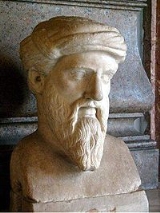
Pythagoras


Pythagoras


"Pythagoras of Samos" redirects here. For the Samian statuary of the same name, see Pythagoras (sculptor)Pythagoras (sculptor)

Pythagoras of Samos was a statuary from Samos whom Pliny the Elder expressly distinguishes from the more renowned Pythagoras...
.


Pythagoras of Samos was an IonianIonians

The Ionians were one of the four main ancient Greek ethno-linguistic groups, linked by their use of the Ionic dialect of the...
 Greek mathematicianMathematician

A mathematician is a person whose primary area of study and research is the field of mathematics....
 and founder of the religious movement called PythagoreanismPythagoreanism

Pythagoreanism is a term used for the esoteric and metaphysical beliefs held by Pythagoras and his followers, the Pythagorea...
. He is often revered as a great mathematician, mystic and scientist; however some have questioned the scope of his contributions to mathematics and natural philosophy. HerodotusHerodotus

Herodotus of Halicarnassus was a Dorian Greek historian who lived in the 5th century BC and is regarded as the "father o...
 referred to him as "the most able philosopher among the Greeks". His name led him to be associated with PythiaPythia

The Pythia was the priestess presiding over the Oracle of Apollo at Delphi, located on the slopes of Mount Parnassus....
n ApolloApollo Overview

In Greek and Roman mythology, Apollo , the ideal of the kouros, was the archer-god of medicine and healing and also a b...
; AristippusAristippus Overview

Aristippus was a Greek philosopher born in Cyrene in Africa....
 explained his name by saying, "He spoke (agor-) the truth no less than did the Pythian (Pyth-)," and Iamblichus tells the story that the Pythia prophesied that his pregnant mother would give birth to a man supremely beautiful, wise, and of benefit to humankind.

He is best known for the Pythagorean theoremPythagorean theorem Summary

In mathematics, the Pythagorean theorem or Pythagoras' theorem is a relation in Euclidean geometry among the three sid...
, which bears his name.


Discussion
Ask a question about 'Pythagoras'
Start a new discussion about 'Pythagoras'
Answer questions from other users
Full Discussion Forum


Timeline

582 BC   Born


Quotations


Number rules the universe.

As quoted in Comic Sections (1993) by Desmond MacHale

Number is the ruler of forms and ideas, and the cause of gods and demons.

As quoted in Collection of Pythagorean Doctrines by Iamblichus of Chalcis

Time is the soul of this world.

As quoted in Wisdom (2002) by Desmond MacHale :Quotes cited as from the "Golden Verses", but drawn from various translations.

Work at these things, practice them, these are the things you ought to desire; they are what will put you on the path of divine virtue — yes, by the one who entrusted our soul with the tetraktys, source of ever-flowing nature. Pray to the gods for success and get to work.

Practice justice in word and deed, and do not get in the habit of acting thoughtlessly about anything.

As quoted in Divine Harmony : The Life and Teachings of Pythagoras by John Strohmeier and Peter Westbrook. (1999)

There is geometry in the humming of the strings. There is music in the spacings of the spheres.

As quoted in the preface of the book entitled Music of the Spheres by Guy Murchie (1961)


Encyclopedia


"Pythagoras of Samos" redirects here. For the Samian statuary of the same name, see Pythagoras (sculptor)Pythagoras (sculptor)

Pythagoras of Samos was a statuary from Samos whom Pliny the Elder expressly distinguishes from the more renowned Pythagoras...
.


Pythagoras of Samos was an IonianIonians

The Ionians were one of the four main ancient Greek ethno-linguistic groups, linked by their use of the Ionic dialect of the...
 Greek mathematicianMathematician

A mathematician is a person whose primary area of study and research is the field of mathematics....
 and founder of the religious movement called PythagoreanismPythagoreanism

Pythagoreanism is a term used for the esoteric and metaphysical beliefs held by Pythagoras and his followers, the Pythagorea...
. He is often revered as a great mathematician, mystic and scientist; however some have questioned the scope of his contributions to mathematics and natural philosophy. HerodotusHerodotus

Herodotus of Halicarnassus was a Dorian Greek historian who lived in the 5th century BC and is regarded as the "father o...
 referred to him as "the most able philosopher among the Greeks". His name led him to be associated with PythiaPythia

The Pythia was the priestess presiding over the Oracle of Apollo at Delphi, located on the slopes of Mount Parnassus....
n ApolloApollo Overview

In Greek and Roman mythology, Apollo , the ideal of the kouros, was the archer-god of medicine and healing and also a b...
; AristippusAristippus Overview

Aristippus was a Greek philosopher born in Cyrene in Africa....
 explained his name by saying, "He spoke (agor-) the truth no less than did the Pythian (Pyth-)," and Iamblichus tells the story that the Pythia prophesied that his pregnant mother would give birth to a man supremely beautiful, wise, and of benefit to humankind.

He is best known for the Pythagorean theoremPythagorean theorem Summary

In mathematics, the Pythagorean theorem or Pythagoras' theorem is a relation in Euclidean geometry among the three sid...
, which bears his name. Known as "the father of numbers", Pythagoras made influential contributions to philosophyPhilosophy

Philosophy is a field of study that includes diverse subfields such as aesthetics, epistemology, ethics, logic, and metaphys...
 and religious teaching in the late 6th century BC. Because legend and obfuscation cloud his work even more than with the other pre-Socratics, one can say little with confidence about his life and teachings. We do know that Pythagoras and his students believed that everything was related to mathematicsMathematics

Mathematics is the discipline that deals with concepts such as quantity, structure, space and change....
 and that numbers were the ultimate reality and, through mathematics, everything could be predicted and measured in rhythmic patterns or cycles. According to IamblichusIamblichus of Chalcis

Iamblichus, also known as Iamblichus Chalcidensis, was a neoplatonist philosopher who determined the direction taken b...
, Pythagoras once said that "number is the ruler of forms and ideas and the cause of gods and demons."

He was the first man to call himself a philosopher, or lover of wisdom, and Pythagorean ideas exercised a marked influence on PlatoPlato

Plato , whose real name is believed to have been Aristocles, was an immensely influential ancient Greek philosopher, ...
. Unfortunately, very little is known about Pythagoras because none of his writings have survived. Many of the accomplishments credited to Pythagoras may actually have been accomplishments of his colleagues and successors.

Life

Pythagoras was born on SamosSamos Island Overview

Samos Island is a Greek island in the Eastern Aegean sea, localizated between the island of Chios to the North and the archi...
, a Greek island in the eastern Aegean, off the coast of Asia Minor. He was born to Pythais (his mother, a native of Samos) and Mnesarchus (his father, a PhoeniciaPhoenicia

Phoenicia was an ancient civilization centred in the north of ancient Canaan, with its heartland along the coastal plains of...
n merchant from Tyre). As a young man, he left his native city for CrotonCrotone

Crotone is a city in Calabria, southern Italy, on the Gulf of Taranto....
, CalabriaCalabria

Calabria , is a region in southern Italy which occupies the "toe" of the Italian peninsula south of Naples....
, in Southern ItalyItaly

Italy, officially the Italian Republic , is a Southern European country....
, to escape the tyrannical government of PolycratesPolycrates

Polycrates, son of Aeaces, was the tyrant of Samos from 535 BC to 515 BC....
. According to Iamblichus, ThalesThales

Thales of Miletus , also known as Thales the Milesian, was a pre-Socratic Greek philosopher and one of the Seven Sages...
, impressed with his abilities, advised Pythagoras to head to MemphisMemphis, Egypt

Memphis, coordinates , was the ancient capital of the first nome of Lower Egypt, and of the Old Kingdom of Egypt from its fo...
 in Egypt and study with the priests there who were renowned for their wisdom. He was also discipled in the temples of Tyre and Byblos in Phoenicia. It may have been in Egypt where he learned some geometric principles which eventually inspired his formulation of the theoremTheorem

A theorem is a proposition that has been or is to be proved on the basis of explicit assumptions....
 that is now called by his name. This possible inspiration is presented as an extraordinaire problem in the Berlin PapyrusBerlin papyrus

The Berlin papyrus is an ancient Egyptian papyrus document from the 19th dynasty circa 1300 - 1200 BCE....
. Upon his migration from Samos to CrotonCrotone

Crotone is a city in Calabria, southern Italy, on the Gulf of Taranto....
, CalabriaCalabria

Calabria , is a region in southern Italy which occupies the "toe" of the Italian peninsula south of Naples....
, ItalyItaly

Italy, officially the Italian Republic , is a Southern European country....
, Pythagoras established a secret religious society very similar to (and possibly influenced by) the earlier Orphic cultOrphism (religion)

Orphism or Orphicism seems to have been a mystery religion in the ancient Greek world....
.


Pythagoras undertook a reform of the cultural life of Croton, urging the citizens to follow virtue and form an elite circle of followers around himself called Pythagoreans. Very strict rules of conduct governed this cultural center. He opened his school to both male and female students uniformly. Those who joined the inner circle of Pythagoras's society called themselves the Mathematikoi. They lived at the school, owned no personal possessions and were required to assume a mainly vegetarianVegetarianism

Vegetarianism is the practice of not consuming meat, with or without the use of other animal derivatives, such as dairy prod...
 diet (meat that could be sacrificed was allowed to be eaten). Other students who lived in neighboring areas were also permitted to attend Pythagoras's school. Known as Akousmatikoi, these students were permitted to eat meat and own personal belongings. Richard Blackmore, in his book The Lay Monastery (1714), saw in the religious observances of the Pythagoreans, "the first instance recorded in history of a monastic life."

According to Iamblichus, the Pythagoreans followed a structured life of religious teaching, common meals, exercise, reading and philosophical study. Music featured as an essential organizing factor of this life: the disciples would sing hymns to ApolloApollo

In Greek and Roman mythology, Apollo , the ideal of the kouros, was the archer-god of medicine and healing and also a b...
 together regularly; they used the lyreLyre

The lyre is a stringed musical instrument well known for its use in Classical Antiquity....
 to cure illness of the soul or body; poetry recitations occurred before and after sleep to aid the memory.

Flavius Josephus, in his polemical Against ApionAgainst Apion

Against Apion was a work written by Flavius Josephus as a defense of Judaism as a classical religion and philosophy, str...
, in defence of JudaismFacts About Judaism

Judaism is the religion of the Jewish people....
 against Greek philosophyGreek philosophy

Classical Greek philosophy focused on the role of reason and inquiry....
, mentions that according to Hermippus of SmyrnaHermippus of Smyrna

Hermippus of Smyrna, a Peripatetic philosopher, surnamed by the ancient writers the Callimachian , from which it may be ...
, Pythagoras was familiar with Jewish beliefs, incorporating some of them in his own philosophy.

Towards the end of his life he fled to MetapontumMetapontum

Metapontum or Metapontium, was an important city of Magna Graecia, situated on the gulf of Tarentum, between the river...
 because of a plot against him and his followers by a noble of Croton named Cylon. He died in Metapontum around 90 years old from unknown causes.

Pythagoreans


The organization was in some ways a school, in some ways a brotherhood, and in some ways a monastery. It was based upon the religious teachings of Pythagoras and was very secretive. At first, the school was highly concerned with the morality of society. Members were required to live ethically, love one another, share political beliefs, practice pacifism, and devote themselves to the mathematics of nature.

Pythagoras's followers were commonly called "Pythagoreans". They are generally accepted as philosophical mathematicians who had an influence on the beginning of axiomatic geometry, which after two hundred years of development was written down by EuclidEuclid

Euclid , a Greek mathematician, who lived in Alexandria, Hellenistic Egypt, almost certainly during the reign of Ptolemy I...
 in The ElementsEuclid's Elements Summary

Euclid's Elements is a mathematical and geometric treatise, consisting of 13 books, written by the Hellenistic mathemat...
.

The Pythagoreans observed a rule of silence called echemythia, the breaking of which was punishable by death. This was because the Pythagoreans believed that a man's words were usually careless and misrepresented him and that when someone was "in doubt as to what he should say, he should always remain silent". Another rule that they had was to help a man "in raising a burden, but do not assist him in laying it down, for it is a great sin to encourage indolence", and they said "departing from your house, turn not back, for the furies will be your attendants"; this axiom reminded them that it was better to learn none of the truth about mathematics, God, and the universe at all than to learn a little without learning all. (The Secret Teachings of All Ages by Manly P. Hall).

In his biography of Pythagoras (written seven centuries after Pythagoras's time), PorphyryPorphyry (philosopher)

Porphyry was a Neoplatonist philosopher....
 stated that this silence was "of no ordinary kind." The Pythagoreans were divided into an inner circle called the mathematikoi ("mathematicians") and an outer circle called the akousmatikoi ("listeners"). Porphyry wrote "the mathematikoi learned the more detailed and exactly elaborated version of this knowledge, the akousmatikoi (were) those who had heard only the summary headings of his (Pythagoras's) writings, without the more exact exposition." According to Iamblichus, the akousmatikoi were the exotericExoteric

Exoteric knowledge is knowledge that is publicly available, in contrast with esoteric knowledge, which is kept from everyone...
 disciples who listened to lectures that Pythagoras gave out loud from behind a veil.

The akousmatikoi were not allowed to see Pythagoras and they were not taught the inner secrets of the cult. Instead they were taught laws of behavior and morality in the form of cryptic, brief sayings that had hidden meanings. The akousmatikoi recognized the mathematikoi as real Pythagoreans, but not vice versa. After the murder of a number of the mathematikoi by the cohorts of Cylon, a resentful disciple, the two groups split from each other entirely, with Pythagoras's wife TheanoTheano (mathematician)

Theano was one of the few women in ancient mathematics, she is also thought to have been a physician....
 and their two daughters leading the mathematikoi.

Theano, daughter of the Orphic initiate Brontinus, was a mathematician in her own right. She is credited with having written treatises on mathematics, physics, medicine, and child psychology, although nothing of her writing survives. Her most important work is said to have been a treatise on the principle of the golden meanGolden mean

Golden mean may mean:*Doctrine of the Golden Mean, a chapter in Li Ji, one of the "four books" of classical Confuci...
. In a time when women were usually considered property and relegated to the role of housekeeper or spouse, Pythagoras allowed women to function on equal terms in his society.

The Pythagorean society is associated with prohibitions such as not to step over a crossbar, and not to eat beans. These rules seem like primitive superstitionSuperstition

A Superstition is the irrational belief that future events are influenced by specific behaviors, without having a causal rel...
, similar to "walking under a ladder brings bad luck". The abusive epithet mystikos logos ("mystical speech") was hurled at Pythagoras even in ancient times to discredit him. The prohibition on beans could be linked to favism, which is relatively widespread around the Mediterranean.

The key here is that akousmata means "rules", so that the superstitious taboos primarily applied to the akousmatikoi, and many of the rules were probably invented after Pythagoras's death and independent from the mathematikoi (arguably the real preservers of the Pythagorean tradition). The mathematikoi placed greater emphasis on inner understanding than did the akousmatikoi, even to the extent of dispensing with certain rules and ritual practices. For the mathematikoi, being a Pythagorean was a question of innate quality and inner understanding.

There was also another way of dealing with the akousmata — by allegorizing them. We have a few examples of this, one being AristotleAristotle Overview

Aristotle was an ancient Greek philosopher, a student of Plato and teacher of Alexander the Great....
's explanations of them: "'step not over a balance', i.e. be not covetous; 'poke not the fire with a sword', i.e. do not vex with sharp words a man swollen with anger, 'eat not heart', i.e. do not vex yourself with grief," etc. We have evidence for Pythagoreans allegorizing in this way at least as far back as the early fifth century BC. This suggests that the strange sayings were riddles for the initiated.

The Pythagoreans are known for their theory of the transmigration of souls, and also for their theory that numbers constitute the true nature of things. They performed purification rites and followed and developed various rules of living which they believed would enable their soul to achieve a higher rank among the gods.

Much of their mysticism concerning the soul seem inseparable from the Orphic tradition. The Orphics advocated various purificatory rites and practices as well as incubatory rites of descent into the underworld. Pythagoras is also closely linked with Pherecydes of SyrosPherecydes of Syros

Pherecydes of Syros was a Greek thinker from the island of Syros, of the 6th century BC....
, the man ancient commentators tend to credit as the first Greek to teach a transmigration of souls. Ancient commentators agree that Pherekydes was Pythagoras's most intimate teacher. Pherekydes expounded his teaching on the soul in terms of a pentemychos ("five-nooks", or "five hidden cavities") — the most likely origin of the Pythagorean use of the pentagram, used by them as a symbol of recognition among members and as a symbol of inner health (ugieia).

Influence


Pythagoras is commonly given credit for discovering the Pythagorean theoremPythagorean theorem

In mathematics, the Pythagorean theorem or Pythagoras' theorem is a relation in Euclidean geometry among the three sid...
, a theorem in geometry that states that in a right-angled triangle the square of the hypotenuse (the side opposite the right angle), c, is equal to the sum of the squares of the other two sides, b and a—that is, a˛ + b˛ = c˛.

While the theorem that now bears his name was known and previously utilized by the BabyloniansBabylonian mathematics

Babylonian mathematics refers to any mathematics of the peoples of Mesopotamia, from the days of the early Sumerians to the ...
 and IndiansIndian mathematics

The chronology of Indian mathematics spans from the Indus Valley civilization and Vedic civilization to modern India....
, he, or his students, are thought to have constructed the first proof. Because of the secretive nature of his school and the custom of its students to attribute everything to their teacher, there is no evidence that Pythagoras himself worked on or proved this theorem. For that matter, there is no evidence that he worked on any mathematical or meta-mathematical problems. Some attribute it as a carefully constructed myth by followers of PlatoPlato

Plato , whose real name is believed to have been Aristocles, was an immensely influential ancient Greek philosopher, ...
 over two centuries after the death of Pythagoras, mainly to bolster the case for Platonic meta-physics, which resonate well with the ideas they attributed to Pythagoras. This attribution has stuck, down the centuries up to modern times. The earliest known mention of Pythagoras's name in connection with the theorem occurred five centuries after his death, in the writings of CiceroCicero

Marcus Tullius Cicero January 3, 106 BC – December 7, 43 BC) was an orator, statesman, political theorist, and philos...
 and PlutarchPlutarch Overview

Mestrius Plutarchus , known in English as Plutarch, was a Greek historian, biographer, and essayist....
.

Today, Pythagoras is revered as a prophet by the Ahl al-Tawhid or DruzeDruze

The Druze are a distinct religious community based mostly in the Middle East who are an offshoot of Islam and influenced by...
 faith along with his fellow Greek, Plato. But Pythagoras also had his critics, such as HeraclitusHeraclitus

Heraclitus of Ephesus , known as "The Obscure" , was a pre-Socratic Greek philosopher from Ephesus in Asia Minor....
 who said that "much learning does not teach wisdom; otherwise it would have taught HesiodHesiod

Hesiod , the early Greek poet and rhapsode, presumably lived around 700 BCE....
 and Pythagoras, and again XenophanesXenophanes

Xenophanes of Colophon was a Greek philosopher, poet, and social and religious critic....
 and HecataeusHecataeus

Hecataeus, named after goddess Hecate, was a Greek historian, a native of Miletus of a wealthy family....
".

Religion and science

Pythagoras’ religious and scientific views were, in his opinion, inseparably interconnected. However, they are looked at separately in the 21st century. Religiously, Pythagoras was a believer of metempsychosisMetempsychosis

Metempsychosis is a philosophical term in the Greek language referring to the belief of transmigration of the soul, especial...
. He believed in transmigration, or the reincarnation of the soul again and again into the bodies of humans, animals, or vegetables until it became moral. His ideas of reincarnation were influenced by ancient Greek religion. He was one of the first to propose that the thought processes and the soul were located in the brain and not the heart. He himself claimed to have lived four lives that he could remember in detail, and heard the cry of his dead friend in the bark of a dog.

One of Pythagoras' beliefs was that the essence of being is number. Thus, being relies on stability of all things that create the universe. Things like health relied on a stable proportion of elements; too much or too little of one thing causes an imbalance that makes a being unhealthy. Pythagoras viewed thinking as the calculating with the idea numbers. When combined with the Folk theories, the philosophy evolves into a belief that Knowledge of the essence of being can be found in the form of numbers. If this is taken a step further, one can say that because mathematics is an unseen essence, the essence of being is an unseen characteristic that can be encountered by the study of mathematics.

Literary works

No texts by Pythagoras survive, although forgeries under his name — a few of which remain extant — did circulate in antiquityClassical antiquity

Classical antiquity is a broad term for a long period of cultural history centered on the Mediterranean Sea, which begin...
. Critical ancient sources like AristotleAristotle

Aristotle was an ancient Greek philosopher, a student of Plato and teacher of Alexander the Great....
 and AristoxenusAristoxenus

Aristoxenus of Tarentum was a Greek peripatetic philosopher, and writer on music and rhythm....
 cast doubt on these writings. Ancient Pythagoreans usually quoted their master's doctrines with the phrase autos ephe ("he himself said") — emphasizing the essentially oral nature of his teaching. Pythagoras appears as a character in the last book of OvidOvid

Publius Ovidius Naso , a Roman poet known to the English-speaking world as Ovid, wrote on topics of love, abandoned wo...
's MetamorphosesMetamorphoses (poem)

The Metamorphoses by the Roman poet Ovid is a poem in fifteen books that describes the creation and history of the world in ...
,
where Ovid has him expound upon his philosophical viewpoints. Pythagoras has been quoted as saying, "No man is free who cannot command himself."

Lore

There is another side to Pythagoras, as he became the subject of elaborate legends surrounding his historic persona. Aristotle described Pythagoras as wonder-worker and somewhat of a supernatural figure, attributing to him such aspects as a golden thigh, which was a sign of divinity. According to Aristotle and others' accounts, some ancients believed that he had the ability to travel through space and time, and to communicate with animals and plants. An extract from Brewer's Dictionary of Phrase and FableBrewer's Dictionary of Phrase and Fable

Brewer's Dictionary of Phrase and Fable sometimes referred to simply as Brewer's is a reference work containing defini...
's entry entitled "Golden Thigh":

Pythagoras is said to have had a golden thigh, which he showed to Abaris, the Hyperborean priest, and exhibited in the Olympic games.


Another legend, also taken from Brewer's Dictionary, describes his writing on the moon:
Pythagoras asserted he could write on the moon. His plan of operation was to write on a looking-glass in blood, and place it opposite the moon, when the inscription would appear photographed or reflected on the moon's disc.

Other accomplishments


One of Pythagoras's major accomplishments was the discovery that music was based on proportional intervals of the numbers one through four. He believed that the number system, and therefore the universe system, was based on the sum of these numbers: ten. Pythagoreans swore by the Tetrachtys of the Decad, or ten, rather than by the gods. Odd numbers were masculine and even were feminine. He discovered the theory of mathematical proportions, constructed from three to five geometrical solids. One of his order, HippasosHippasus

Hippasus of Metapontum, born circa 500 B.C....
, also discovered irrational numbers, but the idea was unthinkable to Pythagoras, and according to one version this member was executed. Pythagoras (or the Pythagoreans) also discovered square numbers. They found that if one took, for example, four small stones and arranged them into a square, each side of the square was not only equivalent to the other, but that when the two sides were multiplied together, they equaled the sum total of stones in the square arrangement, hence the name "Square Root". He was one of the first to think that the earth was round, that all planets have an axis, and that all the planets travel around one central point. He originally identified that point as Earth, but later renounced it for the idea that the planets revolve around a central “fire” that he never identified as the sun. He also believed that the moon was another planet that he called a “counter-Earth” – furthering his belief in the Limited-Unlimited.

Groups influenced by Pythagoras


Influence on Plato

Pythagoras or in a broader sense, the Pythagoreans, allegedly exercised an important influence on the work of PlatoPlato

Plato , whose real name is believed to have been Aristocles, was an immensely influential ancient Greek philosopher, ...
. According to R. M. HareR. M. Hare

Richard Mervyn Hare was an English moral philosopher, who held the post of White's Professor of Moral Philosophy at the Univ...
, his influence consists of three points: a) the platonic Republic Republic (Plato)

The Republic' is an influential work of philosophy and political theory by the Greek philosopher Plato, written in approximatel...
 might be related to the idea of "a tightly organized community of like-minded thinkers", like the one established by Pythagoras in Croton. b) there is evidence that Plato possibly took from Pythagoras the idea that mathematics and, generally speaking, abstract thinking is a secure basis for philosophical thinking as well as "for substantial theses in scienceScience

Science in the broadest sense refers to any system of knowledge attained by verifiable means....
 and morals". c) Plato and Pythagoras shared a "mystical approach to the soulSoul

The soul, according to many religious and philosophical traditions, is a self-aware ethereal substance particular to a u...
 and its place in the material worldMaterial world

Material world may refer to:* Nature,...
". It is probable that both have been influenced by Orphism.

Plato's harmonics were clearly influenced by the work of ArchytasArchytas

Archytas was an Ancient Greek philosopher, mathematician, astronomer, statesman, and strategist....
, a genuine Pythagorean of the third generation, who made important contributions to geometry, reflected in Book VIII of EuclidEuclid

Euclid , a Greek mathematician, who lived in Alexandria, Hellenistic Egypt, almost certainly during the reign of Ptolemy I...
's Elements.

Roman influence

In the legends of ancient RomeAncient Rome

Ancient Rome was a civilization that grew out of the city-state of Rome, founded in the Italian Peninsula circa the 9th cent...
, Numa PompiliusNuma Pompilius

According to legend, Numa Pompilius was the second of the Kings of Rome, succeeding Romulus....
, the second King of Rome, is said to have studied under Pythagoras. This is unlikely, since the commonly accepted dates for the two lives do not overlap.

Influence on esoteric groups

Pythagoras started a secret society called the Pythagorean brotherhood devoted to the study of mathematics. This had a great effect on future esoteric traditions, such as Rosicrucianism and Freemasonry, both of which were occult groups dedicated to the study of mathematics and both of which claimed to have evolved out of the Pythagorean brotherhood. The mystical and occult qualities of Pythagorean mathematics are discussed in a chapter of Manly P. Hall's The Secret Teachings of All Ages entitled "Pythagorean Mathematics".

Pythagorean theory was tremendously influential on later numerologyNumerology

Numerology refers to any of several systems, traditions or beliefs in a mystical or esoteric relationship between numbers an...
, which was extremely popular throughout the Middle EastMiddle East

The Middle East is a subcontinent for the historical and cultural subregion of Africa-Eurasia traditionally held to be count...
 in the ancient world. The 8th-century MuslimMuslim

A Muslim is an adherent of Islam....
 alchemistAlchemy

Alchemy refers to both an early form of the investigation of nature and an early philosophical and spiritual discipline, bot...
 Jabir ibn Hayyan grounded his work in an elaborate numerology greatly influenced by Pythagorean theory.

See also

  • HippasusHippasus

    Hippasus of Metapontum, born circa 500 B.C....
  • PythagoreanismPythagoreanism

    Pythagoreanism is a term used for the esoteric and metaphysical beliefs held by Pythagoras and his followers, the Pythagorea...
  • Pythagorean commaPythagorean comma

    In music, when ascending from an initial pitch by a cycle of justly tuned perfect fifths, leapfrogging twelve times, one eventuall...
  • Pythagorean cupPythagorean cup

    A Pythagorean cup is a form of drinking cup which forces its user to imbibe only in moderation....
  • Sacred geometrySacred geometry

    Sacred geometry can be described as a belief system attributing a religious or cultural value to many of the fundamental for...
  • Heliopolis-Pythagoras connectionHeliopolis (ancient)

    Heliopolis, coordinates , was one of the most ancient cities of Egypt, and capital of the 13th Lower Egyptian nome....
  • Lute of PythagorasLute of Pythagoras

    The lute of Pythagoras is a geometric form made of pentagons with inscribed pentagrams where the sides of the pentagrams are...
  • Pythagoras treePythagoras tree

    The Pythagoras tree is a plane fractal constructed from squares....


Primary sources

No primary sources about Pythagoras have survived. This article describes the classical interpretation of Pythagoras, which is based on a small set of texts written between 150 AD and 450 AD. As these texts were written 600 to 1000 years after Pythagoras is said to have lived, their accuracy is uncertain.

It is postulated that the classical Pythagoras did not exist prior to these biographies: many of the discoveries and life details they attributed to Pythagoras may have been those of other Pythagoreans, if not fiction. This would explain the lack of reference to a man Pythagoras until 150 AD, given that he would have been of interest to contemporary philosophers (Aristotle referred to the so-called Pythagoreans). It is suggested that the mathematical significance of the early Pythagoreans (pre 450 BC) has been exaggerated (with the exception of their theory of harmonics), and that the Pythagoreans were an Orphic-like cult with an emphasis on numerology who only later evolved into serious mathematicians as geometry became popular across Greece.