
All Topics  
Printing

 
Printing

   Email Print
   Bookmark   Link


Printing


Printing is a process for reproducing text and image, typically with ink on paper
Paper

Paper is thin material mainly used for writing upon, printing upon or packaging. It is produced by pressing together moist fibers, typically cellulose pulp derived from wood, rags or grasses, and drying them into flexible sheets....
 using a printing press. It is often carried out as a large-scale industrial process, and is an essential part of publishing and transaction printing.

Woodblock printing Woodblock printing
Woodblock printing

Woodblock printing is a technique for printing text, or patterns used widely throughout East Asia and originating in China in antiquity as a method of printing on textiles and later paper....
 is a technique for printing a text, images or patterns that was used widely throughout East Asia
East Asia

East Asia is a subregion of Asia that can be defined in either Geography or cultural terms. Geography and geopolitically, it covers about 12,000,000 km?, or about 28 percent of the Asian continent, about 15 percent bigger than the area of Europe, though some categorize Tibet, Xinjiang, and Mongolia as Central Asia....
. It originated in China
China

China is a Culture of China, an ancient civilization, and, depending on perspective, a national or multinational entity extending over a large area in East Asia....
 in antiquity as a method of printing on textile
Textile

A textile is a flexible material consisting of a network of natural or artificial fibres often referred to as thread or yarn. Yarn is produced by Spinning raw wool fibres, linen, cotton, or other material on a spinning wheel to produce long strands known as yarn....
s and later on paper
Paper

Paper is thin material mainly used for writing upon, printing upon or packaging. It is produced by pressing together moist fibers, typically cellulose pulp derived from wood, rags or grasses, and drying them into flexible sheets....
.


Discussion
Ask a question about 'Printing'
Start a new discussion about 'Printing'
Answer questions from other users
Full Discussion Forum


Encyclopedia


Printing is a process for reproducing text and image, typically with ink on paper
Paper

Paper is thin material mainly used for writing upon, printing upon or packaging. It is produced by pressing together moist fibers, typically cellulose pulp derived from wood, rags or grasses, and drying them into flexible sheets....
 using a printing press. It is often carried out as a large-scale industrial process, and is an essential part of publishing and transaction printing.

History


Woodblock printing
Woodblock printing
Woodblock printing

Woodblock printing is a technique for printing text, or patterns used widely throughout East Asia and originating in China in antiquity as a method of printing on textiles and later paper....
 is a technique for printing a text, images or patterns that was used widely throughout East Asia
East Asia

East Asia is a subregion of Asia that can be defined in either Geography or cultural terms. Geography and geopolitically, it covers about 12,000,000 km?, or about 28 percent of the Asian continent, about 15 percent bigger than the area of Europe, though some categorize Tibet, Xinjiang, and Mongolia as Central Asia....
. It originated in China
China

China is a Culture of China, an ancient civilization, and, depending on perspective, a national or multinational entity extending over a large area in East Asia....
 in antiquity as a method of printing on textile
Textile

A textile is a flexible material consisting of a network of natural or artificial fibres often referred to as thread or yarn. Yarn is produced by Spinning raw wool fibres, linen, cotton, or other material on a spinning wheel to produce long strands known as yarn....
s and later on paper
Paper

Paper is thin material mainly used for writing upon, printing upon or packaging. It is produced by pressing together moist fibers, typically cellulose pulp derived from wood, rags or grasses, and drying them into flexible sheets....
. As a method of printing on cloth, the earliest surviving examples from China
China

China is a Culture of China, an ancient civilization, and, depending on perspective, a national or multinational entity extending over a large area in East Asia....
 date to before 220, and from Egypt
Egypt

Egypt is a country mainly in North Africa, with the Sinai Peninsula forming a land bridge in Western Asia. Covering an area of about , Egypt borders the Mediterranean Sea to the north, the Gaza Strip and Israel to the northeast, the Red Sea to the east, Sudan to the south and Libya to the west....
 to the 4th century.

In East Asia
By 593 A.D., the first printing press was invented in China, and the first printed newspaper was available in Beijing in 700 A.D. It was a woodblock printing. And the Tianemmen scrolls, the earliest known complete woodblock printed book with illustrations was printed in China in 868 A.D., it did not supersede the use of block printing.

In Middle East
Woodblock printing on cloth appeared in Egypt
Egypt

Egypt is a country mainly in North Africa, with the Sinai Peninsula forming a land bridge in Western Asia. Covering an area of about , Egypt borders the Mediterranean Sea to the north, the Gaza Strip and Israel to the northeast, the Red Sea to the east, Sudan to the south and Libya to the west....
 by the 4th century, though it is not clear if the Egyptian printing of cloth was learned from China or developed separately. Block printing of text, called tarsh in Arabic
Arabic language

Arabic is a Central Semitic language, thus related to and classified alongside other Semitic languages languages such as Hebrew language and Aramaic language....
 was developed in Arabic Egypt during the 9th-10th centuries, mostly for prayers and amulet
Amulet

An amulet , a close cousin of the talisman consists of any object intended to bring good luck and/or protection to its owner.Potential amulets include: Gemstone or simple Gemstone, statues, coins, drawings, pendants, jewelry ring, plants, animals, etc.; even words said in certain occasions?for example: vade retro satana?, to repe...
s. It is unclear whether the print blocks were made from metal
Metal

In chemistry, a metal is a chemical element whose atoms readily lose electrons to form positive ions , and form metallic bonds between other metal atoms and ionic bonds between nonmetal atoms....
 or wood or other materials. This technique, however, appears to have had very little influence outside of the Muslim world
Muslim world

.The term Muslim world has several meanings. In a Culture sense it refers to the worldwide community of Muslims, adherents of Islam. This community Islam by country, roughly one-fifth of the world population....
. Though Europe adopted woodblock printing from the Muslim world, initially for fabric, the technique of metal block printing was also unknown in Europe. Block printing later went out of use in Islamic Central Asia
Central Asia

Central Asia is a region of Asia from the Caspian Sea in the west to central China in the east, and from southern Russia in the north to northern India in the south....
 after movable type printing was introduced from China.

In Europe
Block printing first came to Christian Europe as a method for printing on cloth, where it was common by 1300. Images printed on cloth for religious purposes could be quite large and elaborate, and when paper
Paper

Paper is thin material mainly used for writing upon, printing upon or packaging. It is produced by pressing together moist fibers, typically cellulose pulp derived from wood, rags or grasses, and drying them into flexible sheets....
 became relatively easily available, around 1400, the medium transferred very quickly to small woodcut
Woodcut

Woodcut - formally known as Xylography - is a relief printing artistic technique in printmaking in which an image is carved into the surface of a block of wood, with the printing parts remaining level with the surface while the non-printing parts are removed, typically with gouges....
 religious images and playing card
Playing card

A playing card is a piece of specially prepared heavy paper, thin card, or thin plastic, figured with distinguishing motifs and used as one of a set for playing card games....
s printed on paper. These prints
Old master print

An old master print is a work of art produced by a printing process within the Western tradition . A date of about 1830 is usually taken as marking the end of the period whose prints are covered by this term....
 were produced in very large numbers from about 1425 onwards.

Around the mid-century, block-books, woodcut books with both text and images, usually carved in the same block, emerged as a cheaper alternative to manuscripts and books printed with movable type
Movable Type

Movable Type is a blog software developed by the company Six Apart. It was publicly announced on 3 September 2001, and version 1.0 was publicly released on 8 October 2001....
. These were all short heavily illustrated works, the bestsellers of the day, repeated in many different block-book versions: the Ars moriendi
Ars moriendi

Ars moriendi is the name of two related Latin texts dating from about 1415 and 1450 which offer advice on the protocols and procedures of a good death and on how to "die well", according to Christianity precepts of the late Middle Ages....
 and the Biblia pauperum
Biblia pauperum

The Biblia pauperum was a tradition of picture Bibles beginning in the later Middle Ages. They sought to portray the historical books of the Bible visually....
 were the most common. There is still some controversy among scholars as to whether their introduction preceded or, the majority view, followed the introduction of movable type
Movable Type

Movable Type is a blog software developed by the company Six Apart. It was publicly announced on 3 September 2001, and version 1.0 was publicly released on 8 October 2001....
, with the range of estimated dates being between about 1440–1460.

Movable type printing

Metal Movable Type
Movable type is the system of printing
Printing

Printing is a process for reproducing text and image, typically with ink on paper using a printing press. It is often carried out as a large-scale industrial process, and is an essential part of publishing and transaction printing....
 and typography
Typography

Typography is the art and techniques of typesetting, type design, and modifying type glyphs. Type glyphs are created and modified using a variety of illustration techniques....
 using movable pieces of metal type, made by casting from matrices
Matrix (printing)

In hot metal typesetting, a matrix is a mould for casting the letters known as sort used in letterpress printing.In letterpress typography the matrix of one letter is inserted into the bottom of a hand mould, the mould is locked and molten type metal is poured into a straight-sided vertical cavity above the matrix....
 struck by letterpunches
Punchcutting

In traditional typography, punchcutting is the craft of cutting letter punches in steel from which matrix were made in copper for Type foundry in the letterpress era....
. Movable type
Movable Type

Movable Type is a blog software developed by the company Six Apart. It was publicly announced on 3 September 2001, and version 1.0 was publicly released on 8 October 2001....
 allowed for much more flexible processes than hand copying or block printing.

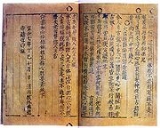
Around 1040, the first known movable type system was created in China by Bi Sheng
Bi Sheng

B? Sheng was the inventor of the first known movable type printing printing press. Bi Sheng's press was made of China porcelain and was invented between 1041 and 1048 in China....
 out of porcelain
Porcelain

Porcelain is a ceramic material made by heating raw materials, generally including clay in the form of kaolin, in a kiln to temperatures between and ....
. Sheng used clay type, which broke easily, but Wang Zhen
Wang Zhen (official)

Wang Zhen was an official of the Yuan Dynasty of China. He is credited with the invention of the first wooden movable type printing in the world, while his predecessor of the Song Dynasty , Bi Sheng , invented the world's first earthenware movable type printing....
 later carved a more durable type from wood by 1298 AD, and developed a complex system of revolving tables and number-association with written Chinese characters that made typesetting and printing more efficient. However, the main method in use there remained woodblock printing.

Around 1450, Johannes Gutenberg
Johannes Gutenberg

Johannes Gensfleisch zur Laden zum Gutenberg was a Germany goldsmith and printer who is credited with being the first European to use movable type printing, in around 1439, and the global inventor of the mechanical printing press....
 introduced what is regarded as an independent invention of movable type in Europe (see printing press
Printing press

A printing press is a mechanical device for applying pressure to an inked surface resting upon a medium , thereby transferring an image. The mechanical systems involved were first assembled in Germany by the goldsmith Johannes Gutenberg around 1439, based on existing screw-presses used to press cloth, grapes etc., and possibly to print wood...
), along with innovations in casting the type based on a matrix and hand mould
Hand mould

A Hand mould is a two-part mould used for casting small metal objects that could be operated by hand. In particular, it refers to a system for casting movable type, pioneered by Johannes Gutenberg, which was widely used in the early era of printing in Europe ....
. Gutenberg was the first to create his type pieces from an alloy of lead
Lead

Lead is a main-group Chemical element with symbol Pb and atomic number 82. Lead is a soft, malleable poor metal, also considered to be one of the heavy metal ....
, tin
Tin

Tin is a chemical element with the symbol Sn and atomic number 50. Tin is obtained chiefly from the mineral cassiterite, where it occurs as an oxide, SnO2....
 and antimony
Antimony

Antimony is a chemical element with the symbol Sb and atomic number 51. A metalloid, antimony has four allotropy forms. The stable form of antimony is a blue-white metalloid....
 – the same components still used today.

Johannes Gutenberg's work on the printing press
Printing press

A printing press is a mechanical device for applying pressure to an inked surface resting upon a medium , thereby transferring an image. The mechanical systems involved were first assembled in Germany by the goldsmith Johannes Gutenberg around 1439, based on existing screw-presses used to press cloth, grapes etc., and possibly to print wood...
 began in approximately 1436 when he partnered with Andreas Dritzehen — a man he had previously instructed in gem-cutting—and Andreas Heilmann, owner of a paper mill. It was not until a 1439 lawsuit
Lawsuit

In law, a lawsuit is a civil action brought before a court in which the party commencing the action, called the plaintiff, seeks a legal remedy or equitable remedy....
 against Gutenberg that official record exists; witnesses testimony discussed type, an inventory of metals (including lead) and his type mold.

Compared to woodblock printing
Woodblock printing

Woodblock printing is a technique for printing text, or patterns used widely throughout East Asia and originating in China in antiquity as a method of printing on textiles and later paper....
, movable type page setting was quicker and more durable. The metal type pieces were more durable and the lettering was more uniform, leading to typography and font
Font

In typography, a font is traditionally defined as a complete character set of a single size and style of a particular typeface. For example, the set of all characters for 9-point Bulmer italic type is a font, and the 10-point size would be a separate font, as would the 9 point upright....
s. The high quality and relatively low price of the Gutenberg Bible
Gutenberg Bible

The Gutenberg Bible is a printed version of the Latin Vulgate translation of the Bible that was printed by Johannes Gutenberg, in Mainz, Germany in the fifteenth century....
 (1455) established the superiority of movable type, and printing press
Printing press

A printing press is a mechanical device for applying pressure to an inked surface resting upon a medium , thereby transferring an image. The mechanical systems involved were first assembled in Germany by the goldsmith Johannes Gutenberg around 1439, based on existing screw-presses used to press cloth, grapes etc., and possibly to print wood...
es rapidly spread across Europe, leading up to the Renaissance
Renaissance

The Renaissance was a cultural movement that spanned roughly the 14th to the 17th century, beginning in Italy in the late Middle Ages and later spreading to the rest of Europe....
, and later all around the world. Today, practically all movable type printing ultimately derives from Gutenberg's movable type printing, which is often regarded as the most important invention of the second millennium.

Rotary printing press

The rotary printing press was invented by Richard March Hoe in 1847. It uses impressions curved around a cylinder to print on long continuous rolls of paper
Paper

Paper is thin material mainly used for writing upon, printing upon or packaging. It is produced by pressing together moist fibers, typically cellulose pulp derived from wood, rags or grasses, and drying them into flexible sheets....
 or other substrates. Rotary drum printing was later significantly improved by William Bullock
William Bullock (inventor)

William Bullock was an United States inventor whose 1863 invention of the web rotary printing press helped revolutionize the printing industry due to its great speed and efficiency....
.

Modern printing technology

Drukarnia Zlamywak
Across the world, over 45 trillion pages (2005 figure) are printed annually. In 2006 there were approximately 30,700 printing companies in the United States, accounting for $112 billion, according to the 2006 U.S. Industry & Market Outlook by . Print jobs that move through the Internet made up 12.5% of the total U.S. printing market last year, according to research firm InfoTrend/CAP Ventures.

Offset press

Offset printing is a widely used printing
Printing

Printing is a process for reproducing text and image, typically with ink on paper using a printing press. It is often carried out as a large-scale industrial process, and is an essential part of publishing and transaction printing....
 technique where the inked image is transferred (or "offset") from a plate to a rubber blanket, then to the printing surface. When used in combination with the lithographic
Lithography

Lithography is a method for printing using a stone or a metal plate with a completely smooth surface. By contrast, in intaglio a plate is engraving, etching or mezzotint to make cavities to contain the printing ink, and in woodblock printing and letterpress ink is applied to the raised surfaces of letters or images....
 process, which is based on the repulsion of oil and water, the offset technique employs a flat (planographic) image carrier on which the image to be printed obtains ink
Ink

An ink is a liquid containing various pigments and/or dyes used for coloring a surface to produce an , writing, or design. Ink is used for drawing and/or writing with a pen, brush or quill....
 from ink rollers, while the non-printing area attracts a film of water, keeping the non-printing areas ink-free.

Currently, most book
Book

A book is a set or collection of written, printed, illustrated, or blank sheets, made of paper, parchment, or other material, usually fastened together to hinge at one side....
s and newspaper
Newspaper

A newspaper is a publication containing news, information and advertising, usually printed on low-cost paper called newsprint. General-interest newspapers often feature articles on Politics, crime, business, art/entertainment, society and sports....
s are printed using the technique of offset lithography. Other common techniques include:
  • flexography
    Flexography

    Flexography is a form of printing process which utilizes a flexible relief plate. It is basically an updated version of letterpress that can be used for printing on almost any type of substrate including plastic, metallic films, cellophane, and paper....
     used for packaging, labels, newspapers.
  • hot wax dye transfer
  • inkjet used typically to print a small number of books or packaging, and also to print a variety of materials from high quality papers simulate offset printing, to floor tiles; Inkjet is also used to apply mailing addresses to direct mail pieces.
  • laser printing mainly used in offices and for transactional printing (bills, bank documents). Laser printing is commonly used by direct mail companies to create variable data letters or coupons, for example.
  • pad printing
    Pad printing

    Pad printing is a printing process that can transfer a 2-D image onto a 3-D object. This is accomplished using an indirect offset printing process that involves an image being transferred from the printing plate via a silicone pad onto a substrate ....
     popular for its unique ability to print on complex 3-dimensional surfaces.
  • relief print
    Relief print

    A relief print is an image created by a printmaking process, such as woodcut, where the areas of the matrix that are to show printed black are on the original surface; the parts of the matrix that are to be blank having been cut away, or otherwise removed....
    , (mainly used for catalogues).
  • rotogravure
    Rotogravure

    Rotogravure is a type of intaglio printing process, in that it involves engraving the image onto an . In gravure printing, the image is engraved onto a copper cylinder because, like offset printing and flexography, it uses a rotary printing press....
     mainly used for magazines and packaging.
  • screen-printing
    Screen-printing

    Screen printing 1. A printing technique that uses a woven mesh to support an ink blocking stencil. The attached stencil forms open areas of mesh that transfer ink as a sharp-edged image onto a Substrate ....
     from T-shirts to floor tiles.


Gravure

Gravure printing
Rotogravure

Rotogravure is a type of intaglio printing process, in that it involves engraving the image onto an . In gravure printing, the image is engraved onto a copper cylinder because, like offset printing and flexography, it uses a rotary printing press....
 is an intaglio printing technique, where the image to be printed is made up of small depressions in the surface of the printing plate. The cells are filled with ink and the excess is scraped off the surface with a doctor blade, then a rubber-covered roller presses paper onto the surface of the plate and into contact with the ink in the cells. The printing plates are usually made from copper and may be produced by digital engraving or laser
Laser

A laser is a device that emits light through a process called stimulated emission. The term laser is an acronym for light amplification by stimulated emission of radiation....
 etching.

Gravure printing is used for long, high-quality print runs such as magazines, mail-order catalogues, packaging, and printing onto fabric and wallpaper. It is also used for printing postage stamps and decorative plastic laminates, such as kitchen worktops.

Impact of the invention of printing


Religious impact

Samuel Hartlib
Samuel Hartlib

Samuel Hartlib was a German-British polymath. An active promoter and expert writer in many fields, he was interested in science, medicine, agriculture, politics, and education....
, who was exiled in Britain
Great Britain

Great Britain is an island lying to the northwest of Continental Europe. It is the List of islands by area, and the largest in Europe. With a population of 58.9 million people it is List of islands by population....
 and enthusiastic about social and cultural reforms, wrote in 1641 that "the art of printing will so spread knowledge that the common people, knowing their own rights and liberties, will not be governed by way of oppression". For both churchmen and governments, it was concerning that print allowed readers, eventually including those from all classes of society, to study religious texts and politically sensitive issues by themselves, instead of thinking mediated by the religious and political authorities.

It took a long long time for print to penetrate Russia
Russia

Russia , or the Russian Federation , is a list of countries spanning more than one continent country extending over much of northern Eurasia....
 and the Orthodox Christian world, a region (including modern Serbia
Serbia

Serbia , officially the Republic of Serbia , is a country in Central Europe and Balkans Europe, covering the southern part of the Pannonian Plain and the central part of the Balkans....
, Romania
Romania

Romania is a country located in Southeastern Europe Central Europe, North of the Balkan Peninsula, on the Lower Danube, within and outside the Carpathian Mountains, bordering on the Black Sea....
 and Bulgaria
Bulgaria

The state of Bulgaria , Scientific transliteration Balgarija, officially the Republic of Bulgaria has played a significant role in the Balkans in south-eastern Europe for over fourteen centuries....
) where reading ability was largely restricted to the clergy. In 1564, a White Russian
Russians

The Russian people are an East Slavs ethnic group, primarily living in Russia and neighboring countries.The English language term Russians is used to refer to the citizens of Russia, regardless of their ethnicity ; in Russian language, the demonym Russian is translated as Rossiyanin ....
 brought a press to Moscow
Moscow

Moscow is the capital and the largest types of inhabited localities in Russia of the Russian Federation. It is also the largest European cities and metropolitan areas, with the Moscow metropolitan area ranking among the largest urban areas in the world....
, and soon after that his workshop was destroyed by a mob.

In the Muslim
Muslim

:A Muslim , , is an adherent of the religion of Islam. The feminine form is Muslimah . Literally, the word means "one who submits "....
 world, printing, especially in Arabic or Turkish was strongly opposed throughout the early modern period (printing in Hebrew was sometimes permitted). Indeed, the Muslim
Muslim

:A Muslim , , is an adherent of the religion of Islam. The feminine form is Muslimah . Literally, the word means "one who submits "....
 countries have been regarded as a barrier to the passage of printing from China to the West. According to an imperial ambassador to Istanbul
Istanbul

Istanbul is the largest city in Turkey, List of metropolitan areas in Europe by population, and List of cities proper by population in the world with a population of 12.6 million....
 in the middle of the sixteenth century, it was a sin for the Turks
Turkish people

The Turkish people , also known as "Turks" are defined mainly as citizens of the Republic of Turkey. An early history text provided the definition of being a Turk as "any individual within the Republic of Turkey, whatever his faith who speaks Turkish, grows up with Turkish culture and adopts the Turkish ideal is a Turk." This ideal...
 to print religious books. In 1515, Sultan Selim I
Selim I

Selim I also known as "the Grim" or "the Brave", or the best translation "the Stern", Yavuz in Turkish language, the long name is Yavuz Sultan Selim; October 10 1465/1466/1470 September 22, 1520) was the Sultan of the Ottoman Empire from 1512 to 1520....
 issued a decree under which the practice of printing would be punishable by death. At the end of the century, Sultan Murad III
Murad III

Murad III was the Sultan of the Ottoman Empire from 1574 until his death.Murad III was the eldest son of sultan Selim II and Valide Sultan Nurbanu Sultan, originally named Cecilia Venier-Baffo, a Venetian Noblewoman, and succeeded his father in 1574....
 permitted the sale of non-religious printed books in Arabic characters, yet the majority were imported from Italy
Italy

Italy , officially the Italian Republic , is a country located on the Italian Peninsula in Southern Europe and on the two largest islands in the Mediterranean Sea, Sicily and Sardinia....
.

Jew
Jew

A Jew is a member of the Jewish people, an ethnoreligious group that traces its ancestry to the Israelites or Hebrews of the Ancient Near East....
s were banned from German printing guild
Guild

File:Windsorguildhall.jpgA guild is an association of artisan in a particular trade. The earliest guilds were formed as confraternities of workers....
s; as a result Hebrew printing sprang up in Italy
Italy

Italy , officially the Italian Republic , is a country located on the Italian Peninsula in Southern Europe and on the two largest islands in the Mediterranean Sea, Sicily and Sardinia....
, beginning in 1470 in Rome
Rome

Rome is the capital city of Italy and Lazio, and is Italy's largest and most populous city, with 2,724,347 residents in an urban area of some ....
, then speading to other towns. Local rulers had the authority to grant or revoke licenses to publish Hebrew books.

It was thought that the introduction of the printing medium 'would strengthen religion and enhance the power of monarchs.' The majority of books were of religious nature with the church and crown regulating the content. The consequences of printing wrong material were extreme. Meyrowitz used the example of William Carter who, in 1584, printed a pro-Catholic pamphlet in Protestant-dominated England. The consequence of his action was hanging.

The widespread distribution of the Bible 'had a revolutionary impact, because it decreased the power of the Catholic Church as the prime possessor and interpretor of God's word.'

Social impact

Print gave a broader range of readers access to knowledge and enabled later generations to build on the intellectual achievements of earlier ones. Print, according to Acton
John Dalberg-Acton, 1st Baron Acton

John Emerich Edward Dalberg-Acton, 1st Baron Acton, Royal Victorian Order , commonly known as simply Lord Acton, was an England historian, the only son of Sir Ferdinand Dalberg-Acton, 7th Baronet and grandson of the Neapolitan admiral, Sir John Acton, 6th Baronet....
 in his lecture On the Study of History (1895), gave "assurance that the work of the Renaissance
Renaissance

The Renaissance was a cultural movement that spanned roughly the 14th to the 17th century, beginning in Italy in the late Middle Ages and later spreading to the rest of Europe....
 would last, that what was written would be accessible to all, that such an occultation of knowledge and ideas as had depressed the Middle Ages
Middle Ages

File:Karl 1 mit papst gelasius gregor1 sacramentar v karl d kahlen.jpgThe Middle Ages of European history are a period in history which lasted for roughly a millennium, commonly dated from the fall of the Roman Empire in the 5th century to the beginning of the Early Modern Period in the 16th century, marked by the division of Western Christi...
 would never recur, that not an idea would be lost".

Print was instrumental in changing the nature of reading within society.

Elizabeth Eisenstein

Elizabeth Lewisohn Eisenstein is an American historian of the French Revolution and early 19th century France. She is well-known for her work on the history of early printing, writing on the transition in media between the era of Manuscript culture and that of Print culture, as well as the role of the printing press in effecting broad cultur...
 identifies two long term effects of the invention of printing. She claims that print created a sustained and uniform reference for knowledge as well as allowing for comparison between incompatible views. (Eisenstein in Briggs and Burke, 2002: p21)

Asa Briggs and Peter Burke
Peter Burke

Peter Burke is a British historian....
 identify five kinds of reading that developed in relation to the introduction of print:
  1. Critical reading: due to the fact that texts finally became accessible to the general population, critical reading emerged because people were given the option to form their own opinions on texts.
  2. Dangerous Reading: reading was seen as a dangerous pursuit because it was considered rebellious and unsociable. This was especially in the case of women because reading could stir up dangerous emotions like love. There was also the concern that if women could read, they could read love notes.
  3. Creative reading: Printing allowed people to read texts and interpret them creatively, often in very different ways than the author intended.
  4. Extensive Reading: Print allowed for a wide range of texts to become available, thus, previous methods of intensive reading of texts from start to finish, began to change. With texts being readily available, people began reading on particular topics or chapters, allowing for much more extensive reading on a wider range of topics.
  5. Private reading: This is linked to the rise of individualism. Before print, reading was often a group event, where one person would read to a group of people. With print, literacy rose as did availability of texts, thus reading became a solitary pursuit.


"While the invention of printing has been discussed conventionally in terms of its value for spreading ideas, it’s even greater contribution is its furthering of the long-developing shift in the relationship between space and discourse".

The proliferation of media that Ong is discussing in relation to the introduction of the printing press, to the death of an oral culture and that the new this new culture had more of an emphasis on the visual rather than in an auditory medium. As such the printing press gave birth to a more accessible and widely available source of knowledge in the sense that it broke down the boundaries between the possessors of knowledge and the masses. The narrative or discourse now existed in what would become indirectly through time, the global village
Global Village (term)

Global Village is a term closely associated with Marshall McLuhan, popularized in his books The Gutenberg Galaxy: The Making of Typographic Man and Understanding Media ....
.

The invention of printing also changed the occupational structure of European cities. Printers
Printer (publisher)

A printer is a company that provides commercial printing services, often also offering typesetting and book-binding services. The term can also refer to people who operate printing presses, or who run printing companies....
 emerged as a new group of artisans for whom literacy was essential, although the much more labour-intensive occupation of the scribe
Scribe

A scribe is a person who writes books or documents by hand as a profession. The profession, previously found in all literate cultures in some form, lost most of its importance and status with the advent of printing....
 naturally declined. Proof-correcting arose as a new occupation, while a rise in the amount of booksellers
Bookselling

Bookselling is the commercial trading of books, the retail and distribution end of the publishing process. People who engage in bookselling are called booksellers or bookmen....
 and librarian
Librarian

A librarian is an information professional trained in library and information science, which is the organization and management of information services or materials for those with information needs....
s naturally followed the explosion in the numbers of books.

Digital printing

Digital printing
Digital printing

Digital printing is the reproduction of digital images on a physical surface. It is generally used for short print runs, and for the customization of print media....
 accounts for approximately 9% of the 45 trillion pages printed (2005 figure) around the world.

Printing at home or in an office
Office

An office is generally a room or other area in which people employment, but may also denote a position within an organization with specific duties attached to it ; the latter is in fact an earlier usage, office as place originally referring to the location of one's duty....
 or engineering environment is subdivided into:
  • small format (up to ledger size paper sheets), as used in business offices and libraries
  • wide format (up to 3' or 914mm wide rolls of paper), as used in drafting and design establishments.


Some of the more common printing technologies are:
  • blueprint
    Blueprint

    A blueprint is a type of paper-based reproduction usually of a technical drawing, documenting an architecture or an engineering design. More generally, the term "blueprint" has come to be used to refer to any detailed plan....
    —and related chemical technologies.
  • daisy wheel—where pre-formed characters are applied individually.
  • dot-matrix
    Dot matrix printer

    A dot matrix printer or impact matrix printer is a type of computer printer with a print head that runs back and forth, or in an up and down motion, on the page and prints by impact, striking an ink-soaked cloth ribbon against the paper, much like a typewriter....
    —which produces arbitrary patterns of dots with an array of printing studs.
  • inkjet—including bubble-jet—where ink is sprayed onto the paper to create the desired image.
  • laser—where toner consisting primarily of polymer with pigment of the desired colours is melted and applied directly to the paper to create the desired image.
  • line printing
    Line printer

    The line printer is a form of high speed impact computer printer in which one line of type is printed at a time. They are mostly associated with the early days of computing, but the technology is still in use....
    —where pre-formed characters are applied to the paper by lines.
  • solid ink
    Solid ink

    Solid ink is a technology used in computer printers and Multifunction printer devices originally created by Tektronix in 1986. After Xerox acquired the Tektronix Color Printing and Imaging Division in 2000, the solid ink technology became part of the Xerox line of office printing and imaging products....
     printer-where cubes of ink are melted onto paper.
  • heat transfer
    Thermal printer

    A thermal printer produces a printed image by selectively heating coated thermochromic paper, or thermal paper as it is commonly known, when the paper passes over the thermal Computer printer....
    —like early fax machines or modern receipt printers that apply heat to special paper, which turns black to form the printed image.


Vendors typically stress the total cost to operate the equipment, involving complex calculations that include all cost factors involved in the operation as well as the capital equipment costs, amortization, etc. For the most part, toner systems beat inkjet in the long run, whereas inkjets are less expensive in the initial purchase price.

Professional digital printing
Digital printing

Digital printing is the reproduction of digital images on a physical surface. It is generally used for short print runs, and for the customization of print media....
 (using toner
Toner

File:Toner-container-black-0a.jpgToner is a Powder used in laser printers and photocopiers to form the printed text and images on the paper....
) primarily uses an electrical charge to transfer toner or liquid ink to the substrate it is printed on. Digital print quality has steadily improved from early color and black & white copiers to sophisticated colour digital presses like the Xerox iGen3, the Kodak Nexpress, the HP Indigo Digital Press
Indigo Digital Press

Indigo is the name given to a series of Digital Offset printing Printing press made by the HP Company in Israel.The main uses for HP Indigo presses include general commercial printing, label, flexible packaging, folding carton and specialty printing....
 series and the InfoPrint 5000. The iGen3 and Nexpress use toner particles and the Indigo uses liquid ink. The InfoPrint 5000 is a full-color, continuous forms inkjet drop-on-demand printing system. All handle variable data and rival offset in quality. Digital offset presses are called direct imaging presses; although these receive computer files and automatically turn them into print-ready plates, they cannot insert variable data.

Small press and fanzines generally use digital printing
Digital printing

Digital printing is the reproduction of digital images on a physical surface. It is generally used for short print runs, and for the customization of print media....
 or more rarely xerography
Xerography

Xerography is a photocopying technique developed by Chester Carlson in 1938 and patented on October 6, 1942. He received for his invention. Although dry electrostatic printing processes had been invented as far back as 1778 by Georg Christoph Lichtenberg, Carlson's innovation combined electrostatic printing with photography....
. Prior to the introduction of cheap photocopying the use of machines such as the spirit duplicator
Spirit duplicator

A spirit duplicator was a low-volume printing method used mainly by schools and churches. Sheets printed on a ditto machine were called ditto sheets, or just dittos....
, hectograph
Hectograph

The hectograph or gelatin duplicator or jellygraph is a printing process which involves transfer of an original, prepared with special inks, to a pan of gelatin or a gelatin pad pulled tight on a metal frame....
, and mimeograph was common.

See also

  • Color printing
    Color printing

    Color printing is the reproduction of an image or text in color .While there are many techniques for reproducing images in color, specific graphic processes and industrial equipment are used for mass reproduction of color images on paper....
  • Converters (industry)
  • Flexography
    Flexography

    Flexography is a form of printing process which utilizes a flexible relief plate. It is basically an updated version of letterpress that can be used for printing on almost any type of substrate including plastic, metallic films, cellophane, and paper....
  • Foil imaging
    Foil imaging

    In art, foil imaging is a unique printer making surface technique made possible by the invention of the Iowa Foil Printer, which makes use of the commercial foil stamping process....
  • Foil stamping
    Foil Stamping

    Foil stamping, typically a commercial print process, is the application of pigment or metallic foil, often gold or silver, but can also be various patterns or what is known as pastel foil which is a flat opaque color or whitea special film-backed material, to paper where a heated die is stamped onto the foil, making it adhere to the surface...
  • Hot metal typesetting
    Hot metal typesetting

    Hot metal typesetting is a term used to encompass a range of different 19th century technologies to create or typesetting text for use in the letterpress method of printing....
  • In-mould decoration
    In-Mould Decoration

    In-mould decoration, a special type of plastic moulding, is used for decorating plastic surfaces with color and/or with an abrasion resistant coat....
  • In-mould labelling
    In-mould labelling

    In-mould labelling is the use of paper or plastic labels during the manufacturing of containers by blow molding, injection molding, or thermoforming processes....
  • Intaglio (printmaking)
    Intaglio (printmaking)

    Intaglio is a family of printmaking techniques in which the image is incised into a surface, known as the matrix or plate. Normally, copper or zinc plates are used as a surface, and the incisions are created by etching, engraving, drypoint, aquatint or mezzotint....
  • Jang Young Sil
  • Letterpress printing
    Letterpress printing

    Letterpress printing is a term for the 'relief' printing of text and image using a press with a "type-high bed", in which a reversed, raised surface is inked and then pressed into a sheet of paper to obtain a positive right-reading image....
  • Movable type
    Movable Type

    Movable Type is a blog software developed by the company Six Apart. It was publicly announced on 3 September 2001, and version 1.0 was publicly released on 8 October 2001....
  • Offset printing
    Offset printing

    Offset printing is a commonly used printing technique where the inked image is transferred from a plate to a rubber blanket, then to the printing surface....
  • Pad printing
    Pad printing

    Pad printing is a printing process that can transfer a 2-D image onto a 3-D object. This is accomplished using an indirect offset printing process that involves an image being transferred from the printing plate via a silicone pad onto a substrate ....
  • Print on demand
    Print on demand

    Print on demand , sometimes called publish on demand, is a printing technology and business process in which new copies of a book are not printed until an order has been received....
  • Printmaking
    Printmaking

    Printmaking is the process of making artworks by printing, normally on paper. Except in the case of monotyping, the process is capable of producing multiples of the same piece, which is called a 'print....
  • Security printing
    Security printing

    Security printing is the field of the printing industry that deals with the printing of items such as banknotes, passports, tamper-evident labels, stock certificates, postage stamps and identity cards....
  • Typography
    Typography

    Typography is the art and techniques of typesetting, type design, and modifying type glyphs. Type glyphs are created and modified using a variety of illustration techniques....
  • Wang Zhen
    Wang Zhen (official)

    Wang Zhen was an official of the Yuan Dynasty of China. He is credited with the invention of the first wooden movable type printing in the world, while his predecessor of the Song Dynasty , Bi Sheng , invented the world's first earthenware movable type printing....
  • Waterless printing
    Waterless printing

    Waterless printing is a method of offset printing which is less environmentally damaging than conventional lithographic printing. Traditionally, printing is a huge consumer of resources, including chemicals, water and energy....
  • Laurens Janszoon Coster
    Laurens Janszoon Coster

    Laurens Janszoon Coster , or Laurens Jansz Koster, was one of the early European printers. He was an important citizen of Haarlem and held the position of Sexton of Sint-Bavokerk....
  • Printing press check
    Printing press check

    The printing press check is step in the printing process. It takes place after a printing press is set up but before the print run is underway....


External links

  • - numerous links to online resources and other organizations.
  • .
  • — International Paper.
  • - selection of international sites dedicated to the history of printing.
  • - national trade association for printers and companies in the graphic arts.
  • . English website of the Gutenberg-Museum Mainz (Germany)
  • - The website of the British Printing Society


Further reading

    • Elizabeth L. Eisenstein, The Printing Press as an Agent of Change, Cambridge University Press, September 1980, Paperback, 832 pages, ISBN 0-521-29955-1
  • Marshall McLuhan
    Marshall McLuhan

    Herbert Marshall McLuhan, Order of Canada was a Canada educator, philosopher, and scholar ? a professor of English literature, a Literary criticism, a rhetorician, and a Communication theory....
    , The Gutenberg Galaxy: The Making of Typographic Man (1962) Univ. of Toronto Press (1st ed.); reissued by Routledge & Kegan Paul ISBN 0-7100-1818-5.
  • Tam, Pui-Wing The New Paper Trail, The Wall Street Journal Online, February 13, 2006 Pg.R8
  • Woong-Jin-Wee-In-Jun-Gi #11 Jang Young Sil by Baek Sauk Gi. Copyright 1987 Woongjin Publishing Co., Ltd. Pg. 61.
On the effects of Gutenberg's printing

Early printers manuals The classic manual of early hand-press technology is:A somewhat later one, showing 18th century developments is