


Edwin Smith papyrus

Encyclopedia
Papyrus
Papyrus is a thick paper-like material produced from the pith of the papyrus plant, Cyperus papyrus, a wetland sedge that was once abundant in the Nile Delta of Egypt....
is unique among the four principal medical papyri in existence
that survive today. While other papyri, such as the Ebers Papyrus
Ebers papyrus
The Ebers Papyrus, also known as Papyrus Ebers, is an Egyptian medical papyrus dating to circa 1550 BC. Among the oldest and most important medical papyri of ancient Egypt, it was purchased at Luxor, in the winter of 1873–74 by Georg Ebers...
and London Medical Papyrus
London Medical Papyrus
The London Medical Papyrus is an Ancient Egyptian papyrus in the British Museum, London, England. The writings of this papyrus are of 61 recipes, of which 25 are classified as medical the remainder are of magic. The medical foci of the writing are skin complaints, eye complaints, bleeding and burns...
, are medical texts based in magic, the Edwin Smith Papyrus presents a rational and scientific approach to medicine in Ancient Egypt, in which medicine and magic do not conflict. Magic would be more prevalent had the cases of illness been mysterious, such as internal disease.
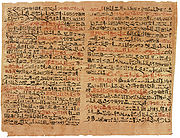
The Edwin Smith papyrus is 4.68 m in length, divided into 17 pages. The recto, the front side, is 377 lines long, while the verso, the backside, is 92 lines long. Aside from the fragmentary first sheet of the papyrus, the remainder of the papyrus is fairly intact. It is written in hieratic
Hieratic
Hieratic refers to a cursive writing system that was used in the provenance of the pharaohs in Egypt and Nubia that developed alongside the hieroglyphic system, to which it is intimately related...
, the Egyptian cursive form of hieroglyphs, in black and red ink. The vast majority of the papyrus is concerned with trauma and surgery, with short sections on gynaecology and cosmetics on the verso. On the recto side, there are 48 cases of injury. Each case details the type of the injury, examination of the patient, diagnosis and prognosis, and treatment. The verso side consists of eight magic spells and five prescriptions. The spells of the verso side and two incidents in Case 8 and Case 9 are the exceptions to the practical nature of this medical text. Generic spells and incantations may have been used as a last resort in terminal cases.
Authorship
Authorship of the Edwin Smith Papyrus is debated. The majority of the papyrus was written by one scribe, with only small sections copied by a second scribe. The papyrus ends abruptly in the middle of a line, without any inclusion of an author. It is believed that the papyrus is an incomplete copy of an older reference manuscript from the Old Kingdom, evidenced by archaic grammar, terminology, form and commentary. The text is attributed by some to Imhotep, an architect, high priest, and physician of the Old Kingdom, 3000-2500 BCE,.Procedure
The rational and practical nature of the papyrus is illustrated in 48 case histories, which are listed according to each organ. Presented cases are typical, not individual. The papyrus begins by addressing injuries to the head, and continues with treatments for injuries to neck, arms and torso, detailing injuries in descending anatomical order like a modern anatomical exposition. The title of each case details the nature of trauma, such as “Practices for a gaping wound in his head, which has penetrated to the bone and split the skull”. The incredibly objective examination process included visual and olfactory clues, palpation and taking of the pulse. Following the examination are the diagnosis and prognosis, where the physician judges the patient’s chances of survival and makes one of three diagnoses: “An ailment which I will treat,” “An ailment with which I will contend,” or “An ailment not to be treated”. Last, treatment options are offered. In many of the cases, explanations of trauma are included to provide further clarity.Among the treatments are closing wounds with sutures (for wounds of the lip, throat, and shoulder), bandaging, splints, poultices, preventing and curing infection with honey, and stopping bleeding with raw meat. Immobilization is advised for head and spinal cord injuries, as well as other lower body fractures. The papyrus also describes realistic anatomical, physiological and pathological observations. It contains the first known descriptions of the cranial structures, the meninges, the external surface of the brain, the cerebrospinal fluid, and the intracranial pulsations. Here,the word ‘brain’ appears for the first time in any language. The procedures of this papyrus demonstrate an Egyptian level of knowledge of medicines that surpassed that of Hippocrates, who lived 1000 years later. The influence of brain injuries on parts of the body is recognized, such as paralysis. The relationship between the location of a cranial injury and the side of the body affected is also recorded, while crushing injuries of vertebrae were noted to impair motor and sensory functions. Due to its practical nature and the types of trauma investigated, it is believed that the papyrus served as a textbook for the trauma that resulted from military battles.
History
The Edwin Smith Papyrus dates to Dynasties 16-17 of the Second Intermediate Period. Egypt was ruled from Thebes during this time and the papyrus is likely to have originated from there. Edwin SmithEdwin Smith (Egyptologist)
Edwin Smith was an American dealer and collector of antiquities who gave his name to an Ancient Egyptian medical papyrus, the Edwin Smith Papyrus....
, an American Egyptologist, was born in Connecticut in 1822 – the same year Egyptian hieroglyphic was decoded. Smith purchased it in Luxor, Egypt in 1862, from an Egyptian dealer named Mustafa Agha. The papyrus was in the possession of Smith until his death, when his daughter donated the papyrus to New York Historical Society. From 1938 through 1948, the papyrus was at the Brooklyn Museum. In 1948, the New York Historical Society and the Brooklyn Museum presented the papyrus to the New York Academy of Medicine, where it remains today. The first translation of the papyrus was by James Henry Breasted, with the medical advice of Dr. Arno B Luckhardt, in 1930 Breasted’s translation changed the understanding of the history of medicine. It demonstrates that Egyptian medical care was not limited to the magical modes of healing demonstrated in other Egyptian medical sources. Rational, scientific practices were used, constructed through observation and examination.
From 2005 through 2006, the Edwin Smith Papyrus was on exhibition at the Metropolitan Museum of Art in New York. James P. Allen, curator of Egyptian Art at the museum, published a new translation of the work, coincident with the exhibition. This was the first complete English translation since Breasted’s in 1930. This translation offers a more modern understanding of hieratic and medicine.
See also
- Ancient Egyptian medicineAncient Egyptian medicineThe medicine of the ancient Egyptians is some of the oldest documented. From the beginnings of the civilization in the until the Persian invasion of 525 BC, Egyptian medical practice went largely unchanged and was highly advanced for its time, including simple non-invasive surgery, setting of...
- Medical literatureMedical literatureMedical literature refers to articles in journals and texts in books devoted to the field of medicine.Contemporary and historic views regarding diagnosis, prognosis and treatment of medical conditions have been documented for thousands of years. The Edwin Smith papyrus is the first known medical...
- Herbal medicine in ancient Egypt Aboelsoud http://www.academicjournals.org/jmpr/PDF/pdf2010/18Jan/Aboelsoud.pdf
External links
- Turning the Pages: a virtual reconstruction of the Edwin Smith Papyrus. From the U.S. National Library of Medicine.
- The Edwin Smith Surgical Papyrus: translation of all 48 cases from the papyrus. An unacknowledged reprint of the translations from Breasted 1930.
- Medicine In Ancient Egypt
- Cybermuseum of Neurosurgery: translation of 13 cases pertaining to injuries of the skull and spinal cord, with commentary.
- History of Medicine: lists other papyruses.