

Scholasticism

Encyclopedia
Scholasticism is a method of critical thought which dominated teaching by the academics (scholastics, or schoolmen) of medieval universities
Medieval university
Medieval university is an institution of higher learning which was established during High Middle Ages period and is a corporation.The first institutions generally considered to be universities were established in Italy, France, and England in the late 11th and the 12th centuries for the study of...
in Europe from about 1100–1500, and a program of employing that method in articulating and defending orthodoxy in an increasingly pluralistic context. It originated as an outgrowth of, and a departure from, Christian monastic schools.
Not so much a philosophy or a theology as a method of learning, scholasticism places a strong emphasis on dialectical reasoning to extend knowledge by inference
Inference
Inference is the act or process of deriving logical conclusions from premises known or assumed to be true. The conclusion drawn is also called an idiomatic. The laws of valid inference are studied in the field of logic.Human inference Inference is the act or process of deriving logical conclusions...
, and to resolve contradictions. Scholastic thought is also known for rigorous conceptual analysis and the careful drawing of distinctions. In the classroom and in writing, it often takes the form of explicit disputation
Disputation
In the scholastic system of education of the Middle Ages, disputations offered a formalized method of debate designed to uncover and establish truths in theology and in sciences...
: a topic drawn from the tradition is broached in the form of a question, opponents' responses are given, a counterproposal is argued and opponent's arguments rebutted. Because of its emphasis on rigorous dialectical method, scholasticism was eventually applied to many other fields of study.
As a program, scholasticism began as an attempt at harmonization on the part of medieval Christians thinkers: to harmonize the various authorities of their own tradition, and to reconcile Christian theology with classical and late antiquity philosophy, especially that of Aristotle
Aristotle
Aristotle was a Greek philosopher and polymath, a student of Plato and teacher of Alexander the Great. His writings cover many subjects, including physics, metaphysics, poetry, theater, music, logic, rhetoric, linguistics, politics, government, ethics, biology, and zoology...
but also of Neoplatonism
Neoplatonism
Neoplatonism , is the modern term for a school of religious and mystical philosophy that took shape in the 3rd century AD, based on the teachings of Plato and earlier Platonists, with its earliest contributor believed to be Plotinus, and his teacher Ammonius Saccas...
. (See also Christian apologetics
Christian apologetics
Christian apologetics is a field of Christian theology that aims to present a rational basis for the Christian faith, defend the faith against objections, and expose the perceived flaws of other world views...
.)
The main figures of scholasticism historically are Anselm of Canterbury
Anselm of Canterbury
Anselm of Canterbury , also called of Aosta for his birthplace, and of Bec for his home monastery, was a Benedictine monk, a philosopher, and a prelate of the church who held the office of Archbishop of Canterbury from 1093 to 1109...
, Peter Abelard
Peter Abelard
Peter Abelard was a medieval French scholastic philosopher, theologian and preeminent logician. The story of his affair with and love for Héloïse has become legendary...
, Albertus Magnus
Albertus Magnus
Albertus Magnus, O.P. , also known as Albert the Great and Albert of Cologne, is a Catholic saint. He was a German Dominican friar and a bishop, who achieved fame for his comprehensive knowledge of and advocacy for the peaceful coexistence of science and religion. Those such as James A. Weisheipl...
, Duns Scotus
Duns Scotus
Blessed John Duns Scotus, O.F.M. was one of the more important theologians and philosophers of the High Middle Ages. He was nicknamed Doctor Subtilis for his penetrating and subtle manner of thought....
, William of Ockham
William of Ockham
William of Ockham was an English Franciscan friar and scholastic philosopher, who is believed to have been born in Ockham, a small village in Surrey. He is considered to be one of the major figures of medieval thought and was at the centre of the major intellectual and political controversies of...
, Bonaventure
Bonaventure
Saint Bonaventure, O.F.M., , born John of Fidanza , was an Italian medieval scholastic theologian and philosopher. The seventh Minister General of the Order of Friars Minor, he was also a Cardinal Bishop of Albano. He was canonized on 14 April 1482 by Pope Sixtus IV and declared a Doctor of the...
and Thomas Aquinas
Thomas Aquinas
Thomas Aquinas, O.P. , also Thomas of Aquin or Aquino, was an Italian Dominican priest of the Catholic Church, and an immensely influential philosopher and theologian in the tradition of scholasticism, known as Doctor Angelicus, Doctor Communis, or Doctor Universalis...
. Thomas Aquinas's masterwork, the Summa Theologica
Summa Theologica
The Summa Theologiæ is the best-known work of Thomas Aquinas , and although unfinished, "one of the classics of the history of philosophy and one of the most influential works of Western literature." It is intended as a manual for beginners in theology and a compendium of all of the main...
, is often seen as the highest fruit of Scholasticism. Important work in the scholastic tradition has been carried on, however, well past Aquinas' time, for instance by Francisco Suárez
Francisco Suárez
Francisco Suárez was a Spanish Jesuit priest, philosopher and theologian, one of the leading figures of the School of Salamanca movement, and generally regarded among the greatest scholastics after Thomas Aquinas....
and Molina, and also among Lutheran and Reformed thinkers.
Etymology
The terms "scholastic" and "scholasticism" derive from the LatinLatin
Latin is an Italic language originally spoken in Latium and Ancient Rome. It, along with most European languages, is a descendant of the ancient Proto-Indo-European language. Although it is considered a dead language, a number of scholars and members of the Christian clergy speak it fluently, and...
word scholasticus , which means "that [which] belongs to the school." The "scholastics" were, roughly, "schoolmen."
Early Scholasticism
The first significant renewal of learning in the West came with the Carolingian RenaissanceCarolingian Renaissance
In the history of ideas the Carolingian Renaissance stands out as a period of intellectual and cultural revival in Europe occurring from the late eighth century, in the generation of Alcuin, to the 9th century, and the generation of Heiric of Auxerre, with the peak of the activities coordinated...
of the Early Middle Ages
Early Middle Ages
The Early Middle Ages was the period of European history lasting from the 5th century to approximately 1000. The Early Middle Ages followed the decline of the Western Roman Empire and preceded the High Middle Ages...
. Charlemagne
Charlemagne
Charlemagne was King of the Franks from 768 and Emperor of the Romans from 800 to his death in 814. He expanded the Frankish kingdom into an empire that incorporated much of Western and Central Europe. During his reign, he conquered Italy and was crowned by Pope Leo III on 25 December 800...
, advised by Peter of Pisa
Peter of Pisa
Peter of Pisa was a grammarian of the Early middle ages. He originally taught at Pavia. In 776, after the conquest of the Lombard Kingdom, Charlemagne summoned him to his court to teach Latin. Peter was a friend of Alcuin. He returned about the year 790 to Italy where he died no later than 799...
and Alcuin of York, attracted the scholars of England and Ireland, and by decree in AD 787 established schools in every abbey in his empire. These schools, from which the name scholasticism is derived, became centers of medieval learning.
During this period, knowledge of the Greek language
Ancient Greek
Ancient Greek is the stage of the Greek language in the periods spanning the times c. 9th–6th centuries BC, , c. 5th–4th centuries BC , and the c. 3rd century BC – 6th century AD of ancient Greece and the ancient world; being predated in the 2nd millennium BC by Mycenaean Greek...
had vanished in the west except in Ireland, where it was widely dispersed in the monastic school
Monastic school
Monastic schools were, along with cathedral schools, the most important institutions of higher learning in the Latin West from the early Middle Ages until the 12th century. Since Cassiodorus's educational program, the standard curriculum incorporated religious studies, the Trivium, and the...
s. Irish scholars had a considerable presence in the Frankish court
Carolingian Empire
Carolingian Empire is a historiographical term which has been used to refer to the realm of the Franks under the Carolingian dynasty in the Early Middle Ages. This dynasty is seen as the founders of France and Germany, and its beginning date is based on the crowning of Charlemagne, or Charles the...
, where they were renowned for their learning. Among them was Johannes Scotus Eriugena
Johannes Scotus Eriugena
Johannes Scotus Eriugena was an Irish theologian, Neoplatonist philosopher, and poet. He is known for having translated and made commentaries upon the work of Pseudo-Dionysius.-Name:...
, one of the founders of scholasticism. Eriugena was the most significant Irish intellectual of the early monastic period, and an outstanding philosopher in terms of originality. He had considerable familiarity with the Greek language, and translated many works into Latin, affording access to the Cappadocian Fathers
Cappadocian Fathers
The Cappadocian Fathers are Basil the Great , who was bishop of Caesarea; Basil's brother Gregory of Nyssa , who was bishop of Nyssa; and a close friend, Gregory of Nazianzus , who became Patriarch of Constantinople...
and the Greek theological tradition.
The other three founders of scholasticism were the 11th century scholars Peter Abelard
Peter Abelard
Peter Abelard was a medieval French scholastic philosopher, theologian and preeminent logician. The story of his affair with and love for Héloïse has become legendary...
, Archbishop Lanfranc of Canterbury and Archbishop Anselm of Canterbury
Anselm of Canterbury
Anselm of Canterbury , also called of Aosta for his birthplace, and of Bec for his home monastery, was a Benedictine monk, a philosopher, and a prelate of the church who held the office of Archbishop of Canterbury from 1093 to 1109...
. Anselm is sometimes misleadingly called the "Father of scholasticism," owing to the prominence accorded to reason in his theology. Rather than establish a position by appeal to authority, he used argument to demonstrate why what he believed on authority must be so.
The period also saw the beginning of the 'discovery
Transmission of Greek philosophical ideas in the Middle Ages
The introduction of Greek philosophy and science into the culture of the Latin West in the Middle Ages was an event that transformed the intellectual life of Western Europe...
' of many Greek works which had been lost to the Latin West. As early as the 10th century, scholars in Spain had begun to gather translated texts, and in the latter half of that century began transmitting them to the rest of Europe. After the Reconquista
Reconquista
The Reconquista was a period of almost 800 years in the Middle Ages during which several Christian kingdoms succeeded in retaking the Muslim-controlled areas of the Iberian Peninsula broadly known as Al-Andalus...
of the 12th century, Spain opened even further for Christian scholars, who were now able to work in 'friendly' religious territory. As these Europeans encountered Islamic philosophy, they opened a wealth of Arab knowledge of mathematics and astronomy.
At the same time Anselm of Laon
Anselm of Laon
Anselm of Laon was a French theologian and founder of a school of scholars who helped to pioneer biblical hermeneutics.Remembered in the century after his death as "Anselmus" or "Anselm", his name was more properly "Ansellus" or, in Modern French, "Anseau."Born of very humble parents at Laon...
systematised the production of the gloss
Gloss
A gloss is a brief notation of the meaning of a word or wording in a text. It may be in the language of the text, or in the reader's language if that is different....
on Scripture, followed by the rise to prominence of dialectic
Dialectic
Dialectic is a method of argument for resolving disagreement that has been central to Indic and European philosophy since antiquity. The word dialectic originated in Ancient Greece, and was made popular by Plato in the Socratic dialogues...
(the middle subject of the medieval trivium) in the work of Abelard, and the production by Peter Lombard
Peter Lombard
Peter Lombard was a scholastic theologian and bishop and author of Four Books of Sentences, which became the standard textbook of theology, for which he is also known as Magister Sententiarum-Biography:Peter Lombard was born in Lumellogno , in...
of a collection of Sentences
Sentences
The Four Books of Sentences is a book of theology written by Peter Lombard in the twelfth century. It is a systematic compilation of theology, written around 1150; it derives its name from the sententiae or authoritative statements on biblical passages that it gathered together.-Origin and...
or opinions of the Church Fathers and other authorities.
High Scholasticism
The 13th and early 14th centuries are generally seen as the high period of scholasticism. The early 13th century witnessed the culmination of the recovery of Greek philosophyRecovery of Aristotle
The "Recovery of Aristotle" refers to the copying or re-translating of most of Aristotle's other books , from Greek or Arabic text into Latin, during the Middle Ages, of the Latin West...
. Schools of translation grew up in Italy and Sicily, and eventually in the rest of Europe. Scholars such as Adelard of Bath
Adelard of Bath
Adelard of Bath was a 12th century English scholar. He is known both for his original works and for translating many important Greek and Arabic scientific works of astrology, astronomy, philosophy and mathematics into Latin from Arabic versions, which were then introduced to Western Europe...
travelled to Sicily and the Arab world, translating works on astronomy and mathematics, including the first complete translation of Euclid’s
Euclid
Euclid , fl. 300 BC, also known as Euclid of Alexandria, was a Greek mathematician, often referred to as the "Father of Geometry". He was active in Alexandria during the reign of Ptolemy I...
Elements
Euclid's Elements
Euclid's Elements is a mathematical and geometric treatise consisting of 13 books written by the Greek mathematician Euclid in Alexandria c. 300 BC. It is a collection of definitions, postulates , propositions , and mathematical proofs of the propositions...
. Powerful Norman kings gathered men of knowledge from Italy and other areas into their courts as a sign of their prestige. William of Moerbeke
William of Moerbeke
Willem van Moerbeke, O.P., known in the English speaking world as William of Moerbeke was a prolific medieval translator of philosophical, medical, and scientific texts from Greek into Latin...
's translations and editions of Greek philosophical texts in the middle half of the thirteenth century helped in forming a clearer picture of Greek philosophy, and particularly of Aristotle, than was given by the Arabic versions on which they had previously relied, and which had distorted or obscured the relation between Platonic and Aristotelian systems of philosophy. His work formed the basis of the major commentaries that followed.
The universities
University
A university is an institution of higher education and research, which grants academic degrees in a variety of subjects. A university is an organisation that provides both undergraduate education and postgraduate education...
developed in the large cities of Europe during this period, and rival clerical orders within the church began to battle for political and intellectual control over these centers of educational life. The two main orders founded in this period were the Franciscans and the Dominicans
Dominican Order
The Order of Preachers , after the 15th century more commonly known as the Dominican Order or Dominicans, is a Catholic religious order founded by Saint Dominic and approved by Pope Honorius III on 22 December 1216 in France...
. The Franciscans were founded by Francis of Assisi
Francis of Assisi
Saint Francis of Assisi was an Italian Catholic friar and preacher. He founded the men's Franciscan Order, the women’s Order of St. Clare, and the lay Third Order of Saint Francis. St...
in 1209. Their leader in the middle of the century was Bonaventure
Bonaventure
Saint Bonaventure, O.F.M., , born John of Fidanza , was an Italian medieval scholastic theologian and philosopher. The seventh Minister General of the Order of Friars Minor, he was also a Cardinal Bishop of Albano. He was canonized on 14 April 1482 by Pope Sixtus IV and declared a Doctor of the...
, a traditionalist who defended the theology of Augustine
Augustine of Hippo
Augustine of Hippo , also known as Augustine, St. Augustine, St. Austin, St. Augoustinos, Blessed Augustine, or St. Augustine the Blessed, was Bishop of Hippo Regius . He was a Latin-speaking philosopher and theologian who lived in the Roman Africa Province...
and the philosophy of Plato
Plato
Plato , was a Classical Greek philosopher, mathematician, student of Socrates, writer of philosophical dialogues, and founder of the Academy in Athens, the first institution of higher learning in the Western world. Along with his mentor, Socrates, and his student, Aristotle, Plato helped to lay the...
, incorporating only a little of Aristotle in with the more neoplatonist elements. Following Anselm, Bonaventure supposed that reason can only discover truth when philosophy is illuminated by religious faith. Other important Franciscan scholastics were Duns Scotus
Duns Scotus
Blessed John Duns Scotus, O.F.M. was one of the more important theologians and philosophers of the High Middle Ages. He was nicknamed Doctor Subtilis for his penetrating and subtle manner of thought....
, Peter Auriol and William of Ockham
William of Ockham
William of Ockham was an English Franciscan friar and scholastic philosopher, who is believed to have been born in Ockham, a small village in Surrey. He is considered to be one of the major figures of medieval thought and was at the centre of the major intellectual and political controversies of...
.
By contrast, the Dominican order, a teaching order founded by St Dominic in 1215, to propagate and defend Christian doctrine, placed more emphasis on the use of reason and made extensive use of the new Aristotelian sources
Recovery of Aristotle
The "Recovery of Aristotle" refers to the copying or re-translating of most of Aristotle's other books , from Greek or Arabic text into Latin, during the Middle Ages, of the Latin West...
derived from the East, and Moorish Spain. The great representatives of Dominican thinking in this period were Albertus Magnus
Albertus Magnus
Albertus Magnus, O.P. , also known as Albert the Great and Albert of Cologne, is a Catholic saint. He was a German Dominican friar and a bishop, who achieved fame for his comprehensive knowledge of and advocacy for the peaceful coexistence of science and religion. Those such as James A. Weisheipl...
and (especially) Thomas Aquinas
Thomas Aquinas
Thomas Aquinas, O.P. , also Thomas of Aquin or Aquino, was an Italian Dominican priest of the Catholic Church, and an immensely influential philosopher and theologian in the tradition of scholasticism, known as Doctor Angelicus, Doctor Communis, or Doctor Universalis...
, whose artful synthesis of Greek rationalism and Christian doctrine eventually came to define Catholic philosophy. Aquinas placed more emphasis on reason and argumentation, and was one of the first to use the new translation of Aristotle's metaphysical and epistemological writing. This was a significant departure from the Neoplatonic
Neoplatonism
Neoplatonism , is the modern term for a school of religious and mystical philosophy that took shape in the 3rd century AD, based on the teachings of Plato and earlier Platonists, with its earliest contributor believed to be Plotinus, and his teacher Ammonius Saccas...
and Augustinian thinking that had dominated much of early scholasticism. Aquinas showed how it was possible to incorporate much of the philosophy of Aristotle without falling into the "errors" of the Commentator Averroes
Averroes
' , better known just as Ibn Rushd , and in European literature as Averroes , was a Muslim polymath; a master of Aristotelian philosophy, Islamic philosophy, Islamic theology, Maliki law and jurisprudence, logic, psychology, politics, Arabic music theory, and the sciences of medicine, astronomy,...
.
Neo-Scholasticism
The revival and development from the second half of the nineteenth century of medieval scholastic philosophy, sometimes called neo-ThomismThomism
Thomism is the philosophical school that arose as a legacy of the work and thought of St. Thomas Aquinas, philosopher, theologian, and Doctor of the Church. In philosophy, his commentaries on Aristotle are his most lasting contribution...
.
Post-Thomistic Scholasticism
Academic Scholasticism went into decline in the 1970s when the Thomistic revival that had been spearheaded by Maritain, GilsonGilson
Gilson is a hamlet in the North Warwickshire district of Warwickshire, England. It is known to some residents as 'Gil'.Gilson was once an agricultural hamlet mid way between Water Orton and Coleshill. It dates from the Anglo-Saxon period and is first documented in 1232 AD...
, and others came to an end. Partly, this was because Thomism had ceased to be a living philosophy engaging the questions of the day, and had become a quest to understand the historical Aquinas, and also because after the Second Vatican Council
Second Vatican Council
The Second Vatican Council addressed relations between the Roman Catholic Church and the modern world. It was the twenty-first Ecumenical Council of the Catholic Church and the second to be held at St. Peter's Basilica in the Vatican. It opened under Pope John XXIII on 11 October 1962 and closed...
, other theological schools came to the fore. Still, those who had learned Scholastic philosophy continued to have unresolved questions about how the insights of the medieval synthesis could be applied to contemporary problems. This conversation left the academic environment for internet discussion groups such as Aquinas, Christian Philosophy, and Thomism, and websites such as Open Philosophy, where it continues today.
Analytical Scholasticism
A renewed interest in the "scholastic" way of doing philosophy has recently awoken in the confines of the analytic philosophyAnalytic philosophy
Analytic philosophy is a generic term for a style of philosophy that came to dominate English-speaking countries in the 20th century...
. Attempts emerged to combine elements of scholastic and analytic methodology in pursuit of a contemporary philosophical synthesis. Proponents of various incarnations of this approach include Anthony Kenny
Anthony Kenny
Sir Anthony John Patrick Kenny FBA is an English philosopher whose interests lie in the philosophy of mind, ancient and scholastic philosophy, the philosophy of Wittgenstein and the philosophy of religion...
, Józef Maria Bocheński
Józef Maria Bochenski
Józef Maria Bocheński was a Polish Dominican, logician and philosopher.-Life:...
, Edward Feser, Peter King
Peter King
-Politics:*Peter King , Australian politician*Peter T. King , U.S. Republican Congressman from New York*Peter King , British politician*Peter King, 1st Baron King -Politics:*Peter King (Australian politician) (born 1952), Australian politician*Peter T. King (born 1944), U.S. Republican...
, Thomas Williams
Thomas Williams
Thomas Williams may refer to:* Thomas Williams * Williams, Gresham Professor of Astronomy from 11 November 1613* Thomas Williams , signatory of the Mayflower Compact...
, Bill Vallicella, David Oderberg, Gyula Klima, William Norris Clarke or Stanislav Sousedík. As a pioneer part of this movement can be seen Analytical Thomism
Analytical Thomism
Analytical Thomism is a philosophical movement which promotes the interchange of ideas between the thought of Saint Thomas Aquinas , and modern analytic philosophy....
.
Scholastic Method
The scholastics would choose a book by a renowned scholar, auctor (author), as a subject for investigation. By reading it thoroughly and critically, the disciples learned to appreciate the theories of the author. Other documents related to the book would be referenced, such as Church councils, papal letters and anything else written on the subject, be it ancient or contemporary. The points of disagreement and contention between multiple sources would be written down in individual sentences or snippets of text, known as sententiaeSententiae
Sententiae are brief moral sayings, such as proverbs, adages, aphorisms, maxims, or apophthegms taken from ancient or popular or other sources, often quoted without context. A sententia , also called a "sentence," is a kind of rhetorical proof...
.
Once the sources and points of disagreement had been laid out through a series of dialectic
Dialectic
Dialectic is a method of argument for resolving disagreement that has been central to Indic and European philosophy since antiquity. The word dialectic originated in Ancient Greece, and was made popular by Plato in the Socratic dialogues...
s, the two sides of an argument would be made whole so that they would be found to be in agreement and not contradictory. (Of course, sometimes opinions would be totally rejected, or new positions proposed.) This was done in two ways.
The first was through philological
Philology
Philology is the study of language in written historical sources; it is a combination of literary studies, history and linguistics.Classical philology is the philology of Greek and Classical Latin...
analysis. Words were examined and argued to have multiple meanings. It was also considered that the auctor might have intended a certain word to mean something different. Ambiguity could be used to find common ground between two otherwise contradictory statements.
The second was through logical analysis, which relied on the rules of formal logic
Logic
In philosophy, Logic is the formal systematic study of the principles of valid inference and correct reasoning. Logic is used in most intellectual activities, but is studied primarily in the disciplines of philosophy, mathematics, semantics, and computer science...
to show that contradictions did not exist but were subjective to the reader.
Scholastic Instruction
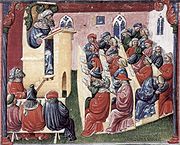
Scholastic schools had two methods of teaching. The first was the lectio: a teacher would read a text, expounding on certain words and ideas, but no questions were permitted; it was a simple reading of a text: instructors explained, and students listened in silence.The second was the disputatio, which goes right to the heart of scholasticism. There were two types of disputationes: the first was the "ordinary" type, whereby the questions (quaestiones) to be disputed were announced beforehand; the second was the quodlibetal, whereby the students proposed a question to the teacher without prior preparation. The teacher advanced a response, citing authoritative texts to prove his position. Students then rebutted the response, and the quodlibetal went back and forth. Someone took notes on what was said, allowing the teacher to summarise all arguments and present his final position the following day, riposting all rebuttals.
See also
- Actus primusActus primusActus primus is a technical expression used in scholastic philosophy.The Latin word actus means determination, complement, perfection. In every being there are many actualities, which are subordinated. Thus existence supposes essence; power supposes existence; action supposes faculty...
- AristotelianismAristotelianismAristotelianism is a tradition of philosophy that takes its defining inspiration from the work of Aristotle. The works of Aristotle were initially defended by the members of the Peripatetic school, and, later on, by the Neoplatonists, who produced many commentaries on Aristotle's writings...
- Medieval philosophyMedieval philosophyMedieval philosophy is the philosophy in the era now known as medieval or the Middle Ages, the period roughly extending from the fall of the Western Roman Empire in the fifth century AD to the Renaissance in the sixteenth century...
- History of science in the Middle Ages
- List of scholastic philosophers
- Neo-ScholasticismNeo-ScholasticismNeo-Scholasticism is the revival and development of medieval scholastic philosophy starting from the second half of the 19th century. It has some times been called neo-Thomism partly because Thomas Aquinas in the 13th century gave to scholasticism a final form, partly because the idea gained ground...
- Recovery of AristotleRecovery of AristotleThe "Recovery of Aristotle" refers to the copying or re-translating of most of Aristotle's other books , from Greek or Arabic text into Latin, during the Middle Ages, of the Latin West...
- Renaissance of the 12th centuryRenaissance of the 12th centuryThe Renaissance of the 12th century was a period of many changes at the outset of the High Middle Ages. It included social, political and economic transformations, and an intellectual revitalization of Western Europe with strong philosophical and scientific roots...
- ScotismScotismScotism is the name given to the philosophical and theological system or school named after Blessed John Duns Scotus. The word comes from the name of its originator, whose Opus Oxoniense was one of the most important documents in medieval philosophy and Roman Catholic theology, defining what would...
- ThomismThomismThomism is the philosophical school that arose as a legacy of the work and thought of St. Thomas Aquinas, philosopher, theologian, and Doctor of the Church. In philosophy, his commentaries on Aristotle are his most lasting contribution...
- NominalismNominalismNominalism is a metaphysical view in philosophy according to which general or abstract terms and predicates exist, while universals or abstract objects, which are sometimes thought to correspond to these terms, do not exist. Thus, there are at least two main versions of nominalism...
Secondary sources
- Gracia, J. G. and Noone, T. B., eds., (2003) A Companion to Philosophy in the Middle Ages. London: Blackwell, ISBN 0631216723
- McGrade, A. S., ed., (2003) The Cambridge Companion to Medieval Philosophy. Cambridge: Cambridge University Press.
External links
- Scholasticon by Jacob Schmutz
- Medieval Philosophy Electronic Resources
- Instituto Teológico São Tomás de Aquino
- "Scholasticism". In Encyclopædia BritannicaEncyclopædia BritannicaThe Encyclopædia Britannica , published by Encyclopædia Britannica, Inc., is a general knowledge English-language encyclopaedia that is available in print, as a DVD, and on the Internet. It is written and continuously updated by about 100 full-time editors and more than 4,000 expert...
Online. - Scholasticism Joseph Rickaby, (1908), 121 pp. (also at googlebooks)
- Scholasticism in The Catholic Encyclopedia
- Yahoo! directory category: Scholasticism
- Living Scholasticism: discussion groups, and chat
- The genius of the scholastics and the orbit of Aristotle, article on the influence of scholasticism on later thought
- Medieval Philosophy, Universities and the Church by James Hannam ALCUIN - Regensburger Infothek der Scholastik - Huge database with information on biography, text chronology, editions.