
In Depth
See Also

Radar

RADAR is a system that uses radio Radio

Radio is the wireless transmission of signals [i], by modulation [i] of electromagnetic waves [i] ... 

 waves to detect, determine the direction and distance and/or speed of objects such as aircraft Aircraft

An aircraft is any machine [i] capable of atmospheric [i] flight [i]. ... 

, ship Ship

A ship is a large, sea-going watercraft [i]. ... 

s, terrain or rain Rain

Rain is a form of precipitation [i], other forms of which include snow [i], sleet [i], hail [i] ... 

 and map them. A transmitter emits radio waves, which are reflected by the target, and detected by a receiver, typically in the same location as the transmitter. Although the radio signal returned is usually very weak, radio signals can easily be amplified, so radar can detect objects at ranges where other emission, such as sound Sound

Sound is a disturbance of mechanical energy [i] that propagates through matter [i] as a wave [i]. ... 

 or visible light Visible spectrum

The visible spectrum is the portion of the electromagnetic spectrum [i] that is visible [i] ... 

, would be too weak to detect. Radar is used in many contexts, including meteorological Meteorology

Meteorology is the scientific study of the atmosphere [i] that focuses on weather [i] ... 

 detection of precipitation, air traffic control Air traffic control

Air traffic control is a service provided by ground-based controllers [i] who di ... 

, police Police

Police forces are government organizations [i] charged with the responsibility of maintaining law [i] and ... 

 detection of speeding Speed limit

A road speed limit is the maximum speed allowed by law [i] for road vehicle [i]s. ... 

 traffic Traffic

Traffic refers to the movement of motorized vehicle [i]s, unmotorized vehicles and pedestrian [i]s on road [i] ... 

, and by the military.

Discussions

  Discussion Features

   Ask a question about 'Radar'

   Start a new discussion about 'Radar'

   Answer questions about 'Radar'

   'Radar' discussion forum

Timeline

1946   Project Diana Project Diana

Project Diana, named for the Roman moon goddess, was a project of the US Army signal corps to bounce rad... 

 bounces Radar waves off the moon Moon

The Moon is Earth [i]'s only natural satellite [i]. ... 

, measuring the exact distance between the earth Earth

Earth is the third planet [i] in the solar system [i] in terms of distance from the Sun [i], and the fi ... 

 and the moon and proving that the communication was possible between the earth and outerspace, effectively opening the space age Space Age

The Space Age is a contemporary period encompassing the activities related to the space race [i], space exploration [i] ... 

.

1989   August 9 The asteroid Asteroid

Asteroid, minor planet, and planetoid are synonyms, and are used to indicate a diverse group of small ce... 

 4769 Castalia 4769 Castalia

The asteroid 4769 Castalia was the first asteroid [i] to be directly imaged. ... 

 is the first asteroid directly imaged by radar from Arecibo Arecibo, Puerto Rico

Arecibo, settled in 1556, is a municipality in the northern midwest coast of Puerto Rico [i] and located ... 

.


Encyclopedia


RADAR is a system that uses radio Radio

Radio is the wireless transmission of signals [i], by modulation [i] of electromagnetic waves [i] ... 

 waves to detect, determine the direction and distance and/or speed of objects such as aircraft Aircraft

An aircraft is any machine [i] capable of atmospheric [i] flight [i]. ... 

, ship Ship

A ship is a large, sea-going watercraft [i]. ... 

s, terrain or rain Rain

Rain is a form of precipitation [i], other forms of which include snow [i], sleet [i], hail [i]... 

 and map them. A transmitter emits radio waves, which are reflected by the target, and detected by a receiver, typically in the same location as the transmitter. Although the radio signal returned is usually very weak, radio signals can easily be amplified, so radar can detect objects at ranges where other emission, such as sound Sound

Sound is a disturbance of mechanical energy [i] that propagates through matter [i] as a wave [i]. ... 

 or visible light Visible spectrum

The visible spectrum is the portion of the electromagnetic spectrum [i] that is visible [i] ... 

, would be too weak to detect. Radar is used in many contexts, including meteorological Meteorology

Meteorology is the scientific study of the atmosphere [i] that focuses on weather [i] ... 

 detection of precipitation, air traffic control Air traffic control

Air traffic control is a service provided by ground-based controllers [i] who di ... 

, police Police

Police forces are government organizations [i] charged with the responsibility of maintaining law [i] and ... 

 detection of speeding Speed limit

A road speed limit is the maximum speed allowed by law [i] for road vehicle [i]s. ... 

 traffic Traffic

Traffic refers to the movement of motorized vehicle [i]s, unmotorized vehicles and pedestrian [i]s on road [i] ... 

, and by the military.

The term RADAR was coined in 1941 as an acronym for Radio Detection and Ranging. This acronym of American origin replaced the previously used British abbreviation RDF . The term has since entered the English language English language

English is a widely distributed language that originated in England [i] but is now the primary language ... 

 as a standard word, radar, losing the capitalization in the process.

History


Several inventors, scientist Scientist

A scientist is an expert [i] in at least one area of science [i] who uses the scientific method [i] to d ... 

s, and engineers contributed to the development of radar History of radar

The history of radar began in the 1900s when engineers invented reflection devices.... 

. The use of radio waves to detect "the presence of distant metallic objects via radio waves" was first implemented in 1904 by Christian Hülsmeyer, who demonstrated the feasibility of detecting the presence of a ship in dense fog, but not its distance. He received a Reichspatent patent Nr. 165546 for his pre-radar device.

Prior to the Second World War World War II

World War II, or the Second World War, was a worldwide [i] conflict [i] fought betwe ... 

, developments by the Americans, the Germans, the French . , and the British , led to the first real radars. Hungarian Zoltán Bay produced a working model by 1936 at the Tungsram laboratory in the same vein.

The war precipitated the research to find better resolution, more portability, more features for that new defensive weapon. Post-war years have seen the use of radar in fields as diverse as air traffic control Air traffic control

Air traffic control is a service provided by ground-based controllers [i] who di ... 

, weather Weather

Weather is an all-encompassing term used to describe all of the many and varied phenomena [i] that c ... 

 monitoring, astrometry Astrometry

Astrometry is a branch of astronomy [i] that deals with the positions of star [i]s and other celestial bodies [i] ... 

 and road speed control.

Principles


Reflection


Electromagnetic waves reflect from any large change in the dielectric Dielectric

A dielectric, or electrical insulator [i], is a substance that is highly resistant to electric current [i] ... 

 or diamagnetic Diamagnetism

Diamagnetism is a form of magnetism [i] which is only exhibited by a substance in the presence of an ex ... 

 constants. This means that a solid object in air Earth's atmosphere

Earth's atmosphere is a layer of gases surrounding the planet Earth [i] and retained by the Earth's gravity [i]... 

 or vacuum Vacuum

A vacuum is a volume [i] of space [i] that is substansively empty of matter [i], so that gaseous pressur ... 

, or other significant change in atomic density between the object and what's surrounding it, will usually scatter radar waves. This is particularly true for electrically Electricity

Electricity is a general term for the variety of phenomena resulting from the presence and flow of electric charge [i] ... 

 conductive materials, such as metal Metal

In chemistry, a metal is an element [i] that readily forms positive ion [i]s and has ... 

 and carbon fibre Carbon fiber

Carbon fiber can refer to carbon [i] filament thread, or to felt or woven cloth made from those carbon f ... 

, making radar particularly well suited to the detection of aircraft Aircraft

An aircraft is any machine [i] capable of atmospheric [i] flight [i]. ... 

 and ship Ship

A ship is a large, sea-going watercraft [i]. ... 

s. Radar absorbing material, containing resistive and sometimes magnetic Magnetism

In physics [i], magnetism is one of the phenomena [i] by which materials [i] exert an attractive or repu ... 

 substances, is used on military vehicles to reduce radar reflection. This is the radio equivalent of painting something a dark colour.

Radar wave Wave

[i], often transferring [[energy]... 

s scatter in a variety of ways depending on the size of the radio wave and the shape of the target. If the wavelength is much shorter than the target's size, the wave will bounce off in a way similar to the way light is reflected by a mirror Mirror

A mirror is a device whose surface has good specular reflection [i]; that is, it is smooth enough to for ... 

. If the wavelength is much longer than the size of the target, the target is polarized Polarization

In electrodynamics [i], polarization is the property of electromagnetic wave [i]s, such as light [i], t... 

 , like a dipole antenna Dipole antenna

A dipole antenna, invented by Heinrich Rudolph Hertz [i] around 1886 [i], is an antenna [i] with ... 

. This is described by Rayleigh scattering Rayleigh scattering

Rayleigh scattering is the scattering [i] of light [i], or other electromagnetic [i] r... 

, an effect that creates the Earth Earth

Earth is the third planet [i] in the solar system [i] in terms of distance from the Sun [i], and the fi ... 

's blue sky and red sunset Sunset

Sunset, also called sundown in some American English [i] dialect [i]s, is the time at which the Su ... 

s. When the two length scales are comparable, there may be resonances. Early radars used very long wavelength Wavelength

The wavelength is the distance between repeating units of a wave [i] pattern. ... 

s that were larger than the targets and received a vague signal, whereas some modern systems use shorter wavelength Wavelength

The wavelength is the distance between repeating units of a wave [i] pattern. ... 

s that can image objects as small as a loaf of bread or smaller.

Short radio waves reflect from curves and corner Angle

An angle is the figure formed by two rays [i] sharing a common endpoint [i], called the vertex [i]... 

s, in a way similar to glint from a rounded piece of glass Glass

Glass is a uniform amorphous solid [i] material, usually produced when the viscous molten material cools ... 

. The most reflective targets for short wavelengths have 90° angle Angle

An angle is the figure formed by two rays [i] sharing a common endpoint [i], called the vertex [i]... 

s between the reflective surfaces. A structure consisting of three flat surfaces meeting at a single corner, like the corner on a box, will always reflect waves entering its opening directly back at the source. These so-called corner reflector Corner reflector

A corner reflector is a retroreflector [i] consisting of three mutually perpendicular, intersecting flat ... 

s are commonly used as radar reflectors to make otherwise difficult-to-detect objects easier to detect, and are often found on boats in order to improve their detection in a rescue situation and to reduce collisions. For similar reasons, objects attempting to avoid detection will angle their surfaces in a way to eliminate inside corners and avoid surfaces and edges perpendicular to likely detection directions, which leads to "odd" looking stealth aircraft Stealth aircraft

A stealth aircraft is an aircraft [i] which has been designed to absorb and deflect radar [i]; these are ... 

. These precautions do not completely eliminate reflection because of diffraction Diffraction

Diffraction refers to the various phenomena associated with wave propagation, such as the bending, sprea... 

, especially at longer wavelengths. Half wavelength long wires or strips of conducting material, such as chaff, are very reflective but do not direct the scattered energy back toward the source. The extent to which an object reflects or scatters radio waves is called its radar cross section.

Radar equation

The amount of power Pr returning to the receiving antenna is given by the radar equation:

where*'
  • Pt = transmitter power
  • Gt = gain of the transmitting antenna
  • Ar = effective aperture of the receiving antenna
  • s = radar cross section, or scattering coefficient, of the target
  • F = pattern propagation factor
  • Rt = distance from the transmitter to the target
  • Rr = distance from the target to the receiver.


In the common case where the transmitter and the receiver are at the same location, Rt = Rr and the term Rt2 Rr2 can be replaced by R4, where R is the range.
This yields:

This shows that the received power declines as the fourth power of the range, which means that the reflected power from distant targets is very, very small.

The equation above with F = 1 is a simplification for vacuum Vacuum

A vacuum is a volume [i] of space [i] that is substansively empty of matter [i], so that gaseous pressur ... 

 without interference. The propagation factor accounts for the effects of multipath Multipath

In wireless [i] telecommunication [i]s, multipath is the propagation [i] phenomenon that results in radio [i] ... 

 and shadowing and depends on the details of the environment. In a real-world situation, pathloss effects should also be considered.

Other mathematical developments in radar signal processing include time-frequency analysis , as well as the chirplet transform Chirplet transform

In signal processing [i], the chirplet transform is an inner product [i] of an input signal with a famil ... 

 which makes use of the fact that radar returns from moving targets typically "chirp" .

Polarization

In the transmitted radar signal, the electric field is perpendicular to the direction of propagation, and this direction of the electric field is the Polarization Polarization

In electrodynamics [i], polarization is the property of electromagnetic wave [i]s, such as light [i], t... 

 of the wave. Radars use horizontal, vertical, and circular polarization to detect different types of reflections. For example, circular polarization Circular polarization

In electrodynamics [i], circular polarization of electromagnetic radiation [i] is a polarization [i] suc ... 

 is used to minimize the interference caused by rain. Linear polarization Linear polarization

In electrodynamics [i], linear polarization or plane polarization of electromagnetic radiation [i] ... 

 returns usually indicate metal surfaces, and help a search radar ignore rain. Random polarization returns usually indicate a fractal Fractal

In colloquial usage, a fractal is a shape that is recursively constructed or self-similar [i],... 

 surface, such as rocks or soil Soil

Soil is the collection of natural bodies that form in earthy material on the land surface.... 

, and are used by navigation Navigation

There are several traditions of navigation.... 

al radars.

Interference

Radar systems must overcome several different sources of unwanted signals in order to focus only on the actual targets of interest. These unwanted signals may originate from internal and external sources, both passive and active. The ability of the radar system to overcome these unwanted signals defines its signal-to-noise ratio Signal-to-noise ratio

Signal-to-noise ratio is an electrical engineering [i] concept defined as the ratio of a given transmit ... 

 : the higher a system's SNR, the better it is in isolating actual targets from the surrounding noise signals.
Noise
Signal noise is an internal source of random variations in the signal, which is inherently generated to some degree by all electronic components . Noise typically appears as random variations superimposed on the desired echo signal received in the radar receiver. The lower the power of the desired signal, the more difficult it is to discern it from the noise . Therefore, the most important noise sources appear in the receiver and much effort is made to minimize these factors. Noise figure is a measure of the noise produced by a receiver compared to an ideal receiver, and this needs to be minimized.

Noise is also generated by external sources, most importantly the natural thermal radiation of the background scene surrounding the target of interest. In modern radar systems, due to the high performance of their receivers, the internal noise is typically about equal to or lower than the external scene noise. An exception is if the radar is aimed upwards at clear sky, where the scene is so cold that it generates very little thermal noise.
Clutter
Clutter refers to actual radio frequency echoes returned from targets which are by definition uninteresting to the radar operators in general. Such targets mostly include natural objects such as ground, sea, precipitation , sand storms, animals , atmospheric turbulence Turbulence

In fluid dynamics [i], turbulence or turbulent flow is a flow regime characterized by chaotic, stochastic [i] ... 

, and other atmospheric effects . Clutter may also be returned from man-made objects such as buildings and, intentionally, by radar countermeasures such as chaff.

Some clutter may also be caused by a long waveguide between the radar transceiver and the antenna. In a typical PPI Plan position indicator

The Plan Position Indicator, known as PPI, is the most common way to represent radar [i] data. ... 

 radar with a rotating antenna, this will usually be seen as a "sun" or "sunburst" in the centre of the display as the receiver responds to echoes from dust particles and misguided RF in the waveguide. Adjusting the timing between when the transmitter sends a pulse and when the receiver stage is enabled will generally reduce the sunburst without affecting the accuracy of the range, since most sunburst is caused by diffused transmit pulse reflected before it leaves the antenna.

While some clutter sources may be undesirable for some radar applications , they may be desirable for others . Clutter is considered a passive interference source, since it only appears in response to radar signals sent by the radar.

There are several methods of detecting and neutralizing clutter. Many of these methods rely on the fact that clutter tends to appear static between radar scans. Therefore, when comparing subsequent scans echoes, desirable targets will appear to move and all stationary echoes can be eliminated. Sea clutter can be reduced by using horizontal polarization, while rain is reduced with circular polarization Circular polarization

In electrodynamics [i], circular polarization of electromagnetic radiation [i] is a polarization [i] suc ... 

 . Other methods attempt to increase the signal-to-clutter ratio.

CFAR  is a method relying on the fact that clutter returns far outnumber echoes from targets of interest. The receiver's gain is automatically adjusted to maintain a constant level of overall visible clutter. While this does not help detect targets masked by stronger surrounding clutter, it does help to distinguish strong target sources. In the past, radar AGC was electronically controlled and affected the gain of the entire radar receiver. As radars evolved, AGC became computer-software controlled, and affected the gain with greater granularity, in specific detection cells.


Clutter may also originate from multipath Multipath

In wireless [i] telecommunication [i]s, multipath is the propagation [i] phenomenon that results in radio [i] ... 

 echoes from valid targets due to ground reflection, atmospheric ducting or ionospheric reflection/refraction Refraction

Refraction is the change in direction of a wave [i] due to a change in its velocity [i].... 

. This specific clutter type is especially bothersome, since it appears to move and behave like other normal targets of interest, thereby creating a ghost. In a typical scenario, an aircraft echo is multipath-reflected from the ground below, appearing to the receiver as an identical target below the correct one. The radar may try to unify the targets, reporting the target at an incorrect height, or - worse - eliminating it on the basis of jitter or a physical impossibility. These problems can be overcome by incorporating a ground map of the radar's surroundings and eliminating all echoes which appear to originate below ground or above a certain height.
Jamming
Radar jamming Radar jamming and deception

Radar [i] jamming and deception is the intentional emission of radio [i] frequency [i] signals to interf ... 

 refers to RF signals originating from sources outside the radar, transmitting in the radar's frequency and thereby masking targets of interest. Jamming may be intentional or unintentional . Jamming is considered an active interference source, since it is initiated by elements outside the radar and in general unrelated to the radar signals.

Jamming is problematic to radar since the jamming signal only needs to travel one-way whereas the radar echoes travel two-ways and are therefore significantly reduced in power by the time they return to the radar receiver. Jammers therefore need be much less powerful than their jammed radars in order to effectively mask targets along the line of sight from the jammer to the radar . Jammers have an added effect of affecting radars along other line-of-sights, due to the radar receiver's sidelobes .

Mainlobe jamming can generally only be reduced by narrowing the mainlobe solid angle, and can never fully be eliminated when directly facing a jammer which uses the same frequency and polarization as the radar. Sidelobe jamming can be overcome by reducing receiving sidelobes in the radar antenna design and by using an omnidirectional antenna to detect and disregard non-mainlobe signals. Other anti-jamming techniques are frequency hopping and polarization Polarization

In electrodynamics [i], polarization is the property of electromagnetic wave [i]s, such as light [i], t... 

. See Electronic counter-counter-measures for details.

Interference has recently become a problem for C-band C band

C band is the label for three portions of the electromagnetic spectrum [i] used in different ways. ... 

  meteorological radars with the proliferation of 5.4 GHz band WiFi equipment.

Radar signal processing


Distance measurement


Transit time


Principle of radar distance measurement using pulse round trip time.
One way to measure the distance to an object is to transmit a short pulse of radio signal, and measure the time it takes for the reflection to return. The distance is one-half the product of round trip time and the speed of the signal. where c is the speed of light in a vacuum, and t is the round trip time. For radar, the speed of signal is the speed of light, making the round trip times very short for terrestrial ranging. Accurate distance measurement requires high-performance electronics.

The receiver cannot detect the return while the signal is being sent out – there is no way to tell if the signal it hears is the original or the return. This means that a radar has a distinct minimum range, which is the length of the pulse multiplied by the speed of light, divided by two. In order to detect closer targets one must use a shorter pulse length.

A similar effect imposes a specific maximum range as well. If the return from the target comes in when the next pulse is being sent out, once again the receiver cannot tell the difference. In order to maximize range, one wants to use longer times between pulses, the inter-pulse time.

These two effects tend to be at odds with each other, and it is not easy to combine both good short range and good long range in a single radar. This is because the short pulses needed for a good minimum range broadcast have less total energy, making the returns much smaller and the target harder to detect. This could be offset by using more pulses, but this would shorten the maximum range again. So each radar uses a particular type of signal. Long range radars tend to use long pulses with long delays between them, and short range radars use smaller pulses with less time between them. This pattern of pulses and pauses is known as the Pulse Repetition Frequency , and is one of the main ways to characterize a radar. As electronics have improved many radars now can change their PRF.
Frequency modulation
Another form of distance measuring radar is based on frequency modulation Frequency modulation

Frequency modulation is a form of modulation [i] which represents information [i] as variations in the ... 

. Frequency comparison between two signals is considerably more accurate, even with older electronics, than timing the signal. By changing the frequency of the returned signal and comparing that with the original, the difference can be easily measured.

This technique can be used in radar systems, and is often found in aircraft radar altimeter Altimeter

An altimeter is an active instrument used to measure the altitude [i] of an object above a fixed level. ... 

s. In these systems a "carrier" radar signal is frequency modulated in a predictable way, typically varying up and down with a sine wave Sine wave

[i], [[signal processing]... 

 or sawtooth pattern at audio frequencies. The signal is then sent out from one antenna and received on another, typically located on the bottom of the aircraft, and the signal can be continuously compared.

Since the signal frequency is changing, by the time the signal returns to the aircraft the broadcast has shifted to some other frequency. The amount of that shift is greater over longer times, so greater frequency differences mean a longer distance, the exact amount being the "ramp speed" selected by the electronics. The amount of shift is therefore directly related to the distance travelled, and can be displayed on an instrument. This signal processing is similar to that used in speed detecting Doppler Doppler effect

The Doppler effect, named after Christian Andreas Doppler [i], is the apparent change in frequency [i] a ... 

 radar. See the article on continuous wave radar for more information.

Speed measurement

Speed is the change in distance Distance

Distance is a numerical description of how far apart things lie.... 

 to an object with respect to time Time

Two distinct views exist on the meaning of time.... 

. Thus the existing system for measuring distance, combined with a little memory Memory

In psychology [i], memory is the ability of an organism to store, retain, and subsequently recall inform... 

 to see where the target last was, is enough to measure speed. At one time the memory consisted of a user making grease-pencil Crayon

A crayon is a stick of colored wax [i], charcoal [i], chalk [i], or other material used for writing and ... 

 marks on the radar screen, and then calculating the speed using a slide rule Slide rule

The slide rule is a mechanical analog computer [i], consisting of at least two finely divided scales , ... 

. Modern radar systems perform the equivalent operation faster and more accurately using computers.

However, if the transmitter's output is coherent , there is another effect that can be used to make almost instant speed measurements , known as the Doppler effect Doppler effect

The Doppler effect, named after Christian Andreas Doppler [i], is the apparent change in frequency [i] a ... 

. Most modern radar systems use this principle in the pulse-doppler radar system. Return signals from targets are shifted away from this base frequency via the Doppler effect enabling the calculation of the speed of the object relative to the radar. The Doppler effect Doppler effect

The Doppler effect, named after Christian Andreas Doppler [i], is the apparent change in frequency [i] a ... 

 is only able to determine the relative speed of the target along the line of sight from the radar to the target. Any component of target velocity perpendicular to this line of sight cannot be determined by Doppler alone---tracking the target's azimuth over time must be used.

It is also possible to make a radar without any pulsing, known as a continuous-wave radar , by sending out a very pure signal of a known frequency. CW radar is ideal for determining the radial component of a target's velocity, but it cannot determine the target's range. CW radar is typically used by traffic enforcement to measure vehicle speed quickly and accurately where range is not important.

Reduction of interference effects

Signal processing is employed in radar systems to reduce the interference effects. Signal processing techniques include moving target indication , pulse doppler, moving target detection processors, correlation with secondary surveillance radar   targets and space-time adaptive processing . Constant false alarm rate  and digital terrain model  processing are also used in clutter environments.

Radar engineering


Antenna design

Radio signals broadcast from a single antenna will spread out in all directions, and likewise a single antenna will receive signals equally from all directions. This leaves the radar with the problem of deciding where the target object is located.

Early systems tended to use omni-directional broadcast antennas, with directional receiver antennas which were pointed in various directions. For instance the first system to be deployed, Chain Home Chain Home

Chain Home / AMES TYPE 1 was the codename for the ring of coastal radar [i] stations built by the ... 

, used two straight antennas at right angle Right Angle

Sorry, no overview for this topic 

s for reception, each on a different display. The maximum return would be detected with an antenna at right angles to the target, and a minimum with the antenna pointed directly at it . The operator could determine the direction to a target by rotating Rotation

Rotation is the movement of an object in a circular motion.... 

 the antenna so one display showed a maximum while the other shows a minimum.

One serious limitation with this type of solution is that the broadcast is sent out in all directions, so the amount of energy in the direction being examined is a small part Inverse-square law

In physics [i], an inverse-square law is any physical law [i] stating that some physical quantity [i] or ... 

 of that transmitted. To get a reasonable amount of power on the "target", the transmitting aerial should also be directional.
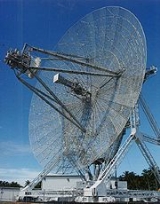
Parabolic reflector
More modern systems used a steerable parabolic Parabola

The parabola is a conic section [i] generated by the intersection of a right circular conical surface [i] ... 

 "dish" to create a tight broadcast beam, typically using the same dish as the receiver. Such systems often combined two radar frequencies in the same antenna in order to allow automatic steering, or radar lock.


Slotted waveguide

Applied similarly to the parabolic reflector the slotted waveguide is moved mechanically to scan and is particularly suitable for non-tracking surface scan systems, where the vertical pattern may remain constant. Owing to lower cost and less wind exposure, shipboard, airport surface, and harbour surveillance radars now use this in preference to the parabolic antenna.
Phased array
Another method of steering is used in a phased array radar. This uses an array Array

In computer programming [i], a group of [i] element [i]s of a spec ... 

 of similar aerials suitably spaced, the phase of the signal to each individual aerial being controlled so that the signal is reinforced in the desired direction and cancels in other directions. If the individual aerials are in one plane and the signal is fed to each aerial in phase with all others then the signal will reinforce in a direction perpendicular to that plane. By altering the relative phase of the signal fed to each aerial the direction of the beam can be moved because the direction of constructive interference will move. Because phased array radars require no physical movement the beam can scan at thousands of degrees per second, fast enough to irradiate and track many individual targets, and still run a wide-ranging search periodically. By simply turning some of the antennas on or off, the beam can be spread for searching, narrowed for tracking, or even split into two or more virtual radars. However, the beam cannot be effectively steered at small angles to the plane of the array, so for full coverage multiple arrays are required, typically disposed on the faces of a triangular pyramid .

Phased array radars have been in use since the earliest years of radar use in World War II World War II

World War II, or the Second World War, was a worldwide [i] conflict [i] fought betwe ... 

, but limitations of the electronics led to fairly poor accuracy. Phased array radars were originally used for missile Missile

A missile is a projectile [i] propelled as a weapon at a target. ... 

 defense. They are the heart of the ship-borne Aegis combat system Aegis combat system

The Aegis combat system is an integrated missile guidance [i] system used by the United States Navy [i].... 

, and the Patriot Missile System MIM-104 Patriot

The MIM-104 Patriot is the primary surface-to-air missile [i] system used by the United States Army [i] ... 

, and are increasingly used in other areas because the lack of moving parts makes them more reliable, and sometimes permits a much larger effective antenna, useful in fighter aircraft applications that offer only confined space for mechanical scanning.

As the price of electronics has fallen, phased array radars have become more and more common. Almost all modern military radar systems are based on phased arrays, where the small additional cost is far offset by the improved reliability of a system with no moving parts. Traditional moving-antenna designs are still widely used in roles where cost is a significant factor such as air traffic surveillance, weather radars and similar systems.

Phased array radars are also valued for use in aircraft, since they can track multiple targets. The first aircraft to use phased array radar was the Mikoyan MiG-31 Mikoyan MiG-31

The Mikoyan [i] MiG-31 is a supersonic interceptor [i] developed to replace the MiG-25 [i]... 

. The MiG-31M's SBI-16 Zaslon Mikoyan MiG-31

The Mikoyan [i] MiG-31 is a supersonic interceptor [i] developed to replace the MiG-25 [i]... 

 phased array radar is considered to be the world's most powerful fighter radar.

Frequency bands

The traditional band names originated as code-names during World War II World War II

World War II, or the Second World War, was a worldwide [i] conflict [i] fought betwe ... 

 and are still in military and aviation use throughout the world in the 21st century. They have been adopted in the United States by the IEEE Institute of Electrical and Electronics Engineers

The Institute of Electrical and Electronics Engineers or IEEE is an international non-profit [i], ... 

, and internationally by the ITU International Telecommunication Union

The International Telecommunication Union is an international organization [i] established to standardi ... 

. Most countries have additional regulations to control which parts of each band are available for civilian or military use.

Other users of the radio spectrum, such as the broadcasting and electronic countermeasures industries, have replaced the traditional military designations with their own systems.

Radar frequency bands
Band NameFrequency RangeWavelength RangeNotes
HF3-30 MHz10-100 m Metre

The metre, or meter , is a measure of length [i]. ... 

coastal radar systems, over-the-horizon radars; 'high frequency'
P< 300 MHz1 m+'P' for 'previous', applied retrospectively to early radar systems
VHF50-330 MHz0.9-6 mvery long range, ground penetrating; 'very high frequency'
UHF300-1000 MHz0.3-1 mvery long range , ground penetrating, foliage penetrating; 'ultra high frequency'
L1-2 GHz15-30 cmlong range air traffic control Air traffic control

Air traffic control is a service provided by ground-based controllers [i] who di ... 

 and surveillance Surveillance

Surveillance is the monitoring of behavior [i].
... 

; 'L' for 'long'
S2-4 GHz7.5-15 cmterminal air traffic control, long range weather, marine radar; 'S' for 'short'
C4-8 GHz3.75-7.5 cmSatellite transponders; a compromise between X and S bands; weather
X8-12 GHz2.5-3.75 cmmissile Missile

A missile is a projectile [i] propelled as a weapon at a target. ... 

 guidance, marine radar, weather, medium-resolution mapping and ground surveillance; in the USA United States

The United States of America, also known as the United States, the U.S., the U.S.A., a... 

 the narrow range 10.525 GHz ±25 MHz is used for airport Airport

An airport is a facility where aircraft [i] such as airplanes [i] and helicopters [i] can take off [i] a ... 

 radar. Named X band because the frequency was a secret during WW2.
Ku12-18 GHz1.67-2.5 cmhigh-resolution mapping, satellite altimetry; frequency just under K band
K18-27 GHz1.11-1.67 cmfrom German German language

German is a West Germanic language [i]. ... 

 kurz, meaning 'short'; limited use due to absorption by water vapour Water vapor

Water vapor, also aqueous vapor, is the gas [i] phase of water [i]. ... 

, so Ku and Ka were used instead for surveillance. K-band is used for detecting clouds by meteorologists, and by police for detecting speeding motorists. K-band radar guns operate at 24.150 ± 0.100 GHz.
Ka27-40 GHz0.75-1.11 cmmapping, short range, airport surveillance; frequency just above K band Photo radar, used to trigger cameras which take pictures of license plates of cars running red lights, operates at 34.300 ± 0.100 GHz.
mm40-300 GHz7.5 mm - 1 mm millimetre band, subdivided as below. The letter designators appear to be random, and the frequency ranges dependent on waveguide size. Multiple letters are assigned to these bands by different groups. These are from Baytron, a now defunct company that made test equipment.
Q40-60 GHz7.5 mm - 5 mm Used for Military communication. 
V50-75 GHz6.0 - 4 mm Very strongly absorbed by the atmosphere. 
E60-90 GHz6.0 - 3.33 mm 
W75-110 GHz2.7 - 4.0 mmused as a visual sensor for experimental autonomous vehicles, high-resolution meteorological observation, and imaging.

Radar modulators

Modulators are sometimes called pulsers and act to provide the short pulses of power to the magnetron Cavity magnetron

[i] [[microwave]... 

. In this way, the transmitted pulse of RF radiation is kept to a defined, and usually very short, duration. Modulators consist of a high voltage pulse generator formed from a HV supply, a pulse forming network or line and a high voltage switch such as a thyratron Thyratron

A thyratron is a type of gas filled tube [i] used as a high energy [i] electrical switch [i]. ... 

.

A klystron tube Klystron tube

A klystron is a specialized vacuum tube [i] called a linear-beam [i] tube. ... 

 is an amplifier, so it can be modulated by its low power input signal.

Radar Coolant

Coolanol and PAO are the two main coolants used to cool Airborn Radar equipment.

Navy has instituted a program for Pollution Prevention to reduce or eliminate the volume and toxicity of waste, air emissions, and effluent discharges. Because of this Coolanol is used less often today.

PAO is a synthetic lubricant composition is a blend of a polyol ester admixed with effective amounts of an antioxidant, yellow metal pacifier and rust inhibitors. The polyol ester blend includes a major proportion of poly ester blend formed by reacting poly partial esters with at least one C7 to C12 carboxylic acid mixed with an ester formed by reacting a polyol having at least two hydroxyl groups and at least one C8-C10 carboxylic acid. Preferably, the acids are linear and avoid those which can cause odours during use. Effective additives include secondary arylamine antioxidants, triazole derivative yellow metal pacifier and an amino acid derivative and substituted primary and secondary amine and/or diamine rust inhibitor.

A synthetic coolant/lubricant composition, comprising an ester mixture of:

50 to 80 weight percent of poly ester formed by reacting a poly partial ester and at least one linear monocarboxylic acid having from 6 to 12 carbon atoms, and 20 to 50 weight percent of a polyol ester formed by reacting a polyol having 5 to 8 carbon atoms and at least two hydroxyl groups with at least one linear monocarboxylic acid having from 7 to 12 carbon atoms, the weight percents based on the total weight of the composition.

Radar functions and roles


Detection and search radars

  • Early Warning Radar Systems
    • Early Warning Radar
    • Ground Control Intercept  Radar
    • Airborne Early Warning Airborne Early Warning

      An Airborne Early Warning system is a radar [i] system carried by an aircraft [i] which is designed to d ... 

    • Over-the-Horizon Over-the-horizon radar

      Over-the-horizon radar, or OTH, is a design concept for radar [i] systems to overcome the problem... 

       Radar
  • Target Acquisition Radar Systems
    • Surface-to-Air Missile Surface-to-air missile

      [i] designed to be launched from the ground to destroy [[aircraft]... 

       Systems
    • Anti-Aircraft Artillery Anti-aircraft warfare

      Anti-aircraft warfare, or air defense, is any method of engaging military aircraft [i] in combat f ... 

       Systems
  • Surface Search Radar Systems
    • Surface Search Radar
    • Coastal Surveillance Radar
    • Harbour Surveillance Radar
    • Antisubmarine Warfare Anti-submarine warfare

      If you were searching for A/S, you might have meant aksjeselskap [i], a Norwegian stock company form.' ... 

       Radar
  • Height Finder Radar Systems
  • Gap Filler Radar Systems

Threat radars

  • Target Tracking Systems
    • AAA Anti-aircraft warfare

      Anti-aircraft warfare, or air defense, is any method of engaging military aircraft [i] in combat f ... 

       Systems
    • SAM Surface-to-air missile

      [i] designed to be launched from the ground to destroy [[aircraft]... 

       Systems
    • Precision Approach Radar Precision Approach Radar

      Precision Approach Radar is a type of radar [i] guidance system designed to provide lateral and vertical ... 

       Systems
  • Multi-Function Systems
    • Fire Control Systems
      • Acquisition Mode
      • Semiautomatic Tracking Mode
      • Manual Tracking Mode
    • Airborne Intercept Radars
      • Search Mode
      • TA Mode
      • TT Mode
      • Target Illumination Mode
      • Missile Guidance Missile guidance

        Missile guidance technologies of missile [i] systems use a variety of methods to guide a missile to its ... 

         Mode

Missile guidance systems

  • Air-to-Air Missile Air-to-air missile

    An air-to-air missile is a guided missile [i] fired from an aircraft [i] for the purpose of destroying a ... 

  • Air-to-Surface Missile Air-to-surface missile

    An air-to-surface missile is a missile [i] designed to be launched from military [i] aircraft [i] and st ... 

  • SAM Surface-to-air missile

    [i] designed to be launched from the ground to destroy [[aircraft]... 

     Systems
  • Surface-to-Surface Missiles  Systems

Battlefield and reconnaissance radar

  • Battlefield Surveillance Systems
    • Battlefield Surveillance Radars
  • Countermortar/Counterbattery Systems
    • Shell Tracking Radars
  • Air Mapping Systems
    • Side Looking Airborne Radar
    • Synthetic Aperture Radar Synthetic aperture radar

      Synthetic aperture radar is a form of radar [i] in which sophisticated post-processing of radar data is ... 


Air Traffic Control and Navigation

  • Air Traffic Control Air traffic control

    Air traffic control is a service provided by ground-based controllers [i] who di ... 

     Systems
    • Air Traffic Control Radars Air traffic control

      Air traffic control is a service provided by ground-based controllers [i] who di ... 

    • Secondary Surveillance Radar
    • Ground Control Approach Radars
    • PAR Precision Approach Radar

      Precision Approach Radar is a type of radar [i] guidance system designed to provide lateral and vertical ... 

       Systems
  • Distance Measuring Equipment Distance Measuring Equipment

    Distance Measuring Equipment is a transponder-based radio navigation technology that measures distance b... 

  • Radio Beacons Radio beacon

    [i] that usually transmits a constant [[Signalling|signal]... 

  • Identification Friend or Foe  Systems
    • IFF Interrogator
    • IFF Transponder
  • Altimeter Altimeter

    An altimeter is an active instrument used to measure the altitude [i] of an object above a fixed level. ... 

      Radar Systems
  • Terrain-Following Radar  Systems

Space and range instrumentation Radar systems

  • Space Tracking Systems
  • Range Instrumentation Systems
  • Video Relay/Downlink Systems
  • Space-Based Radar

Weather-sensing Radar systems

  • Weather radar Weather radar

    A weather radar is a type of radar [i] used to locate precipitation [i], calculate its mot ... 


  • Doppler weather radar Doppler radar

    Doppler radar uses the Doppler effect [i] to measure the relative velocity information from a radar [i] ... 


  • Wind profiler Wind profiler

    A wind profiler is a piece of weather observing equipment that uses radar [i] or sound waves to detect t ... 

    s

See also


  • Types and uses of radar
    • Doppler radar Doppler radar

      Doppler radar uses the Doppler effect [i] to measure the relative velocity information from a radar [i] ... 

    • Planar array radar
    • Imaging radar
    • Incoherent scatter
    • 3D radar 3D radar

      3D radar provides for radar [i] coverage on three dimensions unlike the more common 2D radar [i].... 

    • SCR-270 radar SCR-270 radar

      The U.S. Army [i]'s SCR-270 was one of the first operational early warning radar [i]s. ... 

    • Low probability of intercept
    • Multistatic radar
    • Precision Approach Radar Precision Approach Radar

      Precision Approach Radar is a type of radar [i] guidance system designed to provide lateral and vertical ... 

  • Magnetron Cavity magnetron

    [i] [[microwave]... 

  • Klystron tube Klystron tube

    A klystron is a specialized vacuum tube [i] called a linear-beam [i] tube. ... 

  • Traveling wave tube Traveling wave tube

    A traveling wave tube is an electronic [i] device used to produce high-power radio frequency [i] ... 

  • Crossed-field amplifier
  • Gallium arsenide
  • List of radars
  • Radio Radio

    Radio is the wireless transmission of signals [i], by modulation [i] of electromagnetic waves [i] ... 

  • Similar detection and ranging methods
    • Sonar Sonar

      SONAR  — or sonar — is a technique that uses sound [i] propagation under wa ... 

    • LIDAR LIDAR

      LIDAR is a technology that determines distance to an object or surface using laser [i] pulses.... 

  • Other
    • Active Electronically Scanned Array Active Electronically Scanned Array

      An Active Electronically Scanned Array, also known as active phased array [i] radar [i] is a revol ... 

    • Continuous-wave radar
    • Doppler radar Doppler radar

      Doppler radar uses the Doppler effect [i] to measure the relative velocity information from a radar [i] ... 

       as weather radar
    • Millimetre cloud radar
    • Passive radar
    • Pulse-doppler
    • Radar gun Radar gun

      A radar gun is a small Doppler radar [i] used to detect the speed of objects. ... 

      , for traffic policing and as used in some sports
    • X-band radar X-band radar

      X band [i] is a radio [i] frequency [i] range designation that denotes the operational frequency of a specific... 


Further reading


External links


Notes


References