
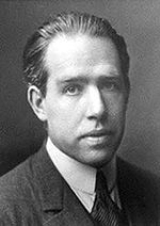
Niels Henrik David Bohr (ni:ls ˈboɐ̯ˀ; 7 October 1885 – 18 November 1962) was a
DanishDenmark is a Scandinavian country in Northern Europe. The countries of Denmark and Greenland, as well as the Faroe Islands, constitute the Kingdom of Denmark . It is the southernmost of the Nordic countries, southwest of Sweden and south of Norway, and bordered to the south by Germany. Denmark...
physicistA physicist is a scientist who studies or practices physics. Physicists study a wide range of physical phenomena in many branches of physics spanning all length scales: from sub-atomic particles of which all ordinary matter is made to the behavior of the material Universe as a whole...
who made foundational contributions to understanding atomic structure and
quantum mechanicsQuantum mechanics, also known as quantum physics or quantum theory, is a branch of physics providing a mathematical description of much of the dual particle-like and wave-like behavior and interactions of energy and matter. It departs from classical mechanics primarily at the atomic and subatomic...
, for which he received the Nobel Prize in
PhysicsPhysics is a natural science that involves the study of matter and its motion through spacetime, along with related concepts such as energy and force. More broadly, it is the general analysis of nature, conducted in order to understand how the universe behaves.Physics is one of the oldest academic...
in 1922. Bohr mentored and collaborated with many of the top physicists of the century at his institute in
CopenhagenCopenhagen is the capital and largest city of Denmark, with an urban population of 1,199,224 and a metropolitan population of 1,930,260 . With the completion of the transnational Øresund Bridge in 2000, Copenhagen has become the centre of the increasingly integrating Øresund Region...
. He was part of a team of physicists working on the
Manhattan ProjectThe Manhattan Project was a research and development program, led by the United States with participation from the United Kingdom and Canada, that produced the first atomic bomb during World War II. From 1942 to 1946, the project was under the direction of Major General Leslie Groves of the US Army...
. Bohr married Margrethe Nørlund in 1912, and one of their sons, Aage Bohr, grew up to be an important physicist who in 1975 also received the Nobel Prize. Bohr has been described as one of the most influential scientists of the 20th century.
Early years
Bohr was born in
CopenhagenCopenhagen is the capital and largest city of Denmark, with an urban population of 1,199,224 and a metropolitan population of 1,930,260 . With the completion of the transnational Øresund Bridge in 2000, Copenhagen has become the centre of the increasingly integrating Øresund Region...
, Denmark, in 1885. His father,
Christian BohrChristian Harald Lauritz Peter Emil Bohr was a Danish physician, father of the physicist and Nobel laureate Niels Bohr, as well as the mathematician Harald Bohr and grandfather of another physicist and nobel laureate Aage Bohr...
, was professor of
physiologyPhysiology is the science of the function of living systems. This includes how organisms, organ systems, organs, cells, and bio-molecules carry out the chemical or physical functions that exist in a living system. The highest honor awarded in physiology is the Nobel Prize in Physiology or...
at the
University of CopenhagenThe University of Copenhagen is the oldest and largest university and research institution in Denmark. Founded in 1479, it has more than 37,000 students, the majority of whom are female , and more than 7,000 employees. The university has several campuses located in and around Copenhagen, with the...
(it is his name which is given to the
Bohr shiftBohr effect is a property of hemoglobin first described in 1904 by the Danish physiologist Christian Bohr , which states that an increasing concentration of protons and/or carbon dioxide will reduce the oxygen affinity of hemoglobin...
or
Bohr effectBohr effect is a property of hemoglobin first described in 1904 by the Danish physiologist Christian Bohr , which states that an increasing concentration of protons and/or carbon dioxide will reduce the oxygen affinity of hemoglobin...
), while his mother, Ellen Adler Bohr, came from a wealthy Jewish family prominent in Danish banking and parliamentary circles. His brother was
Harald BohrHarald August Bohr was a Danish mathematician and football player. After receiving his doctorate in 1910, Bohr became an eminent mathematician, founding the field of almost periodic functions. His brother was the Nobel Prize-winning physicist Niels Bohr...
, a
mathematicianA mathematician is a person whose primary area of study is the field of mathematics. Mathematicians are concerned with quantity, structure, space, and change....
and Olympic footballer who played on the
Danish national teamThe Denmark national football team represents Denmark in association football and is controlled by the Danish Football Association , the governing body for the football clubs which are organized under DBU...
. Niels Bohr was a passionate footballer as well, and the two brothers played a number of matches for the Copenhagen-based
Akademisk BoldklubAkademisk Boldklub or AB is a Danish professional football club from Copenhagen,currently playing at the second highest level in Danish domestic football, the 1st Division.-History:...
, with Niels in goal.
In 1903 Bohr enrolled as an undergraduate at Copenhagen University, initially studying philosophy and mathematics. In 1905, prompted by a gold medal competition sponsored by the
Royal Danish Academy of Sciences and LettersRoyal Danish Academy of Sciences and Letters is a Danish non-governmental science Academy, founded 13 November 1742 by permission of the King Christian VI, as a historical Collegium Antiquitatum...
, he conducted a series of experiments to examine the properties of
surface tensionSurface tension is a property of the surface of a liquid that allows it to resist an external force. It is revealed, for example, in floating of some objects on the surface of water, even though they are denser than water, and in the ability of some insects to run on the water surface...
, using his father's laboratory in the university, familiar to him from assisting there since childhood. His essay won the prize, and it was this success that decided Bohr to abandon philosophy and adopt physics. He continued as a graduate student at the University of Copenhagen, under the physicist
Christian ChristiansenChristian Christiansen was a Danish physicist.Christiansen first taught at the local polytechnical school. In 1886 he was appointed to a chair for physics at the University of Copenhagen....
, receiving his doctorate in 1911.
As a post-doctoral student, Bohr first conducted experiments under
J. J. ThomsonSir Joseph John "J. J." Thomson, OM, FRS was a British physicist and Nobel laureate. He is credited for the discovery of the electron and of isotopes, and the invention of the mass spectrometer...
, of
Trinity College, CambridgeTrinity College is a constituent college of the University of Cambridge. Trinity has more members than any other college in Cambridge or Oxford, with around 700 undergraduates, 430 graduates, and over 170 Fellows...
and
Cavendish LaboratoryThe Cavendish Laboratory is the Department of Physics at the University of Cambridge, and is part of the university's School of Physical Sciences. It was opened in 1874 as a teaching laboratory....
. In 1912 he met and later joined
Ernest RutherfordErnest Rutherford, 1st Baron Rutherford of Nelson OM, FRS was a New Zealand-born British chemist and physicist who became known as the father of nuclear physics...
at Manchester University, where on and off he spent four fruitful years in association with the older physics professor. In 1916, Bohr returned permanently to the University of Copenhagen, where he was appointed to the Chair of Theoretical Physics, a position created especially for him. In 1918 he began efforts to establish the University Institute of Theoretical Physics, which he later directed.
Earlier in 1910 Bohr had met Margrethe Nørlund, sister of the mathematician Niels Erik Nørlund. They were married in Copenhagen in 1912. Of their six sons, the oldest died in a boating accident and another died from childhood meningitis. The others went on to lead successful lives, including Aage Bohr, who became a very successful physicist and, like his father, was awarded the Nobel Prize in physics, in 1975. His other sons were Hans Henrik, a physician, Erik, a chemical engineer, and Ernest, a lawyer.
Physics
In 1922, Bohr was awarded the Nobel Prize in
physicsPhysics is a natural science that involves the study of matter and its motion through spacetime, along with related concepts such as energy and force. More broadly, it is the general analysis of nature, conducted in order to understand how the universe behaves.Physics is one of the oldest academic...
"for his services in the investigation of the
structure of atomsThe atom is a basic unit of matter that consists of a dense central nucleus surrounded by a cloud of negatively charged electrons. The atomic nucleus contains a mix of positively charged protons and electrically neutral neutrons...
and of the radiation emanating from them." The award recognized his early leading work in the emerging field of
Quantum MechanicsQuantum mechanics, also known as quantum physics or quantum theory, is a branch of physics providing a mathematical description of much of the dual particle-like and wave-like behavior and interactions of energy and matter. It departs from classical mechanics primarily at the atomic and subatomic...
.
While at Manchester University, Bohr had adapted Rutherford's nuclear structure to
Max PlanckMax Karl Ernst Ludwig Planck, ForMemRS, was a German physicist who actualized the quantum physics, initiating a revolution in natural science and philosophy. He is regarded as the founder of the quantum theory, for which he received the Nobel Prize in Physics in 1918.-Life and career:Planck came...
's
quantumIn physics, a quantum is the minimum amount of any physical entity involved in an interaction. Behind this, one finds the fundamental notion that a physical property may be "quantized," referred to as "the hypothesis of quantization". This means that the magnitude can take on only certain discrete...
theory and so obtained a model of atomic structure which, with later improvements – mainly as a result of Heisenberg's concepts – remains valid to this day. Bohr published his
modelIn atomic physics, the Bohr model, introduced by Niels Bohr in 1913, depicts the atom as a small, positively charged nucleus surrounded by electrons that travel in circular orbits around the nucleus—similar in structure to the solar system, but with electrostatic forces providing attraction,...
of
atomic structureThe atom is a basic unit of matter that consists of a dense central nucleus surrounded by a cloud of negatively charged electrons. The atomic nucleus contains a mix of positively charged protons and electrically neutral neutrons...
in 1913. Here he introduced the theory of
electronThe electron is a subatomic particle with a negative elementary electric charge. It has no known components or substructure; in other words, it is generally thought to be an elementary particle. An electron has a mass that is approximately 1/1836 that of the proton...
s traveling in
orbitIn physics, an orbit is the gravitationally curved path of an object around a point in space, for example the orbit of a planet around the center of a star system, such as the Solar System...
s around the atom's
nucleusThe nucleus is the very dense region consisting of protons and neutrons at the center of an atom. It was discovered in 1911, as a result of Ernest Rutherford's interpretation of the famous 1909 Rutherford experiment performed by Hans Geiger and Ernest Marsden, under the direction of Rutherford. The...
, the chemical properties of each element being largely determined by the number of electrons in the outer orbits of its atoms. Bohr also introduced the idea that an electron could drop from a higher-energy orbit to a lower one, in the process emitting a
photonIn physics, a photon is an elementary particle, the quantum of the electromagnetic interaction and the basic unit of light and all other forms of electromagnetic radiation. It is also the force carrier for the electromagnetic force...
(light
quantumIn physics, a quantum is the minimum amount of any physical entity involved in an interaction. Behind this, one finds the fundamental notion that a physical property may be "quantized," referred to as "the hypothesis of quantization". This means that the magnitude can take on only certain discrete...
) of discrete energy. This became a basis for
quantum theoryQuantum mechanics, also known as quantum physics or quantum theory, is a branch of physics providing a mathematical description of much of the dual particle-like and wave-like behavior and interactions of energy and matter. It departs from classical mechanics primarily at the atomic and subatomic...
.
Among the international community of nuclear physicists, Bohr came to play the role of convener of discussion groups and lectures, as well as being a mentor and an advisor. With the assistance of the Danish government and the
Carlsberg FoundationCarlsberg Foundation was founded by J. C. Jacobsen in 1876 and owns 30,3% of the shares in Carlsberg Group and has 74,2% of the voting power.The purpose of the foundation is to run and fund Carlsberg Laboratory, the museum at Frederiksborg Palace, to fund scientific research, run the Ny Carlsberg...
, he succeeded in founding the Institute of Theoretical Physics in 1921, of which he became director. Bohr's institute served as a focal point for researchers into Quantum Mechanics and related subjects in the 1920s and '30s, when most of the world's best known theoretical physicists spent some time in his company. Bohr became widely appreciated as their congenial host and eminent colleague, both at the Institute and at the Foundation's mansion in Carlsberg, where he and his family resided after 1932.
Bohr also conceived the principle of
complementarityIn physics, complementarity is a basic principle of quantum theory proposed by Niels Bohr, closely identified with the Copenhagen interpretation, and refers to effects such as the wave–particle duality...
: that items could be separately analyzed as having several contradictory properties. For example, physicists currently conclude that light behaves either as a wave or a stream of particles depending on the experimental framework – two apparently mutually exclusive properties – on the basis of this principle. Bohr found philosophical applications for this daring principle.
Albert EinsteinAlbert Einstein was a German-born theoretical physicist who developed the theory of general relativity, effecting a revolution in physics. For this achievement, Einstein is often regarded as the father of modern physics and one of the most prolific intellects in human history...
much preferred the determinism of classical physics over the probabilistic new quantum physics (to which among many others Einstein himself had 'unwittingly' contributed). Philosophical issues that arose from the novel aspects of Quantum Mechanics became widely celebrated subjects of discussion. Einstein and Bohr had good-natured arguments over such issues throughout their lives. See article
Bohr–Einstein debatesThe Bohr–Einstein debates were a series of public disputes about quantum mechanics between Albert Einstein and Niels Bohr, who were two of its founders. Their debates are remembered because of their importance to the philosophy of science. An account of them has been written by Bohr in an article...
.
Werner HeisenbergWerner Karl Heisenberg was a German theoretical physicist who made foundational contributions to quantum mechanics and is best known for asserting the uncertainty principle of quantum theory...
worked as an assistant to Bohr and university lecturer in Copenhagen from 1926 to 1927. It was in Copenhagen, in 1927, that Heisenberg developed his
uncertainty principleIn quantum mechanics, the Heisenberg uncertainty principle states a fundamental limit on the accuracy with which certain pairs of physical properties of a particle, such as position and momentum, can be simultaneously known...
, while working on the mathematical foundations of quantum mechanics. Heisenberg later became head of the
German nuclear energy projectThe German nuclear energy project, , was an attempted clandestine scientific effort led by Germany to develop and produce the atomic weapons during the events involving the World War II...
. In April 1940, early in World War II,
GermanyNazi Germany , also known as the Third Reich , but officially called German Reich from 1933 to 1943 and Greater German Reich from 26 June 1943 onward, is the name commonly used to refer to the state of Germany from 1933 to 1945, when it was a totalitarian dictatorship ruled by...
invaded and occupied Denmark. In September 1941, Bohr was visited by Heisenberg in Copenhagen. See section below.
Manhattan Project
In September 1943, reliable word reached Bohr about his imminent arrest by the German police; the Danish resistance quickly managed to help Bohr and his wife escape by sea to Sweden. Soon after, Bohr was flown in a military aircraft to Britain. There he was introduced to the then-secret atomic bomb project (see
Political Activities section below for greater detail). Eventually he was directed to the project's principal location in the United States of America.
Bohr worked on the
Manhattan ProjectThe Manhattan Project was a research and development program, led by the United States with participation from the United Kingdom and Canada, that produced the first atomic bomb during World War II. From 1942 to 1946, the project was under the direction of Major General Leslie Groves of the US Army...
at the top-secret
Los AlamosLos Alamos National Laboratory is a United States Department of Energy national laboratory, managed and operated by Los Alamos National Security , located in Los Alamos, New Mexico...
laboratory in
New MexicoNew Mexico is a state located in the southwest and western regions of the United States. New Mexico is also usually considered one of the Mountain States. With a population density of 16 per square mile, New Mexico is the sixth-most sparsely inhabited U.S...
, where he was known by the name of
Nicholas Baker for security reasons. His role on the project was as the knowledgeable consultant or "father confessor". He often expressed social concern about such weaponry and an eventual
nuclear arms raceThe nuclear arms race was a competition for supremacy in nuclear warfare between the United States, the Soviet Union, and their respective allies during the Cold War...
, and is quoted as saying, "That is why I went to America. They didn't need my help in making the atom bomb."
Bohr believed that atomic secrets should be shared by the international scientific community. After meeting with Bohr, J. Robert Oppenheimer suggested that Bohr visit President
Franklin D. RooseveltFranklin Delano Roosevelt , also known by his initials, FDR, was the 32nd President of the United States and a central figure in world events during the mid-20th century, leading the United States during a time of worldwide economic crisis and world war...
to convince him that the Manhattan Project should be shared with the Russians in the hope of speeding up its results. Roosevelt suggested that Bohr return to the United Kingdom to try to win British approval.
Winston ChurchillSir Winston Leonard Spencer-Churchill, was a predominantly Conservative British politician and statesman known for his leadership of the United Kingdom during the Second World War. He is widely regarded as one of the greatest wartime leaders of the century and served as Prime Minister twice...
disagreed with the idea of openness towards the Russians to the point that he wrote in a letter: "It seems to me Bohr ought to be confined or at any rate made to see that he is very near the edge of mortal crimes."
Later years
Following the war Bohr returned to Copenhagen. He continued to advocate the peaceful use of
nuclear energyNuclear power is the use of sustained nuclear fission to generate heat and electricity. Nuclear power plants provide about 6% of the world's energy and 13–14% of the world's electricity, with the U.S., France, and Japan together accounting for about 50% of nuclear generated electricity...
. When awarded the
Order of the ElephantThe Order of the Elephant is the highest order of Denmark. It has origins in the 15th century, but has officially existed since 1693, and since the establishment of constitutional monarchy in 1849, is now almost exclusively bestowed on royalty and heads of state.- History :A Danish religious...
by the Danish government, he designed his own
coat of armsA coat of arms is a unique heraldic design on a shield or escutcheon or on a surcoat or tabard used to cover and protect armour and to identify the wearer. Thus the term is often stated as "coat-armour", because it was anciently displayed on the front of a coat of cloth...
which featured a
taijituTaijitu is a term which refers to a Chinese symbol for the concept of yin and yang...
(symbol of yin and yang) and the motto in : "opposites are complementary". He died in
CopenhagenCopenhagen is the capital and largest city of Denmark, with an urban population of 1,199,224 and a metropolitan population of 1,930,260 . With the completion of the transnational Øresund Bridge in 2000, Copenhagen has become the centre of the increasingly integrating Øresund Region...
in 1962 of heart failure. He is buried in the Assistens Kirkegård in the
NørrebroNørrebro is one of the 10 official districts of Copenhagen, Denmark. It is northwest of the city centre, beyond the location of the old Northern Gate , which, until dismantled in 1856, was near the current Nørreport station.-Geography:...
section of Copenhagen.
Contributions to Physics and Chemistry
- The Bohr model
In atomic physics, the Bohr model, introduced by Niels Bohr in 1913, depicts the atom as a small, positively charged nucleus surrounded by electrons that travel in circular orbits around the nucleus—similar in structure to the solar system, but with electrostatic forces providing attraction,...
of the atom, the theory that electronThe electron is a subatomic particle with a negative elementary electric charge. It has no known components or substructure; in other words, it is generally thought to be an elementary particle. An electron has a mass that is approximately 1/1836 that of the proton...
s travel in discrete orbitIn physics, an orbit is the gravitationally curved path of an object around a point in space, for example the orbit of a planet around the center of a star system, such as the Solar System...
s around the atom's nucleusThe nucleus is the very dense region consisting of protons and neutrons at the center of an atom. It was discovered in 1911, as a result of Ernest Rutherford's interpretation of the famous 1909 Rutherford experiment performed by Hans Geiger and Ernest Marsden, under the direction of Rutherford. The...
.
- The shell model of the atom, where the chemical properties of an element are determined by the electrons in the outermost orbit.
- The correspondence principle
In physics, the correspondence principle states that the behavior of systems described by the theory of quantum mechanics reproduces classical physics in the limit of large quantum numbers....
, the basic tool of Old quantum theoryThe old quantum theory was a collection of results from the years 1900–1925 which predate modern quantum mechanics. The theory was never complete or self-consistent, but was a collection of heuristic prescriptions which are now understood to be the first quantum corrections to classical mechanics...
.
- The liquid drop model of the atomic nucleus
The nucleus is the very dense region consisting of protons and neutrons at the center of an atom. It was discovered in 1911, as a result of Ernest Rutherford's interpretation of the famous 1909 Rutherford experiment performed by Hans Geiger and Ernest Marsden, under the direction of Rutherford. The...
.
- Identified the isotope of uranium that was responsible for slow-neutron fission – 235U.
- Much work on the Copenhagen interpretation
The Copenhagen interpretation is one of the earliest and most commonly taught interpretations of quantum mechanics. It holds that quantum mechanics does not yield a description of an objective reality but deals only with probabilities of observing, or measuring, various aspects of energy quanta,...
of quantum mechanicsQuantum mechanics, also known as quantum physics or quantum theory, is a branch of physics providing a mathematical description of much of the dual particle-like and wave-like behavior and interactions of energy and matter. It departs from classical mechanics primarily at the atomic and subatomic...
.
- The principle of complementarity
In physics, complementarity is a basic principle of quantum theory proposed by Niels Bohr, closely identified with the Copenhagen interpretation, and refers to effects such as the wave–particle duality...
: that items could be separately analyzed as having several contradictory properties.
Denmark during World War II
As regards the
Occupation of DenmarkNazi Germany's occupation of Denmark began with Operation Weserübung on 9 April 1940, and lasted until German forces withdrew at the end of World War II following their surrender to the Allies on 5 May 1945. Contrary to the situation in other countries under German occupation, most Danish...
during World War II, and especially the events surrounding the Danish policy of cooperation with Nazi Germany and the treatment of Danish Jews, most Danish archives remained sealed until 1998, many remain sealed to this day, and opinions of Danish historical scholars and politicians on these dark topics remain deeply divided. So too, scholarly opinions remain divided on the importance of the political activities of Niels Bohr during this period. All sources agree that almost as soon as Hitler had taken power in Germany, Bohr played an active role in rescuing Jewish physicists out of Germany, typically offering them haven in Copenhagen before they could take up permanent residence elsewhere.
As for
Sweden during World War IISweden during World War II maintained a policy of neutrality. When the Second World War began on September 1, 1939, the fate of Sweden was unclear...
and especially in the autumn of 1943, it was far from certain that they would accept Danish Jews attempting to escape Hitler's deportation order. As related by Bohr's friend
Stefan RozentalStefan Rozental , was a nuclear physicist, specialising in quantum mechanics. Trapped outside Poland when World War I started, he and his parents ended up in Denmark and spent four years from 1915 there before they returned to their native Poland in 1919 after the war...
and the historian
Richard RhodesRichard Lee Rhodes is an American journalist, historian, and author of both fiction and non-fiction , including the Pulitzer Prize-winning The Making of the Atomic Bomb , and most recently, The Twilight of the Bombs...
, Bohr was immediately smuggled out of Denmark in order to secure his services for the Manhattan project. But rather than proceeding promptly to the United States, as had been planned for him, on 30 September 1943 Bohr persuaded King Gustav of Sweden to make public Sweden's willingness to provide asylum, on 2 October 1943 Swedish radio broadcast that Sweden was ready to offer asylum, and there followed quickly thereafter the mass
rescue of the Danish JewsThe rescue of the Danish Jews occurred during Nazi Germany's occupation of Denmark during World War II. On October 1st 1943 Nazi leader Adolf Hitler ordered Danish Jews to be arrested and deported...
by their countrymen. Historians are divided not on Bohr's political actions in Sweden, but rather on the implications and impacts of those actions. Some argue that Bohr was among those rescued and therefore could have played no role in facilitating the mass rescue, whereas Rhodes and others
interpret Bohr's political action in Sweden as being a decisive event without which that mass rescue could not have occurred. Whether or not the mass rescue could have happened without Bohr's political activity in Sweden, there is no doubt that he did all that he could for his countrymen.
Nuclear weapons
"
Tube AlloysTube Alloys was the code-name for the British nuclear weapon directorate during World War II, when the development of nuclear weapons was kept at such a high level of secrecy that it had to be referred to by code even in the highest circles of government...
" was the code-name for the British nuclear weapon program. British intelligence inquired about Bohr's availability for work or insights of particular value. Bohr's reply made it clear that he could not help. This reply, like his reaction to Heisenberg, made sure that if Gestapo intercepted anything attributed to Bohr it would point to no knowledge regarding nuclear energy as it stood in 1941. This does not exclude the possibility that Bohr privately made calculations going further than his work in 1939 with Wheeler.
The allied powers learned in 1944 that Germany had no atomic weapons. Bohr hoped then that greater atomic armament could be prevented by some new international agreements, before the weapons were used in the war. He also hoped that new contacts could be established between the Western and Russian nuclear scientists, as signs of cooperation between the soon-to-be victorious powers in the war. Bohr's friend Supreme Court Justice Felix Frankfurter informed President Roosevelt about Bohr's opinions, and a meeting between them was organised 26 August 1944. President Roosevelt, however, did not agree with Bohr. The British Prime Minister Winston Churchill also refused, after a meeting with Bohr 16 May 1944. He disagreed with the idea of any openness towards the Russians to the point that he wrote in a letter: "It seems to me Bohr ought to be confined or at any rate made to see, that he is very near the edge of mortal crimes."
After leaving Denmark in the dramatic day and night (October 1943) when most Jews were able to escape to Sweden due to exceptional circumstances (see
Rescue of the Danish JewsThe rescue of the Danish Jews occurred during Nazi Germany's occupation of Denmark during World War II. On October 1st 1943 Nazi leader Adolf Hitler ordered Danish Jews to be arrested and deported...
), Bohr was quickly asked again to join the British effort and he was flown to the UK. He was evacuated from Stockholm in 1943 in an unarmed
De Havilland MosquitoThe de Havilland DH.98 Mosquito was a British multi-role combat aircraft that served during the Second World War and the postwar era. It was known affectionately as the "Mossie" to its crews and was also nicknamed "The Wooden Wonder"...
operated by
British Overseas Airways CorporationThe British Overseas Airways Corporation was the British state airline from 1939 until 1946 and the long-haul British state airline from 1946 to 1974. The company started life with a merger between Imperial Airways Ltd. and British Airways Ltd...
(BOAC). Passengers on BOAC's Mosquitos were carried in an improvised cabin in the bomb bay. The flight almost ended in tragedy as Bohr did not don his oxygen equipment as instructed and passed out at high altitude. He would have died had not the pilot surmising from Bohr's lack of response to intercom communication that he had lost consciousness, descended to a lower altitude for the remainder of the flight. Bohr's comment was that he had slept like a baby for the entire flight.
As part of the UK team on "Tube Alloys" Bohr went to
Los AlamosLos Alamos National Laboratory is a United States Department of Energy national laboratory, managed and operated by Los Alamos National Security , located in Los Alamos, New Mexico...
.
OppenheimerJulius Robert Oppenheimer was an American theoretical physicist and professor of physics at the University of California, Berkeley. Along with Enrico Fermi, he is often called the "father of the atomic bomb" for his role in the Manhattan Project, the World War II project that developed the first...
credited Bohr warmly for his guiding help during certain discussions among scientists there. Discreetly, he met President
Franklin D. RooseveltFranklin Delano Roosevelt , also known by his initials, FDR, was the 32nd President of the United States and a central figure in world events during the mid-20th century, leading the United States during a time of worldwide economic crisis and world war...
and later
Winston ChurchillSir Winston Leonard Spencer-Churchill, was a predominantly Conservative British politician and statesman known for his leadership of the United Kingdom during the Second World War. He is widely regarded as one of the greatest wartime leaders of the century and served as Prime Minister twice...
to warn against the perilous perspectives that would follow from separate development of nuclear weapons by several powers rather than some form of controlled sharing of the knowledge, which would spread quickly in any case. Only in the 1950s, after the Soviet Union's first nuclear weapon test, was it possible to create the
International Atomic Energy AgencyThe International Atomic Energy Agency is an international organization that seeks to promote the peaceful use of nuclear energy, and to inhibit its use for any military purpose, including nuclear weapons. The IAEA was established as an autonomous organization on 29 July 1957...
along the lines of Bohr's suggestion.
Open World
Bohr advocated informing the Soviet authorities that the atomic bomb would soon be in use. In 1944 he obtained an audience with
Winston ChurchillSir Winston Leonard Spencer-Churchill, was a predominantly Conservative British politician and statesman known for his leadership of the United Kingdom during the Second World War. He is widely regarded as one of the greatest wartime leaders of the century and served as Prime Minister twice...
, who became worried about whether Bohr was a security risk. In 1950 he addressed an 'Open Letter' to the United Nations.
Relationship
Bohr and
Werner HeisenbergWerner Karl Heisenberg was a German theoretical physicist who made foundational contributions to quantum mechanics and is best known for asserting the uncertainty principle of quantum theory...
enjoyed at first a strong relationship. It began as one between a mentor and his protégé. Bohr had become aware of Heisenberg's talent during a lecture Heisenberg gave in Göttingen in 1922. During the mid-1920s, Heisenberg worked with Bohr at the institute in Copenhagen. Heisenberg, like most of Bohr's assistants, learned Danish. Heisenberg's
uncertainty principleIn quantum mechanics, the Heisenberg uncertainty principle states a fundamental limit on the accuracy with which certain pairs of physical properties of a particle, such as position and momentum, can be simultaneously known...
was developed during this period, as was Bohr's complementarity principle.
During the 1930s, however, the relationship became constricted due to political developments in Germany. During World War II, Bohr, who was of half-Jewish ancestry, remained for several years in occupied Denmark. Heisenberg in Germany had become head of the German nuclear effort. Heisenberg made a famous visit to Bohr in September 1941. During a private moment outside with Bohr, Heisenberg, it seems, began to address nuclear energy and morality as well as the war. Neither Bohr nor Heisenberg spoke about it in any detail and left few written records of this part of the meeting, when they were alone. Bohr seems to have reacted by terminating that conversation abruptly while not giving Heisenberg hints in any direction.
While some suggest that the relationship became strained at this meeting, other evidence shows that the level of contact had been reduced considerably for some time already. Heisenberg suggested that the fracture occurred later. In correspondence to his wife, Heisenberg described the final visit of the trip: "Today I was once more, with Weizsäcker, at Bohr's. In many ways this was especially nice, the conversation revolved for a large part of the evening around purely human concerns, Bohr was reading aloud, I played a Mozart Sonata (A-Major)."
Ivan SupekIvan Supek was a Croatian physicist, philosopher, writer, playwright, peace activist and humanist.-Early years and education:Supek was born on April 8, 1915 in Zagreb, Croatia...
, one of Heisenberg's students and friends, claimed that the main figure of the meeting was actually
WeizsäckerCarl Friedrich Freiherr von Weizsäcker was a German physicist and philosopher. He was the longest-living member of the research team which performed nuclear research in Germany during the Second World War, under Werner Heisenberg's leadership...
who tried to persuade Bohr to mediate peace between Great Britain and Germany.
Speculation
In 1957, while the author
Robert JungkRobert Jungk , also known as Robert Baum and Robert Baum-Jungk, was an Austrian writer and journalist who wrote mostly on issues relating to nuclear weapons....
was working on the book
Brighter Than a Thousand Suns (see letter page 100 in this book), Heisenberg wrote to Jungk explaining that he had visited Copenhagen to communicate to Bohr the views of the German scientists, that production of an atomic weapon was possible with great efforts and this raised enormous responsibilities on the worlds scientists on either side. But Bohr was shocked by the news, that Heisenberg was involved in such studies. And the conversation went wrong because of this.
The German attemptsThe German nuclear energy project, , was an attempted clandestine scientific effort led by Germany to develop and produce the atomic weapons during the events involving the World War II...
were mostly focused on energy production and Heisenberg's circle of colleagues tried probably to keep it that way. Heisenberg acknowledged that his cryptic approach of the subject had so alarmed Bohr that the discussion failed. Heisenberg nuanced his claims and avoided the implication that he and his colleagues had sabotaged the bomb effort. The production of the bomb in USA showed that it craved enormous resources, which was never considered in this scale in Germany during the war.
When Bohr saw Jungk's erroneous depiction in the Danish translation of the book, he disagreed. He drafted (but never sent) a letter to Heisenberg, stating that he never understood the purpose of Heisenberg's visit and was shocked by Heisenberg's opinion that Germany would win the war. And atomic weapons could be decisive in a long war. Bohr had described the possibility of an atomic weapon in a lecture in England 1939.
Michael FraynMichael J. Frayn is an English playwright and novelist. He is best known as the author of the farce Noises Off and the dramas Copenhagen and Democracy...
's play
CopenhagenCopenhagen is a play by Michael Frayn, based around an event that occurred in Copenhagen in 1941, a meeting between the physicists Niels Bohr and Werner Heisenberg. It debuted in London in 1998...
(1998), which was performed in London (for five years), Copenhagen, Gothenburg, Rome, Athens, and Geneva and on Broadway in New York, explores what might have happened at the 1941 meeting between Heisenberg and Bohr. Frayn points in particular to the onus of being one of the few to understand what it would mean to create a nuclear weapon.
Kierkegaard's influence on Bohr
It is generally accepted that Bohr read the 19th century Danish
ChristianChristian existentialism describes a group of writings that take a philosophically existentialist approach to Christian theology. The school of thought is often traced back to the work of the Danish philosopher and theologian considered the father of existentialism, Søren Kierkegaard...
existentialistExistentialism is a term applied to a school of 19th- and 20th-century philosophers who, despite profound doctrinal differences, shared the belief that philosophical thinking begins with the human subject—not merely the thinking subject, but the acting, feeling, living human individual...
philosopherChristian philosophy may refer to any development in philosophy that is characterised by coming from a Christian tradition.- Origins of Christian philosophy :...
,
Søren KierkegaardSøren Aabye Kierkegaard was a Danish Christian philosopher, theologian and religious author. He was a critic of idealist intellectuals and philosophers of his time, such as Georg Wilhelm Friedrich Hegel, Friedrich Wilhelm Joseph Schelling and Karl Wilhelm Friedrich Schlegel...
. Richard Rhodes argues in
The Making of the Atomic BombThe Making of the Atomic Bomb, a book written by Richard Rhodes, won the 1988 Pulitzer Prize for General Non-Fiction, a National Book Award and a National Book Critics Circle Award...
that Bohr was influenced by Kierkegaard via the philosopher
Harald HøffdingHarald Høffding was a Danish philosopher.-Life:Born and educated in Copenhagen, he became a schoolmaster, and ultimately in 1883 a professor at the University of Copenhagen...
, who was strongly influenced by Kierkegaard and who was an old friend of Bohr's father. In 1909, Bohr sent his brother Kierkegaard's
Stages on Life's WayStages on Life's Way is a philosophical work by Søren Kierkegaard written in 1845. The book was written as a continuation of Kierkegaard's masterpiece Either/Or...
as a birthday gift. In the enclosed letter, Bohr wrote, "It is the only thing I have to send home; but I do not believe that it would be very easy to find anything better.... I even think it is one of the most delightful things I have ever read." Bohr enjoyed Kierkegaard's language and literary style, but mentioned that he had some "disagreement with [Kierkegaard's ideas]."
Given this, there has been some dispute over whether Kierkegaard influenced Bohr's philosophy and science. David Favrholdt argues that Kierkegaard had minimal influence over Bohr's work, taking Bohr's statement about disagreeing with Kierkegaard at face value, while Jan Faye endorses the opposing point of view by arguing that one can disagree with the content of a theory while accepting its general premises and structure.
Legacy

- He was one of the founding fathers of CERN
The European Organization for Nuclear Research , known as CERN , is an international organization whose purpose is to operate the world's largest particle physics laboratory, which is situated in the northwest suburbs of Geneva on the Franco–Swiss border...
in 1954.
- Received the first ever Atoms for Peace Award
The Atoms for Peace Award was established in 1955 through a grant of $1,000,000 by the Ford Motor Company Fund. An independent nonprofit corporation was set up to administer the award for the development or application of peaceful nuclear technology. It was created in response to U.S. President...
in 1957.
- In 1965, three years after Bohr's death, the Institute of Physics at the University of Copenhagen
The University of Copenhagen is the oldest and largest university and research institution in Denmark. Founded in 1479, it has more than 37,000 students, the majority of whom are female , and more than 7,000 employees. The university has several campuses located in and around Copenhagen, with the...
changed its name to the Niels Bohr InstituteThe Niels Bohr Institute is a research institute of the University of Copenhagen. The research of the institute spans astronomy, geophysics, nanotechnology, particle physics, quantum mechanics and biophysics....
.
- The Bohr model
In atomic physics, the Bohr model, introduced by Niels Bohr in 1913, depicts the atom as a small, positively charged nucleus surrounded by electrons that travel in circular orbits around the nucleus—similar in structure to the solar system, but with electrostatic forces providing attraction,...
s semicentennial was commemorated in Denmark on 21 November 1963 with a postage stamp depicting Bohr, the hydrogenHydrogen is the chemical element with atomic number 1. It is represented by the symbol H. With an average atomic weight of , hydrogen is the lightest and most abundant chemical element, constituting roughly 75% of the Universe's chemical elemental mass. Stars in the main sequence are mainly...
atom and the formulaIn mathematics, a formula is an entity constructed using the symbols and formation rules of a given logical language....
for the difference of any two hydrogen energy levels:
.
- Bohrium
Bohrium is a chemical element with the symbol Bh and atomic number 107 and is the heaviest member of group 7 .It is a synthetic element whose most stable known isotope, 270Bh, has a half-life of 61 seconds...
(a chemical element, atomic number 107) is named in honour of Bohr.
- Hafnium
Hafnium is a chemical element with the symbol Hf and atomic number 72. A lustrous, silvery gray, tetravalent transition metal, hafnium chemically resembles zirconium and is found in zirconium minerals. Its existence was predicted by Dmitri Mendeleev in 1869. Hafnium was the penultimate stable...
, another chemical element, whose properties were predicted by Bohr, was named by him after Hafnia, CopenhagenCopenhagen is the capital and largest city of Denmark, with an urban population of 1,199,224 and a metropolitan population of 1,930,260 . With the completion of the transnational Øresund Bridge in 2000, Copenhagen has become the centre of the increasingly integrating Øresund Region...
's Latin name.
- Asteroid 3948 Bohr
3948 Bohr is a small main belt asteroid. It was discovered by Poul Jensen in 1985. It is named after the Danish physicist Niels Bohr ....
is named after him.
- The Centennial of Bohr's birth was commemorated in Denmark on 3 October 1985 with a postage stamp depicting Bohr with his wife Margrethe.
- In 1997 the Danish National Bank started circulating the 500-krone banknote
Danmarks Nationalbank is issuing banknotes of the Danish Krone and is in the transition of replacing the 1997 banknote series. As of September 2010 the 200kr, 500kr and 1000kr from the 1997 series are the currently circulating notes....
with the portrait of Bohr smoking a pipe.
Books cited
- Niels Bohr: A Centenary Volume, edited by A. P French and P.J. Kennedy (Harvard University 1985).
Further reading
- 1999. Causality and Complementarity: Epistemological Lessons of Studies in Atomic Physics. Ox Bow Press. ISBN 1-881987-13-2. The 1949–50 Gifford lectures
The Gifford Lectures were established by the will of Adam Lord Gifford . They were established to "promote and diffuse the study of Natural Theology in the widest sense of the term — in other words, the knowledge of God." The term natural theology as used by Gifford means theology supported...
.
- 1987 (1958). Atomic Physics and Human Knowledge. Ox Bow Press. ISBN 0-91802452-8. Seven essays written 1933–57. 1958 ed., Wiley Interscience.
- Niels Bohr Collected Works 13-Volume Limited Edition Set, General Editor, Finn Aaserud; ISBN 978-0-444-53286-2.
- Niels Bohr: The Man, His Science, and the World They Changed, by Ruth Moore; ISBN 0-262-63101-6.
- Suspended In Language: Niels Bohr's Life, Discoveries, And The Century He Shaped by Jim Ottaviani (graphic novel); ISBN 0-9660106-5-5.
- Harmony and Unity : The Life of Niel's Bohr, by Niels Blaedel; ISBN 0-910239-14-2.
- Niels Bohr: A Centenary Volume, edited by A. P French and P.J. Kennedy. ISBN 0-674-62415-7.
- Copenhagen
Copenhagen is a play by Michael Frayn, based around an event that occurred in Copenhagen in 1941, a meeting between the physicists Niels Bohr and Werner Heisenberg. It debuted in London in 1998...
Michael FraynMichael J. Frayn is an English playwright and novelist. He is best known as the author of the farce Noises Off and the dramas Copenhagen and Democracy...
ISBN 0413724905
- Faust in Copenhagen: A Struggle for the Soul of Physics by Gino Segre; ISBN 0-670-03858-X.
See also
- Bohr model
In atomic physics, the Bohr model, introduced by Niels Bohr in 1913, depicts the atom as a small, positively charged nucleus surrounded by electrons that travel in circular orbits around the nucleus—similar in structure to the solar system, but with electrostatic forces providing attraction,...
- Bohr-Einstein debates
The Bohr–Einstein debates were a series of public disputes about quantum mechanics between Albert Einstein and Niels Bohr, who were two of its founders. Their debates are remembered because of their importance to the philosophy of science. An account of them has been written by Bohr in an article...
- Atomic physics
Atomic physics is the field of physics that studies atoms as an isolated system of electrons and an atomic nucleus. It is primarily concerned with the arrangement of electrons around the nucleus and...
- Bohr radius
The Bohr radius is a physical constant, approximately equal to the most probable distance between the proton and electron in a hydrogen atom in its ground state. It is named after Niels Bohr, due to its role in the Bohr model of an atom...
- Bohr magneton
- Ernest Rutherford
Ernest Rutherford, 1st Baron Rutherford of Nelson OM, FRS was a New Zealand-born British chemist and physicist who became known as the father of nuclear physics...
- Werner Heisenberg
Werner Karl Heisenberg was a German theoretical physicist who made foundational contributions to quantum mechanics and is best known for asserting the uncertainty principle of quantum theory...
- Copenhagen Interpretation
The Copenhagen interpretation is one of the earliest and most commonly taught interpretations of quantum mechanics. It holds that quantum mechanics does not yield a description of an objective reality but deals only with probabilities of observing, or measuring, various aspects of energy quanta,...
- Quantum Mechanics
Quantum mechanics, also known as quantum physics or quantum theory, is a branch of physics providing a mathematical description of much of the dual particle-like and wave-like behavior and interactions of energy and matter. It departs from classical mechanics primarily at the atomic and subatomic...
- Niels Bohr Institute
The Niels Bohr Institute is a research institute of the University of Copenhagen. The research of the institute spans astronomy, geophysics, nanotechnology, particle physics, quantum mechanics and biophysics....
- Niels Bohr International Gold Medal
The Niels Bohr International Gold Medal is an international engineering award.It has been awarded annually since 1955 for "outstanding work by an engineer or physicist for the peaceful utilization of atomic energy". The medal is administered by the Dansk Ingeniorforening ....
- History of quantum mechanics
The history of quantum mechanics, as it interlaces with the history of quantum chemistry, began essentially with a number of different scientific discoveries: the 1838 discovery of cathode rays by Michael Faraday; the 1859-1860 winter statement of the black body radiation problem by Gustav...
- Standard Model
The Standard Model of particle physics is a theory concerning the electromagnetic, weak, and strong nuclear interactions, which mediate the dynamics of the known subatomic particles. Developed throughout the mid to late 20th century, the current formulation was finalized in the mid 1970s upon...
- Bohrium
Bohrium is a chemical element with the symbol Bh and atomic number 107 and is the heaviest member of group 7 .It is a synthetic element whose most stable known isotope, 270Bh, has a half-life of 61 seconds...
External links