
All Topics  
Archimedes

 
Archimedes

   Email Print
   Bookmark   Link


Archimedes


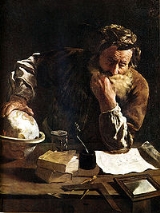
Archimedes of Syracuse (Greek
Ancient Greek

Ancient Greek is the historical stage in the development of the Greek language spanning across the Archaic Greece , Classical Greece , and Hellenistic civilization periods of ancient Greece and the classical antiquity....
: ) (c. 287 BC – c. 212 BC) was a Greek mathematician
Greek mathematics

Greek mathematics, as that term is used in this article, is the mathematics written in Greek language, developed from the 6th century BC to the 5th century AD around the Eastern shores of the Mediterranean....
, physicist
Physicist

A physicist is a scientist who studies or practices physics. Physicists study a wide range of physical phenomena in many Physics#Major fields of physics spanning all length scales: from atom particles of which all ordinary matter is made to the behavior of the material Universe as a whole ....
, engineer
Engineer

An engineer is a person professionally engaged in a field of engineering. Engineers are concerned with developing economical and safe solutions to practical problems, by applying mathematics and scientific knowledge while considering technical constraints....
, inventor
Inventor

An inventor is a person who creates or discovers a new method, form, device or other useful means. The word inventor comes form the latin verb invenire, invent-, to find....
, and astronomer
Astronomer

An astronomer is a scientist who studies Celestial body such as planets, stars, and Galaxy.Historically, astronomy was more concerned with the classification and description of phenomena in the sky, while astrophysics attempted to explain these phenomena and the differences between them using physical laws....
. Although few details of his life are known, he is regarded as one of the leading scientist
Scientist

A scientist, in the broadest sense, refers to any person that engages in a system activity to acquire knowledge or an individual that engages in such practices and traditions that are linked to schools of thought or philosophy....
s in classical antiquity
Classical antiquity

Classical antiquity is a broad term for a long period of cultural history centered on the Mediterranean Sea, comprising the interlocking civilizations of Ancient Greece and Ancient Rome....
. Among his advances in physics
Physics

Physics is the natural science which examines basic concepts such as energy, force, and spacetime and all that derives from these, such as mass, charge, matter and its Motion ....
 are the foundations of hydrostatics
Fluid statics

Fluid statics is the science of fluids at rest, and is a sub-field within fluid mechanics. The term usually refers to the mathematical treatment of the subject....
, statics
Statics

Statics is the branch of mechanics concerned with the analysis of loads on physical systems in static equilibrium, that is, in a state where the relative positions of subsystems do not vary over time, or where components and structures are at a constant velocity....
 and the explanation of the principle of the lever
Lever

In physics, a lever is a rigid object that is used with an appropriate fulcrum or wiktionary:pivot point to multiply the mechanical force that can be applied to another object....
. He is credited with designing innovative machine
Machine

A machine is any device that uses energy to perform some activity. In common usage, the meaning is that of a device having parts that perform or assist in performing any type of work....
s, including siege engines and the screw pump
Archimedes' screw

Archimedes' screw, the Archimedes screw, the Archimedean screw or the screwpump is a machine historically used for transferring water from a low-lying body of water into irrigation ditches....
 that bears his name. Modern experiments have tested claims that Archimedes designed machines capable of lifting attacking ships out of the water and setting ships on fire using an array of mirrors.

Archimedes is generally considered to be the greatest mathematician
Mathematician

A mathematician is a person whose primary area of study and/or research is the field of mathematics....
 of antiquity and one of the greatest of all time.


Discussion
Ask a question about 'Archimedes'
Start a new discussion about 'Archimedes'
Answer questions from other users
Full Discussion Forum


Recent Posts


Encyclopedia


Archimedes of Syracuse (Greek
Ancient Greek

Ancient Greek is the historical stage in the development of the Greek language spanning across the Archaic Greece , Classical Greece , and Hellenistic civilization periods of ancient Greece and the classical antiquity....
: ) (c. 287 BC – c. 212 BC) was a Greek mathematician
Greek mathematics

Greek mathematics, as that term is used in this article, is the mathematics written in Greek language, developed from the 6th century BC to the 5th century AD around the Eastern shores of the Mediterranean....
, physicist
Physicist

A physicist is a scientist who studies or practices physics. Physicists study a wide range of physical phenomena in many Physics#Major fields of physics spanning all length scales: from atom particles of which all ordinary matter is made to the behavior of the material Universe as a whole ....
, engineer
Engineer

An engineer is a person professionally engaged in a field of engineering. Engineers are concerned with developing economical and safe solutions to practical problems, by applying mathematics and scientific knowledge while considering technical constraints....
, inventor
Inventor

An inventor is a person who creates or discovers a new method, form, device or other useful means. The word inventor comes form the latin verb invenire, invent-, to find....
, and astronomer
Astronomer

An astronomer is a scientist who studies Celestial body such as planets, stars, and Galaxy.Historically, astronomy was more concerned with the classification and description of phenomena in the sky, while astrophysics attempted to explain these phenomena and the differences between them using physical laws....
. Although few details of his life are known, he is regarded as one of the leading scientist
Scientist

A scientist, in the broadest sense, refers to any person that engages in a system activity to acquire knowledge or an individual that engages in such practices and traditions that are linked to schools of thought or philosophy....
s in classical antiquity
Classical antiquity

Classical antiquity is a broad term for a long period of cultural history centered on the Mediterranean Sea, comprising the interlocking civilizations of Ancient Greece and Ancient Rome....
. Among his advances in physics
Physics

Physics is the natural science which examines basic concepts such as energy, force, and spacetime and all that derives from these, such as mass, charge, matter and its Motion ....
 are the foundations of hydrostatics
Fluid statics

Fluid statics is the science of fluids at rest, and is a sub-field within fluid mechanics. The term usually refers to the mathematical treatment of the subject....
, statics
Statics

Statics is the branch of mechanics concerned with the analysis of loads on physical systems in static equilibrium, that is, in a state where the relative positions of subsystems do not vary over time, or where components and structures are at a constant velocity....
 and the explanation of the principle of the lever
Lever

In physics, a lever is a rigid object that is used with an appropriate fulcrum or wiktionary:pivot point to multiply the mechanical force that can be applied to another object....
. He is credited with designing innovative machine
Machine

A machine is any device that uses energy to perform some activity. In common usage, the meaning is that of a device having parts that perform or assist in performing any type of work....
s, including siege engines and the screw pump
Archimedes' screw

Archimedes' screw, the Archimedes screw, the Archimedean screw or the screwpump is a machine historically used for transferring water from a low-lying body of water into irrigation ditches....
 that bears his name. Modern experiments have tested claims that Archimedes designed machines capable of lifting attacking ships out of the water and setting ships on fire using an array of mirrors.

Archimedes is generally considered to be the greatest mathematician
Mathematician

A mathematician is a person whose primary area of study and/or research is the field of mathematics....
 of antiquity and one of the greatest of all time. He used the method of exhaustion
Method of exhaustion

The method of exhaustion is a method of finding the area of a shape by inscribing inside it a sequence of polygons whose areas Convergence to the area of the containing shape....
 to calculate the area
Area

Area is a quantity expressing the two-dimensional size of a defined part of a surface, typically a region bounded by a closed curve. The term surface area refers to the total area of the exposed surface of a 3-dimensional solid, such as the sum of the areas of the exposed sides of a polyhedron....
 under the arc of a parabola
Parabola

In mathematics, the parabola is a conic section, the intersection of a right circular conical surface and a plane parallel to a generating straight line of that surface....
 with the summation of an infinite series
Series (mathematics)

In mathematics, given an infinite set sequence of numbers , a series is informally the result of adding all those terms together: . These can be written more compactly using the summation symbol ?....
, and gave a remarkably accurate approximation of pi
Pi

Pi or p is a mathematical constant whose value is the ratio of any circle's circumference to its diameter in Euclidean geometry; this is the same value as the ratio of a circle's area to the square of its radius....
. He also defined the spiral bearing his name, formulas for the volume
Volume

The volume of any solid, liquid, plasma, vacuum or theoretical object is how much three-dimensional space it occupies, often quantified numerically....
s of surfaces of revolution
Surface of revolution

A surface of revolution is a surface created by rotating a curve lying on some plane around a straight line that lies on the same plane.Examples of surfaces generated by a straight line are the cylinder and conical surfaces....
 and an ingenious system for expressing very large numbers.

Archimedes died during the Siege of Syracuse when he was killed by a Roman
Roman Republic

The Roman Republic was the phase of the Ancient Rome characterized by a republican form of government; a period which began with the overthrow of the Roman Roman Kingdom, c....
 soldier despite orders that he should not be harmed. Cicero
Cicero

Marcus Tullius Cicero was a Ancient Rome philosopher, statesman, lawyer, political theorist, and Constitution of the Roman Republic. Cicero is widely considered one of Rome's greatest rhetoric and prose stylists....
 describes visiting the tomb of Archimedes, which was surmounted by a sphere
Sphere

A sphere is a symmetrical geometrical object. In non-mathematical usage, the term is used to refer either to a round ball or to its two-dimensional surface....
 inscribe
Inscribe

In geometry, an inscribed planar shape or solid is one that is enclosed by and "fits snugly" inside another geometric shape or solid. Specifically, at all points where figures meet, their edges must lie tangent....
d within a cylinder
Cylinder (geometry)

A cylinder is one of the most curvilinear basic geometric shapes: the surface formed by the points at a fixed distance from a given straight line, the axis of the cylinder....
. Archimedes had proven that the sphere has two thirds of the volume and surface area of the cylinder (including the bases of the latter), and regarded this as the greatest of his mathematical achievements.

Unlike his inventions, the mathematical writings of Archimedes were little known in antiquity. Mathematicians from Alexandria
Alexandria

Alexandria , with a population of 4.1 million, is the second-largest city in Egypt, and is the country's largest seaport, serving about 80% of Egypt's imports and exports....
 read and quoted him, but the first comprehensive compilation was not made until c. AD 530 by Isidore of Miletus
Isidore of Miletus

Isidore of Miletus was one of the two Greeks architects who designed the church of Hagia Sophia in Constantinople .The Emperor Justinian I decided to rebuild the 4th century basilica in Constantinople which was destroyed during the Nika riots of 532....
, while commentaries on the works of Archimedes written by Eutocius
Eutocius of Ascalon

Eutocius of Ascalon was a Greek people mathematician who wrote commentaries on several Archimedean treatises and on the Apollonian Conics....
 in the sixth century AD opened them to wider readership for the first time. The relatively few copies of Archimedes' written work that survived through the Middle Ages
Middle Ages

File:Karl 1 mit papst gelasius gregor1 sacramentar v karl d kahlen.jpgThe Middle Ages of European history are a period in history which lasted for roughly a millennium, commonly dated from the fall of the Roman Empire in the 5th century to the beginning of the Early Modern Period in the 16th century, marked by the division of Western Christi...
 were an influential source of ideas for scientists during the Renaissance
Renaissance

The Renaissance was a cultural movement that spanned roughly the 14th to the 17th century, beginning in Italy in the late Middle Ages and later spreading to the rest of Europe....
, while the discovery in 1906 of previously unknown works by Archimedes in the Archimedes Palimpsest
Archimedes Palimpsest

The Archimedes Palimpsest is a palimpsest on parchment in the form of a codex. It originally was a copy of an otherwise unknown work of the ancient mathematician, physicist, and engineer Archimedes of Syracuse, Italy and other authors, which was overwritten with a religious text....
 has provided new insights into how he obtained mathematical results.

Biography


Archimedes was born c. 287 BC in the seaport city of Syracuse, Sicily, at that time a colony of Magna Graecia
Magna Graecia

Magna Graecia is the name of the area in Southern Italy and Sicily that was Colonies in antiquity#Greek colonies by Greek settlers in the eighth century BC, who brought with them the lasting imprint of their Hellenic civilization....
. The date of birth is based on a statement by the Byzantine Greek
Byzantine Greeks

Byzantine Greeks or Byzantines or Romaioi, is a conventional term used by modern historians to refer to the medieval Greeks or Hellenization citizens of the Byzantine Empire, centered mainly in Constantinople, the southern Balkans, the Greek islands, Asia Minor and the large urban centres of the Near East and Northern Egypt....
 historian John Tzetzes
John Tzetzes

John Tzetzes , was a Byzantine Empire poet and grammarian, known to have lived at Constantinople during the 12th century.Tzetzes was Georgians on his mother's side ....
 that Archimedes lived for 75 years. In The Sand Reckoner
The Sand Reckoner

The Sand Reckoner is a work by Archimedes in which he set out to determine an upper bound for the number of grains of sand that fit into the universe....
, Archimedes gives his father's name as Phidias, an astronomer
Astronomer

An astronomer is a scientist who studies Celestial body such as planets, stars, and Galaxy.Historically, astronomy was more concerned with the classification and description of phenomena in the sky, while astrophysics attempted to explain these phenomena and the differences between them using physical laws....
 about whom nothing is known. Plutarch
Plutarch

Lucius Mestrius Plutarchus , c. AD 46 ? 120 ? commonly known in English as Plutarch ? was a Ancient Rome historian , biographer, essayist, and Middle Platonism....
 wrote in his Parallel Lives
Parallel Lives

File:Plutarchs LIVES.jpgPlutarch's Lives of the Noble Greeks and Romans, commonly called Parallel Lives or Plutarch's Lives, is a series of biography of famous men, arranged in tandem to illuminate their common moral virtues or failings....
 that Archimedes was related to King Hiero II
Hiero II of Syracuse

Hieron II, king of Syracuse, Italy from 270 to 215 BC, was the illegitimate son of a Syracusan noble, Hierocles of Syracuse, who claimed descent from Gelon....
, the ruler of Syracuse. A biography of Archimedes was written by his friend Heracleides but this work has been lost, leaving the details of his life obscure. It is unknown, for instance, whether he ever married or had children. During his youth Archimedes may have studied in Alexandria
Alexandria

Alexandria , with a population of 4.1 million, is the second-largest city in Egypt, and is the country's largest seaport, serving about 80% of Egypt's imports and exports....
, Egypt
Ancient Egypt

Ancient Egypt was an Ancient history civilization in eastern North Africa, concentrated along the lower reaches of the Nile in what is now the modern nation of Egypt....
, where Conon of Samos
Conon of Samos

Conon of Samos was a Greek astronomy and mathematician. He is primarily remembered for naming the constellation Coma Berenices....
 and Eratosthenes of Cyrene
Eratosthenes

Eratosthenes of Cyrene was a Greeks mathematician, poet, sportsperson, geographer and astronomer. He made several discoveries and inventions including a system of latitude and longitude....
 were contemporaries. He referred to Conon of Samos as his friend, while two of his works (The Method of Mechanical Theorems
Archimedes' use of infinitesimals

The Method of Mechanical Theorems is a work by Archimedes which contains the first attested explicit use of infinitesimals. The work was lost, but was rediscovered in the celebrated Archimedes Palimpsest....
 and the Cattle Problem
Archimedes' cattle problem

Archimedes' cattle problem is a problem in Diophantine equation#Diophantine_analysis, the study of polynomial equations with integer solutions....
) have introductions addressed to Eratosthenes.

Archimedes died c. 212 BC during the Second Punic War
Second Punic War

The Second Punic War lasted from 218 BC to 201 BC and involved combatants in the western and eastern Mediterranean. It was the second of three major wars between Carthage and the Roman Republic....
, when Roman forces under General Marcus Claudius Marcellus
Marcus Claudius Marcellus

Marcus Claudius Marcellus , five times elected as consul of the Roman Republic, was an important Roman military leader during the Gallic War of 225 BC and the Second Punic War....
 captured the city of Syracuse after a two-year-long siege
Siege

A siege is a military blockade of a city or fortress with the intent of conquering by Battle of attrition and/or assault. The term derives from sedere, Latin for "to sit." A siege occurs when an attacker encounters a city or fortress that cannot be easily taken by a coup de main and refuses to surrender ....
. According to the popular account given by Plutarch
Plutarch

Lucius Mestrius Plutarchus , c. AD 46 ? 120 ? commonly known in English as Plutarch ? was a Ancient Rome historian , biographer, essayist, and Middle Platonism....
, Archimedes was contemplating a mathematical diagram
Mathematical diagram

Mathematical diagrams are diagrams in the field of mathematics, and diagrams using mathematics such as charts and graphs, that are mainly designed to convey mathematical relationships, for example, comparisons over time....
 when the city was captured. A Roman soldier commanded him to come and meet General Marcellus but he declined, saying that he had to finish working on the problem. The soldier was enraged by this, and killed Archimedes with his sword. Plutarch also gives a account of the death of Archimedes which suggests that he may have been killed while attempting to surrender to a Roman soldier. According to this story, Archimedes was carrying mathematical instruments, and was killed because the soldier thought that they were valuable items. General Marcellus was reportedly angered by the death of Archimedes, as he considered him a valuable scientific asset and had ordered that he not be harmed.

The last words attributed to Archimedes are "Do not disturb my circles" , a reference to the circles in the mathematical drawing that he was supposedly studying when disturbed by the Roman soldier. This quote is often given in Latin
Latin

Latin is an Italic language, historically spoken in Latium and Ancient Rome. Through the Military history of the Roman Empire, Latin spread throughout the Mediterranean and a large part of Europe....
 as "Noli turbare circulos meos," but there is no reliable evidence that Archimedes uttered these words and they do not appear in the account given by Plutarch.

The tomb of Archimedes carried a sculpture illustrating his favorite mathematical proof, consisting of a sphere
Sphere

A sphere is a symmetrical geometrical object. In non-mathematical usage, the term is used to refer either to a round ball or to its two-dimensional surface....
 and a cylinder
Cylinder (geometry)

A cylinder is one of the most curvilinear basic geometric shapes: the surface formed by the points at a fixed distance from a given straight line, the axis of the cylinder....
 of the same height and diameter. Archimedes had proven that the volume and surface area of the sphere are two thirds that of the cylinder including its bases. In 75 BC, 137 years after his death, the Roman orator
Orator

An orator, or oratist, is a speaker.An orator may also be called an oratarian - literally, "he who orates".Etymology...
 Cicero
Cicero

Marcus Tullius Cicero was a Ancient Rome philosopher, statesman, lawyer, political theorist, and Constitution of the Roman Republic. Cicero is widely considered one of Rome's greatest rhetoric and prose stylists....
 was serving as quaestor
Quaestor

Quaestor is a type of public official.In the Roman Republic a quaestor was an elected official who supervised the treasury and financial affairs of the state, its armies and its officers....
 in Sicily
Sicily

Sicily is an Autonomous regions with special statute of Italy. Of all the regions of Italy, Sicily covers the largest land area at 25,708 km? and currently has just over five million inhabitants....
. He had heard stories about the tomb of Archimedes, but none of the locals was able to give him the location. Eventually he found the tomb near the Agrigentine gate in Syracuse, in a neglected condition and overgrown with bushes. Cicero had the tomb cleaned up, and was able to see the carving and read some of the verses that had been added as an inscription.

The standard versions of the life of Archimedes were written long after his death by the historians of Ancient Rome. The account of the siege of Syracuse given by Polybius
Polybius

Polybius was a Greek historian of the Hellenistic Period noted for his book called The Histories covering in detail the period of 220–146 BC....
 in his Universal History was written around seventy years after Archimedes' death, and was used subsequently as a source by Plutarch and Livy
Livy

Titus Livius , known as Livy in English language, was a Ancient Rome historian who wrote a monumental history of Rome, Ab Urbe Condita, from its founding through the reign of Augustus in Livy's own time....
. It sheds little light on Archimedes as a person, and focuses on the war machines that he is said to have built in order to defend the city.

Discoveries and inventions


The Golden Crown

The most widely known anecdote
Anecdote

An anecdote is a short Narrative narrating an interesting or amusing biographical incident. It may be as brief as the setting and provocation of a List of French phrases#B....
 about Archimedes tells of how he invented a method for determining the volume of an object with an irregular shape. According to Vitruvius
Vitruvius

File:Vitruvius.jpgMarcus Vitruvius Pollio was a Ancient Rome writer, architect and engineer , active in the 1st century BC. By his own description Vitruvius served as a Ballista , the third class of arms in the military offices....
, a new crown in the shape of a laurel wreath
Laurel wreath

A laurel wreath is a circular wreath made of interlocking branches and leaves of the Bay Laurel , an aromatic broadleaf evergreen. In Greek mythology, Apollo is represented wearing a laurel wreath on his head....
 had been made for King Hiero II
Hiero II of Syracuse

Hieron II, king of Syracuse, Italy from 270 to 215 BC, was the illegitimate son of a Syracusan noble, Hierocles of Syracuse, who claimed descent from Gelon....
, and Archimedes was asked to determine whether it was of solid gold
Gold

Gold is a chemical element with the symbol Au and atomic number 79. It is a highly sought-after precious metal, having been used as money, as a store of value, in jewelry, in sculpture, and for ornamentation since the beginning of recorded history....
, or whether silver
Silver

Silver is a chemical element with the chemical symbol Ag and atomic number 47. A soft, white, lustrous transition metal, it has the highest electrical conductivity of any element and the highest thermal conductivity of any metal....
 had been added by a dishonest goldsmith. Archimedes had to solve the problem without damaging the crown, so he could not melt it down into a regularly shaped body in order to calculate its density
Density

The density of a material is defined as its mass per unit volume. The symbol of density is ....
. While taking a bath, he noticed that the level of the water in the tub rose as he got in, and realized that this effect could be used to determine the volume
Volume

The volume of any solid, liquid, plasma, vacuum or theoretical object is how much three-dimensional space it occupies, often quantified numerically....
 of the crown. For practical purposes water is incompressible, so the submerged crown would displace an amount of water equal to its own volume. By dividing the weight of the crown by the volume of water displaced, the density of the crown could be obtained. This density would be lower than that of gold if cheaper and less dense metals had been added. Archimedes then took to the streets naked, so excited by his discovery that he had forgotten to dress, crying "Eureka
Eureka (word)

Eureka is an exclamation used as an interjection to celebrate a Discovery ....
!" (Greek
Greek language

Greek is an Indo-European languages native to the southern Balkan peninsula, the language of the Greek people. It forms an independent branch within Indo-European....
: "e????a!," meaning "I have found it!")

The story about the golden crown does not appear in the known works of Archimedes, but in his treatise On Floating Bodies he gives the principle known in hydrostatics
Fluid statics

Fluid statics is the science of fluids at rest, and is a sub-field within fluid mechanics. The term usually refers to the mathematical treatment of the subject....
 as Archimedes' Principle
Buoyancy

In physics, buoyancy is the upward force that keeps things afloat. The net upward buoyancy force is equal to the magnitude of the weight of fluid displaced by the body....
. This states that a body immersed in a fluid experiences a buoyant force equal to the weight of the displaced fluid.

The Archimedes Screw

A large part of Archimedes' work in engineering arose from fulfilling the needs of his home city of Syracuse. The Greek writer Athenaeus of Naucratis
Athenaeus

Athenaeus , of Naucratis in Egypt, Greeks rhetorician and grammarian, flourished about the end of the 2nd and beginning of the 3rd century A.D. The Suda only tells us that he lived in the times of Marcus ; but the contempt with which he speaks of Commodus shows that he survived that emperor....
 described how King Hieron II commissioned Archimedes to design a huge ship, the Syracusia
Syracusia

The Syracusia was an ancient Greeks ship. With a length of 55 meters , is sometimes claimed to be the List of world's largest wooden ships of antiquity....
, which could be used for luxury travel, carrying supplies, and as a naval warship. The Syracusia is said to have been the largest ship built in classical antiquity. According to Athenaeus, it was capable of carrying 600 people and included garden decorations, a gymnasium
Gymnasium (ancient Greece)

The gymnasium in ancient Greece functioned as a training facility for competitors in public games. It was also a place for socializing and engaging in intellectual pursuits....
 and a temple dedicated to the goddess Aphrodite
Aphrodite

Aphrodite is the classical Greek mythology goddess of love, sex, and beauty. According to Greek oral poet Hesiod, she was born when Uranus was castrated by his son Cronus....
 among its facilities. Since a ship of this size would leak a considerable amount of water through the hull, the Archimedes screw was purportedly developed in order to remove the bilge water. Archimedes' machine was a device with a revolving screw-shaped blade inside a cylinder. It was turned by hand, and could also be used to transfer water from a body of water into irrigation canals. The Archimedes screw is still in use today for pumping liquids and granulated solids such as coal and grain. The Archimedes screw described in Roman times by Vitruvius
Vitruvius

File:Vitruvius.jpgMarcus Vitruvius Pollio was a Ancient Rome writer, architect and engineer , active in the 1st century BC. By his own description Vitruvius served as a Ballista , the third class of arms in the military offices....
 may have been an improvement on a screw pump that was used to irrigate the Hanging Gardens of Babylon
Hanging Gardens of Babylon

The Hanging Gardens of Babylon, also known as the Hanging Gardens of Semiramis, near present-day Al Hillah in Iraq , is considered one of the original Seven Wonders of the Ancient World....
.

The Claw of Archimedes

The Claw of Archimedes
Claw of Archimedes

The Claw of Archimedes was an ancient weapon devised by Archimedes to defend the seaward portion of Syracuse, Italy's city wall against amphibious assault....
 is a weapon that he is said to have designed in order to defend the city of Syracuse. Also known as "the ship shaker," the claw consisted of a crane-like arm from which a large metal grappling hook was suspended. When the claw was dropped onto an attacking ship the arm would swing upwards, lifting the ship out of the water and possibly sinking it. There have been modern experiments to test the feasibility of the claw, and in 2005 a television documentary entitled Superweapons of the Ancient World built a version of the claw and concluded that it was a workable device.

The Archimedes Heat Ray – myth or reality?


The 2nd century AD historian Lucian
Lucian

Lucian of Samosata was an Assyrian people rhetorician, and satire who wrote in the Greek language. He is noted for his witty and scoffing nature....
 wrote that during the Siege of Syracuse
Siege of Syracuse (212 BC)

The Siege of Syracuse by the Roman Republic took place in 214 BC-212 BC, at the end of which the Magna Graecia Hellenistic civilization city of Syracuse, Italy, located on the east coast of Sicily, fell....
 (c. 214–212 BC), Archimedes repelled an attack by Roman soldiers with a burning-glass
Burning-glass

A burning-glass is a large Lens #Types of lenses that can concentrate the sun's rays onto a small area, heating up the area and thus resulting in Combustion of the exposed surface....
. The device was used to focus sunlight on to approaching ships, causing them to catch fire. This purported weapon, sometimes called the "Archimedes heat ray," has been the subject of ongoing debate about its credibility since the Renaissance. René Descartes
René Descartes

Ren? Descartes , , also known as Renatus Cartesius , was a French philosophy, mathematician, scientist, and writer who spent most of his adult life in the Dutch Republic....
 rejected it as false, while modern researchers have attempted to recreate the effect using only the means that would have been available to Archimedes. It has been suggested that a large array of highly polished bronze
Bronze

Bronze is a metal alloy consisting primarily of copper, usually with tin as the main additive, but sometimes with other chemical element such as phosphorus, manganese, aluminium, or silicon....
 or copper
Copper

Copper is a chemical element with the symbol Cu and atomic number 29.It is a ductile metal with very high thermal and electrical conductivity....
 shields acting as mirrors could have been employed to focus sunlight on to a ship. This would have used the principle of the parabolic reflector
Parabolic reflector

A parabolic reflector is a parabola-shaped Mirror device, used to collect or distribute energy such as light, sound, or radio waves. Parabolic reflectors are used to collect energy from a distant source and bring it to a common Focus , thus correcting spherical aberration found in simpler spherical reflectors....
 in a manner similar to a solar furnace
Solar furnace

A solar furnace is a structure used to harness the rays of the sun in order to produce high temperatures, usually for industry. This is achieved using a curved mirror that acts as a parabolic reflector, concentrating light onto a Focus ....
.

A test of the Archimedes heat ray was carried out in 1973 by the Greek scientist Ioannis Sakkas. The experiment took place at the Skaramagas
Skaramagas

Skaramagas is a small town in the western part of Athens, Greece. It is part of the municipality of Chaidari. The town has a refinery and a shipyard which mainly carry oil production to other parts of the Mediterranean and the world....
 naval base outside Athens
Athens

Athens , the Capital and largest city of Greece, dominates the Attica periphery; as one of the List of cities by time of continuous habitation, its recorded history spans around 3,400 years....
. On this occasion 70 mirrors were used, each with a copper coating and a size of around five by three feet (1.5 by 1 m). The mirrors were pointed at a plywood of a Roman warship at a distance of around 160 feet (50 m). When the mirrors were focused accurately, the ship burst into flames within a few seconds. The plywood ship had a coating of tar
Bitumen

Bitumen is a mixture of organic compounds liquids that are highly viscous, black, sticky, entirely soluble in carbon disulfide, and composed primarily of highly condensed polycyclic aromatic hydrocarbons....
 paint, which may have aided combustion.

In October 2005 a group of students from the Massachusetts Institute of Technology
Massachusetts Institute of Technology

The Massachusetts Institute of Technology is a private university research university located in Cambridge, Massachusetts, Massachusetts, United States....
 carried out an experiment with 127 one-foot (30 cm) square mirror tiles, focused on a wooden ship at a range of around 100 feet (30 m). Flames broke out on a patch of the ship, but only after the sky had been cloudless and the ship had remained stationary for around ten minutes. It was concluded that the device was a feasible weapon under these conditions. The MIT group repeated the experiment for the television show MythBusters
MythBusters

MythBusters is a popular science television program produced by Australian firm Beyond Television Productions originally for the Discovery Channel in the United States and Canada....
, using a wooden fishing boat in San Francisco as the target. Again some charring occurred, along with a small amount of flame. In order to catch fire, wood needs to reach its flash point
Flash point

The flash point of a flammability liquid is the lowest temperature at which it can form an ignitable mixture in air. At this temperature the vapour may cease to burn when the source of ignition is removed....
, which is around 300 degrees Celsius (570 °F).

When MythBusters broadcast the result of the San Francisco experiment in January 2006, the claim was placed in the category of "busted" (or failed) because of the length of time and the ideal weather conditions required for combustion to occur. It was also pointed out that since Syracuse faces the sea towards the east, the Roman fleet would have had to attack during the morning for optimal gathering of light by the mirrors. MythBusters also pointed out that conventional weaponry, such as flaming arrows or bolts from a catapult, would have been a far easier way of setting a ship on fire at short distances.

Other discoveries and inventions

While Archimedes did not invent the lever
Lever

In physics, a lever is a rigid object that is used with an appropriate fulcrum or wiktionary:pivot point to multiply the mechanical force that can be applied to another object....
, he wrote the earliest known rigorous explanation of the principle involved. According to Pappus of Alexandria
Pappus of Alexandria

Pappus of Alexandria was one of the last great Greek mathematicss of antiquity, known for his Synagoge or Collection , and for Pappus's hexagon theorem in projective geometry....
, his work on levers caused him to remark: "Give me a place to stand on, and I will move the Earth." Plutarch describes how Archimedes designed block-and-tackle
Block and tackle

A block and tackle is a system of two or more pulleys with a rope or cable threaded between them, usually used to lift or pull heavy loads....
 pulley
Pulley

A pulley is a mechanism composed of a wheel with a Groove between two flanges around the wheel's circumference. A rope, cable or belt usually runs inside the groove....
 systems, allowing sailors to use the principle of leverage to lift objects that would otherwise have been too heavy to move.

Archimedes has also been credited with improving the power and accuracy of the catapult
Catapult

A catapult is any one of a number of non-handheld mechanical devices used to throw a projectile a great distance without the aid of an explosive substance?particularly various types of ancient and medieval siege engines....
, and with inventing the odometer
Odometer

An odometer is a device used for indicating distance traveled by an automobile or other vehicle. It may be electronics or Machine. The word derives from the Ancient Greek words hod?s, meaning 'path' or 'way', and m?tron, 'measure' ....
 during the First Punic War
First Punic War

The First Punic War was the first of Punic Wars fought between Carthage and the Roman Republic. For 23 years, the two powers struggled for supremacy in the western Mediterranean Sea....
. The odometer was described as a cart with a gear mechanism that dropped a ball into a container after each mile traveled.

Cicero
Cicero

Marcus Tullius Cicero was a Ancient Rome philosopher, statesman, lawyer, political theorist, and Constitution of the Roman Republic. Cicero is widely considered one of Rome's greatest rhetoric and prose stylists....
 (106–43 BC) mentions Archimedes briefly in his dialogue
Dialogue

A dialogue is a conversation between two or more people. It is also a literary form in which two or more parties engage in a discussion....
 De re publica
De re publica

De re publica is a dialogue#Literature by Cicero, written in six books between 54 and 51 BC. It is written in the format of a Socratic dialogue; that is to say, Scipio Africanus Minor takes the role of a wise old man — an obligatory part for the genre....
, which portrays a fictional conversation taking place in 129 BC. After the capture of Syracuse c. 212 BC, General Marcus Claudius Marcellus
Marcus Claudius Marcellus

Marcus Claudius Marcellus , five times elected as consul of the Roman Republic, was an important Roman military leader during the Gallic War of 225 BC and the Second Punic War....
 is said to have taken back to Rome two mechanisms used as aids in astronomy, which showed the motion of the Sun, Moon and five planets. Cicero mentions similar mechanisms designed by Thales of Miletus
Thales

Thales of Miletus , was a Pre-Socratic philosophy Greek philosophy from Miletus in Asia Minor, and one of the Seven Sages of Greece. Many, most notably Aristotle, regard him as the first philosopher in the Greek philosophy....
 and Eudoxus of Cnidus
Eudoxus of Cnidus

Eudoxus of Cnidus was a Ancient Greece astronomer, mathematician, scholar and student of Plato. Since all his own works are lost, our knowledge of him is obtained from secondary sources, such as Aratus's poem on astronomy....
. The dialogue says that Marcellus kept one of the devices as his only personal loot from Syracuse, and donated the other to the Temple of Virtue in Rome. Marcellus' mechanism was demonstrated, according to Cicero, by Gaius Sulpicius Gallus
Gaius Sulpicius Gallus

Gaius Sulpicius Gallus, Roman Republic general, statesman and orator.Under Lucius Aemilius Paulus, his intimate friend, he commanded the 2nd legion in the campaign against Perseus of Macedon, and gained great reputation for having predicted an eclipse of the moon on the night before the battle of Pydna ....
 to Lucius Furius Philus
Lucius Furius Philus

Lucius Furius Philus was a consul of ancient Rome in 136 BC. He was a member of the Scipionic circle, and particularly close to Scipio Aemilianus....
, who described it thus:

This is a description of a planetarium
Planetarium

File:Planetarium-Thursday-1-July-2008.JPGFile:Belgrade Planetarium theatre day.jpgFile:Belgrade Planetarium theatre night.jpgA planetarium is a theatre built primarily for presenting educational and entertaining shows about astronomy and the night sky, or for training in celestial navigation....
 or orrery
Orrery

File:orrery small.jpgAn orrery is a mechanical device that illustrates the relative positions and motions of the planets and natural satellites in the solar system in a heliocentric model....
. Pappus of Alexandria
Pappus of Alexandria

Pappus of Alexandria was one of the last great Greek mathematicss of antiquity, known for his Synagoge or Collection , and for Pappus's hexagon theorem in projective geometry....
 stated that Archimedes had written a manuscript (now lost) on the construction of these mechanisms entitled . Modern research in this area has been focused on the Antikythera mechanism
Antikythera mechanism

The Antikythera mechanism , is an ancient mechanical calculator designed to calculate astronomy positions. It was discovered in the Antikythera wreck off the Greece island of Antikythera, between Kythera and Crete, in 1901....
, another device from classical antiquity that was probably designed for the same purpose. Constructing mechanisms of this kind would have required a sophisticated knowledge of differential gearing. This was once thought to have been beyond the range of the technology available in ancient times, but the discovery of the Antikythera mechanism in 1902 has confirmed that devices of this kind were known to the ancient Greeks.

Mathematics

While he is often regarded as a designer of mechanical devices, Archimedes also made contributions to the field of mathematics. Plutarch
Plutarch

Lucius Mestrius Plutarchus , c. AD 46 ? 120 ? commonly known in English as Plutarch ? was a Ancient Rome historian , biographer, essayist, and Middle Platonism....
 wrote: "He placed his whole affection and ambition in those purer speculations where there can be no reference to the vulgar needs of life."

Archimedes Pi
Archimedes was able to use infinitesimal
Infinitesimal

Infinitesimals have been used to express the idea of objects so small that there is no way to see them or to measure them. For everyday life, an infinitesimal object is an object which is smaller than any possible measure....
s in a way that is similar to modern integral calculus
Integral

Integration is an important concept in mathematics, specifically in the field of calculus and, more broadly, mathematical analysis. Given a function ƒ of a Real number variable x and an interval [ab] of the real line, the integral...
. By assuming a proposition to be true and showing that this would lead to a contradiction
Contradiction

In classical logic, a contradiction consists of a logical incompatibility between two or more propositions. It occurs when the propositions, taken together, yield two logical consequences which form the logical inversions of each other....
, he could give answers to problems to an arbitrary degree of accuracy, while specifying the limits within which the answer lay. This technique is known as the method of exhaustion
Method of exhaustion

The method of exhaustion is a method of finding the area of a shape by inscribing inside it a sequence of polygons whose areas Convergence to the area of the containing shape....
, and he employed it to approximate the value of p
Pi

Pi or p is a mathematical constant whose value is the ratio of any circle's circumference to its diameter in Euclidean geometry; this is the same value as the ratio of a circle's area to the square of its radius....
 (pi). He did this by drawing a larger polygon
Polygon

In geometry a polygon is traditionally a plane Shape that is bounded by a closed curve path or circuit, composed of a finite sequence of straight line segments ....
 outside a circle
Circle

A circle is a simple shape of Euclidean geometry consisting of those point in a plane which are the same distance from a given point called the center....
 and a smaller polygon inside the circle. As the number of sides of the polygon increases, it becomes a more accurate approximation of a circle. When the polygons had 96 sides each, he calculated the lengths of their sides and showed that the value of p lay between (approximately 3.1429) and (approximately 3.1408). He also proved that the area
Area

Area is a quantity expressing the two-dimensional size of a defined part of a surface, typically a region bounded by a closed curve. The term surface area refers to the total area of the exposed surface of a 3-dimensional solid, such as the sum of the areas of the exposed sides of a polyhedron....
 of a circle was equal to p multiplied by the square
Square (geometry)

In Euclidean geometry, a square is a regular polygon with four equal sides and four equal angles . A square with vertices ABCD would be denoted ....
 of the radius
RADIUS

Remote Authentication Dial In User Service is a networking protocol that provides centralized access, authorization and accounting management for people or computers to connect and use a network service....
 of the circle.

In Measurement of a Circle
Measurement of a Circle

Measurement of a Circle is a treatise that consists of three propositions by Archimedes. The treatise is only a fraction of what was a longer work....
, Archimedes gives the value of the square root
Square root

In mathematics, a square root of a number x is a number r such that r2 = x, or, in other words, a number r whose square is x....
 of 3 as being more than (approximately 1.7320261) and less than (approximately 1.7320512). The actual value is approximately 1.7320508, making this a very accurate estimate. He introduced this result without offering any explanation of the method used to obtain it. This aspect of the work of Archimedes caused John Wallis
John Wallis

John Wallis was an England Mathematics who is given partial credit for the development of modern calculus. Between 1643 and 1689 he served as chief cryptographer for Parliament of the United Kingdom and, later, the royal court....
 to remark that he was: "as it were of set purpose to have covered up the traces of his investigation as if he had grudged posterity the secret of his method of inquiry while he wished to extort from them assent to his results."

In The Quadrature of the Parabola
The Quadrature of the Parabola

The Quadrature of the Parabola is a treatise on geometry, written by Archimedes in the 3rd century B.C. Written as a letter to his friend Dositheus, the work presents 24 propositions regarding parabolas, culminating in a proof that the area of a parabolic segment is 4/3 that of a certain inscribe triangle....
, Archimedes proved that the area enclosed by a parabola
Parabola

In mathematics, the parabola is a conic section, the intersection of a right circular conical surface and a plane parallel to a generating straight line of that surface....
 and a straight line is 4/3 times the area of a corresponding inscribed triangle
Triangle

A triangle is one of the basic shapes of geometry: a polygon with three corners or wikt:vertex and three sides or edges which are line segments....
 as shown in the figure at right. He expressed the solution to the problem as an infinite
Series (mathematics)

In mathematics, given an infinite set sequence of numbers , a series is informally the result of adding all those terms together: . These can be written more compactly using the summation symbol ?....
 geometric series
Geometric series

In mathematics, a geometric series is a series with a constant ratio between successive term . For example, the seriesis geometric, because each term is equal to half of the previous term....
 with the common ratio
Geometric series

In mathematics, a geometric series is a series with a constant ratio between successive term . For example, the seriesis geometric, because each term is equal to half of the previous term....
 :

If the first term in this series is the area of the triangle, then the second is the sum of the areas of two triangles whose bases are the two smaller secant line
Secant line

A secant line of a curve is a line that intersects two Point s on the curve. The word secant comes from the Latin secare, for to cut....
s, and so on. This proof uses a variation of the series which sums to .

In The Sand Reckoner
The Sand Reckoner

The Sand Reckoner is a work by Archimedes in which he set out to determine an upper bound for the number of grains of sand that fit into the universe....
, Archimedes set out to calculate the number of grains of sand that the universe could contain. In doing so, he challenged the notion that the number of grains of sand was too large to be counted. He wrote: "There are some, King Gelo (Gelo II, son of Hiero II
Hiero II of Syracuse

Hieron II, king of Syracuse, Italy from 270 to 215 BC, was the illegitimate son of a Syracusan noble, Hierocles of Syracuse, who claimed descent from Gelon....
), who think that the number of the sand is infinite in multitude; and I mean by the sand not only that which exists about Syracuse and the rest of Sicily but also that which is found in every region whether inhabited or uninhabited." To solve the problem, Archimedes devised a system of counting based on the myriad
Myriad

Myriad is a classical Greek language name for the number 104 = 10000 . In modern English language the word refers to an unspecified large quantity....
. The word is from the Greek murias, for the number 10,000. He proposed a number system using powers of a myriad of myriads (100 million) and concluded that the number of grains of sand required to fill the universe would be 8 vigintillion
Names of large numbers

This article lists and discusses the usage and derivation of names of large numbers, together with their possible extensions.The following table lists those names of large numbers which are found in many English dictionaries and thus have a special claim to being "real words"....
, or 8.

Writings

The written work of Archimedes has not survived as well as that of Euclid
Euclid

Euclid , floruit 300 BC, also known as Euclid of Alexandria, was a Greek mathematics and is often referred to as the Father of Geometry. He was active in Alexandria during the reign of Ptolemy I ....
, and seven of his treatises are known to have existed only through references made to them by other authors. Pappus of Alexandria
Pappus of Alexandria

Pappus of Alexandria was one of the last great Greek mathematicss of antiquity, known for his Synagoge or Collection , and for Pappus's hexagon theorem in projective geometry....
 mentions On Sphere-Making
On Sphere-Making

On Sphere-Making is the title of a lost work by Archimedes, mentioned by Pappus of Alexandria. It is believed to have described the construction of orrery or astronomical clocks akin to the Antikythera mechanism....
 and another work on polyhedra
Polyhedron

|}A polyhedron is often defined as a geometry object with flat faces and straight edges .This definition of a polyhedron is not very precise, and to a modern mathematician is quite unsatisfactory....
, while Theon of Alexandria
Theon of Alexandria

Theon was a Greeks scholar and mathematician who lived in Alexandria, Egypt. The biographical tradition defines Theon as "the man from the Mouseion"; actually, both the Library of Alexandria and the Mouseion may have been destroyed a century before by the Emperor Aurelian during his struggle against Zenobia....
 quotes a remark about refraction
Refraction

Refraction is the change in direction of a wave due to a change in its speed. This is most commonly observed when a wave passes from one optical medium to another....
 from the Catoptrica. During his lifetime, Archimedes made his work known through correspondence with the mathematicians in Alexandria
Alexandria

Alexandria , with a population of 4.1 million, is the second-largest city in Egypt, and is the country's largest seaport, serving about 80% of Egypt's imports and exports....
. The writings of Archimedes were collected by the Byzantine
Byzantine Empire

Byzantine Empire and Eastern Roman Empire are conventional names used to describe the Roman Empire during the Middle Ages, centered on its capital of Constantinople....
 architect Isidore of Miletus
Isidore of Miletus

Isidore of Miletus was one of the two Greeks architects who designed the church of Hagia Sophia in Constantinople .The Emperor Justinian I decided to rebuild the 4th century basilica in Constantinople which was destroyed during the Nika riots of 532....
 (c. 530 AD), while commentaries on the works of Archimedes written by Eutocius
Eutocius of Ascalon

Eutocius of Ascalon was a Greek people mathematician who wrote commentaries on several Archimedean treatises and on the Apollonian Conics....
 in the sixth century AD helped to bring his work a wider audience. Archimedes' work was translated into Arabic by Thabit ibn Qurra
Thabit ibn Qurra

was an Arab Islamic astronomy, Islamic mathematics and Islamic medicine who was known as 'Thebit' in Latin....
 (836–901 AD), and Latin by Gerard of Cremona
Gerard of Cremona

Gerard of Cremona , was a Lombardy translator of Arabic language Islamic science.He was one of a small group of scholars who invigorated medieval Europe in the twelfth century by transmitting Greece and Arab traditions in astronomy, medicine and other sciences, in the form of Translations into Latin , which made them available to every lit...
 (c. 1114–1187 AD). During the Renaissance
Renaissance

The Renaissance was a cultural movement that spanned roughly the 14th to the 17th century, beginning in Italy in the late Middle Ages and later spreading to the rest of Europe....
, the Editio Princeps (First Edition) was published in Basel
Basel

Basel is Switzerland's third most populous city . With 731,000 inhabitants in the tri-national metropolitan area , Basel is Switzerland's third-largest urban area....
 in 1544 by Johann Herwagen with the works of Archimedes in Greek and Latin. Around the year 1586 Galileo Galilei
Galileo Galilei

Galileo Galilei was a Grand Duchy of Tuscany physicist, mathematician, astronomer, and philosopher who played a major role in the Scientific Revolution....
 invented a hydrostatic balance for weighing metals in air and water after apparently being inspired by the work of Archimedes.

Surviving works

  • On the Equilibrium of Planes (two volumes)
The first book is in fifteen propositions with seven postulates
Axiom

In traditional logic, an axiom or postulate is a proposition that is not proved or demonstrated but considered to be either self-evidence, or subject to necessary decision....
, while the second book is in ten propositions. In this work Archimedes explains the Law of the Lever
Torque

Torque is the tendency of a force to rotate an object about an axis . Just as a force is a push or a pull, a torque can be thought of as a twist....
, stating:
Archimedes uses the principles derived to calculate the areas and centers of gravity
Center of mass

The center of mass of a system of wiktionary:Particles is a specific point at which, for many purposes, the system's mass behaves as if it were concentrated....
 of various geometric figures including triangle
Triangle

A triangle is one of the basic shapes of geometry: a polygon with three corners or wikt:vertex and three sides or edges which are line segments....
s, parallelogram
Parallelogram

In geometry, a parallelogram is a quadrilateral with two sets of parallel sides. The opposite or facing sides of a parallelogram are of equal length, and the opposite angles of a parallelogram are of equal size....
s and parabola
Parabola

In mathematics, the parabola is a conic section, the intersection of a right circular conical surface and a plane parallel to a generating straight line of that surface....
s.
  • On the Measurement of a Circle
    Measurement of a Circle

    Measurement of a Circle is a treatise that consists of three propositions by Archimedes. The treatise is only a fraction of what was a longer work....
This is a short work consisting of three propositions. It is written in the form of a correspondence with Dositheus of Pelusium, who was a student of Conon of Samos
Conon of Samos

Conon of Samos was a Greek astronomy and mathematician. He is primarily remembered for naming the constellation Coma Berenices....
. In Proposition II, Archimedes shows that the value of π
Pi

Pi or p is a mathematical constant whose value is the ratio of any circle's circumference to its diameter in Euclidean geometry; this is the same value as the ratio of a circle's area to the square of its radius....
 (pi) is greater than and less than . The latter figure was used as an approximation of p throughout the Middle Ages and is still used today when a rough figure is required.
  • On Spirals
    On Spirals

    On Spirals is a treatise by Archimedes in 225 BC. Although Archimedes did not discover the Archimedean spiral, he employed it in this book to square the circle and trisect an angle....
This work of 28 propositions is also addressed to Dositheus. The treatise defines what is now called the Archimedean spiral
Archimedean spiral

The Archimedean spiral is a spiral named after the 3rd century BC Ancient Greece mathematician Archimedes. It is the locus of points corresponding to the locations over time of a point moving away from a fixed point with a constant speed along a line which rotates with constant angular velocity....
. It is the locus
Locus (mathematics)

In mathematics, a locus is a collection of point which share a property. The term locus is usually used of a condition which defines a continuous figure or figures, that is, a curve....
 of points corresponding to the locations over time of a point moving away from a fixed point with a constant speed along a line which rotates with constant angular velocity
Angular velocity

In physics, the angular velocity is a vector quantity which specifies the angular speed, and axis about which an object is rotating. The SI unit of angular velocity is radians per second, although it may be measured in other units such as degrees per second, revolutions per second, degrees per hour, etc....
. Equivalently, in polar coordinates
Coordinates (mathematics)

Coordinates are numbers which describe the location of points in a plane or in space. For example, the height above sea level is a coordinate which is useful for describing points near the surface of the earth....
 (r, θ) it can be described by the equation
with real number
Real number

In mathematics, the real numbers may be described informally in several different ways. The real numbers include both rational numbers, such as 42 and −23/129, and irrational numbers, such as pi and the square root of two; or, a real number can be given by an infinite decimal representation, such as 2.4871773339...., where the digits co...
s a and b. This is an early example of a mechanical curve
Curve

In mathematics, a curve consists of the points through which a continuous function moving point passes. This notion captures the intuitive idea of a geometrical dimension object, which furthermore is connectedness in the sense of having no continuous function or continuum ....
 (a curve traced by a moving point
Point (geometry)

In geometry, topology and related branches of mathematics a spatial point describes a specific object within a given space that consists of neither volume, area, length, nor any other higher dimensional analogue....
) considered by a Greek mathematician.
  • On the Sphere and the Cylinder (two volumes)
In this treatise addressed to Dositheus, Archimedes obtains the result of which he was most proud, namely the relationship between a sphere
Sphere

A sphere is a symmetrical geometrical object. In non-mathematical usage, the term is used to refer either to a round ball or to its two-dimensional surface....
 and a circumscribed cylinder
Cylinder (geometry)

A cylinder is one of the most curvilinear basic geometric shapes: the surface formed by the points at a fixed distance from a given straight line, the axis of the cylinder....
 of the same height and diameter
Diameter

In geometry, a diameter of a circle is any straight line segment that passes through the center of the circle and whose endpoints are on the circle....
. The volume is ' for the sphere, and ' for the cylinder. The surface area is ' for the sphere, and ' for the cylinder (including its two bases), where ' is the radius of the sphere and cylinder. The sphere has a volume and surface area that of the cylinder. A sculpted sphere and cylinder were placed on the tomb of Archimedes at his request.
  • On Conoids and Spheroids
This is a work in 32 propositions addressed to Dositheus. In this treatise Archimedes calculates the areas and volumes of sections
Cross section (geometry)

In geometry, a cross-section is the intersection of a body in 2-dimensional space with a line, or of a body in 3-dimensional space with a plane, etc....
 of cones
Cone (geometry)

A cone is a dimension geometric shape that tapers smoothly from a flat, round base to a point called the apex or vertex. More precisely, it is the solid figure bounded by a plane base and the surface formed by the locus of all straight line segments joining the apex to the perimeter of the base....
, spheres, and paraboloids.
  • On Floating Bodies (two volumes)
In the first part of this treatise, Archimedes spells out the law of equilibrium of fluids, and proves that water will adopt a spherical form around a center of gravity. This may have been an attempt at explaining the theory of contemporary Greek astronomers such as Eratosthenes
Eratosthenes

Eratosthenes of Cyrene was a Greeks mathematician, poet, sportsperson, geographer and astronomer. He made several discoveries and inventions including a system of latitude and longitude....
 that the Earth is round. The fluids described by Archimedes are not , since he assumes the existence of a point towards which all things fall in order to derive the spherical shape.


In the second part, he calculates the equilibrium positions of sections of paraboloids. This was probably an idealization of the shapes of ships' hulls. Some of his sections float with the base under water and the summit above water, similar to the way that icebergs float. Archimedes' principle of buoyancy is given in the work, stated as follows:
  • The Quadrature of the Parabola
    The Quadrature of the Parabola

    The Quadrature of the Parabola is a treatise on geometry, written by Archimedes in the 3rd century B.C. Written as a letter to his friend Dositheus, the work presents 24 propositions regarding parabolas, culminating in a proof that the area of a parabolic segment is 4/3 that of a certain inscribe triangle....
In this work of 24 propositions addressed to Dositheus, Archimedes proves by two methods that the area enclosed by a parabola
Parabola

In mathematics, the parabola is a conic section, the intersection of a right circular conical surface and a plane parallel to a generating straight line of that surface....
 and a straight line is 4/3 multiplied by the area of a triangle
Triangle

A triangle is one of the basic shapes of geometry: a polygon with three corners or wikt:vertex and three sides or edges which are line segments....
 with equal base and height. He achieves this by calculating the value of a geometric series
Geometric series

In mathematics, a geometric series is a series with a constant ratio between successive term . For example, the seriesis geometric, because each term is equal to half of the previous term....
 that sums to infinity with the ratio
Ratio

A ratio is an expression which compares quantities relative to each other. The most common examples involve two quantities, but in theory any number of quantities can be compared....
 .
  • (O)stomachion
    Ostomachion

    Ostomachion is a mathematical treatise attributed to Archimedes. This work has survived fragmentarily in an Arabic language version and in a copy of the original ancient Greek text made in Byzantine times....
This is a dissection puzzle
Dissection puzzle

A dissection puzzle, also called a transformation puzzle, is a tiling puzzle where a solver is given a set of pieces that can be assembled in different ways to produce two or more distinct shapes....
 similar to a Tangram
Tangram

The tangram is a dissection puzzle consisting of seven flat shapes, called tans, which are put together to form shapes. The objective of the puzzle is to form a specific shape using all seven pieces, which may not overlap....
, and the treatise describing it was found in more complete form in the Archimedes Palimpsest
Archimedes Palimpsest

The Archimedes Palimpsest is a palimpsest on parchment in the form of a codex. It originally was a copy of an otherwise unknown work of the ancient mathematician, physicist, and engineer Archimedes of Syracuse, Italy and other authors, which was overwritten with a religious text....
. Archimedes calculates the areas of the 14 pieces which can be assembled to form a square
Square (geometry)

In Euclidean geometry, a square is a regular polygon with four equal sides and four equal angles . A square with vertices ABCD would be denoted ....
. Research published by Dr. Reviel Netz of Stanford University
Stanford University

Leland Stanford Junior University, commonly referred to as Stanford University or Stanford, is a private university research university located in Stanford, California, California, United States....
 in 2003 argued that Archimedes was attempting to determine how many ways the pieces could be assembled into the shape of a square. The figure given by Dr. Netz is that the pieces can be made into a square in 17,152 ways. The number of arrangements is 536 when solutions that are equivalent by rotation and reflection have been excluded. The puzzle represents an example of an early problem in combinatorics
Combinatorics

Combinatorics is a branch of pure mathematics concerning the study of Countable set objects. It is related to many other areas of mathematics, such as algebra, probability theory, ergodic theory and geometry, as well as to applied subjects in computer science and statistical physics....
.
The origin of the puzzle's name is unclear, and it has been suggested it is taken from the Ancient Greek
Ancient Greek

Ancient Greek is the historical stage in the development of the Greek language spanning across the Archaic Greece , Classical Greece , and Hellenistic civilization periods of ancient Greece and the classical antiquity....
 word for throat or gullet, stomachos . Ausonius
Ausonius

Decimus Magnus Ausonius was a Latin literature poet and rhetorician, born at Burdigala ....
 refers to the puzzle as Ostomachion, a Greek compound word formed from the roots of (osteon - bone) and (mache - fight). The puzzle is also known as the Loculus of Archimedes or Archimedes' Box.
  • Archimedes' cattle problem
    Archimedes' cattle problem

    Archimedes' cattle problem is a problem in Diophantine equation#Diophantine_analysis, the study of polynomial equations with integer solutions....
This work was discovered by Gotthold Ephraim Lessing
Gotthold Ephraim Lessing

Gotthold Ephraim Lessing was a Germany writer, philosopher, dramatist, publicist, and art critic, and one of the most outstanding representatives of the Enlightenment era....
 in a Greek manuscript consisting of a poem of 44 lines, in the Herzog August Library in Wolfenbüttel
Wolfenbüttel

Wolfenb?ttel is a town in Lower Saxony, Germany, located on the Oker river about 13 kilometres south of Braunschweig. It is the seat of the Wolfenb?ttel and of the bishop of the Protestant Lutheran State Church of Brunswick....
, Germany
Germany

Germany , officially the Federal Republic of Germany , is a country in Central Europe. It is bordered to the north by the North Sea, Denmark, and the Baltic Sea; to the east by Poland and the Czech Republic; to the south by Austria and Switzerland; and to the west by France, Luxembourg, Belgium, and the Netherlands....
 in 1773. It is addressed to Eratosthenes and the mathematicians in Alexandria. Archimedes challenges them to count the numbers of cattle in the Herd of the Sun by solving a number of simultaneous Diophantine equation
Diophantine equation

In mathematics, a Diophantine equation is an indeterminate equation polynomial equation that allows the variables to be integers only. Diophantine problems have fewer equations than unknown variables and involve finding integers that work correctly for all equations....
s. There is a more difficult version of the problem in which some of the answers are required to be square number
Square number

In mathematics, a square number, sometimes also called a perfect square, is an integer that can be written as the square of some other integer; in other words, it is the product of some integer with itself....
s. This version of the problem was first solved by A. Amthor in 1880, and the answer is a very large number, approximately 7.760271.
  • The Sand Reckoner
    The Sand Reckoner

    The Sand Reckoner is a work by Archimedes in which he set out to determine an upper bound for the number of grains of sand that fit into the universe....
In this treatise, Archimedes counts the number of grains of sand that will fit inside the universe. This book mentions the heliocentric
Heliocentrism

In astronomy, heliocentrism is the theory that the Sun is at the center of the Universe. The word came from the Greek language . Historically, heliocentrism was opposed to geocentrism, which placed the earth at the center....
 theory of the solar system
Solar System

The Solar System consists of the Sun and those Astronomical object bound to it by gravity: the eight planets and five dwarf planets, their 173 known Natural satellite, and billions of Small Solar System body....
 proposed by Aristarchus of Samos
Aristarchus of Samos

Aristarchus or Aristarch was a Greeks astronomer and mathematician, born on the island of Samos Island, in Greece. He was the first Greek, and the first man in general, to present an explicit argument for a Heliocentrism of the solar system, placing the Sun, not the Earth, at the center of the known universe....
, contemporary ideas about the size of the Earth and the distance between various celestial bodies. By using a system of numbers based on powers of the myriad
Myriad

Myriad is a classical Greek language name for the number 104 = 10000 . In modern English language the word refers to an unspecified large quantity....
, Archimedes concludes that the number of grains of sand required to fill the universe is 8 in modern notation. The introductory letter states that Archimedes' father was an astronomer named Phidias. The Sand Reckoner or Psammites is the only surviving work in which Archimedes discusses his views on astronomy.
  • The Method of Mechanical Theorems
This treatise was thought lost until the discovery of the Archimedes Palimpsest
Archimedes Palimpsest

The Archimedes Palimpsest is a palimpsest on parchment in the form of a codex. It originally was a copy of an otherwise unknown work of the ancient mathematician, physicist, and engineer Archimedes of Syracuse, Italy and other authors, which was overwritten with a religious text....
 in 1906. In this work Archimedes uses infinitesimals
Archimedes' use of infinitesimals

The Method of Mechanical Theorems is a work by Archimedes which contains the first attested explicit use of infinitesimals. The work was lost, but was rediscovered in the celebrated Archimedes Palimpsest....
, and shows how breaking up a figure into an infinite number of infinitely small parts can be used to determine its area or volume. Archimedes may have considered this method lacking in formal rigor, so he also used the method of exhaustion
Method of exhaustion

The method of exhaustion is a method of finding the area of a shape by inscribing inside it a sequence of polygons whose areas Convergence to the area of the containing shape....
 to derive the results. As with The Cattle Problem, The Method of Mechanical Theorems was written in the form of a letter to Eratosthenes in Alexandria
Alexandria

Alexandria , with a population of 4.1 million, is the second-largest city in Egypt, and is the country's largest seaport, serving about 80% of Egypt's imports and exports....
.


Apocryphal works

Archimedes' Book of Lemmas
Book of Lemmas

The Book of Lemmas is a book attributed to Archimedes by Thabit ibn Qurra. The book was written over 2,200 years ago and consists of fifteen propositions on circles....
 or Liber Assumptorum is a treatise with fifteen propositions on the nature of circles. The earliest known copy of the text is in Arabic
Arabic language

Arabic is a Central Semitic language, thus related to and classified alongside other Semitic languages languages such as Hebrew language and Aramaic language....
. The scholars T. L. Heath
T. L. Heath

Sir Thomas Little Heath was a British civil servant, mathematician, classics scholar, historian of ancient Greek mathematics, translator, and mountaineer....
 and Marshall Clagett
Marshall Clagett

Marshall Clagett was an USA scholar who specialized in the history of science.Born in Washington, D.C., he studied at the California Institute of Technology and George Washington University....
 argued that it cannot have been written by Archimedes in its current form, since it quotes Archimedes, suggesting modification by another author. The Lemmas may be based on an earlier work by Archimedes that is now lost.

It has also been claimed that Heron's formula
Heron's formula

In geometry, Heron's formula states that the area of a triangle whose sides have lengths a, b, and c iswhere s is the semiperimeter of the triangle:...
 for calculating the area of a triangle from the length of its sides was known to Archimedes. However, the first reliable reference to the formula is given by Heron of Alexandria
Hero of Alexandria

Hero of Alexandria . was an ancient Greek mathematics who was a resident of a Roman province ; he was also an engineer who was active in his hometown of Alexandria....
 in the 1st century  AD.

Archimedes Palimpsest


The foremost document containing the work of Archimedes is the Archimedes Palimpsest
Archimedes Palimpsest

The Archimedes Palimpsest is a palimpsest on parchment in the form of a codex. It originally was a copy of an otherwise unknown work of the ancient mathematician, physicist, and engineer Archimedes of Syracuse, Italy and other authors, which was overwritten with a religious text....
. In 1906, the Danish professor Johan Ludvig Heiberg
Johan Ludvig Heiberg (historian)

Johan Ludvig Heiberg was a Denmark philologist and historian. He is best known for his discovery of previously unknown texts in the Archimedes Palimpsest, and for his edition of Euclid's Elements that T....
 visited Constantinople
Constantinople

Constantinople was the empire capital of the Roman Empire , the Byzantine Empire , the Latin Empire , and the Ottoman Empire . Strategically located between the Golden Horn and the Sea of Marmara at the point where Europe meets Asia, Byzantine Constantinople had been the capital of a Christendom empire, successor to ancient ancient Greece...
 and examined a 174-page goatskin parchment of prayers written in the 13th century AD. He discovered that it was a palimpsest
Palimpsest

A palimpsest is a manuscript page from a scroll or book that has been scraped off and used again. The word "palimpsest" comes through Latin from Greek language pa??? + ?a? = , and meant "scraped again." Ancient Rome wrote on Wax tablet that could be smoothed and reused, and a passing use of the rather bookish term "palimpsest" by Cicero se...
, a document with text that has been written over an erased older work. Palimpsests were created by scraping the ink from existing works and reusing them, which was a common practice in the Middle Ages as vellum
Vellum

Vellum is mammal skin prepared for writing or printing on single pages, scrolls, Codex or books. It is generally thin, smooth and durable, although there are great variations depending on preparation, the quality of the skin, and the type of animal....
 was expensive. The older works in the palimpsest were identified by scholars as 10th century AD copies of previously unknown treatises by Archimedes. The parchment spent hundreds of years in a monastery library in Constantinople before being sold to a private collector in the 1920s. On October 29, 1998 it was sold at auction to an anonymous buyer for $2 million at Christie's
Christie's

Christie's is a leading art business and a fine arts auction house....
 in New York
New York City

The City of New York is the List of United States cities by population in the United States, while the New York metropolitan area ranks among the List of urban areas by population....
. The palimpsest holds seven treatises, including the only surviving copy of On Floating Bodies in the original Greek. It is the only known source of the Method of Mechanical Theorems, referred to by Suidas and thought to have been lost forever. Stomachion was also discovered in the palimpsest, with a more complete analysis of the puzzle than had been found in previous texts. The palimpsest is now stored at the Walters Art Museum
Walters Art Museum

The Walters Art Museum, located in Baltimore, Maryland's Mount Vernon, Baltimore neighborhood, is a public art museum founded in 1934. The museum's collection was amassed substantially by two men, William Thompson Walters , who began serious collecting when he moved to Paris at the outbreak of the American Civil War, and Henry Walters , who r...
 in Baltimore
Baltimore, Maryland

Baltimore is an independent city and the largest city in the U.S. state of Maryland in the United States. Baltimore is located in central Maryland along the tidal portion of the Patapsco River, an arm of the Chesapeake Bay....
, Maryland
Maryland

Maryland is a U.S. state located in the Mid Atlantic States of the United States, bordering Virginia, West Virginia and the Washington, D.C. to the south and west, Pennsylvania to the north, and Delaware to the east....
, where it has been subjected to a range of modern tests including the use of ultraviolet
Ultraviolet

Ultraviolet light is electromagnetic radiation with a wavelength shorter than that of visible light, but longer than x-rays, in the range 400 nanometer to 10 nm, and energies from 3 Electron volt to 124 eV....
 and light
Light

Light, or visible light, is electromagnetic radiation of a wavelength that is Visible spectrum to the human eye , or up to 380?750 nm. In the broader field of physics, light is sometimes used to refer to electromagnetic radiation of all wavelengths, whether visible or not....
 to read the overwritten text.

The treatises in the Archimedes Palimpsest are: On the Equilibrium of Planes, On Spirals, Measurement of a Circle
Measurement of a Circle

Measurement of a Circle is a treatise that consists of three propositions by Archimedes. The treatise is only a fraction of what was a longer work....
, On the Sphere and the Cylinder, On Floating Bodies, The Method of Mechanical Theorems
and Stomachion.

Legacy


There is a crater
Impact crater

In the broadest sense, the term impact crater can be applied to any depression, natural or manmade, resulting from the high velocity impact of a projectile with larger body....
 on the Moon
Moon

The Moon is Earth's only natural satellite and the List of natural satellites by diameter satellite in the Solar System. The average centre-to-centre distance from the Earth to the Moon is km, about thirty times the diameter of the Earth....
 named Archimedes
Archimedes (crater)

Archimedes is a large moon impact crater on the eastern edges of the Mare Imbrium. To the south of the crater extends the Montes Archimedes mountainous region....
 (29.7° N, 4.0° W) in his honor, and a lunar mountain range, the Montes Archimedes
Montes Archimedes

Montes Archimedes is a mountain range on the Moon. It is named after the crater Archimedes that lies to the north, which in turn has an eponym of the Ancient Greece mathematician Archimedes....
 (25.3° N, 4.6° W).

The asteroid
Asteroid

Asteroids, sometimes called minor planets or planetoids, are small Solar System bodies in orbit around the Sun, smaller than planets but larger than meteoroids....
 3600 Archimedes
3600 Archimedes

3600 Archimedes is a small asteroid belt asteroid, belonging to the Rafita family. It was discovered by Lyudmila Vasil'evna Zhuravleva in 1978. It is named after Archimedes, the ancient Greece scientist....
 is named after him.

The Fields Medal
Fields Medal

The Fields Medal is a prize awarded to two, three, or four mathematicians not over 40 years of age at each International Congress of Mathematicians of the International Mathematical Union, a meeting that takes place every four years....
 for outstanding achievement in mathematics carries a portrait of Archimedes, along with his proof concerning the sphere and the cylinder. The inscription around the head of Archimedes is a quote attributed to him which reads in Latin: "Transire suum pectus mundoque potiri" (Rise above oneself and grasp the world).

Archimedes has appeared on postage stamps issued by East Germany (1973), Greece
Greece

Greece , officially the Hellenic Republic , is a country in southeastern Europe, situated on the southern end of the Balkans. It has borders with Albania, Bulgaria and the former Yugoslav Republic of Macedonia to the north, and Turkey to the east....
 (1983), Italy
Italy

Italy , officially the Italian Republic , is a country located on the Italian Peninsula in Southern Europe and on the two largest islands in the Mediterranean Sea, Sicily and Sardinia....
 (1983), Nicaragua
Nicaragua

Nicaragua officially the Republic of Nicaragua , is a representative democracy republic. It is the largest state in Central America with an area of 130,000 km2, about the size of the state of New York....
 (1971), San Marino
San Marino

The Most Serene Republic of San Marino is a country in the Apennine Mountains. It is a landlocked country Enclave and exclave, completely surrounded by Italy....
 (1982), and Spain
Spain

Spain or the Kingdom of Spain , is a country located in Southern Europe on the Iberian Peninsula.The Spanish constitution does not establish any official denomination of the country, even though Espa?a , Estado espa?ol and Naci?n espa?ola are used interchangeably....
 (1963).

The exclamation of Eureka!
Eureka (word)

Eureka is an exclamation used as an interjection to celebrate a Discovery ....
 attributed to Archimedes is the state motto of California
California

California is a U.S. state on the West Coast of the United States of the United States, along the Pacific Ocean. It is bordered by Oregon to the north, Nevada to the east, Arizona to the southeast, and to the south the Mexico state of Baja California....
. In this instance the word refers to the discovery of gold near Sutter's Mill
Sutter's Mill

Sutter's Mill was a sawmill owned by 19th century pioneer John Sutter. It was located in Coloma, California, USA at the bank of the American River....
 in 1848 which sparked the California Gold Rush
California Gold Rush

The California Gold Rush began on January 24, 1848, when gold was discovered by James W. Marshall at Sutter's Mill, in Coloma, California, California....
.

A movement for civic engagement targeting universal access to health care in the US state of Oregon
Oregon

Oregon is a U.S. state in the Pacific Northwest region of the United States. The area was inhabited by many indigenous tribes before the arrival of traders, explorers and settlers....
 has been named the "Archimedes Movement," headed by former Oregon Governor John Kitzhaber
John Kitzhaber

John Albert Kitzhaber is a medical educator and was the Governor of Oregon for two terms in 1995-2003. Prior to becoming a politician in Oregon, he was a practicing physician....
.

See also


Further reading

  • Republished translation of the 1938 study of Archimedes and his works by an historian of science.*
  • Complete works of Archimedes in English.**


The Works of Archimedes online

  • Text in Classical Greek:
  • In English translation: , trans. T.L. Heath; supplemented by , trans. L.G. Robinson


External links

  • In Our Time
    In Our Time (BBC Radio 4)

    In Our Time is a discussion programme hosted since 2002 by Melvyn Bragg on BBC Radio 4 in the United Kingdom, described as a series investigating the "history of ideas"....
    , broadcast in 2007 (requires RealPlayer
    RealPlayer

    RealPlayer is a Proprietary software cross-platform media player by RealNetworks that plays a number of multimedia formats including MP3, MPEG-4, QuickTime, Windows Media, and multiple versions of Proprietary format RealAudio and RealVideo formats....
    )
  • at MathPages
  • at MathPages