


Military history

Encyclopedia
Military history is a humanities
discipline within the scope of general historical
recording of armed conflict
in the history of humanity, and its impact on the societies, their cultures, economies and changing intra
and international relations
hips.
Professional historians normally focus on military affairs that had a major impact on the societies involved as well as the aftermath of conflicts, while amateur historians and hobbyists often take a larger interest in the details of battles, equipment and uniforms in use.
The essential subjects of military history study are the causes of war, the social and cultural foundations, military doctrine on each side, the logistics, leadership, technology, strategy
, and tactics
used, and how these changed over time.
As an applied field, military history has been studied at academies and service schools because the military command
seeks to not repeat past mistakes, and improve upon its current performance by instilling an ability in commanders to perceive historical parallels during a battle, so as to capitalize on the lessons learned from the past.
The discipline of military history is dynamic, changing with development as much of the subject area as the societies and organisations that make use of it. The dynamic nature of the discipline of military history is largely related to the rapidity of change the military forces, and the art and science of managing them, as well as the frenetic pace of technological development
that had taken place during the period known as the Industrial Revolution
, and more recently in the nuclear
and information age
s.
An important recent concept is the Revolution in Military Affairs
(RMA) which attempts to explain how warfare has been shaped by emerging technologies, such as gunpowder. It highlights the short outbursts of rapid change followed by periods of relative stability.
is the study of the history of history and in this case, of the field of military history, to gain an accurate assessment of conflicts using all available sources. For this reason military history is periodised, creating overlaying boundaries of study and analysis in which descriptions of battles by leaders may be unreliable due to the inclination to minimize mention of failure and exaggerate successes. Military historians use Historiographical analysis in an effort to allow an unbiased, contemporary view of records.
One military historian, Jeremy Black, in a recent work mentioned some problems 21st century military historians face as an inheritance of their predecessors: Eurocentricity, a technological bias, a focus on leading military powers and dominant military systems, the separation of land from sea and recently air conflicts, the focus on state-to-state conflict, a lack of focus on political "tasking" in how forces are used.
If these challenges were not sufficient for the military historians, the limits of method are complicated by the lack of records, either destroyed or never recorded for its value as a military secret that may prevent some salient facts from being reported at all; scholars still do not know the exact nature of Greek fire
for instance. Despite these limits, wars are some of the most studied and detailed periods of human history.
Military historians have often compared
organization, tactical and strategic ideas, leadership, and national support of the militaries of different nations.
) and Elam (current Iran
) c.2700 BCE near the modern Basra
, and includes such enduring records as the Hebrew Bible
. Other prominent records in military history are the Trojan War
in Homer
's Iliad
(though its historicity
has been challenged), The Histories
by Herodotus
(484 BC - 425 BC) who is often called "father of history". Next was Thucydides
whose impartiality, despite being an Athenian
, allowed him to take advantage of his exile to research the war from different perspectives by carefully examining documents and interviewing eyewitnesses. An approach centered around the analysis of a leader was taken by Xenophon
(430 BC - 355 BC) in Anabasis
, recording the expedition of Cyrus the Younger
into Anatolia
.
The records of the Roman Julius Caesar
(100 BC - 44 BC) enable a comparative approach for campaign
s such as Commentarii de Bello Gallico
and Commentarii de Bello Civili
.
 New weapons development can dramatically alter the face of war.
Chariot
s, pulled by animals like the onager
, ox
, donkey
, and later the horse
, originated around 2000 BC. The chariot was an effective, fast weapon; while one man controlled the maneuvering of the chariot, a second bowman could shoot arrows at enemy soldiers. These became crucial to the maintenance of several governments, including the New Egyptian Kingdom and the Shang Dynasty
and the nation states of early to mid Zhou dynasty
.
Some of the military unit types and technologies which were developed in the ancient world are:
For settled agrarian civilizations, the infantry
would become the core of military action. The infantry started as opposing armed groups of soldiers underneath commanders. The Greeks
and early Romans used rigid, heavily armed phalanxes
. The Macedonians and Hellenistic states would adopt phalanx formations with sarissa
pikemen. The Romans
would later adopt more flexible maniples from their neighbors. The kingdoms of the Warring States in East Asia also adopted infantry combat, a transition from chariot warfare from centuries earlier.
Cavalry
would become an important tool. In the Sicilian Expedition
, led by Athens
in an attempt to subdue Syracuse
, the well-trained Syracusan cavalry became crucial to the success of the Syracusans. Macedon
ian Alexander the Great effectively deployed his cavalry forces to secure victories. In battles such as the Battle of Cannae
of the Second Punic War
, and the Battle of Carrhae
of the Roman-Persian Wars
, the importance of the cavalry would be repeated.
There were also horse archers, who had the ability to shoot on horseback – the Parthians, Scythians, Mongols
, and other various steppe people were especially fearsome with this tactic. By the 3rd-4th century CE, heavily armored cavalry became widely adopted by the Eastern Roman Empire, Sassanids, Eastern Han Dynasty and Three Kingdoms
, etc.
Even in the First World War
, cavalry was still considered important; the British mobilized 165,000 horses, the Austrians 600,000, the Germans 715,000, and the Russians more than a million.
The early Indo-Iranians
developed the use of chariot
s in warfare. The scythed chariot
was later invented in India and soon adopted by the Persian Empire.
War elephant
s were often deployed for fighting in ancient warfare. They were first used in India and later adopted by both the Persians and Alexander the Great against one another. War elephants were also used in the Battle of the Hydaspes River
, and by Hannibal
in the Second Punic War
against the Romans.(The effectiveness of war elephants in a battle is a matter of debate)
There were also organizational changes, made possible by better training and intercommunication. Combined arms
was the concept of using infantry
, cavalry
, and artillery
in a coordinated way.
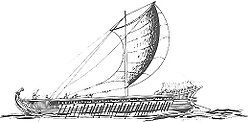 Naval warfare
was often crucial to military success. Early navies used sailing ships without cannons; often the goal was to ram the enemy ships and cause them to sink.
There was human oar power, often using slaves
, built up to ramming speed. Galleys were used in the 3rd millennium BC by the Cretan
s. The Greek
s later advanced these ships.
In 1210 BC, the first recorded naval battle was fought between Suppiluliuma II
, king of the Hittites
, and Cyprus
, which was defeated. In the Persian Wars, the navy became of increasing importance.
Trireme
s were involved in more complicated sea-land operations. Themistocles
helped to build up a stronger Greek navy, composed of 310 ships, and defeated the Persians at the Battle of Salamis
, ending the Persian invasion of Greece.
In the First Punic War
, the war between Carthage
and Rome
started with an advantage to Carthage because of their naval experience. A Roman fleet was built in 261 BC, with the addition of the corvus
that allowed Roman soldiers onboard the ships to board the enemy ships. The bridge would prove effective at the Battle of Mylae
, resulting in a Roman victory.
The Vikings, in the 8th century AD
, invented a ship propelled by oars with a dragon decorating the prow, hence called the Drakkar. The 12th century CE Song Dynasty
invented ships with watertight bulk head compartments while the 2nd century BCE Han Dynasty
invented rudders and sculled oars for their warships.
Fortification
s are important in warfare. Early hill-forts were used to protect inhabitants in the Iron Age
. They were primitive forts surrounded by ditches filled with water.
Forts were then built out of mud bricks, stones, wood, and other available materials. Romans used rectangular fortresses built out of wood and stone. As long as there have been fortifications, there have been contraptions to break in, dating back to the times of Romans
and earlier. Siege
warfare is often necessary to capture forts.
Some of the military unit types and technologies which were used in the medieval period are:
Bows
and arrows were often used by combatants. Egyptians shot arrows from chariots effectively. The crossbow
was developed around 500 BC in China
, and was used a lot in the Middle Ages
. The English
/Welsh
longbow
from the 12th century also became important in the Middle Ages
. It helped to give the English a large early advantage in the Hundred Years' War
, even though the English were eventually defeated. It dominated battlefields for over a century.
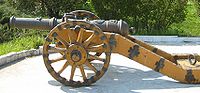 In the 10th century, the invention of gunpowder led to many new weapons that were improved over time. Blackpowder was used in China
since the 4th century, but it was not used as a weapon until the 11th century.
Until the mid-15th century, guns were held in one hand, while the explosive charge was ignited by the other hand. Then came the matchlock
, which was used widely until around the 1720s. Leonardo da Vinci
made drawings of the wheel lock which made its own sparks. Eventually, the matchlock was replaced by the flintlock
.
Cannon
s were first used in Europe in the early 14th century, and played a vital role in the Hundred Years' War
. The first cannons were simply welded metal bars in the form of a cylinder, and the first cannonballs were made of stone. By 1346, at the Battle of Crécy
, the cannon had been used; at the Battle of Agincourt
they would be used again.
At the beginning of the 16th century, the first European fire ships were used. Ships were filled with flammable materials, set on fire, and sent to enemy lines. This tactic was successfully used by Francis Drake
to scatter the Spanish Armada
at the Battle of Gravelines
, and would later be used by the Chinese, Russians, Greeks, and several other countries in naval battles.
Naval mines were invented in the 17th century, though they were not used in great numbers until the American Civil War
. They were used heavily in the First World War and Second World War.
The first model of submarine
was invented in 1624 by Cornelius Drebbel
, which could go to depth of 15 feet (5 m). However, the first war submarine as we presently think of it was constructed in 1885 by Isaac Peral
.
The Turtle
was developed by David Bushnell
during the American Revolution
. Robert Fulton
then improved the submarine design by creating the Nautilus.
 The Howitzer
, a type of field artillery
, was developed in 17th century to fire high trajectory
explosive shells at targets that could not be reached by flat trajectory projectiles.
Bayonets also became of wide usage to infantry soldiers. Bayonet
is named after Bayonne
, France
where it was first manufactured in the 16th century. It is used often in infantry charges to fight in hand-to-hand combat. General Jean Martinet
introduced the bayonet to the French army. They were used a lot in the American Civil War
, and continued to be used in modern wars like the Invasion of Iraq.
Balloon
s were first used in warfare at the end of the 18th century. It was first introduced in Paris of 1783; the first balloon traveled over 5 miles (8 km). Previously military scouts
could only see from high points on the ground, or from the mast of a ship. Now they could be high in the sky, signalling to troops on the ground. This made it much more difficult for troop movements to go unobserved.
At the end of the 18th century, iron-cased artillery rockets were successfully used militarily in India against the British by Tipu Sultan
of the Kingdom of Mysore
during the Anglo-Mysore Wars
. Rockets were generally inaccurate at that time, though William Hale
, in 1844, was able to develop a better rocket. The new rocket no longer needed the rocket stick, and had a higher accuracy.
In the 1860s there were a series of advancements in rifle
s. The first repeating rifle
was designed in 1860 by a company bought out by Winchester
, which made new and improved versions. Springfield rifle
s arrived in the mid-19th century also. Machine gun
s arrived in the middle of the 19th century. Automatic rifle
s and light machine gun
s first arrived at the beginning of the 20th century.
Also in the 1860s came the first boats that would later be known as torpedo boat
s. These were first used in the American Civil War
, but generally were not successful. Several Confederates
used spar torpedo
es, which were bombs on long poles designed to attach to boats. In the later part of the 19th century, the self-propelled torpedo
was developed. The HNoMS Rap (1873)HNoMS Rap
At the start of the World Wars, various nations had developed weapons that were a surprise to their adversaries, leading to a need to learn from this, and alter how to combat them. Flame throwers were first used in the first world war. The French were the first to introduce the armored car in 1902. Then in 1918, the British produced the first armored troop carrier
. Many early tank
s were proof of concept but impractical until further development. In World War I
, the British and French held a crucial advantage due to their superiority in tanks; the Germans had only a few dozen A7V tanks, as well as 170 captured tanks. The British and French both had over several hundred each. The French tanks included the 13 ton Schnedier-Creusot, with a 75 mm gun, and the British had the Mark IV and Mark V tanks.
On December 17, 1903, the Wright Brothers
performed the first controlled, powered, heavier-than-air flight; it went 39 meters (120 ft). In 1907, the first helicopter
flew, but it wasn't practical for usage. Aviation became important in World War I
, in which several aces
gained fame. In 1911 an aircraft
took off from a warship
for the first time. It was a cruiser. Take-offs were soon perfected, but deck landings on a cruiser were another matter. This led to the development of an aircraft carrier
with a decent unobstructed flight deck.
Chemical warfare
exploded into the public consciousness in World War I
but may have been used in earlier wars without as much human attention. The Germans used gas-filled shells at the Battle of Bolimov
on January 3, 1915. These were not lethal, however. In April 1915, the Germans developed a chlorine gas that was highly lethal, and used it to great effect at Second Battle of Ypres
.
World War II
gave rise to even more technology. The worth of the aircraft carrier
was proved in the battles between the United States
and Japan
like the Battle of Midway
. Radar
was independently invented by the Allies
and Axis powers
. It used radio wave
s to detect nearby objects. Molotov cocktail
s were invented by General Franco in the Spanish Civil War, directing the Nationalists to use them against Soviet tanks in the assault on Toledo. The atomic bomb was developed by the Manhattan Project
and launched at Hiroshima and Nagasaki
in 1945, ultimately ending World War II.
During the Cold War
, even though fighting did not actually occur, the superpowers – the United States
and Russia
– engaged in a race
to develop and increase the level of technology available for military purposes. In the space race
, both nations attempted to launch human beings into space to the moon. Other technological advances centered around intelligence (like the spy satellite
) and missiles (ballistic missile
s, cruise missile
s). Nuclear submarine
, invented in 1955. This meant submarines no longer had to surface as often, and could run more quietly. They evolved into becoming underwater missile platforms. Cruise missile
s were invented in Nazi Germany during World War II in the form of the V-1.
of analysis. While general discipline of history subdivides history into Ancient history (Classical antiquity), Middle Ages (Europe, 4th century - 15th century), Early modern period (Europe, 14th century - 18th century), Modern era (Europe, 18th century - 20th century), and the Post-Modern (USA, 1949–present), the periodisation below stresses technological change in its emphasis, particularly the crucial dramatic change during the Gunpowder warfare period.
Periodisation is not uniformly applied through time and space, affirming the claims of Eurocentrism from regional historians. For example what might be described as ancient warfare
is still practised in a number of parts of the world. Other eras that are distinct in Europe
an history, such as the era of Medieval warfare
, may have little relevance in East Asia
.
is the history of militaries: their conquests, their movements, and their technological innovation
s. There are many reasons for this. Kingdom
s and empire
s, the central units of control in the ancient world, could only be maintained through military force. Due to limited agricultural ability, there were relatively few areas that could support large communities, so fighting was common.
Weapon
s and armor, designed to be sturdy, tended to last longer than other artifacts, and thus a great deal of surviving artifacts recovered tend to fall in this category as they are more likely to survive. Weapons and armor were also mass-produced to a scale that makes them quite plentiful throughout history, and thus more likely to be found in archaeological digs.
Such items were also considered signs of posterity or virtue, and thus were likely to placed in tombs and monuments to prominent warriors. And writing
, when it existed, was often used for kings to boast of military conquests or victories.
Writing, when used by the common man, also tended to record such events, as major battles and conquests constituted major events that many would have considered worthy of recording either in an epic such as the Homeric writings pertaining to the Trojan War, or even personal writings. Indeed the earliest stories center around warfare, as war was both a common and dramatic aspect of life; the witnessing of a major battle involving many thousands of soldiers would be quite a spectacle, even today, and thus considered worthy both of being recorded in song and art, but also in realistic histories, as well as being a central element in a fictional work.
Lastly, as nation states evolved and empires grew, the increased need for order and efficiency lead to an increase in the number of records and writings. Officials and armies would have good reason for keeping detailed records and accounts involving any and all things concerning a matter such as warfare that in the words of Sun Tzu
was "a matter of vital importance to the state". For all these reasons, military history comprises a large part of ancient history.
Notable militaries in the ancient world included the Egyptian
s, Babylon
ians, Persians, Ancient Greeks
(notably the Sparta
ns and Macedon
ians) , Indians
(notably the Magadha
s, Gangaridai
s , Gandhara
s and Cholas), Early Imperial Chinese
(notably the Qin
and Han
Dynasties), Xiongnu
Confederation, Ancient Romans
, and Carthaginians
.
The fertile crescent
of Mesopotamia
was the center of several prehistoric conquests. Mesopotamia was conquered by the Sumer
ians, Akkadians, Babylonia
ns, Assyria
ns and Persians. Iran
ians were the first nation who introduced cavalry
into their army.
Egypt
began growing as an ancient power, but eventually fell to the Persians, Greek
s, Romans
, Byzantines
and Arab
s.
The earliest recorded battle in India
was the Battle of the Ten Kings
. The Indian epics
Mahabharata
and Ramayana
are centred around conflicts and refer to military formations, theories of warfare and esoteric weaponry. Chanakya
's Arthashastra
contains a detailed study on ancient warfare, including topics on espionage
and war elephant
s.
Alexander the Great invaded Northwestern India and defeated King Porus in the Battle of the Hydaspes River
. The same region was soon re conquered by Chandragupta Maurya
after defeating the Macedonians and Seleucids
. He also went on to conquer the Nanda Empire
and unify Northern India. Most of Southern Asia
was unified under his grandson Ashoka the Great
after the Kalinga War
, though the empire collapsed not long after his reign.
In China
, the Shang Dynasty
and Zhou Dynasty
had risen and collapsed. This led to a Warring States Period
, in which several states continued to fight with each other over territory. Philosopher-strategists such as Confucius
and Sun Tzu
wrote various manuscripts on ancient warfare (as well as international diplomacy).
The Warring States era philosopher Mozi
(Micius) and his Mohist followers invented various siege weapons and siege crafts, including the Cloud Ladder (a four-wheeled, protractable ramp) to scale fortified walls during a siege of an enemy city. The warring states were first unified by Qin Shi Huang
after a series of military conquests, creating the first empire in 'China.'
His empire
was succeeded by the Han Dynasty
, which expanded into Central Asia, Northern China/Manchuria, Southern China, and present day Korea and Vietnam. The Han came into conflict with settled people such as the proto-Korean Gojoseons, and proto-Vietnamese Nanyue. They also came into conflict with the Xiongnu
(Huns
), Yuezhi
, and other steppe civilizations.
The Han defeated and drove the Xiongnu
s west, securing the city-states along the silk route that continued into the Parthia
n Empire. After the decline of central imperial authority, the Han Dynasty
collapsed into an era of civil war and continuous warfare during the Three Kingdoms
period in the 3rd century CE.
The Achaemenid
Persian Empire was founded by Cyrus the Great
after conquering the Median Empire
, Neo-Babylonian Empire
, Lydia
and Asia Minor
. His successor Cambyses
went onto conquer the Egyptian Empire, much of Central Asia
, and parts of Greece, India and Libya
. The empire later fell to Alexander the Great after defeating Darius III
. After being ruled by the Seleucid dynasty
, the Persian Empire was subsequently ruled by the Parthia
n and Sassanid
dynasties, which were the Roman Empire
's greatest rivals during the Roman-Persian Wars
.
In Greece
, several city-state
s emerged to power, including Athens
and Sparta
. The Greeks successfully stopped two Persian invasions, the first at the Battle of Marathon
, where the Persians were led by Darius the Great
, and the second at the Battle of Salamis
, a naval battle where the Greek ships were deployed by orders of Themistocles
and the Persians were under Xerxes I, and the land engagement of the Battle of Plataea
.
The Peloponnesian War
then erupted between the two Greek powers Athens
and Sparta
. Athens built a long wall to protect its inhabitants, but the wall helped to facilitate the spread of a plague that killed about 30,000 Atheninans, including Pericles
. After a disastrous campaign against Syracuse
, the Athenian navy was decisively defeated by Lysander
at the Battle of Aegospotami
.
The Macedonians
, underneath Philip II of Macedon
and Alexander the Great, invaded Persia and won several major victories, establishing Macedonia as a major power. However, following Alexander's death at an early age, the empire quickly fell apart.
Meanwhile, Rome
was gaining power, following a rebellion against the Etruscans. At the three Punic Wars
, the Romans defeated the neighboring power of Carthage. The First Punic War
centered around naval warfare
. The Second Punic War
started with Hannibal
’s invasion of Italy
by crossing the Alps
. He famously won the encirclement at the Battle of Cannae
. However, after Scipio
invaded Carthage, Hannibal was forced to follow and was defeated at the Battle of Zama
, ending the role of Carthage as a power.
After defeating Carthage the Romans went on to become the Mediterranean's dominant power, successfully campaigning in Greece, (Aemilius Paulus decisive victory over Macedonia at the Battle of Pydna
), in the Middle East (Lucius Licinius Lucullus
, Gnaeus Pompeius Magnus), in Gaul
(Gaius Julius Caesar
) and defeating several Germanic tribes (Gaius Marius
, Germanicus
). While Roman armies suffered several major losses, their large population and ability (and will) to replace battlefield casualties, their training, organization, tactical and technical superiority enabled Rome to stay a predominant military force for several centuries, utilizing well trained and maneuverable armies to routinely overcome the much bigger "tribal" armies of their foes (see Battles of Aquae Sextiae
, Vercellae
, Tigranocerta
, Alesia
).
In 54 BCE the Roman triumvir Marcus Licinius Crassus
took the offensive against the Parthian Empire
in the east. In a decisive battle at Carrhae
Romans were defeated and the golden Aquila
(legionary battle standards) was taken as trophy to Ctesiphon
. The result was one of the worst defeats suffered by the Roman Republic in its entire history.
Romans, whose armies consisted mainly of heavy infantry and only smaller cavalry contingents until then, after this defeat learnt the importance of cavalry from Iranians and eventually introduced it into their army, just as nearly a thousand year earlier the first Iranian to reached the Iranian Plateau
introduced the Assyrians to a similar reform. However, the improvement of the quality of their cavalry coincided with a decline in the quality of their infantry. During the decline of the empire, the Romans relied on "barbarians" to serve in their military as federates, as well as independent "barbarian" kingdoms and their armies to defeat invaders such as the Huns.
While successfully dealing with foreign opponents, Rome experienced numerous civil wars, notably the power struggles of Roman generals such as Marius and Sulla during the end of the Republic. Caesar was also notable for his role in the civil war against the other member of the Triumvirate (Pompey) and against the Roman Senate.
The successors of Caesar — Octavian and Mark Anthony, also fought a civil war with Caesar's assassins (Senators Brutus, Cassius, etc.). Octavian and Mark Anthony eventually fought another civil war between themselves to determine the sole ruler of the Rome. Octavian emerged victorious and Rome was turned into an empire with a huge standing army of professional soldiers.
By the time of Marcus Aurelius, the Romans had expanded from the Atlantic Ocean in the west to Mesopotamia
in the east and controlled Northern Africa and Central Europe up to the Black Sea
. However, Aurelius marked the end of the Five Good Emperors, and Rome quickly fell to decline.
The Huns, Goths
, and other barbaric groups invaded Rome, which continued to suffer from inflation
and other internal strifes. Despite the attempts of Diocletian
, Constantine I, and Theodosius I
, western Rome collapsed and was eventually conquered in 476. The Byzantine empire
continued to prosper, however.
, changing military
tactics
and the role of cavalry
and artillery
.
Similar patterns of warfare existed in other parts of the world. In China around the fifth century armies moved from massed infantry to cavalry based forces, copying the steppe
nomad
s. The Middle East
and North Africa
used similar, if often more advanced, technologies than Europe.
In Japan
the Medieval warfare period is considered by many to have stretched into the nineteenth century. In Africa along the Sahel
and Sudan
states like the Kingdom of Sennar and Fulani Empire
employed Medieval tactics and weapons well after they had been supplanted in Europe.
In the Medieval period, feudalism
was firmly implanted, and there existed many landlord
s in Europe. Landlords often owned castle
s to protect their territory.
The Islam
ic Arab Empire
began rapidly expanding throughout the Middle East
, North Africa
, and Central Asia
, initially led by Khalid ibn al-Walid
, and later under the Umayyads. While their attempts to invade Europe by way of the Balkans were defeated by Byzantium
and Bulgaria
, the Arabs expanded to the Iberian Peninsula
in the west and the Indus Valley
in the east. The Abassids then took over the Arab Empire, though the Umayyads remained in control of Islamic Spain
.
At the Battle of Tours
, the Franks
under Charles Martel
stopped short a Muslim invasion. The Abassids defeated the Tang
Chinese army at the Battle of Talas
, but were later defeated by the Seljuk Turks and the Mongols
centuries later, until the Arab Empire eventually came to an end after the Battle of Baghdad
in 1258.
In China
, the Sui Dynasty
had risen and conquered the Chen Dynasty of the south. They invaded Vietnam (northern Vietnam had been in Chinese control since the Han Dynasty), fighting the troops of Champa
, who had cavalry mounted on elephants. After decades of economic turmoil and a failed invasion of Korea, the Sui collapsed and was followed by the Tang Dynasty
, who fought with various Turkic
groups, the Tibetans
of Lhasa
, the Tanguts, the Khitans, and collapsed due to political fragmentation of powerful regional military governors (jiedushi). The innovative Song Dynasty
followed next, inventing new weapons of war that employed the use of Greek Fire
and gunpowder
(see section below) against enemies such as the Jurchens
.
The Mongols under Genghis Khan
, Ogedei Khan
, Mongke Khan
, and Kublai Khan
conquered most of Eurasia. They took over China, Persia, Turkestan, and Russia. After Kublai Khan
took power and created the Yuan Dynasty
, the divisions of the empire ceased to cooperate with each other, and the mongol empire
was only nominally united.
In New Zealand
, prior to European discovery, oral histories, legends and whakapapa
include many stories of battles and wars. Māori warriors were held in high esteem. One group of Polynesians
migrated to the Chatham Islands
, where they developed the largely pacifist Moriori
culture. Their pacifism left the Moriori unable to defend themselves when the islands were invaded by mainland Māori in the 1830s.
They proceeded to massacre the Moriori and enslave
the survivors. Warrior
culture also developed in the isolated Hawaiian Islands
. During the 1780s and 1790s the chiefs and alii were constantly fighting for power. After a series of battles the Hawaiian Islands were united for the first time under a single ruler who would become known as Kamehameha I
.
weapons were first developed in Song Dynasty
China (see also Technology of Song Dynasty), the technology later spread west to the Ottoman Empire
, from where it spread to the Safavid Empire of Persia and the Mughal Empire
of India. The arquebus
was later adopted by European armies during the Italian Wars
of the early 16th century.
This all brought an end to the dominance of armored cavalry on the battlefield. The simultaneous decline of the feudal system — and the absorption of the medieval city-states into larger states — allowed the creation of professional standing armies to replace the feudal levies
and mercenaries that had been the standard military component of the Middle Ages.
In Africa
, Ahmad ibn Ibrihim al-Ghazi
, was the first African commander to use gunpowder on the continent in the Ethiopian–Adal War, that lasted for fourteen years (1529-1543)
The period spanning between the 1648 Peace of Westphalia
and the 1789 French Revolution
is also known as Kabinettskriege
(Princes' warfare) as wars were mainly carried out by imperial or monarchics states, decided by cabinets and limited in scope and in their aims. They also involved quickly shifting alliances, and mainly used mercenaries.
Over the period of The long 18th-19th centuries all military Arms and Services underwent significant developments that included a more mobile Field artillery
, the transition from use of Battalion
Infantry drill in close order to open order formations and the transfer of emphasis from the use of bayonets to the rifle
that replaced the Musket
, and virtual replacement of all types of cavalry
with the universal Dragoons, or mounted infantry
.
. Technological advances became increasingly important; while the armies of the previous period had usually had similar weapons, the industrial age saw encounters such as the Battle of Sadowa, in which possession of a more advanced technology played a decisive role in the outcome.
Conscription
was employed in industrial warfare to increase the amount of soldiers that were available for combat. This was used by Napoleon Bonaparte in the Napoleonic Wars
.
Total war
was used in industrial warfare, the objective being to prevent the opposing nation to engage in war. William Tecumseh Sherman
's "March to the Sea" and Philip Sheridan
's burning of the Shenandoah Valley
are examples of total warfare.
where success is valued above methods. The notion of total war
is the extreme of this trend. Militaries have developed technological advances rivalling the scientific accomplishments of any other field of study.
However, it should be noted that modern militaries benefit in the development of these technologies under the funding of the public
, the leadership of national governments
, and often in cooperation with large civilian
groups, such as the General Dynamics
and Lockheed Martin
corporations, in the United States
. And as for "total war," it may be argued that it is not an exclusive practice of modern militaries, but in the tradition of genocidal conflict
that marks even tribal warfare to this day.
What distinguishes modern military organizations from those previous is not their willingness to prevail in conflict by any method, but rather the technological variety of tools and methods available to modern battlefield commanders, from submarine
s to satellite
s, from knives
to nuclear warheads.
Some of the military unit types and technologies which were developed in modern times are:
World War I
was sparked by the assassination of Archduke Franz Ferdinand
, leading to the mobilization of Austria
and Serbia
. The Germans
joined the Austrians to form the Central powers; the French
, British
, and Russia
formed the Allied powers. Following the Battle of the Marne
and the outflanking attempt of both nations in the "Race to the Sea
", trench warfare
ensued, leaving the war in a great deadlock.
Major operations by the Germans at the Battle of Verdun
and by the British and the French at the Battle of the Somme were carried out, and new technology like tanks and chlorine gas were used. Following the USA's entrance into the war, the Germans and their allies were eventually defeated.
World War II
ensued after Germany
's invasion of Poland
, forcing Britain
and France
to declare war. Germany quickly defeated France and Belgium, later aided by Italy. A hasty evacuation occurred at Dunkirk to save the Allied army from complete disaster. The Germans then attacked USSR and marched to take over the Soviet resources, but were thwarted.
Meanwhile, Japan, who had already been at war
with the Chinese since 1937, had launched a surprise attack on Pearl Harbor
, leading the United States
to join the Allied powers. In Europe, the Allies opened three fronts: in the west, after securing Normandy
; in the east, aiding the Soviet Union; and in the south, through Italy. Germany eventually surrendered, upon which the Allies turned and focused troops to do island hopping. The dropping of the atom bombs on Hiroshima
and Nagasaki led to the surrender of Japan and the end of the Second World War.
Worsening relationships between wartime Allies developed into the Cold War
, reaching a climax during the Cuban Missile Crisis
at the same time as the Sino-Indian War
. Hostilities never actually occurred, though the US-backed UN forces did engage against the communist states in the Korean War
and the Vietnam War
.
Specific:
Humanities
The humanities are academic disciplines that study the human condition, using methods that are primarily analytical, critical, or speculative, as distinguished from the mainly empirical approaches of the natural sciences....
discipline within the scope of general historical
History
History is the discovery, collection, organization, and presentation of information about past events. History can also mean the period of time after writing was invented. Scholars who write about history are called historians...
recording of armed conflict
War
War is a state of organized, armed, and often prolonged conflict carried on between states, nations, or other parties typified by extreme aggression, social disruption, and usually high mortality. War should be understood as an actual, intentional and widespread armed conflict between political...
in the history of humanity, and its impact on the societies, their cultures, economies and changing intra
Politics
Politics is a process by which groups of people make collective decisions. The term is generally applied to the art or science of running governmental or state affairs, including behavior within civil governments, but also applies to institutions, fields, and special interest groups such as the...
and international relations
International relations
International relations is the study of relationships between countries, including the roles of states, inter-governmental organizations , international nongovernmental organizations , non-governmental organizations and multinational corporations...
hips.
Professional historians normally focus on military affairs that had a major impact on the societies involved as well as the aftermath of conflicts, while amateur historians and hobbyists often take a larger interest in the details of battles, equipment and uniforms in use.
The essential subjects of military history study are the causes of war, the social and cultural foundations, military doctrine on each side, the logistics, leadership, technology, strategy
Strategy
Strategy, a word of military origin, refers to a plan of action designed to achieve a particular goal. In military usage strategy is distinct from tactics, which are concerned with the conduct of an engagement, while strategy is concerned with how different engagements are linked...
, and tactics
Military tactics
Military tactics, the science and art of organizing an army or an air force, are the techniques for using weapons or military units in combination for engaging and defeating an enemy in battle. Changes in philosophy and technology over time have been reflected in changes to military tactics. In...
used, and how these changed over time.
As an applied field, military history has been studied at academies and service schools because the military command
Command and Control (military)
Command and control, or C2, in a military organization can be defined as the exercise of authority and direction by a properly designated commanding officer over assigned and attached forces in the accomplishment of the mission...
seeks to not repeat past mistakes, and improve upon its current performance by instilling an ability in commanders to perceive historical parallels during a battle, so as to capitalize on the lessons learned from the past.
The discipline of military history is dynamic, changing with development as much of the subject area as the societies and organisations that make use of it. The dynamic nature of the discipline of military history is largely related to the rapidity of change the military forces, and the art and science of managing them, as well as the frenetic pace of technological development
Technological evolution
Technological evolution is the name of a science and technology studies theory describing technology development, developed by Czech philosopher Radovan Richta.-Theory of technological evolution:...
that had taken place during the period known as the Industrial Revolution
Industrial Revolution
The Industrial Revolution was a period from the 18th to the 19th century where major changes in agriculture, manufacturing, mining, transportation, and technology had a profound effect on the social, economic and cultural conditions of the times...
, and more recently in the nuclear
Nuclear proliferation
Nuclear proliferation is a term now used to describe the spread of nuclear weapons, fissile material, and weapons-applicable nuclear technology and information, to nations which are not recognized as "Nuclear Weapon States" by the Treaty on the Nonproliferation of Nuclear Weapons, also known as the...
and information age
Information Age
The Information Age, also commonly known as the Computer Age or Digital Age, is an idea that the current age will be characterized by the ability of individuals to transfer information freely, and to have instant access to knowledge that would have been difficult or impossible to find previously...
s.
An important recent concept is the Revolution in Military Affairs
Revolution in Military Affairs
The military concept of Revolution in Military Affairs is a theory about the future of warfare, often connected to technological and organizational recommendations for change in the United States military and others....
(RMA) which attempts to explain how warfare has been shaped by emerging technologies, such as gunpowder. It highlights the short outbursts of rapid change followed by periods of relative stability.
Historiography of military history
HistoriographyHistoriography
Historiography refers either to the study of the history and methodology of history as a discipline, or to a body of historical work on a specialized topic...
is the study of the history of history and in this case, of the field of military history, to gain an accurate assessment of conflicts using all available sources. For this reason military history is periodised, creating overlaying boundaries of study and analysis in which descriptions of battles by leaders may be unreliable due to the inclination to minimize mention of failure and exaggerate successes. Military historians use Historiographical analysis in an effort to allow an unbiased, contemporary view of records.
One military historian, Jeremy Black, in a recent work mentioned some problems 21st century military historians face as an inheritance of their predecessors: Eurocentricity, a technological bias, a focus on leading military powers and dominant military systems, the separation of land from sea and recently air conflicts, the focus on state-to-state conflict, a lack of focus on political "tasking" in how forces are used.
If these challenges were not sufficient for the military historians, the limits of method are complicated by the lack of records, either destroyed or never recorded for its value as a military secret that may prevent some salient facts from being reported at all; scholars still do not know the exact nature of Greek fire
Greek fire
Greek fire was an incendiary weapon used by the Byzantine Empire. The Byzantines typically used it in naval battles to great effect as it could continue burning while floating on water....
for instance. Despite these limits, wars are some of the most studied and detailed periods of human history.
Military historians have often compared
Comparative history
Comparative history is the comparison of different societies which existed during the same time period or shared similar cultural conditions. The comparative history of societies emerged as an important specialty among intellectuals in the Enlightenment in the 18th century, as typified by...
organization, tactical and strategic ideas, leadership, and national support of the militaries of different nations.
Early historians
The documentation of military history begins with the confrontation between Sumer (current IraqIraq
Iraq ; officially the Republic of Iraq is a country in Western Asia spanning most of the northwestern end of the Zagros mountain range, the eastern part of the Syrian Desert and the northern part of the Arabian Desert....
) and Elam (current Iran
Iran
Iran , officially the Islamic Republic of Iran , is a country in Southern and Western Asia. The name "Iran" has been in use natively since the Sassanian era and came into use internationally in 1935, before which the country was known to the Western world as Persia...
) c.2700 BCE near the modern Basra
Basra
Basra is the capital of Basra Governorate, in southern Iraq near Kuwait and Iran. It had an estimated population of two million as of 2009...
, and includes such enduring records as the Hebrew Bible
Hebrew Bible
The Hebrew Bible is a term used by biblical scholars outside of Judaism to refer to the Tanakh , a canonical collection of Jewish texts, and the common textual antecedent of the several canonical editions of the Christian Old Testament...
. Other prominent records in military history are the Trojan War
Trojan War
In Greek mythology, the Trojan War was waged against the city of Troy by the Achaeans after Paris of Troy took Helen from her husband Menelaus, the king of Sparta. The war is among the most important events in Greek mythology and was narrated in many works of Greek literature, including the Iliad...
in Homer
Homer
In the Western classical tradition Homer , is the author of the Iliad and the Odyssey, and is revered as the greatest ancient Greek epic poet. These epics lie at the beginning of the Western canon of literature, and have had an enormous influence on the history of literature.When he lived is...
's Iliad
Iliad
The Iliad is an epic poem in dactylic hexameters, traditionally attributed to Homer. Set during the Trojan War, the ten-year siege of the city of Troy by a coalition of Greek states, it tells of the battles and events during the weeks of a quarrel between King Agamemnon and the warrior Achilles...
(though its historicity
Historicity of the Iliad
The extent of the historical basis of the Iliad has been a topic of scholarly debate in classical studies since the 19th century.While the Age of Enlightenment had rejected the story of the Trojan War as fable, the discoveries made by Heinrich Schliemann at Hisarlik reopened the question in modern...
has been challenged), The Histories
Histories (Herodotus)
The Histories of Herodotus is considered one of the seminal works of history in Western literature. Written from the 450s to the 420s BC in the Ionic dialect of classical Greek, The Histories serves as a record of the ancient traditions, politics, geography, and clashes of various cultures that...
by Herodotus
Herodotus
Herodotus was an ancient Greek historian who was born in Halicarnassus, Caria and lived in the 5th century BC . He has been called the "Father of History", and was the first historian known to collect his materials systematically, test their accuracy to a certain extent and arrange them in a...
(484 BC - 425 BC) who is often called "father of history". Next was Thucydides
Thucydides
Thucydides was a Greek historian and author from Alimos. His History of the Peloponnesian War recounts the 5th century BC war between Sparta and Athens to the year 411 BC...
whose impartiality, despite being an Athenian
Athens
Athens , is the capital and largest city of Greece. Athens dominates the Attica region and is one of the world's oldest cities, as its recorded history spans around 3,400 years. Classical Athens was a powerful city-state...
, allowed him to take advantage of his exile to research the war from different perspectives by carefully examining documents and interviewing eyewitnesses. An approach centered around the analysis of a leader was taken by Xenophon
Xenophon
Xenophon , son of Gryllus, of the deme Erchia of Athens, also known as Xenophon of Athens, was a Greek historian, soldier, mercenary, philosopher and a contemporary and admirer of Socrates...
(430 BC - 355 BC) in Anabasis
Anabasis (Xenophon)
Anabasis is the most famous work, in seven books, of the Greek professional soldier and writer Xenophon. The journey it narrates is his best known accomplishment and "one of the great adventures in human history," as Will Durant expressed the common assessment.- The account :Xenophon accompanied...
, recording the expedition of Cyrus the Younger
Cyrus the Younger
Cyrus the Younger, son of Darius II of Persia and Parysatis, was a Persian prince and general. The time of his birth is unknown, but he died in 401 B.C. The history of Cyrus and of the retreat of the Greeks is told by Xenophon in his Anabasis. Another account, probably from Sophaenetus of...
into Anatolia
Anatolia
Anatolia is a geographic and historical term denoting the westernmost protrusion of Asia, comprising the majority of the Republic of Turkey...
.
The records of the Roman Julius Caesar
Julius Caesar
Gaius Julius Caesar was a Roman general and statesman and a distinguished writer of Latin prose. He played a critical role in the gradual transformation of the Roman Republic into the Roman Empire....
(100 BC - 44 BC) enable a comparative approach for campaign
Military campaign
In the military sciences, the term military campaign applies to large scale, long duration, significant military strategy plan incorporating a series of inter-related military operations or battles forming a distinct part of a larger conflict often called a war...
s such as Commentarii de Bello Gallico
Commentarii de Bello Gallico
Commentarii de Bello Gallico is Julius Caesar's firsthand account of the Gallic Wars, written as a third-person narrative. In it Caesar describes the battles and intrigues that took place in the nine years he spent fighting local armies in Gaul that opposed Roman domination.The "Gaul" that Caesar...
and Commentarii de Bello Civili
Commentarii de Bello Civili
Commentarii de Bello Civili , or Bellum Civile, is an account written by Julius Caesar of his war against Gnaeus Pompeius and the Senate...
.
Technological evolution
Chariot
Chariot
The chariot is a type of horse carriage used in both peace and war as the chief vehicle of many ancient peoples. Ox carts, proto-chariots, were built by the Proto-Indo-Europeans and also built in Mesopotamia as early as 3000 BC. The original horse chariot was a fast, light, open, two wheeled...
s, pulled by animals like the onager
Onager
The Onager is a large member of the genus Equus of the family Equidae native to the deserts of Syria, Iran, Pakistan, India, Israel and Tibet...
, ox
Ox
An ox , also known as a bullock in Australia, New Zealand and India, is a bovine trained as a draft animal. Oxen are commonly castrated adult male cattle; castration makes the animals more tractable...
, donkey
Donkey
The donkey or ass, Equus africanus asinus, is a domesticated member of the Equidae or horse family. The wild ancestor of the donkey is the African Wild Ass, E...
, and later the horse
Horse
The horse is one of two extant subspecies of Equus ferus, or the wild horse. It is a single-hooved mammal belonging to the taxonomic family Equidae. The horse has evolved over the past 45 to 55 million years from a small multi-toed creature into the large, single-toed animal of today...
, originated around 2000 BC. The chariot was an effective, fast weapon; while one man controlled the maneuvering of the chariot, a second bowman could shoot arrows at enemy soldiers. These became crucial to the maintenance of several governments, including the New Egyptian Kingdom and the Shang Dynasty
Shang Dynasty
The Shang Dynasty or Yin Dynasty was, according to traditional sources, the second Chinese dynasty, after the Xia. They ruled in the northeastern regions of the area known as "China proper" in the Yellow River valley...
and the nation states of early to mid Zhou dynasty
Zhou Dynasty
The Zhou Dynasty was a Chinese dynasty that followed the Shang Dynasty and preceded the Qin Dynasty. Although the Zhou Dynasty lasted longer than any other dynasty in Chinese history, the actual political and military control of China by the Ji family lasted only until 771 BC, a period known as...
.
Some of the military unit types and technologies which were developed in the ancient world are:
- SlingerSling (weapon)A sling is a projectile weapon typically used to throw a blunt projectile such as a stone or lead "sling-bullet". It is also known as the shepherd's sling....
- HopliteHopliteA hoplite was a citizen-soldier of the Ancient Greek city-states. Hoplites were primarily armed as spearmen and fought in a phalanx formation. The word "hoplite" derives from "hoplon" , the type of the shield used by the soldiers, although, as a word, "hopla" could also denote weapons held or even...
- AuxiliariesAuxiliaries (Roman military)Auxiliaries formed the standing non-citizen corps of the Roman army of the Principate , alongside the citizen legions...
- InfantryInfantryInfantrymen are soldiers who are specifically trained for the role of fighting on foot to engage the enemy face to face and have historically borne the brunt of the casualties of combat in wars. As the oldest branch of combat arms, they are the backbone of armies...
- Crossbowmen
- Chariots
- CavalryCavalryCavalry or horsemen were soldiers or warriors who fought mounted on horseback. Cavalry were historically the third oldest and the most mobile of the combat arms...
For settled agrarian civilizations, the infantry
Infantry
Infantrymen are soldiers who are specifically trained for the role of fighting on foot to engage the enemy face to face and have historically borne the brunt of the casualties of combat in wars. As the oldest branch of combat arms, they are the backbone of armies...
would become the core of military action. The infantry started as opposing armed groups of soldiers underneath commanders. The Greeks
Ancient Greece
Ancient Greece is a civilization belonging to a period of Greek history that lasted from the Archaic period of the 8th to 6th centuries BC to the end of antiquity. Immediately following this period was the beginning of the Early Middle Ages and the Byzantine era. Included in Ancient Greece is the...
and early Romans used rigid, heavily armed phalanxes
Phalanx formation
The phalanx is a rectangular mass military formation, usually composed entirely of heavy infantry armed with spears, pikes, sarissas, or similar weapons...
. The Macedonians and Hellenistic states would adopt phalanx formations with sarissa
Sarissa
The sarissa or sarisa was a 4 to 7 meter long spear used in the ancient Greek and Hellenistic warfare. It was introduced by Philip II of Macedon and was used in the traditional Greek phalanx formation as a replacement for the earlier dory, which was considerably shorter. The phalanxes of Philip...
pikemen. The Romans
Roman army
The Roman army is the generic term for the terrestrial armed forces deployed by the kingdom of Rome , the Roman Republic , the Roman Empire and its successor, the Byzantine empire...
would later adopt more flexible maniples from their neighbors. The kingdoms of the Warring States in East Asia also adopted infantry combat, a transition from chariot warfare from centuries earlier.
Cavalry
Cavalry
Cavalry or horsemen were soldiers or warriors who fought mounted on horseback. Cavalry were historically the third oldest and the most mobile of the combat arms...
would become an important tool. In the Sicilian Expedition
Sicilian Expedition
The Sicilian Expedition was an Athenian expedition to Sicily from 415 BC to 413 BC, during the Peloponnesian War. The expedition was hampered from the outset by uncertainty in its purpose and command structure—political maneuvering in Athens swelled a lightweight force of twenty ships into a...
, led by Athens
Athens
Athens , is the capital and largest city of Greece. Athens dominates the Attica region and is one of the world's oldest cities, as its recorded history spans around 3,400 years. Classical Athens was a powerful city-state...
in an attempt to subdue Syracuse
Syracuse, Italy
Syracuse is a historic city in Sicily, the capital of the province of Syracuse. The city is notable for its rich Greek history, culture, amphitheatres, architecture, and as the birthplace of the preeminent mathematician and engineer Archimedes. This 2,700-year-old city played a key role in...
, the well-trained Syracusan cavalry became crucial to the success of the Syracusans. Macedon
Macedon
Macedonia or Macedon was an ancient kingdom, centered in the northeastern part of the Greek peninsula, bordered by Epirus to the west, Paeonia to the north, the region of Thrace to the east and Thessaly to the south....
ian Alexander the Great effectively deployed his cavalry forces to secure victories. In battles such as the Battle of Cannae
Battle of Cannae
The Battle of Cannae was a major battle of the Second Punic War, which took place on August 2, 216 BC near the town of Cannae in Apulia in southeast Italy. The army of Carthage under Hannibal decisively defeated a numerically superior army of the Roman Republic under command of the consuls Lucius...
of the Second Punic War
Second Punic War
The Second Punic War, also referred to as The Hannibalic War and The War Against Hannibal, lasted from 218 to 201 BC and involved combatants in the western and eastern Mediterranean. This was the second major war between Carthage and the Roman Republic, with the participation of the Berbers on...
, and the Battle of Carrhae
Battle of Carrhae
The Battle of Carrhae, fought in 53 BC near the town of Carrhae, was a major battle between the Parthian Empire and the Roman Republic. The Parthian Spahbod Surena decisively defeated a Roman invasion force led by Marcus Licinius Crassus...
of the Roman-Persian Wars
Roman-Persian Wars
The Roman–Persian Wars were a series of conflicts between states of the Greco-Roman world and two successive Iranic empires: the Parthian and the Sassanid. Contact between the Parthian Empire and the Roman Republic began in 92 BC; wars began under the late Republic, and continued...
, the importance of the cavalry would be repeated.
There were also horse archers, who had the ability to shoot on horseback – the Parthians, Scythians, Mongols
Mongols
Mongols ) are a Central-East Asian ethnic group that lives mainly in the countries of Mongolia, China, and Russia. In China, ethnic Mongols can be found mainly in the central north region of China such as Inner Mongolia...
, and other various steppe people were especially fearsome with this tactic. By the 3rd-4th century CE, heavily armored cavalry became widely adopted by the Eastern Roman Empire, Sassanids, Eastern Han Dynasty and Three Kingdoms
Three Kingdoms
The Three Kingdoms period was a period in Chinese history, part of an era of disunity called the "Six Dynasties" following immediately the loss of de facto power of the Han Dynasty rulers. In a strict academic sense it refers to the period between the foundation of the state of Wei in 220 and the...
, etc.
Even in the First World War
World War I
World War I , which was predominantly called the World War or the Great War from its occurrence until 1939, and the First World War or World War I thereafter, was a major war centred in Europe that began on 28 July 1914 and lasted until 11 November 1918...
, cavalry was still considered important; the British mobilized 165,000 horses, the Austrians 600,000, the Germans 715,000, and the Russians more than a million.
The early Indo-Iranians
Indo-Iranians
Indo-Iranian peoples are a linguistic group consisting of the Indo-Aryan, Iranian, Dardic and Nuristani peoples; that is, speakers of Indo-Iranian languages, a major branch of the Indo-European language family....
developed the use of chariot
Chariot
The chariot is a type of horse carriage used in both peace and war as the chief vehicle of many ancient peoples. Ox carts, proto-chariots, were built by the Proto-Indo-Europeans and also built in Mesopotamia as early as 3000 BC. The original horse chariot was a fast, light, open, two wheeled...
s in warfare. The scythed chariot
Scythed chariot
The scythed chariot was a war chariot with scythe-like blades mounted on each side, employed in ancient times.-History:The scythed chariot was a modified war chariot. The blades extended horizontally for about to each side of the wheels...
was later invented in India and soon adopted by the Persian Empire.
War elephant
War elephant
A war elephant was an elephant trained and guided by humans for combat. Their main use was to charge the enemy, trampling them and breaking their ranks. A division of war elephants is known as elephantry....
s were often deployed for fighting in ancient warfare. They were first used in India and later adopted by both the Persians and Alexander the Great against one another. War elephants were also used in the Battle of the Hydaspes River
Battle of the Hydaspes River
The Battle of the Hydaspes River was fought by Alexander the Great in 326 BC against King Porus of the Hindu Paurava kingdom on the banks of the Hydaspes River in the Punjab near Bhera in what is now modern-day Pakistan...
, and by Hannibal
Hannibal Barca
Hannibal, son of Hamilcar Barca Hannibal's date of death is most commonly given as 183 BC, but there is a possibility it could have taken place in 182 BC. was a Carthaginian military commander and tactician. He is generally considered one of the greatest military commanders in history...
in the Second Punic War
Second Punic War
The Second Punic War, also referred to as The Hannibalic War and The War Against Hannibal, lasted from 218 to 201 BC and involved combatants in the western and eastern Mediterranean. This was the second major war between Carthage and the Roman Republic, with the participation of the Berbers on...
against the Romans.(The effectiveness of war elephants in a battle is a matter of debate)
There were also organizational changes, made possible by better training and intercommunication. Combined arms
Combined arms
Combined arms is an approach to warfare which seeks to integrate different branches of a military to achieve mutually complementary effects...
was the concept of using infantry
Infantry
Infantrymen are soldiers who are specifically trained for the role of fighting on foot to engage the enemy face to face and have historically borne the brunt of the casualties of combat in wars. As the oldest branch of combat arms, they are the backbone of armies...
, cavalry
Cavalry
Cavalry or horsemen were soldiers or warriors who fought mounted on horseback. Cavalry were historically the third oldest and the most mobile of the combat arms...
, and artillery
Artillery
Originally applied to any group of infantry primarily armed with projectile weapons, artillery has over time become limited in meaning to refer only to those engines of war that operate by projection of munitions far beyond the range of effect of personal weapons...
in a coordinated way.
Naval warfare
Naval warfare is combat in and on seas, oceans, or any other major bodies of water such as large lakes and wide rivers.-History:Mankind has fought battles on the sea for more than 3,000 years. Land warfare would seem, initially, to be irrelevant and entirely removed from warfare on the open ocean,...
was often crucial to military success. Early navies used sailing ships without cannons; often the goal was to ram the enemy ships and cause them to sink.
There was human oar power, often using slaves
Slavery
Slavery is a system under which people are treated as property to be bought and sold, and are forced to work. Slaves can be held against their will from the time of their capture, purchase or birth, and deprived of the right to leave, to refuse to work, or to demand compensation...
, built up to ramming speed. Galleys were used in the 3rd millennium BC by the Cretan
Crete
Crete is the largest and most populous of the Greek islands, the fifth largest island in the Mediterranean Sea, and one of the thirteen administrative regions of Greece. It forms a significant part of the economy and cultural heritage of Greece while retaining its own local cultural traits...
s. The Greek
Ancient Greece
Ancient Greece is a civilization belonging to a period of Greek history that lasted from the Archaic period of the 8th to 6th centuries BC to the end of antiquity. Immediately following this period was the beginning of the Early Middle Ages and the Byzantine era. Included in Ancient Greece is the...
s later advanced these ships.
In 1210 BC, the first recorded naval battle was fought between Suppiluliuma II
Suppiluliuma II
Suppiluliuma II, the son of Tudhaliya IV, was the last known king of the New Kingdom of the Hittite Empire, ruling ca. 1207–1178 BC , contemporary with Tukulti-Ninurta I of Assyria....
, king of the Hittites
Hittites
The Hittites were a Bronze Age people of Anatolia.They established a kingdom centered at Hattusa in north-central Anatolia c. the 18th century BC. The Hittite empire reached its height c...
, and Cyprus
Cyprus
Cyprus , officially the Republic of Cyprus , is a Eurasian island country, member of the European Union, in the Eastern Mediterranean, east of Greece, south of Turkey, west of Syria and north of Egypt. It is the third largest island in the Mediterranean Sea.The earliest known human activity on the...
, which was defeated. In the Persian Wars, the navy became of increasing importance.
Trireme
Trireme
A trireme was a type of galley, a Hellenistic-era warship that was used by the ancient maritime civilizations of the Mediterranean, especially the Phoenicians, ancient Greeks and Romans.The trireme derives its name from its three rows of oars on each side, manned with one man per oar...
s were involved in more complicated sea-land operations. Themistocles
Themistocles
Themistocles ; c. 524–459 BC, was an Athenian politician and a general. He was one of a new breed of politicians who rose to prominence in the early years of the Athenian democracy, along with his great rival Aristides...
helped to build up a stronger Greek navy, composed of 310 ships, and defeated the Persians at the Battle of Salamis
Battle of Salamis
The Battle of Salamis was fought between an Alliance of Greek city-states and the Persian Empire in September 480 BCE, in the straits between the mainland and Salamis, an island in the Saronic Gulf near Athens...
, ending the Persian invasion of Greece.
In the First Punic War
First Punic War
The First Punic War was the first of three wars fought between Ancient Carthage and the Roman Republic. For 23 years, the two powers struggled for supremacy in the western Mediterranean Sea, primarily on the Mediterranean island of Sicily and its surrounding waters but also to a lesser extent in...
, the war between Carthage
Carthage
Carthage , implying it was a 'new Tyre') is a major urban centre that has existed for nearly 3,000 years on the Gulf of Tunis, developing from a Phoenician colony of the 1st millennium BC...
and Rome
Rome
Rome is the capital of Italy and the country's largest and most populated city and comune, with over 2.7 million residents in . The city is located in the central-western portion of the Italian Peninsula, on the Tiber River within the Lazio region of Italy.Rome's history spans two and a half...
started with an advantage to Carthage because of their naval experience. A Roman fleet was built in 261 BC, with the addition of the corvus
Corvus (weapon)
The corvus or harpago was a Roman military boarding device used in naval warfare during the First Punic War against Carthage....
that allowed Roman soldiers onboard the ships to board the enemy ships. The bridge would prove effective at the Battle of Mylae
Battle of Mylae
The Battle of Mylae took place in 260 BC during the First Punic War and was the first real naval battle between Carthage and the Roman Republic. This battle was key in the Roman victory of Mylae as well as Sicily itself...
, resulting in a Roman victory.
The Vikings, in the 8th century AD
Anno Domini
and Before Christ are designations used to label or number years used with the Julian and Gregorian calendars....
, invented a ship propelled by oars with a dragon decorating the prow, hence called the Drakkar. The 12th century CE Song Dynasty
Song Dynasty
The Song Dynasty was a ruling dynasty in China between 960 and 1279; it succeeded the Five Dynasties and Ten Kingdoms Period, and was followed by the Yuan Dynasty. It was the first government in world history to issue banknotes or paper money, and the first Chinese government to establish a...
invented ships with watertight bulk head compartments while the 2nd century BCE Han Dynasty
Han Dynasty
The Han Dynasty was the second imperial dynasty of China, preceded by the Qin Dynasty and succeeded by the Three Kingdoms . It was founded by the rebel leader Liu Bang, known posthumously as Emperor Gaozu of Han. It was briefly interrupted by the Xin Dynasty of the former regent Wang Mang...
invented rudders and sculled oars for their warships.
Fortification
Fortification
Fortifications are military constructions and buildings designed for defence in warfare and military bases. Humans have constructed defensive works for many thousands of years, in a variety of increasingly complex designs...
s are important in warfare. Early hill-forts were used to protect inhabitants in the Iron Age
Iron Age
The Iron Age is the archaeological period generally occurring after the Bronze Age, marked by the prevalent use of iron. The early period of the age is characterized by the widespread use of iron or steel. The adoption of such material coincided with other changes in society, including differing...
. They were primitive forts surrounded by ditches filled with water.
Forts were then built out of mud bricks, stones, wood, and other available materials. Romans used rectangular fortresses built out of wood and stone. As long as there have been fortifications, there have been contraptions to break in, dating back to the times of Romans
Ancient Rome
Ancient Rome was a thriving civilization that grew on the Italian Peninsula as early as the 8th century BC. Located along the Mediterranean Sea and centered on the city of Rome, it expanded to one of the largest empires in the ancient world....
and earlier. Siege
Siege
A siege is a military blockade of a city or fortress with the intent of conquering by attrition or assault. The term derives from sedere, Latin for "to sit". Generally speaking, siege warfare is a form of constant, low intensity conflict characterized by one party holding a strong, static...
warfare is often necessary to capture forts.
Some of the military unit types and technologies which were used in the medieval period are:
- ArtilleryArtilleryOriginally applied to any group of infantry primarily armed with projectile weapons, artillery has over time become limited in meaning to refer only to those engines of war that operate by projection of munitions far beyond the range of effect of personal weapons...
- CataphractCataphractA cataphract was a form of armored heavy cavalry utilised in ancient warfare by a number of peoples in Western Eurasia and the Eurasian Steppe....
- CondottieriCondottierithumb|Depiction of [[Farinata degli Uberti]] by [[Andrea del Castagno]], showing a 15th century condottiero's typical attire.Condottieri were the mercenary soldier leaders of the professional, military free companies contracted by the Italian city-states and the Papacy, from the late Middle Ages...
- Fyrd
- RashidunRashidun armyThe Rashidun Caliphate Army or Rashidun army was the primary military body of the Rashidun Caliphate's armed forces during the Muslim conquests of the 7th century, serving alongside the Rashidun Navy...
- Mobile guardMobile guardThe Mobile Guard was an elite light cavalry regiment of Rashidun army during the Muslim conquest of Syria, under the command of Khalid ibn Walid...
- MamlukMamlukA Mamluk was a soldier of slave origin, who were predominantly Cumans/Kipchaks The "mamluk phenomenon", as David Ayalon dubbed the creation of the specific warrior...
- JanissaryJanissaryThe Janissaries were infantry units that formed the Ottoman sultan's household troops and bodyguards...
- KnightKnightA knight was a member of a class of lower nobility in the High Middle Ages.By the Late Middle Ages, the rank had become associated with the ideals of chivalry, a code of conduct for the perfect courtly Christian warrior....
(see also: ChivalryChivalryChivalry is a term related to the medieval institution of knighthood which has an aristocratic military origin of individual training and service to others. Chivalry was also the term used to refer to a group of mounted men-at-arms as well as to martial valour...
) - CrossbowCrossbowA crossbow is a weapon consisting of a bow mounted on a stock that shoots projectiles, often called bolts or quarrels. The medieval crossbow was called by many names, most of which derived from the word ballista, a torsion engine resembling a crossbow in appearance.Historically, crossbows played a...
- Pikeman
- SamuraiSamuraiis the term for the military nobility of pre-industrial Japan. According to translator William Scott Wilson: "In Chinese, the character 侍 was originally a verb meaning to wait upon or accompany a person in the upper ranks of society, and this is also true of the original term in Japanese, saburau...
- SipahiSipahiSipahi was the name of several Ottoman cavalry corps...
Bows
Bow (weapon)
The bow and arrow is a projectile weapon system that predates recorded history and is common to most cultures.-Description:A bow is a flexible arc that shoots aerodynamic projectiles by means of elastic energy. Essentially, the bow is a form of spring powered by a string or cord...
and arrows were often used by combatants. Egyptians shot arrows from chariots effectively. The crossbow
Crossbow
A crossbow is a weapon consisting of a bow mounted on a stock that shoots projectiles, often called bolts or quarrels. The medieval crossbow was called by many names, most of which derived from the word ballista, a torsion engine resembling a crossbow in appearance.Historically, crossbows played a...
was developed around 500 BC in China
China
Chinese civilization may refer to:* China for more general discussion of the country.* Chinese culture* Greater China, the transnational community of ethnic Chinese.* History of China* Sinosphere, the area historically affected by Chinese culture...
, and was used a lot in the Middle Ages
Middle Ages
The Middle Ages is a periodization of European history from the 5th century to the 15th century. The Middle Ages follows the fall of the Western Roman Empire in 476 and precedes the Early Modern Era. It is the middle period of a three-period division of Western history: Classic, Medieval and Modern...
. The English
England
England is a country that is part of the United Kingdom. It shares land borders with Scotland to the north and Wales to the west; the Irish Sea is to the north west, the Celtic Sea to the south west, with the North Sea to the east and the English Channel to the south separating it from continental...
/Welsh
Wales
Wales is a country that is part of the United Kingdom and the island of Great Britain, bordered by England to its east and the Atlantic Ocean and Irish Sea to its west. It has a population of three million, and a total area of 20,779 km²...
longbow
Longbow
A longbow is a type of bow that is tall ; this will allow its user a fairly long draw, at least to the jaw....
from the 12th century also became important in the Middle Ages
Middle Ages
The Middle Ages is a periodization of European history from the 5th century to the 15th century. The Middle Ages follows the fall of the Western Roman Empire in 476 and precedes the Early Modern Era. It is the middle period of a three-period division of Western history: Classic, Medieval and Modern...
. It helped to give the English a large early advantage in the Hundred Years' War
Hundred Years' War
The Hundred Years' War was a series of separate wars waged from 1337 to 1453 by the House of Valois and the House of Plantagenet, also known as the House of Anjou, for the French throne, which had become vacant upon the extinction of the senior Capetian line of French kings...
, even though the English were eventually defeated. It dominated battlefields for over a century.
China
Chinese civilization may refer to:* China for more general discussion of the country.* Chinese culture* Greater China, the transnational community of ethnic Chinese.* History of China* Sinosphere, the area historically affected by Chinese culture...
since the 4th century, but it was not used as a weapon until the 11th century.
Until the mid-15th century, guns were held in one hand, while the explosive charge was ignited by the other hand. Then came the matchlock
Matchlock
The matchlock was the first mechanism, or "lock" invented to facilitate the firing of a hand-held firearm. This design removed the need to lower by hand a lit match into the weapon's flash pan and made it possible to have both hands free to keep a firm grip on the weapon at the moment of firing,...
, which was used widely until around the 1720s. Leonardo da Vinci
Leonardo da Vinci
Leonardo di ser Piero da Vinci was an Italian Renaissance polymath: painter, sculptor, architect, musician, scientist, mathematician, engineer, inventor, anatomist, geologist, cartographer, botanist and writer whose genius, perhaps more than that of any other figure, epitomized the Renaissance...
made drawings of the wheel lock which made its own sparks. Eventually, the matchlock was replaced by the flintlock
Flintlock
Flintlock is the general term for any firearm based on the flintlock mechanism. The term may also apply to the mechanism itself. Introduced at the beginning of the 17th century, the flintlock rapidly replaced earlier firearm-ignition technologies, such as the doglock, matchlock and wheellock...
.
Cannon
Cannon
A cannon is any piece of artillery that uses gunpowder or other usually explosive-based propellents to launch a projectile. Cannon vary in caliber, range, mobility, rate of fire, angle of fire, and firepower; different forms of cannon combine and balance these attributes in varying degrees,...
s were first used in Europe in the early 14th century, and played a vital role in the Hundred Years' War
Hundred Years' War
The Hundred Years' War was a series of separate wars waged from 1337 to 1453 by the House of Valois and the House of Plantagenet, also known as the House of Anjou, for the French throne, which had become vacant upon the extinction of the senior Capetian line of French kings...
. The first cannons were simply welded metal bars in the form of a cylinder, and the first cannonballs were made of stone. By 1346, at the Battle of Crécy
Battle of Crécy
The Battle of Crécy took place on 26 August 1346 near Crécy in northern France, and was one of the most important battles of the Hundred Years' War...
, the cannon had been used; at the Battle of Agincourt
Battle of Agincourt
The Battle of Agincourt was a major English victory against a numerically superior French army in the Hundred Years' War. The battle occurred on Friday, 25 October 1415 , near modern-day Azincourt, in northern France...
they would be used again.
At the beginning of the 16th century, the first European fire ships were used. Ships were filled with flammable materials, set on fire, and sent to enemy lines. This tactic was successfully used by Francis Drake
Francis Drake
Sir Francis Drake, Vice Admiral was an English sea captain, privateer, navigator, slaver, and politician of the Elizabethan era. Elizabeth I of England awarded Drake a knighthood in 1581. He was second-in-command of the English fleet against the Spanish Armada in 1588. He also carried out the...
to scatter the Spanish Armada
Spanish Armada
This article refers to the Battle of Gravelines, for the modern navy of Spain, see Spanish NavyThe Spanish Armada was the Spanish fleet that sailed against England under the command of the Duke of Medina Sidonia in 1588, with the intention of overthrowing Elizabeth I of England to stop English...
at the Battle of Gravelines
Gravelines
Gravelines is a commune in the Nord department in northern France.It lies at the mouth of the river Aa 15 miles southwest of Dunkirk. There is a market in the town square on Saturdays. The "Arsenal" approached from the town square is home to an extensive and carefully displayed art collection....
, and would later be used by the Chinese, Russians, Greeks, and several other countries in naval battles.
Naval mines were invented in the 17th century, though they were not used in great numbers until the American Civil War
American Civil War
The American Civil War was a civil war fought in the United States of America. In response to the election of Abraham Lincoln as President of the United States, 11 southern slave states declared their secession from the United States and formed the Confederate States of America ; the other 25...
. They were used heavily in the First World War and Second World War.
The first model of submarine
Submarine
A submarine is a watercraft capable of independent operation below the surface of the water. It differs from a submersible, which has more limited underwater capability...
was invented in 1624 by Cornelius Drebbel
Cornelius Drebbel
Cornelis Jacobszoon Drebbel was the Dutch builder of the first navigable submarine in 1620. Drebbel was an innovator who contributed to the development of measurement and control systems, optics and chemistry....
, which could go to depth of 15 feet (5 m). However, the first war submarine as we presently think of it was constructed in 1885 by Isaac Peral
Isaac Peral
Isaac Peral y Caballero , was a Spanish engineer, sailor and designer of the Peral Submarine .-Career:...
.
The Turtle
Turtle (submarine)
The Turtle was the world's first submersible with a documented record of use in combat. It was built in Old Saybrook, Connecticut in 1775 by American Patriot David Bushnell as a means of attaching explosive charges to ships in a harbor...
was developed by David Bushnell
David Bushnell
David Bushnell , of Westbrook, Connecticut, was an American inventor during the Revolutionary War. He is credited with creating the first submarine ever used in combat, while studying at Yale University in 1775. He called it the Turtle because of its look in the water...
during the American Revolution
American Revolution
The American Revolution was the political upheaval during the last half of the 18th century in which thirteen colonies in North America joined together to break free from the British Empire, combining to become the United States of America...
. Robert Fulton
Robert Fulton
Robert Fulton was an American engineer and inventor who is widely credited with developing the first commercially successful steamboat...
then improved the submarine design by creating the Nautilus.
Howitzer
A howitzer is a type of artillery piece characterized by a relatively short barrel and the use of comparatively small propellant charges to propel projectiles at relatively high trajectories, with a steep angle of descent...
, a type of field artillery
Field artillery
Field artillery is a category of mobile artillery used to support armies in the field. These weapons are specialized for mobility, tactical proficiency, long range, short range and extremely long range target engagement....
, was developed in 17th century to fire high trajectory
Trajectory
A trajectory is the path that a moving object follows through space as a function of time. The object might be a projectile or a satellite, for example. It thus includes the meaning of orbit—the path of a planet, an asteroid or a comet as it travels around a central mass...
explosive shells at targets that could not be reached by flat trajectory projectiles.
Bayonets also became of wide usage to infantry soldiers. Bayonet
Bayonet
A bayonet is a knife, dagger, sword, or spike-shaped weapon designed to fit in, on, over or underneath the muzzle of a rifle, musket or similar weapon, effectively turning the gun into a spear...
is named after Bayonne
Bayonne
Bayonne is a city and commune in south-western France at the confluence of the Nive and Adour rivers, in the Pyrénées-Atlantiques department, of which it is a sub-prefecture...
, France
France
The French Republic , The French Republic , The French Republic , (commonly known as France , is a unitary semi-presidential republic in Western Europe with several overseas territories and islands located on other continents and in the Indian, Pacific, and Atlantic oceans. Metropolitan France...
where it was first manufactured in the 16th century. It is used often in infantry charges to fight in hand-to-hand combat. General Jean Martinet
Jean Martinet
Jean Martinet was a French lieutenant-colonel and Inspector General, and one of the first great drill masters of modern times. Martinet served during the reign of Louis XIV and made way to French conquest in the Holy Roman Empire. He was a severe drillmaster, which made him unpopular among...
introduced the bayonet to the French army. They were used a lot in the American Civil War
American Civil War
The American Civil War was a civil war fought in the United States of America. In response to the election of Abraham Lincoln as President of the United States, 11 southern slave states declared their secession from the United States and formed the Confederate States of America ; the other 25...
, and continued to be used in modern wars like the Invasion of Iraq.
Balloon
Balloon (aircraft)
A balloon is a type of aircraft that remains aloft due to its buoyancy. A balloon travels by moving with the wind. It is distinct from an airship, which is a buoyant aircraft that can be propelled through the air in a controlled manner....
s were first used in warfare at the end of the 18th century. It was first introduced in Paris of 1783; the first balloon traveled over 5 miles (8 km). Previously military scouts
Reconnaissance
Reconnaissance is the military term for exploring beyond the area occupied by friendly forces to gain information about enemy forces or features of the environment....
could only see from high points on the ground, or from the mast of a ship. Now they could be high in the sky, signalling to troops on the ground. This made it much more difficult for troop movements to go unobserved.
At the end of the 18th century, iron-cased artillery rockets were successfully used militarily in India against the British by Tipu Sultan
Tipu Sultan
Tipu Sultan , also known as the Tiger of Mysore, was the de facto ruler of the Kingdom of Mysore. He was the son of Hyder Ali, at that time an officer in the Mysorean army, and his second wife, Fatima or Fakhr-un-Nissa...
of the Kingdom of Mysore
Kingdom of Mysore
The Kingdom of Mysore was a kingdom of southern India, traditionally believed to have been founded in 1399 in the vicinity of the modern city of Mysore. The kingdom, which was ruled by the Wodeyar family, initially served as a vassal state of the Vijayanagara Empire...
during the Anglo-Mysore Wars
Anglo-Mysore Wars
The Anglo-Mysore Wars were a series of wars fought in India over the last three decades of the 18th century between the Kingdom of Mysore and the British East India Company, represented chiefly by the Madras Presidency...
. Rockets were generally inaccurate at that time, though William Hale
William Hale (British inventor)
William Hale , was a British inventor and rocket pioneer.- Biography :Hale was born in Colchester, England in 1797. He was self-taught although his grandfather, the educator William Cole, is believed to have tutored him...
, in 1844, was able to develop a better rocket. The new rocket no longer needed the rocket stick, and had a higher accuracy.
In the 1860s there were a series of advancements in rifle
Rifle
A rifle is a firearm designed to be fired from the shoulder, with a barrel that has a helical groove or pattern of grooves cut into the barrel walls. The raised areas of the rifling are called "lands," which make contact with the projectile , imparting spin around an axis corresponding to the...
s. The first repeating rifle
Repeating rifle
A repeating rifle is a single barreled rifle containing multiple rounds of ammunition. These rounds are loaded from a magazine by means of a manual or automatic mechanism, and the action that reloads the rifle also typically recocks the firing action...
was designed in 1860 by a company bought out by Winchester
Winchester Repeating Arms Company
The Winchester Repeating Arms Company was a prominent American maker of repeating firearms, located in New Haven, Connecticut. The Winchester brand is today used under license by two subsidiaries of the Herstal Group, Fabrique Nationale of Belgium and the Browning Arms Company of Morgan, Utah.-...
, which made new and improved versions. Springfield rifle
Springfield Rifle
The term Springfield Rifle may refer to any one of several types of small arms produced by the Springfield Armory in Springfield, Massachusetts, for the United States armed forces....
s arrived in the mid-19th century also. Machine gun
Machine gun
A machine gun is a fully automatic mounted or portable firearm, usually designed to fire rounds in quick succession from an ammunition belt or large-capacity magazine, typically at a rate of several hundred rounds per minute....
s arrived in the middle of the 19th century. Automatic rifle
Automatic rifle
Automatic rifle is a term generally used to describe a semi-automatic rifle chambered for a rifle cartridge, capable of delivering both semi- and full automatic fire...
s and light machine gun
Light machine gun
A light machine gun is a machine gun designed to be employed by an individual soldier, with or without an assistant, as an infantry support weapon. Light machine guns are often used as squad automatic weapons.-Characteristics:...
s first arrived at the beginning of the 20th century.
Also in the 1860s came the first boats that would later be known as torpedo boat
Torpedo boat
A torpedo boat is a relatively small and fast naval vessel designed to carry torpedoes into battle. The first designs rammed enemy ships with explosive spar torpedoes, and later designs launched self-propelled Whitehead torpedoes. They were created to counter battleships and other large, slow and...
s. These were first used in the American Civil War
American Civil War
The American Civil War was a civil war fought in the United States of America. In response to the election of Abraham Lincoln as President of the United States, 11 southern slave states declared their secession from the United States and formed the Confederate States of America ; the other 25...
, but generally were not successful. Several Confederates
Confederate States of America
The Confederate States of America was a government set up from 1861 to 1865 by 11 Southern slave states of the United States of America that had declared their secession from the U.S...
used spar torpedo
Spar torpedo
A spar torpedo is a weapon consisting of a bomb placed at the end of a long pole, or spar, and attached to a boat. The weapon is used by running the end of the spar into the enemy ship. Spar torpedoes were often equipped with a barbed spear at the end, so it would stick to wooden hulls...
es, which were bombs on long poles designed to attach to boats. In the later part of the 19th century, the self-propelled torpedo
Torpedo
The modern torpedo is a self-propelled missile weapon with an explosive warhead, launched above or below the water surface, propelled underwater towards a target, and designed to detonate either on contact with it or in proximity to it.The term torpedo was originally employed for...
was developed. The HNoMS Rap (1873)HNoMS Rap
At the start of the World Wars, various nations had developed weapons that were a surprise to their adversaries, leading to a need to learn from this, and alter how to combat them. Flame throwers were first used in the first world war. The French were the first to introduce the armored car in 1902. Then in 1918, the British produced the first armored troop carrier
Armoured personnel carrier
An armoured personnel carrier is an armoured fighting vehicle designed to transport infantry to the battlefield.APCs are usually armed with only a machine gun although variants carry recoilless rifles, anti-tank guided missiles , or mortars...
. Many early tank
Tank
A tank is a tracked, armoured fighting vehicle designed for front-line combat which combines operational mobility, tactical offensive, and defensive capabilities...
s were proof of concept but impractical until further development. In World War I
World War I
World War I , which was predominantly called the World War or the Great War from its occurrence until 1939, and the First World War or World War I thereafter, was a major war centred in Europe that began on 28 July 1914 and lasted until 11 November 1918...
, the British and French held a crucial advantage due to their superiority in tanks; the Germans had only a few dozen A7V tanks, as well as 170 captured tanks. The British and French both had over several hundred each. The French tanks included the 13 ton Schnedier-Creusot, with a 75 mm gun, and the British had the Mark IV and Mark V tanks.
On December 17, 1903, the Wright Brothers
Wright brothers
The Wright brothers, Orville and Wilbur , were two Americans credited with inventing and building the world's first successful airplane and making the first controlled, powered and sustained heavier-than-air human flight, on December 17, 1903...
performed the first controlled, powered, heavier-than-air flight; it went 39 meters (120 ft). In 1907, the first helicopter
Helicopter
A helicopter is a type of rotorcraft in which lift and thrust are supplied by one or more engine-driven rotors. This allows the helicopter to take off and land vertically, to hover, and to fly forwards, backwards, and laterally...
flew, but it wasn't practical for usage. Aviation became important in World War I
World War I
World War I , which was predominantly called the World War or the Great War from its occurrence until 1939, and the First World War or World War I thereafter, was a major war centred in Europe that began on 28 July 1914 and lasted until 11 November 1918...
, in which several aces
Flying ace
A flying ace or fighter ace is a military aviator credited with shooting down several enemy aircraft during aerial combat. The actual number of aerial victories required to officially qualify as an "ace" has varied, but is usually considered to be five or more...
gained fame. In 1911 an aircraft
Aircraft
An aircraft is a vehicle that is able to fly by gaining support from the air, or, in general, the atmosphere of a planet. An aircraft counters the force of gravity by using either static lift or by using the dynamic lift of an airfoil, or in a few cases the downward thrust from jet engines.Although...
took off from a warship
Warship
A warship is a ship that is built and primarily intended for combat. Warships are usually built in a completely different way from merchant ships. As well as being armed, warships are designed to withstand damage and are usually faster and more maneuvrable than merchant ships...
for the first time. It was a cruiser. Take-offs were soon perfected, but deck landings on a cruiser were another matter. This led to the development of an aircraft carrier
Aircraft carrier
An aircraft carrier is a warship designed with a primary mission of deploying and recovering aircraft, acting as a seagoing airbase. Aircraft carriers thus allow a naval force to project air power worldwide without having to depend on local bases for staging aircraft operations...
with a decent unobstructed flight deck.
Chemical warfare
Chemical warfare
Chemical warfare involves using the toxic properties of chemical substances as weapons. This type of warfare is distinct from Nuclear warfare and Biological warfare, which together make up NBC, the military acronym for Nuclear, Biological, and Chemical...
exploded into the public consciousness in World War I
World War I
World War I , which was predominantly called the World War or the Great War from its occurrence until 1939, and the First World War or World War I thereafter, was a major war centred in Europe that began on 28 July 1914 and lasted until 11 November 1918...
but may have been used in earlier wars without as much human attention. The Germans used gas-filled shells at the Battle of Bolimov
Battle of Bolimov
The Battle of Bolimov was an inconclusive battle of World War I fought on January 31, 1915 between Germany and Russia and considered a preliminary to the Second Battle of the Masurian Lakes.- Battle :...
on January 3, 1915. These were not lethal, however. In April 1915, the Germans developed a chlorine gas that was highly lethal, and used it to great effect at Second Battle of Ypres
Second Battle of Ypres
The Second Battle of Ypres was the first time Germany used poison gas on a large scale on the Western Front in the First World War and the first time a former colonial force pushed back a major European power on European soil, which occurred in the battle of St...
.
World War II
World War II
World War II, or the Second World War , was a global conflict lasting from 1939 to 1945, involving most of the world's nations—including all of the great powers—eventually forming two opposing military alliances: the Allies and the Axis...
gave rise to even more technology. The worth of the aircraft carrier
Aircraft carrier
An aircraft carrier is a warship designed with a primary mission of deploying and recovering aircraft, acting as a seagoing airbase. Aircraft carriers thus allow a naval force to project air power worldwide without having to depend on local bases for staging aircraft operations...
was proved in the battles between the United States
United States
The United States of America is a federal constitutional republic comprising fifty states and a federal district...
and Japan
Japan
Japan is an island nation in East Asia. Located in the Pacific Ocean, it lies to the east of the Sea of Japan, China, North Korea, South Korea and Russia, stretching from the Sea of Okhotsk in the north to the East China Sea and Taiwan in the south...
like the Battle of Midway
Battle of Midway
The Battle of Midway is widely regarded as the most important naval battle of the Pacific Campaign of World War II. Between 4 and 7 June 1942, approximately one month after the Battle of the Coral Sea and six months after Japan's attack on Pearl Harbor, the United States Navy decisively defeated...
. Radar
Radar
Radar is an object-detection system which uses radio waves to determine the range, altitude, direction, or speed of objects. It can be used to detect aircraft, ships, spacecraft, guided missiles, motor vehicles, weather formations, and terrain. The radar dish or antenna transmits pulses of radio...
was independently invented by the Allies
Allies of World War II
The Allies of World War II were the countries that opposed the Axis powers during the Second World War . Former Axis states contributing to the Allied victory are not considered Allied states...
and Axis powers
Axis Powers
The Axis powers , also known as the Axis alliance, Axis nations, Axis countries, or just the Axis, was an alignment of great powers during the mid-20th century that fought World War II against the Allies. It began in 1936 with treaties of friendship between Germany and Italy and between Germany and...
. It used radio wave
Radio Wave
Radio Wave may refer to:*Radio frequency*Radio Wave 96.5, a radio station in Blackpool, UK...
s to detect nearby objects. Molotov cocktail
Molotov cocktail
The Molotov cocktail, also known as the petrol bomb, gasoline bomb, Molotov bomb, fire bottle, fire bomb, or simply Molotov, is a generic name used for a variety of improvised incendiary weapons...
s were invented by General Franco in the Spanish Civil War, directing the Nationalists to use them against Soviet tanks in the assault on Toledo. The atomic bomb was developed by the Manhattan Project
Manhattan Project
The Manhattan Project was a research and development program, led by the United States with participation from the United Kingdom and Canada, that produced the first atomic bomb during World War II. From 1942 to 1946, the project was under the direction of Major General Leslie Groves of the US Army...
and launched at Hiroshima and Nagasaki
Atomic bombings of Hiroshima and Nagasaki
During the final stages of World War II in 1945, the United States conducted two atomic bombings against the cities of Hiroshima and Nagasaki in Japan, the first on August 6, 1945, and the second on August 9, 1945. These two events are the only use of nuclear weapons in war to date.For six months...
in 1945, ultimately ending World War II.
During the Cold War
Cold War
The Cold War was the continuing state from roughly 1946 to 1991 of political conflict, military tension, proxy wars, and economic competition between the Communist World—primarily the Soviet Union and its satellite states and allies—and the powers of the Western world, primarily the United States...
, even though fighting did not actually occur, the superpowers – the United States
United States
The United States of America is a federal constitutional republic comprising fifty states and a federal district...
and Russia
Russia
Russia or , officially known as both Russia and the Russian Federation , is a country in northern Eurasia. It is a federal semi-presidential republic, comprising 83 federal subjects...
– engaged in a race
Nuclear arms race
The nuclear arms race was a competition for supremacy in nuclear warfare between the United States, the Soviet Union, and their respective allies during the Cold War...
to develop and increase the level of technology available for military purposes. In the space race
Space Race
The Space Race was a mid-to-late 20th century competition between the Soviet Union and the United States for supremacy in space exploration. Between 1957 and 1975, Cold War rivalry between the two nations focused on attaining firsts in space exploration, which were seen as necessary for national...
, both nations attempted to launch human beings into space to the moon. Other technological advances centered around intelligence (like the spy satellite
Spy satellite
A spy satellite is an Earth observation satellite or communications satellite deployed for military or intelligence applications....
) and missiles (ballistic missile
Ballistic missile
A ballistic missile is a missile that follows a sub-orbital ballistic flightpath with the objective of delivering one or more warheads to a predetermined target. The missile is only guided during the relatively brief initial powered phase of flight and its course is subsequently governed by the...
s, cruise missile
Cruise missile
A cruise missile is a guided missile that carries an explosive payload and is propelled, usually by a jet engine, towards a land-based or sea-based target. Cruise missiles are designed to deliver a large warhead over long distances with high accuracy...
s). Nuclear submarine
Nuclear submarine
A nuclear submarine is a submarine powered by a nuclear reactor . The performance advantages of nuclear submarines over "conventional" submarines are considerable: nuclear propulsion, being completely independent of air, frees the submarine from the need to surface frequently, as is necessary for...
, invented in 1955. This meant submarines no longer had to surface as often, and could run more quietly. They evolved into becoming underwater missile platforms. Cruise missile
Cruise missile
A cruise missile is a guided missile that carries an explosive payload and is propelled, usually by a jet engine, towards a land-based or sea-based target. Cruise missiles are designed to deliver a large warhead over long distances with high accuracy...
s were invented in Nazi Germany during World War II in the form of the V-1.
Periods of military history
The influence of technology on military history, and evident Eurocentrism are nowhere more pronounced than in the attempt by the military historians to divide their subject area into more manageable periodsPeriodization
Periodization is the attempt to categorize or divide time into named blocks. The result is a descriptive abstraction that provides a useful handle on periods of time with relatively stable characteristics...
of analysis. While general discipline of history subdivides history into Ancient history (Classical antiquity), Middle Ages (Europe, 4th century - 15th century), Early modern period (Europe, 14th century - 18th century), Modern era (Europe, 18th century - 20th century), and the Post-Modern (USA, 1949–present), the periodisation below stresses technological change in its emphasis, particularly the crucial dramatic change during the Gunpowder warfare period.
Periodisation is not uniformly applied through time and space, affirming the claims of Eurocentrism from regional historians. For example what might be described as ancient warfare
Ancient warfare
Ancient warfare is war as conducted from the beginnings of recorded history to the end of the ancient period. In Europe and the Near East, the end of antiquity is often equated with the fall of Rome in 476, and the wars of the Eastern Roman Empire Byzantium in its South Western Asian and North...
is still practised in a number of parts of the world. Other eras that are distinct in Europe
Europe
Europe is, by convention, one of the world's seven continents. Comprising the westernmost peninsula of Eurasia, Europe is generally 'divided' from Asia to its east by the watershed divides of the Ural and Caucasus Mountains, the Ural River, the Caspian and Black Seas, and the waterways connecting...
an history, such as the era of Medieval warfare
Medieval warfare
Medieval warfare is the warfare of the Middle Ages. In Europe, technological, cultural, and social developments had forced a dramatic transformation in the character of warfare from antiquity, changing military tactics and the role of cavalry and artillery...
, may have little relevance in East Asia
East Asia
East Asia or Eastern Asia is a subregion of Asia that can be defined in either geographical or cultural terms...
.
Ancient warfare
Much of what we know of ancient historyAncient history
Ancient history is the study of the written past from the beginning of recorded human history to the Early Middle Ages. The span of recorded history is roughly 5,000 years, with Cuneiform script, the oldest discovered form of coherent writing, from the protoliterate period around the 30th century BC...
is the history of militaries: their conquests, their movements, and their technological innovation
Innovation
Innovation is the creation of better or more effective products, processes, technologies, or ideas that are accepted by markets, governments, and society...
s. There are many reasons for this. Kingdom
Monarchy
A monarchy is a form of government in which the office of head of state is usually held until death or abdication and is often hereditary and includes a royal house. In some cases, the monarch is elected...
s and empire
Empire
The term empire derives from the Latin imperium . Politically, an empire is a geographically extensive group of states and peoples united and ruled either by a monarch or an oligarchy....
s, the central units of control in the ancient world, could only be maintained through military force. Due to limited agricultural ability, there were relatively few areas that could support large communities, so fighting was common.
Weapon
Weapon
A weapon, arm, or armament is a tool or instrument used with the aim of causing damage or harm to living beings or artificial structures or systems...
s and armor, designed to be sturdy, tended to last longer than other artifacts, and thus a great deal of surviving artifacts recovered tend to fall in this category as they are more likely to survive. Weapons and armor were also mass-produced to a scale that makes them quite plentiful throughout history, and thus more likely to be found in archaeological digs.
Such items were also considered signs of posterity or virtue, and thus were likely to placed in tombs and monuments to prominent warriors. And writing
Writing
Writing is the representation of language in a textual medium through the use of a set of signs or symbols . It is distinguished from illustration, such as cave drawing and painting, and non-symbolic preservation of language via non-textual media, such as magnetic tape audio.Writing most likely...
, when it existed, was often used for kings to boast of military conquests or victories.
Writing, when used by the common man, also tended to record such events, as major battles and conquests constituted major events that many would have considered worthy of recording either in an epic such as the Homeric writings pertaining to the Trojan War, or even personal writings. Indeed the earliest stories center around warfare, as war was both a common and dramatic aspect of life; the witnessing of a major battle involving many thousands of soldiers would be quite a spectacle, even today, and thus considered worthy both of being recorded in song and art, but also in realistic histories, as well as being a central element in a fictional work.
Lastly, as nation states evolved and empires grew, the increased need for order and efficiency lead to an increase in the number of records and writings. Officials and armies would have good reason for keeping detailed records and accounts involving any and all things concerning a matter such as warfare that in the words of Sun Tzu
Sun Tzu
Sun Wu , style name Changqing , better known as Sun Tzu or Sunzi , was an ancient Chinese military general, strategist and philosopher who is traditionally believed, and who is most likely, to have authored The Art of War, an influential ancient Chinese book on military strategy...
was "a matter of vital importance to the state". For all these reasons, military history comprises a large part of ancient history.
Notable militaries in the ancient world included the Egyptian
Ancient Egypt
Ancient Egypt was an ancient civilization of Northeastern Africa, concentrated along the lower reaches of the Nile River in what is now the modern country of Egypt. Egyptian civilization coalesced around 3150 BC with the political unification of Upper and Lower Egypt under the first pharaoh...
s, Babylon
Babylon
Babylon was an Akkadian city-state of ancient Mesopotamia, the remains of which are found in present-day Al Hillah, Babil Province, Iraq, about 85 kilometers south of Baghdad...
ians, Persians, Ancient Greeks
Ancient Greece
Ancient Greece is a civilization belonging to a period of Greek history that lasted from the Archaic period of the 8th to 6th centuries BC to the end of antiquity. Immediately following this period was the beginning of the Early Middle Ages and the Byzantine era. Included in Ancient Greece is the...
(notably the Sparta
Sparta
Sparta or Lacedaemon, was a prominent city-state in ancient Greece, situated on the banks of the River Eurotas in Laconia, in south-eastern Peloponnese. It emerged as a political entity around the 10th century BC, when the invading Dorians subjugated the local, non-Dorian population. From c...
ns and Macedon
Macedon
Macedonia or Macedon was an ancient kingdom, centered in the northeastern part of the Greek peninsula, bordered by Epirus to the west, Paeonia to the north, the region of Thrace to the east and Thessaly to the south....
ians) , Indians
Military history of India
The military history of India dates back several millennia. The first reference to armies is found in the Vedas and the epics Ramayana and Mahabaratha. From the ancient period through to the 19th century, a succession of powerful dynasties rose and fell in India as smaller rulers also struggled for...
(notably the Magadha
Magadha
Magadha formed one of the sixteen Mahājanapadas or kingdoms in ancient India. The core of the kingdom was the area of Bihar south of the Ganga; its first capital was Rajagriha then Pataliputra...
s, Gangaridai
Gangaridai
Gangaridai was an ancient state found around 300 BC where the Bengal region lies today . It was described by the Greek traveller Megasthenes in his work Indica...
s , Gandhara
Gandhara
Gandhāra , is the name of an ancient kingdom , located in northern Pakistan and eastern Afghanistan. Gandhara was located mainly in the vale of Peshawar, the Potohar plateau and on the Kabul River...
s and Cholas), Early Imperial Chinese
History of China
Chinese civilization originated in various regional centers along both the Yellow River and the Yangtze River valleys in the Neolithic era, but the Yellow River is said to be the Cradle of Chinese Civilization. With thousands of years of continuous history, China is one of the world's oldest...
(notably the Qin
Qin (state)
The State of Qin was a Chinese feudal state that existed during the Spring and Autumn and Warring States Periods of Chinese history...
and Han
Han (state)
Han was a kingdom during the Warring States Period in China, located in modern-day Shanxi and Henan. Not to be confused with South Korea which shares the same character....
Dynasties), Xiongnu
Xiongnu
The Xiongnu were ancient nomadic-based people that formed a state or confederation north of the agriculture-based empire of the Han Dynasty. Most of the information on the Xiongnu comes from Chinese sources...
Confederation, Ancient Romans
Ancient Rome
Ancient Rome was a thriving civilization that grew on the Italian Peninsula as early as the 8th century BC. Located along the Mediterranean Sea and centered on the city of Rome, it expanded to one of the largest empires in the ancient world....
, and Carthaginians
Carthage
Carthage , implying it was a 'new Tyre') is a major urban centre that has existed for nearly 3,000 years on the Gulf of Tunis, developing from a Phoenician colony of the 1st millennium BC...
.
The fertile crescent
Fertile Crescent
The Fertile Crescent, nicknamed "The Cradle of Civilization" for the fact the first civilizations started there, is a crescent-shaped region containing the comparatively moist and fertile land of otherwise arid and semi-arid Western Asia. The term was first used by University of Chicago...
of Mesopotamia
Mesopotamia
Mesopotamia is a toponym for the area of the Tigris–Euphrates river system, largely corresponding to modern-day Iraq, northeastern Syria, southeastern Turkey and southwestern Iran.Widely considered to be the cradle of civilization, Bronze Age Mesopotamia included Sumer and the...
was the center of several prehistoric conquests. Mesopotamia was conquered by the Sumer
Sumer
Sumer was a civilization and historical region in southern Mesopotamia, modern Iraq during the Chalcolithic and Early Bronze Age....
ians, Akkadians, Babylonia
Babylonia
Babylonia was an ancient cultural region in central-southern Mesopotamia , with Babylon as its capital. Babylonia emerged as a major power when Hammurabi Babylonia was an ancient cultural region in central-southern Mesopotamia (present-day Iraq), with Babylon as its capital. Babylonia emerged as...
ns, Assyria
Assyria
Assyria was a Semitic Akkadian kingdom, extant as a nation state from the mid–23rd century BC to 608 BC centred on the Upper Tigris river, in northern Mesopotamia , that came to rule regional empires a number of times through history. It was named for its original capital, the ancient city of Assur...
ns and Persians. Iran
Iran
Iran , officially the Islamic Republic of Iran , is a country in Southern and Western Asia. The name "Iran" has been in use natively since the Sassanian era and came into use internationally in 1935, before which the country was known to the Western world as Persia...
ians were the first nation who introduced cavalry
Cavalry
Cavalry or horsemen were soldiers or warriors who fought mounted on horseback. Cavalry were historically the third oldest and the most mobile of the combat arms...
into their army.
Egypt
Egypt
Egypt , officially the Arab Republic of Egypt, Arabic: , is a country mainly in North Africa, with the Sinai Peninsula forming a land bridge in Southwest Asia. Egypt is thus a transcontinental country, and a major power in Africa, the Mediterranean Basin, the Middle East and the Muslim world...
began growing as an ancient power, but eventually fell to the Persians, Greek
Ancient Greece
Ancient Greece is a civilization belonging to a period of Greek history that lasted from the Archaic period of the 8th to 6th centuries BC to the end of antiquity. Immediately following this period was the beginning of the Early Middle Ages and the Byzantine era. Included in Ancient Greece is the...
s, Romans
Ancient Rome
Ancient Rome was a thriving civilization that grew on the Italian Peninsula as early as the 8th century BC. Located along the Mediterranean Sea and centered on the city of Rome, it expanded to one of the largest empires in the ancient world....
, Byzantines
Byzantine Empire
The Byzantine Empire was the Eastern Roman Empire during the periods of Late Antiquity and the Middle Ages, centred on the capital of Constantinople. Known simply as the Roman Empire or Romania to its inhabitants and neighbours, the Empire was the direct continuation of the Ancient Roman State...
and Arab
Arab
Arab people, also known as Arabs , are a panethnicity primarily living in the Arab world, which is located in Western Asia and North Africa. They are identified as such on one or more of genealogical, linguistic, or cultural grounds, with tribal affiliations, and intra-tribal relationships playing...
s.
The earliest recorded battle in India
History of India
The history of India begins with evidence of human activity of Homo sapiens as long as 75,000 years ago, or with earlier hominids including Homo erectus from about 500,000 years ago. The Indus Valley Civilization, which spread and flourished in the northwestern part of the Indian subcontinent from...
was the Battle of the Ten Kings
Battle of the Ten Kings
Battle of the Ten Kings is a battle alluded to in Mandala 7 of the Rigveda , the ancient Indian sacred collection of Vedic Sanskrit hymns. It is a battle between Aryans...
. The Indian epics
Indian epic poetry
Indian epic poetry is the epic poetry written in the Indian subcontinent, traditionally called Kavya . The Ramayana and Mahabharata, originally composed in Sanskrit and translated thereafter into many other Indian languages, are some of the oldest surviving epic poems on earth and form part of...
Mahabharata
Mahabharata
The Mahabharata is one of the two major Sanskrit epics of ancient India and Nepal, the other being the Ramayana. The epic is part of itihasa....
and Ramayana
Ramayana
The Ramayana is an ancient Sanskrit epic. It is ascribed to the Hindu sage Valmiki and forms an important part of the Hindu canon , considered to be itihāsa. The Ramayana is one of the two great epics of India and Nepal, the other being the Mahabharata...
are centred around conflicts and refer to military formations, theories of warfare and esoteric weaponry. Chanakya
Chanakya
Chānakya was a teacher to the first Maurya Emperor Chandragupta , and the first Indian emperor generally considered to be the architect of his rise to power. Traditionally, Chanakya is also identified by the names Kautilya and VishnuGupta, who authored the ancient Indian political treatise...
's Arthashastra
Arthashastra
The Arthashastra is an ancient Indian treatise on statecraft, economic policy and military strategy which identifies its author by the names Kautilya and , who are traditionally identified with The Arthashastra (IAST: Arthaśāstra) is an ancient Indian treatise on statecraft, economic policy and...
contains a detailed study on ancient warfare, including topics on espionage
Espionage
Espionage or spying involves an individual obtaining information that is considered secret or confidential without the permission of the holder of the information. Espionage is inherently clandestine, lest the legitimate holder of the information change plans or take other countermeasures once it...
and war elephant
War elephant
A war elephant was an elephant trained and guided by humans for combat. Their main use was to charge the enemy, trampling them and breaking their ranks. A division of war elephants is known as elephantry....
s.
Alexander the Great invaded Northwestern India and defeated King Porus in the Battle of the Hydaspes River
Battle of the Hydaspes River
The Battle of the Hydaspes River was fought by Alexander the Great in 326 BC against King Porus of the Hindu Paurava kingdom on the banks of the Hydaspes River in the Punjab near Bhera in what is now modern-day Pakistan...
. The same region was soon re conquered by Chandragupta Maurya
Chandragupta Maurya
Chandragupta Maurya , was the founder of the Maurya Empire. Chandragupta succeeded in conquering most of the Indian subcontinent. Chandragupta is considered the first unifier of India and its first genuine emperor...
after defeating the Macedonians and Seleucids
Seleucid Empire
The Seleucid Empire was a Greek-Macedonian state that was created out of the eastern conquests of Alexander the Great. At the height of its power, it included central Anatolia, the Levant, Mesopotamia, Persia, today's Turkmenistan, Pamir and parts of Pakistan.The Seleucid Empire was a major centre...
. He also went on to conquer the Nanda Empire
Nanda Dynasty
The Nanda Empire originated from the region of Magadha in Ancient India during the 5th and 4th centuries BC. At its greatest extent, the Nanda Empire extended from Bengal in the east, to Punjab in the west and as far south as the Vindhya Range...
and unify Northern India. Most of Southern Asia
South Asia
South Asia, also known as Southern Asia, is the southern region of the Asian continent, which comprises the sub-Himalayan countries and, for some authorities , also includes the adjoining countries to the west and the east...
was unified under his grandson Ashoka the Great
Ashoka
Ashok Maurya or Ashoka , popularly known as Ashoka the Great, was an Indian emperor of the Maurya Dynasty who ruled almost all of the Indian subcontinent from ca. 269 BC to 232 BC. One of India's greatest emperors, Ashoka reigned over most of present-day India after a number of military conquests...
after the Kalinga War
Kalinga War
The Kalinga War was a war fought between the Mauryan Empire under Ashoka the Great and the state of Kalinga, a feudal republic located on the coast of the present-day Indian state of Orissa. The Kalinga war is one of the major battles in the History of India. Kalinga put up a stiff resistance,...
, though the empire collapsed not long after his reign.
In China
China
Chinese civilization may refer to:* China for more general discussion of the country.* Chinese culture* Greater China, the transnational community of ethnic Chinese.* History of China* Sinosphere, the area historically affected by Chinese culture...
, the Shang Dynasty
Shang Dynasty
The Shang Dynasty or Yin Dynasty was, according to traditional sources, the second Chinese dynasty, after the Xia. They ruled in the northeastern regions of the area known as "China proper" in the Yellow River valley...
and Zhou Dynasty
Zhou Dynasty
The Zhou Dynasty was a Chinese dynasty that followed the Shang Dynasty and preceded the Qin Dynasty. Although the Zhou Dynasty lasted longer than any other dynasty in Chinese history, the actual political and military control of China by the Ji family lasted only until 771 BC, a period known as...
had risen and collapsed. This led to a Warring States Period
Warring States Period
The Warring States Period , also known as the Era of Warring States, or the Warring Kingdoms period, covers the Iron Age period from about 475 BC to the reunification of China under the Qin Dynasty in 221 BC...
, in which several states continued to fight with each other over territory. Philosopher-strategists such as Confucius
Confucius
Confucius , literally "Master Kong", was a Chinese thinker and social philosopher of the Spring and Autumn Period....
and Sun Tzu
Sun Tzu
Sun Wu , style name Changqing , better known as Sun Tzu or Sunzi , was an ancient Chinese military general, strategist and philosopher who is traditionally believed, and who is most likely, to have authored The Art of War, an influential ancient Chinese book on military strategy...
wrote various manuscripts on ancient warfare (as well as international diplomacy).
The Warring States era philosopher Mozi
Mozi
Mozi |Lat.]] as Micius, ca. 470 BC – ca. 391 BC), original name Mo Di , was a Chinese philosopher during the Hundred Schools of Thought period . Born in Tengzhou, Shandong Province, China, he founded the school of Mohism, and argued strongly against Confucianism and Daoism...
(Micius) and his Mohist followers invented various siege weapons and siege crafts, including the Cloud Ladder (a four-wheeled, protractable ramp) to scale fortified walls during a siege of an enemy city. The warring states were first unified by Qin Shi Huang
Qin Shi Huang
Qin Shi Huang , personal name Ying Zheng , was king of the Chinese State of Qin from 246 BC to 221 BC during the Warring States Period. He became the first emperor of a unified China in 221 BC...
after a series of military conquests, creating the first empire in 'China.'
His empire
Qin Dynasty
The Qin Dynasty was the first imperial dynasty of China, lasting from 221 to 207 BC. The Qin state derived its name from its heartland of Qin, in modern-day Shaanxi. The strength of the Qin state was greatly increased by the legalist reforms of Shang Yang in the 4th century BC, during the Warring...
was succeeded by the Han Dynasty
Han Dynasty
The Han Dynasty was the second imperial dynasty of China, preceded by the Qin Dynasty and succeeded by the Three Kingdoms . It was founded by the rebel leader Liu Bang, known posthumously as Emperor Gaozu of Han. It was briefly interrupted by the Xin Dynasty of the former regent Wang Mang...
, which expanded into Central Asia, Northern China/Manchuria, Southern China, and present day Korea and Vietnam. The Han came into conflict with settled people such as the proto-Korean Gojoseons, and proto-Vietnamese Nanyue. They also came into conflict with the Xiongnu
Xiongnu
The Xiongnu were ancient nomadic-based people that formed a state or confederation north of the agriculture-based empire of the Han Dynasty. Most of the information on the Xiongnu comes from Chinese sources...
(Huns
Huns
The Huns were a group of nomadic people who, appearing from east of the Volga River, migrated into Europe c. AD 370 and established the vast Hunnic Empire there. Since de Guignes linked them with the Xiongnu, who had been northern neighbours of China 300 years prior to the emergence of the Huns,...
), Yuezhi
Yuezhi
The Yuezhi, or Rouzhi , also known as the Da Yuezhi or Da Rouzhi , were an ancient Central Asian people....
, and other steppe civilizations.
The Han defeated and drove the Xiongnu
Xiongnu
The Xiongnu were ancient nomadic-based people that formed a state or confederation north of the agriculture-based empire of the Han Dynasty. Most of the information on the Xiongnu comes from Chinese sources...
s west, securing the city-states along the silk route that continued into the Parthia
Parthia
Parthia is a region of north-eastern Iran, best known for having been the political and cultural base of the Arsacid dynasty, rulers of the Parthian Empire....
n Empire. After the decline of central imperial authority, the Han Dynasty
Han Dynasty
The Han Dynasty was the second imperial dynasty of China, preceded by the Qin Dynasty and succeeded by the Three Kingdoms . It was founded by the rebel leader Liu Bang, known posthumously as Emperor Gaozu of Han. It was briefly interrupted by the Xin Dynasty of the former regent Wang Mang...
collapsed into an era of civil war and continuous warfare during the Three Kingdoms
Three Kingdoms
The Three Kingdoms period was a period in Chinese history, part of an era of disunity called the "Six Dynasties" following immediately the loss of de facto power of the Han Dynasty rulers. In a strict academic sense it refers to the period between the foundation of the state of Wei in 220 and the...
period in the 3rd century CE.
The Achaemenid
Achaemenid Empire
The Achaemenid Empire , sometimes known as First Persian Empire and/or Persian Empire, was founded in the 6th century BCE by Cyrus the Great who overthrew the Median confederation...
Persian Empire was founded by Cyrus the Great
Cyrus the Great
Cyrus II of Persia , commonly known as Cyrus the Great, also known as Cyrus the Elder, was the founder of the Achaemenid Empire. Under his rule, the empire embraced all the previous civilized states of the ancient Near East, expanded vastly and eventually conquered most of Southwest Asia and much...
after conquering the Median Empire
Medes
The MedesThe Medes...
, Neo-Babylonian Empire
Neo-Babylonian Empire
The Neo-Babylonian Empire or Second Babylonian Empire was a period of Mesopotamian history which began in 626 BC and ended in 539 BC. During the preceding three centuries, Babylonia had been ruled by their fellow Akkadian speakers and northern neighbours, Assyria. Throughout that time Babylonia...
, Lydia
Lydia
Lydia was an Iron Age kingdom of western Asia Minor located generally east of ancient Ionia in the modern Turkish provinces of Manisa and inland İzmir. Its population spoke an Anatolian language known as Lydian....
and Asia Minor
Asia Minor
Asia Minor is a geographical location at the westernmost protrusion of Asia, also called Anatolia, and corresponds to the western two thirds of the Asian part of Turkey...
. His successor Cambyses
Cambyses II of Persia
Cambyses II son of Cyrus the Great , was a king of kings of the Achaemenid Empire. Cambyses's grandfather was Cambyses I, king of Anshan. Following Cyrus the Great's conquest of the Near East and Central Asia, Cambyses II further expanded the empire into Egypt during the Late Period by defeating...
went onto conquer the Egyptian Empire, much of Central Asia
Central Asia
Central Asia is a core region of the Asian continent from the Caspian Sea in the west, China in the east, Afghanistan in the south, and Russia in the north...
, and parts of Greece, India and Libya
Libya
Libya is an African country in the Maghreb region of North Africa bordered by the Mediterranean Sea to the north, Egypt to the east, Sudan to the southeast, Chad and Niger to the south, and Algeria and Tunisia to the west....
. The empire later fell to Alexander the Great after defeating Darius III
Darius III of Persia
Darius III , also known by his given name of Codomannus, was the last king of the Achaemenid Empire of Persia from 336 BC to 330 BC....
. After being ruled by the Seleucid dynasty
Seleucid Empire
The Seleucid Empire was a Greek-Macedonian state that was created out of the eastern conquests of Alexander the Great. At the height of its power, it included central Anatolia, the Levant, Mesopotamia, Persia, today's Turkmenistan, Pamir and parts of Pakistan.The Seleucid Empire was a major centre...
, the Persian Empire was subsequently ruled by the Parthia
Parthia
Parthia is a region of north-eastern Iran, best known for having been the political and cultural base of the Arsacid dynasty, rulers of the Parthian Empire....
n and Sassanid
Sassanid Empire
The Sassanid Empire , known to its inhabitants as Ērānshahr and Ērān in Middle Persian and resulting in the New Persian terms Iranshahr and Iran , was the last pre-Islamic Persian Empire, ruled by the Sasanian Dynasty from 224 to 651...
dynasties, which were the Roman Empire
Roman Empire
The Roman Empire was the post-Republican period of the ancient Roman civilization, characterised by an autocratic form of government and large territorial holdings in Europe and around the Mediterranean....
's greatest rivals during the Roman-Persian Wars
Roman-Persian Wars
The Roman–Persian Wars were a series of conflicts between states of the Greco-Roman world and two successive Iranic empires: the Parthian and the Sassanid. Contact between the Parthian Empire and the Roman Republic began in 92 BC; wars began under the late Republic, and continued...
.
In Greece
Greece
Greece , officially the Hellenic Republic , and historically Hellas or the Republic of Greece in English, is a country in southeastern Europe....
, several city-state
City-state
A city-state is an independent or autonomous entity whose territory consists of a city which is not administered as a part of another local government.-Historical city-states:...
s emerged to power, including Athens
Athens
Athens , is the capital and largest city of Greece. Athens dominates the Attica region and is one of the world's oldest cities, as its recorded history spans around 3,400 years. Classical Athens was a powerful city-state...
and Sparta
Sparta
Sparta or Lacedaemon, was a prominent city-state in ancient Greece, situated on the banks of the River Eurotas in Laconia, in south-eastern Peloponnese. It emerged as a political entity around the 10th century BC, when the invading Dorians subjugated the local, non-Dorian population. From c...
. The Greeks successfully stopped two Persian invasions, the first at the Battle of Marathon
Battle of Marathon
The Battle of Marathon took place in 490 BC, during the first Persian invasion of Greece. It was fought between the citizens of Athens, aided by Plataea, and a Persian force commanded by Datis and Artaphernes. It was the culmination of the first attempt by Persia, under King Darius I, to subjugate...
, where the Persians were led by Darius the Great
Darius I of Persia
Darius I , also known as Darius the Great, was the third king of kings of the Achaemenid Empire...
, and the second at the Battle of Salamis
Battle of Salamis
The Battle of Salamis was fought between an Alliance of Greek city-states and the Persian Empire in September 480 BCE, in the straits between the mainland and Salamis, an island in the Saronic Gulf near Athens...
, a naval battle where the Greek ships were deployed by orders of Themistocles
Themistocles
Themistocles ; c. 524–459 BC, was an Athenian politician and a general. He was one of a new breed of politicians who rose to prominence in the early years of the Athenian democracy, along with his great rival Aristides...
and the Persians were under Xerxes I, and the land engagement of the Battle of Plataea
Battle of Plataea
The Battle of Plataea was the final land battle during the second Persian invasion of Greece. It took place in 479 BC near the city of Plataea in Boeotia, and was fought between an alliance of the Greek city-states, including Sparta, Athens, Corinth and Megara, and the Persian Empire of Xerxes...
.
The Peloponnesian War
Peloponnesian War
The Peloponnesian War, 431 to 404 BC, was an ancient Greek war fought by Athens and its empire against the Peloponnesian League led by Sparta. Historians have traditionally divided the war into three phases...
then erupted between the two Greek powers Athens
Athens
Athens , is the capital and largest city of Greece. Athens dominates the Attica region and is one of the world's oldest cities, as its recorded history spans around 3,400 years. Classical Athens was a powerful city-state...
and Sparta
Sparta
Sparta or Lacedaemon, was a prominent city-state in ancient Greece, situated on the banks of the River Eurotas in Laconia, in south-eastern Peloponnese. It emerged as a political entity around the 10th century BC, when the invading Dorians subjugated the local, non-Dorian population. From c...
. Athens built a long wall to protect its inhabitants, but the wall helped to facilitate the spread of a plague that killed about 30,000 Atheninans, including Pericles
Pericles
Pericles was a prominent and influential statesman, orator, and general of Athens during the city's Golden Age—specifically, the time between the Persian and Peloponnesian wars...
. After a disastrous campaign against Syracuse
Syracuse, Italy
Syracuse is a historic city in Sicily, the capital of the province of Syracuse. The city is notable for its rich Greek history, culture, amphitheatres, architecture, and as the birthplace of the preeminent mathematician and engineer Archimedes. This 2,700-year-old city played a key role in...
, the Athenian navy was decisively defeated by Lysander
Lysander
Lysander was a Spartan general who commanded the Spartan fleet in the Hellespont which defeated the Athenians at Aegospotami in 405 BC...
at the Battle of Aegospotami
Battle of Aegospotami
The naval Battle of Aegospotami took place in 405 BC and was the last major battle of the Peloponnesian War. In the battle, a Spartan fleet under Lysander completely destroyed the Athenian navy...
.
The Macedonians
Ancient Macedonians
The Macedonians originated from inhabitants of the northeastern part of the Greek peninsula, in the alluvial plain around the rivers Haliacmon and lower Axios...
, underneath Philip II of Macedon
Philip II of Macedon
Philip II of Macedon "friend" + ἵππος "horse" — transliterated ; 382 – 336 BC), was a king of Macedon from 359 BC until his assassination in 336 BC. He was the father of Alexander the Great and Philip III.-Biography:...
and Alexander the Great, invaded Persia and won several major victories, establishing Macedonia as a major power. However, following Alexander's death at an early age, the empire quickly fell apart.
Meanwhile, Rome
Rome
Rome is the capital of Italy and the country's largest and most populated city and comune, with over 2.7 million residents in . The city is located in the central-western portion of the Italian Peninsula, on the Tiber River within the Lazio region of Italy.Rome's history spans two and a half...
was gaining power, following a rebellion against the Etruscans. At the three Punic Wars
Punic Wars
The Punic Wars were a series of three wars fought between Rome and Carthage from 264 B.C.E. to 146 B.C.E. At the time, they were probably the largest wars that had ever taken place...
, the Romans defeated the neighboring power of Carthage. The First Punic War
First Punic War
The First Punic War was the first of three wars fought between Ancient Carthage and the Roman Republic. For 23 years, the two powers struggled for supremacy in the western Mediterranean Sea, primarily on the Mediterranean island of Sicily and its surrounding waters but also to a lesser extent in...
centered around naval warfare
Naval warfare
Naval warfare is combat in and on seas, oceans, or any other major bodies of water such as large lakes and wide rivers.-History:Mankind has fought battles on the sea for more than 3,000 years. Land warfare would seem, initially, to be irrelevant and entirely removed from warfare on the open ocean,...
. The Second Punic War
Second Punic War
The Second Punic War, also referred to as The Hannibalic War and The War Against Hannibal, lasted from 218 to 201 BC and involved combatants in the western and eastern Mediterranean. This was the second major war between Carthage and the Roman Republic, with the participation of the Berbers on...
started with Hannibal
Hannibal Barca
Hannibal, son of Hamilcar Barca Hannibal's date of death is most commonly given as 183 BC, but there is a possibility it could have taken place in 182 BC. was a Carthaginian military commander and tactician. He is generally considered one of the greatest military commanders in history...
’s invasion of Italy
Italy
Italy , officially the Italian Republic languages]] under the European Charter for Regional or Minority Languages. In each of these, Italy's official name is as follows:;;;;;;;;), is a unitary parliamentary republic in South-Central Europe. To the north it borders France, Switzerland, Austria and...
by crossing the Alps
Alps
The Alps is one of the great mountain range systems of Europe, stretching from Austria and Slovenia in the east through Italy, Switzerland, Liechtenstein and Germany to France in the west....
. He famously won the encirclement at the Battle of Cannae
Battle of Cannae
The Battle of Cannae was a major battle of the Second Punic War, which took place on August 2, 216 BC near the town of Cannae in Apulia in southeast Italy. The army of Carthage under Hannibal decisively defeated a numerically superior army of the Roman Republic under command of the consuls Lucius...
. However, after Scipio
Scipio Africanus
Publius Cornelius Scipio Africanus , also known as Scipio Africanus and Scipio the Elder, was a general in the Second Punic War and statesman of the Roman Republic...
invaded Carthage, Hannibal was forced to follow and was defeated at the Battle of Zama
Battle of Zama
The Battle of Zama, fought around October 19, 202 BC, marked the final and decisive end of the Second Punic War. A Roman army led by Publius Cornelius Scipio Africanus defeated a Carthaginian force led by the legendary commander Hannibal...
, ending the role of Carthage as a power.
After defeating Carthage the Romans went on to become the Mediterranean's dominant power, successfully campaigning in Greece, (Aemilius Paulus decisive victory over Macedonia at the Battle of Pydna
Battle of Pydna
The Battle of Pydna in 168 BC between Rome and the Macedonian Antigonid dynasty saw the further ascendancy of Rome in the Hellenic/Hellenistic world and the end of the Antigonid line of kings, whose power traced back to Alexander the Great.Paul K...
), in the Middle East (Lucius Licinius Lucullus
Lucius Licinius Lucullus
This article is on the Consul of 151 BC. For the descendent see Lucullus, and for others of this name see Licinia .Lucius Licinius Lucullus was a novus homo who became Consul in 151 BC. He was imprisoned by the Tribunes for attempting to enforce a troop levy too harshly...
, Gnaeus Pompeius Magnus), in Gaul
Gaul
Gaul was a region of Western Europe during the Iron Age and Roman era, encompassing present day France, Luxembourg and Belgium, most of Switzerland, the western part of Northern Italy, as well as the parts of the Netherlands and Germany on the left bank of the Rhine. The Gauls were the speakers of...
(Gaius Julius Caesar
Julius Caesar
Gaius Julius Caesar was a Roman general and statesman and a distinguished writer of Latin prose. He played a critical role in the gradual transformation of the Roman Republic into the Roman Empire....
) and defeating several Germanic tribes (Gaius Marius
Gaius Marius
Gaius Marius was a Roman general and statesman. He was elected consul an unprecedented seven times during his career. He was also noted for his dramatic reforms of Roman armies, authorizing recruitment of landless citizens, eliminating the manipular military formations, and reorganizing the...
, Germanicus
Germanicus
Germanicus Julius Caesar , commonly known as Germanicus, was a member of the Julio-Claudian dynasty and a prominent general of the early Roman Empire. He was born in Rome, Italia, and was named either Nero Claudius Drusus after his father or Tiberius Claudius Nero after his uncle...
). While Roman armies suffered several major losses, their large population and ability (and will) to replace battlefield casualties, their training, organization, tactical and technical superiority enabled Rome to stay a predominant military force for several centuries, utilizing well trained and maneuverable armies to routinely overcome the much bigger "tribal" armies of their foes (see Battles of Aquae Sextiae
Battle of Aquae Sextiae
The Battle of Aquae Sextiae took place in 102 BC. After a string of Roman defeats , the Romans under Gaius Marius finally defeated the Teutones and Ambrones.-The battle:...
, Vercellae
Battle of Vercellae
The Battle of Vercellae, or Battle of the Raudine Plain, in 101 BC was the Roman victory of Consul Gaius Marius over the invading Germanic Cimbri tribe near the settlement of Vercellae in Cisalpine Gaul....
, Tigranocerta
Battle of Tigranocerta
The Battle of Tigranocerta was fought on October 6, 69 BC between the forces of the Roman Republic and the army of the Kingdom of Armenia led by King Tigranes the Great. The Roman force was led by Consul Lucius Licinius Lucullus, and Tigranes was defeated...
, Alesia
Battle of Alesia
The Battle of Alesia or Siege of Alesia took place in September, 52 BC around the Gallic oppidum of Alesia, a major town centre and hill fort of the Mandubii tribe...
).
In 54 BCE the Roman triumvir Marcus Licinius Crassus
Marcus Licinius Crassus
Marcus Licinius Crassus was a Roman general and politician who commanded the right wing of Sulla's army at the Battle of the Colline Gate, suppressed the slave revolt led by Spartacus, provided political and financial support to Julius Caesar and entered into the political alliance known as the...
took the offensive against the Parthian Empire
Parthian Empire
The Parthian Empire , also known as the Arsacid Empire , was a major Iranian political and cultural power in ancient Persia...
in the east. In a decisive battle at Carrhae
Battle of Carrhae
The Battle of Carrhae, fought in 53 BC near the town of Carrhae, was a major battle between the Parthian Empire and the Roman Republic. The Parthian Spahbod Surena decisively defeated a Roman invasion force led by Marcus Licinius Crassus...
Romans were defeated and the golden Aquila
Aquila (Roman)
The Aquila was the eagle standard of a Roman legion, carried by a special grade legionary known as an Aquilifer. One eagle standard was carried by each legion.-History:...
(legionary battle standards) was taken as trophy to Ctesiphon
Ctesiphon
Ctesiphon, the imperial capital of the Parthian Arsacids and of the Persian Sassanids, was one of the great cities of ancient Mesopotamia.The ruins of the city are located on the east bank of the Tigris, across the river from the Hellenistic city of Seleucia...
. The result was one of the worst defeats suffered by the Roman Republic in its entire history.
Romans, whose armies consisted mainly of heavy infantry and only smaller cavalry contingents until then, after this defeat learnt the importance of cavalry from Iranians and eventually introduced it into their army, just as nearly a thousand year earlier the first Iranian to reached the Iranian Plateau
Iranian plateau
The Iranian plateau, or Iranic plateau, is a geological formation in Southwest Asia. It is the part of the Eurasian Plate wedged between the Arabian and Indian plates, situated between the Zagros mountains to the west, the Caspian Sea and the Kopet Dag to the north, the Hormuz Strait and Persian...
introduced the Assyrians to a similar reform. However, the improvement of the quality of their cavalry coincided with a decline in the quality of their infantry. During the decline of the empire, the Romans relied on "barbarians" to serve in their military as federates, as well as independent "barbarian" kingdoms and their armies to defeat invaders such as the Huns.
While successfully dealing with foreign opponents, Rome experienced numerous civil wars, notably the power struggles of Roman generals such as Marius and Sulla during the end of the Republic. Caesar was also notable for his role in the civil war against the other member of the Triumvirate (Pompey) and against the Roman Senate.
The successors of Caesar — Octavian and Mark Anthony, also fought a civil war with Caesar's assassins (Senators Brutus, Cassius, etc.). Octavian and Mark Anthony eventually fought another civil war between themselves to determine the sole ruler of the Rome. Octavian emerged victorious and Rome was turned into an empire with a huge standing army of professional soldiers.
By the time of Marcus Aurelius, the Romans had expanded from the Atlantic Ocean in the west to Mesopotamia
Mesopotamia
Mesopotamia is a toponym for the area of the Tigris–Euphrates river system, largely corresponding to modern-day Iraq, northeastern Syria, southeastern Turkey and southwestern Iran.Widely considered to be the cradle of civilization, Bronze Age Mesopotamia included Sumer and the...
in the east and controlled Northern Africa and Central Europe up to the Black Sea
Black Sea
The Black Sea is bounded by Europe, Anatolia and the Caucasus and is ultimately connected to the Atlantic Ocean via the Mediterranean and the Aegean seas and various straits. The Bosphorus strait connects it to the Sea of Marmara, and the strait of the Dardanelles connects that sea to the Aegean...
. However, Aurelius marked the end of the Five Good Emperors, and Rome quickly fell to decline.
The Huns, Goths
Goths
The Goths were an East Germanic tribe of Scandinavian origin whose two branches, the Visigoths and the Ostrogoths, played an important role in the fall of the Roman Empire and the emergence of Medieval Europe....
, and other barbaric groups invaded Rome, which continued to suffer from inflation
Inflation
In economics, inflation is a rise in the general level of prices of goods and services in an economy over a period of time.When the general price level rises, each unit of currency buys fewer goods and services. Consequently, inflation also reflects an erosion in the purchasing power of money – a...
and other internal strifes. Despite the attempts of Diocletian
Diocletian
Diocletian |latinized]] upon his accession to Diocletian . c. 22 December 244 – 3 December 311), was a Roman Emperor from 284 to 305....
, Constantine I, and Theodosius I
Theodosius I
Theodosius I , also known as Theodosius the Great, was Roman Emperor from 379 to 395. Theodosius was the last emperor to rule over both the eastern and the western halves of the Roman Empire. During his reign, the Goths secured control of Illyricum after the Gothic War, establishing their homeland...
, western Rome collapsed and was eventually conquered in 476. The Byzantine empire
Byzantium
Byzantium was an ancient Greek city, founded by Greek colonists from Megara in 667 BC and named after their king Byzas . The name Byzantium is a Latinization of the original name Byzantion...
continued to prosper, however.
Medieval warfare
When stirrups came into use some time during the Dark Ages militaries were forever changed. This invention coupled with technological, cultural, and social developments had forced a dramatic transformation in the character of warfare from antiquityClassical antiquity
Classical antiquity is a broad term for a long period of cultural history centered on the Mediterranean Sea, comprising the interlocking civilizations of ancient Greece and ancient Rome, collectively known as the Greco-Roman world...
, changing military
Military
A military is an organization authorized by its greater society to use lethal force, usually including use of weapons, in defending its country by combating actual or perceived threats. The military may have additional functions of use to its greater society, such as advancing a political agenda e.g...
tactics
Military tactics
Military tactics, the science and art of organizing an army or an air force, are the techniques for using weapons or military units in combination for engaging and defeating an enemy in battle. Changes in philosophy and technology over time have been reflected in changes to military tactics. In...
and the role of cavalry
Cavalry
Cavalry or horsemen were soldiers or warriors who fought mounted on horseback. Cavalry were historically the third oldest and the most mobile of the combat arms...
and artillery
Artillery
Originally applied to any group of infantry primarily armed with projectile weapons, artillery has over time become limited in meaning to refer only to those engines of war that operate by projection of munitions far beyond the range of effect of personal weapons...
.
Similar patterns of warfare existed in other parts of the world. In China around the fifth century armies moved from massed infantry to cavalry based forces, copying the steppe
Steppe
In physical geography, steppe is an ecoregion, in the montane grasslands and shrublands and temperate grasslands, savannas, and shrublands biomes, characterized by grassland plains without trees apart from those near rivers and lakes...
nomad
Nomad
Nomadic people , commonly known as itinerants in modern-day contexts, are communities of people who move from one place to another, rather than settling permanently in one location. There are an estimated 30-40 million nomads in the world. Many cultures have traditionally been nomadic, but...
s. The Middle East
Middle East
The Middle East is a region that encompasses Western Asia and Northern Africa. It is often used as a synonym for Near East, in opposition to Far East...
and North Africa
North Africa
North Africa or Northern Africa is the northernmost region of the African continent, linked by the Sahara to Sub-Saharan Africa. Geopolitically, the United Nations definition of Northern Africa includes eight countries or territories; Algeria, Egypt, Libya, Morocco, South Sudan, Sudan, Tunisia, and...
used similar, if often more advanced, technologies than Europe.
In Japan
Japan
Japan is an island nation in East Asia. Located in the Pacific Ocean, it lies to the east of the Sea of Japan, China, North Korea, South Korea and Russia, stretching from the Sea of Okhotsk in the north to the East China Sea and Taiwan in the south...
the Medieval warfare period is considered by many to have stretched into the nineteenth century. In Africa along the Sahel
Sahel
The Sahel is the ecoclimatic and biogeographic zone of transition between the Sahara desert in the North and the Sudanian Savannas in the south.It stretches across the North African continent between the Atlantic Ocean and the Red Sea....
and Sudan
Sudan (region)
The Sudan is the name given to a geographic region to the south of the Sahara, stretching from Western to Eastern Africa. The name derives from the Arabic bilâd as-sûdân or "land of the Blacks"...
states like the Kingdom of Sennar and Fulani Empire
Fulani Empire
The Sokoto Caliphate is an Islamic spiritual community in Nigeria, led by the Sultan of Sokoto, Sa’adu Abubakar. Founded during the Fulani Jihad in 1809 by Usuman dan Fodio, it was one of the most powerful empires in sub-Saharan Africa prior to European conquest and colonization...
employed Medieval tactics and weapons well after they had been supplanted in Europe.
In the Medieval period, feudalism
Feudalism
Feudalism was a set of legal and military customs in medieval Europe that flourished between the 9th and 15th centuries, which, broadly defined, was a system for ordering society around relationships derived from the holding of land in exchange for service or labour.Although derived from the...
was firmly implanted, and there existed many landlord
Landlord
A landlord is the owner of a house, apartment, condominium, or real estate which is rented or leased to an individual or business, who is called a tenant . When a juristic person is in this position, the term landlord is used. Other terms include lessor and owner...
s in Europe. Landlords often owned castle
Castle
A castle is a type of fortified structure built in Europe and the Middle East during the Middle Ages by European nobility. Scholars debate the scope of the word castle, but usually consider it to be the private fortified residence of a lord or noble...
s to protect their territory.
The Islam
Islam
Islam . The most common are and . : Arabic pronunciation varies regionally. The first vowel ranges from ~~. The second vowel ranges from ~~~...
ic Arab Empire
Caliphate
The term caliphate, "dominion of a caliph " , refers to the first system of government established in Islam and represented the political unity of the Muslim Ummah...
began rapidly expanding throughout the Middle East
Middle East
The Middle East is a region that encompasses Western Asia and Northern Africa. It is often used as a synonym for Near East, in opposition to Far East...
, North Africa
North Africa
North Africa or Northern Africa is the northernmost region of the African continent, linked by the Sahara to Sub-Saharan Africa. Geopolitically, the United Nations definition of Northern Africa includes eight countries or territories; Algeria, Egypt, Libya, Morocco, South Sudan, Sudan, Tunisia, and...
, and Central Asia
Central Asia
Central Asia is a core region of the Asian continent from the Caspian Sea in the west, China in the east, Afghanistan in the south, and Russia in the north...
, initially led by Khalid ibn al-Walid
Khalid ibn al-Walid
Khālid ibn al-Walīd also known as Sayf Allāh al-Maslūl , was a companion of the Islamic prophet Muhammad. He is noted for his military tactics and prowess, commanding the forces of Medina and those of his immediate successors of the Rashidun Caliphate; Abu Bakr and Umar...
, and later under the Umayyads. While their attempts to invade Europe by way of the Balkans were defeated by Byzantium
Byzantium
Byzantium was an ancient Greek city, founded by Greek colonists from Megara in 667 BC and named after their king Byzas . The name Byzantium is a Latinization of the original name Byzantion...
and Bulgaria
First Bulgarian Empire
The First Bulgarian Empire was a medieval Bulgarian state founded in the north-eastern Balkans in c. 680 by the Bulgars, uniting with seven South Slavic tribes...
, the Arabs expanded to the Iberian Peninsula
Iberian Peninsula
The Iberian Peninsula , sometimes called Iberia, is located in the extreme southwest of Europe and includes the modern-day sovereign states of Spain, Portugal and Andorra, as well as the British Overseas Territory of Gibraltar...
in the west and the Indus Valley
Indus River
The Indus River is a major river which flows through Pakistan. It also has courses through China and India.Originating in the Tibetan plateau of western China in the vicinity of Lake Mansarovar in Tibet Autonomous Region, the river runs a course through the Ladakh district of Jammu and Kashmir and...
in the east. The Abassids then took over the Arab Empire, though the Umayyads remained in control of Islamic Spain
Al-Andalus
Al-Andalus was the Arabic name given to a nation and territorial region also commonly referred to as Moorish Iberia. The name describes parts of the Iberian Peninsula and Septimania governed by Muslims , at various times in the period between 711 and 1492, although the territorial boundaries...
.
At the Battle of Tours
Battle of Tours
The Battle of Tours , also called the Battle of Poitiers and in Battle of the Court of the Martyrs, was fought in an area between the cities of Poitiers and Tours, located in north-central France, near the village of Moussais-la-Bataille, about northeast of Poitiers...
, the Franks
Franks
The Franks were a confederation of Germanic tribes first attested in the third century AD as living north and east of the Lower Rhine River. From the third to fifth centuries some Franks raided Roman territory while other Franks joined the Roman troops in Gaul. Only the Salian Franks formed a...
under Charles Martel
Charles Martel
Charles Martel , also known as Charles the Hammer, was a Frankish military and political leader, who served as Mayor of the Palace under the Merovingian kings and ruled de facto during an interregnum at the end of his life, using the title Duke and Prince of the Franks. In 739 he was offered the...
stopped short a Muslim invasion. The Abassids defeated the Tang
Tang Dynasty
The Tang Dynasty was an imperial dynasty of China preceded by the Sui Dynasty and followed by the Five Dynasties and Ten Kingdoms Period. It was founded by the Li family, who seized power during the decline and collapse of the Sui Empire...
Chinese army at the Battle of Talas
Battle of Talas
The Battle of Talas in 751 AD was an especially notable conflict between the Arab Abbasid Caliphate and the Chinese Tang Dynasty for control not only of the Syr Darya region, but even more...
, but were later defeated by the Seljuk Turks and the Mongols
Mongol Empire
The Mongol Empire , initially named as Greater Mongol State was a great empire during the 13th and 14th centuries...
centuries later, until the Arab Empire eventually came to an end after the Battle of Baghdad
Battle of Baghdad (1258)
The Siege of Baghdad, which occurred in 1258, was an invasion, siege and sacking of the city of Baghdad, the capital of the Abbasid Caliphate at the time and the modern-day capital of Iraq, by the Ilkhanate Mongol forces along with other allied troops under Hulagu Khan.The invasion left Baghdad in...
in 1258.
In China
China
Chinese civilization may refer to:* China for more general discussion of the country.* Chinese culture* Greater China, the transnational community of ethnic Chinese.* History of China* Sinosphere, the area historically affected by Chinese culture...
, the Sui Dynasty
Sui Dynasty
The Sui Dynasty was a powerful, but short-lived Imperial Chinese dynasty. Preceded by the Southern and Northern Dynasties, it ended nearly four centuries of division between rival regimes. It was followed by the Tang Dynasty....
had risen and conquered the Chen Dynasty of the south. They invaded Vietnam (northern Vietnam had been in Chinese control since the Han Dynasty), fighting the troops of Champa
Champa
The kingdom of Champa was an Indianized kingdom that controlled what is now southern and central Vietnam from approximately the 7th century through to 1832.The Cham people are remnants...
, who had cavalry mounted on elephants. After decades of economic turmoil and a failed invasion of Korea, the Sui collapsed and was followed by the Tang Dynasty
Tang Dynasty
The Tang Dynasty was an imperial dynasty of China preceded by the Sui Dynasty and followed by the Five Dynasties and Ten Kingdoms Period. It was founded by the Li family, who seized power during the decline and collapse of the Sui Empire...
, who fought with various Turkic
Turkic peoples
The Turkic peoples are peoples residing in northern, central and western Asia, southern Siberia and northwestern China and parts of eastern Europe. They speak languages belonging to the Turkic language family. They share, to varying degrees, certain cultural traits and historical backgrounds...
groups, the Tibetans
Tibetan people
The Tibetan people are an ethnic group that is native to Tibet, which is mostly in the People's Republic of China. They number 5.4 million and are the 10th largest ethnic group in the country. Significant Tibetan minorities also live in India, Nepal, and Bhutan...
of Lhasa
Lhasa
Lhasa is the administrative capital of the Tibet Autonomous Region in the People's Republic of China and the second most populous city on the Tibetan Plateau, after Xining. At an altitude of , Lhasa is one of the highest cities in the world...
, the Tanguts, the Khitans, and collapsed due to political fragmentation of powerful regional military governors (jiedushi). The innovative Song Dynasty
Song Dynasty
The Song Dynasty was a ruling dynasty in China between 960 and 1279; it succeeded the Five Dynasties and Ten Kingdoms Period, and was followed by the Yuan Dynasty. It was the first government in world history to issue banknotes or paper money, and the first Chinese government to establish a...
followed next, inventing new weapons of war that employed the use of Greek Fire
Greek fire
Greek fire was an incendiary weapon used by the Byzantine Empire. The Byzantines typically used it in naval battles to great effect as it could continue burning while floating on water....
and gunpowder
Gunpowder
Gunpowder, also known since in the late 19th century as black powder, was the first chemical explosive and the only one known until the mid 1800s. It is a mixture of sulfur, charcoal, and potassium nitrate - with the sulfur and charcoal acting as fuels, while the saltpeter works as an oxidizer...
(see section below) against enemies such as the Jurchens
Jurchens
The Jurchens were a Tungusic people who inhabited the region of Manchuria until the 17th century, when they adopted the name Manchu...
.
The Mongols under Genghis Khan
Genghis Khan
Genghis Khan , born Temujin and occasionally known by his temple name Taizu , was the founder and Great Khan of the Mongol Empire, which became the largest contiguous empire in history after his death....
, Ogedei Khan
Ögedei Khan
Ögedei Khan, born Ögedei was the third son of Genghis Khan and second Great Khan of the Mongol Empire by succeeding his father...
, Mongke Khan
Möngke Khan
Möngke Khan , born Möngke, , was the fourth Great Khan of the Mongol Empire from July 1, 1251 – August 11, 1259. He was the first Great Khan from the Toluid line, and made significant reforms to improve the administration of the Empire during his reign...
, and Kublai Khan
Kublai Khan
Kublai Khan , born Kublai and also known by the temple name Shizu , was the fifth Great Khan of the Mongol Empire from 1260 to 1294 and the founder of the Yuan Dynasty in China...
conquered most of Eurasia. They took over China, Persia, Turkestan, and Russia. After Kublai Khan
Kublai Khan
Kublai Khan , born Kublai and also known by the temple name Shizu , was the fifth Great Khan of the Mongol Empire from 1260 to 1294 and the founder of the Yuan Dynasty in China...
took power and created the Yuan Dynasty
Yuan Dynasty
The Yuan Dynasty , or Great Yuan Empire was a ruling dynasty founded by the Mongol leader Kublai Khan, who ruled most of present-day China, all of modern Mongolia and its surrounding areas, lasting officially from 1271 to 1368. It is considered both as a division of the Mongol Empire and as an...
, the divisions of the empire ceased to cooperate with each other, and the mongol empire
Mongol Empire
The Mongol Empire , initially named as Greater Mongol State was a great empire during the 13th and 14th centuries...
was only nominally united.
In New Zealand
New Zealand
New Zealand is an island country in the south-western Pacific Ocean comprising two main landmasses and numerous smaller islands. The country is situated some east of Australia across the Tasman Sea, and roughly south of the Pacific island nations of New Caledonia, Fiji, and Tonga...
, prior to European discovery, oral histories, legends and whakapapa
Whakapapa
Whakapapa , or genealogy, is a fundamental principle that permeates the whole of Māori culture. However, it is more than just a genealogical 'device'...
include many stories of battles and wars. Māori warriors were held in high esteem. One group of Polynesians
Polynesians
The Polynesian peoples is a grouping of various ethnic groups that speak Polynesian languages, a branch of the Oceanic languages within the Austronesian languages, and inhabit Polynesia. They number approximately 1,500,000 people...
migrated to the Chatham Islands
Chatham Islands
The Chatham Islands are an archipelago and New Zealand territory in the Pacific Ocean consisting of about ten islands within a radius, the largest of which are Chatham Island and Pitt Island. Their name in the indigenous language, Moriori, means Misty Sun...
, where they developed the largely pacifist Moriori
Moriori
Moriori are the indigenous people of the Chatham Islands , east of the New Zealand archipelago in the Pacific Ocean...
culture. Their pacifism left the Moriori unable to defend themselves when the islands were invaded by mainland Māori in the 1830s.
They proceeded to massacre the Moriori and enslave
Slavery
Slavery is a system under which people are treated as property to be bought and sold, and are forced to work. Slaves can be held against their will from the time of their capture, purchase or birth, and deprived of the right to leave, to refuse to work, or to demand compensation...
the survivors. Warrior
Warrior
A warrior is a person skilled in combat or warfare, especially within the context of a tribal or clan-based society that recognizes a separate warrior class.-Warrior classes in tribal culture:...
culture also developed in the isolated Hawaiian Islands
Hawaiian Islands
The Hawaiian Islands are an archipelago of eight major islands, several atolls, numerous smaller islets, and undersea seamounts in the North Pacific Ocean, extending some 1,500 miles from the island of Hawaii in the south to northernmost Kure Atoll...
. During the 1780s and 1790s the chiefs and alii were constantly fighting for power. After a series of battles the Hawaiian Islands were united for the first time under a single ruler who would become known as Kamehameha I
Kamehameha I
Kamehameha I , also known as Kamehameha the Great, conquered the Hawaiian Islands and formally established the Kingdom of Hawaii in 1810. By developing alliances with the major Pacific colonial powers, Kamehameha preserved Hawaii's independence under his rule...
.
Gunpowder warfare
After GunpowderGunpowder
Gunpowder, also known since in the late 19th century as black powder, was the first chemical explosive and the only one known until the mid 1800s. It is a mixture of sulfur, charcoal, and potassium nitrate - with the sulfur and charcoal acting as fuels, while the saltpeter works as an oxidizer...
weapons were first developed in Song Dynasty
Song Dynasty
The Song Dynasty was a ruling dynasty in China between 960 and 1279; it succeeded the Five Dynasties and Ten Kingdoms Period, and was followed by the Yuan Dynasty. It was the first government in world history to issue banknotes or paper money, and the first Chinese government to establish a...
China (see also Technology of Song Dynasty), the technology later spread west to the Ottoman Empire
Ottoman Empire
The Ottoman EmpireIt was usually referred to as the "Ottoman Empire", the "Turkish Empire", the "Ottoman Caliphate" or more commonly "Turkey" by its contemporaries...
, from where it spread to the Safavid Empire of Persia and the Mughal Empire
Mughal Empire
The Mughal Empire , or Mogul Empire in traditional English usage, was an imperial power from the Indian Subcontinent. The Mughal emperors were descendants of the Timurids...
of India. The arquebus
Arquebus
The arquebus , or "hook tube", is an early muzzle-loaded firearm used in the 15th to 17th centuries. The word was originally modeled on the German hakenbüchse; this produced haquebute...
was later adopted by European armies during the Italian Wars
Italian Wars
The Italian Wars, often referred to as the Great Italian Wars or the Great Wars of Italy and sometimes as the Habsburg–Valois Wars, were a series of conflicts from 1494 to 1559 that involved, at various times, most of the city-states of Italy, the Papal States, most of the major states of Western...
of the early 16th century.
This all brought an end to the dominance of armored cavalry on the battlefield. The simultaneous decline of the feudal system — and the absorption of the medieval city-states into larger states — allowed the creation of professional standing armies to replace the feudal levies
Feudalism
Feudalism was a set of legal and military customs in medieval Europe that flourished between the 9th and 15th centuries, which, broadly defined, was a system for ordering society around relationships derived from the holding of land in exchange for service or labour.Although derived from the...
and mercenaries that had been the standard military component of the Middle Ages.
In Africa
Africa
Africa is the world's second largest and second most populous continent, after Asia. At about 30.2 million km² including adjacent islands, it covers 6% of the Earth's total surface area and 20.4% of the total land area...
, Ahmad ibn Ibrihim al-Ghazi
Ahmad ibn Ibrihim al-Ghazi
Ahmad ibn Ibrahim al-Ghazi "the Conqueror" was an Imam and General of Adal who invaded Ethiopia and defeated several Ethiopian emperors, wreaking much damage on that kingdom...
, was the first African commander to use gunpowder on the continent in the Ethiopian–Adal War, that lasted for fourteen years (1529-1543)
The period spanning between the 1648 Peace of Westphalia
Peace of Westphalia
The Peace of Westphalia was a series of peace treaties signed between May and October of 1648 in Osnabrück and Münster. These treaties ended the Thirty Years' War in the Holy Roman Empire, and the Eighty Years' War between Spain and the Dutch Republic, with Spain formally recognizing the...
and the 1789 French Revolution
French Revolution
The French Revolution , sometimes distinguished as the 'Great French Revolution' , was a period of radical social and political upheaval in France and Europe. The absolute monarchy that had ruled France for centuries collapsed in three years...
is also known as Kabinettskriege
Kabinettskriege
Kabinettskriege is the German expression referring to the type of wars which affected Europe during the period of absolute monarchies, from the 1648 Peace of Westphalia to the 1789 French Revolution...
(Princes' warfare) as wars were mainly carried out by imperial or monarchics states, decided by cabinets and limited in scope and in their aims. They also involved quickly shifting alliances, and mainly used mercenaries.
Over the period of The long 18th-19th centuries all military Arms and Services underwent significant developments that included a more mobile Field artillery
Field artillery
Field artillery is a category of mobile artillery used to support armies in the field. These weapons are specialized for mobility, tactical proficiency, long range, short range and extremely long range target engagement....
, the transition from use of Battalion
Battalion
A battalion is a military unit of around 300–1,200 soldiers usually consisting of between two and seven companies and typically commanded by either a Lieutenant Colonel or a Colonel...
Infantry drill in close order to open order formations and the transfer of emphasis from the use of bayonets to the rifle
Rifle
A rifle is a firearm designed to be fired from the shoulder, with a barrel that has a helical groove or pattern of grooves cut into the barrel walls. The raised areas of the rifling are called "lands," which make contact with the projectile , imparting spin around an axis corresponding to the...
that replaced the Musket
Musket
A musket is a muzzle-loaded, smooth bore long gun, fired from the shoulder. Muskets were designed for use by infantry. A soldier armed with a musket had the designation musketman or musketeer....
, and virtual replacement of all types of cavalry
Cavalry
Cavalry or horsemen were soldiers or warriors who fought mounted on horseback. Cavalry were historically the third oldest and the most mobile of the combat arms...
with the universal Dragoons, or mounted infantry
Mounted infantry
Mounted infantry were soldiers who rode horses instead of marching, but actually fought on foot . The original dragoons were essentially mounted infantry...
.
Industrial warfare
As weapons—particularly small arms—became easier to use, countries began to abandon a complete reliance on professional soldiers in favor of conscriptionConscription
Conscription is the compulsory enlistment of people in some sort of national service, most often military service. Conscription dates back to antiquity and continues in some countries to the present day under various names...
. Technological advances became increasingly important; while the armies of the previous period had usually had similar weapons, the industrial age saw encounters such as the Battle of Sadowa, in which possession of a more advanced technology played a decisive role in the outcome.
Conscription
Conscription
Conscription is the compulsory enlistment of people in some sort of national service, most often military service. Conscription dates back to antiquity and continues in some countries to the present day under various names...
was employed in industrial warfare to increase the amount of soldiers that were available for combat. This was used by Napoleon Bonaparte in the Napoleonic Wars
Napoleonic Wars
The Napoleonic Wars were a series of wars declared against Napoleon's French Empire by opposing coalitions that ran from 1803 to 1815. As a continuation of the wars sparked by the French Revolution of 1789, they revolutionised European armies and played out on an unprecedented scale, mainly due to...
.
Total war
Total war
Total war is a war in which a belligerent engages in the complete mobilization of fully available resources and population.In the mid-19th century, "total war" was identified by scholars as a separate class of warfare...
was used in industrial warfare, the objective being to prevent the opposing nation to engage in war. William Tecumseh Sherman
William Tecumseh Sherman
William Tecumseh Sherman was an American soldier, businessman, educator and author. He served as a General in the Union Army during the American Civil War , for which he received recognition for his outstanding command of military strategy as well as criticism for the harshness of the "scorched...
's "March to the Sea" and Philip Sheridan
Philip Sheridan
Philip Henry Sheridan was a career United States Army officer and a Union general in the American Civil War. His career was noted for his rapid rise to major general and his close association with Lt. Gen. Ulysses S...
's burning of the Shenandoah Valley
Shenandoah Valley
The Shenandoah Valley is both a geographic valley and cultural region of western Virginia and West Virginia in the United States. The valley is bounded to the east by the Blue Ridge Mountains, to the west by the eastern front of the Ridge-and-Valley Appalachians , to the north by the Potomac River...
are examples of total warfare.
Modern warfare
In modern times, war has evolved from an activity steeped in tradition to a scientific enterpriseScientific enterprise
Scientific enterprise refers to science-based projects developed by, or in cooperation with, private entrepreneurs. For example, in the Age of Exploration, leaders like Henry the Navigator founded schools of navigation, from which stemmed voyages of exploration.-Examples of enterprising scientific...
where success is valued above methods. The notion of total war
Total war
Total war is a war in which a belligerent engages in the complete mobilization of fully available resources and population.In the mid-19th century, "total war" was identified by scholars as a separate class of warfare...
is the extreme of this trend. Militaries have developed technological advances rivalling the scientific accomplishments of any other field of study.
However, it should be noted that modern militaries benefit in the development of these technologies under the funding of the public
Public
In public relations and communication science, publics are groups of individuals, and the public is the totality of such groupings. This is a different concept to the sociological concept of the Öffentlichkeit or public sphere. The concept of a public has also been defined in political science,...
, the leadership of national governments
Central government
A central government also known as a national government, union government and in federal states, the federal government, is the government at the level of the nation-state. The structure of central governments varies from institution to institution...
, and often in cooperation with large civilian
Civilian
A civilian under international humanitarian law is a person who is not a member of his or her country's armed forces or other militia. Civilians are distinct from combatants. They are afforded a degree of legal protection from the effects of war and military occupation...
groups, such as the General Dynamics
General Dynamics
General Dynamics Corporation is a U.S. defense conglomerate formed by mergers and divestitures, and as of 2008 it is the fifth largest defense contractor in the world. Its headquarters are in West Falls Church , unincorporated Fairfax County, Virginia, in the Falls Church area.The company has...
and Lockheed Martin
Lockheed Martin
Lockheed Martin is an American global aerospace, defense, security, and advanced technology company with worldwide interests. It was formed by the merger of Lockheed Corporation with Martin Marietta in March 1995. It is headquartered in Bethesda, Maryland, in the Washington Metropolitan Area....
corporations, in the United States
United States
The United States of America is a federal constitutional republic comprising fifty states and a federal district...
. And as for "total war," it may be argued that it is not an exclusive practice of modern militaries, but in the tradition of genocidal conflict
Ethnic war
An ethnic conflict or ethnic war is a conflict between ethnic groups often as a result of ethnic nationalism. They are of interest because of the apparent prevalence since the Cold War and because they frequently result in war crimes such as genocide...
that marks even tribal warfare to this day.
What distinguishes modern military organizations from those previous is not their willingness to prevail in conflict by any method, but rather the technological variety of tools and methods available to modern battlefield commanders, from submarine
Submarine
A submarine is a watercraft capable of independent operation below the surface of the water. It differs from a submersible, which has more limited underwater capability...
s to satellite
Satellite
In the context of spaceflight, a satellite is an object which has been placed into orbit by human endeavour. Such objects are sometimes called artificial satellites to distinguish them from natural satellites such as the Moon....
s, from knives
Knife
A knife is a cutting tool with an exposed cutting edge or blade, hand-held or otherwise, with or without a handle. Knives were used at least two-and-a-half million years ago, as evidenced by the Oldowan tools...
to nuclear warheads.
Some of the military unit types and technologies which were developed in modern times are:
- AmmunitionAmmunitionAmmunition is a generic term derived from the French language la munition which embraced all material used for war , but which in time came to refer specifically to gunpowder and artillery. The collective term for all types of ammunition is munitions...
- ArmoryArmory (military)An armory or armoury is a place where arms and ammunition are made, maintained and repaired, stored, issued to authorized users, or any combination of those...
- ConscriptionConscriptionConscription is the compulsory enlistment of people in some sort of national service, most often military service. Conscription dates back to antiquity and continues in some countries to the present day under various names...
- GrenadierGrenade launcherA grenade launcher or grenade discharger is a weapon that launches a grenade with more accuracy, higher velocity, and to greater distances than a soldier could throw it by hand....
- SappersSappingMining, landmining or undermining is a siege method which has been used since antiquity against a walled city, fortress, castle or other strongly held and fortified military position.-Antiquity:...
and Miners - Marine
- AviationMilitary aviationMilitary aviation is the use of aircraft and other flying machines for the purposes of conducting or enabling warfare, including national airlift capacity to provide logistical supply to forces stationed in a theater or along a front. Air power includes the national means of conducting such...
- RiflemanRiflemanAlthough ultimately originating with the 16th century handgunners and the 17th century musketeers and streltsy, the term rifleman originated from the 18th century. It would later become the term for the archetypal common soldier.-History:...
- Special ForcesSpecial forcesSpecial forces, or special operations forces are terms used to describe elite military tactical teams trained to perform high-risk dangerous missions that conventional units cannot perform...
- Naval Combatant
- Global Information GridGlobal Information GridThe Global Information Grid is an all-encompassing communications project of the United States Department of Defense.It is defined as a "globally interconnected, end-to-end set of information capabilities for collecting, processing, storing, disseminating, and managing information on demand to...
- Active Electronically Scanned ArrayActive Electronically Scanned ArrayAn Active Electronically Scanned Array , also known as active phased array radar is a type of phased array radar whose transmitter and receiver functions are composed of numerous small solid-state transmit/receive modules . AESAs aim their "beam" by broadcasting radio energy that interfere...
- Network-centric warfareNetwork-centric warfareNetwork-centric warfare, also called network-centric operations, is a military doctrine or theory of war pioneered by the United States Department of Defense in the 1990's....
- SupercomputerSupercomputerA supercomputer is a computer at the frontline of current processing capacity, particularly speed of calculation.Supercomputers are used for highly calculation-intensive tasks such as problems including quantum physics, weather forecasting, climate research, molecular modeling A supercomputer is a...
- Space warfareSpace warfareSpace warfare is combat that takes place in outer space, i.e. outside the atmosphere. Space warfare therefore includes ground-to-space warfare, such as attacking satellites from the Earth, as well as space-to-space warfare, such as satellites attacking satellites.It does not include the use of...
- Cyberwar
World War I
World War I
World War I , which was predominantly called the World War or the Great War from its occurrence until 1939, and the First World War or World War I thereafter, was a major war centred in Europe that began on 28 July 1914 and lasted until 11 November 1918...
was sparked by the assassination of Archduke Franz Ferdinand
Archduke Franz Ferdinand of Austria
Franz Ferdinand was an Archduke of Austria-Este, Austro-Hungarian and Royal Prince of Hungary and of Bohemia, and from 1889 until his death, heir presumptive to the Austro-Hungarian throne. His assassination in Sarajevo precipitated Austria-Hungary's declaration of war against Serbia...
, leading to the mobilization of Austria
Austria
Austria , officially the Republic of Austria , is a landlocked country of roughly 8.4 million people in Central Europe. It is bordered by the Czech Republic and Germany to the north, Slovakia and Hungary to the east, Slovenia and Italy to the south, and Switzerland and Liechtenstein to the...
and Serbia
Serbia
Serbia , officially the Republic of Serbia , is a landlocked country located at the crossroads of Central and Southeast Europe, covering the southern part of the Carpathian basin and the central part of the Balkans...
. The Germans
Germany
Germany , officially the Federal Republic of Germany , is a federal parliamentary republic in Europe. The country consists of 16 states while the capital and largest city is Berlin. Germany covers an area of 357,021 km2 and has a largely temperate seasonal climate...
joined the Austrians to form the Central powers; the French
France
The French Republic , The French Republic , The French Republic , (commonly known as France , is a unitary semi-presidential republic in Western Europe with several overseas territories and islands located on other continents and in the Indian, Pacific, and Atlantic oceans. Metropolitan France...
, British
United Kingdom
The United Kingdom of Great Britain and Northern IrelandIn the United Kingdom and Dependencies, other languages have been officially recognised as legitimate autochthonous languages under the European Charter for Regional or Minority Languages...
, and Russia
Russia
Russia or , officially known as both Russia and the Russian Federation , is a country in northern Eurasia. It is a federal semi-presidential republic, comprising 83 federal subjects...
formed the Allied powers. Following the Battle of the Marne
First Battle of the Marne
The Battle of the Marne was a First World War battle fought between 5 and 12 September 1914. It resulted in an Allied victory against the German Army under Chief of Staff Helmuth von Moltke the Younger. The battle effectively ended the month long German offensive that opened the war and had...
and the outflanking attempt of both nations in the "Race to the Sea
Race to the Sea
The Race to the Sea is a name given to the period early in the First World War when the two sides were still engaged in mobile warfare on the Western Front. With the German advance stalled at the First Battle of the Marne, the opponents continually attempted to outflank each other through...
", trench warfare
Trench warfare
Trench warfare is a form of occupied fighting lines, consisting largely of trenches, in which troops are largely immune to the enemy's small arms fire and are substantially sheltered from artillery...
ensued, leaving the war in a great deadlock.
Major operations by the Germans at the Battle of Verdun
Battle of Verdun
The Battle of Verdun was one of the major battles during the First World War on the Western Front. It was fought between the German and French armies, from 21 February – 18 December 1916, on hilly terrain north of the city of Verdun-sur-Meuse in north-eastern France...
and by the British and the French at the Battle of the Somme were carried out, and new technology like tanks and chlorine gas were used. Following the USA's entrance into the war, the Germans and their allies were eventually defeated.
World War II
World War II
World War II, or the Second World War , was a global conflict lasting from 1939 to 1945, involving most of the world's nations—including all of the great powers—eventually forming two opposing military alliances: the Allies and the Axis...
ensued after Germany
Germany
Germany , officially the Federal Republic of Germany , is a federal parliamentary republic in Europe. The country consists of 16 states while the capital and largest city is Berlin. Germany covers an area of 357,021 km2 and has a largely temperate seasonal climate...
's invasion of Poland
Poland
Poland , officially the Republic of Poland , is a country in Central Europe bordered by Germany to the west; the Czech Republic and Slovakia to the south; Ukraine, Belarus and Lithuania to the east; and the Baltic Sea and Kaliningrad Oblast, a Russian exclave, to the north...
, forcing Britain
United Kingdom
The United Kingdom of Great Britain and Northern IrelandIn the United Kingdom and Dependencies, other languages have been officially recognised as legitimate autochthonous languages under the European Charter for Regional or Minority Languages...
and France
France
The French Republic , The French Republic , The French Republic , (commonly known as France , is a unitary semi-presidential republic in Western Europe with several overseas territories and islands located on other continents and in the Indian, Pacific, and Atlantic oceans. Metropolitan France...
to declare war. Germany quickly defeated France and Belgium, later aided by Italy. A hasty evacuation occurred at Dunkirk to save the Allied army from complete disaster. The Germans then attacked USSR and marched to take over the Soviet resources, but were thwarted.
Meanwhile, Japan, who had already been at war
Second Sino-Japanese War
The Second Sino-Japanese War was a military conflict fought primarily between the Republic of China and the Empire of Japan. From 1937 to 1941, China fought Japan with some economic help from Germany , the Soviet Union and the United States...
with the Chinese since 1937, had launched a surprise attack on Pearl Harbor
Pearl Harbor
Pearl Harbor, known to Hawaiians as Puuloa, is a lagoon harbor on the island of Oahu, Hawaii, west of Honolulu. Much of the harbor and surrounding lands is a United States Navy deep-water naval base. It is also the headquarters of the U.S. Pacific Fleet...
, leading the United States
United States
The United States of America is a federal constitutional republic comprising fifty states and a federal district...
to join the Allied powers. In Europe, the Allies opened three fronts: in the west, after securing Normandy
Normandy
Normandy is a geographical region corresponding to the former Duchy of Normandy. It is in France.The continental territory covers 30,627 km² and forms the preponderant part of Normandy and roughly 5% of the territory of France. It is divided for administrative purposes into two régions:...
; in the east, aiding the Soviet Union; and in the south, through Italy. Germany eventually surrendered, upon which the Allies turned and focused troops to do island hopping. The dropping of the atom bombs on Hiroshima
Hiroshima
is the capital of Hiroshima Prefecture, and the largest city in the Chūgoku region of western Honshu, the largest island of Japan. It became best known as the first city in history to be destroyed by a nuclear weapon when the United States Army Air Forces dropped an atomic bomb on it at 8:15 A.M...
and Nagasaki led to the surrender of Japan and the end of the Second World War.
Worsening relationships between wartime Allies developed into the Cold War
Cold War
The Cold War was the continuing state from roughly 1946 to 1991 of political conflict, military tension, proxy wars, and economic competition between the Communist World—primarily the Soviet Union and its satellite states and allies—and the powers of the Western world, primarily the United States...
, reaching a climax during the Cuban Missile Crisis
Cuban Missile Crisis
The Cuban Missile Crisis was a confrontation among the Soviet Union, Cuba and the United States in October 1962, during the Cold War...
at the same time as the Sino-Indian War
Sino-Indian War
The Sino-Indian War , also known as the Sino-Indian Border Conflict , was a war between China and India that occurred in 1962. A disputed Himalayan border was the main pretext for war, but other issues played a role. There had been a series of violent border incidents after the 1959 Tibetan...
. Hostilities never actually occurred, though the US-backed UN forces did engage against the communist states in the Korean War
Korean War
The Korean War was a conventional war between South Korea, supported by the United Nations, and North Korea, supported by the People's Republic of China , with military material aid from the Soviet Union...
and the Vietnam War
Vietnam War
The Vietnam War was a Cold War-era military conflict that occurred in Vietnam, Laos, and Cambodia from 1 November 1955 to the fall of Saigon on 30 April 1975. This war followed the First Indochina War and was fought between North Vietnam, supported by its communist allies, and the government of...
.
See also
- Army historyArmy history-Sparta:The Spartan army was one of the earliest professional armies, as men began training at the age of 7 and devoted their lives to war until retirement at the age of 60...
- WarWarWar is a state of organized, armed, and often prolonged conflict carried on between states, nations, or other parties typified by extreme aggression, social disruption, and usually high mortality. War should be understood as an actual, intentional and widespread armed conflict between political...
- Military scienceMilitary scienceMilitary science is the process of translating national defence policy to produce military capability by employing military scientists, including theorists, researchers, experimental scientists, applied scientists, designers, engineers, test technicians, and military personnel responsible for...
- Historical reenactmentHistorical reenactmentHistorical reenactment is an educational activity in which participants attempt torecreate some aspects of a historical event or period. This may be as narrow as a specific moment from a battle, such as the reenactment of Pickett's Charge at the Great Reunion of 1913, or as broad as an entire...
- MilitariaMilitariaMilitaria are artifacts or replicas of military, police, etc., collected for their historical significance. Such antiques include firearms, swords, knives, and other weapons such as; uniforms, helmets, other military headgear, and armour; military orders and decorations; challenge coins and...
- WargamingWargamingA wargame is a strategy game that deals with military operations of various types, real or fictional. Wargaming is the hobby dedicated to the play of such games, which can also be called conflict simulations, or consims for short. When used professionally to study warfare, it is generally known as...
- Maritime historyMaritime historyMaritime history is the study of human activity at sea. It covers a broad thematic element of history that often uses a global approach, although national and regional histories remain predominant...
- Naval historyNaval historyNaval history is the area of military history concerning war at sea and the subject is also a sub-discipline of the broad field of maritime history....
Specific:
- Ancient Greek warfareAncient Greek warfareWith the emergence of Ancient Greece from its 'Dark Age', the population seemed to have significantly risen, allowing restoration of urbanized culture, and the rise of the city-states . Such developments would have consequently restored the possibility of organized warfare between statelets...
- Roman warfare
- Military history of ancient RomeMilitary history of ancient RomeFrom its origin as a city-state in Italy in the 8th century BC, to its rise as an empire covering much of Southern Europe, Western Europe, Near East and North Africa and fall in the 5th century AD, the political history of Ancient Rome was typically closely entwined with its military history...
- Military history of the Soviet UnionMilitary history of the Soviet UnionThe military history of the Soviet Union began in the days following the 1917 October Revolution that brought the Bolsheviks to power. The new government formed the Red Army to fight various enemies in the Russian Civil War. The years 1918-1921 saw Red Army's defeats in Polish-Soviet war and...
- List of primary and secondary sources on the Cold War
Surveys
- Archer, I. John R. Ferris, Holger H. Herwig, and Timothy H. E. Travers. World History of Warfare (2nd ed. 2008) 638pp
- Black, Jeremy. Warfare in the Western World, 1775-1882 (2001) 240pp.
- Black, Jeremy. Warfare in the Western World, 1882-1975 (2002), 256pp
- Chambers, John Whiteclay, ed. The Oxford Companion to American Military History (2000) online at OUP
- Cowley, Robert, and Geoffrey Parker, eds. The Reader's Companion to Military History (2001) excellent coverage by scholars
- Dear, I. C. B., and M. R. D. Foot, eds. Oxford Companion to World War II (2005; 2nd ed. 2010) online at OUP
- Doughty, Robert, Ira Gruber, Roy Flint, and Mark Grimsley. Warfare In The Western World (2 vol 1996), comprehensive textbook
- Dupuy, R. Ernest and Trevor N. Dupuy. The Encyclopedia of Military History: From 3500 B.C. to the Present (1977), 1465pp; comprehensive discussion focused on wars and battles
- Echevarria, Antulio J. Imagining Future War: The West's Technological Revolution and Visions of Wars to Come, 1880-1914 (2007)
- Holmes, Richard, ed. The Oxford Companion to Military History (2001) 1071pp; online at OUP
- Jones, Archer, 2001, The Art of War in the Western World, University of Illinois Press. ISBN 978-0-252-06966-6
- Littauer, M. A., and J. H. Crouwel, The origin of the true chariot, Antiquity, (1996) Volume 70, Number 270, pp. 934–939
- Kohn, George C. Dictionary of Wars (3rd ed. 2006) 704pp; very useful summary across world history
- Noe, Kenneth W., George C. Rable and Carol Reardon. "Battle Histories: Reflections on Civil War Military Studies" Civil War History 53#3 2007. pp 229+. online edition
- Parker, Geoffrey, ed. The Cambridge Illustrated History of Warfare (2008), good overview
Historiography
- Barnett, Correlli, Shelford Bidwell, Brian Bond, and John Terraine. Old Battles and New Defences: Can We Learn from Military History? (1986). online edition
- Black, Jeremy. "Determinisms and Other Issues," Journal of Military History, 68 (Oct. 2004), 1217–32. in Project MUSEProject MUSEProject MUSE is an online database of current and back issues of peer-reviewed humanities and social sciences journals. It was founded in 1993 by Todd Kelley and Susan Lewis and is a project of the Johns Hopkins University Press and the Milton S. Eisenhower Library. It had support from the Mellon...
- Black, Jeremy. Rethinking Military History (2004) online edition
- Bucholz, Arden. "Hans Delbruck and Modern Military History." The Historian vol 55#3 (1993) pp 517+.
- Chambers II, John Whiteclay. "The New Military History: Myth and Reality," Journal of Military History, 55 (July 1991), 395–406
- Charters, David A., Marc Milner, and J. Brent Wilson. eds. Military History and the Military Profession, (1992)
- Citino, Robert M. "Military Histories Old and New: A Reintroduction," The American Historical Review Vol. 112, no. 4 (October 2007), pp. 1070–1090 online version
- Grimsley, Mark. "Why Military History Sucks," Nov. 1996, War Historian.org, online at http://www.warhistorian.org/why_military_history_sucks.php
- Karsten, Peter. ed., Encyclopedia of War and American Society (3 vols., 2005).
- Karsten, Peter. "The 'New' American Military History: A Map of the Territory, Explored and Unexplored," American Quarterly, 36 #3, (1984), 389–418 in JSTOR
- Kohn, Richard H. "The Social History of the American Soldier: A Review and Prospectus for Research," American Historical Review, 86 (June 1981), 553–67. in JSTOR
- Lee, Wayne E. "Mind and Matter—Cultural Analysis in American Military History: A Look at the State of the Field," Journal of American History, 93 (March 2007), 1116–42. Fulltext: History CooperativeHistory CooperativeHistory Cooperative is an online database of scholarly history articles from leading journals. It provides online access to library users to recent articles from 20 major journals and other online sources. It was originally created by the University of Illinois Press, and is also sponsored by...
and Ebsco - Lynn, John A. Battle: A Cultural History of Combat and Culture (2003).
- Lynn, John A. "Rally Once Again: The Embattled Future of Academic Military History," Journal of Military History, 61 (Oct. 1997), 777–89.
- Mearsheimer, John J. Liddell Hart and the Weight of History. (1988). 234 pp.
- Morillo, Stephen. What is Military History (2006)
- Moyar, Mark. "The Current State of Military History," The Historical Journal (2007), 50: 225-240 online at CJO
- Murray, Williamson and Richard Hart Sinnreich, eds. The past as prologue: the importance of history to the military profession (2006).
- Noe, Kenneth W., George C. Rable and Carol Reardon. "Battle Histories: Reflections on Civil War Military Studies" Civil War History 53#3 2007. pp 229+. online edition
- Porch, Douglas. "Writing History in the "End of History" Era - Reflections on Historians and the GWOT" Journal of Military History 2006 70(4): 1065-1079. Issn: 0899-3718 Fulltext: Ebsco, on war on terror, 2001–present
- Reardon, Carol. Soldiers and Scholars: The U.S. Army and the Uses of Military History, 1865-1920. U. Press of Kansas 1990. 270 pp. ISBN 978-0-7006-0466-1.
- Reid, Brian Holden. "American Military History: the Need for Comparative Analysis." Journal of American History 2007 93(4): 1154-1157. Issn: 0021-8723 Fulltext: History CooperativeHistory CooperativeHistory Cooperative is an online database of scholarly history articles from leading journals. It provides online access to library users to recent articles from 20 major journals and other online sources. It was originally created by the University of Illinois Press, and is also sponsored by...
and Ebsco - Reid, Brian Holden, and Joseph G. Dawson III, eds., "Special Issue: The Vistas of American Military History, 1800–1898," American Nineteenth Century History, 7 (June 2006), 139–321.
- Spector, Ronald H. "Teetering on the Brink of Respectability." Journal of American History 2007 93(4): 1158-1160. Issn: 0021-8723 Fulltext: History CooperativeHistory CooperativeHistory Cooperative is an online database of scholarly history articles from leading journals. It provides online access to library users to recent articles from 20 major journals and other online sources. It was originally created by the University of Illinois Press, and is also sponsored by...
and Ebsco - Spiller, Roger. "Military History and its Fictions." Journal of Military History 2006 70(4): 1081-1097. Issn: 0899-3718 Fulltext: Ebsco
External links
- Society for Military History
- Journal of Military History
- "Web Sources for Military History"
- Graduate programs in military history
- List of Wars World History Database
- Why Study War?, by Victor Davis Hanson, City Journal, Summer 2007
- Military History Encyclopedia
- Military History Wiki
- Military History - The Canadian War Museum
- War Studies Primer - An introductory course on the study of war and military history
- MA in Military History, University of Buckingham