
All Topics  
Tipu Sultan

 
Tipu Sultan

   Email Print
   Bookmark   Link


Tipu Sultan


Sultan Fateh Ali Tipu November, 1750, Devanahalli
Devanahalli

See...
 – 4 May, 1799, Srirangapattana), also known as the Tiger of Mysore
Mysore

Mysore ; renamed to Mysuru|??????) is the second largest city in the state of Karnataka, India. It is the headquarters of the Mysore district and the Mysore division and lies about southwest of Bangalore, the capital of Karnataka....
, was the de facto ruler of the India
India

India, officially the Republic of India , is a country in South Asia. It is the List of countries and outlying territories by total area country by geographical area, the List of countries by population country, and the most populous liberal democracy in the world....
n Kingdom of Mysore
Kingdom of Mysore

The Kingdom of Mysore was a kingdom of southern India, traditionally believed to have been founded in 1399 in the vicinity of the modern city of Mysore....
 from 1782 (the time of his father's death) until his own demise in 1799. He was the first son of Haidar Ali by his second wife, Fatima or Fakhr-un-nissa.

Tipu Sultan, in addition to his role as ruler, was a scholar, soldier, and poet.


Discussion
Ask a question about 'Tipu Sultan'
Start a new discussion about 'Tipu Sultan'
Answer questions from other users
Full Discussion Forum


Recent Posts


Encyclopedia


Sultan Fateh Ali Tipu November, 1750, Devanahalli
Devanahalli

See...
 – 4 May, 1799, Srirangapattana), also known as the Tiger of Mysore
Mysore

Mysore ; renamed to Mysuru|??????) is the second largest city in the state of Karnataka, India. It is the headquarters of the Mysore district and the Mysore division and lies about southwest of Bangalore, the capital of Karnataka....
, was the de facto ruler of the India
India

India, officially the Republic of India , is a country in South Asia. It is the List of countries and outlying territories by total area country by geographical area, the List of countries by population country, and the most populous liberal democracy in the world....
n Kingdom of Mysore
Kingdom of Mysore

The Kingdom of Mysore was a kingdom of southern India, traditionally believed to have been founded in 1399 in the vicinity of the modern city of Mysore....
 from 1782 (the time of his father's death) until his own demise in 1799. He was the first son of Haidar Ali by his second wife, Fatima or Fakhr-un-nissa.

Tipu Sultan, in addition to his role as ruler, was a scholar, soldier, and poet. He was a devout Muslim but the majority of his subjects were Hindus. At the request of the French, he built a church, the first in Mysore. In alliance with the French in their struggle with the British both Tipu Sultan and Hyder Ali did not hesitate to use their French trained army against the Marathas
Maratha Empire

The Maratha Empire or the Maratha Confederacy was a Hindu state located in present-day India. It existed from 1674 to 1818. At its peak, the empire's territories covered much of South Asia....
, Sira, Malabar, Coorg and Bednur. He was proficient in many languages. He helped his father Haidar Ali defeat the British in the Second Mysore War, and negotiated the Treaty of Mangalore
Treaty of Mangalore

The Treaty of Mangalore was signed between between Tippu Sultan and the British East India Company on 11 March 1784. It was signed in Mangalore and brought an end to the Second Anglo-Mysore War....
 with them. However, he was defeated in the Third Anglo-Mysore War
Third Anglo-Mysore War

The Third Anglo-Mysore War was a war in South India between the Kingdom of Mysore and the English East India Company. It was the third of four Anglo-Mysore Wars....
 and in the Fourth Anglo-Mysore War
Fourth Anglo-Mysore War

The Fourth Anglo-Mysore War was a war in South India between the Kingdom of Mysore and the British East India Company under the Richard Wellesley, 1st Marquess Wellesley....
 by the combined forces of the British East India Company
British East India Company

The East India Company was an early England joint-stock company that was formed initially for pursuing trade with the Indies, but that ended up trading with the Indian subcontinent and China....
, the Nizam of Hyderabad and to a lesser extent, Travancore
Travancore

Travancore or Thiruvithaamkoor was a Indian Princely State in India under the British Raj, with its capital at Thiruvananthapuram ruled by the Travancore Royal Family.The name Thiruvithankoor might be derived from Thiruvithankode where the capital Padmanabhapuram was situated....
. Tipu Sultan died defending his capital Srirangapattana, on 4 May, 1799.

Sir Walter Scott
Walter Scott

Sir Walter Scott, 1st Baronet, was a prolific Scotland historical novelist and poet popular throughout Europe during his time.In some ways Scott was the first English-language author to have a truly international career in his lifetime, with many contemporary readers all over Europe, Australia, and North America....
, commenting on the abdication of Napoleon Bonaparte in 1814, wrote:
"Although I never supposed that he Napoleon possessed, allowing for some difference of education, the liberality of conduct and political views which were sometimes exhibited by old Haidar Ally, yet I did think he Napoleon might have shown the same resolved and dogged spirit of resolution which induced Tippoo Saib to die manfully upon the breach of his capital city with his sabre clenched in his hand."


Early life

Daria Daulat Bagh
Tipu Sultan was born at Devanahalli
Devanahalli

See...
, in present-day Bangalore District, some 33 km east of Banglore city
Bangalore

Bangalore , officially Bengaluru , is the capital of the Indian States and territories of India of Karnataka. Located on the Deccan Plateau in the south-eastern part of Karnataka, Bangalore is India's List of most populous cities in India and List of most populous metropolitan areas in India....
. The exact date of his birth is not known; various sources claim various dates between 1749 and 1753. According to one widely accepted dating, he was born on 10 November, 1750 (Friday, 10th Zil-Hijja, 1163 AH). His father, Haidar Ali, was the de-facto ruler of Mysore
Kingdom of Mysore

The Kingdom of Mysore was a kingdom of southern India, traditionally believed to have been founded in 1399 in the vicinity of the modern city of Mysore....
. His mother, Fatima or Fakhr-un-nissa was a daughter of Shahal Tharique, governor of the fort of Cuddapah. Tipu Sultan was a religious man practising all the duties of Islam.

His rule

During his rule, Tipu Sultan laid the foundation for a dam where the famous Krishna Raja Sagara
Krishna Raja Sagara

Krishna Raja Sagara , also popularly known as KRS , is the name of both a lake and the dam that causes it. For information about the settlement near the dam and reservoir, see Krishnarajasagara....
 Dam across the river Cauvery was later built. He also completed the project of Lal Bagh
Lal Bagh

File:Lalbagh Glasshouse night panorama.jpgLal Bagh Botanical Garden is a well known botanical garden in Bangalore, India The garden was commissioned by the ruler of Mysore State, Hyder Ali....
 started by his father Haidar Ali, and built roads, public buildings, and ports along the Kerala shoreline. His trade extended to countries which included Sri Lanka, Afghanistan, France, Turkey, and Iran. Under his leadership, the Mysore army proved to be a school of military science to Indian princes. The serious blows that Tipu Sultan inflicted on the British in the First and Second Mysore Wars affected their reputation as an invincible power. Dr. APJ Abdul Kalam, the former President of India
President of India

The President of India or Rashtrapati is the head of state and first citizen of India, as well as the Commander-in-Chief of the Indian Military of India....
, in his Tipu Sultan Shaheed Memorial Lecture in Bangalore (30 November 1991), called Tipu Sultan the innovator of the world’s first war rocket. Two of these rockets, captured by the British at Srirangapatna, are displayed in the Royal Artillery Museum
Firepower - The Royal Artillery Museum

Firepower: The Royal Artillery Museum is a military museum in Woolwich in south-east London, England, which tells the story of the Royal Regiment of Artillery and of the Royal Arsenal....
 in London. Most of Tipu Sultan's campaigns resulted in successes. He managed to subdue all the petty kingdoms in the south. He defeated the Marathas and the Nizams and was also one of the few Indian rulers to have defeated British armies. He is said to have started a coinage system, banking system, a new calendar, and a new system of weights and measures. He was well versed in Urdu, Kannada, Persian and Arabic. Tipu was supposed to become a Sufi but his father Haider Ali insisted him to become a capable soldier and a great leader.

Religious policy

As a Muslim
Muslim

:A Muslim , , is an adherent of the religion of Islam. The feminine form is Muslimah . Literally, the word means "one who submits "....
 ruler in a largely Hindu domain, Tipu Sultan faced problems in establishing the legitimacy of his rule, and in reconciling his desire to be seen as a devout Islamic ruler with the need to be pragmatic to avoid antagonising the majority of his subjects. His religious legacy has become a source of considerable controversy in the subcontinent. Some groups proclaim him a great warrior for the faith or Ghazi, while a large number of groups revile him as a bigot who massacred Hindus.

Tippu Sultan has been criticized as being anti-Hindu
Anti-Hindu

Anti-Hindu prejudice is a negative perception or religious intolerance against the practice and practitioners of Hinduism. Anti-Hindu sentiments have been expressed by Muslims in Pakistan, Bangladesh, leading to significant persecution of Hindus in those regions, such as the 1971 Bangladesh atrocities by Pakistan, and the recent Hinduism in...
. While some historians claim that he had an egalitarian attitude towards Hindus and was harsh towards them only when politically expedient. In the first part of his reign in particular he appears to have been notably more aggressive and religiously doctrinaire than his father, Haidar Ali. Some historians claim that Tippu Sultan was a religious persecutor of Hindus. In 1780 CE he declared himself to be the Padishah
Padishah

Padishah, Padshah, Padeshah, Badishah or Badshah is a very prestigious title, which is composed from the Persian words pad "master" and the better-known title shah "king", which was adopted by several Islamic monarchy claiming the highest rank, roughly equivalent to Christian Emperors or the ancient notion of...
 or Emperor of Mysore, and struck coinage in his own name without reference to the reigning Mughal Emperor Shah Alam II
Shah Alam II

Shah Alam II also known as Ali Gauhar was a Mughal emperor of India . He inherited the throne from his father, Alamgir II as Shah Alam II ....
. H. D. Sharma writes that in his correspondence with other Islamic rulers such as Shah Zaman of Afghanistan
Afghanistan

Afghanistan , officially the Islamic republic of Afghanistan, is a landlocked country that is located approximately in the center of Asia....
, Tipu Sultan used this title and declared that he intended to establish an Islamic Empire in the entire country, along the lines of the Mughal Empire
Mughal Empire

The Mughal Empire was a Muslim imperial power of the Indian subcontinent which began in 1526, ruled most of the Indian Subcontinent by the late 17th and early 18th centuries, and ended in the mid-19th century....
 which was at its nadir during the period in question. His alliance with the French was supposedly aimed at achieving this goal by driving his main rivals, the British, out of the subcontinent.

C. K. Kareem also notes that Tippu Sultan issued an edict for the destruction of Hindu temples in Kerala
Kerala

Kerala is a Indian Union States and territories of India located in the southwestern part of India. With an Arabian Sea coastline on the west, it is bordered on the north by Karnataka and by Tamil Nadu on the south and east....
. He is alleged to have ordered massacres and forced conversions of Brahmins in Kerala
Kerala

Kerala is a Indian Union States and territories of India located in the southwestern part of India. With an Arabian Sea coastline on the west, it is bordered on the north by Karnataka and by Tamil Nadu on the south and east....
  Mandyam Iyengars, particularly of the Bharadwaja gotra, do not celebrate Naraka Chaturdashi
Naraka Chaturdashi

Naraka Chaturdashi, also known as "Chhoti Diwali" or Kali Chaudas is is a Hindu festival, which falls on the second day of the festival of Diwali....
 during Deepawali due to the lore that Tippu Sultan massacred between 500 to 800 relatives of the Tirumaliengar in Melkote
Melkote

Melukote in Pandavapura taluk of Mandya district, Karnataka, is one of the sacred places in Karnataka. The place is also known as Thirunarayanapuram....
, in retaliation for his having entered into an agreement with the British in 1790, on behalf of the dowager queen Rani Lakshammanni of Mysore. It is believed that Tipu ordered Shamaiya Iyengar
Shamaiya Iyengar

Shamaiya Iyengar was one of the ministers during the time of Hyder Ali, originally from Sulkunte, near Budikote in Bangarpet. He was also minister for communication [posts] and police during Tipu Sultan's time.it is believed that Tipu ordered him to be blinded....
 to be blinded. However, Tipu himself forgave Shamaiya when Shamaiya's son bravely defended against the British during the last Anglo-Mysore War, dying due to a gunshot in the chest. Noted historian Hayavadana C. Rao, writing for the Raja of Mysore, wrote about Tippu in his encyclopaedic work on the History of Mysore. He asserted that Tippu's "religious fanaticism and the excesses committed in the name of religion, both in Mysore and in the provinces, stand condemned for all time. His bigotry, indeed, was so great that it precluded all ideas of toleration". He further asserts that the acts of Tippu that were constructive towards Hindus were largely political and ostentatious rather than an indication of genuine tolerance.

Following are living examples of Tipu Sultan's religious excesses on the hindu population across south india: 1) Currently existing Tulu minorities in Kerala and Maharashtra. Through generations, the reason for their migration was documented in community books. 2) Muslim-majority district of malappuram in the path of Tipu's infamous and genocidal "padayottam", an attempt to exterminate hindu religion across south India ( as claimed by Tipu himself in his communication with Islamic kings).

Even while it is evident that Tipu Sultan had led extremely violent anti-hindu campaigns, Some historians have said that the extent of force was not exclusively motivated by religion, and it did not amount to an anti-Kafir
Kafir

Kafir is an Arabic word meaning "rejecter" or "ingrate," also the term "Kuffar" the plural of the word "Kafir" is used to refer to peasants Surah 57 Al-Hadid Ayah 20; as they till earth and "cover up" seeds....
 policy. Brittlebank, Hasan, Chetty, Habib and Saletare, amongst others, argue that stories of Tipu Sultan's religious persecution of Hindus and Christians are largely derived from the work of early British authors such as Kirkpatrick and Wilks, whom they do not consider to be entirely reliable. A. S. Chetty argues that Wilks’ account in particular cannot be trusted, Irfan Habib
Irfan Habib

Irfan Habib is an Indian historian, a former Chairman of the Indian Council of Historical Research and a Padma Bhushan awardee. He is a Professor Emeritus at Aligarh Muslim University.....
 and Mohibbul Hasan argues that these early British authors had a strong vested interest in presenting Tipu Sultan as a tyrant from whom the British had "liberated" Mysore. This assessment is echoed by Brittlebank in her recent work where she writes that Wilks and Kirkpatrick must be used with particular care as both authors had taken part in the wars against Tipu Sultan and were closely connected to the administrations of Lord Cornwallis and Richard Wellesley, 1st Marquess Wellesley
Richard Wellesley, 1st Marquess Wellesley

Richard Colley Wesley, later Wellesley, 1st Marquess Wellesley Order of the Garter, Privy Council of the United Kingdom was an Kingdom of Ireland politician and colonial administrator....
.

Mohibbul Hasan, Prof. Sheikh Ali and eminents Historians cast great doubt on the scale of the deportations and forced conversions in Coorg in particular, and Hasan says that the English versions of what happened were intended to malign Tipu Sultan, and to be used as propaganda against him. He argues that little reliance can be placed in Muslim accounts such as Kirmani’s "Nishan-e Haidari"; in their anxiety to represent the Sultan as a champion of Islam, they had a tendency to exaggerate and distort the facts: Kirmani claims that 70,000 Coorgis were converted, when forty years later the entire population of Coorg was still less than that number. According to Ramchandra Rao "Punganuri" the true number of converts was about 500. The portrayal of Tipu Sultan as a religious bigot is disputed, and some sources suggest that he in fact often embraced religious pluralism.

Tipu Sultan's treasurer was Krishna Rao, Shamaiya Iyengar
Shamaiya Iyengar

Shamaiya Iyengar was one of the ministers during the time of Hyder Ali, originally from Sulkunte, near Budikote in Bangarpet. He was also minister for communication [posts] and police during Tipu Sultan's time.it is believed that Tipu ordered him to be blinded....
 was his Minister of Post and Police, his brother Ranga Iyengar was also an officer and Purnaiya held the very important post of "Mir Asaf". Moolchand and Sujan Rai were his chief agents at the Mughal court, and his chief "Peshkar", Suba Rao, was also a Hindu. There is such evidence as grant deeds, and correspondence between his court and temples, and his having donated jewellery and deeded land grants to several temples, which some claim he was compelled to do in order to make alliances with Hindu rulers. Between 1782 and 1799 Tipu Sultan issued 34 "Sanads" (deeds) of endowment to temples in his domain, while also presenting many of them with gifts of silver and gold plate. The Srikanteswara Temple in Nanjangud still possesses a jewelled cup presented by the Sultan.

In 1791 some Maratha horsemen under Raghunath Rao Patwardhan raided the temple and monastery of Sringeri Shankaracharya
Shankaracharya

Shankaracharya, is a commonly used title of heads of mathas in the Advaita tradition. The title derives from Adi Shankara, a theologian of Hinduism, who established four mathas in four regions of India....
, killing and wounding many, and plundering the monastery of all its valuable possessions. The incumbent Shankaracharya
Shankaracharya

Shankaracharya, is a commonly used title of heads of mathas in the Advaita tradition. The title derives from Adi Shankara, a theologian of Hinduism, who established four mathas in four regions of India....
 petitioned Tippu Sultan for help. A bunch of about 30 letters written in Kannada, which were exchanged between Tippu Sultan's court and the Sringeri Shankaracharya
Shankaracharya

Shankaracharya, is a commonly used title of heads of mathas in the Advaita tradition. The title derives from Adi Shankara, a theologian of Hinduism, who established four mathas in four regions of India....
 were discovered in 1916 by the Director of Archaeology in Mysore
Mysore

Mysore ; renamed to Mysuru|??????) is the second largest city in the state of Karnataka, India. It is the headquarters of the Mysore district and the Mysore division and lies about southwest of Bangalore, the capital of Karnataka....
. Tippu Sultan expressed his indignation and grief at the news of the raid, and wrote:

"People who have sinned against such a holy place are sure to suffer the consequences of their misdeeds at no distant date in this Kali age in accordance with the verse: "Hasadbhih kriyate karma ruladbhir-anubhuyate" (People do [evil] deeds smilingly but suffer the consequences crying)."


He immediately ordered the "Asaf" of Bednur to supply the Swami with 200 "rahatis" (fanams) in cash and other gifts and articles. Tippu Sultan's interest in the Sringeri temple continued for many years, and he was still writing to the Swami in the 1790s CE. In light of this and other events, B.A. Saletare has described Tippu Sultan as a defender of the Hindu Dharma, who also patronized other temples including one at Melkote, for which he issued a Kannada decree that the Shrivaishnava invocatory verses there should be recited in the traditional form. The temple at Melkote still has gold and silver vessels with inscriptions indicating that they were presented by the Sultan. Tippu Sultan also presented four silver cups to the Lakshmikanta Temple at Kalale. Tippu Sultan does seem to have repossessed unauthorised grants of land made to Brahmin
Brahmin

Brahmin is the class of educators, law makers, scholars and preachers of Dharma in Hinduism. It is said to occupy the highest position among the varna in Hinduism of Hinduism....
s and temples, but those which had proper "sanads" were not. It was a normal practice for any ruler, Muslim or Hindu, to do on his accession or on the conquest of new territory.

The Srikanteswara temple at Nanjungud was presented with a jewelled cup and some precious stones. To another temple, Nanjundeswara, in the same town of Nanjungud, he gave a greenish linga to Ranganatha temple at Srirangapatana he gifted seven silver cups and a silver camphor burner. This temple was hardly a stone's throw from his palace from where he would listen with equal respect the ringing of temple bells, and the Muezzin's call from the mosque.

Tippu was known to be Anti-Christian. The captivity of Mangalorean Catholics at Seringapatam, which began on 24 February 1784 and ended on 4 May 1799, remains the most disconsolate memory in their history. Soon after the Treaty of Mangalore
Treaty of Mangalore

The Treaty of Mangalore was signed between between Tippu Sultan and the British East India Company on 11 March 1784. It was signed in Mangalore and brought an end to the Second Anglo-Mysore War....
 in 1784, Tippu gained control of Canara. He issued orders to seize the Christians in Canara, confiscate their estates, and deport them to Seringapatam, the capital of his empire, through the Jamalabad fort
Jamalabad

Jamalabad fort, located 8 km north of Beltangadi town, is 1788 ft above sea level and was formerly called Narasimha Gudde, which refers to the granite hill on which the fort is built....
 route. According to Thomas Munro, a Scottish soldier and the first collector of Canara, around 60,000 of them, nearly 92 percent of the entire Mangalorean Catholic community, were captured, only 7,000 escaped. Francis Buchanan
Francis Buchanan-Hamilton

Dr Francis Buchanan, later known as Francis Hamilton but often referred to as Francis Buchanan-Hamilton was a Scottish physician who made significant contributions as a geography zoologist and botanist while living in India....
 gives the numbers as 70,000 captured, from a population of 80,000, with 10,000 escaping. They were forced to climb nearly through the jungles of the Western Ghat
Western Ghats

The Western Ghats also known as the Sahyadri mountains, is a mountain range along the western side of India. It runs north to south along the western edge of the Deccan Plateau, and separates the plateau from a narrow coastal plain along the Arabian Sea....
 mountain ranges. It was from Mangalore to Seringapatam, and the journey took six weeks. According to British Government records, 20,000  of them died on the march to Seringapatam. According to James Scurry, a British officer, who was held captive along with Mangalorean Catholics, 30,000 of them were forcibly converted to Islam. The young women and girls were forcibly made wives of the Muslims living there. The young men who offered resistance were disfigured by cutting their noses, upper lips, and ears. According to Mr. Silva of Gangolim, a survivor of the captivity, if a person who had escaped from Seringapatam was found, the punishment under the orders of Tipu was the cutting off of the ears, nose, the feet and one hand.

Tippu's right hand

Sirdar Yaar Mohammad, the right hand of Sultan Tipu, also known as Ghazi-e-Mysore (Fighter of Mysore), was born in 18th century, in a Muslim Rajput family to Shah Mohammad, a Sufi saint. It is said that, Tipu had become a disciple of Shah Mohammad. Yaar joined the Army of Mysore and soon became one of the favorite generals of Tippu Sultan. Seeing his patriotic and dauntless behavior, Tippu Sultan made him his Commander-in-Chief. He fought dauntlessly in the Battle of Seringapatam
Battle of Seringapatam

The Battle of Seringapatam was the final confrontation of the Fourth Anglo-Mysore War between the East India Company of Kingdom of Great Britian and the Kingdom of Mysore....
 (1799), but after Tippu's death, and later the fall of Mysore, he ran away to the Kullu
Kullu

Kullu, once known as Kulanthpitha - "the end of the habitable world", is the capital town of the Kullu District, in the state of Himachal Pradesh, India....
 hills and then to Punjab. Thus, he managed to evade capture by the English. After the fall of Mysore, he was declared one of the most wanted Mysore's officers. East India Company
East India Company

East India Company was a historical English company, founded in 1600, and chartered with the monopoly of trading with Southeast Asia, East Asia, and India....
 tried its best to capture him, dead or alive, but couldn’t succeed. He carried bounty on his head. Several of Yaar's family members and relatives were killed by the conquerors, however, he, along with his wife, his saintly father Shah Mohammad and son Ilahi Baksh, escaped. He spent the rest of his live as a fugitive. General Yaar Mohammad died in the first half of 19th century. His descendants still live in Punjab
Punjab (Pakistan)

The Punjab...
, Pakistan
Pakistan

Pakistan , officially the Islamic Republic of Pakistan, is a country located in South Asia and borders Central Asia and the Middle East. It has a 1,046 kilometre coastline along the Arabian Sea and Gulf of Oman in the south, and is bordered by Afghanistan and Iran in the west, India in the east and People's Republic of China in th...
, today.

Syed Abdul Ghaffar

Syed Abdul Ghaffar was Tipu's key General who had won many battles for him. He fell fighting the British on May 4, 1799 and this was the final blow to Tipu Sultan after which he never recovered.

Description

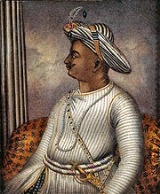
Alexander Beatson who published a volume entitled "View of the Origin and Conduct of the War with the late Tippoo Sultaun" on the Fourth Mysore War, described Tippu Sultan as follows: "His stature was about five feet eight inches; he had a short neck, square shoulders, and was rather corpulent: his limbs were small, particularly his feet and hands; he had large full eyes, small arched eyebrows, and an aquiline nose; his complexion was fair, and the general expression of his countenance, not void of dignity"..

He was called the Tiger of Mysore. It is said that Tippu Sultan was hunting in the forest with a French friend. He came face to face with a tiger. His gun did not work, and his dagger fell on the ground as the tiger jumped on him. He reached for the dagger, picked it up, and killed the tiger with it. That earned him the name "the Tiger of Mysore". He had the image of a tiger on his flag. Tippu Sultan was also very fond of innovations. Alexander Beatson has mentioned that Tippu Sultan was "passionately fond of new inventions. In his palace was found a great variety of curious swords, daggers, fusils, pistols, and blunderbusses; some were of exquisite workmanship, mounted with gold, or silver, and beautifully inlaid and ornamented with tigers' heads and stripes, or with Persian and Arabic verses". Tipu's Tiger
Tipu's Tiger

Tipu's Tiger is an automaton, representing a tiger savaging a European soldier, or employee of the British East India Company. It is currently on display in the Victoria and Albert Museum, London....
, an automaton representing a tiger attacking a European soldier, made for Tippu Sultan, is on display in the Victoria and Albert Museum
Victoria and Albert Museum

The Victoria and Albert Museum in London is the world's largest museum of decorative arts and design, housing a permanent collection of over 4.5 million Object ....
, London. During Tippu Sultan's reign, a new calendar, new coinage, and seven new government departments, were introduced as well as innovations in the use of rocket artillery.

Proclamations

The following proclamations were issued by Tippu Sultan:
  • "Agriculture is the life-blood of the nation. This land, rich and fertile, will reward those that work on it. Famine and want are either the result of sloth and ignorance or of corruption" (Tipu's circular to all Amildars, 1788).
  • "There can be no glory or achievement if the foundation of our palaces, roads and dams are mingled with the tears and blood of humanity..." (1789 CE).
He is quoted as having said: "It is far better to live like a Tiger for a day than to live like a jackal for a hundred years".

Early military career

Tippu Sultan was instructed in military tactics by French
France

France , officially the French Republic , is a country whose Metropolitan France is located in Western Europe and that also comprises various Overseas departments and territories of France....
 officers in the employment of his father, Hyder Ali
Hyder Ali

Hyder Ali, Haider Ali or Haidar 'Ali , was the de facto ruler of the Kingdom of Mysore in southern India. He is said to have induced his brother to employ a Parsi people to purchase artillery and small arms from the government of Bombay Presidency, and to enrol some thirty sailors of different European nations as gunners, and is t...
 (also spelled as "Haidar Ali"). At age 15, he accompanied his father Haidar Ali against the British in the First Mysore War in 1766. He commanded a corps of cavalry in the invasion of Carnatic
Carnatic region

The Carnatic coast is the region of South India lying between the Eastern Ghats and the Coromandel Coast, in the modern Indian states of Tamil Nadu, south eastern Karnataka and southern Andhra Pradesh....
 in 1767 at age 16. He also distinguished himself in the First Anglo-Maratha War
First Anglo-Maratha War

The First Anglo-Maratha War was the first of three Anglo-Maratha wars fought between the British East India Company and Maratha Empire in India....
 of 1775–1779.

A model army

Under Tipu's leadership the Mysore army became a model and a school of military science to Indian powers. The dread of a European army had no longer any effect on them. A lad of 17 years, Tipu made such a surprising dash on Madras in 1767, that the entire English council, who were all members of the Madras Government, sought refuge in a ship. He fell with such fury on Colonel Bailey in 1782, that the entire English army was either cut or taken prisoners. Bailey himself languished for long in prisons of Srirangapatna.

The hero of Buxar, Sir Hector Munro, who had defeated three rulers at Buxar-Shah Alam, Shuja-ud-daula and Mir Qasim-and who had paved the way for the consolidation of British Power in India, was forced to throw off all his guns into the tank of Conjeevaram and run for life to Madras, when Tipu chased him. Similarly the entire detachment of Colonel Braithwaite was captured, and Braithwaite himself was kept for long captive in Srirangapatna. General Medows, and Lord Cornvallis were harassed for two long years in the third Mysore War. It was only an All India Confederacy of the Nizam, the Maratha and the English together with an surreptitious entry into Srirangapatna in the dead of night that enabled the confederates to beat Tipu in 1792.

Second Mysore War


Main article: Second Anglo-Mysore War
Second Anglo-Mysore War

The Second Anglo-Mysore War was a conflict in India between the Kingdom of Great Britain and the Kingdom of Mysore. At the time, Mysore was a key France ally in India, and the Franco-British conflict raging on account of the American Revolutionary War helped spark Anglo-Mysorean hostilities in India....


Tippu Sultan led a large body of troops in the Second Mysore War, in February 1782, and defeated Braithwaite
Braithwaite

Braithwaite is a village in the northern Lake District, England. It lies just to the west of Keswick, Cumbria, and to the east of the Grisedale Pike ridge, at the approximate grid reference of ....
 on the banks of the Kollidam. Although the British were defeated this time, Tippu Sultan realized that the British were a new kind of threat in India. Upon becoming the Sultan
Sultan

Sultan is an Islamic honorifics, with several historical meanings. Originally it was an Arabic language abstract noun meaning "strength", "authority", or "rulership", derived from the verbal noun ???? sulah, meaning "authority" or "power"....
 after his father's death later that year, he worked to check the advances of the British by making alliances with the Marathas and the Mughals
List of Mughal emperors

The Mughal Empire was the dominant power in the Indian subcontinent between the mid-16th century and the end of the 17th century. Founded in 1526, it survived nominally until 1857, when it was supplanted by the British Raj....
.

Tippu Sultan had defeated Colonel Braithwaite at Annagudi near Tanjore on 18 February 1782. The British army, consisting of 100 Europeans, 300 cavalry, 1400 sepoy
Sepoy

A sepoy was a native of British India, a soldier allied to a European power, usually the United Kingdom. Specifically, it was the term used in the British Indian Army, and earlier in the Honourable East India Company, for an infantry private , and is still so used in the modern Indian Army, Pakistan Army and Bangladesh Army....
s and 10 field pieces, was the standard size of the colonial armies. Tippu Sultan had seized all the guns and taken the entire detachment prisoners. In December 1781 Tippu Sultan had successfully seized Chittur from the British. Tippu Sultan had thus gained sufficient military experience by the time Haidar Ali died in December 1782.

The Second Mysore War came to an end with the Treaty of Mangalore. It was the last occasion when an Indian king had dictated terms to the mighty British, and the treaty is a prestigious document in the history of India.

The Second Mysore War is also remembered for alleged excesses committed by Hyder Ali and Tippu Sultan in Tanjore. During the period of occupation which lasted six months, Hyder Ali and Tippu Sultan are believed to have impoverished the country. As late as 1784, the Dutch missionary Christian Friedrich Schwarz
Christian Friedrich Schwarz

Christian Friedrich Schwarz was a Germany Protestant missionary to India, born on October 8 1726 at Sonnenburg, in the electorate of Brandenburg, Prussia....
 describes Tippu's alleged abduction of 12,000 children from the region. It is alleged that the invaders plundered the country and took away the cattle
Cattle

Cattle, colloquially referred to as cows, are domestication ungulates, a member of the subfamily Bovinae of the family Bovidae. They are raised as livestock for meat , dairy products , leather and as draft animals ....
 and grain
GRAIN

GRAIN is an international non-governmental organization based in Barcelona, Spain, which works toward sustainable agriculture. It was formed upon the realization that the genetic diversity of the world's food crops are being drastically eliminated....
. The invasion is believed to have had such an impact on the economy of the country that it did not recover until the start of the nineteenth century. The gross produce of the kingdom fell by over ninety percent between 1780 and 1781 and took over 15 years for it to reach pre-1781 levels.

Battle of Pollilur

The Battle of Pollilur
Battle of Pollilur

The Battle of Pollilur took place on 10 September, 1780 at Pollilur near the city of Kanchipuram in present-day Tamil Nadu state, India. It was waged between two forces commanded by Tipu Sultan of the Kingdom of Mysore, and Colonel William Baille of the British East India Company....
 took place in 1780 at Pollilur near the city of Kanchipuram. It was a part of the second Anglo-Mysore war. Tippu Sultan was dispatched by Haidar Ali with 10,000 men and 18 guns to intercept Colonel Baillie who was on his way to join Sir Hector Munro
Hector Munro

General Sir Hector Munro, Order of the Bath , was a Scotland noble and the ninth Commander-in-Chief, India ....
. Out of 360 Europeans, about 200 were captured alive, and the sepoys, who were about 3800 men, suffered very high casualties. Munro was moving south with a separate British force to join Baillie, but on hearing the news of the defeat he was forced to retreat to Madras, abandoning his artillery in a water tank at Kanchipuram
Kanchipuram

Kanchipuram, Kanchi, or Kancheepuram is a city and a municipality in Kanchipuram district in the Indian States and territories of India of Tamil Nadu....
.

Fourth Mysore War


Main article :Fourth Anglo-Mysore War
Fourth Anglo-Mysore War

The Fourth Anglo-Mysore War was a war in South India between the Kingdom of Mysore and the British East India Company under the Richard Wellesley, 1st Marquess Wellesley....


After Horatio Nelson had defeated François-Paul Brueys D'Aigalliers
François-Paul Brueys d'Aigalliers

Vice-Admiral Fran?ois-Paul Brueys d'Aigalliers, Comte de Brueys, was the French commander in the Battle of the Nile, in which the French Navy was defeated by Royal Navy forces under Admiral Horatio Nelson....
 at the Battle of the Nile
Battle of the Nile

At the Battle of the Nile or Aboukir Bay , a Kingdom of Great Britain fleet under Rear-Admiral Horatio Nelson surprised and largely destroyed a France fleet under Fran?ois-Paul Brueys D'Aigalliers anchored near Alexandria, Egypt, stranding Napoleon's army in Egypt....
 in Egypt in 1798 CE, three armies, one from Bombay, and two British (one of which included Arthur Wellesley
Arthur Wellesley, 1st Duke of Wellington

Field Marshal Arthur Wellesley, 1st Duke of Wellington, Order of the Garter, Order of St Patrick, Order of the Bath, Royal Guelphic Order, Privy Council of the United Kingdom, Royal Society , was an Anglo-Irish soldier and statesman, and one of the leading military and political figures of the nineteenth century....
, the future first Duke of Wellington
Duke of Wellington

The Dukedom of Wellington, derived from Wellington, Somerset in Somerset, is an hereditary title and the senior rank in the Peerage of the United Kingdom....
), marched into Mysore in 1799 and besieged
Siege

A siege is a military blockade of a city or fortress with the intent of conquering by Battle of attrition and/or assault. The term derives from sedere, Latin for "to sit." A siege occurs when an attacker encounters a city or fortress that cannot be easily taken by a coup de main and refuses to surrender ....
 the capital Srirangapatnam in the Fourth Mysore War. There were over 26,000 soldiers of the British East India Company comprising about 4000 Europeans and the rest Indians. A column was supplied by the Nizam of Hyderabad consisting of ten battalions and over 16,000 cavalry, and many soldiers were sent by the Marathas. Thus the soldiers in the British force numbered over 50,000 soldiers whereas Tippu Sultan had only about 30,000 soldiers. The British broke through the city walls, and Tippu Sultan died defending his capital on May 4.

Rocket artillery

A military tactic developed by Tippu Sultan and his father, Haidar Ali was the use of mass attacks with rocket
Rocket

A rocket or rocket vehicle is a missile, aircraft or other vehicle which obtains thrust by the Reaction of the rocket to the ejection of fast moving fluid exhaust from a rocket engine....
 brigades on infantry formations. Tippu Sultan wrote a military manual called Fathul Mujahidin
Fathul Mujahidin

Fathul Mujahidin is a military manual that was written by Tippu Sultan, a ruler of the Kingdom of Mysore, considered the father of rocket artillery in battle for his use of iron-cased rocket artillery in defeating the British Army in the 1792 battle at Srirangapatna, one of the battles of the Third Anglo-Mysore War, which is considered a tech...
 in which 200 rocket men were prescribed to each Mysorean "cushoon
Cushoon

Cushoon is the equivalent of a regiment/brigade in Tippu Sultan's army. They were formed from 4 teeps ....
" (brigade). Mysore had 16 to 24 cushoons of infantry. The areas of town where rockets and fireworks were manufactured were known as Taramandal Pet ("Galaxy Market").

The rocket men were trained to launch their rockets at an angle calculated from the diameter of the cylinder and the distance of the target. In addition, wheeled rocket launchers capable of launching five to ten rockets almost simultaneously were used in war. Rockets could be of various sizes, but usually consisted of a tube of soft hammered iron about 8" long and 1½ - 3" diameter, closed at one end and strapped to a shaft of bamboo about 4ft. long. The iron tube acted as a combustion chamber and contained well packed black powder propellant. A rocket carrying about one pound of powder could travel almost 1,000 yards. In contrast, rockets in Europe not being iron cased, could not take large chamber pressures and as a consequence, were not capable of reaching distances anywhere near as great.

Haidar Ali's father, the Naik or chief constable at Budikote
Budikote

Budikote or the "Fort of Ash" is a small village situated in Bangarpet Taluk of Kolar District in Karnataka state of India. It is about 15 miles from Kolar Gold Fields the nearest city....
, commanded 50 rocketmen for the Nawab of Arcot. There was a regular Rocket Corps in the Mysore Army, beginning with about 1200 men in Haidar Ali's time. At the Battle of Pollilur
Battle of Pollilur

The Battle of Pollilur took place on 10 September, 1780 at Pollilur near the city of Kanchipuram in present-day Tamil Nadu state, India. It was waged between two forces commanded by Tipu Sultan of the Kingdom of Mysore, and Colonel William Baille of the British East India Company....
 (1780), during the Second Anglo-Mysore War
Second Anglo-Mysore War

The Second Anglo-Mysore War was a conflict in India between the Kingdom of Great Britain and the Kingdom of Mysore. At the time, Mysore was a key France ally in India, and the Franco-British conflict raging on account of the American Revolutionary War helped spark Anglo-Mysorean hostilities in India....
, Colonel William Braille's ammunition stores are thought to have been detonated by a hit from one of Haidar Ali's Mysore rockets resulting in a humiliating British defeat.

In the Third Anglo-Mysore War
Third Anglo-Mysore War

The Third Anglo-Mysore War was a war in South India between the Kingdom of Mysore and the English East India Company. It was the third of four Anglo-Mysore Wars....
 of 1792, there is mention of two rocket units fielded by Tipu Sultan, 120 men and 131 men respectively. Lt. Col. Knox was attacked by rockets near Srirangapatna on the night of 6 February 1792, while advancing towards the Kaveri river from the north. The Rocket Corps ultimately reached a strength of about 5000 in Tipu Sultan's army. Mysore rockets were also used for ceremonial purposes. When the Jacobin Club
Jacobin Club

The Jacobin Club was the largest and most powerful political club of the French Revolution. It originated as the Club Benthorn, formed at Versailles as a group of Brittany deputies to the Estates-General of 1789 of 1789....
 of Mysore sent a delegation to Tippu Sultan, 500 rockets were launched as part of the gun salute.

During the Fourth Anglo-Mysore War
Fourth Anglo-Mysore War

The Fourth Anglo-Mysore War was a war in South India between the Kingdom of Mysore and the British East India Company under the Richard Wellesley, 1st Marquess Wellesley....
, rockets were again used on several occasions. One of these involved Colonel Arthur Wellesley
Arthur Wellesley, 1st Duke of Wellington

Field Marshal Arthur Wellesley, 1st Duke of Wellington, Order of the Garter, Order of St Patrick, Order of the Bath, Royal Guelphic Order, Privy Council of the United Kingdom, Royal Society , was an Anglo-Irish soldier and statesman, and one of the leading military and political figures of the nineteenth century....
, later famous as the First Duke of Wellington
Duke of Wellington

The Dukedom of Wellington, derived from Wellington, Somerset in Somerset, is an hereditary title and the senior rank in the Peerage of the United Kingdom....
. Arthur Wellesley was defeated by Tipu's Diwan, Purnaiya at the Battle of Sultanpet Tope. Quoting Forrest,
"At this point (near the village of Sultanpet, Figure 5) there was a large tope, or grove, which gave shelter to Tipu's rocketmen and had obviously to be cleaned out before the siege could be pressed closer to Srirangapattana island. The commander chosen for this operation was Col. Wellesley, but advancing towards the tope after dark on the 5 April 1799, he was set upon with rockets and musket-fires, lost his way and, as Beatson politely puts it, had to "postpone the attack" until a more favourable opportunity should offer.
The following day, Wellesley launched a fresh attack with a larger force, and took the whole position without losing a single man. On 22 April 1799, twelve days before the main battle, rocketeers worked their way around to the rear of the British encampment, then 'threw a great number of rockets at the same instant' to signal the beginning of an assault by 6,000 Indian infantry and a corps of Frenchmen, all directed by Mir Golam Hussain and Mohomed Hulleen Mir Mirans. The rockets had a range of about 1,000 yards. Some burst in the air like shells. Others called ground rockets, on striking the ground, would rise again and bound along in a serpentine motion until their force was spent. According to one British observer, a young English officer named Bayly:
"So pestered were we with the rocket boys that there was no moving without danger from the destructive missiles ...". He continued: "The rockets and musketry from 20,000 of the enemy were incessant. No hail could be thicker. Every illumination of blue lights was accompanied by a shower of rockets, some of which entered the head of the column, passing through to the rear, causing death, wounds, and dreadful lacerations from the long bamboos of twenty or thirty feet, which are invariably attached to them'."


During the conclusive British attack on Srirangapattana on May 2,1799, a British shot struck a magazine of rockets within the Tipu Sultan's fort causing it to explode and send a towering cloud of black smoke, with cascades of exploding white light, rising up from the battlements. On the afternoon of 4 May when the final attack on the fort was led by Baird, he was again met by "furious musket and rocket fire", but this did not help much; in about an hour's time the Fort was taken; perhaps in another hour Tipu had been shot (the precise time of his death is not known), and the war was effectively over.

After the fall of Srirangapattana, 600 launchers, 700 serviceable rockets and 9,000 empty rockets were found. Some of the rockets had pierced cylinders, to allow them to act like incendiaries, while some had iron points or steel blades bound to the bamboo. By attaching these blades to rockets they became very unstable towards the end of their flight causing the blades to spin around like flying scythes, cutting down all in their path.

These experiences eventually led to the Royal Woolwich Arsenal
Royal Arsenal

The Royal Arsenal, Woolwich, originally known as the Woolwich Warren, carried out armaments manufacture, ammunition proof test and explosives research for British armed forces....
's beginning a military rocket R&D program in 1801, their first demonstration of solid-fuel rockets in 1805 and publication of A Concise Account of the Origin and Progress of the Rocket System in 1807 by William Congreve
William Congreve (inventor)

Sir William Congreve, 2nd Baronet , was an England inventor and rocket artillery pioneer distinguished for his development and deployment of Congreve rockets....
, son of the arsenal's commandant. Congreve rockets were soon systematically used by the British during the Napoleonic Wars and their confrontation with the US during 1812-14. These descendants of Mysore rockets find mention in the Star Spangled Banner.

Treatment of prisoners

A clause in the proposed treaty of alliance with the French stated, " I demanded that male and female prisoners as well English and Portuguese, who shall be taken by the republican troops or by mine, shall be treated with humanity, and with regard to their persons that they shall be transported at our joint expense out of India to some place for distant from the territories of the allies." In short Tipu was an enlightened ruler, the sheet-anchor of whose state-policy was the well-being of all his subjects irrespective of caste, creed or class. He took his stand on the bedrock of humanity, regarding all his subjects as equal citizen to live in peace, harmony and concord. However, during the storming of Srirangapattana by the British in 1799, thirteen murdered British prisoners were discovered, killed by either having their necks broken or nails driven into their skulls.

Jacobin Club in Mysore

Tippu Sultan was a founder-member of the Jacobin Club
Jacobin Club

The Jacobin Club was the largest and most powerful political club of the French Revolution. It originated as the Club Benthorn, formed at Versailles as a group of Brittany deputies to the Estates-General of 1789 of 1789....
. While accepting the membership, he said of France, "Behold my acknowledgement of the standard of your country, which is dear to me, and to which I am allied; it shall always be supported in my country, as it has been in the Republic, my sister!". He was named as "Citizen Tippu Sultan".

In fiction

  • In Jules Verne
    Jules Verne

    Jules Gabriel Verne was a France author who helped pioneer the science fiction genre. He is best known for his novels Journey to the Center of the Earth , From the Earth to the Moon , Twenty Thousand Leagues Under the Sea , and Around the World in Eighty Days ....
    's Mysterious Island, Captain Nemo
    Captain Nemo

    File:20000_Nemo_South_Pole_flag.jpgCaptain Nemo is a fictional character featured in Jules Verne's novels Twenty Thousand Leagues Under the Sea and The Mysterious Island ....
     is described as a nephew of Tippu Sultan.
  • Tippu Sultan's life and adventures were the central theme of a short-running South Indian television series "The Adventures of Tipu Sultan", and of a more popular national television series "The Sword of Tipu Sultan
    The Sword of Tipu Sultan (TV serial)

    The Sword of Tipu Sultan was a television serial that was first broadcast on the Doordarshan channel in Television in India in the year 1990 in television....
    ".
  • Naseem Hijazi
    Naseem Hijazi

    Sharif Husain , more commonly by his pseudonym Nasim Hijazi was an Urdu writer who is well-known for his novels dealing with Islamic history....
    's novels Muazam Ali and Aur Talwar Toot Gaye (And The Sword Broke) describe Tippu Sultan's wars.
  • Wilkie Collins
    Wilkie Collins

    William Wilkie Collins was an English people novelist, playwright, and author of short stories. He was hugely popular in his time, and wrote 27 novels, more than 50 short stories, at least 15 plays, and over 100 pieces of non-fiction work....
     novel The Moonstone
    The Moonstone

    The Moonstone by Wilkie Collins is a 19th-century United Kingdom epistolary novel, generally considered the first detective novel in the English language....
     contains an account of Tippu Sultan and the Fall of Srirangapattana in the prologue.
  • In The Surprising Adventures of Baron Munchausen by Rudolf Erich Raspe
    Rudolf Erich Raspe

    Rudolf Erich Raspe was a Germany librarian, writer and scientist, and he was called by his biographer John Carswell a "rogue". He is best known for his collection of tall tales: The Surprising Adventures of Baron Munchausen, originally a satirical work with political aims....
    , Munchausen vanquishes Tippoo near the end of the novel.
  • Sharpe's Tiger
    Sharpe's Tiger (novel)

    Sharpe's Tiger is Bernard Cornwell's return to the Richard Sharpe series of novels, set during his early years in India. This is Cornwell's device to find prequel material for his hero....
     is a novel in which Napoleonic soldier Richard Sharpe
    Richard Sharpe (fictional character)

    Richard Sharpe is the central character in Bernard Cornwell's Sharpe series of historical fiction stories. These formed the basis for an ITV Sharpe wherein the eponymous character was played by Sean Bean....
     fights at the Battle of Srirangapattana, later killing the Tippu Sultan.
  • The Only King Who Died on the Battlefield: An Historical Novel Based on Truth (published in 2006), was written by a US-Pakistani resident and a young college student "Mohammed Faisal Iftikhar". The novel claims that in recent history, Tipu Sultan is the only king who died on the battlefield.


Family and descendants

Tippu Sultan had four wives, by whom he had 16 sons and at least 8 daughters, including:

1. Shahzada
Shahzada

Shahzada is the Urdu and Persian word for prince. The term literally means "son of a monarch or Shah". Shahzadi is princess. Typically the formulation of the princely title Shahzada is connected to the prince's surname....
 Hyder Ali Sultan Sahib (1771-30 July 1815), desc

2. Shahzada
Shahzada

Shahzada is the Urdu and Persian word for prince. The term literally means "son of a monarch or Shah". Shahzadi is princess. Typically the formulation of the princely title Shahzada is connected to the prince's surname....
 Abdul Khaliq Sultan Sahib (1782-12 September 1806, desc

3. Shahzada
Shahzada

Shahzada is the Urdu and Persian word for prince. The term literally means "son of a monarch or Shah". Shahzadi is princess. Typically the formulation of the princely title Shahzada is connected to the prince's surname....
 Muhi-ud-din Sultan Sahib (1782-30 September 1811), desc

4. Shahzada
Shahzada

Shahzada is the Urdu and Persian word for prince. The term literally means "son of a monarch or Shah". Shahzadi is princess. Typically the formulation of the princely title Shahzada is connected to the prince's surname....
 Muiz-ud-din Sultan Sahib (1783-30 March 1818), desc

5. Shahzada
Shahzada

Shahzada is the Urdu and Persian word for prince. The term literally means "son of a monarch or Shah". Shahzadi is princess. Typically the formulation of the princely title Shahzada is connected to the prince's surname....
 Miraj-ud-din Sultan Sahib (1784?-?)

6. Shahzada
Shahzada

Shahzada is the Urdu and Persian word for prince. The term literally means "son of a monarch or Shah". Shahzadi is princess. Typically the formulation of the princely title Shahzada is connected to the prince's surname....
 Muin-ud-din Sultan Sahib (1784?-?)

7. Shahzada
Shahzada

Shahzada is the Urdu and Persian word for prince. The term literally means "son of a monarch or Shah". Shahzadi is princess. Typically the formulation of the princely title Shahzada is connected to the prince's surname....
 Muhammad Yasin Sultan Sahib (1784-15 March 1849), desc

8. Shahzada
Shahzada

Shahzada is the Urdu and Persian word for prince. The term literally means "son of a monarch or Shah". Shahzadi is princess. Typically the formulation of the princely title Shahzada is connected to the prince's surname....
 Muhammad Subhan Sultan Sahib (1785-27 September 1845), desc

9. Shahzada
Shahzada

Shahzada is the Urdu and Persian word for prince. The term literally means "son of a monarch or Shah". Shahzadi is princess. Typically the formulation of the princely title Shahzada is connected to the prince's surname....
 Muhammad Shukru'llah Sultan Sahib (1785-25 September 1837), desc

10. Shahzada
Shahzada

Shahzada is the Urdu and Persian word for prince. The term literally means "son of a monarch or Shah". Shahzadi is princess. Typically the formulation of the princely title Shahzada is connected to the prince's surname....
 Sarwar-ud-din Sultan Sahib (1790-20 October 1833), desc

11. Shahzada
Shahzada

Shahzada is the Urdu and Persian word for prince. The term literally means "son of a monarch or Shah". Shahzadi is princess. Typically the formulation of the princely title Shahzada is connected to the prince's surname....
 Muhammad Nizam-ud-din Sultan Sahib (1791-20 October 1791)

12. Shahzada
Shahzada

Shahzada is the Urdu and Persian word for prince. The term literally means "son of a monarch or Shah". Shahzadi is princess. Typically the formulation of the princely title Shahzada is connected to the prince's surname....
 Muhammad Jamal-ud-din Sultan Sahib (1795-13 November 1842), desc

13. Shahzada
Shahzada

Shahzada is the Urdu and Persian word for prince. The term literally means "son of a monarch or Shah". Shahzadi is princess. Typically the formulation of the princely title Shahzada is connected to the prince's surname....
 Munir-ud-din Sultan Sahib (1795-1 December 1837), desc

14. His Highness Shahzada
Shahzada

Shahzada is the Urdu and Persian word for prince. The term literally means "son of a monarch or Shah". Shahzadi is princess. Typically the formulation of the princely title Shahzada is connected to the prince's surname....
 Sir
Sir

Sir is an honorific used as a title and in several other modern contexts.It was once used as a courtesy title among equals, but in common usage it is now usually reserved for one of superior Command hierarchy or Social status, such as an educator or commanding officer, or in age ; as a form of address from a merchant to a customer; in for...
 Ghulam Muhammad Sultan Sahib
Ghulam Muhammad Sultan Sahib

Shahzada Sir Ghulam Muhammad Sultan Sahib, Order of the Star of India was the fourteenth son of Tipu Sultan, the Indian warrior-emperor of Mysore....
, KCSI
Order of the Star of India

The Most Exalted Order of the Star of India is an order of chivalry founded by Victoria of the United Kingdom in 1861. The Order includes members of three classes:...
 (March 1795-11 August 1872), desc

15. Shahzada
Shahzada

Shahzada is the Urdu and Persian word for prince. The term literally means "son of a monarch or Shah". Shahzadi is princess. Typically the formulation of the princely title Shahzada is connected to the prince's surname....
 Ghulam Ahmad Sultan Sahib (1796-11 April 1824)

16. Shahzada
Shahzada

Shahzada is the Urdu and Persian word for prince. The term literally means "son of a monarch or Shah". Shahzadi is princess. Typically the formulation of the princely title Shahzada is connected to the prince's surname....
.............Sultan Sahib (1797–1797)

Tippu Sultan's family was sent to Calcutta by the British. Noor Inayat Khan
Noor Inayat Khan

Noor-un-Nisa Inayat Khan, George Cross, Order of the British Empire, , usually known as Noor Inayat Khan, was a British Special Operations Executive agent in World War II of British India origin and the first female radio operator to be sent into occupied France to aid the French R?sistance....
, who was a major in the British Indian army, is said to be one of Tippu Sultan's descendants who died in France under German occupation.

Sword of Tippu Sultan

Tippu Sultan had lost his sword in a war with the Nair
Nair

Nair is the name of a Hindu Kshatriya upper caste ethnic dravidian community from the South Indian state of Kerala. The Nairs were a martial nobility and figured prominently in the history of Kerala....
s of Travancore
Travancore

Travancore or Thiruvithaamkoor was a Indian Princely State in India under the British Raj, with its capital at Thiruvananthapuram ruled by the Travancore Royal Family.The name Thiruvithankoor might be derived from Thiruvithankode where the capital Padmanabhapuram was situated....
 in which, he was defeated. The Nair army
Nair Brigade

The Nair Brigade was the army of the erstwhile kingdom of Travancore in India. Nairs were a warrior community in the region which was responsible for the security of Travancore and other local kingdoms....
 under the leadership of Raja Kesavadas
Raja Kesavadas

Rajah Kesavadas was the Dewan of Travancore during the reign of Dharma Raja Karthika Thirunal Rama Varma....
, defeated the Mysore army near Aluva. The Maharaja, Dharma Raja
Dharma Raja

Dharma Raja Karthika Thirunal Rama Varma was the Maharajah of Travancore from 1758 -1798. He succeeded his uncle Marthanda Varma, who is credited with the title of "maker of modern Travancore"....
, gifted the famous sword to the Nawab of Arcot
Arcot

Arcot is a locality and part of Vellore city in the state of Tamil Nadu, India. Located on the eastern end of the Vellore city on the southern banks of Palar River at , the city straddles a highly strategic trade route between Chennai and Bangalore, between the Mysore Ghat and the Javadi Hills....
, from where the sword went to London
London

London is the capital of both England and the United Kingdom, and the most populous municipality in the European Union. An important settlement for two millennia, History of London goes back to its founding by the Roman Empire....
. The sword was on display at the Wallace Collection, No. 1 Manchester Square, London. At an auction
Auction

An auction is a process of trade goods or services by offering them up for bid, taking bids, and then selling the item to the winning bidder....
 in London in 2004, the industrialist-politician Vijay Mallya
Vijay Mallya

Vijay Mallya is an Indian businessman and Rajya Sabha Member of Parliament. The son of industrialist Vittal Mallya, he is the Chairman of the United Breweries Group and Kingfisher Airlines, which draws its name from United Breweries Group's flagship beer brand, Kingfisher....
 purchased the sword of Tippu Sultan and some other historical artifacts, and brought them back to India for public display after nearly two centuries.

Further reading

  • Agha, Shamsu. Tipu Sultan", "Mirza Ghalib in London";, "Flight Delayed", Paperback, ISBN 0901974420
  • Ali, B Sheik. Tippu Sultan, Nyasanal Buk Trast
  • Amjad, Sayyid. °Ali Ashahri, Savanih Tipu Sultan, Himaliyah Buk Ha®us
  • Banglori, Mahmud Khan Mahmud. Sahifah-yi Tipu Sultan, Hamalayah Pablishing Ha°us,
  • Bhagwan, Gidwami S. The Sword of Tipu Sultan: The Life and Legend of Tipu Sultan of India, Allied Publishers 1978
  • Bowring, Lewin. Haidar Ali and Tipu Sultan and the Struggle with the Musalman Powers of the South, Asian Educational Services,India, ISBN 812061299X
  • Brittlebank, Kate. Tipu Sultan's Search for Legitimacy: Islam and Kingship in a Hindu Domain, OUP India, ISBN 0195639774
  • Buddle, Anne. Tigers Round the Throne, Zamana Gallery, ISBN 1869933028
  • Campbell, Richard Hamilton. Tippoo Sultan: The fall of Srirangapattana and the restoration of the Hindu raj, Govt. Press
  • Chinnian, P. Tipu Sultan the Great, Siva Publications
  • Habib, Irfan. State and Diplomacy Under Tipu Sultan: Documents and Essays, Manohar Publishers and Distributors, ISBN 818522952X
  • Hashimi, Sajjad. Tipu Sultan, Maktabah-yi Urdu Da®ijast
  • Home, Robert. Select Views in Mysore: The Country of Tipu Sultan from Drawings Taken on the Spot by Mr. Home, Asian Educational Services,India, ISBN 8120615123
  • Mohibbul, Hasan. History of Tipu Sultan,Aakar Books, ISBN 8187879572
  • Mohibbul, Hasan. Tipu Sultan's Mission to Constantinople,Aakar Books, ISBN 8187879564
  • Moienuddin, Mohammad. Sunset at Srirangapatam: After the death of Tipu Sultan, Orient Longman, ISBN 8125019197
  • Pande, B. N. Aurangzeb and Tipu Sultan: Evaluation of their religious policies (IOS series), Institute of Objective Studies
  • Siddiqi, Faiz Alam. Sultan Tipu Shahid, Buk Karnar,
  • Strandberg, Samuel. Tipu Sultan: The Tiger of Mysore: or, to fight against the odds, AB Samuel Travel, ISBN 9163073331
  • Taylor, George. Coins of Tipu Sultan, Asian Educational Services,India, ISBN 8120605039
  • Wigington, Robin. Firearms of Tipu Sultan,1783-99, J. Taylor Book Ventures, ISBN 1871224136
  • Haidar Ali and Tipu Sultan and the Struggle with the Mohammadan Powers of the South, Cosmo (Publications,India), ISBN 8177554352
  • Confronting Colonialism: Resistance and Modernization Under Haider Ali and Tipu Sultan (Anthem South Asian Studies), Anthem Press, ISBN 1843310244


External links

  • -http://www.voi.org/books/tipu/
  • -www.Tipusultan.org
  • - IndiaStar Review of Books
  • - Dramatised account of the British campaign against Tipu Sultan by G. A. Henty
    G. A. Henty

    George Alfred Henty , referred to as G. A. Henty, was a prolific England novelist, special correspondent and Imperialist. He is best known for his adventure novel stories that were popular in the late 19th century....
    , from Project Gutenberg
    Project Gutenberg

    Project Gutenberg, abbreviated as PG, is a volunteer effort to digitize, archive and distribute cultural works, as founder Michael Hart said "To encourage the creation and distribution of eBooks."....