


Matchlock

Encyclopedia
Firearm
A firearm is a weapon that launches one, or many, projectile at high velocity through confined burning of a propellant. This subsonic burning process is technically known as deflagration, as opposed to supersonic combustion known as a detonation. In older firearms, the propellant was typically...
. This design removed the need to lower by hand a lit match into the weapon's flash pan
Flash pan
The flash pan or priming pan is a small receptacle for priming powder, found next to the touch hole on muzzleloading guns. Flash pans are found on gonnes, matchlocks, wheellocks, snaplocks, snaphances, and flintlocks....
and made it possible to have both hands free to keep a firm grip on the weapon at the moment of firing, and, more importantly, to keep both eyes on the target.
Description
Europe
Europe is, by convention, one of the world's seven continents. Comprising the westernmost peninsula of Eurasia, Europe is generally 'divided' from Asia to its east by the watershed divides of the Ural and Caucasus Mountains, the Ural River, the Caspian and Black Seas, and the waterways connecting...
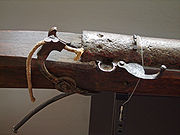
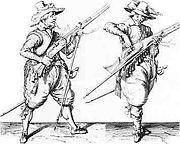
an matchlock gun held a burning slow match
Slow match
Slow match or match cord is the very slow burning cord or twine fuse used by early gunpowder musketeers, artillerymen, and soldiers to ignite matchlock muskets, cannons, and petards...
in a clamp at the end of a small curved lever known as the serpentine. Upon the pulling of a lever (or in later models a trigger) protruding from the bottom of the gun and connected to the serpentine, the clamp dropped down, lowering the smoldering match into the flash pan and igniting the priming powder. The flash from the primer travelled through the touch hole
Touch hole
A touch hole is a small hole, through which the propellant charge of a cannon or muzzleloading gun is ignited. In small arms, the flash from a charge of priming held in the flash pan is enough to ignite the charge within...
igniting the main charge of propellant in the gun barrel
Gun barrel
A gun barrel is the tube, usually metal, through which a controlled explosion or rapid expansion of gases are released in order to propel a projectile out of the end at a high velocity....
. On release of the lever or trigger, the spring-loaded serpentine would move in reverse to clear the pan. For obvious safety reasons the match would be removed before reloading of the gun. Both ends of the match were usually kept alight in case one end should be accidentally extinguished.
Earlier types had only an "S"-shaped serpentine pinned to the stock either behind or in front of the flash pan (the so-called "serpentine lock"), one end of which was manipulated to bring the match into the pan.
Most matchlock mechanisms mounted the serpentine forward of the flash pan. The serpentine dipped backward, toward the firer, to ignite the priming. This is the reverse of the familiar forward-dipping hammer of the flintlock and later firearms.
A type of matchlock was developed called the snapping matchlock
Snapping matchlock
Snapping Matchlock is a type of matchlock mechanism used to ignite early firearms. It was used in Europe from about 1475 to 1640, and in Japan from 1543 till about 1880.-Description:...
, in which the serpentine was strongly spring-loaded, and released by pressing a button, pulling a trigger, or pulling a short string passing into the mechanism. As the match was often extinguished after its relatively violent collision with the flash pan, this type fell out of favour with soldiers, but was often used in fine target weapons.
An inherent weakness of the matchlock was the necessity of keeping the match constantly lit. Being the sole source of ignition for the powder, if the match was not lit when the gun needed to be fired, the mechanism was useless, and the weapon became little more than an expensive club. This was chiefly a problem in wet weather, when damp match cord was difficult to light and to keep burning. Another drawback was the burning match itself. At night, the match would glow in the darkness, possibly revealing the carrier's position. The distinctive smell of burning match-cord was also a give away of a musketeer's position (this was used as a plot device by Akira Kurosawa
Akira Kurosawa
was a Japanese film director, producer, screenwriter and editor. Regarded as one of the most important and influential filmmakers in the history of cinema, Kurosawa directed 30 filmsIn 1946, Kurosawa co-directed, with Hideo Sekigawa and Kajiro Yamamoto, the feature Those Who Make Tomorrow ;...
in his movie Seven Samurai). It was also quite dangerous when soldiers were carelessly handling large quantities of gunpowder (for example, while refilling their powder horns) with lit matches present. This was one reason why soldiers in charge of transporting and guarding ammunition were amongst the first to be issued self-igniting guns like the wheellock
Wheellock
A wheellock, wheel-lock or wheel lock, is a friction-wheel mechanism to cause a spark for firing a firearm. It was the next major development in firearms technology after the matchlock and the first self-igniting firearm. The mechanism is so-called because it uses a rotating steel wheel to provide...
and snaphance
Snaphance
A Snaphance or Snaphaunce is a particular type of mechanism for firing a gun . The name is Dutch in origin but the mechanism can not be attributed to the Netherlands with certainty. It is the mechanical progression of the wheel-lock firing mechanism and the predecessor of the flintlock firing...
.
The matchlock was also uneconomical to keep ready for long periods of time. To maintain a single sentry on night guard duty with a matchlock, keeping both ends of his match lit, required a mile of match per year.
History
The matchlock appeared in EuropeEurope
Europe is, by convention, one of the world's seven continents. Comprising the westernmost peninsula of Eurasia, Europe is generally 'divided' from Asia to its east by the watershed divides of the Ural and Caucasus Mountains, the Ural River, the Caspian and Black Seas, and the waterways connecting...
in the mid-15th century, although the idea of the serpentine appears some 40 years previously in an Austria
Austria
Austria , officially the Republic of Austria , is a landlocked country of roughly 8.4 million people in Central Europe. It is bordered by the Czech Republic and Germany to the north, Slovakia and Hungary to the east, Slovenia and Italy to the south, and Switzerland and Liechtenstein to the...
n manuscript. The first dated illustration of a matchlock mechanism dates to 1475, and by the 16th century they were universally used.
The Janissary
Janissary
The Janissaries were infantry units that formed the Ottoman sultan's household troops and bodyguards...
corps of the Ottoman
Ottoman Empire
The Ottoman EmpireIt was usually referred to as the "Ottoman Empire", the "Turkish Empire", the "Ottoman Caliphate" or more commonly "Turkey" by its contemporaries...
army adopted matchlock arms from Hungary
Hungary
Hungary , officially the Republic of Hungary , is a landlocked country in Central Europe. It is situated in the Carpathian Basin and is bordered by Slovakia to the north, Ukraine and Romania to the east, Serbia and Croatia to the south, Slovenia to the southwest and Austria to the west. The...
gradually from the 1440s onwards. Improved versions of the musket were transported to India
India
India , officially the Republic of India , is a country in South Asia. It is the seventh-largest country by geographical area, the second-most populous country with over 1.2 billion people, and the most populous democracy in the world...
by Babur
Babur
Babur was a Muslim conqueror from Central Asia who, following a series of setbacks, finally succeeded in laying the basis for the Mughal dynasty of South Asia. He was a direct descendant of Timur through his father, and a descendant also of Genghis Khan through his mother...
in 1526.
China
China
Chinese civilization may refer to:* China for more general discussion of the country.* Chinese culture* Greater China, the transnational community of ethnic Chinese.* History of China* Sinosphere, the area historically affected by Chinese culture...
is credited with inventing both gunpowder and firearms but the matchlock was introduced to China by the Portuguese. Europeans refined the primitive hand cannons used in China and in the 15th century the matchlock mechanism was developed. Portuguese arriving in China in the 16th century carried matchlocks and the Chinese obtained the technology for themselves and matchlocks were used by the Chinese into the 19th century.
In Japan
Japan
Japan is an island nation in East Asia. Located in the Pacific Ocean, it lies to the east of the Sea of Japan, China, North Korea, South Korea and Russia, stretching from the Sea of Okhotsk in the north to the East China Sea and Taiwan in the south...
the first documented introduction of the matchlock which became known as the tanegashima was through the Portuguese
Portuguese people
The Portuguese are a nation and ethnic group native to the country of Portugal, in the west of the Iberian peninsula of south-west Europe. Their language is Portuguese, and Roman Catholicism is the predominant religion....
in 1543. The tanegashima seems to have been based on snap matchlocks that were produced in the armory of Goa India, which was captured by the Portuguese in 1510. While the Japanese were technically able to produce tempered steel (e.g. sword blades), they preferred to use work-hardened brass springs in their matchlocks. The name tanegashima came from the island where a Chinese junk
Junk (ship)
A junk is an ancient Chinese sailing vessel design still in use today. Junks were developed during the Han Dynasty and were used as sea-going vessels as early as the 2nd century AD. They evolved in the later dynasties, and were used throughout Asia for extensive ocean voyages...
with Portuguese adventurers on board was driven to anchor by a storm. The lord of the Japanese island Tanegashima Tokitaka (1528–1579) purchased two matchlock rifles from the Portuguese and put a sword smith to work copying the matchlock barrel and firing mechanism. Within a few years the use of the tanegashima in battle forever changed the way war was fought in Japan.
Despite the appearance of more advanced ignition systems such as that of the wheellock and the snaphance, the low cost of production, simplicity, and high availability of the matchlock kept it in use in European armies until about 1720. It was eventually completely replaced by the flintlock
Flintlock
Flintlock is the general term for any firearm based on the flintlock mechanism. The term may also apply to the mechanism itself. Introduced at the beginning of the 17th century, the flintlock rapidly replaced earlier firearm-ignition technologies, such as the doglock, matchlock and wheellock...
as the foot soldier's main armament.
There is evidence that matchlock rifles may have been in usage among some peoples in Christian Abyssinia
Ethiopian Empire
The Ethiopian Empire also known as Abyssinia, covered a geographical area that the present-day northern half of Ethiopia and Eritrea covers, and included in its peripheries Zeila, Djibouti, Yemen and Western Saudi Arabia...
in the late Middle Ages. Although modern rifles were imported into Ethiopia during the 19th century, contemporary British historians noted that along with slingshots the elderly used matchlock rifle weapons for self-defense and by the militaries of the Ras. They were also known to have been used by the Somalian Adal Sultanate
Adal Sultanate
The Adal Sultanate or the Kingdom of Adal was a medieval multi-ethnic Muslim state located in the Horn of Africa.-Overview:...
against Ethiopia
Battle of Shimbra Kure
The Battle of Shimbra Kure was fought in March of 1529 between the forces of Adal led by Imam Ahmad ibn Ibrihim al-Ghazi, and the Ethiopian army, under Dawit II . Despite being outnumbered, the followers of Imam Ahmad prevailed, and were in control of the field at the end of the battle. Both...
.
See also
- Caplock mechanismCaplock mechanismThe caplock mechanism or "percussion" lock was the successor of the flintlock mechanism in firearm technology, and used a percussion cap struck by the hammer to set off the main charge, rather than using a piece of flint to strike a steel frizzen....
- FlintlockFlintlockFlintlock is the general term for any firearm based on the flintlock mechanism. The term may also apply to the mechanism itself. Introduced at the beginning of the 17th century, the flintlock rapidly replaced earlier firearm-ignition technologies, such as the doglock, matchlock and wheellock...
- Hand cannon
- MiqueletMiqueletMiquelet Lock is a modern collector/auctioneer/curator term, largely used by and for the benefit of the English speaking world, widely applied to a distinctive form of snaplock, originally as a flint-against-steel ignition form, prevalent in the Iberian, Italian, and Balkan peninsulas, North...
- SnaplockSnaplockA Snaplock is a particular type of mechanism for firing a gun .A snaplock ignites the weapon's propellant by means of sparks produced when a spring-powered cock strikes a flint down on to a piece of hardened steel...
- SnaphanceSnaphanceA Snaphance or Snaphaunce is a particular type of mechanism for firing a gun . The name is Dutch in origin but the mechanism can not be attributed to the Netherlands with certainty. It is the mechanical progression of the wheel-lock firing mechanism and the predecessor of the flintlock firing...
- WheellockWheellockA wheellock, wheel-lock or wheel lock, is a friction-wheel mechanism to cause a spark for firing a firearm. It was the next major development in firearms technology after the matchlock and the first self-igniting firearm. The mechanism is so-called because it uses a rotating steel wheel to provide...
- The Matchlock GunThe Matchlock GunThe Matchlock Gun is a novel by Walter D. Edmonds that won the Newbery Medal for excellence as the most distinguished contribution to American children's literature in 1942.-Synopsis:...