
All Topics  
Pericles


   Email Print
   Bookmark   Link


Pericles


Pericles (also spelled Perikles) (c. 495 – 429 BC, GreekGreek language

Greek has a documented history of 3,500 years, the longest of any single language within the Indo-European family....
: , meaning "surrounded by glory") was a prominent and influential statesmanStatesman

The term statesman is a respectful term used to refer to politicians, and other notable figures of state....
, orator, and general of AthensHistory of Athens

The history of Athens is the longest of any city in Europe: Athens has been continuously inhabited for at least 3,000 years....
 during the city's Golden AgeGolden age

The term Golden age stems from Greek mythology and Roman poets....
—specifically, the time between the PersianGreco-Persian Wars

The Greco-Persian Wars or Persian Wars were a series of conflicts between several Greek city-states and the Persian E...
 and PeloponnesianPeloponnesian War

The Peloponnesian War was an Ancient Greek military conflict fought by Athens and its empire and the Peloponnesian League, ...
 wars. He was descended, through his mother, from the powerful and historically influential AlcmaeonidAlcmaeonidae

The Alcmaeonidae or Alcmaeonids were a powerful noble family of ancient Athens who claimed descent from the mythologic...
 family.

Pericles had such a profound influence on Athenian society that ThucydidesThucydides

Thucydides was an ancient Greek historian, and the author of the History of the Peloponnesian War, which recounts the 5...
, his contemporary historian, acclaimed him as "the first citizen of Athens". Pericles turned the Delian LeagueDelian League

The Delian League was an association of Greek city-states in the 5th century BC....
 into an Athenian empire and led his countrymen during the first two years of the Peloponnesian War. The period during which he led Athens, roughly from 461 to 429 BC, is sometimes known as the "Age of PericlesAge of Pericles

The Age of Pericles is the term used to denote the historical period from the end of the Persian Wars to either the death of...
", though the period thus denoted can include times as early as the Persian Wars, or as late as the next century.

Pericles promoted the arts and literature; this was a chief reason Athens holds the reputation of being the educational and cultural centre of the ancient GreekAncient Greece

Ancient Greece is the period in Greek history which lasted for around one thousand years and ended with the rise of Christia...
 world.


Discussion
Ask a question about 'Pericles'
Start a new discussion about 'Pericles'
Answer questions from other users
Full Discussion Forum


Quotations


Pericles on the eve of war. Nor is it any longer possible for you to give up this empire . . . Your empire is now like a tyranny: it may have been wrong to take it; it is certainly dangerous to let it go.

Pericles, from Thucydides' History of the Peloponnesian War

But the bravest are surely those who have the clearest vision of what is before them, glory and danger alike, and yet notwithstanding go out to meet it.

Pericles' Funeral Oration, from Thudcydides' History of the Peloponnesian War

Although only a few may originate a policy, we are all able to judge it.

Pericles, quoted in The Open Society and Its Enemies by Karl R. Popper, 1966


Encyclopedia


Pericles (also spelled Perikles) (c. 495 – 429 BC, GreekGreek language

Greek has a documented history of 3,500 years, the longest of any single language within the Indo-European family....
: , meaning "surrounded by glory") was a prominent and influential statesmanStatesman

The term statesman is a respectful term used to refer to politicians, and other notable figures of state....
, orator, and general of AthensHistory of Athens

The history of Athens is the longest of any city in Europe: Athens has been continuously inhabited for at least 3,000 years....
 during the city's Golden AgeGolden age

The term Golden age stems from Greek mythology and Roman poets....
—specifically, the time between the PersianGreco-Persian Wars

The Greco-Persian Wars or Persian Wars were a series of conflicts between several Greek city-states and the Persian E...
 and PeloponnesianPeloponnesian War

The Peloponnesian War was an Ancient Greek military conflict fought by Athens and its empire and the Peloponnesian League, ...
 wars. He was descended, through his mother, from the powerful and historically influential AlcmaeonidAlcmaeonidae

The Alcmaeonidae or Alcmaeonids were a powerful noble family of ancient Athens who claimed descent from the mythologic...
 family.

Pericles had such a profound influence on Athenian society that ThucydidesThucydides

Thucydides was an ancient Greek historian, and the author of the History of the Peloponnesian War, which recounts the 5...
, his contemporary historian, acclaimed him as "the first citizen of Athens". Pericles turned the Delian LeagueDelian League

The Delian League was an association of Greek city-states in the 5th century BC....
 into an Athenian empire and led his countrymen during the first two years of the Peloponnesian War. The period during which he led Athens, roughly from 461 to 429 BC, is sometimes known as the "Age of PericlesAge of Pericles

The Age of Pericles is the term used to denote the historical period from the end of the Persian Wars to either the death of...
", though the period thus denoted can include times as early as the Persian Wars, or as late as the next century.

Pericles promoted the arts and literature; this was a chief reason Athens holds the reputation of being the educational and cultural centre of the ancient GreekAncient Greece

Ancient Greece is the period in Greek history which lasted for around one thousand years and ended with the rise of Christia...
 world. He started an ambitious project that built most of the surviving structures on the AcropolisAcropolis of Athens

The Acropolis of Athens is the best known acropolis in Greece....
 (including the ParthenonParthenon Overview

he Parthenon was a temple of Athena, built in the 5th century BC on the Acropolis of Athens....
). This project beautified the city, exhibited its glory, and gave work to the people. Furthermore, Pericles fostered Athenian democracyAthenian democracy

The Athenian democracy was the democratic system developed in the Greek city-state of Athens ....
 to such an extent that critics call him a populistPopulism

Populism is a political philosophy or rhetorical style that holds that the common person's interests are oppressed or hinder...
.

Early years

Pericles was born around 495 BC, in the demeDeme

:Lower Agryle:Anagyrous:Euonymon:Themakos:Kedoi:Kephisia:Upper Lamptrai:Lower Lamptrai:Pambotadai:Upper Pergase:Lower PergaseAegid...
 of CholargosCholargos

Cholargos Latin/Older form: Cholargus is a suburb of Athens, Greece, located northeast of the city center and about 6 ...
 just north of Athens. He was the son of the politic XanthippusXanthippus

Xanthippus was a Greek mercenary general hired by the Carthaginians to aid in their war against the Romans during the First ...
, who, although ostracizedOstracism

Ostracism was a procedure under the Athenian democracy in which a prominent citizen could be expelled from the city-state o...
 in 485–484 BC, returned to Athens to command the Athenian contingent in the Greek victory at MycaleBattle of Mycale

The Battle of Mycale was one of the two major battles that ended the Persian invasion of Greece, during the Greco-Persian Wa...
 just five years later. Pericles' mother, Agariste, was a scion of the powerful and controversial noble family of the AlcmaeonidaeAlcmaeonidae

The Alcmaeonidae or Alcmaeonids were a powerful noble family of ancient Athens who claimed descent from the mythologic...
, and her familial connections played a crucial role in starting Xanthippus' political career. Agariste was the great-granddaughter of the tyrant of SicyonSicyon

Sicyon was an ancient Greek city situated in the northern Peloponnesus between Corinth and Achaea....
, CleisthenesCleisthenes of Sicyon

Cleisthenes was the tyrant of Sicyon, who aided in the war against Cirra that destroyed that city in 595 BC....
, and the niece of the supreme Athenian reformer CleisthenesCleisthenes

Cleisthenes was a noble Athenian of the accursed Alcmaeonid family....
, another Alcmaeonid. According to HerodotusHerodotus

Herodotus of Halicarnassus was a Dorian Greek historian who lived in the 5th century BC and is regarded as the "father o...
 and PlutarchPlutarch

Mestrius Plutarchus , known in English as Plutarch, was a Greek historian, biographer, and essayist....
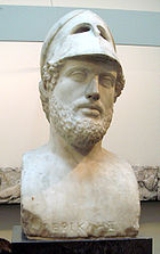
, Agariste dreamed, a few nights before Pericles' birth, that she had borne a lion. One interpretation of the anecdote treats the lion as a traditional symbol of greatness, but the story may also allude to the unusual size of Pericles' skull, which became a popular target of contemporary comedians. (Although Plutarch claims that this deformity was the reason that Pericles was always depicted wearing a helmet, this is not the case; the helmet was actually the symbol of his official rank as strategosStrategos

The term strategos is used in Greek to mean "general"....
 (general)).

"Our polity does not copy the laws of neighboring states; we are rather a pattern to others than imitators ourselves. It is called a democracy, because not the few but the many govern. If we look to the laws, they afford equal justice to all in their private differences; if to social standing, advancement in public life falls to reputation for capacity, class considerations not being allowed to interfere with merit; nor again does poverty bar the way, if a man is able to serve the state, he is not hindered by the obscurity of his condition."
Pericles' Funeral Oration as recorded by Thucydides, ; Thucydides .


Pericles belonged to the local tribeTribe

A tribe, viewed historically or developmentally, consists of a social group existing before the development of, or outside o...
 of Acamantis . His early years were quiet; the introverted, young Pericles avoided public appearances, preferring to devote his time to his studies.

His family's nobility and wealth allowed him to fully pursue his inclination toward education. He learned music from the masters of the time|Damon]] or Pythocleides could have been his teacher) and he is considered to have been the first politician to attribute great importance to philosophyPhilosophy

Philosophy is a field of study that includes diverse subfields such as aesthetics, epistemology, ethics, logic, and metaphys...
. He enjoyed the company of the philosophers ProtagorasProtagoras

Protagoras was a pre-Socratic philosopher and is numbered as one of the sophists by Plato....
, ZenoZeno of Elea

Zeno of Elea was a pre-Socratic Greek philosopher of southern Italy and a member of the Eleatic School founded by Parmenides...
 of EleaElea Overview

Elea may refer to:* Velia , Italy...
 and AnaxagorasAnaxagoras

Anaxagoras was a pre-Socratic Greek philosopher....
. Anaxagoras in particular became a close friend and influenced him greatly. Pericles' manner of thought and rhetorical charisma may have been in part products of Anaxagoras' emphasis on emotional calm in the face of trouble and skepticism about divine phenomena. His proverbial calmness and self-control are also regarded as products of Anaxagoras' influence.

Political career until 431 BC

Entering politics

In the spring of 472 BC, Pericles presented the Persae of AeschylusAeschylus

Aeschylus was a playwright of ancient Greece....
 at the Greater Dionysia as a liturgyLiturgy

A liturgy comprises a prescribed ceremony, according to the traditions of a particular group or event....
, demonstrating that he was then one of the wealthier men of Athens. Simon Hornblower has argued that Pericles' selection of this play, which presents a nostalgic picture of ThemistoclesThemistocles

Themistocles was a leader in the Athenian democracy during the Persian Wars....
' famous victory at SalamisBattle of Salamis

The Battle of Salamis was a naval battle between the Greek city-states and Persia, fought in September, 480 BC in the strait...
, shows that the young politician was supporting Themistocles against his political opponent Cimon, whose faction succeeded in having Themistocles ostracized shortly afterwards.

Plutarch says that Pericles stood first among the Athenians for forty years. If this was so, Pericles must have taken up a position of leadership by the early 460s BC. Throughout these years he endeavored to protect his privacy and tried to present himself as a model for his fellow citizens. For example, he would often avoid banquets, trying to be frugal.

In 463 BC Pericles was the leading prosecutor of Cimon, the leader of the conservative faction, who was accused of neglecting Athens' vital interests in MacedonMacedon

Macedon or Macedonia was the name of an ancient kingdom in the northern-most part of ancient Greece, bordering the ki...
. Although Cimon was acquitted, this confrontation proved that Pericles' major political opponent was vulnerable.

Ostracizing Cimon


Around 462–461 BC the leadership of the democratic party decided it was time to take aim at the AreopagusAreopagus Summary

The Areopagus or Areios Pagos is the 'Hill of Ares', north-west of the Acropolis, which in classical times functioned...
, a traditional council controlled by the Athenian aristocracy, which had once been the most powerful body in the state. The leader of the party and mentor of Pericles, EphialtesEphialtes of Athens Summary

Ephialtes was leader of the democratic movement and of the homonymous party in Athens....
, proposed a sharp reduction of the Areopagus' powers. The EcclesiaEcclesia (ancient Athens)

The ecclesia or ekklesia was the principal assembly of the democracy of ancient Athens....
 (the Athenian Assembly) adopted Ephialtes' proposal without strong opposition. This reform signalled the commencement of a new era of "radical democracy". The democratic party gradually became dominant in Athenian politics and Pericles seemed willing to follow a populist policy in order to cajole the public. According to AristotleAristotle

Aristotle was an ancient Greek philosopher, a student of Plato and teacher of Alexander the Great....
, Pericles' stance can be explained by the fact that his principal political opponent, Cimon, was rich and generous, and was able to secure public favor by lavishly bestowing his sizable personal fortune. The historian Loren J. Samons II argues, however, that Pericles had enough resources to make a political mark by private means, had he so chosen.

In 461 BC, Pericles achieved the political elimination of this formidable opponent using the weapon of ostracismOstracism

Ostracism was a procedure under the Athenian democracy in which a prominent citizen could be expelled from the city-state o...
. The ostensible accusation was that Cimon betrayed his city by acting as a friend of SpartaSparta

Sparta is a city in southern Greece....
.

Even after Cimon's ostracism, Pericles continued to espouse and promote a populist social policy. He first proposed a decree that permitted the poor to watch theatrical plays without paying, with the state covering the cost of their admission. With other decrees he lowered the property requirement for the archonArchon

Archon is a Greek word that means "ruler" or the like, though it is frequently encountered as the title of some specific...
ship in 458–457 BC and bestowed generous wages on all citizens who served as jurymen in the HeliaiaHeliaia

Heliaia or Halia was the supreme court of ancient Athens....
 (the supreme court of Athens) some time just after 454 BC. His most controversial measure, however, was a law of 451 BC limiting Athenian citizenship to those of Athenian parentage on both sides.

"Rather, the admiration of the present and succeeding ages will be ours, since we have not left our power without witness, but have shown it by mighty proofs; and far from needing a Homer for our panegyrist, or other of his craft whose verses might charm for the moment only for the impression which they gave to melt at the touch of fact, we have forced every sea and land to be the highway of our daring, and everywhere, whether for evil or for good, have left imperishable monuments behind us."
Pericles' Funeral Oration as recorded by Thucydides


Such measures impelled Pericles' critics to regard him as responsible for the gradual degeneration of the Athenian democracy. Constantine PaparrigopoulosConstantine Paparregopoulus

Constantine Paparregopoulus or Konstantinos Paparrigopoulos is deemed the major modern Greek historian for the coheren...
, a major modern Greek historian, argues that Pericles sought for the expansion and stabilization of all democratic institutions. Hence, he enacted legislation granting the lower classes access to the political system and the public offices, from which they had previously been barred on account of limited means or humble birth. According to Samons, Pericles believed that it was necessary to raise the demos, in which he saw an untapped source of Athenian power and the crucial element of Athenian military dominance. (The fleet, backbone of Athenian power since the days of Themistocles, was manned almost entirely by members of the lower classes.)

Cimon, on the other hand, apparently believed that no further free space for democratic evolution existed. He was certain that democracy had reached its peak and Pericles' reforms were leading to the stalemate of populism. According to Paparrigopoulos, history vindicated Cimon, because Athens, after Pericles' death, sank into the abyss of political turmoil and demagogy. Paparrigopoulos maintains that an unprecedented regression descended upon the city, whose glory perished as a result of Pericles' populist policies. According to another historian, Justin Daniel King, radical democracy benefited people individually, but harmed the state.
Pericles, Aspasia, Alcibiades and friends viewing Phidias' work. Alma-TademaLawrence Alma-Tadema

Sir Lawrence Alma-Tadema, OM, RA was a Dutch-born painter of the Victorian era, best known for his sumptuous portrayals of ...
, 1868, Birmingham Museum & Art GalleryBirmingham Museum & Art Gallery

Opened in 1885 as an art gallery, Birmingham Museum & Art Gallery, in Birmingham, England, has a collection of international...
]]

Pericles made his first military excursions during the First Peloponnesian War, which was caused in part by Athens' alliance with MegaraMegara

Megara is an ancient city in Attica, Greece....
 and ArgosArgos

Argos is a city in Greece in the Peloponnese near Nafplio, which was its historic harbor, named for Nauplius....
 and the subsequent reaction of Sparta. In 454 BC he attacked SicyonSicyon

Sicyon was an ancient Greek city situated in the northern Peloponnesus between Corinth and Achaea....
 and AcarnaniaAcarnania

Acarnania is a region of west-central Greece that lies along the Ionian Sea, west of Aetolia, with the Achelous River for a ...
. He then unsuccessfully tried to take Oeniadea on the Corinthian gulf, before returning to Athens. In 451 BC, Cimon is said to have returned from exile and negotiated a five years' truce with Sparta after a proposal of Pericles, an event which indicates a shift in Pericles' political strategy. Pericles may have realized the importance of Cimon's contribution during the ongoing conflicts against the Peloponnesians and the Persians. Anthony J. Podlecki argues, however, that Pericles' alleged change of position was invented by ancient writers to support "a tendentious view of Pericles' shiftiness".

Plutarch states that Cimon struck a power-sharing deal with his opponents, according to which Pericles would carry through the interior affairs and Cimon would be the leader of the Athenian army, campaigning abroad. If it was actually made, this bargain would constitute a concession on Pericles' part that he was not a great strategist. Kagan believes that Cimon adapted himself to the new conditions and promoted a political marriage between Periclean liberals and Cimonian conservatives.

In the mid 450s the Athenians launched an unsuccessful attempt to aid an Egyptian revolt against Persia, which led to a prolonged siege of a Persian fortress in the NileNile

The Nile ; Ancient Egyptian iteru), a river in Africa, is accepted by most authorities as being the longest river on Ear...
 Delta. The campaign culminated in a disaster on a very large scale; the besieging force was defeated and destroyed. In 451–450 BC the Athenians sent troops to CyprusCyprus

[[Akrotiri and Dhekelia|Base Areas]...
. Cimon defeated the Persians in the Battle of Salamis, but died of disease in 449 BC. Pericles is said to have initiated both expeditions in Egypt and Cyprus, although some researchers, such as Karl Julius Beloch, argue that the dispatch of such a great fleet conforms with the spirit of Cimon's policy.

Complicating the account of this complex period is the issue of the Peace of CalliasPeace of Callias

The Peace of Callias is a purported treaty established around 449 BC between the Delian League and Persia, ending the Persia...
, which allegedly ended hostilities between the Greeks and the Persians. The very existence of the treaty is hotly disputed, and its particulars and negotiation are equally ambiguous. Ernst Badian believes that a peace between Athens and Persia was first ratified in 463 BC (making the Athenian interventions in Egypt and Cyprus violations of the peace), and renegotiated at the conclusion of the campaign in Cyprus, taking force again by 449–448 BC. John Fine, on the other hand, suggests that the first peace between Athens and Persia was concluded in 450–449 BC, as a result of Pericles' strategic calculation that ongoing conflict with Persia was undermining Athens' ability to spread its influence in Greece and the AegeanAegean Sea

The Aegean Sea is an arm of the Mediterranean Sea, located between the Greek peninsula and Anatolia....
. Kagan believes that Pericles used CalliasCallias

Callias was the head of a wealthy Athenian family, and fought at the battle of Marathon in priestly attire....
, a brother-in-law of Cimon, as a symbol of unity and employed him several times to negotiate important agreements.

In the spring of 449 BC, Pericles proposed the Congress Decree, which led to a meeting ("Congress") of all Greek states in order to consider the question of rebuilding the temples destroyed by the Persians. The Congress failed because of Sparta's stance, but Pericles' real intentions remain unclear. Some historians think that he wanted to prompt some kind of confederation with the participation of all the Greek cities; others think he wanted to assert Athenian pre-eminence. According to the historian Terry Buckley the objective of the Congress Decree was a new mandate for the Delian LeagueDelian League

The Delian League was an association of Greek city-states in the 5th century BC....
 and for the collection of "phoros" (taxes).

"Remember, too, that if your country has the greatest name in all the world, it is because she never bent before disaster; because she has expended more life and effort in war than any other city, and has won for herself a power greater than any hitherto known, the memory of which will descend to the latest posterity."
Pericles' Third Oration according to Thucydides


During the Second Sacred WarSecond Sacred War

The Second Sacred War took place between 449 BC-448 BC and resulted in an indirect confrontation between Athens and Sparta d...
 Pericles led the Athenian army against DelphiDelphi

Delphi is an archaeological site and a modern town in Greece....
 and reinstated PhocisPhocis

Phocis is an ancient district of central Greece, and a prefecture of modern Greece. ...
 in its sovereign rights on the oracleOracle

An oracle is a person or agency considered to be a source of wise counsel or prophetic opinion; an infallible authority, usu...
. In 447 BC Pericles engaged in his most admired excursion, the expulsion of barbarians from the Thracian peninsula of GallipoliFacts About Gallipoli

Gallipoli, called Gelibolu in modern Turkish, , is a town in northwestern Turkey....
, in order to establish Athenian colonists in the region. At this time, however, Athens was seriously challenged by a number of revolts among its allies (or, to be more accurate, its subjects). In 447 BC the oligarchs of ThebesFacts About Thebes, Greece

Thebes is a city in Greece, situated to the north of the Cithaeron range, which divides Boeotia from Attica, and on the sou...
 conspired against the democratic faction. The Athenians demanded their immediate surrender, but, after the Battle of CoroneaBattle of Coronea (447 BC)

The Battle of Coronea took place between the Athenian-led Delian League and the Boeotian League in 447 BC during the First P...
, Pericles was forced to concede the loss of Boeotia in order to recover the prisoners taken in that battle. With Boeotia in hostile hands, Phocis and Locris became untenable and quickly fell under the control of hostile oligarchs. In 446 BC, a more dangerous uprising erupted. EuboeaEuboea

Euboea or Negropont or Negroponte, is the largest island of the Greek archipelago....
 and MegaraMegara

Megara is an ancient city in Attica, Greece....
 revolted. Pericles crossed over to Euboea with his troops, but was forced to return when the Spartan army invaded AtticaAttica

Attica is a periphery in Greece, containing Athens, the capital of Greece....
. Through bribery and negotiations, Pericles defused the imminent threat, and the Spartans returned home. When Pericles was later audited for the handling of public money, an expenditure of 10 talents was not sufficiently justified, since the official documents just referred that the money was spent for a "very serious purpose". Nonetheless, the "serious purpose" (namely the bribery) was so obvious to the auditors that they approved the expenditure without official meddling and without even investigating the mystery. After the Spartan threat had been removed, Pericles crossed back to Euboea to crush the revolt there. He then inflicted a stringent punishment on the landowners of ChalcisChalcis

Chalcis or Chalkida, Halkida, Halkis or Chalkis, the chief town of the island of Euboea in Greece, s...
, who lost their properties. The residents of IstiaiaIstiaia

Istiaia is a municipality in Euboea, Greece. Population 7,353....
, meanwhile, who had butchered the crew of an Athenian triremeTrireme

Triremes are several different types of ancient warships....
, were uprooted and replaced by 2,000 Athenian settlers. The crisis was brought to an official end by the Thirty Years' Peace (winter of 446/445 BC), in which Athens relinquished most of the possessions and interests on the Greek mainland which it had acquired since 460 BC, and both Athens and Sparta agreed not to attempt to win over the other state's allies.
Final battle with the conservatives
In 444 BC, the conservative and the democratic faction confronted each other in a fierce struggle. The ambitious new leader of the conservatives, ThucydidesThucydides (politician)

Thucydides was a prominent politician of ancient Athens and the leader for a number of years of the powerful conservative fa...
 (not to be confused with the historian of the same name), accused Pericles of profligacy, criticizing the way he spent the money for the ongoing building plan. Thucydides managed, initially, to incite the passions of the ecclesia in his favor, but, when Pericles, the leader of the democrats, took the floor, he put the conservatives in the shade. Pericles responded resolutely, proposing to reimburse the city for all the expenses from his private property, under the term that he would make the inscriptions of dedication in his own name. His stance was greeted with applause, and Thucydides suffered an unexpected defeat. In 442 BC, the Athenian public ostracized Thucydides for 10 years and Pericles was once again the unchallenged suzerain of the Athenian political arena.
Athens' rule over its alliance


Pericles wanted to stabilize Athens' dominance over its alliance and to enforce its pre-eminence in Greece. The process by which the Delian League transformed into an Athenian empire is generally considered to have begun well before Pericles' time, as various allies in the league chose to pay tribute to Athens instead of manning ships for the league's fleet, but the transformation was speeded and brought to its conclusion by measures implemented by Pericles. The final steps in the shift to empire may have been triggered by Athens' defeat in Egypt, which challenged the city's dominance in the Aegean and led to the revolt of several allies, such as MiletusMiletus Overview

Miletus was an ancient city on the western coast of Anatolia, near the mouth of the Maeander River....
 and ErythraeErythrae

Erythrae was one of the twelve Ionian cities of Asia Minor, situated 22 km north-east of Cesme, on a small peninsula stretch...
. Either because of a genuine fear for its safety after the defeat in Egypt and the revolts of the allies, or as a pretext to gain control of the League's finances, Athens transferred the treasury of the alliance from DelosDelos Summary

The island of Delos, isolated in the centre of the roughly circular ring of islands called the Cyclades, near Mykonos, had a...
 to Athens in 454–453 BC. By 450–449 BC the revolts in Miletus and Erythrae were quelled and Athens restored its rule over its allies. Around 447 BC Clearchus proposed the Coinage Decree, which imposed Athenian silver coinage, weights and measures on all of the allies. According to one of the decree's most stringent provisions, surplus from a minting operation was to go into a special fund, and anyone proposing to use it otherwise was subject to the death penalty.

It was from the alliance's treasury that Pericles drew the funds necessary to enable his ambitious building plan, centered on the "Periclean Acropolis", which included the PropylaeaPropylaea

Propylaea, Propylea or Propylaia is the monumental gateway that serves as the entrance to an acropolis....
, the Parthenon and the golden statue of Athena, sculpted by Pericles' friend, PhidiasPhidias

Phidias, son of Charmides, was an ancient Greek sculptor, universally regarded as the greatest of all Classical sculptors....
. In 449 BC Pericles proposed a decree allowing the use of 9,000 talents to finance the major rebuilding program of Athenian temples. Angelos Vlachos, a Greek AcademicianAcademician

The title Academician denotes a Full Member of an art, literary, or scientific academy....
, points out that the utilization of the alliance's treasury, initiated and executed by Pericles, is one of the largest embezzlements in human history; this misappropriation financed, however, some of the most marvellous artistic creations of the ancient world.
Samian War


The Samian War was the last significant military event before the Peloponnesian War. After Thucydides' ostracism, Pericles was re-elected yearly to the generalship, the only office he ever officially occupied, although his influence was so great as to make him the de facto ruler of the state. In 440 BC SamosSamos Island

Samos Island is a Greek island in the Eastern Aegean sea, localizated between the island of Chios to the North and the archi...
 was at war with MiletusMiletus

Miletus was an ancient city on the western coast of Anatolia, near the mouth of the Maeander River....
 over control of PrienePriene

Priene was an ancient city of Ionia on the foot-hills of Mycale, about 6 miles north of the Maeander....
, an ancient city of IoniaIonia

Ionia was an ancient region of southwestern coastal Anatolia on the Aegean Sea....
 on the foot-hills of MycaleMycale

Mycale is a mountain on the west coast of central Anatolia in Turkey, north of the mouth of the Maeander and opposite the is...
. Worsted in the war, the Milesians came to Athens to plead their case against the Samians. When the Athenians ordered the two sides to stop fighting and submit the case to arbitration at Athens, the Samians refused. In response, Pericles passed a decree dispatching an expedition to Samos, "alleging against its people that, although they were ordered to break off their war against the Milesians, they were not complying". In a naval battle the Athenians led by Pericles and the other nine generals defeated the forces of Samos and imposed on the island an administration pleasing to them. When the Samians revolted against Athenian rule, Pericles compelled the rebels to capitulate after a tough siege of eight months, which resulted in substantial discontent among the Athenian sailors. Pericles then quelled a revolt in ByzantiumByzantium

Byzantium was an ancient Greek city-state, which according to legend was founded by Greek colonists from Megara in 667 BC an...
 and, when he returned to Athens, gave a funeral oration to honor the soldiers who died in the expedition.

Between 438-436 BC Pericles led Athens' fleet in PontusFacts About Pontus

Pontus is the name which was applied, in ancient times, to extensive tracts of country in the northeast of Asia Minor border...
 and established friendly relations with the Greek cities of the region. Pericles focused also on internal projects, such as the fortification of Athens (the building of the "middle wall" about 440 BC), and on the creation of new cleruchiesCleruchy Overview

A cleruchy, in Hellenic Greece, was a specialised type of colony established by Athens....
, such as AndrosAndros

Andros, or Andro, an island of the Greek archipelago, the most northerly of the Cyclades, approximately 10 km south ea...
, Naxos and ThuriiThurii

Thurii – Greek: , called also by some Latin writers and by Ptolemy, Thurium, for a time also Copiae and so...
 (444 BC) as well as AmphipolisAmphipolis

Amphipolis was an Ancient Greek city in the region once inhabited by the Edoni people in the present-day periphery of East ...
 (437-436 BC).
Personal attacks


Pericles and his friends were never immune from attack, as preeminence in democratic Athens was not equivalent to absolute rule. Just before the eruption of the Peloponnesian war, Pericles and two of his closest associates, Phidias and his companion, AspasiaAspasia

*Prostitution in Ancient Greece*Timeline of Ancient Greece ...
, faced a series of personal and judicial attacks.

Phidias, who had been in charge of all building projects, was first accused of embezzling gold intended for the statue of AthenaAthena

In Greek mythology, Athena was the goddess of wisdom, weaving, crafts, and war....
 and then of impiety, because, when he wrought the battle of the AmazonsAmazons

In Greek mythology, the Amazons were either an ancient legendary nation of female warriors or a land dominated by women at ...
 on the shield of Athena, he carved out a figure that suggested himself as a bald old man, and also inserted a very fine likeness of Pericles fighting with an Amazon. Pericles' enemies also found a false witness against Phidias, named Menon.

Aspasia, who was noted for her ability as a conversationalist and adviser, was accused of corrupting the women of Athens in order to satisfy Pericles' perversions. Aspasia was probably a hetaeraHetaera

In ancient Greece, hetaerae were courtesans, that is to say, sophisticated companions and prostitutes....
 and ran a brothelFacts About Brothel

Brothels are establishments specifically dedicated to prostitution and may be confined to special red-light districts in lar...
, although these allegations are disputed by modern scholars. The accusations against her were probably nothing more than unproven slanders, but the whole experience was very bitter for Pericles. Although Aspasia was acquitted thanks to a rare emotional outburst of Pericles, his friend, Phidias, died in prison and another friend of his, Anaxagoras, was attacked by the ecclesiaEcclesia (ancient Athens)

The ecclesia or ekklesia was the principal assembly of the democracy of ancient Athens....
 for his religious beliefs.

Beyond these initial prosecutions, the ecclesia attacked Pericles himself by asking him to justify his ostensible profligacy with, and maladministration of, public money. According to Plutarch, Pericles was so afraid of the oncoming trial that he did not let the Athenians yield to the Lacedaemonians. Beloch also believes that Pericles deliberately brought on the war to protect his political position at home. Thus, at the start of the Peloponnesian War, Athens found itself in the awkward position of entrusting its future to a leader whose pre-eminence had just been seriously shaken for the first time in over a decade.

Peloponnesian War


The causes of the Peloponnesian War have been much debated, but most ancient historians laid the blame on Pericles and Athens. Plutarch seems to believe that Pericles and the Athenians incited the war, scrambling to implement their belligerent tactics "with a sort of arrogance and a love of strife". Thucydides hints at the same thing; although he is generally regarded as an admirer of Pericles, Thucydides has, at this point, been criticised for bias towards SpartaSparta

Sparta is a city in southern Greece....
.

Prelude to the war


Pericles was convinced that the war against Sparta, which could not conceal its envy of Athens' pre-eminence, was inevitable if not to be welcomed. Therefore he did not hesitate to send troops to Corcyra to reinforce the Corcyraean fleet, which was fighting against CorinthCorinth

Corinth, or Korinth is a Greek city-state, on the Isthmus of Corinth, the narrow stretch of land that joins the Pelop...
. In 433 BC the enemy fleets confronted each other at the Battle of SybotaBattle of Sybota

The Battle of Sybota took place in 433 BC between Corcyra and Corinth....
 and a year later the Athenians fought Corinthian colonists at the Battle of PotidaeaFacts About Battle of Potidaea

The Battle of Potidaea was, with the Battle of Sybota, one of the catalysts for the Peloponnesian War....
; these two events contributed greatly to Corinth's lasting hatred of Athens. During the same period, Pericles proposed the Megarian DecreeMegarian decree

The Megarian Decree was a set of economic sanctions levied upon Megara in 435 BC by the Athenian Empire shortly before the o...
, which resembled a modern trade embargo. According to the provisions of the decree, Megarian merchants were excluded from the market of Athens and the ports in its empire. This ban strangled the Megarian economy and strained the fragile peace between Athens and Sparta, which was allied with Megara. According to George Cawkwell, a praelectorFacts About Praelector

At the universities of Oxford and Cambridge, a praelector is a Fellow of a college....
 in ancient historyAncient history

Ancient history is the study of significant cultural and political events from the beginning of human history until the Earl...
, with this decree Pericles breached the Thirty Years Peace "but, perhaps, not without the semblance of an excuse". The Athenians' justification was that the Megarians had cultivated the sacred land consecrated to DemeterDemeter

Dmtr is the Greek goddess of agriculture, the pure nourisher of youth and the green earth, the health-giving cycle of lif...
 and had given refuge to runaway slaves, a behavior which the Athenians considered to be impious.

After consultations with its allies, Sparta sent a deputation to Athens demanding certain concessions, such as the immediate expulsion of the Alcmaeonidae family including Pericles and the retraction of the Megarian Decree, threatening war if the demands were not met. The obvious purpose of these proposals was the instigation of a confrontation between Pericles and the people; this event, indeed, would come about a few years later. At that time, the Athenians unhesitatingly followed Pericles' instructions. In the first legendary oration Thucydides puts in his mouth, Pericles advised the Athenians not to yield to their opponents' demands, since they were militarily stronger. Pericles was not prepared to make unilateral concessions, believing that "if Athens conceded on that issue, then Sparta was sure to come up with further demands". Consequently, Pericles asked the Spartans to offer a quid pro quo. In exchange for retracting the Megarian Decree, the Athenians demanded from Sparta to abandon their practice of periodic expulsion of foreigners from their territory and to recognize the autonomy of its allied cities, a request implying that Sparta's hegemony was also ruthless. The terms were rejected by the Spartans, and, with neither side willing to back down, the two sides prepared for war. According to Athanasios G. Platias and Constantinos Koliopoulos, professors of strategic studies and international politics, "rather than to submit to coercive demands, Pericles chose war". Another consideration that may well have influenced Pericles' stance was the concern that revolts in the empire might spread if Athens showed herself weak.

First year of the war (431 BC)


In 431 BC, while peace already was precarious, Archidamus IIArchidamus II

Archidamus II was a king of Sparta who reigned from approximately 469 BC to 427 BC....
, Sparta's king, sent a new delegation to Athens, demanding that the Athenians submit to Sparta's demands. This deputation was not allowed to enter Athens, as Pericles had already passed a resolution according to which no Spartan deputation would be welcomed if the Spartans had previously initiated any hostile military actions. The Spartan army was at this time gathered at Corinth, and, citing this as a hostile action, the Athenians refused to admit their emissaries. With his last attempt at negotiation thus declined, Archidamus invaded AtticaAttica

Attica is a periphery in Greece, containing Athens, the capital of Greece....
, but found no Athenians there; Pericles, aware that Sparta's strategy would be to invade and ravage Athenian territory, had previously arranged to evacuate the entire population of the region to within the walls of Athens.

No definite record exists of how exactly Pericles managed to convince the residents of Attica to agree to move into the crowded urban areas. For most, the move meant abandoning their land and ancestral shrines and completely changing their lifestyle. Therefore, although they agreed to leave, many rural residents were far from happy with Pericles' decision. Pericles also gave his compatriots some advice on their present affairs and reassured them that, if the enemy did not plunder his farms, he would offer his property to the city. This promise was prompted by his concern that Archidamus, who was a friend of his, might pass by his estate without ravaging it, either as a gesture of friendship or as a calculated political move aimed to alienate Pericles from his constituents.

"For heroes have the whole earth for their tomb; and in lands far from their own, where the column with its epitaph declares it, there is enshrined in every breast a record unwritten with no tablet to preserve it, except that of the heart."
Pericles' Funeral Oration as recorded by Thucydides


In any case, seeing the pillage of their farms, the Athenians were outraged, and they soon began to indirectly express their discontent towards their leader, who many of them considered to have drawn them into the war. Even in the face of mounting pressure, Pericles did not give in to the demands for immediate action against the enemy or revise his initial strategy. He also avoided convening the ecclesia, fearing that the populace, outraged by the unopposed ravaging of their farms, might rashly decide to challenge the vaunted Spartan army in the field. As meetings of the assembly were called at the discretion of its rotating presidents, the "prytanies", Pericles had no formal control over their scheduling; rather, the respect in which Pericles was held by the prytanies was apparently sufficient to persuade them to do as he wished. While the Spartan army remained in Attica, Pericles sent a fleet of 100 ships to loot the coasts of the PeloponnesePeloponnese

The Peloponnese or Peloponnesus is a large peninsula in southern Greece, forming the part of the country south of the...
 and charged the cavalry to guard the ravaged farms close to the walls of the city. When the enemy retired and the pillaging came to an end, Pericles proposed a decree according to which the authorities of the city should put aside 1,000 talents and 100 ships, in case Athens was attacked by naval forces. According to the most stringent provision of the decree, even proposing a different use of the money or ships would entail the penalty of death. During the autumn of 431 BC, Pericles led the Athenian forces that invaded Megara and a few months later (winter of 431 BC-430 BC) he delivered his monumental and emotional Funeral OrationPericles' Funeral Oration

Pericles' Funeral Oration is a famous speech from Thucydides' History of the Peloponnesian WarThucydides, History of ...
, honoring the Athenians who died for their city.

Last military operations and death

In 430 BC, the army of Sparta looted Attica for a second time, but Pericles was not daunted and refused to revise his initial strategy. Unwilling to engage the Spartan army in battle, he again led a naval expedition to plunder the coasts of the Peloponnese, this time taking 100 Athenian ships with him. According to Plutarch, just before the sailing of the ships an eclipseEclipse

An is an astronomical event that occurs when one celestial object moves into the shadow of another....
 of the moonMoon Overview

The Moon is Earth's only natural satellite....
 frightened the crews, but Pericles used the astronomical knowledge he had acquired from Anaxagoras to calm them. In the summer of the same year an epidemic broke out and devastated the Athenians. The exact identity of the diseasePlague of Athens

The city-state of Athens in ancient Greece was hit by a devastating epidemic, known as the Plague of Athens, during the seco...
 is uncertain, and has been the source of much debate. In any case, the city's plight, caused by the epidemic, triggered a new wave of public uproar, and Pericles was forced to defend himself in an emotional final speech, a rendition of which is presented by Thucydides. This is considered to be a monumental oration, revealing Pericles' virtues but also his bitterness towards his compatriots' ingratitude. Temporarily, he managed to tame the people's resentment and to ride out the storm, but his internal enemies' final bid to undermine him came off; they managed to deprive him of the generalship and to fine him at an amount estimated between 15 and 50 talents. Ancient sources mention CleonCleon

Cleon, Athenian politician during the Peloponnesian War, was the son of Cleaenetus, from whom he inherited a lucrative tanne...
, a rising and dynamic protagonist of the Athenian political scene during the war, as the public prosecutor in Pericles' trial.

Nevertheless, within just a year, in 429 BC, the Athenians not only forgave Pericles but also re-elected him as strategos. He was reinstated in command of the Athenian army and led all its military operations during 429 BC, having once again under his control the levers of power. In that year, however, Pericles witnessed the death of both his legitimate sons from his first wife, and his sons Paralus and XanthippusParalus and Xanthippus Overview

Paralus and Xanthippus were the two legitimate sons of Pericles, Xanthippus being the older one and Paralus the younge...
, in the epidemic. His morale undermined, he burst into tears and not even Aspasia's companionship could console him. He himself died of the plague in the autumn of 429 BC.

Just before his death, Pericles' friends were concentrated around his bed, enumerating his virtues during peace and underscoring his nine war trophies. Pericles, though moribund, heard them and interrupted them, pointing out that they forgot to mention his fairest and greatest title to their admiration; "for", said he, "no living Athenian ever put on mourning because of me". Pericles lived during the first two and a half years of the Peloponnesian War and, according to Thucydides, his death was a disaster for Athens, since his successors were inferior to him; they preferred to incite all the bad habits of the rabble and followed an unstable policy, endeavoring to be popular rather than useful. With these bitter comments, Thucydides not only laments the loss of a man he admired, but he also heralds the flickering of Athens' unique glory and grandeur.

Personal life

Pericles, following Athenian custom, was first married to one of his closest relatives, with whom he had two sons, Paralus and XanthippusParalus and Xanthippus

Paralus and Xanthippus were the two legitimate sons of Pericles, Xanthippus being the older one and Paralus the younge...
. This marriage, however, was not a happy one, and at some point near 445 BC, Pericles divorced his wife and offered her to another husband, with the agreement of her male relatives. The name of his first wife is not known; the only information about her is that she was the wife of Hipponicus, before being married to Pericles, and the mother of CalliasCallias III

Callias, son of Hipponicus by the woman who married Pericles, third head of one of the most distinguished Athenian families ...
 from this first marriage.

"For men can endure to hear others praised only so long as they can severally persuade themselves of their own ability to equal the actions recounted: when this point is passed, envy comes in and with it incredulity."
Pericles' Funeral Oration as recorded by Thucydides


The woman he really adored was Aspasia of Miletus. She became Pericles' mistress and they began to live together as if they were married. This relationship aroused many reactions and even Pericles' own son, Xanthippus, who had political ambitions, did not hesitate to slander his father. Nonetheless, these persecutions did not undermine Pericles' morale, although he had to burst into tears in order to protect his beloved Aspasia when she was accused of corrupting Athenian society. His greatest personal tragedy was the death of his sister and of both his legitimate sons, Xanthippus and Paralus, all affected by the epidemic, a calamity he never managed to overcome.
Just before his death, the Athenians allowed a change in the law of 451 BC that made his half-Athenian son with Aspasia, Pericles the younger, a citizen and legitimate heir, a decision all the more striking in consideration that Pericles himself had proposed the law confining citizenship to those of Athenian parentage on both sides.

Assessments

Pericles marked a whole era and inspired conflicting judgments about his significant decisions, which is something normal for a political personality of his magnitude. The fact that he was at the same time a vigorous statesman, general and orator makes more complex the objective assessment of his actions.

Political leadership


Some contemporary scholars, for example Sarah Ruden, call Pericles a populist, a demagogue and a hawk, while other scholars admire his charismatic leadership. According to Plutarch, after assuming the leadership of Athens, "he was no longer the same man as before, nor alike submissive to the people and ready to yield and give in to the desires of the multitude as a steersman to the breezes". It is told that when his political opponent, Thucydides, was asked by Sparta's king, Archidamus, whether he or Pericles was the better fighter, Thucydides answered without any hesitation that Pericles was better, because even when he was defeated, he managed to convince the audience that he had won. In matters of character, Pericles was above reproach in the eyes of the ancient historians, since "he kept himself untainted by corruption, although he was not altogether indifferent to money-making".

Thucydides, an admirer of Pericles, maintains that Athens was "in name a democracy but, in fact, governed by its first citizen". Through this comment, the historian illustrates what he perceives as Pericles' charisma to lead, convince and, sometimes, to manipulate. Although Thucydides mentions the fining of Pericles, he does not mention the accusations against Pericles but instead focuses on Pericles' integrity. On the other hand, in one of his dialogues, PlatoPlato

Plato , whose real name is believed to have been Aristocles, was an immensely influential ancient Greek philosopher, ...
 rejects the glorification of Pericles and quotes SocratesSocrates

Socrates was an ancient Greek philosopher who is widely credited for laying the foundation for Western philosophy....
 as saying: "As far as I know, Pericles made the Athenians slothful, garrulous and avaricious, by starting the system of public fees".
Plutarch mentions other criticism of Pericles' leadership: "many others say that the people were first led on by him into allotments of public lands, festival-grants, and distributions of fees for public services, thereby falling into bad habits, and becoming luxurious and wanton under the influence of his public measures, instead of frugal and self-sufficing".

Thucydides argues that Pericles "was not carried away by the people, but he was the one guiding the people". His judgement is not unquestioned; some 20th century critics, such as Malcolm F. McGregor and John S. Morrison, proposed that he may have been a charismatic public face acting as an advocate on the proposals of advisors, or the people themselves. According to King, by increasing the power of the people, the Athenians left themselves with no authoritative leader. During the Peloponnesian War, Pericles' dependence on popular support to govern was obvious.

Military achievements

For more than 20 years Pericles led numerous expeditions, mainly naval ones. Being always cautious, he never undertook of his own accord a battle involving much uncertainty and peril and he did not accede to the "vain impulses of the citizens". He based his military policy on ThemistoclesThemistocles

Themistocles was a leader in the Athenian democracy during the Persian Wars....
' principle that Athens' predominance depends on its superior naval power and believed that the Peloponnesians were near-invincible on land. Pericles also tried to minimize the advantages of Sparta by rebuilding the walls of Athens. According to Josiah Ober, professor of classics in Princeton UniversityPrinceton University Overview

Princeton University is a coeducational private university located in Princeton, New Jersey....
, the strategy of rebuilding the walls radically altered the use of force in Greek international relations.

"These glories may incur the censure of the slow and unambitious; but in the breast of energy they will awake emulation, and in those who must remain without them an envious regret. Hatred and unpopularity at the moment have fallen to the lot of all who have aspired to rule others."
Pericles' Third Oration as recorded by Thucydides


During the Peloponnesian War, Pericles initiated a defensive "grand strategy" whose aim was the exhaustion of the enemy and the preservation of the status quo. According to Platias and Koliopoulos, Athens as the strongest party did not have to beat Sparta in military terms and "chose to foil the Spartan plan for victory". The two basic principles of the "Periclean Grand Strategy" were the rejection of appeasement (in accordance with which he urged the Athenians not to revoke the Megarian Decree) and the avoidance of overextension. According to Kagan, Pericles' vehement insistence that there should be no diversionary expeditions may well have resulted from the bitter memory of the Egyptian campaign, which he had allegedly supported. His strategy is said to have been "inherently unpopular", but Pericles managed to persuade the Athenian public to follow it. It is for that reason that Hans DelbrückHans Delbrück Overview

Hans Delbrck was a German historian. ...
 called him one of the greatest statesmen and military leaders in history. Although his countrymen engaged in several aggressive actions soon after his death, Platias and Koliopoulos argue that the Athenians remained true to the larger Periclean strategy of seeking to preserve, not expand, the empire, and did not depart from it until the Sicilian Expedition. For his part, Ben X. de Wet concludes his strategy would have succeeded had he lived longer.

Critics of Pericles' strategy, however, have been just as numerous as its supporters. A common criticism is that Pericles was always a better politician and orator than strategist. Donald KaganDonald Kagan

Donald Kagan is a Yale historian specializing in ancient Greece, notable for his four-volume history of the Peloponnesian Wa...
 called the Periclean strategy "a form of wishful thinking that failed", Barry S. Strauss and Josiah Ober have stated that "as strategist he was a failure and deserves a share of the blame for Athens' great defeat", and Victor Davis HansonVictor Davis Hanson

Victor Davis Hanson is a military historian, columnist, political essayist and former Classics professor, best known as a s...
 believes that Pericles had not worked out a clear strategy for an effective offensive action that could possible force Thebes or Sparta to stop the war. Kagan criticizes the Periclean strategy on four counts: first that by rejecting minor concessions it brought about war; second, that it was unforeseen by the enemy and hence lacked credibility; third, that it was too feeble to exploit any opportunities; and fourth, that it depended on Pericles for its execution and thus was bound to be abandoned after his death. Kagan estimates Pericles' expenditure on his military strategy in the Peloponnesian War to be about 2,000 talentsTalent (weight) Summary

A talent is an ancient unit of mass....
 annually, and based on this figure concludes that he would only have enough money to keep the war going for three years. He asserts that since Pericles must have known about these limitations he probably planned for a much shorter war. Others, such as Donald W. Knight, conclude that the strategy was too defensive and would not succeed.

On the other hand, Platias and Koliopoulos reject these criticisms and state that "the Athenians lost the war only when they dramatically reversed the Periclean grand strategy that explicitly disdained further conquests". Hanson stresses that the Periclean strategy was not innovative, but could lead to a stagnancy in favor of Athens. It is a popular conclusion that those succeeding him lacked his abilities and character.

Oratorical skill


Thucydides' modern commentators are still trying to unravel the puzzle of Pericles' orations and to figure out if the wording belongs to the Athenian statesman or the historian. Since Pericles never wrote down or distributed his orations, no historians are able answer this with certainty; Thucydides recreated three of them from memory and, thereby, it cannot be ascertained that he did not add his own notions and thoughts. Although Pericles was a main source of his inspiration, some historians have noted that the passionate and idealistic literary style of the speeches Thucydides attributes to Pericles is completely at odds with Thucydides' own cold and analytical writing style. This might, however, be the result of the incorporation of the genre of rhetoric into the genre of historiography. That is to say, Thucydides could simply have used two different writing styles for two different purposes.

Kagan states that Pericles adopted "an elevated mode of speech, free from the vulgar and knavish tricks of mob-orators" and, according to Diodorus SiculusDiodorus Siculus

Diodorus Siculus was a Greek historian, born at Agyrium in Sicily....
, he "excelled all his fellow citizens in skill of oratory". According to PlutarchPlutarch

Mestrius Plutarchus , known in English as Plutarch, was a Greek historian, biographer, and essayist....
, he avoided using gimmicks in his speeches, unlike the passionate DemosthenesFacts About Demosthenes

Demosthenes was a prominent Greek statesman and orator of ancient Athens....
, and always spoke in a calm and tranquil manner. The biographer points out, however, that the poet IonIon of Chios Summary

Ion of Chios was a versatile writer, dramatist, lyric poet and philosopher in Ancient Greece....
 reported that Pericles' speaking style was "a presumptuous and somewhat arrogant manner of address, and that into his haughtiness there entered a good deal of disdain and contempt for others". GorgiasGorgias

Gorgias, Greek sophist, pre-socratic philosopher and rhetorician, was a native of Leontini in Sicily....
, in Plato's homonymous dialogue, uses Pericles as an example of powerful oratory. In MenexenusMenexenus

The Menexenus is a Socratic dialogue of Plato, traditionally included in the seventh tetralogy along with the Greater'...
, however, Socrates casts aspersions on Pericles' rhetorical fame, claiming ironically that, since Pericles was educated by Aspasia, a trainer of many orators, he would be superior in rhetoric to someone educated by AntiphonAntiphon (person)

Antiphon the Sophist lived in Athens probably in the last two decades of the 5th century BCE....
. He also attributes authorship of the Funeral Oration to Aspasia and attacks his contemporaries' veneration of Pericles.

Ancient Greek writers call Pericles "Olympian" and vaunt his talents; referring to him "thundering and lightening and exciting Greece" and carrying the weapons of Zeus when orating. According to QuintilianQuintilian

Marcus Fabius Quintilianus, Roman rhetorician, widely referred to in medieval schools of rhetoric and in Renaissance writing...
, Pericles would always prepare assiduously for his orations and, before going on the rostrum, he would always pray to the Gods, so as not to utter any improper word. Sir Richard C. JebbRichard Claverhouse Jebb

Sir Richard Claverhouse Jebb, OM was a British classical scholar and politician....
 concludes that "unique as an Athenian statesman, Pericles must have been in two respects unique also as an Athenian orator; first, because he occupied such a position of personal ascendancy as no man before or after him attained; secondly, because his thoughts and his moral force won him such renown for eloquence as no one else ever got from Athenians".

Legacy

Pericles' most visible legacy can be found in the literary and artistic works of his Golden Age, most of which survive to this day. The Acropolis, though in ruins, still stands and is a symbol of modern Athens. Paparrigopoulos wrote that these masterpieces are "sufficient to render the name of Greece immortal in our world".

In politics, Victor L. Ehrenberg argues that a basic element of Pericles' legacy is Athenian imperialism, which denies true democracy and freedom to the people of all but the ruling state. The promotion of such an arrogant imperialism is said to have ruined Athens. Pericles and his "expansionary" policies were placed in the center of neocons's and pro-Iraq warIraq War Summary

The Iraq War, also known alternatively as the Second or Third Gulf War, is a military engagement encompassing th...
 conservatives' analyses and arguments. According to Gary NorthGary North

Gary North is a writer and publisher from the Christian Reconstruction movement....
, a fierce neocons' critic, "there is little doubt that certain neoconservatives, who are not serving in the military, and who avoided such service in their college days, resonate with [Pericles' suggestions]."

Other analysts maintain an Athenian humanism illustrated in the Golden Age. The freedom of expression is regarded as the lasting legacy deriving from this period. Pericles is lauded as "the ideal typeIdeal type

Ideal type, also known as pure type, or idealtyp, is a typological term invented by sociologist Max Weber....
 of the perfect statesman in ancient Greece" and his Funeral Oration is nowadays synonymous with the struggle for participatory democracy and civic pride.

See also

class="NavContent" style="font-size:normal; text-align:center">


  • Art in Ancient GreeceArt in Ancient Greece

    The art of ancient Greece has exercised an enormous influence on the culture of many countries from ancient times until the ...
  • Culture of GreeceCulture of Greece

    The Culture of Greece has evolved over thousands of years, with its beginnings in the Mycenean and Minoan Civilizations, con...
  • Sculpture of Ancient Greece
  • Timeline of Ancient GreeceTimeline of Ancient Greece

    This is a timeline of ancient Greece....


Citations

Primary sources (Greek and Roman)

  • AristophanesAristophanes

    Aristophanes was a Greek Old Comic dramatist....
    , The AcharniansThe Acharnians

    The Acharnians is a comedic play by the ancient Greek satirist Aristophanes....
    . See original text in .

. See original text in .
  • Aristotle, Politika (Politics)Politics (Aristotle)

    From the Greek word "polis", the Politics or Ta Politika of Aristotle is the second half of a single treatise of which his...
    . See original text in .
  • Cicero, De OratoreDe Oratore

    De Oratore is a discourse on rhetoric written by Cicero in 55 BC....
    . See original text in .
  • Diodorus Siculus, Library, 12th Book. See original text in .
  • Herodotus, The HistoriesHistories (Herodotus)

    The Histories of Herodotus of Halicarnassus is considered the first work of history in Western literature....
    , VI. See original text in .
  • Plato, Alcibiades IFirst Alcibiades Summary

    The First Alcibiades or Alcibiades I is a dialogue featuring Alcibiades in conversation with Socrates, ascribed to P...
    . See original text in , from
  • Plato, GorgiasGorgias (dialogue)

    Gorgias refers to the last dialogue that Plato wrote before leaving Athens....
    . See original text in , from
  • Plato, Menexenus. See original text in , from
  • Plato, Phaedrus, See original text in , from
  • Plutarch, Cimon. See original text in .
  • Plutarch, . See original text in .
  • Quintilian, Institutiones. See original text in .
  • , I-III. See original text in .
  • XenophonXenophon

    Xenophon , son of Gryllus, of the deme Erchia of Athens, was a soldier, mercenary and an admirer of Socrates and is known f...
     (?), Constitution of AthensConstitution of the Athenians Overview

    The Constitution of the Athenians is the name of either of two texts from Classical antiquity, one probably by Aristotle, th...
    . See original text in .

Secondary sources

  • Beloch, K.J. (1884). Die Attische Politik seit Perikles . Leipzig (in German).
  • Beloch, K.J. (1893). Griechische Geschichte. Volume II (in German).***
  • Delbrück, Hans (1920): History of the Art of War, University of Nebraska Press; Reprint edition, 1990. Translated by Walter, J. Renfroe. Volume 1.
  • Encyclopaedic Dictionary The Helios. Volume VIII. article: The Funeral Speech over the Fallen. Volume XV. article: Pericles (in Greek).******* Kakridis, Ioannis Th. (1993). Interpretative Comments on the Pericles' Funeral Oration. Estia (in Greek).* King, J.D. (2005). ******* Paparrigopoulos, Konstantinos (-Karolidis, Pavlos)(1925), History of the Hellenic Nation (Volume Ab). Eleftheroudakis (in Greek).******** Vlachos, Angelos (1992). Remarks on Thucydides' History of the Peloponnesian War (??-??). Volume I. Estia (in Greek).
  • Vlachos, Angelos (1974). Thucydides' bias. Estia (in Greek).*

Further reading

  • Gore VidalGore Vidal

    Eugene Luther Gore Vidal , known as Gore Vidal, is a prolific and versatile American writer of novels, stage plays, sc...
    , Creation (novel)Facts About Creation (novel)

    Creation is an epic historical fiction novel by Gore Vidal which was published in 1981....
     for a fictional account of Pericles and a Persian view of the wars.