

Knife

Encyclopedia
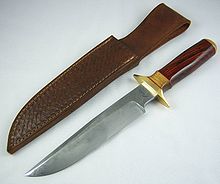
Blade
A blade is that portion of a tool, weapon, or machine with a cutting edge and/or a pointed tip that is designed to cut and/or puncture, stab, slash, chop, slice, thrust, or scrape animate or inanimate surfaces or materials...
, hand-held or otherwise, with or without a handle. Knives were used at least two-and-a-half million years ago
Stone Age
The Stone Age is a broad prehistoric period, lasting about 2.5 million years , during which humans and their predecessor species in the genus Homo, as well as the earlier partly contemporary genera Australopithecus and Paranthropus, widely used exclusively stone as their hard material in the...
, as evidenced by the Oldowan tools. Originally made of rock, flint
Flint
Flint is a hard, sedimentary cryptocrystalline form of the mineral quartz, categorized as a variety of chert. It occurs chiefly as nodules and masses in sedimentary rocks, such as chalks and limestones. Inside the nodule, flint is usually dark grey, black, green, white, or brown in colour, and...
, and obsidian
Obsidian
Obsidian is a naturally occurring volcanic glass formed as an extrusive igneous rock.It is produced when felsic lava extruded from a volcano cools rapidly with minimum crystal growth...
, knives have evolved in construction as technology has, with blades being made from bronze
Bronze
Bronze is a metal alloy consisting primarily of copper, usually with tin as the main additive. It is hard and brittle, and it was particularly significant in antiquity, so much so that the Bronze Age was named after the metal...
, copper
Copper
Copper is a chemical element with the symbol Cu and atomic number 29. It is a ductile metal with very high thermal and electrical conductivity. Pure copper is soft and malleable; an exposed surface has a reddish-orange tarnish...
, iron
Iron
Iron is a chemical element with the symbol Fe and atomic number 26. It is a metal in the first transition series. It is the most common element forming the planet Earth as a whole, forming much of Earth's outer and inner core. It is the fourth most common element in the Earth's crust...
, steel
Steel
Steel is an alloy that consists mostly of iron and has a carbon content between 0.2% and 2.1% by weight, depending on the grade. Carbon is the most common alloying material for iron, but various other alloying elements are used, such as manganese, chromium, vanadium, and tungsten...
, ceramic
Ceramic
A ceramic is an inorganic, nonmetallic solid prepared by the action of heat and subsequent cooling. Ceramic materials may have a crystalline or partly crystalline structure, or may be amorphous...
s, and titanium
Titanium
Titanium is a chemical element with the symbol Ti and atomic number 22. It has a low density and is a strong, lustrous, corrosion-resistant transition metal with a silver color....
. Many cultures have their unique version of the knife. Due to its role as humankind's first tool, certain cultures have attached spiritual and religious significance to the knife. Most native Americans used them.
Most modern-day knives follow either a fixed-blade or a folding construction style, with blade patterns and styles as varied as their makers and countries of origin.
Materials, features, and construction
Today, knives come in many forms but can be generally categorized between two broad types: fixed blade knives and folding, or pocket knivesPocket knife
A pocket knife is a folding knife with one or more blades that fit inside the handle that can still fit in a pocket. It is also known as a jackknife or jack-knife...
.
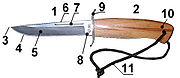
Parts of a knife
Modern knives consist of a blade (1) and handle (2). The blade edge can be plain or serratedSerrated blade
A serrated blade is a type of blade used on saws and on some knives or scissors. It is also known as a dentated, sawtooth, or toothed blade.A serrated blade has a cutting edge that has many small points of contact with the material being cut...
or a combination of both. The handle, used to grip and manipulate the blade safely, may include the tang
Tang (weaponry)
A tang or shank is the back portion of a tool where it extends into stock material or is connected to a handle as on a knife, sword, spear, arrowhead, chisel, screwdriver, etc...
, a portion of the blade that extends into the handle. Knives are made with partial tangs (extending part way into the handle, known as a "Stick Tang") or full tangs (extending the full length of the handle, often visible on top and bottom). The handle can include a bolster, which is a piece of material used to balance the knife, usually brass or other metal, at the front of the handle where it meets the blade. The blade consists of (3) the point - the end of the knife used for piercing; (4) the edge - the cutting surface of the knife extending from the point to the heel; (5), the grind
Grind
The grind of a blade refers to the shape of the cross-section of the blade. It is distinct from the type of blade , though different tools and blades may have lent their name to a particular grind.Grinding involves removing significant portions of metal from the blade and is thus distinct from...
, the cross section
Cross section (geometry)
In geometry, a cross-section is the intersection of a figure in 2-dimensional space with a line, or of a body in 3-dimensional space with a plane, etc...
shape of the blade; (6) the spine - the thickest section of the blade; (7), the fuller
Fuller (weapon)
A fuller is a rounded or beveled groove or slot in the flat side of a blade . A fuller is often used to lighten the blade, much in the way that an I-beam shape allows a given amount of strength to be achieved with less material...
, the groove added to lighten the blade; (8) the ricasso
Ricasso
A ricasso is a part of sword and knife blades. It is the section just above the guard or handle. It is sometimes unsharpened and unbevelled.The first unsharpened ricassos were found on Middle Bronze Age swords...
, the flat section of the blade located at the junction of the blade and the knife's bolster or guard; (9) the guard, the barrier between the blade and the handle which protects the hand from an opponent, and (10) the end of the handle, or butt. A choil, where the blade is unsharpened and possibly indented as it meets the handle, may be used to prevent scratches to the handle when sharpening or as a forward-finger grip. The knife's handle or butt may allow a lanyard
Lanyard
A lanyard is a rope or cord exclusively worn around the neck or wrist to carry something. Usually it is used where there is a risk of losing the object or to ensure it is visible at all times. Aboard a ship, it may refer to a piece of rigging used to secure objects...
(11) to be used to secure the knife to the wrist, or a portion of the tang to protrude as a striking surface for hitting or glass breaking. Single edged knives may uitilze a reverse edge or false edge, in which the forward section of the knife's spine (opposing the sharpened edge) is thinned and left unsharpened.
Blade
Iron
Iron is a chemical element with the symbol Fe and atomic number 26. It is a metal in the first transition series. It is the most common element forming the planet Earth as a whole, forming much of Earth's outer and inner core. It is the fourth most common element in the Earth's crust...
and carbon
Carbon
Carbon is the chemical element with symbol C and atomic number 6. As a member of group 14 on the periodic table, it is nonmetallic and tetravalent—making four electrons available to form covalent chemical bonds...
, can be very sharp, hold its edge well, and remain easy to sharpen, but is vulnerable to rust and stains. Stainless steel is an alloy of iron, chromium
Chromium
Chromium is a chemical element which has the symbol Cr and atomic number 24. It is the first element in Group 6. It is a steely-gray, lustrous, hard metal that takes a high polish and has a high melting point. It is also odorless, tasteless, and malleable...
, possibly nickel
Nickel
Nickel is a chemical element with the chemical symbol Ni and atomic number 28. It is a silvery-white lustrous metal with a slight golden tinge. Nickel belongs to the transition metals and is hard and ductile...
, and molybdenum
Molybdenum
Molybdenum , is a Group 6 chemical element with the symbol Mo and atomic number 42. The name is from Neo-Latin Molybdaenum, from Ancient Greek , meaning lead, itself proposed as a loanword from Anatolian Luvian and Lydian languages, since its ores were confused with lead ores...
, with only a small amount of carbon. It is not able to take quite as sharp an edge as carbon steel, but is highly resistant to corrosion. High carbon stainless steel is stainless steel with a higher amount of carbon, intended to incorporate the better attributes of carbon steel and stainless steel. High carbon stainless steel blades do not discolor or stain, and maintain a sharp edge. Laminate
Laminate
A laminate is a material that can be constructed by uniting two or more layers of material together. The process of creating a laminate is lamination, which in common parlance refers to the placing of something between layers of plastic and gluing them with heat and/or pressure, usually with an...
blades use multiple metals to create a layered sandwich, combining the attributes of both. For example, a harder, more brittle steel may be sandwiched between an outer layer of softer, tougher, stainless steel to reduce vulnerability to corrosion. In this case, however, the part most affected by corrosion, the edge, is still vulnerable. Pattern-welding is similar to laminate construction. Layers of different steel types are welded together, but then the stock is manipulated to create patterns in the steel. Titanium
Titanium
Titanium is a chemical element with the symbol Ti and atomic number 22. It has a low density and is a strong, lustrous, corrosion-resistant transition metal with a silver color....
is a metal that has a better strength-to-weight ratio, is more wear resistant, and more flexible than steel. Although less hard and unable to take as sharp an edge, carbides in the titanium alloy allow them to be heat-treated to a sufficient hardness. Ceramic
Ceramic
A ceramic is an inorganic, nonmetallic solid prepared by the action of heat and subsequent cooling. Ceramic materials may have a crystalline or partly crystalline structure, or may be amorphous...
blades are hard, brittle, and lightweight: they may maintain a sharp edge for years with no maintenance at all, but are as fragile as glass and will break if dropped on a hard surface. They are immune to common corrosion, and can only be sharpened on silicon carbide sandpaper and some grinding wheels. Plastic
Plastic
A plastic material is any of a wide range of synthetic or semi-synthetic organic solids used in the manufacture of industrial products. Plastics are typically polymers of high molecular mass, and may contain other substances to improve performance and/or reduce production costs...
blades are not especially sharp and typically serrated
Serrated blade
A serrated blade is a type of blade used on saws and on some knives or scissors. It is also known as a dentated, sawtooth, or toothed blade.A serrated blade has a cutting edge that has many small points of contact with the material being cut...
. They are often disposable.
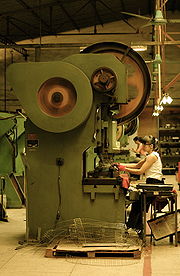
Steel blades are commonly shaped by forging
Forging
Forging is a manufacturing process involving the shaping of metal using localized compressive forces. Forging is often classified according to the temperature at which it is performed: '"cold," "warm," or "hot" forging. Forged parts can range in weight from less than a kilogram to 580 metric tons...
or stock removal. Forged blades are made by heating a single piece of steel, then shaping the metal while hot using a hammer or press. Stock removal blades are shaped by grinding and removing metal. With both methods, after shaping, the steel must be heat treated
Heat treatment
Heat treating is a group of industrial and metalworking processes used to alter the physical, and sometimes chemical, properties of a material. The most common application is metallurgical. Heat treatments are also used in the manufacture of many other materials, such as glass...
. This involves heating the steel above its critical point, then quenching the blade to harden it. After hardening, the blade is tempered
Tempering
Tempering is a heat treatment technique for metals, alloys and glass. In steels, tempering is done to "toughen" the metal by transforming brittle martensite or bainite into a combination of ferrite and cementite or sometimes Tempered martensite...
to remove stresses and make the blade tougher. Mass manufactured kitchen cutlery uses both the forging and stock removal processes. Forging tends to be reserved for manufacturers' more expensive product lines, and can often be distinguished from stock removal product lines by the presence of an integral bolster, though integral bolsters can be crafted through either shaping method.
Knives are sharpened in various ways. Flat ground blades have a profile that tapers from the thick spine to the sharp edge in a straight or convex line. Seen in cross section, the blade would form a long, thin triangle, or where the taper does not extend to the back of the blade, a long thin rectangle with one peaked side. Hollow ground blades have concave, beveled edges. The resulting blade has a thinner edge, so it may have better cutting ability for shallow cuts, but it is lighter and less durable than flat ground blades and will tend to bind in deep cuts. Serrated blade knives have a wavy, scalloped or saw-like blade. Serrated blades are more well suited for tasks that require aggressive 'sawing' motions, whereas plain edge blades are better suited for tasks that require push-through cuts (e.g., shaving, chopping, slicing).
Fixed blade features
A fixed blade knife, sometimes called a sheath knife, does not fold or slide, and is typically stronger due to the tang, the extension of the blade into the handle, and lack of moving parts.Folding blade features
A folding knife connects the blade to the handle through a pivot, allowing the blade to fold into the handle. To prevent injury to the knife user through the blade accidentally closing on the user's hand, folding knives typically have a locking mechanism. Different locking mechanisms are favored by various individuals for reasons such as perceived strength (lock safety), legality, and ease of use.Popular locking mechanisms include:
- Slip joint – Found most commonly on traditional pocket knives, the opened blade does not lock, but is held in place by a spring device that allows the blade to fold if a certain amount of pressure is applied.
- Lockback – Also known as the spine lock, the lockback includes a pivoted latch affixed to a spring, and can be disengaged only by pressing the latch down to release the blade.
- Liner LockWalker LinerlockThe Walker Linerlock is a locking system developed by custom knifemaker Michael Walker in 1980 for use on folding knives.When the blade of the knife is in the opened position, it is held in place by a leaf spring that butts up against the tang of the blade to prevent the blade from closing...
– Invented by Michael Walker, uses a leaf spring-type liner within the groove of the handle that snaps into position under the blade when it is deployed. The lock is released by pushing the liner to the side, to allow the blade to return to its groove set into the handle. - Compression Lock – A variant of the Liner Lock, it uses a small piece of metal at the tip of the lock to lock into a small corresponding impression in the blade. This creates a lock that doesn't disengage when the blade is torqued, instead becoming more tightly locked. It is released by pressing the tab of metal to the side, to allow the blade to be placed into its grove set into the handle.
- Frame Lock – Also known as the integral lock or monolock, this locking mechanism was invented by custom knifemaker Chris ReeveChris ReeveChris Reeve is an American knife maker, recognized as one of the most influential people in knife making history. Reeve founded Chris Reeve Knives , and is co-owner of the company with his wife, Anne Reeve.-Background:...
for the SebenzaSebenzaThe Sebenza is a folding pocket knife manufactured by Chris Reeve Knives of Boise, Idaho. It is constructed with a stainless steel blade and titanium handle. Its handle functions as the lock mechanism similar in concept to the Walker linerlock differing in that the handle itself forms the lock...
as an update to the liner lock. The frame lock works in a manner similar to the liner lock but uses a partial cutout of the actual knife handle, rather than a separate liner inside the handle to hold the blade in place. - Collar lock – found on Opinel knivesOpinel knifeThe Opinel knife, or simply Opinel, is a simple, wooden-handled pocket-knife manufactured since 1890 in the town of Saint-Jean-de-Maurienne in the Savoie region of France.-History:...
- Button Lock – Found mainly on automatic knives, this type of lock uses a small push-button to open and release the knife.
- Axis Lock – A locking mechanism exclusively licensed to the Benchmade Knife CompanyBenchmadeThe Benchmade Knife Company is a knife manufacturer run by Roberta and Les de Asis in Oregon City, Oregon, United States. Its products are geared toward many niche markets, such as outdoor sporting cutlery, rescue, law-enforcement, martial-arts, and military...
- Arc Lock – A locking mechanism exclusively licensed to SOG Specialty KnivesSOG Specialty KnivesSOG Specialty Knives, Inc. is a U.S. knife and tool manufacturing company famous for their production of the knife with the same name, SOG....
. - Tri-Ad Lock – A locking mechanism exclusively licensed to Cold SteelCold SteelCold Steel is a Ventura, California-based maker of knives, swords and other edged weapons and tools. Cold Steel was founded in 1980 by company president, Lynn C. Thompson...
. - PickLock – A round post on the back base of the blade locks into a hole in a spring tab in the handle. To close, manually lift (pick) the spring tab (lock) off the blade post with your fingers, or in "Italian Style Stilettos" swivel the bolster (hand guard) clockwise to lift the spring tab off the blade post.
Another prominent feature on many folding knives is the opening mechanism. Traditional pocket knives and Swiss Army Knives
Swiss Army knife
The Swiss Army knife is a brand of pocket knife or multi-tool manufactured by Victorinox AG and Wenger SA. The term "Swiss Army knife" was coined by US soldiers after World War II due to the difficulty they had in pronouncing the German name....
commonly employ the nail nick, while modern folding knives more often use a stud, hole, disk, or flipper located on the blade, all which have the benefit of allowing the user to open the knife with one hand.
The wave feature is another prominent design, which uses a part of the blade that protrudes outward to catch on one's pocket as it is drawn, thus opening the blade; this was patented by Ernest Emerson
Ernest Emerson
Ernest R. Emerson is an American custom knifemaker, martial artist, and edged-weapons expert. Originally an engineer and machinist in the aerospace industry, Emerson became a knifemaker known for making decorative knives but later became better known for his combat knives, eventually founding a...
and is not only used on many of the Emerson knives, but also on knives produced by Spyderco
Spyderco
Spyderco is a Golden, Colorado, U.S.A. based cutlery company that produces knives and knife sharpeners. Spyderco introduced many features that are now common on folding knives, including the pocket clip, serrations, and the opening hole...
and Cold Steel
Cold Steel
Cold Steel is a Ventura, California-based maker of knives, swords and other edged weapons and tools. Cold Steel was founded in 1980 by company president, Lynn C. Thompson...
as well.
Automatic or switchblade
Switchblade
A switchblade is a type of knife with a folding or sliding blade contained in the handle which is opened automatically by a spring when a button, lever, or switch on the handle or bolster is activated A switchblade (also known as an automatic knife, pushbutton knife, switch, Sprenger, Springer,...
knives open using the stored energy from a spring that is released when the user presses a button or lever or other actuator built into the handle of the knife. Automatic knives are popular amongst law enforcement and military users for their ease of rapid deployment and their ability to be opened using only one hand. Automatic knives are severely restricted by law in most American states.
Increasingly common are assisted opening knives which use springs to propel the blade once the user has moved it past a certain angle. These differ from automatic or switchblade knives in that the blade is not released by means of a button or catch on the handle; rather, the blade itself is the actuator. Most assisted openers use flippers as their opening mechanism. Assisted opening knives can be as fast or faster than automatic knives to deploy.
Sliding blade features
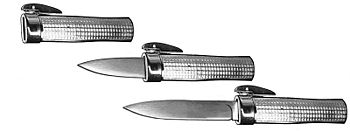
Gravity knife
A gravity knife is a knife with a blade contained in its handle, and which opens its blade by the force of inertia or gravity. As the gravity knife requires gravity or inertia to propel the blade out of the handle, it differs fundamentally from the switchblade, which opens its spring-propelled...
). Another form is an O-T-F (out-the-front) switchblade, which only requires the push of a button or spring to cause the blade to slide out of the handle, and lock into place. To retract the blade back into the handle, a release lever or button, usually the same control as to open, is pressed. A very common form of sliding knife is the sliding utility knife
Utility knife
A utility knife is a knife used for general or utility purposes. The utility knife was originally a fixed blade knife with a cutting edge suitable for general work such as cutting hides and cordage, scraping hides, butchering animals, cleaning fish, and other tasks.Today, the term "utility knife"...
(commonly known as a stanley knife or boxcutter).
Handle
The handles of knives can be made from a number of different materials, each of which has advantages and disadvantages. Handles are produced in a wide variety of shapes and styles. Handles are often textured to enhance grip.- WoodWoodWood is a hard, fibrous tissue found in many trees. It has been used for hundreds of thousands of years for both fuel and as a construction material. It is an organic material, a natural composite of cellulose fibers embedded in a matrix of lignin which resists compression...
handles provide good grip and are warm in the hand, but are more difficult to care for. They do not resist water well, and will crack or warp with prolonged exposure to water. Modern stabilized and laminated woods have largely overcome these problems. Many beautiful and exotic hardwoods are employed in the manufacture of custom and some production knives. In some countries it is now forbidden for commercial butchers' knives to have wood handles, for sanitary reasons. - PlasticPlasticA plastic material is any of a wide range of synthetic or semi-synthetic organic solids used in the manufacture of industrial products. Plastics are typically polymers of high molecular mass, and may contain other substances to improve performance and/or reduce production costs...
handles are more easily cared for than wooden handles, but can be slippery and become brittle over time. - Injection molded handles made from higher grade plastics are composed of PolyphthalamidePolyphthalamidePolyphthalamide is a thermoplastic synthetic resin of the polyamide family that is used to replace metals in high temperature automotive applications, as the housing for high temperature electrical connectors and multiple other uses. It has found a degree of favor for use in cutlery...
, and when marketed under trademarked names such as ZytelZytelZytel is a trademark owned by DuPont and used for a number of different high strength, abrasion and impact resistant thermoplastic polyamide formulations of the family more commonly known as nylon, often with varying degrees of fiberglass, from 13% to 60%, added in for additional stiffness.Some of...
or Grivory, are reinforced with KevlarKevlarKevlar is the registered trademark for a para-aramid synthetic fiber, related to other aramids such as Nomex and Technora. Developed at DuPont in 1965, this high strength material was first commercially used in the early 1970s as a replacement for steel in racing tires...
or fiberglassFiberglassGlass fiber is a material consisting of numerous extremely fine fibers of glass.Glassmakers throughout history have experimented with glass fibers, but mass manufacture of glass fiber was only made possible with the invention of finer machine tooling...
. These are often used by major knife manufacturers. - RubberRubberNatural rubber, also called India rubber or caoutchouc, is an elastomer that was originally derived from latex, a milky colloid produced by some plants. The plants would be ‘tapped’, that is, an incision made into the bark of the tree and the sticky, milk colored latex sap collected and refined...
handles such as KratonKraton (polymer)Kraton is the trade name given to a number of high performance elastomers manufactured by Kraton Polymers , and used as synthetic replacements for rubber. Kraton polymers offers many of the properties of natural rubber, such as flexibility, high traction, and sealing abilities, but with increased...
or Resiprene-C are generally preferred over plastic due to their durable and cushioning nature. - MicartaMicartaMicarta is a trademark of Norplex-Micarta industrial high pressure laminates and refers to a composite of linen, canvas, paper, fiberglass, carbon fiber or other fabric in a thermosetting plastic, originally used in electrical and decorative Koekjes applications. Micarta was developed by George...
is a popular handle material on user knives due to its toughness and stability. Micarta is nearly impervious to water, is grippy when wet, and is an excellent insulator. Micarta has come to refer to any fibrous material cast in resin. There are many varieties of micarta available. One very popular version is a fiberglass impregnated resin called G-10. - LeatherLeatherLeather is a durable and flexible material created via the tanning of putrescible animal rawhide and skin, primarily cattlehide. It can be produced through different manufacturing processes, ranging from cottage industry to heavy industry.-Forms:...
handles are seen on some hunting and military knives, notably the KA-BARKA-BARKA-BAR is the contemporary popular name for the combat knife first adopted by the United States Marine Corps in November 1942 as the 1219C2 Combat Knife , and subsequently adopted by the United States Navy as the U.S. Navy Utility Knife, Mark 2...
. Leather handles are typically produced by stacking leather washers, or less commonly, as a sleeve surrounding another handle material. - Skeleton handles refers to the practice of using the tang itself as the handle, usually with sections of material removed to reduce weight. Skeleton handled knives are often wrapped with parachute cord or other wrapping materials to enhance grip.
- Stainless steelStainless steelIn metallurgy, stainless steel, also known as inox steel or inox from French "inoxydable", is defined as a steel alloy with a minimum of 10.5 or 11% chromium content by mass....
and Aluminum handles are durable and sanitary, but can be slippery. To counter this, premium knife makers make handles with ridges, bumps, or indentations to provide extra grip. Another problem with knives that have metal handles is that, since metal is an excellent heat-conductor, these knives can be very uncomfortable, and even painful or dangerous, when handled without gloves or other protective handwear in (very) cold climates.
More exotic materials usually only seen on art or ceremonial knives include: Stone, bone, mammoth tooth, mammoth ivory, oosik (walrus penis bone), walrus tusk, antler (often called stag in a knife context), sheep horn, buffalo horn, teeth, etc. Many materials have been employed in knife handles.
Knives as weapons
As a weapon, the knife is universally adopted as an essential tool. It is the essential element of a knife fightKnife fight
A knife fight is a violent physical confrontation between two or more combatants in which one or more participants is armed with a knife...
. For example:
- Ballistic knifeBallistic knifeA ballistic knife is a specialized combat knife with a detachable gas- or spring-propelled blade that can be fired to a distance of several feet or meters by pressing a trigger or switch on the handle.-History and usage:...
: A specialized combat knife with a detachable gas- or spring-propelled blade that can be fired to a distance of several feet or meters by pressing a trigger or switch on the handle. - BayonetBayonetA bayonet is a knife, dagger, sword, or spike-shaped weapon designed to fit in, on, over or underneath the muzzle of a rifle, musket or similar weapon, effectively turning the gun into a spear...
: A knife-shaped close-quarters fighting weapon designed to attach to the muzzle of a rifle or similar weapon. - Combat knifeCombat knifeA combat knife is a fighting knife designed solely for military use and primarily intended for hand-to-hand or close combat fighting.Since the end of trench warfare, most military combat knives have been secondarily designed for utility use in addition to their original role as close-quarter combat...
: Any knife intended to be used by soldiers in the field, as a general-use tool, but also for fighting. - DaggerDaggerA dagger is a fighting knife with a sharp point designed or capable of being used as a thrusting or stabbing weapon. The design dates to human prehistory, and daggers have been used throughout human experience to the modern day in close combat confrontations...
: A double-edged combat knife with a central spine and edges sharpened their full length, used primarily for stabbing. Variations include the StilettoStilettoA stiletto is a knife or dagger with a long slender blade and needle-like point, intended primarily as a stabbing weapon. The stiletto blade's narrow cross-section and acuminated tip reduces friction upon entry, allowing the blade to penetrate deeply...
and Push daggerPush daggerA push dagger is a short-bladed dagger with a "T" handle designed to be grasped in the hand so that the blade protrudes from the front of one's fist, typically between the 2nd and 3rd finger...
. See List of daggers for a more detailed list. - Fighting knifeFighting knifeA fighting knife is a knife with a blade designed to inflict a lethal injury in a physical confrontation between two or more individuals at very short range...
: A knife with a blade designed to inflict a lethal injury in a physical confrontation between two or more individuals at very short range (grappling distance). Well known examples include the Bowie knifeBowie knifeA Bowie knife is a pattern of fixed-blade fighting knife first popularized by Colonel James "Jim" Bowie in the early 19th Century. Since the first incarnation was created by James Black, the Bowie knife has come to incorporate several recognizable and characteristic design features, although its...
and the Fairbairn-Sykes Fighting KnifeFairbairn-Sykes fighting knifeThe Fairbairn-Sykes Fighting Knife is a double-edged fighting knife resembling a dagger or poignard with a foil grip developed by William Ewart Fairbairn and Eric Anthony Sykes in Shanghai based on concepts which the two men initiated before World War II while serving on the Shanghai Municipal...
. - RampuriRampuriThe Rampuri is an Indian gravity knife of formidable reputation having a single edged blade roughly 9 to 12 inches long. Usually it is the switchblade type but there are step-lock types available as well, which became synonymous to the town of Rampur, Uttar Pradesh. It formed the basic weapon...
: An Indian gravity knife of formidable reputation having a single edged blade roughly 9 to 12 inches long. - ShivShiv (weapon)A shiv is a slang term for any sharp or pointed implement used as a knife-like weapon. However, the word in practical usage is frequently used when referring to an improvised bladed weapon. Shivs are commonly made by inmates in prisons across the world...
: A crudely made homemade knife out of everyday materials, especially prevalent in prisons among inmates. An alternate name in some prisons is Shank. - Throwing knifeThrowing knifeThrowing knives are knives that are specially designed and weighted so that they can be thrown effectively. They are a distinct category from ordinary knives....
: A knife designed and weighted for throwing - Trench knifeTrench knifeA Trench knife is a combat knife designed to kill or gravely incapacitate an enemy soldier at close quarters, as might be encountered in a trenchline or other confined area. It was developed in response to a need for a close combat weapon for soldiers conducting assaults and raids on enemy...
: Purpose-made or improvised knives, intended for close-quarter fighting, particularly in trench warfareTrench warfareTrench warfare is a form of occupied fighting lines, consisting largely of trenches, in which troops are largely immune to the enemy's small arms fire and are substantially sheltered from artillery...
characterized by a d-shaped integral hand guard.
Knives as utensils
Cooking
Cooking is the process of preparing food by use of heat. Cooking techniques and ingredients vary widely across the world, reflecting unique environmental, economic, and cultural traditions. Cooks themselves also vary widely in skill and training...
or as cutlery
Cutlery
Cutlery refers to any hand implement used in preparing, serving, and especially eating food in the Western world. It is more usually known as silverware or flatware in the United States, where cutlery can have the more specific meaning of knives and other cutting instruments. This is probably the...
. Examples of this include:
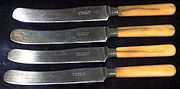
- Bread knife: A knife with a serrated blade for cutting breadBreadBread is a staple food prepared by cooking a dough of flour and water and often additional ingredients. Doughs are usually baked, but in some cuisines breads are steamed , fried , or baked on an unoiled frying pan . It may be leavened or unleavened...
- Boning knifeBoning knifeA boning knife is a type of kitchen knife with a sharp point and narrow blade. It is used in food preparation for removing the bones of poultry, meat, and fish. Generally 12 cm to 17 cm in length it features a very narrow blade...
: A knife used for removing the bones of poultryPoultryPoultry are domesticated birds kept by humans for the purpose of producing eggs, meat, and/or feathers. These most typically are members of the superorder Galloanserae , especially the order Galliformes and the family Anatidae , commonly known as "waterfowl"...
, meatMeatMeat is animal flesh that is used as food. Most often, this means the skeletal muscle and associated fat and other tissues, but it may also describe other edible tissues such as organs and offal...
, and fishFishFish are a paraphyletic group of organisms that consist of all gill-bearing aquatic vertebrate animals that lack limbs with digits. Included in this definition are the living hagfish, lampreys, and cartilaginous and bony fish, as well as various extinct related groups... - Carving knife: A knife for carving large cooked meats such as poultry, roasts, hams
- Chef's knifeChef's knifeIn cooking, a chef's knife, also known as a French knife or a cook's knife, is a cutting tool used in food preparation. The chef's knife was originally designed primarily to slice and disjoint large cuts of beef...
: Also known as a French knife, a cutting tool used in preparing food - Butcher's KnifeButcher knifeA butcher knife is a knife designed and used primarily for the butchering and/or dressing of animals.During the late 18th century to mid 1840s, the butcher knife was a key tool for mountain men. Simple, useful and cheap to produce, they were used for everything from skinning beaver, cutting food,...
: A knife designed and used primarily for the butchering and/or dressing of animals. - Electric knifeElectric knifeAn electric knife or electric carving knife is an electrical kitchen device used for slicing foods. An electric knife requires less physical effort than an ordinary knife and produces neater slices. The device consists of two serrated blades that are clipped together...
: An electrical device consisting of two serrated blades that are clipped together, providing a sawing action when powered on - Kitchen knifeKitchen knifeA kitchen knife is any knife that is intended to be used in food preparation. While much of this work can be accomplished with a few general-purpose knives – notably a large chef's knife, a tough cleaver, and a small paring knife – there are also many specialized knives that are designed for...
: Any knife, including the chef's knife, that is intended to be used in food preparation - CleaverCleaver (knife)A cleaver is a large knife that varies in its shape but usually resembles a rectangular-bladed hatchet. It is used mostly for hacking through bones as a kitchen knife or butcher knife, and can also be used for crushing via its broad side, typically garlic....
: A large knife that varies in its shape but usually resembles a rectangular-bladed hatchet. It is used mostly for hacking through bones as a kitchen knife or butcher knife, and can also be used for crushing via its broad side, typically garlic. - Oyster knifeOysterThe word oyster is used as a common name for a number of distinct groups of bivalve molluscs which live in marine or brackish habitats. The valves are highly calcified....
: Has a short, thick blade for prying open oyster shells - Paring or Coring Knife: A knife with a small but sharp blade used for cutting out the cores from fruit.
- Table knifeTable knifeA table knife is an item of cutlery, part of a table setting. Table knives are typically of moderate sharpness only, designed to cut only prepared and cooked food. They are usually made of stainless steel and may be ornate, often having handles of bone, wood or ivory.The distinguishing feature...
or Case knifeCase knifeA case knife is a name used throughout the American South to refer to a table knife, i.e. a knife intended for use at the dining table. The origin of this usage comes from a time when inns did not customarily provide eating utensils with meals. The table fork was relatively new, and was often...
: A piece of cutlery, either a butter knifeButter knifeIn common usage, a butter knife may refer to any non-serrated table knife designed with a dull edge and rounded point; formal flatware patterns make a distinction between such a place knife and a butter knife...
, steak knife, or both, that is part of a table settingTable settingTable setting or place setting refers to the way to set a table with tableware—such as eating utensils and dishes for serving and eating. The arrangement for a single diner is called a place setting...
, accompanying the forkForkAs a piece of cutlery or kitchenware, a fork is a tool consisting of a handle with several narrow tines on one end. The fork, as an eating utensil, has been a feature primarily of the West, whereas in East Asia chopsticks have been more prevalent...
and spoonSpoonA spoon is a utensil consisting of a small shallow bowl, oval or round, at the end of a handle. A type of cutlery , especially as part of a place setting, it is used primarily for serving. Spoons are also used in food preparation to measure, mix, stir and toss ingredients... - UluUluAn ulu is an all-purpose knife traditionally used by Eskimo women, both Yupik and Inuit. It is utilized in applications as diverse as skinning and cleaning animals, cutting a child's hair, cutting food and, if necessary, trimming blocks of snow and ice used to build an igloo...
: An InuitInuitThe Inuit are a group of culturally similar indigenous peoples inhabiting the Arctic regions of Canada , Denmark , Russia and the United States . Inuit means “the people” in the Inuktitut language...
woman's all-purpose knife
Knives as tools
As a utility tool the knife can take many forms, including: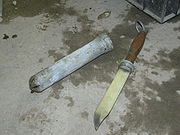
- BalisongBalisong (knife)A Butterfly knife, also known as a fan knife or Balisong, is a folding pocket knife with two handles counter-rotating around the tang such that, when closed, the blade is concealed within grooves in the handles. It is sometimes called a Batangas knife, after the Tagalog province of Batangas in the...
: A folding knife also known as a "butterfly knife" or "batangas", with two handles counter-rotating around the tangTang (weaponry)A tang or shank is the back portion of a tool where it extends into stock material or is connected to a handle as on a knife, sword, spear, arrowhead, chisel, screwdriver, etc...
such that, when closed, the blade is hidden within the handles. - Bowie knifeBowie knifeA Bowie knife is a pattern of fixed-blade fighting knife first popularized by Colonel James "Jim" Bowie in the early 19th Century. Since the first incarnation was created by James Black, the Bowie knife has come to incorporate several recognizable and characteristic design features, although its...
: Commonly, any large sheath knife, or a specific style of large knife popularized by Jim BowieJim BowieJames "Jim" Bowie , a 19th-century American pioneer, slave trader, land speculator, and soldier, played a prominent role in the Texas Revolution, culminating in his death at the Battle of the Alamo...
. - Diver's knife: A knife adapted for use in diving and water sports and a necessary part of standard diving dressStandard diving dressA standard diving dress consists of a metallic diving helmet, an airline or hose from a surface supplied diving air pump, a canvas diving suit, diving knife and boots...
. - Electrician's knife: A short-bladed knife used to cut electrical insulation.
- Hunting knifeHunting knifeA hunting knife is a knife used during hunting for preparing the game to be used as food: skinning the animal and cutting up the meat. It is different from the Hunting dagger which was traditionally used to kill wild game....
: A knife used to dress large game. - Linoleum knifeLinoleum knifeA linoleum knife is a small knife that has a short, stiff blade with a curved point and a handle and is used to cut linoleum or other sheet materials such as wood panelling and veneer and sheet mica. The knife is similar in design to the sickle...
: is a small knife that has a short, stiff blade with a curved point and a handle and is used to cut linoleumLinoleumLinoleum is a floor covering made from renewable materials such as solidified linseed oil , pine rosin, ground cork dust, wood flour, and mineral fillers such as calcium carbonate, most commonly on a burlap or canvas backing; pigments are often added to the materials.The finest linoleum floors,...
or other sheet materials. - MacheteMacheteThe machete is a large cleaver-like cutting tool. The blade is typically long and usually under thick. In the English language, an equivalent term is matchet, though it is less commonly known...
: A large heavy knife used to cut through thick vegetation such as sugar cane or jungle undergrowth; it may be used as an offensive weapon. - Multitool: Customarily with a knife as its most elemental feature, these tools may include a variety of other tools. Made famous by the Swiss Army KnifeSwiss Army knifeThe Swiss Army knife is a brand of pocket knife or multi-tool manufactured by Victorinox AG and Wenger SA. The term "Swiss Army knife" was coined by US soldiers after World War II due to the difficulty they had in pronouncing the German name....
. - Palette knifePalette knifeA palette knife is a blunt tool used for mixing or applying paint, with a flexible steel blade. It is primarily used for mixing paint colors, paste, etc., or for marbling, decorative endpapers, etc...
: A knife, or frosting spatulaFrosting spatulaA frosting spatula or palette knife is a kitchen utensil designed especially for the use of spreading a substance onto a flat surface, such as frosting on a cake. It is also an ideal tool for applying spreads onto sandwiches in mass quantities....
, lacking a cutting edge, used by artists for tasks such as mixing and applying paint and in cookingCookingCooking is the process of preparing food by use of heat. Cooking techniques and ingredients vary widely across the world, reflecting unique environmental, economic, and cultural traditions. Cooks themselves also vary widely in skill and training...
for spreading icingIcing (food)Icing, also called frosting in the United States, is a sweet often creamy glaze made of sugar with a liquid such as water or milk, that is often enriched with ingredients such as butter, egg whites, cream cheese, or flavorings and is used to cover or decorate baked goods, such as cakes or cookies...
. - Paper knife: Or a "Letter Opener" it is a knife made of metal or plastic, used for opening mail.
- Pocket knifePocket knifeA pocket knife is a folding knife with one or more blades that fit inside the handle that can still fit in a pocket. It is also known as a jackknife or jack-knife...
: Also known as a "multi-toolMulti-toolA multi-tool is any one of a range of portable, versatile hand tools that combines several individual functions in a single unit...
" or "jackknife," a knife which may contain several folding blades, as well as other tools. - Produce knife: A knife with a rectangular profile and a blunt front edge used by grocers to cut produceProduceProduce is a generalized term for a group of farm-produced goods and, not limited to fruits and vegetables . More specifically, the term "produce" often implies that the products are fresh and generally in the same state as where they were harvested. In supermarkets the term is also used to refer...
. - ScalpelScalpelA scalpel, or lancet, is a small and extremely sharp bladed instrument used for surgery, anatomical dissection, and various arts and crafts . Scalpels may be single-use disposable or re-usable. Re-usable scalpels can have attached, resharpenable blades or, more commonly, non-attached, replaceable...
: A medical knife, used to perform surgerySurgerySurgery is an ancient medical specialty that uses operative manual and instrumental techniques on a patient to investigate and/or treat a pathological condition such as disease or injury, or to help improve bodily function or appearance.An act of performing surgery may be called a surgical...
. - Straight razorStraight razorA straight razor is a razor with a blade that can fold into its handle. They are also called open razors and cut-throat razors.Although straight razors were once the principal method of manual shaving, they have been largely overshadowed by the safety razor, incorporating a disposable blade...
: A reusable knife blade used for shavingShavingShaving is the removal of hair, by using a razor or any other kind of bladed implement, to slice it down to the level of the skin. Shaving is most commonly practiced by men to remove their facial hair and by women to remove their leg and underarm hair...
hair. - Survival knifeSurvival knifeSurvival knives are knives intended for survival purposes in a wilderness environment, often in an emergency situation when the user has lost most of his/her main equipment. Military units issue some type of survival knife to pilots in the event their plane may be shot down. Survival knives can be...
: A sturdy knife, sometimes with a hollow handle filled with survival equipment. - SwitchbladeSwitchbladeA switchblade is a type of knife with a folding or sliding blade contained in the handle which is opened automatically by a spring when a button, lever, or switch on the handle or bolster is activated A switchblade (also known as an automatic knife, pushbutton knife, switch, Sprenger, Springer,...
: A knife with a folding blade that springs out of the grip when a button or lever on the grip is pressed. - Utility knifeUtility knifeA utility knife is a knife used for general or utility purposes. The utility knife was originally a fixed blade knife with a cutting edge suitable for general work such as cutting hides and cordage, scraping hides, butchering animals, cleaning fish, and other tasks.Today, the term "utility knife"...
: A short knife with a replaceable triangular blade, used for cutting sheet materials including card stockCard stockCard stock, also called cover stock or pasteboard, is a paper stock that is thicker and more durable than normal writing or printing paper, but thinner and more flexible than other forms of paperboard. Card stock is often used for business cards, postcards, playing cards, catalog covers,...
, paperboardPaperboardPaperboard is a thick paper based material. While there is no rigid differentiation between paper and paperboard, paperboard is generally thicker than paper. According to ISO standards, paperboard is a paper with a basis weight above 224 g/m2, but there are exceptions. Paperboard can be single...
, and corrugated fiberboard - Wood carving knife: Knives used for wood carvingWood carvingWood carving is a form of working wood by means of a cutting tool in one hand or a chisel by two hands or with one hand on a chisel and one hand on a mallet, resulting in a wooden figure or figurine, or in the sculptural ornamentation of a wooden object...
, often with short, thin replaceable blades for better control. - X-Acto knife: A scalpel-like knife with a long handle and a replaceable pointed blade, used for precise, clean cutting in arts and crafts
Knives as a traditional or religious implement
- AthameAthameAn Athame or Athamé is a ceremonial dagger, with a double-edged blade and usually a black handle. It is the main ritual implement or magical tool among several used in the religion of Wicca, and is also used in various other neopagan witchcraft traditions. It is variously pronounced or...
: A typically black-handled and double-edged ritual knife used in WiccaWiccaWicca , is a modern Pagan religious movement. Developing in England in the first half of the 20th century, Wicca was popularised in the 1950s and early 1960s by a Wiccan High Priest named Gerald Gardner, who at the time called it the "witch cult" and "witchcraft," and its adherents "the Wica."...
and other derivative forms of Neopagan witchcraftWitchcraftWitchcraft, in historical, anthropological, religious, and mythological contexts, is the alleged use of supernatural or magical powers. A witch is a practitioner of witchcraft...
. (see also BolineBolineIn Wicca the boline is a white-handled ritual knife, one of several magical tools used in Wicca. Unlike the athame, which in most traditions is never used for actual physical cutting, the boline is used for cutting cords and herbs, carving candles, etc...
). - KirpanKirpanThe kirpan is a ceremonial sword or dagger carried by orthodox Sikhs. It is a religious commandment given by Guru Gobind Singh at the Baisakhi Amrit Sanchar in CE 1699, all baptised Sikhs must wear a kirpan at all times....
: A ceremonial knife that all baptised SikhSikhA Sikh is a follower of Sikhism. It primarily originated in the 15th century in the Punjab region of South Asia. The term "Sikh" has its origin in Sanskrit term शिष्य , meaning "disciple, student" or शिक्ष , meaning "instruction"...
s must wear as one of the five visible symbols of the Sikh faith (Kakars) - Kilaya: A daggerDaggerA dagger is a fighting knife with a sharp point designed or capable of being used as a thrusting or stabbing weapon. The design dates to human prehistory, and daggers have been used throughout human experience to the modern day in close combat confrontations...
used in Tibetan Buddhism - KrisKrisThe kris or keris is an asymmetrical dagger or sword nowadays most strongly associated with the culture of Indonesia, but also indigenous to Malaysia, Southern Thailand and Brunei. It is known as kalis in the southern Philippines. The kris is famous for its distinctive wavy blade , but many have...
: A dagger used in Indo-Malay cultures, often by royalty and sometimes in religious rituals. - KukriKukriThe kukri is a curved Nepalese Knife, similar to the machete, used as both a tool and as a weapon...
: A NepalNepalNepal , officially the Federal Democratic Republic of Nepal, is a landlocked sovereign state located in South Asia. It is located in the Himalayas and bordered to the north by the People's Republic of China, and to the south, east, and west by the Republic of India...
ese knife used as both tool and weapon - PuukkoPuukkoA puukko is a small traditional Finnish belt-knife with a single curving cutting edge and a flat back.- Design :The basic components of a puukko are a hilt and a blade along with a sheath, which can be attached to a belt. The blade is short, typically less than 100 mm.The flat back allows the...
: A traditional FinnishCulture of FinlandThe culture of Finland combines indigenous heritage, as represented for example by the country's Uralic national language Finnish, and the sauna, with common Nordic and European culture. Because of its history and geographic location Finland has been influenced by the adjacent areas' various...
or ScandinaviaScandinaviaScandinavia is a cultural, historical and ethno-linguistic region in northern Europe that includes the three kingdoms of Denmark, Norway and Sweden, characterized by their common ethno-cultural heritage and language. Modern Norway and Sweden proper are situated on the Scandinavian Peninsula,...
n style woodcraft belt-knife used as a tool rather than a weapon - SeaxSeaxSeax in Old English means knife or cutting tool. The name of the roofer's tool, the zax, is a development from this word...
: A GermanicGermanic peoplesThe Germanic peoples are an Indo-European ethno-linguistic group of Northern European origin, identified by their use of the Indo-European Germanic languages which diversified out of Proto-Germanic during the Pre-Roman Iron Age.Originating about 1800 BCE from the Corded Ware Culture on the North...
single-edged knife, used primarily as a tool, but may have been a weapon - Sgian DubhSgian DubhThe sgian-dubh is a small, singled-edged knife worn as part of traditional Scottish Highland dress along with the kilt. It is worn tucked into the top of the kilt hose with only the upper portion of the hilt visible...
: A small dagger traditionally worn with highland dress (kiltKiltThe kilt is a knee-length garment with pleats at the rear, originating in the traditional dress of men and boys in the Scottish Highlands of the 16th century. Since the 19th century it has become associated with the wider culture of Scotland in general, or with Celtic heritage even more broadly...
)
Rituals and superstitions

Ritual
A ritual is a set of actions, performed mainly for their symbolic value. It may be prescribed by a religion or by the traditions of a community. The term usually excludes actions which are arbitrarily chosen by the performers....
and superstition
Superstition
Superstition is a belief in supernatural causality: that one event leads to the cause of another without any process in the physical world linking the two events....
, as the knife was an essential tool for survival since early man. Knife symbols can be found in various cultures to symbolize all stages of life; for example, a knife placed under the bed while giving birth is said to ease the pain, or, stuck into the headboard of a cradle, to protect the baby; knives were included in some Anglo-Saxon burial rites, so the dead would not be defenseless in the next world. The knife plays an important role in some initiation
Initiation
Initiation is a rite of passage ceremony marking entrance or acceptance into a group or society. It could also be a formal admission to adulthood in a community or one of its formal components...
rites, and many cultures perform rituals with a variety of knives, including the ceremonial sacrifices of animals. Samurai
Samurai
is the term for the military nobility of pre-industrial Japan. According to translator William Scott Wilson: "In Chinese, the character 侍 was originally a verb meaning to wait upon or accompany a person in the upper ranks of society, and this is also true of the original term in Japanese, saburau...
warriors, as part of bushido
Bushido
, meaning "Way of the Warrior-Knight", is a Japanese word which is used to describe a uniquely Japanese code of conduct and a way of the samurai life, loosely analogous to the concept of chivalry. It originates from the samurai moral code and stresses frugality, loyalty, martial arts mastery, and...
, could perform ritual suicide, or seppuku
Seppuku
is a form of Japanese ritual suicide by disembowelment. Seppuku was originally reserved only for samurai. Part of the samurai bushido honor code, seppuku was either used voluntarily by samurai to die with honor rather than fall into the hands of their enemies , or as a form of capital punishment...
, with a tantō
Tanto
A is one of the traditional Japanese swords that were worn by the samurai class of feudal Japan. The tantō dates to the Heian period, when it was mainly used as a weapon but evolved in design over the years to become more ornate...
, a common Japanese knife. An athame
Athame
An Athame or Athamé is a ceremonial dagger, with a double-edged blade and usually a black handle. It is the main ritual implement or magical tool among several used in the religion of Wicca, and is also used in various other neopagan witchcraft traditions. It is variously pronounced or...
, a ceremonial black-handled knife, is used in Wicca
Wicca
Wicca , is a modern Pagan religious movement. Developing in England in the first half of the 20th century, Wicca was popularised in the 1950s and early 1960s by a Wiccan High Priest named Gerald Gardner, who at the time called it the "witch cult" and "witchcraft," and its adherents "the Wica."...
and derived forms of neopagan witchcraft
Witchcraft
Witchcraft, in historical, anthropological, religious, and mythological contexts, is the alleged use of supernatural or magical powers. A witch is a practitioner of witchcraft...
.
In Greece
Greece
Greece , officially the Hellenic Republic , and historically Hellas or the Republic of Greece in English, is a country in southeastern Europe....
a black-handled knife placed under the pillow
Pillow
A pillow is a large cushion support for the head, usually used while sleeping in a bed, or for the body as used on a couch or chair. There are also throw pillows , which are pillows that are purely decorative and not designed for support or comfort...
is used to keep away nightmares. As early as 1646 reference is made to a superstition of laying a knife across another piece of cutlery being a sign of witchcraft. A common belief is that if a knife is given as a gift, the relationship of the giver and recipient will be severed. Something such as a small coin, dove or a valuable item is exchanged for the gift, rendering "payment."
Legislation
Knives are typically restricted by law, although restrictions vary greatly by country or state and type of knife. For example, some laws restrict carrying knives in public while other laws restrict private ownership of certain knives, such as switchbladeSwitchblade
A switchblade is a type of knife with a folding or sliding blade contained in the handle which is opened automatically by a spring when a button, lever, or switch on the handle or bolster is activated A switchblade (also known as an automatic knife, pushbutton knife, switch, Sprenger, Springer,...
s.
External links
- DIY Kitchen Kinfe How to make a razor sharp kitchen knife for 50 cents
- Chinese Knife Story & Resource
- American Knife & Tool Institute
- A.G. Russell's Knife Encyclopedia
- Blade HQ's Knife Glossary
- A collection of Knife Wallpapers
- Interactive knife steel database and comparison graph builder