


Ammunition

Encyclopedia
_browning_ball_m33_ammunition_loaded_onto_a_browning_m2_hb_0.50_caliber_heavy_machine_.jpg)
Latin
Latin is an Italic language originally spoken in Latium and Ancient Rome. It, along with most European languages, is a descendant of the ancient Proto-Indo-European language. Although it is considered a dead language, a number of scholars and members of the Christian clergy speak it fluently, and...
munire, to provide), but which in time came to refer specifically to gunpowder
Gunpowder
Gunpowder, also known since in the late 19th century as black powder, was the first chemical explosive and the only one known until the mid 1800s. It is a mixture of sulfur, charcoal, and potassium nitrate - with the sulfur and charcoal acting as fuels, while the saltpeter works as an oxidizer...
and artillery
Artillery
Originally applied to any group of infantry primarily armed with projectile weapons, artillery has over time become limited in meaning to refer only to those engines of war that operate by projection of munitions far beyond the range of effect of personal weapons...
. The collective term for all types of ammunition is munitions. In the widest sense of the word it covers anything that can be used in combat
Combat
Combat, or fighting, is a purposeful violent conflict meant to establish dominance over the opposition, or to terminate the opposition forever, or drive the opposition away from a location where it is not wanted or needed....
that includes bomb
Bomb
A bomb is any of a range of explosive weapons that only rely on the exothermic reaction of an explosive material to provide an extremely sudden and violent release of energy...
s, missile
Missile
Though a missile may be any thrown or launched object, it colloquially almost always refers to a self-propelled guided weapon system.-Etymology:The word missile comes from the Latin verb mittere, meaning "to send"...
s, warhead
Warhead
The term warhead refers to the explosive material and detonator that is delivered by a missile, rocket, or torpedo.- Etymology :During the early development of naval torpedoes, they could be equipped with an inert payload that was intended for use during training, test firing and exercises. This...
s, and mines (landmines
Land mine
A land mine is usually a weight-triggered explosive device which is intended to damage a target—either human or inanimate—by means of a blast and/or fragment impact....
, naval mine
Naval mine
A naval mine is a self-contained explosive device placed in water to destroy surface ships or submarines. Unlike depth charges, mines are deposited and left to wait until they are triggered by the approach of, or contact with, an enemy vessel...
s, and anti-personnel mine
Anti-personnel mine
Anti-personnel mines are a form of land mine designed for use against humans, as opposed to anti-tank mines, which are designed for use against vehicles...
s)—that munitions factories manufacture. The purpose of ammunition is predominantly to project force
Force
In physics, a force is any influence that causes an object to undergo a change in speed, a change in direction, or a change in shape. In other words, a force is that which can cause an object with mass to change its velocity , i.e., to accelerate, or which can cause a flexible object to deform...
against a selected target
Targeting (warfare)
Targeting is the process used to select objects or installations to be attacked, taken, or destroyed in warfare.Technologically advanced countries can generally select their targets in such a way as to minimize collateral damage and civilian casualties. This can fall by the wayside, however, during...
. However, the nature of ammunition use also includes delivery or combat supporting munitions such as pyrotechnic
Flare (pyrotechnic)
A flare, also sometimes called a fusee, is a type of pyrotechnic that produces a brilliant light or intense heat without an explosion. Flares are used for signalling, illumination, or defensive countermeasures in civilian and military applications...
or incendiary
Incendiary ammunition
-World War I:One of the first uses of incendiary ammunition occurred in World War I. At the time, phosphorus—the primary ingredient in the incendiary charge—ignited upon firing, leaving a trail of blue smoke. They were also known as 'smoke tracer' for this reason. The effective range of...
compound
Chemical compound
A chemical compound is a pure chemical substance consisting of two or more different chemical elements that can be separated into simpler substances by chemical reactions. Chemical compounds have a unique and defined chemical structure; they consist of a fixed ratio of atoms that are held together...
s. Since the design of the cartridge
Cartridge (firearms)
A cartridge, also called a round, packages the bullet, gunpowder and primer into a single metallic case precisely made to fit the firing chamber of a firearm. The primer is a small charge of impact-sensitive chemical that may be located at the center of the case head or at its rim . Electrically...
, the meaning has been transferred to the assembly of a projectile
Projectile
A projectile is any object projected into space by the exertion of a force. Although a thrown baseball is technically a projectile too, the term more commonly refers to a weapon....
and its propellant
Gunpowder
Gunpowder, also known since in the late 19th century as black powder, was the first chemical explosive and the only one known until the mid 1800s. It is a mixture of sulfur, charcoal, and potassium nitrate - with the sulfur and charcoal acting as fuels, while the saltpeter works as an oxidizer...
in a single package.
The subject of ammunition is a complex one which covers application of fire to targets
Targeting (warfare)
Targeting is the process used to select objects or installations to be attacked, taken, or destroyed in warfare.Technologically advanced countries can generally select their targets in such a way as to minimize collateral damage and civilian casualties. This can fall by the wayside, however, during...
, general use of weapon
Weapon
A weapon, arm, or armament is a tool or instrument used with the aim of causing damage or harm to living beings or artificial structures or systems...
s by personnel, explosives
Explosive material
An explosive material, also called an explosive, is a reactive substance that contains a great amount of potential energy that can produce an explosion if released suddenly, usually accompanied by the production of light, heat, sound, and pressure...
and propellants, cartridge systems
Cartridge (firearms)
A cartridge, also called a round, packages the bullet, gunpowder and primer into a single metallic case precisely made to fit the firing chamber of a firearm. The primer is a small charge of impact-sensitive chemical that may be located at the center of the case head or at its rim . Electrically...
, high explosive projectiles (HE), warhead
Warhead
The term warhead refers to the explosive material and detonator that is delivered by a missile, rocket, or torpedo.- Etymology :During the early development of naval torpedoes, they could be equipped with an inert payload that was intended for use during training, test firing and exercises. This...
s, shaped charge
Shaped charge
A shaped charge is an explosive charge shaped to focus the effect of the explosive's energy. Various types are used to cut and form metal, to initiate nuclear weapons, to penetrate armor, and in the oil and gas industry...
forms
Armour-piercing discarding sabot
Armour-piercing discarding sabot is a type of kinetic energy projectile fired from a gun to attack armoured targets. APDS rounds are sabot rounds and were commonly used in large calibre tank guns, but have now been superseded by armour-piercing fin-stabilized discarding sabot projectiles in such...
of attack on armour and aircraft
Anti-aircraft warfare
NATO defines air defence as "all measures designed to nullify or reduce the effectiveness of hostile air action." They include ground and air based weapon systems, associated sensor systems, command and control arrangements and passive measures. It may be to protect naval, ground and air forces...
, carrier projectiles, fuzes, mortar ammunition, small arms ammunition, grenades, mines, pyrotechnics, improved conventional munitions, and terminally guided munition.
Glossary
- A cartridgeCartridge (firearms)A cartridge, also called a round, packages the bullet, gunpowder and primer into a single metallic case precisely made to fit the firing chamber of a firearm. The primer is a small charge of impact-sensitive chemical that may be located at the center of the case head or at its rim . Electrically...
, is a single unit of ammunition. For a modern small arms cartridge this is the combination of bulletBulletA bullet is a projectile propelled by a firearm, sling, or air gun. Bullets do not normally contain explosives, but damage the intended target by impact and penetration...
, propellantPropellantA propellant is a material that produces pressurized gas that:* can be directed through a nozzle, thereby producing thrust ;...
, primer and cartridge case in a single unit. - A "round" is a term synonymous with a fully loaded cartridge containing a projectileProjectileA projectile is any object projected into space by the exertion of a force. Although a thrown baseball is technically a projectile too, the term more commonly refers to a weapon....
, propellantPropellantA propellant is a material that produces pressurized gas that:* can be directed through a nozzle, thereby producing thrust ;...
, primerBlasting capA blasting cap is a small sensitive primary explosive device generally used to detonate a larger, more powerful and less sensitive secondary explosive such as TNT, dynamite, or plastic explosive....
and casingCartridge (firearms)A cartridge, also called a round, packages the bullet, gunpowder and primer into a single metallic case precisely made to fit the firing chamber of a firearm. The primer is a small charge of impact-sensitive chemical that may be located at the center of the case head or at its rim . Electrically...
. - Large caliberCaliberIn guns including firearms, caliber or calibre is the approximate internal diameter of the barrel in relation to the diameter of the projectile used in it....
cannonCannonA cannon is any piece of artillery that uses gunpowder or other usually explosive-based propellents to launch a projectile. Cannon vary in caliber, range, mobility, rate of fire, angle of fire, and firepower; different forms of cannon combine and balance these attributes in varying degrees,...
often fire explosive-filled projectileProjectileA projectile is any object projected into space by the exertion of a force. Although a thrown baseball is technically a projectile too, the term more commonly refers to a weapon....
s known as shellsShell (projectile)A shell is a payload-carrying projectile, which, as opposed to shot, contains an explosive or other filling, though modern usage sometimes includes large solid projectiles properly termed shot . Solid shot may contain a pyrotechnic compound if a tracer or spotting charge is used...
, non-explosive projectiles may be used for practice (see artilleryArtilleryOriginally applied to any group of infantry primarily armed with projectile weapons, artillery has over time become limited in meaning to refer only to those engines of war that operate by projection of munitions far beyond the range of effect of personal weapons...
). - Large numbers of small projectiles intended to be fired all at once in a single discharge are also called shot; hand-held guns designed for this type of ammunition are generally known as shotgunShotgunA shotgun is a firearm that is usually designed to be fired from the shoulder, which uses the energy of a fixed shell to fire a number of small spherical pellets called shot, or a solid projectile called a slug...
s. - DudDudA dud is an ammunition round or explosive that fails to fire or detonate, respectively, on time or on command.Duds are still dangerous and have to be deactivated and disposed of carefully. Poorly designed devices A dud is an ammunition round or explosive that fails to fire or detonate,...
s are fully loaded ordnance that fail to function as intended. A cartridge that fails to fire in the weapon is known as a misfire. A partially functioning round is named a hang fireHang fireHang fire refers to an unexpected delay between the triggering of a firearm and the ignition of the propellant. This failure was common in firearm actions that relied on open primer pans, due to the poor or inconsistent quality of the powder. Modern weapons are susceptible, particularly if the...
. Dud ammunition, unexploded ordnance (UXO)Unexploded ordnanceUnexploded ordnance are explosive weapons that did not explode when they were employed and still pose a risk of detonation, potentially many decades after they were used or discarded.While "UXO" is widely and informally used, munitions and explosives of...
, is regarded as highly dangerous, and most safety officials inform civilians to report finding of any large-bore duds to the local police or military. - Dum-dumDum-dumAn expanding bullet is a bullet designed to expand on impact, increasing in diameter to limit penetration and/or produce a larger diameter wound. They are informally known as a Dum-dum or dumdum bullets...
rounds were early attempts to cause contact-initiated expansion. Many were leadnose bullets with "X" marks cut across the nose.
Historical (circa World War I)
These general conditions apply to the storage of ammunition in fortresses. Here the positions for the magazineAmmunition dump
An ammunition dump, ammunition compound, ammunition depot, bomb dump, ammunition supply point or ammo dump, is a military storage facility for live ammunition and explosives....
and ammunition stores are so chosen as to afford the best means of protection from an enemy's fire. Huge earth parapet
Parapet
A parapet is a wall-like barrier at the edge of a roof, terrace, balcony or other structure. Where extending above a roof, it may simply be the portion of an exterior wall that continues above the line of the roof surface, or may be a continuation of a vertical feature beneath the roof such as a...
s cover these buildings, which are further strengthened, where possible, by traverse
Gun laying
Gun laying is the process of aiming an artillery piece, such as a gun, howitzer or mortar on land or at sea against surface or air targets. It may be laying for direct fire, where the gun is aimed similarly to a rifle, or indirect fire, where firing data is calculated and applied to the sights...
s protecting the entrances. For the purpose of filling, emptying, and examining cannon
Cannon
A cannon is any piece of artillery that uses gunpowder or other usually explosive-based propellents to launch a projectile. Cannon vary in caliber, range, mobility, rate of fire, angle of fire, and firepower; different forms of cannon combine and balance these attributes in varying degrees,...
cartridges and shell, a laboratory
Laboratory
A laboratory is a facility that provides controlled conditions in which scientific research, experiments, and measurement may be performed. The title of laboratory is also used for certain other facilities where the processes or equipment used are similar to those in scientific laboratories...
is generally provided at some distance from the magazine. The various stores for explosives are classified into those under magazine conditions (such as magazines, laboratories, and cartridge stores) and those with which these restrictions need not be observed (such as ammunition and shell stores). The interior walls of a magazine are lined, and the floors laid so that there may be no exposed iron
Iron
Iron is a chemical element with the symbol Fe and atomic number 26. It is a metal in the first transition series. It is the most common element forming the planet Earth as a whole, forming much of Earth's outer and inner core. It is the fourth most common element in the Earth's crust...
or steel
Steel
Steel is an alloy that consists mostly of iron and has a carbon content between 0.2% and 2.1% by weight, depending on the grade. Carbon is the most common alloying material for iron, but various other alloying elements are used, such as manganese, chromium, vanadium, and tungsten...
. At the entrance, there is a lobby or barrier, inside which persons about to enter the magazine change their clothes for a special suit, and their boots for a pair made without nails. In an ammunition or shell store these precautions need not be taken except where the shell store and the adjacent cartridge store have a common entrance; persons entering may do so in their ordinary clothes. A large work may have a main magazine and several subsidiary magazines, from which the stock of cartridges is renewed in the cartridge stores attached to each group of guns or in the expense cartridge stores and cartridge recesses. The same applies to main ammunition stores which supply the shell stores, expense stores, and recesses.
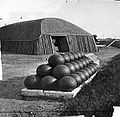
Gun
A gun is a muzzle or breech-loaded projectile-firing weapon. There are various definitions depending on the nation and branch of service. A "gun" may be distinguished from other firearms in being a crew-served weapon such as a howitzer or mortar, as opposed to a small arm like a rifle or pistol,...
s forming the movable armament or for guns placed in permanent positions. The movable armament will consist of guns and howitzer
Howitzer
A howitzer is a type of artillery piece characterized by a relatively short barrel and the use of comparatively small propellant charges to propel projectiles at relatively high trajectories, with a steep angle of descent...
s of small and medium caliber, and it is necessary to arrange suitable expense cartridge stores and shell stores close to the available positions. They can generally be constructed to form part of the permanent work in the projected face of traverses or other strong formations, and should be arranged for a twenty-four hour supply of ammunition. These stores are refilled from the main magazine every night under cover of darkness. Light railways join the various positions. The guns mounted in permanent emplacements are divided into groups of two or three guns each, and usually each group will require but one calibre of ammunition. A cartridge store, shell store and a general store, all well ventilated, are arranged for the especial service of such a group of guns. In the cartridge store the cylinders containing the cartridges are so placed and labeled that the required charge, whether reduced or full, can be immediately selected.
In the shell store the common shell are separated from the armour-piercing or shrapnel. Each nature of projectile is painted in a distinctive manner to render identification easy. The fuzes and tubes are placed in the general store with the tools and accessories belonging to the guns. The gun group is distinguished by some letter and the guns of the group by numerals; thus
Breech-loading weapon
A breech-loading weapon is a firearm in which the cartridge or shell is inserted or loaded into a chamber integral to the rear portion of a barrel....
of the gun and not exposed to hostile fire.
In order to supply the ammunition sufficiently rapidly for the efficient service of modern guns, hydraulic, electric, or hand-power, hoist
Hoist (device)
A hoist is a device used for lifting or lowering a load by means of a drum or lift-wheel around which rope or chain wraps. It may be manually operated, electrically or pneumatically driven and may use chain, fiber or wire rope as its lifting medium. The load is attached to the hoist by means of a...
s are employed to raise the cartridges and shell from the cartridge store and shell store to the gun floor, whence they are transferred to a derrick or loading tray attached to the mounting for loading the gun.
Projectiles for BL guns above 6 inch (152 mm) calibre are stored in shell stores ready filled and fuzed standing on their bases, except shrapnel and high-explosive shell, which are fuzed only when about to be used. Smaller sizes of shells are laid on their sides in layers, each layer pointing in the opposite direction to the one below to prevent injury
Injury
-By cause:*Traumatic injury, a body wound or shock produced by sudden physical injury, as from violence or accident*Other injuries from external physical causes, such as radiation injury, burn injury or frostbite*Injury from infection...
to the driving bands. Cartridges are stored in brass
Brass
Brass is an alloy of copper and zinc; the proportions of zinc and copper can be varied to create a range of brasses with varying properties.In comparison, bronze is principally an alloy of copper and tin...
corrugated cases or in zinc
Zinc
Zinc , or spelter , is a metallic chemical element; it has the symbol Zn and atomic number 30. It is the first element in group 12 of the periodic table. Zinc is, in some respects, chemically similar to magnesium, because its ion is of similar size and its only common oxidation state is +2...
cylinders. The corrugated cases are stacked in layers in the magazine with the mouth of the case towards a passage between the stacks, so that it can be opened and the cartridges removed and transferred to a leather case when required for transport to the gun. Cylinders are stacked, when possible, vertically one above the other. The charges are sent to the gun in these cylinders, and provision is made for the rapid removal of the empty cylinders.
The number and nature of rounds allotted to any fortress depends on questions of policy
Policy
A policy is typically described as a principle or rule to guide decisions and achieve rational outcome. The term is not normally used to denote what is actually done, this is normally referred to as either procedure or protocol...
and location, the degrees of resistance the nature of the works and personnel could reasonably be expected to give, and finally on the nature of the armament. That is to say, for guns of large calibre three hundred to four hundred rounds per gun might be sufficient, while for light QF guns it might amount to one thousand or more rounds per gun.
Modern era

Mortar (weapon)
A mortar is an indirect fire weapon that fires explosive projectiles known as bombs at low velocities, short ranges, and high-arcing ballistic trajectories. It is typically muzzle-loading and has a barrel length less than 15 times its caliber....
, but increasingly aircraft-delivered bomb
Bomb
A bomb is any of a range of explosive weapons that only rely on the exothermic reaction of an explosive material to provide an extremely sudden and violent release of energy...
s, smart bombs
Precision-guided munition
A precision-guided munition is a guided munition intended to precisely hit a specific target, and to minimize damage to things other than the target....
, rocket
Rocket
A rocket is a missile, spacecraft, aircraft or other vehicle which obtains thrust from a rocket engine. In all rockets, the exhaust is formed entirely from propellants carried within the rocket before use. Rocket engines work by action and reaction...
s and other explosive-bearing projectiles. The destructive power and lethality of these systems may be difficult to appreciate; but forces in the fight see the accuracy as just another survival tool against the enemy. A single cluster bomb
Cluster bomb
A cluster munition is a form of air-dropped or ground-launched explosive weapon that releases or ejects smaller sub-munitions. Commonly, this is a cluster bomb that ejects explosive bomblets that are designed to kill enemy personnel and destroy vehicles...
, deliverable by any of the above systems, can sow softball
Softball
Softball is a bat-and-ball sport played between two teams of 10 to 14 players. It is a direct descendant of baseball although there are some key differences: softballs are larger than baseballs, and the pitches are thrown underhand rather than overhand...
-sized bomblets across a 100-yard (90-m) American football–sized field in sufficient density to kill any personnel, even penetrating sandbagged trenches and body armour
Flak jacket
thumb|300px|The two components of an obsolete British military flak vest. On the left, the nylon vest. On the right, the several layers of [[ballistic nylon]] that provide the actual protection...
.
Operation Desert Storm
Gulf War
The Persian Gulf War , commonly referred to as simply the Gulf War, was a war waged by a U.N.-authorized coalition force from 34 nations led by the United States, against Iraq in response to Iraq's invasion and annexation of Kuwait.The war is also known under other names, such as the First Gulf...
saw widespread usage of cluster bombs—the Iraq
Iraq
Iraq ; officially the Republic of Iraq is a country in Western Asia spanning most of the northwestern end of the Zagros mountain range, the eastern part of the Syrian Desert and the northern part of the Arabian Desert....
i forces called them "steel rain". There is little doubt that their usage is also seen as a psychological tool
Psychological warfare
Psychological warfare , or the basic aspects of modern psychological operations , have been known by many other names or terms, including Psy Ops, Political Warfare, “Hearts and Minds,” and Propaganda...
. The aforementioned bomblets are armed upon dispersal by the spinning action which is hastened by a design resembling a "softball with small wings".
Design of the ammunition
The design of the ammunition is determined by its purpose; anti-personnel ammunition is often designed to break up or tumble inside the target, in order to maximize the damage done. Anti-personnel shells contain shrapnel and are designed to explode in mid-air, so its fragments will spread over a large area. Armor-piercing ammunition tends to be hard, sharp, and narrow, often with lubricationLubrication
Lubrication is the process, or technique employed to reduce wear of one or both surfaces in close proximity, and moving relative to each another, by interposing a substance called lubricant between the surfaces to carry or to help carry the load between the opposing surfaces. The interposed...
. Incendiary projectiles include a material such as white phosphorus
Phosphorus
Phosphorus is the chemical element that has the symbol P and atomic number 15. A multivalent nonmetal of the nitrogen group, phosphorus as a mineral is almost always present in its maximally oxidized state, as inorganic phosphate rocks...
which burns fiercely. Tracer ammunition
Tracer ammunition
Tracer ammunition are bullets that are built with a small pyrotechnic charge in their base. Ignited by the burning powder, the phosphorus tail burns very brightly, making the projectile visible to the naked eye...
emits light as it travels, allowing the gunner to see the path of bullets in flight while using a machine gun
Machine gun
A machine gun is a fully automatic mounted or portable firearm, usually designed to fire rounds in quick succession from an ammunition belt or large-capacity magazine, typically at a rate of several hundred rounds per minute....
.
Popular types of military rifle and machine gun
Machine gun
A machine gun is a fully automatic mounted or portable firearm, usually designed to fire rounds in quick succession from an ammunition belt or large-capacity magazine, typically at a rate of several hundred rounds per minute....
ammunition include the 5.45 mm, 5.56 mm, and 7.62 mm
7.62×51mm NATO
The 7.62×51mm NATO is a rifle cartridge developed in the 1950s as a standard for small arms among NATO countries...
. Main battle tanks
Tank
A tank is a tracked, armoured fighting vehicle designed for front-line combat which combines operational mobility, tactical offensive, and defensive capabilities...
use KE-penetrator
Kinetic energy penetrator
A kinetic energy penetrator is a type of ammunition which, like a bullet, does not contain explosives and uses kinetic energy to penetrate the target....
s to combat other MBTs and armoured fighting vehicle
Armoured fighting vehicle
An armoured fighting vehicle is a combat vehicle, protected by strong armour and armed with weapons. AFVs can be wheeled or tracked....
s, and HE-Frag (High Explosive-Fragmentation) for soft target
Soft target
Soft target is a military term referring to unarmored/undefended targets needing to be destroyed. For example, a soft target would be an automobile, a house, or assembly of people while a hard target could be a main battle tank or a well defended installation...
s such as infantry
Infantry
Infantrymen are soldiers who are specifically trained for the role of fighting on foot to engage the enemy face to face and have historically borne the brunt of the casualties of combat in wars. As the oldest branch of combat arms, they are the backbone of armies...
.
Components of ammunition
The components of ammunition intended for rifles and munitions may be divided into these categories:- explosive materialExplosive materialAn explosive material, also called an explosive, is a reactive substance that contains a great amount of potential energy that can produce an explosion if released suddenly, usually accompanied by the production of light, heat, sound, and pressure...
s and propellantsGunpowderGunpowder, also known since in the late 19th century as black powder, was the first chemical explosive and the only one known until the mid 1800s. It is a mixture of sulfur, charcoal, and potassium nitrate - with the sulfur and charcoal acting as fuels, while the saltpeter works as an oxidizer... - projectileProjectileA projectile is any object projected into space by the exertion of a force. Although a thrown baseball is technically a projectile too, the term more commonly refers to a weapon....
s of all kinds - cartridgesCartridge (firearms)A cartridge, also called a round, packages the bullet, gunpowder and primer into a single metallic case precisely made to fit the firing chamber of a firearm. The primer is a small charge of impact-sensitive chemical that may be located at the center of the case head or at its rim . Electrically...
Fuzes
The term "fuze" is used, by English speakers, to denote detonators for explosives, differentiating it from "fuses", which are either circuit breakersFuse (electrical)
In electronics and electrical engineering, a fuse is a type of low resistance resistor that acts as a sacrificial device to provide overcurrent protection, of either the load or source circuit...
or a means of transmitting fire (e.g. the fuse
Fuse (explosives)
In an explosive, pyrotechnic device or military munition, a fuse is the part of the device that initiates function. In common usage, the word fuse is used indiscriminately...
on a firecracker
Firecracker
A firecracker is a small explosive device primarily designed to produce a large amount of noise, especially in the form of a loud bang; any visual effect is incidental to this goal. They have fuses, and are wrapped in a heavy paper casing to contain the explosive compound...
).
Common artillery fuzes include point detonating, delay, time, and proximity
Proximity fuze
A proximity fuze is a fuze that is designed to detonate an explosive device automatically when the distance to target becomes smaller than a predetermined value or when the target passes through a given plane...
. Point detonating fuzes detonate upon contact with the target. Delay fuzes are designed to penetrate a target before detonating. Time fuzes, as the name implies, detonate a certain time after being fired in order to achieve a burst at a specific time after being fired. Proximity fuzes contain a radio transceiver
Transceiver
A transceiver is a device comprising both a transmitter and a receiver which are combined and share common circuitry or a single housing. When no circuitry is common between transmit and receive functions, the device is a transmitter-receiver. The term originated in the early 1920s...
activated after firing to detonate the projectile when the signal reflected from the ground reaches a certain strength, e.g. 7 meters above the ground. Fuzes are usually armed by the acceleration of the projectile imparted by firing, and usually arm several meters after clearing the bore of the weapon.
Storage of ammunition
See ammunition dumpAmmunition dump
An ammunition dump, ammunition compound, ammunition depot, bomb dump, ammunition supply point or ammo dump, is a military storage facility for live ammunition and explosives....
and magazine
Magazine (artillery)
Magazine is the name for an item or place within which ammunition is stored. It is taken from the Arabic word "makahazin" meaning "warehouse".-Ammunition storage areas:...
for discussion of modern ammunition storage facilities.
Firearms ammunition
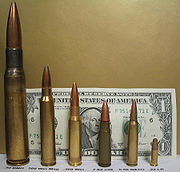
Infantry
Infantrymen are soldiers who are specifically trained for the role of fighting on foot to engage the enemy face to face and have historically borne the brunt of the casualties of combat in wars. As the oldest branch of combat arms, they are the backbone of armies...
) soldier
Soldier
A soldier is a member of the land component of national armed forces; whereas a soldier hired for service in a foreign army would be termed a mercenary...
. Someone serving in the infantry generally carries, in pouches, bandolier
Bandolier
A bandolier or a bandoleer is a pocketed belt for holding ammunition. It was usually slung over the chest. In its original form, it was common issue to soldiers from the 16th to 18th centuries. This was very useful for quickly reloading a musket....
s, etc., one hundred rounds of small-arms
Small arms
Small arms is a term of art used by armed forces to denote infantry weapons an individual soldier may carry. The description is usually limited to revolvers, pistols, submachine guns, carbines, assault rifles, battle rifles, multiple barrel firearms, sniper rifles, squad automatic weapons, light...
ammunition (S.A.A.), and it is usual to supplement this, when an action is imminent, from the regimental reserve (see below). Like any trade, the proper tools are necessary for the task at hand. Infantry need to be provided with the weapons and ammunition to deal with the expected threat, be it another foot soldier, a mounted combatant, armoured vehicle or aircraft.
Every reduction in the caliber
Caliber
In guns including firearms, caliber or calibre is the approximate internal diameter of the barrel in relation to the diameter of the projectile used in it....
(size) of the rifle's
Rifle
A rifle is a firearm designed to be fired from the shoulder, with a barrel that has a helical groove or pattern of grooves cut into the barrel walls. The raised areas of the rifling are called "lands," which make contact with the projectile , imparting spin around an axis corresponding to the...
ammunition means an increase in the number of rounds carried. One hundred rounds of the Martini-Henry
Martini-Henry
The Martini-Henry was a breech-loading single-shot lever-actuated rifle adopted by the British, combining an action worked on by Friedrich von Martini , with the rifled barrel designed by Scotsman Alexander Henry...
ammunition weighed 10 pounds 10 ounces (4.8 kg); the same weight gives 155 rounds of 0.303 in (7.7 mm) ammunition and at 0.256 in (6.5 mm) the number of rounds is still greater. The regimental reserves were historically carried in six S.A.A. carts and on eight pack animal
Pack animal
A pack animal or beast of burden is a working animal used by humans as means of transporting materials by attaching them so their weight bears on the animal's back; the term may be applied to either an individual animal or a species so employed...
s. The six carts are distributed, one as reserve to the machine gun, three as reserve to the battalion itself, and two as part of the brigade reserve, which consists therefore of eight carts. The brigade reserve communicates directly with the brigade ammunition columns of the artillery
Artillery
Originally applied to any group of infantry primarily armed with projectile weapons, artillery has over time become limited in meaning to refer only to those engines of war that operate by projection of munitions far beyond the range of effect of personal weapons...
(see below). The eight pack animals follow the eight companies of their battalion. These, with two out of the three battalion carts, endeavour to keep close to the firing line, the remaining cart being with the reserve companies. Men also are employed as carriers, and this duty is so onerous that picked men only are detailed. Gallantry displayed in bringing up ammunition is considered indeed to justify special rewards. The amount of S.A.A. in regimental charge is 100 rounds in the possession of each soldier, 2000 to 2200 on each pack animal, and 16,000 to 17,600 in each of four carts, with, in addition, about 4000 rounds with the machine gun and 16,000 more in the fifth cart.
Currently, every army of an internationally recognized country (except those who rely on others for defense, such as Andorra
Andorra
Andorra , officially the Principality of Andorra , also called the Principality of the Valleys of Andorra, , is a small landlocked country in southwestern Europe, located in the eastern Pyrenees mountains and bordered by Spain and France. It is the sixth smallest nation in Europe having an area of...
) has adopted assault rifle
Assault rifle
An assault rifle is a selective fire rifle that uses an intermediate cartridge and a detachable magazine. Assault rifles are the standard infantry weapons in most modern armies...
s as the main infantry weapon.
In western (NATO) forces, the 7.62 mm NATO round has been mostly replaced by the lighter 5.56 mm NATO
5.56x45mm NATO
5.56×45mm NATO is a rifle cartridge developed in the United States and originally chambered in the M16 rifle. Under STANAG 4172, it is a standard cartridge for NATO forces as well as many non-NATO countries. It is derived from, but not identical to, the .223 Remington cartridge...
round, which is better suited for automatic fire than the larger round and allows each soldier to carry more ammunition. The larger caliber
Caliber
In guns including firearms, caliber or calibre is the approximate internal diameter of the barrel in relation to the diameter of the projectile used in it....
ammunition is still retained where range and weight of shot is important, e.g. machine gun
Machine gun
A machine gun is a fully automatic mounted or portable firearm, usually designed to fire rounds in quick succession from an ammunition belt or large-capacity magazine, typically at a rate of several hundred rounds per minute....
s and sniper rifle
Sniper rifle
In military and law enforcement terminology, a sniper rifle is a precision-rifle used to ensure more accurate placement of bullets at longer ranges than other small arms. A typical sniper rifle is built for optimal levels of accuracy, fitted with a telescopic sight and chambered for a military...
s.
Other nations, especially forces with former ties to the Soviet Union tend to use rifles related to or developed from the AK-47
AK-47
The AK-47 is a selective-fire, gas-operated 7.62×39mm assault rifle, first developed in the Soviet Union by Mikhail Kalashnikov. It is officially known as Avtomat Kalashnikova . It is also known as a Kalashnikov, an "AK", or in Russian slang, Kalash.Design work on the AK-47 began in the last year...
with similar sized rounds to the NATO ones. In 7.62x39mm and 5.45x39mm
5.45x39mm
The Soviet 5.45×39mm cartridge is a rimless bottlenecked rifle cartridge. It was introduced into service in 1974 for use with the new AK-74 assault rifle. It gradually supplemented then largely replaced the 7.62x39mm round in service....
for assault rifles and 7.62x54mmR for sniper rifles and light machine guns.
Ordnance ammunition
Modern artillery ordnance ammunition is generally of two types: separate loading and semi-fixed. Semi-fixed ammunition (rounds) appear in the form of a projectileProjectile
A projectile is any object projected into space by the exertion of a force. Although a thrown baseball is technically a projectile too, the term more commonly refers to a weapon....
mated with a cartridge case which contains the propellant
Propellant
A propellant is a material that produces pressurized gas that:* can be directed through a nozzle, thereby producing thrust ;...
and they resemble small arms rounds.
The canister is outfitted with a primer on its base which fires upon contact from the firing pin. Gunpowder
Gunpowder
Gunpowder, also known since in the late 19th century as black powder, was the first chemical explosive and the only one known until the mid 1800s. It is a mixture of sulfur, charcoal, and potassium nitrate - with the sulfur and charcoal acting as fuels, while the saltpeter works as an oxidizer...
, precision machined to burn evenly, is contained inside of cloth bags that are numbered. US/NATO 105 mm howitzers use semi-fixed ammunition, containing seven powder bags referred to as increments or charges. Putting the powder in bags allows the howitzer crew to remove the increments when firing at closer targets. The unused increments are disposed of by analysing burning in a powder pit at a safe distance from the guns.
Above a certain size, semi-fixed rounds are impracticable; the weight of the whole assembly is too much to be carried effectively. In this case separate loading ammunition is used: the projectile and propelling charge are supplied and loaded separately. The projectile is rammed home in the chamber, the powder charge(s) are loaded (usually by hand), then the breech is closed and the primer is inserted into the primer holder on the back the breech. Separate loading ammunition is typically used on 155 mm and larger howitzers. Several propellant types are available for 155 mm howitzer.
All normal projectiles arrive at the weapon with a plug in the fuze
Fuse (explosives)
In an explosive, pyrotechnic device or military munition, a fuse is the part of the device that initiates function. In common usage, the word fuse is used indiscriminately...
well on the nose of the projectile. Using a special fuze wrench, the plug is unscrewed and a fuze is screwed in. The decision as to which type of fuze to use is made by the fire direction center and carried out by the gun crew.
The armaments fitted to early tanks were contemporary field or naval artillery pieces and used the same ammunition. When tank versus tank combat became more important, and specific tank guns did not exist, it became common to adapt anti-aircraft guns (artillery) which fired shells of high velocity, which were needed for high altitude targets. As the armour applied to tanks increased, ammunition for tank use paralleled that of anti-tank guns. Current tank gun ammunition is a single fixed round ("shell" and charge combined in a single piece) for quick loading, the propellant is in a combustible case, thus negating empty shell casings. The primary anti-armor (anti-tank) warhead is the sabot
Sabot
A sabot is a device used in a firearm or cannon to fire a projectile, such as a bullet, that is smaller than the bore diameter, or which must be held in a precise position. The term is also applied to a battery stub case, a device used similarly to make a small electrical battery usable in a...
round, a shaped charge or sensor fuzed warhead.
The tank made horse cavalry obsolete, and while an infantryman could deal with a horse-mounted enemy, new weapons were needed to defeat a tank or other armored fighting vehicle. The first anti-tank weapons given to the infantrymen were based upon small arms; for example the anti-tank rifle
Anti-tank rifle
An anti-tank rifle is a rifle designed to penetrate the armour of vehicles, particularly tanks. The usefulness of rifles for this purpose ran from the introduction of tanks in World War I and until the Korean War...
. As even the later designs of tanks carried more armour, the limit of a man-portable rifle that could fire a round with sufficient kinetic energy to penetrate the armour was reached.
The introduction of the shaped charge
Shaped charge
A shaped charge is an explosive charge shaped to focus the effect of the explosive's energy. Various types are used to cut and form metal, to initiate nuclear weapons, to penetrate armor, and in the oil and gas industry...
warhead gave the infantryman a weapon that used chemical energy rather than kinetic to penetrate armour in a focused manner, which made them more effective than large grenades. When propelled by a rocket, the shaped charge gained range as well. Weapons such as the US Bazooka
Bazooka
Bazooka is the common name for a man-portable recoilless rocket antitank weapon, widely fielded by the U.S. Army. Also referred to as the "Stovepipe", the innovative bazooka was amongst the first-generation of rocket propelled anti-tank weapons used in infantry combat...
and German Panzerfaust
Panzerfaust
The Panzerfaust was an inexpensive, recoilless German anti-tank weapon of World War II. It consisted of a small, disposable preloaded launch tube firing a high explosive anti-tank warhead, operated by a single soldier...
, although bulky, were suitable for infantry use—though they were designed to be short ranged weapons, which simplified accuracy for striking a vehicles weak points.
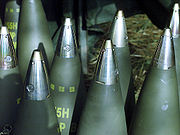
Today's infantryman can deploy sophisticated multi-spectral man-portable surface-to-air missiles equipped with the ability to reject decoys and defeat counter-measures.
Since aircraft are relatively light in weight, and delicate in construction, this, combined with their highly flammable fuel, made aircraft more susceptible to fatal damage since their first mass usage in World War I; sometimes being brought down by single bullet, when striking something vital in the airplane. The main weaknesses of ammunition provided to infantry to deal with aircraft were limited range and small warheads; both due to the necessity of maintaining man-portable weapons.
An example of a modern surface to air missile for infantry is the FIM-92 Stinger
FIM-92 Stinger
The FIM-92 Stinger is a personal portable infrared homing surface-to-air missile , which can be adapted to fire from ground vehicles and helicopters , developed in the United States and entered into service in 1981. Used by the militaries of the U.S...
MANPADS (Man Portable Air Defence System), provided as an all-up round in a canister it is attached to a launcher unit and is ready to expend. Numerous other missiles in this class exist from different nations of origin. Infantry machine guns and rifles may improve their ability against aircraft by utilising tracer ammunition, to allow the aimer to better gauge the lead aim necessary to strike his target.
Weapons developed primarily for anti-tank roles can add proximity fusing to increase the probability of a kill by having the warhead detonate nearby the target without having to make contact.
Naval ammunition
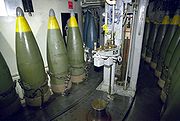
High explosive incendiary
In warfare, High-explosive incendiary is a type of ammunition specially designed to pierce armor, fragment, and ignite readily combustible materials....
shells (with point detonating fuzes to start fires on ships, or mechanical time fuzes designed to fragment and create clouds of shrapnel to defeat aircraft). With the demise of the armored warship, contemporary naval gun ammunition is solely the high explosive variety, but new fuzing and guidance options are available to increase lethality, especially against high speed missile or aircraft threats.
Supply of ammunition in the field
With every successive improvement in military arms there has necessarily been a corresponding modification in the method of supplying ammunition and in the quantity required to be supplied. When hand-to-hand weapons were the principal implements of battle, there was no such need. But in the Middle AgesMiddle Ages
The Middle Ages is a periodization of European history from the 5th century to the 15th century. The Middle Ages follows the fall of the Western Roman Empire in 476 and precedes the Early Modern Era. It is the middle period of a three-period division of Western history: Classic, Medieval and Modern...
, the archers
Archery
Archery is the art, practice, or skill of propelling arrows with the use of a bow, from Latin arcus. Archery has historically been used for hunting and combat; in modern times, however, its main use is that of a recreational activity...
and crossbowmen had to replenish the shafts and bolts expended in action, and during a siege
Siege
A siege is a military blockade of a city or fortress with the intent of conquering by attrition or assault. The term derives from sedere, Latin for "to sit". Generally speaking, siege warfare is a form of constant, low intensity conflict characterized by one party holding a strong, static...
, stone
Rock (geology)
In geology, rock or stone is a naturally occurring solid aggregate of minerals and/or mineraloids.The Earth's outer solid layer, the lithosphere, is made of rock. In general rocks are of three types, namely, igneous, sedimentary, and metamorphic...
bullets of great size, as well as heavy arrow
Arrow
An arrow is a shafted projectile that is shot with a bow. It predates recorded history and is common to most cultures.An arrow usually consists of a shaft with an arrowhead attached to the front end, with fletchings and a nock at the other.- History:...
s, were freely used. The missile
Missile
Though a missile may be any thrown or launched object, it colloquially almost always refers to a self-propelled guided weapon system.-Etymology:The word missile comes from the Latin verb mittere, meaning "to send"...
s of those days were however interchangeable, and at the Battle of Towton
Battle of Towton
In 1461, England was in the sixth year of the Wars of the Roses, a series of civil wars between the Houses of York and Lancaster over the English throne. The Lancastrians backed the reigning King of England, Henry VI, an indecisive man who suffered bouts of madness...
(1461), part of the Wars of the Roses
Wars of the Roses
The Wars of the Roses were a series of dynastic civil wars for the throne of England fought between supporters of two rival branches of the royal House of Plantagenet: the houses of Lancaster and York...
, the commander of the Yorkist
House of York
The House of York was a branch of the English royal House of Plantagenet, three members of which became English kings in the late 15th century. The House of York was descended in the paternal line from Edmund of Langley, 1st Duke of York, the fourth surviving son of Edward III, but also represented...
archers induced the enemy to loose arrows in order to obtain them for future use, similarly to a story in the Romance of the Three Kingdoms (孔明借箭). This interchangeability of war material was even possible for many centuries after the invention of firearms. At the Battle of Liegnitz
Battle of Liegnitz (1760)
The Battle of Liegnitz on August 15, 1760 saw Frederick the Great's Prussian Army defeat the Austrian army under Ernst von Laudon.The armies collided around the Prussian Silesian city of Liegnitz . Frederick split his army in 2, one part commanded by Field Marshal Zieten. Frederick heard the sound...
(1760) a general officer was specially commissioned by Frederick II of Prussia
Frederick II of Prussia
Frederick II was a King in Prussia and a King of Prussia from the Hohenzollern dynasty. In his role as a prince-elector of the Holy Roman Empire, he was also Elector of Brandenburg. He was in personal union the sovereign prince of the Principality of Neuchâtel...
to pack up and send away, for Prussia
Prussia
Prussia was a German kingdom and historic state originating out of the Duchy of Prussia and the Margraviate of Brandenburg. For centuries, the House of Hohenzollern ruled Prussia, successfully expanding its size by way of an unusually well-organized and effective army. Prussia shaped the history...
n use, all the musket
Musket
A musket is a muzzle-loaded, smooth bore long gun, fired from the shoulder. Muskets were designed for use by infantry. A soldier armed with a musket had the designation musketman or musketeer....
s and ammunition left on the field of battle by the defeated Austrians.
Captured material is utilized whenever possible at the present time. In the First Sino-Japanese War
First Sino-Japanese War
The First Sino-Japanese War was fought between Qing Dynasty China and Meiji Japan, primarily over control of Korea...
, the Japanese went so far as to prepare beforehand spare parts for the Chinese
China
Chinese civilization may refer to:* China for more general discussion of the country.* Chinese culture* Greater China, the transnational community of ethnic Chinese.* History of China* Sinosphere, the area historically affected by Chinese culture...
guns they expected to capture. It is rare to find a modern army trusting to captures for arms and ammunition; almost the only instance of the practice is that of the Chilean Civil War
Chilean Civil War
The Chilean Civil War of 1891 was an armed conflict between forces supporting Congress and forces supporting the sitting President, José Manuel Balmaceda. The war saw a confrontation between the Chilean Army and the Chilean Navy, which had sided with the president and the congress, respectively...
(1891) in which the army of one belligerent was almost totally dependent upon this means of replenishing stores of arms and cartridges. What was possible with weapons of comparatively rough make is no longer to be thought of in the case of modern arms.
The Lee-Metford
Lee-Metford
The Lee-Metford rifle was a bolt action British army service rifle, combining James Paris Lee's rear-locking bolt system and ten-round magazine with a seven groove rifled barrel designed by William Ellis Metford...
bullet of 0.303 inch (7.7 mm) diameter can scarcely be used in a rifle of smaller caliber, and in general the minute accuracy of parts in modern weapons makes interchangeability almost impossible. However, the widespread availability of mass-produced small arms have resulted in many conflicts in which both sides use the same weapons (e.g. AK-74) and ammunition types, making captured ammunition once again a potentially important consideration. Further, owing to the rapidity with which, in modern arms, ammunition is expended, and the fact that, as battles are fought at longer ranges than formerly, more shots have to be fired in order to inflict heavy losses, it is necessary that the reserves of ammunition should be as close as possible to the troops who have to use them. This was always the case even with the older firearms, as, owing to the great weight of the ammunition, the soldier
Soldier
A soldier is a member of the land component of national armed forces; whereas a soldier hired for service in a foreign army would be termed a mercenary...
could only carry a few rounds. Nevertheless it is only within the past seventy years that there has grown up the elaborate system of ammunition supply which now prevails in all regularly organized armies. That which is described in the present article is the British, as laid down in the official Combined Training (1905) and other manuals. The new system designed for stronger divisions, and others, vary only in details and nomenclature. Against this, the move towards smaller calibres (e.g. NATO standard 5.56 mm) and reduced consumption rates in modern low-intensity asymmetric warfare may make ammunition relatively less important (if only by weight/volume) than other combat supply commodities such as water.
See also
- Ammunition boxAmmunition boxAn ammunition box is a container designed for safe transport and storage of ammunition. It is typically made of metal and labelled with caliber, quantity, and manufacturing date or lot number...
- Ammunition columnAmmunition columnAn ammunition column consists of military vehicles carrying artillery and small arms ammunition for the combatant unit to which the column belongs. Thus the ammunition columns of a division, forming part of the brigades of field artillery, carry reserve ammunition for the guns, the machine guns of...
- Ammunition dumpAmmunition dumpAn ammunition dump, ammunition compound, ammunition depot, bomb dump, ammunition supply point or ammo dump, is a military storage facility for live ammunition and explosives....
- Armor-piercing shot and shellArmor-piercing shot and shellAn armor-piercing shell is a type of ammunition designed to penetrate armor. From the 1860s to 1950s, a major application of armor-piercing projectiles was to defeat the thick armor carried on many warships. From the 1920s onwards, armor-piercing weapons were required for anti-tank missions...
- Breaching roundBreaching roundA breaching round or slug-shot is a shotgun shell specially made for the purposes of door breaching. It is typically fired at a range of 6 inches or less, aimed at the hinges or the area between the doorknob and lock and door jamb, and is designed to destroy the object it hits and then disperse...
- BulletBulletA bullet is a projectile propelled by a firearm, sling, or air gun. Bullets do not normally contain explosives, but damage the intended target by impact and penetration...
- Cartridge (firearms)Cartridge (firearms)A cartridge, also called a round, packages the bullet, gunpowder and primer into a single metallic case precisely made to fit the firing chamber of a firearm. The primer is a small charge of impact-sensitive chemical that may be located at the center of the case head or at its rim . Electrically...
- Expanding bullet
- Explosive materialExplosive materialAn explosive material, also called an explosive, is a reactive substance that contains a great amount of potential energy that can produce an explosion if released suddenly, usually accompanied by the production of light, heat, sound, and pressure...
- Fuse (explosives)Fuse (explosives)In an explosive, pyrotechnic device or military munition, a fuse is the part of the device that initiates function. In common usage, the word fuse is used indiscriminately...
- Full metal jacket bulletFull metal jacket bulletA full metal jacket is a bullet consisting of a soft core encased in a shell of harder metal, such as gilding metal, cupronickel or less commonly a steel alloy. This shell can extend around all of the bullet, or often just the front and sides with the rear left as exposed lead...
- HandloadingHandloadingHandloading or reloading is the process of loading firearm cartridges or shotgun shells by assembling the individual components , rather than purchasing completely assembled, factory-loaded cartridges...
- High explosive incendiaryHigh explosive incendiaryIn warfare, High-explosive incendiary is a type of ammunition specially designed to pierce armor, fragment, and ignite readily combustible materials....
- Hollow-point bullet
- HowitzerHowitzerA howitzer is a type of artillery piece characterized by a relatively short barrel and the use of comparatively small propellant charges to propel projectiles at relatively high trajectories, with a steep angle of descent...
- KE munition
- Lead shotLead shotLead shot is a collective term for small balls of lead. These were the original projectiles for muskets and early rifles, but today lead shot is fired primarily from shotguns. It is also used for a variety of other purposes...
- List of handgun cartridges
- List of rifle cartridges
- Naval artilleryNaval artilleryNaval artillery, or naval riflery, is artillery mounted on a warship for use in naval warfare. Naval artillery has historically been used to engage either other ships, or targets on land; in the latter role it is currently termed naval gunfire fire support...
- Proximity fuzeProximity fuzeA proximity fuze is a fuze that is designed to detonate an explosive device automatically when the distance to target becomes smaller than a predetermined value or when the target passes through a given plane...
- Rheological ammunitionRheological AmmunitionRheological ammunition uses a rheological substance that can be controlled by injecting a current or introducing a magnetic field to the projectiles core, thereby changing some properties of the projectile. The idea is to create a projectile with a core that can be hard or soft depending on...
- Rotation of ammunitionRotation of ammunitionRotation of ammunition is a term used with reference to guns.Projectiles intended for R.M.L. guns were at first fitted with a number of gun-metal studs arranged around them in a spiral manner corresponding to the twist of rifling...
- Shell (projectile)Shell (projectile)A shell is a payload-carrying projectile, which, as opposed to shot, contains an explosive or other filling, though modern usage sometimes includes large solid projectiles properly termed shot . Solid shot may contain a pyrotechnic compound if a tracer or spotting charge is used...
- Tracer ammunitionTracer ammunitionTracer ammunition are bullets that are built with a small pyrotechnic charge in their base. Ignited by the burning powder, the phosphorus tail burns very brightly, making the projectile visible to the naked eye...
- Tubes and primers for ammunitionTubes and primers for ammunitionTubes and primers are used to ignite the propellant in projectile weapons.In ancient times various devices were adopted to ignite the charge. Small guns were fired by priming powder poured down the touch hole and ignited by glowing embers or a red-hot iron rod. Later the priming powder was...
External links
- Ammunition at the Open Directory Project.
- European Ammunition Box Translations