

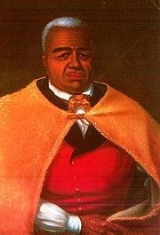
Kamehameha I

Encyclopedia
Kamehameha I also known as Kamehameha the Great, conquered the Hawaiian Islands
and formally established the Kingdom of Hawaii
in 1810. By developing alliances with the major Pacific colonial powers, Kamehameha preserved Hawaii's independence under his rule. Kamehameha is remembered for the Kanawai Mamalahoe
, the "Law of the Splintered Paddle", which protects human rights
of non-combatant
s in times of battle. Kamehameha's full Hawaiian name is Kalani Paiea Wohi o Kaleikini Kealiikui Kamehameha o Iolani i Kaiwikapu kaui Ka Liholiho Kūnuiākea.
, Keaweaopala was slain and Kalaniōpuu claimed victory. For his loyal service to his uncle, Kamehameha was made Kalaniōpuu's aide.
In 1779, Kamehameha again traveled with Kalaniōpuu to Kealakekua Bay. This time he, among other young chiefs accompanying their senior chief, met with Captain James Cook
. Cook was perhaps mistaken by some Native Hawaiians to be Lono
, the Hawaiian god of fertility. Cook's ship was the ; Kamehameha may have stayed on board at least one night. It was Kamehameha's first contact with non-Hawaiians.
, as well as the district of Waipio valley
. There was already bad blood between the two cousins, caused when Kamehameha presented a slain alii
's body to the gods instead of to Kiwalao. When a group of chiefs from the Kona district offered to back Kamehameha against Kiwalao, he accepted eagerly. The five Kona chiefs supporting Kamehameha were: Keeaumoku Pāpaiahiahi
(Kamehameha's father-in-law), Keaweaheulu Kaluaapana (Kamehameha's uncle), Kekūhaupio (Kamehameha's warrior teacher), Kameeiamoku and Kamanawa
(twin uncles of Kamehameha). Kiwalao was soon defeated in the battle of Mokuohai
, and Kamehameha took control of the districts of Kohala, Kona, and Hamakua on the island of Hawaii.
Kamehameha then moved against the district of Puna
in 1790 deposing Chief Keawemauhili
. Keōua Kuahuula
, exiled to his home in Kaū, took advantage of Kamehameha's absence and led an uprising. When Kamehameha returned with his army to put down the rebellion, Keōua fled past the Kilauea
volcano, which erupted and killed nearly a third of his warriors from poisonous gas.
Questioning a kahuna on how best to go about securing the rest of the island, Kamehameha resolved to construct a temple (heiau
) to Kūkailimoku, as well as lay an alii's body on it.
When the Puukoholā Heiau was completed in 1791, Kamehameha invited Keōua to meet with him. Keōua may have been dispirited by his recent losses. He may have mutilated himself before landing so as to make himself an imperfect sacrificial victim. As he stepped on shore, one of Kamehameha's chiefs threw a spear at him. By some accounts he dodged it, but was then cut down by musket fire. Caught by surprise, Keōua's bodyguards were killed. With Keōua dead, and his supporters captured or slain, Kamehameha became King of all Hawaii island.
Kamehameha's dreams included far more than the island of Hawaiii; with the counsel of his favorite wife Kaahumanu, who became one of Hawaiii's most powerful figures, he set about planning to conquer the rest of the Hawaiian Islands. Help came from British and American traders, who sold guns and ammunition to Kamehameha. Two westerners who lived on Hawaiii island, Isaac Davis
and John Young
, became advisors of Kamehameha and trained his troops in the use of firearms.
With his new army, Kamehameha felt confident enough to move on the neighboring islands of Maui
and Oahu
, already weakened by a war of succession that had broken out between King Kahekili II
's son and brother. Kamehameha may or may not have known that his rival, King Kalanikupule
, also possessed firearms, and was planning a move against him when the alii nui of Hawaii invaded those islands.
In 1795, Kamehameha set sail with an armada of 960 war canoes and 10,000 soldiers. He quickly secured the lightly defended islands of Maui and Molokai at the Battle of Kawela
. The army moved on the island of Oahu, landing his troops at Waialae
and Waikīkī
. What Kamehameha did not know was that one of his commanders, a high-ranking alii named Kaiana, had defected to Kalanikupule. Kaiana assisted in the cutting of notches into the Nuuanu Pali mountain ridge; these notches, like those on a castle
turret, would serve as gunports for Kalanikupule's cannon.
In a series of skirmishes, Kamehameha's forces were able to push back Kalanikupule's men until the latter was cornered on the Pali Lookout. While Kamehameha moved on the Pali, his troops took heavy fire from the cannon. In desperation, he assigned two divisions of his best warriors to climb to the Pali to attack the cannons from behind; they surprised Kalanikupule's gunners and took control of the weapons. With the loss of their guns, Kalanikupule's troops fell into disarray and were cornered by Kamehameha's still-organized troops. A fierce battle ensued, with Kamehameha's forces forming an enclosing wall. By using their traditional Hawaiian spears, as well as muskets and cannon, they were able to kill Kalanikupule's forces to a man. Over 400 men were forced off the Pali's cliff, a drop of 1,000 feet. Kaiana was killed during the action; Kalanikupule was captured some time later and sacrificed to Kūkailimoku.
Kamehameha was now ruler of all the Hawaiian Islands from Oahu to the east, but the western islands of Kauai
and Niihau
continued to elude him. Using Honolulu as a base, he had a forty-ton ship built. When he attempted to invade the western islands in 1796, Kaiana's brother Namakeha led a rebellion on Hawaii island against his rule, and Kamehameha was forced to return and put down the insurrection.
In 1803 he tried again, but this time, disease broke out among his warriors; Kamehameha himself fell ill, though he later recovered. During this time, Kamehameha was amassing the largest armada Hawaii had ever seen - foreign-built schooners and massive war canoes, armed with cannon and carrying his vast army. Kaumualii
, alii nui of Kauai, watched as Kamehameha built up his invading force and decided he would have a better chance in negotiation than battle. He may also have been influenced by foreign merchants, who saw the continuing feud between Kamehameha and Kaumualii as bad for the sandalwood
trade.
In 1810, Kaumualii became a vassal
of Kamehameha, who therefore emerged as the sole sovereign of the unified Hawaiian islands
.
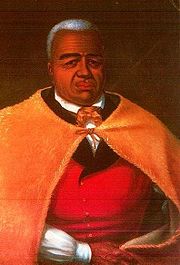 As king, Kamehameha took several steps to ensure that the islands remained a united realm even after his death. He unified the legal system and he used the products he collected in taxes to promote trade with Europe
and the United States
. Kamehameha did not allow non-Hawaiians to own land; they would not be able to until the Great Mahele
of 1848. This edict ensured the islands' independence even while many of the other islands of the Pacific
succumbed to the colonial powers.
In fact, the Kingdom of Hawaii that Kamehameha established retained its independence, except for a five-month British occupation in 1843, until it was annexed by the United States in 1898. It was this legacy that earned Kamehameha the epithet "Napoleon
of the Pacific."
Kamehameha also instituted the Mamalahoe Kanawai, the Law of the Splintered Paddle
. Its origins derived from before the unification of the Island of Hawaii, in 1782, when Kamehameha, during a raid, caught his foot in a rock. Two local fisherman, fearful of the great warrior, hit Kamehameha hard on the head with a large paddle, which actually broke the paddle. Kamehameha was stunned and left for dead, allowing the fisherman and his companion to escape. Twelve years later, the same fisherman was brought before Kamehameha for punishment. King Kamehameha instead blamed himself for attacking innocent people, gave the fisherman gifts of land and set them free. He declared the new law, "Let every elderly person, woman and child lie by the roadside in safety". This law, which provided for the safety of noncombatants in wartime, is estimated to have saved thousands of lives during Kamehameha's campaigns. It became the first written law of the Kingdom of Hawaii, was included in the state constitution
, and has influenced many subsequent humanitarian laws of war.
Although he ended human sacrifice, Kamehameha was to the last a follower of the Hawaiian religion
and Hawaiian traditions (such as Lua). He believed so strongly in his religion and culture that he would execute his subjects for breaches of the strict rules called kapu
. Although he entertained Christian
s, he did not appear to take them seriously.
, a compound he built in Kailua-Kona.
It is now the site of King Kamehameha's Beach Hotel, the starting and finishing points of the Ironman World Championship
Triathlon.
As the custom of the time, he took several wives and had many children, although he would outlive about half of them.
When Kamehameha died May 8, 1819, his body was hidden by his trusted friends, Hoapili
and Hoolulu
. The mana, or power of a person, was considered to be sacred. As per the ancient custom, his body was buried hidden because of his mana. His final resting place remains unknown.
|-
1795-1819
1782-1795
1795-1810
1810-1819
Hawaiian Islands
The Hawaiian Islands are an archipelago of eight major islands, several atolls, numerous smaller islets, and undersea seamounts in the North Pacific Ocean, extending some 1,500 miles from the island of Hawaii in the south to northernmost Kure Atoll...
and formally established the Kingdom of Hawaii
Kingdom of Hawaii
The Kingdom of Hawaii was established during the years 1795 to 1810 with the subjugation of the smaller independent chiefdoms of Oahu, Maui, Molokai, Lānai, Kauai and Niihau by the chiefdom of Hawaii into one unified government...
in 1810. By developing alliances with the major Pacific colonial powers, Kamehameha preserved Hawaii's independence under his rule. Kamehameha is remembered for the Kanawai Mamalahoe
Mamalahoe
Kānāwai Māmalahoe, or Law of the Splintered Paddle , is a precept in Hawaiian law, originating with King Kamehameha I in 1797...
, the "Law of the Splintered Paddle", which protects human rights
Human rights
Human rights are "commonly understood as inalienable fundamental rights to which a person is inherently entitled simply because she or he is a human being." Human rights are thus conceived as universal and egalitarian . These rights may exist as natural rights or as legal rights, in both national...
of non-combatant
Non-combatant
Non-combatant is a term in the law of war describing civilians not taking a direct part in hostilities, as well as persons such as medical personnel and military chaplains who are regular soldiers but are protected because of their function as well as soldiers who are hors de combat ; that is, sick,...
s in times of battle. Kamehameha's full Hawaiian name is Kalani Paiea Wohi o Kaleikini Kealiikui Kamehameha o Iolani i Kaiwikapu kaui Ka Liholiho Kūnuiākea.
Unification of Hawaii
When Alapai died, his position was succeeded by his son Keaweaopala. Kalaniōpuu, Alapai's great-nephew, challenged his rule, and was backed by his nephew Kamehameha. In fierce fighting at Kealakekua BayKealakekua Bay
Kealakekua Bay is located on the Kona coast of the island of Hawaii about south of Kailua-Kona.Settled over a thousand years ago, the surrounding area contains many archeological and historical sites such as religious temples, and was listed in the National Register of Historic Places listings on...
, Keaweaopala was slain and Kalaniōpuu claimed victory. For his loyal service to his uncle, Kamehameha was made Kalaniōpuu's aide.
In 1779, Kamehameha again traveled with Kalaniōpuu to Kealakekua Bay. This time he, among other young chiefs accompanying their senior chief, met with Captain James Cook
James Cook
Captain James Cook, FRS, RN was a British explorer, navigator and cartographer who ultimately rose to the rank of captain in the Royal Navy...
. Cook was perhaps mistaken by some Native Hawaiians to be Lono
Lono
In Hawaiian mythology, the deity Lono is associated with fertility, agriculture, rainfall, and music. In one of the many Hawaiian legends of Lono, he is a fertility and music god who descended to Earth on a rainbow to marry Laka. In agricultural and planting traditions, Lono was identified with...
, the Hawaiian god of fertility. Cook's ship was the ; Kamehameha may have stayed on board at least one night. It was Kamehameha's first contact with non-Hawaiians.
First: the Big Island of Hawaii
Raised in the royal court of his uncle Kalaniōpu, Kamehameha achieved prominence in 1782, upon Kalaniōpuu's death. While the kingship was inherited by Kalaniōpuu's son Kiwalao, Kamehameha was given a prominent religious position, guardianship of the Hawaiian god of war, KūkailimokuKū
In Hawaiian mythology Kū or Kū-ka-ili-moku is one of the four great gods along with Kanaloa, Kāne, and Lono.He is known as the god of war and the husband of the goddess Hina. Some have taken this to suggest a complementary dualism, as the word kū in the Hawaiian language means "standing up" while...
, as well as the district of Waipio valley
Waipio valley
Waipio Valley is a valley located in the Hamakua District of the Big Island of Hawaii. "Waipio" means "curved water" in the Hawaiian language.It was the capital and permanent residence of many early Hawaiian alii up until the time of King Umi...
. There was already bad blood between the two cousins, caused when Kamehameha presented a slain alii
Ali'i
Alii is a word in the Polynesian language denoting chiefly status in ancient Hawaii and the Samoa Islands. A similar word with the same concept is found in other Polynesian societies. In the Cook Islands, an ariki is a high chief and the House of Ariki is a parliamentary house...
's body to the gods instead of to Kiwalao. When a group of chiefs from the Kona district offered to back Kamehameha against Kiwalao, he accepted eagerly. The five Kona chiefs supporting Kamehameha were: Keeaumoku Pāpaiahiahi
Keeaumoku Papaiahiahi
Keeaumoku Pāpaiahiahi was a Hawaiian high chief and the father of Kaahumanu. He was the principal agent in elevating Kamehameha I to the throne of Hawaii and served in a capacity similar to commander in chief or Prime Minister...
(Kamehameha's father-in-law), Keaweaheulu Kaluaapana (Kamehameha's uncle), Kekūhaupio (Kamehameha's warrior teacher), Kameeiamoku and Kamanawa
Kamanawa
Kamanawa was a Hawaiian high chief and early supporter of King Kamehameha I, known as one of the royal niau-pio twins with his brother Kameeiamoku...
(twin uncles of Kamehameha). Kiwalao was soon defeated in the battle of Mokuohai
Battle of Moku'ohai
The Battle of Mokuōhai, fought in 1782 on the island of Hawaii, was a key battle in the early days of Kamehameha I's wars to conquer the Hawaiian Islands...
, and Kamehameha took control of the districts of Kohala, Kona, and Hamakua on the island of Hawaii.
Kamehameha then moved against the district of Puna
Puna, Hawaii
Puna is one of the nine districts in Hawaii County, Big Island, Hawaii. The District of Puna is located on the easternmost portion of the island and shares borders to the north with the District of South Hilo and a border to the west with the District of Kaū...
in 1790 deposing Chief Keawemauhili
Keawemauhili
Keawemauhili, spelled in old texts as Keawe-mau-hili, was an important member of the Hawaiian nobility at the time of the founding of the Kingdom of Hawaii.-Life:...
. Keōua Kuahuula
Keoua Kuahuula
Keōua Kuahuula was an Alii during the time of the unification of the Kingdom of Hawaii.His name means Keōua of the "red altar"....
, exiled to his home in Kaū, took advantage of Kamehameha's absence and led an uprising. When Kamehameha returned with his army to put down the rebellion, Keōua fled past the Kilauea
Kilauea
Kīlauea is a volcano in the Hawaiian Islands, and one of five shield volcanoes that together form the island of Hawaii. Kīlauea means "spewing" or "much spreading" in the Hawaiian language, referring to its frequent outpouring of lava. The Puu Ōō cone has been continuously erupting in the eastern...
volcano, which erupted and killed nearly a third of his warriors from poisonous gas.
Questioning a kahuna on how best to go about securing the rest of the island, Kamehameha resolved to construct a temple (heiau
Heiau
A heiau is a Hawaiian temple. Many types of heiau existed, including heiau to treat the sick , offer first fruits, offer first catch, start rain, stop rain, increase the population, ensure health of the nation, achieve success in distant voyaging, reach peace, and achieve success in war . Only the...
) to Kūkailimoku, as well as lay an alii's body on it.
When the Puukoholā Heiau was completed in 1791, Kamehameha invited Keōua to meet with him. Keōua may have been dispirited by his recent losses. He may have mutilated himself before landing so as to make himself an imperfect sacrificial victim. As he stepped on shore, one of Kamehameha's chiefs threw a spear at him. By some accounts he dodged it, but was then cut down by musket fire. Caught by surprise, Keōua's bodyguards were killed. With Keōua dead, and his supporters captured or slain, Kamehameha became King of all Hawaii island.
Kamehameha's wider ambition: all the islands
According to legend, Kamehameha lifted the 5,000 pound stone at age 14, and was the only person to ever lift it. The legend that goes with this particular stone is that the man who lifted it was the legendary warrior who would unite all of the islands. The prophecy was meant to be with Kamehameha. The Naha Stone now rests in front of the Hilo Public Library on the island of Hawaii.Kamehameha's dreams included far more than the island of Hawaiii; with the counsel of his favorite wife Kaahumanu, who became one of Hawaiii's most powerful figures, he set about planning to conquer the rest of the Hawaiian Islands. Help came from British and American traders, who sold guns and ammunition to Kamehameha. Two westerners who lived on Hawaiii island, Isaac Davis
Isaac Davis (Hawaii)
Isaac Davis was a Welsh advisor to Kamehameha I and helped form the Kingdom of Hawaii. He arrived in Hawaii in 1790 as the sole survivor of the massacre of the crew of The Fair American. He along with John Young became friends and advisors to Kamehameha...
and John Young
John Young (Hawaii)
John Young was a British subject who became an important military advisor to Kamehameha I during the formation of the Kingdom of Hawaii. He was left behind by Simon Metcalfe, captain of the American ship Eleanora, and along with a Welshmen Isaac Davis became a friend and advisor to Kamehameha...
, became advisors of Kamehameha and trained his troops in the use of firearms.
With his new army, Kamehameha felt confident enough to move on the neighboring islands of Maui
Maui
The island of Maui is the second-largest of the Hawaiian Islands at and is the 17th largest island in the United States. Maui is part of the state of Hawaii and is the largest of Maui County's four islands, bigger than Lānai, Kahoolawe, and Molokai. In 2010, Maui had a population of 144,444,...
and Oahu
Oahu
Oahu or Oahu , known as "The Gathering Place", is the third largest of the Hawaiian Islands and most populous of the islands in the U.S. state of Hawaii. The state capital Honolulu is located on the southeast coast...
, already weakened by a war of succession that had broken out between King Kahekili II
Kahekili II
Kahekili II, full name Kahekilinuiahumanu, was the twenty fifth King of Maui. His name was short for Kāne-Hekili after the Hawaiian god of thunder. Because Kāne-Hekili was believed to be black on one side, Kahekili tattooed one side of his body from head to foot.-Family:He was born about...
's son and brother. Kamehameha may or may not have known that his rival, King Kalanikupule
Kalanikupule
Kalanikūpule was the 27th Mōī of Maui and King of Oahu. He was the last king to physically fight with Kamehameha I over the Hawaiian Islands. Kalanikūpule was the last of the longest line of Alii Aimoku in the Hawaiian Islands.- Early life :...
, also possessed firearms, and was planning a move against him when the alii nui of Hawaii invaded those islands.
In 1795, Kamehameha set sail with an armada of 960 war canoes and 10,000 soldiers. He quickly secured the lightly defended islands of Maui and Molokai at the Battle of Kawela
Archeological Sites at Kawela
Archeological Sites at Kawela are a number of archeological sites at or near the settlement of Kawela on the southern coast of Molokai, the northernmost of the islands of Maui County, Hawaii. It was the site of two battles in Hawaiian history....
. The army moved on the island of Oahu, landing his troops at Waialae
Waialae
Waialae or Waialae may refer to:*Waialae Country Club, a private country club in Honolulu, Hawaii*Waialae, Hawaii, a section of Honolulu, Hawaii alongside Kāhala*Waialae Stream, a small river on Hawaiʻi...
and Waikīkī
Waikiki
Waikiki is a neighborhood of Honolulu, in the City and County of Honolulu, on the south shore of the island of Oahu, in Hawaii. Waikiki Beach is the shoreline fronting Waikīkī....
. What Kamehameha did not know was that one of his commanders, a high-ranking alii named Kaiana, had defected to Kalanikupule. Kaiana assisted in the cutting of notches into the Nuuanu Pali mountain ridge; these notches, like those on a castle
Castle
A castle is a type of fortified structure built in Europe and the Middle East during the Middle Ages by European nobility. Scholars debate the scope of the word castle, but usually consider it to be the private fortified residence of a lord or noble...
turret, would serve as gunports for Kalanikupule's cannon.
In a series of skirmishes, Kamehameha's forces were able to push back Kalanikupule's men until the latter was cornered on the Pali Lookout. While Kamehameha moved on the Pali, his troops took heavy fire from the cannon. In desperation, he assigned two divisions of his best warriors to climb to the Pali to attack the cannons from behind; they surprised Kalanikupule's gunners and took control of the weapons. With the loss of their guns, Kalanikupule's troops fell into disarray and were cornered by Kamehameha's still-organized troops. A fierce battle ensued, with Kamehameha's forces forming an enclosing wall. By using their traditional Hawaiian spears, as well as muskets and cannon, they were able to kill Kalanikupule's forces to a man. Over 400 men were forced off the Pali's cliff, a drop of 1,000 feet. Kaiana was killed during the action; Kalanikupule was captured some time later and sacrificed to Kūkailimoku.
Kamehameha was now ruler of all the Hawaiian Islands from Oahu to the east, but the western islands of Kauai
Kauai
Kauai or Kauai, known as Tauai in the ancient Kaua'i dialect, is geologically the oldest of the main Hawaiian Islands. With an area of , it is the fourth largest of the main islands in the Hawaiian archipelago, and the 21st largest island in the United States. Known also as the "Garden Isle",...
and Niihau
Niihau
Niihau or Niihau is the seventh largest of the inhabited Hawaiian Islands in the U.S. state of Hawaii, having an area of . Niihau lies southwest of Kauai across the Kaulakahi Channel. Several intermittent playa lakes provide wetland habitats for the Hawaiian Coot, the Black-winged Stilt, and the...
continued to elude him. Using Honolulu as a base, he had a forty-ton ship built. When he attempted to invade the western islands in 1796, Kaiana's brother Namakeha led a rebellion on Hawaii island against his rule, and Kamehameha was forced to return and put down the insurrection.
In 1803 he tried again, but this time, disease broke out among his warriors; Kamehameha himself fell ill, though he later recovered. During this time, Kamehameha was amassing the largest armada Hawaii had ever seen - foreign-built schooners and massive war canoes, armed with cannon and carrying his vast army. Kaumualii
Kaumualii
Kaumualii was the last independent Alii Aimoku of Kauai and Niihau before becoming a vassal of Kamehameha I of the unified Kingdom of Hawaii in 1810...
, alii nui of Kauai, watched as Kamehameha built up his invading force and decided he would have a better chance in negotiation than battle. He may also have been influenced by foreign merchants, who saw the continuing feud between Kamehameha and Kaumualii as bad for the sandalwood
Sandalwood
Sandalwood is the name of a class of fragrant woods from trees in the genus Santalum. The woods are heavy, yellow, and fine-grained, and unlike many other aromatic woods they retain their fragrance for decades. As well as using the harvested and cut wood in-situ, essential oils are also extracted...
trade.
In 1810, Kaumualii became a vassal
Vassal
A vassal or feudatory is a person who has entered into a mutual obligation to a lord or monarch in the context of the feudal system in medieval Europe. The obligations often included military support and mutual protection, in exchange for certain privileges, usually including the grant of land held...
of Kamehameha, who therefore emerged as the sole sovereign of the unified Hawaiian islands
Hawaiian Islands
The Hawaiian Islands are an archipelago of eight major islands, several atolls, numerous smaller islets, and undersea seamounts in the North Pacific Ocean, extending some 1,500 miles from the island of Hawaii in the south to northernmost Kure Atoll...
.
First King of Hawaii
Europe
Europe is, by convention, one of the world's seven continents. Comprising the westernmost peninsula of Eurasia, Europe is generally 'divided' from Asia to its east by the watershed divides of the Ural and Caucasus Mountains, the Ural River, the Caspian and Black Seas, and the waterways connecting...
and the United States
United States
The United States of America is a federal constitutional republic comprising fifty states and a federal district...
. Kamehameha did not allow non-Hawaiians to own land; they would not be able to until the Great Mahele
Great Mahele
The Great Mahele or just the Mahele was the Hawaiian land redistribution act proposed by King Kamehameha III in the 1830s and enacted in 1848.-Overview:...
of 1848. This edict ensured the islands' independence even while many of the other islands of the Pacific
Pacific Ocean
The Pacific Ocean is the largest of the Earth's oceanic divisions. It extends from the Arctic in the north to the Southern Ocean in the south, bounded by Asia and Australia in the west, and the Americas in the east.At 165.2 million square kilometres in area, this largest division of the World...
succumbed to the colonial powers.
In fact, the Kingdom of Hawaii that Kamehameha established retained its independence, except for a five-month British occupation in 1843, until it was annexed by the United States in 1898. It was this legacy that earned Kamehameha the epithet "Napoleon
Napoleon I of France
Napoleon Bonaparte was a French military and political leader during the latter stages of the French Revolution.As Napoleon I, he was Emperor of the French from 1804 to 1815...
of the Pacific."
Kamehameha also instituted the Mamalahoe Kanawai, the Law of the Splintered Paddle
Mamalahoe
Kānāwai Māmalahoe, or Law of the Splintered Paddle , is a precept in Hawaiian law, originating with King Kamehameha I in 1797...
. Its origins derived from before the unification of the Island of Hawaii, in 1782, when Kamehameha, during a raid, caught his foot in a rock. Two local fisherman, fearful of the great warrior, hit Kamehameha hard on the head with a large paddle, which actually broke the paddle. Kamehameha was stunned and left for dead, allowing the fisherman and his companion to escape. Twelve years later, the same fisherman was brought before Kamehameha for punishment. King Kamehameha instead blamed himself for attacking innocent people, gave the fisherman gifts of land and set them free. He declared the new law, "Let every elderly person, woman and child lie by the roadside in safety". This law, which provided for the safety of noncombatants in wartime, is estimated to have saved thousands of lives during Kamehameha's campaigns. It became the first written law of the Kingdom of Hawaii, was included in the state constitution
Constitution of Hawaii
The Constitution of the State of Hawaiʻi refers to various legal documents throughout the history of the Hawaiian Islands that defined the fundamental principles of authority and governance within its sphere of jurisdiction. Numerous constitutions have been promulgated for the Kingdom of Hawaii,...
, and has influenced many subsequent humanitarian laws of war.
Although he ended human sacrifice, Kamehameha was to the last a follower of the Hawaiian religion
Hawaiian religion
Hawaiian religion is the term used to describe the folk religious beliefs and practises of the Hawaiian people. It is unrelated to, though commonly confused with, the philosophy of Huna....
and Hawaiian traditions (such as Lua). He believed so strongly in his religion and culture that he would execute his subjects for breaches of the strict rules called kapu
Kapu
Kapu refers to the ancient Hawaiian code of conduct of laws and regulations. The kapu system was universal in lifestyle, gender roles, politics, religion, etc. An offense that was kapu was often a corporal offense, but also often denoted a threat to spiritual power, or theft of mana. Kapus were...
. Although he entertained Christian
Christian
A Christian is a person who adheres to Christianity, an Abrahamic, monotheistic religion based on the life and teachings of Jesus of Nazareth as recorded in the Canonical gospels and the letters of the New Testament...
s, he did not appear to take them seriously.
Later life
After about 1812, Kamehameha spent his time at KamakahonuKamakahonu
Kamakahonu, the residence of Kamehameha I, was located at the North end of Kailua Bay in Kailua-Kona on Hawaiʻi Island.-History:Kamehameha I , who unified the Hawaiian Islands, lived out the last years of his life and instituted some of the most constructive measures of his reign here...
, a compound he built in Kailua-Kona.
It is now the site of King Kamehameha's Beach Hotel, the starting and finishing points of the Ironman World Championship
Ironman World Championship
The Ironman World Championship has been held annually in Hawaii since 1978, with an additional race in 1982. It is owned and organised by the World Triathlon Corporation and is currently sponsored by Ford...
Triathlon.
As the custom of the time, he took several wives and had many children, although he would outlive about half of them.
When Kamehameha died May 8, 1819, his body was hidden by his trusted friends, Hoapili
Hoapili
Ulumāheihei Hoapili was a member of the nobility during the formation of the Kingdom of Hawaii. He was a trusted military and political advisor to King Kamehameha I, known as "Kamehameha the Great"...
and Hoolulu
Hoolulu
Hoolulu was a member of the nobility during the formation of the Kingdom of Hawaii. He was a trusted advisor to King Kamehameha I, known as "Kamehameha the Great". He was one of a select few to know the secret resting place of Kamehameha, and his descendants continue the tradition of guarding...
. The mana, or power of a person, was considered to be sacred. As per the ancient custom, his body was buried hidden because of his mana. His final resting place remains unknown.
Honors
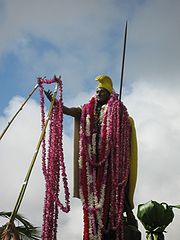
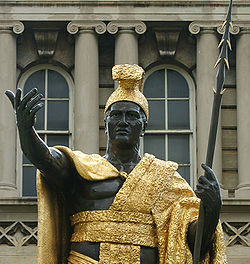
Statues
Five major statues exist, where each of the statues vary slightly from each other in details such as having different weaponry, gilding or painting:- The original cast: the ship, bound for Honolulu on which it was being shipped from Europe sank off the Falkland IslandsFalkland IslandsThe Falkland Islands are an archipelago in the South Atlantic Ocean, located about from the coast of mainland South America. The archipelago consists of East Falkland, West Falkland and 776 lesser islands. The capital, Stanley, is on East Falkland...
but in 1912 the original was salvaged, repaired and erected in Kapaau on the Big Island of Hawaii;
- A replacement statue was erected in his honor by King KalākauaKalakauaKalākaua, born David Laamea Kamanakapuu Mahinulani Nalaiaehuokalani Lumialani Kalākaua and sometimes called The Merrie Monarch , was the last reigning king of the Kingdom of Hawaii...
in 1883 at Aliiōlani Halei'sAliiolani HaleAliiōlani Hale is a building located in downtown Honolulu, Hawaii, currently used as the home of the Hawaii State Supreme Court. It is the former seat of government of the Kingdom of Hawaii and the Republic of Hawaii....
judicial system in Honolulu;
- One is located in Hilo, Hawaii at the north end of the Wailoa River State Recreation AreaWailoa River State Recreation AreaThe Wailoa River State Recreation Area is a park in Hilo, on Hawaii Island in the US state of Hawaii.-Description:The name wai loa literally means ""long water" in the Hawaiian language.It is located at , between downtown Hilo, Hawaii and Hilo Bay....
, where it enjoys a view of Hilo BayHilo BayHilo Bay is a large bay located on the eastern coast of the island of Hawaii.-Description:The modern town of Hilo, Hawaii overlooks Hilo Bay, located at ....
;
- One of smaller size is located in an outdoor Polynesian shopping center, across from the Monte Carlo Resort and Casino on the Las Vegas StripLas Vegas StripThe Las Vegas Strip is an approximately stretch of Las Vegas Boulevard in Clark County, Nevada; adjacent to, but outside the city limits of Las Vegas proper. The Strip lies within the unincorporated townships of Paradise and Winchester...
in NevadaNevadaNevada is a state in the western, mountain west, and southwestern regions of the United States. With an area of and a population of about 2.7 million, it is the 7th-largest and 35th-most populous state. Over two-thirds of Nevada's people live in the Las Vegas metropolitan area, which contains its...
; and
- One in the National Statuary Hall CollectionNational Statuary Hall CollectionThe National Statuary Hall Collection in the United States Capitol comprises statues donated by individual states to honor persons notable in their history...
at the United States CapitolUnited States CapitolThe United States Capitol is the meeting place of the United States Congress, the legislature of the federal government of the United States. Located in Washington, D.C., it sits atop Capitol Hill at the eastern end of the National Mall...
as a representation of the State of Hawaii. This is located in the New Visitors Center in the Capitol.
Other legacy
- In 1865 King Kamehameha VKamehameha ValoghaKamehameha V , born as Lot Kapuāiwa, reigned as monarch of the Kingdom of Hawaii from 1863 to 1872. His motto was "Onipa`a": immovable, firm, steadfast or determined; he worked diligently for his people and kingdom and was described as the last great traditional chief...
created the Royal Order of Kamehameha IRoyal Order of Kamehameha IThe Royal Order of Kamehameha I was a society established in 1865 by King Kamehameha V in defense of the sovereignty of the Kingdom of Hawaii.-History:...
society and Royal Order of Kamehameha IRoyal Order of Kamehameha I (decoration)The Royal Order of Kamehameha I was founded on 11 April 1865 by King Kamehameha V in memory of his grandfather King Kamehameha I and in commemoration of the 70th anniversary of the founding of the Kingdom of Hawaii. This Order was granted to both native Hawaiians and foreigners for distinguished...
decoration in his honor.
- In 1871 Kamehameha V decreed a holiday, Kamehameha DayKamehameha DayKamehameha Day on June 11 is a public holiday of the state of Hawaii in the United States. It honors Kamehameha the Great, the monarch who first established the unified Kingdom of Hawaii — comprising the Hawaiian Islands of Niihau, Kauai, Oahu, Molokai, Lānai, Kahoolawe, Maui and...
, in his honor. This holiday is still celebrated annually on June 11.
- Kamehameha SchoolsKamehameha SchoolsKamehameha Schools , formerly called Kamehameha Schools/Bishop Estate , is a private co-educational college-preparatory institution that specializes in Native Hawaiian language and cultural education. It is located in Hawaii and operates three campuses: Kapālama , Pukalani , and Keaau...
were founded in the will of Bernice Pauahi BishopBernice Pauahi BishopBernice Pauahi Bishop , born Bernice Pauahi Pākī, was a Hawaiian princess, philanthropist, alii, and direct descendant of the royal House of Kamehameha. She was the great-granddaughter of King Kamehameha I and last surviving heir...
, at the time of her death in 1884 the heir of the Kamehameha estate. Her intention was to bring education and thus hope for a future to the rapidly declining number of native Hawaiians. The first school opened in 1887.
- The defences of the entrance to Pearl HarborPearl HarborPearl Harbor, known to Hawaiians as Puuloa, is a lagoon harbor on the island of Oahu, Hawaii, west of Honolulu. Much of the harbor and surrounding lands is a United States Navy deep-water naval base. It is also the headquarters of the U.S. Pacific Fleet...
were named Fort KamehamehaFort KamehamehaFort Kamehameha was a United States Army military base that was the site of several coastal artillery batteries to defend Pearl Harbor starting in 1907 in Honolulu, Hawaii.-History:The eastern areas of the fort were in the district called Moanalua...
in 1909.
- A C-17 Globemaster IIIC-17 Globemaster IIIThe Boeing C-17 Globemaster III is a large military transport aircraft. Developed for the United States Air Force from the 1980s to the early 1990s by McDonnell Douglas, the C-17 is used for rapid strategic airlift of troops and cargo to main operating bases or forward operating bases throughout...
, P-153, was named the "Spirit of Kamehameha", while a Benjamin Franklin class submarineBenjamin Franklin class submarineThe Benjamin Franklin class of submarine was an evolutionary development from the of fleet ballistic missile submarine. Having quieter machinery and other improvements, they are considered a separate class. A subset of this class is the re-engineered 640 class starting with...
, launched in 1965 and decommissioned in 2002, was christened the USS Kamehameha.
- In the introduction to the mangaMangaManga is the Japanese word for "comics" and consists of comics and print cartoons . In the West, the term "manga" has been appropriated to refer specifically to comics created in Japan, or by Japanese authors, in the Japanese language and conforming to the style developed in Japan in the late 19th...
Dragonball, creator Akira ToriyamaAkira Toriyamais a Japanese manga artist and game artist known mostly for his creation of Dragon Ball in 1984. Toriyama admires Osamu Tezuka's Astro Boy and was impressed by Walt Disney's One Hundred and One Dalmatians, which he remembers for the great art...
said that he named Goku's energy attack after Kamehameha after visiting Hawaii on vacation and seeing a statue of the king. It is said that Goku's advanced energy attack, Genki-Dama, was named after Kamehameha's dog.
- Kamehameha I appears on the state quarter coin50 State QuartersThe 50 State Quarters program is the release of a series of circulating commemorative coins by the United States Mint. Between 1999 and 2008, it featured each of the 50 U.S. states on unique designs for the reverse of the quarter....
of Hawaii
- The PC game Civilization VCivilization VSid Meier's Civilization V is a turn-based strategy, 4X computer game developed by Firaxis, released on Microsoft Windows in September 2010 and on Mac OS X on November 23, 2010...
includes Kamehameha as a downloadable leader to play as.
- Kamehameha I appears on the 1975 Hawaii license plateVehicle registration plates of HawaiiSince 1922, the U.S. territory and later U.S. state of Hawaii has issued license plates for vehicles registered there.-Passenger plates 1957 to present:-1981 base:-1991 base:-1991 base:-External links:*...
.
Ancestry
External links
|-
1795-1819
1782-1795
1795-1810
1810-1819