
All Topics  
Military history of ancient Rome

 
Military History of Ancient Rome

   Email Print
   Bookmark   Link


Military history of ancient Rome


From its origin as a city-state in Italy
History of Italy during Roman times

This is an overview of the history of Italy during Roman times....
 in 9th century BC, the rise as an empire
Roman Empire

The Roman Empire was the Roman Republic phase of the Ancient Rome, characterised by an autocracy form of government and large territorial holdings in Europe and around the Mediterranean....
 covering much of Eurasia
Eurasia

Eurasia is a large landmass covering about 53,990,000 km? or about 10.6% of the Earth's surface . Often considered a single continent, Eurasia comprises the traditional continents of Europe and Asia, concepts which date back to classical antiquity and the borders for which are somewhat arbitrary....
 and North Africa
North Africa

North Africa or Northern Africa is the northernmost region of the African continent, separated by the Sahara from Sub-Saharan Africa.Geopolitically, the United Nations subregion of Northern Africa includes the following seven countries or territories:...
 and fall in the 5th century AD of Ancient Rome
Ancient Rome

Ancient Rome was a civilization that grew out of a small agricultural community founded on the Italian Peninsula as early as the 10th century BC....
 was often closely entwined with its military history
Military history

Military history is a humanities List of academic disciplines within the scope of History recording of War in the Human history, and its impact on the societies, their cultures, economies and changing Politics and international relationships....
. The core of the campaign history of the Roman military is an aggregate of different accounts of the Roman military's land battles, from its initial defence against and subsequent conquest of the city's hilltop neighbours in the Italian peninsula
Italian Peninsula

The Italian Peninsula or Apennine Peninsula is one of the three peninsulas of Southern Europe , spanning 1,000 km from the Po Valley in the north to the central Mediterranean Sea in the south....
, to the ultimate struggle of the Western Roman Empire
Western Roman Empire

The Western Roman Empire refers to the western half of the Roman Empire, from its division by Diocletian in 285; the other half of the Roman Empire was the Eastern Roman Empire, today widely known as the Byzantine Empire....
 for its existence against invading Huns, Vandals
Vandals

The Vandals were an East Germanic tribe that entered the late Roman Empire during the 5th century. The Goths Theodoric the Great, king of the Ostrogoths and regent of the Visigoths, was allied by marriage with the Vandals as well as with the Burgundians and the Franks under Clovis I....
 and Germanic tribes
Germanic Wars

The Germanic Wars is a name given to a series of Wars between the Ancient Rome and various Germanic tribes between 113 BC and 439 A.D. The nature of these wars varied through time between Roman conquest, Germanic uprisings and later Germanic invasions in Roman Empire that started in the late 2nd century....
 after the empire's split into East and West
Western Roman Empire

The Western Roman Empire refers to the western half of the Roman Empire, from its division by Diocletian in 285; the other half of the Roman Empire was the Eastern Roman Empire, today widely known as the Byzantine Empire....
.


Discussion
Ask a question about 'Military history of ancient Rome'
Start a new discussion about 'Military history of ancient Rome'
Answer questions from other users
Full Discussion Forum


Encyclopedia


From its origin as a city-state in Italy
History of Italy during Roman times

This is an overview of the history of Italy during Roman times....
 in 9th century BC, the rise as an empire
Roman Empire

The Roman Empire was the Roman Republic phase of the Ancient Rome, characterised by an autocracy form of government and large territorial holdings in Europe and around the Mediterranean....
 covering much of Eurasia
Eurasia

Eurasia is a large landmass covering about 53,990,000 km? or about 10.6% of the Earth's surface . Often considered a single continent, Eurasia comprises the traditional continents of Europe and Asia, concepts which date back to classical antiquity and the borders for which are somewhat arbitrary....
 and North Africa
North Africa

North Africa or Northern Africa is the northernmost region of the African continent, separated by the Sahara from Sub-Saharan Africa.Geopolitically, the United Nations subregion of Northern Africa includes the following seven countries or territories:...
 and fall in the 5th century AD of Ancient Rome
Ancient Rome

Ancient Rome was a civilization that grew out of a small agricultural community founded on the Italian Peninsula as early as the 10th century BC....
 was often closely entwined with its military history
Military history

Military history is a humanities List of academic disciplines within the scope of History recording of War in the Human history, and its impact on the societies, their cultures, economies and changing Politics and international relationships....
. The core of the campaign history of the Roman military is an aggregate of different accounts of the Roman military's land battles, from its initial defence against and subsequent conquest of the city's hilltop neighbours in the Italian peninsula
Italian Peninsula

The Italian Peninsula or Apennine Peninsula is one of the three peninsulas of Southern Europe , spanning 1,000 km from the Po Valley in the north to the central Mediterranean Sea in the south....
, to the ultimate struggle of the Western Roman Empire
Western Roman Empire

The Western Roman Empire refers to the western half of the Roman Empire, from its division by Diocletian in 285; the other half of the Roman Empire was the Eastern Roman Empire, today widely known as the Byzantine Empire....
 for its existence against invading Huns, Vandals
Vandals

The Vandals were an East Germanic tribe that entered the late Roman Empire during the 5th century. The Goths Theodoric the Great, king of the Ostrogoths and regent of the Visigoths, was allied by marriage with the Vandals as well as with the Burgundians and the Franks under Clovis I....
 and Germanic tribes
Germanic Wars

The Germanic Wars is a name given to a series of Wars between the Ancient Rome and various Germanic tribes between 113 BC and 439 A.D. The nature of these wars varied through time between Roman conquest, Germanic uprisings and later Germanic invasions in Roman Empire that started in the late 2nd century....
 after the empire's split into East and West
Western Roman Empire

The Western Roman Empire refers to the western half of the Roman Empire, from its division by Diocletian in 285; the other half of the Roman Empire was the Eastern Roman Empire, today widely known as the Byzantine Empire....
. These accounts were written by various authors throughout and after the history of the Empire. Despite the later Empire's encompassing of lands around the periphery
Mediterranean Basin

The Mediterranean Basin refers to the lands around and surrounded by the Mediterranean Sea. In biogeography, the Mediterranean Basin refers to the lands around the Mediterranean Sea that have a Mediterranean climate, with mild, rainy winters and hot, dry summers, which supports characteristic Mediterranean forests, woodlands, and scrub...
 of the Mediterranean Sea
Mediterranean Sea

The Mediterranean Sea is a sea or Ocean off the Atlantic Ocean surrounded by the Mediterranean region and almost completely enclosed by land: on the north by Europe, on the south by Africa, and on the east by Asia....
, naval battles
Naval warfare

Naval warfare is combat in and on seas, oceans, or any other major bodies of water such as large lakes and wide rivers....
 were typically less significant than land battles to the military history of Rome, due to its largely unchallenged dominance of the sea following fierce naval fighting during the First Punic War
First Punic War

The First Punic War was the first of Punic Wars fought between Carthage and the Roman Republic. For 23 years, the two powers struggled for supremacy in the western Mediterranean Sea....
.

The Roman army battled first against its tribal neighbours and Etruscan
Etruscan civilization

Etruscan civilization is the modern English name given to the culture and way of life of a people of ancient Italy and Corsica whom the ancient Romans called Etrusci or Tusci....
 towns within Italy, and later came to dominate much of the Mediterranean and further afield, including the provinces of Britannia
Roman Britain

Roman Britain refers to those parts of the island of Great Britain controlled by the Roman Empire between AD 43 and 410. The Romans referred to their province as Britannia....
 and Asia Minor
History of Anatolia

The History of Anatolia encompasses the region known as Anatolia , known by the Latin name of Asia Minor, considered to be the westernmost extent of Southwest Asia....
 at the Empire's height. As with most ancient civilisations, Rome's military served the triple purposes of securing its borders, exploiting peripheral areas through measures such as imposing tribute
Tribute

A tribute is wealth one party gives to another as a sign of respect or, as was often case in historical contexts, of submission or allegiance....
 on conquered peoples, and maintaining internal order. From the outset, Rome's military typified this pattern, and the majority of Rome's campaigns were characterised by one of two types: the first is the territorial expansionist campaign, normally begun as a counter-offensive, in which each victory brought subjugation of large areas of territory and allowed Rome to grow from a small town to one of the largest empires
List of largest empires

This article provides a list of the largest empires in History of the world....
 in the ancient world, encompassing around one quarter of the world's total population; the second is the civil war
Civil war

A civil war is a war between organized groups to take control of a nation or region, or to change government policies. It is high-intensity conflict, often involving Regular Army, that is sustained, organized and large-scale....
, examples of which plagued Rome right from its foundation to its eventual demise.

Roman armies were not invincible, despite their formidable reputation and host of victories: over the centuries the Romans "produced their share of incompetents" who led Roman armies into catastrophic defeats. Nevertheless, it was generally the fate of even the greatest of Rome's enemies, such as Pyrrhus
Pyrrhus of Epirus

Pyrrhus or Pyrrhos was a Greeks general of the Hellenistic civilization. He was king of the Greek tribe of Molossians, of the royal Aeacid house , and later he became King of Epirus and Macedon ....
 and Hannibal, to win the battle but lose the war. The history of Rome's campaigning is, if nothing else, a history of obstinate persistence overcoming appalling losses.

Kingdom (756 BC – 459 BC)

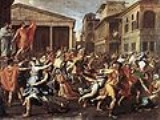
Poussin Rapesabinelouvre
Rome is almost unique in the ancient world in that its history, military and otherwise, is documented often in great detail almost from the city's very foundation
Founding of Rome

The founding of Rome is reported by many legends, which in recent times are beginning to be supplemented by more scientific reconstructions.Virgil's Aeneid is an important source for information about those early times or, at least, the myth-historical events current in the Augustan period....
 right through to its eventual demise
Decline of the Roman Empire

The English historian Edward Gibbon, author of The Decline and Fall of the Roman Empire made this concept part of the framework of the English language, but he was neither the first nor the last to speculate on why and when the Empire collapsed....
. Although some histories have been lost, such as Trajan
Trajan

Marcus Ulpius Nerva Traianus, commonly known as Trajan , was a Roman Emperors who reigned from 98 until his death in 117. Born Marcus Ulpius Traianus into a nonpatrician family in the Hispania Baetica province , Trajan rose to prominence during the reign of emperor Domitian, serving as a general in the Roman army along the Limes G...
's account of the Dacian Wars, and others, such as Rome's earliest histories, are at least semi-apocryphal, the extant histories of Rome's military history are extensive.

The very earliest history, from the time of Rome's founding as a small tribal village, through to the downfall of Rome's kings, is the least well preserved. This is because, whilst the early Romans were literate to some degree, either they lacked the will to record their history at this time or else such histories as they did record were lost.

Although the Roman historian Livy
Livy

Titus Livius , known as Livy in English language, was a Ancient Rome historian who wrote a monumental history of Rome, Ab Urbe Condita, from its founding through the reign of Augustus in Livy's own time....
 (traditionally 59 BC – AD 17) lists a series of seven kings of early Rome in his work Ab Urbe Condita, from its establishment and through its earliest years, the first four 'kings' (Romulus
Romulus

Romulus may refer to any of these articles:...
, Numa
Numa Pompilius

Numa Pompilius , according to legend, was the second king of Rome, succeeding Romulus. After Romulus died, Romans in the city elected a Sabine man to be king, so as to make him loyal to both tribes in Rome....
, Tullus Hostilius
Tullus Hostilius

Tullus Hostilius was the third of the legendary Kings of Rome. He succeeded Numa Pompilius, and was succeeded by Ancus Marcius.His successful wars with Alba Longa, Fidenae and Veii shadow forth the earlier conquests of Latin territory and the first extension of the Roman territory beyond the walls of Rome....
 and Ancus Marcius
Ancus Marcius

Ancus Marcius was the fourth of the Kings of Rome, possibly a legendary figure.Like Numa Pompilius, his reputed maternal grandfather , he was a friend of peace and religion, but was obliged to make war to defend his territories....
) are almost certainly entirely apocryphal. Grant
Michael Grant (author)

Michael Grant Order of the British Empire was an English Classics and numismatist. According to his obituary in The Times he was "one of the few classical historians to win respect from [both] academics and a lay readership"....
 and others argue that prior to the time when the Etruscan kingdom of Rome was established under the traditionally fifth king Tarquinius Priscus
Tarquinius Priscus

Lucius Tarquinius Priscus, also called Tarquin the Elder or Tarquin I, was the fifth Kings of Rome from 616 BC to 579 BC. His wife was Tanaquil....
, Rome would have been led by a religious leader of some sort. Very little is known of Rome's military history during this era, and what history has come down to us is of a legendary rather than factual nature. Traditionally, Romulus fortified one of the first-settled of Rome's seven hills, the Palatine Hill
Palatine Hill

The Palatine Hill is the centermost of the Seven Hills of Rome and is one of the most ancient parts of the city. It stands 40 metres above the Roman Forum, looking down upon it on one side, and upon the Circus Maximus on the other....
, after founding the city, and Livy states that shortly after its founding Rome was "equal to any of the surrounding cities in her prowess in war".

"Events before the city was founded or planned, which have been handed down more as pleasing poetic fictions than as reliable records of historical events, I intend neither to affirm nor to refute. To antiquity we grant the indulgence of making the origins of cities more impressive by comingling the human with the divine, and if any people should be permitted to sanctify its inception and reckon the gods as its founders, surely the glory of the Roman people in war is such that, when it boasts Mars in particular as its parent... the nations of the world would as easily acquiesce in this claim as they do in our rule."
Livy
Livy

Titus Livius , known as Livy in English language, was a Ancient Rome historian who wrote a monumental history of Rome, Ab Urbe Condita, from its founding through the reign of Augustus in Livy's own time....
, on Rome's early history


The first campaign, if such it can be called, that was fought by the Romans in this legendary account is their seizing of the women from several nearby villages inhabited by the Sabine
Sabine

The Sabines were an Ancient Italic peoples tribe that lived in ancient Italy, inhabiting Latium before the founding of Rome. Their language belonged to the Osco-Umbrian languages subgroup of Italic languages and shows some similarities to Oscan language and Umbrian language....
 people for purposes of "begetting their children", an event known as The Rape of the Sabine Women
The Rape of the Sabine Women

The Rape of the Sabine Women is an episode in the legendary history of Rome in which the first generation of Roman men acquired wives for themselves from the neighboring Sabine families....
. According to Livy, the Sabine village of Caenina responded first by invading Roman territory, but were routed and their city captured. The Sabines of Antemnae
Antemnae

Antemnae , an ancient village of Latium, situated on the west of the Via Salaria, two miles north of Rome, where the Anio falls into the Tiber. It is said to have been conquered by Romulus after the rape of the Sabine women, and to have assisted the Tarquins....
 were defeated next in a similar fashion, and again the Sabines of Crustumerium
Crustumerium

Crustumerium was an ancient town of Latium, on the edge of the Sabine territory, near the headwaters of the Allia, not far from the Tiber.It appears several times in the early history of Rome, but was conquered in 500 BC according to Livy , the tribus Crustumina or Clustumina being formed in 471 BC....
. The remaining main body of the Sabines attacked Rome and briefly captured the citadel, but were then routed.

There were further wars against the Fidenae
Fidenae

Fidenae was an ancient town of Latium, situated about 5 miles north of Rome on the Via Salaria, which ran between it and the Tiber.It was for some while the frontier of the Roman territory and was often in the hands of Veii....
, Veientes
Veii

Veii was, in ancient times, an important Etrurian city 16 km NNW of Rome, Italy; its site lies in the modern comune of Formello, in the Province of Rome....
, the Albans
Alba Longa

Alba Longa was an ancient city of Latium in central Italian Peninsula southeast of Ancient Rome in the Alban Hills. Founder and head of the Latin League, it was destroyed by Rome around the middle of the 7th century BC....
, the Medullia, the Apiolae, and the Collatia
Collatia

Collatia was an ancient town of Latium, c. 15 km northeast of Rome by the Via Collatina.It appears in the legendary history of Rome as captured by Tarquinius Priscus....
.

Under the Etruscan kings Tarquinius Priscus
Tarquinius Priscus

Lucius Tarquinius Priscus, also called Tarquin the Elder or Tarquin I, was the fifth Kings of Rome from 616 BC to 579 BC. His wife was Tanaquil....
, Servius Tullius
Servius Tullius

Servius Tullius was the sixth legendary Roman king of ancient Rome and the second king of the Etruria dynasty. The traditional dates of his reign are 578-535 BC....
 and Tarquinius Superbus, Rome expanded to the north-west, coming into conflict again with the Veientes after the expiry of the treaty that concluded their earlier war. There was a further campaign against the Gabii
Gabii

Gabii was an ancient city of Latium, between 12 and 13 miles East of Rome. It was located on the south-eastern bank of an extinct volcanic crater-lake, the Lago di Castiglione.....
, and later against the Rutuli
Rutuli

The Rutuli or Rutulians were members of a legendary Ancient Italic peoples tribe. Thought to have been descended from the Umbri and the Pelasgians, the Rutuli were located in territory whose capital was the ancient town of Ardea_%28RM%29, located about 20 miles southeast of Rome....
. The Etruscan kings were overthrown as part of a wider reduction in Etruscan power in the region during this period, and Rome reformed itself as a republic
Republic

A republic is a state or country that is not led by a hereditary monarch but in which the people have an impact on its government. The word originates from the Latin term res publica....
, a form of government based on popular representation and in contrast to its previous autocratic
Autocracy

An autocracy is a form of government in which the political power is held by a single, self-appointed ruler. The term autocrat is derived from the Greek language word 'a?t????t?? ....
 kingship.

Republic


Early (458 BC – 274 BC)


Early Italian campaigns (458–396 BC)
Etruscan Civilization Map
The first non-apocryphal Roman wars were wars of both expansion and defence, aimed at protecting Rome itself from neighbouring cities and nations and establishing its territory in the region. Florus writes that at this time Although sources disagree, it is possible that Rome itself was twice invaded by Etruscan armies in this period, first in around 509 BC under the recently-overthrown king Tarquinius Superbus, and again in 508 BC under the Etruscan Lars Porsenna.

Initially, Rome's immediate neighbours were either Latin
Latins

Latins can refer to several groups of people. Its meaning has changed throughout time, and can still refer to different things even today....
 towns and villages on a tribal system similar to that of Rome, or else tribal Sabines from the Apennine hills beyond. One by one, Rome defeated both the persistent Sabines and the local cities that were either under Etruscan control or else Latin towns that had cast off their Etruscan rulers, as had Rome. Rome defeated the Lavinii
Lavinium

Lavinium was a Latin port city of Latium 30 km south of Rome, already fortified in the seventh century BCE and a flourishing in the sixth. and assimilated by Republican Rome....
 and Tusculi
Tusculum

Tusculum is the classical Roman name of a major ancient Alban Hills city, in the Latium region of Italy....
 in the Battle of Lake Regillus
Battle of Lake Regillus

The Battle of Lake Regillus was a legendary early Roman Republic victory, won over the Latin League led by the expelled Etruscan civilization former king of Rome....
 in 496 BC, the Sabines in an Unknown Battle in 449 BC, the Aequi
Aequi

The Aequi were an ancient people of north-east Latium, in central Italy, whose name occurs constantly in Livy's first decade as hostile to Rome in the first three centuries of the city's existence....
 in the Battle of Mons Algidus
Battle of Mons Algidus

The Battle of Mons Algidus was fought in 458 BC between the Roman Republic and the Aequi near Algidus Mons, Latium. The Roman dictator Cincinnatus turned a Roman defeat into an important victory....
 in 458 BC and the Battle of Corbione
Battle of Corbione

The Battle of Corbione took place in 446 BC. General Titus Quinctius Capitolinus Barbatus and legatus Spurius Postumius Albus Regillensis led Roman troops to a victory over the Aequi tribes of north-east Latium and the Volsci tribes of southern Latium....
 in 446 BC, the Volsci
Volsci

The Volsci were an ancient Italic peoples, well known in the history of the first century of the Roman Republic. They then inhabited the partly hilly, partly marshy district of the south of Latium, bounded by the Aurunci and Samnites on the south, the Hernici on the east, and stretching roughly from Norba and Cora in the north to Anzio in t...
 in the Battle of Corbione
Battle of Corbione

The Battle of Corbione took place in 446 BC. General Titus Quinctius Capitolinus Barbatus and legatus Spurius Postumius Albus Regillensis led Roman troops to a victory over the Aequi tribes of north-east Latium and the Volsci tribes of southern Latium....
 in 446 BC and the Capture of Antium in 377 BC, the Aurunci
Aurunci

The Aurunci were an italic peoples population which lived in southern Italy from around the 1st millennium BC. Of Indo-Europeans origin, their language belonged to the Oscan group....
 in the Battle of Aricia, and the Veientes
Veii

Veii was, in ancient times, an important Etrurian city 16 km NNW of Rome, Italy; its site lies in the modern comune of Formello, in the Province of Rome....
 in the Battle of the Cremera
Battle of the Cremera

The Battle of the Cremera was fought between Roman Republic and the Etruscan civilization city of Veii, in 477 BC .Historical records show the defeat of the Roman stronghold on the river Cremera, and the consequent incursions of the Veientes in Roman territory....
 in 477 BC, the Capture of Fidenae in 435 BC and the Siege of Veii in 396 BC. After defeating the Veientes, the Romans had effectively completed the conquest of their immediate Etruscan neighbours, as well as secured their position against the immediate threat posed by the tribespeople of the Apennine hills.

However, Rome still controlled only a very limited area and the affairs of Rome were minor even to those in Italy: the remains of Veii, for instance, lie entirely within modern Rome's suburbs and Rome's affairs were only just coming to the attention of the Greeks, the dominant cultural force at the time. At this point the bulk of Italy remained in the hands of Latin
Latin

Latin is an Italic language, historically spoken in Latium and Ancient Rome. Through the Military history of the Roman Empire, Latin spread throughout the Mediterranean and a large part of Europe....
, Sabine
Sabine

The Sabines were an Ancient Italic peoples tribe that lived in ancient Italy, inhabiting Latium before the founding of Rome. Their language belonged to the Osco-Umbrian languages subgroup of Italic languages and shows some similarities to Oscan language and Umbrian language....
, Samnite and other peoples in the central part of Italy, Greek colonies to the south, and, notably, the Celtic people, including the Gauls
Gauls

The Gauls were a Continental Celtic Celts people of Classical Antiquity, the inhabitants of Gaul , and speakers of the Gaulish language.Archaeologically, they were the bearers of the La T?ne culture ....
, to the north. The Celtic civilization at this time was vibrant and growing in strength and territory, and stretched, if incohesively, across much of mainland Europe. It is at the hands of the Gallic Celts that Rome suffered a humiliating defeat that temporarily set back its advance and was to imprint itself upon the Roman consciousness.

Celtic invasion of Italia (390–387 BC)
By 390 BC, several Gallic tribes had begun invading Italy from the north as their culture expanded throughout Europe. Most of this was unknown to the Romans at this time, who still had purely local security concerns, but the Romans were alerted when a particularly warlike tribe, the Senones
Senones

The Senones were a Gaul people of Gaul, who in the time of Julius Caesar inhabited the district which now includes the departments of Seine-et-Marne, Loiret and Yonne....
, invaded the Etruscan province of Siena from the north and attacked the town of Clusium
Clusium

Clusium was an ancient city in Italy, one of several found at the site. The current municipality of Chiusi partly overlaps this Roman walled city....
, not far from Rome's sphere of influence. The Clusians, overwhelmed by the size of the enemy in numbers and ferocity, called on Rome for help. Perhaps unintentionally the Romans found themselves not just in conflict with the Senones, but their primary target. The Romans met them in pitched battle at the Battle of the Allia
Battle of the Allia

The Battle of the Allia was a battle of the first Gallic invasion of Italy. The battle was fought near the Allia river: the defeat of the Roman army opened the route for the Gauls to sack Rome....
 around 390–387 BC. The Gauls, under their chieftain Brennus
Brennus (4th century BC)

Brennus was a tribal chief of the Senones, a Gaul tribe originating from the modern areas of France known as Seine-et-Marne, Loiret, and Yonne, but which had expanded to occupy northern Italy....
, defeated the Roman army of around 15,000 troops and proceeded to pursue the fleeing Romans back to Rome itself and partially sacked the town before being either driven off or bought off.

Now that the Romans and Gauls had blooded one another, intermittent warfare was to continue between the two in Italy for more than two centuries, including the Battle of the Anio, the Battle of Lake Vadimo
Battle of Lake Vadimo

The Battle of Lake Vadimo may refer to battles:# the battle of Lake Vadimo , a Roman Republic victory over an Etruscan civilization army;# the battle of Lake Vadimo , a Roman Republic victory over a joint Etruscan civilization-Gaulish army....
, the Battle of Faesulae
Battle of Faesulae

The Battle of Faesulae was fought in 225 BC between the Roman Republic and a group of Gauls living in Italy. The Gauls defeated the Romans, but later the same year, a decisive battle at Battle of Telamon had the opposite outcome....
 in 225 BC, the Battle of Telamon
Battle of Telamon

The Battle of Telamon was fought between the Roman Republic and an alliance of Gauls in 225 BC. The Romans, led by the consuls Gaius Atilius Regulus and Lucius Aemilius Papus, defeated the Gauls, thus extending their influence over northern Italy....
 in 224 BC, the Battle of Clastidium
Battle of Clastidium

The Battle of Clastidium was fought in 222 BC between a Roman Republican army led by the Roman consul Marcus Claudius Marcellus and the Insubres led by Viridomarus....
 in 222 BC, the Battle of Cremona
Battle of Cremona (200 BC)

The Battle of Cremona was fought in 200 BC between the Roman Republic and Cisalpine Gaul. The Roman force was victorious....
 in 200 BC, the Battle of Mutina
Battle of Mutina (194 BC)

The Battle of Mutina was fought in 194 BC, near Modena, between the Roman Republic and the Gauls. The Roman army won the battle. This battle marked the end of the Gaulic campaign in Italy....
 in 194 BC, the Battle of Arausio
Battle of Arausio

The Battle of Arausio took place on October 6, 105 BC, at a site between the town of Arausio and the Rh?ne River. Ranged against the migratory tribes of the Cimbri under Boiorix and the Teutoni were two Roman army, commanded by the proconsul Quintus Servilius Caepio and consul Gnaeus Mallius Maximus....
 in 105 BC, and the Battle of Vercellae
Battle of Vercellae

The Battle of Vercellae, or Battle of the Raudine Plain, in 101 BC was the Roman republic victory of Consul Gaius Marius over the Germanic Cimbri invasion force near the settlement of Vercellae in Cisalpine Gaul....
 in 101 BC. The Celtic problem would not be resolved for Rome until the final subjugation of all Gaul following the Battle of Alesia
Battle of Alesia

The Battle of Alesia or Siege of Alesia took place in September, 52 BC around the Gallic oppidum of Alesia , a major town centre and hill fort of the Mandubii tribe....
 in 52 BC.

Expansion into Italia (343–282 BC)
Pietra Bismantova
After recovering surprisingly swiftly from the sack of Rome, the Romans immediately resumed their expansion within Italy. Despite their successes so far, their mastery of the whole of Italy was by no means assured at this point: the Samnites were a people just as martial and as rich as the Romans and with an objective of their own of securing more lands in the fertile Italian plains on which Rome itself lay. The First Samnite War of between 343 BC and 341 BC that followed widespread Samnite incursions into Rome's territory was a relatively short affair: the Romans beat the Samnites in both the Battle of Mount Gaurus
Battle of Mount Gaurus

The Battle of Mount Gaurus, a battle between the Ancient Rome and the Samnium, was fought in 342 BC. The battle was a success for the Romans, who were led by Marcus Valerius Corvus....
 in 342 BC and the Battle of Suessola in 341 BC but were forced to withdraw from the war before they could pursue the conflict further due to the revolt of several of their Latin allies in the Latin War
Latin War

The Latin War was a conflict between the Roman Republic and its neighbors the Latins peoples of ancient Italy. It ended in the dissolution of the Latin League, and incorporation of its territory into the Roman sphere of influence, with the Latins gaining partial rights and varying levels of citizenship....
.

Rome was therefore forced to contend by around 340 BC against both Samnite incursions into their territory and, simultaneously, in a bitter war against their former allies. Rome bested the Latins in the Battle of Vesuvius
Battle of Vesuvius

The Battle of Vesuvius in 340 BC saw the Roman army under Publius Decius Mus and Titus Manlius Torquatus defeat the Latins near Mount Vesuvius....
 and again in the Battle of Trifanum
Battle of Trifanum

The Battle of Trifanum was fought in 339 BC between the Roman Republic and the Latin League. The Roman force was led by Titus Manlius Torquatus , and they were victorious....
, after which the Latin cities were obliged to submit to Roman rule. Perhaps due to Rome's lenient treatment of their defeated foe, the Latins submitted largely amicably to Roman rule for the next 200 years.

The Second Samnite War, from 327 BC to 304 BC, was a much longer and more serious affair for both the Romans and Samnites, running for over twenty years and incorporating twenty-four battles that led to massive casualties on both sides. The fortunes of the two sides fluctuated throughout its course: the Samnites seized Neapolis in the Capture of Neapolis
Capture of Neapolis

During the Second Samnite War , from 326 BC to 304 BC, between ancient Rome and the Samnites, the Samnites seized Naples in the Capture of Neapolis in 327 BC, which the Romans then later re-captured....
 in 327 BC, which the Romans then re-captured before losing at the Battle of the Caudine Forks
Battle of the Caudine Forks

The Battle of Caudine Forks, 321 BC, was a decisive battle of the Samnite Wars....
 and the Battle of Lautulae
Battle of Lautulae

The Battle of Lautulae was fought in 315 BC between the Roman Republic and the Samnites. The Samnites won this battle....
. The Romans then proved victorious at the Battle of Bovianum
Battle of Bovianum

The Battle of Bovianum was fought in 305 BC between the Roman Republic and the Samnium....
 and the tide turned strongly against the Samnites from 314 BC onwards, leading them to sue for peace
Suing for peace

Suing for peace is an act by a warring nation to initiate a peace process in which the peace terms are more favorable than an unconditional surrender....
 with progressively less generous terms. By 304 BC the Romans had effectively annexed the greater degree of the Samnite territory, founding several colonies. This pattern of meeting aggression in force and almost inadvertently gaining territory in strategic counter-attacks was to become a common feature of Roman military history.

Seven years after their defeat, with Roman dominance of the area looking assured, the Samnites rose again and defeated the Romans at the Battle of Camerinum
Battle of Camerinum

The Battle of Camerinum in 298 BC was the first battle of the Third Samnite War. In the battle, the Samnites defeated the Roman Republic, who were commanded by Lucius Cornelius Scipio Barbatus....
 in 298 BC, to open the Third Samnite War. With this success in hand they managed to bring together a coalition of several previous enemies of Rome, all of whom were probably keen to prevent any one faction dominating the entire region. The army that faced the Romans at the Battle of Sentinum
Battle of Sentinum

The Battle of Sentinum was the decisive battle of the Third Samnite War, fought in 295 BC near Sentinum , in which the Roman Republic were able to overcome a formidable coalition of Samnites, Etruscan civilizations, Umbrians, and their Gallic allies....
 in 295 BC therefore included Samnites, Gauls, Etruscans and Umbrians. When the Roman army won a convincing victory over these combined forces it must have become clear that little could prevent Roman dominance of Italy. In the Battle of Populonia
Battle of Populonia

The Battle of Populonia was fought in 282 BC between Roman Republic and the Etruscans. The Romans were victorious, and the Etruscan threat to Rome sharply diminished after this battle....
 in 282 BC Rome finished off the last vestiges of Etruscan power in the region.

Pyrrhic War (280–275 BC)
By the beginning of the third century, Rome had established itself as a major power on the Italian Peninsula
Italian Peninsula

The Italian Peninsula or Apennine Peninsula is one of the three peninsulas of Southern Europe , spanning 1,000 km from the Po Valley in the north to the central Mediterranean Sea in the south....
, but had not yet come into conflict with the dominant military powers in the Mediterranean
Mediterranean Basin

The Mediterranean Basin refers to the lands around and surrounded by the Mediterranean Sea. In biogeography, the Mediterranean Basin refers to the lands around the Mediterranean Sea that have a Mediterranean climate, with mild, rainy winters and hot, dry summers, which supports characteristic Mediterranean forests, woodlands, and scrub...
 at the time: Carthage
Carthage

Carthage refers both to an ancient city in present-day Tunisia, and a modern-day suburb of Tunis. The civilization that developed within the city's sphere of influence is referred to as Punic or Carthaginian....
 and the Greek kingdoms
Ancient Greece

The term Ancient Greece refers to the period of History of Greece lasting from the Greek Dark Ages ca. 1100 BC and the Dorian invasion, to 146 BC and the Roman Republic conquest of Greece after the Battle of Corinth ....
. Rome had all but completely defeated the Samnites, mastered its fellow Latin towns, and greatly reduced Etruscan
Etruscan civilization

Etruscan civilization is the modern English name given to the culture and way of life of a people of ancient Italy and Corsica whom the ancient Romans called Etrusci or Tusci....
 power in the region. However, the south of Italy was controlled by the Greek
Ancient Greece

The term Ancient Greece refers to the period of History of Greece lasting from the Greek Dark Ages ca. 1100 BC and the Dorian invasion, to 146 BC and the Roman Republic conquest of Greece after the Battle of Corinth ....
 colonies of Magna Grecia who had been allied to the Samnites, and continued Roman expansion brought the two into inevitable conflict.

When a diplomatic dispute between Rome and the Greek colony of Tarentum
Taranto

Taranto is a coastal city in Puglia, Southern Italy. It is the capital of the Province of Taranto and is an important commercial port as well as the main Italian naval base....
 erupted into open warfare in the naval Battle of Thurii
Battle of Thurii

The naval Battle of Thurii was fought between Ancient Rome and the Greek colony of TarantoFollowing the battle, Tarentum appealed for aid to Pyrrhus of Epirus, ruler of Epirus , for military aid....
, Tarentum appealed for military aid to Pyrrhus
Pyrrhus of Epirus

Pyrrhus or Pyrrhos was a Greeks general of the Hellenistic civilization. He was king of the Greek tribe of Molossians, of the royal Aeacid house , and later he became King of Epirus and Macedon ....
, ruler of Epirus
Epirus (region)

Epirus is a region in south-eastern Europe, currently divided between the Peripheries of Greece Epirus in Greece and the prefectures of Gjirokast?r, Vlor?, Kor??, and Berat in southern Albania....
. Motivated by his diplomatic obligations to Tarentum, and a personal desire for military accomplishment, Pyrrhus landed a Greek army of some 25,000 men and a contingent of war elephant
War elephant

A war elephant is an elephant trained and guided by humans for combat. Their main use was in charge s, to trample the enemy and/or break their ranks....
s on Italian soil in 280 B.C, where his forces were joined by some Greek colonists and a portion of the Samnites who revolted against Roman control.

The Roman army had not yet seen elephants in battle, and their inexperience turned the tide in Pyrrhus' favour at the Battle of Heraclea
Battle of Heraclea

The Battle of Heraclea took place in 280 BC between the Roman Republic under the command of Consul Publius Valerius Laevinus and the combined forces of Greeks from Epirus , Taranto, Thurii, Metapontum, and Heraclea under the command of King Pyrrhus of Epirus....
 in 280 BC, and again at the Battle of Ausculum in 279 BC. Despite these victories, Pyrrhus found his position in Italy untenable. Rome steadfastly refused to negotiate with Pyrrhus as long as his army remained in Italy. Furthermore, Rome entered into a treaty of support with Carthage
Carthage

Carthage refers both to an ancient city in present-day Tunisia, and a modern-day suburb of Tunis. The civilization that developed within the city's sphere of influence is referred to as Punic or Carthaginian....
, and Pyrrhus found that despite his expectations, none of the other Italic peoples
Ancient Italic peoples

Ancient peoples of Italy are all those peoples that lived in Italy before the Ancient Rome. Not all of these various peoples are linguistically or ethnicity closely related....
 would defect to the Greek and Samnite cause. Facing unacceptably heavy losses
Pyrrhic victory

A Pyrrhic victory is a victory with devastating cost to the victor....
 with each encounter with the Roman army, and failing to find further allies in Italy, Pyrrhus withdrew from the peninsula and campaigned in Sicily
Sicily

Sicily is an Autonomous regions with special statute of Italy. Of all the regions of Italy, Sicily covers the largest land area at 25,708 km? and currently has just over five million inhabitants....
 against Carthage, abandoning his allies to deal with the Romans.

When his Sicilian campaign was also ultimately a failure, and at the request of his Italian allies, Pyrrhus returned to Italy to face Rome once more. In 275 BC, Pyrrhus again met the Roman army at the Battle of Beneventum. This time the Romans had devised methods to deal with the war elephants, including the use of javelins, fire and, one source claims, simply hitting the elephants heavily on the head. While Beneventum was indecisive, Pyrrhus realised that his army had been exhausted and reduced by years of foreign campaigns, and seeing little hope for further gains, he withdrew completely from Italy.

The conflicts with Pyrrhus would have a great effect on Rome, however. Rome had shown that it was capable of pitting its armies successfully against the dominant military powers of the Mediterranean, and further showed that the Greek kingdoms were incapable of defending their colonies in Italy and abroad. Rome quickly moved into southern Italia, subjugating and dividing Magna Grecia. Effectively dominating the Italian peninsula, and with a proven international military reputation, Rome now began to look outwards at expansion from the Italian mainland. Since the Alps formed a natural barrier to the north, and Rome was none too keen to meet the fierce Gauls in battle once more, the city's gaze turned to Sicily and the islands of the Mediterranean, a policy that would bring it into direct conflict with its former ally Carthage
Carthage

Carthage refers both to an ancient city in present-day Tunisia, and a modern-day suburb of Tunis. The civilization that developed within the city's sphere of influence is referred to as Punic or Carthaginian....
.

Middle (274 BC – 148 BC)

Rome first began to make war outside the Italian peninsula in the Punic wars
Punic Wars

The Punic Wars were a series of three wars fought between Ancient Rome and Carthage from 264 to 146 BC. They were probably the largest wars yet of the ancient world....
 against Carthage
Carthage

Carthage refers both to an ancient city in present-day Tunisia, and a modern-day suburb of Tunis. The civilization that developed within the city's sphere of influence is referred to as Punic or Carthaginian....
, a former Phoenicia
Phoenicia

Phoenicia was an ancient civilization centered in the north of ancient Canaan, with its heartland along the coastal regions of modern day Lebanon, extending to parts of Israel, Syria and the Palestinian territories....
n colony on the north coast of Africa that had developed into a powerful state. These wars, starting in 264 BC were probably the largest conflicts of the ancient world yet and saw Rome become the most powerful state of the Western Mediterranean, with territory in Sicily
Sicily

Sicily is an Autonomous regions with special statute of Italy. Of all the regions of Italy, Sicily covers the largest land area at 25,708 km? and currently has just over five million inhabitants....
, North Africa
North Africa

North Africa or Northern Africa is the northernmost region of the African continent, separated by the Sahara from Sub-Saharan Africa.Geopolitically, the United Nations subregion of Northern Africa includes the following seven countries or territories:...
, Iberia
Iberian Peninsula

The Iberian Peninsula, or Iberia, is located in the extreme southwest of Europe and includes modern-day Spain, Portugal, Andorra and Gibraltar and a very small area of France....
, and with the end of the Macedonian wars
Macedonian Wars

The Macedonian and Seleucid wars were a series of conflicts fought by Rome during and after the second Punic war, in the eastern Mediterranean, the Adriatic, and the Aegean Sea....
 (which ran concurrently with the Punic wars) Greece
Greece

Greece , officially the Hellenic Republic , is a country in southeastern Europe, situated on the southern end of the Balkans. It has borders with Albania, Bulgaria and the former Yugoslav Republic of Macedonia to the north, and Turkey to the east....
 as well. After the defeat of the Seleucid Emperor Antiochus III the Great
Antiochus III the Great

Antiochus III the Great, , younger son of Seleucus II Callinicus, became the 6th ruler of the Seleucid Empire as a youth of about eighteen in 223 BC....
 in the Roman-Syrian War
Roman-Syrian War

The Roman-Syrian War , also known as War of Antiochos or Syrian War, was a military conflict between two coalitions led by the Roman Republic and the Seleucid Empire under Antiochus III the Great....
 (Treaty of Apamea, 188 BC) in the eastern sea, Rome emerged as the dominant Mediterranean power and the most powerful city in the classical world.

Punic Wars (264–146 BC)
Rome Carthage 218
The First Punic War
First Punic War

The First Punic War was the first of Punic Wars fought between Carthage and the Roman Republic. For 23 years, the two powers struggled for supremacy in the western Mediterranean Sea....
 began in 264 BC when settlements on Sicily began to appeal to the two powers between which they lay – Rome and Carthage – in order to solve internal conflicts. The willingness of both Rome and Carthage to become embroiled on the soil of a third party may indicate a willingness to test each other's power without wishing to enter a full war of annihilation; certainly there was considerable disagreement within Rome about whether to prosecute the war at all. The war saw land battles in Sicily early on such as the Battle of Agrigentum
Battle of Agrigentum

The battle of Agrigentum was the first pitched battle of the First Punic War and the first large-scale military confrontation between Carthage and the Roman Republic....
 but the theatre shifted to naval battles around Sicily and Africa. For the Romans naval warfare was a relatively unexplored concept. Before the First Punic War
First Punic War

The First Punic War was the first of Punic Wars fought between Carthage and the Roman Republic. For 23 years, the two powers struggled for supremacy in the western Mediterranean Sea....
 in 264 BC there was no Roman navy to speak of as all previous Roman wars had been fought on land in Italy
Italy

Italy , officially the Italian Republic , is a country located on the Italian Peninsula in Southern Europe and on the two largest islands in the Mediterranean Sea, Sicily and Sardinia....
. The new war in Sicily
Sicily

Sicily is an Autonomous regions with special statute of Italy. Of all the regions of Italy, Sicily covers the largest land area at 25,708 km? and currently has just over five million inhabitants....
 against Carthage
Carthage

Carthage refers both to an ancient city in present-day Tunisia, and a modern-day suburb of Tunis. The civilization that developed within the city's sphere of influence is referred to as Punic or Carthaginian....
, a great naval power, forced Rome to quickly build a fleet and train sailors.

Rome took to naval warfare "like a brick to water" and the first few naval battles of the First Punic War
First Punic War

The First Punic War was the first of Punic Wars fought between Carthage and the Roman Republic. For 23 years, the two powers struggled for supremacy in the western Mediterranean Sea....
 such as the Battle of the Lipari Islands
Battle of the Lipari Islands

The Battle of the Aeolian Islands or Lipara was the first encounter between the fleets of Carthage and the Roman Republic during the First Punic War....
 were catastrophic disasters for Rome
Rome

Rome is the capital city of Italy and Lazio, and is Italy's largest and most populous city, with 2,724,347 residents in an urban area of some ....
, as might fairly be expected from a city that had no real prior experience of naval warfare. However, after training more sailors and inventing a grappling engine known as a Corvus
Corvus (weapon)

A corvus or harpago was a Ancient Rome military Boarding used in naval warfare during the First Punic War against Carthage.In Chapters 1.22-4-11 of his History, Polybius describes this device as a bridge 1.2 m wide and 10.9 m long, with a small parapet on both sides....
, a Roman naval force under C. Duillius was able to roundly defeat a Carthaginian fleet at the Battle of Mylae
Battle of Mylae

The Battle of Mylae took place in 260 BC during the First Punic War and was the first real naval battle between Carthage and the Roman Republic....
. In just 4 years, a state without any real naval experience had managed to better a major regional maritime power in battle. Further naval victories followed at the Battle of Tyndaris
Battle of Tyndaris

The Battle of Tyndaris was a naval battle of the First Punic War, which took place off Tyndaris in 257 BC. Tyndaris was a Sicilian town founded as a Greek colony in 396 BC located on the high ground overlooking the Tyrrhenian Sea in the Gulf of Patti....
 and Battle of Cape Ecnomus
Battle of Cape Ecnomus

The Battle of Cape Ecnomus was a naval battle, fought off Cape Ecnomus , between the fleets of Carthage and the Roman Republic, during the First Punic War....
.

After having won control of the seas, a Roman force landed on the African coast under Regulus
Marcus Atilius Regulus

Marcus Atilius Regulus , a general and Roman consul in the ninth year of the First Punic War . Regulus defeated the Salentini and captured Brundisium during his first term as consul in 267 BC....
, who was at first victorious, winning the Battle of Adys
Battle of Adys

The Battle of Adys was fought in 255 BC between Carthage and a Roman army led by Marcus Atilius Regulus. Regulus inflicted a crushing defeat upon the Carthaginians, who then sued for peace....
 and forcing Carthage to sue for peace. However the terms of peace that Rome proposed were so heavy that negotiations failed and, in response, the Carthaginians hired Xanthippus of Carthage, a mercenary from the martial Greek city-state of Sparta, to reorganise and lead their army. Xanthippus managed to cut off the Roman army from its base by re-establishing Carthaginian naval supremacy, then defeated and captured Regulus at the Battle of Tunis
Battle of Tunis

The Battle of Tunis between the Roman Republic and Carthage occurred in the spring of 255 BC during the First Punic War. The battle ended in a decisive Carthaginian victory....
.

Despite being defeated on African soil, with their newfound naval abilities, the Romans roundly beat the Carthaginians in naval battle again – largely through the tactical innovations of the Roman fleet – at the Battle of the Aegates Islands
Battle of the Aegates Islands

The Battle of the Aegates Islands or Aegusa was the final naval battle fought between the fleets of Carthage and the Roman Republic during the First Punic War....
 and leaving Carthage without a fleet or sufficient coin to raise one. For a maritime power the loss of their access to the Mediterranean stung financially and psychologically, and the Carthaginians again sued for peace, during which Rome battled the Ligures tribe in the Ligurian War and the Insubres in the Gallic War.

Continuing distrust led to the renewal of hostilities in the Second Punic War
Second Punic War

The Second Punic War lasted from 218 BC to 201 BC and involved combatants in the western and eastern Mediterranean. It was the second of three major wars between Carthage and the Roman Republic....
 when Hannibal Barca
Hannibal Barca

Hannibal, son of Hamilcar Barca, commonly known as Hannibal Hannibal's date of death is most commonly given as 183 BC, but there is a possibility it could have taken place in 182 BC. was a Carthage military commander and tactician who is popularly credited as one of the most talented commanders in history....
, a member of the Barcid
Barcid

The Barcid family was a notable family in the ancient city of Carthage; many of its members were fierce enemies of the Roman Republic. The word "Barcid" was coined by scholars when talking about the family in general....
 family of Carthaginian nobility, attacked Saguntum, a city with diplomatic ties to Rome. Hannibal then raised an army in Iberia and famously crossed the Italian Alps with elephants to invade Italy. In the first battle on Italian soil at Ticinus in 218 BC Hannibal defeated the Romans under Scipio the Elder
Publius Cornelius Scipio

Publius Cornelius Scipio was a general and statesman of the Roman Republic.A member of the Cornelius gens, Scipio served as consul in 218 BC, the first year of the Second Punic War, and sailed with an army from Pisa to Massilia , with the intention of arresting Hannibal's advance on Italy....
 in a small cavalry fight. Hannibal's success continued with victories in the Battle of the Trebia
Battle of the Trebia

The Battle of the Trebia was the first major battle of the Second Punic War, fought between the Carthage forces of Hannibal and the Roman Republic in 218 BC....
, the Battle of Lake Trasimene
Battle of Lake Trasimene

The Battle of Lake Trasimene was a Roman defeat in the Second Punic War between the Carthaginians under Hannibal and the Roman Republic under the consul Gaius Flaminius....
, where he ambushed an unsuspecting Roman army, and the Battle of Cannae
Battle of Cannae

The Battle of Cannae was a major battle of the Second Punic War, taking place on August 2, 216 BC near the town of Cannae in Apulia in southeast Italy....
, in what is considered one of the great masterpieces of the tactical art, and for a while "Hannibal seemed invincible", able to beat Roman armies at will.

In the three battles of Nola, Roman general Marcus Claudius Marcellus
Marcus Claudius Marcellus

Marcus Claudius Marcellus , five times elected as consul of the Roman Republic, was an important Roman military leader during the Gallic War of 225 BC and the Second Punic War....
 managed to hold off Hannibal but then Hannibal smashed a succession of Roman consular armies at the First Battle of Capua, the Battle of the Silarus
Battle of the Silarus

The Battle of the Silarus was fought in 212 BC between Hannibal's army and a Roman force led by praetor Marcus Centenius Penula. The Carthaginians were victorious, destroying the entire Roman army....
, the Second Battle of Herdonia, the Battle of Numistro
Battle of Numistro

The Battle of Numistro was fought in 210 BC between Hannibal's army and a Roman army led by consul Marcus Claudius Marcellus. The battle was inconclusive, since the long battle ended with Hannibal retreating, and Marcellus hunting him until Battle of Asculum the following year....
 and the Battle of Asculum. By this time Hannibal's brother Hasdrubal Barca
Hasdrubal Barca

Hasdrubal, son of Hamilcar Barca, was Hamilcar's second son and a Carthage general in the Second Punic War. He was a younger brother of Hannibal, son of Hamilcar Barca....
 sought to cross the Alps into Italy and join his brother with a second army. Despite being defeated in Iberia in the Battle of Baecula
Battle of Baecula

The Battle of Baecula was Scipio Africanus?s first major field battle after he had taken command of Roman interests in Iberian Peninsula during the Second Punic War, in which he routed the Carthaginian army under the command of Hasdrubal Barca....
, Hasdrubal managed to break through into Italy only to be defeated decisively by Gaius Claudius Nero
Gaius Claudius Nero

Gaius Claudius Nero was a Ancient Rome consul who fought in the Battle of the Metaurus . He was member of the gens Claudius .In 207 BC he was elected consul with Marcus Livius Salinator, and with his colleague he led the army that battle of the Metaurus the Carthage at the river Metaurus, killing their commander, Hannibal's brother Has...
 and Marcus Livius Salinator
Marcus Livius Salinator

Marcus Livius Salinator , the son of Marcus , was a Roman Republic consul who fought in both the Illyrian Wars and Second Punic War, most notably during the Battle of the Metaurus....
 on the Metaurus River
Battle of the Metaurus

The Battle of the Metaurus was a pivotal battle in the Second Punic War between Rome and Carthage, fought in 207 BC near the Metauro River in present-day Italy....
.

"Apart from the romance of Scipio's personality and his political importance as the founder of Rome's world-dominion, his military work has a greater value to modern students of war than that of any other great captain of the past.. His genius revealed to him that peace and war are the two wheels on which the world runs."
BH Liddell Hart on Scipio Africanus Major


Unable to defeat Hannibal himself on Italian soil, and with Hannibal savaging the Italian countryside but unwilling or unable to destroy Rome itself, the Romans boldly sent an army to Africa with the intention of threatening the Carthaginian capital. In 203 BC at the Battle of Bagbrades the invading Roman army under Scipio Africanus Major defeated the Carthaginian army of Hasdrubal Gisco
Hasdrubal Gisco

Hasdrubal Gisco or Hasdrubal son of Gisco was a Carthage general who fought against Roman Republic in Iberian Peninsula and North Africa during the Second Punic War....
 and Syphax
Syphax

Syphax was a king of the ancient Libyan tribe Masaesyli of western Numidia during the last quarter of the third century BCE. When in 218, war broke out between Carthage and Rome, Syphax was originally sympathetic to the Roman Empire and in 213, he concluded an alliance with the Romans and they sent military advisers to help Syphax train his t...
 and Hannibal was recalled to Africa. At the famous Battle of Zama
Battle of Zama

The Battle of Zama, fought around October 19, 202 BC, marked the final and decisive end of the Second Punic War. A Roman Republic army led by Scipio Africanus defeated a Carthage force led by Hannibal Barca....
 Scipio decisively defeated – perhaps even "annihilated" – Hannibal's army in North Africa, ending the Second Punic War
Second Punic War

The Second Punic War lasted from 218 BC to 201 BC and involved combatants in the western and eastern Mediterranean. It was the second of three major wars between Carthage and the Roman Republic....
.

Carthage never managed to recover after the Second Punic War and the Third Punic War
Third Punic War

The Third Punic War was the third and last of the Punic Wars fought between the former Phoenician colony of Carthage, and the Roman Republic. The Punic Wars were named because of the Ancient Rome name for Carthaginians: Punici, or Poenici....
 that followed was in reality a simple punitive mission to raze the city of Carthage to the ground. Carthage was almost defenceless and when besieged offered immediate surrender, conceding to a string of outrageous Roman demands. The Romans refused the surrender, demanding as their further terms of surrender the complete destruction of the city and, seeing little to lose, the Carthaginians prepared to fight. In the Battle of Carthage
Battle of Carthage (c.149 BC)

The Battle of Carthage was the major act of the Third Punic War between the Phoenician city of Carthage in Africa and the Roman Republic. It was a siege operation, starting sometime between 149 BC and 148 BC, and ending in the spring of 146 BC with the sack and complete destruction of the city of Carthage....
 the city was stormed after a short siege and completely destroyed, its culture "almost totally extinguished".

Conquest of the Iberian peninsula (218–19 BC)

Rome's conflict with the Carthaginians in the Punic Wars
Punic Wars

The Punic Wars were a series of three wars fought between Ancient Rome and Carthage from 264 to 146 BC. They were probably the largest wars yet of the ancient world....
 led them into expansion in the Iberian peninsula
Iberian Peninsula

The Iberian Peninsula, or Iberia, is located in the extreme southwest of Europe and includes modern-day Spain, Portugal, Andorra and Gibraltar and a very small area of France....
 of modern-day Spain
Spain

Spain or the Kingdom of Spain , is a country located in Southern Europe on the Iberian Peninsula.The Spanish constitution does not establish any official denomination of the country, even though Espa?a , Estado espa?ol and Naci?n espa?ola are used interchangeably....
 and Portugal
Portugal

Portugal , officially the Portuguese Republic , is a country on the Iberian Peninsula. Located in southwestern Europe, Portugal is the westernmost country of mainland Europe and is bordered by the Atlantic Ocean to the west and south and by Spain to the north and east....
. The Punic empire of the Carthaginian Barcid family consisted of territories in Iberia, many of which Rome gained control of during the Punic Wars. Italy remained the main theatre of war for much of the Second Punic War
Second Punic War

The Second Punic War lasted from 218 BC to 201 BC and involved combatants in the western and eastern Mediterranean. It was the second of three major wars between Carthage and the Roman Republic....
, but the Romans also aimed to destroy the Barcid Empire in Iberia and prevent major Punic allies from linking up with forces in Italy.

Over the years Rome had gradually expanded along the southern Iberian coast until in 211 BC it captured the city of Saguntum. Following two major military expeditions to Iberia, the Romans finally crushed Carthaginian control of the peninsula in 206 BC, at the Battle of Ilipa
Battle of Ilipa

The Battle of Ilipa was arguably Scipio Africanus?s most brilliant victory in his military career during the Second Punic War. Though it may not seem to be as original as Hannibal?s tactic at Battle of Cannae, Scipio?s pre-battle maneuver and his Reverse Cannae formation was still a culmination of his military tactics ability, in which he...
, and the peninsula became a Roman province known as Hispania
Hispania

Hispania was the name given by the Ancient Rome to the whole of the Iberian Peninsula . When Rome was a Roman Republic, Hispania was divided into Roman provinces: Hispania Citerior and Hispania Ulterior....
. From 206 BC onwards the only opposition to Roman control of the peninsula came from within the native Celtiberian
Celtiberians

The Celtiberians were a Celtic languages-speaking people of the Iberian Peninsula in the final centuries BCE. The group originated when Celts migrated from Gaul and integrated with the local Pre-Indo-European populations of Iberia, in particular the Iberians....
 tribes themselves, the disunity of which prevented security from Roman expansion.

Following two small-scale rebellions in 197 BC, in 195–194 BC, war broke out in between the Romans and the Lusitani people in the Lusitanian War
Lusitanian War

The Lusitanian War, called the Purinos Polemos , was a war of resistance fought between the advancing legions of the Roman Republic and the Lusitani tribes of Hispania Ulterior from 155 BC to 139 BC....
, in modern-day Portugal. By 179 BC, the Romans had mostly succeeded in pacifying the region and bringing it under their control.

In around 154 BC, a major revolt was re-ignited in Numantia
Numantia

Numantia is the name of an ancient Celtiberian settlement, whose remains are located 7 km north of the city of Soria, on a hill known as Cerro de la Muela in the municipality of Garray....
, which is known as the First Numantine War, and a long war of resistance was fought between the advancing forces of the Roman Republic and the Lusitani tribes of Hispania. The praetor
Praetor

Praetor was a Title#Titles_for_heads_of_state granted by the government of Ancient Rome to men acting in one of two official capacities: the commander of an army, either before it was mustered or more typically in the field, or an elected Magistratus assigned duties that varied depending on the historical period....
 Servius Sulpicius Galba
Servius Sulpicius Galba (consul 144 BC)

Servius Sulpicius Galba was a consul of Rome in 144 BC.He served as tribune in the second legion in Macedonia, under Lucius Aemilius Paullus Macedonicus, to whom he was personally hostile....
 and the proconsul
Proconsul

Ancient RomeIn the Roman Republic, a proconsul was a promagistrate who, after serving as consul, spent a year as a Roman governor of a Roman province....
 Lucius Licinius Lucullus
Lucius Licinius Lucullus

This article is on the Consul of 151 BC - for the descendent see Lucullus, and for others of this name see Licinius #Licinii Luculli.Lucius Licinius Lucullus was a novus homo who became Roman consul in 151 BC....
 arrived in 151 BC and began the process of subduing the local population. Galba betrayed the Lusitani leaders he had invited to peace talks and had them killed in 150 BC, ingloriously ending the first phase of the war.

The Lusitani revolted again in 146 BC under a new leader called Viriathus
Viriathus

Viriathus was the most important leader of the Lusitanians people that resisted Roman Republic expansion into the regions of Western Iberian Peninsula , where the Roman province of Lusitania would be established ....
, invading Turdetania (southern Iberia) in a guerilla war. The Lusitanians were initially successful, defeating a Roman army at the Battle of Tribola and going on to sack nearby Carpetania, and then besting a second Roman army at the First Battle of Mount Venus in 146 BC, again going on to sack another nearby city. In 144 BC, the general Quintus Fabius Maximus Aemilianus
Quintus Fabius Maximus Aemilianus

Quintus Fabius Maximus Aemilianus was a Roman statesman and consul .Fabius was by adoption a member of the patrician gens Fabius, but by birth he was the eldest son of Lucius Aemilius Paullus Macedonicus and Papiria Masonis and the elder brother of Scipio Aemilianus....
 campaigned successfully against the Lusitani, but failed in his attempts to arrest Viriathus.

In 144 BC, Viriathus formed a league against Rome with several Celtiberian tribes and persuaded them to rise against Rome too, in the Second Numantine War. Viriathus' new coalition bested Roman armies at the Second Battle of Mount Venus in 144 BC and again at the failed Siege of Erisone. In 139 BC, Viriathus was finally killed in his sleep by three of his companions who had been promised gifts by Rome. In 136 and 135 BC, more attempts were made to gain complete control of the region of Numantia, but they failed. In 134 BC, the Consul Scipio Aemilianus finally succeeded in suppressing the rebellion following the successful Siege of Numantia
Siege of Numantia

The Siege of Numantia was the culminating and pacifying action of the long-running Numantine War between the forces of the Roman Republic and those of the native Celtiberians population of Hispania Citerior....
.

Since the Roman invasion of the Iberian peninsula had begun in the south in the territories around the Mediterranean controlled by the Barcids, the last region of the peninsula to be subdued lay in the far north. The Cantabrian Wars
Cantabrian Wars

The Cantabrian Wars or Astur-Cantabrian Wars occurred during the Ancient Rome conquest of the provinces of Cantabria, Asturias and Le?n. They were the final stage of the conquest of Hispania....
 or Astur-Cantabrian Wars, from 29 BC to 19 BC, occurred during the Roman conquest of these northern provinces of Cantabria
Cantabria

Cantabria is a Spain province and autonomous community with Santander, Cantabria as its capital city. It is bordered on the east by the Basque Country , on the south by Castile and Le?n , on the west by the Principality of Asturias, and on the north by the Cantabrian Sea....
 and Asturias
Asturias

The Principality of Asturias is an autonomous communities of Spain within the kingdom of Spain, former Kingdom of Asturias in the Middle Ages....
. Iberia was fully occupied by 25 BC and the last revolt put down by 19 BC

Macedon, the Greek poleis, and Illyria (215–148 BC)
Rome's preoccupation with its war with Carthage provided an opportunity for Philip V
Philip V of Macedon

File:Philip_V_of_Macedon BM.jpgPhilip V was King of Macedon from 221 BC to 179 BC. Philip's reign was principally marked by an unsuccessful struggle with the emerging power of Roman Republic....
 of the kingdom of Macedon
Macedon

Macedon or Macedonia was the name of a monarchy centred in the northernmost part of ancient Greece. The homeland of the ancient Macedonians, it was bordered by the kingdom of Epirus to the west and the region of Thrace to the east....
 in northern Greece
Greece

Greece , officially the Hellenic Republic , is a country in southeastern Europe, situated on the southern end of the Balkans. It has borders with Albania, Bulgaria and the former Yugoslav Republic of Macedonia to the north, and Turkey to the east....
, to attempt to extend his power westward. Philip sent ambassadors to Hannibal's camp in Italy, to negotiate an alliance as common enemies of Rome. However, Rome discovered the agreement when Philip's emissaries, along with emissaries from Hannibal, were captured by a Roman fleet. Desiring to prevent Philip from aiding Carthage in Italy and elsewhere, Rome sought out land allies in Greece to fight a proxy war against Macedon on its behalf and found partners in the Aetolian League
Aetolian League

The Aetolian League was a confederation of states in ancient Greece centered on the cities of Aetolia in central Greece. Alternatively termed the Aitolian League, it was established in 370 BC in opposition to Macedon and the Achaean League....
 of Greek city-states, the Illyrians
Illyrians

Illyrians has come to refer to a broad, ill-defined "Indo-European languages" group of peoples who inhabited the western Balkans and even possibly Messapia in Southern Italy ....
 to the north of Macedon and the kingdom of Pergamon
Kingdom of Pergamon

The Kingdom of Pergamon was an Hellenistic period kingdom founded by Attalus I in the 3rd century BC.. The Kingdom gradually expanded and reached its peak in 188 BC after the treaty of Apamea....
 and the city-state of Rhodes
Rhodes

Rhodes is a Greece List of islands of Greece approximately southwest of Turkey in eastern Aegean Sea. It is the largest of the Dodecanese islands in terms of both land area and population, with a population of 117,007 of which 53,709 resided in the Rhodes capital city of the island....
, which lay across the Aegean from Macedon.

The First Macedonian War
First Macedonian War

The First Macedonian War was fought by Roman Republic, allied with the Aetolian League and Attalus I of Pergamon, against Philip V of Macedon, contemporaneously with the Second Punic War against Carthage....
 saw the Romans involved directly in only limited land operations and when the Aetolians sued for peace with Philip once more Rome's small expeditionary force, with no more allies in Greece, but having achieved their objective of pre-occupying Philip and preventing him from aiding Hannibal, was ready to make peace. A treaty was drawn up between Rome and Macedon at Phoenice in 205 BC which promised Rome a small indemnity, formally ending the First Macedonian War.

Macedon began to encroach on territory claimed by several other Greek city states in 200 BC and these states pleaded for help from their newfound ally Rome. Rome gave Philip an ultimatum that he must submit Macedonia to being essentially a Roman province. Philip, unsurprisingly, refused and, after initial internal reluctance for further hostilities, Rome declared war against Philip in the Second Macedonian War
Second Macedonian War

The Second Macedonian War was fought between Macedon, led by Philip V of Macedon, and Rome, allied with Pergamon and Rhodes. The result was the defeat of Philip who was forced to abandon all his possessions in Greece....
. In the Battle of the Aous
Battle of the Aous

The Battle of the Aous was fought in 198 BC between Rome and Macedon, at or near modern Tepelen? in Albania. The Roman force was led by Titus Quinctius Flamininus and the Macedonians were led by Philip V of Macedon....
 Roman forces under Titus Quinctius Flamininus
Titus Quinctius Flamininus

File:Quinctius_Flamininus.jpgTitus Quinctius Flamininus was a Roman Republic politician and general instrumental in the Roman conquest of Greece....
 defeated the Macedonians, and in a second larger battle under the same opposing commanders in 197 BC, in the Battle of Cynoscephalae
Battle of Cynoscephalae

The Battle of Cynoscephalae was fought in Thessaly in 197 BC between the Roman Republic army, led by Titus Quinctius Flamininus, and the Antigonid dynasty of Macedon, led by Philip V of Macedon....
, Flamininus again beat the Macedonians decisively. Macedonia was forced to sign the Treaty of Tempea
Treaty of Tempea

The Treaty of Tempea ended the Second Macedonian War between the Roman Republic and Philip V of Macedon. Rome won the decisive Battle of Cynoscephalae in 197 BC, and by the Treaty of Tempea, 196 BC, they forced Philip to give up Macedonia's possessions in Greece and Asia, and pay a war indemnity of 1000 talents....
, in which it lost all claim to territory in Greece and Asia, and had to pay a war indemnity to Rome.

Between the second and third Macedonian wars Rome faced further conflict in the region due to a tapestry of shifting rivalries, alliances and leagues all seeking to gain greater influence. After the Macedonians had been defeated in the Second Macedonian War in 197 BC, the Greek city-state of Sparta
Sparta

Sparta was a city-state in ancient Greece, situated on the Eurotas River in the southern part of the Peloponnese. From circa 650 BC it rose to become the dominant military power in the region and as such was recognized as the overall leader of the combined Greek forces during the Greco-Persian Wars....
 stepped into the partial power vacuum in Greece. Fearing the Spartans would take increasing control of the region, the Romans drew on help from allies to prosecute the Roman-Spartan War, defeating a Spartan army at the Battle of Gythium
Battle of Gythium

The Battle of Gythium was fought in 195 BC between Sparta and the coalition of Rome, Rhodes, the Achaean League and Pergamum. As the port of Gythium was an important Spartan base the allies decided to capture it before they advanced inland to Sparta....
 in 195 BC. They also fought their former allies the Aetolian League in the Aetolian War
Aetolian War

The Aetolian War was fought between the Roman Republic and their Achean and Ancient Macedonians allies and the Aetolian League and their allies, the kingdom of Athamania....
, against the Istrians in the Istrian War, against the Illyrians in the Illyrian War, and against Achaia in the Achaean War.

Rome now turned its attentions to Antiochus III
Antiochus III the Great

Antiochus III the Great, , younger son of Seleucus II Callinicus, became the 6th ruler of the Seleucid Empire as a youth of about eighteen in 223 BC....
 of the Seleucid Empire
Seleucid Empire

The Seleucid Empire /s?'lus?d/ was a Hellenistic empire, i.e. a successor state of Alexander the Great's empire. The Seleucid Empire was centered in the near East and at the height of its power included central Anatolia, the Levant, Mesopotamia, Persia, today's Turkmenistan, Pamir Mountains and parts of Pakistan....
 to the east. After campaigns as far abroad as Bactria, India, Persia and Judea, Antiochus moved to Asia Minor and Thrace to secure several coastal towns, a move that brought him into conflict with Roman interests. A Roman force under Manius Acilius Glabrio
Manius Acilius Glabrio (consul 191 BC)

Manius Acilius Glabrio was a Roman Republic consul, general, and member of a plebeian family.Glabrio became consul in 191 BC, defeated Antiochus the Great of Syria at the Battle of Thermopylae , and compelled him to leave Greece....
 defeated Antiochus at the Battle of Thermopylae
Battle of Thermopylae (191 BC)

The Battle of Thermopylae was fought in 191 BC between a Roman Republic army led by consul Manius Acilius Glabrio and a Seleucid force led by King Antiochus III the Great....
 and forced him to evacuate Greece: the Romans then pursued the Seleucids beyond Greece, beating them again in naval battles at the Battle of the Eurymedon
Battle of the Eurymedon (190 BC)

The Battle of the Eurymedon was fought in 190 BC between a Seleucid Empire fleet and Rhodian ships, who were allied with the Roman Republic. The Seleucids were led by the famous Carthaginian general Hannibal, who had gone into exile in the events following the Battle of Zama....
 and Battle of Myonessus
Battle of Myonessus

The naval Battle of Myonessus was fought in 190 BC during the Roman-Syrian War of Rome against Antiochus III the Great for the domination over Greece, between a Seleucid Empire fleet and a Roman Republic plus Rhodes fleet....
, and finally in a decisive engagement of the Battle of Magnesia
Battle of Magnesia

The Battle of Magnesia was fought in 190 BC near Magnesia ad Sipylum, on the plains of Lydia , between the Roman Republic, led by the consul Lucius Cornelius Scipio Asiaticus and his brother, the famed general Scipio Africanus, with their ally Eumenes II of Pergamum against the army of Antiochus III the Great of the Seleucid Empire....
.

In 179 BC Philip died and his talented and ambitious son, Perseus of Macedon
Perseus of Macedon

File:Perseus_of_Macedon BM.jpgPerseus was the last king of the Antigonid dynasty, who ruled the successor state in Macedon created upon the death of Alexander the Great....
, took his throne and showed a renewed interest in Greece. He also allied himself with the warlike Bastarnae
Bastarnae

The Bastarnae or Basternae were an ancient tribal group of probably mixed Celts and Germanic origin which, between not later than 200 BC and until at least 300 AD, inhabited the region between the eastern Carpathian mountains and the Dnieper river ....
, and both this and his actions in Greece possibly violated the treaty signed with the Romans by his father or, if not, certainly was not "behaving as [Rome considered] a subordinate ally should". Rome declared war on Macedonia again, starting the Third Macedonian War
Third Macedonian War

The Third Macedonian War was a war fought between Ancient Rome and King Perseus of Macedon. In 179 BC King Philip V of Macedon of Macedon died and his talented and ambitious son, Perseus, took his throne....
. Perseus initially had greater military success against the Romans than his father, winning the Battle of Callicinus
Battle of Callicinus

The Battle of Callicinus was fought in 171 BC between Macedon and Rome. The Macedonians were led by their king, Perseus of Macedon, while the Roman force was led by Consul Publius Licinius Crassus ....
 against a Roman consular army. However, as with all such ventures in this period, Rome responded by simply sending another army. The second consular army duly defeated the Macedonians at the Battle of Pydna
Battle of Pydna

The Battle of Pydna in 168 BC between Roman Republic and the Macedon Antigonid dynasty represents the ascendancy of Rome in the Ancient Greece/Hellenistic civilization world and the end of the Antigonid line of List of kings of Macedon, whose power traced back to Alexander the Great....
 in 168 BC and the Macedonians, lacking the reserve of the Romans and with King Perseus captured, duly capitulated, ending the Third Macedonian War
Third Macedonian War

The Third Macedonian War was a war fought between Ancient Rome and King Perseus of Macedon. In 179 BC King Philip V of Macedon of Macedon died and his talented and ambitious son, Perseus, took his throne....
.

The Fourth Macedonian War, fought from 150 BC to 148 BC, was the final war between Rome and Macedon and began when Andriscus
Andriscus

Andriscus, also spelt Andriskos and often called the pseudo-Philip, was King of Macedon , and ruler of Edremit , Balikesir in Aeolis ....
 usurped the Macedonian throne. The Romans raise a consular army under Quintus Caecilius Metellus, who swiftly defeated Andriscus at the Second battle of Pydna
Battle of Pydna (148 BC)

The Battle of Pydna was fought in 148 BC between Rome and the forces of the Macedonian leader Andriscus. The Roman force was led by Quintus Caecilius Metellus Macedonicus, and was the winner of this engagement....
.

Under Lucius Mummius
Lucius Mummius Achaicus

Lucius Mummius , was a Roman empire statesman and general. He later received the Roman naming conventions#agnomen Achaicus.Consul in 146 BC, Mummius was appointed to take command of the Battle of Corinth , and having obtained an easy victory over the incapable Diaeus, entered Corinth after a victory over the defending forces....
, Corinth
Ancient Corinth

Corinth, or Korinth was a city-state on the Isthmus of Corinth, the narrow stretch of land that joins the Peloponnesus to the mainland of Greece, roughly halfway between Ancient Athens and Sparta....
 was destroyed following a siege in 146 BC, leading to the surrender and thus conquest of the Achaean League
Achaean League

The Achaean League was a confederation of Greece poliss in Achaea, a territory on the northern coast of the Peloponnese. An initial confederation existed during the 5th century BC through the 4th century BC....
 (see Battle of Corinth
Battle of Corinth (146 BC)

The Battle of Corinth was a battle fought between the Roman Republic and the Roman Greece City-state of Corinth and its allies in the Achaean League in 146 BC, that resulted in the complete and total destruction of the City-state of Corinth which was previously so famous for its fabulous wealth....
).

Late (147 BC – 30 BC)


Jugurthine War (111–104 BC)
Rome had, in the earlier Punic Wars, gained large tracts of territory in Africa, which they had consolidated in the following centuries, and much of which had been granted to the kingdom of Numidia, a kingdom on the north African coast approximating to modern Algeria, in return for its past military assistance. The Jugurthine War of 111–104 BC was fought between Rome and Jugurtha
Jugurtha

Jugurtha or Jugurthen was a Berber Ancient Libya King of Numidia, born in Cirta. The name Jugurthen pronounced in Berber Yugur tn or Yugr tn is actually a Berber name and phrase meaning: is greater than them....
 of Numidia
Numidia

Numidia was an ancient Berber people kingdom in present-day Algeria and part of Tunisia that later alternated between being a Roman province and being a Roman client state, and is no longer in existence today....
 and constituted the final Roman pacification of Northern Africa, after which Rome largely ceased expansion on the continent after reaching natural barriers of desert and mountain. Following Jugurtha's usurpation of the Numidian throne, a loyal ally of Rome since the Punic Wars, Rome felt compelled to intervene. Jugurtha impudently bribed the Romans into accepting his usurpation and was granted half the kingdom. Following further aggression and further bribery attempts, the Romans sent an army to tackle him. The Romans were defeated at the Battle of Suthul
Battle of Suthul

The Battle of Suthul was an episode of the Jugurthine War. The battle was fought in 110 BC between the ancient Rome force led by the praetor Aulus Postimius Albinus and the army of Numidia, led by King Jugurtha....
 but fared better at the Battle of the Muthul
Battle of the Muthul

The Battle of the Muthul was an episode of the Jugurthine War. This battle was fought in 108 BC between the Numidians led by King Jugurtha, and a Roman force under Quintus Caecilius Metellus Numidicus....
 and finally defeated Jugurtha at the Battle of Thala
Battle of Thala

The Battle of Thala was part of the Jugurthine War of 111-104 BC between Rome and Jugurtha of Numidia, a kingdom on the north African coast approximating to modern Algeria....
, the Battle of Mulucha, and the Battle of Cirta (104 BC). Jugurtha was finally captured not in battle but by treachery, ending the war.

Resurgence of the Celtic threat (121 BC)

By 121 BC, memories of Rome itself being sacked by Celtic tribes from Gaul were still prominent despite their historical distance, having been made into a legendary account that was taught to each generation of Roman youth. However, Rome was, unknown at the time, to face a resurgent Celtic threat within the next year. In 121 BC, Rome came into contact with the Celtic tribes of the Allobroges
Allobroges

The Allobroges were a warlike Celts tribe in Gaul located between the Rh?ne River and the Lake of Geneva in what later became Savoy, Dauphin?, and Vivarais....
 and the Arverni
Arverni

Category:Tribes involved in Caesar's Gallic WarsThe Arverni were a Gallic tribe that inhabited the present-day region of Clermont-Ferrand, France....
, both of which they defeated with apparent ease in the First Battle of Avignon near the Rhone river and the Second Battle of Avignon, the same year.

New Germanic threat (113–101 BC)

The Cimbrian War
Cimbrian War

The Cimbrian War was fought between the Roman Republic and the Proto-Germanic tribes of the Cimbri and the Teutons , who migrated from northern Europe into Roman controlled territory, and clashed with Rome and her allies....
 (113–101 BC) was a far more serious affair than the earlier clashes of 121 BC. The Germanic
Germanic peoples

File:Germanische-ratsversammlung 1-1250x715.jpgThe Germanic peoples are a historical Ethnolinguistics group, originating in Northern Europe and identified by their use of the Indo-European languages Germanic languages which diversified out of Common Germanic in the course of the Pre-Roman Iron Age....
 tribes of the Cimbri
Cimbri

The Cimbri were a Celtic or Germanic peoples tribe who together with the Teutones and the Ambrones threatened the Roman Republic in the late 2nd century BC....
 and the Teutons
Teutons

The Teutons or Teutones were mentioned as a Germanic tribe by Greece and Roman Empire authors, notably Strabo and Marcus Velleius Paterculus and normally in close connection with the Cimbri, whose ethnicity is contested between Gauls and Germani....
 or Teutones migrated from northern Europe into Rome's northern territories, and clashed with Rome and her allies. The Cimbrian War was the first time since the Second Punic War
Second Punic War

The Second Punic War lasted from 218 BC to 201 BC and involved combatants in the western and eastern Mediterranean. It was the second of three major wars between Carthage and the Roman Republic....
 that Italia
Italia (Roman province)

Italia, under the Roman Republic and later Roman Empire, was the name of the Italian peninsula....
 and Rome
Rome

Rome is the capital city of Italy and Lazio, and is Italy's largest and most populous city, with 2,724,347 residents in an urban area of some ....
 itself had been seriously threatened, and caused great fear in Rome for some time. The Battle of Noreia
Battle of Noreia

The Battle of Noreia in 112 BC, was the opening action of the Cimbrian War fought between the Roman Republic and the migrating Proto-Germanic language tribes the Cimbri and the Teutons ....
 in 112 BC, was the opening action of the Cimbrian War fought between the Roman Republic and the migrating Proto-Germanic tribes of the Cimbri and the Teutons. It ended in defeat, and near disaster, for the Romans. In 105 BC the Romans suffered one of their worst defeats ever at the Battle of Arausio
Battle of Arausio

The Battle of Arausio took place on October 6, 105 BC, at a site between the town of Arausio and the Rh?ne River. Ranged against the migratory tribes of the Cimbri under Boiorix and the Teutoni were two Roman army, commanded by the proconsul Quintus Servilius Caepio and consul Gnaeus Mallius Maximus....
. It was the costliest defeat Rome had suffered since the Battle of Cannae
Battle of Cannae

The Battle of Cannae was a major battle of the Second Punic War, taking place on August 2, 216 BC near the town of Cannae in Apulia in southeast Italy....
. After the Cimbri inadvertently granted the Romans a reprieve by diverting to plunder Iberia, Rome was given the opportunity to carefully prepare for and successfully meet the Cimbri and Teutons in battle in the Battle of Aquae Sextiae
Battle of Aquae Sextiae

The Battle of Aquae Sextiae took place in 102 BC. After a string of Roman Republic defeats , the Romans under Gaius Marius finally defeated the Teutones and Ambrones....
 and the Battle of Vercellae
Battle of Vercellae

The Battle of Vercellae, or Battle of the Raudine Plain, in 101 BC was the Roman republic victory of Consul Gaius Marius over the Germanic Cimbri invasion force near the settlement of Vercellae in Cisalpine Gaul....
  where both tribes were virtually annihilated, ending the threat.

Internal unrest (135–71 BC)
The extensive campaigning abroad by Roman generals, and the rewarding of soldiers with plunder on these campaigns, led to a general trend of soldiers becoming increasingly loyal to their generals rather than to the state, and to a willingness to follow their generals in battle against the state. Rome was also plagued by several slave uprisings during this period, in part because in the past century vast tracts of land had been given over to slave farming in which the slaves greatly outnumbered their Roman masters. In the last century BC at least twelve civil wars and rebellions occurred. This pattern did not break until Octavian (later Caesar Augustus) ended it by becoming a successful challenger to the Senate's authority, and was made princeps
Princeps

The Latin word Princeps means exactly 'a prime'. This article is devoted to a number of specific historical meanings the word took, by far the most important of which follows first....
 (emperor).

Between 135 BC and 71 BC there were three Servile Wars
Roman Servile Wars

The Servile Wars were a series of three slave revolts in the late Roman Republic. See:* First Servile War: 135 BC ? 132 BC in Sicily, led by Eunus, a former slave claiming to be a prophet, and Cleon ...
 involving slave uprisings against the Roman state, the third
Third Servile War

The Third Servile War, also called the Gladiator War and The War of Spartacus by Plutarch, was the last of a series of unrelated and unsuccessful slave rebellions against the Roman Republic, known collectively as the Servile Wars....
 uprising the most serious, - estimates of the numbers involved include 120,000 and 150,000 revolting slaves. Additionally, in 91 BC the Social War broke out between Rome and its former allies in Italy, collectively known as the Socii, over dissent among the allies that they shared the risk of Rome's military campaigns, but not its rewards. Despite defeats such as the Battle of Fucine Lake
Battle of Fucine Lake

The Battle of Fucine Lake was fought in 89 BC between a Roman army and a rebel force during the Social War . Lucius Porcius Cato was the leader of the Roman army at this battle....
, Roman troops defeated the Italian militia
Militia

The term militia is commonly used today to refer to a military force composed of ordinary citizens to provide defense, emergency law enforcement, or paramilitary service, in times of emergency without being paid a regular salary or committed to a fixed term of service....
s in decisive engagements, notably the Battle of Asculum
Battle of Asculum (89 BC)

The Battle of Asculum was fought in 89 BC during the Social War between Rome and its former Italian allies. The Romans were led by Pompeius Strabo, and were victorious over the rebels....
. Although they lost militarily, the Socii achieved their objectives with the legal proclamations of the Lex Julia
Lex Julia

Lex Julia are Ancient Rome laws, introduced by any member of the Julii.In the narrow sense they refer to a series of laws relating to marriage and morals, introduced by Augustus in 18 BC-17 BC....
 and Lex Plautia Papiria
Lex Plautia Papiria

The Lex Plautia Papiria was a Rome plebiscite enacted amidst the Social War in 89 BCE. Sponsored by the Tribune , M. Plautius Silvanus and C....
, which granted citizenship to more than 500,000 Italians.

The internal unrest reached its most serious, however, in the two civil wars or marches upon Rome of the consul Lucius Cornelius Sulla
Lucius Cornelius Sulla

Lucius Cornelius Sulla Felix , or simply Sulla, was a Roman general and politician, holding the office of consul twice as well as the Roman dictator....
 at the beginning of 82 BC. In the Battle of the Colline Gate
Battle of the Colline Gate

The battle of the Colline Gate, fought in November of 82 BC, was the final battle by which Lucius Cornelius Sulla secured control of Rome following the civil war against his rivals....
 at the very door of the city of Rome, a Roman army under Sulla bested an army of the Roman senate, along with some Samnite allies. Whatever the rights and wrongs of his grievances against those in power of the state, his actions marked a watershed of the willingness of Roman troops to wage war against one another that was to pave the way for the wars of the triumvirate
Triumvirate

The term triumvirate is commonly used to describe a political regime dominated by three powerful individuals. The arrangement can be formal or informal, and though the three are usually equal on paper, in reality this is rarely the case....
, the overthrowing of the Senate as the de facto head of the Roman state, and the eventual endemic usurpation of the later Empire
Roman usurper

Usurpers are individuals or groups of individuals who obtain and maintain the power or rights of another by force and without legal authority. Usurpers were a common feature of the late Roman Empire, especially from the crisis of the third century onwards, when political instability became the rule....
.

Conflicts with Mithridates (89–63 BC)
Mithridates the Great was the ruler of Pontus
Pontus

Pontus or Pontos is a region on the southern coast of the Black Sea, located in modern-day northeastern Turkey. The name was applied to the coastal region in Antiquity by the Greeks who colonized the area, and derived from the Greek name of the Black Sea: Pontos Euxeinos , or simply Pontos....
, a large kingdom in Asia Minor, from 120 to 63 BC. He is remembered as one of Rome's most formidable and successful enemies who engaged three of the most prominent generals of the late Roman Republic: Sulla, Lucullus
Lucullus

Lucius Licinius Lucullus , is one of the canonical great men of Roman history, always included in the biographical collections of leading generals and politicians, two of which survive today despite the slender surviving literature from the antiquity....
, and Pompey the Great. In a pattern familiar from the Punic Wars, the Romans came into conflict with him after the two states' spheres of influence began to overlap. Mithridates antagonised Rome by seeking to expand his kingdom, and Rome for her part seemed equally keen for war and the spoils and prestige that it might bring. After conquering western Anatolia
Anatolia

Anatolia or Asia Minor is a region of Western Asia, comprising most of the modern Republic of Turkey. It is a geographic region bounded by the Black Sea to the north, the Caucasus to the northeast, the Aegean Sea to the west, the Mediterranean Sea to the south, and the Iranian plateau to the east and southeast....
 (modern Turkey) in 88 BC, Roman sources state that Mithridates ordered the killing of the majority of the 80,000 Romans living there. The massacre may have been greatly exaggerated by the Romans but it was the official reason given for the commencement of hostilities in the First Mithridatic War
First Mithridatic War

The First Mithridatic War was a conflict fought between the Kingdom of Pontus and revolting Greek cities?Athens being the most prominent?led by Mithridates VI of Pontus against the Roman Republic and the Bithynia....
. The Roman general Lucius Cornelius Sulla
Lucius Cornelius Sulla

Lucius Cornelius Sulla Felix , or simply Sulla, was a Roman general and politician, holding the office of consul twice as well as the Roman dictator....
 forced Mithridates out of Greece proper after the Battle of Chaeronea
Battle of Chaeronea (86 BC)

The Battle of Chaeronea was the victory of the Roman Republic forces of Lucius Cornelius Sulla over King Mithridates VI of Pontus near Chaeronea, in Boeotia, in 86 BC during the First Mithridatic War....
 and later Battle of Orchomenus
Battle of Orchomenus

The Battle of Orchomenus was fought in 85 BC between Rome and the forces of Mithridates VI of Pontus. The Roman army was led by Lucius Cornelius Sulla, while Mithridates' army was led by Archelaus ....
 but then had to return to Italy to answer the internal threat posed by his rival Marius; consequently, Mithridates VI was defeated but not beaten. A peace was made between Rome and Pontus, but this proved only a temporary lull.

The Second Mithridatic War
Second Mithridatic War

The Second Mithridatic War was one of three Mithridatic Wars fought between Pontus and the Roman Republic. The second Mithridatic war was fought between King Mithridates VI of Pontus and general Lucius Licinius Murena....
 began when Rome tried to annex Bithnyia as a province. In the Third Mithridatic War
Third Mithridatic War

The Third Mithridatic War was the last and longest of three Mithridatic Wars fought between Mithridates VI of Pontus and the Roman Republic. The Romans won the war, and Mithridates committed suicide, ending the menace of Pontus and conquering the Kingdom of Armenian kingdom....
, first Lucius Licinius Lucullus
Lucius Licinius Lucullus

This article is on the Consul of 151 BC - for the descendent see Lucullus, and for others of this name see Licinius #Licinii Luculli.Lucius Licinius Lucullus was a novus homo who became Roman consul in 151 BC....
 and then Pompey the Great were sent against Mithridates. Mithridates was finally defeated by Pompey in the night-time Battle of the Lycus
Battle of the Lycus

The Battle of the Lycus was fought in 66 BC between the Roman Republic army of Pompey and the forces of Mithridates VI of Pontus. The Romans easily won the battle with few losses....
.

Campaign against the Cilician pirates (67 BC)
The Mediterranean had at this time fallen into the hands of pirates, largely from Cilicia
Cilicia

In antiquity, Cilicia now known as ?ukurova, was a commonly used name of the south coastal region of the Anatolian peninsula, and a political entity in Roman times....
. Rome had destroyed many of the states that had previously policed the Mediterranean with fleets, but had failed to step into the gap created. The pirates had seized the opportunity of a relative power vacuum and had not only strangled shipping lanes but had plundered many cities on the coasts of Greece and Asia, and had even made descents upon Italy itself. After the Roman admiral Marcus Antonius Creticus
Marcus Antonius Creticus

Marcus Antonius Creticus was a Ancient Rome politician, member of the Antonius family. Creticus was son of Marcus Antonius Orator and by his marriage to Julia Antonia he had three sons triumvir Mark Antony, Gaius Antonius and Lucius Antonius ....
 (father of the triumvir Marcus Antonius) failed to clear the pirates to the satisfaction of the Roman authorities, Pompey
Pompey

Gnaeus Pompeius Magnus, commonly known as Pompey /'p?mpi/, Pompey the Great or Pompey the Triumvir , was a distinguished military and political leader of the late Roman Republic....
 was nominated his successor as commander of a special naval task force to campaign against the pirates. It supposedly took Pompey just forty days to clear the western portion of the sea of pirates, and restore communication between Iberia, Africa, and Italy. Plutarch describes how Pompey first swept their craft from the Mediterranean in a series of small actions and through promise of honouring the surrender of cities and craft. He then followed the main body of the pirates to their strongholds on the coast of Cilicia
Cilicia

In antiquity, Cilicia now known as ?ukurova, was a commonly used name of the south coastal region of the Anatolian peninsula, and a political entity in Roman times....
, and destroyed them there in the naval Battle of Korakesion
Battle of Korakesion

The Battle of Korakesion, also known as the Battle of Coracesium, was a naval battle fought in 67 BC between the pirates of Cilicia and Pompey of Roman Republic....
.

Caesar's early campaigns (59–50 BC)
During a term as praetor in Iberia, Pompey's contemporary Julius Caesar
Julius Caesar

'Gaius Julius Caesar' , July 13, 100 BC ? March 15, 44 BC,) was a Roman Republic military and political leader. He played a critical role in the transformation of the Roman Republic into the Roman Empire....
 of the Roman Julii clan defeated the Calaici and Lusitani in battle. Following a consular term, he was then appointed to a five year term as Proconsular Governor of Transalpine Gaul (current southern France) and Illyria (the coast of Dalmatia). Not content with an idle governorship, Caesar strove to find reason to invade Gaul, which would give him the dramatic military success he sought. To this end he stirred up popular nightmares of the first sack of Rome by the Gauls and the more recent spectre of the Cimbri and Teutones. When the Helvetii
Helvetii

The Helvetii were a Celts tribe and the main occupants of the Swiss plateau in the 1st century BC. They are prominently featured in Julius Caesar Commentarii de Bello Gallico....
 and Tigurini tribes began to migrate on a route that would take them near (not into) the Roman province of Transalpine Gaul, Caesar had the barely sufficient excuse he needed for his Gallic Wars
Gallic Wars

The Gallic Wars were a series of military campaigns waged by the Roman Republic proconsul Julius Caesar against several Gaul, lasting from 58 BC to 51 BC....
, fought between 58 BC and 49 BC. After slaughtering the Helvetii tribe, Caesar prosecuted a "long, bitter and costly" campaign against other tribes across the breadth of Gaul, many of whom had fought alongside Rome against their common enemy the Helvetii
Helvetii

The Helvetii were a Celts tribe and the main occupants of the Swiss plateau in the 1st century BC. They are prominently featured in Julius Caesar Commentarii de Bello Gallico....
, and annexed their territory to that of Rome. Plutarch claims that the campaign cost a million Gallic lives. Although "fierce and able" the Gauls were handicapped by internal disunity and fell in a series of battles over the course of a decade.

Caesar defeated the Helvetii
Helvetii

The Helvetii were a Celts tribe and the main occupants of the Swiss plateau in the 1st century BC. They are prominently featured in Julius Caesar Commentarii de Bello Gallico....
 in 58 BC at the Battle of the Arar
Battle of the Arar

The Battle of the Arar was fought between the migrating tribes of the Helvetii, and three Roman legions, under the command of Julius Caesar, in 58 BC....
 and Battle of Bibracte
Battle of Bibracte

The Battle of Bibracte was fought between the Helvetii and six Roman legions, under the command of Julius Caesar. It was the second major battle of the Gallic Wars....
, the Belgic confederacy known as the Belgae at the Battle of the Axona
Battle of the Axona

The Battle of the Axona was fought in 57 BC, between the Roman army of Julius Caesar and the Belgae. The Belgae, led by King Galba of Suessiones, attacked, only to be repelled by Caeser....
, the Nervii in 57 BC at the Battle of the Sabis
Battle of the Sabis

The Battle of the Sabis, also known as the Battle of the Sambre or the Battle against the Nervians , was fought in 57 BC in the area known today as Wallonia, between the Roman legions of the Roman Republic and an association of Belgic tribes, principally the Nervii ....
, the Aquitani, Treviri, Tencteri, Aedui and Eburones in unknown battles, and the Veneti in 56 BC. In 55 and 54 BC he made two expeditions to Britain
Roman conquest of Britain

By AD 43, the time of the main Roman invasion of Britain, Great Britain had already frequently been the target of invasions, planned and actual, by forces of the Roman Republic and Roman Empire....
. In 52 BC, following the Siege of Avaricum and a string of inconclusive battles, Caesar defeated a union of Gauls led by Vercingetorix
Vercingetorix

Vercingetorix , born around 82 BC, died 46 BC, was tribal chief of the Arverni, originating from the Arvernian city of Gergovia and known as the man who led the Gauls in their ultimately unsuccessful war against Roman republic rule under Julius Caesar....
 at the Battle of Alesia
Battle of Alesia

The Battle of Alesia or Siege of Alesia took place in September, 52 BC around the Gallic oppidum of Alesia , a major town centre and hill fort of the Mandubii tribe....
, completing the Roman conquest of Transalpine Gaul. By 50 BC, the entirety of Gaul lay in Roman hands. Caesar recorded his own accounts of these campaigns in Commentarii de Bello Gallico
Commentarii de Bello Gallico

Commentarii de Bello Gallico is Julius Caesar's firsthand account of his nine years of Gallic Wars, written as a third-person narrative. The Latin title, literally Commentaries about the Gallic War, is often retained in English translations of the book, and the title is also translated to About the Gallic War, Of the Ga...
 ("Commentaries on the Gallic War").

Gaul never regained its Celtic identity, never attempted another nationalist rebellion, and remained loyal to Rome until the fall of the Western Empire in 476. However, although Gaul itself was to thereafter remain loyal, cracks were appearing in the political unity of Rome's governing figures – partly over concerns over the loyalty of Caesar's Gallic troops to his person rather than the state – that were soon to drive Rome into a lengthy series of civil wars.

Triumvirates, Caesarian ascension, and revolt (53–30 BC)
Caesar and Pompey
By 59 BC an unofficial political alliance known as the First Triumvirate
First Triumvirate

The First Triumvirate is a term used by some historians to refer to the unofficial Rome political alliance of Julius Caesar, Marcus Licinius Crassus, and Pompey....
 was formed between Gaius Julius Caesar
Julius Caesar

'Gaius Julius Caesar' , July 13, 100 BC ? March 15, 44 BC,) was a Roman Republic military and political leader. He played a critical role in the transformation of the Roman Republic into the Roman Empire....
, Marcus Licinius Crassus
Marcus Licinius Crassus

Marcus Licinius Crassus was a Roman Republic general and politician who commanded Sulla's decisive victory at Battle of the Colline Gate, suppressed the Slavery revolt led by Spartacus and entered into a secret pact, known as the First Triumvirate, with Pompey and Julius Caesar....
, and Gnaeus Pompeius Magnus to share power and influence. It was always an uncomfortable alliance given that Crassus and Pompey intensely disliked one another. In 53 BC, Crassus launched a Roman invasion of the Parthian Empire
Parthian Empire

The Arsacid Empire , was a significant political and cultural power in the ancient Near East, and a counterweight to the Roman Empire in the region....
. After initial successes, he marched his army deep into the desert; but here his army was cut off deep in enemy territory, surrounded and slaughtered at the Battle of Carrhae
Battle of Carrhae

The Battle of Carrhae in 53 BC was a decisive victory for the Parthian Spahbod Surena over the Roman Republic general Marcus Licinius Crassus near the town of Carrhae ....
 in "the greatest Roman defeat since Hannibal" in which Crassus himself perished. The death of Crassus removed some of the balance in the Triumvirate and, consequently, Caesar and Pompey began to move apart. While Caesar was fighting against Vercingetorix in Gaul, Pompey proceeded with a legislative agenda for Rome that revealed that he was at best ambivalent towards Caesar and perhaps now covertly allied with Caesar's political enemies. In 51 BC, some Roman senators demanded that Caesar would not be permitted to stand for Consul unless he turned over control of his armies to the state, and the same demands were made of Pompey by other factions. Relinquishing his army would leave Caesar defenceless before his enemies. Caesar chose Civil War over laying down his command and facing trial. The triumvirate was shattered and conflict was inevitable.

Pompey initially assured Rome and the senate that he could defeat Caesar in battle should he march on Rome. However, by the spring of 49 BC, when Caesar crossed the Rubicon river with his invading forces and swept down the Italian peninsula towards Rome, Pompey ordered the abandonment of Rome. Caesar's army was still under-strength, with certain units remaining in Gaul, but on the other hand Pompey himself only had a small force at his command, and that with uncertain loyalty having served under Caesar. Tom Holland attributes Pompey's willingness to abandon Rome to waves of panicking refugees stirring ancestral fears of invasions from the north. Pompey's forces retreated south towards Brundisium, and then fled to Greece. Caesar first directed his attention to the Pompeian stronghold of Iberia but following campaigning by Caesar in the Siege of Massilia
Siege of Massilia

The Siege and naval Battle of Marseille#Roman was an episode of Caesar's civil war, fought in 49 BC.Lucius Domitius Ahenobarbus had become proconsul of Gaul and sent to gain control of Massilia ....
 and Battle of Ilerda
Battle of Ilerda

The Battle of Ilerda took place in June 49 BC between the forces of Julius Caesar and the Spanish army of Pompey the Great, led by his legatus Lucius Afranius and Marcus Petreius....
 decided to tackle Pompey himself in Greece. Pompey initially defeated Caesar at the Battle of Dyrrachium
Battle of Dyrrhachium (48 BC)

The Battle of Dyrrachium on 10 July 48 BC, was a battle of Caesar's civil war in modern Albania. In the battle Gnaeus Pompeius Magnus defeated Julius Caesar....
 in 48 BC but failing to follow up on the victory, Pompey was decisively defeated in the Battle of Pharsalus
Battle of Pharsalus

The Battle of Pharsalus was a decisive battle of Caesar's civil war. On August 9, 48 BC, the battle was fought at Pharsalus in central Greece between forces of the Populares faction and forces of the Optimates faction....
 in 48 BC despite outnumbering Caesar's forces two to one. Pompey fled again, this time to Egypt, where he was murdered in an attempt to ingratiate the country with Caesar and avoid a war with Rome.

Pompey's death did not see the end of the civil wars since initially Caesar's enemies were manifold and Pompey's supporters continued to fight on after his death. In 46 BC Caesar lost perhaps as much as a third of his army when his former commander Titus Labienus
Titus Labienus

Titus Labienus was a professional Ancient Rome soldier in the late Roman Republic. He served as Tribune of the Plebs in 63 BC, and is remembered as one of Julius Caesar's lieutenants, mentioned frequently in the accounts of his military campaigns....
, who had defected to the Pompeians several years earlier, defeated him at the Battle of Ruspina
Battle of Ruspina

The Battle of Ruspina was fought on January 4, 46 BC between competing political factions of the late Roman Republic, the Optimates and the Populares....
. However, after this low point Caesar came back to defeat the Pompeian army of Metellus Scipio in the Battle of Thapsus
Battle of Thapsus

The Battle of Thapsus took place on April 6 46 BC near Thapsus . The Conservative Republican Army, led by Cato the Younger and Quintus Caecilius Metellus Pius Scipio Nasica clashed with the forces of Julius Caesar, who eventually won the battle....
, after which the Pompeians retreated yet again to Iberia. Caesar defeated the combined forces of Titus Labienus and Gnaeus Pompey the Younger at the Battle of Munda
Battle of Munda

The Battle of Munda took place on March 17, 45 BC in the plains of Munda, modern southern Spain. This was the last battle of Julius Caesar's Caesar's civil war against the conservative republicans....
 in Iberia. Labienus was killed in the battle and the Younger Pompey captured and executed.

"The Parthians began to shoot from all sides. They did not pick any particular target since the Romans were so close together that they could hardly miss...If they kept their ranks they were wounded. If they tried to charge the enemy, the enemy did not suffer more and they did not suffer less, because the Parthians could shoot even as they fled...When Publius urged them to charge the enemy's mail-clad horsemen, they showed him that their hands were riveted to their shields and their feet nailed through and through to the ground, so that they were helpless either for flight or for self-defence."
Plutarch
Plutarch

Lucius Mestrius Plutarchus , c. AD 46 ? 120 ? commonly known in English as Plutarch ? was a Ancient Rome historian , biographer, essayist, and Middle Platonism....
 on the Battle of Carrhae
Battle of Carrhae

The Battle of Carrhae in 53 BC was a decisive victory for the Parthian Spahbod Surena over the Roman Republic general Marcus Licinius Crassus near the town of Carrhae ....


Despite his military success, or probably because of it, fear spread of Caesar, now the primary figure of the Roman state, becoming an autocratic ruler and ending the Roman Republic. This fear drove a group of senators naming themselves The Liberators
Liberatores

Liberatores is the Latin name that the assassins of Julius Caesar gave themselves.The men considered the ringleaders of the conspiracy were Gaius Cassius Longinus and Marcus Junius Brutus ....
 to assassinate him in 44 BC. Further civil war followed between those loyal to Caesar and those who supported the actions of the Liberators. Caesar's supporter Mark Antony
Mark Antony

Marcus Antonius , known in English as Marc Antony, was a Roman Republic politician and General. He was an important supporter and the best friend of Julius Caesar as a military commander and administrator, being Caesar's second cousin, once removed, by his mother Julia Antonia....
 condemned Caesar's assassins and war broke out between the two factions. Antony was denounced as a public enemy, and Octavian was entrusted with the command of the war against him. In the Battle of Forum Gallorum
Battle of Forum Gallorum

The Battle of Forum Gallorum was fought near a village in northern Italy , on April 14, 43 BC, between the forces of Mark Antony and the legions of the Roman Republic under the overall command of consul Gaius Vibius Pansa Caetronianus, aided by Aulus Hirtius and the untested Augustus ....
 Antony, besieging Caesar's assassin Decimus Brutus in Mutina, defeated the forces of the consul Pansa, who was killed, but Antony was then immediately defeated by the army of the other consul, Hirtius. At the Battle of Mutina
Battle of Mutina

The Battle of Mutina was fought on April 21, 43 BC between the forces of Mark Antony and the forces of Gaius Vibius Pansa Caetronianus and Aulus Hirtius, who were providing aid to one of Caesar's assassins, Decimus Junius Brutus Albinus....
 Antony was again defeated in battle by Hirtius, who was killed. Although Antony failed to capture Mutina, Decimus Brutus was murdered shortly thereafter.

Octavian betrayed his party, and came to terms with Caesarians Antony and Lepidus
Marcus Aemilius Lepidus (triumvir)

Marcus Aemilius Lepidus ,born ca 90 BC died 13 BC, was a patrician Ancient Rome politician of the 1st century BC who rose to become a member of the Second Triumvirate and Pontifex Maximus....
 and on 26 November 43 BC the Second Triumvirate
Second Triumvirate

The Second Triumvirate is the name historians give to the official political alliance of Gaius Julius Caesar Octavianus , Marcus Aemilius Lepidus , and Mark Antony, formed on 26 November 43 BC with the enactment of the Lex Titia, the adoption of which marked the end of the Roman Republic....
 was formed, this time in an official capacity. In 42 BC Triumvirs Mark Antony
Mark Antony

Marcus Antonius , known in English as Marc Antony, was a Roman Republic politician and General. He was an important supporter and the best friend of Julius Caesar as a military commander and administrator, being Caesar's second cousin, once removed, by his mother Julia Antonia....
 and Octavian fought the indecisive Battle of Philippi
Battle of Philippi

The Battle of Philippi was the final battle in the Liberators' civil war between the forces of Mark Antony and Augustus against the forces of Julius Caesar's assassins Marcus Junius Brutus and Gaius Cassius Longinus in 42 BC, at Philippi in Macedonia ....
 with Caesar's assassins Marcus Brutus and Cassius
Gaius Cassius Longinus

For other individuals with a similar name, see Cassius Longinus.Gaius Cassius Longinus was a Roman Republic Roman Senate, the prime mover in the conspiracy against Julius Caesar, and the brother in-law of Marcus Junius Brutus....
. Although Brutus defeated Octavian, Antony defeated Cassius, who committed suicide. Brutus also committed suicide shortly afterwards.

However, civil war flared again when the Second Triumvirate of Octavian, Lepidus and Mark Antony
Mark Antony

Marcus Antonius , known in English as Marc Antony, was a Roman Republic politician and General. He was an important supporter and the best friend of Julius Caesar as a military commander and administrator, being Caesar's second cousin, once removed, by his mother Julia Antonia....
 failed just as the first had almost as soon as its opponents had been removed. The ambitious Octavian built a power base and then launched a campaign against Mark Antony. Together with Lucius Antonius, Mark Antony's wife Fulvia
Fulvia

Fulvia was a Ancient Rome woman who lived in the 1st century BC. According to Plutarch, Fulvia had no interest in spinning nor managing a household nor ruling a husband with no ambition for public life; Fulvia wanted to govern or to command and be a commander-in-chief....
 raised an army in Italy to fight for Antony's rights against Octavian but she was defeated by Octavian at the Battle of Perugia
Battle of Perugia

The Battle of Perugia was fought in the winter of 41 BC and 40 BC between Augustus and Lucius Antonius, the brother of Mark Antony, who was aided by Antony's wife, Fulvia....
. Her death led to partial reconciliation between Octavian and Anthony who went on to crush the army of Sextus Pompeius
Sextus Pompeius

Sextus Pompeius Magnus Pius, in English Sextus Pompey , was a Ancient Rome general from the late Roman Republic . He was the last focus of opposition to the Second Triumvirate....
, the last focus of opposition to the second triumvirate, in the naval Battle of Naulochus
Battle of Naulochus

The naval Battle of Naulochus was fought on 3 September 36 BC between the fleets of Sextus Pompeius and Marcus Vipsanius Agrippa, off Naulochus, Sicily....
.

As before, once opposition to the triumvirate was crushed, it started to tear at itself. The triumvirate expired on the last day of 33 BC and was not renewed in law and in 31 BC, war began again. At the Battle of Actium
Battle of Actium

The Battle of Actium was the final engagement in the Final War of the Roman Republic. It was fought between the forces of Augustus and the combined forces of Mark Antony and Cleopatra VII....
, Octavian decisively defeated Antony and Cleopatra
Cleopatra VII of Egypt

Cleopatra VII Philopator was a Hellenistic ruler of Egypt, originally sharing power with her father Ptolemy XII Auletes and later with her brothers/husbands Ptolemy XIII and Ptolemy XIV; eventually gaining sole rule of Egypt....
 in a naval battle near Greece, using fire to destroy the enemy fleet.

Octavian went on to become Emperor under the name Augustus and, in the absence of political assassins or usurpers, was able to greatly expand the borders of the Empire.

Empire


Early to Middle (30 BC – 180 AD)


Imperial expansion (40 BC – 117)

Under emperors secure from interior enemies, such as Augustus and Trajan
Trajan

Marcus Ulpius Nerva Traianus, commonly known as Trajan , was a Roman Emperors who reigned from 98 until his death in 117. Born Marcus Ulpius Traianus into a nonpatrician family in the Hispania Baetica province , Trajan rose to prominence during the reign of emperor Domitian, serving as a general in the Roman army along the Limes G...
, the military achieved great territorial gains in both the East and the West. In the West, following humiliating defeats at the hands of the Sugambri, Tencteri and Usipetes tribes in 16 BC, Roman armies pushed north and east out of Gaul to subdue much of Germania. The Pannonian revolt in AD 6 forced the Romans to cancel their plan to cement their conquest of Germania by invading Bohemia
Bohemia

History...
 for the moment. Despite the loss of a large army almost to the man in Varus
Publius Quinctilius Varus

Publius Quinctilius Varus was a Ancient Rome politician and general under emperor Augustus, mainly remembered for having lost three Roman legions and his own life when attacked by Germanic tribes leader Arminius in the Battle of the Teutoburg Forest....
' famous defeat at the hands of the Germanic leader Arminius
Arminius

Arminius, also known as Armin or Hermann was a chieftain of the Cherusci who defeated a Roman army in the Battle of the Teutoburg Forest....
 in the Battle of the Teutoburg Forest
Battle of the Teutoburg Forest

The Battle of the Teutoburg Forest took place in 9 A.D. when an alliance of Germanic tribes led by Arminius, the son of Segimer of the Cherusci, ambushed and destroyed three Roman Empire Roman legions led by Publius Quinctilius Varus....
 in AD 9, Rome recovered and continued its expansion up to and beyond the borders of the known world. Roman armies under Germanicus
Germanicus

Germanicus Julius Caesar Claudianus . Born in Lugdunum, Gaul , was a member of the Julio-Claudian dynasty of the early Roman Empire. At birth he was named either Nero Claudius Drusus after his father or Tiberius Claudius Nero after his uncle and received the agnomen Germanicus, by which he is principally known, in 9 BC, when...
 pursued several more campaigns against the Germanic tribes of the Marcomanni
Marcomanni

The Marcomanni were a Germanic tribe, probably related to the Buri , Suebi or Suevi....
, Hermunduri
Hermunduri

The Hermunduri, Hermanduri, Hermunduri, Hermunduli, Hermonduri, or Hermonduli were an ancient tribe of Germanic people who occupied the area around what is now Thuringia, Saxony, and Northern Bavaria, from the first to the third century....
, Chatti
Chatti

The Chatti were an ancient Germanic tribes whose homeland was near the Weser. They settled in central and northern Hesse and southern Lower Saxony, along the upper reaches of the Weser river and in the valleys and mountains of the Eder, Fulda and Werra river regions, a district approximately corresponding to Hesse-Kassel, though probably so...
, Cherusci
Cherusci

The Cherusci were a Germanic tribe that inhabited parts of the northern Rhine valley and the plains and forests of northwestern Germany, in the area between present-day Osnabr?ck and Hanover), during the 1st century BC and 1st century....
, Bructeri
Bructeri

The Bructeri were a Germanic tribe located in northwestern Germany , between the Lippe River and Ems rivers south of the Teutoburg Forest, in present-day North Rhine-Westphalia around 100 BC through 350....
, and Marsi
Marsi

The Marsi were an ancient people of Italy, whose chief centre was Marruvium, on the eastern shore of Fucine Lake. The area in which they lived is now called Marsica....
. Overcoming several mutinies in the armies along the Rhine, Germanicus defeated the Germanic tribes of Arminius in a series of battles culminating in the Battle of the Weser River
Battle of the Weser River

The Battle of the Weser River, sometimes known as a first Battle of Minden, was fought in 16 A.D. between Roman legions commanded by Emperor Tiberius' heir and adopted son Julius Caesar Germanicus, and an alliance of Germanic tribes commanded by Arminius....
.

After preliminary low-scale invasions of Britain
Caesar's invasions of Britain

During his Gallic Wars, Julius Caesar invaded Great Britain twice, in 55 and 54 BC. The first invasion, made late in summer, was either intended as a full invasion or a reconnaissance-in-force expedition....
, the Romans invaded Britain in force
Roman conquest of Britain

By AD 43, the time of the main Roman invasion of Britain, Great Britain had already frequently been the target of invasions, planned and actual, by forces of the Roman Republic and Roman Empire....
 in 43 AD, forcing their way inland through several battles against British tribes, including the Battle of the Medway
Battle of the Medway

The Battle of the Medway took place in 43 on the River Medway in the lands of the Iron Age tribe of the Cantiaci, now the England county of Kent....
, the Battle of the Thames, the Battle of Caer Caradoc
Battle of Caer Caradoc

The Battle of Caer Caradoc was the final battle in Caratacus's resistance to Roman Empire rule. Fought in 50, the Romans defeated the Britons and thus secured the southern areas of the province of Roman Britain....
 and the Battle of Mona. Following a general uprising in which the Britons sacked Colchester, St Albans and London, the Romans suppressed the rebellion in the Battle of Watling Street
Battle of Watling Street

The Battle of Watling Street took place in Roman Britain in AD 60 or 61 between an alliance of Indigenous peoples of Europe Brythonic tribes, led by Boudica, and the Ancient Romes led by Gaius Suetonius Paulinus....
 and went on to push as far north as central Scotland in the Battle of Mons Graupius
Battle of Mons Graupius

According to Gaius Cornelius Tacitus, the Battle of Mons Graupius took place in 83 or 84 AD. Gnaeus Julius Agricola, the List of Roman governors of Britain and Tacitus' father-in-law, had sent his fleet ahead to panic the Caledonians, and, with light infantry reinforced with British auxiliaries, reached the site, which he found occupied by th...
. Tribes in modern-day Scotland and Northern England repeatedly rebelled against Roman rule and two military bases were established in Britannia
Roman Britain

Roman Britain refers to those parts of the island of Great Britain controlled by the Roman Empire between AD 43 and 410. The Romans referred to their province as Britannia....
 to protect against rebellion and incursions from the north, from which Roman troops built and manned Hadrian's Wall
Hadrian's Wall

Hadrian's Wall is a Rock and Sod fortification built by the Roman Empire across the width of what is now northern England. Begun in AD 122, during the rule of emperor Hadrian, it was the middle of three such fortifications built across Great Britain, the first being from the River Clyde to the River Forth under Agricola and the last the Ant...
.

On the continent, the extension of the Empire's borders beyond the Rhine hung in the balance for some time, with the emperor Caligula
Caligula

Gaius Julius Caesar Augustus Germanicus , more commonly known by his nickname Caligula , was the third Roman Emperor, reigning from 16 March 37 until his assassination on 24 January 41....
 apparently poised to invade Germania in AD 39, and Cnaeus Domitius Corbulo crossing the Rhine in AD 47 and marching into the territory of the Frisii and Chauci
Chauci

The Chauci were a populous Germanic tribes that inhabited the extreme northwestern shore of Germany between Frisia in the west and the Elbe estuary in the east....
 before his successor Claudius
Claudius

Tiberius Claudius Caesar Augustus Germanicus or Claudius I was the fourth Roman Emperor, a member of the Julio-Claudian dynasty, ruling from January 24, AD 41 to his death in AD 54....
 ordered the suspension of further attacks across the Rhine, setting what was to become the permanent limit of the Empire's expansion in this direction.

"Never was there slaughter more cruel than took place there in the marshes and woods, never were more intolerable insults inflicted by barbarians, especially those directed against the legal pleaders. They put out the eyes of some of them and cut off the hands of others; they sewed up the mouth of one of them after first cutting out his tongue, which one of the barbarians held in his hand, exclaiming At last, you viper, you have ceased to hiss!."
Florus
Florus

Florus, Roman Empire historian, lived in the time of Trajan and Hadrian.He compiled, chiefly from Livy, a brief sketch of the history of Rome from the foundation of the city to the closing of the temple of Janus by Augustus Caesar ....
 on the loss of Varus
Publius Quinctilius Varus

Publius Quinctilius Varus was a Ancient Rome politician and general under emperor Augustus, mainly remembered for having lost three Roman legions and his own life when attacked by Germanic tribes leader Arminius in the Battle of the Teutoburg Forest....
' force


Further east, Trajan
Trajan

Marcus Ulpius Nerva Traianus, commonly known as Trajan , was a Roman Emperors who reigned from 98 until his death in 117. Born Marcus Ulpius Traianus into a nonpatrician family in the Hispania Baetica province , Trajan rose to prominence during the reign of emperor Domitian, serving as a general in the Roman army along the Limes G...
 turned his attention to Dacia
Dacia

In ancient geography, Dacia was the land of the Dacians. It was named by the ancient Greeks "Getae". Dacia was a large district of East-Central Europe, bounded on the north by the Carpathian Mountains, on the south by the Danube, on the west by the Tisia or Tisza, on the east by the Tyras or Dniester, now in eastern Moldova....
, an area north of Macedon and Greece and east of the Danube that had been on the Roman agenda since before the days of Caesar when they had beaten a Roman army at the Battle of Histria. In AD 85, the Dacians had swarmed over the Danube and pillaged Moesia
Moesia

Moesia was an ancient region and Roman province situated in the areas of modern Serbia, Bulgaria and Romania along the south bank of the Danube River....
 and initially defeated an army the Emperor Domitian
Domitian

Titus Flavius Domitianus , commonly known as Domitian, was a Roman Emperor who reigned from 14 September 81 until his death. Domitian was the last emperor of the Flavian dynasty, which ruled the Roman Empire between 69 and 96, encompassing the reigns of Domitian's father Vespasian , his elder brother Titus , and that of Domitian himself...
 sent against them, but the Romans were victorious in the Battle of Tapae in AD 88 and a truce was drawn up.

Emperor Trajan recommenced hostilities against Dacia and, following an uncertain number of battles, defeated the Dacian general Decebalus
Decebalus

Decebalus or "The Brave One" was a king of Dacia and is famous for fighting three wars and negotiating two interregnums of peace without being eliminated against the Roman Empire under two emperors....
 in the Second Battle of Tapae in 101. With Trajan's troops pressing towards the Dacian capital Sarmizegethusa, Decebalus once more sought terms. Decebalus rebuilt his power over the following years and attacked Roman garrisons again in 105. In response Trajan again marched into Dacia, besieging the Dacian capital in the Siege of Sarmizethusa, and razing it to the ground. With Dacia quelled, Trajan subsequently invaded the Parthian empire to the east, his conquests taking the Roman Empire to its greatest extent. Rome's borders in the east were indirectly governed through a system of client states for some time, leading to less direct campaigning than in the west in this period.

The land of Armenia between the Black Sea
Black Sea

The Black Sea is an inland sea sea bounded by southeastern Europe, the Caucasus and the Anatolia and is ultimately connected to the Atlantic Ocean via the Mediterranean Sea and Aegean Seas and various straits....
 and Caspian Sea
Caspian Sea

The Caspian Sea is the largest enclosed body of water on Earth by area, variously classed as the List of lakes by area or a full-fledged sea. It has a surface area of 371,000 square kilometers and a volume of 78,200 cubic kilometers ....
 became a focus of contention between Rome and the Parthian Empire, and control of the region was repeatedly gained and lost. The Parthians forced Armenia into submission from AD 37 but in AD 47 the Romans retook control of the kingdom and offered it client kingdom
Client state

Client state is one of several terms used to describe the subordination of one state to a more powerful state in international affairs. It is the least specific of these terms and may be treated as a broad category which includes satellite state, puppet state, neo-colony, protectorate, vassal state and tributary state....
 status. Under Nero, the Romans fought a campaign between AD 55 and 63
Roman-Parthian War of 58–63

The Roman?Parthian War of 58?63 was fought between the Roman Empire and Parthia over control of Kingdom of Armenia, a vital buffer state between the two realms....
 against the Parthian Empire, which had again invaded Armenia. After gaining Armenia once more in AD 60 and subsequently losing it again in AD 62, the Romans sent Gnaeus Domitius Corbulo
Gnaeus Domitius Corbulo

Gnaeus Domitius Corbulo was a Ancient Rome general....
 in AD 63 into the territories of Vologases I of Parthia
Parthia

Parthia is a region of north-eastern Iran, best known for having been the political and cultural base of the Arsacid dynasty, after which the Arsacid Empire is then also known as the 'Parthian Empire'....
. Corbulo succeeded in returning Armenia to Roman client status, where it remained for the next century.

Year of the Four Emperors (69)

In 69 AD, Marcus Salvius Otho had the Emperor Galba
Galba

Servius Sulpicius Galba , also called Servius Sulpicius Galba Caesar Augustus, was Roman Emperor from June 8, 68 until his death. He was the first emperor of the Year of the Four Emperors....
 murdered and claimed the throne for himself. However, Vitellius
Vitellius

Aulus Vitellius Germanicus, born Aulus Vitellius and commonly known as Vitellius , was a Roman Emperors who reigned from 16 April 69 to 22 December of the same year....
, governor of the province of Germania Inferior
Germania Inferior

Germania Inferior was a Ancient Rome Roman provinces located on the left bank of the Rhine, in today's southern and western Netherlands, parts of Flanders, and North Rhine-Westphalia left of the Rhine....
, had also claimed the throne and marched on Rome with his troops. Following an inconclusive battle near Antipolis, Vitellius' troops attacked the city of Placentia in the Assault of Placentia, but were repulsed by the Othonian garrison.

Otho left Rome on March 14, and marched north towards Placentia to meet his challenger. In the Battle of Locus Castrorum
Battle of Locus Castrorum

The Battle of Locus Castrorum took place during the Year of the Four Emperors between the armies of the rival Roman emperors Otho and Vitellius....
 the Othonians had the better of the fighting, and Vitellius' troops retreated to Cremona. The two armies met again on the Via Postunia, in the First Battle of Bedriacum, after which the Othonian troops fled back to their camp in Bedriacum, and the next day surrendered to the Vitellian forces. Otho decided to commit suicide rather than fight on.

Meanwhile, the forces stationed in the Middle East provinces of Judaea
Iudaea Province

Iudaea was a Roman province that extended over the former region of the Hasmonean and Herodian kingdoms of Israel. It was named after the tetrarchy of Judea of which it was an expansion, the latter name deriving from the Kingdom of Judah of the 6th century BCE....
 and Syria
Syria (Roman province)

Syria was a Roman province, annexed in 64 BC by Pompey, as a consequence of his military presence after pursuing victory in the Third Mithridatic War....
 had acclaimed Vespasian
Vespasian

Titus Flavius Vespasianus, commonly known as Vespasian , was a Roman Emperor who reigned from 69 A.D. until his death in 79 A.D. Vespasian was the founder of the short lived Flavian dynasty, which ruled the Roman Empire between 69 A.D....
 as emperor and the Danubian armies of the provinces of Raetia
Raetia

File:REmpire Rhetia.pngRaetia was a Roman province of the Roman Empire, bounded on the west by the country of the Helvetii, on the east by Noricum, on the north by Vindelicia, and on the south by Cisalpine Gaul....
 and Moesia
Moesia

Moesia was an ancient region and Roman province situated in the areas of modern Serbia, Bulgaria and Romania along the south bank of the Danube River....
 also acclaimed Vespasian as Emperor. Vespasians' and Vitellius' armies met in the Second Battle of Bedriacum, after which the Vitellian troops were driven back into their camp outside Cremona, which was taken. Vespasian's troops then attacked Cremona itself, which surrendered.

Under pretence of siding with Vespasian, Civilis
Gaius Julius Civilis

Gaius Julius Civilis was the leader of the Batavian rebellion against the Romans in 69. By his nomen, it can be told that he was made a Roman citizen by either Augustus or Caligula....
 of Batavia
Batavians

The Batavians were a Germanic tribes tribe, originally part of the Chatti, reported by Gaius Cornelius Tacitus to have lived around the Rhine delta, in the area that is currently the Netherlands, "an uninhabited district on the extremity of the coast of Gaul, and also of a neighbouring island, surrounded by the ocean in...
 had taken up arms and induced the inhabitants of his native country to rebel. The rebelling Batavians were immediately joined by several neighbouring German tribes including the Frisians
Frisians

The Frisians are an ethnic group of Germanic people living in coastal parts of The Netherlands and Germany. They are concentrated in the Dutch provinces of Friesland and Groningen and, in Germany, East Frisia and North Frisia....
. These forces drove out the Roman garrisons near the Rhine and defeated a Roman army at the Battle of Castra Vetera, after which many Roman troops along the Rhine and in Gaul defected to the Batavian cause. However, disputes soon broke out amongst the different tribes, rendering co-operation impossible; Vespasian, having successfully ended the civil war, called upon Civilis to lay down his arms, and on his refusal his legions met him in force, defeating him in the Battle of Augusta Treverorum.

Jewish revolts (66–135)
The first Jewish-Roman War, sometimes called The Great Revolt, was the first of three major rebellions by the Jews of Judaea Province against the Roman Empire. Judea was already a troubled region with bitter violence among several competing Jewish sects and a long history of rebellion The Jews' anger turned on Rome following robberies from their temples and Roman insensitivity – Tacitus says disgust and repulsion – towards their religion. The Jews began to prepare for armed revolt. Earlier successes including the repulse of the First Siege of Jerusalem and the Battle of Beth-Horon
Battle of Beth Horon (66)

The Battle of Beth Horon was a battle fought in 66 CE between Roman and Jewish forces and was one of the decisive battles in the First Jewish-Roman War....
 only attracted greater attention from Rome and Emperor Nero appointed general Vespasian to crush the rebellion. Vespasian led his forces in a methodical clearance of the areas in revolt. By the year 68, Jewish resistance in the North had been crushed. A few towns and cities held out for a few years before falling to the Romans, leading to the Siege of Masada in 73 AD and the Second Siege of Jerusalem
Siege of Jerusalem (70)

The Siege of Jerusalem in the year 70 AD was a decisive event in the First Jewish-Roman War. It was followed by the Masada#History in 73 AD. The Roman Empire army, led by the future Emperor Titus, with Tiberius Julius Alexander as his second-in-command, besieged and conquered the city of Jerusalem, which had been occupied by its Jewish defend...
.

In 115, revolt broke out again in the province, leading to the second Jewish-Roman war known as the Kitos War
Kitos War

The Kitos War is the name given to the second of the Jewish-Roman wars. The name comes from the Mauretanian Roman general Lusius Quietus who ruthlessly suppressed a Jewish revolt in Mesopotamia and was sent to Iudaea to handle the revolt there as procurator under Trajan, a position he held until he was recalled to Rome and executed by Hadr...
, and again in 132 in what is known as Bar Kokhba's revolt
Bar Kokhba's revolt

The Bar Kokhba revolt against the Roman Empire was a second major rebellion by the Jews of Iudaea Province and the last of the Jewish-Roman Wars....
. Both were brutally crushed.

Struggle with Parthia (161–217)
By the second century AD the territories of Persia were controlled by the Arsacid dynasty and known as the Parthian Empire
Parthian Empire

The Arsacid Empire , was a significant political and cultural power in the ancient Near East, and a counterweight to the Roman Empire in the region....
. Due in large part to their employment of powerful heavy cavalry and mobile horse-archers, Parthia was the most formidable enemy of the Roman Empire in the east. As early as 53 BC, the Roman general Crassus had invaded Parthia, but he was killed and his army was defeated at the Battle of Carrhae
Battle of Carrhae

The Battle of Carrhae in 53 BC was a decisive victory for the Parthian Spahbod Surena over the Roman Republic general Marcus Licinius Crassus near the town of Carrhae ....
. In the years following Carrhae, the Romans were divided in civil war and hence unable to campaign against Parthia. Trajan also campaigned against the Parthians and briefly captured their capital, putting a puppet ruler on the throne, but rebellions with the province and the Jewish revolts in Judea made it difficult to maintain the captured province and the territories were abandoned.

A revitalised Parthian Empire renewed its assault in 161, defeating two Roman armies and invading Armenia and Syria. Emperor Lucius Verus
Lucius Verus

Lucius Aurelius Verus , born as Lucius Ceionius Commodus, known simply as Lucius Verus, was Roman Emperors with Marcus Aurelius , from 161 until his death....
 and general Gaius Avidius Cassius were sent in 162 to counter the resurgent Parthia. In this war, the Parthian city of Seleucia on the Tigris was destroyed and the palace at the capital Ctesiphon was burned to the ground by Avidius Cassius
Avidius Cassius

Gaius Avidius Cassius was a Roman usurper who briefly ruled Aegyptus Province and Syria in 175.A native of Cyrrhus, Syria, he was the son of Gaius Avidius Heliodorus, a noted orator who had become prefect of Egypt....
 in 164. The Parthians made peace but were forced to cede western Mesopotamia to the Romans.

In 197, Emperor Septimius Severus
Septimius Severus

Lucius Septimius Severus was a Roman Empire general, and Roman Emperor from April 14 193 to 211. He was born in what is now the Libyan part of Rome's historic Africa Province, making him the first emperor to be born in the Roman province of Africa Province....
 waged a brief and successful war against the Parthian Empire in retaliation for the support given to rival for the imperial throne Pescennius Niger
Pescennius Niger

Gaius Pescennius Niger was a Roman usurper from 193 to 194. Niger was born of an old Italian equestrian family.File:Denarius-Pescennius Niger-RIC 0015var.jpg...
. The Parthian capital Ctesiphon was sacked by the Roman army, and the northern half of Mesopotamia was restored to Rome.

Emperor Caracalla
Caracalla

Caracalla , born Lucius Septimius Bassianus and later called Marcus Aurelius Antoninus and Marcus Aurelius Severus Antoninus, was the eldest son of Septimius Severus and Roman Emperor from 211 – 217....
, the son of Severus, marched on Parthia in 217 from Edessa to begin a war against them, but he was assassinated while on the march. In 224, the Parthian Empire was crushed not by the Romans but by the rebellious Persian vassal king Ardashir, who revolted, leading to the establishment of Sassanid Empire
Sassanid Empire

The Sassanid Empire or Sassanian Dynasty is the name of the last pre-Islamic Iranian empire. It was one of the two main powers in Western Asia for a period of more than 400 years....
 of Persia, which replaced Parthia as Rome's major rival in the East.

Throughout the Parthian wars, tribal groups along the Rhine and Danube took advantage of Rome's preoccupation with the eastern frontier (and the plague that the Romans suffered from after bringing it back form the east) and launched a series of raids and incursions into Rome's territories, including the Marcomannic Wars
Marcomannic Wars

The Marcomannic Wars were a series of wars lasting over a dozen years from about 166 until 180. These wars pitted the Roman Empire against the Marcomanni, Quadi and other Germanic peoples, along both sides of the upper and middle Danube....
.

Late (180 AD – 476 AD)


Migration period (163–378)
Alemanni Expansion
After Varus' defeat in Germania in the first century, Rome had adopted a largely defensive strategy along the border with Germania, constructing a line of defences known as limes
Limes

A limes was a border defense or delimiting system of Ancient Rome. It marked the Borders of the Roman Empire.The Latin language noun limes had a number of different meanings: a path or balk delimiting Field , a boundary line or marker, any road or path, any channel, such as a stream channel, or any distinction or difference....
along the Rhine. Although the exact historicity is unclear, since the Romans often assigned one name to several distinct tribal groups, or conversely applied several names to a single group at different times, some mix of Germanic peoples, Celts, and tribes of mixed Celto-Germanic ethnicity were settled in the lands of Germania from the first century onwards. The Cherusci
Cherusci

The Cherusci were a Germanic tribe that inhabited parts of the northern Rhine valley and the plains and forests of northwestern Germany, in the area between present-day Osnabr?ck and Hanover), during the 1st century BC and 1st century....
, Bructeri
Bructeri

The Bructeri were a Germanic tribe located in northwestern Germany , between the Lippe River and Ems rivers south of the Teutoburg Forest, in present-day North Rhine-Westphalia around 100 BC through 350....
, Tencteri, Usipi
Usipi

The Usipi were a Germanic tribes whose territory lay on the right bank of the Rhine , probably between the valleys of the Lahn and Sieg. They are mentioned in Ptolemy's Geography and in Tacitus' Germania , where they are described as one of the neighbouring tribes to the Chatti and the Tencteri during the 1st century AD....
, Marsi
Marsi

The Marsi were an ancient people of Italy, whose chief centre was Marruvium, on the eastern shore of Fucine Lake. The area in which they lived is now called Marsica....
, and Chatti
Chatti

The Chatti were an ancient Germanic tribes whose homeland was near the Weser. They settled in central and northern Hesse and southern Lower Saxony, along the upper reaches of the Weser river and in the valleys and mountains of the Eder, Fulda and Werra river regions, a district approximately corresponding to Hesse-Kassel, though probably so...
 of Varus' time had by the third century either evolved into or been displaced by a confederacy or alliance of Germanic tribes collectively known as the Alamanni
Alamanni

The Alamanni, Allemanni, or Alemanni were originally an alliance of Germanic languagess located around the upper Main river . One of the earliest references to them is the cognomen Alamannicus assumed by Caracalla, who ruled the Roman Empire from 211?17 and claimed thereby to be their defeater....
, first mentioned by Cassius Dio describing the campaign of Caracalla in 213.

In around 166 AD, several Germanic tribes pushed across the Danube, striking as far as Italy itself in the Siege of Aquileia in 166 AD, and the heartland of Greece in the Sack of Eleusis.

Although the essential problem of large tribal groups on the frontier remained much the same as the situation Rome faced in earlier centuries, the third century saw a marked increase in the overall threat, although there is disagreement over whether external pressure increased, or Rome's ability to meet it declined. The Carpi
Carpians

The Carpi or Carpiani were a Dacian tribe that were located, between not later than ca. 100 and until at least ca. 400 AD, in the central eastern Carpathian Mountains, and in what is today central Moldavia ....
 and Sarmatians
Sarmatians

The Sarmatians, Sarmat? or Sauromat? were a people of Ancient Iranian peoples origin. Mentioned by Classics authors, they migrated from Central Asia to the Ural Mountains around fifth century B.C....
 whom Rome had held at bay were replaced by the Goths
Goths

The Goths were East Germanic tribes who, in the 3rd and 4th centuries, invasion the Roman Empire and later adopted Arian Christianity. In the 5th and 6th centuries, divided as the Visigoths and the Ostrogoths, they established powerful successor-states of the Roman Empire in the Iberian peninsula and Italy....
 and likewise the Quadi
Quadi

The Quadi were a smaller Germanic tribe, about which little definitive information is known. The history of non-literate peoples is written by their opponents, and we can only know the Germanic tribe the Romans called the 'Quadi' through Roman eyes....
 and Marcomanni
Marcomanni

The Marcomanni were a Germanic tribe, probably related to the Buri , Suebi or Suevi....
 that Rome had defeated were replaced by the greater confederation of the Alamanni
Alamanni

The Alamanni, Allemanni, or Alemanni were originally an alliance of Germanic languagess located around the upper Main river . One of the earliest references to them is the cognomen Alamannicus assumed by Caracalla, who ruled the Roman Empire from 211?17 and claimed thereby to be their defeater....
.

The assembled warbands of the Alamanni frequently crossed the
limes, attacking Germania Superior such that they were almost continually engaged in conflicts with the Roman Empire, whilst Goths attacked across the Danube in battles such as the Battle of Beroa and Battle of Philippopolis
Battle of Philippopolis

The Battle of Philippopolis was fought in 250 AD between Roman Empire and the Goths. The Goths were led by King Cniva, and after a long siege, they were victorious....
 in 250 and the Battle of Abrittus
Battle of Abrittus

The Battle of Abritus , also known as the Battle of Forum Terebronii, occurred in the Roman province of Moesia Inferior probably in July, 251, between the Roman Empire and a federation of "Scythians#Migration_period" tribesmen under the Goths King Cniva....
 in 251, and both Goths and Heruli
Heruli

The Heruli were a nomadic Germanic people, who were subjugated by the Ostrogoths, Huns, and Byzantine Empires in the 3rd to 5th centuries. The name is related to earl and was probably an honorific military title....
 ravaged the Aegean and, later, Greece, Thrace and Macedonia. However, their first major assault deep into Roman territory came in 268. In that year the Romans were forced to denude much of their German frontier of troops in response to a massive invasion by another new Germanic tribal confederacy, the Goths
Goths

The Goths were East Germanic tribes who, in the 3rd and 4th centuries, invasion the Roman Empire and later adopted Arian Christianity. In the 5th and 6th centuries, divided as the Visigoths and the Ostrogoths, they established powerful successor-states of the Roman Empire in the Iberian peninsula and Italy....
, from the east. The pressure of tribal groups pushing into the Empire was the end result of a chain of migrations with its roots far to the east: Huns
Huns

The Huns were a confederation of Central Asian Eurasian nomads or semi-nomads, who had established an empire in Eurasia. The Huns may have stimulated the Migration Period, a contributing factor in the collapse of the Roman Empire....
 from the Russian steppe attacked the Goths
Goths

The Goths were East Germanic tribes who, in the 3rd and 4th centuries, invasion the Roman Empire and later adopted Arian Christianity. In the 5th and 6th centuries, divided as the Visigoths and the Ostrogoths, they established powerful successor-states of the Roman Empire in the Iberian peninsula and Italy....
, who in turn attacked the Dacians
Dacians

The Dacians were an Indo-European people, the ancient inhabitants of Dacia , present-day Romania and Moldova, parts of Sarmatia and Scythia Minor in southeastern Europe ....
, Alans
Alans

The Alans or Alani were a group among the Sarmatians people, Eurasian nomads of the 1st millennium AD who spoke an Eastern Iranian language which derived from Scytho-Sarmatian language and which in turn evolved into modern Ossetian language....
 and Sarmatians
Sarmatians

The Sarmatians, Sarmat? or Sauromat? were a people of Ancient Iranian peoples origin. Mentioned by Classics authors, they migrated from Central Asia to the Ural Mountains around fifth century B.C....
 at or inside Rome's borders. The Goths first appeared in history as a distinct people in this invasion of 268 when they swarmed over the Balkan peninsula and over-ran the Roman provinces of Pannonia and Illyricum and even threatened Italia itself.

The Alamanni seized the opportunity to launch a major invasion of Gaul and northern Italy. However, the Visigoths were defeated in battle that summer near the modern Italian-Slovenian border and then routed in the Battle of Naissus
Battle of Naissus

The Battle of Naissus was the defeat of a Goths coalition by the Roman Empire under Emperor Gallienus near Naissus . The events around the invasion and the battle are an important part of the history of the Crisis of the Third Century....
 that September by Gallienus
Gallienus

Publius Licinius Egnatius Gallienus ruled the Roman Empire as co-emperor with his father Valerian from 253 to 260, and then as the sole Roman Emperor from 260 to 268....
, Claudius
Claudius II

Marcus Aurelius Claudius , often referred to as Claudius Gothicus or Claudius II, was a Roman Emperor. He ruled the Roman Empire for less than two years , but during that brief time he managed to obtain some successes....
 and Aurelian
Aurelian

Lucius Domitius Aurelianus , known in English as Aurelian, Roman Emperor , was the second of several highly successful "soldier-emperors" who helped the Roman Empire regain its power during the latter part of the third century and the beginning of the fourth....
, who then turned and defeated the Alemanni at the Battle of Lake Benacus
Battle of Lake Benacus

The Battle of Lake Benacus was one of the decisive battles that marked the beginning of the Roman Empire's emergence from the Crisis of the Third Century....
. Claudius' successor Aurelian
Aurelian

Lucius Domitius Aurelianus , known in English as Aurelian, Roman Emperor , was the second of several highly successful "soldier-emperors" who helped the Roman Empire regain its power during the latter part of the third century and the beginning of the fourth....
 defeated the Goths twice more in the Battle of Fanum Fortunae and the Battle of Ticinum. The Goths remained a major threat to the Empire but directed their attacks away from Italy itself for several years after their defeat. By 284 AD, Gothic troops were serving on behalf of the Roman military as federated troops.

The Alamanni on the other hand resumed their drive towards Italy almost immediately. They defeated Aurelian
Aurelian

Lucius Domitius Aurelianus , known in English as Aurelian, Roman Emperor , was the second of several highly successful "soldier-emperors" who helped the Roman Empire regain its power during the latter part of the third century and the beginning of the fourth....
 at the Battle of Placentia
Battle of Placentia

The Battle of Placentia was fought in January 271 between a Roman Empire army led by Emperor Aurelian and the Alamanni , near modern Piacenza....
 in 271 but were beaten back for a short time after they lost the battles of Fano
Battle of Fano

The Battle of Fano - also known as the Battle of Fanum Fortunae - was fought in January 271 between the Roman Empire and the Alamanni. The Romans were led by Emperor Aurelian, and they were victorious....
 and Pavia
Battle of Pavia (271)

The Battle of Pavia was fought in 271 near Pavia , and resulted in the Roman Empire Emperor Aurelian destroying the retreating Alamanni army....
 later that year. They were beaten again in 298 at the battles of Lingones
Battle of Lingones

The Battle of Lingones was fought in 298 between the Roman Empire and the Alamanni. The Roman force was led by Constantius Chlorus, and was victorious....
 and Vindonissa
Battle of Vindonissa

The Battle of Vindonissa was fought in 298 between the Roman Empire army, led by Emperor Constantius Chlorus, and the Alemanni. The Romans won the battle, fought in Vindonissa, strengthening Rome's defenses along the Rhine....
 but fifty years later they were resurgent again, making incursions in 356 at the Battle of Reims
Battle of Reims (356)

The Battle of Reims was fought in 356 between the Roman Empire army led by Roman Emperor Julian the Apostate and the Alemanni. The Alemanni were victorious....
, in 357 at the Battle of Strasbourg
Battle of Strasbourg

The Battle of Strasbourg, also known as the Battle of Argentoratum, was fought in 357 between the Late Roman army under the Caesar Julian the Apostate and the Alamanni tribal confederation led by the joint paramount king Chnodomar....
, in 367 at the Battle of Solicinium
Battle of Solicinium

The Battle of Solicinium was fought in 367 between a Roman Empire army and the Alamanni. The Roman force was led by Emperor Valentinian I, and they managed to repel the Alamanni, but suffered heavy losses during the battle....
 and in 378 at Battle of Argentovaria
Battle of Argentovaria

The Battle of Argentovaria was fought in May 378 between the Roman emperor Gratian and the invading army of the Lentienses, at Argentovaria . With this defeat, the Lentienses disappear from history....
. In the same year the Goths
Goths

The Goths were East Germanic tribes who, in the 3rd and 4th centuries, invasion the Roman Empire and later adopted Arian Christianity. In the 5th and 6th centuries, divided as the Visigoths and the Ostrogoths, they established powerful successor-states of the Roman Empire in the Iberian peninsula and Italy....
 inflicted a crushing defeat on the Eastern Empire at the Battle of Adrianople
Battle of Adrianople

The second Battle of Adrianople , sometimes known as the Battle of Hadrianopolis, was fought between a Roman Empire army led by the Roman Emperor Valens and Goths rebels led by Fritigern....
, in which the Eastern Emperor Valens
Valens

Flamin Julius Valens was Roman Emperor , after he was given the Eastern part of the empire by his brother Valentinian I. Valens, sometimes known as the Last of the Romans, was defeated and killed in the Battle of Adrianople, which marked the beginning of the fall of the Western Roman Empire....
 was massacred along with tens of thousands of Roman troops.

At the same time, Franks
Franks

The Franks or Frankish people were a West Germanic ethnic group first identified in the 3rd century as living north and east of the Lower Rhine River....
 raided through the North Sea and the English Channel
English Channel

The English Channel is an Arm of the Atlantic Ocean that separates England from northern France, and joins the North Sea to the Atlantic. It is about long and varies in width from at its widest, to only in the Strait of Dover....
, Vandals
Vandals

The Vandals were an East Germanic tribe that entered the late Roman Empire during the 5th century. The Goths Theodoric the Great, king of the Ostrogoths and regent of the Visigoths, was allied by marriage with the Vandals as well as with the Burgundians and the Franks under Clovis I....
 pressed across the Rhine, Iuthungi against the Danube, Iazyges
Iazyges

The Iazyges were a nomadic tribe. Known also as Jaxamatae, Ixibatai, Iazygite, J?szok, ?szi. They were a branch of the Sarmatian people who, c....
, Carpi
Carpians

The Carpi or Carpiani were a Dacian tribe that were located, between not later than ca. 100 and until at least ca. 400 AD, in the central eastern Carpathian Mountains, and in what is today central Moldavia ....
 and Taifali harassed Dacia, and Gepids joined the Goths and Heruli in attacks round the Black Sea. At around the same time, lesser-known tribes such as the Bavares, Baquates and Quinquegentanei raided Africa.

At the start of the fifth century AD, the pressure on Rome's western borders was growing intense. However, it was not only the western borders that were under threat: Rome was also under threat both internally and on its eastern borders.

Usurpers (193–394)
Raphael Constantine At Milvian Bridge
A military that was often willing to support its commander over its emperor meant that commanders could establish sole control of the army they were responsible for and usurp the imperial throne. The so-called Crisis of the Third Century
Crisis of the Third Century

Crisis of the Third Century was the crumbling and near collapse of the Roman Empire between 235 and 284 caused by invasion, civil war, Plague of Cyprian, and economic collapse....
 describes the turmoil of murder, usurpation and in-fighting that is traditionally seen as developing with the murder of the Emperor Alexander Severus
Alexander Severus

Marcus Aurelius Severus Alexander, commonly called Alexander Severus, was the last Roman Emperors of the Severan dynasty, having succeeded, as heir apparent, his despised cousin, the eighteen year old Elagabalus who had been murdered along with his mother by his own guards—and as a mark of contempt, had their remains cast into...
 in 235. However, Cassius Dio marks the wider imperial decline as beginning in 180 AD with ascension of Commodus
Commodus

Lucius Aurelius Commodus Antoninus , was a Roman Emperor who ruled from 180 to 192 . The name given here was his official name at his accession to sole rule; see 'Commodus#Changes of name' for earlier and later forms....
 to the throne, a judgement with which Gibbon
Edward Gibbon

Edward Gibbon was an English historian and Member of Parliament. His most important work, The History of the Decline and Fall of the Roman Empire, was published in six volumes between 1776 and 1788....
 concurred, and Matyszak
Philip Matyszak

Philip Matyszak is a United Kingdom non-fiction author, primarily of historical works relating to ancient Rome ....
 states that
"the rot... had become established long before" even that.

Though the crisis of the third century was not the absolute beginning of Rome's decline, nevertheless it did mark a severe strain on the empire as Romans waged war on one another as they had not done since the final days of the Republic. Within the space of a single century, twenty-seven military officers claimed themselves emperors and reigned over parts of the empire for months or days, all but two meeting with a violent end. The time was characterised by a Roman army that was as likely to be attacking itself as an outside invader, reaching a low point around 258 AD. Ironically, while it was these usurpations that led to the break up of the Empire during the crisis, it was the strength of several frontier generals that helped reunify the empire through force of arms.

The situation was complex, often with 3 or more usurpers in existence at once. Septimius Severus
Septimius Severus

Lucius Septimius Severus was a Roman Empire general, and Roman Emperor from April 14 193 to 211. He was born in what is now the Libyan part of Rome's historic Africa Province, making him the first emperor to be born in the Roman province of Africa Province....
 and Pescennius Niger
Pescennius Niger

Gaius Pescennius Niger was a Roman usurper from 193 to 194. Niger was born of an old Italian equestrian family.File:Denarius-Pescennius Niger-RIC 0015var.jpg...
, both rebel generals promoted as emperors by the troops they commanded, clashed for the first time in 193 AD at the Battle of Cyzicus
Battle of Cyzicus (193)

The Battle of Cyzicus was fought in 193 between the forces of Septimus Severus and his rival for the empire, Pescennius Niger.The battle took place in the context of the Year of the Five Emperors, a tumultuous period in the Roman Empire when Emperor Pertinax was assassinated by the Praetorian Guards....
, in which Niger was defeated. However, it took two further defeats at the Battle of Nicaea
Battle of Nicaea

The Battle of Nicaea was fought in 193 between the forces of Septimus Severus and his eastern rival, Pescennius Niger. It took place at Iznik in Asia Minor....
 later that year and the Battle of Issus
Battle of Issus (194)

The Battle of Issus was the third major battle, following the Battle of Nicaea, in 194 between the forces of Emperor Septimus Severus and his rival, Pescennius Niger, Roman governor of Syria who had been acclaimed Emperor by his troops, like Severus, following the death of Pertinax....
 the following year, for Niger to be definitively defeated. Almost as soon as Niger's hopes of the imperial crown had been laid to rest, Severus was forced to deal with another rival for the throne in the person of Clodius Albinus
Clodius Albinus

Decimus Clodius Septimius Al?binus was a Roman usurper proclaimed Roman Emperor by the legions in Roman Britain and Hispania upon the murder of Pertinax....
, who had originally been allied to Severus. Albinus was proclaimed emperor by his troops in Britain and, crossing over to Gaul, defeated Severus' general Virius Lupus
Virius Lupus

Virius Lupus was a Roman Empire soldier and politician of the late second and early 3rd century.He served as a legatus of one of the German provinces and supported Septimus Severus during the civil war that followed the murder of Pertinax....
 in battle, before being in turn defeated and killed himself in the Battle of Lugdunum
Battle of Lugdunum

The Battle of Lugdunum, also called the Battle of Lyon, was fought on 19 February 197 at Lugdunum , between the armies of the Roman Emperor Septimius Severus and of the Roman usurper Clodius Albinus....
 by Severus himself.

After this turmoil, Severus faced no more internal threats for the rest of his reign, and the reign of his successor Caracalla
Caracalla

Caracalla , born Lucius Septimius Bassianus and later called Marcus Aurelius Antoninus and Marcus Aurelius Severus Antoninus, was the eldest son of Septimius Severus and Roman Emperor from 211 – 217....
 passed uninterrupted for a while until he was murdered by Macrinus
Macrinus

Marcus Opellius Macrinus was Roman Empire Roman Emperors for fourteen months in 217 and 218. Macrinus was the first emperor to become so without membership in the senatorial class and the first emperor of Mauretania descent....
, who proclaimed himsef emperor in his place. Despite Macrinus having his position ratified by the Roman senate, the troops of Varius Avitus
Elagabalus

Elagabalus , also known as Heliogabalus or Marcus Aurelius Antoninus, was a Roman Emperor of the Severan dynasty who reigned from 218 to 222....
 declared him to be emperor instead, and the two met in battle at the Battle of Antioch
Battle of Antioch (218)

The Battle of Antioch took place between two Roman armies of the Roman Emperor Macrinus and his contender Elagabalus, whose troops were commanded by general Gannys....
 in 218 AD, in which Macrinus was defeated. However, Avitus himself – taking the imperial name Elagabalus – was murdered shortly afterwards and Alexander Severus
Alexander Severus

Marcus Aurelius Severus Alexander, commonly called Alexander Severus, was the last Roman Emperors of the Severan dynasty, having succeeded, as heir apparent, his despised cousin, the eighteen year old Elagabalus who had been murdered along with his mother by his own guards—and as a mark of contempt, had their remains cast into...
 was proclaimed emperor by both the Praetorian Guard and the senate who, after a short reign, was murdered in turn. His murderers were working on behalf of the army who were unhappy with their lot under his rule and who raised in his place Maximinus Thrax
Maximinus Thrax

Gaius Iulius Verus Maximinus , also known as Maximinus Thrax and Maximinus I, was a Roman Emperor .Maximinus is described by several ancient sources as the first barbarian who wore the imperial purple and the first emperor never to set foot in Rome....
. However, just as he had been raised by the army, Maximinus was also brought down by them and despite winning the Battle of Carthage
Battle of Carthage (238)

The Battle of Carthage was fought in 238 between a Roman army loyal to Roman Emperor Maximinus Thrax and the forces of Emperors Gordian I and Gordian II....
 against the senate's newly-proclaimed Gordian II
Gordian II

Marcus Antonius Gordianus Sempronianus Romanus Africanus , known in English language as Gordian II, was Roman Emperor during the year 238....
, he was murdered when it appeared to his forces as though he would not be able to best the next senatorial candidate for the throne, Gordian III
Gordian III

Marcus Antonius Gordianus Pius , known in English language as Gordian III, was Roman Emperor from 238 to 244. Gordian was the son of Antonia Gordiana and his father was an unnamed Roman Senator who died before 238....
.

Gordian III's fate is not certain, although he may have been murdered by his own successor, Philip the Arab
Philip the Arab

Marcus Julius Philippus or Philippus I Arabs , known in English language as Philip the Arab or formerly in English as Philip the Arabian, was a Roman Emperor from 244 to 249....
, who ruled for only a few years before the army again raised a general to proclaimed emperor, this time Decius
Decius

Gaius Messius Quintus Decius was the Roman Emperors from 249 - 251. In the last year of his reign, he co-ruled with his son Herennius Etruscus until both of them were killed in the Battle of Abrittus....
, who defeated Philip in the Battle of Verona
Battle of Verona

The Battle of Verona was fought in June of 403 by Alaric I's Visigoths, and a Roman force led by Stilicho. Alaric was defeated and subsequently withdrew from Italy....
 to seize the throne. Several succeeding generals avoided battling usurpers for the throne chiefly by virtue of being murdered by their own troops before battle could commence, which at least relieved the empire momentarily of manpower losses to internal strife. The lone exception to this rule was Gallienus
Gallienus

Publius Licinius Egnatius Gallienus ruled the Roman Empire as co-emperor with his father Valerian from 253 to 260, and then as the sole Roman Emperor from 260 to 268....
, emperor from 260 AD to 268 AD, who saw a remarkable array of usurpers
Gallienus usurpers

The Gallienus usurpers were the Roman usurper who claimed Roman Emperor during the reign of Gallienus . The existence of usurpers during the Crisis of the Third Century was very common, and the high number of usurpers fought by Gallienus is due to his long rule; 15 years was a long reign by the standards of the 3rd century Roman Empire....
, most of whom he defeated in pitched battle. The army was therefore mostly spared further infighting until around 273 AD, when Aurelian defeated the Gallic usurper Tetricus
Tetricus I

Caius Pius Esuvius Tetricus was Emperor of the Gallic Empire from 270/271 to 273, following the murder of Victorinus. Tetricus, who ruled with his son, Tetricus II, was the last of the Gallic emperors....
 in the Battle of Chalons
Battle of Chalons (273)

The Battle of Ch?lons was fought in 274, between Roman Emperor Aurelian, and the Roman Emperor of the Gallic Empire, Tetricus I.Tetricus was defeated, and surrendered to Aurelian, but the Roman Emperor spared him his life....
. The next decade saw a barely credible number of usurpers, sometimes 3 at the same time, all vying for the imperial throne. Most of the battles are not recorded, primarily due to the turmoil of the time, until Diocletian
Diocletian

Gaius Aurelius Valerius Diocletianus , born Diocles and commonly known as Diocletian , was Roman Emperor from November 20, 284 to May 1, 305....
, a usurper himself, defeated Carinus
Carinus

Marcus Aurelius Carinus was Roman Emperor and elder son of the Emperor Carus, on whose accession he was appointed governor of the western portion of the empire....
 at the Battle of the Margus
Battle of the Margus

The Battle of the Margus was fought in May 285 between the armies of Roman Emperors Diocletian and Carinus in the valley of the Margus River in Moesia ....
 to become emperor.

Some small measure of stability again returned at this point, with the empire split into a Tetrarchy of two greater and two lesser emperors, a system that staved off civil wars for a short time until 312 AD. In that year, relations between the tetrarchy collapsed for good and Constantine I
Constantine I

Flavius Valerius Aurelius Constantinus , commonly known in English_language as Constantine I, Constantine the Great, or Saint Constantine , was Roman Emperor from 306, and the undisputed holder of that office from 324 until his death in 337....
, Licinius
Licinius

Valerius Licinianus Licinius was Roman emperor from 308 to 324.Of Dacian peasant origin, born in Moesia Superior, Licinius accompanied his close childhood friend, the Emperor Galerius, on the Persian expedition in 297....
, Maxentius
Maxentius

Marcus Aurelius Valerius Maxentius was Western Roman Emperor from 306 to 312. He was the son of former emperor Maximian, and the son-in-law of Galerius, also an emperor....
 and Maximinus
Maximinus

title = Roman Emperor of the Roman Empire|name=Maximinus Daia|full name =Gaius Valerius Galerius Maximinus Daia| image =...
 jostled for control of the empire. In the Battle of Turin
Battle of Turin (312)

The Battle of Turin was fought in 312 between Roman emperor Constantine I and the troops of his rival augustus, Maxentius. Constantine won the battle, giving an impressive display of the tactical skill which was to characterise his whole military career....
 Constantine defeated Maxentius, and in the Battle of Tzirallum
Battle of Tzirallum

The Battle of Tzirallum was fought in 313 between the armies of Licinius and Maximinus. Licinius was the victor and Maximinus was forced to flee. After this battle, Licinius became emperor of East Roman Empire....
 Licinius
Licinius

Valerius Licinianus Licinius was Roman emperor from 308 to 324.Of Dacian peasant origin, born in Moesia Superior, Licinius accompanied his close childhood friend, the Emperor Galerius, on the Persian expedition in 297....
 defeated Maximinus
Maximinus

title = Roman Emperor of the Roman Empire|name=Maximinus Daia|full name =Gaius Valerius Galerius Maximinus Daia| image =...
. From 314 AD onwards, Constantine defeated Licinius in the Battle of Cibalae
Battle of Cibalae

The Battle of Cibalae was fought on October 8, 314 , between the two Roman emperors Constantine I and Licinius. The site of the battle was approximately 350 kilometers within the territory of Licinius....
, then the Battle of Mardia
Battle of Mardia

The Battle of Mardia, also known as Battle of Campus Mardiensis or Battle of Campus Ardiensis, was fought, probably at modern Harmanli in Thrace, in late 316/early 317 between the forces of Roman Emperors Constantine I and Licinius....
, and then again at the Battle of Adrianople
Battle of Adrianople (324)

The Battle of Adrianople was fought on July 3, 324 during a Roman civil war, the second to be waged between the two Roman emperor Constantine I and Licinius; Licinius suffered a heavy defeat....
, the Battle of the Hellespont
Battle of the Hellespont

The Battle of the Hellespont, consisting of two separate naval clashes, was fought in 324 between a Constantinian fleet, led by the eldest son of Constantine I, Crispus; and a larger fleet under Licinius' admiral, Abantus ....
 and the Battle of Chrysopolis
Battle of Chrysopolis

The Battle of Chrysopolis was fought on 18 September 324 in Chrysopolis , near Chalcedon , between the two Roman emperors Constantine I and Licinius....
.

Constantine then turned to Maxentius, beating him in the Battle of Verona
Battle of Verona (312)

The Battle of Verona was fought in 312 between the forces of the Roman emperors Constantine I and Maxentius. Maxentius' forces were defeated, and Ruricius Pompeianus, the most senior Maxentian commander, was killed in the fighting....
 and the Battle of Milvian Bridge
Battle of Milvian Bridge

The Battle of the Milvian Bridge took place between the Roman Emperors Constantine I and Maxentius on October 28, 312. Constantine won the battle and started on the path that led him to end the Tetrarchy and become the sole ruler of the Roman Empire....
 in the same year. Constantine's son Constantius II
Constantius II

Flavius Iulius Constantius, known in English as Constantius II was a Roman Emperor of the Constantinian dynasty....
 inherited his father's rule and later defeated the usurper Magnentius
Magnentius

Flavius Magnus Magnentius was a Roman usurper .Born in Samarobriva , Gaul, Magnentius was the commander of the Herculians and Iovians, the imperial guard units ....
 in first the Battle of Mursa Major
Battle of Mursa Major

The Battle of Mursa Major was fought in 351 between the Eastern Roman army led by Constantius II and the western forces supporting the usurper Magnentius....
 and then the Battle of Mons Seleucus
Battle of Mons Seleucus

The Battle of Mons Seleucus was fought in 353 between the forces of Constantius II and the forces of the usurper Magnentius. Constantius' forces were victorious, and Magnentius later committed suicide....
.

Successive emperors Valens
Valens

Flamin Julius Valens was Roman Emperor , after he was given the Eastern part of the empire by his brother Valentinian I. Valens, sometimes known as the Last of the Romans, was defeated and killed in the Battle of Adrianople, which marked the beginning of the fall of the Western Roman Empire....
 and Theodosius I
Theodosius I

Flavius Theodosius , also called Theodosius I and Theodosius the Great , was Roman Emperor from 379 to 395. Reuniting the eastern and western portions of the empire, Theodosius was the last emperor of both the Eastern Roman Empire and Western Roman Empire....
 also defeated usurpers in, respectively, the Battle of Thyatira
Battle of Thyatira

The Battle of Thyatira was fought in 366 at Thyatira, Phrygia , between the army of the Roman Emperor Valens and the army of the Roman usurper Procopius , led by his general Gomoarius....
, and the battles of the Save
Battle of the Save

The Battle of the Save was fought in 388 between the forces of Roman usurper Magnus Maximus and the Eastern Roman Empire . Emperor Theodosius I defeated Magnus Maximus's army in battle....
 and the Frigidus
Battle of the Frigidus

The Battle of the Frigidus, also called the Battle of the Frigid River, was fought between September 5–6 394, between the army of the Eastern Roman Empire Theodosius I and the army of Western Roman Empire Eugenius....
.

Struggle with the Sassanid Empire (230–363)
After overthrowing the Parthian confederacy, the Sassanid Empire
Sassanid Empire

The Sassanid Empire or Sassanian Dynasty is the name of the last pre-Islamic Iranian empire. It was one of the two main powers in Western Asia for a period of more than 400 years....
 that arose from its remains pursued a more aggressive expansionist policy than their predecessors and continued to make war against Rome. In 230 AD, the first Sassanid emperor attacked Roman territory first in Armenia
Armenia

Armenia , officially the Republic of Armenia , is a landlocked mountainous country in South Caucasus between the Black Sea and the Caspian Sea....
 and then in Mesopotamia
Mesopotamia

Mesopotamia is the area of the Tigris-Euphrates river system, along the Tigris and Euphrates rivers, largely corresponding to modern Iraq, as well as some parts of northeastern Syria, some parts of southeastern Turkey, and some parts of the Khuzestan Province of southwestern Iran....
 but Roman losses were largely restored by Severus
Alexander Severus

Marcus Aurelius Severus Alexander, commonly called Alexander Severus, was the last Roman Emperors of the Severan dynasty, having succeeded, as heir apparent, his despised cousin, the eighteen year old Elagabalus who had been murdered along with his mother by his own guards—and as a mark of contempt, had their remains cast into...
 within a few years. In 243, Emperor Gordian III
Gordian III

Marcus Antonius Gordianus Pius , known in English language as Gordian III, was Roman Emperor from 238 to 244. Gordian was the son of Antonia Gordiana and his father was an unnamed Roman Senator who died before 238....
's army retook the Roman cities of Hatra, Nisibis and Carrhae from the Sassanids after defeating the Sassanids at the Battle of Resaena
Battle of Resaena

The Battle of Resaena or Resaina, near Ceylanpinar TR, was fought in 243 between the forces of the Roman Empire, led by Praetorian Prefect Gaius Furius Sabinius Aquila Timesitheus, and a Sassanid Empire army, led by King Shapur I....
 but what happened next is unclear: Persian sources claim that Gordian was defeated and killed in the Battle of Misikhe
Battle of Misikhe

In 243, Emperor Gordian III of Rome's army retook the Roman cities of Hatra, Nisibis and Carrhae from the Sassanid Empire after defeating the Sassanids at the Battle of Resaena....
 but Roman sources mention this battle only as an insignificant setback and suggest that Gordian died elsewhere.

Certainly, the Sassanids had not been cowed by the previous battles with Rome and in 253 the Sassanids under Shapur I
Shapur I

Shapur I was the second Sassanid King of the Sassanid Empire. The dates of his reign are commonly given as 241 - 272, but it is likely that he also reigned as co-regent prior to his father's death in 241....
 penetrated deeply into Roman territory several times, defeating a Roman force at the Battle of Barbalissos
Battle of Barbalissos

The Battle of Barbalissos was fought between the Sassanid Empire and Roman Empire at Barbalissos. Shapur I used Roman incursions into Armenia as pretext and resumed hostilities with the Romans....
 and conquering and plundering Antiochia
Antiochia

Antiochia or Antiocheia or Antiochea or Antiokheia may refer any of several Hellenistic cities in the Near East most of which were founded or rebuilt by Antiochus I:...
 in 252 following the Siege of Antiochia. The Romans recovered Antioch by 253 AD, and Emperor Valerian gathered an army and marched eastward to the Sassanid borders. In 260 at the Battle of Edessa
Battle of Edessa

The Battle of Edessa took place between the armies of the Roman Empire under the command of Emperor Valerian and Sassanid Empire forces under King Shapur I in 259....
 the Sassanids defeated the Roman army and captured the Roman Emperor Valerian
Valerian (emperor)

Publius Licinius Valerianus , commonly known in English language as Valerian or Valerian I, was the Roman Emperor from 253 to 260....
.

There was a lasting peace between Rome and the Sassanid Empire between 297 and 337 following a treaty between Narseh
Narseh

Narseh was the seventh Sassanid dynasty King of Persian Empire , and son of Shapur I .During the rule of his father Shapur I, Narseh had served as the Viceroy of Sistan, Baluchistan and Sindh....
 and Emperor Diocletian
Diocletian

Gaius Aurelius Valerius Diocletianus , born Diocles and commonly known as Diocletian , was Roman Emperor from November 20, 284 to May 1, 305....
. However, just before the death of Constantine I
Constantine I

Flavius Valerius Aurelius Constantinus , commonly known in English_language as Constantine I, Constantine the Great, or Saint Constantine , was Roman Emperor from 306, and the undisputed holder of that office from 324 until his death in 337....
 in 337, Shapur II
Shapur II

Shapur II was the ninth King of the Sassanid Empire from 309 to 379. During his long reign, the Sassanid Empire saw its first golden era since the reign of Shapur I ....
 broke the peace and began a twenty-six year conflict, attempting with little success to conquer Roman fortresses in the region. After early Sassanid successes including the Battle of Amida in 359 AD and the Siege of Pirisabora
Siege of Pirisabora

The Siege of Pirisabora was part of the war between ancient Rome and the Sassanid Empire. It was an early Sassanid successes when they defeated the Romans at Pirisabora in 363 AD....
 in 363 AD, Emperor Julian
Julian the Apostate

Flavius Claudius Julianus, known also as Julian or Julian the Apostate , was Roman Emperor of the Constantinian dynasty. He was the last non-Christian Roman Emperor, and expended much energy during his reign attempting to supplant the growing power of Christianity within the empire with officially revived Religion in ancient Rom...
  met Shapur in 363 in the Battle of Ctesiphon
Battle of Ctesiphon (363)

The Battle of Ctesiphon took place on May 29, 363 between the armies of Roman Emperor Julian the Apostate and the Sassanid empire Shapur II of Persia outside the walls of the Persian capital Ctesiphon....
 outside the walls of the Persian capital. The Romans were victorious but were unable to take the city, and were forced to retreat due to their vulnerable position in the middle of hostile territory. Julian was killed in the Battle of Samarra
Battle of Samarra

The battle of Samarra took place on 26 June of 363, after the invasion of Sassanid Empire by the Roman Empire. It was a major skirmish with the Persians with indecisive results....
 during the retreat, possibly by one of his own men.

There were several future wars, although all brief and small-scale, since both the Romans and the Sassanids were forced to deal with threats from other directions during the fifth century. A war against Bahram V
Bahram V

Bahram V was the fourteenth Sassanid King of Persia . Also called Bahramgur, he was a son of Yazdegerd I , after whose sudden death he gained the crown against the opposition of the grandees by the help of Mundhir, the Arabic dynast of al-Hirah....
 in 420 over the persecution of the Christians in Persia led to a brief war that was soon concluded by treaty and in 441 a war with Yazdegerd II
Yazdegerd II

Yazdegerd II, , fifteenth Sassanid King of Persia, was the son of Bahram V and reigned from 438 to 457.In the beginning of his reign, Yazdegerd quickly attacked the Eastern Roman Empire with a mixed army of various nations, including his Gupta Empire allies, to eliminate the threat of a Roman build-up....
 was again swiftly concluded by treaty after both parties battled threats elsewhere.

Collapse of the Western Empire (402–476)
476eur
628px Western and Eastern Roman Empires 476ad(3)
Many theories have been advanced in explanation of the decline of the Roman Empire
Decline of the Roman Empire

The English historian Edward Gibbon, author of The Decline and Fall of the Roman Empire made this concept part of the framework of the English language, but he was neither the first nor the last to speculate on why and when the Empire collapsed....
, and many dates given for its fall, from the onset of its decline in the third century to the fall of Constantinople in 1453. Militarily, however, the Empire finally fell after first being overrun by various non-Roman peoples and then having its heart in Italy seized by Germanic troops in a revolt. The historicity and exact dates are uncertain, and some historians do not consider that the Empire fell at this point. Disagreement persists since the decline of the Empire had been a long and gradual process rather than a single event.

The Empire became gradually less Romanised and increasingly Germanic in nature: although the Empire buckled under Visigothic assault, the overthrow of the last Emperor Romulus Augustus was carried out by federated Germanic troops from within the Roman army rather than by foreign troops. In this sense had Odoacer not renounced the title of Emperor and named himself "King of Italy" instead, the Empire might have continued in name. Its identity, however, was no longer Roman – it was increasingly populated and governed by Germanic peoples long before 476. The Roman people were by the fifth century "
bereft of their military ethos" and the Roman army itself a mere supplement to federated troops of Goths, Huns, Franks and others fighting on their behalf.

Rome's last gasp began when the Visigoths revolted around 395 AD. Led by Alaric I
Alaric I

Alaric I , was likely born about 370 on an Peuce Island at the mouth of the Danube. He was king of the Visigoths from 395–410 and the first Germanic peoples leader to take the city of Rome....
, they attempted to seize Constantinople, but were rebuffed and instead plundered much of Thrace in northern Greece. In 402 AD they besieged Mediolanum, the capital of Roman Emperor Honorius
Honorius (emperor)

Flavius Honorius was Roman Emperor and then Western Roman Empire from 395 until his death. He was the younger son of Theodosius I and his first wife Aelia Flaccilla, and brother of the Eastern Emperor Arcadius....
, defended by Roman Gothic troops. The arrival of the Roman Stilicho
Stilicho

Flavius Stilicho was a high-ranking general , Patrician and Consul of the Western Roman Empire, notably of barbarian birth....
 and his army forced Alaric to relieve the siege and move towards Hasta (modern Asti) in western Italy, where Stilicho attacked it at the Battle of Pollentia
Battle of Pollentia

The Battle of Pollentia was fought on 6 April 402 between the Roman Empire and the Visigoths.Since February, the Visigoths, led by Alaric I, had been besieging Mediolanum, the capital of Roman Emperor Honorius, defended by Roman Gothic troops....
, capturing Alaric's camp. Stilicho offered to return the prisoners in exchange for the Visigoths returning to Illyricum but upon arriving at Verona, Alaric halted his retreat. Stilicho again attacked at the Battle of Verona
Battle of Verona

The Battle of Verona was fought in June of 403 by Alaric I's Visigoths, and a Roman force led by Stilicho. Alaric was defeated and subsequently withdrew from Italy....
 and again defeated Alaric, forcing him to withdraw from Italy.

In 405 AD, the Ostrogoths invaded Italy itself, but were defeated. However, in 406 AD an unprecedented number of tribes took advantage of the freezing of the Rhine to cross
en masse: Vandals, Suevi, Alans and Burgundians swept across the river and met little resistance in the Sack of Moguntiacum and the Sack of Treviri, completely over-running Gaul. Despite this grave danger, or perhaps because of it, the Roman army continued to be wracked by usurpation, in one of which Stilicho, Rome's foremost defender of the period, was put to death.

It is in this climate that, despite his earlier setback, Alaric returned again in 410 and managed to sack Rome
Sack of Rome (410)

The Sack of Rome occurred on August 24, 410. The city was attacked by the Visigoths, led by Alaric I. The Roman capital had been moved to the Italian city of Ravenna by the young emperor Honorius , after the Visigoths entered Italy....
. The Roman capital had by this time moved to the Italian city of Ravenna
Ravenna

Ravenna is a city and comune in the Emilia-Romagna region of Italy. The city is inland, but is connected to the Adriatic Sea by a canal. Ravenna once served as the seat of the Western Roman Empire and later the Ostrogoths and the Exarchate of Ravenna....
, but some historians view 410 as an alternative date for the true fall of the Roman Empire. Without possession of Rome or many of its former provinces, and increasingly Germanic in nature, the Roman Empire after 410 had little in common with the earlier Empire. By 410 AD, Britain had been mostly denuded of Roman troops, and by 425 AD was no longer part of the Empire, and much of western Europe was beset "
by all kinds of calamities and disasters", coming under barbarian kingdoms ruled by Vandals
Vandals

The Vandals were an East Germanic tribe that entered the late Roman Empire during the 5th century. The Goths Theodoric the Great, king of the Ostrogoths and regent of the Visigoths, was allied by marriage with the Vandals as well as with the Burgundians and the Franks under Clovis I....
, Suebians, Visigoths and Burgundians
Burgundians

File:Roman Empire 125.svgThe Burgundians were an East Germanic language Germanic tribes which may have emigrated from mainland Scandinavia to the island of Bornholm, whose old form in Old Norse still was Burgundarholmr , and from there to mainland Europe....
.

"The fighting became hand-to-hand, fierce, savage, confused and without the slightest respite.... Blood from the bodies of the slain turned a small brook which flowed through the plain into a torrent. Those made desperately thirsty by their injuries drank water so augmented with blood that in their misery it seemed as though they were forced to drink the very blood which had poured from their wounds"
Jordanes
Jordanes

Jordanes , was a 6th century Roman bureaucrat , who turned his hand to history later in life.Though he also wrote Romana , a book about the history of Rome, his most known work is his Getica, written in Constantinople about AD 551 ....
 on the Battle of the Catalaunian Plains


The remainder of Rome's territory, if not its nature, was defended for several decades following 410 largely by Flavius Aëtius
Flavius Aëtius

Flavius A?tius or simply A?tius, , dux et patricius, was a Roman Empire general of the closing period of the Western Roman Empire. He was an able military commander and the most influential man of the Western Roman Empire for two decades ....
, who managed to play off each of Rome's barbarian invaders against one another. In 436 he led a Hunnic army against the Visigoths at the Battle of Arles, and again in 436 at the Battle of Narbonne. In 451 he led a combined army, including his former enemy the Visigoths, against the Huns at the Battle of the Catalaunian Plains, beating them so soundly that although they later sacked Concordia, Altinum
Altinum

Altinum is the name of an ancient coastal town of the Veneti in Venetia, 15 km SE of Tarvisium , in Italy, on the edge of the lagoons. It was reportedly very wealthy....
, Mediolanum
Mediolanum

Mediolanum, the ancient Milan, was an important Celts and then Ancient Rome centre of northern Italy. This article charts the history of the city from its settlement by the Insubres around 600 BC, through its conquest by the Ancient Rome and its development into a key centre of Western Christianity and capital of the Western Roman Empire, un...
, Ticinum
Ticinum

Ticinum was an ancient city of Gallia Transpadana, founded on the banks of the river of the same name a little way above its confluence with the Padus ....
, and Patavium, they never again directly threatened Rome. Despite being the only clear champion of the Empire at this point Aëtius was slain by the Emperor Valentinian III
Valentinian III

Flavius Placidus Valentinianus , known in English as Valentinian III, was among the last Western Roman Emperors ....
's own hand, leading Sidonius Apollinaris
Sidonius Apollinaris

Gaius Sollius Apollinaris Sidonius or Saint Sidonius Apollinaris , a poet, diplomat, and bishop. Sidonius was "the single most important surviving author from fifth-century Gaul" according to Eric Goldberg....
 to observe, "
I am ignorant, sir, of your motives or provocations; I only know that you have acted like a man who has cut off his right hand with his left".

Carthage, the second largest city in the empire, was lost along with much of North Africa in 439 AD to the Vandals, and the fate of Rome seemed sealed. By 476, what remained of the Empire was completely in the hands of federated Germanic troops and when they revolted led by Odoacer
Odoacer

Odoacer , also known as Odovacar , was a Germanic general and the first non-Roman King of Italy after 476. He deposed the last Western Roman Emperor, Romulus Augustus, that year, but continued to rule first as a nominal client of Julius Nepos and, after Nepos' death in AD 480, as a client of the Eastern Roman Emperor....
 and deposed Emperor Romulus Augustus there was nobody to stop them. Odoacer happened to hold the part of the Empire around Italy and Rome but other parts of the Empire were ruled by Visigoths, Ostrogoths, Franks, Alans and others. The Empire in the West had fallen, and its remnant in Italy was no longer Roman in nature. The Byzantine Empire
Byzantine Empire

Byzantine Empire and Eastern Roman Empire are conventional names used to describe the Roman Empire during the Middle Ages, centered on its capital of Constantinople....
 and the Goths continued to fight over Rome and the surrounding area for many years, though by this point Rome's importance was negligible. Following years of grinding war the city was by 540 AD near-abandoned and desolate with much of its environment turned into an unhealthy marsh, an inglorious end for a city that once ruled much of the known world.

At this point in time, the Eastern Roman Empire stands alone, and events in Roman military history fall under the category of Byzantine military history.

Citations


Bibliography


Primary sources


(print:
Penguin Books
Penguin Books

Penguin Books is a United Kingdom publisher founded in 1935 by Allen Lane. Lane's idea was to provide quality writing cheaply, for the same price as a pack of cigarettes....
, 1976, (tr. Jane Mitchell), ISBN 0-140-44187-5)
  • (print: Penguin Books
    Penguin Books

    Penguin Books is a United Kingdom publisher founded in 1935 by Allen Lane. Lane's idea was to provide quality writing cheaply, for the same price as a pack of cigarettes....
    , 1987, ISBN 0-140-44448-3)
(print: Book 1 as The Rise of Rome, Oxford University Press
Oxford University Press

Oxford University Press is a publisher and a department of the University of Oxford in England. It is the largest university press in the world, being larger than all the American university presses combined with Cambridge University Press....
, 1998, ISBN 0-19-282296-9) (print: Jacques Amyot
Jacques Amyot

Jacques Amyot , French Renaissance writer and translator, was born of poor parents, at Melun.He found his way to the university of Paris, where he supported himself by serving some of the richer students....
 and Thomas North
Thomas North

Sir Thomas North was an England translator of Plutarch, second son of the Edward North, 1st Baron North....
 (tr.), Plutarch, Lives of the Noble Grecians and Romans, Southern Illinois University Press
Southern Illinois University Press

Southern Illinois University Press, founded in 1956, is a List of university presses located in Carbondale, Illinois, Illinois.The press publishes approximately 50 titles annually, among its more than 1,200 titles currently in print....
, 1963, ISBN 0-404-51870-2 ) (print: Harvard University Press
Harvard University Press

Harvard University Press is a publishing house, a division of Harvard University, that is highly respected in academic publishing. It was established on January 13, 1913....
, 1927. (Translation by W. R. Paton), unknown ISBN
  • (print: John Carew Rolfe
    John Carew Rolfe

    John Carew Rolfe, Ph.D. was an United States classical scholar, the son of William James Rolfe.He graduated from Harvard University in 1881 and from Cornell University in 1885....
     (tr.), Sallust, Loeb Classical Library
    Loeb Classical Library

    The Loeb Classical Library is a series of books, today published by the Harvard University Press, which presents important works of ancient Greek Literature and Latin Literature in a way designed to make the text accessible to the broadest possible audience, by presenting the original Greek or Latin text on each left-hand leaf, and a fairly...
    , 1940, ISBN 0-674-99128-1 )
(print: Penguin Books
Penguin Books

Penguin Books is a United Kingdom publisher founded in 1935 by Allen Lane. Lane's idea was to provide quality writing cheaply, for the same price as a pack of cigarettes....
, 1975, ISBN 0-140-44150-6)

Secondary and tertiary sources

, 1889
  • Norman F Cantor, Antiquity, Perennial Press, 2004, ISBN 0-06-093098-5
  • Gerard Chaliand
    Gérard Chaliand

    G?rard Chaliand is a Franco-Armenian relations expert in armed-conflict studies and in international and strategic relations, especially asymmetric conflicts ....
     (ed.),
    The Art of War in World History, University of California Press
    University of California Press

    University of California Press, also known as UC Press, is a publishing house associated with the University of California that engages in academic publishing....
    , 1994, ISBN 0-520-07964-7
  • Winston Churchill
    Winston Churchill

    Sir Winston Leonard Spencer-Churchill, Order of the Garter, Order of Merit, Order of the Companions of Honour, Territorial Decoration, Fellow of the Royal Society, Her Majesty's Most Honourable Privy Council, Queen's Privy Council for Canada was a Politics of the United Kingdom known chiefly for his leadership of the United King...
    ,
    A History of the English-Speaking Peoples, Cassell, 1998, ISBN 0-304-34912-7
  • Tony Clunn, In Quest of the Lost Legions, Arminius Publishing, 1999, ISBN 0-954-41900-6
  • Arther Ferrill, The Fall of the Roman Empire: The Military Explanation, Thames and Hudson, 1988, ISBN 0-500-27495-9
  • James Fraser, The Roman Conquest Of Scotland: The Battle Of Mons Graupius AD 84, Tempus Publishing, 2005, ISBN 0-752-43325-3
  • (print: Penguin Books
    Penguin Books

    Penguin Books is a United Kingdom publisher founded in 1935 by Allen Lane. Lane's idea was to provide quality writing cheaply, for the same price as a pack of cigarettes....
    , 1985, ISBN 0-14-043189-6)
  • Raymond W Goldsmith, An Estimate of the Size and Structure of the National Product of the Early Roman Empire, , 30, 1984
  • Adrian Goldsworthy
    Adrian Goldsworthy

    Adrian Goldsworthy is a United Kingdom historian and list of military writers. Goldsworthy went to college in Westbourne House School Penarth, Penarth....
    ,
    In the Name of Rome: The Men Who Won the Roman Empire, Weidenfield and Nicholson, 2003, ISBN 0-297-84666-3
  • Adrian Goldsworthy
    Adrian Goldsworthy

    Adrian Goldsworthy is a United Kingdom historian and list of military writers. Goldsworthy went to college in Westbourne House School Penarth, Penarth....
    ,
    The Punic Wars, Cassell & Co, 2000, ISBN 0-304-35284-5
  • Adrian Goldsworthy
    Adrian Goldsworthy

    Adrian Goldsworthy is a United Kingdom historian and list of military writers. Goldsworthy went to college in Westbourne House School Penarth, Penarth....
    ,
    The Complete Roman Army, Thames and Hudson, 2003, ISBN 0-500-05124-0
  • Michael Grant
    Michael Grant (author)

    Michael Grant Order of the British Empire was an English Classics and numismatist. According to his obituary in The Times he was "one of the few classical historians to win respect from [both] academics and a lay readership"....
    ,
    The History of Rome, Faber and Faber
    Faber and Faber

    Faber and Faber, often abbreviated to Faber, is an independent publishing house in the UK, notable in particular for publishing a great deal of poetry and for its former editor T....
    , 1993, ISBN 0-571-11461-X
  • Victor Davis Hanson
    Victor Davis Hanson

    Victor Davis Hanson is a military historian, columnist, political essayist and former classics professor, notable as a scholar of ancient warfare....
    ,
    Carnage and Culture, Hanson Press, 2002, ISBN 0-385-72038-6
  • Albert Harkness
    Albert Harkness

    Albert Harkness was an United States classical scholar and educator, born at Mendon, Massachusetts, Massachusetts He graduated at Brown University in 1842, was senior master of the Providence High School from 1846 to 1853, pursued studies in Germany at the universities of Humboldt University of Berlin, University of Bonn, and Georg-August U...
    ,
    The Military System Of The Romans, University Press of the Pacific, 2004, ISBN 1-410-21153-3
  • Peter Heather
    Peter Heather

    Peter Heather is an historian of Late Antiquity and the Early Middle Ages, currently Professor of Medieval History at King's College London.Heather was born in Northern Ireland in 1960....
    ,
    The Fall of the Roman Empire: A New History, Macmillan Publishers
    Macmillan Publishers

    Macmillan Publishers Ltd, also known as The Macmillan Group, is a Private company international publishing company owned by Georg von Holtzbrinck Publishing Group....
    , 2005, ISBN 0-330-49136-9
  • Tom Holland
    Tom Holland

    Tom Holland may refer to:*Tom Holland , American film director*Tom Holland , British author*Tom Holland , English football player...
    ,
    Rubicon, Little Brown, 2003, ISBN 0-316-86130-8
  • Boris Johnson
    Boris Johnson

    Alexander Boris de Pfeffel Johnson is an England politician and journalist. The current Mayor of London, he previously served as the Conservative Party Member of Parliament#United Kingdom for Henley and as editor of The Spectator magazine....
    ,
    The Dream of Rome
    The Dream of Rome

    The Dream Of Rome is a book by Boris Johnson Member of Parliament, in which he discusses how the Roman Empire achieved political and cultural unity in Europe, and compares it to the failure of the European Union to do the same....
    , Harper Press, 2006, ISBN 0-00-722441-9
  • Arnold Hugh Martin Jones
    Arnold Hugh Martin Jones

    Arnold Hugh Martin Jones was a prominent 20th century British historian of classical antiquity, particularly of the later Roman Empire....
    ,
    The Later Roman Empire, Johns Hopkins University Press
    Johns Hopkins University Press

    The Johns Hopkins University Press is the publishing division of the Johns Hopkins University. It was founded in 1878 and holds the distinction of being the oldest continuously running university press in the United States....
    , 1964, ISBN 0-801-83285-3
  • Robin Lane Fox
    Robin Lane Fox

    Robin Lane Fox is an England historian, currently a Fellow of New College, Oxford and University of Oxford Reader in Ancient History....
    ,
    The Classical World, Penguin Books
    Penguin Books

    Penguin Books is a United Kingdom publisher founded in 1935 by Allen Lane. Lane's idea was to provide quality writing cheaply, for the same price as a pack of cigarettes....
    , 2005, ISBN 0-141-02141-1
  • Basil Liddell Hart
    Basil Liddell Hart

    The England military historian and theorist Sir Basil Henry Liddell Hart , usually known before his knighthood as Captain B. H. Liddell Hart,...
    ,
    Scipio Africanus, Da Capo Press, 1994, ISBN 0-306-80583-9
  • Edward Luttwak
    Edward Luttwak

    Edward Nicolae Luttwak is an United States military strategist and historian who has published works on military strategy, history and international relations....
    ,
    The Grand Strategy of the Roman Empire, Johns Hopkins University Press
    Johns Hopkins University Press

    The Johns Hopkins University Press is the publishing division of the Johns Hopkins University. It was founded in 1878 and holds the distinction of being the oldest continuously running university press in the United States....
    , ISBN 0-8018-2158-4
  • Philip Matyszak
    Philip Matyszak

    Philip Matyszak is a United Kingdom non-fiction author, primarily of historical works relating to ancient Rome ....
    ,
    The Enemies of Rome, Thames and Hudson, 2004, ISBN 0-500-25124-X*
  • Nigel Rodgers, The Roman Army: Legions, Wars and Campaigns: A Military History of the World's First Superpower From the Rise of the Republic and the Might of the Empire to the Fall of the West , Southwater, 2005, ISBN 1-844-76210-6
  • Henry William Frederick Saggs, Civilization Before Greece and Rome, Yale University Press
    Yale University Press

    Yale University Press is a book publisher 1908 in literature by George Parmly Day. It became an official Academic department of Yale University 1961 in literature, but remains financially and operationally autonomous....
    , 1989, ISBN 0-300-05031-3
  • Antonio Santosuosso
    Antonio Santosuosso

    Antonio Santosuosso is a Professor Emeritus of History at the University of Western Ontario in London, Ontario....
    ,
    Storming the Heavens: Soldiers, Emperors and Civilians in the Roman Empire, Westview Press, 2001, ISBN 0-8133-3523-X
  • Bruce Trigger
    Bruce Trigger

    Bruce Graham Trigger was a Canada archaeology, Anthropology, and ethnohistory.Born in Preston, Ontario, he received a doctorate in archaeology from Yale University in 1964....
    ,
    Understanding Early Civilizations, Cambridge University Press
    Cambridge University Press

    Cambridge University Press is a printer and publisher granted a Royal Letters Patent by Henry VIII of England in 1534. It is the world's oldest continually operating book publisher....
    , 2003, ISBN 0-521-82245-9
  • Michael Wood, In Search of the First Civilizations, BBC Books
    BBC Books

    BBC Books is an imprint majority owned and managed by Random House. The minority shareholder is BBC Worldwide, the commercial subsidiary of the BBC....
    , 1992, ISBN 0-563-52266-6
  • George Patrick Welch
    George Patrick Welch

    George Patrick Welch is a historian and author, whose works include Britannia: The Roman conquest and occupation of Britain . He was born in 1929 in Minneapolis, in the United States....
    , Britannia: The Roman Conquest & Occupation of Britain, Hale, 1963, ISBN 0-158-79256-5