

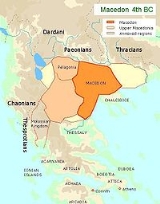
Ancient Macedonians

Encyclopedia
The Macedonians originated from inhabitants of the northeastern part of the Greek peninsula, in the alluvial plain around the rivers Haliacmon
and lower Axios
. Generally described as an ancient Greek people
, they gradually expanded from their homeland along the Haliacmon
valley on the northern edge of the Greek world, absorbing various neighbouring tribes during this process (primarily Thracian
and Illyrian
). Although composed of various clans, the Kingdom of Macedon, established around the 8th century BC, is mostly associated with the Argeads
, both the name of the ruling dynasty and of the tribe named after it. Traditionally ruled by independent families, the Macedonians seem to have accepted Argead rule by the time of King Alexander I
(r. 498–454 BC). Under King Philip II
(r. 359–336 BC), they are credited with numerous military innovations which led to the exploits of Alexander the Great, the establishment of several realms
from the Diadochi
, and the inauguration of Hellenistic civilization
.
, Makedon is the eponymous hero of Macedonia and is mentioned in Hesiod
’s Catalogue of Women. The first historical attestation of the Macedonians occurs in the works of Herodotus during the mid-5th century BC. The Macedonians are absent in Homer
’s Catalogue of Ships. In fact, the term "Macedonia" itself appears late. The Iliad states that, upon leaving Olympus, Hera journeyed via Pieria and Emathia before reaching Athos. This is later re-iterated by Strabo in his Geography.
In his A History of Macedonia, Nicholas G. L. Hammond reconstructed the earliest phases of Macedonian history, based on his interpretation of later literary accounts and archaeological excavations in the region of Macedonia. His work remains a point of reference for all scholars engaging in the subject.
According to Hammond, the Macedonians are missing from early Macedonian historical accounts because they had been living in the Orestian highlands since before the Dark Ages
, possibly having originated from the same (proto-Greek) population pool that produced other Greek peoples. The Macedonian tribes subsequently moved down from Orestis in the upper Haliacmon to the Pierian highlands in the lower Heliacmon due to pressure from the Orestae, a related tribe who had migrated to Orestis from Pelagonia
. In their new Pierian home, north of Olympus, the Macedonian tribes mingled with the "Dorians-to-be". This might account for traditions which placed the eponymous founder, Macedon, "round Pieria and Olympus". Certain traditions placed the Dorian homeland in the Pindus mountain range in western Thessaly, whilst Herodotus pushed this further north to the Macedonian Pindus, and "were called, as an ethnos, Mακεδνόν".
A different, southern homeland theory also exists in traditional historiography. By placing the Dorian "homeland" in Phthiotis, and citing the traditions of fraternity between Makedon and Magnetes, Arnold Joseph Toynbee has argued that the Makedones migrated north to Macedonia from central Greece.
(which certain scholars have attempted to connect with the villages Alebea or Velvedos). Here, the brothers served as humble shepherds for a local ruler. After a vision, the brothers fled to another region in Macedonia, near the Midas Gardens by the foot of Mount Bermion, and then set about subjugating the rest of Macedonia. Thucydides seems to echo Herodotus's account, making it probable that the story was disseminated by the Macedonian court, i.e. it accounts the belief the Macedonians themselves had about the origin of their kingdom, if not an actual memory of this beginning. Later historians modified the dynastic traditions by introducing variously Caranus or Archelaus as the founding Temenid kings.
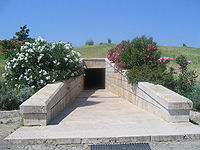 The earliest sources, Herodotus and Thucydides, called the royal family Temenidae. It is only in later sources that the term "Argeadae" was introduced (e.g. Strabo, Appian, Pausanias). However, Appian suggests that the term Argeadae referred to a leading Macedonian tribe rather than the name of the ruling dynasty. The origin of the name "Argeadae" is itself unclear. The most common connection, as propounded by Herodotus, is with Peloponessian Argos. Appian, rather, connects it with Orestian Argos. Another tradition suggests the name was adopted after Caranus moved Macedonia's capital from Edessa to Agea, thus appropriating the name of the city for its citizens. A figure, Argeas, is mentioned in the Iliad, raising the possibility that the Macedonian kings (like many other Mediterranean populations) derived their genealogy from Trojan War
heroes.
Taking Herodotus's lineage account as the most trustworthy, Appian recalls that, after Perdiccas
, six successive heirs ruled: Argeus, Philip, Aeropus, Alcetas, Amyntas and Alexander. Amyntas I ruled at the time of the Persian invasion of Paeonia. However, Alexander I is the first truly historic figure. Based on this line of succession, and an estimated 25 to 30-year average ruling period, the beginnings of the Macedonian dynasty have thus been traditionally dated to 750 BC. Hammond upholds the traditional view that the Temenidae did, in fact, arrive from the Peloponnese and took charge of Macedonian leadership, possibly usurping rule from a native "Argead" dynasty with Illyrian help. However, other scholars doubt the veracity of their Peloponnesian origins. For example, Hatzopoulos takes Appian's testimony to suggest that the royal lineage imposed itself onto the tribes of the Middle Heliacmon from Argos Orestikon, whilst Borza suggested that the Argeads were a family of notables hailing from Vergina itself.
and Pieria
were mostly occupied by Thracians (Pierians, Paeonians) and Bottiaeans
, as well as certain Illyrian and Epirote tribes, whilst Herodotus relates that the Bryges were co-habitants with the Macedonians prior to their bulk migrating to Asia Minor
.
If there was indeed a group of ethnically definable Macedonian tribes living in the Pierian highlands prior to their expansion, the first conquest was of the Pierian piedmont and coastal plain, including Vergina, possibly launching their expansion from a base by Mount Bermion, as mentioned by Herodotus.
Thucydides describes the Macedonian expansion specifically as a process of conquest led by the Argeadae:
Thucydides's account gives a geographical overview of Macedonian possessions at the time of Alexander I’s rule. To reconstruct a chronology of the expansion by Alexander I's predecessors is more difficult, but generally, three stages have been proposed from Thucydides's reading. The initial and most important conquest was of Pieria and Bottiaei, including Pydna
and Dium followed by a second stage which consolidated rule in Pieria, Bottiaea, captured Methone and Pella, and extended rule over Eordaea and Almopia. By Hammond's reckoning, the third stage occurred some time after 550 BC, whereby the Macedonians wrested control over Mygdonia, Edonia
, lower Paeonia, Bisaltia
and Crestonia
. However, the second stage might have occurred as late as 520 BC; and the third stage probably did not occur until after 479 BC, whereby the Macedonians capitalized on the weakened Paeonian state after the Persian withdrawal.
Whatever the case, Thucydides's description of the Macedonian state relays the accumulated territorial extent by the rule of Perdiccas II, Alexander I’s son. Hammond has contended that the early stages of Macedonian expansion were particularly militaristic, expunging populations, or at least subduing them, from a large and varied area. It has been hypothesized that the cause of Macedonian expansion was demographic pressure. Given that pastoralism and highland living could not support a very concentrated settlement density, pastoralist tribes often searched for more arable lowlands suitable for agriculture.
Similarly, the historicity of migration, conquest and population expulsion have also been called into question. Thucydides's account of the forced expulsion of the Pierians and Bottiaeans could have been formed on the basis of his perceived similarity of names of the Pierians and Bottiaeans living in the Strymon valley with the names of regions in Macedonia; whereas his account of Eordean
extermination was formulated precisely because such toponymic correspondences are lacking. Likewise, the Argead conquest of Macedonia may be viewed as a commonly used literary topos in classical Macedonian rhetoric: tales of migration served to create complex genealogical connections between trans-regional ruling elites, whilst at the same time used by the ruling dynasty to legitimize their rule, heroicize mythical ancestors, and distance themselves from their subjects.
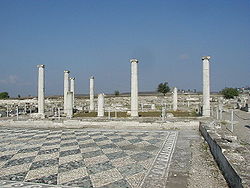 Conflict was a historical reality in the early Macedonian kingdom and pastoralist traditions allowed the potential for population mobility (Greek archaeologists have found that some of the passes linking the Macedonian highlands with the valley regions have been used for thousands of years). However, the archaeological evidence does not point to any significant disruptions between the Iron Age and Hellenistic periods in Macedonia. The general continuity of material culture, settlement sites, and pre-Greek onosmaticon mitigate against the traditional "ethnic cleansing" account of early Macedonian expansion.
The process of state formation in Macedonia was in many ways analogous to its neighbours in Epirus, Illyria, Thrace, and Thessaly, whereby regional elites could mobilize disparate communities for the purpose of organizing land and resources. Local notables were often based in urban-like settlements, although contemporary historians often did not recognize them as poleis (because they were not self-ruled but under the rule of a "King"). From the mid-6th century, there appears a series of exceptionally rich burials throughout the region – in Trebenista
, Vergina
, Sindos
, Agia Paraskevi, Pella
-Archontiko, Aiani
, Gevgelija
, Amphipolis
– sharing a similar burial rite and grave accompaniments, interpreted to represent the rise of a new regional ruling class sharing a common ideology, customs and even religious beliefs. A common geography, mode of existence, and defensive interests might have necessitated the creation of a political confederacy amongst otherwise ethno-linguistically diverse communities; which led to the consolidation of a new, "Macedonian", ethnic identity.
The traditional view that Macedonia housed un-urbanized ethne in constant conflict is thus slowly changing, bridging the cultural gap between southern Epirus and the north Aegean region. Hatzopoulos's studies on Macedonian institutions have lent support to the hypothesis of Macedonian state formation occurring via an "integration" of regional elites which were based in city-like centres, including the Argeadae at Vergina, and the Paeonia
n/Edoni
an peoples in Sindos, Ichnai and Pella, as well as the mixed Macedonian-"Barbarian" colonies in the Thermaic Gulf and western Chlakidike. The Temenidae became overall leaders of a new Macedonian state due to the diplomatic proficiency of Alexander I and the logistic centrality of Vergina itself. It has been suggested that a breakdown in traditional "Balkan" tribal traditions associated with adaptation of certain "Aegean" socio-political institutions created a climate of institutional flexibility in a vast, resource-rich land. Non-Argead centres increasingly became "dependent allies", allowing the Argeads to gradually extract a more secure control over the lower and eastern territories of Macedonia. However, this control was only really consolidated by Phillip II.
 Macedonia possessed a distinct material culture by the Early Iron Age. Typically "Balkan" burial, ornamental, and ceramic forms were used for most of the Iron Age. These features suggest broad cultural affinities and organizational structures analogous with Thracian, Epirote, and Illyrian regions. This, however, did not necessarily symbolize a sharing of common identity or political allegiance. Toward the latter 6th century BC, Macedonia became more open to Greek influences from the south, although a small but detectable amount of interaction with the south had been present since late Mycenaean times. By the 5th century BC, Macedonia was a part of the "Greek cultural milieu", possessing many cultural traits typical of the southern Greek city-states. Classical Greek objects and customs were appropriated selectively and utilized in peculiarly "Macedonian" ways.
led a way of life which differed little from that of their neighbors in Epirus
and Illyris
, engaging in seasonal transhumance supplemented by agriculture. In these mountainous regions, upland sites served as important focal points for local communities, so-called "tribal centers". In these difficult terrains, competition for resources often precipitated inter-tribal conflict and raiding forays into the comparatively richer lowland settlements of coastal Macedonia and Thessaly
. Despite the remoteness of the upper Macedonian highlands, excavations at Aiani
since 1983 have brought to light finds attesting to the presence of social organization since the 2nd millennium BC
. The excavations have unearthed the oldest pieces of black-and-white pottery, characteristic of the tribes of northwest Greece, discovered so far. Found with Μycenaean
sherd
s, they can be dated with certainty to the 14th century BC. The findings also include some of the oldest samples of writing in Macedonia, among them inscriptions bearing Greek names like Θέμιδα (Themida). The inscriptions demonstrate that Hellenism in Upper Macedonia
was at a high economic, artistic, and cultural level by the 6th century BC, overturning the notion that Upper Macedonia was culturally and socially isolated from the rest of ancient Greece.
By contrast, the alluvial plains of Lower Macedonia
and Pelagonia
favored the development of a native aristocracy with a wealth which at times surpassed the classical Greek poleis. There was a comparative abundance of natural resources, such as timber and minerals. Exploitation of mineral mines helped catalyze coinage in Macedonia from the 5th century BC, developing under southern Greek, Thracian and Persian influences. In contrast with classical Greek poleis, the Macedonians generally possessed very few slaves.
During the Late Bronze Age (circa 15th century BC), the ancient Macedonians developed distinct matt-painted wares that evolved from Middle Helladic pottery traditions originating in central and southern Greece. The Macedonians continued to utilize an individualized form of material culture (albeit showing analogies in ceramic, ornamental and burial forms with the so-called Lausitz culture between 1200–900 BC) and that of the Glasinac culture
after circa 900 BC. Whilst some of these influences persisted beyond the 6th century BC, a more ubiquitous presence of items of an Aegean-Mediterranean character is observed from the latter 6th century BC, as Greece recovered from its "Dark Ages
". The avenues by which southern Greek impulses penetrated Macedonia were via trade with north Aegean colonies such as Methone
and those in the Chalcidice
, neighbouring Thessaly, and from the Ionic colonies Asia Minor. Later, Ionic influences were supplanted by those of Athenian provenance. Thus, by the latter 6th century local elites were able to acquire "exotic" Aegean items such as Athenian red figure pottery
, fine tablewares, olive oil and wine amphorae, fine ceramic perfume flasks, glass, marble and precious metal ornaments; which would serve as status symbols. By the 5th century BC, they become rather widespread; not only in Macedonia, but also in much of the central Balkans.
Macedonian settlements bear a strong continuity dating back to the Bronze Age. While settlement numbers appeared to drop in central and southern Greece after 1000 BC, there is a dramatic increase in Macedonia, keeping traditionally used house construction techniques. These settlements seemed to have developed on raised promontories near river flood plains, and are called tells (Greek: τύμβοι). They are particularly focused in western Macedonia (between Florina and Lake Vergiotis, the upper and middle Heliacmon River, and down to Bottiaea). The other focus is in eastern Macedonia, on either side of the Axius and in the Chalcidice. Urbanization was encouraged and controlled by Macedonian kings. Whilst a comparatively meager number of Macedonians lived in the few native Macedonian cities (e.g. Aegeae, Pella
, Dion), urbanization increased by the 4th century BC as Greek colonies were conquered and integrated into Macedonia, or new towns were founded (such as Philippi
, Thessalonike
and Alexandropolis). These towns possessed typical Greek urban infrastructural features, such as gymnasia, temples and theaters.
An important aspect of Macedonian social life were court symposia, which were characterized by heavy drinking (of apparently unmixed wine), feasting, and general debauchery. Symposia had several functions, amongst which was providing relief from the hardship of battle and marching. Symposia were Greek traditions since Homeric times, providing a venue for interaction amongst Macedonian elites. An ethos of egalitarianism surrounded symposia, allowing all male elites to express ideas and concerns, although built-up rivalries and excessive drinking often led to quarrels, fighting and even murder. The degree of extravagance and propensity for violence set Macedonian symposia apart from classical Greek symposia. Like symposia, hunting was another focus of elite activity, and it remained popular throughout Macedonia’s history. Although the Macedonians created their own athletic games and, after the late 4th century, non-royal Macedonians competed and became victors in the Olympic Games and other athletic events such as the Argive Hera
ean games, athletics were a less favored pastime compared to hunting.
Nevertheless, Alexander the Great sponsored athletic contests for his men; along with other facets of cultural life, such as philosophy and theatre, which increasingly incorporated Macedonia into the Greek world. Atticization was seen as early as King Archelaus's
reign, who welcomed southern Greek intellectuals into the kingdom. Athenian playwrights such as Euripides
and Agathon
and the famous painter Zeuxis, all were influential in the early kingdom. Euripides wrote his last two tragedies at Archelaus's court.
 The ancient Macedonians worshipped the Olympic Pantheon, especially Zeus
, Artemis
, Heracles
and Dionysus
. Evidence of this worship is attested from the beginning of the 4th century BC onwards, as there exists little evidence regarding Macedonian religious practices from earlier times. From an early period, Zeus was the single most important deity in the Macedonian pantheon. Macedon, the mythical ancestor of the Macedonians, was held to be a son of Zeus, and Zeus features prominently in Macedonian coinage. The most important center of worship of Zeus was at Dion in Pieria
, the spiritual center of the Macedonians, where beginning in 400 BC King Archelaus
established an annual festival in honor of Zeus and featuring lavish sacrifices and athletic contests. Worship of Zeus's son Heracles
was also prominent, with coins featuring Heracles appear from the 5th century BC onwards. This was in large part because the Argead
kings of Macedon traced their lineage to Heracles, making sacrifices to him in the Macedonian capitals of Vergina
and Pella
. Numerous votive reliefs and dedications also attest to the importance of the worship of Artemis. Artemis was often depicted as a huntress and served as a tutelary goddess for young girls entering the coming-of-age process, much as Heracles Cynagidas (Hunter) did for young men who had completed it. By contrast, some deities popular elsewhere in the Greek world, notably Poseidon
and Hephaistos, were largely ignored by the Macedonians.
Other deities worshipped by the ancient Macedonians were part of a local pantheon: Thaulos (god of war equated with Ares); Gyga (later equated with Athena; Gozoria (goddess of hunting equated with Artemis); Zeirene (goddess of love equated with Aphrodite); Xandos (god of light); Totoës (god of sleep); Darron (god of healing); Aretos (local version of Heracles); Bedu (from Edessa
; god of water or air); the Echédorides (nymphs); the Arantides (possibly the Furies); the Sauadai (water spirits or demons identified with the Satyrs); Pasikraia (a goddess attested in Macedonia and Thessaly); and Sabazius-Dionysus (a Thracian god). A notable influence on Macedonian religious life and worship was neighboring Thessaly; the two regions shared many similar cultural institutions. The Macedonians also worshiped non-Greek gods, such as the "Thracian rider", Orpheus
and Bendis
, and other Balkan cult figures. They were tolerant of, and open to incorporating, foreign religious influences, such as the sun-cult worship of the Paeonians. By the 4th century BC, there had been a significant fusion of Macedonian and common Greek religious identity, but Macedonia was nevertheless characterized by an unusually diverse religious life. This diversity extended even to the belief in magic, as attested by curse tablets. It was a not an insignificant, but secret aspect of Greek cultural practice.
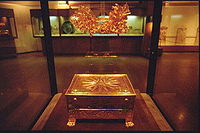
A notable feature of Macedonian culture was the ostentatious burials reserved for its rulers. The Macedonian elite chose to construct lavish tombs at time of death rather than construct temples during life. Such traditions had been practiced throughout Greece and the central-west Balkans since the Bronze Age
, and Macedonian burials contain items similar to those at Mycenae (burial with weapons, gold "death masks", etc). From the 6th century, Macedonian burials became particularly lavish, displaying a rich variety of Greek imports, reflecting the incorporation of Macedonia into a wider economic and political network centred on the Aegean city-states. Burials contained a repertoire of jewelery and ornaments of unprecedented wealth and artistic style. This zenith of Macedonian "warrior burial" style drew close parallels with sites in south-central Illyria and western Thrace, creating a koinon of elite burials. Lavish warrior burials had been discontinued in southern and central Greece from the 7th century onwards, where offerings at sanctuaries and the erection of temples instead became the norm. From the 6th century BC, cremation replaced the traditional inhumation rite for elite Macedonians. One of the most lavish tombs is one dated to the 4th century at Vergina
, believed to be that of Phillip II. It contains extravagant grave goods, highly sophisticated artwork depicting hunting scenes and Greek cultic figures, and a vast array of weaponry. This demonstrates a continuing tradition of the "warrior society" rather than a focus on religious piety and "technology of the intellect" which had become paramount facets of central Greek society in the classical period.
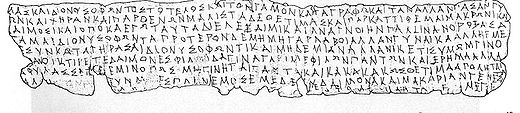 For administrative and political purposes, Attic Greek
seems to have operated as a lingua franca
amongst the ethno-linguistically diverse communities of Macedonia and the north Aegean region, creating a diglossic linguistic area
. Attic Greek was standardized as the language of the court, formal discourse and diplomacy from at least the time of Archelaus
at the end of the 5th century BC. Attic was further spread by Macedonia's conquests. Although Macedonian continued to be spoken well into Antigonid
times, Attic became the prevalent oral dialect not only in Macedonia, but throughout the Macedonian-ruled Hellenistic world.
Attempts to classify Ancient Macedonian are made difficult by the paucity of surviving Ancient Macedonian texts, as it was a primarily oral language and most archeological inscriptions indicate that there was no dominant written language in Macedonia other than Attic, and later Koine Greek
. Classification attempts are based on a vocabulary of 150-200 words and 200 personal names assembled mainly from the 5th century lexicon of Hesychius of Alexandria
, as well as a few fragmentary surviving inscriptions, coins, and the occasional passage in ancient sources. Most of the vocabulary is regular Greek, with tendencies toward Doric Greek
and Aeolic Greek
; on the other hand, there can be found some Illyrian and Thracian
elements. The Pella curse tablet, which was found in 1986 at Pella
and dates to the mid-4th century BC or slightly earlier, is believed to be the only substantial attested text in Macedonian. The language of the tablet is a harsh but a distinctly recognizable form of Northwest Greek: the tablet, therefore, has been used to support the argument that ancient Macedonian was a Northwest Greek dialect, whilst Hatzopoulos's analysis revealed some tendencies toward the Aeolic Greek
dialect. Macedonian onomastics paint a similar picture, most personal names being recognizably Greek (e.g. Alexandros, Philippos, Dionysios, Apollonios, Demetrios), with some dating back to Homeric (e.g. Ptolemaeos) or even Mycenean times, though here too there can be found the occasional non-Greek name (e.g. "Bithys"). Nevertheless, a definitive conclusion eludes the linguistic community. On the one hand, Macedonian shares close structural and lexical affinity with the "proper" Greek dialects (especially Northwest Greek and Thessalian) The majority of the words are Greek
, although some of these could represent loans or cognate
forms. On the other hand, a number of phonological, lexical and onomastic features also set Macedonian apart. These latter features, possibly representing traces of a substratal language, occur in what are considered to be particularly conservative systems of the language.
Several hypotheses have consequently been proposed as to the overall "position" of Macedonian, but all broadly see it either as a peripheral Greek dialect, a separate yet related language (see Hellenic languages
), or even a hybridized idiom. Drawing on the similarities between Macedonian, Greek and Brygian, several scholars suggest that they formed an Indo-European macro-dialectical group which split before circa 14th-13th century BCE (i.e. prior to the appearance of the main Greek dialects). The same data has been analyzed in alternative manner, which sees the formation of the main Greek dialects as a later convergence of related but distinct groups. Macedonian did not fully participate in this process, making its ultimate position difficult to define other than being a contiguous, related 'minor' language.
Another stream of evidence is metalinguistics and the question of mutual intelligibility. The available literary evidence cannot provide detail as to the exact nature of Macedonian, however, it does suggest that Macedonian and Greek were sufficiently different to pose communication difficulties between Greek and Macedonian contingents, even necessitating the use of interpreters as late as the time of Alexander the Great. Based on this evidence, Papazoglou has argued that, by definition, Macedonian could not have been a Greek dialect. Nevertheless, Edward Anson points out that "whatever may be meant by stray allusions to spoken 'Macedonian', all surviving epigraphical evidence from grave markers to public inscriptions is in Greek".
 During the Archaic period, regional tribes fused together into a larger unit of Macedonians, and the army functioned as the most effective social institution of creating a common Macedonian identity with the kings as supreme commanders. Nevertheless, Anson argues that the term "Macedonian" was used to refer to all the inhabitants of the region.
Most ancient sources on the Macedonians come from outside of Macedonia. According to Eugene N. Borza, most of these sources are either ill-informed, hostile, or both, making the Macedonians one of the "silent" peoples of the ancient Mediterranean. Moreover, most ancient sources tend to focus on the deeds of Macedonian kings in connection with political and military events such as the Peloponnesian War
, and evidence on the ethnic identity of Macedonians of lower social status is highly fragmentary and unsatisfactory from the Archaic to the Hellenistic period.
How the Macedonians related to their neighbors is complicated by the fact that, both Hellenic and Macedonian identities were "extremely complex and fluid social constructions" "constantly subject to negotiation and renegotiation in an ongoing political process." Yet, a glimpse of the nature of the Macedonians' relationship with southern Greeks may be gleaned from the available literary sources. Most of the literary evidence tends to come from later sources focusing on the campaigns of Alexander the Great rather than on Macedonia itself, while most contemporary evidence on Philip tends to be Athenian and hostile. For Macedonia before Philip, historians have to rely on archeological inscriptions and material remains, a few fragments from historians whose work is now lost, the occasional passing mention in Herodotus
and Thucydides
, and "universal histories" from the Roman era.
There was an "evolving view" of the Macedonians as seen by the Greek poleis. By and large, the Macedonians were not seen as "true Hellenes" until after the death of Alexander the Great, and throughout the Classical era, most Greeks distinguished themselves from Macedonians. The gulf between Macedonians and Greeks was only bridged when both parties found themselves threatened by a new, western "barbarian" – Rome. As Danforth summarizes: "It is with the emergence of Rome as a common enemy in the west that the Macedonians came to be regarded as 'northern Greeks'. This is precisely the period during which ancient authors, such as Polybius
and Strabo
, did refer to the ancient Macedonians as Greeks." The reasons for such an evolution remain subject to debate: that is, whether the repeated denial of Macedonian Hellenicity during the Classical era represented a true ethnic distinction between Macedonians and southern Greeks, a cultural "otherness" between the archaic institutions of the Macedonians and those of the poleis, and/or political animosity between ideologically oppositional regimens. Indeed, much of the ambiguity about the Macedonians' ethnic identity, and sharp contrast between "Macedonians" and "Greeks" comes from a small group of patriotic Athenian orators and historians. As a point of comparison, Engels suggests the Greekness of the Epirotes, who led a similarly 'archaic' life as the Macedonians, never drew a sharp discussion as with the Macedonians, perhaps because the Epirotes, unlike the Macedonians, never attempted to achieve hegemony over all of Greece. Whatever the case, the degree of antipathy between Macedonians and Greeks was of different quality than that seen amongst other Greek states with a long-term history of mutual animosity (e.g. Sparta and Athens).
The identity of the Argeads is generally examined separately from the Macedonian ethnos as a whole. The earliest version of the Temenid foundation myth was circulated by Alexander I, via Herodotus, during his apparent appearance at the Olympic Games. Despite protests from some competitors, the Hellanodikai
("Judges of the Greeks") accepted Alexander’s Greek genealogy, as did Herodotus himself, and later Thucydides. In accepting his Greek credentials, the judges were either moved by the evidence itself, or did so out of political considerations - as reward for services to Hellas. The historicity of Alexander I’s participation in the Olympics has been doubted by some scholars (Alexander’s name does not appear in any list of Olympic victors), who see the story as a piece of propaganda engineered by the Argeads and spread by Herodotus. Moreover, that there were protests from other competitors suggests that the supposed Argive genealogy of the Argeads "was far from mainstream knowledge"; and the appellation "Philhelene" was "surely not an appellation that could be given to an actual Greek". Whatever the case, "what mattered was the Alexander had played the geneaological game a la grecque and played it well".
The emphasis on the Heraklean ancestry of the Argeads served to heroicize the royal family and to provide a sacred genealogy which established a "divine right to rule" over their subjects. The Macedonian royal family, like those of Epirus, emphasized "blood and kinship in order to construct for themselves a heroic genealogy that sometimes also functioned as a Hellenic genealogy."
Although most contemporary Greek writers accepted the Argeads as Greek, they nevertheless expressed an air of ambiguity about them (specifically their monarchic institutions and their background of Persian alliance) often portraying them as a potential "barbarian" threat to Greece. For example, the late 5th century sophist, Thrasymachus of Chalcedon, objected "we Greeks are enslaved to the barbarian Archelaus" (Fragment 2).
The issue of Macedonian Hellenicity, and that of their royal house, was particularly pertinent in the 4th century BCE, around the politics of invading Persia. Demosthenes viewed Macedonia's monarchy to be incongruous with an Athenian-led Pan-Hellenic alliance. He thus castigated Philip II for being "neither Greek nor a remote relative of the Greeks, nor even a respectable barbarian, but one of those cursed Macedonians..." This was obvious political slander, but "the orator clearly could not do this, if his audience was likely to regard his claim as nonsense: it could not be said of a Theban, or even a Thessalian". On the other hand, Isocrates believed that only Macedonia was capable of leading a war against Persia, thus felt compelled to uphold that Phillip was a "bona fide" Hellene by discussing his Argead and Heraclean heritage.
With regard to how the Macedonian ethnos as a whole was regarded by the Greeks, the earliest reference comes from Hesiod's Catalogue of Women
. The eponymous Makedon, and his brother Magnes, are made sons of Zeus and Thyia, daughter of Deucalion. Descent form Zeus did not make one a Greek, but having been fathered by Hellen himself did. Thus, although Engels interpreted that Hesiod counted the Macedonians as Greeks, Hall stipulates that "according to strict genealogical logic, [this] excludes the population that bears [Macedon’s] name from the ranks of the Hellenes". Later writers also deny Macedon a Hellenic lineage: Apollodorus (3.8.1) makes him a son of Lycaon, son of earth-born Pelasgus, whilst Pseudo–Scymnos (6.22) makes him born directly from the earth. Hellanicus, on the other hand, produced a genealogy which made Makedon the son of Aeolus, thus implying that the Macedonians were Greeks, mostly related to the Aeolians.
These early writers and their formulation of genealogical relationships demonstrate that, prior to the 5th century, Greekness was defined on an ethnic basis and legitimized by tracing descent from eponymous Hellen. Subsequently, cultural considerations assumed greater importance.
Thucydides and Herodotus regarded the Macedonians either as northern Greeks, barbarians, or an intermediate group between "pure" Greeks and barbarians. For Herodotus, Hellenicity and ethnicity were firmly bounded and culturally determined categories. In his Histories, Herodotus recalls a reliable tradition whereby the Dorians were formed by a fusion of Macedonian and other Greek tribes, suggesting that Macedonians were Greeks. In other sections of his work, however, Herodotus implies that the Macedonians are not Greek: in 5.20.4, he calls King Amyntas an aner Hellen Makedon hyparchos, or "a Greek who ruled over Macedonians", and in 7.130.3 where Herodotus tells that the Thessalians were the "first of the Greeks" to submit to Xerxes.
Thucydides's classification of "barbarian" versus "Greek" operated on an relative rather than absolute basis. That is, Thucydides did not perceive Greeks and barbarians as mutually exclusive categories, rather opposite poles on a linear spectrum. He placed the Macedonians on his cultural continuum closer to barbarians than Hellenes, or perhaps an intermediate category between Greeks and non–Greeks. For example, he distinguishes between three groups fighting in the Peloponnesian War
: The Greeks (including Peloponnesians), the barbarian Illyrians, and the Macedonians. In recounting Brasidas's expedition to Lyncus, he juxtaposes the Macedonian cavalry with "the rest of the huge barbarian throng". Whilst this calls them barbarians by association, more explicit is his recounting of Brasidas's speech where he tells his Peloponnesian troops to dispel fear of fighting against "barbarians: because they had already fought against Macedonians".
Ancient geographers differed in their views on the size of Macedonia and on the ethnicity of the Macedonians. While most ancient geographers did not include the core territories of the Macedonian kingdom in their definition of Greece, the reasons are unknown. For example, Strabo
says that while "Macedonia is of course part of Greece, yet now, since I am following the nature and shape of the places geographically, I have chosen to classify it apart from the rest of Greece". While he speaks of the "Macedonians and the other Greeks", Pausanias did not include Macedonia in Hellas as indicated in Book 10 of his Description of Greece.
 As noted above, Isocrates defended Philip's Greek origins, but was not inclined to think the same of his people: "He (Perdiccas I) left the Greek world alone completely, but he desired to hold the kingship in Macedonia; for he understood that Greeks are not accustomed to submit themselves to monarchy whereas others are incapable of living their lives without domination of this sort...for he alone of the Greeks deemed it fit to rule over an ethnically unrelated population." Nevertheless, Philip named the federation of Greek states he created with Macedon at its head (nowadays referred to as the League of Corinth
) as simply "The Hellenes" (i.e. Greeks), and the Macedonians were moreover granted two seats in the exclusively Greek Great Amphictyonic League
in 346 BC when the Phocians were expelled; although Badian sees it as a personal honor awarded to Phillip, and not to the Macedonian people as a whole.
With Philip's conquest of Greece, Greeks and Macedonians both enjoyed privileges at the royal court, and there was no social distinction amongst his court hetairoi, although Philip's armies were only ever led by Macedonians. The process of Greek and Macedonian syncretism culminated during the reign of Alexander the Great, and he even allowed Greeks to command his armies. However, there was also some persisting antagonism between Macedonians and Greeks lasting into Antgonid times. Some "Greeks" continued to push against their Macedonian overlords throughout the Hellenistic era. They rejoiced on the death of Phillip II; and they revolted against Alexander's Antigonid successors, which the Greeks called, revealingly, the Hellenic War. However, whilst Pan-Hellenic sloganeering was used by Greeks against Antigonid dominance, it was also used by Macedonians themselves to drum up popular support throughout Greece.
After the 3rd century BC, and especially in Roman times, the Macedonians were consistently regarded as Greeks. For example, Polybius has the Acarnanian Lyciscus tell the Spartans that they are "of the same tribe" as the Achaeans and the Macedonians. Livy, in his History of Rome, states that the Macedonians, Aetolians and Acarnanians were "all men of the same language". Similar opinions are shared also by Arrian and Strabo (7.7.1).
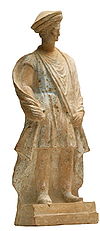
The Persians referred to both Greeks and Macedonians as Yauna ("Ionians", their term for "Greeks"), though they distinguished the "Yauna by the sea and across the sea" from the Yaunã Takabara or "Greeks with hats that look like shields", possibly referring to the Macedonian kausia
hat. According to another interpretation, the Persians used such terms in a geographical rather than ethnic sense. That is, Yauna, and its various attributes, possibly referred to regions lying north and west of Asia Minor; and could have included Phrygians, Mysians, Aeolians, Thracians, and Paionians in addition to Greeks. In Hellenistic times, most Egyptians and Syrians included the Macedonians among the larger category of "Greeks" without hesitations, as the Persians had done earlier.
While there is a general consensus among contemporary scholars that the ancient Macedonians were of Greek stock, some specialist literature notes that Greeks of the classical period often doubted the Hellenic lineage of Macedonians. Some scholars interpret this as evidence that the Macedonians were not Hellenes but were gradually accepted as such. Others, such as Ian Worthington, argue that "...not much need to be said about the Greekness of ancient Macedonia: it is undeniable", explaining the apparent animosity between Macedonians and Greeks as "political". One recent ethnological essay by Jonathan M. Hall has highlighted that the issue of Macedonian identity has, in the past, been "phrased in anachronistic terms conditioned by the vocabulary of nationalism and the modern nation-state". Hall adds: "to ask whether the Macedonians "really were" Greek or not in antiquity is ultimately a redundant question given the shifting semantics of Greekness between the 6th and 4th centuries BC. What cannot be denied, however, is that the cultural commodification of Hellenic
identity that emerged in the 4th century might have remained a provincial artifact, confined to the Balkan peninsula, had it not been for the Macedonians."
Haliacmon
The Haliacmon is the longest river in Greece, with a total length of . Haliacmon is the traditional English name for the river, but many sources cite the formerly official Katharevousa version of the name, Aliákmon...
and lower Axios
Vardar
The Vardar or Axios is the longest and major river in the Republic of Macedonia and also a major river of Greece. It is long, and drains an area of around . The maximum depth of river is ....
. Generally described as an ancient Greek people
Ancient Greece
Ancient Greece is a civilization belonging to a period of Greek history that lasted from the Archaic period of the 8th to 6th centuries BC to the end of antiquity. Immediately following this period was the beginning of the Early Middle Ages and the Byzantine era. Included in Ancient Greece is the...
, they gradually expanded from their homeland along the Haliacmon
Haliacmon
The Haliacmon is the longest river in Greece, with a total length of . Haliacmon is the traditional English name for the river, but many sources cite the formerly official Katharevousa version of the name, Aliákmon...
valley on the northern edge of the Greek world, absorbing various neighbouring tribes during this process (primarily Thracian
Thracians
The ancient Thracians were a group of Indo-European tribes inhabiting areas including Thrace in Southeastern Europe. They spoke the Thracian language – a scarcely attested branch of the Indo-European language family...
and Illyrian
Illyrians
The Illyrians were a group of tribes who inhabited part of the western Balkans in antiquity and the south-eastern coasts of the Italian peninsula...
). Although composed of various clans, the Kingdom of Macedon, established around the 8th century BC, is mostly associated with the Argeads
Argead dynasty
The Argead dynasty was an ancient Greek royal house. They were the ruling dynasty of Macedonia from about 700 to 310 BC. Their tradition, as described in ancient Greek historiography, traced their origins to Argos, in southern Greece...
, both the name of the ruling dynasty and of the tribe named after it. Traditionally ruled by independent families, the Macedonians seem to have accepted Argead rule by the time of King Alexander I
Alexander I of Macedon
- Biography :Alexander was the son of Amyntas I and Queen Eurydice.According to Herodotus, he was unfriendly to Persia, and had the envoys of Darius I killed when they arrived at the court of his father during the Ionian Revolt...
(r. 498–454 BC). Under King Philip II
Philip II of Macedon
Philip II of Macedon "friend" + ἵππος "horse" — transliterated ; 382 – 336 BC), was a king of Macedon from 359 BC until his assassination in 336 BC. He was the father of Alexander the Great and Philip III.-Biography:...
(r. 359–336 BC), they are credited with numerous military innovations which led to the exploits of Alexander the Great, the establishment of several realms
Hellenistic period
The Hellenistic period or Hellenistic era describes the time which followed the conquests of Alexander the Great. It was so named by the historian J. G. Droysen. During this time, Greek cultural influence and power was at its zenith in Europe and Asia...
from the Diadochi
Diadochi
The Diadochi were the rival generals, family and friends of Alexander the Great who fought for the control of Alexander's empire after his death in 323 BC...
, and the inauguration of Hellenistic civilization
Hellenistic civilization
Hellenistic civilization represents the zenith of Greek influence in the ancient world from 323 BCE to about 146 BCE...
.
Early history
The expansion of the Macedonian kingdom has been described as a three-staged process. As a "frontier" kingdom on the border of the Greek world and "Barbarian" Europe, the Macedonians first subjugated their immediate neighbours to the north (various Illyrian and Thracian tribes) before turning against the states of southern and central Greece. Macedonia was then able to lead a largely Hellenic military force against their primary objective – the conquest of Persia – which they achieved with remarkable ease.Prehistoric "Homeland"
In Greek mythologyGreek mythology
Greek mythology is the body of myths and legends belonging to the ancient Greeks, concerning their gods and heroes, the nature of the world, and the origins and significance of their own cult and ritual practices. They were a part of religion in ancient Greece...
, Makedon is the eponymous hero of Macedonia and is mentioned in Hesiod
Hesiod
Hesiod was a Greek oral poet generally thought by scholars to have been active between 750 and 650 BC, around the same time as Homer. His is the first European poetry in which the poet regards himself as a topic, an individual with a distinctive role to play. Ancient authors credited him and...
’s Catalogue of Women. The first historical attestation of the Macedonians occurs in the works of Herodotus during the mid-5th century BC. The Macedonians are absent in Homer
Homer
In the Western classical tradition Homer , is the author of the Iliad and the Odyssey, and is revered as the greatest ancient Greek epic poet. These epics lie at the beginning of the Western canon of literature, and have had an enormous influence on the history of literature.When he lived is...
’s Catalogue of Ships. In fact, the term "Macedonia" itself appears late. The Iliad states that, upon leaving Olympus, Hera journeyed via Pieria and Emathia before reaching Athos. This is later re-iterated by Strabo in his Geography.
In his A History of Macedonia, Nicholas G. L. Hammond reconstructed the earliest phases of Macedonian history, based on his interpretation of later literary accounts and archaeological excavations in the region of Macedonia. His work remains a point of reference for all scholars engaging in the subject.
According to Hammond, the Macedonians are missing from early Macedonian historical accounts because they had been living in the Orestian highlands since before the Dark Ages
Greek Dark Ages
The Greek Dark Age or Ages also known as Geometric or Homeric Age are terms which have regularly been used to refer to the period of Greek history from the presumed Dorian invasion and end of the Mycenaean Palatial civilization around 1200 BC, to the first signs of the Greek city-states in the 9th...
, possibly having originated from the same (proto-Greek) population pool that produced other Greek peoples. The Macedonian tribes subsequently moved down from Orestis in the upper Haliacmon to the Pierian highlands in the lower Heliacmon due to pressure from the Orestae, a related tribe who had migrated to Orestis from Pelagonia
Pelagonia
This is about the geographical plain between Greece and the Republic of Macedonia. For the political unit in Macedonia, go to Pelagonia Statistical Region....
. In their new Pierian home, north of Olympus, the Macedonian tribes mingled with the "Dorians-to-be". This might account for traditions which placed the eponymous founder, Macedon, "round Pieria and Olympus". Certain traditions placed the Dorian homeland in the Pindus mountain range in western Thessaly, whilst Herodotus pushed this further north to the Macedonian Pindus, and "were called, as an ethnos, Mακεδνόν".
A different, southern homeland theory also exists in traditional historiography. By placing the Dorian "homeland" in Phthiotis, and citing the traditions of fraternity between Makedon and Magnetes, Arnold Joseph Toynbee has argued that the Makedones migrated north to Macedonia from central Greece.
Temenids and Argeads
The Macedonian expansion is said to have been led by the Temenid ruling dynasty. Herodotus recounts that Perdiccas, the founder of the dynasty, was descended from the Heraclid Temenos. He left Argos with his two older brothers (Aeropus and Gayanes) and arrived, via Illyria, to Lebaea, a city in Upper MacedoniaUpper Macedonia
Upper Macedonia is a geographical and tribal term to describe the regions that became part of the kingdom of Macedon in the early 4th century BC. From that date, its inhabitants were politically equal to Lower Macedonians...
(which certain scholars have attempted to connect with the villages Alebea or Velvedos). Here, the brothers served as humble shepherds for a local ruler. After a vision, the brothers fled to another region in Macedonia, near the Midas Gardens by the foot of Mount Bermion, and then set about subjugating the rest of Macedonia. Thucydides seems to echo Herodotus's account, making it probable that the story was disseminated by the Macedonian court, i.e. it accounts the belief the Macedonians themselves had about the origin of their kingdom, if not an actual memory of this beginning. Later historians modified the dynastic traditions by introducing variously Caranus or Archelaus as the founding Temenid kings.
Trojan War
In Greek mythology, the Trojan War was waged against the city of Troy by the Achaeans after Paris of Troy took Helen from her husband Menelaus, the king of Sparta. The war is among the most important events in Greek mythology and was narrated in many works of Greek literature, including the Iliad...
heroes.
Taking Herodotus's lineage account as the most trustworthy, Appian recalls that, after Perdiccas
Perdiccas
Perdiccas was one of Alexander the Great's generals. After Alexander's death in 323 BC he became regent of all Alexander's empire.Arrian tells us he was son of Orontes, a descendant of the independent princes of the Macedonian province of Orestis...
, six successive heirs ruled: Argeus, Philip, Aeropus, Alcetas, Amyntas and Alexander. Amyntas I ruled at the time of the Persian invasion of Paeonia. However, Alexander I is the first truly historic figure. Based on this line of succession, and an estimated 25 to 30-year average ruling period, the beginnings of the Macedonian dynasty have thus been traditionally dated to 750 BC. Hammond upholds the traditional view that the Temenidae did, in fact, arrive from the Peloponnese and took charge of Macedonian leadership, possibly usurping rule from a native "Argead" dynasty with Illyrian help. However, other scholars doubt the veracity of their Peloponnesian origins. For example, Hatzopoulos takes Appian's testimony to suggest that the royal lineage imposed itself onto the tribes of the Middle Heliacmon from Argos Orestikon, whilst Borza suggested that the Argeads were a family of notables hailing from Vergina itself.
Expansion from the Core
Both Strabo and Thucydides recount that EmathiaEmathia
For the modern Greek prefecture, see ImathiaEmathia is an earliest and poetic name of Macedonia , but foremost it roughly corresponds to the district of Bottiaea around Pella.-Classical sources:...
and Pieria
Pieria
Pieria is one of the regional units of Greece. It is located in the southern part of Macedonia, in the Region of Central Macedonia. Its capital is the town of Katerini. Pieria is the smallest regional unit within Macedonia. The name Pieria originates from the ancient tribe and the ancient country...
were mostly occupied by Thracians (Pierians, Paeonians) and Bottiaeans
Bottiaeans
Bottiaeans or Bottiaei were an ancient people of uncertain origin, living in Central Macedonia. Sometime, during the Archaic period, they were expelled by Macedonians from Bottiaea to Bottike...
, as well as certain Illyrian and Epirote tribes, whilst Herodotus relates that the Bryges were co-habitants with the Macedonians prior to their bulk migrating to Asia Minor
Asia Minor
Asia Minor is a geographical location at the westernmost protrusion of Asia, also called Anatolia, and corresponds to the western two thirds of the Asian part of Turkey...
.
If there was indeed a group of ethnically definable Macedonian tribes living in the Pierian highlands prior to their expansion, the first conquest was of the Pierian piedmont and coastal plain, including Vergina, possibly launching their expansion from a base by Mount Bermion, as mentioned by Herodotus.
Thucydides describes the Macedonian expansion specifically as a process of conquest led by the Argeadae:
Thucydides's account gives a geographical overview of Macedonian possessions at the time of Alexander I’s rule. To reconstruct a chronology of the expansion by Alexander I's predecessors is more difficult, but generally, three stages have been proposed from Thucydides's reading. The initial and most important conquest was of Pieria and Bottiaei, including Pydna
Pydna
Pydna was a Greek city in ancient Macedon, the most important in Pieria. Modern Pydna is a small town and a former municipality in the northeastern part of Pieria regional unit, Greece. Since the 2011 local government reform it is part of the municipality Pydna-Kolindros, of which it is a...
and Dium followed by a second stage which consolidated rule in Pieria, Bottiaea, captured Methone and Pella, and extended rule over Eordaea and Almopia. By Hammond's reckoning, the third stage occurred some time after 550 BC, whereby the Macedonians wrested control over Mygdonia, Edonia
Edonia
Edonia was an area of ancient southern Thrace located to the east of Chalkidiki, between the Nestus and Strymon rivers. It was home to the Edoni people. The cities of Drabescus, Myrcinus, Amphipolis, and Eion were located in Edonia....
, lower Paeonia, Bisaltia
Bisaltia
Bisaltia or Bisaltica was an ancient region extending from the river Strymon and Lake Cercinitis on the east to Crestonia on the west. The eponymous inhabitants, known as the Bisaltae, were a Thracian people. The most important town in Bisaltia was the Greek city of Argilus...
and Crestonia
Crestonia
Crestonia was an ancient region immediately north of Mygdonia. The Echeidorus river, which flowed through Mygdonia into the Thermaic Gulf, had its source in Crestonia...
. However, the second stage might have occurred as late as 520 BC; and the third stage probably did not occur until after 479 BC, whereby the Macedonians capitalized on the weakened Paeonian state after the Persian withdrawal.
Whatever the case, Thucydides's description of the Macedonian state relays the accumulated territorial extent by the rule of Perdiccas II, Alexander I’s son. Hammond has contended that the early stages of Macedonian expansion were particularly militaristic, expunging populations, or at least subduing them, from a large and varied area. It has been hypothesized that the cause of Macedonian expansion was demographic pressure. Given that pastoralism and highland living could not support a very concentrated settlement density, pastoralist tribes often searched for more arable lowlands suitable for agriculture.
Ethnogenesis scenario
More recently, scholars have questioned the traditionalist perspective first set in place by Hammond, highlighting several inconsistencies. Instead, an alternative model of state and ethnos formation, promulgated by an alliance of regional elites, has recently been postulated, which re-dates the creation of Macedonian kingdom to the 6th century BCE. For example, direct literary, archaeological and linguistic evidence is lacking to support Hammond's contention that a distinct Macedonian ethnos had existed in the Haliacmon valley since the Bronze Age. Rather, his interpretation has been criticized as a "conjectural reconstruction" from what appears during later, historical times.Similarly, the historicity of migration, conquest and population expulsion have also been called into question. Thucydides's account of the forced expulsion of the Pierians and Bottiaeans could have been formed on the basis of his perceived similarity of names of the Pierians and Bottiaeans living in the Strymon valley with the names of regions in Macedonia; whereas his account of Eordean
Eordaea
This article is based on the article Eordea Province on the English Wikipedia, accessed on 13 September 2011.Eordeae was an ancient kingdom and later administrative unit of Ancient Macedonia...
extermination was formulated precisely because such toponymic correspondences are lacking. Likewise, the Argead conquest of Macedonia may be viewed as a commonly used literary topos in classical Macedonian rhetoric: tales of migration served to create complex genealogical connections between trans-regional ruling elites, whilst at the same time used by the ruling dynasty to legitimize their rule, heroicize mythical ancestors, and distance themselves from their subjects.
The process of state formation in Macedonia was in many ways analogous to its neighbours in Epirus, Illyria, Thrace, and Thessaly, whereby regional elites could mobilize disparate communities for the purpose of organizing land and resources. Local notables were often based in urban-like settlements, although contemporary historians often did not recognize them as poleis (because they were not self-ruled but under the rule of a "King"). From the mid-6th century, there appears a series of exceptionally rich burials throughout the region – in Trebenista
Trebeništa
Trebeništa is an ancient necropolis located in Macedonia., dating from the Iron Age around the 7th century BC It is located near the town of Ohrid, in the Republic of Macedonia. It is believed that the necropolis was used by the people from the ancient town of Lychnidos. Trebeništa was discovered...
, Vergina
Vergina
Vergina is a small town in northern Greece, located in the peripheral unit of Imathia, Central Macedonia. Since the 2011 local government reform it is part of the municipality Veroia, of which it is a municipal unit...
, Sindos
Sindos
Sindos is a suburb of Thessaloniki, Greece. It is home to the Alexandrio Technological Educational Institute of Thessaloniki and the Industrial Zone of the city. The suburb is part of the municipality of Delta.In antiquity, Sindos was noted by Herodotus Sindos (Greek: Σίνδος, Latin: Sindus, South...
, Agia Paraskevi, Pella
Pella
Pella , an ancient Greek city located in Pella Prefecture of Macedonia in Greece, was the capital of the ancient kingdom of Macedonia.-Etymology:...
-Archontiko, Aiani
Aiani
Aiani or Kalliani is a town and a former municipality in the Kozani peripheral unit, Greece. Since the 2011 local government reform it is part of the municipality Kozani, of which it is a municipal unit. It lies 20 km south of Kozani city...
, Gevgelija
Gevgelija
Gevgelija is a town with a population of 15,685 located in the very southeast of the Republic of Macedonia along the banks of the Vardar River, situated at the country's main border with Greece , the point which links the motorway from Skopje and three other former Yugoslav capitals with...
, Amphipolis
Amphipolis
Amphipolis was an ancient Greek city in the region once inhabited by the Edoni people in the present-day region of Central Macedonia. It was built on a raised plateau overlooking the east bank of the river Strymon where it emerged from Lake Cercinitis, about 3 m. from the Aegean Sea. Founded in...
– sharing a similar burial rite and grave accompaniments, interpreted to represent the rise of a new regional ruling class sharing a common ideology, customs and even religious beliefs. A common geography, mode of existence, and defensive interests might have necessitated the creation of a political confederacy amongst otherwise ethno-linguistically diverse communities; which led to the consolidation of a new, "Macedonian", ethnic identity.
The traditional view that Macedonia housed un-urbanized ethne in constant conflict is thus slowly changing, bridging the cultural gap between southern Epirus and the north Aegean region. Hatzopoulos's studies on Macedonian institutions have lent support to the hypothesis of Macedonian state formation occurring via an "integration" of regional elites which were based in city-like centres, including the Argeadae at Vergina, and the Paeonia
Paeonia
Paeonia or Paionia may refer to:*the generic name of the peony*the ancient tribe and kingdom of Paeonia , in today's northern Greece and the Republic of Macedonia*Paionia , a municipality in northern Greece...
n/Edoni
Edoni
The Edoni were a Thracian people who dwelt mostly between the Nestus and the Strymon rivers in southern Thrace, but also once dwelt west of the Strymon at least as far as the Axios. They inhabited the region of Mygdonia before the Macedonians drove them out...
an peoples in Sindos, Ichnai and Pella, as well as the mixed Macedonian-"Barbarian" colonies in the Thermaic Gulf and western Chlakidike. The Temenidae became overall leaders of a new Macedonian state due to the diplomatic proficiency of Alexander I and the logistic centrality of Vergina itself. It has been suggested that a breakdown in traditional "Balkan" tribal traditions associated with adaptation of certain "Aegean" socio-political institutions created a climate of institutional flexibility in a vast, resource-rich land. Non-Argead centres increasingly became "dependent allies", allowing the Argeads to gradually extract a more secure control over the lower and eastern territories of Macedonia. However, this control was only really consolidated by Phillip II.
Culture
Economy
The inhabitants of Upper MacedoniaUpper Macedonia
Upper Macedonia is a geographical and tribal term to describe the regions that became part of the kingdom of Macedon in the early 4th century BC. From that date, its inhabitants were politically equal to Lower Macedonians...
led a way of life which differed little from that of their neighbors in Epirus
Epirus
The name Epirus, from the Greek "Ήπειρος" meaning continent may refer to:-Geographical:* Epirus - a historical and geographical region of the southwestern Balkans, straddling modern Greece and Albania...
and Illyris
Illyria
In classical antiquity, Illyria was a region in the western part of the Balkan Peninsula inhabited by the Illyrians....
, engaging in seasonal transhumance supplemented by agriculture. In these mountainous regions, upland sites served as important focal points for local communities, so-called "tribal centers". In these difficult terrains, competition for resources often precipitated inter-tribal conflict and raiding forays into the comparatively richer lowland settlements of coastal Macedonia and Thessaly
Thessaly
Thessaly is a traditional geographical region and an administrative region of Greece, comprising most of the ancient region of the same name. Before the Greek Dark Ages, Thessaly was known as Aeolia, and appears thus in Homer's Odyssey....
. Despite the remoteness of the upper Macedonian highlands, excavations at Aiani
Aiani
Aiani or Kalliani is a town and a former municipality in the Kozani peripheral unit, Greece. Since the 2011 local government reform it is part of the municipality Kozani, of which it is a municipal unit. It lies 20 km south of Kozani city...
since 1983 have brought to light finds attesting to the presence of social organization since the 2nd millennium BC
2nd millennium BC
The 2nd millennium BC marks the transition from the Middle to the Late Bronze Age.Its first half is dominated by the Middle Kingdom of Egypt and Babylonia. The alphabet develops. Indo-Iranian migration onto the Iranian plateau and onto the Indian subcontinent propagates the use of the chariot...
. The excavations have unearthed the oldest pieces of black-and-white pottery, characteristic of the tribes of northwest Greece, discovered so far. Found with Μycenaean
Mycenaean Greece
Mycenaean Greece was a cultural period of Bronze Age Greece taking its name from the archaeological site of Mycenae in northeastern Argolis, in the Peloponnese of southern Greece. Athens, Pylos, Thebes, and Tiryns are also important Mycenaean sites...
sherd
Sherd
In archaeology, a sherd is commonly a historic or prehistoric fragment of pottery, although the term is occasionally used to refer to fragments of stone and glass vessels as well....
s, they can be dated with certainty to the 14th century BC. The findings also include some of the oldest samples of writing in Macedonia, among them inscriptions bearing Greek names like Θέμιδα (Themida). The inscriptions demonstrate that Hellenism in Upper Macedonia
Upper Macedonia
Upper Macedonia is a geographical and tribal term to describe the regions that became part of the kingdom of Macedon in the early 4th century BC. From that date, its inhabitants were politically equal to Lower Macedonians...
was at a high economic, artistic, and cultural level by the 6th century BC, overturning the notion that Upper Macedonia was culturally and socially isolated from the rest of ancient Greece.
By contrast, the alluvial plains of Lower Macedonia
Lower Macedonia
Lower Macedonia or Macedonia proper or Emathia is a geographical term to the coastal plain, watered by the rivers Haliacmon, Axius on the west and bounded by Strymon on the east. Its districts are: Pieria, Bottiaea, Amphaxitis, Crestonia, Mygdonia, Anthemous, Crousis and Bisaltia...
and Pelagonia
Pelagonia
This is about the geographical plain between Greece and the Republic of Macedonia. For the political unit in Macedonia, go to Pelagonia Statistical Region....
favored the development of a native aristocracy with a wealth which at times surpassed the classical Greek poleis. There was a comparative abundance of natural resources, such as timber and minerals. Exploitation of mineral mines helped catalyze coinage in Macedonia from the 5th century BC, developing under southern Greek, Thracian and Persian influences. In contrast with classical Greek poleis, the Macedonians generally possessed very few slaves.
During the Late Bronze Age (circa 15th century BC), the ancient Macedonians developed distinct matt-painted wares that evolved from Middle Helladic pottery traditions originating in central and southern Greece. The Macedonians continued to utilize an individualized form of material culture (albeit showing analogies in ceramic, ornamental and burial forms with the so-called Lausitz culture between 1200–900 BC) and that of the Glasinac culture
Illyrians
The Illyrians were a group of tribes who inhabited part of the western Balkans in antiquity and the south-eastern coasts of the Italian peninsula...
after circa 900 BC. Whilst some of these influences persisted beyond the 6th century BC, a more ubiquitous presence of items of an Aegean-Mediterranean character is observed from the latter 6th century BC, as Greece recovered from its "Dark Ages
Greek Dark Ages
The Greek Dark Age or Ages also known as Geometric or Homeric Age are terms which have regularly been used to refer to the period of Greek history from the presumed Dorian invasion and end of the Mycenaean Palatial civilization around 1200 BC, to the first signs of the Greek city-states in the 9th...
". The avenues by which southern Greek impulses penetrated Macedonia were via trade with north Aegean colonies such as Methone
Methoni, Pieria
Methoni is a village and a former municipality in Pieria regional unit, Greece. Since the 2011 local government reform it is part of the municipality Pydna-Kolindros, of which it is a municipal unit...
and those in the Chalcidice
Chalcidice
Chalkidiki, also Halkidiki, Chalcidice or Chalkidike , is a peninsula in northern Greece, and one of the regional units of Greece. It is part of the region of Central Macedonia. The autonomous Mount Athos region is part of the peninsula, but not of the regional unit...
, neighbouring Thessaly, and from the Ionic colonies Asia Minor. Later, Ionic influences were supplanted by those of Athenian provenance. Thus, by the latter 6th century local elites were able to acquire "exotic" Aegean items such as Athenian red figure pottery
Red-figure pottery
Red-figure vase painting is one of the most important styles of figural Greek vase painting. It developed in Athens around 530 BC and remained in use until the late 3rd century BC. It replaced the previously dominant style of Black-figure vase painting within a few decades...
, fine tablewares, olive oil and wine amphorae, fine ceramic perfume flasks, glass, marble and precious metal ornaments; which would serve as status symbols. By the 5th century BC, they become rather widespread; not only in Macedonia, but also in much of the central Balkans.
Macedonian settlements bear a strong continuity dating back to the Bronze Age. While settlement numbers appeared to drop in central and southern Greece after 1000 BC, there is a dramatic increase in Macedonia, keeping traditionally used house construction techniques. These settlements seemed to have developed on raised promontories near river flood plains, and are called tells (Greek: τύμβοι). They are particularly focused in western Macedonia (between Florina and Lake Vergiotis, the upper and middle Heliacmon River, and down to Bottiaea). The other focus is in eastern Macedonia, on either side of the Axius and in the Chalcidice. Urbanization was encouraged and controlled by Macedonian kings. Whilst a comparatively meager number of Macedonians lived in the few native Macedonian cities (e.g. Aegeae, Pella
Pella
Pella , an ancient Greek city located in Pella Prefecture of Macedonia in Greece, was the capital of the ancient kingdom of Macedonia.-Etymology:...
, Dion), urbanization increased by the 4th century BC as Greek colonies were conquered and integrated into Macedonia, or new towns were founded (such as Philippi
Philippi
Philippi was a city in eastern Macedonia, established by Philip II in 356 BC and abandoned in the 14th century after the Ottoman conquest...
, Thessalonike
Thessalonike
Thessalonike, may refer to:* Thessalonike of Macedon, a daughter of king Philip II of Macedon* Thessaloniki, Greece's second-largest city, named after Thessalonica of Macedon* Thessaloniki, a poem-song of Nikos Kavvadias...
and Alexandropolis). These towns possessed typical Greek urban infrastructural features, such as gymnasia, temples and theaters.
Society
Macedonian society was dominated by aristocratic families whose main source of wealth and prestige was their herds of horses and cattle. In this respect, Macedonia was similar to Thessaly and Thrace. However, unlike Thessaly, Macedonia was ruled by a monarchy from its earliest history until the Roman conquest in 167 BC. The nature of the kingship, however, remains debated. One viewpoint sees it as an autocracy, whereby the king held absolute power. Any other position of authority, including the army, was appointed at the whim of the king himself. The other, "constitutionalist", position argues that there was an evolution from a society of many minor "kings" — each of equal authority — to a sovereign military state whereby an army of citizen soldiers supported a central king against a rival class of nobility. Kingship was hereditary along the main male line, however, whether this was of a primogeniture nature remains to be established. The situation was further complicated by the fact that Macedonian kings were notoriously polygamist, sometimes resulting in sibling rivalry and even fratricide.An important aspect of Macedonian social life were court symposia, which were characterized by heavy drinking (of apparently unmixed wine), feasting, and general debauchery. Symposia had several functions, amongst which was providing relief from the hardship of battle and marching. Symposia were Greek traditions since Homeric times, providing a venue for interaction amongst Macedonian elites. An ethos of egalitarianism surrounded symposia, allowing all male elites to express ideas and concerns, although built-up rivalries and excessive drinking often led to quarrels, fighting and even murder. The degree of extravagance and propensity for violence set Macedonian symposia apart from classical Greek symposia. Like symposia, hunting was another focus of elite activity, and it remained popular throughout Macedonia’s history. Although the Macedonians created their own athletic games and, after the late 4th century, non-royal Macedonians competed and became victors in the Olympic Games and other athletic events such as the Argive Hera
Hera
Hera was the wife and one of three sisters of Zeus in the Olympian pantheon of Greek mythology and religion. Her chief function was as the goddess of women and marriage. Her counterpart in the religion of ancient Rome was Juno. The cow and the peacock were sacred to her...
ean games, athletics were a less favored pastime compared to hunting.
Nevertheless, Alexander the Great sponsored athletic contests for his men; along with other facets of cultural life, such as philosophy and theatre, which increasingly incorporated Macedonia into the Greek world. Atticization was seen as early as King Archelaus's
Archelaus I of Macedon
Archelaus I was a king of Macedon from 413 to 399 BC. He was a capable and beneficent ruler, known for the sweeping changes he made in state administration, the military, and commerce. By the time that he died, Archelaus had succeeded in converting Macedon into a significantly stronger power...
reign, who welcomed southern Greek intellectuals into the kingdom. Athenian playwrights such as Euripides
Euripides
Euripides was one of the three great tragedians of classical Athens, the other two being Aeschylus and Sophocles. Some ancient scholars attributed ninety-five plays to him but according to the Suda it was ninety-two at most...
and Agathon
Agathon
Agathon was an Athenian tragic poet whose works, up to the present moment, have been lost. He is best known for his appearance in Plato's Symposium, which describes the banquet given to celebrate his obtaining a prize for his first tragedy at the Lenaia in . He is also a prominent character in...
and the famous painter Zeuxis, all were influential in the early kingdom. Euripides wrote his last two tragedies at Archelaus's court.
Religion
Zeus
In the ancient Greek religion, Zeus was the "Father of Gods and men" who ruled the Olympians of Mount Olympus as a father ruled the family. He was the god of sky and thunder in Greek mythology. His Roman counterpart is Jupiter and his Etruscan counterpart is Tinia.Zeus was the child of Cronus...
, Artemis
Artemis
Artemis was one of the most widely venerated of the Ancient Greek deities. Her Roman equivalent is Diana. Some scholars believe that the name and indeed the goddess herself was originally pre-Greek. Homer refers to her as Artemis Agrotera, Potnia Theron: "Artemis of the wildland, Mistress of Animals"...
, Heracles
Heracles
Heracles ,born Alcaeus or Alcides , was a divine hero in Greek mythology, the son of Zeus and Alcmene, foster son of Amphitryon and great-grandson of Perseus...
and Dionysus
Dionysus
Dionysus was the god of the grape harvest, winemaking and wine, of ritual madness and ecstasy in Greek mythology. His name in Linear B tablets shows he was worshipped from c. 1500—1100 BC by Mycenean Greeks: other traces of Dionysian-type cult have been found in ancient Minoan Crete...
. Evidence of this worship is attested from the beginning of the 4th century BC onwards, as there exists little evidence regarding Macedonian religious practices from earlier times. From an early period, Zeus was the single most important deity in the Macedonian pantheon. Macedon, the mythical ancestor of the Macedonians, was held to be a son of Zeus, and Zeus features prominently in Macedonian coinage. The most important center of worship of Zeus was at Dion in Pieria
Pieria
Pieria is one of the regional units of Greece. It is located in the southern part of Macedonia, in the Region of Central Macedonia. Its capital is the town of Katerini. Pieria is the smallest regional unit within Macedonia. The name Pieria originates from the ancient tribe and the ancient country...
, the spiritual center of the Macedonians, where beginning in 400 BC King Archelaus
Archelaus I of Macedon
Archelaus I was a king of Macedon from 413 to 399 BC. He was a capable and beneficent ruler, known for the sweeping changes he made in state administration, the military, and commerce. By the time that he died, Archelaus had succeeded in converting Macedon into a significantly stronger power...
established an annual festival in honor of Zeus and featuring lavish sacrifices and athletic contests. Worship of Zeus's son Heracles
Heracles
Heracles ,born Alcaeus or Alcides , was a divine hero in Greek mythology, the son of Zeus and Alcmene, foster son of Amphitryon and great-grandson of Perseus...
was also prominent, with coins featuring Heracles appear from the 5th century BC onwards. This was in large part because the Argead
Argead dynasty
The Argead dynasty was an ancient Greek royal house. They were the ruling dynasty of Macedonia from about 700 to 310 BC. Their tradition, as described in ancient Greek historiography, traced their origins to Argos, in southern Greece...
kings of Macedon traced their lineage to Heracles, making sacrifices to him in the Macedonian capitals of Vergina
Vergina
Vergina is a small town in northern Greece, located in the peripheral unit of Imathia, Central Macedonia. Since the 2011 local government reform it is part of the municipality Veroia, of which it is a municipal unit...
and Pella
Pella
Pella , an ancient Greek city located in Pella Prefecture of Macedonia in Greece, was the capital of the ancient kingdom of Macedonia.-Etymology:...
. Numerous votive reliefs and dedications also attest to the importance of the worship of Artemis. Artemis was often depicted as a huntress and served as a tutelary goddess for young girls entering the coming-of-age process, much as Heracles Cynagidas (Hunter) did for young men who had completed it. By contrast, some deities popular elsewhere in the Greek world, notably Poseidon
Poseidon
Poseidon was the god of the sea, and, as "Earth-Shaker," of the earthquakes in Greek mythology. The name of the sea-god Nethuns in Etruscan was adopted in Latin for Neptune in Roman mythology: both were sea gods analogous to Poseidon...
and Hephaistos, were largely ignored by the Macedonians.
Other deities worshipped by the ancient Macedonians were part of a local pantheon: Thaulos (god of war equated with Ares); Gyga (later equated with Athena; Gozoria (goddess of hunting equated with Artemis); Zeirene (goddess of love equated with Aphrodite); Xandos (god of light); Totoës (god of sleep); Darron (god of healing); Aretos (local version of Heracles); Bedu (from Edessa
Edessa
Edessa may refer to:*Edessa, Greece*Edessa, Mesopotamia, now Şanlıurfa, Turkey*County of Edessa, a crusader state*Osroene, an ancient kingdom and province of the Roman Empire...
; god of water or air); the Echédorides (nymphs); the Arantides (possibly the Furies); the Sauadai (water spirits or demons identified with the Satyrs); Pasikraia (a goddess attested in Macedonia and Thessaly); and Sabazius-Dionysus (a Thracian god). A notable influence on Macedonian religious life and worship was neighboring Thessaly; the two regions shared many similar cultural institutions. The Macedonians also worshiped non-Greek gods, such as the "Thracian rider", Orpheus
Orpheus
Orpheus was a legendary musician, poet, and prophet in ancient Greek religion and myth. The major stories about him are centered on his ability to charm all living things and even stones with his music; his attempt to retrieve his wife from the underworld; and his death at the hands of those who...
and Bendis
Bendis
Bendis was a Thracian goddess of the moon and the hunt whom the Greeks identified with Artemis. She was a huntress, like Artemis, but was accompanied by dancing satyrs and maenads on a fifth century red-figure stemless cup ....
, and other Balkan cult figures. They were tolerant of, and open to incorporating, foreign religious influences, such as the sun-cult worship of the Paeonians. By the 4th century BC, there had been a significant fusion of Macedonian and common Greek religious identity, but Macedonia was nevertheless characterized by an unusually diverse religious life. This diversity extended even to the belief in magic, as attested by curse tablets. It was a not an insignificant, but secret aspect of Greek cultural practice.
A notable feature of Macedonian culture was the ostentatious burials reserved for its rulers. The Macedonian elite chose to construct lavish tombs at time of death rather than construct temples during life. Such traditions had been practiced throughout Greece and the central-west Balkans since the Bronze Age
Bronze Age
The Bronze Age is a period characterized by the use of copper and its alloy bronze as the chief hard materials in the manufacture of some implements and weapons. Chronologically, it stands between the Stone Age and Iron Age...
, and Macedonian burials contain items similar to those at Mycenae (burial with weapons, gold "death masks", etc). From the 6th century, Macedonian burials became particularly lavish, displaying a rich variety of Greek imports, reflecting the incorporation of Macedonia into a wider economic and political network centred on the Aegean city-states. Burials contained a repertoire of jewelery and ornaments of unprecedented wealth and artistic style. This zenith of Macedonian "warrior burial" style drew close parallels with sites in south-central Illyria and western Thrace, creating a koinon of elite burials. Lavish warrior burials had been discontinued in southern and central Greece from the 7th century onwards, where offerings at sanctuaries and the erection of temples instead became the norm. From the 6th century BC, cremation replaced the traditional inhumation rite for elite Macedonians. One of the most lavish tombs is one dated to the 4th century at Vergina
Vergina
Vergina is a small town in northern Greece, located in the peripheral unit of Imathia, Central Macedonia. Since the 2011 local government reform it is part of the municipality Veroia, of which it is a municipal unit...
, believed to be that of Phillip II. It contains extravagant grave goods, highly sophisticated artwork depicting hunting scenes and Greek cultic figures, and a vast array of weaponry. This demonstrates a continuing tradition of the "warrior society" rather than a focus on religious piety and "technology of the intellect" which had become paramount facets of central Greek society in the classical period.
Language
Attic Greek
Attic Greek is the prestige dialect of Ancient Greek that was spoken in Attica, which includes Athens. Of the ancient dialects, it is the most similar to later Greek, and is the standard form of the language studied in courses of "Ancient Greek". It is sometimes included in Ionic.- Origin and range...
seems to have operated as a lingua franca
Lingua franca
A lingua franca is a language systematically used to make communication possible between people not sharing a mother tongue, in particular when it is a third language, distinct from both mother tongues.-Characteristics:"Lingua franca" is a functionally defined term, independent of the linguistic...
amongst the ethno-linguistically diverse communities of Macedonia and the north Aegean region, creating a diglossic linguistic area
Diglossia
In linguistics, diglossia refers to a situation in which two dialects or languages are used by a single language community. In addition to the community's everyday or vernacular language variety , a second, highly codified variety is used in certain situations such as literature, formal...
. Attic Greek was standardized as the language of the court, formal discourse and diplomacy from at least the time of Archelaus
Archelaus I of Macedon
Archelaus I was a king of Macedon from 413 to 399 BC. He was a capable and beneficent ruler, known for the sweeping changes he made in state administration, the military, and commerce. By the time that he died, Archelaus had succeeded in converting Macedon into a significantly stronger power...
at the end of the 5th century BC. Attic was further spread by Macedonia's conquests. Although Macedonian continued to be spoken well into Antigonid
Antigonid dynasty
The Antigonid dynasty was a dynasty of Hellenistic kings descended from Alexander the Great's general Antigonus I Monophthalmus .-History:...
times, Attic became the prevalent oral dialect not only in Macedonia, but throughout the Macedonian-ruled Hellenistic world.
Attempts to classify Ancient Macedonian are made difficult by the paucity of surviving Ancient Macedonian texts, as it was a primarily oral language and most archeological inscriptions indicate that there was no dominant written language in Macedonia other than Attic, and later Koine Greek
Koine Greek
Koine Greek is the universal dialect of the Greek language spoken throughout post-Classical antiquity , developing from the Attic dialect, with admixture of elements especially from Ionic....
. Classification attempts are based on a vocabulary of 150-200 words and 200 personal names assembled mainly from the 5th century lexicon of Hesychius of Alexandria
Hesychius of Alexandria
Hesychius of Alexandria , a grammarian who flourished probably in the 5th century CE, compiled the richest lexicon of unusual and obscure Greek words that has survived...
, as well as a few fragmentary surviving inscriptions, coins, and the occasional passage in ancient sources. Most of the vocabulary is regular Greek, with tendencies toward Doric Greek
Doric Greek
Doric or Dorian was a dialect of ancient Greek. Its variants were spoken in the southern and eastern Peloponnese, Crete, Rhodes, some islands in the southern Aegean Sea, some cities on the coasts of Asia Minor, Southern Italy, Sicily, Epirus and Macedon. Together with Northwest Greek, it forms the...
and Aeolic Greek
Aeolic Greek
Aeolic Greek is a linguistic term used to describe a set of dialects of Ancient Greek spoken mainly in Boeotia , Thessaly, and in the Aegean island of Lesbos and the Greek colonies of Asia Minor ....
; on the other hand, there can be found some Illyrian and Thracian
Thracian language
The Thracian language was the Indo-European language spoken in ancient times in Southeastern Europe by the Thracians, the northern neighbors of the Ancient Greeks. The Thracian language exhibits satemization: it either belonged to the Satem group of Indo-European languages or it was strongly...
elements. The Pella curse tablet, which was found in 1986 at Pella
Pella
Pella , an ancient Greek city located in Pella Prefecture of Macedonia in Greece, was the capital of the ancient kingdom of Macedonia.-Etymology:...
and dates to the mid-4th century BC or slightly earlier, is believed to be the only substantial attested text in Macedonian. The language of the tablet is a harsh but a distinctly recognizable form of Northwest Greek: the tablet, therefore, has been used to support the argument that ancient Macedonian was a Northwest Greek dialect, whilst Hatzopoulos's analysis revealed some tendencies toward the Aeolic Greek
Aeolic Greek
Aeolic Greek is a linguistic term used to describe a set of dialects of Ancient Greek spoken mainly in Boeotia , Thessaly, and in the Aegean island of Lesbos and the Greek colonies of Asia Minor ....
dialect. Macedonian onomastics paint a similar picture, most personal names being recognizably Greek (e.g. Alexandros, Philippos, Dionysios, Apollonios, Demetrios), with some dating back to Homeric (e.g. Ptolemaeos) or even Mycenean times, though here too there can be found the occasional non-Greek name (e.g. "Bithys"). Nevertheless, a definitive conclusion eludes the linguistic community. On the one hand, Macedonian shares close structural and lexical affinity with the "proper" Greek dialects (especially Northwest Greek and Thessalian) The majority of the words are Greek
Greek language
Greek is an independent branch of the Indo-European family of languages. Native to the southern Balkans, it has the longest documented history of any Indo-European language, spanning 34 centuries of written records. Its writing system has been the Greek alphabet for the majority of its history;...
, although some of these could represent loans or cognate
Cognate
In linguistics, cognates are words that have a common etymological origin. This learned term derives from the Latin cognatus . Cognates within the same language are called doublets. Strictly speaking, loanwords from another language are usually not meant by the term, e.g...
forms. On the other hand, a number of phonological, lexical and onomastic features also set Macedonian apart. These latter features, possibly representing traces of a substratal language, occur in what are considered to be particularly conservative systems of the language.
Several hypotheses have consequently been proposed as to the overall "position" of Macedonian, but all broadly see it either as a peripheral Greek dialect, a separate yet related language (see Hellenic languages
Hellenic languages
Hellenic, as a technical term in historical linguistics, is the branch of the Indo-European language family that includes Greek . According to most traditional classifications, Hellenic contains only Greek as a single language alone in its branch, and is as such co-extensive with "Greek"...
), or even a hybridized idiom. Drawing on the similarities between Macedonian, Greek and Brygian, several scholars suggest that they formed an Indo-European macro-dialectical group which split before circa 14th-13th century BCE (i.e. prior to the appearance of the main Greek dialects). The same data has been analyzed in alternative manner, which sees the formation of the main Greek dialects as a later convergence of related but distinct groups. Macedonian did not fully participate in this process, making its ultimate position difficult to define other than being a contiguous, related 'minor' language.
Another stream of evidence is metalinguistics and the question of mutual intelligibility. The available literary evidence cannot provide detail as to the exact nature of Macedonian, however, it does suggest that Macedonian and Greek were sufficiently different to pose communication difficulties between Greek and Macedonian contingents, even necessitating the use of interpreters as late as the time of Alexander the Great. Based on this evidence, Papazoglou has argued that, by definition, Macedonian could not have been a Greek dialect. Nevertheless, Edward Anson points out that "whatever may be meant by stray allusions to spoken 'Macedonian', all surviving epigraphical evidence from grave markers to public inscriptions is in Greek".
Identity
Most ancient sources on the Macedonians come from outside of Macedonia. According to Eugene N. Borza, most of these sources are either ill-informed, hostile, or both, making the Macedonians one of the "silent" peoples of the ancient Mediterranean. Moreover, most ancient sources tend to focus on the deeds of Macedonian kings in connection with political and military events such as the Peloponnesian War
Peloponnesian War
The Peloponnesian War, 431 to 404 BC, was an ancient Greek war fought by Athens and its empire against the Peloponnesian League led by Sparta. Historians have traditionally divided the war into three phases...
, and evidence on the ethnic identity of Macedonians of lower social status is highly fragmentary and unsatisfactory from the Archaic to the Hellenistic period.
How the Macedonians related to their neighbors is complicated by the fact that, both Hellenic and Macedonian identities were "extremely complex and fluid social constructions" "constantly subject to negotiation and renegotiation in an ongoing political process." Yet, a glimpse of the nature of the Macedonians' relationship with southern Greeks may be gleaned from the available literary sources. Most of the literary evidence tends to come from later sources focusing on the campaigns of Alexander the Great rather than on Macedonia itself, while most contemporary evidence on Philip tends to be Athenian and hostile. For Macedonia before Philip, historians have to rely on archeological inscriptions and material remains, a few fragments from historians whose work is now lost, the occasional passing mention in Herodotus
Herodotus
Herodotus was an ancient Greek historian who was born in Halicarnassus, Caria and lived in the 5th century BC . He has been called the "Father of History", and was the first historian known to collect his materials systematically, test their accuracy to a certain extent and arrange them in a...
and Thucydides
Thucydides
Thucydides was a Greek historian and author from Alimos. His History of the Peloponnesian War recounts the 5th century BC war between Sparta and Athens to the year 411 BC...
, and "universal histories" from the Roman era.
There was an "evolving view" of the Macedonians as seen by the Greek poleis. By and large, the Macedonians were not seen as "true Hellenes" until after the death of Alexander the Great, and throughout the Classical era, most Greeks distinguished themselves from Macedonians. The gulf between Macedonians and Greeks was only bridged when both parties found themselves threatened by a new, western "barbarian" – Rome. As Danforth summarizes: "It is with the emergence of Rome as a common enemy in the west that the Macedonians came to be regarded as 'northern Greeks'. This is precisely the period during which ancient authors, such as Polybius
Polybius
Polybius , Greek ) was a Greek historian of the Hellenistic Period noted for his work, The Histories, which covered the period of 220–146 BC in detail. The work describes in part the rise of the Roman Republic and its gradual domination over Greece...
and Strabo
Strabo
Strabo, also written Strabon was a Greek historian, geographer and philosopher.-Life:Strabo was born to an affluent family from Amaseia in Pontus , a city which he said was situated the approximate equivalent of 75 km from the Black Sea...
, did refer to the ancient Macedonians as Greeks." The reasons for such an evolution remain subject to debate: that is, whether the repeated denial of Macedonian Hellenicity during the Classical era represented a true ethnic distinction between Macedonians and southern Greeks, a cultural "otherness" between the archaic institutions of the Macedonians and those of the poleis, and/or political animosity between ideologically oppositional regimens. Indeed, much of the ambiguity about the Macedonians' ethnic identity, and sharp contrast between "Macedonians" and "Greeks" comes from a small group of patriotic Athenian orators and historians. As a point of comparison, Engels suggests the Greekness of the Epirotes, who led a similarly 'archaic' life as the Macedonians, never drew a sharp discussion as with the Macedonians, perhaps because the Epirotes, unlike the Macedonians, never attempted to achieve hegemony over all of Greece. Whatever the case, the degree of antipathy between Macedonians and Greeks was of different quality than that seen amongst other Greek states with a long-term history of mutual animosity (e.g. Sparta and Athens).
The identity of the Argeads is generally examined separately from the Macedonian ethnos as a whole. The earliest version of the Temenid foundation myth was circulated by Alexander I, via Herodotus, during his apparent appearance at the Olympic Games. Despite protests from some competitors, the Hellanodikai
Hellanodikai
The Hellanodikai were the judges of the Ancient Olympic Games, and the success of the games are attributed to their efforts. It was their sacred duty to maintain the standards and legacy of the games, as well as uphold the rules...
("Judges of the Greeks") accepted Alexander’s Greek genealogy, as did Herodotus himself, and later Thucydides. In accepting his Greek credentials, the judges were either moved by the evidence itself, or did so out of political considerations - as reward for services to Hellas. The historicity of Alexander I’s participation in the Olympics has been doubted by some scholars (Alexander’s name does not appear in any list of Olympic victors), who see the story as a piece of propaganda engineered by the Argeads and spread by Herodotus. Moreover, that there were protests from other competitors suggests that the supposed Argive genealogy of the Argeads "was far from mainstream knowledge"; and the appellation "Philhelene" was "surely not an appellation that could be given to an actual Greek". Whatever the case, "what mattered was the Alexander had played the geneaological game a la grecque and played it well".
The emphasis on the Heraklean ancestry of the Argeads served to heroicize the royal family and to provide a sacred genealogy which established a "divine right to rule" over their subjects. The Macedonian royal family, like those of Epirus, emphasized "blood and kinship in order to construct for themselves a heroic genealogy that sometimes also functioned as a Hellenic genealogy."
Although most contemporary Greek writers accepted the Argeads as Greek, they nevertheless expressed an air of ambiguity about them (specifically their monarchic institutions and their background of Persian alliance) often portraying them as a potential "barbarian" threat to Greece. For example, the late 5th century sophist, Thrasymachus of Chalcedon, objected "we Greeks are enslaved to the barbarian Archelaus" (Fragment 2).
The issue of Macedonian Hellenicity, and that of their royal house, was particularly pertinent in the 4th century BCE, around the politics of invading Persia. Demosthenes viewed Macedonia's monarchy to be incongruous with an Athenian-led Pan-Hellenic alliance. He thus castigated Philip II for being "neither Greek nor a remote relative of the Greeks, nor even a respectable barbarian, but one of those cursed Macedonians..." This was obvious political slander, but "the orator clearly could not do this, if his audience was likely to regard his claim as nonsense: it could not be said of a Theban, or even a Thessalian". On the other hand, Isocrates believed that only Macedonia was capable of leading a war against Persia, thus felt compelled to uphold that Phillip was a "bona fide" Hellene by discussing his Argead and Heraclean heritage.
With regard to how the Macedonian ethnos as a whole was regarded by the Greeks, the earliest reference comes from Hesiod's Catalogue of Women
Catalogue of Women
thumb|275px|[[Guido Reni]]'s first Atalanta e Ippomene , depicting the race of [[Atalanta]], a myth which was known to Reni from [[Ovid]]'s [[Metamorphoses]], but is now also represented by several fragments of the Catalogue of Women.The Catalogue of Women —also known as...
. The eponymous Makedon, and his brother Magnes, are made sons of Zeus and Thyia, daughter of Deucalion. Descent form Zeus did not make one a Greek, but having been fathered by Hellen himself did. Thus, although Engels interpreted that Hesiod counted the Macedonians as Greeks, Hall stipulates that "according to strict genealogical logic, [this] excludes the population that bears [Macedon’s] name from the ranks of the Hellenes". Later writers also deny Macedon a Hellenic lineage: Apollodorus (3.8.1) makes him a son of Lycaon, son of earth-born Pelasgus, whilst Pseudo–Scymnos (6.22) makes him born directly from the earth. Hellanicus, on the other hand, produced a genealogy which made Makedon the son of Aeolus, thus implying that the Macedonians were Greeks, mostly related to the Aeolians.
These early writers and their formulation of genealogical relationships demonstrate that, prior to the 5th century, Greekness was defined on an ethnic basis and legitimized by tracing descent from eponymous Hellen. Subsequently, cultural considerations assumed greater importance.
Thucydides and Herodotus regarded the Macedonians either as northern Greeks, barbarians, or an intermediate group between "pure" Greeks and barbarians. For Herodotus, Hellenicity and ethnicity were firmly bounded and culturally determined categories. In his Histories, Herodotus recalls a reliable tradition whereby the Dorians were formed by a fusion of Macedonian and other Greek tribes, suggesting that Macedonians were Greeks. In other sections of his work, however, Herodotus implies that the Macedonians are not Greek: in 5.20.4, he calls King Amyntas an aner Hellen Makedon hyparchos, or "a Greek who ruled over Macedonians", and in 7.130.3 where Herodotus tells that the Thessalians were the "first of the Greeks" to submit to Xerxes.
Thucydides's classification of "barbarian" versus "Greek" operated on an relative rather than absolute basis. That is, Thucydides did not perceive Greeks and barbarians as mutually exclusive categories, rather opposite poles on a linear spectrum. He placed the Macedonians on his cultural continuum closer to barbarians than Hellenes, or perhaps an intermediate category between Greeks and non–Greeks. For example, he distinguishes between three groups fighting in the Peloponnesian War
Peloponnesian War
The Peloponnesian War, 431 to 404 BC, was an ancient Greek war fought by Athens and its empire against the Peloponnesian League led by Sparta. Historians have traditionally divided the war into three phases...
: The Greeks (including Peloponnesians), the barbarian Illyrians, and the Macedonians. In recounting Brasidas's expedition to Lyncus, he juxtaposes the Macedonian cavalry with "the rest of the huge barbarian throng". Whilst this calls them barbarians by association, more explicit is his recounting of Brasidas's speech where he tells his Peloponnesian troops to dispel fear of fighting against "barbarians: because they had already fought against Macedonians".
Ancient geographers differed in their views on the size of Macedonia and on the ethnicity of the Macedonians. While most ancient geographers did not include the core territories of the Macedonian kingdom in their definition of Greece, the reasons are unknown. For example, Strabo
Strabo
Strabo, also written Strabon was a Greek historian, geographer and philosopher.-Life:Strabo was born to an affluent family from Amaseia in Pontus , a city which he said was situated the approximate equivalent of 75 km from the Black Sea...
says that while "Macedonia is of course part of Greece, yet now, since I am following the nature and shape of the places geographically, I have chosen to classify it apart from the rest of Greece". While he speaks of the "Macedonians and the other Greeks", Pausanias did not include Macedonia in Hellas as indicated in Book 10 of his Description of Greece.
League of Corinth
The League of Corinth, also sometimes referred to as Hellenic League was a federation of Greek states created by Philip II of Macedon during the winter of 338 BC/337 BC after the Battle of Chaeronea, to facilitate his use of military forces in his war against Persia...
) as simply "The Hellenes" (i.e. Greeks), and the Macedonians were moreover granted two seats in the exclusively Greek Great Amphictyonic League
Amphictyonic League
In the Archaic period of ancient Greece, an amphictyony , a "league of neighbors", or Amphictyonic League was an ancient association of Greek tribes formed in the dim past, before the rise of the Greek polis...
in 346 BC when the Phocians were expelled; although Badian sees it as a personal honor awarded to Phillip, and not to the Macedonian people as a whole.
With Philip's conquest of Greece, Greeks and Macedonians both enjoyed privileges at the royal court, and there was no social distinction amongst his court hetairoi, although Philip's armies were only ever led by Macedonians. The process of Greek and Macedonian syncretism culminated during the reign of Alexander the Great, and he even allowed Greeks to command his armies. However, there was also some persisting antagonism between Macedonians and Greeks lasting into Antgonid times. Some "Greeks" continued to push against their Macedonian overlords throughout the Hellenistic era. They rejoiced on the death of Phillip II; and they revolted against Alexander's Antigonid successors, which the Greeks called, revealingly, the Hellenic War. However, whilst Pan-Hellenic sloganeering was used by Greeks against Antigonid dominance, it was also used by Macedonians themselves to drum up popular support throughout Greece.
After the 3rd century BC, and especially in Roman times, the Macedonians were consistently regarded as Greeks. For example, Polybius has the Acarnanian Lyciscus tell the Spartans that they are "of the same tribe" as the Achaeans and the Macedonians. Livy, in his History of Rome, states that the Macedonians, Aetolians and Acarnanians were "all men of the same language". Similar opinions are shared also by Arrian and Strabo (7.7.1).
The Persians referred to both Greeks and Macedonians as Yauna ("Ionians", their term for "Greeks"), though they distinguished the "Yauna by the sea and across the sea" from the Yaunã Takabara or "Greeks with hats that look like shields", possibly referring to the Macedonian kausia
Kausia
A kausia was an ancient Macedonian flat hat which was worn during the Hellenistic period but perhaps even before the time of Alexander the Great and was also used in lion hunting and as a protection against the sun by the poorer classes in Rome....
hat. According to another interpretation, the Persians used such terms in a geographical rather than ethnic sense. That is, Yauna, and its various attributes, possibly referred to regions lying north and west of Asia Minor; and could have included Phrygians, Mysians, Aeolians, Thracians, and Paionians in addition to Greeks. In Hellenistic times, most Egyptians and Syrians included the Macedonians among the larger category of "Greeks" without hesitations, as the Persians had done earlier.
While there is a general consensus among contemporary scholars that the ancient Macedonians were of Greek stock, some specialist literature notes that Greeks of the classical period often doubted the Hellenic lineage of Macedonians. Some scholars interpret this as evidence that the Macedonians were not Hellenes but were gradually accepted as such. Others, such as Ian Worthington, argue that "...not much need to be said about the Greekness of ancient Macedonia: it is undeniable", explaining the apparent animosity between Macedonians and Greeks as "political". One recent ethnological essay by Jonathan M. Hall has highlighted that the issue of Macedonian identity has, in the past, been "phrased in anachronistic terms conditioned by the vocabulary of nationalism and the modern nation-state". Hall adds: "to ask whether the Macedonians "really were" Greek or not in antiquity is ultimately a redundant question given the shifting semantics of Greekness between the 6th and 4th centuries BC. What cannot be denied, however, is that the cultural commodification of Hellenic
Hellenistic civilization
Hellenistic civilization represents the zenith of Greek influence in the ancient world from 323 BCE to about 146 BCE...
identity that emerged in the 4th century might have remained a provincial artifact, confined to the Balkan peninsula, had it not been for the Macedonians."
See also
- Ancient GreeceAncient GreeceAncient Greece is a civilization belonging to a period of Greek history that lasted from the Archaic period of the 8th to 6th centuries BC to the end of antiquity. Immediately following this period was the beginning of the Early Middle Ages and the Byzantine era. Included in Ancient Greece is the...
- Ancient Macedon
- Ancient Macedonian languageAncient Macedonian languageAncient Macedonian was the language of the ancient Macedonians. It was spoken in the kingdom of Macedon during the 1st millennium BCE and it belongs to the Indo-European group of languages...
- Macedonia (ancient kingdom)
- List of ancient Macedonians
- List of ancient Macedonians in epigraphy
External links
- Demetrius C. Evangelides – "The Yaunã Takabara and the Ancient Macedonians"
- Heracles to Alexander The Great: Treasures From The Royal Capital of Macedon, A Hellenic Kingdom in the Age of Democracy (Ashmolean Museum of Art and Archaeology, University of Oxford)
- Twilight of the Polis and the rise of Macedon (Philip, Demosthenes and the Fall of the Polis). Yale University Courses, Lecture 24. (Introduction to Ancient Greek History)