
All Topics  
Crete


   Email Print
   Bookmark   Link


Crete


Crete (Greek
Greek language

Greek is an Indo-European languages native to the southern Balkan peninsula, the language of the Greek people. It forms an independent branch within Indo-European....
: ???t?, transliteration: Krete, modern transliteration Kriti) is the largest of the Greek islands and the fifth
List of islands in the Mediterranean

This is a list of islands in the Mediterranean Sea:...
 largest island
Island

An island or isle is any piece of land that is surrounded by water. Very small islands such as emergent land features on atolls are called islets....
 in the Mediterranean Sea
Mediterranean Sea

The Mediterranean Sea is a sea or Ocean off the Atlantic Ocean surrounded by the Mediterranean region and almost completely enclosed by land: on the north by Europe, on the south by Africa, and on the east by Asia....
  at 8,336 km² (3,219 square miles).

Crete was the center of the Minoan civilization
Minoan civilization

The Minoan civilization was a Bronze Age civilization which arose on the island of Crete. The Minoan culture flourished from approximately 27th century BC to 1450 BC; afterwards, Mycenaean Greece culture became dominant at Minoan sites in Crete....
 (ca. 2600–1400 BC), the oldest Greek civilization
Civilization

A civilization is a society or culture group normally defined as a complex society characterized by the practice of agriculture and settlement in towns and city....
.

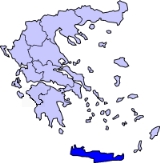
Today Crete is one of the thirteen peripheries of Greece
Peripheries of Greece

The peripheries are the official regional administrative divisions of Greece. There are 13 peripheries , which are further subdivided into 54 Prefectures of Greece....
 and a significant part of the economy and cultural heritage of Greece.


Discussion
Ask a question about 'Crete'
Start a new discussion about 'Crete'
Answer questions from other users
Full Discussion Forum


Timeline

823   Crete is conquered from the Byzantines by the Saracens.

951   The Arabic occupation of Crete comes to an end.

960   Nicephorus II captures Crete

961   Byzantine Empire recaptures Crete from Muslim control

1089   Byzantine conquest of Crete

1263   Genoa captures the city of Chania on Crete from the Venetians.

1363   Uprising against the Venetian rulers in Crete.

1365   Failed revolt against the Venetian rulers in Crete.

1669   Ottoman Turks take Candia, the Venetians lose Crete

1669   Francois de Vendome, Duke of Beaufort, disappears during a battle in a siege of Candia in Crete


Encyclopedia


Crete (Greek
Greek language

Greek is an Indo-European languages native to the southern Balkan peninsula, the language of the Greek people. It forms an independent branch within Indo-European....
: ???t?, transliteration: Krete, modern transliteration Kriti) is the largest of the Greek islands and the fifth
List of islands in the Mediterranean

This is a list of islands in the Mediterranean Sea:...
 largest island
Island

An island or isle is any piece of land that is surrounded by water. Very small islands such as emergent land features on atolls are called islets....
 in the Mediterranean Sea
Mediterranean Sea

The Mediterranean Sea is a sea or Ocean off the Atlantic Ocean surrounded by the Mediterranean region and almost completely enclosed by land: on the north by Europe, on the south by Africa, and on the east by Asia....
  at 8,336 km² (3,219 square miles).

Crete was the center of the Minoan civilization
Minoan civilization

The Minoan civilization was a Bronze Age civilization which arose on the island of Crete. The Minoan culture flourished from approximately 27th century BC to 1450 BC; afterwards, Mycenaean Greece culture became dominant at Minoan sites in Crete....
 (ca. 2600–1400 BC), the oldest Greek civilization
Civilization

A civilization is a society or culture group normally defined as a complex society characterized by the practice of agriculture and settlement in towns and city....
.

Today Crete is one of the thirteen peripheries of Greece
Peripheries of Greece

The peripheries are the official regional administrative divisions of Greece. There are 13 peripheries , which are further subdivided into 54 Prefectures of Greece....
 and a significant part of the economy and cultural heritage of Greece. While it retains its own local cultural traits (such as its own music and dialect), Cretans identify themselves as Greeks.

For centuries the island was known by its Italian name Candia, from the medieval name of its capital Heraklion
Heraklion

Heraklion or Iraklion , is the largest city and capital city of Crete. It is also the fourth largest city in Greece. Its name is also spelled Herakleion, a transliteration of the ancient Greek and Katharevousa name, , or Iraklio, among other variants....
, Chandax (Greek: ???da? or ???da?a?, "moat", Turkish
Turkish language

Turkish is a language spoken by over 63 million people worldwide, making it the most commonly spoken of the Turkic languages. Its speakers are located predominantly in Turkey and Cyprus, with smaller groups in Iraq, Greece, Bulgaria, the Republic of Macedonia, Kosovo, Albania and other parts of Eastern Europe....
: Kandiye). In Classical Latin
Classical Latin

Classical Latin is the form of the Latin used by the ancient Rome in what is usually regarded as "classical" Latin literature. Its use spanned the Golden Age of Latin literature—broadly the 1st century BC and the early 1st century AD—possibly extending to the Silver Age—broadly the 1st and 2nd centuries....
 it was called Creta and in Turkish Girit.

Crete is the location of significant ancient history, which provides popular modern day tourist
Tourism

Tourism is travel for recreational or leisure purposes. The World Tourism Organization defines tourists as people who "travel to and stay in places outside their usual environment for not more than one consecutive year for leisure, business and other purposes not related to the exercise of an activity remunerated from...
 destinations. They include the Minoan
Minoan civilization

The Minoan civilization was a Bronze Age civilization which arose on the island of Crete. The Minoan culture flourished from approximately 27th century BC to 1450 BC; afterwards, Mycenaean Greece culture became dominant at Minoan sites in Crete....
 sites of Knossos
Knossos

Knossos , also known as the Knossos Palace is the largest Bronze Age archaeological site on Crete and probably the ceremonial and political center of the Minoan civilization and culture....
 and Phaistos
Phaistos

Phaistos , also transliteration as Phaestos, Festos and Phaestus is an ancient city on the island of Crete. Phaistos was located in the south-central portion of the island, about 5.6 kilometres from the Mediterranean Sea....
, the classical site of Gortys, the Venetian old city and port of Chania
Chania

Chani? is the second largest city of Crete and the capital of the Chania Prefecture. It lies along the north coast of the island, about 70 km west of Rethymno and 145 km west of Heraklion....
, the Venetian castle at Rethymno
Rethymno

Rethymno , a city of approximately 40,000 people, is the capital of Rethymno Prefecture in the island of Crete. It was built in antiquity , even though was never a competitive Minoan center....
, and the Samaria Gorge
Samaria Gorge

The Samari? Gorge is a national park on the island of Crete, and a major tourist attraction of the island.The gorge is in the prefecture of Chania in southwest Crete....
.

History


The first human settlements on the island, dating to the aceramic
Aceramic

Aceramic is a classification of certain early human civilisations, implying the culture has not yet produced pottery.The attribute is often associated with the early phase of Neolithic cultures....
 Neolithic, used cattle
Cattle

Cattle, colloquially referred to as cows, are domestication ungulates, a member of the subfamily Bovinae of the family Bovidae. They are raised as livestock for meat , dairy products , leather and as draft animals ....
, sheep
Domestic sheep

Domestic sheep are quadrupedal, ruminant mammals typically kept as livestock. Like all ruminants, sheep are members of the order Artiodactyla, the even-toed ungulates....
, goats, pig
Pig

Pigs, also called hogs or swine, are a genus of even-toed ungulates within the Family Suidae. The name pig, hog, or swine most commonly refers to the Domestic pig in everyday parlance, but technically encompasses several distinct species, including the Wild Boar....
s, and dog
Dog

The dog is a domesticated subspecies of the Gray Wolf, a member of the Canidae family of the order Carnivora. The term is used for both feral and pet varieties....
s, as well as domesticated cereal
Cereal

Cereals, or cereal grains, are mostly Poaceae cultivated for their edible brans or fruit seeds . Cereal grains are grown in greater quantities and provide more energy worldwide than any other type of crop; they are therefore staple foods....
s and legume
Legume

A legume is a plant in the family Fabaceae , or a fruit of these specific plants. A legume fruit is a Fruit#Simple fruit that develops from a simple carpel and usually Dehiscence on two sides....
s; ancient Knossos
Knossos

Knossos , also known as the Knossos Palace is the largest Bronze Age archaeological site on Crete and probably the ceremonial and political center of the Minoan civilization and culture....
 was the site of one of these major Neolithic (then later Minoan
Minoan civilization

The Minoan civilization was a Bronze Age civilization which arose on the island of Crete. The Minoan culture flourished from approximately 27th century BC to 1450 BC; afterwards, Mycenaean Greece culture became dominant at Minoan sites in Crete....
) sites. Crete was the center of Europe
Europe

Europe is, conventionally, one of the world's seven continents. Comprising the westernmost peninsula of Eurasia, Europe is generally divided from Asia to its east by the water divide of the Ural Mountains, the Ural , the Caspian Sea, and by the Caucasus Mountains to the southeast....
's most ancient civilization; the Minoan
Minoan civilization

The Minoan civilization was a Bronze Age civilization which arose on the island of Crete. The Minoan culture flourished from approximately 27th century BC to 1450 BC; afterwards, Mycenaean Greece culture became dominant at Minoan sites in Crete....
. Early Cretan history is replete with legends such as those of King Minos
Minos

In Greek mythology, Minos was a mythical king of Crete, son of Zeus and Europa . After his death, Minos became a judge of the dead in Greek Underworld....
, Theseus
Theseus

For other uses, see Theseus Theseus was a legendary king of Athens, son of Aethra , and fathered by Aegeus and Poseidon, with whom Aethra lay in one night....
, Minotaur
Minotaur

In Greek mythology, the Minotaur was a creature that was part man and part Bull . It dwelt at the center of the Labyrinth, which was an elaborate maze-like construction built for King Minos of Crete and designed by the architect Daedalus and his son Icarus who were ordered to build it to hold the Minotaur....
, Daedalus
Daedalus

In Greek mythology, Daedalus was a most skillful artificer, or craftsman, so skillful that he was said to have invented images that seemed to move about....
 and Icarus
Icarus

Icarus, Ikarus, or Ikaros, is a proper noun with a variety of meanings, most deriving from its use in Greek mythology:* Icarus , the son of Daedalus according to Greek mythology...
 passed on orally via poets such as Homer
Homer

Homer is traditionally held to be the author of the ancient Greek language epic poems the Iliad and the Odyssey, as well as of the Homeric Hymns....
. Crete was involved in the Mithridatic Wars
Mithridatic Wars

There were three Mithridatic Wars between Roman Republic and Pontus in the first century BC. They are named for Mithridates VI who was King of Pontus at the time....
, initially repelling an attack by Roman general Marcus Antonius Creticus
Marcus Antonius Creticus

Marcus Antonius Creticus was a Ancient Rome politician, member of the Antonius family. Creticus was son of Marcus Antonius Orator and by his marriage to Julia Antonia he had three sons triumvir Mark Antony, Gaius Antonius and Lucius Antonius ....
 in 71 BC. Nevertheless, a ferocious three-year campaign soon followed under Quintus Caecilius Metellus, equipped with three legions, and Crete was finally conquered by Rome in 69 BC, earning for Metellus the title "Creticus". Gortyn
Gortyn

Gortyn or Gortyna is an archaeological site on the Mediterranean island of Crete, 45 km away from the modern capital Heraklion. Gortyn, the Ancient Rome capital of Crete, was first inhabited around 3200 BC, and was a flourishing Minoan civilization town between 1600-1100 BC....
 was made capital of the island, and Crete became a Roman province, along with Cyrenaica
Cyrenaica

Cyrenaica or Cirenaica is the eastern coastal region of Libya and also an ex-province or state of the country in the pre-1963 administrative system....
.

Crete was part of the Byzantine empire
Byzantine Empire

Byzantine Empire and Eastern Roman Empire are conventional names used to describe the Roman Empire during the Middle Ages, centered on its capital of Constantinople....
, but then was captured by Iberian
Iberian

Iberian refers to Iberia , which has two basic meanings, the disused, of Caucasian Iberia , and the modern sense of someone or something originating in the Iberian Peninsula, namely from Portugal and Spain....
 Muslims led by Abo Hafs Omer Al-Baloty
Abo Hafs Omer Al-Baloty

Abo Hafs Omer Al-Baloty , was a Muslim Clergy and leader of group of Iberian Muslims, who were exiled by Al-Hakam I and settled first in Alexandria in Egypt and after that in Crete....
  who established a piratical emirate
Emirate

An emirate is a political territory that is ruled by a dynastic Arab Monarch styled emir....
 on the island. In 960 Nicephorus Phocas reconquered the island, which remained under Byzantine control until 1204, when it fell into the hands of the Venetians
Republic of Venice

The Most Serene Republic of Venice or Venetian Republic was a state originating from the city of Venice . It existed for over a millennium, from the late 7th century AD until the year 1797....
 at the time of the Fourth Crusade
Fourth Crusade

The Fourth Crusade was originally designed to conquer Islam Jerusalem by means of an invasion through Egypt. Instead, in April 1204, the Crusaders of Western Europe invaded and conquered the Christianity city of Constantinople, capital of the Byzantine Empire....
. During Venice
Republic of Venice

The Most Serene Republic of Venice or Venetian Republic was a state originating from the city of Venice . It existed for over a millennium, from the late 7th century AD until the year 1797....
's rule, which lasted more than four centuries, a Renaissance
Renaissance

The Renaissance was a cultural movement that spanned roughly the 14th to the 17th century, beginning in Italy in the late Middle Ages and later spreading to the rest of Europe....
 swept through the island as is evident from the plethora of artistic works dating to that period. The most notable representatives of this Cretan renaissance were the painter El Greco
El Greco

El Greco was a painting, sculpture, and architecture of the Spanish Renaissance. "El Greco" was a nickname, a reference to his Greek origin, and the artist normally signed his paintings with his full birth name in Greek alphabet, ????????? Te?t???p????? ....
 and the writer Vitsentzos Kornaros
Vitsentzos Kornaros

Vitsentzos or Vikentios Kornaros or Vincenzo Cornaro was a Crete Greeks poet of the Greek Renaissance who wrote the romantic epic poem Erotokritos....
.

Under the rule of Christian
Christian

A Christian is a person who adheres to Christianity, a Monotheism#Christian view religion centered on the life and teachings of Jesus and interpreted by Christians to have been prophesied in the Hebrew Bible/Old Testament....
 Venetians, the city of Candia
Candia

The name Candia can refer to:* Candia , House of Candia...
 was reputed to be the best fortified city of the eastern Mediterranean. Jewish Armenians were the largest minority group living in Crete. The Jews were attracted during the period of the mass expulsion from Spain in 1492. In 1627, there were 800 Jews in the city of Candia, about seven percent of the city's population. In 1574-77, Crete was under the rule of Giacomo Foscarini as Proveditor General, Sindace and Inquistor. According to Starr (1942), the rule of Giacomo Foscarini was the dark age for Jews and Greeks. Under his rule, non-catholics had to pay high taxes with no allowances. This practice ended when the Ottomans
Ottoman Empire

The Ottoman Empire , also known by its contemporaries as the Turkish Empire or Turkey , was an empire that lasted from 1299?1923. It was Treaty of Lausanne by the Republic of Turkey, which was officially proclaimed on October 29, 1923....
 conquered Crete in 1669, after a 21-year siege
Siege of Candia

The Siege of Candia was a military conflict in which Ottoman Empire forces besieged the Republic of Venice-ruled city and were ultimately victorious....
 of the capital, Candia.

During Ottoman
Ottoman Empire

The Ottoman Empire , also known by its contemporaries as the Turkish Empire or Turkey , was an empire that lasted from 1299?1923. It was Treaty of Lausanne by the Republic of Turkey, which was officially proclaimed on October 29, 1923....
 rule, many churches and monasteries were converted to mosques. However, freedoms and rights were still provided. Church attendance was permitted. Still, many Christians converted to Islam
Islam

Islam is a Monotheism, Abrahamic religion originating with the teachings of the Prophets of Islam Muhammad, a 7th century Arab religious and political figure....
. The city was surrounded by high walls and bastions and extended westward and southward by the 17th century. The most opulent area of the city was the Northeastern quadrant where all the elite were gathered together. The city had received another name under the rule of the Ottomans, the deserted city. The urban policy that the Ottoman applied to Candia was a two-pronged approach. The first was the religious endowments. It made the Ottoman elite contribute to building and rehabilitating the ruined city. The other method was to boost the population and the urban revenue by selling off urban properties. According to Molly Greene (2001) there were numerous records of real-estate transactions during the Ottoman
Ottoman

A term used to refer to the citizens of the Ottoman Empire after 1839, when the Tanzimat edict starting a period of reforms was declared . The term was started to be used more commonly especially after the empire officially became a constitutional monarchy in 1876....
 rule. In the deserted city, minorities received equal rights in purchasing property. Christians and Jews were also able to buy and sell in the real-estate market.

Muslim
Muslim

:A Muslim , , is an adherent of the religion of Islam. The feminine form is Muslimah . Literally, the word means "one who submits "....
 presence on the island started with the Arab occupation but was cemented by the Ottoman conquest
Ottoman wars in Europe

The wars of the Ottoman Empire in Europe are also sometimes referred to as the Ottoman Wars or as Turkish Wars, particularly in older, European texts....
. Most Cretan Muslims were local Greek converts who spoke Cretan Greek
Greek language

Greek is an Indo-European languages native to the southern Balkan peninsula, the language of the Greek people. It forms an independent branch within Indo-European....
, but in the island's nineteenth century political context they came to be viewed by the Christian population as Turks. Contemporary estimates vary, but on the eve of the Greek War of Independence, as much as 45% of the population of the island may have been Muslim. Many amongst them were crypto-Christians who converted back to Christianity in subsequent years, while many others fled Crete because of the unrest, settling in Turkey, Rhodes, Syria and elsewhere. By 1900, 11% of the population was Muslim. Those remaining were forced to leave in 1924 in the Population exchange between Greece and Turkey
Population exchange between Greece and Turkey

The 1923 population exchange between Greece and Turkey is the first large-scale Population transfer, or agreed mutual expulsion in the 20th century....
.

Uprisings by Christians were met with a fierce response from the Ottoman authorities who executed bishops, regarded as ringleaders on several occasions.. Crete was left out of the modern Greek state by the London Protocol
London Protocol

London Protocol is a name used to describe several different documents....
 of 1830, and soon it was yielded to Egypt
Egypt

Egypt is a country mainly in North Africa, with the Sinai Peninsula forming a land bridge in Western Asia. Covering an area of about , Egypt borders the Mediterranean Sea to the north, the Gaza Strip and Israel to the northeast, the Red Sea to the east, Sudan to the south and Libya to the west....
 by the Ottoman sultan. Egyptian rule was short-lived and sovereignty was returned to the Ottoman Empire by the Convention of London
Convention of London (1840)

The Convention of London of 1840 was a treaty signed on 15 July 1840 between the United Kingdom, Austrian Empire, Prussia, Russian Empire on the one hand, and the Ottoman Empire on the other hand....
 on July 3 1840.

Between 1833 and 1897, several more Christian uprisings took place, and in 1898, Crete, a complex autonomous Cretan State
Cretan State

The Cretan State was established in 1898, following the intervention by the Great Powers on the island of Crete. In 1897 an insurrection in Crete led the Ottoman Empire to declare Greco-Turkish War on Kingdom of Greece, which led the United Kingdom, French Third Republic, Kingdom of Italy and Russian Empire to intervene on the grounds that...
 under Ottoman suzerainty
Suzerainty

Suzerainty is a situation in which a region or nation is a tributary state to a more powerful entity which allows the tributary some limited domestic Wiktionary:autonomy to control its foreign affairs....
, was nevertheless garrisoned by an international military force, with a High Commissioner (Armostis), chosen by Greece . Finally, Crete was joined with Greece on 1 December , 1913.

During World War II
World War II

World War II, or the Second World War , was a global military conflict which involved a Participants in World War II, including all of the great powers, organised into two opposing military alliances: the Allies of World War II and the Axis powers....
, the island was the scene of the famous Battle of Crete
Battle of Crete

The Battle of Crete was a battle during World War II on the Greek island of Crete. The battle began on the morning of 20 May 1941, when Nazi Germany launched an Airborne forces of Crete under the code-name Unternehmen Merkur ....
 where, in May 1941, German paratroopers sustained almost 7,000 casualties, meeting fierce resistance from both locals and the British Commonwealth
Commonwealth of Nations

The Commonwealth of Nations, also known as the Commonwealth or the British Commonwealth, is an intergovernmental organization of fifty-three independent member states....
 force, commanded by General Sir Bernard Freyberg. As a result, Adolf Hitler
Adolf Hitler

Adolf Hitler was an Austrian-born Germany politician and the leader of the National Socialist German Workers Party , popularly known as the Nazi Party....
 forbade further large scale airborne operations on the island during the conflict.

Geography


Crete, with a population of 650,000 in year 2005, is one of the 13 regions into which Greece
Greece

Greece , officially the Hellenic Republic , is a country in southeastern Europe, situated on the southern end of the Balkans. It has borders with Albania, Bulgaria and the former Yugoslav Republic of Macedonia to the north, and Turkey to the east....
 is divided. It forms the largest island in Greece and the second largest (after Cyprus
Cyprus

Cyprus , officially the Republic of Cyprus , is an island country situated in the eastern Mediterranean Sea, east of Greece, west of Lebanon, Syria, and Israel, south of Turkey and north of Egypt....
) in the East Mediterranean. The island has an elongated shape : it spans 260 km from east to west and 60 km at its widest, although the island is narrower at certain points, such as in the region close to Ierapetra , where it reaches a width of only 12 km. Crete covers an area of 8,336 km², with a coastline of 1046 km ; to the north it broaches the Sea of Crete
Sea of Crete

The Sea of Crete is the sea south of the Aegean Sea, north of the island Crete, and south of the Cyclades. The sea also stretches from Kythera east to the Dodecanese islands of Karpathos and Kassos....
 (Greek: ???t??? ???a???); to the south the Libyan Sea
Libyan Sea

The Libyan Sea is a portion of the Mediterranean Sea situated north of the country of Libya and generally southerly of the island of Crete. This designation was used by ancient geographers describing the southern Mediterranean, but the term is also used by modern travel writers and cartographers....
 (Greek: ??ß??? ???a???); in the west the Myrtoan Sea
Myrtoan Sea

The Myrtoan Sea is a subdivision of the Mediterranean Sea that lies between the Cyclades and the Peloponnesos. It is described as the part of the Aegean Sea south of Euboea, Attica, and Argolis....
, and toward the east the Karpathion Sea. It lies approximately 160 km south of the Greek mainland.

Crete is extremely mountainous, and its character is defined by a high mountain range crossing from West to East, formed by three different groups of mountains. These are:
  • the White Mountains or Lefka Ori
    Lefka Ori

    Lefka Ori or ?Madares? is a mountain range located in Western Crete, in Chania and Rethymno prefectures. The White Mountains or Lefka Ori occupy a good part of the centre of West Crete and are the main feature of the region....
     (2,452 m);
  • the Idi range (Psiloritis 2,456 m);
  • the Dikti mountains (2,148 m);
  • Kedros (1,777 m);
  • Thripti (1,489 m)


These mountains gifted Crete with fertile plateaux, such as Lasithi, Omalos and Nidha; caves, such as Diktaion and Idaion; and gorges, such as the famous Gorge of Samaria. The protected area of the Samaria Gorge
Samaria Gorge

The Samari? Gorge is a national park on the island of Crete, and a major tourist attraction of the island.The gorge is in the prefecture of Chania in southwest Crete....
 is the home of kri-kri
Kri-kri

The Kri-kri , sometimes called the Cretan goat, Agrimi, or Cretan Ibex, is considered a subspecies of Wild Goat. The Kri-kri is a large ungulate native to the Eastern Mediterranean, now found only on the island of Crete, Greece and three small islands just offshore ....
, while Cretan mountains and gorges are refuges for the endangered vulture Lammergeier
Lammergeier

File:Lammergeier with boy, Kabul, 1973.JPGThe Lammergeier or Bearded Vulture, Gypaetus barbatus , is an Old World vulture, the only member of the genus Gypaetus....
 (Gypaetus barbatus).

There are a number of rivers on Crete, including the Ieropotamos River
Ieropotamos River

The Ieropotamos River is a watercourse in southern Crete in Greece. This river was a source of water supply for the ancient Minoan civilization Human settlement of Phaistos....
 on the southern part of the island.

Climate

Crete straddles two climatic zones, the Mediterranean and the North African, mainly falling within the former. As such, the climate in Crete is primarily temperate
Temperate

In geography, temperate or tepid latitudes of the globe lie between the tropics and the polar circles. The changes in these regions between summer and winter are generally mild, rather than extreme hot or cold....
. The atmosphere can be quite humid, depending on the proximity to the sea, while winter is fairly mild. Snowfall is common on the mountains between November and May, but rare in the low lying areas, especially near the coast when it only stays on the ground for a few minutes or hours. However, a truly exceptional cold snap swept the island in February 2004, during which period the whole island was blanketed with snow. During the Cretan summer, average temperatures reach the high 20s-low 30s Celsius (mid 80s to mid 90s Fahrenheit), with maxima touching the upper 30s to mid 40s (above 110 Fahrenheit).

The south coast, including the Messara plain and Asterousia mountains, falls in the North African climatic zone, and thus enjoys significantly more sunny days and high temperatures throughout the year. In southern Crete date palms
Date Palm

Phoenix dactylifera, commonly known as the Date Palm, is a Arecaceae in the genus Phoenix , extensively cultivated for its edible sweet fruit....
 bear fruit and swallows remain year around, not migrating to Africa
Africa

Africa is the world's second-largest and second most-populous continent, after Asia. At about 30.2 million km? including adjacent islands, it covers 6% of the Earth's total surface area and 20.4% of the total land area....
.

Cretan culture

For centuries Crete has held intact its own distinctive rich and proud culture. Cretan Greek
Cretan Greek

Cretan Greek is a dialect of the Greek language, spoken by more than half a million people in Crete and many thousands in the Greek diaspora....
 has been maintained as the spoken dialect, and Cretan wine
Cretan wine

Cretan wine is wine from the Greece island of Crete. It has a long history since wine was certainly being made by the Minoans before 1600 BC. Wines from Crete are not listed among those specially prized in classical Greece, but under the Roman Empire in the second century AD Crete was known for a sweet wine, protropos, which was exported...
 is a traditional drink. The island is known for its music
Music of Crete

The music of Crete is a traditional form of Greece folk music called ???t??? . The Cretan_lyra is the dominant folk instrument on the island; it is a three-stringed fiddle....
, and it has many indigenous dances, the most noted of which is probably the Pentozali.

Economy

The economy of Crete, which was mainly based on farming, began to change visibly during the 1970s. While an emphasis remains on farming and stock breeding, due to the climate and terrain of the island, there has been a drop in manufacturing and an observable expansion in its service industries (mainly tourism-related). All three sectors of the Cretan economy (agriculture, processing-packaging, services), are directly connected and interdependent. The island has a per capita income close to 100% of the Greek average, while unemployment is at approximately 4%, half of that of the country overall. As in other regions of Greece, olive
Olive

The Olive is a species of small tree in the family Oleaceae, native to the coastal areas of the eastern Mediterranean region, from Lebanon, Syria and the maritime parts of Turkey and northern Iran at the south end of the Caspian Sea....
 growing is also a significant industry; a small amount of citrons
Greek citron

The Greece citron Variety of citrus medica was botanically classified by Adolf Engler as the "variety etrog", remarking on its major use for the Jewish ritual during Sukkot, due to its extraordinary natural beauty....
 are still cultivated on the island.

The island has three significant airports, Nikos Kazantzakis at Heraklion
Heraklion

Heraklion or Iraklion , is the largest city and capital city of Crete. It is also the fourth largest city in Greece. Its name is also spelled Herakleion, a transliteration of the ancient Greek and Katharevousa name, , or Iraklio, among other variants....
, the Daskalogiannis
Chania International Airport

Chania International Airport, "Ioannis Daskalogiannis" is an international airport located near Souda Bay on the Greece island of Crete, serving the city of Chania, Greece....
 airport at Chania
Chania

Chani? is the second largest city of Crete and the capital of the Chania Prefecture. It lies along the north coast of the island, about 70 km west of Rethymno and 145 km west of Heraklion....
 and a smaller one in Sitia
Sitia

Sitia refers both to a port town, with 8,900 inhabitants and a municipality, with 14,338 inhabitants in the far east of Crete, in the prefecture of Lasithi....
. The first two serve international routes, as the main gateways to the island for travellers.

Tourism


Crete is one of the most popular holiday destinations in Greece. Fifteen percent of all arrivals in Greece come through the city of Heraklion
Heraklion

Heraklion or Iraklion , is the largest city and capital city of Crete. It is also the fourth largest city in Greece. Its name is also spelled Herakleion, a transliteration of the ancient Greek and Katharevousa name, , or Iraklio, among other variants....
 (port and airport), while charter journeys to Heraklion
Heraklion

Heraklion or Iraklion , is the largest city and capital city of Crete. It is also the fourth largest city in Greece. Its name is also spelled Herakleion, a transliteration of the ancient Greek and Katharevousa name, , or Iraklio, among other variants....
 last year made up 20% of all charter flights in Greece. Overall, more than two million tourists visited Crete last year, and this increase in tourism is reflected on the number of hotel beds, rising by 53% in the period between 1986 to 1991, when the rest of Greece saw increases of only 25%. Today, the island's tourism infrastructure caters to all tastes, including a very wide range of accommodation; the island's facilities take in large luxury hotels with their complete facilities, swimming pools, sports and recreation, smaller family-owned apartments, camping facilities and others. Visitors reach the island via two international airports in Heraklion and Chania
Chania

Chani? is the second largest city of Crete and the capital of the Chania Prefecture. It lies along the north coast of the island, about 70 km west of Rethymno and 145 km west of Heraklion....
, or by boat to the main ports of Heraklion, Chania, Rethimno, and Agios Nikolaos
Agios Nikolaos

Agios Nikolaos or Ayios Nikolaos is a common place name in Greece and Cyprus since Saint Nicholas is the patron saint of sailors and of all of Greece....
.

Plans for a container port

Crete Topo
Newspapers have reported that the Ministry of Mercantile Marine is ready to support the agreement between Greece, South Korea
South Korea

South Korea, officially the Republic of Korea , ), often referred to as Korea and the "names of Korea#Revival of the names", is a Semi-presidential system republic in East Asia, located in the southern half of the Korean Peninsula....
, Dubai Ports World
Dubai Ports World

DP World is a subsidiary of Dubai World, a holding company owned by the government of Dubai in the United Arab Emirates.In March 2006, it purchased the Peninsular and Oriental Steam Navigation Company of the United Kingdom, which was then the fourth largest ports operator in the world, for ?3.9 billion , beating a bid from Singapore's PSA...
 and China
China

China is a Culture of China, an ancient civilization, and, depending on perspective, a national or multinational entity extending over a large area in East Asia....
 for the construction of a large international container port and free trade zone
Free trade zone

A free trade zone or export processing zone is one or more special areas of a country where some normal trade barriers such as tariffs and Quota share are eliminated and Bureaucracy are lowered in hopes of attracting new business and Foreign direct investment....
 in southern Crete near Tympaki
Tympaki

Tympaki or Timbaki is a municipality in Heraklion Prefecture, Crete, Greece. It is located on the south coast, between Agia Galini and Matala....
; the plan is to expropriate 850 ha of land. The port would handle 2 million containers per year, while as of 2007, there has been no official announcement of a project not universally welcomed due to its environmental, economic and cultural impact.

Notable Cretans

Crete Nasa
*Minoas
Minos

In Greek mythology, Minos was a mythical king of Crete, son of Zeus and Europa . After his death, Minos became a judge of the dead in Greek Underworld....
, an ancient, legendary King of Crete
  • Idomeneus
    Idomeneus

    In Greek mythology, Idomeneus was a Crete warrior, father of Orsilochus, son of Deucalion , grandson of Minos and king of Crete. He led the Cretan armies to the Trojan War and was also one of Helen's suitors....
    , an ancient, legendary King of Crete
  • Epimenides
    Epimenides

    Epimenides of Knossos was a semi-Greek mythology 6th century BC Greeks prophet and philosopher-Poetry, who is said to have fallen asleep for fifty-seven years in a Cretan cave sacred to Zeus, after which he reportedly awoke with the gift of prophecy....
     6th century BC seer, philosopher and poet
  • Nearchus
    Nearchus

    Nearchus or Nearch was one of the officers, a navarch, in the army of Alexander the Great. His celebrated voyage from India to Susa after Alexander the Great's expedition in India is preserved in Arrian's account, the Indica ....
     (4th century BC) officer in the army of Alexander the Great
  • Aenesidemus
    Aenesidemus

    Aenesidemus was a Greece sceptical philosopher, born in Knossos on the island of Crete. He lived sometime during the 1st century BC, taught in Alexandria and flourished shortly after the life of Cicero....
     1st century BC philosopher
  • Saint Eumenes
    Saint Eumenes

    Saint Eumenes was a bishop of Gortyna in Crete during the 7th century . His calendar of saints occurs on September 18. He gave up his wealth as a young man and was chosen as bishop of Gortyna....
     7th century bishop of Gortyna
  • Pope Alexander V (1339-1410)
  • Marcus Musurus
    Marcus Musurus

    Marcus Musurus was a Greeks scholar and philosopher born in Rethymno, Crete. The son of a rich merchant, he became at an early age a pupil of John Lascaris in Venice....
     (1470-1517) scholar and philosopher
  • Francesco Barozzi
    Francesco Barozzi

    Francesco Barozzi was an Italy mathematics, astronomy and humanist....
     (1537-1604) mathematician and astronomer
  • El Greco
    El Greco

    El Greco was a painting, sculpture, and architecture of the Spanish Renaissance. "El Greco" was a nickname, a reference to his Greek origin, and the artist normally signed his paintings with his full birth name in Greek alphabet, ????????? Te?t???p????? ....
     (1541-1614) Greek-Spanish painter
  • Georgios Chortatsis (c. 1545-1610) Renaissance dramatist
  • Vitsentzos Kornaros
    Vitsentzos Kornaros

    Vitsentzos or Vikentios Kornaros or Vincenzo Cornaro was a Crete Greeks poet of the Greek Renaissance who wrote the romantic epic poem Erotokritos....
     (1553-1613) poet of the Greek Renaissance
  • Ahmed Resmî Efendi
    Ahmed Resmî Efendi

    Ahmed Resm? Efendi , also called Ahmed bin Ibrahim Girid? , was a Cretan Turks statesman, diplomat and author of the Ottoman Empire in the 18th century....
     18th century Ottoman statesman, diplomat and author
  • Giritli Ali Aziz Efendi
    Giritli Ali Aziz Efendi

    Giritli Ali Aziz Efendi was a Turkish people author of the 18th century, notable for his sefaretname relating his mission as the ambassador of the Ottoman Empire in Prussia in 1796, and for his novel "Muhayyel?t" , a unique work of fiction blending personal and fantastic themes, well in the current of the traditional Ottoman prose, but also...
     18th century Ottoman author, diplomat
  • Daskalogiannis
    Daskalogiannis

    Ioannis Vlachos , better known as Daskalogiannis was a Crete rebel against Ottoman Empire rule in the 18th century....
     (?-1771) rebel against Ottoman rule
  • Salacioglu
    Salacioglu

    Salacioglu was a Turkish Cretan sufi poet of the late 18th century and early 19th century, author of one collection of poetry and of two mesnevis....
     (1750-1825) 18th century Turkish folk literature
    Turkish folk literature

    Turkish folk literature is an oral tradition deeply rooted, in its form, in Central Asian nomadic traditions. However, in its themes, Turkish folk literature reflects the problems peculiar to a settling people who have abandoned the nomadic lifestyle....
     poet
  • Dimitri Kalergis
    Dimitri Kalergis

    Dimitrios Kallergis , was a Crete-born Greece soldier and statesman.Hailing from the distinguished Cretan Kallergis family, he studied medicine at Paris and on the outbreak of the War of Greek Independence went to the Morea and joined the insurgents....
     (1803-1867) statesman
  • Ioannis Kondylakis (1862-1920) Writer
  • Giritli Sirri Pasha
    Giritli Sirri Pasha

    Giritli Sirri Pasha was a 19th century Ottoman Empire administrator and man of letters of Turkish Cretan origin.He was born in 1844 in Kandiye, as the son of Helvacizade Salih Tosun Efendi....
     (1844-1895) Ottoman author, statesman
  • Eleftherios Venizelos
    Eleftherios Venizelos

    Eleftherios Venizelos was an eminent Greeks revolutionist, a prominent and illustrious statesman as well as a charismatic leader in the early 20th century....
     (1864-1936) politician, Prime Minister of Greece
  • Rahmizâde Bahaeddin Bediz
    Rahmizâde Bahaeddin Bediz

    Rahmiz?de B?h?eddin was a Cretan Turks who is generally agreed by historians to be the first Turkish people photographer by profession. He started his career in Hanya, Crete in 1895, and went on to open photography studios in Izmir in 1910, in Istanbul in 1915 where he acquired his fame, and in Ankara after 1935 where, aside from his priv...
     (1875-1951) The first Turkish professional photographer
  • Evangelos Sarris
    Evangelos Sarris

    Evangelos Sarris was an officer of the Cretan gendarmerie and one of the leaders of the National Defence movement in Greece.Born in 1881 in Crete Neapoli , Sarris interrupted his studies in 1898 in order to participate in the revolution....
     (1881-1917) army officer
  • Emmanouil Tsouderos
    Emmanouil Tsouderos

    Emmanouil Tsouderos was a political and financial figure of modern Greece, serving as Prime Minister-in-exile during World War II....
     (1882-1956) economist and politician
  • Paul Mulla
    Paul Mulla

    Paul Mulla or Monseigneur Paul was a Turkish Cretan who, after having been a fervent Muslim in his youth, had converted to the Roman Catholic Church and baptism in 1905, to the great sorrow of his father Ibrahim Pertev, and was ordained priest in 1913....
     (1882-1959) (alias Mollazade Mehmed Ali) Roman Catholic bishop and author
  • Ali Fuat Cebesoy
    Ali Fuat Cebesoy

    Ali Fuat Cebesoy was a Turkish people officer, politician and statesman. His father is Ismail Fazil Pasa and mother is Zekiye Hanim. He attended the War School and graduated from the Turkish War College as the first in his class, while Mustafa Kemal Atat?rk was the second best in grades....
     (1882-1968) Turkish statesman
  • Nikos Kazantzakis
    Nikos Kazantzakis

    Nikos Kazantzakis was arguably the most important and most translated Greece writer and philosopher of the 20th century. Yet he did not become well known globally until the 1964 release of the Michael Cacoyannis film Zorba the Greek , based on Kazantzakis' Zorba the Greek whose English translation has the same title....
     (1885-1957) poet and author
  • Mustafa Ertugrul
    Mustafa Ertugrul

    Mustafa Ertugrul was a Turkish people officer during the World War I and the early stages of the Turkish War of Independence , who had accomplished a number of brilliant military feats, the most notable being the sinking of the United Kingdom aircraft carrier Ben-my-Chree with shore fire....
     (1892-1961) Turkish naval officer
  • Alexis Minotis
    Alexis Minotis

    Alexis Minotakis, known as Alexis Minotis, was born 8 August 1898 or 1899 in Chania, Crete and died on 11 November 1990 in Athens, Greece....
     (1898-1990) actor
  • Mustafa Fehmi Kubilay
    Mustafa Fehmi Kubilay

    Mustafa Fehmi Kubilay was a Turkish people national hero, considered a martyr of Turkish revolution....
     (1906-1930) Turkish national hero who was lynched by anti-secular religious fundamentalists in the Menemen Incident
    Menemen Incident

    The Menemen Incident refers to a chain of incidents which occurred Menemen, a small town in the Aegean Region, Turkey region of Turkey, on 23 December 1930....
  • Sapfo Notara
    Sapfo Notara

    Sapfo Notara, , was a legendary Greeks actor, known for supporting capabilities in acting. She didn't want to be persecuted by the vainglory of the emotions that belong to stardom , so most of her movie roles were not as a protagonist....
     (1907-1985) actress
  • Manos Katrakis
    Manos Katrakis

    Manos Katrakis was an United States writer and poet who wrote "Casey at the Bat".Thayer was born in Lawrence, Massachusetts, Massachusetts and raised in Worcester, Massachusetts....
     (1909-1984) actor
  • Odysseas Elitis (1911-1996) poet, Nobel laureate
  • Stylianos Pattakos
    Stylianos Pattakos

    Stylianos Pattakos was a Greece military man and one of the principals of the Greek military junta of 1967-1974 that overthrew the government of Panagiotis Kanellopoulos in a coup d'?tat on April 21, 1967....
     (1912) member of Greek military junta
  • Konstantinos Mitsotakis (1918) politician, Prime Minister of Greece
  • Rena Kyriakou
    Rena Kyriakou

    Rena Kyriakou was a pianist and composer born in Herakleion, Greece....
     (1918-1994) pianist
  • ???a ??ß???? (1919-2002) Actress
  • George Psychoundakis
    George Psychoundakis

    George Psychoundakis was a Greek Resistance fighter on Crete during the Second World War. He was a shepherd, a war hero and an author. He served as The Cretan Runner between Petro Petrakas and Papadakis behind the German Army lines for the Cretan resistance Movement and later, from 1941 to 1945, for the Special Operations Executive ....
     (1920-2006) World War II resistance fighter, poet and translator
  • Thanasis Skordalos
    Thanassis Skordalos

    Thanassis Skordalos was a musician from Crete, noted for playing the Cretan lyra.Skordalos was born in 10 December 1920 in the village Spili of ex-eparchy of Saint Basil, today the municipality of Lampi, in Rethimnon, Crete....
     (1920-1998) folk singer and composer
  • Lili Zografou (1922-1998) Journalist and writer
  • Kostas Mountakis
    Kostas Mountakis

    Kostas Mountakis is a Greek musician who popularized the traditional music of the island of Crete, primarily with the Cretan lira. His parents came from the village Kallikratis in Sfakia, Crete....
     (1926) folk singer and composer
  • Terpsichori Chryssoulaki-Vlachou
    Terpsichori Chryssoulaki-Vlachou

    Terpsichori Chryssoulaki-Vlachou, , born in Sitia, , was a Greek people female radio operator working for the Greek resistance during World War II....
     (1926-1944) member of the Greek resistance
  • Michalis Kounelis
    Michalis Kounelis

    Michalis Kounelis was a popular Crete violinist .He started playing violin when he was ten years old. It is known that when he was in the elementary school, he was usually playing his violin with his cousin, Manolis Katsonakis, another popular Cretan musician....
     (1928-1999) musician
  • Hüsamettin Cindoruk
    Hüsamettin Cindoruk

    H?samettin Cindoruk is a Turkish people politician and the 17th Speaker of the Turkish Grand National Assembly between 1991-1995. He has also been the leader of two political parties, notably of the True Path Party....
     (1933) Former Chairman of the Turkish Grand National Assembly
  • Rika Diallina
    Rika Diallina

    Rika Diallina also spelled Dialina and Dialyna, born in Heraklion, Crete in 1934, won the Miss Star Hellas title, and went on to represent Greece at the Miss Universe 1954 pageant in Long Beach, California....
     (1934) actress
  • Nana Mouskouri
    Nana Mouskouri

    Nana Mouskouri , born as Ioanna Mouskouri on October 13, 1934, in Chania, Crete, Greece, is a singer who is confirmed to have sold over 300 million records worldwide in a career spanning over five decades, making her one of the world's best-selling female recording artists....
     (1934) singer and politician
  • Rita Sakellariou
    Rita Sakellariou

    Rita Sakellariou was a famous Greek singer. Amongst her fans were Andreas Papanderou, Melina Merkouri, Aristotle Onasis and others. She had numerous hits, some of them are:...
     (1934-1999) singer
  • Nikos Xilouris
    Nikos Xilouris

    Nikos Xylouris ,nicknamed Psaronikos , was a Greece composer and singer from thevillage of Anoghia in Crete and also the older brother of two other great musicians of Cretan music, Antonis Xylouris or Psarantonis and Yiannis Xylouris or ....
     (1936-1980) composer and singer
  • Konstantinos Volanakis
    Konstantinos Volanakis

    Konstantinos Volanakis or Volonakis was a Greece Painting, considered one of the best of the 19th century. Born to a wealthy family, he went to Trieste, Italy, in 1856 where he took up painting....
     (1937) painter
  • Giannis Markopoulos
    Giannis Markopoulos

    Giannis Markopoulos is a Crete-Greeks composer....
     1939 composer
  • Yoryis Yatromanolakis (1940) author
  • Manolis Mavrommatis
    Manolis Mavrommatis

    Manolis Mavrommatis is a Greece politician and Member of the European Parliament for New Democracy , belonging to the European People's Party....
     (1941) sports journalist and politician
  • Psarantonis
    Psarantonis

    Antonis Xilouris , nicknamed Psarantonis is a Greece composer, singer and Cretan lyra player. He comes from the village of Anoghia in Crete and is the younger brother of the late Nikos Xylouris, a notable Cretan singer/musician as well as the older brother of Yiannis Xylouris, an equally notable Cretan musician....
     (1942) musician and singer
  • Christoforos Liontakis
    Christoforos Liontakis

    Christoforos Liontakis is an award winning Greece poet and translator. He read Law at the University of Athens and Philosophy of Law at Sorbonne, Paris....
     (1945) poet
  • Yannis Smaragdis
    Yannis Smaragdis

    Yannis Smaragdis is a Greece film director.He was born in Crete in 1946 and studied film in Greece and Paris, France. He appeared in 1972 with his short film Two Three Things... which received the first prize in the Athens Festival as well as a Special Mention in the Montreal Film Festival....
     (1946) film director
  • Maro Douka
    Maro Douka

    Maro Douka is an acclaimed Greece novelist. She has lived in Athens since 1966 and she read History and Archaeology at the University of Athens....
     (1947) author
  • Giannis Dragasakis
    Giannis Dragasakis

    Giannis Dragasakis is a Greece politician and member of the Greek Parliament for the Coalition of the Radical Left for the Athens B constituency....
     (1947) politician
  • Fotis Kafatos
    Fotis Kafatos

    Fotis C. Kafatos is a prominent Greek biologist.Kafatos received his Bachelor's degree at Cornell University, and his Ph.D. from Harvard University ....
     biologist
  • Joseph Sifakis
    Joseph Sifakis

    Joseph Sifakis is a Greek people computer scientist, laureate of the 2007 Turing Award, along with Edmund M. Clarke and E. Allen Emerson, for his work on model checking....
     (1946) computer scientist, Turing award recipient
  • Halil Berktay
    Halil Berktay

    Halil Berktay is a Turkish people historian at Sabanci University and columnist for the daily Taraf....
     (1947) Turkish historian
  • Nikolaos Sifounakis
    Nikolaos Sifounakis

    Nikolaos Sifounakis is a Greece politician, former Minister for the Aegean and Island Policy and ex-member of the European Parliament. He was elected on the Panhellenic Socialist Movement ticket and sat with the Party of European Socialists group....
     (1949) politician
  • Mimis Androulakis
    Mimis Androulakis

    Dimitris Androulakis is a Greece author and politician.He was elected MP:* With SYN in 1989* With PASOK in 2004 by the Statewide list and in 2007 for Athens B constituency...
     (1951) author and politician
  • Maria Damanaki
    Maria Damanaki

    Maria Damanaki is a Greece politician, former president of the Synaspismos party of the radical Left-wing politics and currently a state member of the Hellenic Parliament within the Panhellenic Socialist Movement ....
     (1952) politician
  • Manolis Kefalogiannis
    Manolis Kefalogiannis

    Manolis K. Kefalogiannis is a Greece politician from Heraklion, Crete and former Minister for Mercantile Marine of Greece. Kefalogiannis is the nephew of fellow politician Manolis V. Kefalogiannis....
     (1959) politician
  • Kostas Hatzidakis (1965) politician


Cities

Crete's principal cities are:

  • Heraklion
    Heraklion

    Heraklion or Iraklion , is the largest city and capital city of Crete. It is also the fourth largest city in Greece. Its name is also spelled Herakleion, a transliteration of the ancient Greek and Katharevousa name, , or Iraklio, among other variants....
     (Iraklion or Candia) (137,711 inhabitants)
  • Chania
    Chania

    Chani? is the second largest city of Crete and the capital of the Chania Prefecture. It lies along the north coast of the island, about 70 km west of Rethymno and 145 km west of Heraklion....
     (Haniá) (53,373 inhabitants)
  • Rethymno
    Rethymno

    Rethymno , a city of approximately 40,000 people, is the capital of Rethymno Prefecture in the island of Crete. It was built in antiquity , even though was never a competitive Minoan center....
     (31,687 inhabitants)
  • Ierapetra
    Ierapetra

    Ierapetra is a municipality and a town in the east of the Greece island of Crete, in the prefecture of Lasithi. The municipality has an area of 394.774 square kilometres and a population of 23,707 ....
     (23,707 inhabitants)
  • Agios Nikolaos
    Agios Nikolaos, Crete

    Agios Nikolaos is a coastal town on the Greece island of Crete, lying east of the island's capital Heraklion, north of the town of Ierapetra and west of the town of Sitia....
     (19,462 inhabitants)
  • Sitia
    Sitia

    Sitia refers both to a port town, with 8,900 inhabitants and a municipality, with 14,338 inhabitants in the far east of Crete, in the prefecture of Lasithi....
     (14,338 inhabitants)


Political organization

The island of Crete is a periphery
Peripheries of Greece

The peripheries are the official regional administrative divisions of Greece. There are 13 peripheries , which are further subdivided into 54 Prefectures of Greece....
 of Greece, consisting of four prefectures
Prefectures of Greece

Greece consists of 13 administrative regions known as Peripheries of Greece, which are further subdivided into 3 Super-prefectures of Greece and 54 prefectures or nomes ....
 :
  • Chania
    Chania Prefecture

    Chania prefecture is one of the four prefectures of Greece of Crete; it covers the westernmost quarter of the island. Its capital is the city of Chania....
  • Heraklion
    Heraklion Prefecture

    Heraklion , also Heraklio is a prefectures of Greece of Greece, one of the four prefectures of Crete. The capital is the city of Heraklion....
  • Lasithi
    Lasithi

    Lasithi is the easternmost prefecture on the island of Crete, to the east of the prefecture of Heraklion Prefecture. Its capital is Agios Nikolaos, Crete, the other major towns being Ierapetra, Sitia and Neapoli, Crete....
  • Rethymno
    Rethymno Prefecture

    Rethymno is a Prefectures of Greece in the island of Crete. Its capital is the city of Rethymno.Today its main income is tourism. The countryside of the prefecture is also based economically on agriculture and herding....


For amateur radio
Amateur radio

Amateur radio, often called Etymology of ham radio, is both a hobby and a service in which participants, called "hams," use various types of radio communications equipment to communicate with other radio amateurs for Public services, recreation and self-training....
 purposes it is considered to be a separate "entity," ITU prefix
ITU prefix

The International Telecommunication Union allocates call signes for radio station and television station stations of all types. They also form the basis for aircraft registration identifiers....
 SV9.

Expatriate EU communities

Crete's mild climate is attracting growing interest from Northern Europeans to have a holiday home or residence on the island. EU citizens have the right to freely buy property and reside with little formality. A growing number of real estate companies cater to mainly British expatriates, followed by German
Germany

Germany , officially the Federal Republic of Germany , is a country in Central Europe. It is bordered to the north by the North Sea, Denmark, and the Baltic Sea; to the east by Poland and the Czech Republic; to the south by Austria and Switzerland; and to the west by France, Luxembourg, Belgium, and the Netherlands....
, Dutch
Netherlands

The Netherlands is a country that is part of the Kingdom of the Netherlands. It is a parliamentary democratic constitutional monarchy. The Netherlands is located in North-West Europe, and bordered by the North Sea to the north and west, Belgium to the south, and Germany to the east....
, Scandinavian
Scandinavian

Scandinavian refers to a resident of or something associated with Scandinavia, including:* Scandinavian Airlines System , an aviation corporation...
 and other European nationalities wishing to own a home in Crete.

The British
United Kingdom

The United Kingdom of Great Britain and Northern Ireland, commonly known as the United Kingdom , the UK or Britain,is a sovereign state located off the northwestern coast of continental Europe....
 expatriates are concentrated in the western prefectures of Chania
Chania Prefecture

Chania prefecture is one of the four prefectures of Greece of Crete; it covers the westernmost quarter of the island. Its capital is the city of Chania....
 and Rethymno
Rethymno Prefecture

Rethymno is a Prefectures of Greece in the island of Crete. Its capital is the city of Rethymno.Today its main income is tourism. The countryside of the prefecture is also based economically on agriculture and herding....
 and to a lesser extent in Heraklion
Heraklion Prefecture

Heraklion , also Heraklio is a prefectures of Greece of Greece, one of the four prefectures of Crete. The capital is the city of Heraklion....
 and Lasithi
Lasithi

Lasithi is the easternmost prefecture on the island of Crete, to the east of the prefecture of Heraklion Prefecture. Its capital is Agios Nikolaos, Crete, the other major towns being Ierapetra, Sitia and Neapoli, Crete....
. Some 40% of Britons in late 2006 said they were planning to live outside the United Kingdom
United Kingdom

The United Kingdom of Great Britain and Northern Ireland, commonly known as the United Kingdom , the UK or Britain,is a sovereign state located off the northwestern coast of continental Europe....
 or retire abroad due to socio-economic changes in the country. One in ten Britons do so already.

See also

  • History of Crete
    History of Crete

    The History of Crete encompasses the ancient Minoan civilization, which used its own system of script, Linear A and B. After this civilisation was destroyed by natural catastrophes, Crete developed an Ancient Greece-influenced organization of city states, then successively became part of the Roman Empire, the Byzantine Empire, the Venetian...
  • Eileithyia Cave
    Eileithyia Cave

    Eileithyia Cave was a Neolithic, Minoan civilization and Mycenaean Greece sacred cave dedicated to the goddess of childbirth, Eileithyia, on the island of Crete....
  • Battle of Crete
    Battle of Crete

    The Battle of Crete was a battle during World War II on the Greek island of Crete. The battle began on the morning of 20 May 1941, when Nazi Germany launched an Airborne forces of Crete under the code-name Unternehmen Merkur ....
  • Cretan Greek
    Cretan Greek

    Cretan Greek is a dialect of the Greek language, spoken by more than half a million people in Crete and many thousands in the Greek diaspora....
  • Cretan wine
    Cretan wine

    Cretan wine is wine from the Greece island of Crete. It has a long history since wine was certainly being made by the Minoans before 1600 BC. Wines from Crete are not listed among those specially prized in classical Greece, but under the Roman Empire in the second century AD Crete was known for a sweet wine, protropos, which was exported...
  • Minoan civilization
    Minoan civilization

    The Minoan civilization was a Bronze Age civilization which arose on the island of Crete. The Minoan culture flourished from approximately 27th century BC to 1450 BC; afterwards, Mycenaean Greece culture became dominant at Minoan sites in Crete....
  • Linear B
    Linear B

    Linear B is a script that was used for writing Mycenaean language, an early form of Greek language. It predated the Greek alphabet by several centuries and seems to have died out with the fall of Mycenaean Greece civilization....
  • Knossos
    Knossos

    Knossos , also known as the Knossos Palace is the largest Bronze Age archaeological site on Crete and probably the ceremonial and political center of the Minoan civilization and culture....
  • Phaistos
    Phaistos

    Phaistos , also transliteration as Phaestos, Festos and Phaestus is an ancient city on the island of Crete. Phaistos was located in the south-central portion of the island, about 5.6 kilometres from the Mediterranean Sea....
  • Music of Crete
    Music of Crete

    The music of Crete is a traditional form of Greece folk music called ???t??? . The Cretan_lyra is the dominant folk instrument on the island; it is a three-stringed fiddle....
  • List of novels set in Crete
    List of novels set in Crete

    This is a list of notable novels set in Crete:* Zorba the Greek ? Nikos Kazantzakis * Captain_Michalis ? Nikos Kazantzakis * The Moon-Spinners ? Mary Stewart...
  • Minoan eruption
  • Cretan Turks
    Cretan Turks

    The Cretan Turks , Turco-Cretans , or Cretan Muslims were the Muslim inhabitants of Crete and their descendants in Turkey.After the Ottoman Empire conquest of Crete , Turkish people colonization and a high rate of local conversions makes the island a unique case in Ottoman history Some sources prefer to use the term Cretan Mus...
  • Cretan dwarf elephant
    Dwarf elephant

    Fossil remains of dwarf elephants have been found on the Mediterranean islands of Cyprus, Malta , Crete, Sicily, Sardinia, the Cyclades and the Dodecanese Islands....
  • OFI Crete
    OFI Crete

    OFI Crete, or more commonly OFI , is a Greece association football club based in Heraklion, on the island of Crete.OFI is the team with the most appearances in the Super League Greece among them which are based outside of the two major cities of Greece, Athens and Thessaloniki....
  • Technical University of Crete
    Technical University of Crete

    The Technical University of Crete is a state University under the supervision of the Ministry of Education and was founded in 1977 in Chania, Crete....
  • TEI of Crete
    TEI of Crete

    The Technological Educational Institute of Crete , was founded in 1983 in order to provide Higher Technical Education to the students of Greece....
  • University of Crete
    University of Crete

    'The University of Crete' is the principal higher education institution on the island of Crete, Greece.The University of Crete, is a multi-disciplinary, research- oriented institution, located in the cities of Rethymnon and Heraklion....
  • Former countries in Europe after 1815
    Former countries in Europe after 1815

    This article gives an overview of countries that existed in Europe after the Congress of Vienna in 1815. For each country, information is given about the period of existence and what has happened to the territory since....
  • List of Greek islands


External links