

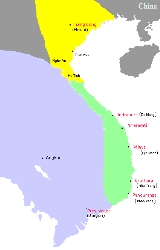
Champa

Encyclopedia
The kingdom of Champa also called Nagari , is an abugida alphabet of India and Nepal...
as चंपा; Chăm Pa in Vietnamese
Vietnamese language
Vietnamese is the national and official language of Vietnam. It is the mother tongue of 86% of Vietnam's population, and of about three million overseas Vietnamese. It is also spoken as a second language by many ethnic minorities of Vietnam...
, 占城 Chiêm Thành in Hán Việt and Zhàn chéng in Chinese
China
Chinese civilization may refer to:* China for more general discussion of the country.* Chinese culture* Greater China, the transnational community of ethnic Chinese.* History of China* Sinosphere, the area historically affected by Chinese culture...
records) was an Indianized kingdom that controlled what is now southern and central Vietnam
Vietnam
Vietnam – sometimes spelled Viet Nam , officially the Socialist Republic of Vietnam – is the easternmost country on the Indochina Peninsula in Southeast Asia. It is bordered by China to the north, Laos to the northwest, Cambodia to the southwest, and the South China Sea –...
from approximately the 7th century through to 1832.
The Cham people are remnants of this kingdom. They speak Cham
Cham language
Cham is the language of the Cham people of Southeast Asia, and formerly the language of the kingdom of Champa in central Vietnam. A member of the Malayo-Polynesian branch of the Austronesian family, it is spoken by 100,000 people in Vietnam and up to 220,000 people in Cambodia . There are also...
, a Malayo-Polynesian language
Malayo-Polynesian languages
The Malayo-Polynesian languages are a subgroup of the Austronesian languages, with approximately 385.5 million speakers. These are widely dispersed throughout the island nations of Southeast Asia and the Pacific Ocean, with a smaller number in continental Asia...
.
Champa was preceded in the region by a kingdom called Lin-yi (林邑, Middle Chinese *Lim Ip) or Lâm Ấp (Vietnamese) that was in existence from 192 AD, but the historical relationship between Lin-yi and Champa is not clear. Champa reached its apogee in the 9th and 10th centuries. Thereafter began a gradual decline under pressure from Đại Việt, the Vietnamese polity centered in the region of modern Hanoi
Hanoi
Hanoi , is the capital of Vietnam and the country's second largest city. Its population in 2009 was estimated at 2.6 million for urban districts, 6.5 million for the metropolitan jurisdiction. From 1010 until 1802, it was the most important political centre of Vietnam...
. In 1471, Viet troops sacked the northern Cham capital of Vijaya
Vijaya (Champa)
Vijaya was a city-state in the ancient kingdom of Champa in what is now south-central Vietnam. It was the capital of Champa for several centuries until it was conquered by Vietnam in 1471.-Geography, Economy, Transport:...
, and in 1697 the southern principality of Panduranga became a vassal of the Vietnamese emperor. In 1832, the Vietnamese emperor Minh Mạng
Minh Mang
Minh Mạng was the second emperor of the Nguyễn Dynasty of Vietnam, reigning from 14 February 1820 until 20 January 1841. He was a younger son of Emperor Gia Long, whose eldest son, Crown Prince Canh, had died in 1801...
annexed the remaining Cham territories. Mỹ Sơn, a former religious center, and Hội An
Hoi An
Hội An , or rarely Faifo, is a city of Vietnam, on the coast of the South China Sea in the South Central Coast of Vietnam. It is located in Quang Nam province and is home to approximately 120,000 inhabitants...
, one of Champa's main port cities, are now heritage listed.
Geography of historical Champa
Between the 7th and the 15th centuries, Champa at times included the modern Vietnamese provinces of Quảng NamQuang Nam Province
Quảng Nam is a province on the South Central Coast of Vietnam. It is bordered by Thua Thien-Huế province to the north, the nation of Laos to the west, Kon Tum Province to the southwest, Quảng Ngãi Province to the southeast, the South China Sea to the east, and the city of Da Nang to the...
, Quảng Ngãi
Quang Ngai Province
Quảng Ngãi is a province in the South Central Coast region of Vietnam, on the coast of South China Sea. It is located 883 km south of Hanoi and 838 km north of Ho Chi Minh City.-History:...
, Bình Định
Binh Dinh Province
Bình Định is a province of Vietnam. It is located in Vietnam's South Central Coast region.-Administration:Binh Dinh is divided into one city and 10 districts:*An Lão*An Nhơn*Hoài Ân*Hoài Nhơn*Phù Cát*Phù Mỹ*Tuy Phước*Tây Sơn*Vân Canh...
, Phú Yên, Khánh Hòa
Khanh Hoa Province
Khánh Hòa is a province of Vietnam, located in the South Central Coast. It has a population of 1,066,300 and spans an area of 5,197 km². Its capital is Nha Trang...
, Ninh Thuận
Ninh Thuan Province
Ninh Thuận is a province in the South Central Coast region of Vietnam .-History:The Cham principality of Panduranga had its center in Ninh Thuan Province, but also included much of what is now Binh Thuan Province. Panduranga became the political centre of Champa after the fall of Vijaya in 1471...
, and Bình Thuận
Binh Thuan Province
Bình Thuận is a province of Vietnam. It is located on the country's South Central Coast, not far from Ho Chi Minh City. It is sometimes seen as part of the Southeast Region. Binh Thuan is known for its scenery and for its good beaches...
. Though Cham territory included the mountainous zones west of the coastal plain and (at times) extended into present-day Laos
Laos
Laos Lao: ສາທາລະນະລັດ ປະຊາທິປະໄຕ ປະຊາຊົນລາວ Sathalanalat Paxathipatai Paxaxon Lao, officially the Lao People's Democratic Republic, is a landlocked country in Southeast Asia, bordered by Burma and China to the northwest, Vietnam to the east, Cambodia to the south and Thailand to the west...
, for the most part the Cham remained a seafaring people dedicated to trade, and maintained few settlements of any size away from the coast.
Historical Champa consisted of up to five principalities:
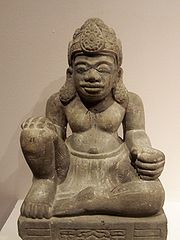
- Indrapura ("City of IndraIndra' or is the King of the demi-gods or Devas and Lord of Heaven or Svargaloka in Hindu mythology. He is also the God of War, Storms, and Rainfall.Indra is one of the chief deities in the Rigveda...
") was the capital of Champa from about 875 to about 1000 AD. It was located at the site of the modern village of Dong Duong, not far from the modern city of Da NangDa NangĐà Nẵng , occasionally Danang, is a major port city in the South Central Coast of Vietnam, on the coast of the South China Sea at the mouth of the Han River. It is the commercial and educational center of Central Vietnam; its well-sheltered, easily accessible port and its location on the path of...
. Also in the region of Da Nang are the ancient Cham city of Singhapura ("City of the Lion"), the location of which has been identified with an archeological site in the modern village of Trà Kiệu, and the valley of Mỹ Sơn, where a number of ruined temples and towers can still be viewed. The associated port was at modern Hội AnHoi AnHội An , or rarely Faifo, is a city of Vietnam, on the coast of the South China Sea in the South Central Coast of Vietnam. It is located in Quang Nam province and is home to approximately 120,000 inhabitants...
. The territory once controlled by this principality included present-day Quảng BìnhQuang Binh ProvinceQuảng Bình , formerly Tiên Bình under the reign of Le Trung Hung of the Lê Dynasty, this province was renamed Quảng Bình in 1604) is a province in the North Central Coast of Vietnam....
, Quảng TrịQuang Tri ProvinceQuảng Trị is a province on the North Central Coast of Vietnam, north of the former imperial capital of Huế.-Geography:Located in North Central Vietnam, Quang Tri Province is surrounded by Quang Binh Province on the north, Thua Thien-Hue Province on the south, Savannakhet Province of Laos on the...
, and Thừa Thiên–HuếThua Thien-Hue ProvinceThừa Thiên-Huế is a province in the North Central Coast of Vietnam, approximately in the center of the country. It borders Quang Tri Provice to the north and Da Nang City to the south, Laos to the west and the South China Sea to the east. The province has 128 km of coastline, 22,000 ha of...
provinces.
- Amaravati was located in present-day Quảng NamQuang Nam ProvinceQuảng Nam is a province on the South Central Coast of Vietnam. It is bordered by Thua Thien-Huế province to the north, the nation of Laos to the west, Kon Tum Province to the southwest, Quảng Ngãi Province to the southeast, the South China Sea to the east, and the city of Da Nang to the...
province.
- Vijaya was located in present-day Bình ĐịnhBinh Dinh ProvinceBình Định is a province of Vietnam. It is located in Vietnam's South Central Coast region.-Administration:Binh Dinh is divided into one city and 10 districts:*An Lão*An Nhơn*Hoài Ân*Hoài Nhơn*Phù Cát*Phù Mỹ*Tuy Phước*Tây Sơn*Vân Canh...
Province. The capital has been identified with the archeological site at Cha Ban. The associated port was at present-day Qui NhơnQui NhonQui Nhơn , also Quy Nhơn, is a coastal city in Binh Dinh province in central Vietnam. It is composed of 16 wards and five communes with a total of 286 km². Quy Nhon is the capital of Bình Định province. As of 2009 its population was 280,900. Historically, the commercial activities of the city...
. Important excavations have also been conducted at nearby Thap Mam, which may have been a religious and cultural center. Vijaya became the political and cultural center of Champa around 1000 AD, when the northern capital of Indrapura was abandoned due to pressure from the Viet. It remained the center of Champa until 1471, when it as sacked by the Viet and the center of Champa was again displaced toward the South. In its time, the principality of Vijaya controlled much of present-day Quang-Nam, Quang-Ngai, Binh Dinh, and Phu Yen Provinces.
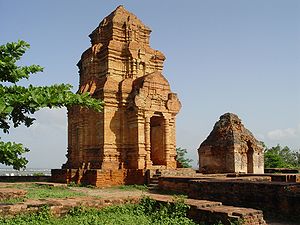
- Kauthara was located in the area of modern Nha TrangNha TrangNha Trang is a coastal city and capital of Khanh Hoa province, on the South Central Coast of Vietnam. It is bounded on the North by Ninh Hoà district, on the East by the South China Sea, on the South by Cam Ranh town and on the West by Diên Khánh district...
in Khánh HòaKhanh Hoa ProvinceKhánh Hòa is a province of Vietnam, located in the South Central Coast. It has a population of 1,066,300 and spans an area of 5,197 km². Its capital is Nha Trang...
Province. Its religious and cultural center was the temple of Po NagarPo nagarPo Nagar is a Cham temple tower founded sometime before 781 AD and located in the medieval principality of Kauthara, near modern Nha Trang in Vietnam...
, several towers of which still stand at Nha Trang.
- Panduranga was located in the area of present-day Phan Rang in Ninh ThuậnNinh Thuan ProvinceNinh Thuận is a province in the South Central Coast region of Vietnam .-History:The Cham principality of Panduranga had its center in Ninh Thuan Province, but also included much of what is now Binh Thuan Province. Panduranga became the political centre of Champa after the fall of Vijaya in 1471...
Province. Panduranga was the last of the Cham territories to be annexed by the Vietnamese.
Within the four principalities there were two main clans: the "Dua" and the "Cau". The Dua lived in Amarvati and Vijaya while the Cau lived in Kauthara and Panduranga. The two clans differed in their customs and habits and conflicting interests led to many clashes and even war. But they usually managed to settle disagreements through intermarriage.
Sources for the historiography of Champa
The historiographyHistoriography
Historiography refers either to the study of the history and methodology of history as a discipline, or to a body of historical work on a specialized topic...
of Champa relies upon three types of sources:
- Physical remains, including brick structures and ruins as well as stone sculptures;
- Inscriptions in Cham and SanskritSanskritSanskrit , is a historical Indo-Aryan language and the primary liturgical language of Hinduism, Jainism and Buddhism.Buddhism: besides Pali, see Buddhist Hybrid Sanskrit Today, it is listed as one of the 22 scheduled languages of India and is an official language of the state of Uttarakhand...
on steleSteleA stele , also stela , is a stone or wooden slab, generally taller than it is wide, erected for funerals or commemorative purposes, most usually decorated with the names and titles of the deceased or living — inscribed, carved in relief , or painted onto the slab...
s and other stone surfaces; - Chinese and Vietnamese histories, diplomatic reports, and other texts.
Overarching theories in the historiography of Champa
Modern scholarship has been guided by two competing theories in the historiography of Champa. Scholars agree that historically Champa was divided into several regions or principalities spread out from South to North along the coast of modern Vietnam and united by a common language, culture and heritage. However, scholars have disagreed on whether these several regions belonged to a single political unit, or whether they were politically independent of one another. It is acknowledged that the historical record is not equally rich for each of the regions in every historical period. For example, in the 10th century, the record is richest for Indrapura; in the 12th century, it is richest for Vijaya; following the 15th century, it is richest for Panduranga. Some scholars have taken these shifts in the historical record to reflect the movement of the Cham capital from one location to another. According to such scholars, if the 10th century record is richest for Indrapura, it is so because at that time Indrapura was the capital of Champa. Other scholars have disputed this contention, holding that Champa was never a united country, and arguing that the presence of a particularly rich historical record for a given region in a given period is no basis for claiming that the region functioned as the capital of a united Champa during that period.Sources of foreign cultural influence
Through the centuries, Cham culture and society were influenced by forces emanating from China, from India, from CambodiaCambodia
Cambodia , officially known as the Kingdom of Cambodia, is a country located in the southern portion of the Indochina Peninsula in Southeast Asia...
, from Java
Java
Java is an island of Indonesia. With a population of 135 million , it is the world's most populous island, and one of the most densely populated regions in the world. It is home to 60% of Indonesia's population. The Indonesian capital city, Jakarta, is in west Java...
, as well as from other sources. Lin Yi, the predecessor state of historical Champa, began its existence in 192 AD as a breakaway Chinese colony. An official successfully revolted against Chinese rule in central Vietnam, and Lin Yi was founded in 192. In the 4th century, wars with the neighboring Kingdom of Funan in Cambodia and the acquisition of Funanese territory led to the infusion of Indian culture into Cham society. Sanskrit
Sanskrit
Sanskrit , is a historical Indo-Aryan language and the primary liturgical language of Hinduism, Jainism and Buddhism.Buddhism: besides Pali, see Buddhist Hybrid Sanskrit Today, it is listed as one of the 22 scheduled languages of India and is an official language of the state of Uttarakhand...
was adopted as a scholarly language, and Hinduism
Hinduism
Hinduism is the predominant and indigenous religious tradition of the Indian Subcontinent. Hinduism is known to its followers as , amongst many other expressions...
, especially Shaivism
Shaivism
Shaivism is one of the four major sects of Hinduism, the others being Vaishnavism, Shaktism and Smartism. Followers of Shaivism, called "Shaivas," and also "Saivas" or "Saivites," revere Shiva as the Supreme Being. Shaivas believe that Shiva is All and in all, the creator, preserver, destroyer,...
, became the state religion. From the 10th century onwards Arab maritime trade in the region brought increasing Islamic cultural and religious influences. Champa came to serve as an important link in the Spice Route which stretched from the Persian Gulf
Persian Gulf
The Persian Gulf, in Southwest Asia, is an extension of the Indian Ocean located between Iran and the Arabian Peninsula.The Persian Gulf was the focus of the 1980–1988 Iran-Iraq War, in which each side attacked the other's oil tankers...
to southern China and later in the Arab maritime routes in Indo-China as a supplier of aloe. Despite the frequent wars between Champa and Cambodia the two countries also traded and cultural influences moved in both directions. Royal families of the two countries intermarried frequently. Champa also had close trade and cultural relations with the powerful maritime empire of Srivijaya
Srivijaya
Srivijaya was a powerful ancient thalassocratic Malay empire based on the island of Sumatra, modern day Indonesia, which influenced much of Southeast Asia. The earliest solid proof of its existence dates from the 7th century; a Chinese monk, I-Tsing, wrote that he visited Srivijaya in 671 for 6...
and later Majapahit of the Malay Archipelago
Malay Archipelago
The Malay Archipelago refers to the archipelago between mainland Southeastern Asia and Australia. The name was derived from the anachronistic concept of a Malay race....
.
Minangkabau people in Sumatra
Sumatra
Sumatra is an island in western Indonesia, westernmost of the Sunda Islands. It is the largest island entirely in Indonesia , and the sixth largest island in the world at 473,481 km2 with a population of 50,365,538...
Indonesia
Indonesia
Indonesia , officially the Republic of Indonesia , is a country in Southeast Asia and Oceania. Indonesia is an archipelago comprising approximately 13,000 islands. It has 33 provinces with over 238 million people, and is the world's fourth most populous country. Indonesia is a republic, with an...
believe that one of their ancestor come from Champa who called as Harimau Campo (Tiger of Champa). Harimau Campo together with Datuak Suri Dirajo (one of Minangkabau founding father), Kambiang Hutan, and Anjiang Mualim created basic concept of martial art of Minangkabau called silek (silat
Silat
Silat Melayu is a blanket term for the types of silat created in peninsular Southeast Asia, particularly Malaysia, Thailand, Brunei and Singapore. The silat tradition has deep roots in Malay culture and can trace its origin to the dawn of Malay civilization, 2000 years ago...
). Evidences gathered from linguistic studies also confirm that a very strong cultural influence of Champa in Indonesia is found in Aceh
Aceh
Aceh is a special region of Indonesia, located on the northern tip of the island of Sumatra. Its full name is Daerah Istimewa Aceh , Nanggroë Aceh Darussalam and Aceh . Past spellings of its name include Acheh, Atjeh and Achin...
, indicated by the use of chamic or Aceh–Chamic language as main language in coastal districts of Aceh Besar
Aceh Besar
Aceh Besar Regency is a regency of Aceh province, Indonesia. The regency covers an area of 2686 square kilometres and according to the 2000 census had a population of 225,948 people. The regency is located at the northwest tip of Sumatra island and it covers an area including the provincial...
, Pidie, Bireun, Aceh Utara, Kota Lhokseumawe, Aceh Timur, Aceh Barat
Aceh Barat
West Aceh Regency is a regency in the Aceh province of Indonesia. The regency currently covers an area of 2927.95 square kilometres and according to the 2000 census had a population of 251,227 people. The seat of the regency government is at Meulaboh. It is a palm oil producing area...
, Aceh Barat Daya, and Aceh Jaya
Aceh Jaya
Aceh Jaya is a regency of Aceh, Indonesia. The regency covers an area of 3727 square kilometres and according to the 2000 census had a population of 86,601 people. The regency according to the 2010 figures has a population of 96,200. The seat of the regency is Calang...
.
Prehistory
The people of Champa were descended from Malayo-Polynesian settlers who appear to have reached the Southeast Asian mainland from BorneoBorneo
Borneo is the third largest island in the world and is located north of Java Island, Indonesia, at the geographic centre of Maritime Southeast Asia....
about the time of the Sa Huynh culture
Sa Huynh culture
The Sa Huỳnh culture was a culture in central and southern Vietnam that flourished between 1000 BC and 200 AD. Archaeological sites from the culture have been discovered from the Mekong Delta to just south of the Tonkin region. The Sa Huynh people were most likely the predecessors of the Cham...
in the 2nd and 1st centuries BC. There are pronounced ceramic, industrial and funerary continuities with sites such as the Niah Caves
Niah Caves
Niah Caves is located within the district of Miri in Sarawak, Malaysia. Part of Niah National Park, the main cave, Niah Great Cave, is located in Gunung Subis and is made up of several voluminous, high-ceilinged chambers...
in Sarawak
Sarawak
Sarawak is one of two Malaysian states on the island of Borneo. Known as Bumi Kenyalang , Sarawak is situated on the north-west of the island. It is the largest state in Malaysia followed by Sabah, the second largest state located to the North- East.The administrative capital is Kuching, which...
, East Malaysia. Sa Huynh sites are rich in iron
Iron
Iron is a chemical element with the symbol Fe and atomic number 26. It is a metal in the first transition series. It is the most common element forming the planet Earth as a whole, forming much of Earth's outer and inner core. It is the fourth most common element in the Earth's crust...
artifacts, by contrast with the Dong Son culture
Dong Son culture
The Đông Sơn culture was a prehistoric Bronze Age age in Vietnam centered at the Red River Valley of northern Vietnam. At this time the first Vietnamese kingdoms of Văn Lang and Âu Lạc appeared...
sites found in northern Vietnam and elsewhere in mainland Southeast Asia, where bronze
Bronze
Bronze is a metal alloy consisting primarily of copper, usually with tin as the main additive. It is hard and brittle, and it was particularly significant in antiquity, so much so that the Bronze Age was named after the metal...
artifacts are dominant. The Cham language
Cham language
Cham is the language of the Cham people of Southeast Asia, and formerly the language of the kingdom of Champa in central Vietnam. A member of the Malayo-Polynesian branch of the Austronesian family, it is spoken by 100,000 people in Vietnam and up to 220,000 people in Cambodia . There are also...
is part of the Austronesian
Austronesian languages
The Austronesian languages are a language family widely dispersed throughout the islands of Southeast Asia and the Pacific, with a few members spoken on continental Asia that are spoken by about 386 million people. It is on par with Indo-European, Niger-Congo, Afroasiatic and Uralic as one of the...
family. According to one study, Cham is related most closely to modern Acehnese
Acehnese people
The Acehnese are a people in Aceh, Indonesia. Their homeland is located in the northern-most tip of the island of Sumatra and had a history of political struggle against the Dutch...
.
Founding Legend
Cham tradition claims that the founder of the Cham state was Lady Po NagarLady Po Nagar
According to Cham legend, Lady Po Nagar, or Leiou Ye, was the founder of the Cham nation. She originated from Khanh Hoa province, in a peasant family in the mountains of Dai An...
. She originated from Khanh Hoa
Khánh Hòa
Khánh Hòa may refer to a number of places in Vietnam:*Khanh Hoa Province*Khánh Hòa, An Giang - a commune of An Giang Province...
province, in a peasant family in the mountains of Dai An. Spirits assisted her when she sailed on a drift piece of sandalwood to China, where she married a Chinese crown prince, the son of the Emperor of China
Emperor of China
The Emperor of China refers to any sovereign of Imperial China reigning between the founding of Qin Dynasty of China, united by the King of Qin in 221 BCE, and the fall of Yuan Shikai's Empire of China in 1916. When referred to as the Son of Heaven , a title that predates the Qin unification, the...
, with whom she had two children, and then became Queen of Champa. When she returned to Champa to visit her family, the Prince refused to let her go, but she flung the sandalwood into the ocean, disappeared
Teleportation
Teleportation is the fictional or imagined process by which matter is instantaneously transferred from one place to another.Teleportation may also refer to:*Quantum teleportation, a method of transmitting quantum data...
with her children and reappeared at Nha Trang
Nha Trang
Nha Trang is a coastal city and capital of Khanh Hoa province, on the South Central Coast of Vietnam. It is bounded on the North by Ninh Hoà district, on the East by the South China Sea, on the South by Cam Ranh town and on the West by Diên Khánh district...
to her family. When the Chinese prince tried to follow her back to Nha Trang, she was furious, and turned him and his fleet into stone.
The Sa Huỳnh Culture
The Sa Huynh culture is a late prehistoric metal age society on the central coast of Viet Nam. In 1909, about 200 jar burials were uncovered at Sa Huynh, a coastal village located south of Da NangDa Nang
Đà Nẵng , occasionally Danang, is a major port city in the South Central Coast of Vietnam, on the coast of the South China Sea at the mouth of the Han River. It is the commercial and educational center of Central Vietnam; its well-sheltered, easily accessible port and its location on the path of...
. Since then, many more burials have been found, at some 50 sites. The Sa Huynh shows a distinct regional Bronze Age culture, with its own styles of axes, daggers, and ornaments. Carbon dating has placed the Sa Huynh culture roughly the same time line with the Dong Son culture, that is about the first millennium BC. From about 200 AD, the central coast of Viet Nam was inhabited by the Chams, who had adopted elements of Indian political and religious culture. Recent researches by Vietnamese archaeologists has shown that the Chams are linguistic and cultural descendants of the Sa Huynh people. The uncovered artifacts show the Sa Huynh people were highly skilled craftsmen in the production of jewelry and ornaments made with hard stones and glass. Sa Huynh styled ornaments were also found in Thailand, Taiwan and Philippines suggesting they were traded with South East Asian neighbors, over land and maritime routes. Archaeologists also observe that iron seems to have been used by the Sa Huynh peoples when their Dong Son neighbors were still mostly using bronze.
Lâm Ấp
Hue
Hue is one of the main properties of a color, defined technically , as "the degree to which a stimulus can be describedas similar to or different from stimuli that are described as red, green, blue, and yellow,"...
by Khu Lien
Khu Lien
Khu Liên or Sri Mara was born in Tuong Lam, an area of tension between Han Dynasty and the natives of Lam Ap . In 192 AD, he defeated the Chinese prefect and declared himself king of Lam Ap. This is considered the official founding of Champa, though Cham legend dates the founding to be much...
, a local leader rebelling against the Han Dynasty
Han Dynasty
The Han Dynasty was the second imperial dynasty of China, preceded by the Qin Dynasty and succeeded by the Three Kingdoms . It was founded by the rebel leader Liu Bang, known posthumously as Emperor Gaozu of Han. It was briefly interrupted by the Xin Dynasty of the former regent Wang Mang...
. Over the next several centuries, Han forces made repeated unsuccessful attempts to retake the region.
From its neighbor Funan to the west, Lâm Ấp soon received the gift of Indian civilization. Scholars locate the historical beginnings of Champa in the 4th century, when the process of Indianization was well underway. It was in this period that the Cham people began to create stone inscriptions in both Sanskrit
Sanskrit
Sanskrit , is a historical Indo-Aryan language and the primary liturgical language of Hinduism, Jainism and Buddhism.Buddhism: besides Pali, see Buddhist Hybrid Sanskrit Today, it is listed as one of the 22 scheduled languages of India and is an official language of the state of Uttarakhand...
and in their own language, for which they created a unique script.
The Book of Jin
Book of Jin
The Book of Jin is one of the official Chinese historical works. It covers the history of Jin Dynasty from 265 to 420, which written by a number of officials commissioned by the court of Tang Dynasty, with the lead editor being the Prime Minister Fang Xuanling, drawing mostly from the official...
has some records about Lam Ap during the 3rd to 5th centuries. Fan Wen
Fan Wen
Fan Wen was the King of Champa from 336 to 349. Fan Wen was the commander in chief to Fan Tat, and, after Fan Tat's death in 336, he seized the throne. In 340, he sent an embassy to China to request the province of Giao Chi. His request was denied, and so Fan Wen recaptured Jen Nan in 347. He...
(范文) became the king in 336 CE. He attacked and annexed Daqijie, Xiaoqijie, Ship, Xulang, Qudu, Ganlu, and Fudan. Fan Wen sent a message and paid tribute to the Chinese Emperor, and the message was "written in barbarian characters". Lam Ap sometimes maintained the tributary status and sometimes was hostile to the Jin dynasty, and the Commandery of Rinan (日南, Chinese:Rinan, Vietnamese:Nhật Nam) was frequently under attack from Lam Ap.
The first king acknowledged in the inscriptions is Bhadravarman, who reigned from 380 to 413 AD. At Mỹ Sơn, King Bhadravarman established a god named Bhadresvara, whose name was a combination of the king's own name and that of the Hindu
Hindu
Hindu refers to an identity associated with the philosophical, religious and cultural systems that are indigenous to the Indian subcontinent. As used in the Constitution of India, the word "Hindu" is also attributed to all persons professing any Indian religion...
god of gods Shiva
Shiva
Shiva is a major Hindu deity, and is the destroyer god or transformer among the Trimurti, the Hindu Trinity of the primary aspects of the divine. God Shiva is a yogi who has notice of everything that happens in the world and is the main aspect of life. Yet one with great power lives a life of a...
. The worship of the original god-king under the name Bhadresvara and other names continued through the centuries that followed.
The capital of Lâm Ấp at the time of Bhadravarman was the citadel of Simhapura ("Lion City", not to be confused with Singapore
Singapore
Singapore , officially the Republic of Singapore, is a Southeast Asian city-state off the southern tip of the Malay Peninsula, north of the equator. An island country made up of 63 islands, it is separated from Malaysia by the Straits of Johor to its north and from Indonesia's Riau Islands by the...
which shares similar pronunciation and etymology), which was located along two rivers and had a wall eight miles in circumference. A Chinese writer described the people of Lâm Ấp as both warlike and musical, with "deep eyes, a high straight nose, and curly black hair."
According to Chinese records, Sambhuvarman (Fan Fan Tche) was crowned king of Lâm Ấp in 529 AD. Inscriptions credit him with rehabilitating the temple to Bhadresvara after a fire. Sambhuvarman also sent delegations and tribute to China, and unsuccessfully invaded what is now northern Vietnam.
The Chinese sent General Pham Tu to pacify the Chams after they raided Vietnam, which was part of China in 543, the Chams were defeated.
In 605 AD, a general Liu Fang (劉方) of the Sui dynasty
Sui Dynasty
The Sui Dynasty was a powerful, but short-lived Imperial Chinese dynasty. Preceded by the Southern and Northern Dynasties, it ended nearly four centuries of division between rival regimes. It was followed by the Tang Dynasty....
invaded Lâm Ấp, won a battle by luring the enemy war-elephants into an area booby-trapped with camouflaged pits, massacred the defeated troops, and captured the capital. In the 620s, the kings of Lâm Ấp sent delegations to the court of the recently established Tang Dynasty
Tang Dynasty
The Tang Dynasty was an imperial dynasty of China preceded by the Sui Dynasty and followed by the Five Dynasties and Ten Kingdoms Period. It was founded by the Li family, who seized power during the decline and collapse of the Sui Empire...
and asked to become vassals of the Chinese court.
Chinese records report the death of the last king of Lâm Ấp as falling in 756 AD. Thereafter for a time, the Chinese referred to Champa as "Hoan Vuong" or "Huanwang". The earliest Chinese records using a name related to "Champa" are dated 877 AD; however, such names had been in use by the Cham themselves since at least 629 AD, and by the Khmer since at least 657 AD.
Champa at its peak
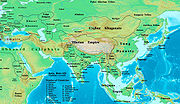
Baghdad
Baghdad is the capital of Iraq, as well as the coterminous Baghdad Governorate. The population of Baghdad in 2011 is approximately 7,216,040...
. They supplemented their income from the trade routes not only by exporting ivory and aloe, but also by engaging in piracy and raiding.
Religious foundations at Mỹ Sơn
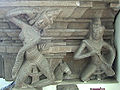
Shiva
Shiva is a major Hindu deity, and is the destroyer god or transformer among the Trimurti, the Hindu Trinity of the primary aspects of the divine. God Shiva is a yogi who has notice of everything that happens in the world and is the main aspect of life. Yet one with great power lives a life of a...
, but temples were also dedicated to Vishnu
Vishnu
Vishnu is the Supreme god in the Vaishnavite tradition of Hinduism. Smarta followers of Adi Shankara, among others, venerate Vishnu as one of the five primary forms of God....
. Scholars have called the architectural style of this period Mỹ Sơn E1
Art of Champa
Champa was an Indic civilization that flourished along the coasts of what is now central and southern Vietnam for roughly a one thousand year period between 500 AD and 1500 AD. The original Chams were probably colonists from the Indonesian islands, who adopted as their principal vocations those of...
, in reference to a particular edifice at Mỹ Sơn that is regarded as emblematic of the style. Important surviving works of art in this style include a pedestal for a linga that has come to be known as the Mỹ Sơn E1 Pedestal and a pediment depicting the birth of Brahma
Brahma
Brahma is the Hindu god of creation and one of the Trimurti, the others being Vishnu and Shiva. According to the Brahma Purana, he is the father of Mānu, and from Mānu all human beings are descended. In the Ramayana and the...
from a lotus issuing from the navel of the sleeping Vishnu
Vishnu
Vishnu is the Supreme god in the Vaishnavite tradition of Hinduism. Smarta followers of Adi Shankara, among others, venerate Vishnu as one of the five primary forms of God....
.
In an important stone inscription dated 657 AD. and found at Mỹ Sơn, King Prakasadharma, who took on the name Vikrantavarman I at his coronation, claimed to be descended through his mother from the Brahman Kaundinya and the serpent princess Soma, the legendary ancestors of the Khmer
Khmer people
Khmer people are the predominant ethnic group in Cambodia, accounting for approximately 90% of the 14.8 million people in the country. They speak the Khmer language, which is part of the larger Mon–Khmer language family found throughout Southeast Asia...
of Cambodia. This inscription thus underlines the ethnic and cultural connection of Champa with the Khmer Empire, its perennial rival to the west. It also commemorates the king's dedication of a monument, probably a linga, to Shiva. Another inscription documents the king's almost mystical devotion to Shiva, "who is the source of the supreme end of life, difficult to attain; whose true nature is beyond the domain of thought and speech, yet whose image, identical with the universe, is manifested by his forms."
Temporary preeminence of Kauthara
In the 8th century, during the time when the Chinese knew the country as "Huanwang", the political center of Champa shifted temporarily from Mỹ Sơn southward to the regions of Panduranga and Kauthara, centered around the temple complex of Po NagarPo nagar
Po Nagar is a Cham temple tower founded sometime before 781 AD and located in the medieval principality of Kauthara, near modern Nha Trang in Vietnam...
near modern Nha Trang
Nha Trang
Nha Trang is a coastal city and capital of Khanh Hoa province, on the South Central Coast of Vietnam. It is bounded on the North by Ninh Hoà district, on the East by the South China Sea, on the South by Cam Ranh town and on the West by Diên Khánh district...
that was dedicated to the indigenous Earth goddess Yan Po Nagar. In 774 AD. raiders from Java
Java
Java is an island of Indonesia. With a population of 135 million , it is the world's most populous island, and one of the most densely populated regions in the world. It is home to 60% of Indonesia's population. The Indonesian capital city, Jakarta, is in west Java...
disembarked in Kauthara, burned the temple of Po Nagar, and carried off the image of Shiva. The Cham king Satyavarman pursued the raiders and defeated them in a naval battle. In 781 AD, Satyavarman erected a stele
Stele
A stele , also stela , is a stone or wooden slab, generally taller than it is wide, erected for funerals or commemorative purposes, most usually decorated with the names and titles of the deceased or living — inscribed, carved in relief , or painted onto the slab...
at Po Nagar, declaring that he had regained control of the area and had restored the temple. In 787 AD, Javanese raiders destroyed a temple dedicated to Shiva near Panduranga.
The Buddhist dynasty at Indrapura

Da Nang
Đà Nẵng , occasionally Danang, is a major port city in the South Central Coast of Vietnam, on the coast of the South China Sea at the mouth of the Han River. It is the commercial and educational center of Central Vietnam; its well-sheltered, easily accessible port and its location on the path of...
in modern Vietnam). Eager to claim an ancient lineage, Indravarman declared himself the descendant of Bhrigu, the venerable sage whose exploits are detailed in the Mahabharata
Mahabharata
The Mahabharata is one of the two major Sanskrit epics of ancient India and Nepal, the other being the Ramayana. The epic is part of itihasa....
, and asserted that Indrapura had been founded by the same Bhrigu in ancient times. From 877 onward, the Chinese knew Champa as "Cheng-cheng", discontinuing their use of the term "Huan-wang."
Indravarman was the first Cham monarch to adopt Mahayana Buddhism as an official religion. At the center of Indrapura, he constructed a Buddhist monastery (vihara) dedicated to the bodhisattva
Bodhisattva
In Buddhism, a bodhisattva is either an enlightened existence or an enlightenment-being or, given the variant Sanskrit spelling satva rather than sattva, "heroic-minded one for enlightenment ." The Pali term has sometimes been translated as "wisdom-being," although in modern publications, and...
Lokesvara. The foundation, regrettably, was devastated during the Vietnam War
Vietnam War
The Vietnam War was a Cold War-era military conflict that occurred in Vietnam, Laos, and Cambodia from 1 November 1955 to the fall of Saigon on 30 April 1975. This war followed the First Indochina War and was fought between North Vietnam, supported by its communist allies, and the government of...
. Thankfully, some photographs and sketches survive from the prewar period. In addition, some stone sculptures from the monastery are preserved in Vietnamese museums. Scholars have called the artistic style typical of the Indrapura the Dong Duong Style
Art of Champa
Champa was an Indic civilization that flourished along the coasts of what is now central and southern Vietnam for roughly a one thousand year period between 500 AD and 1500 AD. The original Chams were probably colonists from the Indonesian islands, who adopted as their principal vocations those of...
. The style is characterized by its dynamism and ethnic realism in the depiction of the Cham people. Surviving masterpieces of the style include several tall sculptures of fierce dvarapala
Dvarapala
Dvarapala is a door or gate guardian often portrayed as warrior or fearsome asura giant, usually armed with a weapon, the most common is gadha mace...
s or temple guardians that were once positioned around the monastery. The period in which Buddhism reigned as the principal religion of Champa came to an end in approximately 925, at which time the Dong Duong Style also began to give way to subsequent artistic styles linked with the restoration of Shaivism
Shaivism
Shaivism is one of the four major sects of Hinduism, the others being Vaishnavism, Shaktism and Smartism. Followers of Shaivism, called "Shaivas," and also "Saivas" or "Saivites," revere Shiva as the Supreme Being. Shaivas believe that Shiva is All and in all, the creator, preserver, destroyer,...
as the national religion.
Kings belonging to the dynasty of Indrapura built a number of temples at Mỹ Sơn in the 9th and 10th centuries. Their temples at Mỹ Sơn came to define a new architectural and artistic style, called by scholars the Mỹ Sơn A1 Style
Art of Champa
Champa was an Indic civilization that flourished along the coasts of what is now central and southern Vietnam for roughly a one thousand year period between 500 AD and 1500 AD. The original Chams were probably colonists from the Indonesian islands, who adopted as their principal vocations those of...
, again in reference to a particular foundation at Mỹ Sơn regarded emblematic for the style. With the religious shift from Buddhism back to Shaivism around the beginning of the 10th century, the center of Cham religion also shifted from Dong Duong back to Mỹ Sơn.
Attrition through conflict with the Việt and the Khmer
Champa reached its peak in the civilization of Indrapura centered in the region of Dong Duong and Mỹ Sơn. Factors contributing to the decline of Champa over the next several centuries include its enviable position along the trade routes, its relatively small population base, and its frequently antagonistic relations with its closest neighbors: the Viet to the north and the Khmer to the west.Interesting parallels may be observed between the history of northern Champa (Indrapura and Vijaya) and that of its neighbor and rival to the west, the Khmer
Khmer people
Khmer people are the predominant ethnic group in Cambodia, accounting for approximately 90% of the 14.8 million people in the country. They speak the Khmer language, which is part of the larger Mon–Khmer language family found throughout Southeast Asia...
civilization of Angkor
Angkor
Angkor is a region of Cambodia that served as the seat of the Khmer Empire, which flourished from approximately the 9th to 15th centuries. The word Angkor is derived from the Sanskrit nagara , meaning "city"...
, located just to the north of the great lake Tonlé Sap
Tonlé Sap
The Tonlé Sap is a combined lake and river system of major importance to Cambodia.The Tonlé Sap is the largest freshwater lake in South East Asia and is an ecological hot spot that was designated as a UNESCO biosphere in 1997....
in what is now Cambodia
Cambodia
Cambodia , officially known as the Kingdom of Cambodia, is a country located in the southern portion of the Indochina Peninsula in Southeast Asia...
. The foundation of the Cham dynasty at Indrapura in 875 AD. was followed just two years later by the foundation at Roluos
Angkor
Angkor is a region of Cambodia that served as the seat of the Khmer Empire, which flourished from approximately the 9th to 15th centuries. The word Angkor is derived from the Sanskrit nagara , meaning "city"...
in 877 of the Khmer empire by King Indravarman I, who united two previously independent regions of Cambodia. The parallels continued as the two peoples flourished from the 10th through the 12th centuries, then went into gradual decline, suffering their ultimate defeat in the 15th century. In 1238, the Khmer lost control of their western possessions around Sukhothai
Sukhothai kingdom
The Sukhothai Kingdom ) was an early kingdom in the area around the city Sukhothai, in north central Thailand. The Kingdom existed from 1238 till 1438...
as the result of a Thai revolt. The successful revolt not only ushered in the era of Thai independence, but also foreshadowed the eventual abandonment of Angkor in 1431 AD. following its sack by Thai invaders from the kingdom of Ayutthaya
Ayutthaya kingdom
Ayutthaya was a Siamese kingdom that existed from 1350 to 1767. Ayutthaya was friendly towards foreign traders, including the Chinese, Vietnamese , Indians, Japanese and Persians, and later the Portuguese, Spanish, Dutch and French, permitting them to set up villages outside the walls of the...
, which had absorbed Sukhothai in 1376. The decline of Champa was roughly contemporaneous with that of Angkor, and was precipitated by pressure from the Đại Việt of what is now northern Vietnam, culminating in the conquest and obliteration of Vijaya in 1471 AD.
Trade
Around the 11th century the Daoyi Zhilue documents Chinese merchants who went to Cham ports in Champa, married Cham women, to whom they regularly returned to after trading voyages. A Chinese merchant from Quanzhou, Wang Yuanmao, traded extensively with Champa, and married a Cham princess.Khmer invasions of Kauthara
In 944 and 945 AD, Khmer troops from Cambodia invaded the region of Kauthara. Around 950, the Khmer pillaged the temple of Po NagarPo nagar
Po Nagar is a Cham temple tower founded sometime before 781 AD and located in the medieval principality of Kauthara, near modern Nha Trang in Vietnam...
and carried off the statue of the goddess. In 960, the Cham King Jaya Indravaman I sent a delegation with tribute to the first king of the Chinese Song Dynasty
Song Dynasty
The Song Dynasty was a ruling dynasty in China between 960 and 1279; it succeeded the Five Dynasties and Ten Kingdoms Period, and was followed by the Yuan Dynasty. It was the first government in world history to issue banknotes or paper money, and the first Chinese government to establish a...
, which had been established in Kaifeng
Kaifeng
Kaifeng , known previously by several names , is a prefecture-level city in east-central Henan province, Central China. Nearly 5 million people live in the metropolitan area...
around 960. In 965, the king restored the temple at Po Nagar and reconstructed the statue of the goddess to replace the one stolen by the Khmer.
War with Đại Việt and the abandonment of Indrapura
In the latter half 10th century, the kings of Indrapura waged war against the Đại Việt of what is now northern Vietnam. The Viet had spent the better part of the century securing their independence from Chinese rule. Following the defeat of the Chinese fleet by Ngô QuyềnNgo Quyen
Ngô Quyền was a Vietnamese prefect and general during the Southern Han Dynasty occupation of Giao Châu in the Red River Valley in what is now northern Vietnam...
in the Battle of Bạch Đằng in 938 AD, the country had gone through a period of internal turmoil until its final reunification by the Đinh Dynasty in 968 under the name Dai Co Viet, and the establishment of a capital at Hoa Lu near modern Hanoi
Hanoi
Hanoi , is the capital of Vietnam and the country's second largest city. Its population in 2009 was estimated at 2.6 million for urban districts, 6.5 million for the metropolitan jurisdiction. From 1010 until 1802, it was the most important political centre of Vietnam...
.
In 979 AD, the Cham King Parameshvaravarman I (Phê Mi Thuê to the Viet) sent a fleet to attack Hoa Lu. The ill-fated expedition was however scuttled by a tempest. In 982, King Lê Hoàn
Lê Hoàn
Lê Hoàn , posthumous name Lê Đại Hành, was a king and emperor of Đại Cồ Việt under the Anterior Lê Dynasty. He was the commander in chief of the army of Emperor Đinh Bộ Lĩnh, but he also had an illicit relationship with the Empress Dowager, dethroned Đinh Bộ Lĩnh’s heir and proclaimed himself king...
of the Đại Việt sent three ambassadors to Indrapura. When the ambassadors were detained, Lê Hoàn decided to go on the offensive. Viet troops sacked Indrapura and killed King Phê Mi Thuê. They carried off Cham dancers and musicians who subsequently came to influence the development of the arts in Đại Việt. As a result of these setbacks, the Cham abandoned Indrapura around 1000 AD. The center of Champa was relocated south to Vijaya in modern Binh Dinh.
Several Chinese accounts record Cham arriving on Hainan, from 986, when the Cham capital fell in 982, several Cham fled to Hainan during the Song dynasty
Song Dynasty
The Song Dynasty was a ruling dynasty in China between 960 and 1279; it succeeded the Five Dynasties and Ten Kingdoms Period, and was followed by the Yuan Dynasty. It was the first government in world history to issue banknotes or paper money, and the first Chinese government to establish a...
. After the 982 fall, of the capital Indrapura to Vietnam, some Cham fled to Guangzhou in addition to Hainan. They became ancestors of the modern day Utsuls on Hainan, who are Muslims and still speak a Cham language.
While declaring himself an independent ruler to his own people, the Vietnamese leader Dinh Bo Linh requested only officially the status of his domain as neifu from the Chinese, which was not an independent state but of an autonomous suboordinate region of China. After this, Champa also demanded this status, to be officially part of China, sending large amounts of tribute to the Chinese. When Vietnam sent Cham prisoners to China, the Chinese sent them back to Champa.
Sack of Vijaya by the Việt
Conflict between Champa and Đại Việt did not end, however, with the abandonment of Indrapura. Champa suffered further Viet attacks in 1021 and 1026 AD. In 1044 AD, a catastrophic battle resulted in the death of the Cham King Sa Dau and the sack of Vijaya by the Đại Việt under Lý Thái TôngLý Thái Tông
Lý Thái Tông was the posthumous title of Lý Phật Mã , emperor of the Lý Dynasty of Đại Việt from 1028 to 1054. His father was Lý Công Uẩn , posthumously known as Lý Thái Tổ , the founder and the first emperor of the Lý Dynasty...
. The invaders captured elephants and musicians and even the Cham queen Mi E, who preserved her honor by throwing herself into the waves as her captors attempted to transport her to their country. 30,000 Cham were killed. Champa began to pay tribute to the Viet kings, including a white rhino sent in 1065. In 1068 AD, however, the King of Vijaya Rudravarman (Che Cu) attacked Đại Việt in order to reverse the setbacks of 1044. Again the Cham were defeated, and again the Đại Việt captured and burned Vijaya. These events were repeated in 1069, when the Viet general Ly Thuong Kiet
Lý Dynasty
The Lý Dynasty , sometimes known as the Later Lý Dynasty , was a Vietnamese dynasty that began in 1009 when Lý Thái Tổ overthrew the Prior Lê Dynasty and ended in 1225 when the queen Lý Chiêu Hoàng was forced to abdicate the throne in favor of her husband, Trần Cảnh. They ruled Vietnam for a...
took a fleet to Champa and occupied Vijaya. Rudravarman and 50,000 others were taken into captivity, eventually purchasing his freedom in exchange for three northern districts of his realm. Taking advantage of the debacle, a leader in southern Champa rebelled and established an independent kingdom. The northern kings were not able to reunite the country until 1084.
Khmer invasions of northern Champa
In 1074 AD, King Harivarman IV took the throne, restoring the temples at Mỹ Sơn and ushering in a period of relative prosperity. Harivarman made peace with the Đại Việt, but provoked war with the Khmer of AngkorAngkor
Angkor is a region of Cambodia that served as the seat of the Khmer Empire, which flourished from approximately the 9th to 15th centuries. The word Angkor is derived from the Sanskrit nagara , meaning "city"...
. In 1080, a Khmer army attacked Vijaya and other centers in northern Champa. Temples and monasteries were sacked; cultural treasures were carried off. After much misery, Cham troops under King Harivarman were able to defeat the invaders and restored the capital and temples.
Around 1080 AD, a new dynasty from the Korat
Korat
Korats are a slate blue-grey shorthair domestic cat with a small to medium build and a low percentage of body fat. Their bodies are semi-cobby, and surprisingly heavy for their size. They are intelligent, playful, active cats and form strong bonds with people. Among Korats' distinguishing...
Plateau in modern Thailand
Thailand
Thailand , officially the Kingdom of Thailand , formerly known as Siam , is a country located at the centre of the Indochina peninsula and Southeast Asia. It is bordered to the north by Burma and Laos, to the east by Laos and Cambodia, to the south by the Gulf of Thailand and Malaysia, and to the...
occupied the throne of Angkor in Cambodia. Soon enough, the kings of the new dynasty embarked on a program of empire-building. Rebuffed in their attempts to conquer Đại Việt in the 1130s, they turned their attention to Champa. In 1145 AD, a Khmer army under King Suryavarman II
Suryavarman II
Suryavarman II was king of the Khmer Empire from 1113 AD to 1145-1150 AD and the builder of Angkor Wat, which he dedicated to the Hindu god Vishnu...
, the founder of Angkor Wat
Angkor Wat
Angkor Wat is a temple complex at Angkor, Cambodia, built for the king Suryavarman II in the early 12th century as his state temple and capital city. As the best-preserved temple at the site, it is the only one to have remained a significant religious centre since its foundation – first Hindu,...
, occupied Vijaya and destroyed the temples at Mỹ Sơn. The Khmer king then proceeded to attempt the conquest of all of northern Champa. In 1149 AD, however, the ruler of the southern principality of Panduranga, King Jaya Harivarman, defeated the invaders and had himself consecrated king of kings in Vijaya. He spent the rest of his reign putting down rebellions in Amaravati and Panduranga.
Sack of Angkor by the Cham

Mahayana
Mahāyāna is one of the two main existing branches of Buddhism and a term for classification of Buddhist philosophies and practice...
theories and the Dharmasutra. After securing peace with the Đại Việt in 1170, Jaya Indravarman invaded Cambodia with inconclusive results. In 1177, however, his troops launched a surprise attack against the Khmer capital of Yasodharapura
Yasodharapura
Yaśodharapura was the first capital of the Khmer empire to be built at the Angkor site. The city was built during the reign of King Yasovarman I after the palace in the previous capital at Roluos was burned during his struggle to consolidate power upon the death of the previous king, his...
from warships piloted up the Mekong River to the great lake Tonlé Sap
Tonlé Sap
The Tonlé Sap is a combined lake and river system of major importance to Cambodia.The Tonlé Sap is the largest freshwater lake in South East Asia and is an ecological hot spot that was designated as a UNESCO biosphere in 1997....
in Cambodia. The invaders sacked the capital, killed the Khmer king, and made off with much booty.
Conquest of Vijaya by the Khmer
The Khmer were rallied by a new king, Jayavarman VIIJayavarman VII
Jayavarman VII was a king of the Khmer Empire in present day Siem Reap, Cambodia. He was the son of King Dharanindravarman II and Queen Sri Jayarajacudamani. He married Jayarajadevi and then, after her death, married her sister Indradevi...
, who drove the Cham from Cambodia in 1181 AD. When Jaya Indravarman IV launched another attack against Cambodia in 1190, Jayavarman VII appointed a Cham prince named Vidyanandana to lead the Khmer army. Vidyanandana defeated the invaders and proceeded to occupy Vijaya and to capture Jaya Indravarman, whom he sent back to Angkor as a prisoner.
Following the conquest of Vijaya, the Khmer king installed his own brother-in-law, Prince In, as a puppet king in Champa. Civil war broke out, however, between several factions. In the end, Prince In prevailed, but declared his independence from Cambodia. Khmer troops attempted unsuccessfully to regain control over Champa throughout the 1190s. In 1203 AD, finally, Jayavarman VII's generals took Vijaya, and Champa effectively became a province of Angkor, not to regain its independence until 1220. Thereafter, Vijaya went into a period of gradual decline that lasted for more than two centuries. This period ended in a total defeat at the hands of the Đại Việt, and was briefly interrupted by a period of astounding military success under the warrior king Chế Bồng Nga.
Invasion of the Mongols
When the Chinese Song dynastySong Dynasty
The Song Dynasty was a ruling dynasty in China between 960 and 1279; it succeeded the Five Dynasties and Ten Kingdoms Period, and was followed by the Yuan Dynasty. It was the first government in world history to issue banknotes or paper money, and the first Chinese government to establish a...
fell to the Mongols, its loyalists fled to Champa where they plotted the reconquest of China.
In 1283 AD, Mongol
Mongol Empire
The Mongol Empire , initially named as Greater Mongol State was a great empire during the 13th and 14th centuries...
troops of the Yuan Dynasty
Yuan Dynasty
The Yuan Dynasty , or Great Yuan Empire was a ruling dynasty founded by the Mongol leader Kublai Khan, who ruled most of present-day China, all of modern Mongolia and its surrounding areas, lasting officially from 1271 to 1368. It is considered both as a division of the Mongol Empire and as an...
under General Sogetu (Sodu) invaded
Mongol invasions of Vietnam
Mongol invasions of Vietnam or Mongol-Vietnamese War refer to the three times that the Mongol Empire and its chief khanate the Yuan Dynasty invaded Đại Việt during the Trần Dynasty and the Kingdom of Champa: in 1257–1258, 1284–1285, and 1287–1288. The Mongols were defeated by Đại...
Champa and occupied Vijaya. In the 1270s, Kublai Khan
Kublai Khan
Kublai Khan , born Kublai and also known by the temple name Shizu , was the fifth Great Khan of the Mongol Empire from 1260 to 1294 and the founder of the Yuan Dynasty in China...
had established his capital and dynasty at Beijing
Beijing
Beijing , also known as Peking , is the capital of the People's Republic of China and one of the most populous cities in the world, with a population of 19,612,368 as of 2010. The city is the country's political, cultural, and educational center, and home to the headquarters for most of China's...
and had toppled the southern Chinese Song Dynasty
Song Dynasty
The Song Dynasty was a ruling dynasty in China between 960 and 1279; it succeeded the Five Dynasties and Ten Kingdoms Period, and was followed by the Yuan Dynasty. It was the first government in world history to issue banknotes or paper money, and the first Chinese government to establish a...
. By 1280, he would turn his attention to the Cham and Viet kingdoms located in the territory of modern Vietnam. A series of Mongol assaults on Đại Việt were, however, unsuccessful, resulting in severe setbacks such as the Battle of Bạch Đằng. Similarly, the invasion of Champa had little lasting effect. Rather than engage the invaders directly, the Cham king and his troops retreated from the coast to the mountains and fought as guerrillas. Two years later, the Mongols left of their own accord. Sogetu was soon killed in another botched invasion of Đại Việt. However, the Champa accepted the Mongol suzerainty
Suzerainty
Suzerainty occurs where a region or people is a tributary to a more powerful entity which controls its foreign affairs while allowing the tributary vassal state some limited domestic autonomy. The dominant entity in the suzerainty relationship, or the more powerful entity itself, is called a...
3 years later.
Chế Mân
In 1307 AD, the Cham King Jaya Simhavarman III (Che Man), the founder of the still extant temple of Po Klaung GaraiPo klaung garai
Po Klong Garai is a Cham temple tower located in the medieval Cham principality of Panduranga, near the city of Phan Rang in what is now southern Vietnam. It was built in honor of the legendary king Po Klaung Garai by the historic King Jaya Simhavarman III, who ruled Champa from c...
in Panduranga, ceded two northern districts to the Đại Việt in exchange for the hand in marriage of a Viet princess. Not long after the nuptials, the king died, and the princess returned to her northern home in order to avoid a Cham custom that would have required her to join her husband in death. However, the lands that Che Man had rashly ceded were not returned. In order to regain these lands, and encouraged by the decline of Đại Việt in the course of the 14th century, the troops of Champa began to make regular incursions into the territory of their neighbor to the north.
Chế Bồng Nga - the Red King
The last strong king of the Cham was Chế Bồng NgaChe Bong Nga
Po Binasuor, or Chế Bồng Nga, Che Bunga ruled Champa from 1360 - 1390 CE...
or Che Bunga
Che Bong Nga
Po Binasuor, or Chế Bồng Nga, Che Bunga ruled Champa from 1360 - 1390 CE...
, who ruled from 1360 until 1390. In Vietnamese stories he is called The Red King. Chế Bồng Nga apparently managed to unite the Cham lands under his rule and by 1372 he was strong enough to attack and almost conquer Đại Việt from the sea.
Cham forces sacked Thăng Long
Hanoi
Hanoi , is the capital of Vietnam and the country's second largest city. Its population in 2009 was estimated at 2.6 million for urban districts, 6.5 million for the metropolitan jurisdiction. From 1010 until 1802, it was the most important political centre of Vietnam...
, the capital city of Đại Việt located at the site of modern Hanoi
Hanoi
Hanoi , is the capital of Vietnam and the country's second largest city. Its population in 2009 was estimated at 2.6 million for urban districts, 6.5 million for the metropolitan jurisdiction. From 1010 until 1802, it was the most important political centre of Vietnam...
, in 1372 and then again in 1377. A last attack in 1388 was checked by the Vietnamese General Hồ Quý Ly, future founder of the Hồ Dynasty. Chế Bồng Nga died two years later in 1390. This was the last serious offensive by the Cham against Đại Việt, but it helped spell the end of the Trần Dynasty, which had forged its reputation in the wars against the Mongols a century earlier, but which now revealed itself as weak and ineffective in the face of the Cham invasions.
Defeat and destruction of Vijaya by the Đại Việt
During the reign of the Ming Hongwu Emperor in China, Champa sent tribute to Ming dynastyMing Dynasty
The Ming Dynasty, also Empire of the Great Ming, was the ruling dynasty of China from 1368 to 1644, following the collapse of the Mongol-led Yuan Dynasty. The Ming, "one of the greatest eras of orderly government and social stability in human history", was the last dynasty in China ruled by ethnic...
to garner Chinese help in the wars with Vietnam. Emperor Hongwu was dead set against military actions in the region of Southeast Asia, he merely rebuked the Vietnamese for their offensive
In 1446, the Đại Việt under the leadership of Trịnh Khả
Trinh Kha
Trịnh Khả close advisor to Lê Lợi, chief ruler of Vietnam during the 1440s, and founder of the powerful Trịnh family.Trịnh Khả, like most of Lê Lợi’s chief aids and generals, was from Thanh Hóa province which is where Lê Lợi was born. During the decade-long war against the Ming dynasty, Trịnh Khả...
launched an invasion of Champa. The attack was successful and Vijaya fell to the invaders. A year later, however, a counter-attack drove the Viet from the city.
In 1470, the Đại Việt, led by the great emperor Lê Thánh Tông
Lê Thánh Tông
Lê Thánh Tông was emperor of Đại Việt from 1460 until his death. He is generally regarded as one of the greatest emperors of Vietnamese history and the Vietnamese "Hammurabi."-Early years:...
, again invaded Champa. Lê Thánh Tông was an extraordinary administrator and leader. The Đại Việt army was very powerful and well organized. By contrast the Cham were disorganized and weak. Vijaya was captured after four days of fighting on 21 March 1471. The Cham king Tra-Toan (Pau Kubah) was captured and died not long thereafter, though he sent his son Syah Pau Ling to Aceh
Aceh
Aceh is a special region of Indonesia, located on the northern tip of the island of Sumatra. Its full name is Daerah Istimewa Aceh , Nanggroë Aceh Darussalam and Aceh . Past spellings of its name include Acheh, Atjeh and Achin...
and began a new dynasty
Aceh Sultanate
The Sultanate of Aceh, officially the Kingdom of Aceh Darussalam was a sultanate centered in the modern area of Aceh Province, Sumatra, Indonesia, which was a major regional power in the 16th and 17th centuries, before experiencing a long period of decline...
there, and another son Syah Indera Berman to Melaka. According to linguistic study Acehnese people
Acehnese people
The Acehnese are a people in Aceh, Indonesia. Their homeland is located in the northern-most tip of the island of Sumatra and had a history of political struggle against the Dutch...
of northern Sumatra
Sumatra
Sumatra is an island in western Indonesia, westernmost of the Sunda Islands. It is the largest island entirely in Indonesia , and the sixth largest island in the world at 473,481 km2 with a population of 50,365,538...
and Cham are related through the Aceh–Chamic languages. At least 60,000 Cham people were killed and 30,000 were taken as slaves by the Vietnamese army. The capital of Vijaya was obliterated. As a result of the victory, Lê Thánh Tông annexed the principalities of Amaravati and Vijaya. This defeat caused the first major Cham emigration, particularly to Cambodia and Malacca
Malacca
Malacca , dubbed The Historic State or Negeri Bersejarah among locals) is the third smallest Malaysian state, after Perlis and Penang. It is located in the southern region of the Malay Peninsula, on the Straits of Malacca. It borders Negeri Sembilan to the north and the state of Johor to the south...
. Those who emigrated to Hainan
Hainan
Hainan is the smallest province of the People's Republic of China . Although the province comprises some two hundred islands scattered among three archipelagos off the southern coast, of its land mass is Hainan Island , from which the province takes its name...
would become known as the Utsul.
Later history of Champa
What remained of historical Champa was the southern principality of Panduranga. Under the protection of Dai-Viet, it preserved some of its independence. This was the starting point of the modern Cham Lords in the principality of Panduranga (Phan Rang, Phan Ri and Phan Thiết).In 1594 the Cham Lord Po At sent forces to assist the Sultanate of Johor's attack on Portuguese
Portugal
Portugal , officially the Portuguese Republic is a country situated in southwestern Europe on the Iberian Peninsula. Portugal is the westernmost country of Europe, and is bordered by the Atlantic Ocean to the West and South and by Spain to the North and East. The Atlantic archipelagos of the...
Malacca
Malacca Town
Most tourist attractions are concentrated in its small city centre which encompasses Jonker Walk which houses Malacca's traditional Chinatown that exhibits Peranakan architecture. A Famosa Fort, St. Paul Hill are among the tourist attractions located in the Bandar Hilir, old city area. There are...
.
When the Ming dynasty
Ming Dynasty
The Ming Dynasty, also Empire of the Great Ming, was the ruling dynasty of China from 1368 to 1644, following the collapse of the Mongol-led Yuan Dynasty. The Ming, "one of the greatest eras of orderly government and social stability in human history", was the last dynasty in China ruled by ethnic...
in China fell, Chinese refugees fled south and extensively settled on Cham lands and in Cambodia. Most of these Chinese were young men, and they took Cham women as wives. Their children identified more with Chinese culture. This migration occurred in the 17th and 18th centuries.
In 1692, the Cham Lord Po Sot rebelled against Nguyễn Phúc Trăn who ruled southern Vietnam. The revolt was at first unsuccessful and the aftermath was exacerbated by an outbreak of plague in Panduranga. However, a Cham aristocrat Oknha Dat obtained the help of the general A Ban, a Lauw leader. They were defeated by the Nguyễn forces of Lord Nguyễn Phúc Chu, under General Nguyễn Hữu Cảnh
Nguyen Huu Canh
Lễ Thành Hầu Nguyễn Hữu Cảnh or Nguyễn Hữu Kính, Hán tự:阮有鏡, was a general of Lord Nguyễn Phúc Chu. He is considered the one who established territorial sovereignty for Vietnam in Saigon and Gia Dinh regions in 1698...
in 1695. After defeated, the new king Po Saktiray Da Patih (younger brother of Po Sot) signed a peace treaty with Nguyễn Phuc Chu. As a result of the treaty, the Cham lords were called Trấn Vương (local lord) of Thuận Thành (Panduranga) by the Nguyễn Lords, and they were closely supervised by Nguyễn officials.
Although the Cham lords had authority over the Cham people, the Panduranga archives supplied some evidence of their limited authority over Vietnamese settlers. The Cham lords often played the role of the judge for Kinh-Cham conflict cases.
17 years later, in 1712, the Nguyễn Lord Nguyễn Phúc Chu made a new treaty called "the treaty with 5 articles" (Ngũ điều Nghị định) with the Cham Lord Po Saktiray Da Patih and clarified the right (included the trial right of the Cham lords and Cham people) and the obligation of the Cham Lords and the Nguyễn Lords. This new treaty was kept until 1832 by the Cham Lords, Nguyễn Lords, Tây Sơn Lords and Nguyễn Emperors.
As a result of the war between the Tây Sơn, under Nguyễn Nhạc, and Nguyễn Ánh, in 1786, the Cham Lord Chei Krei Brei and his court fled to Cambodia. The assumption behind this flight is that they supported the Nguyễn Lords and the Tây Sơn Lords seemed to have won the war. From then on, the Cham Lords' title was downgraded to prefect.
In 1796, during the last years of the Tây Sơn, Tuen Phaow, a noble from Makah (Kelantan
Kelantan
Kelantan is a state of Malaysia. The capital and royal seat is Kota Bharu. The Arabic honorific of the state is Darul Naim, ....
), headed a major revolt against the new Cham leaders (Po Ladhwan Paghuh, Po Chơng Chơn and Po Klan Thu) and claimed Kelantan's support but the revolt was defeated. The Cham leaders regained their special rights once Nguyễn Ánh (the Emperor Gia Long) regained control over Vietnam in 1802. But even the limited Cham rule in Panduranga officially came to an end in 1832, when the Emperor Minh Mạng
Minh Mang
Minh Mạng was the second emperor of the Nguyễn Dynasty of Vietnam, reigning from 14 February 1820 until 20 January 1841. He was a younger son of Emperor Gia Long, whose eldest son, Crown Prince Canh, had died in 1801...
annexed the area.
Hinduism and Buddhism

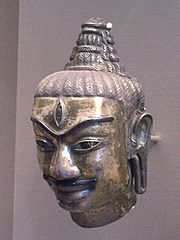
Hinduism
Hinduism is the predominant and indigenous religious tradition of the Indian Subcontinent. Hinduism is known to its followers as , amongst many other expressions...
, and the culture was heavily influenced by that of India. The Hinduism of Champa was overwhelmingly Shaivist
Shaivism
Shaivism is one of the four major sects of Hinduism, the others being Vaishnavism, Shaktism and Smartism. Followers of Shaivism, called "Shaivas," and also "Saivas" or "Saivites," revere Shiva as the Supreme Being. Shaivas believe that Shiva is All and in all, the creator, preserver, destroyer,...
, that is, focussed on the worship of Shiva
Shiva
Shiva is a major Hindu deity, and is the destroyer god or transformer among the Trimurti, the Hindu Trinity of the primary aspects of the divine. God Shiva is a yogi who has notice of everything that happens in the world and is the main aspect of life. Yet one with great power lives a life of a...
, and it was liberally combined with elements of local religious cults such as the worship of the Earth goddess Yan Po Nagar
Po nagar
Po Nagar is a Cham temple tower founded sometime before 781 AD and located in the medieval principality of Kauthara, near modern Nha Trang in Vietnam...
. The main symbols of Cham Shaivism were the linga, the mukhalinga, the jatalinga, the segmented linga, and the kosa.
- A linga (or lingam) is a phallic post that serves as a representation of Shiva. Cham kings frequently erected and dedicated stone lingas as the central religious images in royal temples. The name a Cham king would give to such a linga would be a composite of the king's own name and suffix "-esvara", which stands for Shiva.
- A mukhalinga is a linga upon which has been painted or carved an image of Shiva as a human being or a human face.
- A jatalinga is a linga upon which has been engraved a stylized representation of Shiva's chignon hairstyle.
- A segmented linga is a linga post divided into three sections in order to represents the three aspects of the Hindu godhead or trimurtiTrimurtiThe Trimurti is a concept in Hinduism "in which the cosmic functions of creation, maintenance, and destruction are personified by the forms of Brahmā the creator, Vishnu the maintainer or preserver, and Śhiva the destroyer or transformer," These three deities have been called "the Hindu triad" or...
: the lowest section, square in shape, represents BrahmaBrahmaBrahma is the Hindu god of creation and one of the Trimurti, the others being Vishnu and Shiva. According to the Brahma Purana, he is the father of Mānu, and from Mānu all human beings are descended. In the Ramayana and the...
; the middle section, octogonal in shape, represents VishnuVishnuVishnu is the Supreme god in the Vaishnavite tradition of Hinduism. Smarta followers of Adi Shankara, among others, venerate Vishnu as one of the five primary forms of God....
, and the top section, circular in shape, represents Shiva. - A kosa is a cylindrical basket of precious metal used to cover a linga. The donation of a kosa to the decoration of a linga was a distinguishing characteristic of Cham Shaivism. Cham kings gave names to special kosas in much the way that they gave names to the lingas themselves.
.jpg)
Quang Nam Province
Quảng Nam is a province on the South Central Coast of Vietnam. It is bordered by Thua Thien-Huế province to the north, the nation of Laos to the west, Kon Tum Province to the southwest, Quảng Ngãi Province to the southeast, the South China Sea to the east, and the city of Da Nang to the...
of modern Vietnam) adopted Mahayana Buddhism as its faith. The Buddhist art
Art of Champa
Champa was an Indic civilization that flourished along the coasts of what is now central and southern Vietnam for roughly a one thousand year period between 500 AD and 1500 AD. The original Chams were probably colonists from the Indonesian islands, who adopted as their principal vocations those of...
of Dong Duong has received special acclaim for its originality.
In the 10th centuries and following, Hinduism again became the predominant religion of Champa. Some of the sites which have yielded important works of religious art and architecture from this period are, aside from Mỹ Sơn, Khuong My, Trà Kiệu, Chanh Lo, and Thap Mam.
Islam
IslamIslam
Islam . The most common are and . : Arabic pronunciation varies regionally. The first vowel ranges from ~~. The second vowel ranges from ~~~...
started making headway among the Cham after the 10th century, but it was only after the 1471 invasion that this influence picked up speed. By the 17th century the Royal families of Cham Lords also began to turn to Islam and this eventually triggerred the major shift in religious orientation of the Cham so that by the time of their final annexation by the Vietnamese, the majority of the Cham people had converted to Islam. Most Cham are now Muslim
Muslim
A Muslim, also spelled Moslem, is an adherent of Islam, a monotheistic, Abrahamic religion based on the Quran, which Muslims consider the verbatim word of God as revealed to prophet Muhammad. "Muslim" is the Arabic term for "submitter" .Muslims believe that God is one and incomparable...
s, though significant minorities of Hindu
Hindu
Hindu refers to an identity associated with the philosophical, religious and cultural systems that are indigenous to the Indian subcontinent. As used in the Constitution of India, the word "Hindu" is also attributed to all persons professing any Indian religion...
s and Mahayana Buddhists exist.
Indonesian 15th century records indicate the influence of Princess Darawati, a Cham, in influencing her husband Kertawijaya, Majapahit's seventh ruler, similarly to Parameshwara
Parameswara (sultan)
Parameswara , also called Iskandar Shah or Sri Majara, was a Malay-Hindu prince from Temasek who founded the Malacca Sultanate around 1402.-Etymology:...
of Malacca, to convert the Majapahit royal family to Islam. The Islamic tomb of Putri Champa (Princess of Champa) can be found in Trowulan
Trowulan
Trowulan is a village in Mojokerto, in the Indonesian province of East Java. It is surrounded by an archaeological site covering approximately 100 square kilometres. It has been suggested it was the site of the eponymous capital city of the Majapahit Empire, which is described by Mpu Prapanca in...
, East Java
East Java
East Java is a province of Indonesia. It is located on the eastern part of the island of Java and includes neighboring Madura and islands to its east and to its north East Java is a province of Indonesia. It is located on the eastern part of the island of Java and includes neighboring Madura and...
, the site of Majapahit imperial capital. In 15th to 17th century, Muslim Cham maintain a cordial relationship with Aceh Sultanate
Aceh Sultanate
The Sultanate of Aceh, officially the Kingdom of Aceh Darussalam was a sultanate centered in the modern area of Aceh Province, Sumatra, Indonesia, which was a major regional power in the 16th and 17th centuries, before experiencing a long period of decline...
through dynastic marriage. This sultanate was located on the northern tip of Sumatra
Sumatra
Sumatra is an island in western Indonesia, westernmost of the Sunda Islands. It is the largest island entirely in Indonesia , and the sixth largest island in the world at 473,481 km2 with a population of 50,365,538...
and was an active promotor of Islamic faith in Indonesian archipelago. According to linguistic studies Acehnese people
Acehnese people
The Acehnese are a people in Aceh, Indonesia. Their homeland is located in the northern-most tip of the island of Sumatra and had a history of political struggle against the Dutch...
and Cham are related as both were belongs to the same Aceh–Chamic language family.
Economy
In contrast to Dai Viet, Champa's economy was not based on agriculture. As seafaring people, the Cham were highly mobile and established a network of trade including not only the major ports at Hoi AnHoi An
Hội An , or rarely Faifo, is a city of Vietnam, on the coast of the South China Sea in the South Central Coast of Vietnam. It is located in Quang Nam province and is home to approximately 120,000 inhabitants...
, Thi Nai but also extending into the mountainous hinterland
Tây Nguyên
Tây Nguyên, translated as Western Highlands and sometimes also called Central Highlands, is one of the regions of Vietnam. It contains the provinces of Đắk Lắk, Đắk Nông, Gia Lai, Kon Tum, Lâm Đồng....
. Maritime trade was facilitated by a network of wells that provided fresh water to Cham and foreign ships along the coast of Champa and the islands of Cu Lao Cham
Cham islands
The Cham Islands constitute a group of 8 small islands of Quảng Nam, which form a part of the Cu Lao Cham Marine Park, a world Biosphere Reserve recognized by UNESCO, in South China Sea in Vietnam. The islands are approachable from Cửa Đại beach...
and Ly Son
Ly Son, Vietnam
Lý Sơn , previously known as Cù Lao Ré, Canton Island, and Poulo Canton, is an island and also a district in Quang Ngai province, off the South Central Coast of Vietnam.-Geography and geology:...
. While Kenneth R. Hall suggests that Champa was not able to rely on taxes on trade for continuous revenue, but instead financed their rule by raiding neighbouring countries, Hardy argues that the country's prosperity was above all based on commerce.
The vast majority of Champa's export products came from the mountainous hinterland
Tây Nguyên
Tây Nguyên, translated as Western Highlands and sometimes also called Central Highlands, is one of the regions of Vietnam. It contains the provinces of Đắk Lắk, Đắk Nông, Gia Lai, Kon Tum, Lâm Đồng....
, sourced from as far as Attapeu in southern Laos
Laos
Laos Lao: ສາທາລະນະລັດ ປະຊາທິປະໄຕ ປະຊາຊົນລາວ Sathalanalat Paxathipatai Paxaxon Lao, officially the Lao People's Democratic Republic, is a landlocked country in Southeast Asia, bordered by Burma and China to the northwest, Vietnam to the east, Cambodia to the south and Thailand to the west...
. They included gold and silver, slaves, animal and animal products, and precious woods. By far the most important export product was eaglewood. It was the only product mentioned in Marco Polo
Marco Polo
Marco Polo was a Venetian merchant traveler from the Venetian Republic whose travels are recorded in Il Milione, a book which did much to introduce Europeans to Central Asia and China. He learned about trading whilst his father and uncle, Niccolò and Maffeo, travelled through Asia and apparently...
's brief account and similarly impressed the Arab trader Sulayman several centuries earlier. Most of it was probably taken from the Aquilaria crassna
Aquilaria crassna
Aquilaria crassna is a species of plant in the Thymelaeaceae family. It is found in throughout southeast Asia and in New Guinea.-Economics:Aquilaria crassna is one source of agarwood, a resinous heartwood, used for perfume and incense...
tree, just as most of the eaglewood in Vietnam today.
Remains
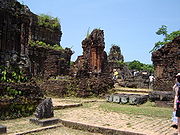
Hoi An
Hội An , or rarely Faifo, is a city of Vietnam, on the coast of the South China Sea in the South Central Coast of Vietnam. It is located in Quang Nam province and is home to approximately 120,000 inhabitants...
. The large complex at Mỹ Sơn was heavily damaged by United States bombing during the Vietnam War. The site is currently being restored with donations from a number of countries and NGO's. As of 2004, the clearing of land mine
Land mine
A land mine is usually a weight-triggered explosive device which is intended to damage a target—either human or inanimate—by means of a blast and/or fragment impact....
s and UXO's had not been completed.
Many historic Cham towers still remain standing at other sites in Central Vietnam, including the following:
- Po NagarPo nagarPo Nagar is a Cham temple tower founded sometime before 781 AD and located in the medieval principality of Kauthara, near modern Nha Trang in Vietnam...
- Po Klaung GaraiPo klaung garaiPo Klong Garai is a Cham temple tower located in the medieval Cham principality of Panduranga, near the city of Phan Rang in what is now southern Vietnam. It was built in honor of the legendary king Po Klaung Garai by the historic King Jaya Simhavarman III, who ruled Champa from c...
Some of the network of wells that was used to provide fresh water to Cham and foreign ships still remains. Cham wells are recognisable by their square shape. They are still in use and provide fresh water even during times of drought.
The largest collection of Cham sculpture
Art of Champa
Champa was an Indic civilization that flourished along the coasts of what is now central and southern Vietnam for roughly a one thousand year period between 500 AD and 1500 AD. The original Chams were probably colonists from the Indonesian islands, who adopted as their principal vocations those of...
may be found in the Da Nang Museum of Cham Sculpture
Museum of Cham Sculpture
The Museum of Cham Sculpture is a museum located in Hai Chau district, Đà Nẵng, central Vietnam. The museum was founded in 1915 as the Musée Henri Parmentier during the colonial French era to preserve the finds of the ancient Champa kingdom and is the only museum in the world dedicated solely to...
(formerly known as "Musée Henri Parmentier") in the coastal city of Da Nang
Da Nang
Đà Nẵng , occasionally Danang, is a major port city in the South Central Coast of Vietnam, on the coast of the South China Sea at the mouth of the Han River. It is the commercial and educational center of Central Vietnam; its well-sheltered, easily accessible port and its location on the path of...
. The museum was established in 1915 by French scholars, and is regarded as one of the most beautiful in Southeast Asia. Other museums with collections of Cham art include the following:
- Museum of Fine Arts, Hanoi
- Museum of History, Hanoi
- Museum of Fine Arts, Saigon
- Museum of History, Saigon
- Musée Guimet, Paris
See also
- History of VietnamHistory of VietnamThe history of Vietnam covers a period of more than 2,700 years. By far Vietnam's most important historical international relationship has been with China. Vietnam's prehistory includes a legend about a kingdom known as Van Lang that included what is now China's Guangxi Autonomous Region and...
- Cham people
- Art of ChampaArt of ChampaChampa was an Indic civilization that flourished along the coasts of what is now central and southern Vietnam for roughly a one thousand year period between 500 AD and 1500 AD. The original Chams were probably colonists from the Indonesian islands, who adopted as their principal vocations those of...
- Aceh–Chamic languages
- List of monarchs of Champa
- Kingdom of ChampasakKingdom of ChampasakThe Kingdom of Champasak , in southern Laos, broke away from the Lan Xang kingdom in 1713. The Kingdom of Champasak prospered at the beginning the 18th century, but it was reduced to a vassal state of Siam before the century had passed. Under French rule the kingdom became an administrative block...
in the south of Laos - Kampong Cham Province in east Cambodia
Literature
- Jean Boisselier, La statuaire du Champa, Paris: École Française d'Extrême-Orient, 1963
- David P. ChandlerDavid P. ChandlerDavid P. Chandler is an American historian and academic who is regarded as one of the foremost western scholars of Cambodia's modern history. Chandler currently resides in Australia, where he is an emeritus professor at Monash University as well as an adjunct professor of Asian Studies at...
, A History of Cambodia, Boulder: Westview Press, 1992 - Emmanuel Guillon Cham Art, London: Thames & Hudson Ltd, 2001 ISBN 0-500-97593-0
- Hardy, Andrew (2009): "Eaglewood and the Economic History of Champa and Central Vietnam" in Hardy, Andrew et al.: Champa and the Archeology of My Son (Vietnam). NUS Press, Singapore
- Jean-François Hubert The Art of Champa, Parkstone Press, 2005 ISBN 1-85995-975-X
- Lê Thành Khôi, Histoire du Vietnam des origines à 1858, Paris: Sudestasie, 1981
- Georges Maspero, Le royaume de Champa, Paris: Van Ouest, 1928. This work, perhaps the most thorough in the use of primary sources to reconstruct the history of Champa, has been translated into English by Walter E.J. Tips under the title, The Champa Kingdom: The History of an Extinct Vietnamese Culture, Bangkok: White Lotus Press, 2002.
- Ngô Vǎn Doanh, Champa: Ancient Towers, Hanoi: Thế Giới Publishers, 2006
- Ngô Vǎn Doanh, Mỹ Sơn Relics, Hanoi: Thế Giới Publishers, 2005
- Scott Rutherford, Insight Guide - Vietnam (ed.), 2006 ISBN 981-234-984-7
- D. R. Sardesai, Vietnam, Trials and Tribulations of a Nation Long Beach Publications, 1988 ISBN 0-941910-04-0
- Michael Vickery, "Champa Revised" ARI Working Paper, No. 37, 2005, www.nus.ari.edu.sg/pub/wps.htm.
- Geoff Wade, "Champa in the Song hui-yao" ARI Working Paper, No. 53, 2005, www.nus.ari.edu.sg/pub/wps.htm
External links
- Proceedings of the Seminar on Champa, "Research on Champa and its Evolution"
- Website of the Asia Research Institute, including the working paper "Champa Revised" by Michael Vickery, and the draft translation "Champa in the Song hui-yao" by Geoff Wade
- Vietnam-Champa Relations and the Malay-Islam Regional Network in the 17th—19th Centuries
- The Survivors of a Lost Civilisation
- Cham Muslims: A look at Cambodia's Muslim minority
- The Cham Muslims of Indo-China
- Photos of Cham art exhibited in Vietnamese museums
- Plumeria flowers - Champa Flowers - La fleur de frangipaniers – Hoa Sứ, Hoa đại, Hoa Champa