
All Topics  
Hiroshima


   Email Print
   Bookmark   Link


Hiroshima


The Japanese city of is the capital of Hiroshima Prefecture
Hiroshima Prefecture

is a Prefectures of Japan of Japan located in the Chugoku region on Honshu island. The capital is the city of Hiroshima....
, and the largest city in the Chugoku region
Chugoku region

The or is the westernmost region of Honshu, the largest island of Japan. It consists of the prefectures of Hiroshima Prefecture, Yamaguchi Prefecture, Shimane Prefecture, Tottori Prefecture, and Okayama Prefecture....
 of western Honshu
Honshu

or Honshu is the largest island of Japan. The nation's main island, it is south of Hokkaido across the Tsugaru Strait, north of Shikoku across the Inland Sea, and northeast of Kyushu across the Kanmon Strait....
, the largest of Japan
Japan

Japan is an island country in East Asia. Located in the Pacific Ocean, it lies to the east of the Sea of Japan, People's Republic of China, North Korea, South Korea and Russia, stretching from the Sea of Okhotsk in the north to the East China Sea and Taiwan in the south....
's islands. It is known throughout the world as the first city in history
Atomic bombings of Hiroshima and Nagasaki

The atomic bombings of Hiroshima and Nagasaki were nuclear warfares near the end of World War II against the Empire of Japan by the United States at the executive order of President of the United States Harry S....
 subjected to nuclear warfare
Nuclear warfare

Nuclear warfare, or atomic warfare refers to the strategy for fighting or deterring military conflicts and terrorism when nuclear weapons are present....
 when it was bombed by the United States of America
United States

The United States of America is a Federal government constitutional republic comprising U.S. state and a federal district. The country is situated mostly in central North America, where its Contiguous United States and Washington, D.C., the Capital districts and territories, lie between the Pacific Ocean and Atlantic Oceans, Borders of the U...
 on August 6, 1945 during World War II
World War II

World War II, or the Second World War , was a global military conflict which involved a Participants in World War II, including all of the great powers, organised into two opposing military alliances: the Allies of World War II and the Axis powers....
.

Hiroshima gained municipality status on April 1, 1889 and was designated on April 1, 1980 by government ordinance. The city's current mayor is Tadatoshi Akiba
Tadatoshi Akiba

is mayor of the city of Hiroshima, Hiroshima, Japan.He studied mathematics at the University of Tokyo, receiving a B.S. in 1966 and an M.S. in 1968....
 who assumed the office on February 23, 1999.

shima was founded on the coast of the Seto Inland Sea in 1589 by Mori Terumoto
Mori Terumoto

Mori Terumoto was the son of Mori Takamoto and grandson and successor of the great warlord Mori Motonari, fought against Toyotomi Hideyoshi but was eventually overcome, participated in the Kyushu campaign on Hideyoshi's side and built Hiroshima Castle....
, who made it his capital after leaving Koriyama Castle in Aki Province
Aki Province

or Geishu was a Provinces of Japan in the Chugoku region of western Honshu, comprising the western part of what is today Hiroshima Prefecture, Japan....
.


Discussion
Ask a question about 'Hiroshima'
Start a new discussion about 'Hiroshima'
Answer questions from other users
Full Discussion Forum


Encyclopedia


The Japanese city of is the capital of Hiroshima Prefecture
Hiroshima Prefecture

is a Prefectures of Japan of Japan located in the Chugoku region on Honshu island. The capital is the city of Hiroshima....
, and the largest city in the Chugoku region
Chugoku region

The or is the westernmost region of Honshu, the largest island of Japan. It consists of the prefectures of Hiroshima Prefecture, Yamaguchi Prefecture, Shimane Prefecture, Tottori Prefecture, and Okayama Prefecture....
 of western Honshu
Honshu

or Honshu is the largest island of Japan. The nation's main island, it is south of Hokkaido across the Tsugaru Strait, north of Shikoku across the Inland Sea, and northeast of Kyushu across the Kanmon Strait....
, the largest of Japan
Japan

Japan is an island country in East Asia. Located in the Pacific Ocean, it lies to the east of the Sea of Japan, People's Republic of China, North Korea, South Korea and Russia, stretching from the Sea of Okhotsk in the north to the East China Sea and Taiwan in the south....
's islands. It is known throughout the world as the first city in history
Atomic bombings of Hiroshima and Nagasaki

The atomic bombings of Hiroshima and Nagasaki were nuclear warfares near the end of World War II against the Empire of Japan by the United States at the executive order of President of the United States Harry S....
 subjected to nuclear warfare
Nuclear warfare

Nuclear warfare, or atomic warfare refers to the strategy for fighting or deterring military conflicts and terrorism when nuclear weapons are present....
 when it was bombed by the United States of America
United States

The United States of America is a Federal government constitutional republic comprising U.S. state and a federal district. The country is situated mostly in central North America, where its Contiguous United States and Washington, D.C., the Capital districts and territories, lie between the Pacific Ocean and Atlantic Oceans, Borders of the U...
 on August 6, 1945 during World War II
World War II

World War II, or the Second World War , was a global military conflict which involved a Participants in World War II, including all of the great powers, organised into two opposing military alliances: the Allies of World War II and the Axis powers....
.

Hiroshima gained municipality status on April 1, 1889 and was designated on April 1, 1980 by government ordinance. The city's current mayor is Tadatoshi Akiba
Tadatoshi Akiba

is mayor of the city of Hiroshima, Hiroshima, Japan.He studied mathematics at the University of Tokyo, receiving a B.S. in 1966 and an M.S. in 1968....
 who assumed the office on February 23, 1999.

History

Hiroshima was founded on the coast of the Seto Inland Sea in 1589 by Mori Terumoto
Mori Terumoto

Mori Terumoto was the son of Mori Takamoto and grandson and successor of the great warlord Mori Motonari, fought against Toyotomi Hideyoshi but was eventually overcome, participated in the Kyushu campaign on Hideyoshi's side and built Hiroshima Castle....
, who made it his capital after leaving Koriyama Castle in Aki Province
Aki Province

or Geishu was a Provinces of Japan in the Chugoku region of western Honshu, comprising the western part of what is today Hiroshima Prefecture, Japan....
. Hiroshima Castle
Hiroshima Castle

', sometimes called ' is a Japanese castle in Hiroshima, Hiroshima, Japan which was the home of the daimyo of the Hiroshima han . Originally constructed in the 1590s, the castle was destroyed in the atomic bombing of Hiroshima and Nagasaki in 1945....
 was quickly built, and Terumoto moved in in 1593. Terumoto was on the losing side at the Battle of Sekigahara
Battle of Sekigahara

The , popularly known as the , was a decisive battle on October 21, 1600 which cleared the path to the Shogunate for Tokugawa Ieyasu. Though it would take three more years for Ieyasu to consolidate his position of power over the Toyotomi clan and the daimyo, Sekigahara is widely considered to be the unofficial beginning of the Tokugawa shogunate,...
. The winner, Tokugawa Ieyasu
Tokugawa Ieyasu

Japanese name|Tokugawa}} was the founder and first shogun of the Tokugawa shogunate of Japan which ruled from the Battle of Sekigahara  in 1600 until the Meiji Restoration in 1868....
, deprived Mori Terumoto of most of his fiefs including Hiroshima and gave Aki province
Aki Province

or Geishu was a Provinces of Japan in the Chugoku region of western Honshu, comprising the western part of what is today Hiroshima Prefecture, Japan....
 to Masanori Fukushima
Fukushima Masanori

was a samurai of the late Sengoku Period to early Edo Period. A retainer of Toyotomi Hideyoshi, he fought in the battle of Shizugatake in 1583, and soon became known as one of Seven Spears of Shizugatake which also included Kato Kiyomasa and others....
, a daimyo who had supported Tokugawa. The castle passed to Asano Nagaakira
Asano Nagaakira

was a Japanese samurai of the early Edo period who served as daimyo of the Wakayama domain, and was later transferred to the Hiroshima Domain....
 in 1619, and Asano was appointed the daimyo of this area. Under Asano rule, the city prospered, developed, and expanded, with few military conflicts or disturbances. Asano's descendants continued to rule until the Meiji Restoration
Meiji Restoration

The , also known as the Meiji Ishin, Revolution, or Renewal, was a chain of events that led to enormous changes in Japan's political and social structure....
 in the 19th century.

Modern Era

Hiroshima served as the capital of Hiroshima Domain
Hiroshima Domain

Hiroshima Domain was a han , or fief, of Edo period Japan. Based at Hiroshima castle in the city of Hiroshima, the domain encompassed Aki province and parts of neighboring Bingo province....
 during the Edo period
Edo period

The , or , is a division of History of Japan running from 1603 to 1868. The period marks the governance of the Edo or Tokugawa shogunate, which was officially established in 1603 by the first Edo shogun Tokugawa Ieyasu....
. After the han was abolished in 1871, the city became the capital of Hiroshima prefecture
Hiroshima Prefecture

is a Prefectures of Japan of Japan located in the Chugoku region on Honshu island. The capital is the city of Hiroshima....
. Hiroshima became a major urban center during the Meiji period
Meiji period

The , or Meiji era, denotes the 45-year reign of the Meiji Emperor, running, in the Gregorian calendar, from 23 October 1868 to 30 July 1912. During this time, Japan started its modernization and rose to world power status....
 as the Japanese economy shifted from primarily rural to urban industries. Ujina Harbor was constructed in the 1880s, allowing Hiroshima to become an important port city. The Sanyo Railroad was extended to Hiroshima in 1894, and a rail line from the main station to the harbor was constructed for military transportation during the First Sino-Japanese War
First Sino-Japanese War

The First Sino-Japanese War was a war fought between Qing Dynasty China and Meiji period Imperial Japan over the control of Korea. The Sino-Japanese War would come to symbolize the degeneration and enfeeblement of the Qing Dynasty and demonstrate how successful modernization had been in Japan since the Meiji Restoration as compared with the...
. New industrial plants, including cotton mill
Cotton mill

A cotton mill is a factory housing spinning and weaving machinery. Cotton was a leading sector in the Industrial Revolution, as cotton spinning was mechanised in mills....
s, were established in Hiroshima in the late 1800s. Further industrialization in Hiroshima was stimulated during the Russo-Japanese War
Russo-Japanese War

The Russo-Japanese War or the Manchurian Campaign in some English sources, was a conflict that grew out of the rival imperialism ambitions of the Russian Empire and the Empire of Japan over Manchuria and Korea....
 in 1904, which required development and production of military supplies. The Hiroshima Prefectural Commercial Exhibition Hall was constructed in 1915 as a center for trade and exhibition of new products. Later, its name was changed to Hiroshima Prefectural Product Exhibition Hall, and again to Hiroshima Prefectural Industrial Promotion Hall.

WWII and atomic bombing

Hiroshimagembakudome
During World War II
World War II

World War II, or the Second World War , was a global military conflict which involved a Participants in World War II, including all of the great powers, organised into two opposing military alliances: the Allies of World War II and the Axis powers....
, the Second Army and Chugoku Regional Army were headquartered in Hiroshima, and the Army Marine Headquarters was located at Ujina port. The city also had large depots of military supplies, and was a key center for shipping.

The bombing of Tokyo and other cities in Japan during World War II caused widespread destruction and over 200,000 deaths, nearly all civilians. For example, Toyama
Toyama, Toyama

is the capital cities of Japan of Toyama Prefecture, Japan. It is located on the coast of the Sea of Japan on the island of Honshu, about 200 km north of the city of Nagoya and 300 km northwest of Tokyo....
, an urban area of 128,000, was nearly 100% destroyed, and incendiary attacks on Tokyo are credited with claiming 90,000 lives. There were no such air raids
Air raids on Japan

There were many air raids on Japan by Allies of World War II aircraft during World War II.The Japanese Archipelago of the Empire of Japan were defended by the Imperial Japanese Army Air Service and the Imperial Japanese Navy Air Service....
 in Hiroshima. However, the threat was certainly there and to protect against potential firebombings in Hiroshima, students were mobilized to demolish houses and create firebreak
Firebreak

A firebreak is a gap in vegetation or other combustible material that acts as a barrier to slow or stop the progress of a wildfire. A firebreak may occur naturally where there is a lack of vegetation or "fuel", such as a river, lake or canyon....
s.

On Monday, August 6, 1945, the nuclear weapon
Nuclear weapon

A nuclear weapon is an explosive device that derives its destructive force from nuclear reactions, either nuclear fission or a combination of fission and nuclear fusion....
 Little Boy
Little Boy

Little Boy was the codename of the atomic bomb that was dropped on Hiroshima, Japan, on August 6, 1945 by the B-29 Superfortress Enola Gay, piloted by Colonel Paul Tibbets in the 393d Bomb Squadron of the United States Army Air Forces....
 was dropped on Hiroshima by the crew of the American B-29 bomber Enola Gay
Enola Gay

The Enola Gay is the B-29 Superfortress bomber that dropped the first Nuclear weapon, code-named "Little Boy", to be used in war, by the United States Army Air Forces in the attack on Hiroshima, Japan on 6 August 1945, just before the end of World War II....
, directly killing an estimated 80,000 people. By the end of the year, injury and radiation brought total casualties to 90,000-140,000. Approximately 69% of the city's buildings were completely destroyed, and 6.6% severely damaged.

Research about the effects of the attack was restricted under Allied
Allies of World War II

The Allies of World War II were the countries officially opposed to the Axis powers of World War II during the World War II. Within the ranks of the Allies powers, the British Empire, the Soviet Union, and the United States of America were known as "The Big Three"....
 occupation
Occupied Japan

At the end of World War II, Japan was occupied by the Allies of World War II, led by the United States with contributions also from the United Kingdom....
, and information censored until the signing of the San Francisco Peace Treaty in 1951, restoring control to the Japanese.

Much has been written in news reports, novels, and popular culture about Hiroshima in the years after the bombing.

Reconstruction after the war

Papercranes
On September 17, 1945, Hiroshima was struck by the Makurazaki Typhoon (Typhoon Ida), one of the largest typhoons of the Showa period
Showa period

The , or Showa era, is the period of Japanese history corresponding to the reign of Emperor Showa , from December 25, 1926 to January 7, 1989. In his coronation message which was read to the people and to the army, the newly enthroned emperor referenced this Japanese era name or nengo: "I have visited the battlefields of the Great War in...
. Hiroshima prefecture
Hiroshima Prefecture

is a Prefectures of Japan of Japan located in the Chugoku region on Honshu island. The capital is the city of Hiroshima....
 suffered more than 3,000 deaths and injuries, about half the national total. More than half the bridges in the city were destroyed, along with heavy damage to roads and railroads, further devastating the city.

Hiroshima was rebuilt after the war, with the help from the national government through the Hiroshima Peace Memorial City Construction Law passed in 1949. It provided financial assistance for reconstruction, along with land donated that was previously owned by the national government and used for military purposes. Several U.S. civic leaders and scholars were consulted about the rebuilding plan.

In 1949, a design was selected for the Hiroshima Peace Memorial Park
Hiroshima Peace Memorial Park

is a large park in the center of Hiroshima, Japan. It is dedicated to the legacy of Hiroshima as the first city in the world to suffer a Atomic bombings of Hiroshima and Nagasaki , which led to the death of as many as 140,000 people by the end of 1945. There are a variety of monuments and buildings in the park, each...
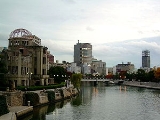
. Hiroshima Prefectural Industrial Promotion Hall, the closest surviving building to the location of the bomb's detonation, was designated the Genbaku Dome or "Atomic Dome"
Hiroshima Peace Memorial

Hiroshima Peace Memorial, commonly called the Atomic Bomb Dome or A-Bomb Dome , in Hiroshima, Japan, is part of the Hiroshima Peace Memorial Park and was designated a UNESCO World Heritage Site in 1996....
, a part of the Hiroshima Peace Memorial Park
Hiroshima Peace Memorial Park

is a large park in the center of Hiroshima, Japan. It is dedicated to the legacy of Hiroshima as the first city in the world to suffer a Atomic bombings of Hiroshima and Nagasaki , which led to the death of as many as 140,000 people by the end of 1945. There are a variety of monuments and buildings in the park, each...
. The Hiroshima Peace Memorial Museum
Hiroshima Peace Memorial Museum

Hiroshima Peace Memorial Museum is located in Hiroshima Peace Memorial Park, in central Hiroshima, Japan.It was established in August 1955 with the Hiroshima Peace Memorial Hall ....
 was opened in 1955 in the Peace Park.

Hiroshima was proclaimed a City of Peace by the Japan
Japan

Japan is an island country in East Asia. Located in the Pacific Ocean, it lies to the east of the Sea of Japan, People's Republic of China, North Korea, South Korea and Russia, stretching from the Sea of Okhotsk in the north to the East China Sea and Taiwan in the south....
ese parliament in 1949, at the initiative of its mayor, Shinzo Hamai
Shinzo Hamai

Shinzo Hamai was the first popularly elected Mayor of Hiroshima . He created Hiroshima's image as a city of peace.The circumstances of his rise to prominence result from the fact that following the nuclear holocaust in Hiroshima, many municipal employees were killed or incapacitated, while Hamai was only slightly injured....
 (1905–1968). As a result, the city of Hiroshima received more international attention as a desirable location for holding international conferences on peace as well as social issues. As part of that effort, the Hiroshima Interpreters' and Guide's Association (HIGA) was established in 1992 in order to facilitate translation services for conferences, and the Hiroshima Peace Institute was established in 1998 within the Hiroshima University
Hiroshima University

, located in the Japan cities of Higashihiroshima, Hiroshima and Hiroshima, was established 1949 by the merger of a number of city educational institutions....
. The city government continues to advocate the abolition of all nuclear weapon
Nuclear weapon

A nuclear weapon is an explosive device that derives its destructive force from nuclear reactions, either nuclear fission or a combination of fission and nuclear fusion....
s and the Mayor of Hiroshima is the President of Mayors for Peace, an international Mayoral organization mobilizing cities and citizens worldwide to abolish and eliminate nuclear weapons by the year 2020 .

Geography

Hiroshima has eight wards
Wards of Japan

A ku , conventionally translated as ward is a district in a large Japanese city. Wards are used to subdivide each City designated by government ordinance , as well as Tokyo ....
 (ku):

EmblemWardPopulationArea (kmē)Density
(per kmē)
Aki-ku
Aki-ku, Hiroshima

Aki-ku is one of the eight Wards of Japan of the city of Hiroshima, Japan.As of November 1 2005, the ward has an estimated population of 76,858 and a population density of 817.55 persons per km?. The total area is 94.01 km?....
78,17694.01832
Asakita-ku
Asakita-ku, Hiroshima

Asakita-ku is one of the eight wards of the city of Hiroshima, Hiroshima, located in the North of Asa-gun and the South of Takata-gun: now-defunct districts ....
156,368353.35443
Asaminami-ku
Asaminami-ku, Hiroshima

Asaminami-ku is one of the eight ward of the city of Hiroshima, located in the South of Asa-gun: now-defunct district.Asa-gun was consisted of Gion-cho, Yasufuruichi-cho, Sato-cho, Numata-cho....
220,351117.191,880
Higashi-ku
Higashi-ku, Hiroshima

Higashi-Ku is one of the eight wards located in Hiroshima, Japan. It is located on the uppermost delta of the Ota River.Within Higashi-ku is the Fudoin Temple in Ushita-shinmachi....
122,04539.383,099
Minami-ku
Minami-ku, Hiroshima

Minami-ku is one of the eight Wards of Japan of the city of Hiroshima, Japan....
138,13826.095,295
Naka-ku
Naka-ku, Hiroshima

Naka-ku is the heart of Hiroshima, Hiroshima Prefecture, Japan. Naka-ku is home to Hiroshima's central business district and Peace Memorial Park....
125,20815.348,162
Nishi-ku
Nishi-ku, Hiroshima

Nishi-ku is one of the eight Wards of Japan of the city of Hiroshima, Japan. The Hiroshima-Nishi Airport is located in Nishi-ku....
184,88135.675,183
Saeki-ku
Saeki-ku, Hiroshima

Saeki-ku is one of the eight Wards of Japan of the city of Hiroshima, Japan.The Hiroshima Branch of the Japan Mint is located here.The ward added the former town of Yuki, Hiroshima from Saeki District, Hiroshima on April 25, 2005....
135,789223.98606
Population as of October 31, 2006


Demographics

As of 2006, the city has an estimated population
Population

File:Population density.pngIn biology, a population is the collection of inter-breeding organisms of a particular species; in sociology, a collection of human beings....
 of 1,154,391, while the total population for the metropolitan area was estimated as 2,043,788 in 2000. The total area of the city is 905.08 kmē, with a density
Population density

Population density is a measurement of population per unit area or unit volume. It is frequently applied to living organisms, and particularly to humans....
 of 1275.4 persons per kmē.

The population around 1910 was 143,000. Before World War II
World War II

World War II, or the Second World War , was a global military conflict which involved a Participants in World War II, including all of the great powers, organised into two opposing military alliances: the Allies of World War II and the Axis powers....
, Hiroshima's population had grown to 360,000, and peaked at 419,182 in 1942. Following the atomic bombing in 1945, the population dropped to 137,197. By 1955, the city's population had returned to pre-war levels.

Economy

Hiroshima is the center of industry for the Chugoku-Shikoku
Shikoku

is the smallest and least populous of the four main islands of Japan, located south of Honshu and east of Kyushu island. Its ancient names include Iyo-no-futana-shima , Iyo-shima , and Futana-shima ....
 region, and is by and large centered along the coastal areas. Hiroshima has long been a port city and Hiroshima port or Hiroshima International Airport
Hiroshima Airport

is an airport in the city of Mihara, Hiroshima, Hiroshima Prefecture, Japan. It is the largest airport in the Chugoku region....
 can be used for the transportation of goods.

Its largest industry is the manufacturing industry with core industries being the production of Mazda cars, car parts and industrial equipment. Mazda Motor Company
Mazda

is a Japanese automaker based in Hiroshima Prefecture, Japan. It is part owned by the Ford Motor Company.During 2007, Mazda produced almost 1.3 million vehicles for global sales....
, now controlled by the Ford Motor Company
Ford Motor Company

The Ford Motor Company is an United States multinational corporation and the world's List of automobile manufacturers#World Motor Vehicle Production by Manufacturer based on worldwide vehicle sales, following Toyota, General Motors, and Volkswagen Group....
, is by far Hiroshima's dominant company. Mazda accounts for 32% of Hiroshima's GDP. Mazda makes many models in Hiroshima for worldwide export, including the popular MX-5/Miata, Mazda Demio
Mazda Demio

The Demio was originally a small minivan or tall station wagon which debuted in 1996. Introduced in 2007, the third generation Demio earned the 2008 World Car Design of the Year title....
(Mazda2), Mazda CX-9
Mazda CX-9

The Mazda CX-9 is a full-size crossover SUV, also described as a "modern station wagon", built by Mazda. It replaced the Mazda MPV minivan for North America ....
 and Mazda RX-8
Mazda RX-8

The Mazda RX-8 is a sports car manufactured by Mazda. It first appeared in 2001 at the North American International Auto Show. It is the successor to the Mazda RX-7 and, like its predecessors in the RX range, it is powered by a Mazda Wankel engine....
. The Mazda CX-7
Mazda CX-7

The CX-7 is a mid-size crossover SUV model from Mazda, the production version of the MX-Crossport concept car. The CX-7 is built in Hiroshima, Japan, starting in early 2006....
 has been built there since early 2006. Other Mazda factories are in Hofu
Hofu, Yamaguchi

is a cities of Japan located in Yamaguchi Prefecture, Japan.As of 2008, the city has an estimated population of 117,535 and the population density of 623 persons per km?....
 and Flat Rock, Michigan
Flat Rock, Michigan

Flat Rock is a city in Wayne County, Michigan of the U.S. state of Michigan. A very small portion of the city extends into Monroe County, Michigan....
.
Mazda787b
General machinery and equipment also account for a large portion of exports. Because these industries require research and design capabilities, it has also had the offshoot that Hiroshima has many innovative companies actively engaged in new growth fields (for example, Hiroshima Vehicle Engineering Company (HIVEC). Many of these companies hold the top market shares in Japan and the world, or are alone in their particular field. Tertiary industries in the wholesale and retail areas are also very developed.

Another result of the concentration of industry is an accumulation of skilled personnel and fundamental technologies. This is considered by business to be a major reason for location in Hiroshima. Business setup costs are also much lower than other large cities in the country and there is a comprehensive system of tax breaks, etc on offer for businesses which locate in Hiroshima. This is especially true of two projects: the Hiroshima Station Urban Development District and the Seifu Shinto area which offer capital installments (up to 501 million yen over 5 years), tax breaks and employee subsidies. Seifu Shinto, which translates as West Wind, New Town is the largest construction project in the region and is an attempt to build "a city within a city." It is attempting to design from the ground up a place to work, play, relax and live.

Hiroshima recently made it onto Lonely Planet's list of the top cities in the world. Commuting times rank amongst the shortest in Japan and the cost of living is lower than other large cities in Japan such as Tokyo
Tokyo

, officially , is one of the 47 prefectures of Japan of Japan and located on the eastern side of the main island Honshu. The twenty-three special wards of Tokyo, each governed as a city, cover the area that was once the Tokyo City in the eastern part of the prefecture, and total over 8 million people....
, Osaka
Osaka

is a Cities of Japan in Japan, located at the mouth of the Yodo River on Osaka Bay, in the Kansai region of the main island of Honshu.Osaka is a City designated by government ordinance under the Local Autonomy Law and the capital city of Osaka Prefecture....
, Kyoto
Kyoto

Sorry, no overview for this topic
, or Fukuoka
Fukuoka, Fukuoka

is the capital cities of Japan of Fukuoka Prefecture and is situated on the northern shore of the island of Kyushu in Japan, across the Korea Strait from South Korea Busan....
.

Culture

Dsc00046
Hiroshimashukkeien7309
Hiroshima has a professional symphony orchestra, which has performed at Wel City Hiroshima since 1963. There are also many museums in Hiroshima, including the Hiroshima Peace Memorial Museum
Hiroshima Peace Memorial Museum

Hiroshima Peace Memorial Museum is located in Hiroshima Peace Memorial Park, in central Hiroshima, Japan.It was established in August 1955 with the Hiroshima Peace Memorial Hall ....
, along with several art museums. The Hiroshima Museum of Art
Hiroshima Museum of Art

The Hiroshima Museum of Art is an art museum founded in 1978. It is located in the Hiroshima Central Park in Hiroshima, Japan....
, which has a large collection of French renaissance
Renaissance

The Renaissance was a cultural movement that spanned roughly the 14th to the 17th century, beginning in Italy in the late Middle Ages and later spreading to the rest of Europe....
 art, opened in 1978. The Hiroshima Prefectural Art Museum
Hiroshima Prefectural Art Museum

The Hiroshima Prefectural Art Museum is an art museum founded in 1968. It was reconstructed in 1996. It is located near Shukkei-en in the Hiroshima, Japan....
 opened in 1968, and is located near Shukkei-en
Shukkei-en

is a historic Japanese garden in the city of Hiroshima, Japan....
 gardens. The Hiroshima City Museum of Contemporary Art
Hiroshima City Museum of Contemporary Art

The Hiroshima City Museum of Contemporary Art is an art museum founded in 1989. It is in Hijiyama Park in the Hiroshima, Japan. The building was designed by architect Kisho Kurokawa....
, which opened in 1989, is located near Hijiyama Park. Festivals include Hiroshima Flower Festival
Hiroshima Flower Festival

The Hiroshima Flower Festival is the Festival for the world Peace from Hiroshima, Japan with smiles of the people with flowers....
 and Hiroshima International Animation Festival
Hiroshima International Animation Festival

The International Animation Festival Hiroshima is a biannual animation festival hosted in Hiroshima, Japan.The festival was found in 1985 by Association International du Film d'Animation or ASIFA as International Animation Festival for the World Peace....
.

Hiroshima Peace Memorial Park

is a large park in the center of Hiroshima, Japan. It is dedicated to the legacy of Hiroshima as the first city in the world to suffer a Atomic bombings of Hiroshima and Nagasaki , which led to the death of as many as 140,000 people by the end of 1945. There are a variety of monuments and buildings in the park, each...
, which includes the Hiroshima Peace Memorial
Hiroshima Peace Memorial

Hiroshima Peace Memorial, commonly called the Atomic Bomb Dome or A-Bomb Dome , in Hiroshima, Japan, is part of the Hiroshima Peace Memorial Park and was designated a UNESCO World Heritage Site in 1996....
, draws many visitors from around the world, especially for the Hiroshima Peace Memorial Ceremony
Hiroshima Peace Memorial Ceremony

Hiroshima Peace Memorial Ceremony is the ceremony for the world peace.Every year on August 6th "A-bomb Day", the City of Hiroshima holds the Peace Memorial Ceremony to console the victims of the atomic bombs and to pray for the realization of lasting world peace....
, an annual commemoration held on the date of the atomic bombing. The park also contains a large collection of monuments, including the Children's Peace Monument
Children's Peace Monument

The is a monument for peace to commemorate Sadako Sasaki and the thousands of child victims of the atomic bombing of Hiroshima, and is located in in Hiroshima Peace Memorial Park, itself in the city of Hiroshima....
, the Hiroshima National Peace Memorial Hall for the Atomic Bomb Victims
Hiroshima National Peace Memorial Hall for the Atomic Bomb Victims

Hiroshima National Peace Memorial Hall for the Atomic Bomb Victims is one of the National Memorial Halls in Hiroshima, Japan....
 and many others.

Hiroshima's rebuilt castle
Hiroshima Castle

', sometimes called ' is a Japanese castle in Hiroshima, Hiroshima, Japan which was the home of the daimyo of the Hiroshima han . Originally constructed in the 1590s, the castle was destroyed in the atomic bombing of Hiroshima and Nagasaki in 1945....
 (nicknamed Rijo, meaning Koi
Koi

, or more specifically , are ornamental domesticated varieties of the common carp Cyprinus carpio. They are also sometimes called Japanese carp....
 Castle
) houses a museum
Museum

A museum is a "permanent institution in the service of society and of its development, open to the public, which acquires, conserves, researches, communicates and exhibits the tangible and intangible heritage of humanity and its environment, for the purposes of education, study, and entertainment", as defined by the International Coun...
 of life in the Edo period
Edo period

The , or , is a division of History of Japan running from 1603 to 1868. The period marks the governance of the Edo or Tokugawa shogunate, which was officially established in 1603 by the first Edo shogun Tokugawa Ieyasu....
. Hiroshima Gokoku Shrine
Hiroshima Gokoku Shrine

is a Japanese Jinja in Hiroshima, Japan....
 is within the walls of the castle. Other attractions in Hiroshima include Shukkei-en
Shukkei-en

is a historic Japanese garden in the city of Hiroshima, Japan....
, Fudoin, Mitaki-dera
Mitaki-dera

File:Mitaki-dera Taho-to.jpg is a historic Japanese temple in the city of Hiroshima, Japan....
, and Hijiyama Park.

Cuisine

Okonomiyaki 2
Hiroshima is known for okonomiyaki
Okonomiyaki

is a Japanese savoury pancake containing a variety of ingredients. The name is derived from the word okonomi, meaning "what you like" or "what you want", and yaki meaning "grilled" or "cooked" ....
, cooked on a hot-plate (usually right in front of the customer). It is cooked with various ingredients, which are layered rather than mixed together as done with the Osaka
Osaka

is a Cities of Japan in Japan, located at the mouth of the Yodo River on Osaka Bay, in the Kansai region of the main island of Honshu.Osaka is a City designated by government ordinance under the Local Autonomy Law and the capital city of Osaka Prefecture....
 version of okonomiyaki. The layers are typically egg, cabbage, moyashi
Moyashi

or is Japanese language for "sprout." It is most commonly used in referring to Mung bean or Urad , but can also be used for the larger Soybean sprout as well....
, sliced pork/bacon with optional items (mayonnaise, fried squid, octopus, cheese, mochi
Mochi

Mochi is a Japanese rice cake made of glutinous rice pounded into paste and molded into shape. In Japan it is traditionally made in a ceremony called mochitsuki....
, kimchi
Kimchi

Kimchi, also spelled gimchi or kimchee, is a traditional Korean pickled dish made of vegetables with varied seasonings, most commonly referring to the spicy baechu variety....
, etc.), and noodles (soba
Soba

File:Preparing Soba 06 cutting.jpg is a type of thin Japanese cuisine noodle made from buckwheat flour. It is served either chilled with a dipping sauce, or in hot broth as a noodle soup....
, udon
Udon

is a type of thick wheat-flour noodle popular in Japanese cuisine.Udon is usually served hot as noodle soup in a mildly flavoured broth, in its simplest form as kake udon, served in kakejiru made of dashi, soy sauce , and mirin....
) topped with another layer of egg and a generous dollop of okonomiyaki sauce (Carp and Otafuku are two popular brands). The amount of cabbage used is usually 3 - 4 times the amount used in the Osaka style, therefore arguably a healthier version. It starts out piled very high and is generally pushed down as the cabbage cooks. The order of the layers may vary slightly depending on the chef's style and preference, and ingredients will vary depending on the preference of the customer.

Media

The Chugoku Shimbun
Chugoku Shimbun

The is a Japanese local daily newspaper based in Hiroshima. It serves the Chugoku region of Japan with a market share in Hiroshima Prefecture, Yamaguchi Prefecture, Shimane Prefecture, and Okayama Prefectures....
 is the local newspaper serving Hiroshima. It publishes both morning paper and evening editions. Television stations include Hiroshima Home TV
Hiroshima Home TV

Hiroshima Home Television Co.,Ltd. is a TV station in Hiroshima. It is a network TV station of All-Nippon News Network. It is broadcasted in Hiroshima Prefecture....
, Hiroshima TV
Hiroshima TV

Hiroshima Telecasting Co.,Ltd. is a TV station in Hiroshima. It is affiliated with Nippon News Network ans NNS. It is broadcasted in Hiroshima Prefecture....
, TV Shinhiroshima
TV Shinhiroshima

Shinhiroshima Telecasting Co., Ltd. is a TV station in Hiroshima. It is a network TV station of Fuji News Network and Fuji Network System ....
, and the RCC Broadcasting Company
RCC Broadcasting Company

RCC Broadcasting Company is a Japanese broadcaster which serves the Hiroshima region....
. Radio stations include Hiroshima FM
Hiroshima FM

Hiroshima FM is an FM and Teletext radio station in Hiroshima for around Inland Sea area.The station was found on February 27, 1982 and went on the air on December 5, 1982....
, Chugoku Communication Network
Chugoku Communication Network

Chugoku Communication Network is a Japanese local FM radio station in Naka-ku, Hiroshima, Hiroshima.The station was found on May 20, 1987 and went on the air on May 1, 2000....
, FM Fukuyama
FM Fukuyama

FM Fukuyama is a Japanese local FM radio station in Fukuyama, Hiroshima.The station was founded on January 9, 1996 and went on the air on August 8, 1996....
, FM Nanami
FM Nanami

ITSUKAICHI Community Broadcast is a Japanese local FM radio station in Saeki-ku, Hiroshima, Hiroshima.The station was founded on November 7, 2003 and went on the air on April 18, 2004....
, and Onomichi FM
Onomichi FM

Onomichi FM is a Japanese local FM radio station in Onomichi, Hiroshima.The station was founded on April 19, 1999 and went on the air on June 1, 1999....
. Hiroshima is also served by NHK
NHK

, or Japan Broadcasting Corporation, is Japan's public broadcaster. The NHK is financed by a television licence. This Japanese public corporation has always identified itself to its audiences by the English pronunciation of its initials, NHK....
, Japan's public broadcaster, with television and radio broadcasting.

Sports

Hiroshima is home to several professional and non-professional sports teams. Baseball
Baseball

Baseball is a bat-and-ball sport played between two team sport of nine players each. The goal of baseball is to score run by hitting a thrown Baseball with a baseball bat and touching a series of four markers called base arranged at the corners of a ninety-foot square, or diamond. Players on one team take turns hitting against...
 fans immediately recognize the city as the home of the Hiroshima Toyo Carp
Hiroshima Toyo Carp

The are a professional baseball team in Japan's Central League. The team is primarily owned by the Matsuda family, led by , who is a descendant of Mazda founder Jujiro Matsuda....
. Six-time champions of Japan's Central League
Central League

The or is one of Japan's two major professional baseball leagues, the winner of which plays the Japan Series against the winner of the other league, the Pacific League....
, the team has gone on to win the Japan Series
Japan Series

, or is a seven-game championship played by the teams of Japan's two professional baseball leagues . The Series is the highest level of play in professional baseball in Japan....
 three times. Kohei Matsuda, owner of Toyo Kogyo, was primary owner of the team from the 1970s until his death in 2002. The team is now owned by members of the Matsuda family, while Mazda
Mazda

is a Japanese automaker based in Hiroshima Prefecture, Japan. It is part owned by the Ford Motor Company.During 2007, Mazda produced almost 1.3 million vehicles for global sales....
 has minority ownership of the team. Hiroshima Municipal Stadium
Hiroshima Municipal Stadium

is a stadium in Hiroshima, Japan. It is primarily used for baseball, and is the home field of the Hiroshima Toyo Carp. It opened in 1957 and holds 31,984 people....
, which was built in 1957, was the home of the Hiroshima Carp from the time it was built until the end of the 2008 season. The stadium is located in central Hiroshima, across from the A-Bomb Dome. The city is building a new baseball stadium near the JR Hiroshima Station, to be ready for the 2009 season. Sanfrecce Hiroshima
Sanfrecce Hiroshima

is a football team in the J. League....
 is the city's J. League
J. League

The , or , is the top professional football league in Japan and one of the most successful leagues in Asian club football. Currently, J. League Division 1 and 2 are the first and second levels of the Japanese football league system....
 football
Football (soccer)

Association football, more commonly known as football or soccer, is a team sport played between two teams of eleven players, and is widely considered to be the most popular sport in the world....
 team. In 1994, the city of Hiroshima hosted the Asian Games
Asian Games

The Asian Games, also called the Asiad, is a multi-sport event held every four years among Sportsperson from all over Asia. The games are regulated by the Olympic Council of Asia under the supervision of the International Olympic Committee ....
.

Symbol Club Sport League Venue Established
  Hiroshima Toyo Carp
Hiroshima Toyo Carp

The are a professional baseball team in Japan's Central League. The team is primarily owned by the Matsuda family, led by , who is a descendant of Mazda founder Jujiro Matsuda....
Baseball
Baseball

Baseball is a bat-and-ball sport played between two team sport of nine players each. The goal of baseball is to score run by hitting a thrown Baseball with a baseball bat and touching a series of four markers called base arranged at the corners of a ninety-foot square, or diamond. Players on one team take turns hitting against...
Central League
Central League

The or is one of Japan's two major professional baseball leagues, the winner of which plays the Japan Series against the winner of the other league, the Pacific League....
Hiroshima Municipal Stadium

is a stadium in Hiroshima, Japan. It is primarily used for baseball, and is the home field of the Hiroshima Toyo Carp. It opened in 1957 and holds 31,984 people....
1950
Sanfrecce Hiroshima
Sanfrecce Hiroshima

is a football team in the J. League....
Soccer J. League
J. League

The , or , is the top professional football league in Japan and one of the most successful leagues in Asian club football. Currently, J. League Division 1 and 2 are the first and second levels of the Japanese football league system....
Hiroshima Big Arch
Hiroshima Big Arch

is a multi-use stadium in Hiroshima, Japan. It is the home ground of J. League club Sanfrecce Hiroshima. It has a capacity of 50,000. It is an all-seater....
1938
  JT Thunders
JT Thunders

JT Thunders is a men's volleyball team based in Hiroshima, Hiroshima, Japan. It plays in V.League . The club was founded in 1931....
Volleyball
Volleyball

Volleyball is an Olympic Games team sport in which two teams of 6 active players are separated by a net. Each team tries to score points by grounding a ball on the other team's court under organized rules....
V.League
V.League (Japan)

The V.League is the top-level volleyball league for both men and women in Japan. The league started in 1994.The competitions are organized by the Japan Volleyball Association....
Nekota Kinen Taiikukan
Nekoda Memorial Gymnasium

is a gymnasium located in Hiroshima, Japan....
1931
Hiroshima Maple Reds

HIROSHIMA MAPLE REDS is a women's Team handball team based in Hiroshima, Japan.It plays in Japan Handball League.The club was founded in 1994 and belonged to IZUMI, a supermarket company in Hiroshima....
Handball
Team handball

Handball is a team sport in which two teams of seven players each pass and bounce a ball to throw it into the goal of the opposing team. The team with the most goals after two periods of 30 minutes wins....
Japan Handball League

The , is the top non-professional Team handball league in Japan.Clubs for menClubs for women=External links=...
Hirogin no mori Taiikukan 1994


Education

Hiroshima University

, located in the Japan cities of Higashihiroshima, Hiroshima and Hiroshima, was established 1949 by the merger of a number of city educational institutions....
 was established in 1949, as part of a national restructuring of the education system. One national university was set-up in each prefecture
Prefecture

Prefecture indicates the office, seat, territorial circumscription of a Prefect. The term prefecture is also used to refer to offices analogous to prefectures....
, including Hiroshima University, which combined eight existing institutions (Hiroshima University of Literature and Science, Hiroshima School of Secondary Education, Hiroshima School of Education, Hiroshima Women's School of Secondary Education, Hiroshima School of Education for Youth, Hiroshima Higher School, Hiroshima Higher Technical School, and Hiroshima Municipal Higher Technical School), with the Hiroshima Prefectural Medical College added in 1953.

Transportation

Local public transportation in Hiroshima is provided by a streetcar
Tram

A tram, tramcar, trolley, trolley car, or streetcar is a railroad car, of lighter weight and construction than a train, designed for the transport of passengers within, close to, or between villages, towns and/or cities, on tracks running primarily on streets....
 system, operated by Hiroshima Electric Railway called for short. Hiroden also operates bus
Bus

A bus is a road vehicle designed to carry passengers. A bus can generally seat a maximum of anywhere from 8 to 200 passengers; many more passengers than a minivan....
es in and around Hiroshima Prefecture
Hiroshima Prefecture

is a Prefectures of Japan of Japan located in the Chugoku region on Honshu island. The capital is the city of Hiroshima....
. Hiroshima Electric Railway was established on June 18, 1910 in Hiroshima. While many other Japanese cities abandoned the streetcar system by the 1980s, Hiroshima retained it because the construction of a subway system was too expensive for the city to afford, as it is located on a delta. During the 1960s, Hiroshima Electric Railway
Hiroshima Electric Railway

is a Japan transportation company established on June 18, 1910, that operates Trams and Buses in and around Hiroshima Prefecture. It is known as for short....
, or Hiroden, bought extra streetcars from other Japanese cities. Although streetcars in Hiroshima are now being replaced by newer models, most retain their original appearance. Thus, the streetcar system is sometimes called a "Moving Museum" by railroad buffs. Of the four streetcars that survived the war, two are still in operation as of July 2006 (Hiroden Numbers 651 and 652). There are seven streetcar lines
Hiroden Streetcar Lines and Routes

This is a list of lines and routes on the Hiroshima Electric Railway's railway and tram systems in and around Hiroshima....
, many of which terminate at Hiroshima Station
Hiroshima Station

is a West Japan Railway Company train station located in Minami-ku, Hiroshima, Japan. Hiroshima Station is the terminal station for several lines, and all Sanyo Shinkansen trains stop here....
. The Astram Line
Astram Line

The is a new transit system operated by Hiroshima Rapid Transit in Hiroshima, Japan....
 opened for the 1994 Asian Games
1994 Asian Games

The 1994 Asian Games also known as XII Asiad were held from October 2 to October 16, 1994 in Hiroshima, Japan. The main theme of this edition was to promote peace and harmony among Asian nations....
 in Hiroshima, with one line from central Hiroshima to Seifu Shinto and Hiroshima Big Arch
Hiroshima Big Arch

is a multi-use stadium in Hiroshima, Japan. It is the home ground of J. League club Sanfrecce Hiroshima. It has a capacity of 50,000. It is an all-seater....
, the main stadium
Stadium

A modern stadium is a place, or venue, for outdoor sports, concerts or other events, consisting of a field or stage partly or completely surrounded by a structure designed to allow spectators to stand or sit and view the event....
 of the Asian Games
Asian Games

The Asian Games, also called the Asiad, is a multi-sport event held every four years among Sportsperson from all over Asia. The games are regulated by the Olympic Council of Asia under the supervision of the International Olympic Committee ....
. Astram uses rubber-tyred metro
Rubber-tyred metro

A rubber-tyred metro is a form of rapid transit system that uses a mix of road transport and rail transport technology. The vehicles have wheels with rubber tire which run inside a guideway for traction, as well as traditional railway steel wheels with flanges on steel tracks for guidance....
 cars, and provides service to areas towards the suburbs that are not served by Hiroden streetcars. The Skyrail Midorizaka Line
Skyrail Midorizaka Line

The is a monorail line, or a people mover line, operated by Skyrail Service. The line runs between Midoriguchi Station and Midori-Chuo Station, all within the new town called Skyrail Town Midorizaka, Aki-ku, Hiroshima, Hiroshima, Hiroshima, Hiroshima Prefecture, Japan....
 is a monorail
Monorail

A monorail is a rail-based transportation system based on a single rail, which acts as its sole support and its guideway. The term is also used variously to describe the beam of the system, or the vehicles traveling on such a beam or track....
 that operates between Midoriguchi and Midori-Chuo, serving three stops. The JR West
West Japan Railway Company

, also referred to as , is one of the Japan Railways Group companies and operates in western Honshu....
 Hiroshima Station offers inter-city rail
Inter-city rail

Inter-city rail services are express train passenger services which cover longer distances than Commuter rail or Regional rail trains.There is no clear definition of Inter-city rail....
 service, including Sanyo Shinkansen
Sanyo Shinkansen

The is a line of the Japan Shinkansen high-speed rail network, connecting Shin-Osaka Station in Osaka with Hakata Station in Fukuoka, Fukuoka, the two largest cities in western Japan....
 which provides high speed service between Shin-Osaka
Shin-Osaka Station

is a train station in Yodogawa-ku, Osaka, Osaka, Japan. It is the western terminus of the Tokaido Shinkansen, and the eastern terminus of the Sanyo Shinkansen ....
 and Fukuoka
Fukuoka, Fukuoka

is the capital cities of Japan of Fukuoka Prefecture and is situated on the northern shore of the island of Kyushu in Japan, across the Korea Strait from South Korea Busan....
. Sanyo Shinkansen began providing service to Hiroshima in 1975, when the Osaka-Hakata extension opened. Other rail service includes the Sanyo Main Line
Sanyo Main Line

The is the Japan Railways Group main railway line in western Japan, connecting Kobe Station and Moji Station, largely running parallel the coast of the Inland Sea, in other words the southern edge of western Honshu....
, Kabe Line
Kabe Line

The is a rail line operated by West Japan Railway Company within the city of Hiroshima, Hiroshima Prefecture, Japan. It begins at Hiroshima Station and terminates at Kabe Station in Asakita-ku, Hiroshima....
, Geibi Line
Geibi Line

The is a rail line operated by West Japan Railway Company in the mountainous area of the Chugoku region. It begins at Bitchu Kojiro Station on the west side of Niimi, Okayama, Okayama Prefecture, connecting through Miyoshi Station in Miyoshi, Hiroshima, Hiroshima Prefecture, and terminating at Hiroshima Station in Hiroshima, Japan....
, and Kure Line
Kure Line

The is a rail line operated by West Japan Railway Company within Hiroshima Prefecture, Japan. It begins at Mihara Station in Mihara, Hiroshima and terminates at Kaitaichi Station in Kaita, Hiroshima....
.

Ferries are operated by JR Miyajima Ferry
JR Miyajima Ferry

is the ferry route between Miyajimaguchi, Hatsukaichi, Hiroshima and Itsukushima .JR Miyajima Ferries are operated by West Japan Railway Company ....
 and Miyajima Matsudai Kisen
Miyajima Matsudai Kisen

is a Japanese ferry company based in Hatsukaichi, Hiroshima, Japan.Miyajima Matsudai Kisen operate the ferries between Miyajimaguchi, Hatsukaichi, Hiroshima and Miyajima ....
 to Miyajima
Miyajima

may refer to* Miyajima, another name for the Japanese island Itsukushima* Miyajima, Hiroshima, a former town on this island, merged into Hatsukaichi, Hiroshima in 2005...
. Hiroden provides service to Miyajimaguchi Station
Miyajimaguchi Station

Miyajimaguchi Station is a West Japan Railway Company Train station on JR Sanyo Main Line in Hatsukaichi, Hiroshima.From the pier near the station there are ferry services for Miyajima by JR Miyajima Ferry and Miyajima Matsudai Kisen....
, which is located near the ferry terminal for service to Miyajima
Miyajima

may refer to* Miyajima, another name for the Japanese island Itsukushima* Miyajima, Hiroshima, a former town on this island, merged into Hatsukaichi, Hiroshima in 2005...
. Hiroshima Port is the main passenger ferry terminal for Hiroshima, with service to Etajima
Etajima

Etajima is an island in Hiroshima Bay located in southwestern Hiroshima Prefecture.From the city of Hiroshima, Hiroshima the island is about 7km out at sea....
, Matsuyama, and other destinations. There is also an international ferry terminal which has service to Busan
Busan

Busan Metropolitan City, also known as Pusan is the largest seaport city in South Korea. Busan has a population of 3.65 million and is South Korea's second largest metropolis, after Seoul....
 and Ulsan
Ulsan

Ulsan is a Special cities of Korea in the south-east of South Korea, facing the Sea of Japan . It is located 70km north of Busan.The city forms the heart of the country's industrial area called the Ulsan Industrial District....
 in South Korea
South Korea

South Korea, officially the Republic of Korea , ), often referred to as Korea and the "names of Korea#Revival of the names", is a Semi-presidential system republic in East Asia, located in the southern half of the Korean Peninsula....
, Shanghai
Shanghai

Shanghai is the List of cities in the People's Republic of China by population in China and one of the List of metropolitan areas by population in the world, with over 20 million people....
, Dalian
Dalian

Dalian is the governing sub-provincial city in the eastern Liaoning Province of Northeast China. Dalian is China's northernmost Warm water port....
, Qingdao
Qingdao

, best known in the West by its Chinese Postal Map Romanization Tsingtao, is a major city in eastern Shandong province of China, People's Republic of China....
 and Ningbo
Ningbo

Ningbo is a seaport with sub-provincial city. The city has a population of 2,182,000 and is situated in northeastern Zhejiang province of China, People's Republic of China....
 in China
China

China is a Culture of China, an ancient civilization, and, depending on perspective, a national or multinational entity extending over a large area in East Asia....
, Keelung
Keelung

Keelung City is a major port city situated in the northeastern part of Taiwan. It borders Taipei County and forms the Taipei-Keelung metropolitan area, along with the City and County of Taipei....
 and Kaohsiung
Kaohsiung

Kaohsiung is a city located in southwestern Taiwan. It is enclosed by the Kaohsiung County, and faces the Taiwan Strait on the west. As one of two Direct-controlled municipality under the administration of Republic of China , Kaohsiung is officially named as the Kaohsiung City, a Province -level political division....
 in Taiwan
Taiwan

Taiwan is an island in East Asia. "Taiwan" is also commonly used to refer to the country governed by the Republic of China and to the ROC itself, which governs the island of Taiwan, Orchid Island and Green Island, Taiwan in the Pacific Ocean off the Taiwan coast, the Penghu islands in the Taiwan Strait, and Kinmen and the Matsu Islands...
, as well as Hong Kong
Hong Kong

Hong Kong , officially the Hong Kong Special Administrative Region, is a territory located in Southern China in East Asia, bordering the province of Guangdong to the north and facing the South China Sea to the east, west and south....
. There is also a boat taxi service that runs along the ota-gawa channels into the city center.

Hiroshima Airport
Hiroshima Airport

is an airport in the city of Mihara, Hiroshima, Hiroshima Prefecture, Japan. It is the largest airport in the Chugoku region....
, located nearby in the city of Mihara
Mihara, Hiroshima

is a cities of Japan located in Hiroshima Prefecture, Japan.The city was founded on November 15, 1936. On March 22, 2005, the town of Daiwa, Hiroshima from the former Kamo District, Hiroshima , the town of Kui, Hiroshima from Mitsugi District, Hiroshima, and the town of Hongo, Hiroshima from Toyota District, Hiroshima merged with the city to cr...
, provides air service within Japan to Tokyo
Tokyo

, officially , is one of the 47 prefectures of Japan of Japan and located on the eastern side of the main island Honshu. The twenty-three special wards of Tokyo, each governed as a city, cover the area that was once the Tokyo City in the eastern part of the prefecture, and total over 8 million people....
, Sapporo, Okinawa, and Sendai. International air service is provided to Seoul
Seoul

Seoul is the Capital and largest city of South Korea. With a population of over 10 million, It is one of the world's List of cities proper by population.The Seoul National Capital Area - which includes the major port city of Incheon and satellite towns in Gyeonggi-do, has 24.5 million inhabitants and is the world's second largest List of me...
, Guam
Guam

Guam , officially the Territory of Guam, is an island in the western Pacific Ocean and is an organized, unincorporated insular area of the United States....
, Bangkok
Bangkok

The city of Bangkok is the Capital , largest urban area and primary city of Thailand. Known in Thai language as Krung Thep Maha Nakhon or Krung Thep for short, it was a small trading post at the mouth of the Chao Phraya River during the Ayutthaya Kingdom and came to the forefront of Thailand when it was given the status as the...
, Taipei
Taipei

Taipei has been the de facto capital of the Republic of China, commonly known as Taiwan, since the Chinese Civil War in 1949, and the capital of Taiwan since Japanese rule that began in 1895....
, Shanghai
Shanghai

Shanghai is the List of cities in the People's Republic of China by population in China and one of the List of metropolitan areas by population in the world, with over 20 million people....
, Beijing
Beijing

is a metropolis in northern China and the Capital of the People's Republic of China. It is one of the four municipality of China, which are equivalent to province in China's Political divisions of China....
, and Dalian
Dalian

Dalian is the governing sub-provincial city in the eastern Liaoning Province of Northeast China. Dalian is China's northernmost Warm water port....
. Commuter air service is also available at Hiroshima-Nishi Airport
Hiroshima-Nishi Airport

is an airport in Nishi-ku, Hiroshima, Hiroshima, Hiroshima Prefecture, Japan....
.

Sister cities

Hiroshima has six overseas sister cities:
  • Montreal
    Montreal

    Montreal, or Montr?al, is the largest city in the Provinces and territories of Canada of Quebec and the List of largest cities and second largest cities by country List of the 100 largest municipalities in Canada by population....
    , Quebec
    Quebec

    Quebec , in French language, Qu?bec , is a Provinces and territories of Canada in the Central Canada and Eastern Canada regions of Canada....
    , Canada
    Canada

    Canada is a country occupying most of northern North America, extending from the Atlantic Ocean in the east to the Pacific Ocean in the west and northward into the Arctic Ocean....
  • Chongqing
    Chongqing

    Chongqing is the largest and most populous of the People's Republic of China's four provinces of China-level municipality of China, and the only one in the less densely populated western region of China....
    , People's Republic of China
    People's Republic of China

    The People's Republic of China , commonly known as China, is the largest country in East Asia and the List of countries by population in the world with over 1.3 billion people, approximately a fifth of the world's population....
  • Daegu
    Daegu

    Daegu , also spelled Taegu , officially called Daegu Metropolitan City, is the fourth largest city in South Korea after Seoul, Busan, and Incheon....
    , South Korea
    South Korea

    South Korea, officially the Republic of Korea , ), often referred to as Korea and the "names of Korea#Revival of the names", is a Semi-presidential system republic in East Asia, located in the southern half of the Korean Peninsula....
  • Hannover, Germany
    Germany

    Germany , officially the Federal Republic of Germany , is a country in Central Europe. It is bordered to the north by the North Sea, Denmark, and the Baltic Sea; to the east by Poland and the Czech Republic; to the south by Austria and Switzerland; and to the west by France, Luxembourg, Belgium, and the Netherlands....
  • Honolulu, Hawaii
    Honolulu, Hawaii

    Honolulu is the Capital and most populous census-designated place in the U.S. state of Hawaii. Although Honolulu refers to the urban area on the southeastern shore of the island of Oahu, the city and the county are consolidated, known as the Honolulu County, Hawaii, and the city and county is designated as the entire island....
    , United States
    United States

    The United States of America is a Federal government constitutional republic comprising U.S. state and a federal district. The country is situated mostly in central North America, where its Contiguous United States and Washington, D.C., the Capital districts and territories, lie between the Pacific Ocean and Atlantic Oceans, Borders of the U...
  • Volgograd
    Volgograd

    Volgograd , geographical renaming Tsaritsyn and Stalingrad is a types of inhabited localities in Russia and the administrative center of Volgograd Oblast, Russia....
    , Russia
    Russia

    Russia , or the Russian Federation , is a list of countries spanning more than one continent country extending over much of northern Eurasia....


  • Within Japan, Hiroshima has a similar relationship with Nagasaki.

    See also

    • Barefoot Gen
      Barefoot Gen

      is a Japanese manga series by Keiji Nakazawa. It ran in several magazines, including Weekly Shonen Jump, from 1973 to 1985. It was subsequently adapted into three live action film adaptations directed by Tengo Yamada, which were released between 1976 and 1980....
    • Kokura
      Kokura

      is an ancient castle town and the center of Kitakyushu, Japan, guarding, via its suburb Moji-ku, Kitakyushu, the Kanmon Straits between Honshu and Kyushu....
    • Yoshito Matsushige
      Yoshito Matsushige

      Yoshito Matsushige was a Japanese people photojournalist who survived the dropping of the atomic bomb on the city of Hiroshima on 6 August 1945 and took five photographs on the day of the bombing in Hiroshima, the only photographs taken that day within Hiroshima that are known....
    • Masaharu Morimoto
      Masaharu Morimoto

      is a well-known Japanese chef, best-known as the third Iron Chef Japanese on the TV cooking show Iron Chef, and an Iron Chef on its spinoff, Iron Chef America....
      , celebrity chef born and raised in Hiroshima and perhaps the city's most famous former resident by way of the popular show Iron Chef
      Iron Chef

      Iron Chef is a Japanese television program produced by Fuji Television. The original Japanese title is . The series, which premiered on October 10, 1993, was a stylized cooking competition featuring accomplished guest chefs challenging one of the show's resident "Iron Chefs" in a timed cooking battle built around a specific theme ingredi...
    • Sadako Kurihara
      Sadako Kurihara

      was a Japanese poetess who lived in Hiroshima and survived the nuclear holocaust there. She was four kilometers north of where the bomb exploded. She became famous for her poems about her city, especially Bringing Forth New Life, which was first published in March 1946....
    • Perfume
      Perfume (group)

      is a female J-pop and electropop group from Hiroshima, consisting of Ayano Omoto, Yuka Kashino and Ayaka Nishiwaki, who debuted locally in 2001 and nationally in 2005....
      , a J-pop group from Hiroshima


    Further reading

    • Pacific War Research Society, Japan's Longest Day (Kodansha, 2002, ISBN 4-7700-2887-3), the internal Japanese account of the surrender and how it was almost thwarted by fanatic soldiers who attempted a coup against the Emperor.
    • Richard B. Frank
      Richard B. Frank

      Richard B. Frank is an United States lawyer and military historian.Frank graduated from the University of Missouri in 1969, after which he served four years in the United States Army....
      , Downfall: The End of the Imperial Japanese Empire (Penguin, 2001 ISBN 0-14-100146-1)
    • Robert Jungk
      Robert Jungk

      Robert Jungk , also known as Robert Baum and Robert Baum-Jungk, was an Austrian writer and journalist who wrote mostly on issues relating to nuclear weapons....
      , Children of the Ashes, 1st Eng. ed. 1961
    • Gar Alperovitz
      Gar Alperovitz

      Gar Alperovitz is Lionel R. Bauman Professor of Political Economy at the University of Maryland, College Park Department of Government and Politics....
      , The Decision to Use the Atomic Bomb, ISBN 0-679-76285-X
    • John Hersey
      John Hersey

      John Richard Hersey was a Pulitzer Prize-winning United States writer and journalism considered one of the earliest practitioners of the so-called New Journalism, in which storytelling devices of the novel are fused with non-fiction reportage....
      , Hiroshima, ISBN 0-679-72103-7
    • Michihiko Hachiya
      Michihiko Hachiya

      Michihiko Hachiya was a Japanese medical practitioner who survived the Hiroshima bombing in 1945 and kept a diary of his experience. He was Director of the Hiroshima Communications Hospital and lived near the hospital, about a mile from the explosion's centre....
      , Hiroshima Diary: The Journal of a Japanese Physician, August 6 - September 30, 1945 (Chapel Hill: University of North Carolina Press, 1955), since reprinted.
    • Masuji Ibuse
      Masuji Ibuse

      was a Japanese author....
      , Black Rain, ISBN 0-87011-364-X
    • Hara Tamiki
      Hara Tamiki

      was a Japanese author. He was born in Hiroshima in 1905 and died in Tokyo in 1951 when he threw himself in front of an oncoming train. Hara was a survivor of the Atomic bombings of Hiroshima and Nagasaki and this experience, and the memory of his dead wife, became central to his work....
      , Summer Flowers ISBN 0-691-00837-X


    External links

    • in English
    • in English
    • - The City of Hiroshima projects for male volunteers in the Red Cross Hiroshima Hospital and Kummanoto Hospital, caring for survivors of the atomic bomb
    • *
    • , analysis of the conflicting estimates
    • Comprehensive information on the history, and political and social implications of the US atomic bombings of Hiroshima and Nagasaki.