
All Topics  
Qin Dynasty


   Email Print
   Bookmark   Link


Qin Dynasty


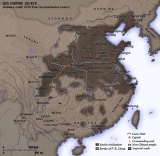
The Qin Dynasty (221 BCE - 206 BCE) was preceded by the feudal Zhou Dynasty
Zhou Dynasty

The Zhou Dynasty was preceded by the Shang Dynasty and followed by the Qin Dynasty in China. The Zhou dynasty lasted longer than any other dynasty in China history?though the actual political and military control of China by the dynasty only lasted during the Western Zhou....
 and followed by the Han Dynasty
Han Dynasty

The Han Dynasty followed the Qin Dynasty and preceded the Three Kingdoms in China. The Han Dynasty was ruled by the family known as the Liu clan who had peasant origins....
 in China
China

China is a Culture of China, an ancient civilization, and, depending on perspective, a national or multinational entity extending over a large area in East Asia....
. The unification of China in 221 BCE under the First Emperor Qin Shi Huang
Qin Shi Huang

Qin Shi Huang , personal name Ying Zheng , was king of the Chinese Qin from 246 BCE to 221 BCE during the Warring States Period. He became the first emperor of a unified China in 221 BCE....
 (or Shi Huang Di) marked the beginning of Imperial China, a period which lasted until the fall of the Qing Dynasty
Qing Dynasty

The Qing Dynasty , also known as the Manchu Dynasty, followed the Ming Dynasty in History of China, and was the last ruling Chinese Dynasties of China, ruling from 1644 to 1912 ....
 in 1912 CE. The Qin Dynasty left a legacy of a centralized and bureaucratic state that would be carried onto successive dynasties. At the height of its power, the Qin Dynasty had a population of about 40 million people.


Discussion
Ask a question about 'Qin Dynasty'
Start a new discussion about 'Qin Dynasty'
Answer questions from other users
Full Discussion Forum


Encyclopedia


The Qin Dynasty (221 BCE - 206 BCE) was preceded by the feudal Zhou Dynasty
Zhou Dynasty

The Zhou Dynasty was preceded by the Shang Dynasty and followed by the Qin Dynasty in China. The Zhou dynasty lasted longer than any other dynasty in China history?though the actual political and military control of China by the dynasty only lasted during the Western Zhou....
 and followed by the Han Dynasty
Han Dynasty

The Han Dynasty followed the Qin Dynasty and preceded the Three Kingdoms in China. The Han Dynasty was ruled by the family known as the Liu clan who had peasant origins....
 in China
China

China is a Culture of China, an ancient civilization, and, depending on perspective, a national or multinational entity extending over a large area in East Asia....
. The unification of China in 221 BCE under the First Emperor Qin Shi Huang
Qin Shi Huang

Qin Shi Huang , personal name Ying Zheng , was king of the Chinese Qin from 246 BCE to 221 BCE during the Warring States Period. He became the first emperor of a unified China in 221 BCE....
 (or Shi Huang Di) marked the beginning of Imperial China, a period which lasted until the fall of the Qing Dynasty
Qing Dynasty

The Qing Dynasty , also known as the Manchu Dynasty, followed the Ming Dynasty in History of China, and was the last ruling Chinese Dynasties of China, ruling from 1644 to 1912 ....
 in 1912 CE. The Qin Dynasty left a legacy of a centralized and bureaucratic state that would be carried onto successive dynasties. At the height of its power, the Qin Dynasty had a population of about 40 million people. Also, the massive Terracotta Army
Terracotta Army

The Terracotta Army are the Terracotta Warriors and Horses of Qin Shi Huang the First Emperor of China. The terracotta figures, dating from 210 BC, were discovered in 1974 by several local farmers near Xi'an, Shanxi province, China near the Mausouleum of the First Qin Emperor....
 at Xi'an
Xi'an

Xi'an , is the Capital of the Shaanxi Provinces of China in the People's Republic of China and a sub-provincial city. As one of the oldest cities in Chinese history, Xi'an is one of the Historical capitals of China because it has been the capital of some of the most important Dynasties in Chinese history in Chinese history, including the Zh...
 was built during the Qin as a royal retinue to guard the First Emperor in the afterlife.

Absorbing the Six Kingdoms

When Qin Shi Huang lived, the six kingdoms (Qi, Yan, Chu, Han, Zhao, and Wei had downfall. In 231 BC, Qin Shi Huang launched his first attack to uniting China--absorbing the Han kingdom. At that time, all of Han's land were captured by other kingdoms especially Qin except Nanyang and Xinzheng. Qin Shi Huang's general, Han Teng, attacked Nanyang. Nanyang was captured. One year later, the armies at Nanyang attacked the Han's capitol Xinzheng, and captured the last King of Han, King An. In 229 BC, Qin Shi Huang launched his attack against Zhao. At that time Zhao still had a very legendary general--Li Mu. Li Mu had been against the legendary general of Qin--Wang Jian. Wang Jian knew that he mustn't attack easily on Li Mu--because he is one of the Four Generals of the Warring States. So he used an Estrange Strategem to use the King of Zhao's hands to kill Li Mu. One year later, in 228 BC, Wang Jian attacked the capitol of Zhao, Handan, and captured the last King of Zhao, King Qian. King Qian's older brother, Childe Jia, escaped to the land of Dai and made himself King of Dai. In 227 BC, Qin Shi Huang attacked Yan. The Crown Prince of Yan--Prince Dan, who was staying in Qin as a hostage, escaped back to Yan. He planned to kill Qin Shi Huang. He found an assassinator named Jing Ke to assassinate Qin Shi Huang. He also commanded a partner of Jing Ke, Qin Wuyang, to go to Qin with him. But Jing Ke failed to assassinate Qin Shi Huang, and was killed himself by the cavilers of Qin. Qin Shi Huang was furious of Prince Dan, so he attacked Yan. King Xi of Yan, the last King, escaped to Liaodong. The general of Qin Li Xin attacked the army of Yan in the Waters of Yi. King Xi was forced to kill his own son Prince Dan and gave the head to the Qin armies. But Qin Shi Huang didn't really make up with Yan. In 225 BC, Qin Shi Huang attacked the southern Wei. Wang Jian's son, Wang Ben, drowned the capitol of Wei Daliang with the water of the Yellow River. Three months later the walls of Daliang crashed. The armies of Qin raided the city and the last King of Wei, King Jia, was captured alive by the Qin armies. Soon after Wei was absorbed, Qin Shi Huang attacked Chu. The general Wang Jian said that he needed sixty thousand men to absorb Chu. But the general Li Xin said that he only needed twenty thousand. Qin Shi Huang thought Wang Jian was too old, so he let Li Xin go instead. Li Xin attacked Chu, but was defeated by the general of Chu, and better known as the grandfather of the Hegemon of Western Chu Xiang Yu, Xiang Yan. Qin Shi Huang was ashamed of Li Xin. Then Wang Jian stood up and took sixty thousand men and went to Chu. When Wang Jian reached Chu, he didn't make the attack immediately. Instead he told all his men to NOT attack. This continued for a year. Finally, the army of Chu gave up and turned east. But just as it happens, Wang Jian lets out his armies and attacked the Chu army. The army was crushed, then Wang Jian went in the capitol of Chu, Shouchun and captured alive the last King of Chu, King Fuchu. But Xiang Yan led up another King of Chu, The Monarch of Changwen. Wang Jian then attacked Monarch Changwen's kingdom and killed him. Xiang Yan, looking at the defeat of his kingdom, committed suicide. Chu was utterly absorbed. This year it was 223 BC. One year later, in 222 BC, Qin Shi Huang attacked King Xi in Liaodong. Wang Ben, the general, crushed the army of Yan, even though it was allied with King Jia of Dai, and captured King Xi alive. Wang Ben turned back and attacked King Jia at Dai. King Jia was also captured. In 221 BC, Qin Shi Huang launched his final bullet of unification--absorbing Qi, the last foe. Qin Shi Huang's general, Wang Ben, now in the northern part, attacked from the north of Qi. The last King of Qi, King Jian, surrendered. King Jian was later banished into the Songbo Forest. The Qin army surrounded the forest and King Jian couldn't find any food because food transportation were all disengaged. King Jian later starved to death in that forest. After King Jian's death, the six kingdoms were all absorbed. Qin Shi Huang established his own dynasty--the Qin dynasty, and made himself the first emperor in history.

Qin Shi Huangdi

Qin Shi Huangdi imposed the Qin state's centralized, non-hereditary aristocratic system on his new empire in place of the Zhou's quasi-feudalistic
Feudalism

Feudalism, a term first used in the early modern period , in its most classic sense refers to a Middle Ages European political system composed of a set of reciprocal law and military obligations among the warrior nobility, revolving around the three key concepts of lords, vassals, and fiefs....
 one. The Qin Empire relied on the philosophy of legalism (with skillful advisers like Li Si
Li Si

Li Si was the influential Prime Minister of the feudal state and later of the dynasty of Qin , between 246 BC and 208 BC. A famous Legalism , he was also a notable calligrapher....
). Centralization, achieved by ruthless methods, was focused on standardizing legal codes and bureaucratic procedures, the forms of writing and coinage, and the pattern of thought and scholarship. The seal script
Seal script

Seal script is an ancient style of Chinese calligraphy. It evolved organically out of the Zhou dynasty script , arising in the Warring States of Qin ....
 character
Chinese character

A Chinese character, also known as a Han character , is a logogram used in writing Chinese language ,'' Japanese language ,'' less frequently Korean language ,'' and formerly Vietnamese language .''...
s from the former state of Qin became the standard for the entire empire. The length of the wheel axle was also unified and expressways standardized to ease transportation throughout the country. To silence criticism of imperial rule, the emperor banished or put to death many dissenting Confucian scholars and confiscated and burned their books not having to do with legalism and farming
Burning of books and burying of scholars

Burning of the books and burial of the scholars is a phrase that refers to a policy and a sequence of events in the Qin Dynasty of China, between the period of 213 and 206 BCE....
.

To prevent future uprisings, Qin Shi Huangdi ordered the confiscation of weapons and stored them in the capital. In order to prevent the resurgence of feudal lords, he also destroyed the walls and fortifications that had separated the previous six states. A national conscription was devised: every male between the ages of seventeen and sixty years was obliged to serve one year in the army. Qin aggrandizement was aided by frequent military expeditions pushing forward the frontiers in the north and south. To fend off a barbarian
Barbarian

"Barbarian" is a pejorative term for an uncivilized person, either in a general reference to a member of a nation or ethnos, typically a tribal society as seen by an urban civilization either viewed as inferior, or admired as a noble savage....
 intrusion (mainly against the Xiongnu
Xiongnu

The Xiongnu were a confederation of nomadic tribes from Central Asia with a ruling class of unknown origin and other subjugated tribes. They lived on the steppes north of China, and appear in Chinese sources from the 3rd century BC as controlling an empire stretching beyond the borders of modern day Mongolia....
 in the north), the fortification walls built by the various warring states were connected; this is usually recognized as the first Great Wall of China
Great Wall of China

The Great Wall of China or is a series of stone and earthen fortifications in China, built, rebuilt, and maintained between the 5th century BC and the 16th century to protect the northern borders of the History of China from Xiongnu attacks during the rule of Dynasties in Chinese history....
, although the present, 4,856- kilometer-long Great Wall of China
Great Wall of China

The Great Wall of China or is a series of stone and earthen fortifications in China, built, rebuilt, and maintained between the 5th century BC and the 16th century to protect the northern borders of the History of China from Xiongnu attacks during the rule of Dynasties in Chinese history....
 was largely built or re-built during the Ming Dynasty
Ming Dynasty

The Ming Dynasty , or Empire of the Great Ming , was the ruling Dynasties in Chinese history of China from 1368 to 1644, following the collapse of the Mongol-led Yuan Dynasty....
. A number of public works projects, including canals and bridges, were also undertaken to consolidate and strengthen imperial rule. A lavish tomb for the emperor, complete with a Terracotta Army
Terracotta Army

The Terracotta Army are the Terracotta Warriors and Horses of Qin Shi Huang the First Emperor of China. The terracotta figures, dating from 210 BC, were discovered in 1974 by several local farmers near Xi'an, Shanxi province, China near the Mausouleum of the First Qin Emperor....
, was built near the capital Xianyang
Xianyang

Xianyang is a city in Shaanxi province, near Xi'an. The city site was located a few kilometers to the northwest of present-day Xi'an. It has an area of 10,213 square kilometers and a population of 4,800,000....
, a city half an hour from modern Xi'an
Xi'an

Xi'an , is the Capital of the Shaanxi Provinces of China in the People's Republic of China and a sub-provincial city. As one of the oldest cities in Chinese history, Xi'an is one of the Historical capitals of China because it has been the capital of some of the most important Dynasties in Chinese history in Chinese history, including the Zh...
. These activities required enormous levies of manpower and resources, not to mention repressive measures.

Qin Shi Huangdi's behavior reportedly became increasingly erratic in the later years of his rule. This may have been the result of drinking solutions containing mercury as well as other deadly compounds. Ironically, Shi Huangdi ingested the mixtures in an increasingly desperate search for an elixir
Elixir

An elixir , Russian language,???????. From Greek language, ??????, "medical powder", from Greek language, ?????, "dry". Eliksir is a pharmaceutical preparation containing an active ingredient that is dissolved in a solution that contains some percentage of Ethanol and is designed to be taken orally....
 that would prolong his life. It has often been speculated that this was at least partially responsible for many of his later acts such as building the terracotta army
Terracotta Army

The Terracotta Army are the Terracotta Warriors and Horses of Qin Shi Huang the First Emperor of China. The terracotta figures, dating from 210 BC, were discovered in 1974 by several local farmers near Xi'an, Shanxi province, China near the Mausouleum of the First Qin Emperor....
.

Campaigns against Xiongnu

When Emperor Qin Shi Huangdi had succeeded in his conquest of all the seven warring states in China he began to concentrate its aggression against the nomadic ethnic Xiongnu which had grown into a powerful invading force in the north and started expanding both east and west. Qin Shi Huang
Qin Shi Huang

Qin Shi Huang , personal name Ying Zheng , was king of the Chinese Qin from 246 BCE to 221 BCE during the Warring States Period. He became the first emperor of a unified China in 221 BCE....
, the first emperor of the Qin Dynasty, sent a 300,000-strong army headed by General Meng Tian
Meng Tian

Meng Tian was a general of the Qin Dynasty who distinguished himself against the Xiongnu and in the construction of the Great Wall of China. He descended from a great line of military generals and architects....
 to drive the Xiongnu northward for 350 km and built the Great Wall to guard against its invasion.

Burning of intellectual books and Confucian burying

Qin Shi Huangdi had allowed the burning of intellectual books and burying Confucians alive when Li Si
Li Si

Li Si was the influential Prime Minister of the feudal state and later of the dynasty of Qin , between 246 BC and 208 BC. A famous Legalism , he was also a notable calligrapher....
 (Li Szu), his prime minister, who had won favor over Chunyu Yue on the matter of commandary-county system, proposed book burning. In 213 BC, on Li Si's urging, Qin Shi Huangdi outlawed all other schools of thought ("Hundred Schools") except for Legalism
Legalism

Legalism may refer to:In legal theory:*Liberal legalism - A theory on the relationship between politics and lawIn philosophy:* Legalism , a concept in Western jurisprudence...
, and he ordered book burning. 346 to 460 Confucians local to Qin capital were buried alive at one time. When Qin Shi Huangdi's elder son, Prince Fusu
Fusu

Fusu was the first son of the First Emperor of China, Qin Shi Huang, and hence the heir apparent. He believed that society would be impeccably run if everyone shared perfect knowledge ....
, encountered the rows of Confucians who were on the way to the burial ground, he went straight to Qin Shi Huangdi pleading for amnesty on behalf of the Confucians. Qin Shi Huangdi rebutted Fusu and further sent his elder son to Shangjun (today's Suide and ancient Suizhou
Suizhou

})|-| Area| 9,636 square kilometre|-| Population| 2.58 million|-| GDP'- Total'- Per Capita|  Renminbi22 billion ?...
) Commandary on the northern border to be with General Meng Tian
Meng Tian

Meng Tian was a general of the Qin Dynasty who distinguished himself against the Xiongnu and in the construction of the Great Wall of China. He descended from a great line of military generals and architects....
. Qin Shi Huangdi then played a trick to have various prefectures send about 700 more Confucians and scholars. All 700 Confucians were stoned to death in a valley, a place later named "valley of Confucian killing".

Second Emperor Han dynasty historians relate that during the last trip with his youngest son Huhai
Qin Er Shi

Qin Er Shi , literally Second Emperor of Qin Dynasty, personal name Huhai, was Emperor of China of the Qin Dynasty in China from 210 BC until 207 BC....
 in 210 BC, Qin Shi Huang died suddenly at Shaqiu prefecture. Huhai, under the advice of two high officials, the Imperial Secretariat Li Si
Li Si

Li Si was the influential Prime Minister of the feudal state and later of the dynasty of Qin , between 246 BC and 208 BC. A famous Legalism , he was also a notable calligrapher....
 and the chief eunuch
Eunuch

A eunuch is a castrated man, in particular one castrated early enough to have major hormonal consequences; the term usually refers to those castrated in order to perform a specific social function, as was common in many societies of the past....
 Zhao Gao
Zhao Gao

Zhao Gao was the chief eunuch during the Qin Dynasty of China. He played an instrumental role in the downfall of the Qin Dynasty. His status of eunuch was due to a congenital defect; he was not castrated....
, forged and altered the Emperor's will. The faked decree ordered Qin Shi Huang's first son, the heir Fusu
Fusu

Fusu was the first son of the First Emperor of China, Qin Shi Huang, and hence the heir apparent. He believed that society would be impeccably run if everyone shared perfect knowledge ....
 to commit suicide, instead naming Huhai as the next emperor. The decree also stripped the command of troops from Marshal Meng Tian
Meng Tian

Meng Tian was a general of the Qin Dynasty who distinguished himself against the Xiongnu and in the construction of the Great Wall of China. He descended from a great line of military generals and architects....
  — a faithful supporter of Fusu — and sentenced Meng's family to death. Zhao Gao step by step seized the power of Huhai, effectively making Huhai a puppet emperor. This marks the beginning of the Qin dynasty decline of

There is a controversy regarding whether Qin Shi Huang himself wanted Huhai to be the next emperor or not. The fundamental mistake of Qin Shi Huang was that he had not arranged his successor properly because he actually wanted to live forever.

Out of concern for the security of his throne, Huhai killed all his brothers and sisters. At the end, he was killed by Zhao Gao
Zhao Gao

Zhao Gao was the chief eunuch during the Qin Dynasty of China. He played an instrumental role in the downfall of the Qin Dynasty. His status of eunuch was due to a congenital defect; he was not castrated....
. Thus Qin Shi Huang, the First Emperor, has no known descendants. The Second Emperor, Huhai, also has no known descendants.

Within three years of Qin Shi Huangdi's death, widespread revolts by peasants, prisoners, soldiers, and descendants of the nobles of the Six Warring States sprang up all over China. Chen Sheng
Chen Sheng

Chen Sheng...
  and Wu Guang
Wu Guang

Wu Guang was a leader of the first rebellion against Qin Dynasty during the reign of Qin Er Shi, following the death of Qin Shi Huang. Less is known about him than Chen Sheng....
, two in a group of about 900 soldiers assigned to defend against the Xiongnu
Xiongnu

The Xiongnu were a confederation of nomadic tribes from Central Asia with a ruling class of unknown origin and other subjugated tribes. They lived on the steppes north of China, and appear in Chinese sources from the 3rd century BC as controlling an empire stretching beyond the borders of modern day Mongolia....
 , became the leaders of the first revolution by commoners.

Huhai lived to see the Battle of Julu
Battle of Julu

The Battle of Julu was fought in Julu in 207 BC primarily between Qin Dynasty forces led by Zhang Han , and Chu rebels led by Xiang Yu. Xiang Yu emerged victorious, defeating a large Qin army with a small number of soldiers....
, the major defeat of the Qin army in the hands of the rebels, which marked the end of the Qin Dynasty.

Third Emperor

In the beginning of October 207 BC, Zhao Gao forced Huhai to commit suicide and replaced him with Fusu's son, Ziying
Ziying

Ziying was the last ruler of the Qin Dynasty of China, ruling as King of Qin from mid-October to the beginning of December 207 BC, and being known posthumously as Qin San Shi ....
. Note that the title of Ziying was "king of Qin" to reflect the fact that Qin no longer controlled the whole of China. The Chu-Han contention
Chu-Han contention

The Chu-Han contention was a post-Qin Dynasty interregnum period in China. During this period the rebel kings derived from the collapse of Qin Dynasty formed two camps fighting each other....
 ensued. Ziying soon killed Zhao Gao and surrendered to Liu Bang in the beginning of December 207 BC. But Liu Bang was forced to hand over Xianyang and Ziying to Xiang Yu
Xiang Yu

Xiang Yu was one of the most prominent generals in China history. His name was Ji , Yu was his courtesy name. He was a descendant of Xiang Yan , a general of Chu nobility....
. Xiang Yu then killed Ziying and burned down the palace in the end of January 206 BC. It is said the fire lasted two months before the inferno died down. A recent archeology survey of the palace ruin determined it to be roughly the size of Manhattan island of New York City. The palace is supported with thousands of pillars made from ancient trees growing to up to 115 meters (375 ft) high. Due to the weight and scale of each lumber, cutting the lumber can take weeks if not months, transporting from the prehistoric forest to the lumber mill requires certain weather so the river can be flooded to even move the massive lumber down river. The captain of each team is rewarded with imperial rank, their goal in life is to acquire one of these prehistoric lumber for the construction of the palace. It is said each pillar sacrificed the lives of a hundred men. Xiang Yu's controversial action sets the stage for the legendary battles between Xiang Yu, the warrior king and Liu Bang, the people's king. The Qin dynasty came to an end, three years after the death of Qin Shi Huang, and less than twenty years after it was founded.

Although the Qin Dynasty was short-lived, its legalist rule had a deep impact on later dynasties in China. The imperial system initiated during the Qin dynasty set a pattern that was developed over the next two millennia.

Sovereigns of Qin Dynasty

Note: King Zhaoxiang of Qin
King Zhaoxiang of Qin

King Zhaoxiang of Qin or King Zhao of Qin was the son of Huiwen of Qin and younger brother of King Wu of Qin. After the death of Wu in 306 BC, Zhao contended for the crown of Qin with his younger brother....
had already been ruling Qin for 51 years when Qin annihilated the Zhou Dynasty; however the other six warring states were still independent regimes. Historiographers thus used the next year (the 52nd year of King Zhaoxiang of Qin) as the official continuation from Zhou Dynasty
Zhou Dynasty

The Zhou Dynasty was preceded by the Shang Dynasty and followed by the Qin Dynasty in China. The Zhou dynasty lasted longer than any other dynasty in China history?though the actual political and military control of China by the dynasty only lasted during the Western Zhou....
.

Qin Shi Huang was the first Chinese sovereign to proclaim himself "Emperor", after reunifying China in 221 BC. That year is therefore usually taken as the start of the "Qin Dynasty".

Posthumous name
Posthumous name

A posthumous name is an honorary name given to royalty, nobles, and sometimes others, in some cultures after the person's death. The posthumous name is commonly used when naming royalty of Table of Chinese monarchs, List of Korean monarchs, Vietnam and emperors of Japan....
s / title
Chinese family names and given name
Chinese name

Personal names in Culture of China follow a number of conventions different from those of personal names in Western cultures. Most noticeably, a Chinese name is written with the family name first and the given name next, therefore "John Smith" as a Chinese name would be "Smith John"....
s
Period of Reigns
Convention: "Qin" + posthumous name
Zhaoxiang (?? Zhaoxiang)
King Zhaoxiang of Qin

King Zhaoxiang of Qin or King Zhao of Qin was the son of Huiwen of Qin and younger brother of King Wu of Qin. After the death of Wu in 306 BC, Zhao contended for the crown of Qin with his younger brother....
Ying Ze (?? qíng zé or Ying Ji, ?? yíng jì) 306 BC–250 BC
Xiaowen (?? Xiàowén)
King Xiaowen of Qin

King Xiaowen of Qin had a very brief reign. Indeed, he only became King of the Qin for less than 1 year, and 3 days after his coronation he died....
Ying Zhu (?? yíng zhù) 250 BC
Zhuangxiang (?? Zhuangxiang)
King Zhuangxiang of Qin

King Zhuangxiang of Qin , personal name Zichu , was a ruler of the Qin , a part of what is now China, during the 3rd century BCE. This article is based on the biography of L? Buwei which is part of the Records of the Grand Historian written by Sima Qian....
Ying Zichu (??? yíng zi chu) 249 BC–247 BC
Shi Huangdi (??? Shi Huángdì) Ying Zheng (?? yíng zhèng) 246 BC–210 BC
Er Shi Huangdi
Qin Er Shi

Qin Er Shi , literally Second Emperor of Qin Dynasty, personal name Huhai, was Emperor of China of the Qin Dynasty in China from 210 BC until 207 BC....
 (???? Èr Shì Huángdì)
Ying Huhai (??? yíng hú hài) 210 BC–207 BC
Ziying was often referred using personal name or Qin Wang Ziying (???? qín wáng zi ying)
Did not exist Ying Ziying
Ziying

Ziying was the last ruler of the Qin Dynasty of China, ruling as King of Qin from mid-October to the beginning of December 207 BC, and being known posthumously as Qin San Shi ....
 (??? yíng zi ying)
207 BC


See also

  • Chinese sovereign
    Chinese sovereign

    Chinese sovereign is the ruler of a particular period in ancient China. Several titles and naming schemes have been used throughout history....
  • Emperor of China
    Emperor of China

    The Emperor of China refers to any monarch of Imperial China reigning since the founding of the Qin Dynasty in 221 BC until the fall of the Qing Dynasty in 1912....
  • Hata clan


Further reading

  • Bodde, Derk. (1986). "The State and Empire of Ch'in," in The Cambridge History of China: Volume I: the Ch'in and Han Empires, 221 B.C. – A.D. 220. Edited by Denis Twitchett and Michael Loewe. Cambridge: Cambridge University Press. ISBN 0521243270.


External Links