
|
|
|
|
Shang Dynasty
|
| |
|
| |
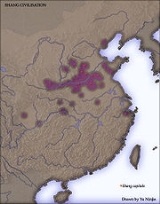
The Shang Dynasty (Chinese: ??) or Yin Dynasty was according to traditional sources the first Chinese dynasty. They ruled in the northeastern region of the area known as "China proper", in the Yellow River valley. According to the chronology based upon calculations by Liu Xin, the Shang ruled between 1766 BCE and 1122 BCE, however according to the chronology based upon the Bamboo Annals, it is between 1556 BCE and 1046 BCE. The results of the Xia Shang Zhou Chronology Project places them between 1600 BCE and 1046 BCE.

Discussion
Ask a question about 'Shang Dynasty'
Start a new discussion about 'Shang Dynasty'
Answer questions from other users
|
Encyclopedia
The Shang Dynasty (Chinese: ??) or Yin Dynasty was according to traditional sources the first Chinese dynasty. They ruled in the northeastern region of the area known as "China proper", in the Yellow River valley. According to the chronology based upon calculations by Liu Xin, the Shang ruled between 1766 BCE and 1122 BCE, however according to the chronology based upon the Bamboo Annals, it is between 1556 BCE and 1046 BCE. The results of the Xia Shang Zhou Chronology Project places them between 1600 BCE and 1046 BCE. According to historical tradition the Shang Dynasty followed the (possibly mythical) Xia Dynasty and preceded the Zhou Dynasty. Direct information about the Shang Dynasty comes from Shang inscriptions on bronze artifacts, but mainly from oracle bones—turtle shells, cattle scapulae or other bones on which were written the first significant corpus of recorded Chinese characters. Other sources on the Shang come from historical records of the later Zhou Dynasty and the Han Dynasty Shiji by Sima Qian.
The inscriptions on the oracle bones are divinations, which can be gleaned for information on the politics, economy, culture, religion, geography, astronomy, calendar, art and medicine of the period, and as such provide critical insight into the early stages of the Chinese civilization. One site of the Shang capitals, later historically called the Ruins of Yin, is near modern day Anyang. Archaeological work there uncovered 11 major Yin royal tombs and the foundations of palaces and ritual sites, containing weapons of war and remains of human as well as of animal sacrifices. Tens of thousands of bronze, jade, stone, bone and ceramic artifacts have been obtained; the workmanship on the bronzes attests to a high level of civilization. In terms of inscribed oracle bones alone, more than 20,000 were discovered in the initial scientific excavations in the 1920s to 1930s, and over four times more have since been found.
Archaeological discovery
During the Qing Dynasty, scholar-bureaucrats and the Chinese gentry became avid antiquarians and collectors of ancient artwork, some claiming to have found Shang Dynasty era bronze vessels with written inscriptions. Despite this, archeologists of the 19th century knew of written records and historical documentations spanning only as far back as the Zhou Dynasty (1046 BCE–256 BCE). In 1899, it was found that Chinese pharmacists were selling "dragon bones" marked with curious and archaic characters. These were finally traced back in 1928 to a site near Anyang in the Yellow River valley, modern Henan province, where the National Government's Academia Sinica began an archeological excavation. Work at the site was halted during the Japanese invasion in 1937, but by 1950 a Shang capital had been discovered near Zhengzhou.
At the excavated royal palace of Yinxu, there were large stone pillar bases found along with rammed earth foundations and platforms "as hard as cement" as Fairbank asserts, which originally supported 53 buildings of wooden post-and-beam construction. In close proximity to the main palatial complex, there were subterranean pits used for storage, service quarters, and housing quarters. The remnants of the rammed earth walls at Zhengzhou are determined to have risen in height, and formed a roughly rectangular wall around the ancient city. Construction of these rammed earth walls was actually an inherited tradition by the Shang civilization, since much older rammed earth fortifications were found at Chinese Neolithic sites of the Longshan culture (c. 3000 BCE–2000 BCE). In 1959, the site of the Erlitou culture was found in Yanshi, south of the Yellow River near Luoyang; their culture is often associated with the legendary Xia Dynasty that preceded the Shang. They also had large palaces that also suggested the existence of a dynastic kingdom preceding the Shang. Radiocarbon dating suggests that the Erlitou culture flourished ca. 2100 BCE to 1800 BCE.
Cowry shell as obtained from the seacoast were also excavated from Anyang, suggesting the Shang were somewhat of a maritime people. Neolithic sites one hundred miles off of mainland China's southern coasts of Fujian — on the island of Taiwan — are dated as far back as 4000 BCE. However, there was very limited sea trade in ancient China, since China was isolated from other large civilizations during the Shang period. Trade relations and diplomatic ties via the Silk Road and Chinese maritime ventures to the Indian Ocean to reach other formidable empires did not exist until the reign of Emperor Wu during the Han Dynasty (202 BCE–220 AD).
Many of the Shang tombs had been tunneled into and ravaged by grave robbers of ancient times. In the spring of 1976, the discovery of Tomb 5 at Yinxu revealed a tomb that was undisturbed and one of the most lavished Shang tombs that archaeologists had yet come across. With over 200 bronze ritual vessels and 109 inscriptions of Lady Fu Hao's name, archaeologists realized they had stumbled across the tomb of the militant consort to King Wu Ding, as described in 170 to 180 written Shang oracle bones. Along with bronze vessels, there was also found stoneware and pottery vessels, bronze weapons, jade carvings of figures and hair combs, and bone hairpins. Historian Robert L. Thorp states that the large assortment of weapons and ritual vessels in her tomb correlate with the oracle bone accounts of her military career and involvement in Wu Ding's ritual ancestral sacrifices.
Rise of Shang The Shang dynasty is believed to have been founded by a rebel leader who overthrew the last Xia ruler. Its civilization was based on agriculture, augmented by hunting, and animal husbandry. The Records of the Grand Historian state that the Shang moved its capital six times. The final and most important move to Yin in 1350 BCE led to the golden age of the dynasty. The term Yin dynasty has been synonymous with the Shang in history, and indeed was the more popular term, although it is now often used specifically in reference to the later half of the Shang. The Japanese and Koreans still refer to the Shang dynasty exclusively as the Yin (In) dynasty.
A line of hereditary Shang kings ruled over much of northern China, and Shang troops fought frequent wars with neighboring settlements and nomadic herdsmen from the inner Asian steppes. The capitals, particularly that in Yin, were centers of glittering court life. Court rituals to propitiate spirits developed. In addition to his secular position, the king was the head of the ancestor- and spirit-worship cult. The king often performed oracle bone divinations himself, especially near the end of the dynasty. Evidence from the royal tombs indicates that royal personages were buried with articles of value, presumably for use in the afterlife. Perhaps for the same reason, hundreds of commoners, who may have been slaves, were buried alive with the royal corpse.
The Shang had a fully developed system of writing as attested on bronze inscriptions, oracle bones, and a small number of other writings on pottery, jade and other stones, horn, etc.; its complexity and state of development indicates an earlier period of development, which is still unattested. Bronze casting and pottery also advanced in Shang culture. The bronze was commonly used for art rather than weapons. In astronomy, the Shang astronomers saw Mars and various comets. Many musical instruments were also invented at that time.
Shang influence, though not political control, extended as far northeast as modern Beijing, where early pre-Yan culture shows evidence of Shang material culture. At least one burial in this region during the Early Shang period contained both Shang-style bronzes and local-style gold jewelry. This Shang influence likely made possible the integration of Yan into the later Zhou Dynasty.
The Shang king, in his oracular divinations, repeatedly shows concern about the fang groups, which represented barbarians outside of the civilized tu regions that made up the Shang center. In particular, the tufang group of the Yan Shan region is regularly mentioned as hostile to the Shang. The discovery of a Chenggu-style ge dagger-axe at Xiaohenan demonstrates that even at this early stage of Chinese history, there was some level of connection between the distant areas of north China.
Mythology
In Book 5 of Mozi, Mozi described the end of Xia dynasty and the new Shang dynasty. During the reign of King Jie of Xia, there was a great climactic change. The paths of the sun and moon were different, the seasons were confused and the five grains were dried up. Ghouls were crying in the country and cranes shrieked for ten nights. Heaven ordered Shang Tang to receive the heavenly commission from Xia dynasty. The Xia dynasty have failed morally and Heaven has determined her end. Therefore, Shang Tang was commanded to destroy Xia with the promise of Heaven's help. In the dark, Heaven destroyed the fortress' pool. Shang Tang then gained victory easily.
Fall of Shang
Shang Zhou, the last Shang king, committed suicide after his army was defeated by the Zhou people. Legends say that his army betrayed him by joining the Zhou rebels in a decisive battle.
The classical novel Fengshen Yanyi is about the war between the Yin and Zhou, in which each was favored and supported by one group of gods.
After Yin's collapse, the surviving Yin ruling family collectively changed their surname from their royal Zi (pinyin: zi; Wade-Giles: tzu) to the name of their fallen dynasty, Yin. The family remained aristocratic and often provided needed administrative services to the succeeding Zhou Dynasty. The King Cheng of Zhou, through the Regent, his uncle the Duke Dan of Zhou, enfeoffed the former Shang King Zhou's brother Ziqi as the ruler of Wei, in the former Shang capital at Shang, with the territory becoming the state of Song later in history. The State of Song and the royal Shang descendants maintained rites to the dead Shang kings which lasted until 286 BCE. (Source: Records of the Grand Historian.)
Both Korean and Chinese legends state that a disgruntled Yin prince named Jizi, who had refused to cede power to the Zhou, left China with his garrison and founded Gija Joseon, and it would become one of the early Korean states (Go-, Gija-, and Wiman-Joseon).
Many Shang clans migrated northeast and were integrated into Yan culture during the Western Zhou period. These clans maintained an elite status, continuing their sacrificial and burial traditions.
Mythology
According to Mozi (470BCE-c391BCE), during the reign of Shang Zhou, Heaven could not endure his morality and his neglect of timely sacrifices. It rained mud for ten days and nights, the nine cauldrons (presumably used in either astronomy or to measure earth movements) shifted positions, witches appeared and ghosts cried at night. There were women who became men, the heaven rained flesh and thorny brambles covered the national highways. A red bird brought a message "Heaven decrees King Wen of Zhou to punish Yin and possess its empire". The Yellow River formed charts and the earth brought forth mythical horses. When King Wu became king, three gods appeared to him in a dream, telling him that they have drowned Shang Zhou in wine and that King Wu was to attack him. On the way back from victory, the heavens gave him the emblem of a yellow bird.
Late and Early Shang
Written records found at Anyang confirm the existence of the Shang dynasty. However, Western scholars are hesitant to associate some settlements contemporaneous with the Anyang settlement with the Shang dynasty. For example, archaeological findings at Sanxingdui suggest a technologically advanced civilization culturally unlike Anyang but lacking writing. The extent of Shang control is difficult to determine, given the lack of archaeological exploration. It is accepted among historians that Yin, ruled by the same Shang of official history, coexisted and traded with other culturally diverse settlements in North China. Yin and the Later Shang in general are the first civilization in Chinese history.
Chinese historians living in later periods were accustomed to the notion of one dynasty succeeding another, but the actual political situation in early China may have been more complicated. The Xia and the Shang can possibly refer to political entities that existed concurrently, just as the early Zhou (successor state of the Shang), is known to have existed at the same time as the Shang. This approach to the Sandai (Or Three Dynasties) system was promoted by noted archaeologist Kwang-chih Chang. The ruling families of the Zhou, Shang, Qin, and (possibly) Xia dynasties did in fact coexist together as rulers of independent kingdoms until 286 BCE, because that was up to when the Sung principality was conquered, which the Shang ruling family ruled while the Zhou king ruled at his independent kingdom and the Kings of the state of Yue also claimed to be descended from Yu the Great of the Xia Dynasty, while the Kings of qin ruled over the State of Qin.
Furthermore, though the ruins of Yinxu confirms the existence of the Late Shang dynasty, no evidence has been unearthed proving the existence of the Shang dynasty before its move to its last capital. This is seen in research by the reference to Yin-era Shang as Late Shang and pre-jiaguwen Shang as Early Shang. The difficulty is less one of conspirators trying to legitimize the Shang Dynasty and more the problem of historians and archaeologists sorting out historical societies and pre-historic (That is, pre-writing) archeological cultures.
At the Shang Dynasty site of Ao, large walls were erected in the 15th century BCE that had dimensions of 20 meters / 65 feet in width at the base and enclosed an area of some 2100 yards². In similar dimensions, the ancient Chinese capital for the State of Zhao, Handan (founded in 386 BCE), had walls that were again 20 meters / 65 feet wide at the base, a height of 15 meters / 50 feet tall, with two separate sides of its rectangular enclosure measured at a length of 1530 yards.
Capitals
The Shang dynasty had a sequence of seven captials across its history with only the final one being considered a true city.
In chronological order:
- Xibo Located in Xitazhuang Township of Yanshi County at the Erlitou site, although this is contested.
- Ao also Xiao Located in Zhengzhou Prefecture, Henan Province
- Xiang
- Geng
- Bi
- Yan
- Yin also Yinxu Located in Anyang Prefecture, Henan Province
Economy
As far back as c. 1500 BCE, the early Shang Dynasty engaged in large-scale production of bronze-ware vessels and weapons. This production necessitated large labor force that would handle the mining, refining, and transportation of copper, tin, and lead ores. The Shang Dynasty royal court and aristocrats required a vast amount of different bronze vessels for various ceremonial purposes and events of religious divination, hence the need for official managers that could provide oversight and employment of hard-laborers and skilled artisans and craftsmen. With the increased amount of bronze available, the army could become better equipped with an assortment of bronze weaponry, and bronze was also able to furnish the fittings of spoke-wheeled chariots that came into widespread use by 1200 BCE. Ceremonial rules decreed how many bronze containers of each type a member of nobility of a certain rank could own.
Apart from their role as the head military commanders, Shang kings also asserted their social supremacy by acting as the high priest of society and leader of divination ceremonies. As the oracle bone texts reveal, the Shang kings were viewed as the best qualified members of society to offer sacrifices to their royal ancestors, to the high god Di, who in their beliefs was responsible for the rain, wind, and thunder.
Shang Military
Shang infantry were armed with a variety of stone or bronze weaponry, including máo spears, yuè pole-axes, ge pole-based dagger-axes, the composite bow, and bronze or leather helmets (Wang Hongyuan 1993). Their western military frontier was at the Taihang Mountains, where they fought the ma or "horse" barbarians, who might have used chariots. The Shang themselves likely only used chariots as mobile command vehicles or elite symbols. They reportedly amassed over a thousand chariots to overthrow the Xia Dynasty. Although the Shang depended upon the military skills of their nobility, the masses of town dwelling and rural commoners provided the Shang rulers with conscript labor as well as military obligation when mobilized for ventures of defense or conquest. The subservient lords of noble lineage and other state rulers were obligated to furnish their locally-kept forces with all the necessary equipment, armor, and armaments, while the Shang king maintained a force of about a thousand troops at his capital, and personally led this force into battle. A rudimentary military bureaucracy was needed in order to muster troops of three to five thousand troops in border campaigns, while it was recorded that up to thirteen thousand troops were mustered in order to suppress uprisings of insolent states to Shang authority. However, even after the Shang integrated the chariot into their military forces, the nobility were still largely amassed in infantry form, as the chariot was mostly associated with transportation, ceremonies, and large-scale royal hunting expeditions. Chariots in the Shang period generally carried three men, the driver placed at the center, an archer on the left, and a warrior armed with a dagger-axe on the right. It had a rectangular frame, with two large spoked wheels, and was driven by two horses, although some of the chariots had teams of four horses.
Gallery
Shang dynasty kings
Posthumous names |
|---|
Convention: posthumous name or King + posthumous name |
Order |
Reign |
Chinese |
Hanyu Pinyin |
Notes |
|---|
| 01 | 29 | ? | Tang | a Sage king; overthrew tyrant Jié of Xià |
| 02 | 02 | ?? | Tài Ding
| | 03 | 32 | ?? | Wài Bing | |
| 04 | 04 | ?? | Zhòng Rén | |
| 05 | 12 | ?? | Tài Jia | |
| 06 | 29 | ?? | Wò Ding | |
| 07 | 25 | ?? | Tài Geng | |
| 08 | 17 | ?? | Xiao Jia | |
| 09 | 12 | ?? | Yong Ji | |
| 10 | 75 | ?? | Tài Wù | |
| 11 | 11 | ?? | Zhòng Ding | |
| 12 | 15 | ?? | Wai Ren | |
| 13 | 09 | ??? | Hé Dan Jia | |
| 14 | 19 | ?? | Zu Yi | |
| 15 | 16 | ?? | Zu Xin | |
| 16 | 20 | ?? | Wò Jia | |
| 17 | 32 | ?? | Zu Ding | |
| 18 | 29 | ?? | Nán Geng | |
| 19 | 07 | ?? | Yáng Jia | |
| 20 | 28 | ?? | Pán Geng | Shang finally settled down at Yin. The period starting from Pán Geng is also called the Yin Dynasty, beginning the golden age of the Shang dynasty. Oracle bone inscriptions are thought to date at least to Pán Geng's era. |
| 21 | 29 | ?? | Xiao Xin | |
| 22 | 21 | ?? | Xiao Yi | |
| 23 | 59 | ?? | Wu Ding | married to consort Fu Hao, who was a renowned warrior. Most of the oracle bones studied are believed to have came from his reign. |
| 24 | 12 | ?? | Zu Geng | |
| 25 | 20 | ?? | Zu Jia | |
| 26 | 06 | ?? | Lin Xin | |
| 27 | 06 | ?? | Geng Ding | or Kang Ding (?? Kang Ding) |
| 28 | 35 | ?? | Wu Yi | |
| 29 | 11 | ?? | Wén Ding | |
| 30 | 26 | ?? | Dì Yi | |
| 31 | 30 | ?? | Dì Xin | aka Zhòu, Zhòu Xin or Zhòu Wáng. Also referred to by adding "Shang" in front of any of these names. |
Note: # All dates are approximate up to 841 BCE. Refer to Zhou dynasty for more info. # Personal names of most of the Shang sovereigns were unknown. The following names were most likely posthumous owing to worse appearances of the Heavenly Stems. |
See also
Further reading
- Timperley, Harold J. The Awakening of China in Archaeology; Further Discoveries in Ho-Nan Province, Royal Tombs of the Shang Dynasty, Dated Traditionally from 1766 to 1122 B.C.. 1936.
External links
|
| |
|
|