

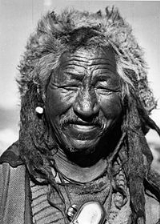
Tibetan people

Encyclopedia
The Tibetan people are an ethnic group that is native to Tibet
, which is mostly in the People's Republic of China
. They number 5.4 million and are the 10th largest ethnic group in the country. Significant Tibetan minorities also live in India
, Nepal
, and Bhutan
. The Khampas of Tibet are originally from Mongolia.
Tibetans speak the Tibetan language
, which belongs to the Sino-Tibetan languages
and has many mutually unintelligible
dialect
s. The traditional, or mythological, explanation of the Tibetan people's origin is that they are the descendants of the monkey Pha Trelgen Changchup Sempa and rock ogre
ss Ma Drag Sinmo. Most Tibetans practice Tibetan Buddhism
, though some observe the indigenous Bön and others are Muslims. Tibetan Buddhism influences Tibetan art
, drama, and architecture, while the harsh geography of Tibet
has produced an adaptive culture of Tibetan medicine and cuisine
.
in 2009 documents an additional 189,000 Tibetan language
speakers living in India
, 5,280 in Nepal
, and 4,800 in Bhutan
.The Central Tibetan Administration
's (CTA) own refugee register
counts 145,150 Tibetans outside Tibet: a little over 100,000 in India
; in Nepal
there are over 16,000; over 1,800 in Bhutan
and more than 25,000 in other parts of the world. Tibetan communities are present in the USA, Canada
, United Kingdom
, Switzerland
, Norway
, France
, Taiwan
, Australia
, Mexico
and Costa Rica
.
How the current numbers compare to Tibetans historically is a difficult claim. The CTA
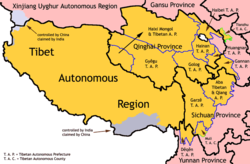
claims that the 5.4 million number is a decrease from 6.3 million in 1959 while the Chinese government claims that it is an increase from 2.7 million in 1954. However, the question depends on the definition and extent of "Tibet"
; the region claimed by the CTA is more expansive and China more diminutive
. Also, the Tibetan administration did not take a formal census
of its territory in the 1950s; the numbers provided by the administration at the time were "based on informed guesswork".
The Tibetan population growth is attributed by PRC officials to the improved quality of health and lifestyle of the average Tibetan since the beginning of reforms under the Chinese governance
. According to Chinese sources, the infant mortality
rate in Tibet was 35.3 per 1,000 in the year 2000, as compared to the 430 infant deaths per 1,000 in 1951. The average life expectancy for Tibetans rose from 35 years in 1950s to over 65 years in the 2000s. Infant mortality in China as a whole was officially rated as 3.1 percent in 2003. UNICEF in 2004 acknowledged the improvements but said that the infant mortality rate still lags behind the national rate eightfold, although Melvyn Goldstein
and his colleagues in 2002 reported a 12.9% rate (fourfold), and official sources in 2004 rated it 3.1% (about equal).
pas have several Khams language dialects which may be unintelligible to Amdo
was, and the Lhasa dialect
may be unintelligible to both of those groups.
 Tibetans are phenotypically
diverse. While political and humanitarian media in the West exaggerate features that supposedly distinguish Tibetans from Han people
(such as long hair, dark skin, and ruddy cheeks), even Tibetans cannot distinguish each other from the Han by physical markers alone. Recent research into the ability of Tibetans' metabolism to function normally in the oxygen-deficient atmosphere above 4400 metres (14,435.7 ft) shows that, although Tibetans living at high altitudes have no more oxygen in their blood than other people, they have 10 times more nitric oxide
and double the forearm blood flow of low-altitude dwellers. Nitric oxide causes dilation of blood vessels allowing blood to flow more freely to the extremities and aids the release of oxygen to tissues. It is not known whether the high levels of nitric oxide are due to a genetic mutation or whether people from lower altitudes would gradually adapt similarly after living for prolonged periods at high altitudes.
The distribution of Haplogroup D-M174
is found among nearly all the populations of Central Asia and Northeast Asia south of the Russian border, although generally at a low frequency of 2% or less. A dramatic spike in the frequency of D-M174 occurs as one approaches the Qinghai-Tibetan Plateau of western China. D-M174 is also found at high frequencies in Japanese people
but it fades into low frequencies in the eastern mainland China between Japan
and Tibet.
The romantic claim that American Navajo
and Tibetans are related has not found support in genetic studies. Some light has been shed on their origins, however, by one genetic study in which it was indicated that Tibetan Y-chromosomes had multiple origins, one from Central Asia while the other from East Asia.
ss Ma Drag Sinmo.
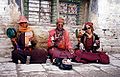
Most Tibetans generally observe Tibetan Buddhism
or a collection of native traditions known as Bön (also absorbed into mainstream Tibetan Buddhism). There is also a minority Tibetan Muslim
population.
Legend said that the 28th king of Tibet, Thothori Nyantsen
, dreamed of a sacred treasure falling from heaven, which contained a Buddhist sutra
, mantra
s, and religious objects. However, because the Tibetan script had not been invented, the text could not be translated in writing and no one initially knew what was written in it. Buddhism did not take root in Tibet
until the reign of Songtsän Gampo, who married two Buddhist princesses, Bhrikuti
of Nepal and Wencheng
of China. It then gained popularity when Padmasambhāva
visited Tibet
at the invitation of the 38th Tibetan king, Trisong Deutson.
Today, one can see Tibetans placing Mani stone
s prominently in public places. Tibetan lama
s, both Buddhist and Bön, play a major role in the lives of the Tibetan people, conducting religious ceremonies and taking care of the monasteries. Pilgrims plant prayer flags over sacred grounds as a symbol of good luck.
The prayer wheel
is a means of simulating chant of a mantra by physically revolving the object several times in a clockwise direction. It is widely seen among Tibetan people. In order not to desecrate religious artifacts such as Stupa
s, mani stones, and Gompa
s, Tibetan Buddhists walk around them in a clockwise direction, although the reverse direction is true for Bön. Tibetan Buddhists chant the prayer "Om mani padme hum
", while the practitioners of Bön chant "Om matri muye sale du".
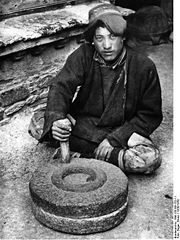
Tibet is rich in culture. Tibetan festivals such as Losar
, Shoton, Linka (festival), and the Bathing Festival are deeply rooted in indigenous religion and also contain foreign influences. Each person takes part in the Bathing Festival three times: at birth, at marriage, and at death. It is traditionally believed that people should not bathe casually, but only on the most important occasions.
is deeply religious in nature, from the exquisitely detailed statues found in Gompa
s to wooden carvings and the intricate designs of the Thangka
paintings. Tibetan art can be found in almost every object and every aspect of daily life.
Thangka
paintings, a syncretism of Indian scroll-painting with Nepalese and Kashmiri painting, appeared in Tibet around the 8th century. Rectangular and painted on cotton or linen, they usually depict traditional motifs including religious, astrological, and theological subjects, and sometimes a mandala
. To ensure that the image will not fade, organic and mineral pigments are added, and the painting is framed in colorful silk brocades.
Tibetan opera was founded in the fourteenth century by Thangthong Gyalpo, a lama and a bridge builder. Gyalpo, and seven girls he recruited, organized the first performance to raise funds for building bridges, which would facilitate transportation in Tibet
. The tradition continued uninterrupted for nearly seven hundred years, and performances are held on various festive occasions such as the Lingka and Shoton festival. The performance is usually a drama, held on a barren stage that combines dances, chants, and songs. Colorful masks are sometimes worn to identify a character, with red symbolizing a king and yellow indicating deities and lamas. The performance starts with a stage purification and blessings. A narrator then sings a summary of the story, and the performance begins. Another ritual blessing is conducted at the end of the play. There are also many historical myths/epics written by high lamas about the reincarnation of a "chosen one" who will do great things.
Standing at 117 metres (383.9 ft) in height and 360 metres (1,181.1 ft) in width, the Potala Palace
is considered the most important example of Tibetan architecture. Formerly the residence of the Dalai Lama
, it contains over a thousand rooms within thirteen stories and houses portraits of the past Dalai Lamas and statues of the Buddha. It is divided between the outer White Palace, which serves as the administrative quarters, and the inner Red Quarters, which houses the assembly hall of the Lamas, chapels, 10,000 shrines, and a vast library of Buddhist scriptures.
is one of the oldest forms in the world. It utilizes up to two thousand types of plants, forty animal species, and fifty minerals. One of the key figures in its development was the renowned 8th century physician Yutok Yonten Gonpo, who produced the Four Medical Tantras integrating material from the medical traditions of Persia, India and China. The tantras contained a total of 156 chapters in the form of Thangkas, which tell about the archaic Tibetan medicine and the essences of medicines in other places.
Yutok Yonten Gonpo's descendant, Yuthok Sarma Yonten Gonpo, further consolidated the tradition by adding eighteen medical works. One of his books includes paintings depicting the resetting of a broken bone. In addition, he compiled a set of anatomical pictures of internal organs.
reflects the rich heritage of the country and people's adaptation to high altitude and religious culinary restrictions. The most important crop is barley
. Dough made from barley flour, called tsampa
, is the staple food
of Tibet
. This is either rolled into noodles or made into steamed dumplings called momos
. Meat
dishes are likely to be yak
, goat
, or mutton, often dried, or cooked into a spicy stew
with potato
es. Mustard seed
is cultivated in Tibet, and therefore features heavily in its cuisine. Yak yoghurt
, butter
and cheese
are frequently eaten, and well-prepared yoghurt is considered something of a prestige item.
, the girls into a single queue.
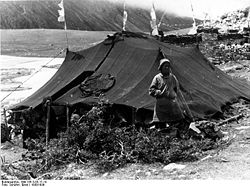
Because of Tibet's cold weather, the men and women wear long thick dresses (chuba). The men wear a shorter version with pants underneath. The style of the clothing varies between regions. Nomads often wear thick sheepskin versions.
is practiced in parts of Tibet. A typical arrangement is where a woman may marry male siblings. This is usually done to avoid division of property and provide financial security. However, monogamy is more common throughout Tibet. Marriages are sometimes arranged by the parents, if the son or daughter has not picked their own partner by a certain age.
--Trotters Independent Traders (talk) 01:14, 25 October 2011 (UTC)Rukor where the world discusses the fate of the nomads
Tibet
Tibet is a plateau region in Asia, north-east of the Himalayas. It is the traditional homeland of the Tibetan people as well as some other ethnic groups such as Monpas, Qiang, and Lhobas, and is now also inhabited by considerable numbers of Han and Hui people...
, which is mostly in the People's Republic of China
People's Republic of China
China , officially the People's Republic of China , is the most populous country in the world, with over 1.3 billion citizens. Located in East Asia, the country covers approximately 9.6 million square kilometres...
. They number 5.4 million and are the 10th largest ethnic group in the country. Significant Tibetan minorities also live in India
India
India , officially the Republic of India , is a country in South Asia. It is the seventh-largest country by geographical area, the second-most populous country with over 1.2 billion people, and the most populous democracy in the world...
, Nepal
Nepal
Nepal , officially the Federal Democratic Republic of Nepal, is a landlocked sovereign state located in South Asia. It is located in the Himalayas and bordered to the north by the People's Republic of China, and to the south, east, and west by the Republic of India...
, and Bhutan
Bhutan
Bhutan , officially the Kingdom of Bhutan, is a landlocked state in South Asia, located at the eastern end of the Himalayas and bordered to the south, east and west by the Republic of India and to the north by the People's Republic of China...
. The Khampas of Tibet are originally from Mongolia.
Tibetans speak the Tibetan language
Tibetan language
The Tibetan languages are a cluster of mutually-unintelligible Tibeto-Burman languages spoken primarily by Tibetan peoples who live across a wide area of eastern Central Asia bordering the Indian subcontinent, including the Tibetan Plateau and the northern Indian subcontinent in Baltistan, Ladakh,...
, which belongs to the Sino-Tibetan languages
Sino-Tibetan languages
The Sino-Tibetan languages are a language family comprising, at least, the Chinese and the Tibeto-Burman languages, including some 250 languages of East Asia, Southeast Asia and parts of South Asia. They are second only to the Indo-European languages in terms of the number of native speakers...
and has many mutually unintelligible
Mutual intelligibility
In linguistics, mutual intelligibility is recognized as a relationship between languages or dialects in which speakers of different but related languages can readily understand each other without intentional study or extraordinary effort...
dialect
Dialect
The term dialect is used in two distinct ways, even by linguists. One usage refers to a variety of a language that is a characteristic of a particular group of the language's speakers. The term is applied most often to regional speech patterns, but a dialect may also be defined by other factors,...
s. The traditional, or mythological, explanation of the Tibetan people's origin is that they are the descendants of the monkey Pha Trelgen Changchup Sempa and rock ogre
Ogre
An ogre is a large, cruel, monstrous, and hideous humanoid monster, featured in mythology, folklore, and fiction. Ogres are often depicted in fairy tales and folklore as feeding on human beings, and have appeared in many classic works of literature...
ss Ma Drag Sinmo. Most Tibetans practice Tibetan Buddhism
Tibetan Buddhism
Tibetan Buddhism is the body of Buddhist religious doctrine and institutions characteristic of Tibet and certain regions of the Himalayas, including northern Nepal, Bhutan, and India . It is the state religion of Bhutan...
, though some observe the indigenous Bön and others are Muslims. Tibetan Buddhism influences Tibetan art
Tibetan art
Tibetan art refers to the art of Tibet. For more than a thousand years, Tibetan artists have played a key role in the cultural life of Tibet. From designs for painted furniture to elaborate murals in religious buildings, their efforts have permeated virtually every facet of life on the Tibetan...
, drama, and architecture, while the harsh geography of Tibet
Geography of Tibet
The geography of Tibet consists of the high mountains, lakes and rivers lying between Central, East and South Asia. Traditionally, Western sources have regarded Tibet as being in Central Asia, though today's maps show a trend toward considering all of modern China, including Tibet, to be part of...
has produced an adaptive culture of Tibetan medicine and cuisine
Cuisine of Tibet
Tibetan cuisine reflects local climes and customs. Few crops grow at the high altitudes that characterize Tibet, although a few areas in Tibet are low enough to grow such crops as rice, oranges, bananas, and lemon. The most important crop is barley. Flour milled from roasted barley, called tsampa,...
.
Demographics
As of 2008, there are 5.4 million Tibetans in China. The SIL EthnologueEthnologue
Ethnologue: Languages of the World is a web and print publication of SIL International , a Christian linguistic service organization, which studies lesser-known languages, to provide the speakers with Bibles in their native language and support their efforts in language development.The Ethnologue...
in 2009 documents an additional 189,000 Tibetan language
Tibetan language
The Tibetan languages are a cluster of mutually-unintelligible Tibeto-Burman languages spoken primarily by Tibetan peoples who live across a wide area of eastern Central Asia bordering the Indian subcontinent, including the Tibetan Plateau and the northern Indian subcontinent in Baltistan, Ladakh,...
speakers living in India
India
India , officially the Republic of India , is a country in South Asia. It is the seventh-largest country by geographical area, the second-most populous country with over 1.2 billion people, and the most populous democracy in the world...
, 5,280 in Nepal
Nepal
Nepal , officially the Federal Democratic Republic of Nepal, is a landlocked sovereign state located in South Asia. It is located in the Himalayas and bordered to the north by the People's Republic of China, and to the south, east, and west by the Republic of India...
, and 4,800 in Bhutan
Bhutan
Bhutan , officially the Kingdom of Bhutan, is a landlocked state in South Asia, located at the eastern end of the Himalayas and bordered to the south, east and west by the Republic of India and to the north by the People's Republic of China...
.The Central Tibetan Administration
Central Tibetan Administration
The Central Tibetan Administration , is an organisation based in India with the stated goals of "rehabilitating Tibetan refugees and restoring freedom and happiness in Tibet". It was established by the 14th Dalai Lama in 1959 shortly after his exile from Tibet...
's (CTA) own refugee register
Green Book (Tibetan document)
Green Book is a document issued since 1971 by the Central Tibetan Administration to Tibetans living outside Tibet, and described by the issuing organization as "the most official document issued by the Tibetan Government in Exile." They are owned by more than 90 per cent of the Tibetan refugees...
counts 145,150 Tibetans outside Tibet: a little over 100,000 in India
India
India , officially the Republic of India , is a country in South Asia. It is the seventh-largest country by geographical area, the second-most populous country with over 1.2 billion people, and the most populous democracy in the world...
; in Nepal
Nepal
Nepal , officially the Federal Democratic Republic of Nepal, is a landlocked sovereign state located in South Asia. It is located in the Himalayas and bordered to the north by the People's Republic of China, and to the south, east, and west by the Republic of India...
there are over 16,000; over 1,800 in Bhutan
Bhutan
Bhutan , officially the Kingdom of Bhutan, is a landlocked state in South Asia, located at the eastern end of the Himalayas and bordered to the south, east and west by the Republic of India and to the north by the People's Republic of China...
and more than 25,000 in other parts of the world. Tibetan communities are present in the USA, Canada
Canada
Canada is a North American country consisting of ten provinces and three territories. Located in the northern part of the continent, it extends from the Atlantic Ocean in the east to the Pacific Ocean in the west, and northward into the Arctic Ocean...
, United Kingdom
United Kingdom
The United Kingdom of Great Britain and Northern IrelandIn the United Kingdom and Dependencies, other languages have been officially recognised as legitimate autochthonous languages under the European Charter for Regional or Minority Languages...
, Switzerland
Switzerland
Switzerland name of one of the Swiss cantons. ; ; ; or ), in its full name the Swiss Confederation , is a federal republic consisting of 26 cantons, with Bern as the seat of the federal authorities. The country is situated in Western Europe,Or Central Europe depending on the definition....
, Norway
Norway
Norway , officially the Kingdom of Norway, is a Nordic unitary constitutional monarchy whose territory comprises the western portion of the Scandinavian Peninsula, Jan Mayen, and the Arctic archipelago of Svalbard and Bouvet Island. Norway has a total area of and a population of about 4.9 million...
, France
France
The French Republic , The French Republic , The French Republic , (commonly known as France , is a unitary semi-presidential republic in Western Europe with several overseas territories and islands located on other continents and in the Indian, Pacific, and Atlantic oceans. Metropolitan France...
, Taiwan
Taiwan
Taiwan , also known, especially in the past, as Formosa , is the largest island of the same-named island group of East Asia in the western Pacific Ocean and located off the southeastern coast of mainland China. The island forms over 99% of the current territory of the Republic of China following...
, Australia
Australia
Australia , officially the Commonwealth of Australia, is a country in the Southern Hemisphere comprising the mainland of the Australian continent, the island of Tasmania, and numerous smaller islands in the Indian and Pacific Oceans. It is the world's sixth-largest country by total area...
, Mexico
Mexico
The United Mexican States , commonly known as Mexico , is a federal constitutional republic in North America. It is bordered on the north by the United States; on the south and west by the Pacific Ocean; on the southeast by Guatemala, Belize, and the Caribbean Sea; and on the east by the Gulf of...
and Costa Rica
Costa Rica
Costa Rica , officially the Republic of Costa Rica is a multilingual, multiethnic and multicultural country in Central America, bordered by Nicaragua to the north, Panama to the southeast, the Pacific Ocean to the west and the Caribbean Sea to the east....
.
How the current numbers compare to Tibetans historically is a difficult claim. The CTA
Central Tibetan Administration
The Central Tibetan Administration , is an organisation based in India with the stated goals of "rehabilitating Tibetan refugees and restoring freedom and happiness in Tibet". It was established by the 14th Dalai Lama in 1959 shortly after his exile from Tibet...
claims that the 5.4 million number is a decrease from 6.3 million in 1959 while the Chinese government claims that it is an increase from 2.7 million in 1954. However, the question depends on the definition and extent of "Tibet"
Definitions of Tibet
Tibet, a historical plateau region in Central Asia, is today mostly under the sovereignty of the People's Republic of China and administered as the Tibet Autonomous Region...
; the region claimed by the CTA is more expansive and China more diminutive
Tibet Autonomous Region
The Tibet Autonomous Region , Tibet or Xizang for short, also called the Xizang Autonomous Region is a province-level autonomous region of the People's Republic of China , created in 1965....
. Also, the Tibetan administration did not take a formal census
Census
A census is the procedure of systematically acquiring and recording information about the members of a given population. It is a regularly occurring and official count of a particular population. The term is used mostly in connection with national population and housing censuses; other common...
of its territory in the 1950s; the numbers provided by the administration at the time were "based on informed guesswork".
The Tibetan population growth is attributed by PRC officials to the improved quality of health and lifestyle of the average Tibetan since the beginning of reforms under the Chinese governance
Seventeen Point Agreement for the Peaceful Liberation of Tibet
The Agreement of the Central People's Government and the Local Government of Tibet on Measures for the Peaceful Liberation of Tibet, or the Seventeen Point Agreement for the Peaceful Liberation of Tibet for short, is the document by which the delegates of the 14th Dalai Lama allegedly reached an...
. According to Chinese sources, the infant mortality
Infant mortality
Infant mortality is defined as the number of infant deaths per 1000 live births. Traditionally, the most common cause worldwide was dehydration from diarrhea. However, the spreading information about Oral Re-hydration Solution to mothers around the world has decreased the rate of children dying...
rate in Tibet was 35.3 per 1,000 in the year 2000, as compared to the 430 infant deaths per 1,000 in 1951. The average life expectancy for Tibetans rose from 35 years in 1950s to over 65 years in the 2000s. Infant mortality in China as a whole was officially rated as 3.1 percent in 2003. UNICEF in 2004 acknowledged the improvements but said that the infant mortality rate still lags behind the national rate eightfold, although Melvyn Goldstein
Melvyn Goldstein
Melvyn C. Goldstein is a US-American anthropologist and Tibet scholar. His research focuses on Tibetan society, history and contemporary politics, population studies, polyandry, studies in cultural and development ecology, economic change and cross-cultural gerontology.-Personal...
and his colleagues in 2002 reported a 12.9% rate (fourfold), and official sources in 2004 rated it 3.1% (about equal).
Language
The Tibetan language encompasses many dialects. KhamKham
Kham , is a historical region covering a land area largely divided between present-day Tibetan Autonomous Region and Sichuan province, with smaller portions located within Qinghai, Gansu and Yunnan provinces of China. During the Republic of China's rule over mainland China , most of the region was...
pas have several Khams language dialects which may be unintelligible to Amdo
Amdo
Amdo is one of the three traditional regions of Tibet, the other two being Ü-Tsang and Kham; it is also the birth place of the 14th Dalai Lama. Amdo encompasses a large area from the Machu River to the Drichu river . While culturally and ethnically a Tibetan area, Amdo has been administered by a...
was, and the Lhasa dialect
Standard Tibetan
Standard Tibetan is the most widely used spoken form of the Tibetan languages. It is based on the speech of Lhasa, an Ü-Tsang dialect belonging to the Central Tibetan languages. For this reason, Standard Tibetan is often called Central Tibetan...
may be unintelligible to both of those groups.
Physical characteristics
Phenotype
A phenotype is an organism's observable characteristics or traits: such as its morphology, development, biochemical or physiological properties, behavior, and products of behavior...
diverse. While political and humanitarian media in the West exaggerate features that supposedly distinguish Tibetans from Han people
Han Chinese
Han Chinese are an ethnic group native to China and are the largest single ethnic group in the world.Han Chinese constitute about 92% of the population of the People's Republic of China , 98% of the population of the Republic of China , 78% of the population of Singapore, and about 20% of the...
(such as long hair, dark skin, and ruddy cheeks), even Tibetans cannot distinguish each other from the Han by physical markers alone. Recent research into the ability of Tibetans' metabolism to function normally in the oxygen-deficient atmosphere above 4400 metres (14,435.7 ft) shows that, although Tibetans living at high altitudes have no more oxygen in their blood than other people, they have 10 times more nitric oxide
Nitric oxide
Nitric oxide, also known as nitrogen monoxide, is a diatomic molecule with chemical formula NO. It is a free radical and is an important intermediate in the chemical industry...
and double the forearm blood flow of low-altitude dwellers. Nitric oxide causes dilation of blood vessels allowing blood to flow more freely to the extremities and aids the release of oxygen to tissues. It is not known whether the high levels of nitric oxide are due to a genetic mutation or whether people from lower altitudes would gradually adapt similarly after living for prolonged periods at high altitudes.
Genetics
In 2010, a study of genomic variation suggests that the majority of the Tibetan gene pool may have diverged from the Han around 3,000 years ago. However, there are possibilities of much earlier human inhabitation of Tibet, and these early residents may have contributed to the modern Tibetan gene pool. Further anthropological and genetic studies will be needed to clarify the history of human settlement in Tibet.The distribution of Haplogroup D-M174
Haplogroup D (Y-DNA)
In human genetics, Haplogroup D is a Y-chromosome haplogroup. Both D and E lineages also exhibit the single-nucleotide polymorphism M168 which is present in all Y-chromosome haplogroups except A and B, as well as the YAP unique-event polymorphism, which is unique to Haplogroup...
is found among nearly all the populations of Central Asia and Northeast Asia south of the Russian border, although generally at a low frequency of 2% or less. A dramatic spike in the frequency of D-M174 occurs as one approaches the Qinghai-Tibetan Plateau of western China. D-M174 is also found at high frequencies in Japanese people
Japanese people
The are an ethnic group originating in the Japanese archipelago and are the predominant ethnic group of Japan. Worldwide, approximately 130 million people are of Japanese descent; of these, approximately 127 million are residents of Japan. People of Japanese ancestry who live in other countries...
but it fades into low frequencies in the eastern mainland China between Japan
Japan
Japan is an island nation in East Asia. Located in the Pacific Ocean, it lies to the east of the Sea of Japan, China, North Korea, South Korea and Russia, stretching from the Sea of Okhotsk in the north to the East China Sea and Taiwan in the south...
and Tibet.
The romantic claim that American Navajo
Navajo people
The Navajo of the Southwestern United States are the largest single federally recognized tribe of the United States of America. The Navajo Nation has 300,048 enrolled tribal members. The Navajo Nation constitutes an independent governmental body which manages the Navajo Indian reservation in the...
and Tibetans are related has not found support in genetic studies. Some light has been shed on their origins, however, by one genetic study in which it was indicated that Tibetan Y-chromosomes had multiple origins, one from Central Asia while the other from East Asia.
Traditional explanation
Tibetans traditionally explain their own origins as rooted in the marriage of the monkey Pha Trelgen Changchup Sempa and rock ogreOgre
An ogre is a large, cruel, monstrous, and hideous humanoid monster, featured in mythology, folklore, and fiction. Ogres are often depicted in fairy tales and folklore as feeding on human beings, and have appeared in many classic works of literature...
ss Ma Drag Sinmo.
Religion
Most Tibetans generally observe Tibetan Buddhism
Tibetan Buddhism
Tibetan Buddhism is the body of Buddhist religious doctrine and institutions characteristic of Tibet and certain regions of the Himalayas, including northern Nepal, Bhutan, and India . It is the state religion of Bhutan...
or a collection of native traditions known as Bön (also absorbed into mainstream Tibetan Buddhism). There is also a minority Tibetan Muslim
Tibetan Muslims
The Tibetan Muslims, also known as the Kachee , form a small minority in Tibet. Despite being Muslim, they are classified as Tibetans, unlike the Hui Muslims, who are also known as the Kyangsha or Gya Kachee...
population.
Legend said that the 28th king of Tibet, Thothori Nyantsen
Thothori Nyantsen
Lha Thothori Nyantsen was the 28th King of Tibet according to the Tibetan legendary tradition...
, dreamed of a sacred treasure falling from heaven, which contained a Buddhist sutra
Sutra
Sūtra is an aphorism or a collection of such aphorisms in the form of a manual. Literally it means a thread or line that holds things together and is derived from the verbal root siv-, meaning to sew , as does the medical term...
, mantra
Mantra
A mantra is a sound, syllable, word, or group of words that is considered capable of "creating transformation"...
s, and religious objects. However, because the Tibetan script had not been invented, the text could not be translated in writing and no one initially knew what was written in it. Buddhism did not take root in Tibet
Tibet
Tibet is a plateau region in Asia, north-east of the Himalayas. It is the traditional homeland of the Tibetan people as well as some other ethnic groups such as Monpas, Qiang, and Lhobas, and is now also inhabited by considerable numbers of Han and Hui people...
until the reign of Songtsän Gampo, who married two Buddhist princesses, Bhrikuti
Bhrikuti
The Nepali Princess Bhrikuti Devi, known to Tibetans as Bal-mo-bza' Khri-btsun, Bhelsa Tritsun or, simply, Khri bTsun , is traditionally considered to have been the first wife of the earliest emperor of Tibet, Songtsän Gampo , and an incarnation of Tara...
of Nepal and Wencheng
Princess Wencheng
Princess Wencheng was a niece of the powerful Emperor Taizong of China's Tang Dynasty, who left China in 640, according to records, arriving the next year in Tibet to marry the thirty-seven year old Songtsän Gampo the thirty-third king of the Yarlung Dynasty of Tibet, in a marriage of...
of China. It then gained popularity when Padmasambhāva
Padmasambhava
Padmasambhava ; Mongolian ловон Бадмажунай, lovon Badmajunai, , Means The Lotus-Born, was a sage guru from Oddiyāna who is said to have transmitted Vajrayana Buddhism to Bhutan and Tibet and neighbouring countries in the 8th century...
visited Tibet
Tibet
Tibet is a plateau region in Asia, north-east of the Himalayas. It is the traditional homeland of the Tibetan people as well as some other ethnic groups such as Monpas, Qiang, and Lhobas, and is now also inhabited by considerable numbers of Han and Hui people...
at the invitation of the 38th Tibetan king, Trisong Deutson.
Today, one can see Tibetans placing Mani stone
Mani stone
Mani stones are stone plates, rocks and/or pebbles, inscribed with the six syllabled mantra of Avalokiteshvara , as a form of prayer in Tibetan Buddhism. The term Mani stone may also be used in a loose sense to refer to stones on which any mantra or devotional designs are inscribed...
s prominently in public places. Tibetan lama
Lama
Lama is a title for a Tibetan teacher of the Dharma. The name is similar to the Sanskrit term guru .Historically, the term was used for venerated spiritual masters or heads of monasteries...
s, both Buddhist and Bön, play a major role in the lives of the Tibetan people, conducting religious ceremonies and taking care of the monasteries. Pilgrims plant prayer flags over sacred grounds as a symbol of good luck.
The prayer wheel
Prayer wheel
A prayer wheel is a cylindrical "wheel" on a spindle made from metal, wood, stone, leather or coarse cotton. Traditionally, the mantra Om Mani Padme Hum is written in Sanskrit on the outside of the wheel. Also sometimes depicted are Dakinis, Protectors and very often the 8 auspicious symbols...
is a means of simulating chant of a mantra by physically revolving the object several times in a clockwise direction. It is widely seen among Tibetan people. In order not to desecrate religious artifacts such as Stupa
Stupa
A stupa is a mound-like structure containing Buddhist relics, typically the remains of Buddha, used by Buddhists as a place of worship....
s, mani stones, and Gompa
Gompa
Gompa and ling are Buddhist ecclesiastical fortifications of learning, lineage and sadhana , located in Tibet, India, Nepal, and Bhutan...
s, Tibetan Buddhists walk around them in a clockwise direction, although the reverse direction is true for Bön. Tibetan Buddhists chant the prayer "Om mani padme hum
Om mani padme hum
is the six syllabled mantra particularly associated with the four-armed Shadakshari form of Avalokiteshvara , the bodhisattva of compassion...
", while the practitioners of Bön chant "Om matri muye sale du".
Culture
Tibet is rich in culture. Tibetan festivals such as Losar
Losar
Losar is the Tibetan word for "new year." lo holds the semantic field "year, age"; sar holds the semantic field "new, fresh". Losar is the most important holiday in Tibet....
, Shoton, Linka (festival), and the Bathing Festival are deeply rooted in indigenous religion and also contain foreign influences. Each person takes part in the Bathing Festival three times: at birth, at marriage, and at death. It is traditionally believed that people should not bathe casually, but only on the most important occasions.
Art
Tibetan artTibetan art
Tibetan art refers to the art of Tibet. For more than a thousand years, Tibetan artists have played a key role in the cultural life of Tibet. From designs for painted furniture to elaborate murals in religious buildings, their efforts have permeated virtually every facet of life on the Tibetan...
is deeply religious in nature, from the exquisitely detailed statues found in Gompa
Gompa
Gompa and ling are Buddhist ecclesiastical fortifications of learning, lineage and sadhana , located in Tibet, India, Nepal, and Bhutan...
s to wooden carvings and the intricate designs of the Thangka
Thangka
A "Thangka," also known as "Tangka", "Thanka" or "Tanka" is a Tibetan silk painting with embroidery, usually depicting a Buddhist deity, famous scene, or mandala of some sort. The thankga is not a flat creation like an oil painting or acrylic painting...
paintings. Tibetan art can be found in almost every object and every aspect of daily life.
Thangka
Thangka
A "Thangka," also known as "Tangka", "Thanka" or "Tanka" is a Tibetan silk painting with embroidery, usually depicting a Buddhist deity, famous scene, or mandala of some sort. The thankga is not a flat creation like an oil painting or acrylic painting...
paintings, a syncretism of Indian scroll-painting with Nepalese and Kashmiri painting, appeared in Tibet around the 8th century. Rectangular and painted on cotton or linen, they usually depict traditional motifs including religious, astrological, and theological subjects, and sometimes a mandala
Mandala
Maṇḍala is a Sanskrit word that means "circle". In the Buddhist and Hindu religious traditions their sacred art often takes a mandala form. The basic form of most Hindu and Buddhist mandalas is a square with four gates containing a circle with a center point...
. To ensure that the image will not fade, organic and mineral pigments are added, and the painting is framed in colorful silk brocades.
Drama
The Tibetan folk opera, known as Ache lhamo, which literally means "sister goddess" or "celestial sister," is a combination of dances, chants and songs. The repertoire is drawn from Buddhist stories and Tibetan history.Tibetan opera was founded in the fourteenth century by Thangthong Gyalpo, a lama and a bridge builder. Gyalpo, and seven girls he recruited, organized the first performance to raise funds for building bridges, which would facilitate transportation in Tibet
Tibet
Tibet is a plateau region in Asia, north-east of the Himalayas. It is the traditional homeland of the Tibetan people as well as some other ethnic groups such as Monpas, Qiang, and Lhobas, and is now also inhabited by considerable numbers of Han and Hui people...
. The tradition continued uninterrupted for nearly seven hundred years, and performances are held on various festive occasions such as the Lingka and Shoton festival. The performance is usually a drama, held on a barren stage that combines dances, chants, and songs. Colorful masks are sometimes worn to identify a character, with red symbolizing a king and yellow indicating deities and lamas. The performance starts with a stage purification and blessings. A narrator then sings a summary of the story, and the performance begins. Another ritual blessing is conducted at the end of the play. There are also many historical myths/epics written by high lamas about the reincarnation of a "chosen one" who will do great things.
Architecture
The most unusual feature of Tibetan architecture is that many of the houses and monasteries are built on elevated, sunny sites facing the south. They are commonly made of a mixture of rocks, wood, cement and earth. Little fuel is available for heating or lighting, so flat roofs are built to conserve heat, and multiple windows are constructed to let in sunlight. Walls are usually sloped inwards at 10 degrees as a precaution against frequent earthquakes in the mountainous area. Tibetan homes and buildings are white-washed on the outside, and beautifully decorated inside.Standing at 117 metres (383.9 ft) in height and 360 metres (1,181.1 ft) in width, the Potala Palace
Potala Palace
The Potala Palace is located in Lhasa, Tibet Autonomous Region, China. It was named after Mount Potala, the abode of Chenresig or Avalokitesvara...
is considered the most important example of Tibetan architecture. Formerly the residence of the Dalai Lama
Dalai Lama
The Dalai Lama is a high lama in the Gelug or "Yellow Hat" branch of Tibetan Buddhism. The name is a combination of the Mongolian word далай meaning "Ocean" and the Tibetan word bla-ma meaning "teacher"...
, it contains over a thousand rooms within thirteen stories and houses portraits of the past Dalai Lamas and statues of the Buddha. It is divided between the outer White Palace, which serves as the administrative quarters, and the inner Red Quarters, which houses the assembly hall of the Lamas, chapels, 10,000 shrines, and a vast library of Buddhist scriptures.
Medicine
Tibetan medicineTraditional Tibetan medicine
Traditional Tibetan medicine is a centuries-old traditional medical system that employs a complex approach to diagnosis, incorporating techniques such as pulse analysis and urinalysis, and utilizes behavior and dietary modification, medicines composed of natural materials and physical therapies...
is one of the oldest forms in the world. It utilizes up to two thousand types of plants, forty animal species, and fifty minerals. One of the key figures in its development was the renowned 8th century physician Yutok Yonten Gonpo, who produced the Four Medical Tantras integrating material from the medical traditions of Persia, India and China. The tantras contained a total of 156 chapters in the form of Thangkas, which tell about the archaic Tibetan medicine and the essences of medicines in other places.
Yutok Yonten Gonpo's descendant, Yuthok Sarma Yonten Gonpo, further consolidated the tradition by adding eighteen medical works. One of his books includes paintings depicting the resetting of a broken bone. In addition, he compiled a set of anatomical pictures of internal organs.
Cuisine
The Cuisine of TibetCuisine of Tibet
Tibetan cuisine reflects local climes and customs. Few crops grow at the high altitudes that characterize Tibet, although a few areas in Tibet are low enough to grow such crops as rice, oranges, bananas, and lemon. The most important crop is barley. Flour milled from roasted barley, called tsampa,...
reflects the rich heritage of the country and people's adaptation to high altitude and religious culinary restrictions. The most important crop is barley
Barley
Barley is a major cereal grain, a member of the grass family. It serves as a major animal fodder, as a base malt for beer and certain distilled beverages, and as a component of various health foods...
. Dough made from barley flour, called tsampa
Tsampa
Tsampa is a Tibetan staple foodstuff, particularly prominent in the central part of the region. It is roasted flour, usually barley flour and sometimes also wheat flour or rice flour...
, is the staple food
Staple food
A staple food is one that is eaten regularly and in such quantities that it constitutes a dominant portion of a diet, and that supplies a high proportion of energy and nutrient needs. Most people live on a diet based on one or more staples...
of Tibet
Tibet
Tibet is a plateau region in Asia, north-east of the Himalayas. It is the traditional homeland of the Tibetan people as well as some other ethnic groups such as Monpas, Qiang, and Lhobas, and is now also inhabited by considerable numbers of Han and Hui people...
. This is either rolled into noodles or made into steamed dumplings called momos
Momo (food)
Momo is a type of pastry native to Nepal as well as among the Tibetans. It is similar to the Mongolian buuz or the Chinese jiaozi.The Tibetan word momo is a loanword from the Chinese mómo .-Production:...
. Meat
Meat
Meat is animal flesh that is used as food. Most often, this means the skeletal muscle and associated fat and other tissues, but it may also describe other edible tissues such as organs and offal...
dishes are likely to be yak
Yak
The yak, Bos grunniens or Bos mutus, is a long-haired bovine found throughout the Himalayan region of south Central Asia, the Tibetan Plateau and as far north as Mongolia and Russia. In addition to a large domestic population, there is a small, vulnerable wild yak population...
, goat
Goat
The domestic goat is a subspecies of goat domesticated from the wild goat of southwest Asia and Eastern Europe. The goat is a member of the Bovidae family and is closely related to the sheep as both are in the goat-antelope subfamily Caprinae. There are over three hundred distinct breeds of...
, or mutton, often dried, or cooked into a spicy stew
Stew
A stew is a combination of solid food ingredients that have been cooked in liquid and served in the resultant gravy. Ingredients in a stew can include any combination of vegetables , meat, especially tougher meats suitable for slow-cooking, such as beef. Poultry, sausages, and seafood are also used...
with potato
Potato
The potato is a starchy, tuberous crop from the perennial Solanum tuberosum of the Solanaceae family . The word potato may refer to the plant itself as well as the edible tuber. In the region of the Andes, there are some other closely related cultivated potato species...
es. Mustard seed
Mustard seed
Mustard seeds are the small round seeds of various mustard plants. The seeds are usually about 1 or 2 mm in diameter. Mustard seeds may be colored from yellowish white to black. They are important spices in many regional foods. The seeds can come from three different plants: black mustard , brown...
is cultivated in Tibet, and therefore features heavily in its cuisine. Yak yoghurt
Yoghurt
Yoghurt, yogurt or yogourt is a dairy product produced by bacterial fermentation of milk. The bacteria used to make yoghurt are known as "yoghurt cultures"...
, butter
Butter
Butter is a dairy product made by churning fresh or fermented cream or milk. It is generally used as a spread and a condiment, as well as in cooking applications, such as baking, sauce making, and pan frying...
and cheese
Cheese
Cheese is a generic term for a diverse group of milk-based food products. Cheese is produced throughout the world in wide-ranging flavors, textures, and forms....
are frequently eaten, and well-prepared yoghurt is considered something of a prestige item.
Clothing
Most Tibetans wear their hair long, although in recent times due to Chinese influence, some men do crop their hair short. The women plait their hair into two queuesQueue (hairstyle)
The queue or cue is a hairstyle in which the hair is worn long and gathered up into a ponytail. It was worn traditionally by certain Native American groups and the Manchu of Manchuria.-Manchu Queue:...
, the girls into a single queue.
Because of Tibet's cold weather, the men and women wear long thick dresses (chuba). The men wear a shorter version with pants underneath. The style of the clothing varies between regions. Nomads often wear thick sheepskin versions.
Literature
Tibet has national literature that has both religious, semi-spiritual and secular elements. While the religious texts are well-known, Tibet has the semi-spiritual Gesar Epic, which is the longest epic in the world and is enjoyed by people in Mongolia and Central Asia too. There are secular texts such as The Dispute Between Tea and Chang (Tibetan beer) and Khache Phalu's Advice.Marriage customs
PolyandryPolyandry
Polyandry refers to a form of marriage in which a woman has two or more husbands at the same time. The form of polyandry in which a woman is married to two or more brothers is known as "fraternal polyandry", and it is believed by many anthropologists to be the most frequently encountered...
is practiced in parts of Tibet. A typical arrangement is where a woman may marry male siblings. This is usually done to avoid division of property and provide financial security. However, monogamy is more common throughout Tibet. Marriages are sometimes arranged by the parents, if the son or daughter has not picked their own partner by a certain age.
See also
- Limbu peopleLimbu peopleThe Yakthung or Limbu tribes and clans belong to the Kirati nation or to the Kirat confederation.They are indigenous to the hill and mountainous regions of east Nepal between the Arun and Mechi rivers to as far as Southern Tibet, Bhutan and Sikkim....
- Tibetan AmericanTibetan AmericanThe history of Tibetan-Americans in the United States is relatively short, as the United States had limited contact or involvement with Tibet before World War II expanded to the Pacific.Tibetans began to immigrate to the United States in the late 1950s...
- BaltisBalti peopleThe Balti are an ethnic group of Tibetan descent with some Dardic admixture located in Gilgit-Baltistan, Pakistan and Ladakh, a region in Jammu & Kashmir, India; as well as scattered in Pakistan's major urban centres of Lahore, Karachi and Islamabad/Rawalpindi. The Balti language belongs to the...
- BurigBurigThe Burig, or Purik, are another group of Tibetan Muslims with small Dardic admixture, who live south of the Balti in Ladakh. Most of them live in Ladakh and Baltistan, especially in Kargil, although significant numbers reside in Leh....
- Monpa Tibetan
- Baima Tibetan
- Bhotias
External links
- Modern Tibetan people from TravelChinaGuide.com
- Imaging Everest: Article on Tibetan people at the time of early mountaineering from the Royal Geographical SocietyRoyal Geographical SocietyThe Royal Geographical Society is a British learned society founded in 1830 for the advancement of geographical sciences...
- Tibetan costume from china.org.cn (in English)
--Trotters Independent Traders (talk) 01:14, 25 October 2011 (UTC)Rukor where the world discusses the fate of the nomads