
All Topics  
Trireme

 
Trireme

   Email Print
   Bookmark   Link


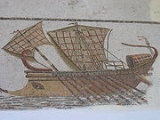
Trireme


from Carthage
Carthage

Carthage refers both to an ancient city in present-day Tunisia, and a modern-day suburb of Tunis. The civilization that developed within the city's sphere of influence is referred to as Punic or Carthaginian....
, mosaic at Bardo Museum
Bardo Museum

Bardo Museum is a museum in Tunis, Tunisia. It was originally a 13th century Hafsid palace, located in the suburbs of Tunis. It contains a major collection of Roman mosaics and other antiquities of interest from Ancient Greece, Tunisia, and from the Arab period....
, Tunis]]

The trireme ( sing., t????e?? pl., sing., triremes pl.) is a class of warships used by the ancient civilizations of the Mediterranean, especially the Phoenicians, ancient Greeks
Ancient Greece

The term Ancient Greece refers to the period of History of Greece lasting from the Greek Dark Ages ca. 1100 BC and the Dorian invasion, to 146 BC and the Roman Republic conquest of Greece after the Battle of Corinth ....
 and Romans
Ancient Rome

Ancient Rome was a civilization that grew out of a small agricultural community founded on the Italian Peninsula as early as the 10th century BC....
. In English, no differentiation is made between the Greek trieres and the Latin triremis. This is sometimes a source of confusion, as in other languages these terms refer to different styles of ships.

The trireme derives its name from its three rows of oar
Oar

An oar is an implement used for water-borne Marine propulsion. Oars have a flat Blade at one end. The oarsmen grasp the oar at the other end....
s on each side, manned with one man per oar.


Discussion
Ask a question about 'Trireme'
Start a new discussion about 'Trireme'
Answer questions from other users
Full Discussion Forum


Recent Posts


Encyclopedia


from Carthage
Carthage

Carthage refers both to an ancient city in present-day Tunisia, and a modern-day suburb of Tunis. The civilization that developed within the city's sphere of influence is referred to as Punic or Carthaginian....
, mosaic at Bardo Museum
Bardo Museum

Bardo Museum is a museum in Tunis, Tunisia. It was originally a 13th century Hafsid palace, located in the suburbs of Tunis. It contains a major collection of Roman mosaics and other antiquities of interest from Ancient Greece, Tunisia, and from the Arab period....
, Tunis]]

The trireme ( sing., t????e?? pl., sing., triremes pl.) is a class of warships used by the ancient civilizations of the Mediterranean, especially the Phoenicians, ancient Greeks
Ancient Greece

The term Ancient Greece refers to the period of History of Greece lasting from the Greek Dark Ages ca. 1100 BC and the Dorian invasion, to 146 BC and the Roman Republic conquest of Greece after the Battle of Corinth ....
 and Romans
Ancient Rome

Ancient Rome was a civilization that grew out of a small agricultural community founded on the Italian Peninsula as early as the 10th century BC....
. In English, no differentiation is made between the Greek trieres and the Latin triremis. This is sometimes a source of confusion, as in other languages these terms refer to different styles of ships.

The trireme derives its name from its three rows of oar
Oar

An oar is an implement used for water-borne Marine propulsion. Oars have a flat Blade at one end. The oarsmen grasp the oar at the other end....
s on each side, manned with one man per oar. The early trireme was a development of the penteconter, an ancient warship with a single row of 25 oars on each side, and of the bireme
Bireme

A bireme is a ship probably invented by the Phoenicians whose best known use was as an ancient greek naval ship that was 80 feet long with a maximum beam length of around 10 feet ....
 , a warship with two banks of oars, probably of Phoenician origin. As a ship it was fast and agile, and became the dominant warship
Warship

A warship is a ship that is built and primarily intended for combat. Warships are usually built in a completely different way than cargo ship....
 in the Mediterranean from the 7th
7th century BC

The 7th century BC started the first day of 700 BC and ended the last day of 601 BC.The Assyrian Empire continued to dominate the near east during this century, exercising formidable power over neighbors like Babylon and Egypt....
 to the 4th century BC, when they were largely superseded by the larger quadriremes and quinquiremes. Triremes played a vital role in the Persian Wars, the creation of the Athenian maritime empire, and its downfall in the Peloponnesian War
Peloponnesian War

The Peloponnesian War which lasted from 431-404BC was an Ancient Greece military conflict, fought by Athens and its Athenian empire against the Peloponnesian League, led by Sparta....
.

History


Origin

Assyrianwarship
The exact origin of the trireme is uncertain and debated, as our evidence comes from literary sources, depictions in reliefs and pottery fragments, which are open to misinterpretations. Depictions of two-tiered ships (biremes), with or without the parexeiresia (the outrigger
Outrigger

An outrigger is a part of a boat's rigging which is rigid and extends beyond the side or gunwale of a boat.In an outrigger canoe or bangka and in sailboats such as the proa, an outrigger is a thin, long, solid, hull used to stabilise an inherently unstable main hull....
, see below), are common in 8th century BC vases and pottery fragments, and it is at the end of that century that the first references to three-tiered ships are found. According to Thucydides
Thucydides

Thucydides was a Greeks history and author of the History of the Peloponnesian War, which recounts the 5th century B.C. war between Sparta and Athens to the year 411 B.C....
, the trireme was introduced to Greece by the Corinth
Corinth

Corinth, or Korinth Corinth is now the capital of the Prefectures of Greece of Corinthia. The city is surrounded by the coastal townlets of Lechaio, Isthmia, Kechries, and the inland townlets of Examilia and the archaeological site....
ians in the late 8th century BC, and that the Corinthian Ameinocles built four such ships for the Samians
Samos Island

Samos is a Greece island in the North Aegean sea, south of Chios, north of Patmos and the Dodecanese, and off the Ionian coast of Turkey....
. Although this was interpreted by later writers, like Pliny
Pliny the Elder

Gaius Plinius Secundus , better known as Pliny the Elder, was an ancient author, naturalist or natural philosopher and naval and military commander of some importance who wrote Natural History ....
 and Diodorus, to mean that triremes were invented in Corinth,, it is likely that the earliest three-tiered warships originated in Phoenicia
Phoenicia

Phoenicia was an ancient civilization centered in the north of ancient Canaan, with its heartland along the coastal regions of modern day Lebanon, extending to parts of Israel, Syria and the Palestinian territories....
. Fragments from an 8th century relief at the Assyria
Assyria

Assyria was a political state centered on the Upper Tigris river, in Mesopotamia , that came to rule regional empires a number of times in history....
n capital of Nineveh
Nineveh

Nineveh , an "exceeding great city", as it is called in the Book of Jonah, lay on the eastern bank of the Tigris in ancient Assyria, across the river from the modern-day major city of Mosul, Iraq....
 depicting the fleets of Tyre and Sidon
Sidon

Sidon,or Sa?da, is the third-largest city in Lebanon. It is located in the South Governorate, Lebanon of Lebanon, on the Mediterranean Sea coast, about 40 km north of Tyre, Lebanon and 40 km south of the capital Beirut....
 have been interpreted as depicting two- and three-level warships, fitted with rams
Ramming

In warfare, ramming is a technique that was used in the air, sea and land combat. The term originated from battering ram, which is a siege weapon used to bring down fortifications by hitting it with force, of which the momentum of the ram being sufficient to damage the target....
. The 2nd century Christian scholar Clement of Alexandria
Clement of Alexandria

Clement of Alexandria , was the first notable member of the Christianity of Alexandria, and one of its most distinguished teachers. He was born about the middle of the 2nd century, and died between 211 and 216....
, drawing on earlier works, explicitly attributes the invention of the trireme (trikrotos naus, "three-tiered ship") to the Sidonians.

Early use and development

Trireme
Herodotus
Herodotus

Herodotus of Halicarnassus was a Greeks historian who lived in the 5th century BC and is regarded as the "Father of History" in Western culture....
 mentions that the Egyptian
Ancient Egypt

Ancient Egypt was an Ancient history civilization in eastern North Africa, concentrated along the lower reaches of the Nile in what is now the modern nation of Egypt....
 pharaoh Necho
Necho

Necho was the name of two Pharaohs of Egypt during the Twenty-sixth dynasty of Egypt. They were:* Necho I * Necho II ...
 (610–595 BC) built triremes on the Nile
Nile

The Nile is a major north-flowing river in Africa, generally regarded as the List of rivers by length in the world.The Nile has two major tributary, the White Nile and Blue Nile, the latter being the source of most of the Nile's water and silt, but the former being the longer of the two....
, for service in the Mediterranean, and in the Red Sea
Red Sea

The Red Sea is a salt water inlet of the Indian Ocean between Africa and Asia. The connection to the ocean is in the south through the Bab el Mandeb sound and the Gulf of Aden....
, but this reference is disputed by modern historians, and attributed to a confusion, since "trieres" was by the 5th century used in the generic sense of "warship", regardless its type. The first definite reference to the use of triremes in naval combat dates to ca. 525 BC, when, according to Herodotus
Herodotus

Herodotus of Halicarnassus was a Greeks historian who lived in the 5th century BC and is regarded as the "Father of History" in Western culture....
, the tyrant
Tyrant

This article is about the political ruler. For other uses see Tyrant and Tyranny In modern usage, a tyrant is a single ruler holding absolute political power over a state or within an organization....
 Polycrates
Polycrates

Polycrates , son of Aeaces, was the tyrant of Samos Island from c. 538 BC to 522 BC.He took power during a festival of Hera with his brothers Pantagnotus and Syloson, but soon had Pantagnotus killed and exiled Syloson to take full control for himself....
 of Samos
Samos Island

Samos is a Greece island in the North Aegean sea, south of Chios, north of Patmos and the Dodecanese, and off the Ionian coast of Turkey....
 was able to contribute 40 triremes to a Persian
Achaemenid Empire

The Achaemenid Empire or Achaemenid Persian Empire was amongst the first Persian Empires that ruled over significant portions of Greater Iran, and followed the Ancient Iranian peoples Median Empire....
 invasion of Egypt
Egypt

Egypt is a country mainly in North Africa, with the Sinai Peninsula forming a land bridge in Western Asia. Covering an area of about , Egypt borders the Mediterranean Sea to the north, the Gaza Strip and Israel to the northeast, the Red Sea to the east, Sudan to the south and Libya to the west....
. Thucydides meanwhile clearly states that in the time of the Persian invasions, the majority of the Greek navies consisted of (probably two-tiered) penteconters and ploia makrá ("long ships").

In any case, by the early 5th century, the trireme was becoming the dominant warship type of the eastern Mediterranean, with minor differences between the "Greek" and "Phoenician" types, as literary references and depictions of the ships on coins make clear. The first large-scale naval battle where triremes participated was the Battle of Lade
Battle of Lade

The Battle of Lade was a naval encounter that took place in 494 BC between the Ionians and the Persian Empire. It was the culmination of the Ionian Revolt and part of the greater Persian Wars....
 during the Ionian Revolt
Ionian Revolt

The Ionian Revolts were triggered by the actions of Aristagoras, the tyrant of the Ionian city of Miletus at the end of the 6th century BC and beginning of the 5th century BC....
, where the combined fleets of the Greek Ionia
Ionia

Ionia is an ancient region of central coastal Anatolia in present-day Turkey, the region nearest Izmir, which was historically Smyrna. It consisted of the northernmost territories of the Ionian League of Hellenes settlements....
n cities were defeated by the Persian fleet, composed of squadrons from their Phoenician, Caria
Caria

Caria was a region of western Anatolia extending along the coast from mid-Ionia south to Lycia and east to Phrygia. The Ionians and Dorians Greeks colonized the west of it and joined the Carian population in forming Greek-dominated states there....
n, Cypriot
Cyprus

Cyprus , officially the Republic of Cyprus , is an island country situated in the eastern Mediterranean Sea, east of Greece, west of Lebanon, Syria, and Israel, south of Turkey and north of Egypt....
 and Egyptian subjects.

Persian and Peloponnesian Wars

Partly as a result of Athenian support to the Ionian Greeks, the Persian Great King Darius
Darius I of Persia

Darius I or Darius the Great was the son of Hystaspes and Persian Empire from 522 BC to 486 BC. Darius is the dominant Latin language spelling used by the Roman historians....
 started moving against metropolitan Greece. The Persian fleet roamed the Aegean Sea unopposed, but the first invasion force was defeated at the Battle of Marathon
Battle of Marathon

The Battle of Marathon, Greece during the Greco-Persian Wars took place in 490 BC and was the culmination of the first attempt by the Achaemenid Empire of Persia, under King Darius I, to subjugate Ancient Greece....
 in 490 BC. The second invasion, under Xerxes
Xerxes I of Persia

Xerxes the Great, also known as Xerxes I of Persia, was a Persian Empire of the Achaemenid Empire. X?rxes is the Greek language form of the Old Persian throne name X?ayar?a, meaning "Ruler of heroes"....
, included a massive land army and a large navy, which were to cooperate closely.

Athens was at that time embroiled in a conflict with the neighbouring island of Aegina
Aegina

Aegina is one of the Greek islands of Greece in the Saronic Gulf, 17 miles from Athens. Tradition derives the name from Aegina, the mother of Aeacus, who was born in and ruled the island....
, which possessed a formidable navy. In order to counter this, and possibly with an eye already at the mounting Persian preparations, in 482 BC the Athenian statesman Themistocles
Themistocles

Themistocles was an Ancient Athens soldier and statesman. As archon in 493 BC, he convinced the Athenians that a powerful fleet was needed to protect them against the Persians....
 used his political skills and influence to persuade the Athenian assembly
Ecclesia (ancient Athens)

The ecclesia or ekklesia was the principal assembly of the Athenian democracy of ancient Athens during its Age of Pericles . It was the popular assembly, opened to all male citizens over the age of 18 by Solon in 594 BC meaning that all classes of citizens in Athens were able to participate, even the thetes....
 to start the construction of 200 triremes, using the income of the newly discovered silver mines at Lavrion. The first clash with the Persian navy was at the Battle of Artemisium
Battle of Artemisium

The Battle of Artemisium was a series of naval engagements over three days during the second Persian invasion of Greece. It took place simultaneously with the more famous land battle at Battle of Thermopylae, in August or September 480 BC, off the coast of Euboea....
, where both sides suffered great casualties. However, the decisive naval clash occurred at Salamis
Battle of Salamis

The Battle of Salamis , was a naval battle fought between an Alliance of Greece city-states and the Achaemenid Empire of Persia in September 480 BC in the straits between the mainland and Salamis Island, an island in the Saronic Gulf near Athens....
, where Xerxes' invasion fleet was decisively defeated.

"Tereus: Where are you from?
Euelpides: From where the good triremes come (i.e. Athens)"
Aristophanes, The Birds
The Birds (play)

The Birds is a Greek comedy written by the Ancient Greek playwright Aristophanes in 414 BC, and performed that year for the Dionysia....
After Salamis and another Greek victory over the Persian fleet at Mycale
Battle of Mycale

The Battle of Mycale, was one of the two major battles that ended the second Achaemenid Empire invasion of Greece, during the Greco-Persian Wars....
, the Ionian cities were freed, and the EWSF Delian League
Delian League

The Delian League was an association of approximately 150 5th-century BC Ancient Greece city-states under the leadership of Classical Athens, whose purpose was to continue fighting the Persian Empire after the Greek victory in the Battle of Plataea at the end of the Greco?Persian Wars....
 was formed under the aegis of Athens. Gradually, the predominance of Athens turned the League effectively into an Athenian Empire. The source and foundation of Athens' power was her strong fleet, composed of over 200 triremes. It not only secured control of the Aegean Sea and the loyalty of her allies, but also safeguarded the trade routes and the grain shipments from the Black Sea, which fed the city's burgeoning population. In addition, as it provided permanent employment for the city's poorer citizens, the fleet played an important role in both maintaining and promoting the radical Athenian form of democracy
Athenian democracy

Athenian democracy developed in the Ancient Greece city-state of Classical Athens, comprising the central city-state of Athens and the surrounding territory of Attica, around 500 BC....
. Athenian maritime power is the first example of thalassocracy
Thalassocracy

The term thalassocracy refers to a state with primarily maritime realms?an empire at sea, such as the Phoenician network of merchant cities....
 in world history. Aside from Athens, other major naval powers of the era included Syracuse, Corfu
Corfu

Corfu is a Greece list of islands of Greece in the Ionian Sea. It is the second largest of the Ionian Islands, and lies off the coast of Sarand?, Albania, from which it is separated by straits varying in breadth from 3 to 23 km , including one near ancient Butrint and a longer one west of Thesprotia....
 and Corinth
Corinth

Corinth, or Korinth Corinth is now the capital of the Prefectures of Greece of Corinthia. The city is surrounded by the coastal townlets of Lechaio, Isthmia, Kechries, and the inland townlets of Examilia and the archaeological site....
.

In the subsequent Peloponnesian War
Peloponnesian War

The Peloponnesian War which lasted from 431-404BC was an Ancient Greece military conflict, fought by Athens and its Athenian empire against the Peloponnesian League, led by Sparta....
, naval actions fought by triremes featured prominently, and despite numerous land engagements, Athens was finally defeated through the destruction of her fleet during the Sicilian Expedition
Sicilian Expedition

The Sicilian Expedition was an Athens expedition to Sicily from 415 BC to 413 BC, during the Peloponnesian War. The expedition was hampered from the outset by uncertainty in its purpose and command structure?political maneuvering in Athens swelled a lightweight force of twenty ships into a massive armada, and the expedition's primary propone...
 and finally, at the Battle of Aegospotami
Battle of Aegospotami

The naval Battle of Aegospotami took place in 405 BC and was the last major battle of the Peloponnesian War. In the battle, a Spartan fleet under Lysander completely destroyed the Athenian navy....
, at the hands of Sparta
Sparta

Sparta was a city-state in ancient Greece, situated on the Eurotas River in the southern part of the Peloponnese. From circa 650 BC it rose to become the dominant military power in the region and as such was recognized as the overall leader of the combined Greek forces during the Greco-Persian Wars....
 and her allies.

Construction of the trireme

No surviving written source gives complete information on the construction or form of the trireme. Already in the 4th century, the writer Zosimus
Zosimus

Zosimus was a Byzantine Empire historian, who lived in Constantinople during the reign of the Byzantine Emperor Anastasius I . According to Photios I of Constantinople, he was a comes, and held the office of "advocate" of the imperial treasury....
 laments the loss of the information concerning the trireme's construction.

Because the triremes had positive buoyancy
Buoyancy

In physics, buoyancy is the upward force that keeps things afloat. The net upward buoyancy force is equal to the magnitude of the weight of fluid displaced by the body....
, no remains of the ship have been found on the seabed, and scholars have had to rely on indirect evidence in texts, depictions on monuments and amphorae, as well as indirect archaeological evidence, most prominently the ship sheds of Piraeus. Most of it concerns the "classical" type of the 5th century, especially as used by Athens. Valuable further information as to the validity of past assumptions was provided by the trireme reconstruction project (see below).

Dimensions

Excavations of the ship sheds (neosoikoi) at the harbour of Zea in Piraeus
Piraeus

Piraeus is a city in the periphery of Attica, Greece, and a municipality within Athens urban area, located 10 km southwest of its center....
, which was the main war harbour of ancient Athens, were first carried out by I. Dragatsis and Wilhelm Dörpfeld
Wilhelm Dörpfeld

Wilhelm D?rpfeld was a Germany architect, best known for his contributions to classical archaeology.D?rpfeld was born in Barmen, Wuppertal. In 1877 he became an assistant at the Olympia, Greece excavations under Richard Bohn, Friedrich Adler , and Ernst Curtius....
 in the 1880s. These have provided us with a general outline of the Athenian trireme. The sheds were ca. 40 m long and just 6 m wide. These dimensions are corroborated by the evidence of Vitruvius
Vitruvius

File:Vitruvius.jpgMarcus Vitruvius Pollio was a Ancient Rome writer, architect and engineer , active in the 1st century BC. By his own description Vitruvius served as a Ballista , the third class of arms in the military offices....
, whereby the individual space alloted to each rower was 2 cubits. With the Doric cubit of 0,49 m, this results in an overall ship length of just under 37 m. The height of the sheds' interior was established as 4.026 metres, leading to estimates that the height of the hull above the water surface was ca. 2.15 metres. Its draught was relatively shallow, about 1 metre, which, in addition to the relatively flat keel and low weight, allowed it to be beached easily.

Construction

Construction of the trireme differed from modern practice. The ancient Mediterranean practice was to build the outer hull
Hull (watercraft)

A hull is the watertight body of a ship or boat. It is a central concept in floating vessels as it provides the buoyancy that keeps the vessel from sinking....
 first, and the ribs afterwards. To secure and strengthen the hull, ropes (
hypozomata) were employed, fitted in the keel and stretched by means of windlasses. Hence the triremes were often called "girded" when in commission.

The triremes were made of softwoods, primarily pine
Pine

Pines are Pinophyta trees in the genus Pinus, in the family Pinaceae. They make up the monotypic subfamily Pinoideae. There are about 115 species of pine, although different authorities accept between 105 and 125 species....
 and fir
Fir

Firs are a genus of between 45-55 species of evergreen Pinophyta in the family Pinaceae. All are trees, reaching heights of 10-80 m tall and trunk diameters of 0.5-4 m when mature....
, with the latter preferred, according to Theophrastos, for its lightness. Larch
Larch

Larches are conifers in the genus Larix, in the family Pinaceae. They are native to much of the cooler temperate northern hemisphere, on lowlands in the far north, and high on mountains further south....
 and plane
Platanus

Platanus is a small genus of trees native to the Northern Hemisphere. They are the sole members of the family Platanaceae.They are all large trees to 30?50 m tall, deciduous , and are mostly found in riparian or other wetland habitat in the wild, though proving drought tolerant in cultivation away from streams....
 were used for the ship's interior parts. The large requirements of timber for ship construction led not only to the deforestation of much of southern Greece, but also to imports of timber from Macedon
Macedon

Macedon or Macedonia was the name of a monarchy centred in the northernmost part of ancient Greece. The homeland of the ancient Macedonians, it was bordered by the kingdom of Epirus to the west and the region of Thrace to the east....
 and Thrace
Thrace

Thrace is a historical and geographic area in southeast Europe. Today the name Thrace designates a region spread over southern Bulgaria , northeastern Greece , and European Turkey ....
, or even from as far as Lebanon
Lebanon

Lebanon , officially the Republic of Lebanon or Lebanese Republic , is a country in Western Asia, on the eastern shore of the Mediterranean Sea....
.

The use of lightwoods meant that the ship could be carried ashore by as few as 140 men, but also that the hull soaked up water, which adversely affected its speed and maneuverability. The ship had therefore to be beached regularly for maintenance.

Propulsion and capabilities

The ship's primary propulsion came from the 170 oars (
kopai), arranged in three rows, with one man per oar. Evidence for this is provided by Thucydides, who records that the Corinth
Corinth

Corinth, or Korinth Corinth is now the capital of the Prefectures of Greece of Corinthia. The city is surrounded by the coastal townlets of Lechaio, Isthmia, Kechries, and the inland townlets of Examilia and the archaeological site....
ian oarsmen carried "each his oar, cushion (
hypersion) and oarloop". The ship also had two masts, a main (istos megas) and a small foremast (istos akateios), with square sails, while steering was provided by two paddles at the stern.

Classical sources indicate that the trireme was capable of sustained speeds of ca. 6 knots at a relatively leisurely pace. There is also a reference by Xenophon of a single day's voyage from Byzantium
Byzantium

Byzantium was an Ancient Greece city, which was founded by Greeks colonists from Megara in 667 BC and named after their king Byzas or Byzantas ....
 to Heraclea Pontica
Heraclea Pontica

Heraclea Pontica , an ancient city on the coast of Bithynia in Asia Minor, at the mouth of the river Lycus . It was founded by the Greek city-state of Megara c.560-558 and was named after Heracles who the Greeks believed entered the underworld at a cave on the adjoining Archerusian promontory ....
, which translates as an average speed of 7.37 knots. These figures seem to be corroborated by the tests conducted with the reconstructed
Olympias: a maximum speed of 8 knots and a steady speed of 4 knots could be maintained, with half the crew resting at a time.

Crew

The total complement (
pleroma) of the ship was about 200. These were divided into the 170 rowers (eretai), who provided the ship's motive power, the deck crew headed by the trierarch, and a marine detachment.

The trierarch

The ship's captain was known as the trierarch
Trierarch

Trierarch was the title of officers who commanded a trireme in the classical Greek world. In Athens and a few other states this officer was also required to pay for the outfitting and maintenance of the ship....
 (
trierarchos). He was a wealthy Athenian citizen (usually from the class of the pentakosiomedimoi
Pentacosiomedimni

In the cities of 5th Century BC Ancient Greece the Pentacosiomedimni were the top class of citizens set out by the Politician Solon. The Pentacosiomedimni were those whose property or estate could produce 500 bushels of wet or dry goods , per year....
), responsible for manning and maintaining the ship for 35 years, which otherwise belonged to Athens. The trierarchia was one of the liturgies of ancient Athens, and although it afforded great prestige, it constituted a great financial burden, so that in the fourth century, it was often shared by two citizens, and after 397 BC it was assigned to special boards.

The deck crew

The deck and command crew (
hyperesia) was headed by the helmsman, the kybernetes, who was always an experienced seaman and often the actual commander of the vessel. Other officers were the bow lookout (proreus or prorates), the boatswain (keleustes), the quartermaster (pentekontarchos), the shipwright (naupegos), the piper (auletes) who gave the rowers' rhythm and 2 toicharchoi, in charge of the rowers on each side of the ship. In addition, there were 10 sailors, handling the masts and the sails.

The rowers

Contrary to popular perception, in the ancient navies, crews were not composed of galley slave
Galley Slave

"Galley Slave" is a science fiction short story by Isaac Asimov, originally published in the December 1957 issue of Galaxy Science Fiction and reprinted in the collections The Rest of the Robots , The Complete Robot , and Robot Visions ....
s, but of free men. In the Athenian case in particular, service in the ships was the integral part of the military service provided by the lower classes, the
thetai, although metics and hired foreigners were also enrolled. Although it has been argued that slaves formed part of the rowing crew in the Sicilian Expedition
Sicilian Expedition

The Sicilian Expedition was an Athens expedition to Sicily from 415 BC to 413 BC, during the Peloponnesian War. The expedition was hampered from the outset by uncertainty in its purpose and command structure?political maneuvering in Athens swelled a lightweight force of twenty ships into a massive armada, and the expedition's primary propone...
, a typical Athenian trireme crew during the Peloponnesian War
Peloponnesian War

The Peloponnesian War which lasted from 431-404BC was an Ancient Greece military conflict, fought by Athens and its Athenian empire against the Peloponnesian League, led by Sparta....
 consisted of 80 citizens, 60 metics and 60 foreign hands. Indeed, in the few emergency cases were slaves were used to crew ships, these were deliberately set free
Freedman

Freedman is the term used to describe a former Slavery who has been Manumission or Emancipation. The first means the freeing of an individual by the owner, often through deed or will, and sometimes by legislative petition....
, usually before being employed. For instance, the tyrant Dionysius I of Syracuse
Dionysius I of Syracuse

Dionysius I or Dionysius the Elder , tyrant of Syracuse, Italy, conquered several cities in Sicily and southern Italy, opposed Carthage's influence in Sicily and made Syracuse the most powerful of the Western Ancient Greece colonies....
 once set all slaves of Syracuse free to man his galleys, employing thus freedmen, but otherwise relied on citizens and foreigners as oarsmen.

In the Athenian navy, the crews enjoyed long practice in peacetime, becoming skilled professionals and ensuring Athens' supremacy in naval warfare. The rowers were divided according to their positions in the ship into
thranitai, zygitai, and thalamitai. According to the excavated Naval Inventories, lists of ships' equipment compiled by the Athenian naval boards, there were:
  • 62 thranitai in the top row (thranos means "deck"). They rowed through the parexeiresia, an outrigger which enabled the inclusion of the third row of oars without significant increase to the height and loss of stability, of the ship. Greater demands were placed upon their strength and synchronization than the other two rows.
  • 54 zygitai in the middle row, named after the beams (zygoi) on which they sat.
  • 54 thalamitai or thalamioi in the lowest row, (thalamos means "hold"). Their position was certainly the most uncomfortable, being underneath their colleagues and also exposed to the water entering through the oarholes, despite the use of the askoma, a leather sleeve through which the oar emerged.


The marines

A varying number of marines (
epibatai), usually 10-20, were carried aboard for boarding actions. At the Battle of Salamis
Battle of Salamis

The Battle of Salamis , was a naval battle fought between an Alliance of Greece city-states and the Achaemenid Empire of Persia in September 480 BC in the straits between the mainland and Salamis Island, an island in the Saronic Gulf near Athens....
, each Athenian ship was recorded to have 14 hoplites and 4 archers (usually Scythian mercenaries) on board, but Herodotus
Herodotus

Herodotus of Halicarnassus was a Greeks historian who lived in the 5th century BC and is regarded as the "Father of History" in Western culture....
 narrates that the Chiots
Chios

Chios is the fifth largest of the Greece list of islands of Greece, situated in the Aegean Sea seven kilometres off the Turkey coast. The island is noted for its strong merchant shipping community, its unique mastic gum and its medieval villages....
 had 40 hoplites on board at Lade
Battle of Lade

The Battle of Lade was a naval encounter that took place in 494 BC between the Ionians and the Persian Empire. It was the culmination of the Ionian Revolt and part of the greater Persian Wars....
 and that the Persian ships carried a similar number. This reflects the different practices between the Athenians and other, less professional navies. Whereas the Athenians relied on speed and maneuverability, where their highly trained crews had the advantage, other states favoured boarding, in a situation that closely mirrored the one that developed during the First Punic War
First Punic War

The First Punic War was the first of Punic Wars fought between Carthage and the Roman Republic. For 23 years, the two powers struggled for supremacy in the western Mediterranean Sea....
. As the presence of too many heavily armed hoplites on deck tended to destabilize the ship, the
epibatai were normally seated, only rising to carry out any boarding action. The hoplites belonged to the middle social classes, so that they came immediately next to the trierarch in status aboard the ship.

Tactics

In the ancient world, naval combat relied on two methods: ramming
Ramming

In warfare, ramming is a technique that was used in the air, sea and land combat. The term originated from battering ram, which is a siege weapon used to bring down fortifications by hitting it with force, of which the momentum of the ram being sufficient to damage the target....
 and boarding
Boarding (attack)

Boarding, in its simplest sense, refers to the insertion onto a ship's deck of people. However, when it is classified as an attack, in most contexts, it refers to the insertion of personnel that are not members of the crew by another party....
. Artillery in the form of ballista
Ballista

The ballista , plural ballistae, was a weapon developed from earlier Greek weapons. It relied upon different mechanics, using two levers with Torsion springs instead of a prod, the springs consisting of several loops of twisted skeins....
s and catapults was widespread, especially in later centuries, but its inherent technical limitations meant that it could not play a decisive role in combat. Rams (
embolon) were fitted to the prows of warships, and were used to rupture the hull of the enemy ship. The preferred method of attack was to come in from astern and behind, with the aim not of creating a single hole, but of rupturing as big a length of the enemy vessel as possible. The minimum speed necessary for a successful impact was about 10 knot
Knot (speed)

The knot is a unit of speed equal to one nautical mile per hour. Its kn abbreviation is preferred by American and Canadian maritime authorities, and by the Institute of Electrical and Electronics Engineers; however, the kt and kts abbreviations also are used....
s. Another method was to brush alongside the enemy ship, with oars drawn in, in order to break the enemy's oars and render the ship immobile, to be finished off with ease. Unlike later eras, boarding actions were not very frequent with the triremes. Their small size allowed for a limited number of marines to be carried aboard, and during the 5th and 4th centuries, emphasis was laid on manoeuvrability and speed, not on armour and firing power, although fleets less confident of their ability in ramming were prone to load more marines onto their ships. In any case, prior to engagement, the masts and railings of the ship were taken down, hindering any attempt at using grappling hook
Grappling hook

A grappling hook is a hook attached to a rope, designed to be thrown or projected a distance, where its hooks will engage with the target. Grappling hooks were originally used in naval warfare to catch the rigging of an enemy ship so that it could be drawn in and boarded....
s. The Athenians especially became masters in the art of ramming, using light, un-decked
Deck (ship)

A deck is a permanent covering over a compartment or a hull of a ship. On a deck #Glossary or deck #Glossary, the primary deck is the horizontal structure which forms the 'roof' for the hull, which both strengthens the hull and serves as the primary working surface....
 (
aphraktai) triremes.

Squadron
Squadron

A squadron is a small military unit or formation of cavalry, Armoured forces, aircraft , or warships....
s of triremes employed a variety of tactics. The
periplous (Gk.
Ancient Greek

Ancient Greek is the historical stage in the development of the Greek language spanning across the Archaic Greece , Classical Greece , and Hellenistic civilization periods of ancient Greece and the classical antiquity....
, "sailing around") involved outflanking or encircling the enemy so as to attack them in the vulnerable rear; the
diekplous (Gk., "Sailing out through") involved a concentrated charge so as to break a hole in the enemy line, allowing galleys to break through and then wheel to attack the enemy line from behind; and the kyklos (Gk., "circle") and the menoeides kyklos (Gk. "half-circle"), were defensive tactics to be employed against these manoeuvres. In all of these manoeuvres, the ability to accelerate faster, row faster, and turn more sharply than one's enemy was very important.

Changes of engagement and construction

During the Hellenistic period
Hellenistic period

The Hellenistic period describes the era which followed the conquests of Alexander the Great. During this time, Greek cultural influence and power was at its zenith in Europe and Asia....
, the light trireme was supplanted by larger warships in dominant navies, especially the pentere/quinquereme
Quinquereme

A quinquereme or penteres is a type of ancient oar-propelled warship that was used by the Greeks of the Hellenistic period and later by the Carthaginians and Ancient Rome, from the 4th century BC to the 1st century....
. The maximum practical number of oar banks a ship could have was three. So the numbers did not refer to the banks of oars any more (for biremes, triremes and quinquiremes), but to the number of rowers per vertical section, with several men on each oar. The reasons for this development was the increasing use of armour on the bows of warships against ramming attacks, which again required heavier ships for a successful attack. This increased the number of rowers per ship, and also made it possible to use less well-trained personnel for moving these new ships to the minimum impact speed of 10 knots. This change was accompanied by an increased reliance on tactics like boarding
Boarding (attack)

Boarding, in its simplest sense, refers to the insertion onto a ship's deck of people. However, when it is classified as an attack, in most contexts, it refers to the insertion of personnel that are not members of the crew by another party....
, missile skirmishes and using warships as platforms for artillery
Artillery

Artillery is a military Combat Arms which employs any apparatus, machine, an assortment of tools or instruments, a system or systems used as weapons for the discharge of large projectiles in combat as a major contribution of fire power within the overall military capability of an armed force....
.

Triremes continued to be the mainstay of all smaller navies. While the Hellenistic kingdoms did develop the quinquireme and even larger ships, most navies of the Greek homeland and the smaller colonies could only afford triremes. It was used by the Diadochi
Diadochi

The Diadochi were the rival successors of Alexander the Great, and their Wars of the Diadochi followed Alexander's death. This was the beginning of the Hellenistic period of Greek history, the time when many people who were not Greek themselves adopted Greek philosophy and styles, Greek urban life, and aspects of the Greek religion....
 Empires and sea powers like Syracuse, Carthage
Carthage

Carthage refers both to an ancient city in present-day Tunisia, and a modern-day suburb of Tunis. The civilization that developed within the city's sphere of influence is referred to as Punic or Carthaginian....
 and later Rome
Rome

Rome is the capital city of Italy and Lazio, and is Italy's largest and most populous city, with 2,724,347 residents in an urban area of some ....
. The difference to the classical 5th century Athenian ships was that they were armoured against ramming and carried significantly more marines. Lightened versions of the trireme and smaller vessels were often used as auxiliaries, and still performed quite effectively against the heavier ships, thanks to their greater manoeuvrability.

With the rise of Rome
Rome

Rome is the capital city of Italy and Lazio, and is Italy's largest and most populous city, with 2,724,347 residents in an urban area of some ....
 the biggest fleet of quinquiremes temporarily ruled the Mediterranean, but during the civil wars after Caesar's death the fleet was on the wrong side and a new warfare with light liburnians was developed. By Imperial times the fleet was relatively small and had mostly political influence, controlling the grain supply and fighting pirates, who usually employed light biremes and liburnians. But instead of the successful liburnians of the civil war, it was again centred around light triremes, but still with many marines. Out of this type of ship the dromon
Dromon

The dromons were the most important warships of the Byzantine navy from the 6th to 12th centuries AD. They were indirectly developed from the ancient trireme and were usually propelled by both oar and sail, a configuration that had been used by navies in the Mediterranean Sea for centuries....
 developed.

Reconstruction

In 1985–1987 a shipbuilder in Piraeus
Piraeus

Piraeus is a city in the periphery of Attica, Greece, and a municipality within Athens urban area, located 10 km southwest of its center....
, financed by Frank Welsh (a Suffolk banker, writer and trireme enthusiast), advised by historian J. S. Morrison and naval architect John F. Coates (who with Welsh founded the Trireme Trust that initiated and managed the project), and informed by evidence from underwater archaeology, built a reconstructed Athenian trireme,
Olympias
Olympias (trireme)

Olympias is a reconstruction of an ancient Athens trireme.She was constructed from 1985 to 1987 by a shipbuilder in Piraeus. Finance came from the Hellenic Navy and donors such as Frank Welsh ....
.

Crewed by 170 volunteer oarsmen and oarswomen,
Olympias in 1988 achieved 9 knots (17 km/h or 10.5 mph). These results, achieved with inexperienced crew, suggest that the ancient writers were not exaggerating about straight-line performance. In addition, Olympias was able to execute a 180-degree turn in one minute and in an arc no wider than two and one half (2.5) ship-lengths. Additional sea trials took place in 1987, 1990, 1992 and 1994. In 2004 Olympias was used ceremonially to transport the Olympic Flame
Olympic Flame

The Olympic Flame or Olympic Torch is a symbol of the Olympic Games. Commemorating the theft of fire from the Greek god Zeus by Prometheus, its origins lie in ancient Greece, when a fire was kept burning throughout the celebration of the Ancient Olympic Games....
 from the port of Keratsini to the main port of Piraeus
Piraeus

Piraeus is a city in the periphery of Attica, Greece, and a municipality within Athens urban area, located 10 km southwest of its center....
 as the 2004 Olympic Torch Relay
2004 Olympic Torch Relay

The 2004 Summer Olympics Torch Relay took the Olympic flame across every habitable continent, returning to Athens, Greece. Every city which had hosted the Summer Olympics was revisited by the torch, as well as several other cities chosen for their international importance....
 entered its final stages in the run-up to the 2004 Summer Olympics opening ceremony
2004 Summer Olympics Opening Ceremony

The Opening Ceremony of the 2004 Summer Olympic Games was held on August 13, 2004 at the Athens Olympic Sports Complex in Maroussi, Greece, a suburb of Athens....
.

The builders of the reconstruction project considered that it effectively proved conclusively what had previously been in doubt, that Athenian triremes were arranged with the crew positioned in a staggered arrangement on three levels with one person per oar. This would have made optimum use of the available internal dimensions. However since modern humans are on average approximately 6 cm (2 inches) taller than Ancient Greeks (and the same relative dimensions can be presumed for oarsmen and other athletes), the construction of a craft which followed the precise dimensions of the ancient vessel led to cramped rowing conditions and consequent restrictions on the modern crew's ability to propel the vessel with full efficiency, which perhaps explains why the ancient speed records stand unbroken.

Sources

  • Thucydides
    Thucydides

    Thucydides was a Greeks history and author of the History of the Peloponnesian War, which recounts the 5th century B.C. war between Sparta and Athens to the year 411 B.C....
    , History of the Peloponnesian War
    History of the Peloponnesian War

    The History of the Peloponnesian War is an account of the Peloponnesian War in Ancient Greece, fought between the Peloponnesian League and the Delian League ....
  • "Age of the Trireme", special issue of Ancient Warfare
    Ancient Warfare (magazine)

    Ancient Warfare is a glossy, bi-monthly military history magazine published by the Netherlands publishing company Karwansaray. The founding and current magazine editor is Jasper Oorthuys....
    , 2/2 (2008)


External links

  • , from the Centre for Maritime Archaeology of the University of Southampton
    University of Southampton

    The University of Southampton is a British public university located in the city of Southampton, England. The origins of the university can be dated back to the founding of the Hartley Institution in 1862 by Henry Robertson Hartley....